


 Скачать презентацию Utility Functions and Indifference Curves Getting Into the
3dfe2478f1c23d904291ad4c752475c8.ppt
- Количество слайдов: 13
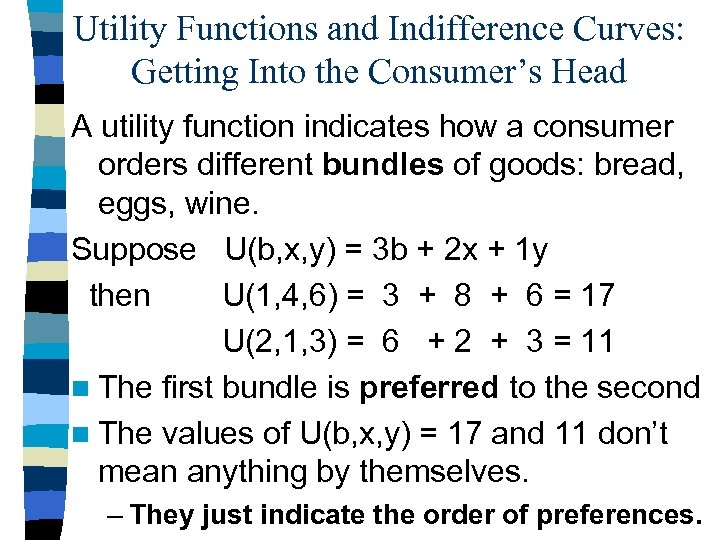 Utility Functions and Indifference Curves: Getting Into the Consumer’s Head A utility function indicates how a consumer orders different bundles of goods: bread, eggs, wine. Suppose U(b, x, y) = 3 b + 2 x + 1 y then U(1, 4, 6) = 3 + 8 + 6 = 17 U(2, 1, 3) = 6 + 2 + 3 = 11 n The first bundle is preferred to the second n The values of U(b, x, y) = 17 and 11 don’t mean anything by themselves. – They just indicate the order of preferences.
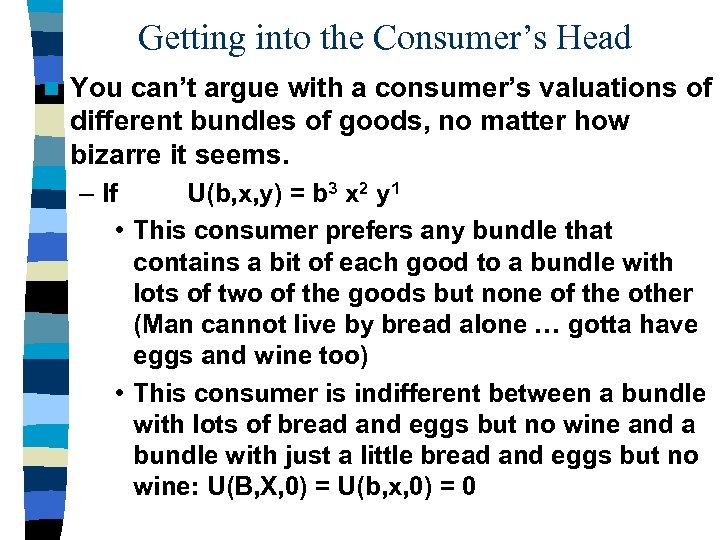 Getting into the Consumer’s Head n You can’t argue with a consumer’s valuations of different bundles of goods, no matter how bizarre it seems. – If U(b, x, y) = b 3 x 2 y 1 • This consumer prefers any bundle that contains a bit of each good to a bundle with lots of two of the goods but none of the other (Man cannot live by bread alone … gotta have eggs and wine too) • This consumer is indifferent between a bundle with lots of bread and eggs but no wine and a bundle with just a little bread and eggs but no wine: U(B, X, 0) = U(b, x, 0) = 0
 Getting Into the Consumer’s Head n In theory, we can tease out the consumer’s utility function by observing her choices when offered different combinations of goods, her revealed preferences. n In practice, we only have to accept the idea that utility functions and indifference maps exist. – We can then get some powerful insights into consumer behavior.
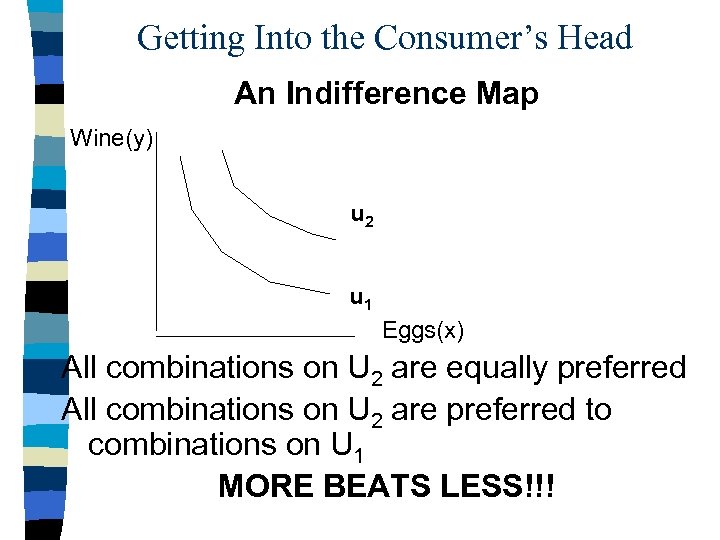 Getting Into the Consumer’s Head An Indifference Map Wine(y) u 2 u 1 Eggs(x) All combinations on U 2 are equally preferred All combinations on U 2 are preferred to combinations on U 1 MORE BEATS LESS!!!
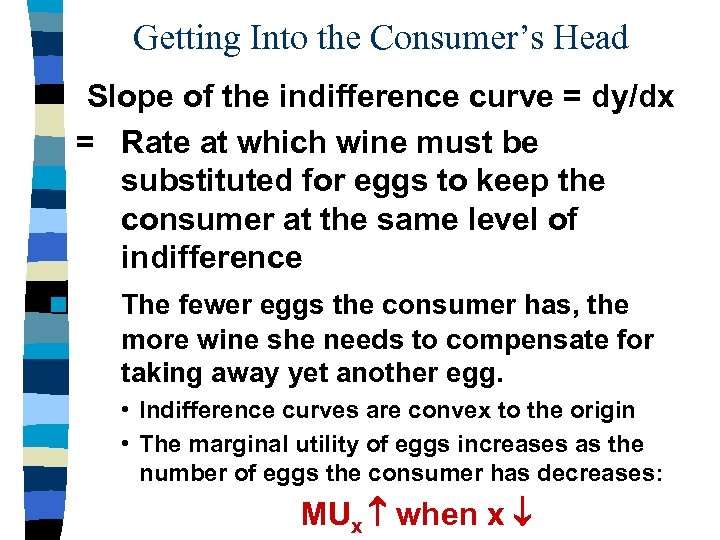 Getting Into the Consumer’s Head Slope of the indifference curve = dy/dx = Rate at which wine must be substituted for eggs to keep the consumer at the same level of indifference n The fewer eggs the consumer has, the more wine she needs to compensate for taking away yet another egg. • Indifference curves are convex to the origin • The marginal utility of eggs increases as the number of eggs the consumer has decreases: MUx when x
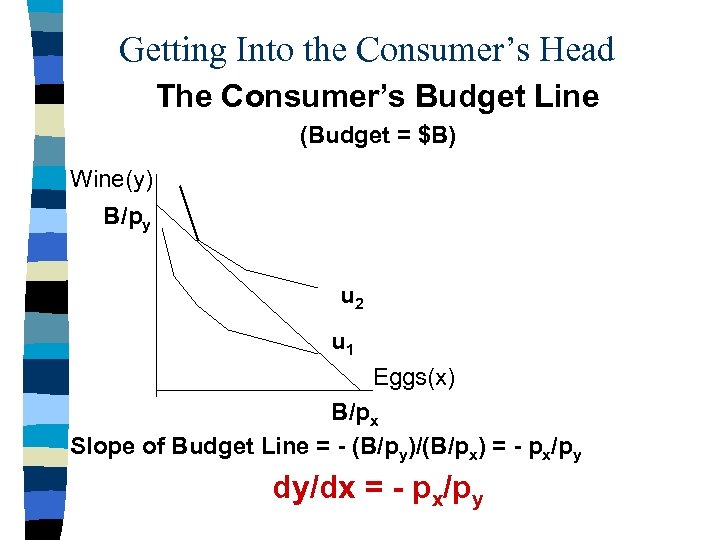 Getting Into the Consumer’s Head The Consumer’s Budget Line (Budget = $B) Wine(y) B/py u 2 u 1 Eggs(x) B/px Slope of Budget Line = - (B/py)/(B/px) = - px/py dy/dx = - px/py
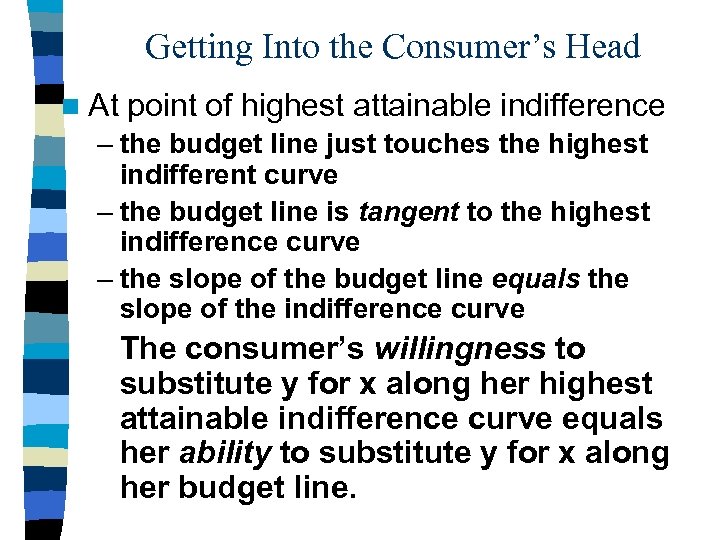 Getting Into the Consumer’s Head n At point of highest attainable indifference – the budget line just touches the highest indifferent curve – the budget line is tangent to the highest indifference curve – the slope of the budget line equals the slope of the indifference curve The consumer’s willingness to substitute y for x along her highest attainable indifference curve equals her ability to substitute y for x along her budget line.
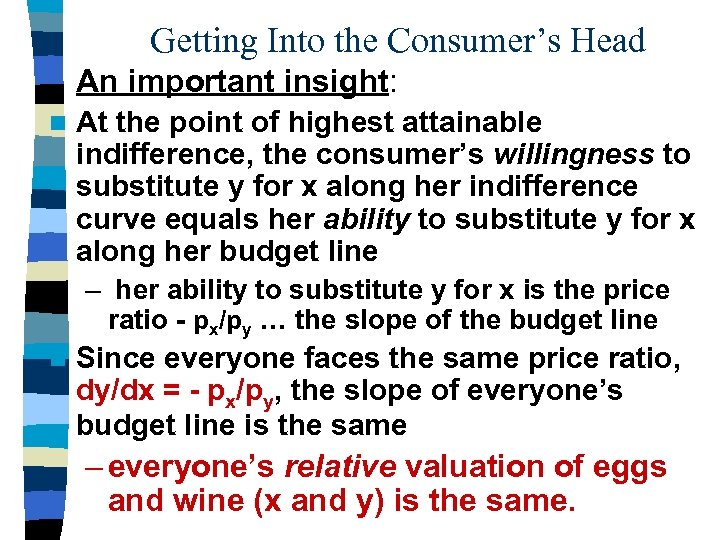 Getting Into the Consumer’s Head An important insight: n At the point of highest attainable indifference, the consumer’s willingness to substitute y for x along her indifference curve equals her ability to substitute y for x along her budget line – her ability to substitute y for x is the price ratio - px/py … the slope of the budget line n Since everyone faces the same price ratio, dy/dx = - px/py, the slope of everyone’s budget line is the same – everyone’s relative valuation of eggs and wine (x and y) is the same.
 Getting Into the Consumer’s Head n Along an indifference curve, - MUx dx = MUy dy Reduced utility from less x=Increased utility from more y So on indifference curve, dy/dx = -MUx/MUy Consumer is in equilibrium when slope of her indifference curve equals slope of budget line - MUx/MUy = dy/dx = - px/py or MUx/ px = MUy/ py = … MUz/ pz Get equal bang per buck from all goods!
 Utility and Demand n Consumer gets equal bang per buck from all goods: apples, bread, eggs, wine, zolo toys MUa/pa = MUb/pb = … MUx/px = MUy/py = … MUz/pz If px , MUx must fall , px x LAW OF DEMAND! Since MUx when x More eggs are bought when the price of eggs declines.
 Demand Consumer Surplus n More eggs are bought when the price of eggs declines. Demand curve reflects price, px, consumer is willing to pay for each quantity of x Consumer is willing to pay more for the first egg than for subsequent eggs … the first egg will be used most productively, e. g. , to bake a cake. n But consumer need only pay the same market price for each egg she buys. n – This is less than she is willing to pay for all but the last egg she buys • she’d never pay more than she’s willing to pay. Consumer realizes consumer surplus in market
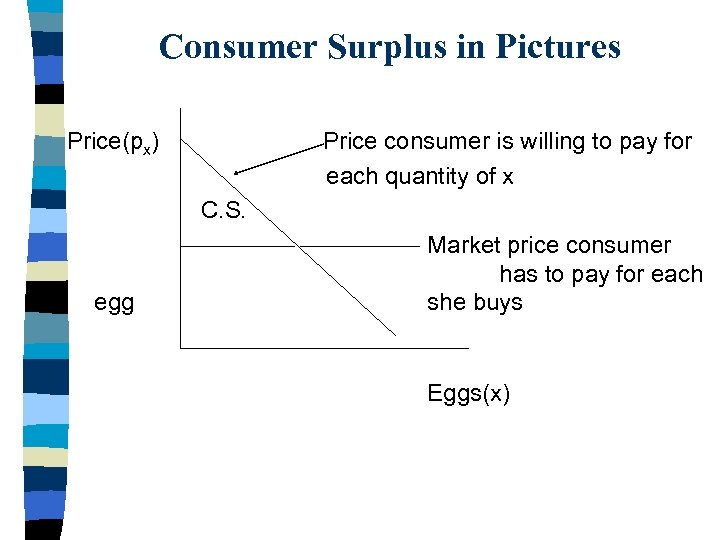 Consumer Surplus in Pictures Price(px) Price consumer is willing to pay for each quantity of x C. S. egg Market price consumer has to pay for each she buys Eggs(x)
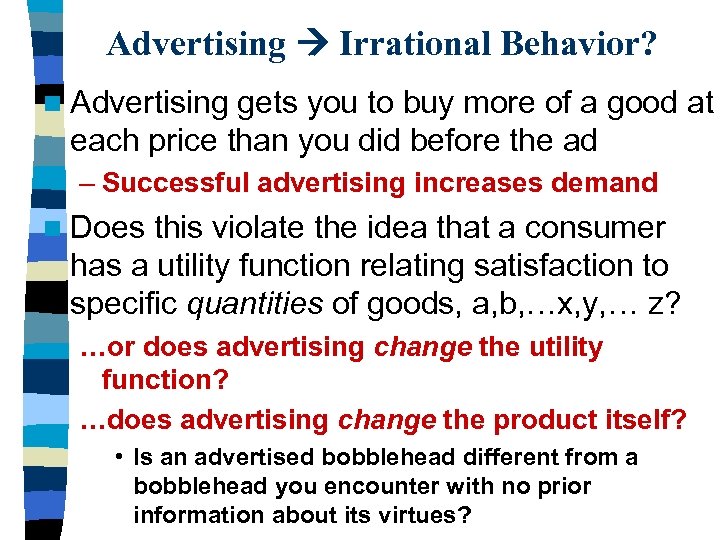 Advertising Irrational Behavior? n Advertising gets you to buy more of a good at each price than you did before the ad – Successful advertising increases demand n Does this violate the idea that a consumer has a utility function relating satisfaction to specific quantities of goods, a, b, …x, y, … z? …or does advertising change the utility function? …does advertising change the product itself? • Is an advertised bobblehead different from a bobblehead you encounter with no prior information about its virtues?