 Скачать презентацию USWRP Joint Hurricane Test Bed JHT Progress and
d28df445fd15b9ed59c3a1436626b7e6.ppt
- Количество слайдов: 47



USWRP Joint Hurricane Test Bed (JHT) Progress and Future Plans Dr. Jiann-Gwo Jiing JHT Director Chief, TSB TPC/NHC 3 March 2004 1
Outline 1. Project Assessments 2002 -03 2. Status of 10 First Round Projects (FY 01 -02) 3. Summary of Second Round Projects Funded in Late FY 03 4. JHT Future Plans 5. JHT Issues 2
Project Assessments 2002 -03 • IT configuration and algorithm processing provided for each project to facilitate forecaster participation • Real-time testing and evaluation activities continued during 2003 season • PIs presented updates at 57 th Interdepartmental Hurricane Conference (IHC) (Mar 2003) • FY 01 -02 projects concluded (Jun-Aug 2003) • JHT reports to TPC/NHC Director on results from 2002 -03 hurricane seasons (Nov 2003) • TPC/NHC decisions for operational implementation (Dec 2003) 3
Input for JHT Project Reports to the TPC Director • • Project PI final report JHT staff members’ assessments TPC Point of Contact (POC) feedback JHT IT Facilitator report – – IT transfer status Compatibility and support issues Estimates of costs to implement and support Input from TPC Technical Support Branch Chief 4
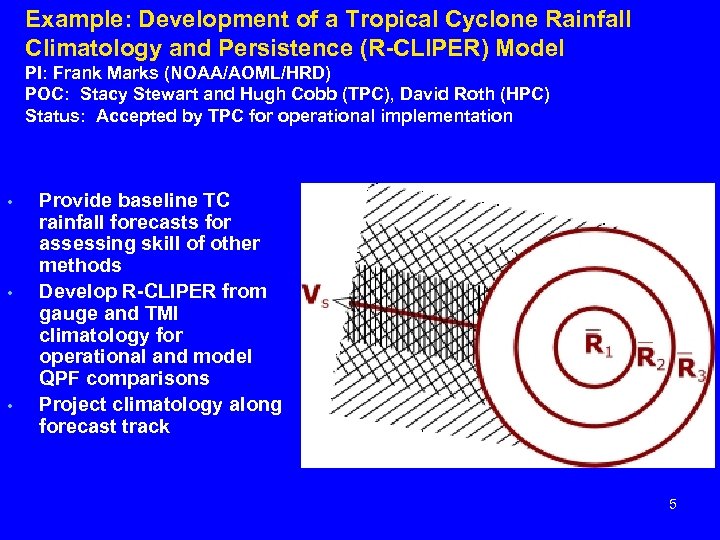
Example: Development of a Tropical Cyclone Rainfall Climatology and Persistence (R-CLIPER) Model PI: Frank Marks (NOAA/AOML/HRD) POC: Stacy Stewart and Hugh Cobb (TPC), David Roth (HPC) Status: Accepted by TPC for operational implementation • • • Provide baseline TC rainfall forecasts for assessing skill of other methods Develop R-CLIPER from gauge and TMI climatology for operational and model QPF comparisons Project climatology along forecast track 5
Example: Development of a Tropical Cyclone Rainfall Climatology and Persistence (R-CLIPER) Model Considerations for operational implementation decision Favorable: • Provides baseline forecast, as originally intended, needed to evaluate the skill of other sources of TC rainfall guidance (primarily dynamical models, as in the new JHT project funded in FY 03) • TPC and HPC forecasters have found the guidance to be useful operationally (e. g. , for preparing generalized rainfall information in public advisories) • Code has been transferred to TPC where it is run and maintained locally • Gempak/NMAP 2 graphical output already routinely available to specialists for each active TC in the Atlantic and eastern North Pacific basins • Negligible CPU, disk space, memory to run; minimal support required Unfavorable: • Unclear reason for needed adjustment factor to final output • Verification results not yet completed • Does not account for storm asymmetries 6
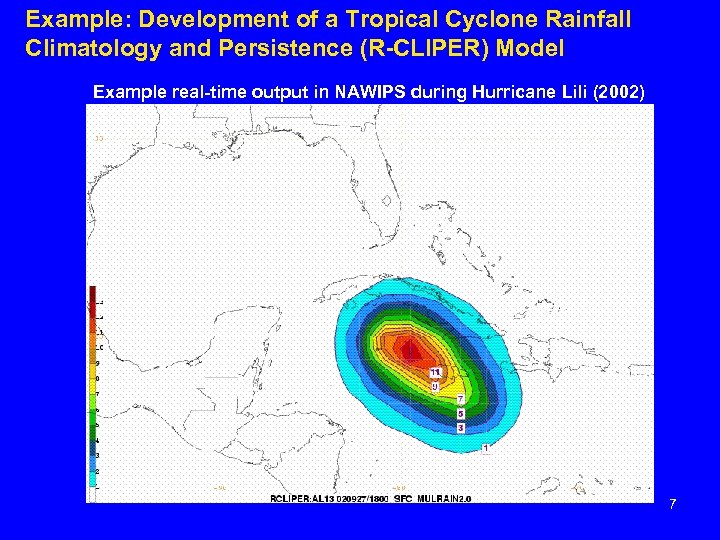
Example: Development of a Tropical Cyclone Rainfall Climatology and Persistence (R-CLIPER) Model Example real-time output in NAWIPS during Hurricane Lili (2002) 7
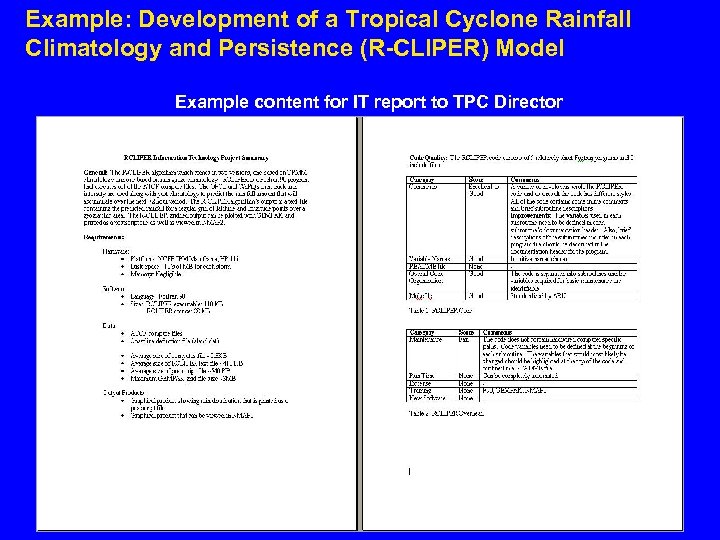
Example: Development of a Tropical Cyclone Rainfall Climatology and Persistence (R-CLIPER) Model Example content for IT report to TPC Director 8
Factors Considered in TPC Decisions for Operational Implementation • Forecast or Analysis Benefit: expected improvement in operational forecast and/or analysis accuracy • Efficiency: adherence to forecaster time constraints and ease of use needs • Compatibility: IT compatibility with operational hardware, software, data, communications, etc. • Sustainability: availability of resources to operate, upgrade, and/or provide support 9
Status of 10 First Round Projects (FY 01 -02) • Ten projects were funded in FY 01 • One was denied second year funding • Six were accepted for operational implementation • Decisions on two projects were deferred until the completion of closely related new projects • One was not accepted for operational implementation at this time 10
Summary of Second Round of Projects Funded in Late FY 03 11
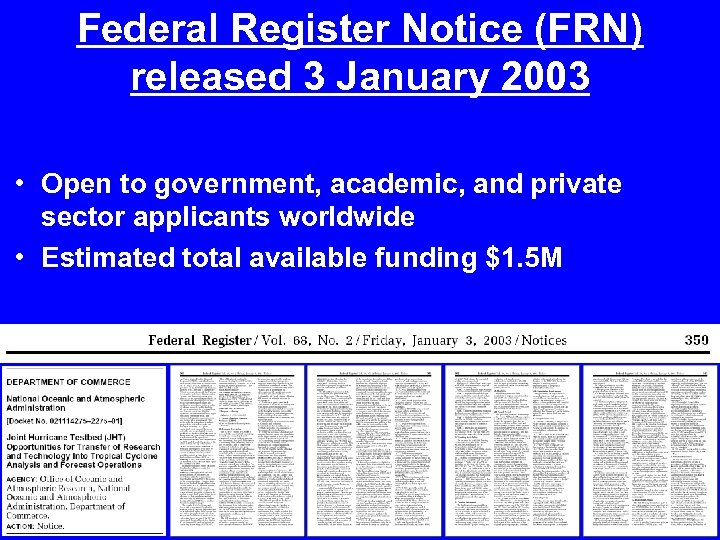
Federal Register Notice (FRN) released 3 January 2003 • Open to government, academic, and private sector applicants worldwide • Estimated total available funding $1. 5 M 12
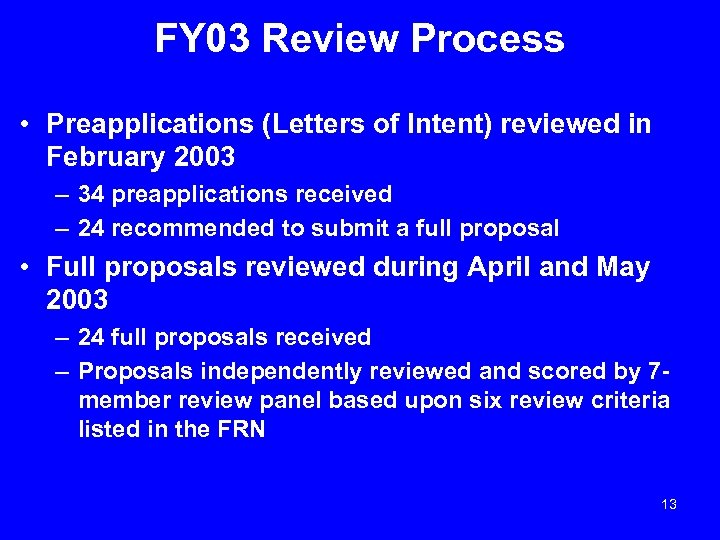
FY 03 Review Process • Preapplications (Letters of Intent) reviewed in February 2003 – 34 preapplications received – 24 recommended to submit a full proposal • Full proposals reviewed during April and May 2003 – 24 full proposals received – Proposals independently reviewed and scored by 7 member review panel based upon six review criteria listed in the FRN 13
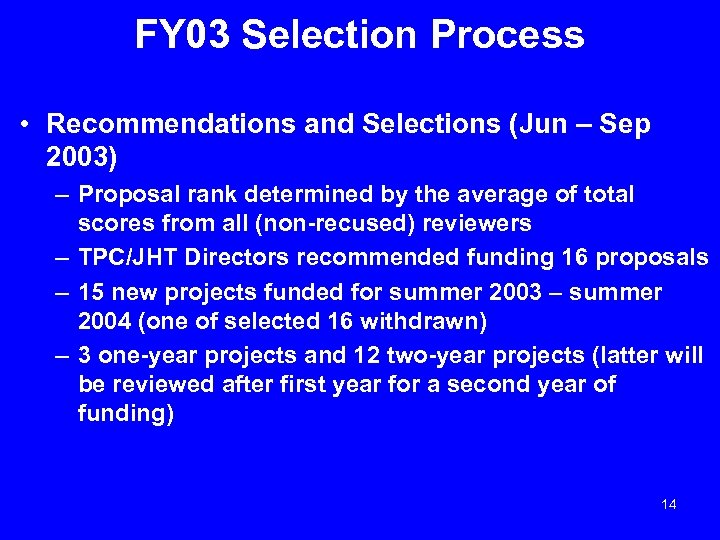
FY 03 Selection Process • Recommendations and Selections (Jun – Sep 2003) – Proposal rank determined by the average of total scores from all (non-recused) reviewers – TPC/JHT Directors recommended funding 16 proposals – 15 new projects funded for summer 2003 – summer 2004 (one of selected 16 withdrawn) – 3 one-year projects and 12 two-year projects (latter will be reviewed after first year for a second year of funding) 14
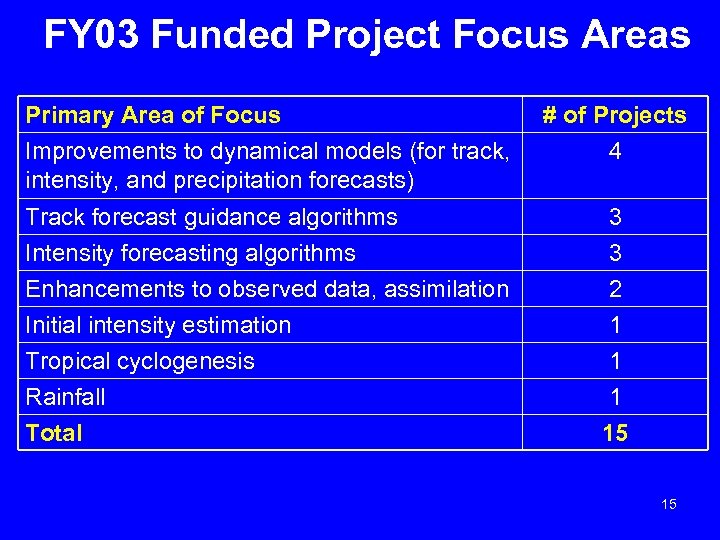
FY 03 Funded Project Focus Areas Primary Area of Focus # of Projects Improvements to dynamical models (for track, intensity, and precipitation forecasts) 4 Track forecast guidance algorithms 3 Intensity forecasting algorithms Enhancements to observed data, assimilation Initial intensity estimation Tropical cyclogenesis Rainfall Total 3 2 1 15 15
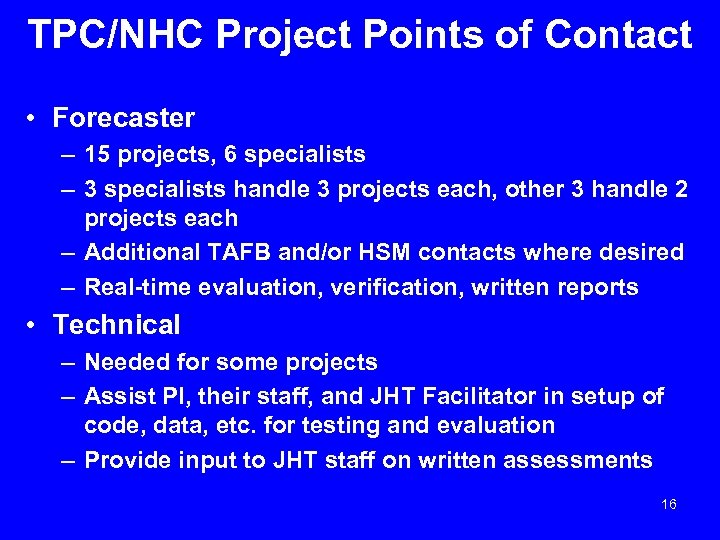
TPC/NHC Project Points of Contact • Forecaster – 15 projects, 6 specialists – 3 specialists handle 3 projects each, other 3 handle 2 projects each – Additional TAFB and/or HSM contacts where desired – Real-time evaluation, verification, written reports • Technical – Needed for some projects – Assist PI, their staff, and JHT Facilitator in setup of code, data, etc. for testing and evaluation – Provide input to JHT staff on written assessments 16
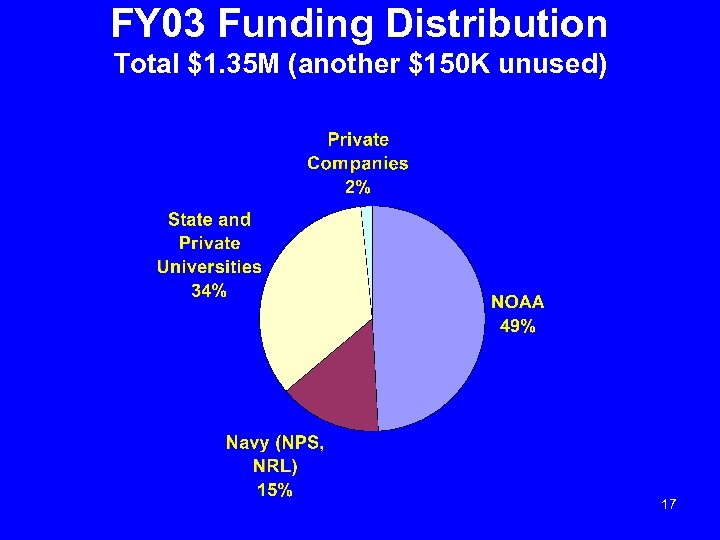
FY 03 Funding Distribution Total $1. 35 M (another $150 K unused) 17
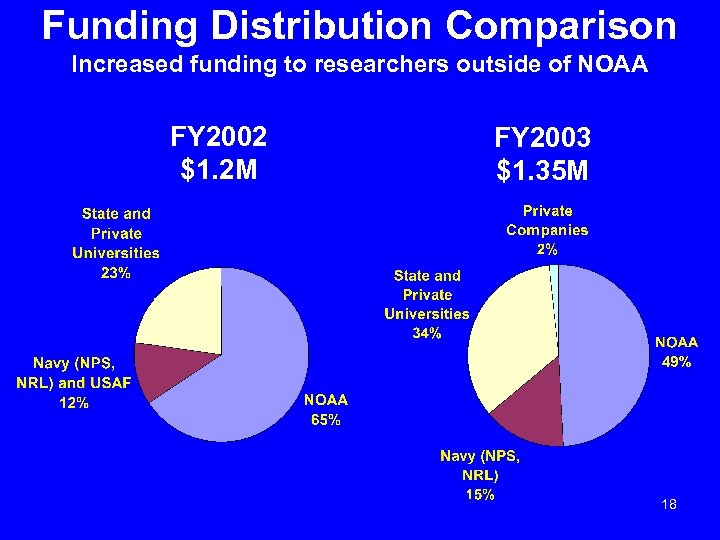
Funding Distribution Comparison Increased funding to researchers outside of NOAA FY 2002 $1. 2 M FY 2003 $1. 35 M 18
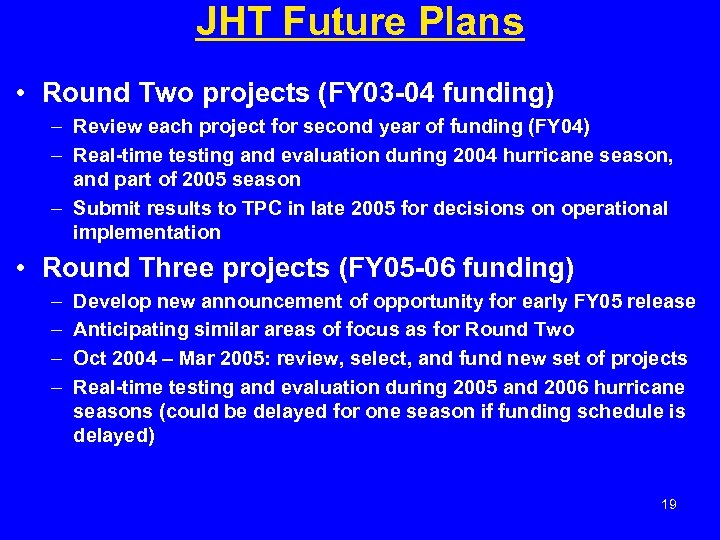
JHT Future Plans • Round Two projects (FY 03 -04 funding) – Review each project for second year of funding (FY 04) – Real-time testing and evaluation during 2004 hurricane season, and part of 2005 season – Submit results to TPC in late 2005 for decisions on operational implementation • Round Three projects (FY 05 -06 funding) – – Develop new announcement of opportunity for early FY 05 release Anticipating similar areas of focus as for Round Two Oct 2004 – Mar 2005: review, select, and fund new set of projects Real-time testing and evaluation during 2005 and 2006 hurricane seasons (could be delayed for one season if funding schedule is delayed) 19
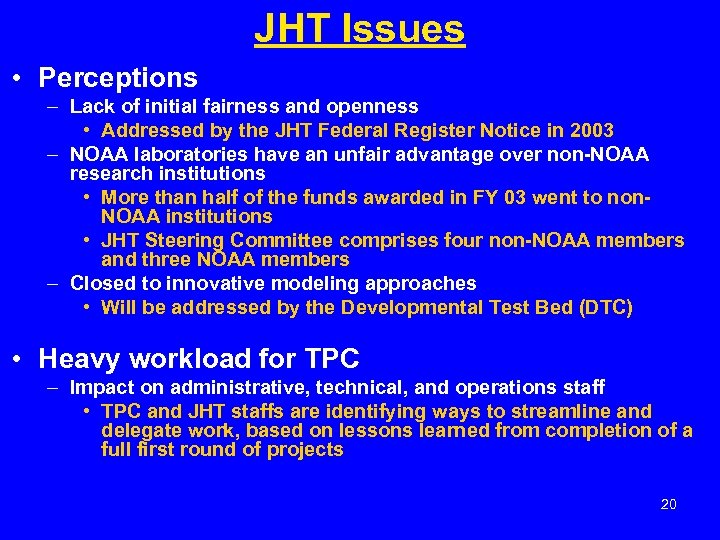
JHT Issues • Perceptions – Lack of initial fairness and openness • Addressed by the JHT Federal Register Notice in 2003 – NOAA laboratories have an unfair advantage over non-NOAA research institutions • More than half of the funds awarded in FY 03 went to non. NOAA institutions • JHT Steering Committee comprises four non-NOAA members and three NOAA members – Closed to innovative modeling approaches • Will be addressed by the Developmental Test Bed (DTC) • Heavy workload for TPC – Impact on administrative, technical, and operations staff • TPC and JHT staffs are identifying ways to streamline and delegate work, based on lessons learned from completion of a full first round of projects 20
JHT Issues continued • IT compatibility – Potential lack of resources for operational implementation of beneficial, cutting-edge techniques • Will seek funding to implement such techniques as needs arise • Funding cycle and schedule – Lengthy process from announcement of opportunity to dispersal of funds to non-NOAA participants • NOAA is addressing the grants applications and awards process – Asynchronous with hurricane season (would be highly desirable for projects to not miss a hurricane season) • USWRP and JHT staffs working together on viable options, including earlier release of announcement of opportunity 21

Thank you 22
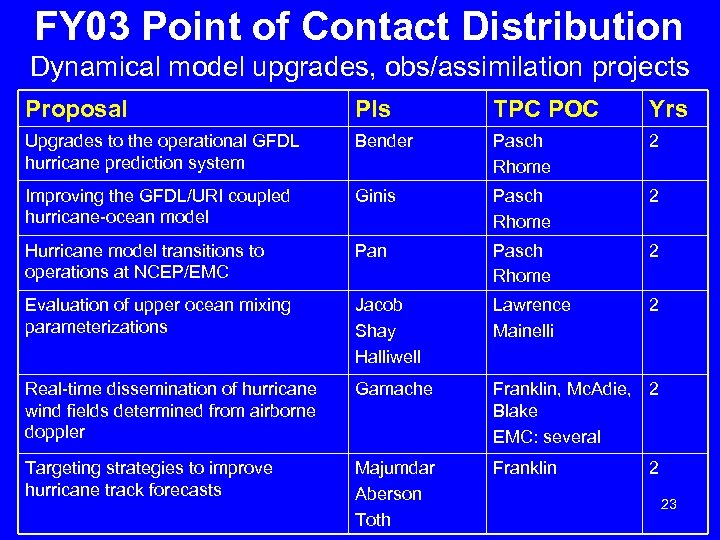
FY 03 Point of Contact Distribution Dynamical model upgrades, obs/assimilation projects Proposal PIs TPC POC Yrs Upgrades to the operational GFDL hurricane prediction system Bender Pasch Rhome 2 Improving the GFDL/URI coupled hurricane-ocean model Ginis Pasch Rhome 2 Hurricane model transitions to operations at NCEP/EMC Pan Pasch Rhome 2 Evaluation of upper ocean mixing parameterizations Jacob Shay Halliwell Lawrence Mainelli 2 Real-time dissemination of hurricane wind fields determined from airborne doppler Gamache Franklin, Mc. Adie, 2 Blake EMC: several Targeting strategies to improve hurricane track forecasts Majumdar Aberson Toth Franklin 2 23
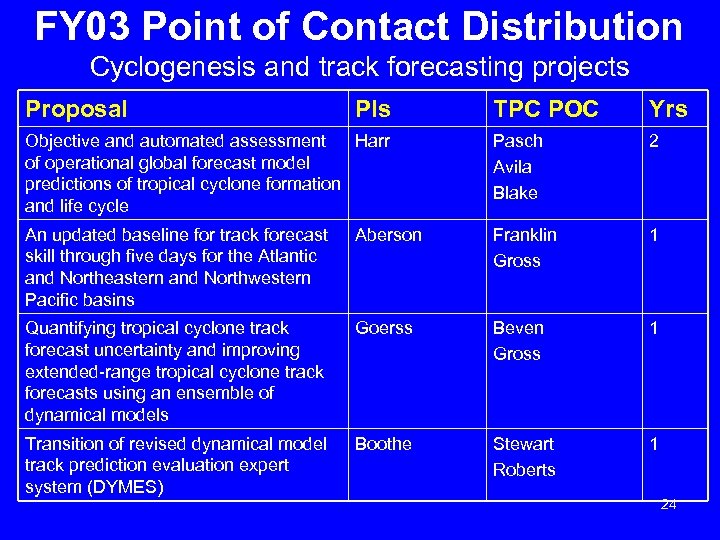
FY 03 Point of Contact Distribution Cyclogenesis and track forecasting projects Proposal PIs TPC POC Yrs Objective and automated assessment Harr of operational global forecast model predictions of tropical cyclone formation and life cycle Pasch Avila Blake 2 An updated baseline for track forecast skill through five days for the Atlantic and Northeastern and Northwestern Pacific basins Aberson Franklin Gross 1 Quantifying tropical cyclone track forecast uncertainty and improving extended-range tropical cyclone track forecasts using an ensemble of dynamical models Goerss Beven Gross 1 Transition of revised dynamical model track prediction evaluation expert system (DYMES) Boothe Stewart Roberts 1 24
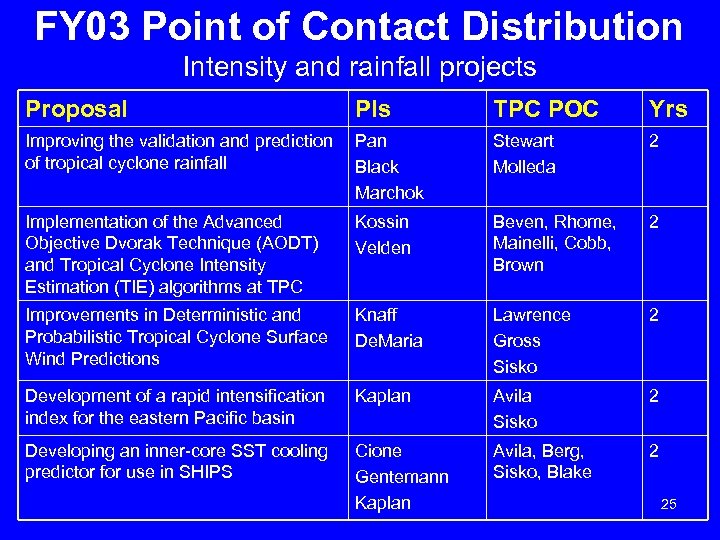
FY 03 Point of Contact Distribution Intensity and rainfall projects Proposal PIs TPC POC Yrs Improving the validation and prediction of tropical cyclone rainfall Pan Black Marchok Stewart Molleda 2 Implementation of the Advanced Objective Dvorak Technique (AODT) and Tropical Cyclone Intensity Estimation (TIE) algorithms at TPC Kossin Velden Beven, Rhome, Mainelli, Cobb, Brown 2 Improvements in Deterministic and Probabilistic Tropical Cyclone Surface Wind Predictions Knaff De. Maria Lawrence Gross Sisko 2 Development of a rapid intensification index for the eastern Pacific basin Kaplan Avila Sisko 2 Developing an inner-core SST cooling predictor for use in SHIPS Cione Gentemann Kaplan Avila, Berg, Sisko, Blake 2 25
FY 03 Individual Project Overviews Dynamical model upgrades, observations and assimilation 26
Upgrades to the operational GFDL hurricane prediction system Morris Bender (NOAA/GFDL) • Goals: – – – Test GFS surface physics package Modify downdraft formulation in SAS scheme Improve momentum mixing in SAS scheme Include effect of evaporation in large-scale condensation Modify land-sea mask for consistency between atmospheric and ocean models – Import and test latest version of Lin microphysics 27
Improving the GFDL/URI coupled hurricane-ocean model for transition to operations Isaac Ginis (Univ. of Rhode Island) • Goals: – Improve ocean component of the coupled model in the Atlantic basin (include explicit init of Loop Current using altimeter data) – Implement ocean coupling in eastern Pacific basin (reduce positive intensity forecast biases) – Evaluate and transfer to operations a new highresolution version of the coupled model (5 nm spacing inner mesh) – Test and implement new air-sea flux parameterizations 28
Hurricane model transitions to operations at NCEP/EMC Hua-Lu Pan (EMC), Bob Tuleya (EMC contractor) • Goals: – Test GFS shallow convection and surface parameterizations in GFDL model – Test bulk microphysics packages – Run parallel version with NOAH LSM in 2003 season – Test WRF physics packages – Test movable nest HWRF – Evaluate Hurricane WRF prototype, compare to GFDL w/WRF physics packages, run the prototype operationally in 2005? 29
Evaluation of upper ocean mixing parameterizations Daniel Jacob (GEST/UMBC) Lynn Shay and George Halliwell (UM/RSMAS) • Goals – Use primitive equation ocean model to simulate upper ocean response to three TCs (Gilbert, Isidore, Lili) using realistic forcing and several ocean vertical mixing models – Compare simulated upper ocean thermal and current structure to data from AXBTs, conductivity, temperature and depth probes (AXCTDs), and current profilers (AXCPs) – Identify mixing models that produce most realistic simulations; provide best vertical mixing parameterization to NCEP for use in coupled models 30
Real-time dissemination of hurricane wind fields determined from airborne doppler John Gamache (HRD) • Goals – Implement existing Doppler radar wind analysis scheme onboard NOAA recon aircraft – Transmit analysis from aircraft to TPC and into H*Wind – Preliminary development and testing of superobs on the aircraft for eventual assimilation into models 31
Targeting strategies to improve hurricane track forecasts Sharanya Majumdar (Univ. of Miami/RSMAS) Sim Aberson (HRD), Zoltan Toth (EMC) • Goals – Develop objective strategy: Ensemble Transform Kalman Filter (ETKF), used in winter storms, using operational ensemble forecasts – Use present subjective targeting method operationally – Identify cases in which ETKF selects targets similar to subjective method; re-run models to simulate ETKF being used operationally to produce sensitivity maps – Refine ETKF software (incl. merge with flight track drawing under development) and procedures for transition to operations – Operationally produce ETKF products that select best feasible flight tracks 32
FY 03 Individual Project Overviews Tropical cyclogenesis, TC track forecasting algorithms 33
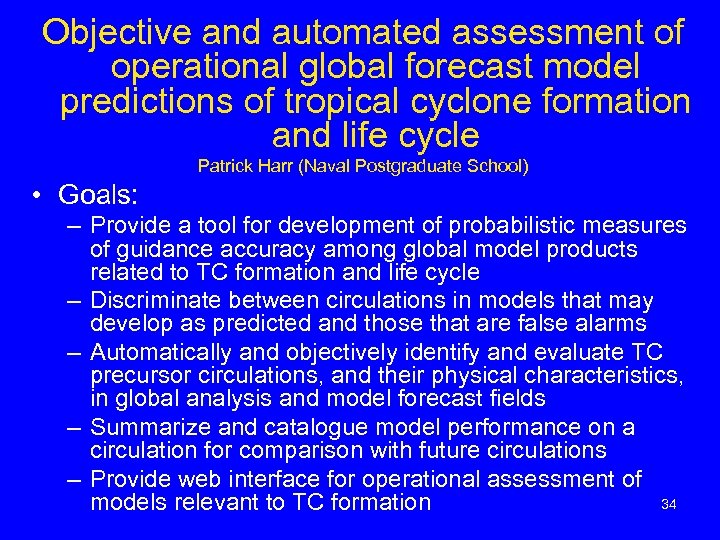
Objective and automated assessment of operational global forecast model predictions of tropical cyclone formation and life cycle Patrick Harr (Naval Postgraduate School) • Goals: – Provide a tool for development of probabilistic measures of guidance accuracy among global model products related to TC formation and life cycle – Discriminate between circulations in models that may develop as predicted and those that are false alarms – Automatically and objectively identify and evaluate TC precursor circulations, and their physical characteristics, in global analysis and model forecast fields – Summarize and catalogue model performance on a circulation for comparison with future circulations – Provide web interface for operational assessment of 34 models relevant to TC formation
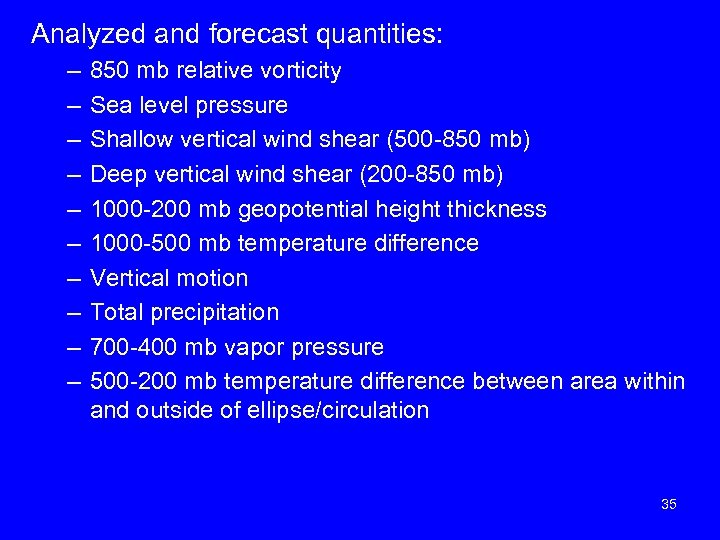
Analyzed and forecast quantities: – – – – – 850 mb relative vorticity Sea level pressure Shallow vertical wind shear (500 -850 mb) Deep vertical wind shear (200 -850 mb) 1000 -200 mb geopotential height thickness 1000 -500 mb temperature difference Vertical motion Total precipitation 700 -400 mb vapor pressure 500 -200 mb temperature difference between area within and outside of ellipse/circulation 35
An updated baseline for track forecast skill through five days for the Atlantic and Northeastern and Northwestern Pacific basins Sim Aberson (HRD) • Goals: – Update CLIPER track models – Incorporate recent best track data used to derive the models – Improve calculation of current storm motion 36
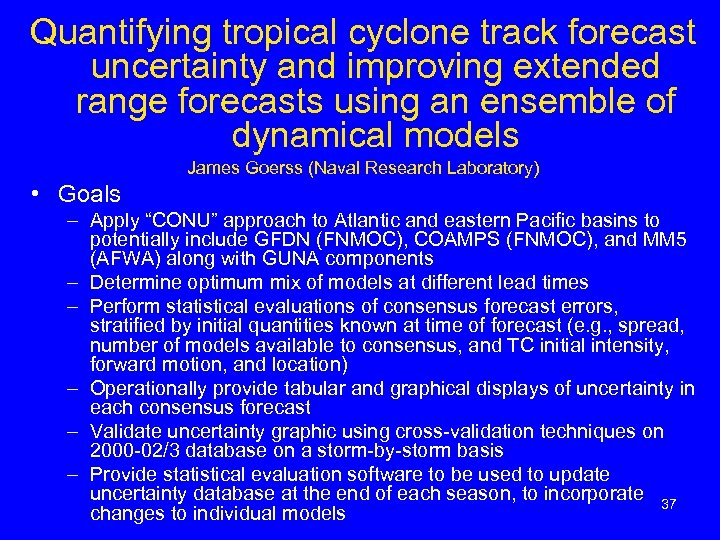
Quantifying tropical cyclone track forecast uncertainty and improving extended range forecasts using an ensemble of dynamical models James Goerss (Naval Research Laboratory) • Goals – Apply “CONU” approach to Atlantic and eastern Pacific basins to potentially include GFDN (FNMOC), COAMPS (FNMOC), and MM 5 (AFWA) along with GUNA components – Determine optimum mix of models at different lead times – Perform statistical evaluations of consensus forecast errors, stratified by initial quantities known at time of forecast (e. g. , spread, number of models available to consensus, and TC initial intensity, forward motion, and location) – Operationally provide tabular and graphical displays of uncertainty in each consensus forecast – Validate uncertainty graphic using cross-validation techniques on 2000 -02/3 database on a storm-by-storm basis – Provide statistical evaluation software to be used to update uncertainty database at the end of each season, to incorporate 37 changes to individual models
Transition of revised dynamical model track prediction evaluation expert system Mark Boothe (Naval Postgraduate School) • Goals – Create revised DYMES that implements the Atlantic error mechanisms determined with previous funding – Demonstrate operational utility during real-time tests 38
FY 03 Individual Project Overviews TC Intensity 39
Implementation of the Advanced Objective Dvorak Technique (AODT) and the Tropical Cyclone Intensity Estimation (TIE) model algorithms James Kossin (CIMSS/Univ. of Wisconsin) Chris Velden (CIMSS/Univ. of Wisconsin) • Goals: – Implement latest version of AODT in NAWIPS, applicable to all stages of TC, non-Mc. IDAS, can be automated – Implement rudimentary version of TIE model in NAWIPS: fully objective regression between recon pressure and IR predictors, SST, and latitude of the TC; additional predictors to be added (e. g. , synoptic environment, microwave imagery) – Integrate AODT and TIE into single code package 40
Improvements in deterministic and probabilistic tropical cyclone surface wind predictions John Knaff (CIRA/CSU) With Mark De. Maria (NESDIS/ORA) • Goals: – Develop and evaluate new component to SHIPS model utilizing recon and GOES IR data to better determine inner core structure – Test neural network prediction method in SHIPS to account for nonlinear interactions between predictors – Provide fields of the probability of surface wind speeds exceeding specified thresholds over certain time intervals 41
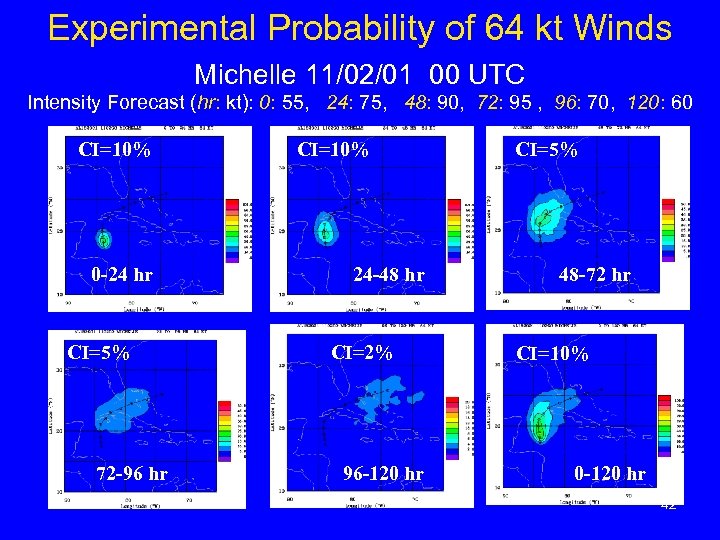
Experimental Probability of 64 kt Winds Michelle 11/02/01 00 UTC Intensity Forecast (hr: kt): 0: 55, 24: 75, 48: 90, 72: 95 , 96: 70, 120: 60 CI=10% 0 -24 hr CI=5% 72 -96 hr CI=10% 24 -48 hr CI=2% 96 -120 hr CI=5% 48 -72 hr CI=10% 0 -120 hr 42
Development of a rapid intensification index for the eastern Pacific basin John Kaplan (HRD) With Mark De. Maria (NOAA/NESDIS/ORA) • Goals – Develop RI index for the eastern Pacific using methodology similar to that for existing Atlantic index • Use 1989 -2003 SHIPS database • 95 th percentile of 24 h over-water intensity changes • Thresholds of significant predictors of RI will be mean values from all RI cases – Output RI probability estimate with each operational eastern Pacific SHIPS forecast – Modify existing code and provide training so that it can be used by TPC to re-derive the eastern Pacific index for future seasons 43
Developing an inner-core SST cooling predictor for use in SHIPS Joe Cione (HRD) Chelle Gentemann (Remote Sensing Systems) and John Kaplan (HRD) • Goals – Test algorithm for use in SHIPS that relates the estimated amount of SST cooling directly under the storm to subsequent TC intensity change – Extend algorithm, based on a developmental 23 hurricane sample (1975 -2002) of observations (AXBTs, buoys), to weaker systems (by 2005) – To run operationally, predict (rather than observe) innercore SST cooling using regression with ambient SST and storm location/speed/intensity – Improve upon weekly Reynolds SSTs that provide initialization; higher spatial and temporal resolution – Test additional predictors related to subsurface upper ocean parameters 44
FY 03 Individual Project Overviews TC Rainfall 45
Improving the validation and prediction of tropical cyclone rainfall Hua-Lu Pan (EMC), Robert Black (HRD), Tim Marchok (GFDL) Goals: – Develop new rainfall validation schemes that provide a baseline of comparison for different forecast systems – Provide new forecasting tool, based on the benchmark R -CLIPER, that incorporates information related to vertical shear and storm track, and can be run operationally – Generate error statistics for rainfall forecasts using traditional and new validation techniques for the operational GFDL, Eta, and GFS models, and the RCLIPER and modified R-CLIPER. 46
2003 -04 JHT Project Schedule • Semi-annual reports due 31 January 2004 • Each PI make presentation at IHC in March 2004, possibly meet with TPC/NHC points of contact • Make preparations for and begin real-time testing and evaluation during 2004 hurricane season • Renewal proposals from PIs due 15 May 2004 • Second year of funded activity for renewed projects begins July/Aug 2004 47
Скачать презентацию USWRP Joint Hurricane Test Bed JHT Progress and
d28df445fd15b9ed59c3a1436626b7e6.ppt