


 Скачать презентацию USPACOM Science and Technology Oceanography Resource Safety and
1e36349e3bd7cf7cc4a0ae2c242f8c93.ppt
- Количество слайдов: 15
 USPACOM Science and Technology Oceanography, Resource, Safety and Security Network (ORSSN) Information Briefing Mr. Jim Burdell Science and Technology Advisor HQ U. S. Pacific Command James. Burdell@pacom. mil 808 -477 -0812 19 March 2010
 ORSSN Drivers • Theater Campaign Plan – Security Cooperation - Phase “ 0” Shaping 1 • Addresses 7 of 7 Theater Strategic Objectives; 6 of 7 GEF Endstates; 6 of 7 Essential Tasks – Allies & Partners • Annual Staff Talks – Maritime Security – Transnational Threats – Annual Staff Talks – Counter Proliferation/Trafficking • Treaty Responsibilities - “Fight for Fish” Picks up where RMAC left off
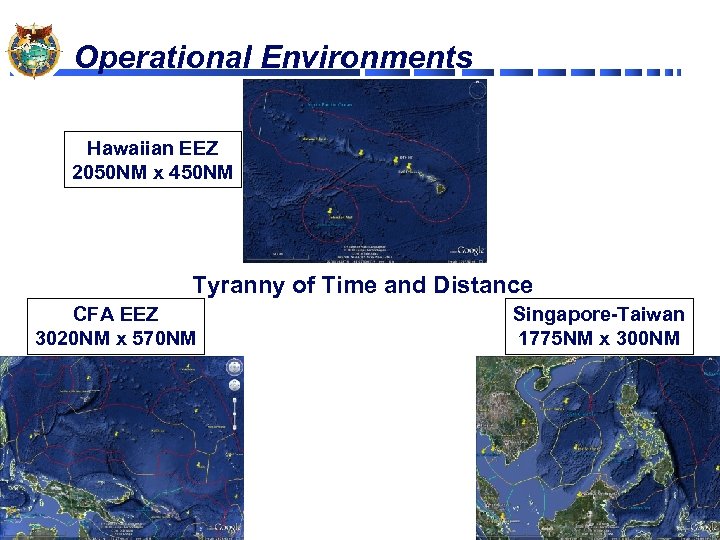 Operational Environments Hawaiian EEZ 2050 NM x 450 NM Tyranny of Time and Distance CFA EEZ 3020 NM x 570 NM Singapore-Taiwan 1775 NM x 300 NM
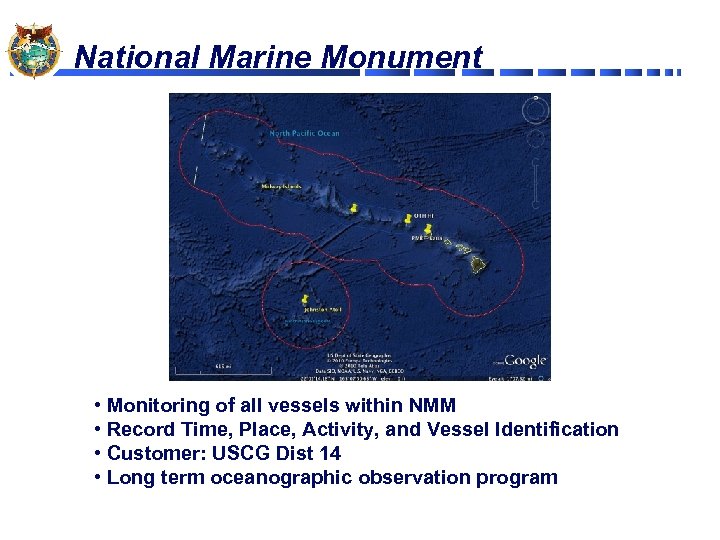 National Marine Monument • Monitoring of all vessels within NMM • Record Time, Place, Activity, and Vessel Identification • Customer: USCG Dist 14 • Long term oceanographic observation program
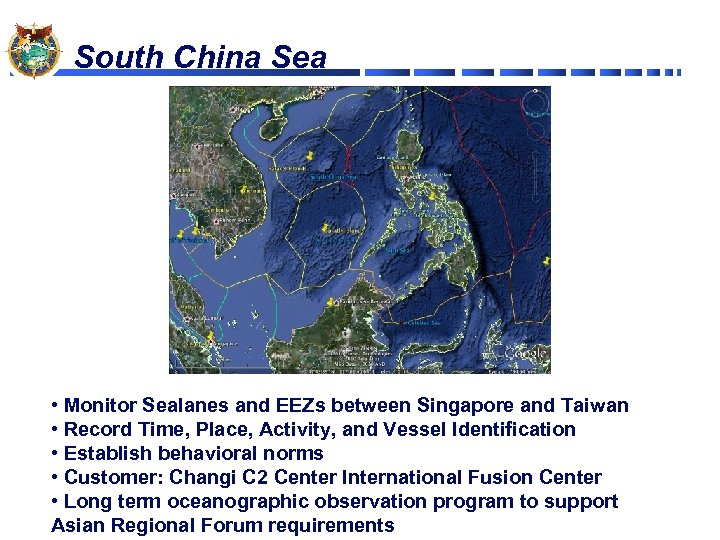 South China Sea • Monitor Sealanes and EEZs between Singapore and Taiwan • Record Time, Place, Activity, and Vessel Identification • Establish behavioral norms • Customer: Changi C 2 Center International Fusion Center • Long term oceanographic observation program to support Asian Regional Forum requirements
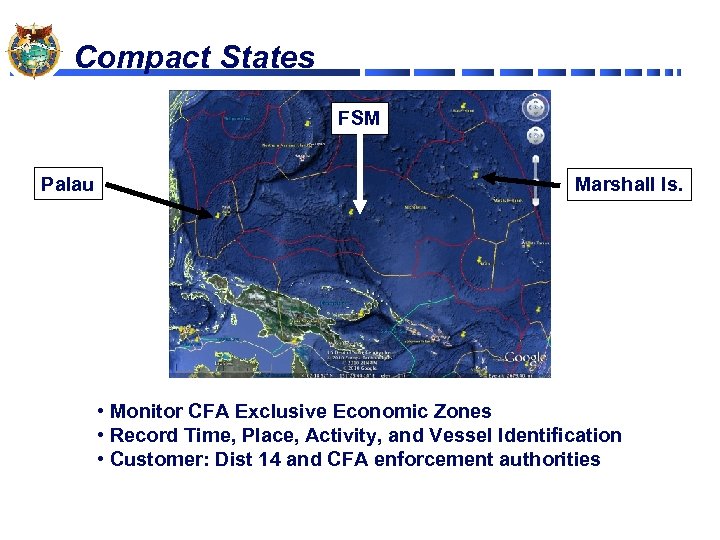 Compact States FSM Palau Marshall Is. • Monitor CFA Exclusive Economic Zones • Record Time, Place, Activity, and Vessel Identification • Customer: Dist 14 and CFA enforcement authorities
 Operational Requirements • Cost effective, multiple use, 7 x 24 broad area surveillance capability to detect and track vessels (>100 GT) at 100 nm – Not “targeting” quality to enhance share-ability – Low infrastructure, operating, and maintenance costs • Cost effective, multiple user, on-demand surveillance capability to supplement long range shore based radar capability to detect and track vessels (>100 GT) from 100 -400 NM from shore • Low cost, low overhead, long range surveillance capability to identify and record activity of vessels detected by broad area surveillance sensors • Centralized sensor/Information processing, fusion, and product dissemination
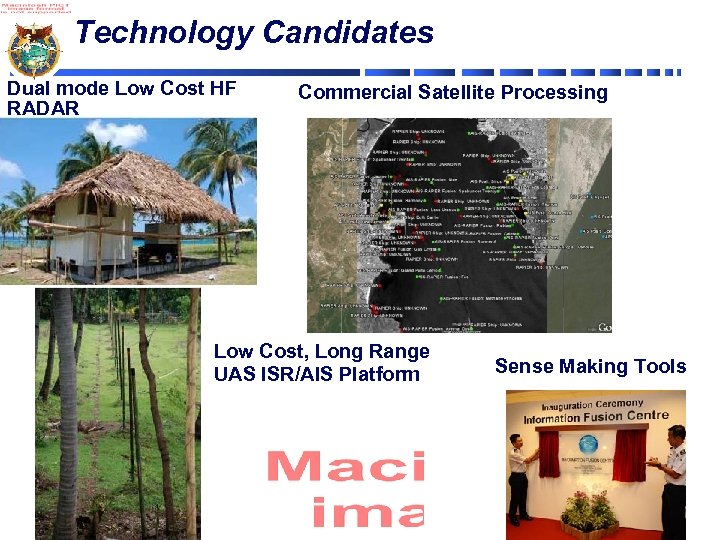 Technology Candidates Dual mode Low Cost HF RADAR Commercial Satellite Processing Low Cost, Long Range UAS ISR/AIS Platform Sense Making Tools
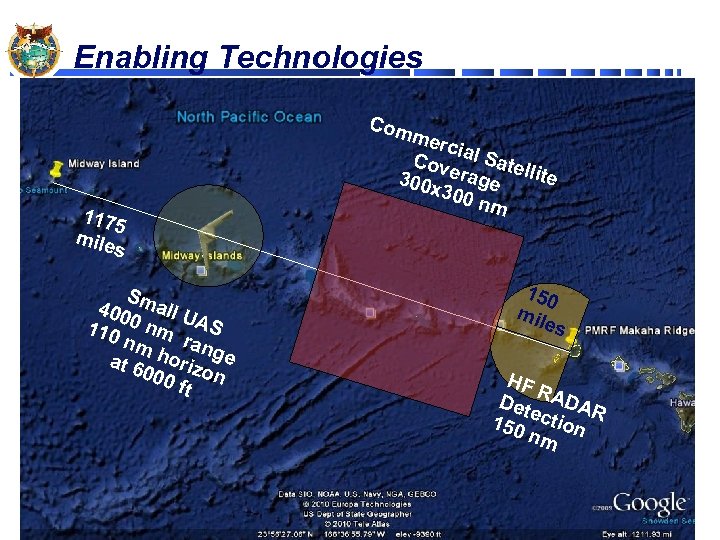 Enabling Technologies Com 1175 mile s S 400 mall U 110 0 nm AS ran nm at 6 horiz ge 000 on ft mer c Cov ial Sate 300 x erage llite 300 nm 150 mil es HF Det RADAR 150 ection nm
 Technology, Policy, & Economic Challenges • Technology • – Over-the-horizon UAS C 2 – Weather avoidance – UAS Sensor packages • EO/IR vs SAR – transmission and storage • Post mission analysis, reporting, and evidentiary requirements – HF Radar Vessel detection algorithms – Integration of Radar, UAS, and Satellite information – Integration with VMS and Sea Star Policy • – UAV operations in 5 -20 k Overwater flight regimes (ICAO) • Sense and Avoid – International data sharing – Interagency customer base Operations and Maintenance Cost models and validation – “Sustainability”
 Technology Evaluation and Integration Program • Enabling Technologies (US/Singapore) – Satellite and HF Radar validation • Core Process 3 – UAV validation • Coalition Warfare Program (US/Singapore) – Integrate technologies into demonstration capability • Joint Capability Technology Demonstration (US/SIN/IND/BRRP/MA/VN) – Deploy International network demonstration capability
 Questions?
 Backups
 ORSSN Goals/PHASE I Demo Approach Goals: Provide US partner nations an affordable means to detect, identify, track, and share information on maritime vessels operating in their Economic Exclusion Zone Phase I Demonstration: Provide USCG District 14 support in monitoring the Northwestern Hawaiian Islands National Monument - Demonstrate low cost technology to detect, identify, track and share shipping technology - Demonstrate the ability transfer information to the Singapore Changi C 2 Center for processing, fusion , and dissemination, for the Phase II follow-on demonstration - Provide opportunities for partner nations to view the technology demonstrations in Hawaii
 Technology Challenges - details HF RADAR • Multi-product processing of HF Radar signals – Centralized processing, multi-point dissemination • Data exfiltration and control via GSM/3 G Networks • Decreased power requirement/stand alone power source for HF Radar sites Commercial Satellite processing • Semi-automated screening of imagery for vessel targets Unmanned Air System • Tasking, control, and capability of UAV to serve as Maritime Patrol Aircraft • Cost per hour, sustainability, life cycle costs Sense Making Tools • Integration of “Sense Making” tools into non-US software architecture – Re. MIX – SMART – Unclassified CMA tools