 Скачать презентацию Using UML Patterns and Java Object-Oriented Software Engineering
63ae90ebbef007ad3b4412cad7f73ef2.ppt
- Количество слайдов: 85



Using UML, Patterns, and Java Object-Oriented Software Engineering 15. Software Life Cycle
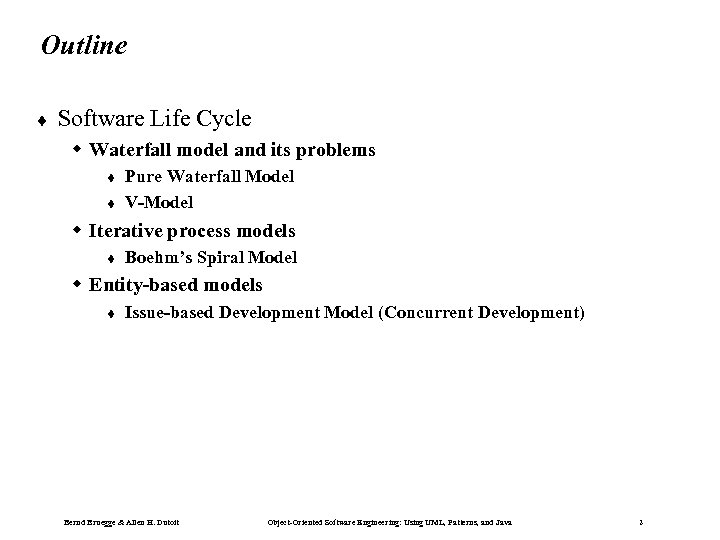
Outline ¨ Software Life Cycle Waterfall model and its problems t t Pure Waterfall Model V-Model Iterative process models t Boehm’s Spiral Model Entity-based models t Issue-based Development Model (Concurrent Development) Bernd Bruegge & Allen H. Dutoit Object-Oriented Software Engineering: Using UML, Patterns, and Java 2
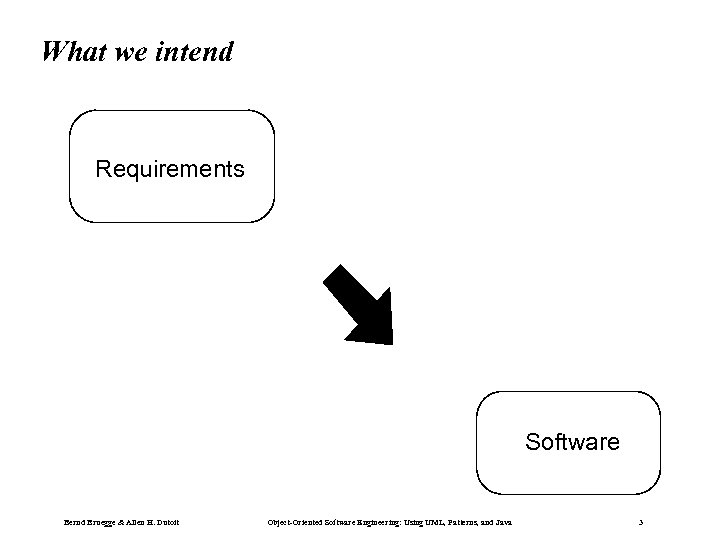
What we intend Requirements Software Bernd Bruegge & Allen H. Dutoit Object-Oriented Software Engineering: Using UML, Patterns, and Java 3
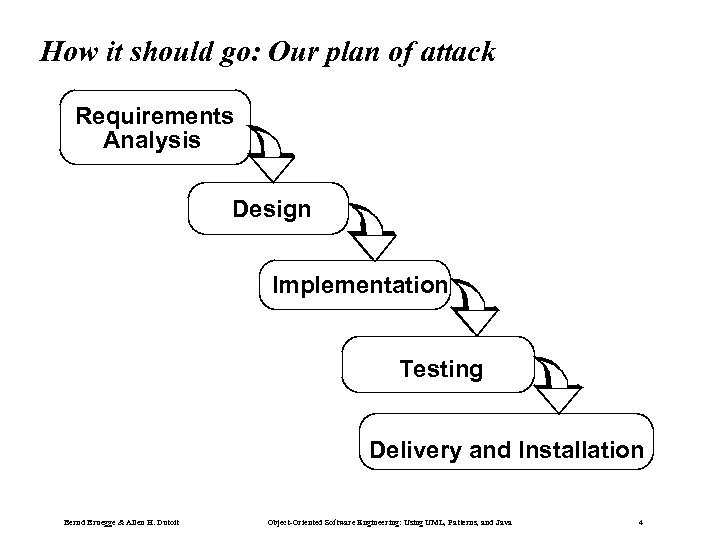
How it should go: Our plan of attack Requirements Analysis Design Implementation Testing Delivery and Installation Bernd Bruegge & Allen H. Dutoit Object-Oriented Software Engineering: Using UML, Patterns, and Java 4
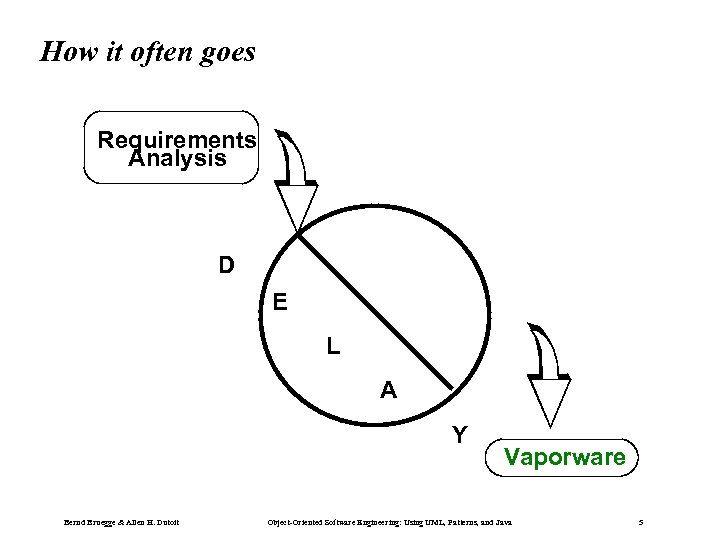
How it often goes Requirements Analysis D E L A Y Bernd Bruegge & Allen H. Dutoit Vaporware Object-Oriented Software Engineering: Using UML, Patterns, and Java 5
Inherent Problems with Software Development ¨ Requirements are complex The client does not know the functional requirements in advance ¨ Requirements may be changing Technology enablers introduce new possibilities to deal with nonfunctional requirements ¨ Frequent changes are difficult to manage Identifying milestones and cost estimation is difficult ¨ There is more than one software system New system must be backward compatible with existing system (“legacy system”) Phased development: Need to distinguish between the system under development and already released systems ¨ Let’s view these problems as the nonfunctional requirements for a system that supports software development! This leads us to software life cycle modeling Bernd Bruegge & Allen H. Dutoit Object-Oriented Software Engineering: Using UML, Patterns, and Java 6
Definitions ¨ Software lifecycle modeling: Attempt to deal with complexity and change ¨ Software lifecycle: Set of activities and their relationships to each other to support the development of a software system ¨ Software development methodology: A collection of techniques for building models - applied across the software lifecycle Bernd Bruegge & Allen H. Dutoit Object-Oriented Software Engineering: Using UML, Patterns, and Java 7
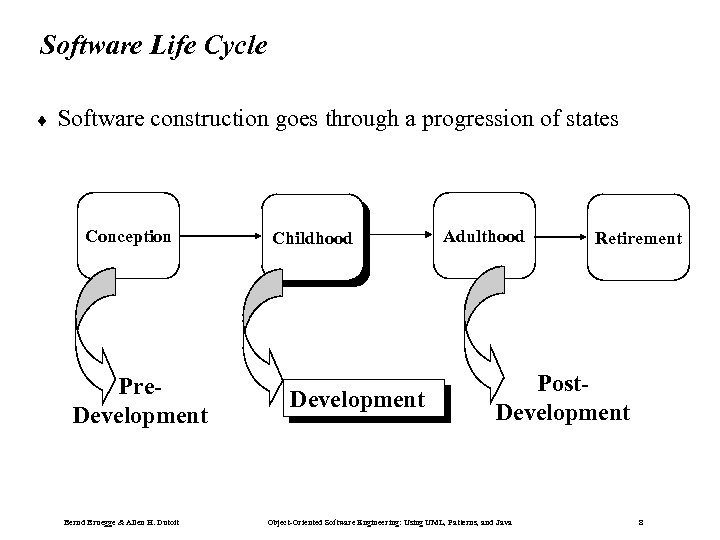
Software Life Cycle ¨ Software construction goes through a progression of states Conception Pre. Development Bernd Bruegge & Allen H. Dutoit Childhood Development Adulthood Retirement Post. Development Object-Oriented Software Engineering: Using UML, Patterns, and Java 8
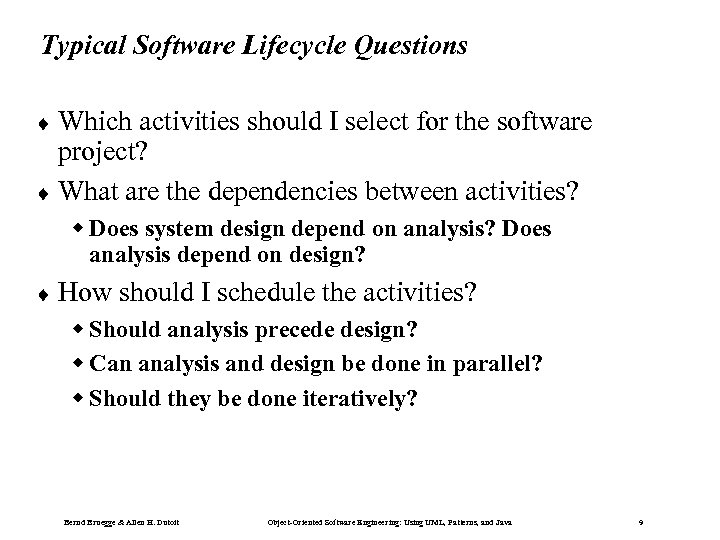
Typical Software Lifecycle Questions ¨ Which activities should I select for the software project? ¨ What are the dependencies between activities? Does system design depend on analysis? Does analysis depend on design? ¨ How should I schedule the activities? Should analysis precede design? Can analysis and design be done in parallel? Should they be done iteratively? Bernd Bruegge & Allen H. Dutoit Object-Oriented Software Engineering: Using UML, Patterns, and Java 9
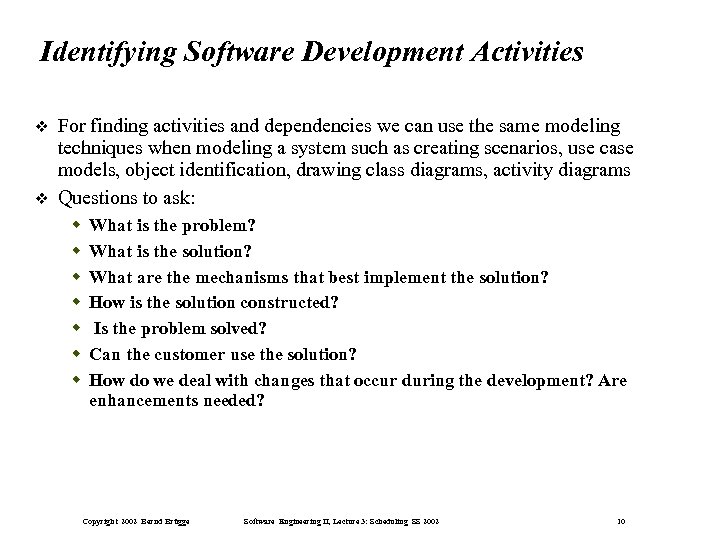
Identifying Software Development Activities For finding activities and dependencies we can use the same modeling techniques when modeling a system such as creating scenarios, use case models, object identification, drawing class diagrams, activity diagrams Questions to ask: What is the problem? What is the solution? What are the mechanisms that best implement the solution? How is the solution constructed? Is the problem solved? Can the customer use the solution? How do we deal with changes that occur during the development? Are enhancements needed? Copyright 2002 Bernd Brügge Software Engineering II, Lecture 3: Scheduling SS 2002 10
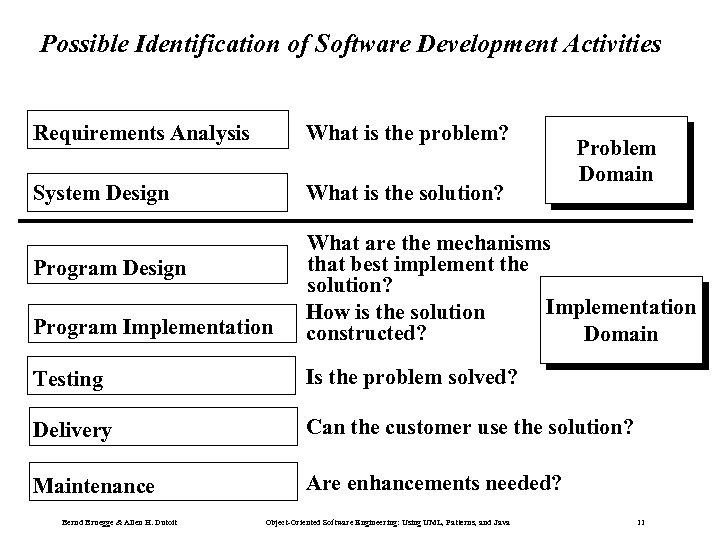
Possible Identification of Software Development Activities Requirements Analysis What is the problem? System Design What is the solution? Problem Domain Program Implementation What are the mechanisms that best implement the solution? Implementation How is the solution constructed? Domain Testing Is the problem solved? Delivery Can the customer use the solution? Maintenance Are enhancements needed? Program Design Bernd Bruegge & Allen H. Dutoit Object-Oriented Software Engineering: Using UML, Patterns, and Java 11
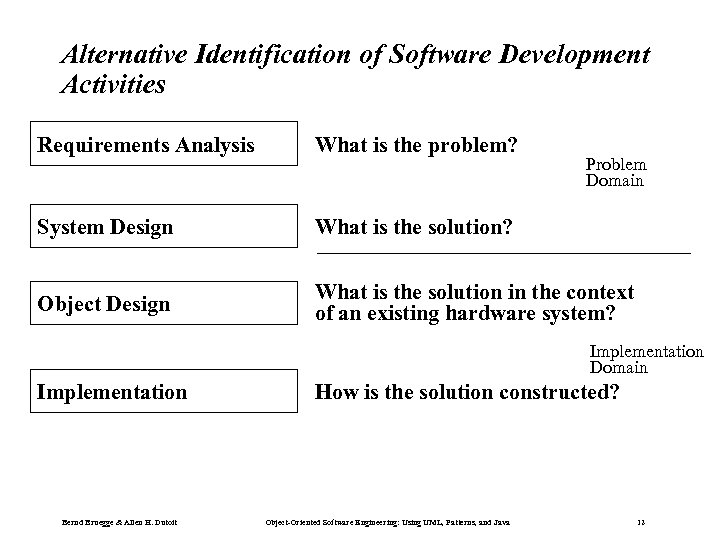
Alternative Identification of Software Development Activities Requirements Analysis What is the problem? System Design What is the solution? Object Design What is the solution in the context of an existing hardware system? Problem Domain Implementation Bernd Bruegge & Allen H. Dutoit How is the solution constructed? Object-Oriented Software Engineering: Using UML, Patterns, and Java 12
Software Development as Application Domain: A Use Case Model Bernd Bruegge & Allen H. Dutoit Object-Oriented Software Engineering: Using UML, Patterns, and Java 13
Activity diagram for the same life cycle model Software development goes through a linear progression of states called software development activities Copyright 2002 Bernd Brügge Software Engineering II, Lecture 3: Scheduling SS 2002 14
Another simple life cycle model System Development and Market creation can be done in parallel and Must be done before the system upgrade activity Copyright 2002 Bernd Brügge Software Engineering II, Lecture 3: Scheduling SS 2002 15
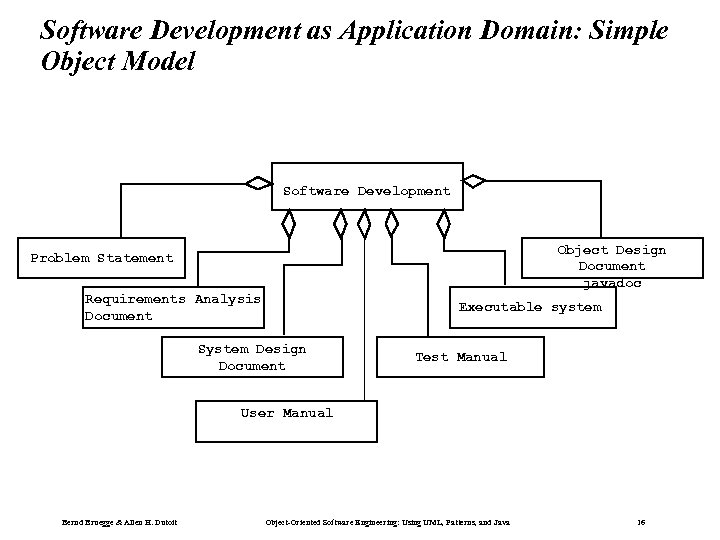
Software Development as Application Domain: Simple Object Model Software Development Object Design Document javadoc Problem Statement Requirements Analysis Document Executable system System Design Document Test Manual User Manual Bernd Bruegge & Allen H. Dutoit Object-Oriented Software Engineering: Using UML, Patterns, and Java 16
Object Model of the Software Life Cycle Bernd Bruegge & Allen H. Dutoit Object-Oriented Software Engineering: Using UML, Patterns, and Java 17
Two Major Views of the Software life cycle Activity-oriented view of a software life cycle all the examples so far Entity-oriented view of a software life cycle Copyright 2002 Bernd Brügge Software Engineering II, Lecture 3: Scheduling SS 2002 18
Entity-centered view of software development Software development consists of the creation of a set of deliverables Copyright 2002 Bernd Brügge Software Engineering II, Lecture 3: Scheduling SS 2002 19
Combining activities and entities in one view Copyright 2002 Bernd Brügge Software Engineering II, Lecture 3: Scheduling SS 2002 20
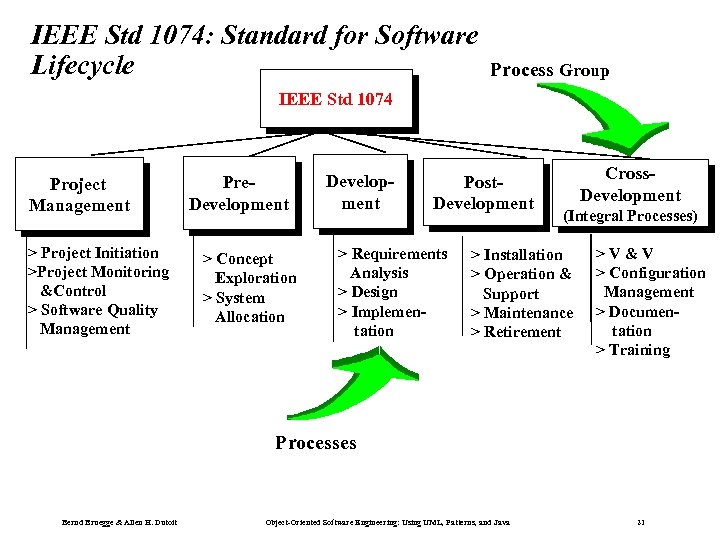
IEEE Std 1074: Standard for Software Lifecycle Process Group IEEE Std 1074 Project Management > Project Initiation >Project Monitoring &Control > Software Quality Management Pre. Development > Concept Exploration > System Allocation Development Post. Development > Requirements Analysis > Design > Implementation Cross. Development (Integral Processes) > Installation > Operation & Support > Maintenance > Retirement >V&V > Configuration Management > Documentation > Training Processes Bernd Bruegge & Allen H. Dutoit Object-Oriented Software Engineering: Using UML, Patterns, and Java 21
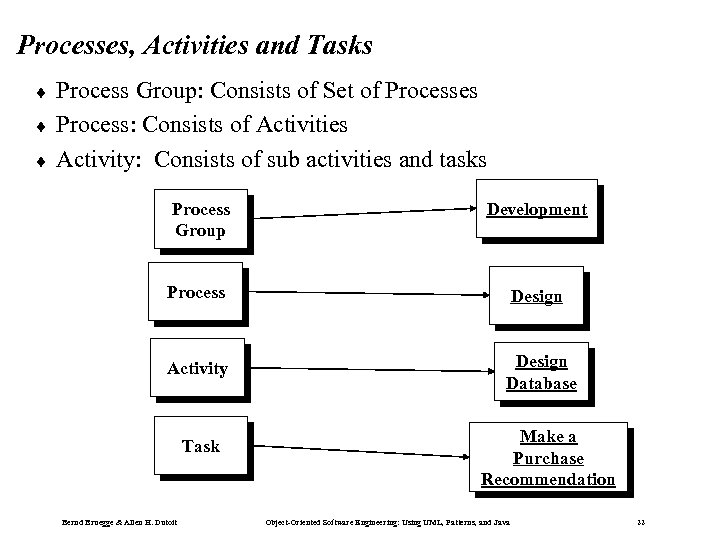
Processes, Activities and Tasks ¨ ¨ ¨ Process Group: Consists of Set of Processes Process: Consists of Activities Activity: Consists of sub activities and tasks Process Group Development Process Design Activity Design Database Task Bernd Bruegge & Allen H. Dutoit Make a Purchase Recommendation Object-Oriented Software Engineering: Using UML, Patterns, and Java 22
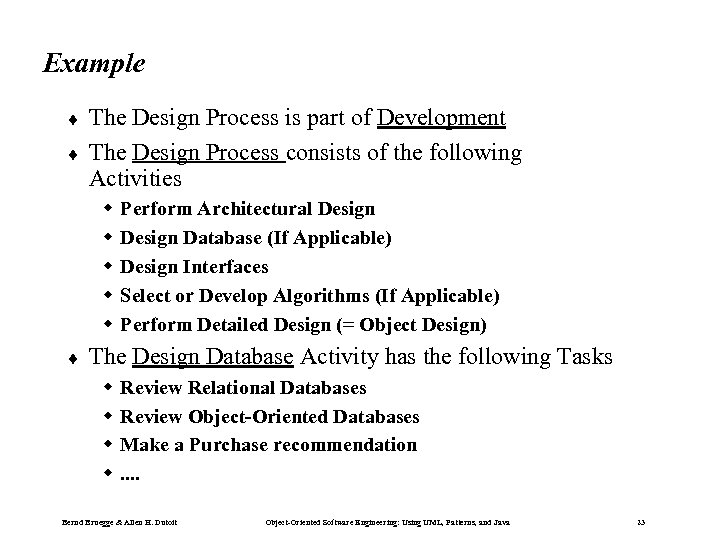
Example ¨ ¨ The Design Process is part of Development The Design Process consists of the following Activities ¨ Perform Architectural Design Database (If Applicable) Design Interfaces Select or Develop Algorithms (If Applicable) Perform Detailed Design (= Object Design) The Design Database Activity has the following Tasks Review Relational Databases Review Object-Oriented Databases Make a Purchase recommendation. . Bernd Bruegge & Allen H. Dutoit Object-Oriented Software Engineering: Using UML, Patterns, and Java 23
UML Class Diagram of the IEEE Standard Copyright 2002 Bernd Brügge Software Engineering II, Lecture 3: Scheduling SS 2002 24
Modeling Dependencies in a Software Lifecycle • Note that the dependency association can mean one of two things: • Activity B depends on Activity A • Activity A must temporarily precede Activity B • Which one is right? Bernd Bruegge & Allen H. Dutoit Object-Oriented Software Engineering: Using UML, Patterns, and Java 25
Life Cycle Modeling Many models have been proposed to deal with the problems of defining activities and associating them with each other The first model proposed was the waterfall model [Royce 1970] Copyright 2002 Bernd Brügge Software Engineering II, Lecture 3: Scheduling SS 2002 26
Life-Cycle Model: Variations on a Theme ¨ ¨ Many models have been proposed to deal with the problems of defining activities and associating them with each other The waterfall model First described by Royce in 1970 ¨ There seem to be at least as many versions as there authorities - perhaps more Bernd Bruegge & Allen H. Dutoit Object-Oriented Software Engineering: Using UML, Patterns, and Java 27
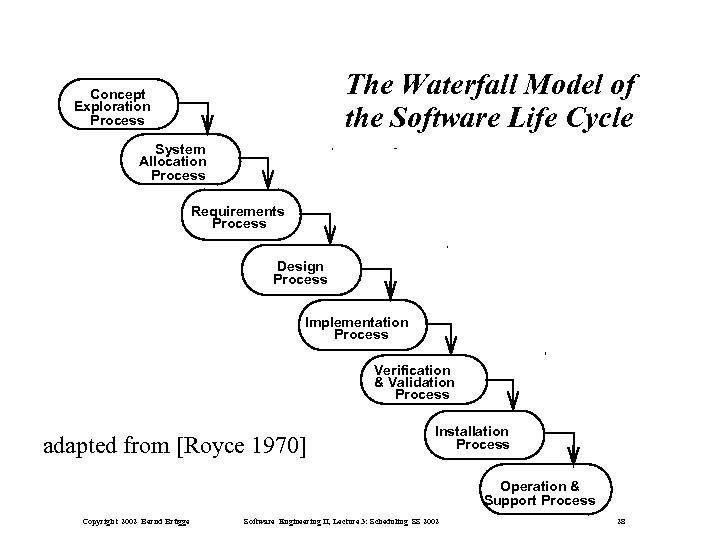
The Waterfall Model of the Software Life Cycle Concept Exploration Process System Allocation Process Requirements Process Design Process Implementation Process Verification & Validation Process adapted from [Royce 1970] Installation Process Operation & Support Process Copyright 2002 Bernd Brügge Software Engineering II, Lecture 3: Scheduling SS 2002 28
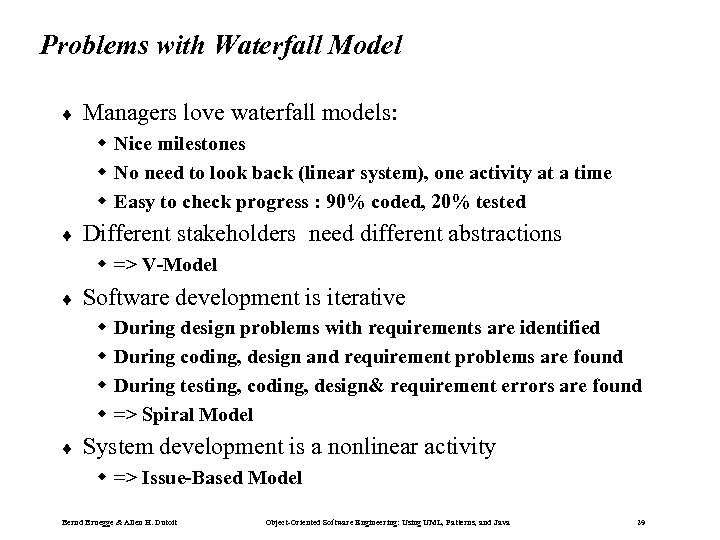
Problems with Waterfall Model ¨ Managers love waterfall models: Nice milestones No need to look back (linear system), one activity at a time Easy to check progress : 90% coded, 20% tested ¨ Different stakeholders need different abstractions => V-Model ¨ Software development is iterative ¨ During design problems with requirements are identified During coding, design and requirement problems are found During testing, coding, design& requirement errors are found => Spiral Model System development is a nonlinear activity => Issue-Based Model Bernd Bruegge & Allen H. Dutoit Object-Oriented Software Engineering: Using UML, Patterns, and Java 29
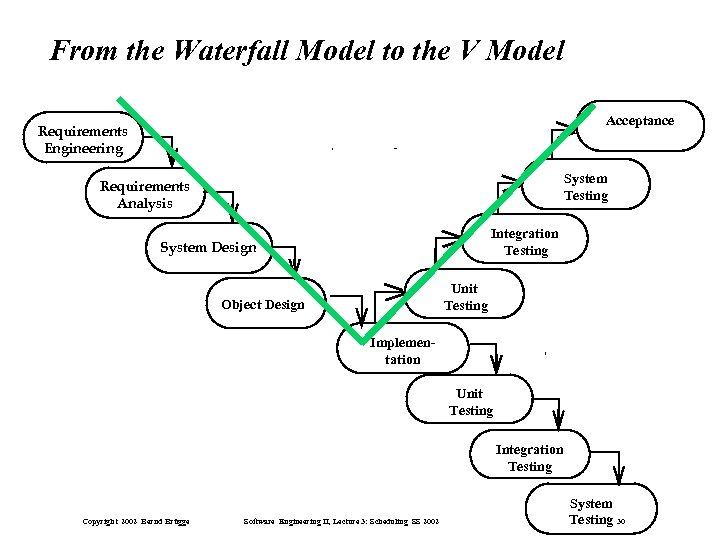
From the Waterfall Model to the V Model Acceptance Requirements Engineering System Testing Requirements Analysis Integration Testing System Design Unit Testing Object Design Implementation Unit Testing Integration Testing Copyright 2002 Bernd Brügge Software Engineering II, Lecture 3: Scheduling SS 2002 System Testing 30
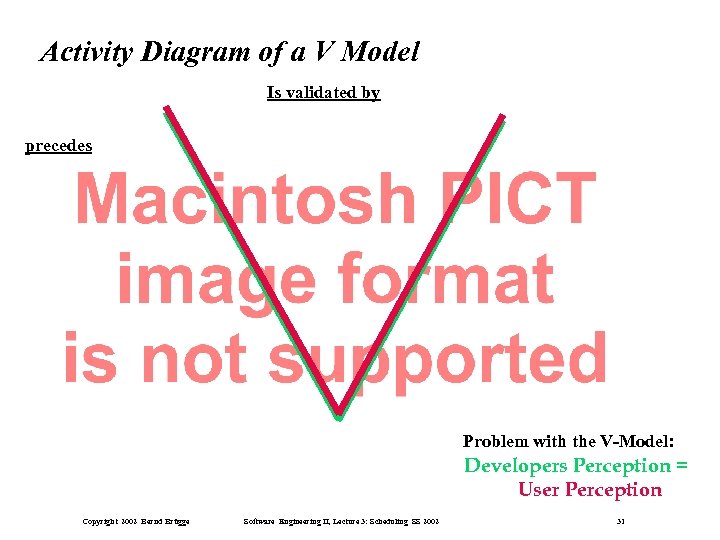
Activity Diagram of a V Model Is validated by precedes Problem with the V-Model: Developers Perception = User Perception Copyright 2002 Bernd Brügge Software Engineering II, Lecture 3: Scheduling SS 2002 31
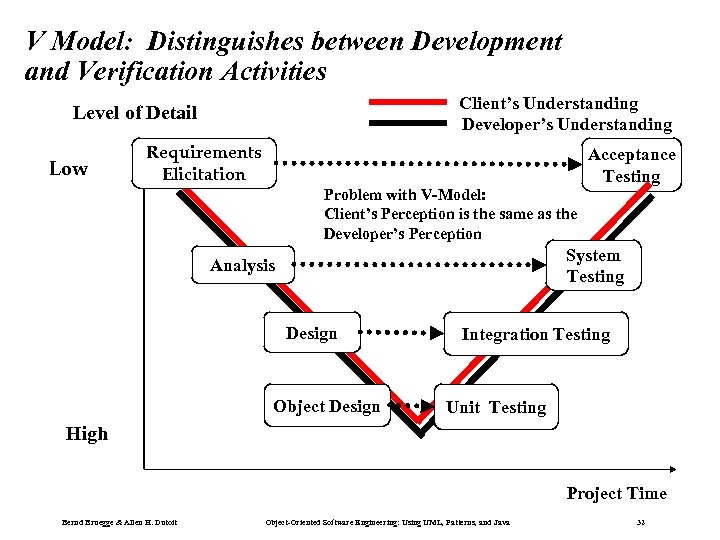
V Model: Distinguishes between Development and Verification Activities Client’s Understanding Developer’s Understanding Level of Detail Low Requirements Elicitation Acceptance Testing Problem with V-Model: Client’s Perception is the same as the Developer’s Perception System Testing Analysis Design Object Design Integration Testing Unit Testing High Project Time Bernd Bruegge & Allen H. Dutoit Object-Oriented Software Engineering: Using UML, Patterns, and Java 32
Problems with V Model ¨ ¨ The V model and its variants do not distinguish temporal and logical dependencies, but fold them into one type of association In particular, the V model does not model iteration Bernd Bruegge & Allen H. Dutoit Object-Oriented Software Engineering: Using UML, Patterns, and Java 33
Properties of Waterfall -based Models Managers love waterfall models: Nice milestones No need to look back (linear system) Always one activity at a time Easy to check progress during development: 90% coded, 20% tested However, software development is nonlinear While a design is being developed, problems with requirements are identified While a program is being coded, design and requirement problems are found While a program is tested, coding errors, design errors and requirement errors are found Copyright 2002 Bernd Brügge Software Engineering II, Lecture 3: Scheduling SS 2002 34
The Alternative: Allow Iteration Escher was the first: -) Copyright 2002 Bernd Brügge Software Engineering II, Lecture 3: Scheduling SS 2002 35
Spiral Model (Boehm) Deals with Iteration ¨ The spiral model proposed by Boehm is an iterative model with the following activities Determine objectives and constraints Evaluate Alternatives Identify risks Resolve risks by assigning priorities to risks Develop a series of prototypes for the identified risks starting with the highest risk. Use a waterfall model for each prototype development (“cycle”) If a risk has successfully been resolved, evaluate the results of the “cycle” and plan the next round If a certain risk cannot be resolved, terminate the project immediately Bernd Bruegge & Allen H. Dutoit Object-Oriented Software Engineering: Using UML, Patterns, and Java 36
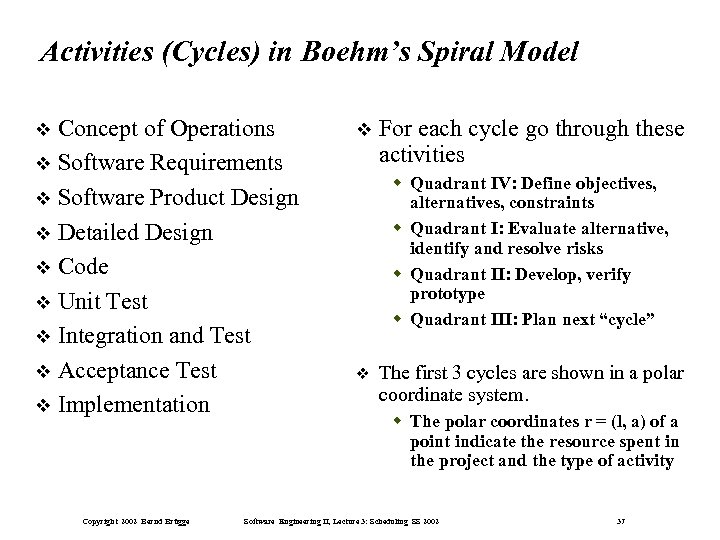
Activities (Cycles) in Boehm’s Spiral Model Concept of Operations Software Requirements Software Product Design Detailed Design Code Unit Test Integration and Test Acceptance Test Implementation Copyright 2002 Bernd Brügge For each cycle go through these activities Quadrant IV: Define objectives, alternatives, constraints Quadrant I: Evaluate alternative, identify and resolve risks Quadrant II: Develop, verify prototype Quadrant III: Plan next “cycle” The first 3 cycles are shown in a polar coordinate system. The polar coordinates r = (l, a) of a point indicate the resource spent in the project and the type of activity Software Engineering II, Lecture 3: Scheduling SS 2002 37
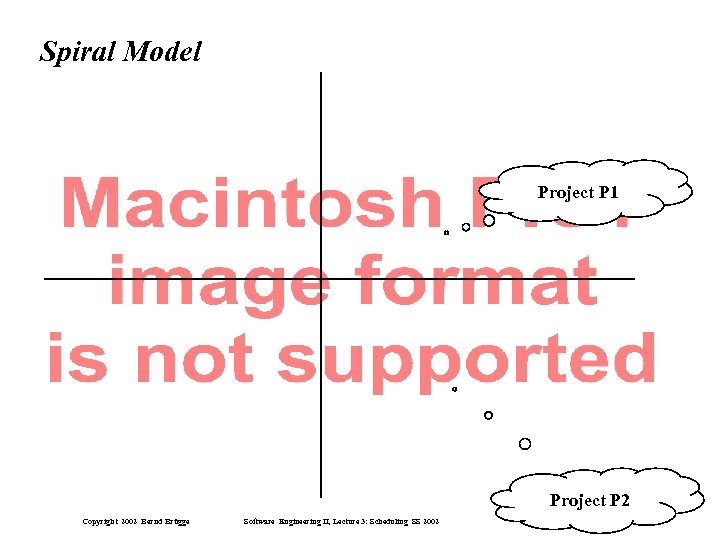
Spiral Model Project P 1 Project P 2 Copyright 2002 Bernd Brügge Software Engineering II, Lecture 3: Scheduling SS 2002 38
Cycle 1, Quadrant IV: Determine Objectives, Alternatives and Constraints Project Start Copyright 2002 Bernd Brügge Software Engineering II, Lecture 3: Scheduling SS 2002 39
Cycle 1, Quadrant I: Evaluate Alternatives, Identify, resolve risks Build Prototype Copyright 2002 Bernd Brügge Software Engineering II, Lecture 3: Scheduling SS 2002 40
Cycle 1, Quadrant II: Develop & Verify Product Concept of Operation Activity Copyright 2002 Bernd Brügge Software Engineering II, Lecture 3: Scheduling SS 2002 41
Cycle 1, Quadrant III: Prepare for Next Activity Requirements and Life cycle Planning Copyright 2002 Bernd Brügge Software Engineering II, Lecture 3: Scheduling SS 2002 42
Cycle 2, Quadrant IV: Software Requirements Activity Start of Round 2 Copyright 2002 Bernd Brügge Software Engineering II, Lecture 3: Scheduling SS 2002 43
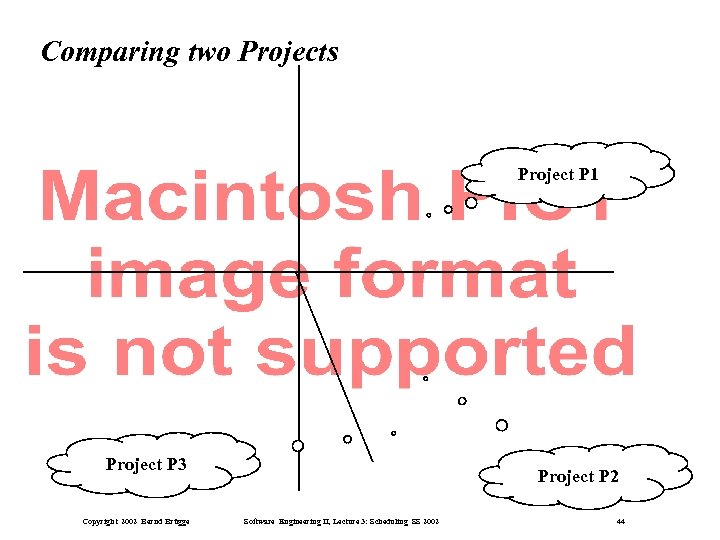
Comparing two Projects Project P 1 Project P 3 Copyright 2002 Bernd Brügge Project P 2 Software Engineering II, Lecture 3: Scheduling SS 2002 44
The Limitations of the Waterfall and Spiral Models ¨ Neither of these model deals well with frequent change The Waterfall model assume that once you are done with a phase, all issues covered in that phase are closed and cannot be reopened The Spiral model can deal with change between phases, but once inside a phase, no change is allowed ¨ What do you do if change is happening more frequently? (“The only constant is the change”) Bernd Bruegge & Allen H. Dutoit Object-Oriented Software Engineering: Using UML, Patterns, and Java 45
Types of Prototypes used in the Spiral Model Illustrative Prototype Develop the user interface with a set of storyboards Implement them on a napkin or with a user interface builder (Visual C++, . . ) Good for first dialog with client Functional Prototype Implement and deliver an operational system with minimum functionality Then add more functionality Order identified by risk Exploratory Prototype ("Hacking") Implement part of the system to learn more about the requirements. Good for paradigm breaks Copyright 2002 Bernd Brügge Software Engineering II, Lecture 3: Scheduling SS 2002 46
Types of Prototyping ctd Revolutionary Prototyping Also called specification prototyping Get user experience with a throwaway version to get the requirements right, then build the whole system Disadvantage: Users may have to accept that features in the prototype are expensive to implement User may be disappointed when some of the functionality and user interface evaporates because it can not be made available in the implementation environment Evolutionary Prototyping The prototype is used as the basis for the implementation of the final system Advantage: Short time to market Disadvantage: Can be used only if target system can be constructed in prototyping language Copyright 2002 Bernd Brügge Software Engineering II, Lecture 3: Scheduling SS 2002 47
Prototyping vs Rapid Development Revolutionary prototyping is sometimes called rapid prototyping Rapid Prototyping is not a good term because it confuses prototyping with rapid development Prototyping is a technical issue: It is a particular model in the life cycle process Rapid development is a management issue. It is a particular way to control a project Prototyping can go on forever if it is not restricted “Time-boxed” prototyping limits the duration of the prototype development Copyright 2002 Bernd Brügge Software Engineering II, Lecture 3: Scheduling SS 2002 48
Limitations of Waterfall and Spiral Models Neither of these model deals well with frequent change The Waterfall model assume that once you are done with a phase, all issues covered in that phase are closed and cannot be reopened The Spiral model can deal with change between phases, but once inside a phase, no change is allowed What do you do if change is happening more frequently? “The only constant is the change” Copyright 2002 Bernd Brügge Software Engineering II, Lecture 3: Scheduling SS 2002 49
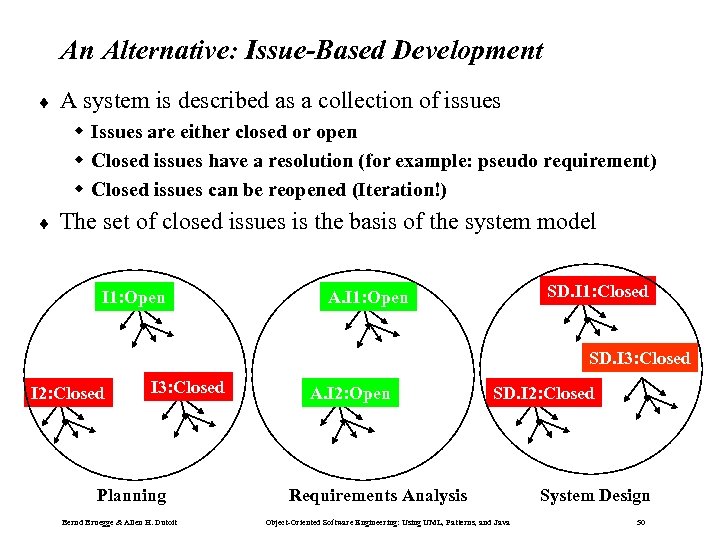
An Alternative: Issue-Based Development ¨ A system is described as a collection of issues Issues are either closed or open Closed issues have a resolution (for example: pseudo requirement) Closed issues can be reopened (Iteration!) ¨ The set of closed issues is the basis of the system model I 1: Open SD. I 1: Closed A. I 1: Open SD. I 3: Closed I 2: Closed I 3: Closed Planning Bernd Bruegge & Allen H. Dutoit A. I 2: Open SD. I 2: Closed Requirements Analysis Object-Oriented Software Engineering: Using UML, Patterns, and Java System Design 50
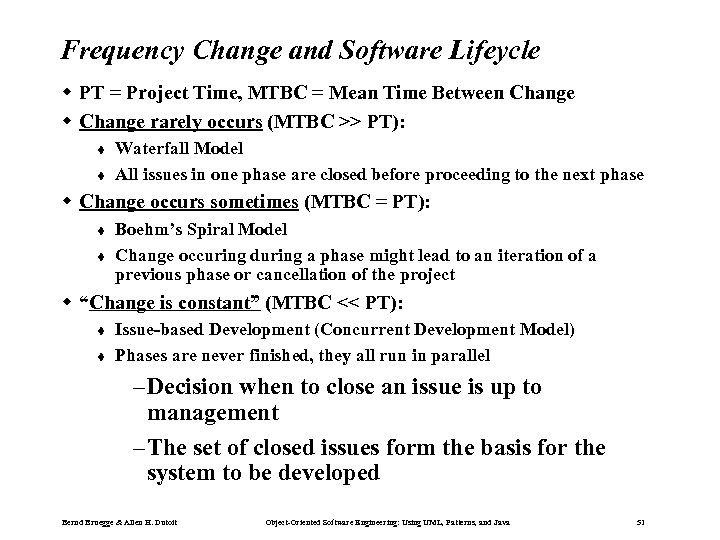
Frequency Change and Software Lifeycle PT = Project Time, MTBC = Mean Time Between Change rarely occurs (MTBC >> PT): t t Waterfall Model All issues in one phase are closed before proceeding to the next phase Change occurs sometimes (MTBC = PT): t t Boehm’s Spiral Model Change occuring during a phase might lead to an iteration of a previous phase or cancellation of the project “Change is constant” (MTBC << PT): t t Issue-based Development (Concurrent Development Model) Phases are never finished, they all run in parallel – Decision when to close an issue is up to management – The set of closed issues form the basis for the system to be developed Bernd Bruegge & Allen H. Dutoit Object-Oriented Software Engineering: Using UML, Patterns, and Java 51
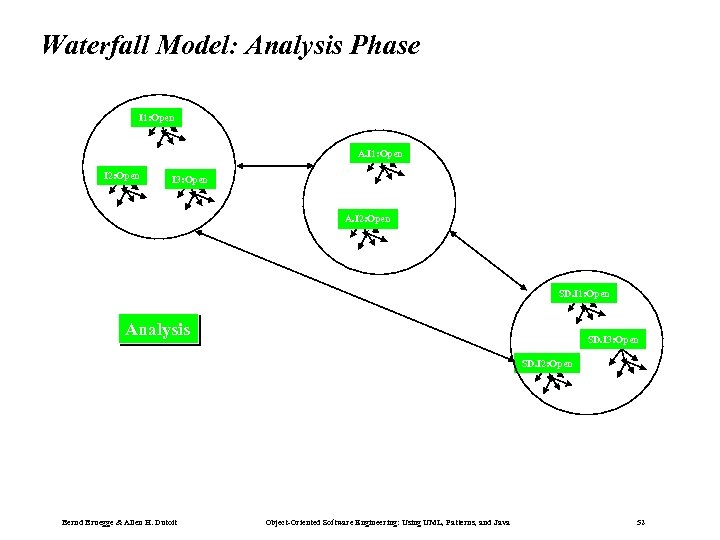
Waterfall Model: Analysis Phase I 1: Open A. I 1: Open I 2: Open I 3: Open A. I 2: Open SD. I 1: Open Analysis SD. I 3: Open SD. I 2: Open Bernd Bruegge & Allen H. Dutoit Object-Oriented Software Engineering: Using UML, Patterns, and Java 52
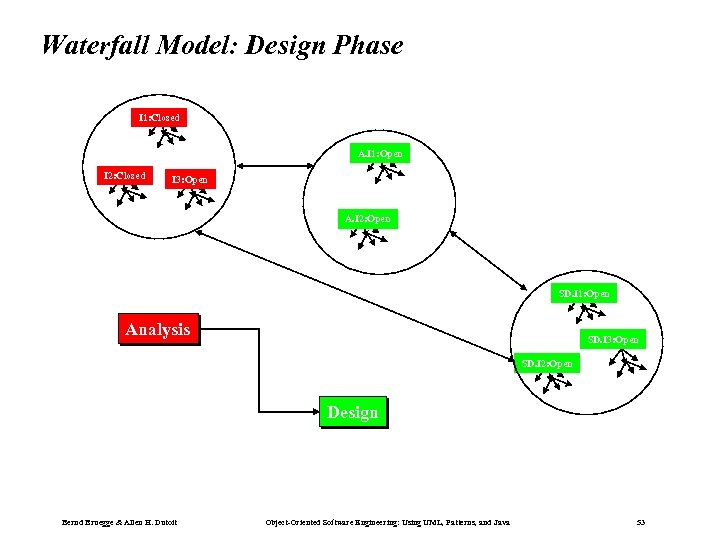
Waterfall Model: Design Phase I 1: Closed A. I 1: Open I 2: Closed I 3: Open A. I 2: Open SD. I 1: Open Analysis SD. I 3: Open SD. I 2: Open Design Bernd Bruegge & Allen H. Dutoit Object-Oriented Software Engineering: Using UML, Patterns, and Java 53
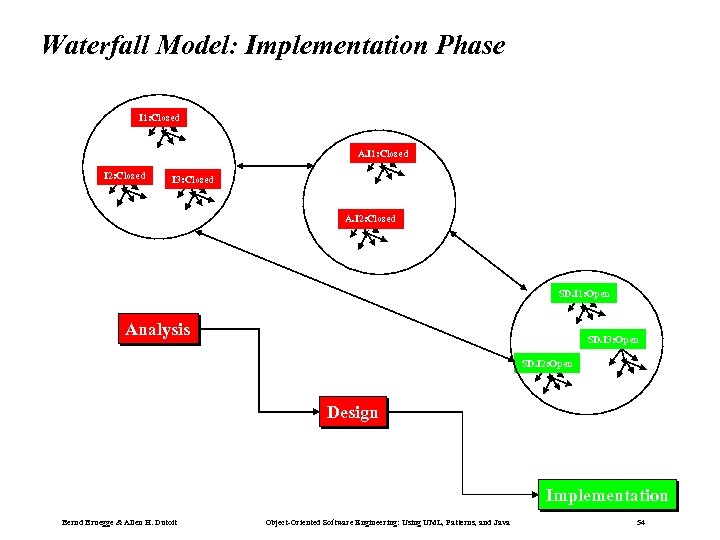
Waterfall Model: Implementation Phase I 1: Closed A. I 1: Closed I 2: Closed I 3: Closed A. I 2: Closed SD. I 1: Open Analysis SD. I 3: Open SD. I 2: Open Design Implementation Bernd Bruegge & Allen H. Dutoit Object-Oriented Software Engineering: Using UML, Patterns, and Java 54
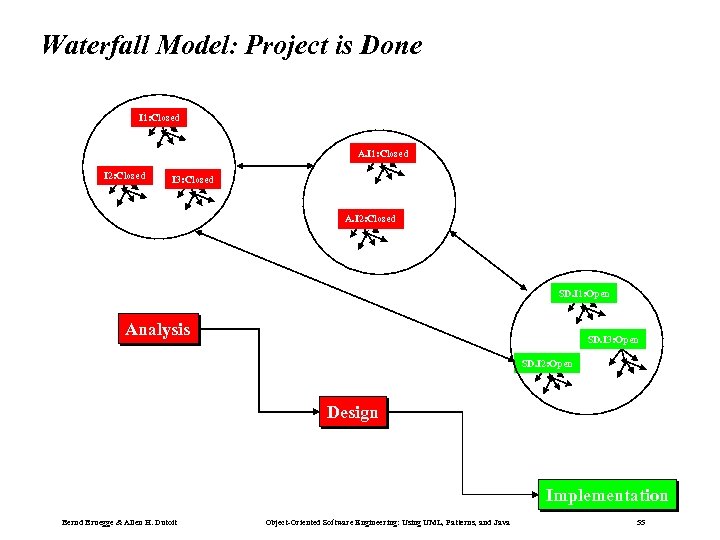
Waterfall Model: Project is Done I 1: Closed A. I 1: Closed I 2: Closed I 3: Closed A. I 2: Closed SD. I 1: Open Analysis SD. I 3: Open SD. I 2: Open Design Implementation Bernd Bruegge & Allen H. Dutoit Object-Oriented Software Engineering: Using UML, Patterns, and Java 55
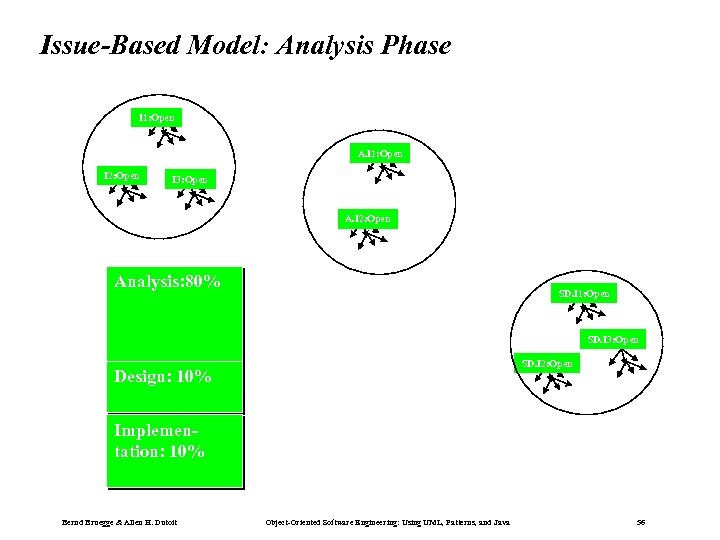
Issue-Based Model: Analysis Phase I 1: Open A. I 1: Open I 2: Open I 3: Open A. I 2: Open Analysis: 80% SD. I 1: Open SD. I 3: Open SD. I 2: Open Design: 10% Implementation: 10% Bernd Bruegge & Allen H. Dutoit Object-Oriented Software Engineering: Using UML, Patterns, and Java 56
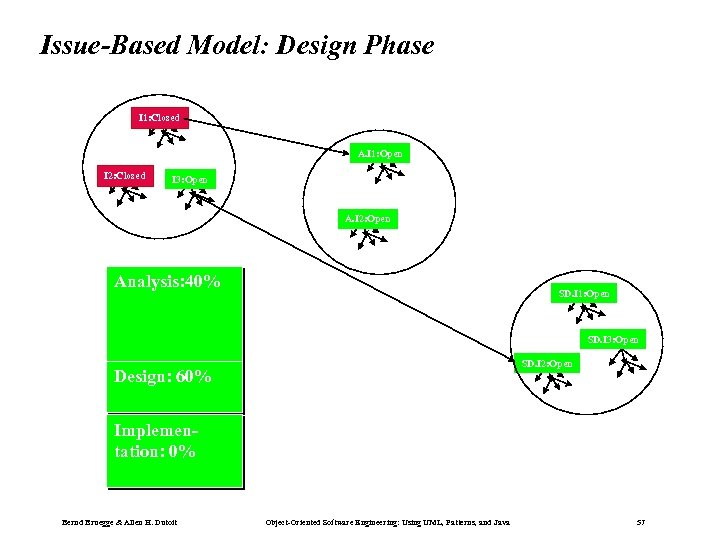
Issue-Based Model: Design Phase I 1: Closed A. I 1: Open I 2: Closed I 3: Open A. I 2: Open Analysis: 40% SD. I 1: Open SD. I 3: Open SD. I 2: Open Design: 60% Implementation: 0% Bernd Bruegge & Allen H. Dutoit Object-Oriented Software Engineering: Using UML, Patterns, and Java 57
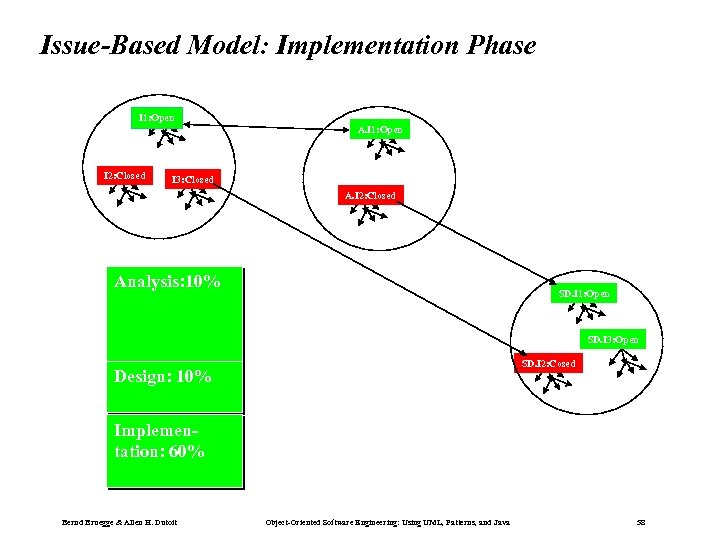
Issue-Based Model: Implementation Phase I 1: Open A. I 1: Open I 2: Closed I 3: Closed A. I 2: Closed Analysis: 10% SD. I 1: Open SD. I 3: Open SD. I 2: Cosed Design: 10% Implementation: 60% Bernd Bruegge & Allen H. Dutoit Object-Oriented Software Engineering: Using UML, Patterns, and Java 58
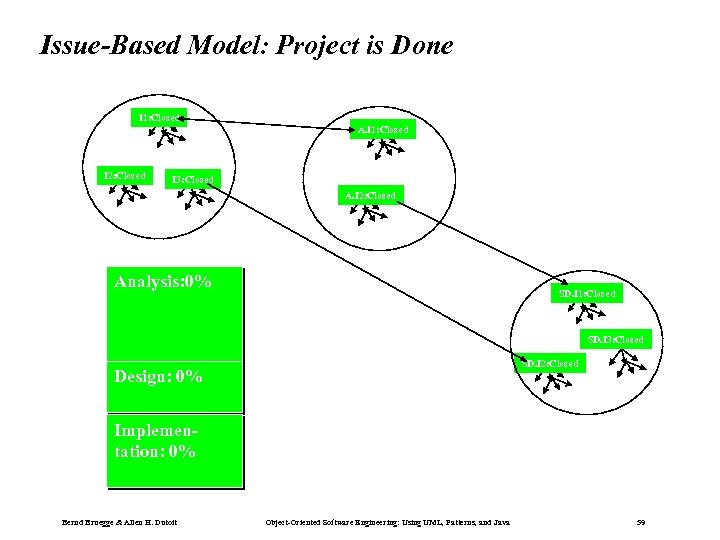
Issue-Based Model: Project is Done I 1: Closed A. I 1: Closed I 2: Closed I 3: Closed A. I 2: Closed Analysis: 0% SD. I 1: Closed SD. I 3: Closed SD. I 2: Closed Design: 0% Implementation: 0% Bernd Bruegge & Allen H. Dutoit Object-Oriented Software Engineering: Using UML, Patterns, and Java 59
Process Maturity ¨ A software development process is mature if the development activities are well defined and if management has some control over the quality, budget and schedule of the project ¨ Process maturity is described with a set of maturity levels and the associated measurements (metrics) to manage the process ¨ Assumption: With increasing maturity the risk of project failure decreases Bernd Bruegge & Allen H. Dutoit Object-Oriented Software Engineering: Using UML, Patterns, and Java 60
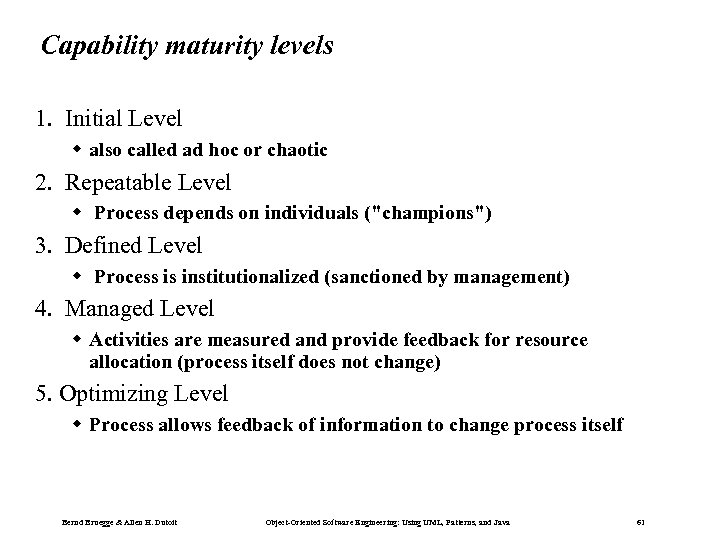
Capability maturity levels 1. Initial Level also called ad hoc or chaotic 2. Repeatable Level Process depends on individuals ("champions") 3. Defined Level Process is institutionalized (sanctioned by management) 4. Managed Level Activities are measured and provide feedback for resource allocation (process itself does not change) 5. Optimizing Level Process allows feedback of information to change process itself Bernd Bruegge & Allen H. Dutoit Object-Oriented Software Engineering: Using UML, Patterns, and Java 61
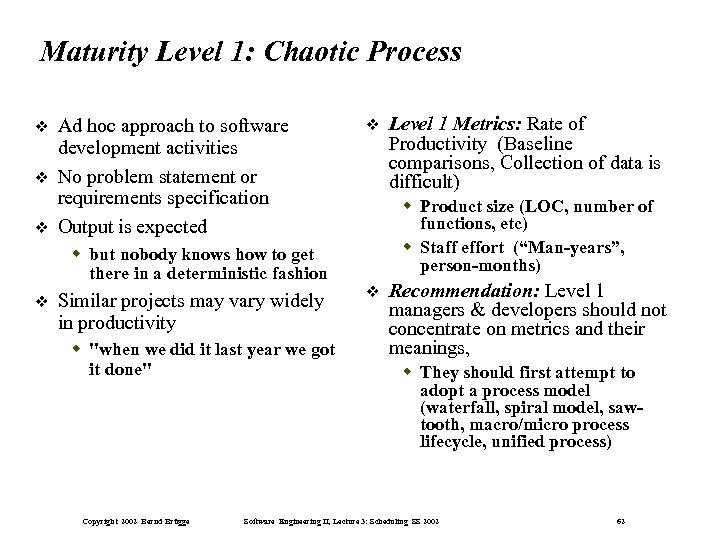
Maturity Level 1: Chaotic Process Ad hoc approach to software development activities No problem statement or requirements specification Output is expected but nobody knows how to get there in a deterministic fashion Similar projects may vary widely in productivity "when we did it last year we got it done" Copyright 2002 Bernd Brügge Level 1 Metrics: Rate of Productivity (Baseline comparisons, Collection of data is difficult) Product size (LOC, number of functions, etc) Staff effort (“Man-years”, person-months) Recommendation: Level 1 managers & developers should not concentrate on metrics and their meanings, They should first attempt to adopt a process model (waterfall, spiral model, sawtooth, macro/micro process lifecycle, unified process) Software Engineering II, Lecture 3: Scheduling SS 2002 62
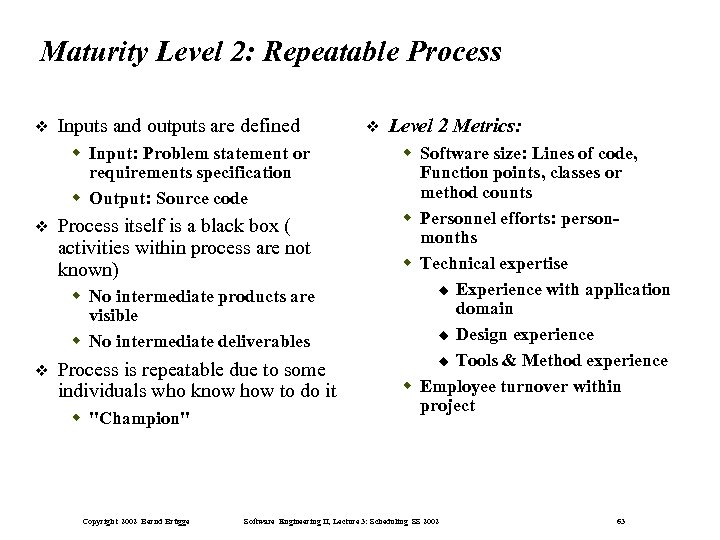
Maturity Level 2: Repeatable Process Inputs and outputs are defined Input: Problem statement or requirements specification Output: Source code Process itself is a black box ( activities within process are not known) No intermediate products are visible No intermediate deliverables Process is repeatable due to some individuals who know how to do it "Champion" Copyright 2002 Bernd Brügge Level 2 Metrics: Software size: Lines of code, Function points, classes or method counts Personnel efforts: personmonths Technical expertise Experience with application domain Design experience Tools & Method experience Employee turnover within project Software Engineering II, Lecture 3: Scheduling SS 2002 63
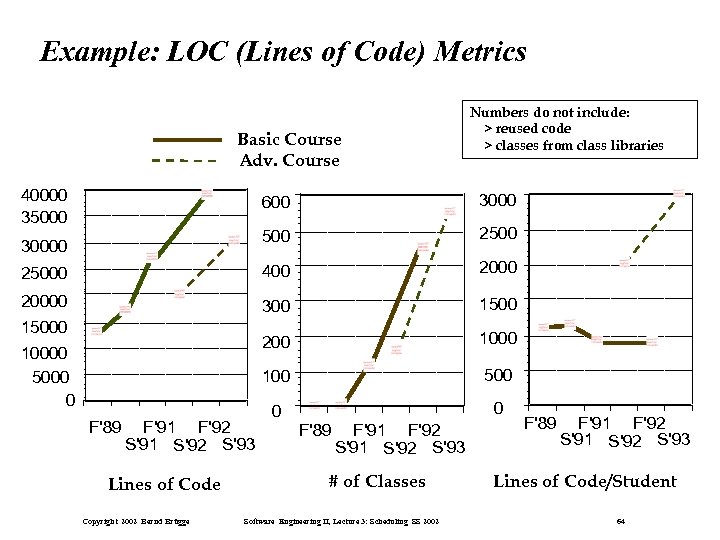
Example: LOC (Lines of Code) Metrics Basic Course Adv. Course 40000 35000 Numbers do not include: > reused code > classes from class libraries 600 3000 500 25000 400 20000 300 1500 200 100 500 0 0 30000 15000 10000 5000 0 F'89 F'91 F'92 S'91 S'92 S'93 Lines of Code Copyright 2002 Bernd Brügge F'89 F'91 F'92 S'91 S'92 S'93 # of Classes Software Engineering II, Lecture 3: Scheduling SS 2002 F'89 F'91 F'92 S'91 S'92 S'93 Lines of Code/Student 64
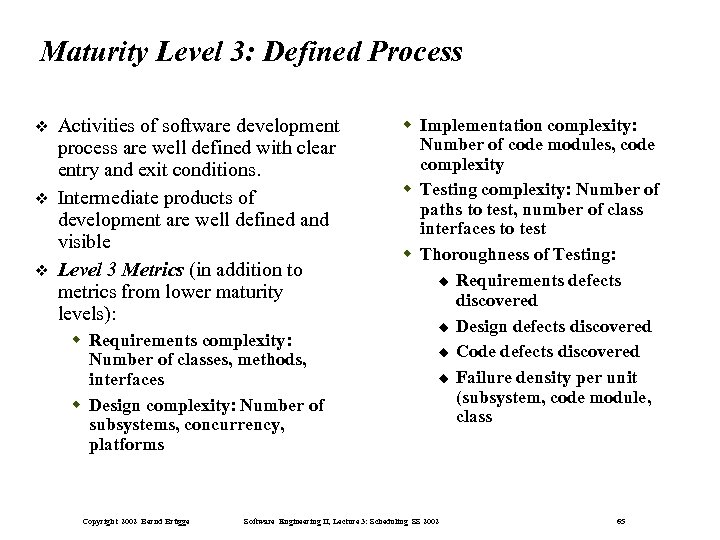
Maturity Level 3: Defined Process Activities of software development process are well defined with clear entry and exit conditions. Intermediate products of development are well defined and visible Level 3 Metrics (in addition to metrics from lower maturity levels): Requirements complexity: Number of classes, methods, interfaces Design complexity: Number of subsystems, concurrency, platforms Copyright 2002 Bernd Brügge Implementation complexity: Number of code modules, code complexity Testing complexity: Number of paths to test, number of class interfaces to test Thoroughness of Testing: Requirements defects discovered Design defects discovered Code defects discovered Failure density per unit (subsystem, code module, class Software Engineering II, Lecture 3: Scheduling SS 2002 65
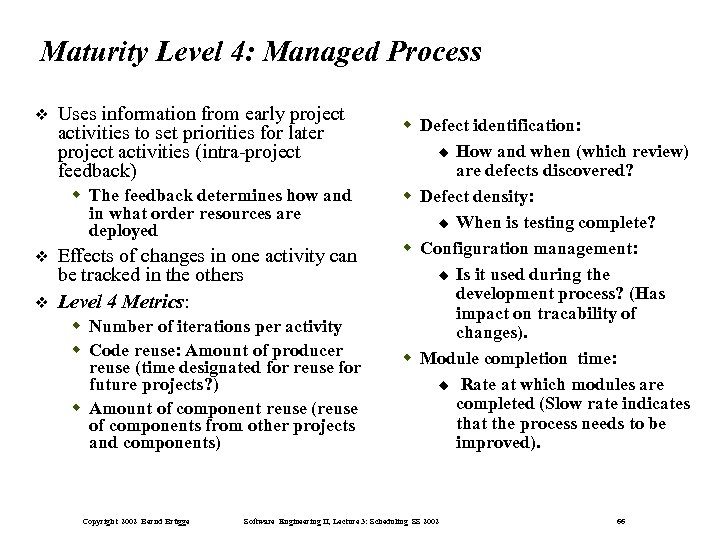
Maturity Level 4: Managed Process Uses information from early project activities to set priorities for later project activities (intra-project feedback) The feedback determines how and in what order resources are deployed Effects of changes in one activity can be tracked in the others Level 4 Metrics: Number of iterations per activity Code reuse: Amount of producer reuse (time designated for reuse for future projects? ) Amount of component reuse (reuse of components from other projects and components) Copyright 2002 Bernd Brügge Defect identification: How and when (which review) are defects discovered? Defect density: When is testing complete? Configuration management: Is it used during the development process? (Has impact on tracability of changes). Module completion time: Rate at which modules are completed (Slow rate indicates that the process needs to be improved). Software Engineering II, Lecture 3: Scheduling SS 2002 66
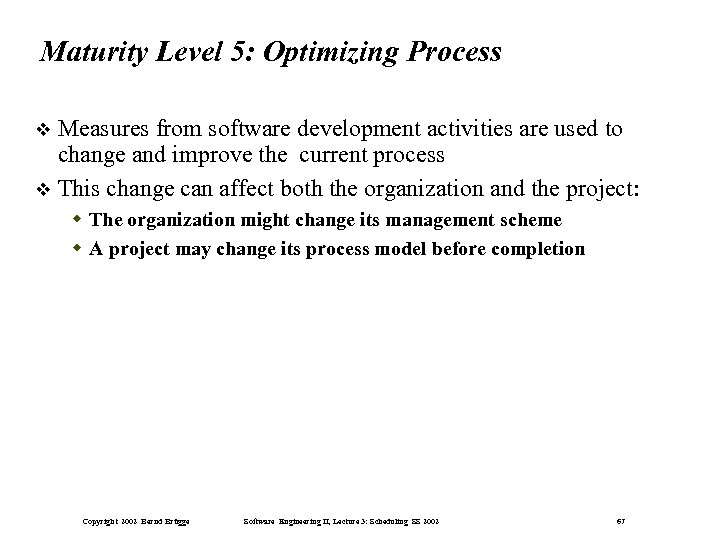
Maturity Level 5: Optimizing Process Measures from software development activities are used to change and improve the current process This change can affect both the organization and the project: The organization might change its management scheme A project may change its process model before completion Copyright 2002 Bernd Brügge Software Engineering II, Lecture 3: Scheduling SS 2002 67
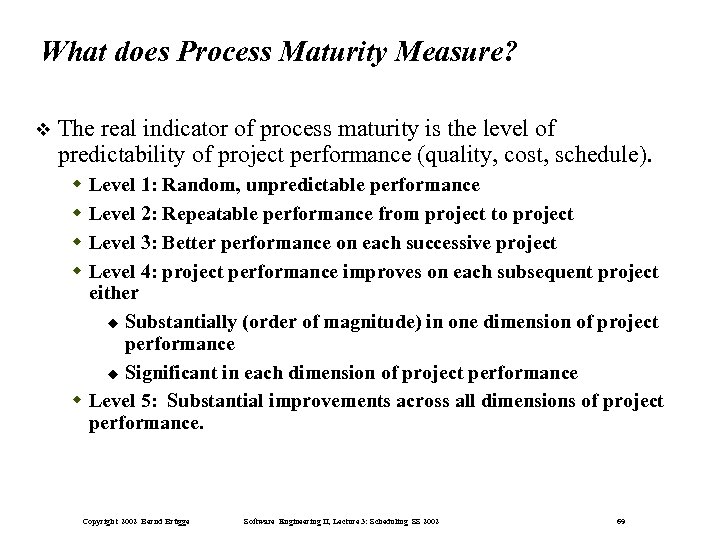
What does Process Maturity Measure? The real indicator of process maturity is the level of predictability of project performance (quality, cost, schedule). Level 1: Random, unpredictable performance Level 2: Repeatable performance from project to project Level 3: Better performance on each successive project Level 4: project performance improves on each subsequent project either Substantially (order of magnitude) in one dimension of project performance Significant in each dimension of project performance Level 5: Substantial improvements across all dimensions of project performance. Copyright 2002 Bernd Brügge Software Engineering II, Lecture 3: Scheduling SS 2002 69
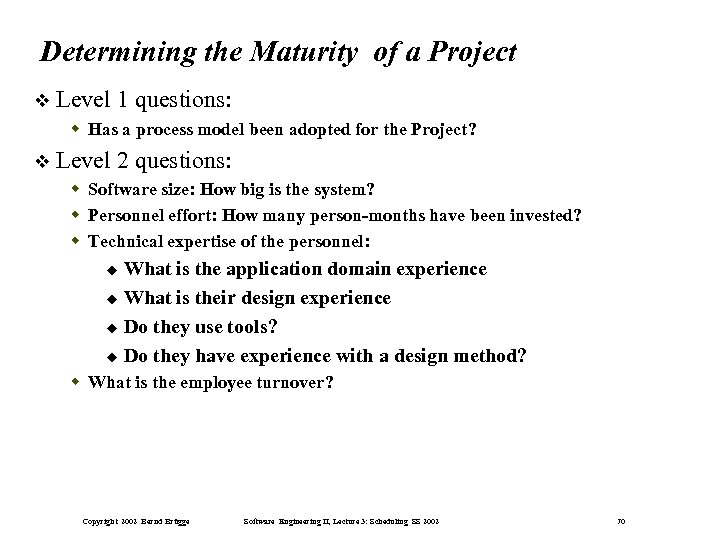
Determining the Maturity of a Project Level 1 questions: Has a process model been adopted for the Project? Level 2 questions: Software size: How big is the system? Personnel effort: How many person-months have been invested? Technical expertise of the personnel: What is the application domain experience What is their design experience Do they use tools? Do they have experience with a design method? What is the employee turnover? Copyright 2002 Bernd Brügge Software Engineering II, Lecture 3: Scheduling SS 2002 70
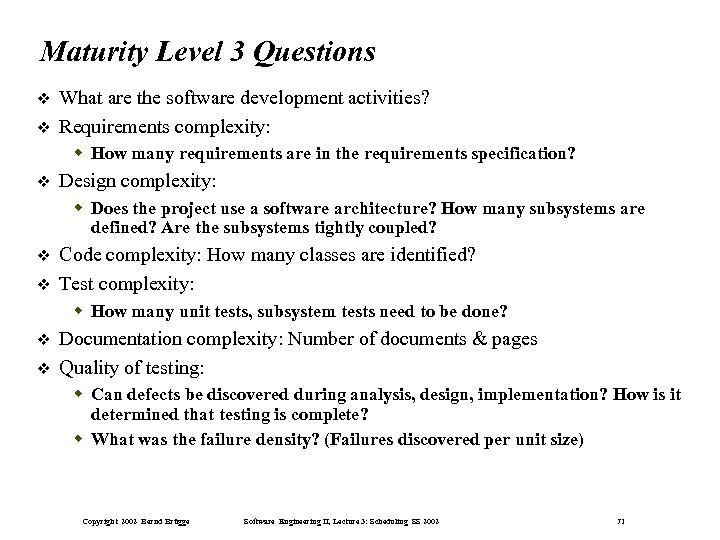
Maturity Level 3 Questions What are the software development activities? Requirements complexity: How many requirements are in the requirements specification? Design complexity: Does the project use a software architecture? How many subsystems are defined? Are the subsystems tightly coupled? Code complexity: How many classes are identified? Test complexity: How many unit tests, subsystem tests need to be done? Documentation complexity: Number of documents & pages Quality of testing: Can defects be discovered during analysis, design, implementation? How is it determined that testing is complete? What was the failure density? (Failures discovered per unit size) Copyright 2002 Bernd Brügge Software Engineering II, Lecture 3: Scheduling SS 2002 71
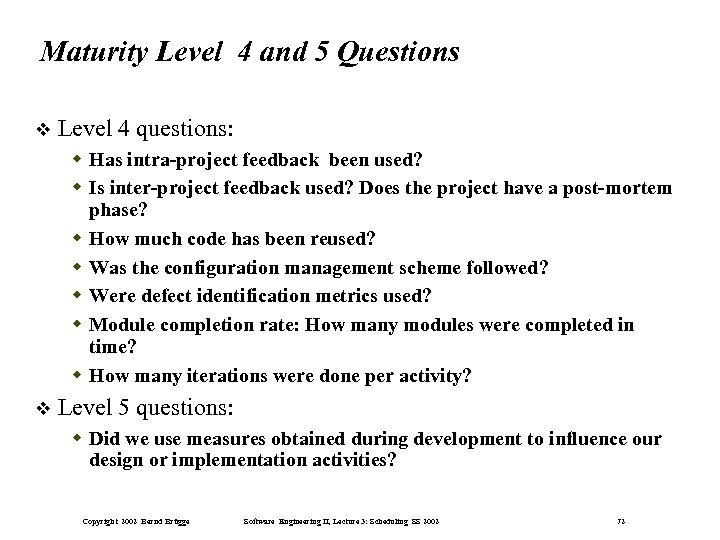
Maturity Level 4 and 5 Questions Level 4 questions: Has intra-project feedback been used? Is inter-project feedback used? Does the project have a post-mortem phase? How much code has been reused? Was the configuration management scheme followed? Were defect identification metrics used? Module completion rate: How many modules were completed in time? How many iterations were done per activity? Level 5 questions: Did we use measures obtained during development to influence our design or implementation activities? Copyright 2002 Bernd Brügge Software Engineering II, Lecture 3: Scheduling SS 2002 72
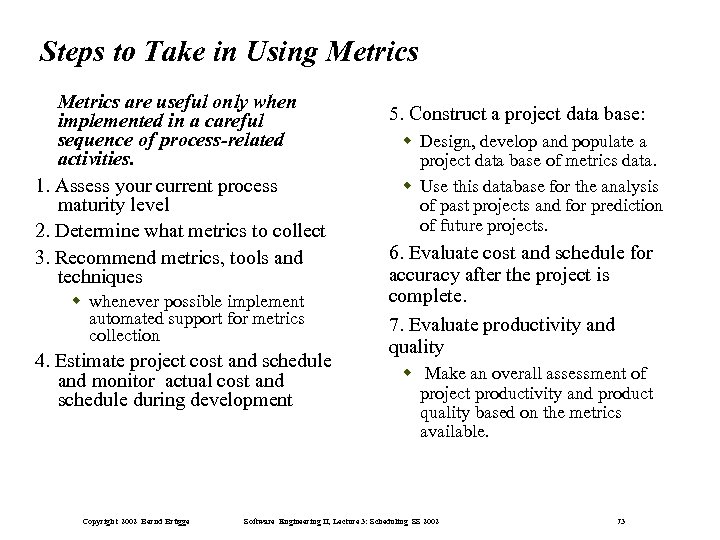
Steps to Take in Using Metrics are useful only when implemented in a careful sequence of process-related activities. 1. Assess your current process maturity level 2. Determine what metrics to collect 3. Recommend metrics, tools and techniques whenever possible implement automated support for metrics collection 4. Estimate project cost and schedule and monitor actual cost and schedule during development Copyright 2002 Bernd Brügge 5. Construct a project data base: Design, develop and populate a project data base of metrics data. Use this database for the analysis of past projects and for prediction of future projects. 6. Evaluate cost and schedule for accuracy after the project is complete. 7. Evaluate productivity and quality Make an overall assessment of project productivity and product quality based on the metrics available. Software Engineering II, Lecture 3: Scheduling SS 2002 73
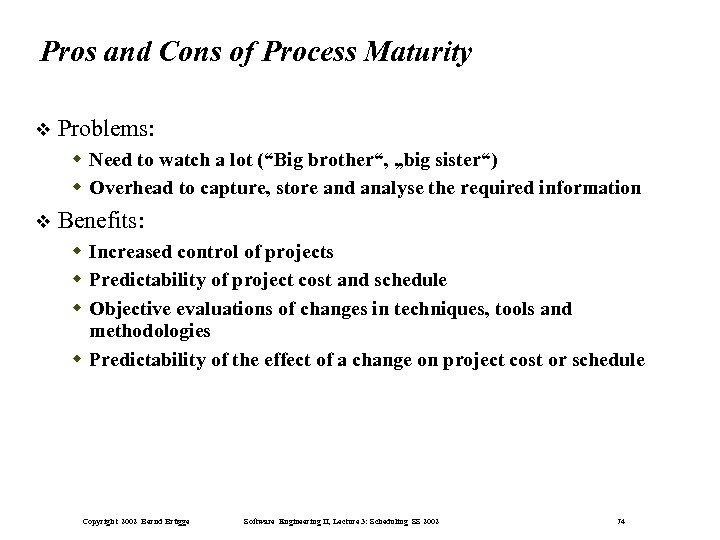
Pros and Cons of Process Maturity Problems: Need to watch a lot (“Big brother“, „big sister“) Overhead to capture, store and analyse the required information Benefits: Increased control of projects Predictability of project cost and schedule Objective evaluations of changes in techniques, tools and methodologies Predictability of the effect of a change on project cost or schedule Copyright 2002 Bernd Brügge Software Engineering II, Lecture 3: Scheduling SS 2002 74
![References Readings used for this lecture [Humphrey 1989] Watts Humphrey, Managing the Software Process,](https://present5.com/presentation/63ae90ebbef007ad3b4412cad7f73ef2/image-74.jpg "References Readings used for this lecture [Humphrey 1989] Watts Humphrey, Managing the Software Process,")
References Readings used for this lecture [Humphrey 1989] Watts Humphrey, Managing the Software Process, SEI Series in Software Engineering, Addison Wesley, ISBN 0 -201 -18095 -2 Additional References [Royce 1970] Winston Royce, Managing the Development of Large Software Systems, Proceedings of the IEEE WESCON, August 1970, pp. 1 -9 SEI Maturity Questionaire, Appendix E. 3 in [Royce 1998], Walker Royce, Software Project Management, Addison-Wesley, ISBN 0 -20130958 -0 Copyright 2002 Bernd Brügge Software Engineering II, Lecture 3: Scheduling SS 2002 75
Summary ¨ Software life cycle The development process is broken into individual pieces called software development activities ¨ No good model for modeling the process (black art) Existing models are an inexact representation of reality Nothing really convincing is available today ¨ Software development standards IEEE 1074 Standards help, but must be taken with a grain of salt The standard allows the lifecycle to be tailored ¨ Capability Maturity Model. Bernd Bruegge & Allen H. Dutoit Object-Oriented Software Engineering: Using UML, Patterns, and Java 76
Backup Slides Bernd Bruegge & Allen H. Dutoit Object-Oriented Software Engineering: Using UML, Patterns, and Java 77
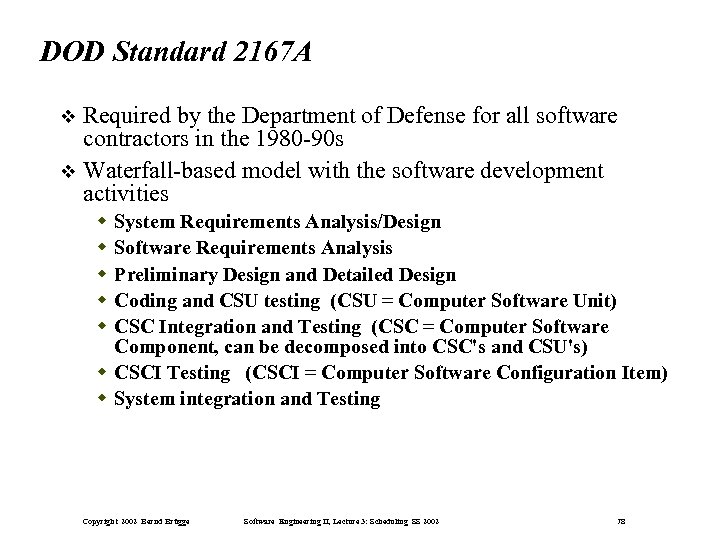
DOD Standard 2167 A Required by the Department of Defense for all software contractors in the 1980 -90 s Waterfall-based model with the software development activities System Requirements Analysis/Design Software Requirements Analysis Preliminary Design and Detailed Design Coding and CSU testing (CSU = Computer Software Unit) CSC Integration and Testing (CSC = Computer Software Component, can be decomposed into CSC's and CSU's) CSCI Testing (CSCI = Computer Software Configuration Item) System integration and Testing Copyright 2002 Bernd Brügge Software Engineering II, Lecture 3: Scheduling SS 2002 78
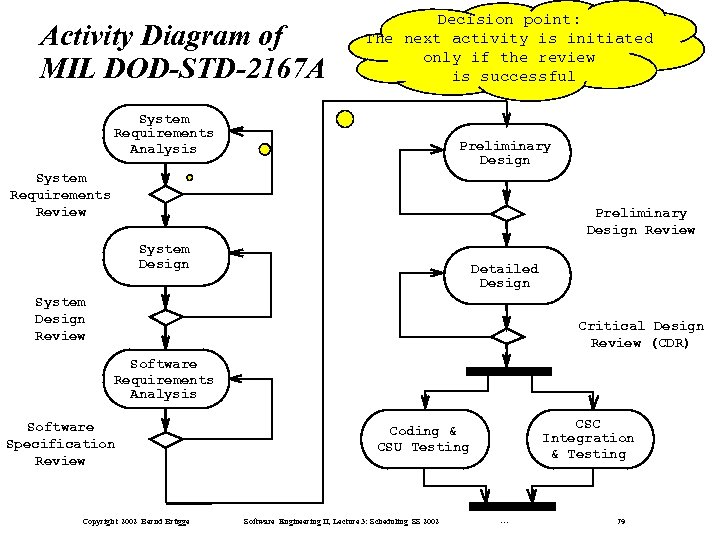
Activity Diagram of MIL DOD-STD-2167 A Decision point: The next activity is initiated only if the review is successful System Requirements Analysis Preliminary Design System Requirements Review Preliminary Design Review System Design Detailed Design System Design Review Critical Design Review (CDR) Software Requirements Analysis Software Specification Review Copyright 2002 Bernd Brügge CSC Integration & Testing Coding & CSU Testing Software Engineering II, Lecture 3: Scheduling SS 2002 … 79
Sharktooth Model Bernd Bruegge & Allen H. Dutoit User’s Understanding Manager’s Understanding Developer’s Understanding Object-Oriented Software Engineering: Using UML, Patterns, and Java 80
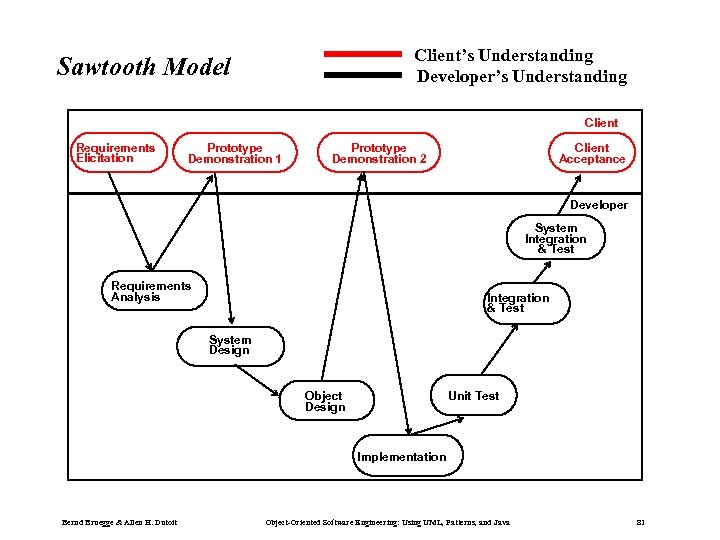
Client’s Understanding Developer’s Understanding Sawtooth Model Client Requirements Elicitation Prototype Demonstration 1 Prototype Demonstration 2 Client Acceptance Developer System Integration & Test Requirements Analysis Integration & Test System Design Unit Test Object Design Implementation Bernd Bruegge & Allen H. Dutoit Object-Oriented Software Engineering: Using UML, Patterns, and Java 81
V-Model Is validated by precedes Problem with the V-Model: Developers Perception = User Perception Bernd Bruegge & Allen H. Dutoit Object-Oriented Software Engineering: Using UML, Patterns, and Java 82
Spiral Model Bernd Bruegge & Allen H. Dutoit Object-Oriented Software Engineering: Using UML, Patterns, and Java 83
Unified Model Bernd Bruegge & Allen H. Dutoit Object-Oriented Software Engineering: Using UML, Patterns, and Java 84

The issue: What is the center of the Universe? Pope: "The earth is the center of the universe" Why? "Aristotle says so". Galileo: "The sun is the center of the universe" Why? "Copernicus says so". Also, "the Jupiter’s moons rotate round Jupiter, not around Earth". Bernd Bruegge & Allen H. Dutoit Object-Oriented Software Engineering: Using UML, Patterns, and Java 86
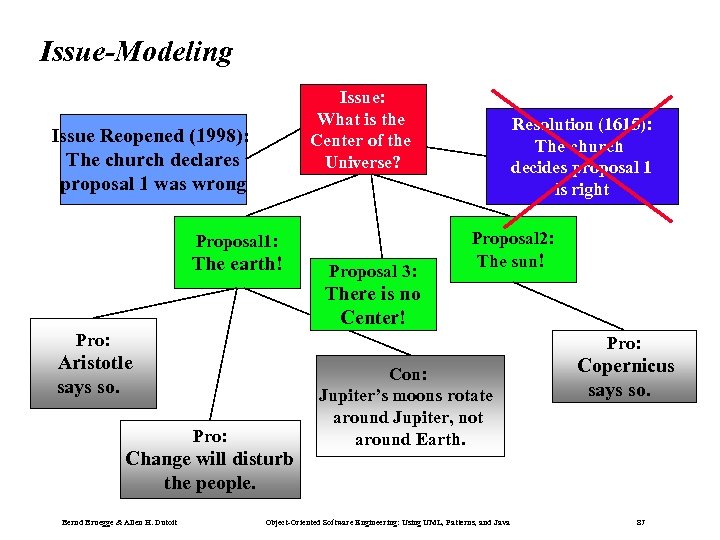
Issue-Modeling Issue: What is the Center of the Universe? Issue Reopened (1998): The church declares proposal 1 was wrong Proposal 1: The earth! Proposal 3: Resolution (1615): The church decides proposal 1 is right Proposal 2: The sun! There is no Center! Pro: Aristotle says so. Pro: Change will disturb the people. Bernd Bruegge & Allen H. Dutoit Con: Jupiter’s moons rotate around Jupiter, not around Earth. Object-Oriented Software Engineering: Using UML, Patterns, and Java Copernicus says so. 87
Скачать презентацию Using UML Patterns and Java Object-Oriented Software Engineering
63ae90ebbef007ad3b4412cad7f73ef2.ppt