 Скачать презентацию Using UML Patterns and Java Object-Oriented Software Engineering
d2a6b426b5bd5fbf142a2f55a376f0a3.ppt
- Количество слайдов: 37



Using UML, Patterns, and Java Object-Oriented Software Engineering Chapter 6 System Design: Decomposing the System
Design “There are two ways of constructing a software design: One way is to make it so simple that there are obviously no deficiencies, and the other way is to make it so complicated that there are no obvious deficiencies. ” - C. A. R. Hoare Bernd Bruegge & Allen H. Dutoit Object-Oriented Software Engineering: Using UML, Patterns, and Java 2
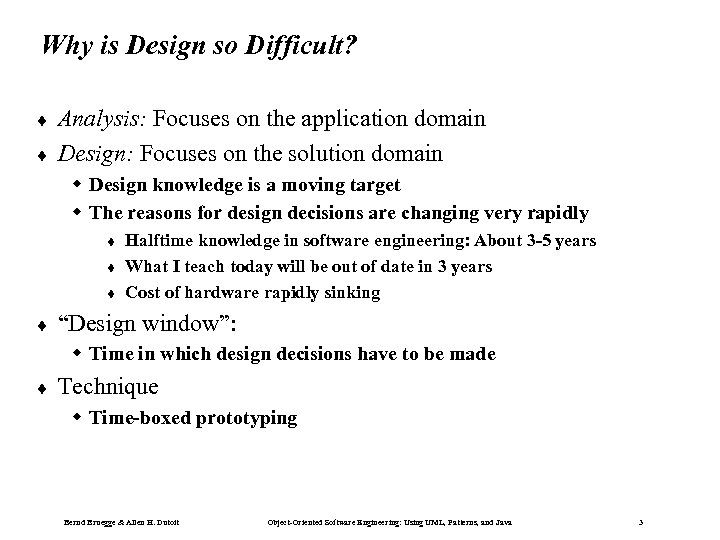
Why is Design so Difficult? ¨ ¨ Analysis: Focuses on the application domain Design: Focuses on the solution domain w Design knowledge is a moving target w The reasons for design decisions are changing very rapidly t t t ¨ Halftime knowledge in software engineering: About 3 -5 years What I teach today will be out of date in 3 years Cost of hardware rapidly sinking “Design window”: w Time in which design decisions have to be made ¨ Technique w Time-boxed prototyping Bernd Bruegge & Allen H. Dutoit Object-Oriented Software Engineering: Using UML, Patterns, and Java 3
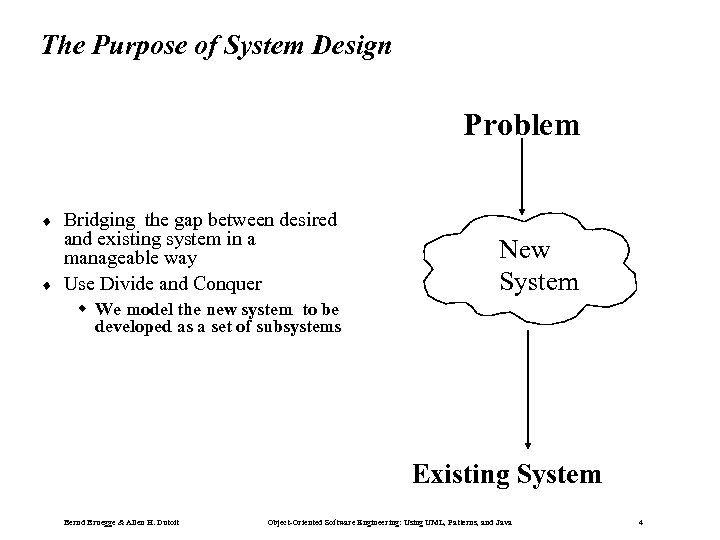
The Purpose of System Design Problem ¨ ¨ Bridging the gap between desired and existing system in a manageable way Use Divide and Conquer New System w We model the new system to be developed as a set of subsystems Existing System Bernd Bruegge & Allen H. Dutoit Object-Oriented Software Engineering: Using UML, Patterns, and Java 4
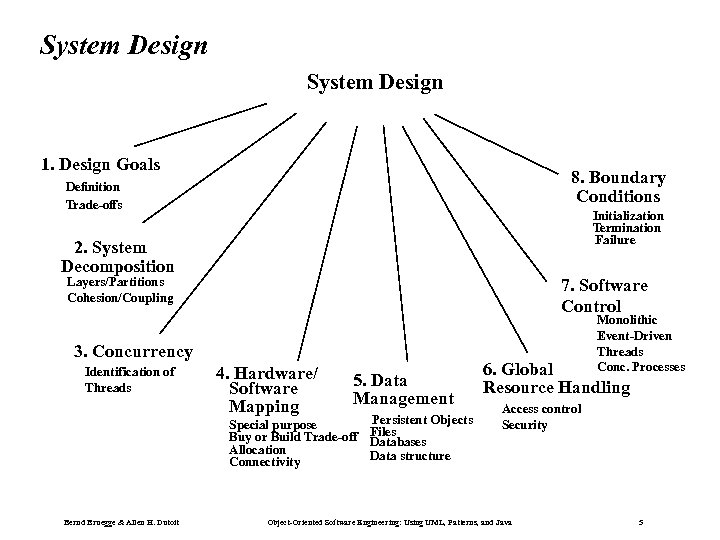
System Design 1. Design Goals 8. Boundary Conditions Definition Trade-offs Initialization Termination Failure 2. System Decomposition Layers/Partitions Cohesion/Coupling 7. Software Control 3. Concurrency Identification of Threads 4. Hardware/ Software Mapping 5. Data Management Persistent Objects Special purpose Files Buy or Build Trade-off Databases Allocation Data structure Connectivity Bernd Bruegge & Allen H. Dutoit Monolithic Event-Driven Threads Conc. Processes 6. Global Resource Handling Access control Security Object-Oriented Software Engineering: Using UML, Patterns, and Java 5
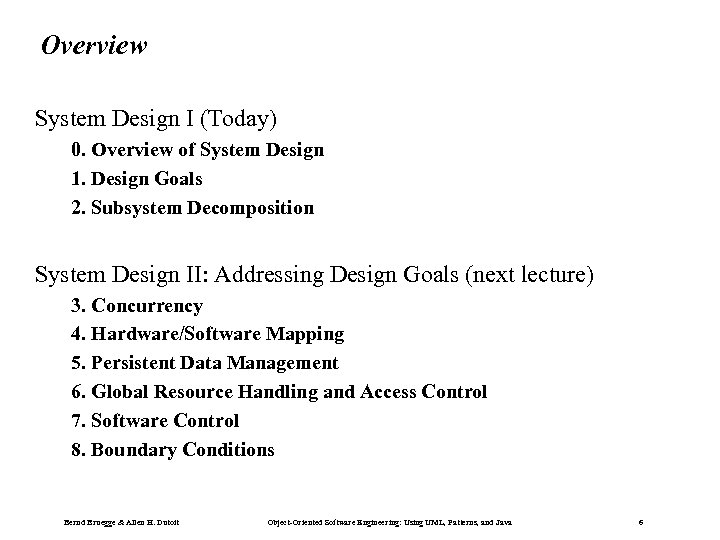
Overview System Design I (Today) 0. Overview of System Design 1. Design Goals 2. Subsystem Decomposition System Design II: Addressing Design Goals (next lecture) 3. Concurrency 4. Hardware/Software Mapping 5. Persistent Data Management 6. Global Resource Handling and Access Control 7. Software Control 8. Boundary Conditions Bernd Bruegge & Allen H. Dutoit Object-Oriented Software Engineering: Using UML, Patterns, and Java 6
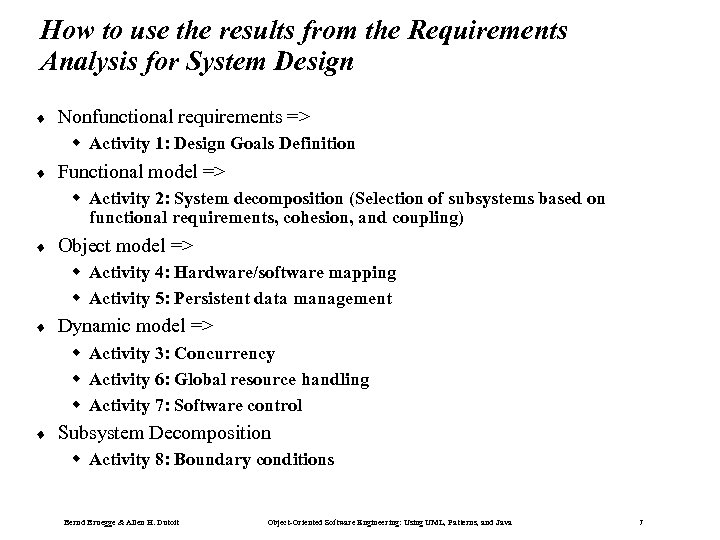
How to use the results from the Requirements Analysis for System Design ¨ Nonfunctional requirements => w Activity 1: Design Goals Definition ¨ Functional model => w Activity 2: System decomposition (Selection of subsystems based on functional requirements, cohesion, and coupling) ¨ Object model => w Activity 4: Hardware/software mapping w Activity 5: Persistent data management ¨ Dynamic model => w Activity 3: Concurrency w Activity 6: Global resource handling w Activity 7: Software control ¨ Subsystem Decomposition w Activity 8: Boundary conditions Bernd Bruegge & Allen H. Dutoit Object-Oriented Software Engineering: Using UML, Patterns, and Java 7
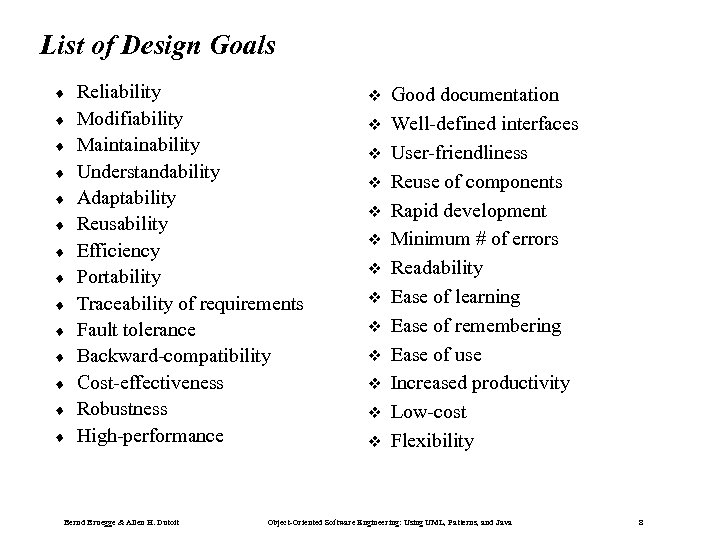
List of Design Goals ¨ ¨ ¨ ¨ Reliability Modifiability Maintainability Understandability Adaptability Reusability Efficiency Portability Traceability of requirements Fault tolerance Backward-compatibility Cost-effectiveness Robustness High-performance Bernd Bruegge & Allen H. Dutoit Good documentation Well-defined interfaces User-friendliness Reuse of components Rapid development Minimum # of errors Readability Ease of learning Ease of remembering Ease of use Increased productivity Low-cost Flexibility Object-Oriented Software Engineering: Using UML, Patterns, and Java 8
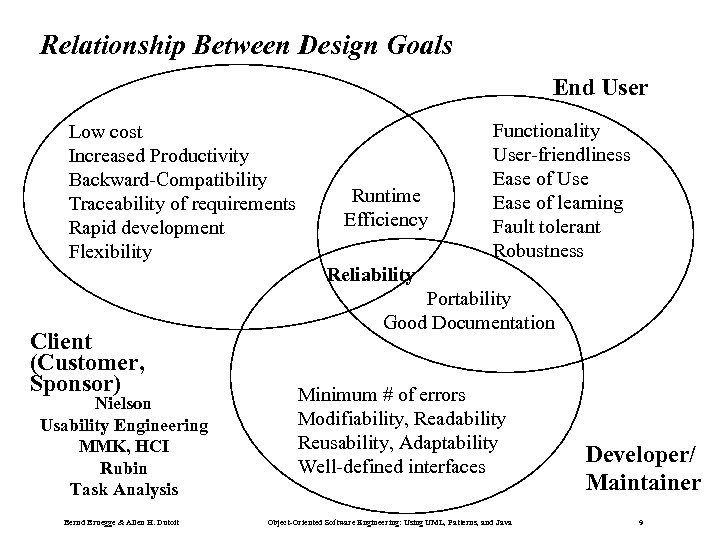
Relationship Between Design Goals End User Low cost Increased Productivity Backward-Compatibility Traceability of requirements Rapid development Flexibility Runtime Efficiency Functionality User-friendliness Ease of Use Ease of learning Fault tolerant Robustness Reliability Client (Customer, Sponsor) Nielson Usability Engineering MMK, HCI Rubin Task Analysis Bernd Bruegge & Allen H. Dutoit Portability Good Documentation Minimum # of errors Modifiability, Readability Reusability, Adaptability Well-defined interfaces Object-Oriented Software Engineering: Using UML, Patterns, and Java Developer/ Maintainer 9
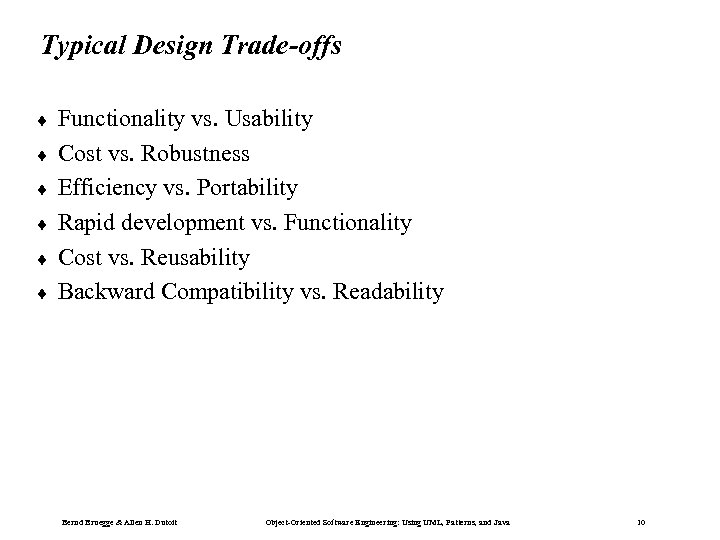
Typical Design Trade-offs ¨ ¨ ¨ Functionality vs. Usability Cost vs. Robustness Efficiency vs. Portability Rapid development vs. Functionality Cost vs. Reusability Backward Compatibility vs. Readability Bernd Bruegge & Allen H. Dutoit Object-Oriented Software Engineering: Using UML, Patterns, and Java 10
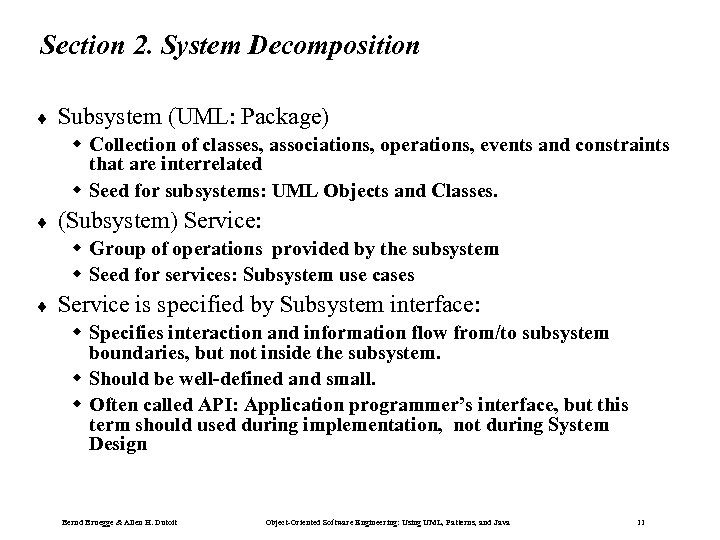
Section 2. System Decomposition ¨ Subsystem (UML: Package) w Collection of classes, associations, operations, events and constraints that are interrelated w Seed for subsystems: UML Objects and Classes. ¨ (Subsystem) Service: w Group of operations provided by the subsystem w Seed for services: Subsystem use cases ¨ Service is specified by Subsystem interface: w Specifies interaction and information flow from/to subsystem boundaries, but not inside the subsystem. w Should be well-defined and small. w Often called API: Application programmer’s interface, but this term should used during implementation, not during System Design Bernd Bruegge & Allen H. Dutoit Object-Oriented Software Engineering: Using UML, Patterns, and Java 11
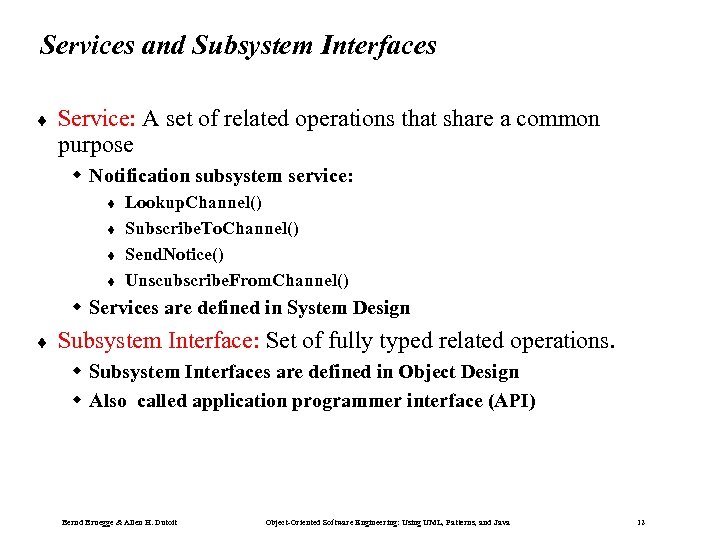
Services and Subsystem Interfaces ¨ Service: A set of related operations that share a common purpose w Notification subsystem service: t t Lookup. Channel() Subscribe. To. Channel() Send. Notice() Unscubscribe. From. Channel() w Services are defined in System Design ¨ Subsystem Interface: Set of fully typed related operations. w Subsystem Interfaces are defined in Object Design w Also called application programmer interface (API) Bernd Bruegge & Allen H. Dutoit Object-Oriented Software Engineering: Using UML, Patterns, and Java 12
Choosing Subsystems ¨ Criteria for subsystem selection: Most of the interaction should be within subsystems, rather than across subsystem boundaries (High cohesion). w Does one subsystem always call the other for the service? w Which of the subsystems call each other for service? ¨ Primary Question: w What kind of service is provided by the subsystems (subsystem interface)? ¨ Secondary Question: w Can the subsystems be hierarchically ordered (layers)? ¨ What kind of model is good for describing layers and partitions? Bernd Bruegge & Allen H. Dutoit Object-Oriented Software Engineering: Using UML, Patterns, and Java 13
Coupling and Cohesion ¨ ¨ Goal: Reduction of complexity while change occurs Cohesion measures the dependence among classes w High cohesion: The classes in the subsystem perform similar tasks and are related to each other (via associations) w Low cohesion: Lots of miscellaneous and auxiliary classes, no associations ¨ Coupling measures dependencies between subsystems w High coupling: Changes to one subsystem will have high impact on the other subsystem (change of model, massive recompilation, etc. ) w Low coupling: A change in one subsystem does not affect any other subsystem ¨ Subsystems should have as maximum cohesion and minimum coupling as possible: w How can we achieve high cohesion? w How can we achieve loose coupling? Bernd Bruegge & Allen H. Dutoit Object-Oriented Software Engineering: Using UML, Patterns, and Java 14
Partitions and Layers Partitioning and layering are techniques to achieve low coupling. A large system is usually decomposed into subsystems using both, layers and partitions. ¨ Partitions vertically divide a system into several independent (or weakly-coupled) subsystems that provide services on the same level of abstraction. ¨ A layer is a subsystem that provides subsystem services to a higher layers (level of abstraction) w A layer can only depend on lower layers w A layer has no knowledge of higher layers Bernd Bruegge & Allen H. Dutoit Object-Oriented Software Engineering: Using UML, Patterns, and Java 15
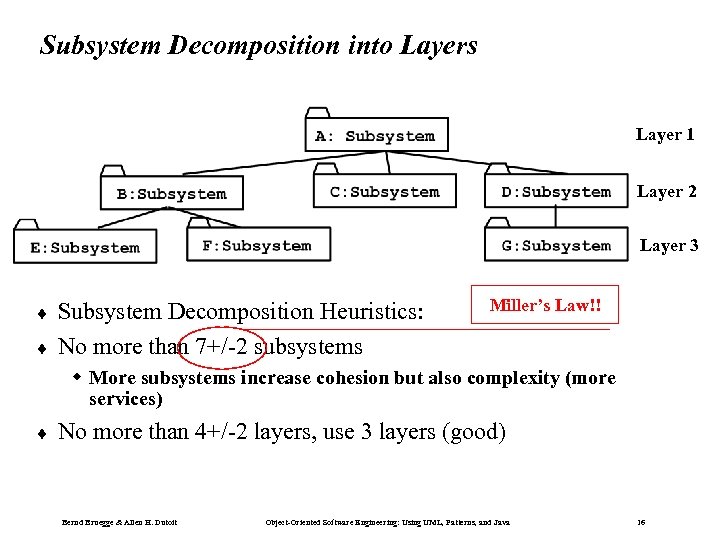
Subsystem Decomposition into Layers Layer 1 Layer 2 Layer 3 ¨ ¨ Subsystem Decomposition Heuristics: No more than 7+/-2 subsystems Miller’s Law!! w More subsystems increase cohesion but also complexity (more services) ¨ No more than 4+/-2 layers, use 3 layers (good) Bernd Bruegge & Allen H. Dutoit Object-Oriented Software Engineering: Using UML, Patterns, and Java 16
Relationships between Subsystems ¨ Layer relationship w Layer A “Calls” Layer B (runtime) w Layer A “Depends on” Layer B (“make” dependency, compile time) ¨ Partition relationship w The subsystem have mutual but not deep knowledge about each other w Partition A “Calls” partition B and partition B “Calls” partition A Bernd Bruegge & Allen H. Dutoit Object-Oriented Software Engineering: Using UML, Patterns, and Java 17
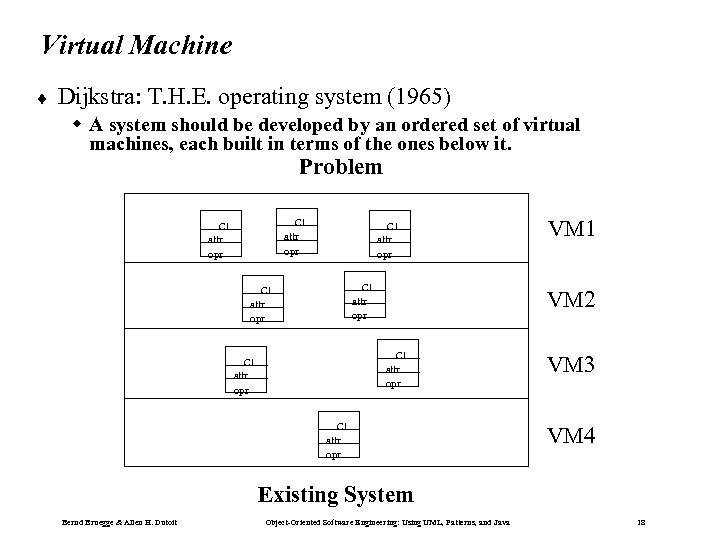
Virtual Machine ¨ Dijkstra: T. H. E. operating system (1965) w A system should be developed by an ordered set of virtual machines, each built in terms of the ones below it. Problem C 1 attr opr C 1 attr opr VM 2 C 1 attr opr VM 1 C 1 attr opr VM 3 VM 4 Existing System Bernd Bruegge & Allen H. Dutoit Object-Oriented Software Engineering: Using UML, Patterns, and Java 18
Virtual Machine ¨ A virtual machine is an abstraction w It provides a set of attributes and operations. ¨ A virtual machine is a subsystem w It is connected to higher and lower level virtual machines by "provides services for" associations. ¨ Virtual machines can implement two types of software architecture w Open and closed architectures. Bernd Bruegge & Allen H. Dutoit Object-Oriented Software Engineering: Using UML, Patterns, and Java 19
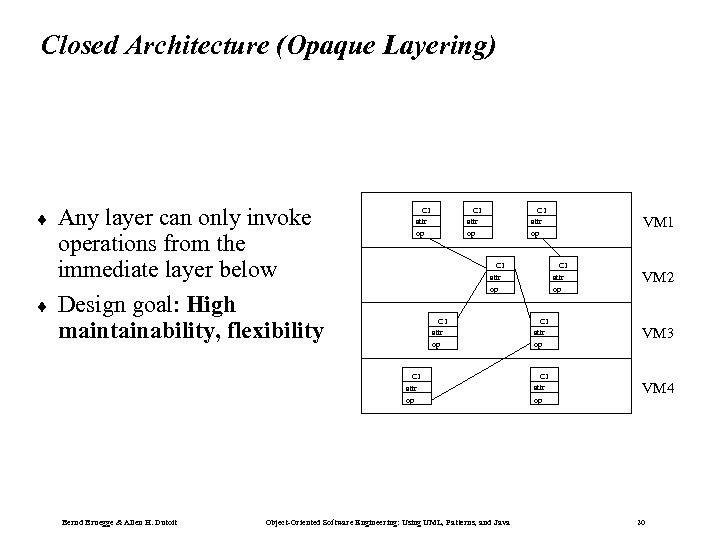
Closed Architecture (Opaque Layering) ¨ ¨ Any layer can only invoke operations from the immediate layer below Design goal: High maintainability, flexibility C 1 attr op op op C 1 attr op op C 1 attr op Bernd Bruegge & Allen H. Dutoit VM 1 op Object-Oriented Software Engineering: Using UML, Patterns, and Java VM 2 VM 3 VM 4 20
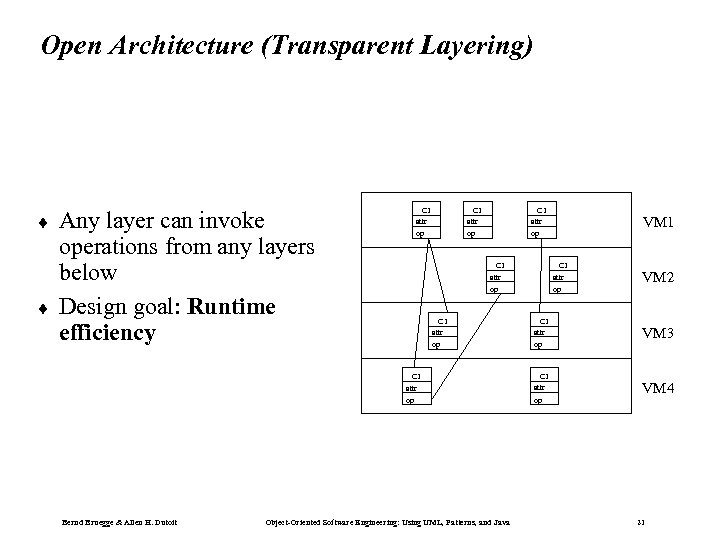
Open Architecture (Transparent Layering) ¨ ¨ C 1 attr op Any layer can invoke operations from any layers below Design goal: Runtime efficiency op op C 1 attr op op C 1 attr op Bernd Bruegge & Allen H. Dutoit VM 1 op Object-Oriented Software Engineering: Using UML, Patterns, and Java VM 2 VM 3 VM 4 21
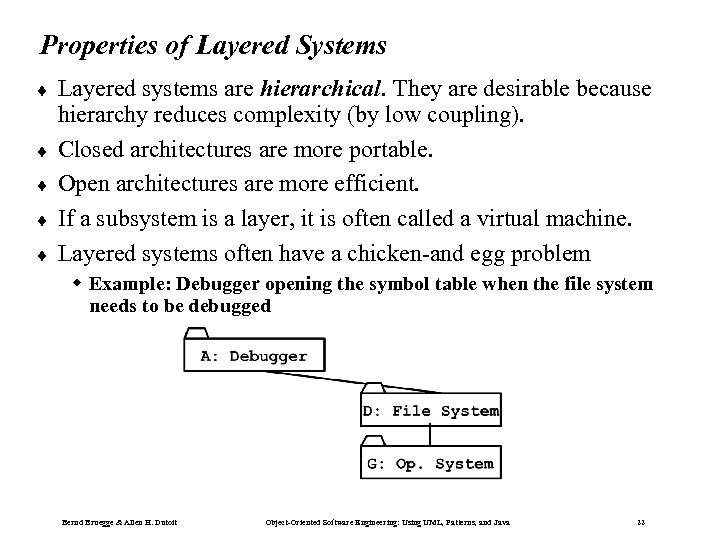
Properties of Layered Systems ¨ ¨ ¨ Layered systems are hierarchical. They are desirable because hierarchy reduces complexity (by low coupling). Closed architectures are more portable. Open architectures are more efficient. If a subsystem is a layer, it is often called a virtual machine. Layered systems often have a chicken-and egg problem w Example: Debugger opening the symbol table when the file system needs to be debugged Bernd Bruegge & Allen H. Dutoit Object-Oriented Software Engineering: Using UML, Patterns, and Java 22
Software Architectural Styles ¨ Subsystem decomposition w Identification of subsystems, services, and their relationship to each other. ¨ ¨ Specification of the system decomposition is critical. Patterns for software architecture w w w Client/Server Peer-To-Peer Repository Model/View/Controller Pipes and Filters Bernd Bruegge & Allen H. Dutoit Object-Oriented Software Engineering: Using UML, Patterns, and Java 23
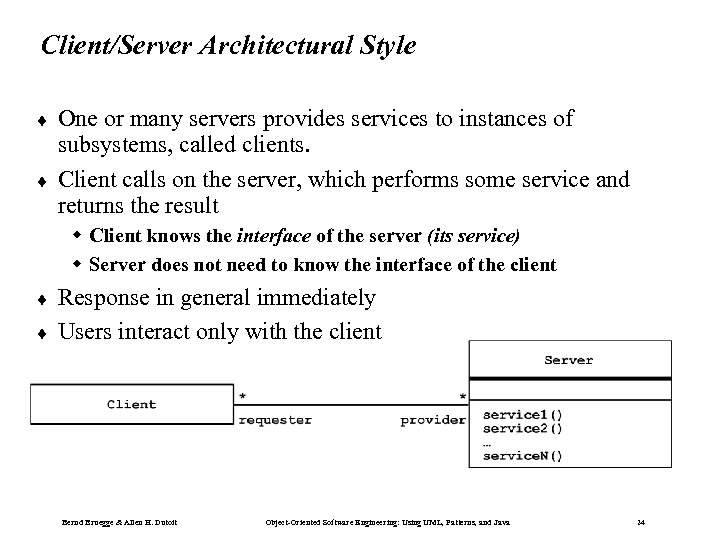
Client/Server Architectural Style ¨ ¨ One or many servers provides services to instances of subsystems, called clients. Client calls on the server, which performs some service and returns the result w Client knows the interface of the server (its service) w Server does not need to know the interface of the client ¨ ¨ Response in general immediately Users interact only with the client Bernd Bruegge & Allen H. Dutoit Object-Oriented Software Engineering: Using UML, Patterns, and Java 24
Problems with Client/Server Architectural Styles ¨ ¨ ¨ Layered systems do not provide peer-to-peer communication Peer-to-peer communication is often needed Example: Database receives queries from application but also sends notifications to application when data have changed Bernd Bruegge & Allen H. Dutoit Object-Oriented Software Engineering: Using UML, Patterns, and Java 25
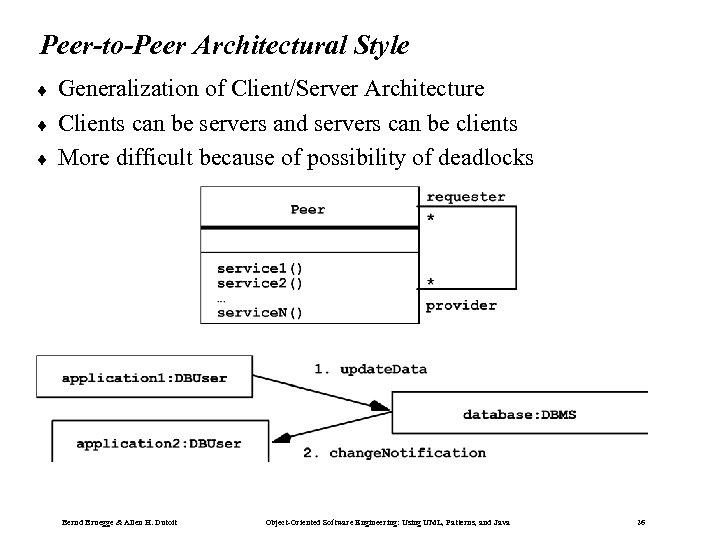
Peer-to-Peer Architectural Style ¨ ¨ ¨ Generalization of Client/Server Architecture Clients can be servers and servers can be clients More difficult because of possibility of deadlocks Bernd Bruegge & Allen H. Dutoit Object-Oriented Software Engineering: Using UML, Patterns, and Java 26
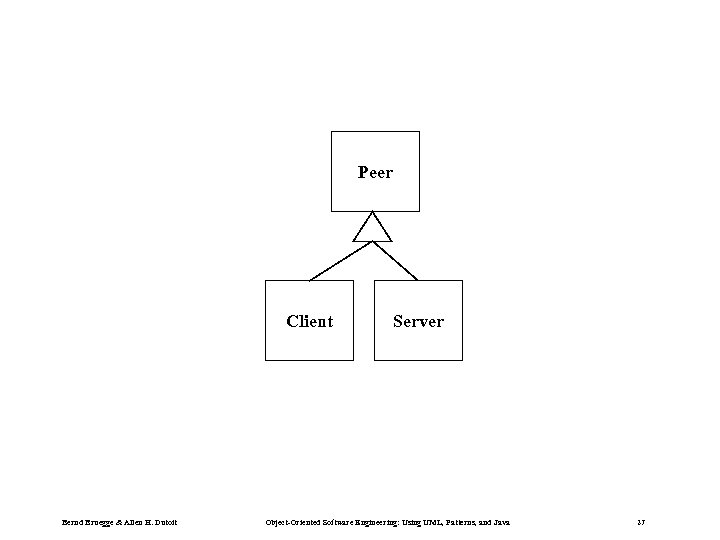
Peer Client Bernd Bruegge & Allen H. Dutoit Server Object-Oriented Software Engineering: Using UML, Patterns, and Java 27
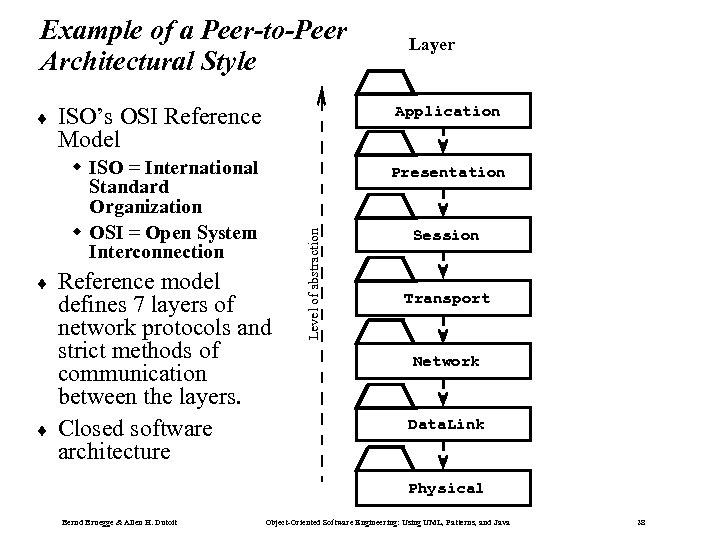
Example of a Peer-to-Peer Architectural Style Application ISO’s OSI Reference Model w ISO = International Standard Organization w OSI = Open System Interconnection ¨ ¨ Presentation Reference model defines 7 layers of network protocols and strict methods of communication between the layers. Closed software architecture Level of abstraction ¨ Layer Session Transport Network Data. Link Physical Bernd Bruegge & Allen H. Dutoit Object-Oriented Software Engineering: Using UML, Patterns, and Java 28
OSI model Packages and their Responsibility ¨ ¨ ¨ ¨ The Physical layer represents the hardware interface to the net-work. It allows to send() and receive bits over a channel. The Datalink layer allows to send and receive frames without error using the services from the Physical layer. The Network layer is responsible for that the data are reliably transmitted and routed within a network. The Transport layer is responsible for reliably transmitting from end to end. (This is the interface seen by Unix programmers when transmitting over TCP/IP sockets) The Session layer is responsible for initializing a connection, including authentication. The Presentation layer performs data transformation services, such as byte swapping and encryption The Application layer is the system you are designing (unless you build a protocol stack). The application layer is often layered itself. Bernd Bruegge & Allen H. Dutoit Object-Oriented Software Engineering: Using UML, Patterns, and Java 29
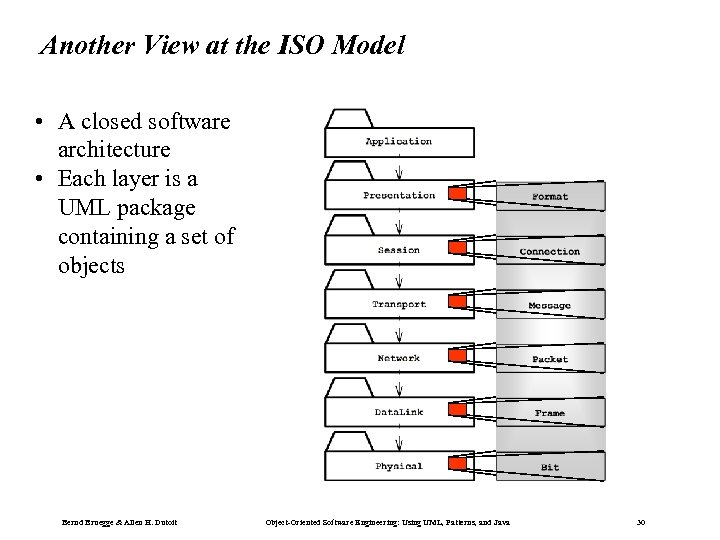
Another View at the ISO Model • A closed software architecture • Each layer is a UML package containing a set of objects Bernd Bruegge & Allen H. Dutoit Object-Oriented Software Engineering: Using UML, Patterns, and Java 30
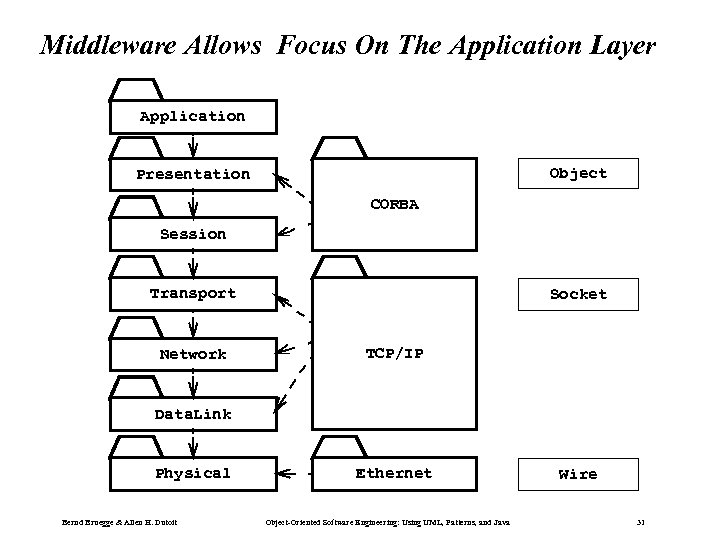
Middleware Allows Focus On The Application Layer Application Object Presentation CORBA Session Transport Network Socket TCP/IP Data. Link Physical Bernd Bruegge & Allen H. Dutoit Ethernet Object-Oriented Software Engineering: Using UML, Patterns, and Java Wire 31
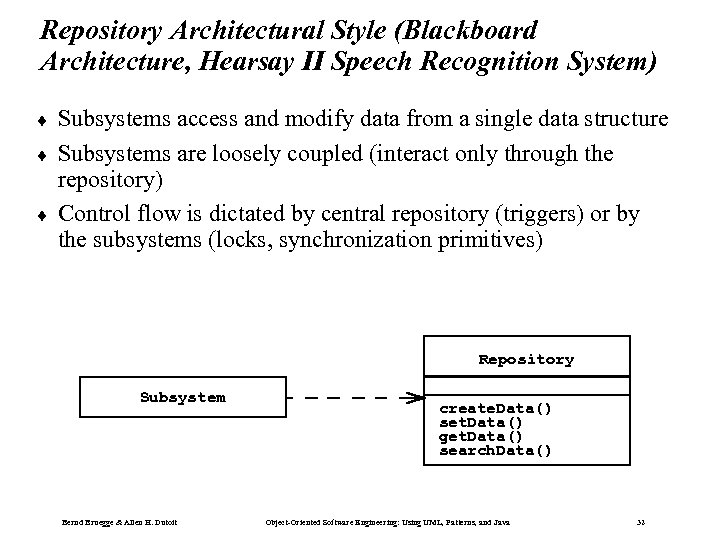
Repository Architectural Style (Blackboard Architecture, Hearsay II Speech Recognition System) ¨ ¨ ¨ Subsystems access and modify data from a single data structure Subsystems are loosely coupled (interact only through the repository) Control flow is dictated by central repository (triggers) or by the subsystems (locks, synchronization primitives) Repository Subsystem Bernd Bruegge & Allen H. Dutoit create. Data() set. Data() get. Data() search. Data() Object-Oriented Software Engineering: Using UML, Patterns, and Java 32
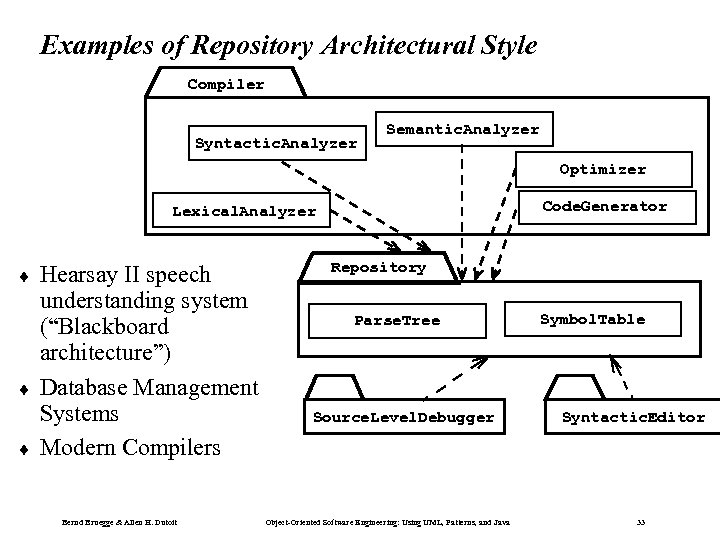
Examples of Repository Architectural Style Compiler Syntactic. Analyzer Semantic. Analyzer Optimizer Code. Generator Lexical. Analyzer ¨ ¨ ¨ Hearsay II speech understanding system (“Blackboard architecture”) Database Management Systems Modern Compilers Bernd Bruegge & Allen H. Dutoit Repository Parse. Tree Source. Level. Debugger Object-Oriented Software Engineering: Using UML, Patterns, and Java Symbol. Table Syntactic. Editor 33
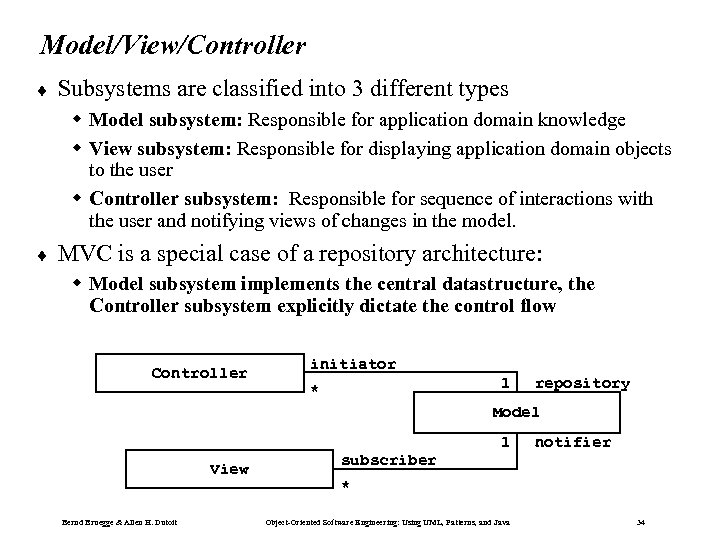
Model/View/Controller ¨ Subsystems are classified into 3 different types w Model subsystem: Responsible for application domain knowledge w View subsystem: Responsible for displaying application domain objects to the user w Controller subsystem: Responsible for sequence of interactions with the user and notifying views of changes in the model. ¨ MVC is a special case of a repository architecture: w Model subsystem implements the central datastructure, the Controller subsystem explicitly dictate the control flow Controller initiator 1 * repository Model View Bernd Bruegge & Allen H. Dutoit subscriber 1 notifier * Object-Oriented Software Engineering: Using UML, Patterns, and Java 34
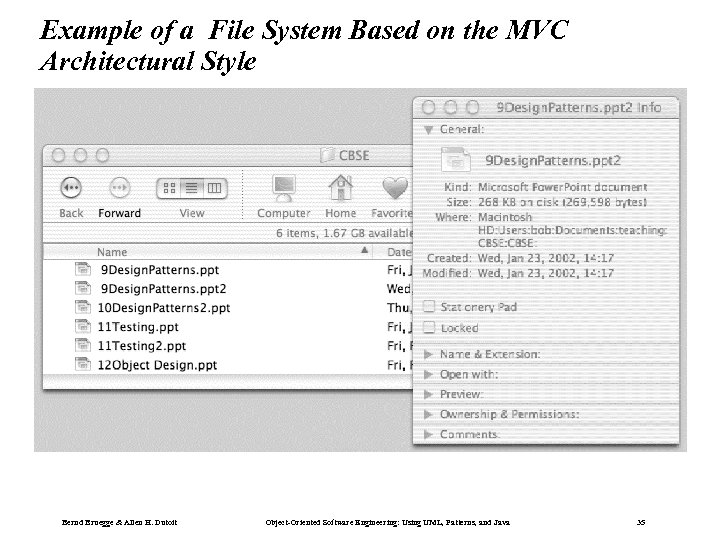
Example of a File System Based on the MVC Architectural Style Bernd Bruegge & Allen H. Dutoit Object-Oriented Software Engineering: Using UML, Patterns, and Java 35
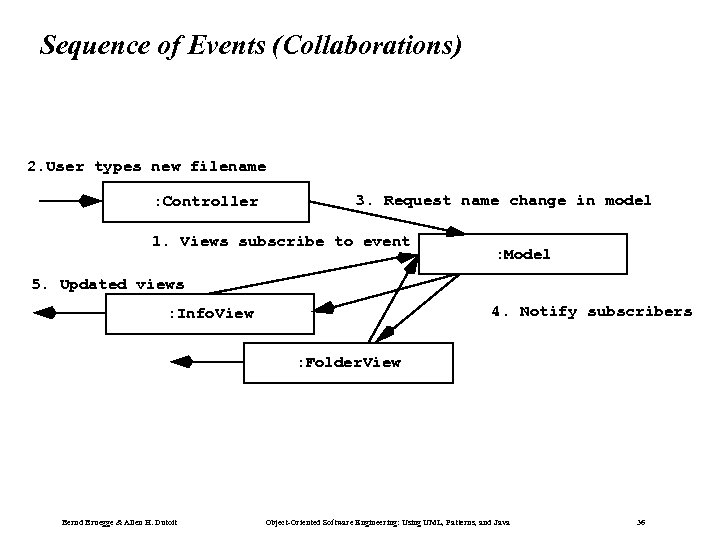
Sequence of Events (Collaborations) 2. User types new filename : Controller 3. Request name change in model 1. Views subscribe to event : Model 5. Updated views 4. Notify subscribers : Info. View : Folder. View Bernd Bruegge & Allen H. Dutoit Object-Oriented Software Engineering: Using UML, Patterns, and Java 36
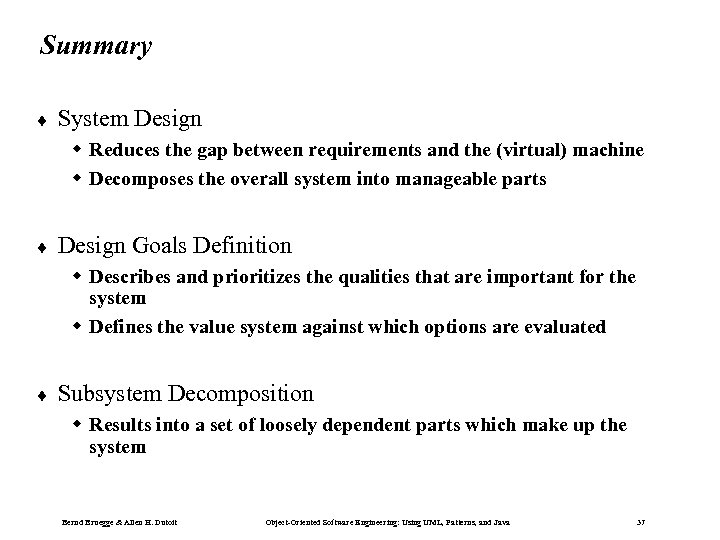
Summary ¨ System Design w Reduces the gap between requirements and the (virtual) machine w Decomposes the overall system into manageable parts ¨ Design Goals Definition w Describes and prioritizes the qualities that are important for the system w Defines the value system against which options are evaluated ¨ Subsystem Decomposition w Results into a set of loosely dependent parts which make up the system Bernd Bruegge & Allen H. Dutoit Object-Oriented Software Engineering: Using UML, Patterns, and Java 37
Скачать презентацию Using UML Patterns and Java Object-Oriented Software Engineering
d2a6b426b5bd5fbf142a2f55a376f0a3.ppt