


 Скачать презентацию Using Timed-Release Cryptography to Mitigate The Preservation Risk
4c941b63031aff7422b77c66494ee1cc.ppt
- Количество слайдов: 32
 Using Timed-Release Cryptography to Mitigate The Preservation Risk of Embargo Periods Rabia Haq, Michael L. Nelson Old Dominion University Norfolk VA www. cs. odu. edu/~{rhaq, mln} 2009 ACM/IEEE Joint Conference on Digital Libraries, Austin TX, June 15 -19 1
 Overview • Embargo Periods – associated preservation risk interval • Time-Locked Puzzle / Time Release Cryptography • System Evaluation using mod_oai (resource harvesting using OAI-PMH) – Optimization Using Chunked Encryption • Future Considerations • Conclusion 2009 ACM/IEEE Joint Conference on Digital Libraries, Austin TX, June 15 -19 2
 Journal Access Models – Romeo Colors* • Red: Traditional subscription-based Access – Purchase-own model • Yellow: Embargoed Access – Hybrid of traditional and open access • Green: Self-authored Open Access – e. g. , ar. Vix. org, institutional repositories • Gold: Free and Open Access Journals – e. g. , PLo. S Journals, www. doaj. org * “Old” Romeo Colors, now green/blue/yellow/white; see: http: //www. sherpa. ac. uk/romeoinfo. html 2009 ACM/IEEE Joint Conference on Digital Libraries, Austin TX, June 15 -19 3
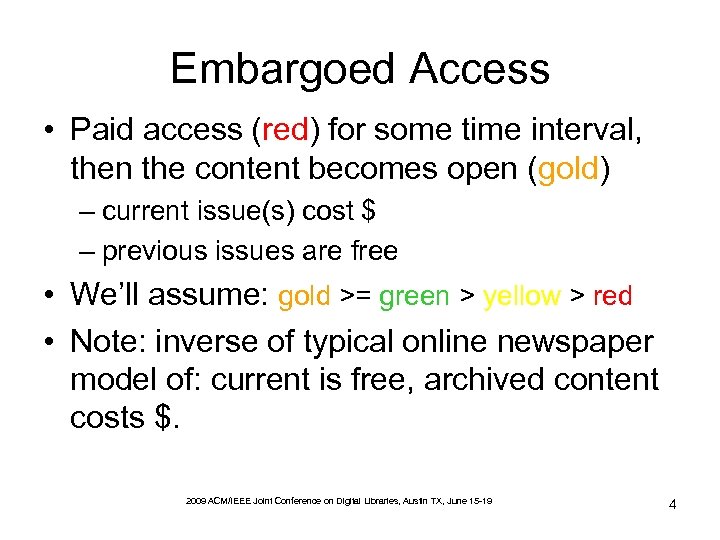 Embargoed Access • Paid access (red) for some time interval, then the content becomes open (gold) – current issue(s) cost $ – previous issues are free • We’ll assume: gold >= green > yellow > red • Note: inverse of typical online newspaper model of: current is free, archived content costs $. 2009 ACM/IEEE Joint Conference on Digital Libraries, Austin TX, June 15 -19 4
 Who Uses Embargoes? • 24% of Pub. Med Central (PMC) titles embargoed • The New England Journal of Medicine – embargoed for 6 months • EBMO Journal – embargoed for 12 months 2009 ACM/IEEE Joint Conference on Digital Libraries, Austin TX, June 15 -19 5
 Preservation Risk Interval: (A Hypothetical, Non-Topical Example) • Journal of UT Football Non-Conference Scheduling is embargoed for 6 months – sample article “Why scheduling Florida Atlantic, UTEP, Rice & Arkansas is not a national championship schedule” – previous volumes (e. g. , 2008, 2007) are freely available – issues 1 --6 of current volume are currently for subscribers only – 6 month “sliding window”: when issue 7 comes out on July 1, issue 1 becomes freely available • Now imagine Mack Brown issues a cease & desist order to JUTFNS on June 30 – what happens to volume 2009, issues 1 -6? Will they ever be available to non-subscribers? 2009 ACM/IEEE Joint Conference on Digital Libraries, Austin TX, June 15 -19 6
 Current Solutions • LOCKSS (CLOCKSS): www. lockss. org – local, cooperating caches between subscribers (i. e. , libraries) – http: //www. clockss. org/clockss/Triggered_Content • Portico: www. portico. org – trusted third party archive (i. e. , neither library nor publisher) – http: //www. portico. org/news/trigger. html 2009 ACM/IEEE Joint Conference on Digital Libraries, Austin TX, June 15 -19 7
 Can We Use Lazy Preservation? • We’ve already shown by using IA, search engine caches, etc. we can reconstruct public web sites after they’ve been lost (Mc. Cown, 2007) • For embargoed content, we could expose encrypted content that is embargoed – but how can we prevent bad guys™ from using zombie farms to break the encryption before the embargo period is up? 2009 ACM/IEEE Joint Conference on Digital Libraries, Austin TX, June 15 -19 8
 Timed-Release Cryptology • Time-Lock Puzzle (TLP) Creation – Data decryption non-parallelizable – Serial computation required to break puzzle – Data locked for predetermined time-period • not self-unlocking -- still requires computation to unlock • Used in MIT/LCS 35 Time Lock Puzzle – http: //people. csail. mit. edu/rivest/lcs 35 -puzzle-description. txt – idea: you could have started in 1999 (with your 1999 computer) and worked for 35 years… OR you can wait until 2033, buy a new computer and work for 1 year rewards procrastination! 2009 ACM/IEEE Joint Conference on Digital Libraries, Austin TX, June 15 -19 9
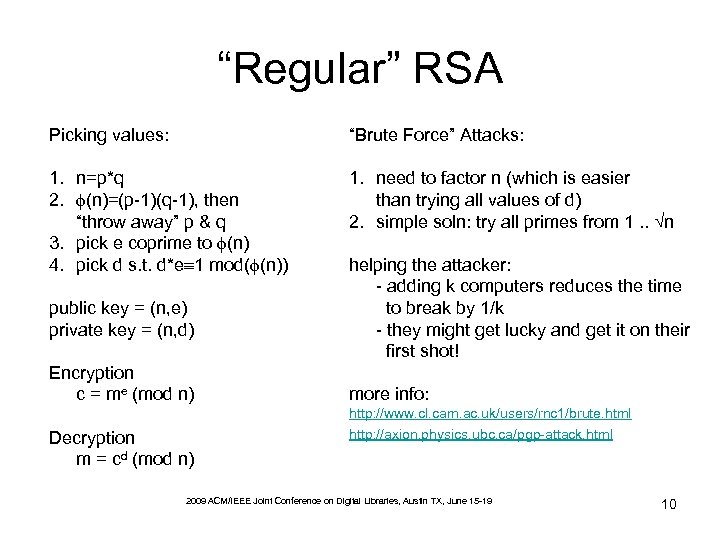 “Regular” RSA Picking values: “Brute Force” Attacks: 1. n=p*q 2. (n)=(p-1)(q-1), then “throw away” p & q 3. pick e coprime to (n) 4. pick d s. t. d*e 1 mod( (n)) 1. need to factor n (which is easier than trying all values of d) 2. simple soln: try all primes from 1. . n public key = (n, e) private key = (n, d) Encryption c = me (mod n) Decryption m = cd (mod n) helping the attacker: - adding k computers reduces the time to break by 1/k - they might get lucky and get it on their first shot! more info: http: //www. cl. cam. ac. uk/users/rnc 1/brute. html http: //axion. physics. ubc. ca/pgp-attack. html 2009 ACM/IEEE Joint Conference on Digital Libraries, Austin TX, June 15 -19 10
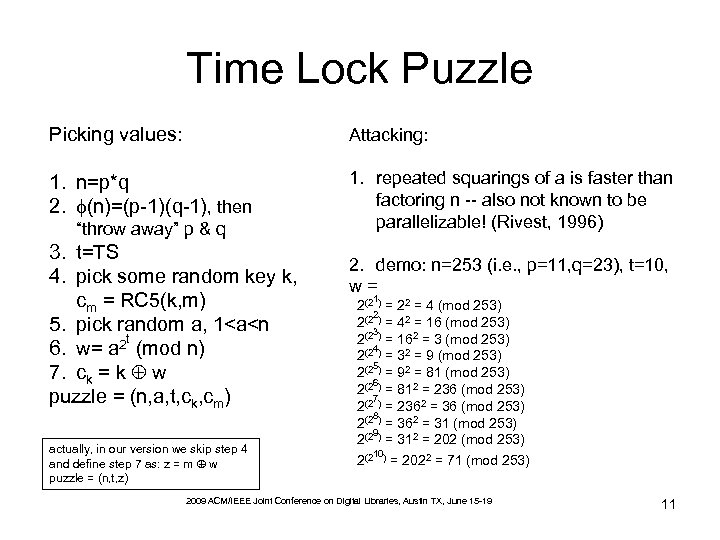 Time Lock Puzzle Picking values: Attacking: 1. n=p*q 2. (n)=(p-1)(q-1), then 1. repeated squarings of a is faster than factoring n -- also not known to be parallelizable! (Rivest, 1996) “throw away” p & q 3. t=TS 4. pick some random key k, cm = RC 5(k, m) 5. pick random a, 1
 Implementation: mod_oai, CRATE • Both based on (Smith, 2008) • mod_oai – an Apache module providing OAI-PMH functionality for an entire web site not just, for example, records in an institutional repository • CRATE – a model for encoding resource + associated metadata – implemented using MPEG-21 DIDL complex object format 2009 ACM/IEEE Joint Conference on Digital Libraries, Austin TX, June 15 -19 12
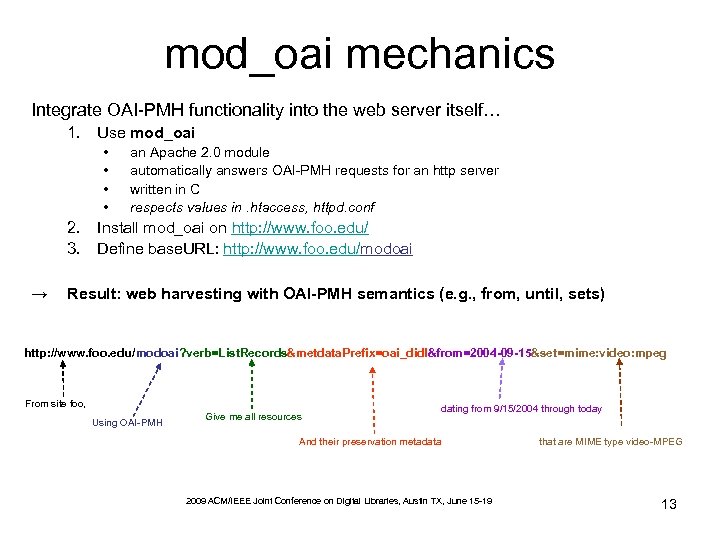 mod_oai mechanics Integrate OAI-PMH functionality into the web server itself… 1. Use mod_oai • • an Apache 2. 0 module automatically answers OAI-PMH requests for an http server written in C respects values in. htaccess, httpd. conf 2. Install mod_oai on http: //www. foo. edu/ 3. Define base. URL: http: //www. foo. edu/modoai → Result: web harvesting with OAI-PMH semantics (e. g. , from, until, sets) http: //www. foo. edu/modoai? verb=List. Records&metdata. Prefix=oai_didl&from=2004 -09 -15&set=mime: video: mpeg From site foo, Using OAI-PMH Give me all resources dating from 9/15/2004 through today And their preservation metadata 2009 ACM/IEEE Joint Conference on Digital Libraries, Austin TX, June 15 -19 that are MIME type video-MPEG 13
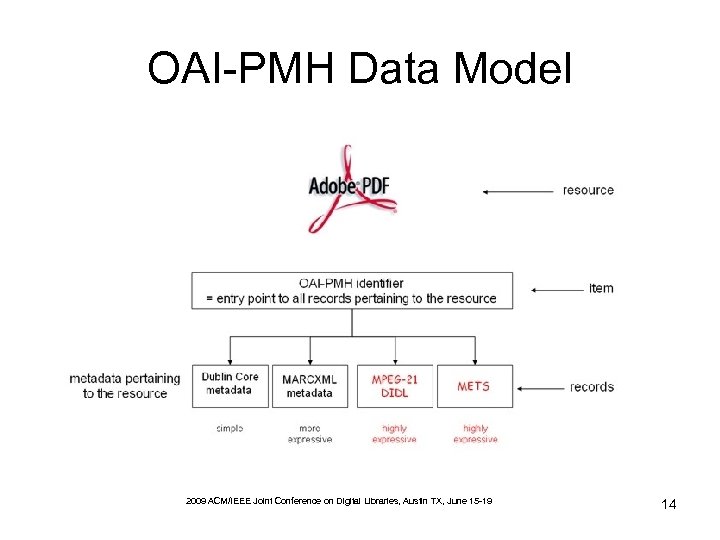 OAI-PMH Data Model 2009 ACM/IEEE Joint Conference on Digital Libraries, Austin TX, June 15 -19 14
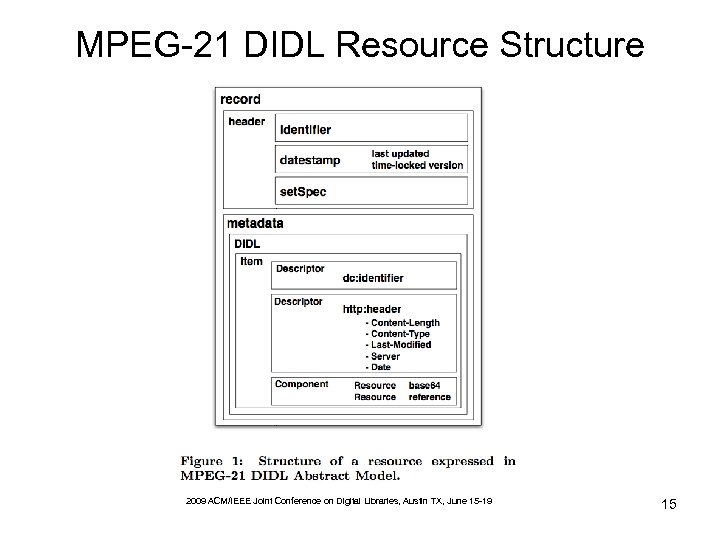 MPEG-21 DIDL Resource Structure 2009 ACM/IEEE Joint Conference on Digital Libraries, Austin TX, June 15 -19 15
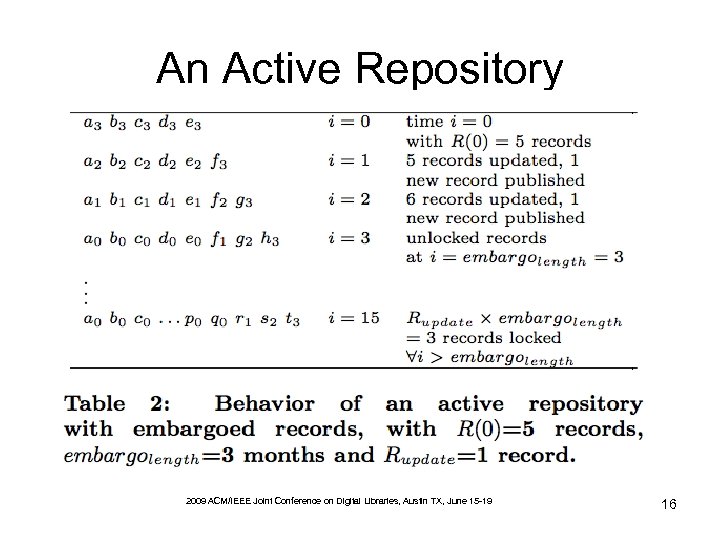 An Active Repository 2009 ACM/IEEE Joint Conference on Digital Libraries, Austin TX, June 15 -19 16
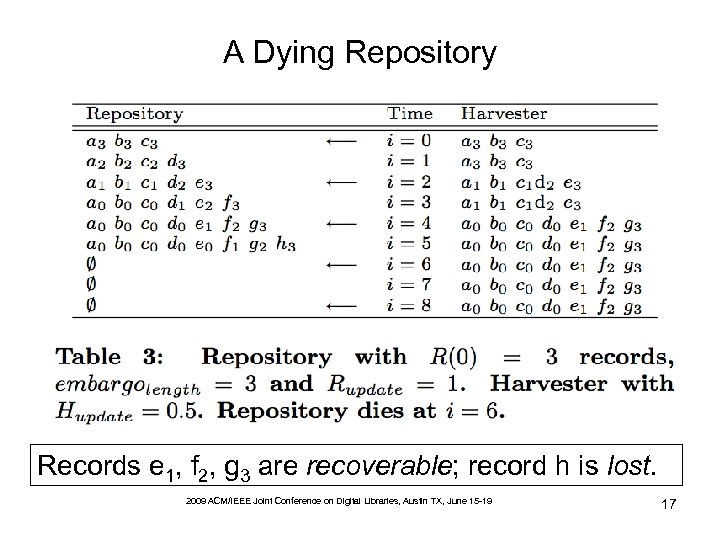 A Dying Repository Records e 1, f 2, g 3 are recoverable; record h is lost. 2009 ACM/IEEE Joint Conference on Digital Libraries, Austin TX, June 15 -19 17
 Dynamic Time-Locked Record Embargo within mod_oai • Identification – Calculation of remaining record embargo period • Encryption – Calculating record time-lock puzzle complexity – Time-Lock Puzzle creation • Encapsulation – exploiting flexibility of MPEG-21 DIDL format to encapsulate encrypted resources and related information 2009 ACM/IEEE Joint Conference on Digital Libraries, Austin TX, June 15 -19 18
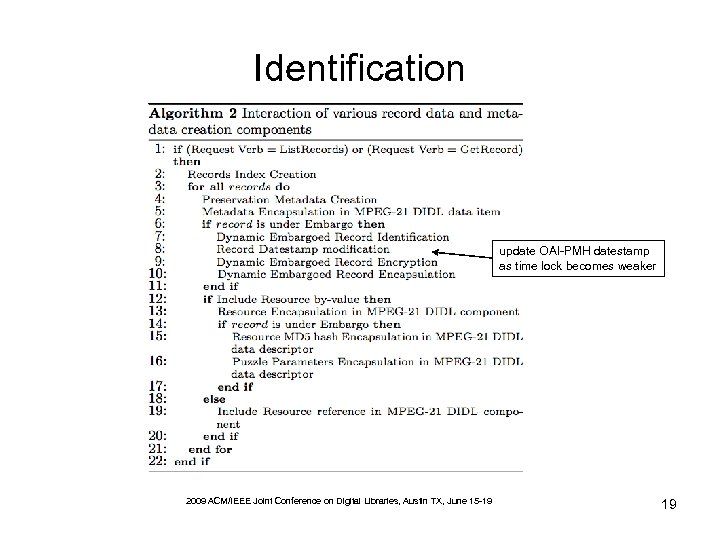 Identification update OAI-PMH datestamp as time lock becomes weaker 2009 ACM/IEEE Joint Conference on Digital Libraries, Austin TX, June 15 -19 19
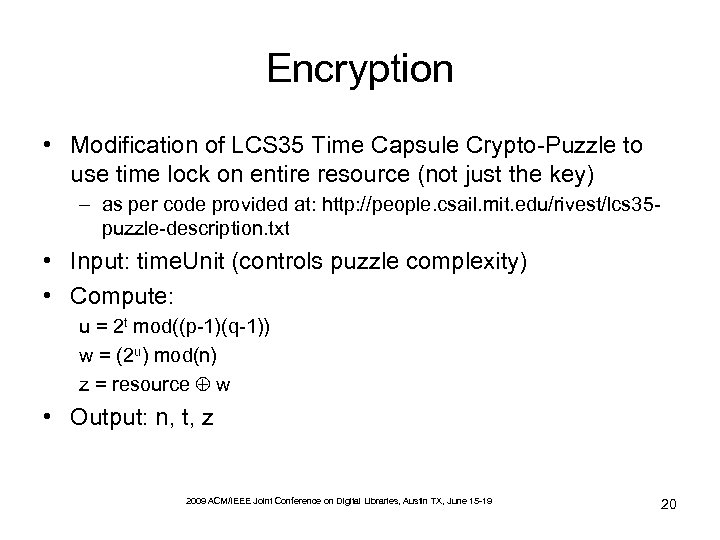 Encryption • Modification of LCS 35 Time Capsule Crypto-Puzzle to use time lock on entire resource (not just the key) – as per code provided at: http: //people. csail. mit. edu/rivest/lcs 35 puzzle-description. txt • Input: time. Unit (controls puzzle complexity) • Compute: u = 2 t mod((p-1)(q-1)) w = (2 u) mod(n) z = resource w • Output: n, t, z 2009 ACM/IEEE Joint Conference on Digital Libraries, Austin TX, June 15 -19 20
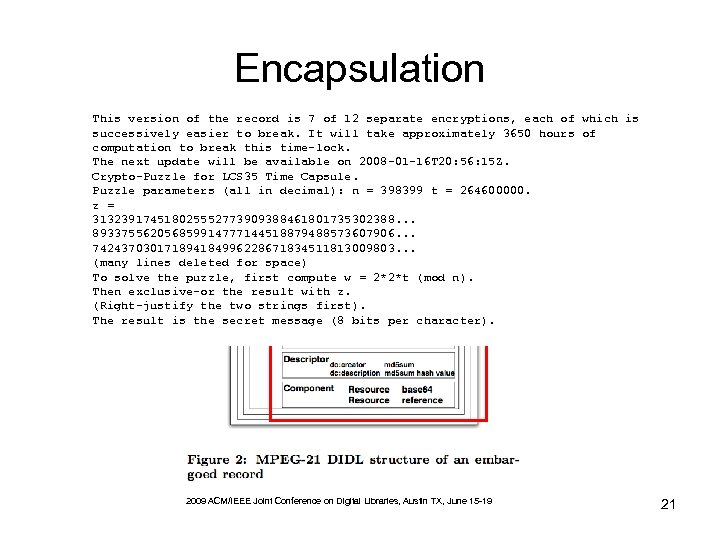 Encapsulation This version of the record is 7 of 12 separate encryptions, each of which is successively easier to break. It will take approximately 3650 hours of computation to break this time-lock. The next update will be available on 2008 -01 -16 T 20: 56: 15 Z. Crypto-Puzzle for LCS 35 Time Capsule. Puzzle parameters (all in decimal): n = 398399 t = 264600000. z = 313239174518025552773909388461801735302388. . . 893375562056859914777144518879488573607906. . . 742437030171894184996228671834511813009803. . . (many lines deleted for space) To solve the puzzle, first compute w = 2*2*t (mod n). Then exclusive-or the result with z. (Right-justify the two strings first). The result is the secret message (8 bits per character). 2009 ACM/IEEE Joint Conference on Digital Libraries, Austin TX, June 15 -19 21
 Selecting Appropriate Values of t • Time required to break puzzle dependent on processor speed • Given our projected short embargo period (6 -24 months), we made a simplifying assumption that Moore’s law increases linearly (not exponentially) – idea: in the next few months, you’re more likely to see something like: 2 Ghz 2. 2 Ghz, not 2 Ghz 4 Ghz • recall: t = number of squarings – – t=T*S S=3000 squarings/second, T=1800 seconds *t. U, t. U = f(machine speed) * embargolength t=3000*1800*t. U 2009 ACM/IEEE Joint Conference on Digital Libraries, Austin TX, June 15 -19 22
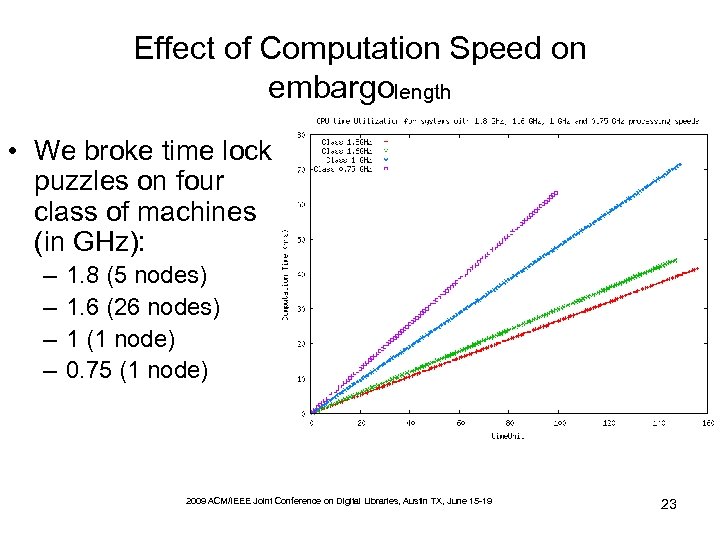 Effect of Computation Speed on embargolength • We broke time lock puzzles on four class of machines (in GHz): – – 1. 8 (5 nodes) 1. 6 (26 nodes) 1 (1 node) 0. 75 (1 node) 2009 ACM/IEEE Joint Conference on Digital Libraries, Austin TX, June 15 -19 23
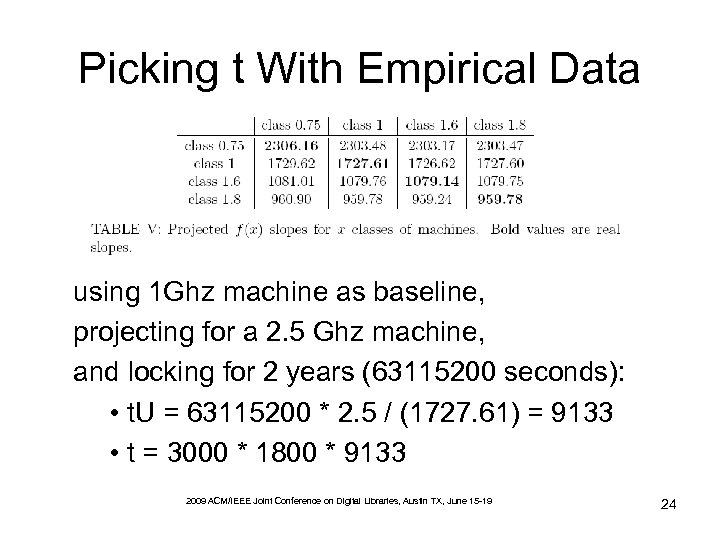 Picking t With Empirical Data using 1 Ghz machine as baseline, projecting for a 2. 5 Ghz machine, and locking for 2 years (63115200 seconds): • t. U = 63115200 * 2. 5 / (1727. 61) = 9133 • t = 3000 * 1800 * 9133 2009 ACM/IEEE Joint Conference on Digital Libraries, Austin TX, June 15 -19 24
 Experimental Evaluation • Embargolength = 365 days • Embargodecrement = 12 • Test website – 525 files – 17. 3 MB data – 63% text files – Average file size = 33 KB 2009 ACM/IEEE Joint Conference on Digital Libraries, Austin TX, June 15 -19 25
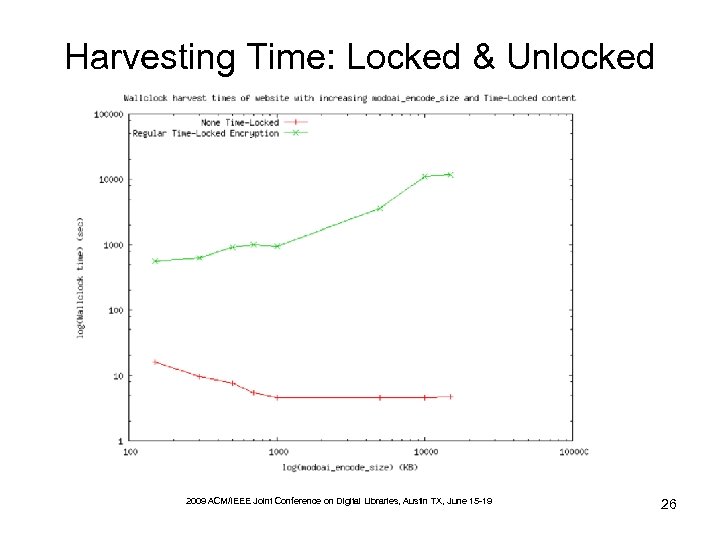 Harvesting Time: Locked & Unlocked 2009 ACM/IEEE Joint Conference on Digital Libraries, Austin TX, June 15 -19 26
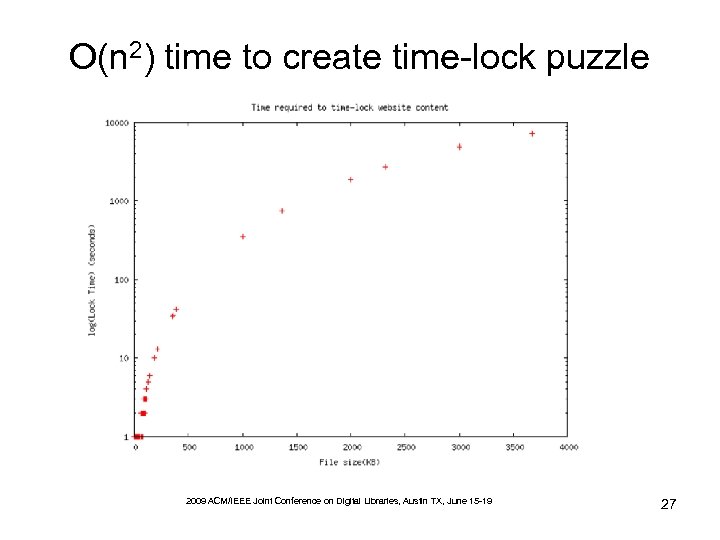 O(n 2) time to create time-lock puzzle 2009 ACM/IEEE Joint Conference on Digital Libraries, Austin TX, June 15 -19 27
 Solution: Break Files Into “Chunks” • Size of file exponentially increases lock-time • Idea: break file into series of small chunks – still O(n 2), but with a much more favorable constant • Lock-time on a 1. 8 GHz machine time_to_lock(200 KB) = 13 sec time_to_lock(100 KB) = 3 sec 200 KB = 100 KB + 100 KB = 3 sec + 3 sec = 6 sec 2009 ACM/IEEE Joint Conference on Digital Libraries, Austin TX, June 15 -19 28
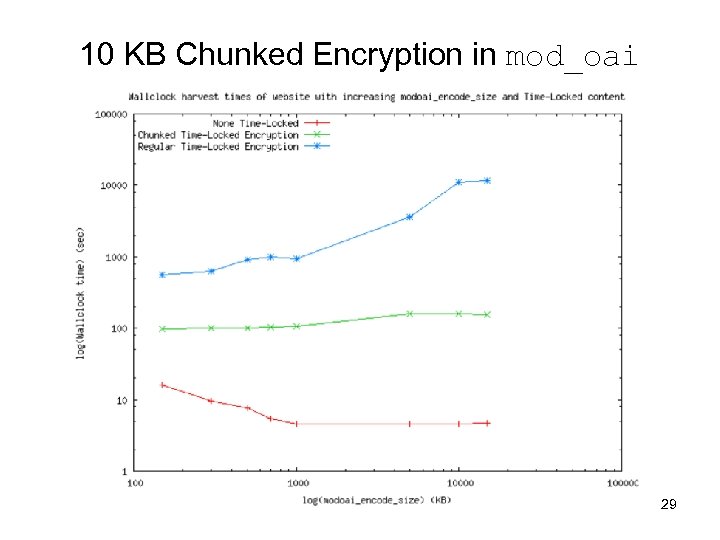 10 KB Chunked Encryption in mod_oai 2009 ACM/IEEE Joint Conference on Digital Libraries, Austin TX, June 15 -19 29
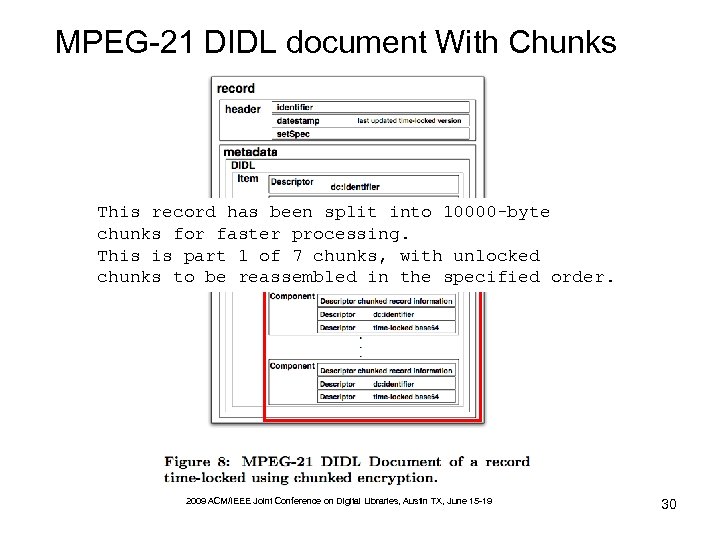 MPEG-21 DIDL document With Chunks This record has been split into 10000 -byte chunks for faster processing. This is part 1 of 7 chunks, with unlocked chunks to be reassembled in the specified order. 2009 ACM/IEEE Joint Conference on Digital Libraries, Austin TX, June 15 -19 30
 Future Considerations • Chunk size performance dependency • Other optimization methods: – Parallel time-locking of resources – Data pre-locking – only time-lock encryption key, use other encryption methods on the original resource (as per original Rivest (1996), not as per http: //people. csail. mit. edu/rivest/lcs 35 -puzzledescription. txt) 2009 ACM/IEEE Joint Conference on Digital Libraries, Austin TX, June 15 -19 31
 Conclusions • Suggest the use of time lock puzzles for dissemination of embargoed records – complement to other methods such as LOCKSS, Poritco, etc. • Implemented and evaluated time lock puzzles in the mod_oai & CRATE environment • Full paper: – http: //doi. acm. org/10. 1145/1555400. 1555430 – http: //www. cs. odu. edu/~mln/pubs/jcdl 09 -time-lock. pdf 2009 ACM/IEEE Joint Conference on Digital Libraries, Austin TX, June 15 -19 32