


 Скачать презентацию Using the Voice of the Customer Scott Shafer
4d150e841e8eddf21af33554c0b8b5f9.ppt
- Количество слайдов: 26
 Using the Voice of the Customer Scott Shafer, CSSBB Professor of Management Director of MA in Management Program
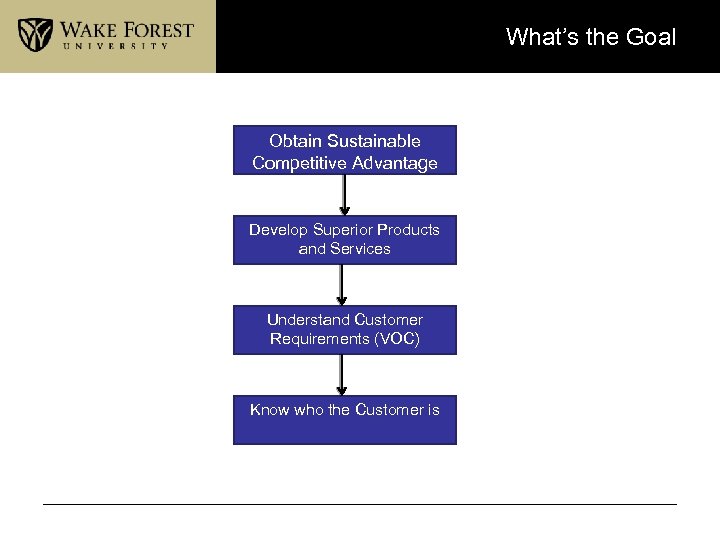 What’s the Goal Obtain Sustainable Competitive Advantage Develop Superior Products and Services Understand Customer Requirements (VOC) Know who the Customer is
 What’s so hard about defining customer requirements? • Customers often not aware of their needs • Needs change over time • Who is the customer?
 Tonight’s Agenda • Who is the customer • Defining VOC • Using VOC
 Tonight’s Agenda • Who is the customer • Defining VOC • Using VOC
 Who is the customer? • Graduate Business School – – Students? Employers? • P&G – – End consumer? Wal-Mart? • Person or organization that actually purchases the product or service from the product/service provider? • All entities that participate in the value chain?
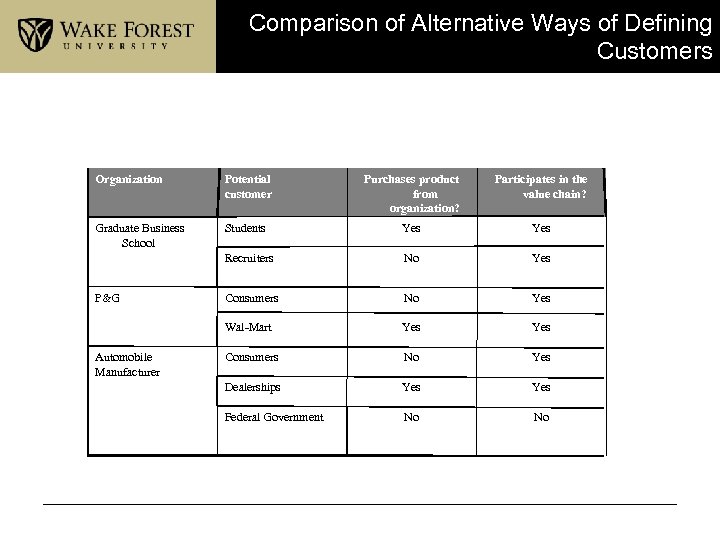 Comparison of Alternative Ways of Defining Customers Organization Potential customer Purchases product from organization? Participates in the value chain? Graduate Business School Students Yes Recruiters No Yes Consumers No Yes Wal-Mart Yes Consumers No Yes Dealerships Yes Federal Government No No P&G Automobile Manufacturer
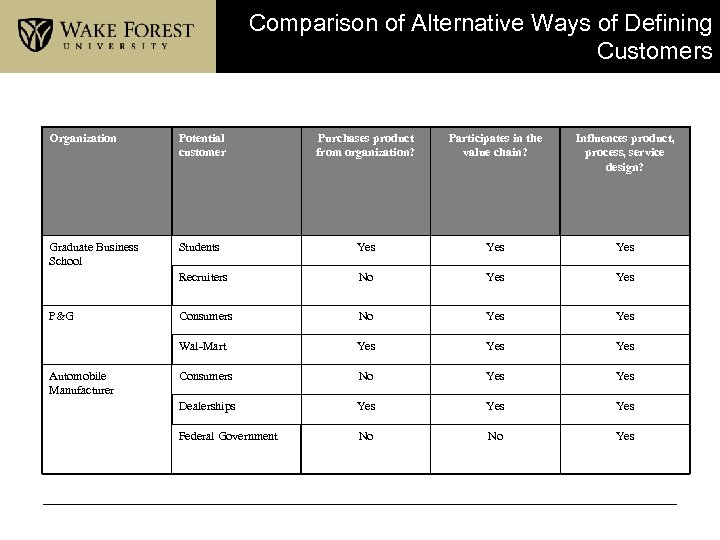 Comparison of Alternative Ways of Defining Customers Organization Potential customer Purchases product from organization? Participates in the value chain? Influences product, process, service design? Graduate Business School Students Yes Yes Recruiters No Yes Consumers No Yes Wal-Mart Yes Yes Consumers No Yes Dealerships Yes Yes Federal Government No No Yes P&G Automobile Manufacturer
 Customers Defined • A customer is any constituency of an organization that influences the design of its products, processes, and/or services.
 Other Ways of Classifying Customers • Intermediate customers versus end users • Internal versus external customers
 Tonight’s Agenda • Who is the customer • Defining VOC • Using VOC
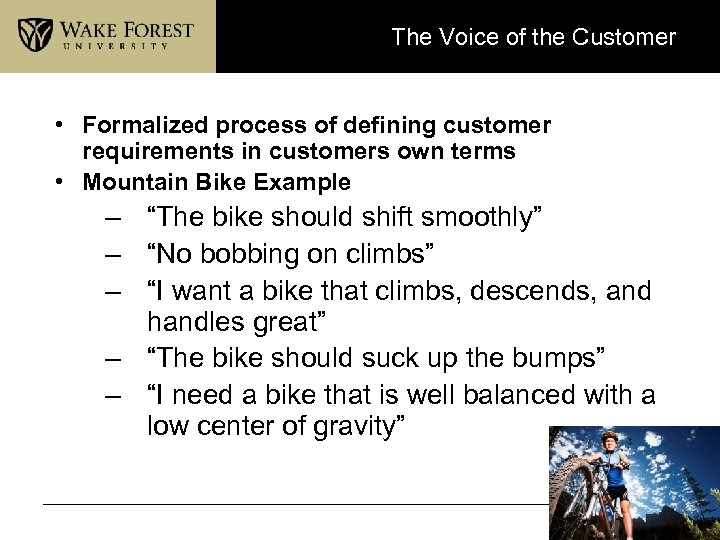 The Voice of the Customer • Formalized process of defining customer requirements in customers own terms • Mountain Bike Example – “The bike should shift smoothly” – “No bobbing on climbs” – “I want a bike that climbs, descends, and handles great” – “The bike should suck up the bumps” – “I need a bike that is well balanced with a low center of gravity”
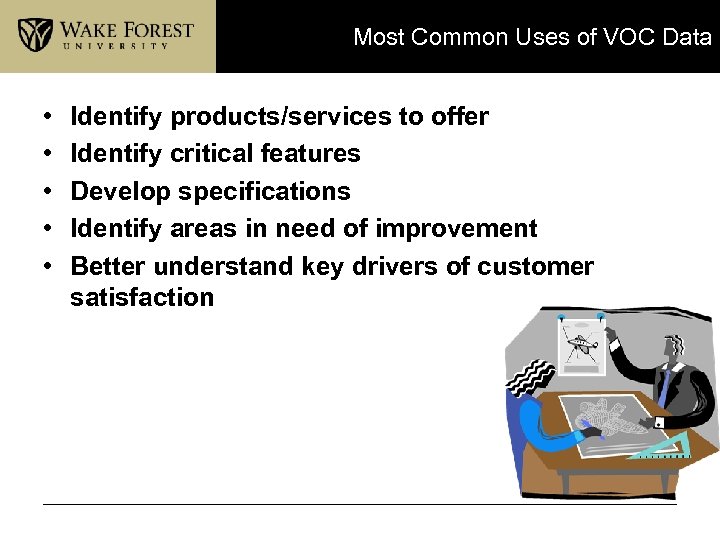 Most Common Uses of VOC Data • • • Identify products/services to offer Identify critical features Develop specifications Identify areas in need of improvement Better understand key drivers of customer satisfaction
 How the question is asked matters • We often think in terms of correcting problems • Alternative approach is to think in terms of ideal or ultimate work system
 What are your major complaints about your current phone system?
 How would you describe an ideal phone system?
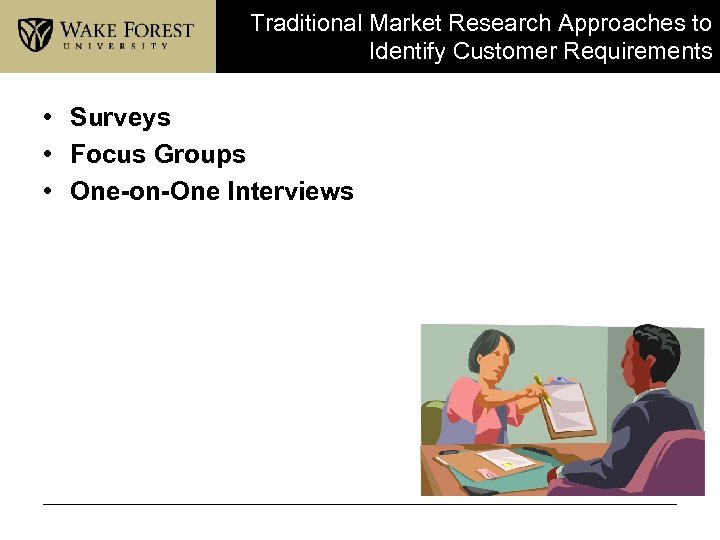 Traditional Market Research Approaches to Identify Customer Requirements • Surveys • Focus Groups • One-on-One Interviews
 Some Comments • Techniques are not mutually exclusive • Broadly define customers to get complete picture – – – Satisfied customers Dissatisfied customers Old customers Customers of competitors Prospective customers • Dissatisfied customers may be unintended customers • Limitations
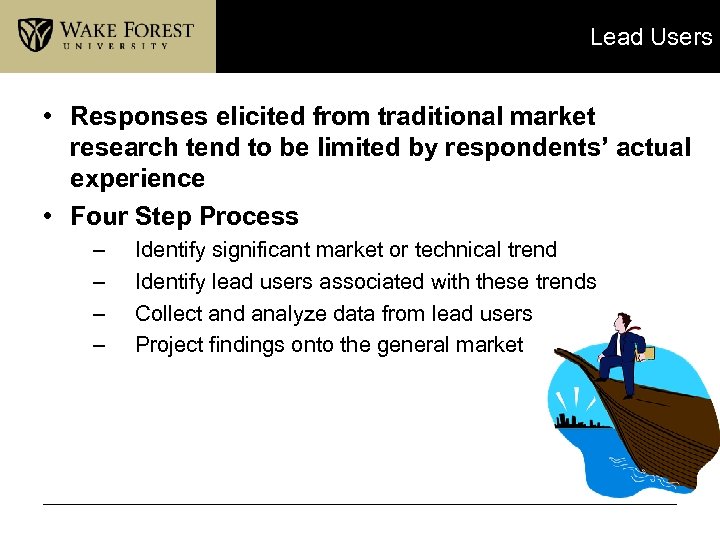 Lead Users • Responses elicited from traditional market research tend to be limited by respondents’ actual experience • Four Step Process – – Identify significant market or technical trend Identify lead users associated with these trends Collect and analyze data from lead users Project findings onto the general market
 Empathic Design • Normal customers are observed using a product/service in their own environment. • Useful insights – – – What triggered use of product or service? How does the customer interact with product/service? Has the customer modified the product/service to meet a need the organization had not anticipated? What unarticulated needs does the customer have? What intangible benefits does the product or service provide?
 Tonight’s Agenda • Who is the customer • Defining VOC • Using VOC
 Quality Function Deployment • Quality Function Deployment is a powerful tool for helping organizations translate VOC data into detailed product/service specifications and process capabilities. • Long term competitive success depends heavily on the extent to which new products or services meet customers’ needs. • The use of QFD ensures that newly designed or improved products and services satisfy market requirements and are ultimately producible by the firm.
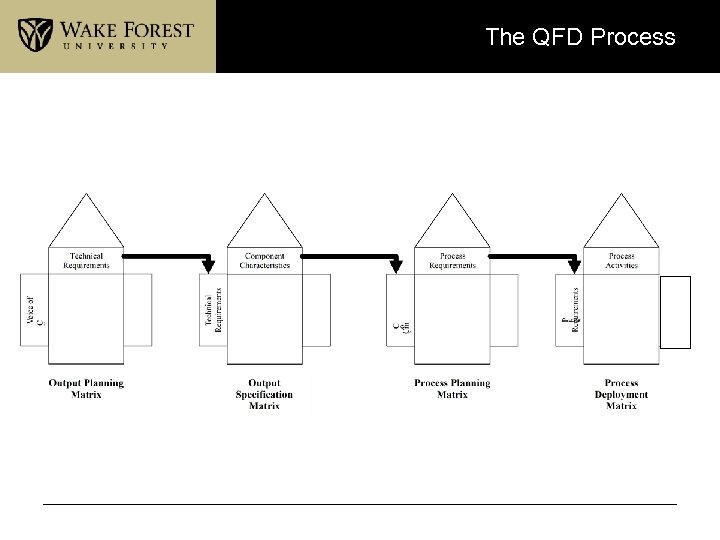 The QFD Process
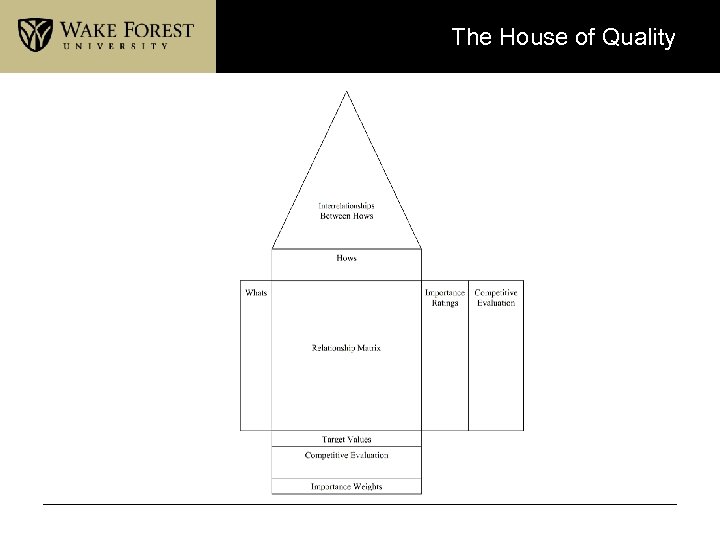 The House of Quality
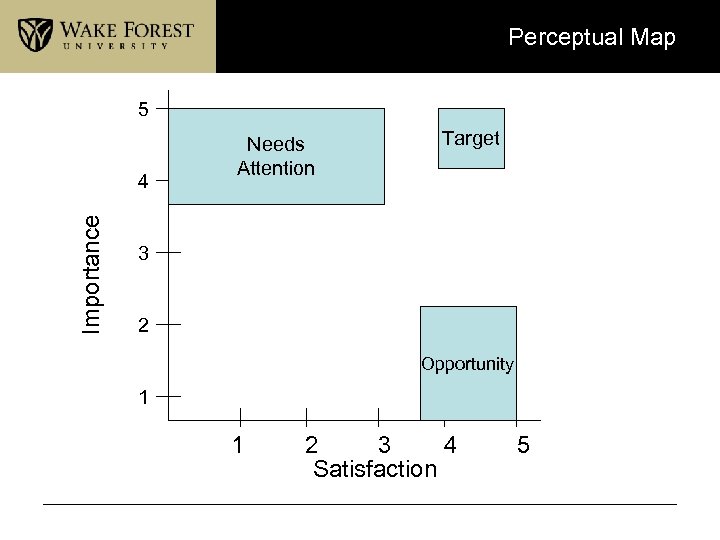 Perceptual Map 5 Importance 4 Needs Attention Target 3 2 Opportunity 1 1 2 3 4 Satisfaction 5
 Questions