


 Скачать презентацию Using the PDSA Cycle to Successfully Implement an
fbd9fd0beca93166a0ad6b3ebc2af2f8.ppt
- Количество слайдов: 12
 Using the PDSA Cycle to Successfully Implement an HIV Rapid Testing Program in Hospital Labor & Delivery by Debra Welborn Maricopa Integrated Health System Funding by the Department of Health and Human Services, Health Resources and Service Administration, the Ryan White CARE Act Amendments of 2000 and the Maricopa Integrated Health System Funded by HRSA HIV/AIDS Bureau
 Maricopa Integrated Health System • Maricopa Integrated Health System (MIHS) is is a special health care district in Phoenix, AZ • MIHS includes: § Acute care hospital, Maricopa Medical Center, with 449 beds § 12 ambulatory health centers including an HIV (Ryan White) health center, § Psychiatric services, Arizona burn center, Level 1 trauma center. • MIHS is the grantee in Maricopa County, Arizona for: § Title III since 1991 - 1563 clients, § Title IV since 1998 - 988 clients § Title I since 1994 and Title II since 2005 2 National Quality Center (NQC)
 Maricopa Integrated Health System • • Maricopa Medical Center (MMC) is #3 in Maricopa County for the largest number of deliveries for uninsured, indigent and refugee women. As a Title IV initiative, MMC went “live” on July 1, 2005 with its program: ‘HIV Rapid Testing in Labor & Delivery’. Criteria: Ø Ø 3 Ensure that Rapid HIV test is offered to 100% of moms (in imminent labor) who do not already have a documented HIV test or who are at high-risk of contracting HIV during the pregnancy Ensure effective pre-test & post-test counseling with appropriate referrals National Quality Center (NQC)
 Challenges in Using Data • Trouble collecting data: § § § • Problems sharing data: § 4 The only way to identify women with no prenatal care is with the manual labor log. Electronic reports are unavailable. The only way to identify women with high risk factors is through a chart review of 100% of deliveries. The only way to compute compliance rates is not with a lab monitoring log, but through chart reviews of electronic medical records. Data is shared through the Perinatal PI Committee with the department heads. The information, however, is not always communicated to other practitioners. National Quality Center (NQC)
 Challenges in Using Data • Difficulties with analyzing data: § • Follow-up problems: § • Minimal, but includes staffing changes, priorities and limited resources remain. Sustainability issues: § 5 Chart Reviews are time consuming: Except for lab results, information is ‘hidden’ in the margins of progress notes, nurses notes or labor & delivery notes. Human resources for data collection and analysis are limited. National Quality Center (NQC)
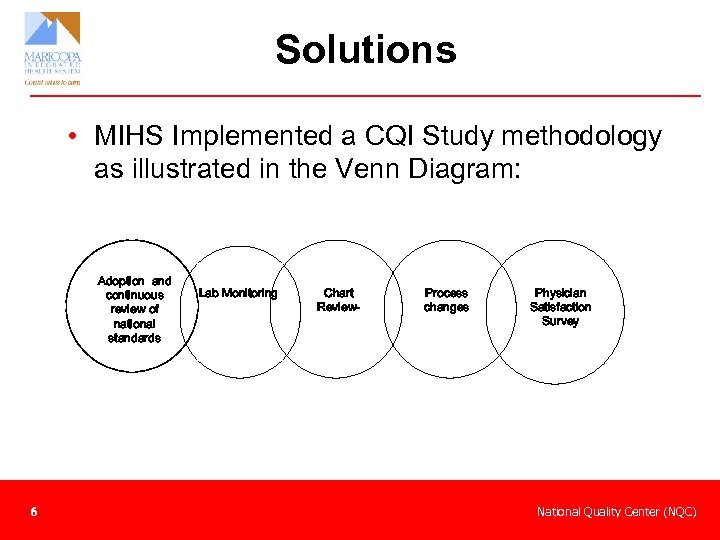 Solutions • MIHS Implemented a CQI Study methodology as illustrated in the Venn Diagram: Adoption and continuous review of national standards 6 Lab Monitoring Chart Review- Process changes Physician Satisfaction Survey National Quality Center (NQC)
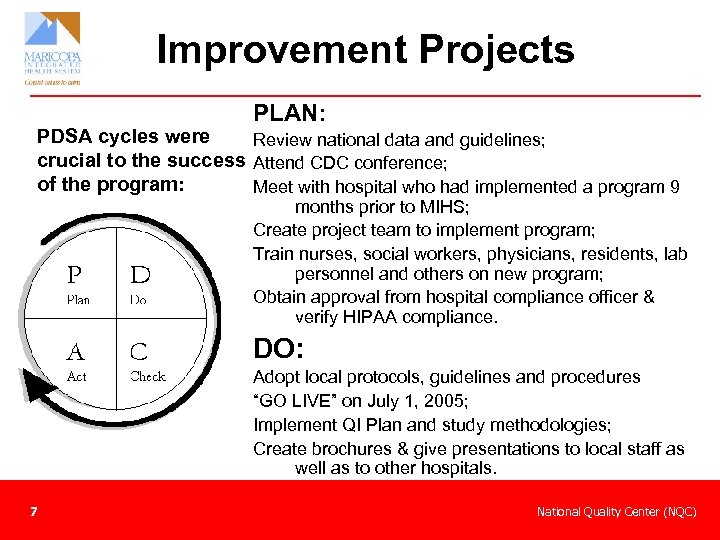 Improvement Projects PLAN: PDSA cycles were Review national data and guidelines; crucial to the success Attend CDC conference; of the program: Meet with hospital who had implemented a program 9 months prior to MIHS; Create project team to implement program; Train nurses, social workers, physicians, residents, lab personnel and others on new program; Obtain approval from hospital compliance officer & verify HIPAA compliance. DO: Adopt local protocols, guidelines and procedures “GO LIVE” on July 1, 2005; Implement QI Plan and study methodologies; Create brochures & give presentations to local staff as well as to other hospitals. 7 National Quality Center (NQC)
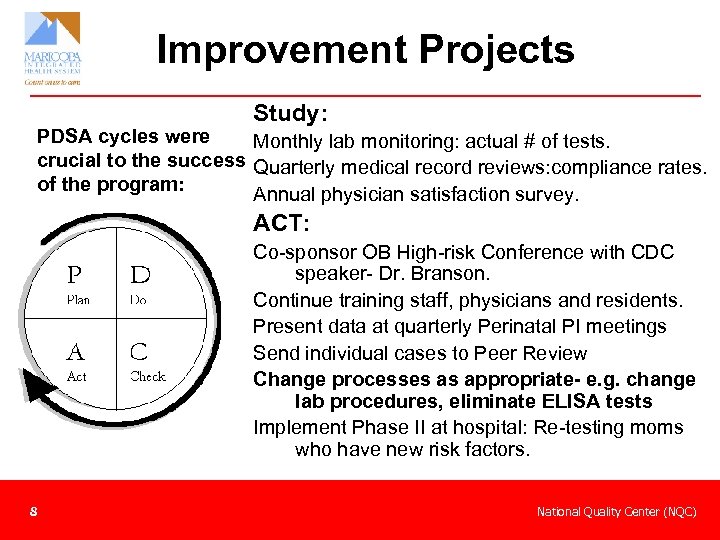 Improvement Projects Study: PDSA cycles were Monthly lab monitoring: actual # of tests. crucial to the success Quarterly medical record reviews: compliance rates. of the program: Annual physician satisfaction survey. ACT: Co-sponsor OB High-risk Conference with CDC speaker- Dr. Branson. Continue training staff, physicians and residents. Present data at quarterly Perinatal PI meetings Send individual cases to Peer Review Change processes as appropriate- e. g. change lab procedures, eliminate ELISA tests Implement Phase II at hospital: Re-testing moms who have new risk factors. 8 National Quality Center (NQC)
 Lessons Learned • You can start a new program and implement a PDSA cycle without total physician buy-in, but it’s problematic. Adjustments are required and improvements are gradual. • Consultation/training from known “experts” are essential to the CQI process- they provide credibility as well as motivation for local practitioners. 9 National Quality Center (NQC)
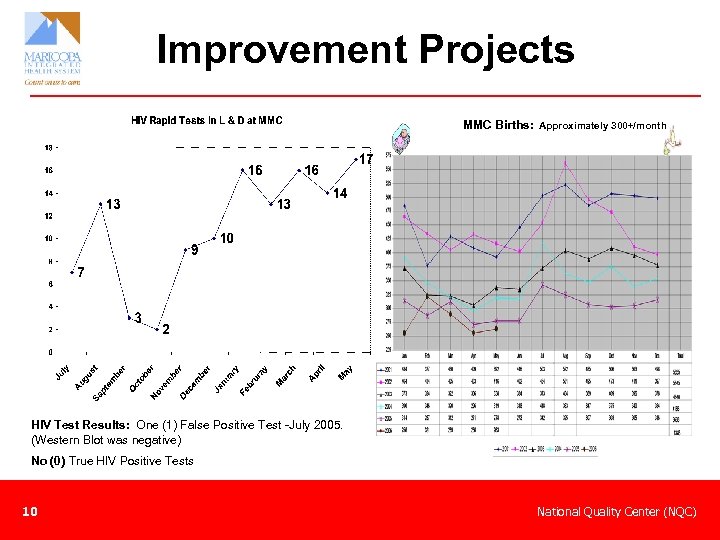 Improvement Projects MMC Births: Approximately 300+/month HIV Test Results: One (1) False Positive Test -July 2005. (Western Blot was negative) No (0) True HIV Positive Tests 10 National Quality Center (NQC)
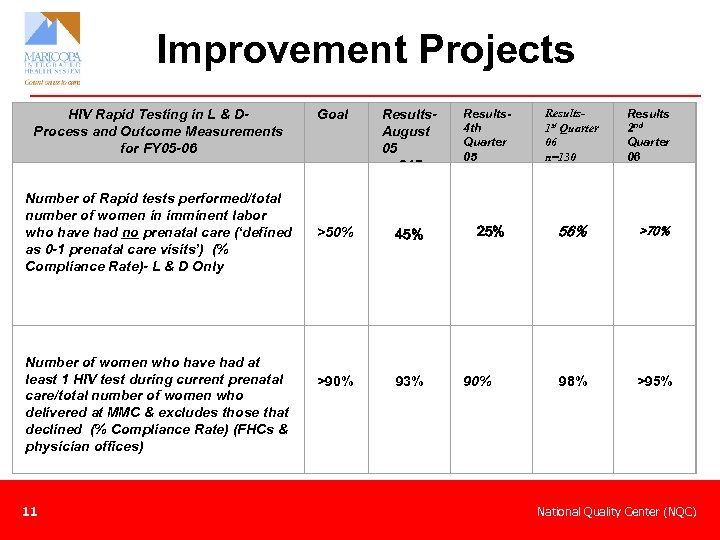 Improvement Projects HIV Rapid Testing in L & DProcess and Outcome Measurements for FY 05 -06 Goal Number of Rapid tests performed/total number of women in imminent labor who have had no prenatal care (‘defined as 0 -1 prenatal care visits’) (% Compliance Rate)- L & D Only >50% Number of women who have had at least 1 HIV test during current prenatal care/total number of women who delivered at MMC & excludes those that declined (% Compliance Rate) (FHCs & physician offices) 11 >90% Results. August 05 n=317 Results 4 th Quarter 05 n=99 25% 45% 93% 90% Results 1 st Quarter 06 n=130 Results 2 nd Quarter 06 n=120+ 56% >70% 98% >95% National Quality Center (NQC)
 Stay Tuned for Part II • MIHS’ initiative includes providing technical assistance to all other hospitals with L & D departments in Maricopa County who have not yet implemented an HIV Rapid Testing Program. • MIHS & AETCs are looking at ways to partner on HIV Rapid Testing programs. • For further information contact: Debra Welborn, Title IV Program Coordinator at 602 -344 -2628. See also www. mihs/org/ryanwhite 12 National Quality Center (NQC)