 Скачать презентацию Using the ICE-GB corpus to model the English
a2996dae247d31f35739cf931439b5d0.ppt
- Количество слайдов: 28



Using the ICE-GB corpus to model the English dative alternation Daphne Theijssen Ph. D student Department of Linguistics Radboud University Nijmegen d. theijssen@let. ru. nl Radboud University Nijmegen
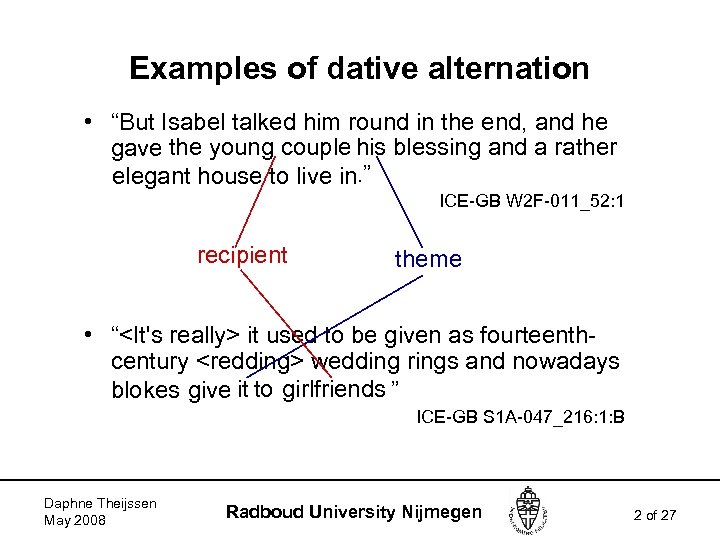
Examples of dative alternation • “But Isabel talked him round in the end, and he gave the young couple his blessing and a rather elegant house to live in. ” ICE-GB W 2 F-011_52: 1 recipient theme • “<It's really> it used to be given as fourteenthcentury <redding> wedding rings and nowadays blokes give it to girlfriends ” ICE-GB S 1 A-047_216: 1: B Daphne Theijssen May 2008 Radboud University Nijmegen 2 of 27
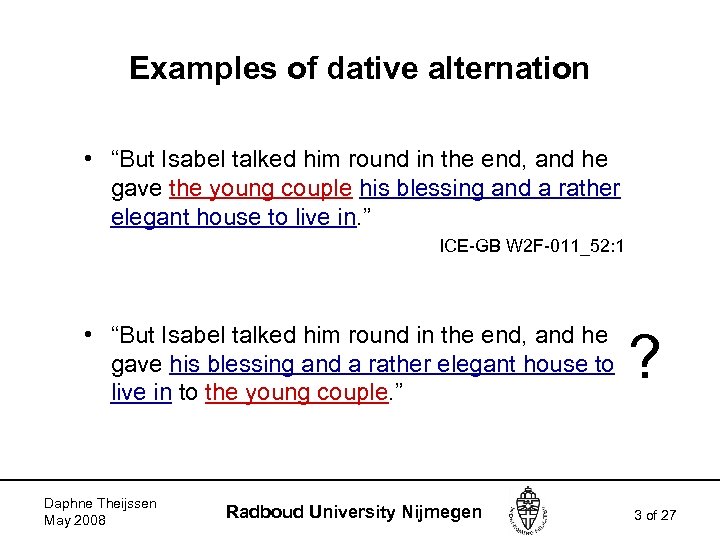
Examples of dative alternation • “But Isabel talked him round in the end, and he gave the young couple his blessing and a rather elegant house to live in. ” ICE-GB W 2 F-011_52: 1 • “But Isabel talked him round in the end, and he gave his blessing and a rather elegant house to live in to the young couple. ” Daphne Theijssen May 2008 Radboud University Nijmegen ? 3 of 27
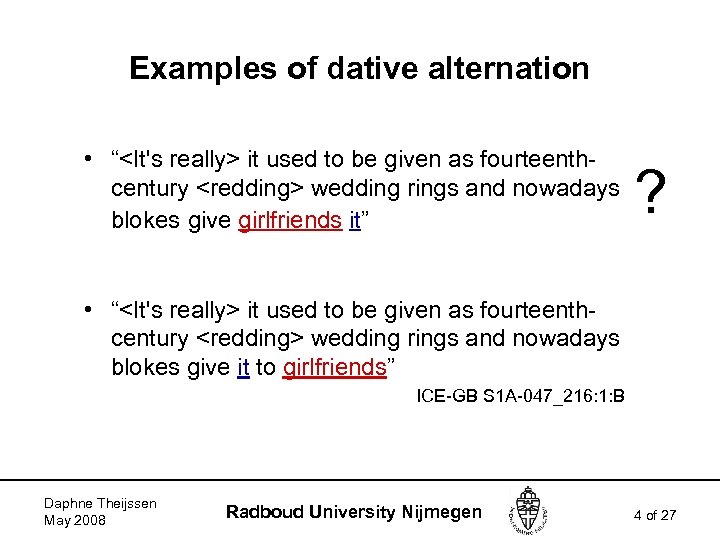
Examples of dative alternation • “<It's really> it used to be given as fourteenthcentury <redding> wedding rings and nowadays blokes give girlfriends it” ? • “<It's really> it used to be given as fourteenthcentury <redding> wedding rings and nowadays blokes give it to girlfriends” ICE-GB S 1 A-047_216: 1: B Daphne Theijssen May 2008 Radboud University Nijmegen 4 of 27
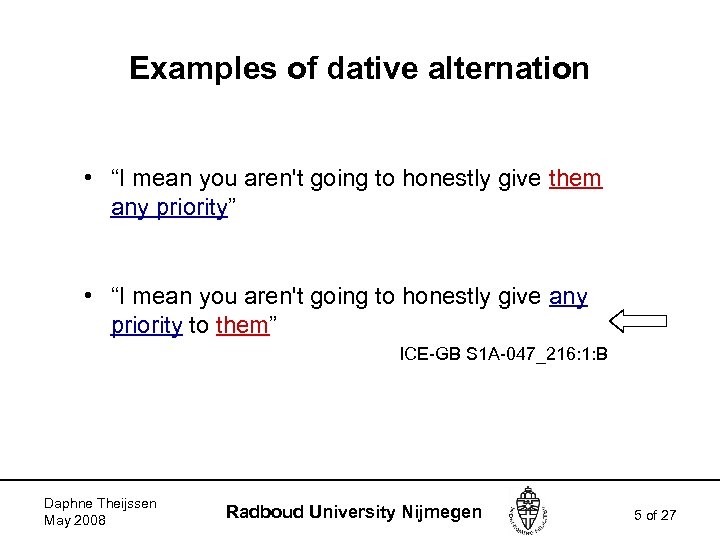
Examples of dative alternation • “I mean you aren't going to honestly give them any priority” • “I mean you aren't going to honestly give any priority to them” ICE-GB S 1 A-047_216: 1: B Daphne Theijssen May 2008 Radboud University Nijmegen 5 of 27
Question Can we predict the dative alternation? Daphne Theijssen May 2008 Radboud University Nijmegen 6 of 27
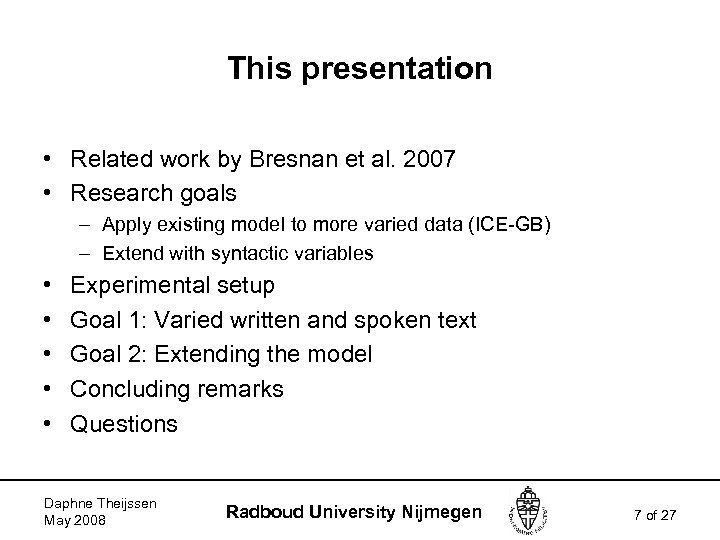
This presentation • Related work by Bresnan et al. 2007 • Research goals – Apply existing model to more varied data (ICE-GB) – Extend with syntactic variables • • • Experimental setup Goal 1: Varied written and spoken text Goal 2: Extending the model Concluding remarks Questions Daphne Theijssen May 2008 Radboud University Nijmegen 7 of 27
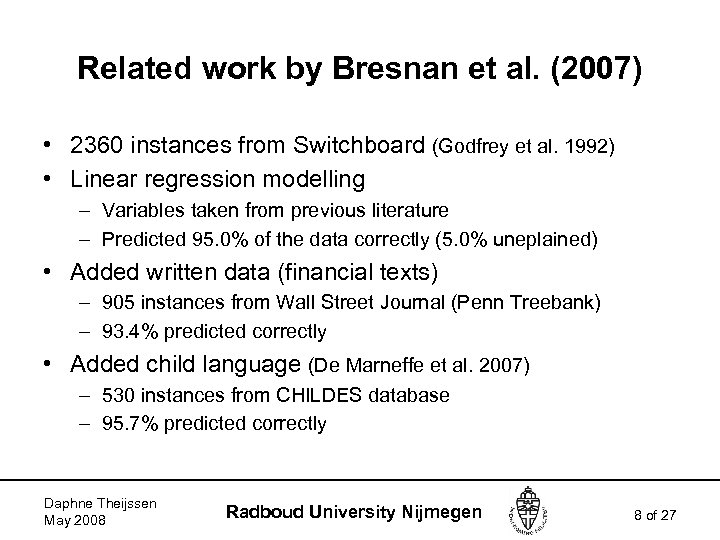
Related work by Bresnan et al. (2007) • 2360 instances from Switchboard (Godfrey et al. 1992) • Linear regression modelling – Variables taken from previous literature – Predicted 95. 0% of the data correctly (5. 0% uneplained) • Added written data (financial texts) – 905 instances from Wall Street Journal (Penn Treebank) – 93. 4% predicted correctly • Added child language (De Marneffe et al. 2007) – 530 instances from CHILDES database – 95. 7% predicted correctly Daphne Theijssen May 2008 Radboud University Nijmegen 8 of 27
Research goals 1. Applying Bresnan et al. ’s GLM (2007) to a corpus showing more variation in text genre 2. Extending the model with syntactic features Daphne Theijssen May 2008 Radboud University Nijmegen 9 of 27
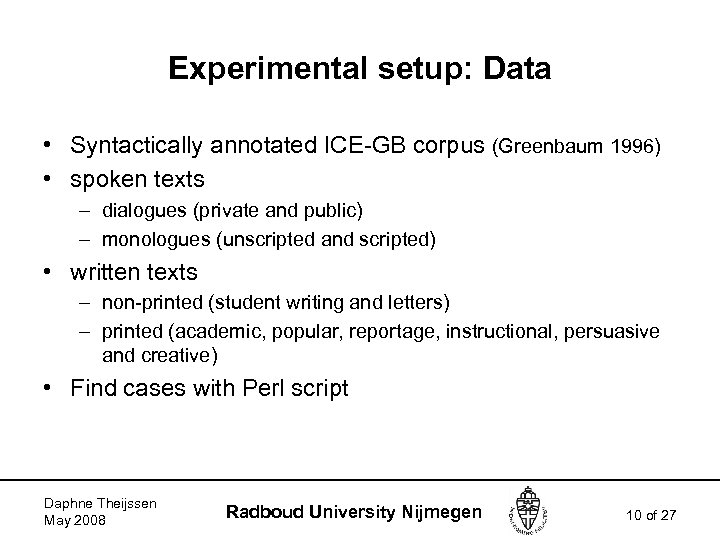
Experimental setup: Data • Syntactically annotated ICE-GB corpus (Greenbaum 1996) • spoken texts – dialogues (private and public) – monologues (unscripted and scripted) • written texts – non-printed (student writing and letters) – printed (academic, popular, reportage, instructional, persuasive and creative) • Find cases with Perl script Daphne Theijssen May 2008 Radboud University Nijmegen 10 of 27
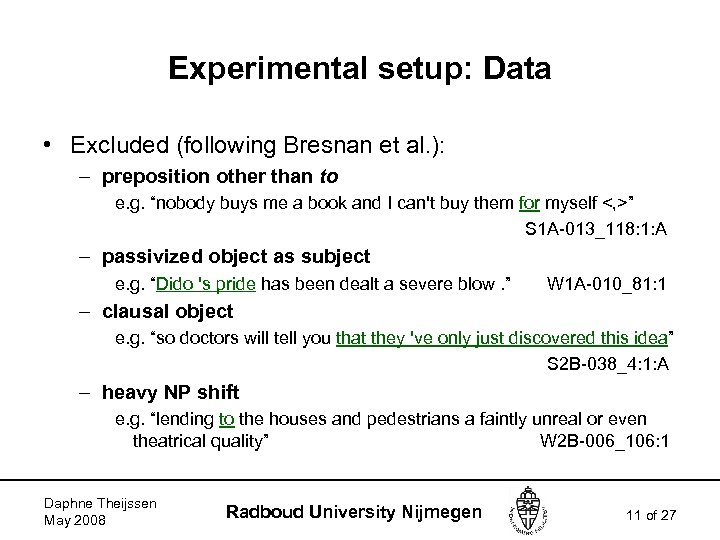
Experimental setup: Data • Excluded (following Bresnan et al. ): – preposition other than to e. g. “nobody buys me a book and I can't buy them for myself <, >” S 1 A-013_118: 1: A – passivized object as subject e. g. “Dido 's pride has been dealt a severe blow. ” W 1 A-010_81: 1 – clausal object e. g. “so doctors will tell you that they 've only just discovered this idea” S 2 B-038_4: 1: A – heavy NP shift e. g. “lending to the houses and pedestrians a faintly unreal or even theatrical quality” W 2 B-006_106: 1 Daphne Theijssen May 2008 Radboud University Nijmegen 11 of 27
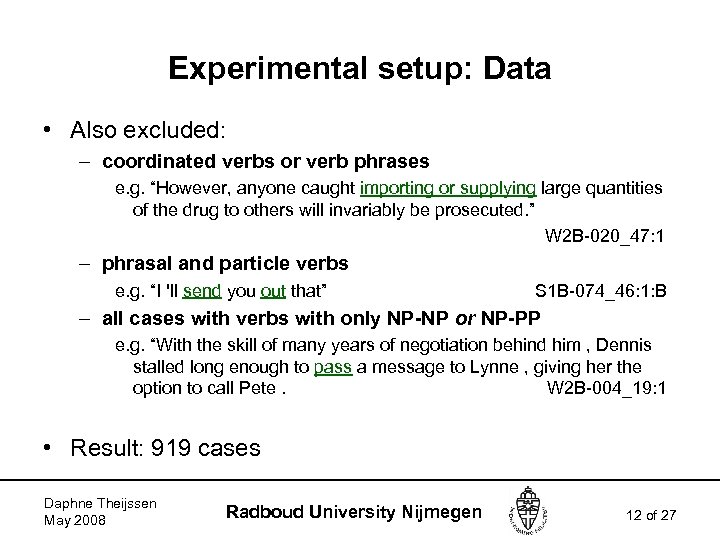
Experimental setup: Data • Also excluded: – coordinated verbs or verb phrases e. g. “However, anyone caught importing or supplying large quantities of the drug to others will invariably be prosecuted. ” W 2 B-020_47: 1 – phrasal and particle verbs e. g. “I 'll send you out that” S 1 B-074_46: 1: B – all cases with verbs with only NP-NP or NP-PP e. g. “With the skill of many years of negotiation behind him , Dennis stalled long enough to pass a message to Lynne , giving her the option to call Pete. W 2 B-004_19: 1 • Result: 919 cases Daphne Theijssen May 2008 Radboud University Nijmegen 12 of 27
Experimental setup: LMER • Linear Mixed-Effect Modelling (Bates 2005) – Fixed effexts: variables – Random effect: verb sense • Verb sense => assume lexical bias (Bresnan et al. 2007, Gries and Stefanowitsch 2004 ) • Analyzing the model – Use coefficients to determine which variables show significant effects in the dative alternation model – Evaluate the model fit (% of correctly predicted cases) Daphne Theijssen May 2008 Radboud University Nijmegen 13 of 27
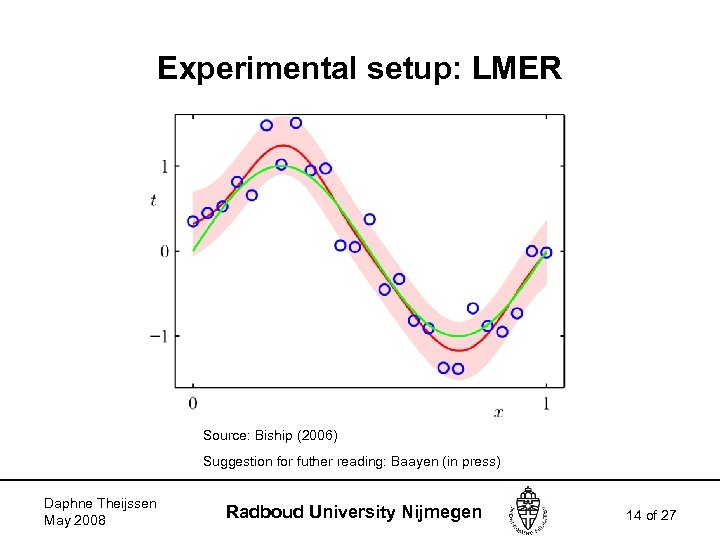
Experimental setup: LMER Source: Biship (2006) Suggestion for futher reading: Baayen (in press) Daphne Theijssen May 2008 Radboud University Nijmegen 14 of 27
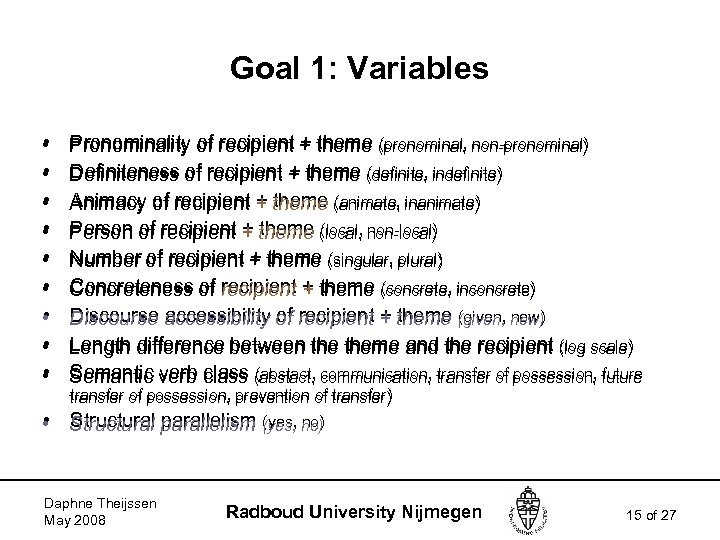
Goal 1: Variables • • • Pronominality of recipient + theme (pronominal, non-pronominal) Definiteness of recipient + theme (definite, indefinite) Animacy of recipient + theme (animate, inanimate) Person of recipient + theme (local, non-local) Number of recipient + theme (singular, plural) Concreteness of recipient + theme (concrete, inconcrete) Discourse accessibility of recipient + theme (given, new) Length difference between theme and the recipient (log scale) Semantic verb class (abstact, communication, transfer of possession, future transfer of possession, prevention of transfer) • Structural parallelism (yes, no) Daphne Theijssen May 2008 Radboud University Nijmegen 15 of 27
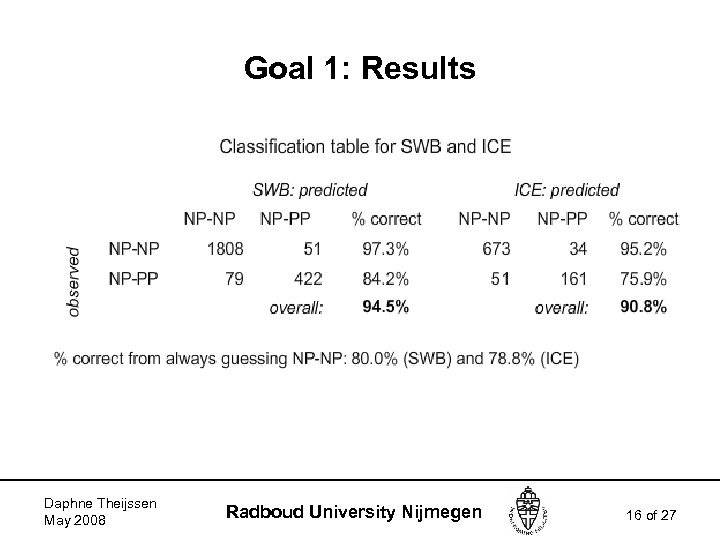
Goal 1: Results Daphne Theijssen May 2008 Radboud University Nijmegen 16 of 27
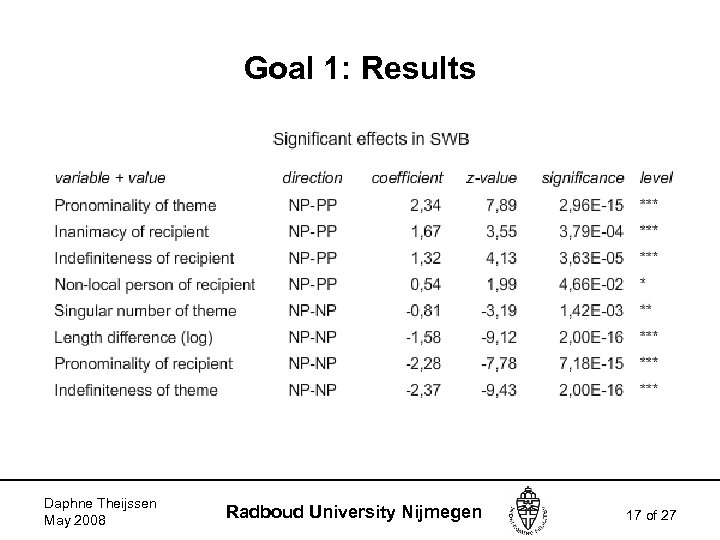
Goal 1: Results Daphne Theijssen May 2008 Radboud University Nijmegen 17 of 27
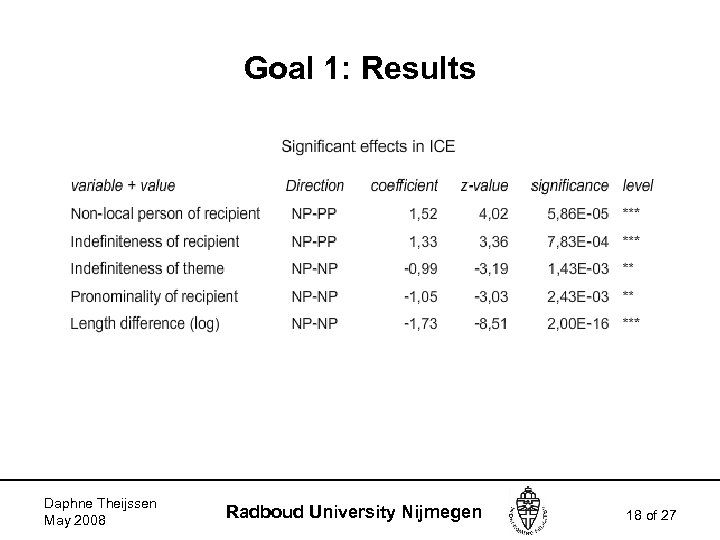
Goal 1: Results Daphne Theijssen May 2008 Radboud University Nijmegen 18 of 27
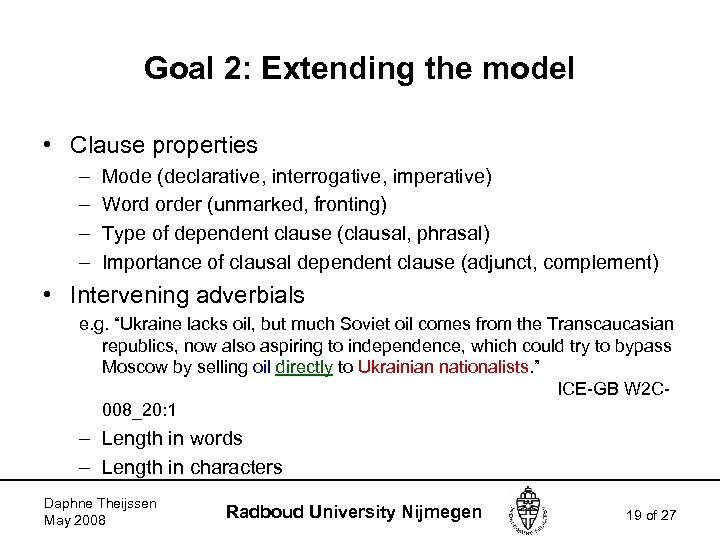
Goal 2: Extending the model • Clause properties – – Mode (declarative, interrogative, imperative) Word order (unmarked, fronting) Type of dependent clause (clausal, phrasal) Importance of clausal dependent clause (adjunct, complement) • Intervening adverbials e. g. “Ukraine lacks oil, but much Soviet oil comes from the Transcaucasian republics, now also aspiring to independence, which could try to bypass Moscow by selling oil directly to Ukrainian nationalists. ” ICE-GB W 2 C 008_20: 1 – Length in words – Length in characters Daphne Theijssen May 2008 Radboud University Nijmegen 19 of 27
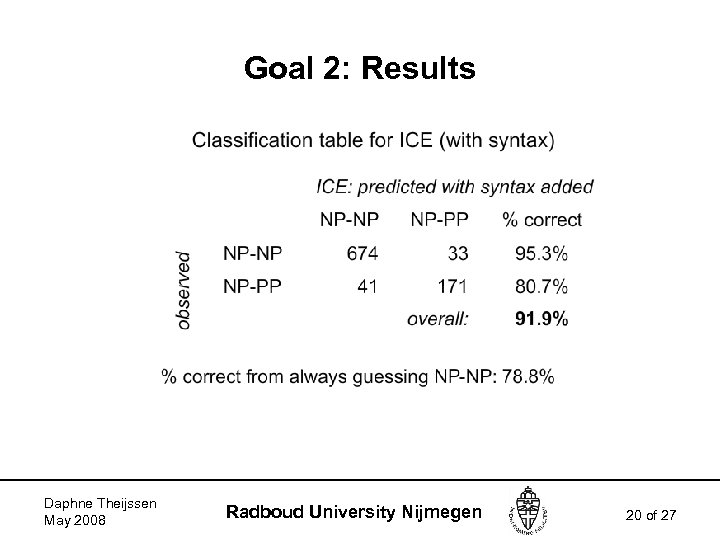
Goal 2: Results Daphne Theijssen May 2008 Radboud University Nijmegen 20 of 27
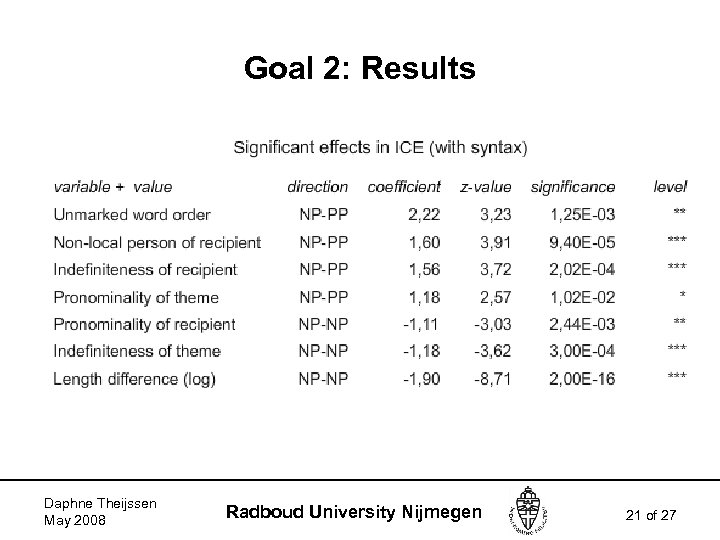
Goal 2: Results Daphne Theijssen May 2008 Radboud University Nijmegen 21 of 27
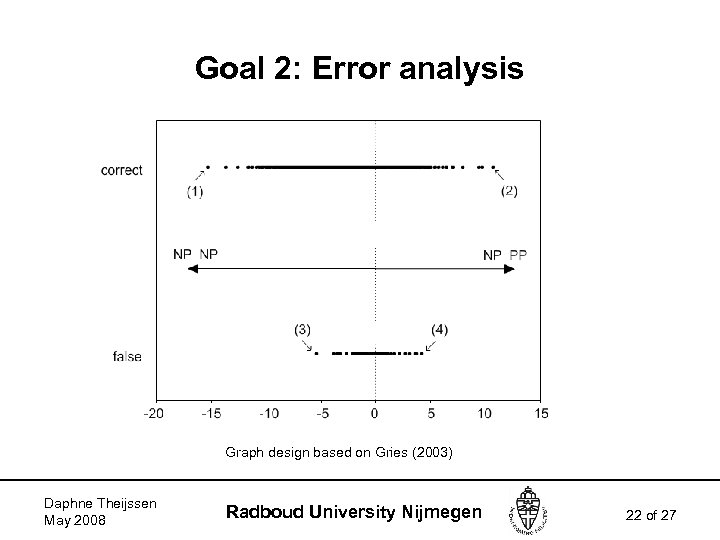
Goal 2: Error analysis Graph design based on Gries (2003) Daphne Theijssen May 2008 Radboud University Nijmegen 22 of 27
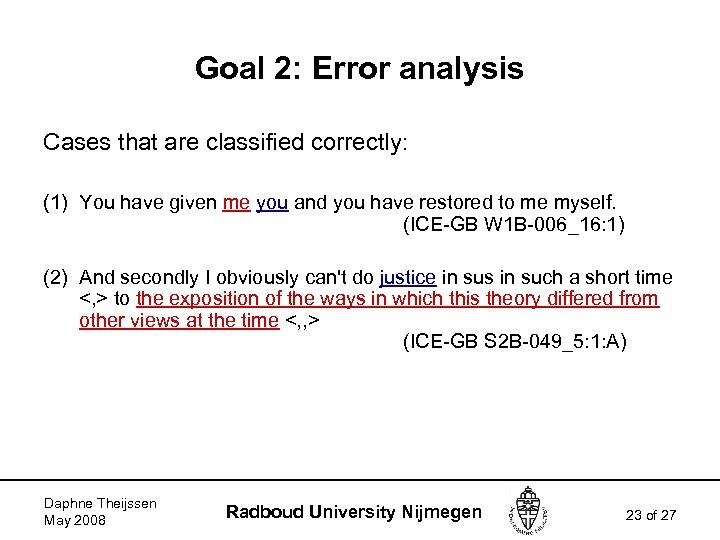
Goal 2: Error analysis Cases that are classified correctly: (1) You have given me you and you have restored to me myself. (ICE-GB W 1 B-006_16: 1) (2) And secondly I obviously can't do justice in sus in such a short time <, > to the exposition of the ways in which this theory differed from other views at the time <, , > (ICE-GB S 2 B-049_5: 1: A) Daphne Theijssen May 2008 Radboud University Nijmegen 23 of 27
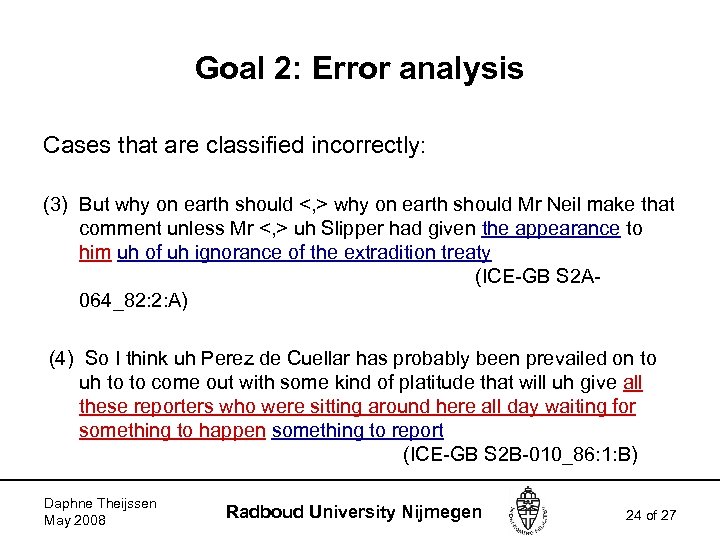
Goal 2: Error analysis Cases that are classified incorrectly: (3) But why on earth should <, > why on earth should Mr Neil make that comment unless Mr <, > uh Slipper had given the appearance to him uh of uh ignorance of the extradition treaty (ICE-GB S 2 A 064_82: 2: A) (4) So I think uh Perez de Cuellar has probably been prevailed on to uh to to come out with some kind of platitude that will uh give all these reporters who were sitting around here all day waiting for something to happen something to report (ICE-GB S 2 B-010_86: 1: B) Daphne Theijssen May 2008 Radboud University Nijmegen 24 of 27
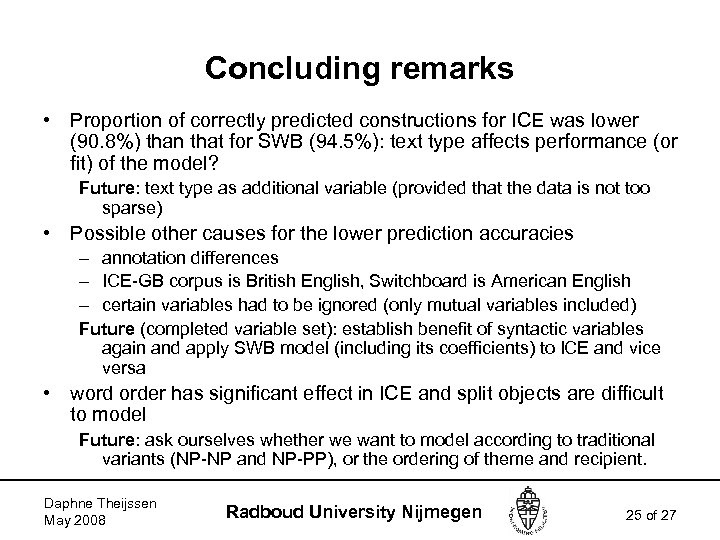
Concluding remarks • Proportion of correctly predicted constructions for ICE was lower (90. 8%) than that for SWB (94. 5%): text type affects performance (or fit) of the model? Future: text type as additional variable (provided that the data is not too sparse) • Possible other causes for the lower prediction accuracies – annotation differences – ICE-GB corpus is British English, Switchboard is American English – certain variables had to be ignored (only mutual variables included) Future (completed variable set): establish benefit of syntactic variables again and apply SWB model (including its coefficients) to ICE and vice versa • word order has significant effect in ICE and split objects are difficult to model Future: ask ourselves whether we want to model according to traditional variants (NP-NP and NP-PP), or the ordering of theme and recipient. Daphne Theijssen May 2008 Radboud University Nijmegen 25 of 27
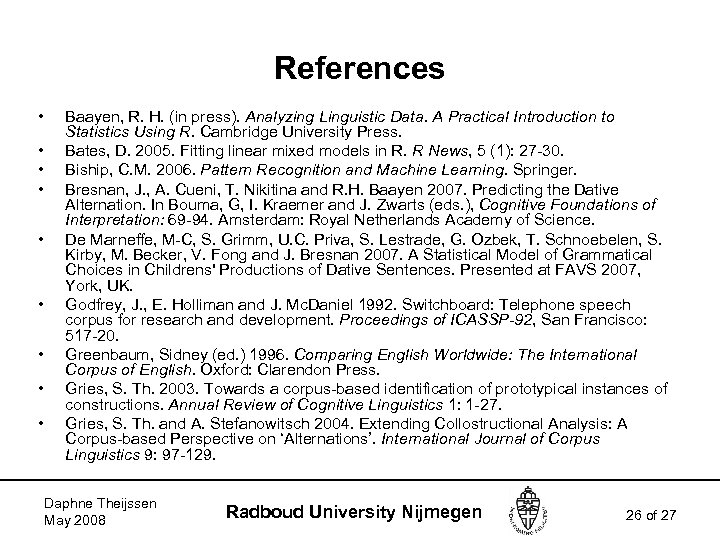
References • • • Baayen, R. H. (in press). Analyzing Linguistic Data. A Practical Introduction to Statistics Using R. Cambridge University Press. Bates, D. 2005. Fitting linear mixed models in R. R News, 5 (1): 27 -30. Biship, C. M. 2006. Pattern Recognition and Machine Learning. Springer. Bresnan, J. , A. Cueni, T. Nikitina and R. H. Baayen 2007. Predicting the Dative Alternation. In Bouma, G, I. Kraemer and J. Zwarts (eds. ), Cognitive Foundations of Interpretation: 69 -94. Amsterdam: Royal Netherlands Academy of Science. De Marneffe, M-C, S. Grimm, U. C. Priva, S. Lestrade, G. Ozbek, T. Schnoebelen, S. Kirby, M. Becker, V. Fong and J. Bresnan 2007. A Statistical Model of Grammatical Choices in Childrens' Productions of Dative Sentences. Presented at FAVS 2007, York, UK. Godfrey, J. , E. Holliman and J. Mc. Daniel 1992. Switchboard: Telephone speech corpus for research and development. Proceedings of ICASSP-92, San Francisco: 517 -20. Greenbaum, Sidney (ed. ) 1996. Comparing English Worldwide: The International Corpus of English. Oxford: Clarendon Press. Gries, S. Th. 2003. Towards a corpus-based identification of prototypical instances of constructions. Annual Review of Cognitive Linguistics 1: 1 -27. Gries, S. Th. and A. Stefanowitsch 2004. Extending Collostructional Analysis: A Corpus-based Perspective on ‘Alternations’. International Journal of Corpus Linguistics 9: 97 -129. Daphne Theijssen May 2008 Radboud University Nijmegen 26 of 27
Questions? Daphne Theijssen May 2008 Radboud University Nijmegen 27 of 27
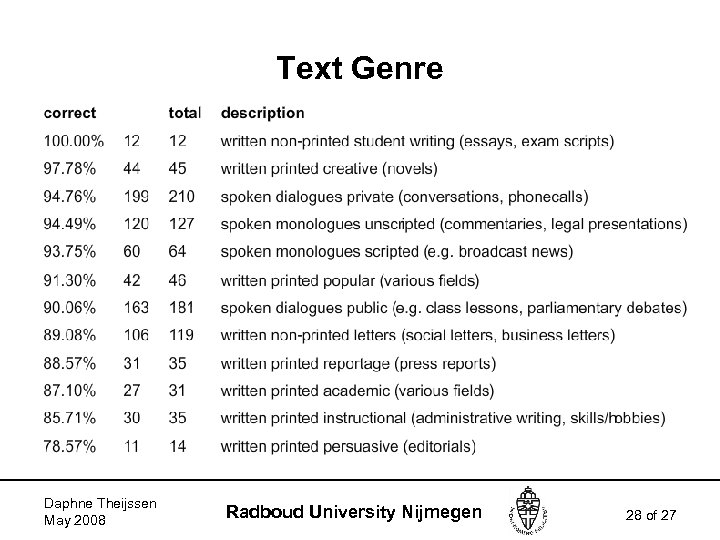
Text Genre Daphne Theijssen May 2008 Radboud University Nijmegen 28 of 27
Скачать презентацию Using the ICE-GB corpus to model the English
a2996dae247d31f35739cf931439b5d0.ppt