 Скачать презентацию Using Small Abstractions to Program Large Distributed Systems
6a8b74a6b262195594bcaa4f766d7f4e.ppt
- Количество слайдов: 53




Using Small Abstractions to Program Large Distributed Systems Douglas Thain University of Notre Dame 19 February 2009

Using Small Abstractions to Program Large Distributed Systems (And multicore computers!) Douglas Thain University of Notre Dame 19 February 2009
Clusters, clouds, and grids give us access to zillions of CPUs. How do we write programs that can run effectively in large systems?

I have 10, 000 iris images acquired in my research lab. I want to reduce each one to a feature space, and then compare all of them to each other. I want to spend my time doing science, not struggling with computers. I own a few machines I can buy time from Amazon or Tera. Grid. I have a laptop. Now What?
How do a I program a CPU? I write the algorithm in a language that I find convenient: C, Fortran, Python, etc… The compiler chooses instructions for the CPU, even if I don’t know assembly. The operating system allocates memory, moves data between disk and memory, and manages the cache. To move to a different CPU, recompile or use a VM, but don’t change the program.
How do I program the grid/cloud? Split the workload into pieces. – How much work to put in a single job? Decide how to move data. – Demand paging, streaming, file transfer? Express the problem in a workflow language or programming environment. – DAG / MPI / Pegasus / Taverna / Swift ? Babysit the problem as it runs. – Worry about disk / network / failures…
How do I program on 128 cores? Split the workload into pieces. – How much work to put in a single thread? Decide how to move data. – Shared memory, message passing, streaming? Express the problem in a workflow language or programming environment. – Open. MP, MPI, PThreads, Cilk, … Babysit the problem as it runs. – Implement application level checkpoints.
Tomorrow’s distributed systems will be clouds of multicore computers. Can we solve both problems with a single model?
Observation In a given field of study, a single person may repeat the same pattern of work many times, making slight changes to the data and algorithms. Examples everyone knows: – Parameter sweep on a simulation code. – BLAST search across multiple databases. Are there other examples? .
Abstractions for Distributed Computing Abstraction: a declarative specification of the computation and data of a workload. A restricted pattern, not meant to be a general purpose programming language. Uses data structures instead of files. Provide users with a bright path. Regular structure makes it tractable to model and predict performance.
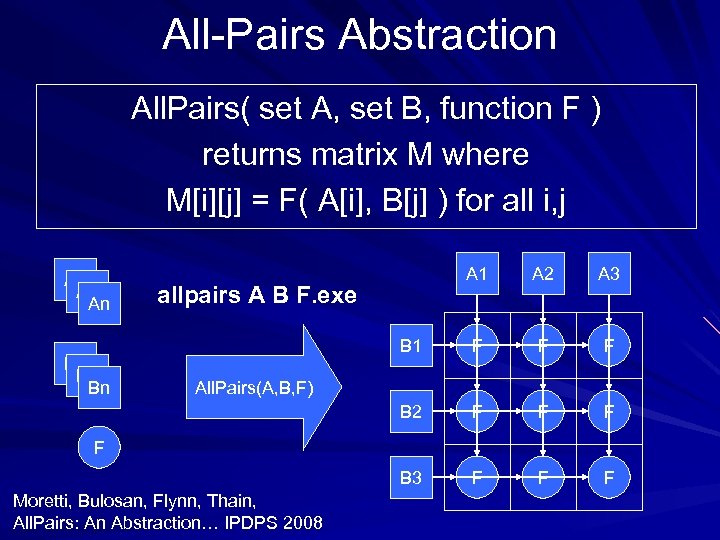
All-Pairs Abstraction All. Pairs( set A, set B, function F ) returns matrix M where M[i][j] = F( A[i], B[j] ) for all i, j A 2 A 3 B 1 F F F B 3 B 1 Bn A 1 B 2 A 1 An F F F allpairs A B F. exe All. Pairs(A, B, F) F Moretti, Bulosan, Flynn, Thain, All. Pairs: An Abstraction… IPDPS 2008
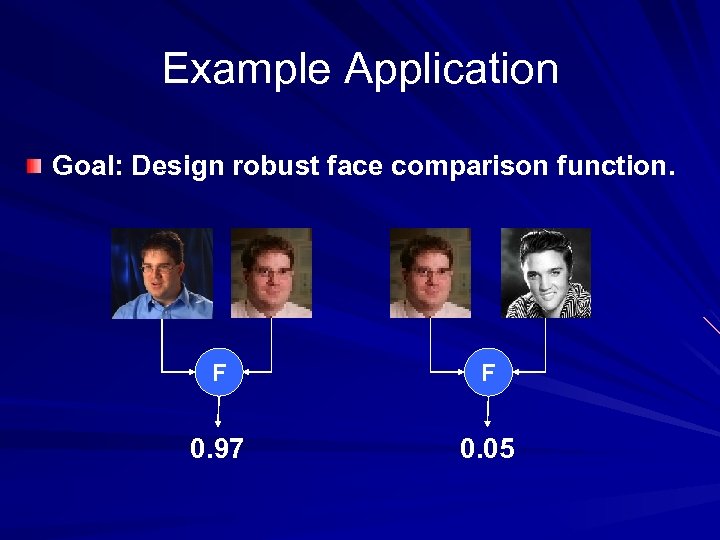
Example Application Goal: Design robust face comparison function. F F 0. 97 0. 05
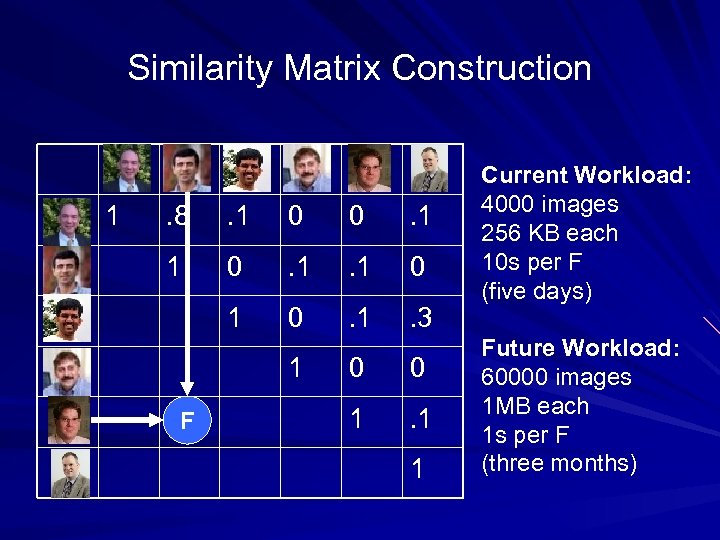
Similarity Matrix Construction 1 . 8 . 1 0 0 . 1 1 0 1 0 . 1 . 3 1 F 0 0 1 . 1 1 Current Workload: 4000 images 256 KB each 10 s per F (five days) Future Workload: 60000 images 1 MB each 1 s per F (three months)
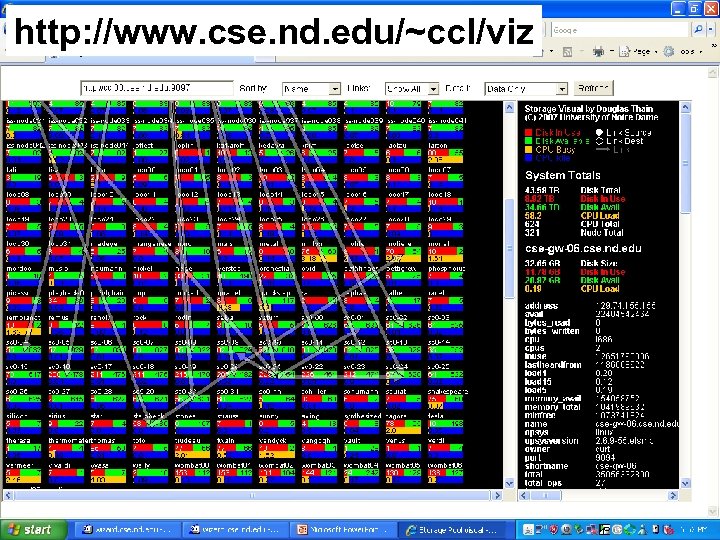
http: //www. cse. nd. edu/~ccl/viz
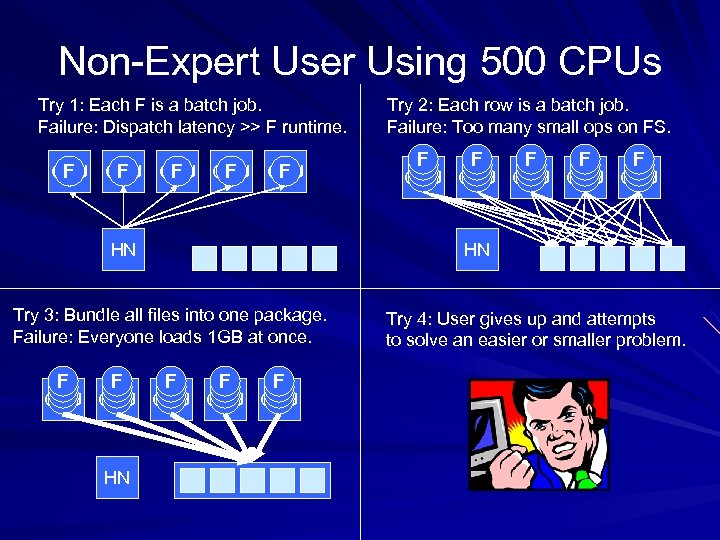
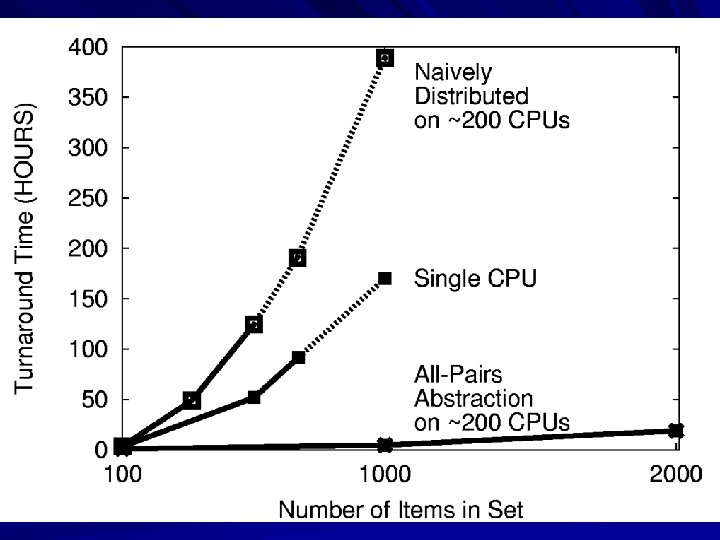
Non-Expert User Using 500 CPUs Try 1: Each F is a batch job. Failure: Dispatch latency >> F runtime. CPU CPU CPU F F F HN Try 3: Bundle all files into one package. Failure: Everyone loads 1 GB at once. F F F CPU CPU F F F HN Try 2: Each row is a batch job. Failure: Too many small ops on FS. F F F CPU CPU F F F HN Try 4: User gives up and attempts to solve an easier or smaller problem.
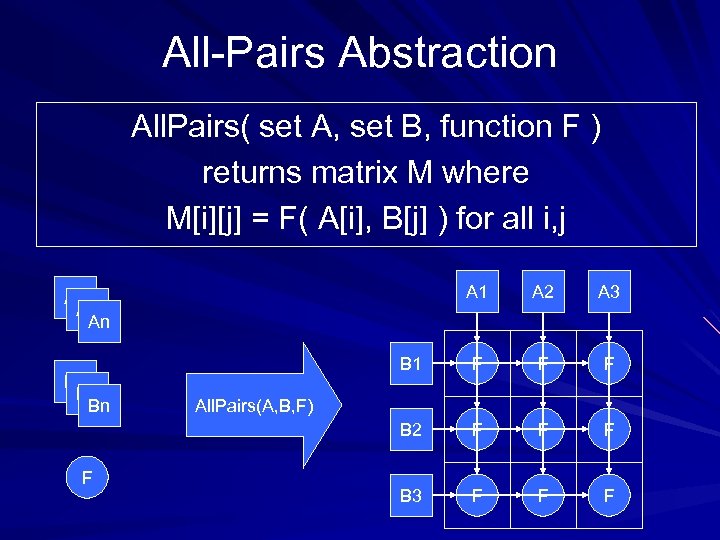
All-Pairs Abstraction All. Pairs( set A, set B, function F ) returns matrix M where M[i][j] = F( A[i], B[j] ) for all i, j A 1 A 2 A 3 B 1 F F F B 2 F F F B 3 F F F A 1 An B 1 Bn F All. Pairs(A, B, F)
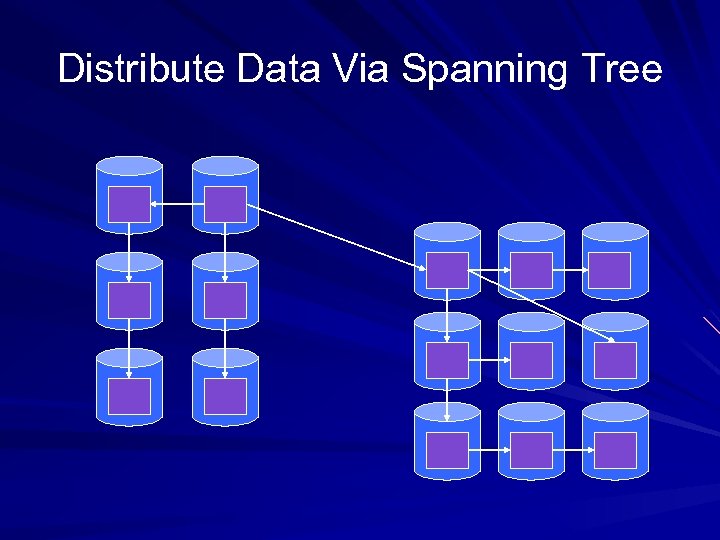
Distribute Data Via Spanning Tree
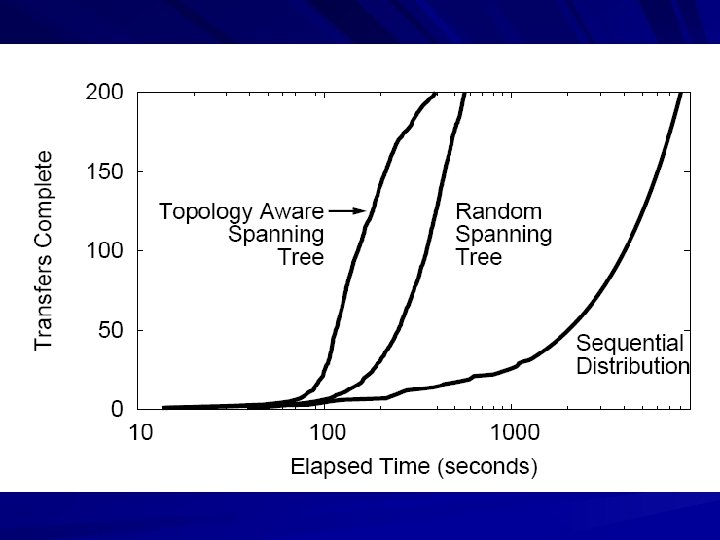
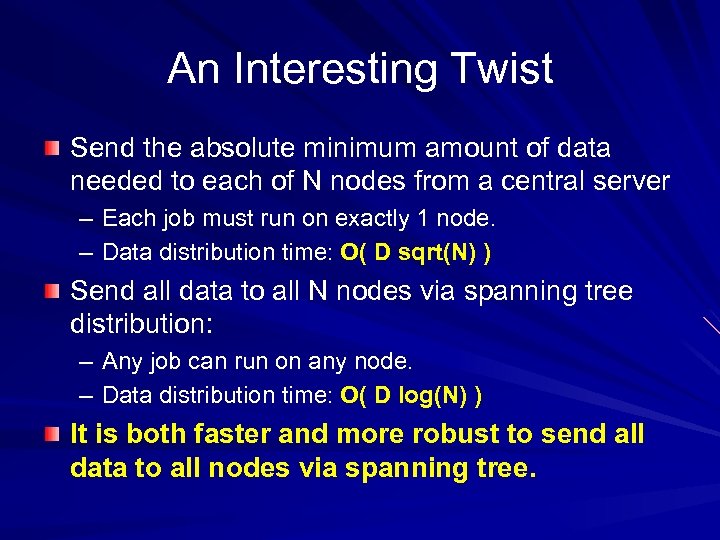
An Interesting Twist Send the absolute minimum amount of data needed to each of N nodes from a central server – Each job must run on exactly 1 node. – Data distribution time: O( D sqrt(N) ) Send all data to all N nodes via spanning tree distribution: – Any job can run on any node. – Data distribution time: O( D log(N) ) It is both faster and more robust to send all data to all nodes via spanning tree.
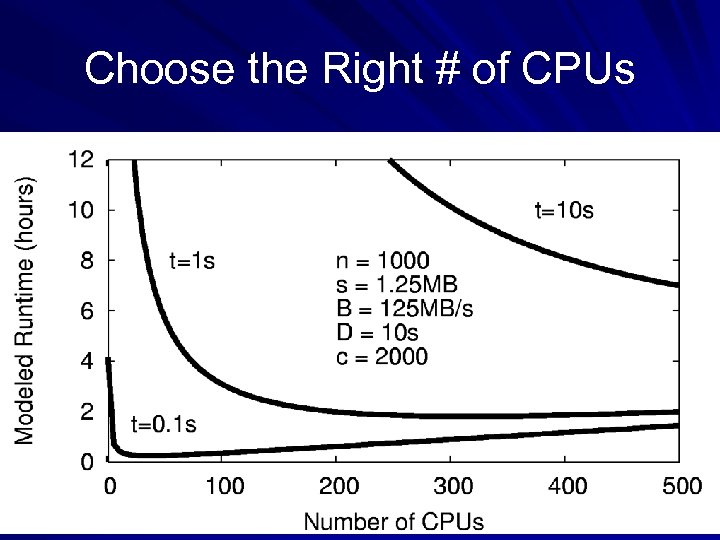
Choose the Right # of CPUs

What is the right metric?
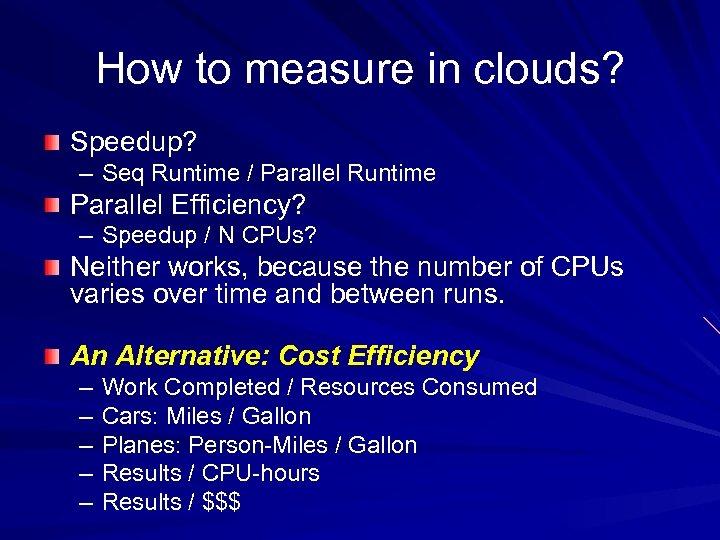
How to measure in clouds? Speedup? – Seq Runtime / Parallel Runtime Parallel Efficiency? – Speedup / N CPUs? Neither works, because the number of CPUs varies over time and between runs. An Alternative: Cost Efficiency – – – Work Completed / Resources Consumed Cars: Miles / Gallon Planes: Person-Miles / Gallon Results / CPU-hours Results / $$$
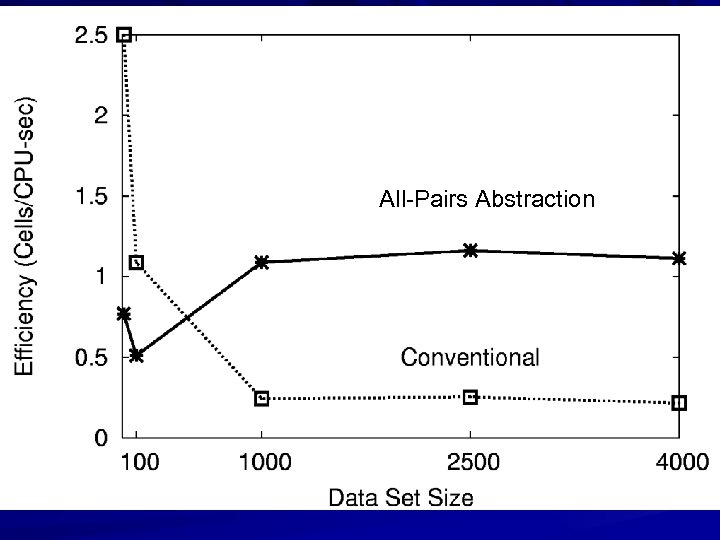
All-Pairs Abstraction
![Wavefront ( R[x, 0], R[0, y], F(x, y, d) ) R[0, 4] x F](https://present5.com/presentation/6a8b74a6b262195594bcaa4f766d7f4e/image-25.jpg "Wavefront ( R[x, 0], R[0, y], F(x, y, d) ) R[0, 4] x F")
Wavefront ( R[x, 0], R[0, y], F(x, y, d) ) R[0, 4] x F d R[0, 3] x y x R[0, 0] R[3, 2] R[4, 3] F R[4, 2] d y F d F x F d R[0, 1] R[4, 4] x F x R[3, 4] y d R[0, 2] R[2, 4] y R[1, 0] y F d x d y F d x y R[2, 0] x y F d y R[3, 0] x F d y R[4, 0]
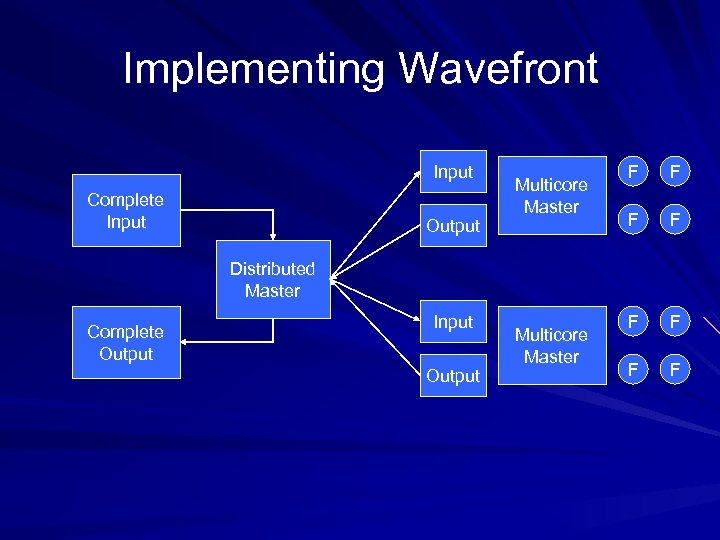
Implementing Wavefront Input Complete Input Output Multicore Master F F F F Distributed Master Complete Output Input Output Multicore Master
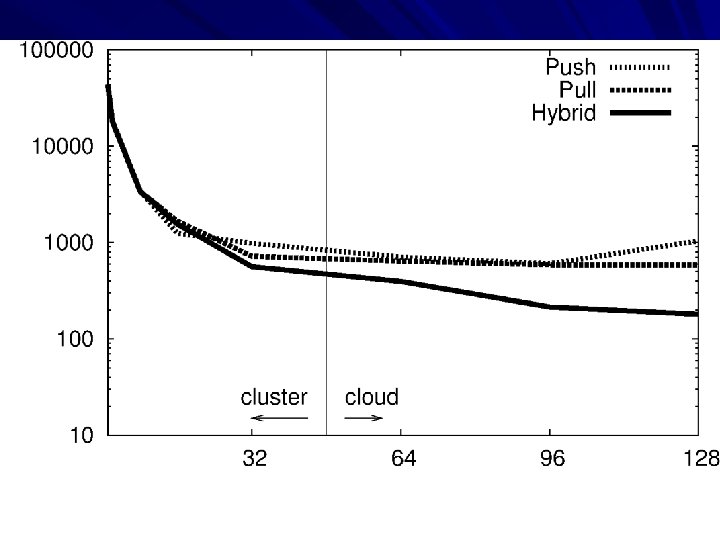
The Performance Problem Dispatch latency really matters: a delay in one holds up all of its children. If we dispatch larger sub-problems: – Concurrency on each node increases. – Distributed concurrency decreases. If we dispatch smaller sub-problems: – Concurrency on each node decreases. – Spend more time waiting for jobs to be dispatched. So, model the system to choose the block size. And, build a fast-dispatch execution system.
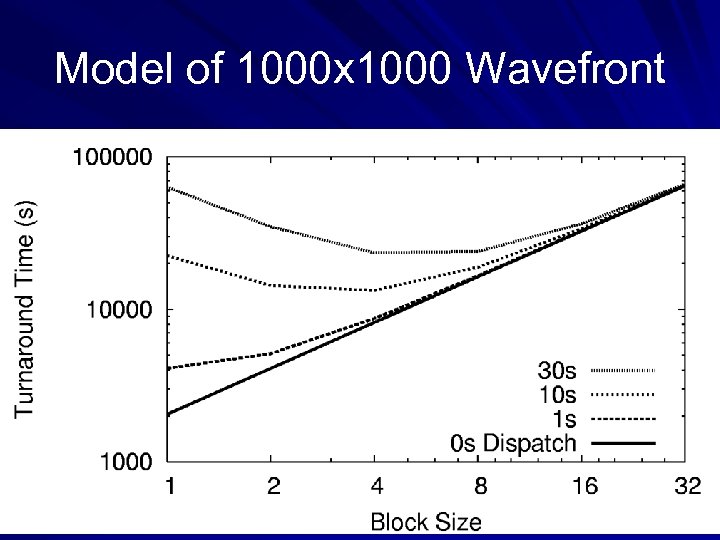
Model of 1000 x 1000 Wavefront
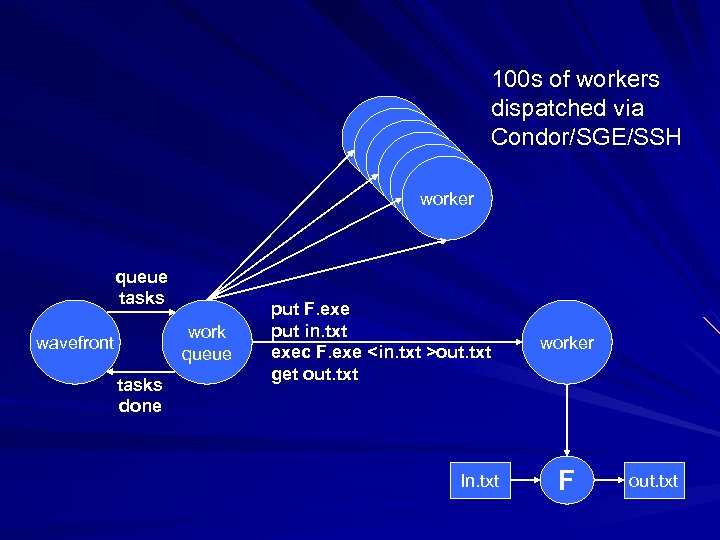
worker worker queue tasks work queue wavefront tasks done 100 s of workers dispatched via Condor/SGE/SSH put F. exe put in. txt exec F. exe <in. txt >out. txt get out. txt In. txt worker F out. txt
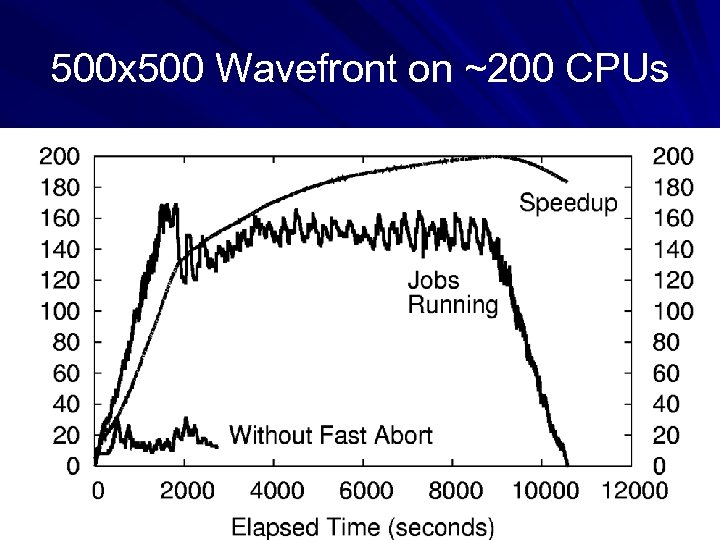
500 x 500 Wavefront on ~200 CPUs
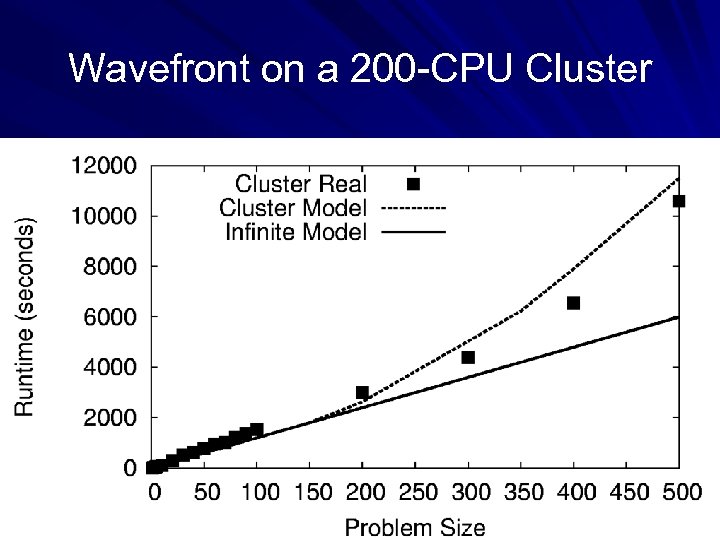
Wavefront on a 200 -CPU Cluster
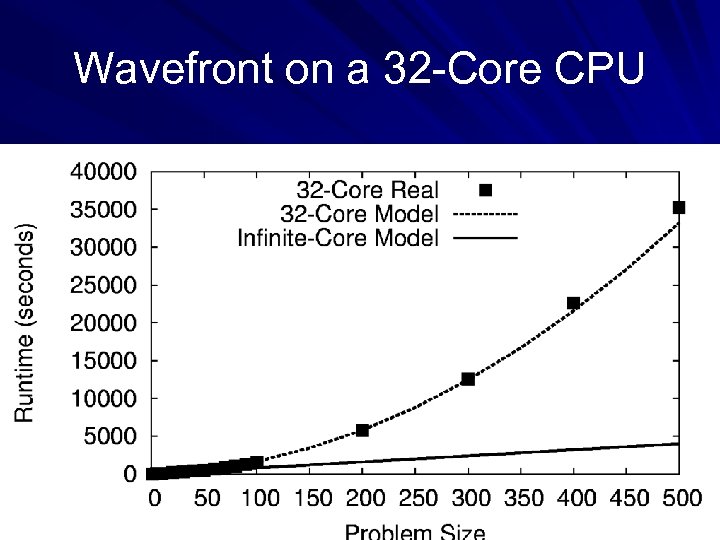
Wavefront on a 32 -Core CPU
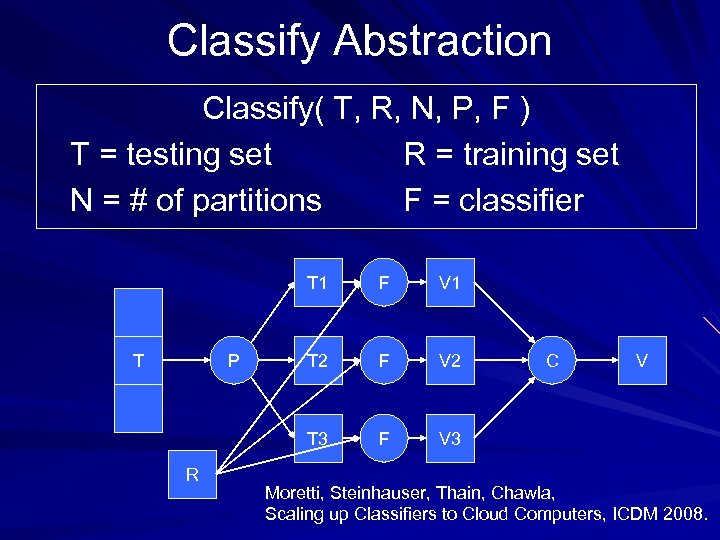
Classify Abstraction Classify( T, R, N, P, F ) T = testing set R = training set N = # of partitions F = classifier T 1 P R V 1 T 2 F V 2 T 3 T F F V 3 C V Moretti, Steinhauser, Thain, Chawla, Scaling up Classifiers to Cloud Computers, ICDM 2008.

From Abstractions to a Distributed Language

What Other Abstractions Might Be Useful? Map( set S, F(s) ) Explore( F(x), x: [a…. b] ) Minimize( F(x), delta ) Minimax( state s, A(s), B(s) ) Search( state s, F(s), Is. Terminal(s) ) Query( properties ) -> set of objects Fluid. Flow( V[x, y, z], F(v), delta )
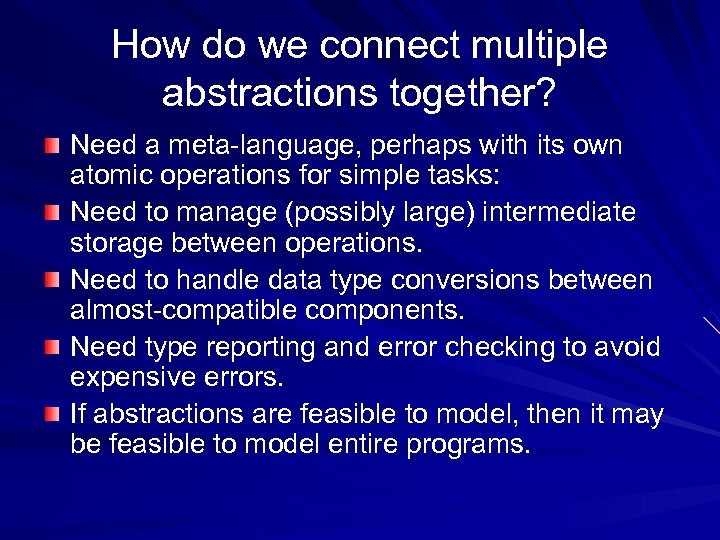
How do we connect multiple abstractions together? Need a meta-language, perhaps with its own atomic operations for simple tasks: Need to manage (possibly large) intermediate storage between operations. Need to handle data type conversions between almost-compatible components. Need type reporting and error checking to avoid expensive errors. If abstractions are feasible to model, then it may be feasible to model entire programs.

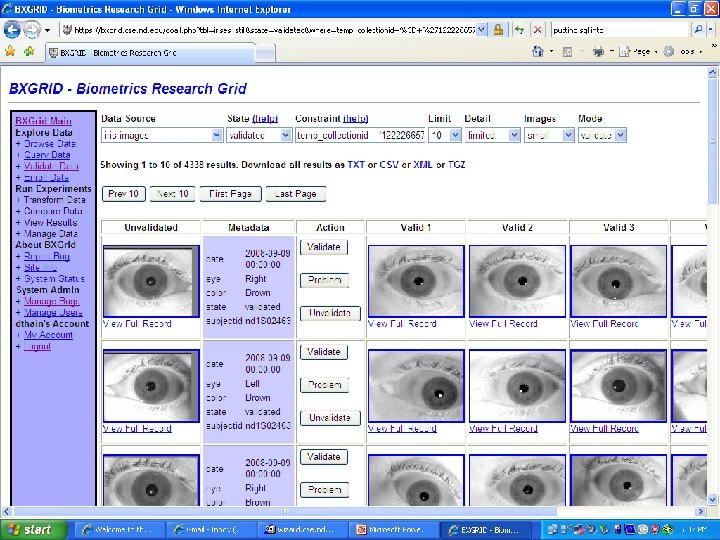
Connecting Abstractions in BXGrid S = Select( color=“brown” ) B = Transform( S, F ) M = All. Pairs( A, B, F ) eye color L brown L blue R brown A 1 A 2 A 3 S 1 F B 1 F F F S 2 F B 2 F F F S 3 F B 3 F F F ROC Curve Bui, Thomas, Kelly, Lyon, Flynn, Thain BXGrid: A Repository and Experimental Abstraction… poster at IEEE e. Science 2008
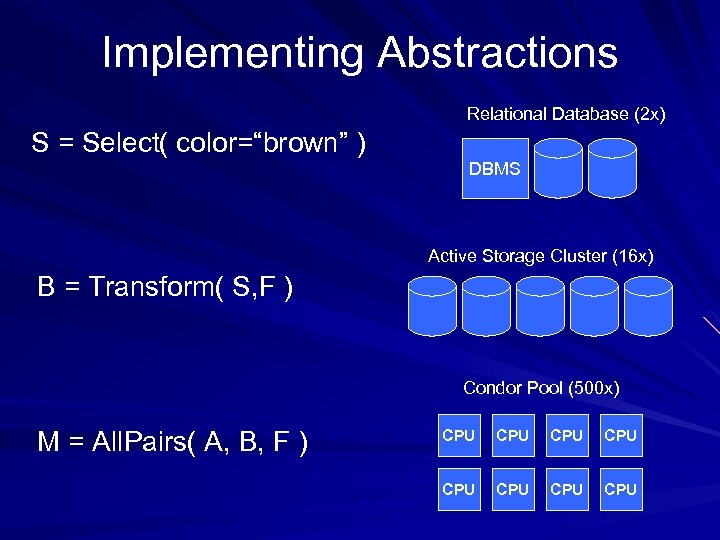
Implementing Abstractions Relational Database (2 x) S = Select( color=“brown” ) DBMS Active Storage Cluster (16 x) B = Transform( S, F ) Condor Pool (500 x) M = All. Pairs( A, B, F ) CPU CPU
What is the Most Useful ABI? Functions can come in many forms: – Unix Program – C function in source form – Java function in binary form Datasets come in many forms: – Set: list of files, delimited single file, or database query. – Matrix: sparse elem list, or binary layout Our current implementations require a particular form. With a carefully stated ABI, abstractions could work with many different user communities.
What is the type system? Files have an obvious technical type: – JPG, BMP, TXT, PTS, … But they also have a logical type: – JPG: Face, Iris, Fingerprint etc. – (This comes out of the BXGrid repository. ) The meta-language can easily perform automatic conversions between technical types, and between some logical types: – – – JPG/Face -> BMP/Face via Image. Magick JPG/Iris -> BIN/Iris. Code via Compute. Iris. Code JPG/Face -> JPG/Iris is not allowed.
Abstractions Redux Mapping general-purpose programs to arbitrary distributed/multicore systems is algorithmically complex and full of pitfalls. But, mapping a single abstraction is a tractable problem that can be optimized, modeled, and re-used. Can we combine multiple abstractions together to achieve both expressive power and tractable performance?

Troubleshooting Large Workloads
It’s Ugly in the Real World Machine related failures: – Power outages, network outages, faulty memory, corrupted file system, bad config files, expired certs, packet filters. . . Job related failures: – Crash on some args, bad executable, missing input files, mistake in args, missing components, failure to understand dependencies. . . Incompatibilities between jobs and machines: – Missing libraries, not enough disk/cpu/mem, wrong software installed, wrong version installed, wrong memory layout. . . Load related failures: – Slow actions induce timeouts; kernel tables: files, sockets, procs; router tables: addresses, routes, connections; competition with other users. . . Non-deterministic failures: – Multi-thread/CPU synchronization, event interleaving across systems, random number generators, interactive effects, cosmic rays. . .
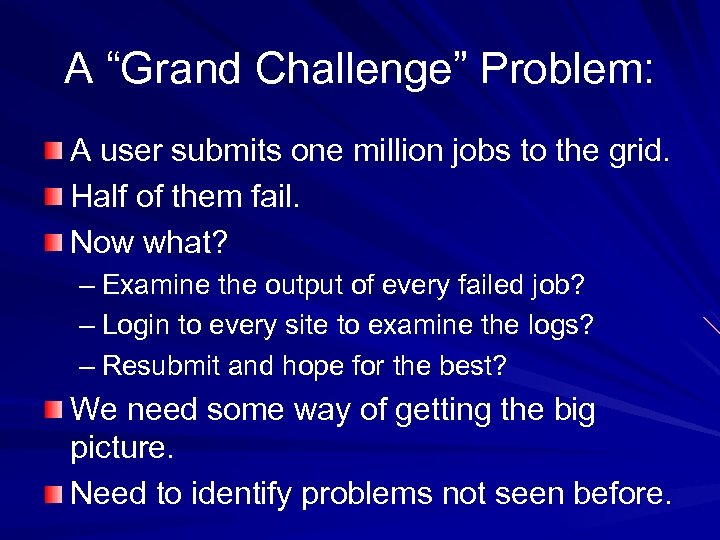
A “Grand Challenge” Problem: A user submits one million jobs to the grid. Half of them fail. Now what? – Examine the output of every failed job? – Login to every site to examine the logs? – Resubmit and hope for the best? We need some way of getting the big picture. Need to identify problems not seen before.
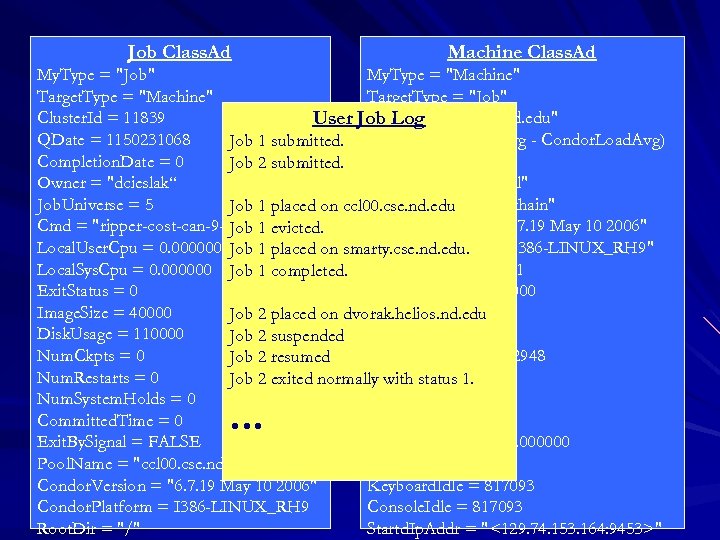
Job Class. Ad Machine Class. Ad My. Type = "Job" My. Type = "Machine" Target. Type = "Job" Cluster. Id = 11839 Name = User Job Log "ccl 00. cse. nd. edu" QDate = 1150231068 Job 1 submitted. Cpu. Busy = ((Load. Avg - Condor. Load. Avg) Completion. Date = 0 Job 2 submitted. >= 0. 500000) Owner = "dcieslak“ Machine. Group = "ccl" Job. Universe = 5 Machine. Owner Job 1 placed on ccl 00. cse. nd. edu = "dthain" Cmd = "ripper-cost-can-9 -50. sh" evicted. Condor. Version = "6. 7. 19 May 10 2006" Job 1 Local. User. Cpu = 0. 000000 Job 1 placed on smarty. cse. nd. edu. = "I 386 -LINUX_RH 9" Condor. Platform Local. Sys. Cpu = 0. 000000 Job 1 completed. Virtual. Machine. ID = 1 Exit. Status = 0 Executable. Size = 20000 Image. Size = 40000 Job. Universe = 1 Job 2 placed on dvorak. helios. nd. edu Disk. Usage = 110000 Job 2 suspended Nice. User = FALSE Num. Ckpts = 0 Virtual. Memory = 962948 Job 2 resumed Num. Restarts = 0 Memory = 498 Job 2 exited normally with status 1. Num. System. Holds = 0 Cpus = 1 Committed. Time = 0 Disk = 19072712 Exit. By. Signal = FALSE Condor. Load. Avg = 1. 000000 Pool. Name = "ccl 00. cse. nd. edu" Load. Avg = 1. 130000 Condor. Version = "6. 7. 19 May 10 2006" Keyboard. Idle = 817093 Condor. Platform = I 386 -LINUX_RH 9 Console. Idle = 817093 Root. Dir = "/" Startd. Ip. Addr = "<129. 74. 153. 164: 9453>" . . .
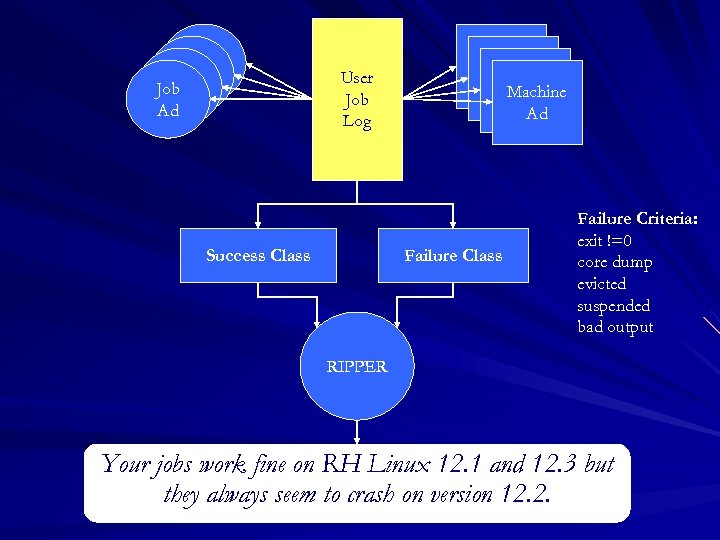
Job Job Ad Ad Ad User Job Log Success Class Machine Ad Ad Failure Class Failure Criteria: exit !=0 core dump evicted suspended bad output RIPPER Your jobs work fine on RH Linux 12. 1 and 12. 3 but they always seem to crash on version 12. 2.
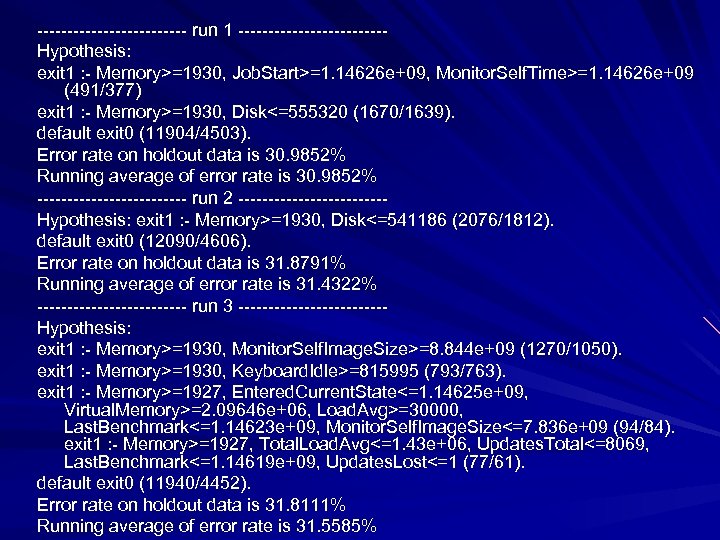
------------- run 1 ------------Hypothesis: exit 1 : - Memory>=1930, Job. Start>=1. 14626 e+09, Monitor. Self. Time>=1. 14626 e+09 (491/377) exit 1 : - Memory>=1930, Disk<=555320 (1670/1639). default exit 0 (11904/4503). Error rate on holdout data is 30. 9852% Running average of error rate is 30. 9852% ------------- run 2 ------------Hypothesis: exit 1 : - Memory>=1930, Disk<=541186 (2076/1812). default exit 0 (12090/4606). Error rate on holdout data is 31. 8791% Running average of error rate is 31. 4322% ------------- run 3 ------------Hypothesis: exit 1 : - Memory>=1930, Monitor. Self. Image. Size>=8. 844 e+09 (1270/1050). exit 1 : - Memory>=1930, Keyboard. Idle>=815995 (793/763). exit 1 : - Memory>=1927, Entered. Current. State<=1. 14625 e+09, Virtual. Memory>=2. 09646 e+06, Load. Avg>=30000, Last. Benchmark<=1. 14623 e+09, Monitor. Self. Image. Size<=7. 836 e+09 (94/84). exit 1 : - Memory>=1927, Total. Load. Avg<=1. 43 e+06, Updates. Total<=8069, Last. Benchmark<=1. 14619 e+09, Updates. Lost<=1 (77/61). default exit 0 (11940/4452). Error rate on holdout data is 31. 8111% Running average of error rate is 31. 5585%
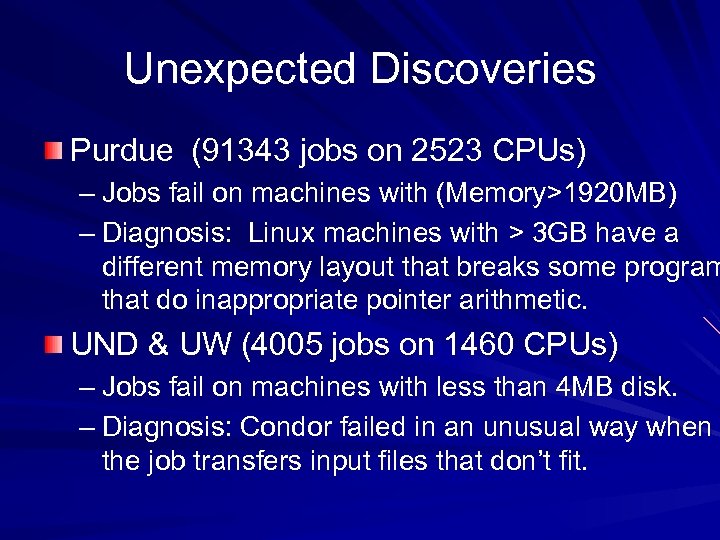
Unexpected Discoveries Purdue (91343 jobs on 2523 CPUs) – Jobs fail on machines with (Memory>1920 MB) – Diagnosis: Linux machines with > 3 GB have a different memory layout that breaks some program that do inappropriate pointer arithmetic. UND & UW (4005 jobs on 1460 CPUs) – Jobs fail on machines with less than 4 MB disk. – Diagnosis: Condor failed in an unusual way when the job transfers input files that don’t fit.

Acknowledgments Cooperative Computing Lab – http: //www. cse. nd. edu/~ccl Faculty: – – Patrick Flynn Nitesh Chawla Kenneth Judd Scott Emrich Grad Students – – – Chris Moretti Hoang Bui Karsten Steinhauser – Li Yu – Michael Albrecht Undergrads – – – Mike Kelly Rory Carmichael Mark Pasquier Christopher Lyon Jared Bulosan NSF Grants CCF-0621434, CNS-0643229
Скачать презентацию Using Small Abstractions to Program Large Distributed Systems
6a8b74a6b262195594bcaa4f766d7f4e.ppt