


 Скачать презентацию Using Research on How Students Learn Astronomy to
8b0bd84892596e7705013d3b7ba36833.ppt
- Количество слайдов: 124
 Using Research on How Students Learn Astronomy to Improve Teaching Tim Slater University of Arizona Department of Astronomy Conceptual Astronomy and Physics Education Research (CAPER) Team http: //caperteam. as. arizona. edu Project BETA – July 26, 2007 – NASA Goddard
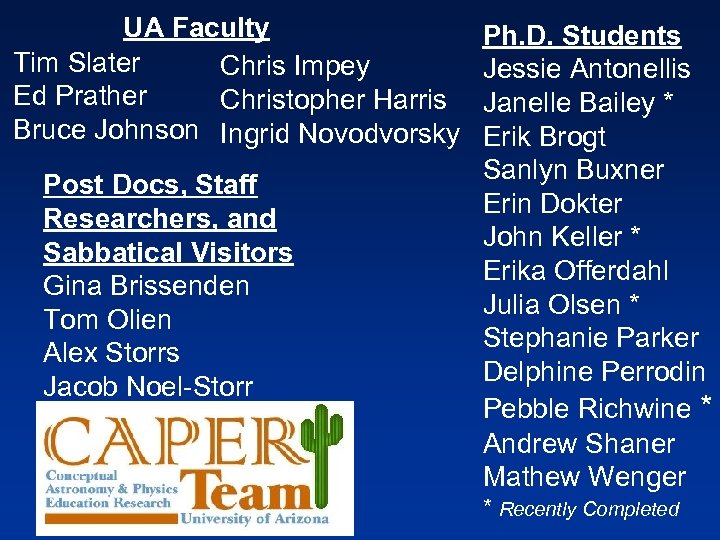 UA Faculty Tim Slater Chris Impey Ed Prather Christopher Harris Bruce Johnson Ingrid Novodvorsky Post Docs, Staff Researchers, and Sabbatical Visitors Gina Brissenden Tom Olien Alex Storrs Jacob Noel-Storr Ph. D. Students Jessie Antonellis Janelle Bailey * Erik Brogt Sanlyn Buxner Erin Dokter John Keller * Erika Offerdahl Julia Olsen * Stephanie Parker Delphine Perrodin Pebble Richwine * Andrew Shaner Mathew Wenger * Recently Completed
 Overview • Recent RESULTS you need to know about how students learn astronomy • RESOURCES you can use to measure the impact of your programs • Pathways you can use to CONNECT with other people teaching astronomy topics
 A Short Video Clip: State of the Union
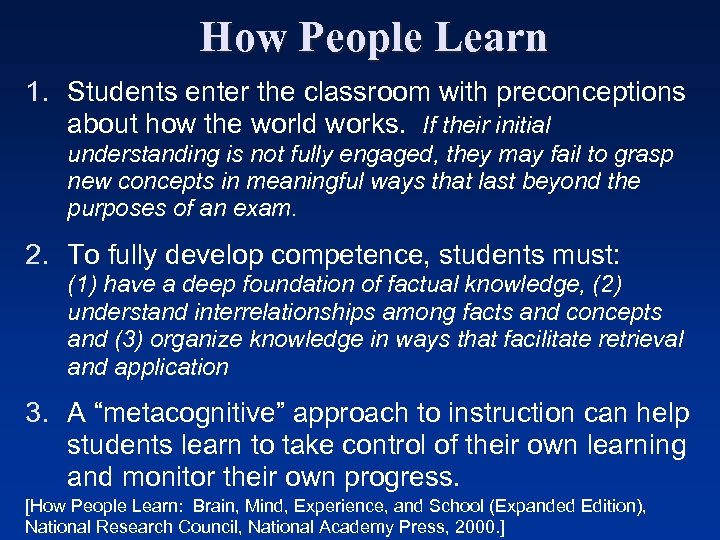 How People Learn 1. Students enter the classroom with preconceptions about how the world works. If their initial understanding is not fully engaged, they may fail to grasp new concepts in meaningful ways that last beyond the purposes of an exam. 2. To fully develop competence, students must: (1) have a deep foundation of factual knowledge, (2) understand interrelationships among facts and concepts and (3) organize knowledge in ways that facilitate retrieval and application 3. A “metacognitive” approach to instruction can help students learn to take control of their own learning and monitor their own progress. [How People Learn: Brain, Mind, Experience, and School (Expanded Edition), National Research Council, National Academy Press, 2000. ]
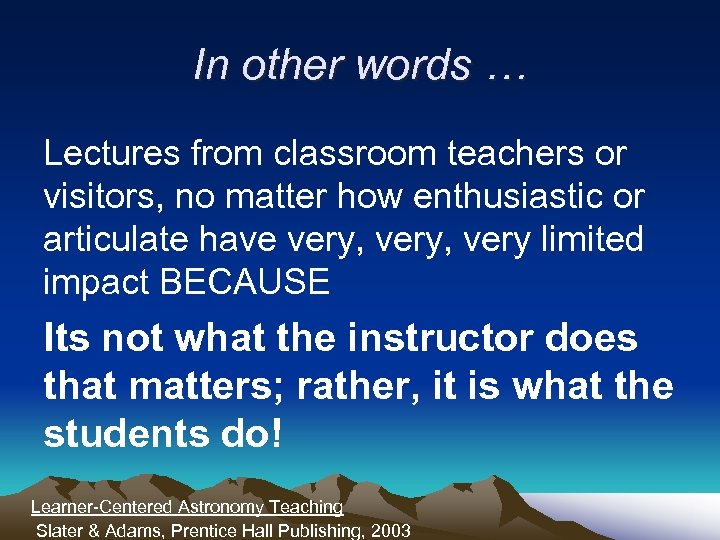 In other words … Lectures from classroom teachers or visitors, no matter how enthusiastic or articulate have very, very limited impact BECAUSE Its not what the instructor does that matters; rather, it is what the students do! Learner-Centered Astronomy Teaching Slater & Adams, Prentice Hall Publishing, 2003
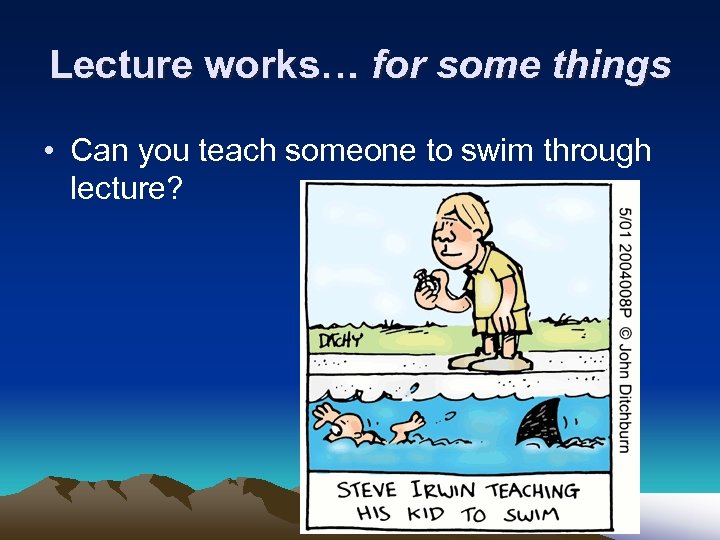 Lecture works… for some things • Can you teach someone to swim through lecture?
 Lecture works… for some things • Can you teach someone to swim through lecture? • Can you teach someone astronomy through lecture? Bottom Line Depends on what you want them to learn
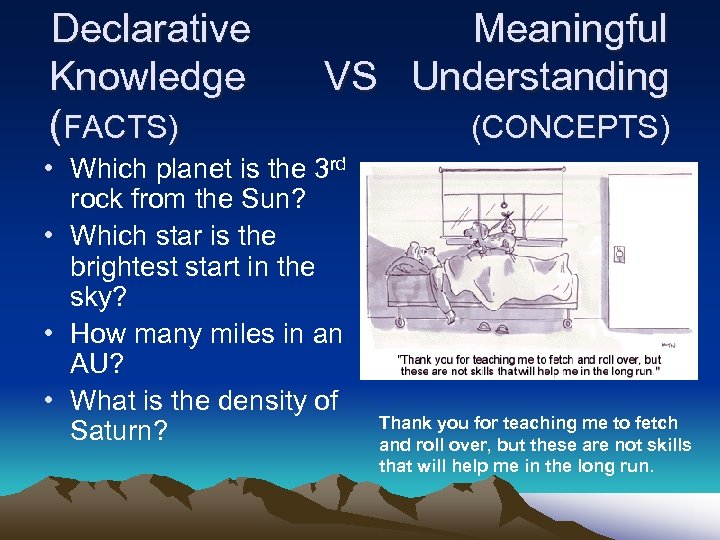 Declarative Knowledge (FACTS) Meaningful VS Understanding • Which planet is the 3 rd rock from the Sun? • Which star is the brightest start in the sky? • How many miles in an AU? • What is the density of Saturn? (CONCEPTS) Thank you for teaching me to fetch and roll over, but these are not skills that will help me in the long run.
 Declarative Knowledge (FACTS) Meaningful VS Understanding (CONCEPTS) • Which planet is the 3 rd • How does spectral type rock from the Sun? impact a habitable zone? • Which star is the • How would a star’s brightest start in the magnitude change if sky? there was intervening • How many miles in an dust? AU? • Which distance units • What is the density of make the most sense for Saturn? things in the galaxy? Can you have one without the other?
 Declarative Knowledge (FACTS) • • Meaningful VS Understanding (CONCEPTS) Which planet is the 3 rd rock from the Sun? Which star is the brightest start in the sky? How many miles in an AU? What is the density of Saturn? • • • How does spectral type impact a habitable zone? How would a star’s magnitude change if there was intervening dust? Which distance units make the most sense for things in the galaxy? TASK: With two other people nearby, write out a list of three declarative FACTS and three CONCEPTUAL UNDERSTANDINGS about black holes to share with the group. What’s the common difference? What does this mean about teaching?
 What do students struggle with? The Big Three 1. Seasons 2. Moon Phases 3. Gravity A Review of Astronomy Education Research, Astronomy Education Review, 2(2), 2003. J. M. Bailey and T. F. Slater
 What Causes the Seasons? A Private Universe – Pyramid Films
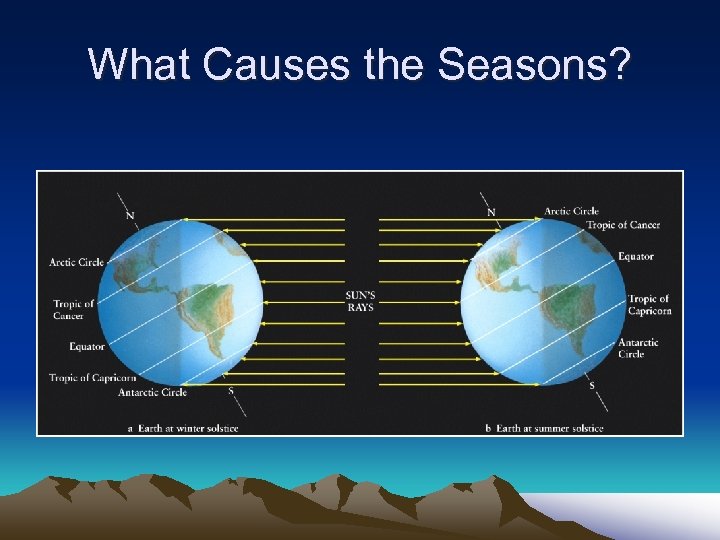 What Causes the Seasons?
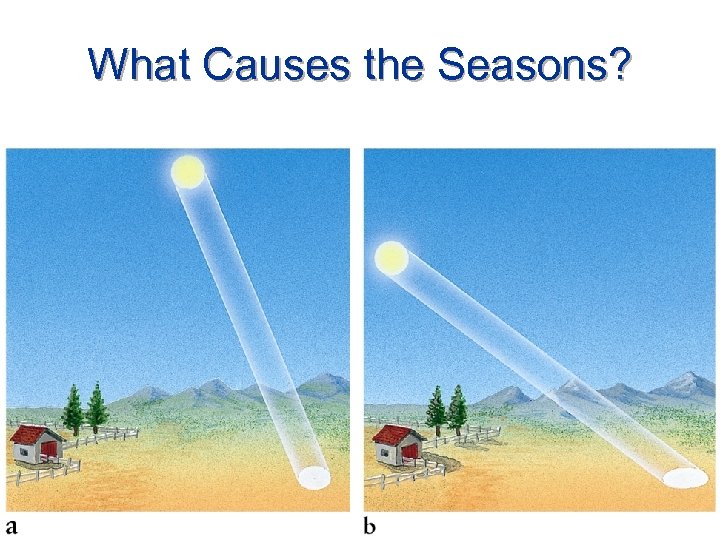 What Causes the Seasons?
 What Causes the Seasons? • New Technology Solutions http: //astro. unl. edu/naap/motion 1/animations/seasons_ecliptic. swf
 What do students struggle with? The Big Three 1. Seasons 2. Moon Phases 3. Gravity A Review of Astronomy Education Research, Astronomy Education Review, 2(2), 2003. J. M. Bailey and T. F. Slater
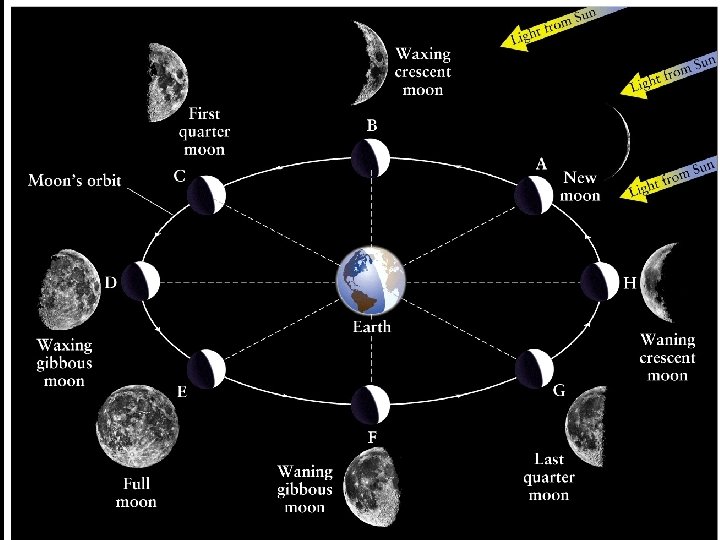
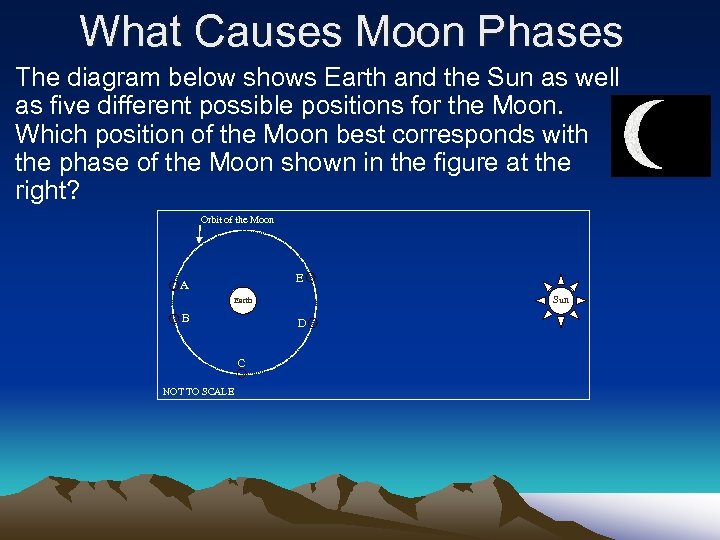 What Causes Moon Phases The diagram below shows Earth and the Sun as well as five different possible positions for the Moon. Which position of the Moon best corresponds with the phase of the Moon shown in the figure at the right? Orbit of the Moon E A Sun Earth B D C NOT TO SCALE
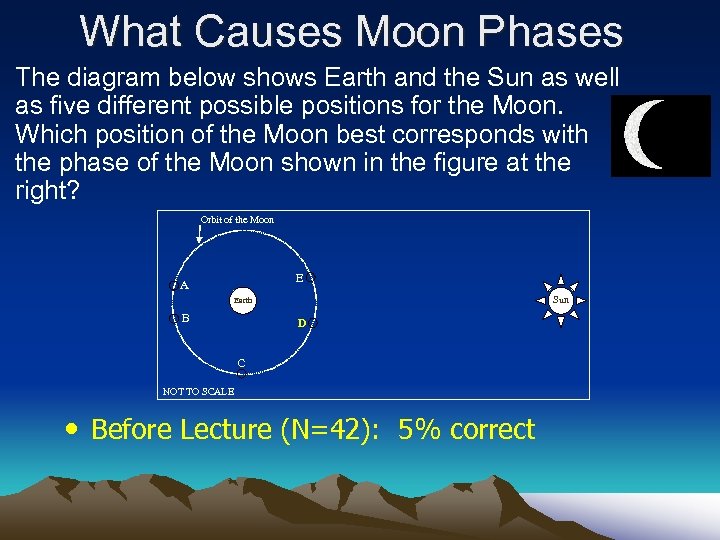 What Causes Moon Phases The diagram below shows Earth and the Sun as well as five different possible positions for the Moon. Which position of the Moon best corresponds with the phase of the Moon shown in the figure at the right? Orbit of the Moon E A Sun Earth B D C NOT TO SCALE • Before Lecture (N=42): 5% correct
 Some New-Untried Technology • http: //astro. unl. edu/naap/lps/animations/lps. swf
 What do students struggle with? The Big Three 1. Seasons 2. Moon Phases 3. Gravity
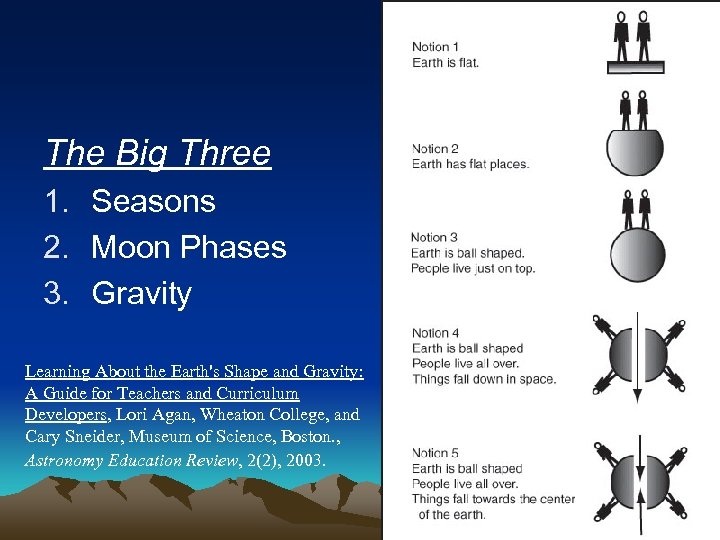 The Big Three 1. Seasons 2. Moon Phases 3. Gravity Learning About the Earth's Shape and Gravity: A Guide for Teachers and Curriculum Developers, Lori Agan, Wheaton College, and Cary Sneider, Museum of Science, Boston. , Astronomy Education Review, 2(2), 2003.
 What do students struggle with? The Big Three 1. Seasons 2. Moon Phases 3. Gravity Modern Topics Too • Stellar Formation • Cosmology • Astrobiology A Review of Astronomy Education Research, Astronomy Education Review, 2(2), 2003. J. M. Bailey and T. F. Slater
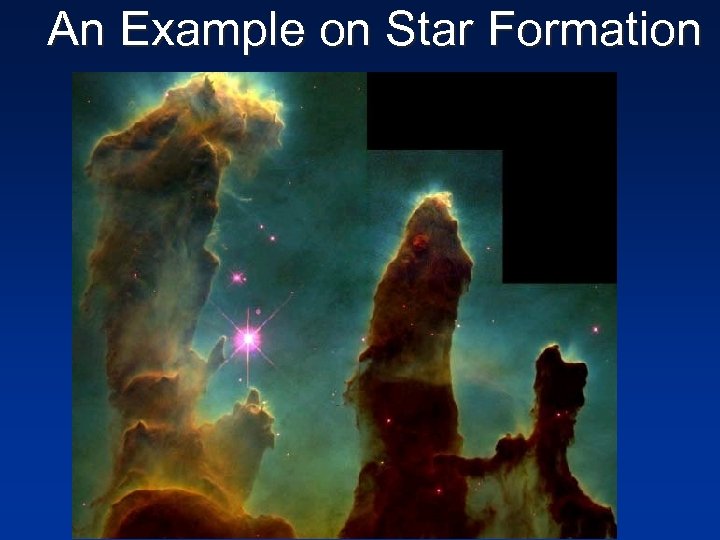 An Example on Star Formation
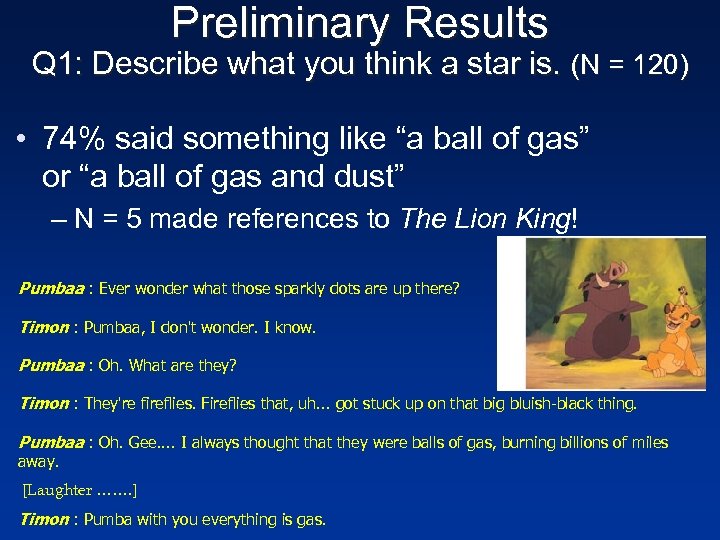 Preliminary Results Q 1: Describe what you think a star is. (N = 120) • 74% said something like “a ball of gas” or “a ball of gas and dust” – N = 5 made references to The Lion King! Pumbaa : Ever wonder what those sparkly dots are up there? Timon : Pumbaa, I don't wonder. I know. Pumbaa : Oh. What are they? Timon : They're fireflies. Fireflies that, uh. . . got stuck up on that big bluish-black thing. Pumbaa : Oh. Gee. . I always thought that they were balls of gas, burning billions of miles away. [Laughter ……. ] Timon : Pumba with you everything is gas.
 The “Complete” Response Q 2: Describe where you think stars come from. Q 3: Describe how you think a star is formed. (Ntotal = 203) If we asked this on a final exam, what might a complete response have to included? 1. Region of gas or gas/dust 2. Gravitational collapse of material in the region 3. Temperature & Pressure increase 4. Fusion begins And now we have a star!
 Preliminary Results Q 2: Describe where you think stars come from. Q 3: Describe how you think a star is formed. (Ntotal = 203) Answer Component #1: Region of gas or gas/dust – 55% of the students said something about a region of gas or gas/dust • Example: “I think stars start from gas and dust. The gas and dust starts in a cloud. The cloud starts out kind of loose and spread out…. ” Early work comprising part of Janelle Bailey’s Ph. D dissertation
 Preliminary Results Q 2: Describe where you think stars come from. Q 3: Describe how you think a star is formed. (Ntotal = 203) Answer Component #2: Collapse - Matter comes together in some way – 48% included some sort of volume reduction of matter – Only 19% of the total specifically include gravity • Example: “Stars are formed when there is a large force of gravity somewhere in space that pulls a bunch of little space particles together and they all collide somewhere in the middle of all this gravity and wham bam. . ” Early work comprising part of Janelle Bailey’s Ph. D dissertation
 Preliminary Results Q 2: Describe where you think stars come from. Q 3: Describe how you think a star is formed. (Ntotal = 203) Answer Component #3: Temperature increase – Only 11% clearly define a temperature increase – Enormous difficulty in distinguishing responses because of how temperature and heat are misused • Example: “…These gasses, over a period of time, contract to form a with (sic) high density. After this, as the mass keeps contracting, the temperature becomes hot enough for nuclear fusion to take place…. ”
 Preliminary Results Q 2: Describe where you think stars come from. Q 3: Describe how you think a star is formed. (Ntotal = 203) Answer Component #4: Fusion or nuclear reactions occur – Only 8% include fusion in response • Example: “From a collection of a large amount matter and gasses enough to cause a chain reaction starting the fusion process (sic). Once that has begun the process will continue until the star runs out of fuel in billions of years. ”
 Preliminary Results Q 2: Describe where you think stars come from. Q 3: Describe how you think a star is formed. (Ntotal = 203) • Other common categories found include: – 25% describe explosions, fire, and/or burning to describe emission heat, light, and/or energy-not a star’s formation • BOTTOM LINE: Students think stars are spherical burning clouds of soup Early work comprising part of Janelle Bailey’s Ph. D dissertation
 An Example on Life in the Universe An astrobiology elective course for science majors emphasizing scientific communication. Journal of College Science Teaching. Offerdahl, E. G. , Slater, T. F. , & Prather, E. E. (2005).
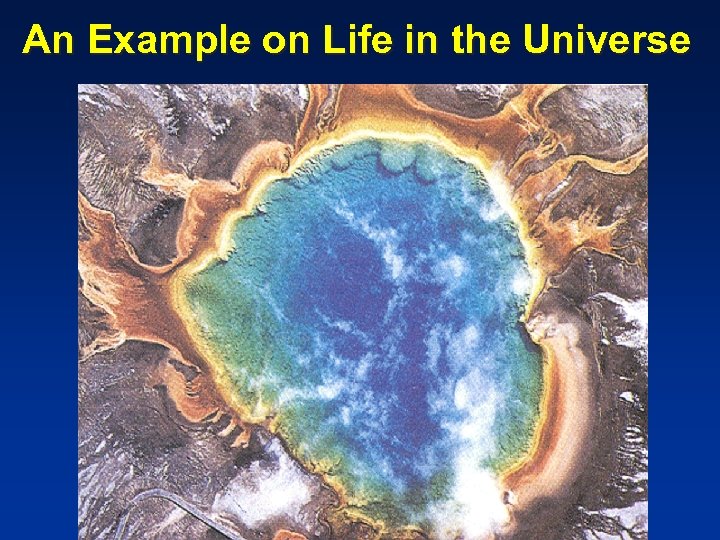 An Example on Life in the Universe
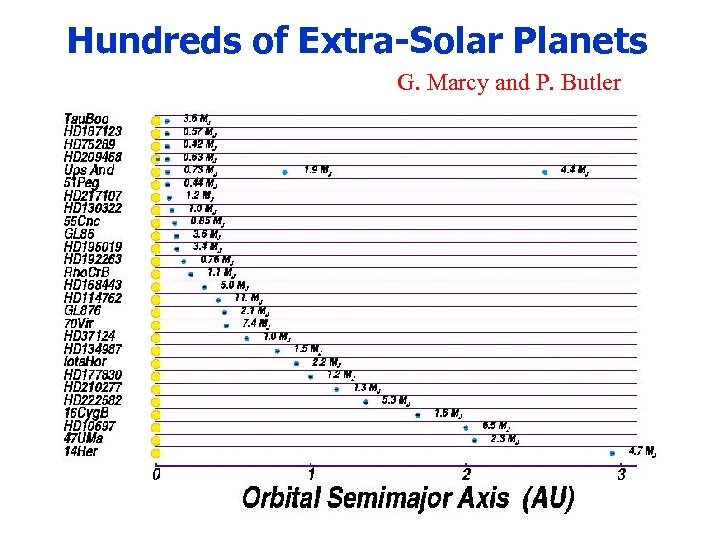 Hundreds of Extra-Solar Planets G. Marcy and P. Butler
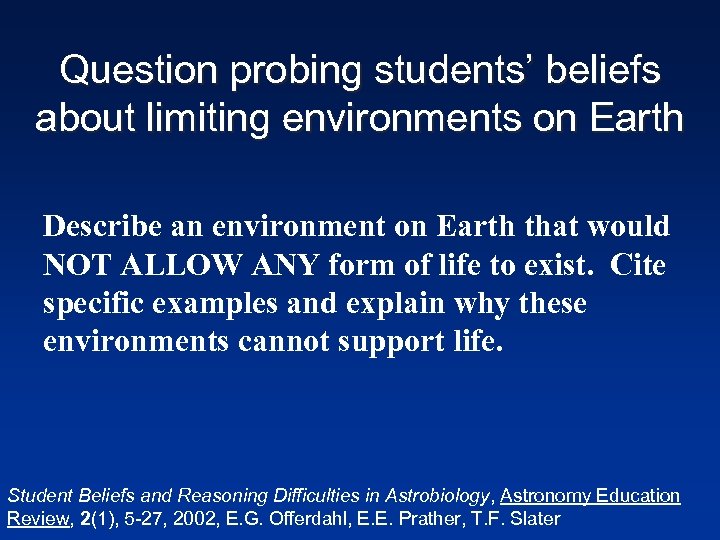 Question probing students’ beliefs about limiting environments on Earth Describe an environment on Earth that would NOT ALLOW ANY form of life to exist. Cite specific examples and explain why these environments cannot support life. Student Beliefs and Reasoning Difficulties in Astrobiology, Astronomy Education Review, 2(1), 5 -27, 2002, E. G. Offerdahl, E. E. Prather, T. F. Slater
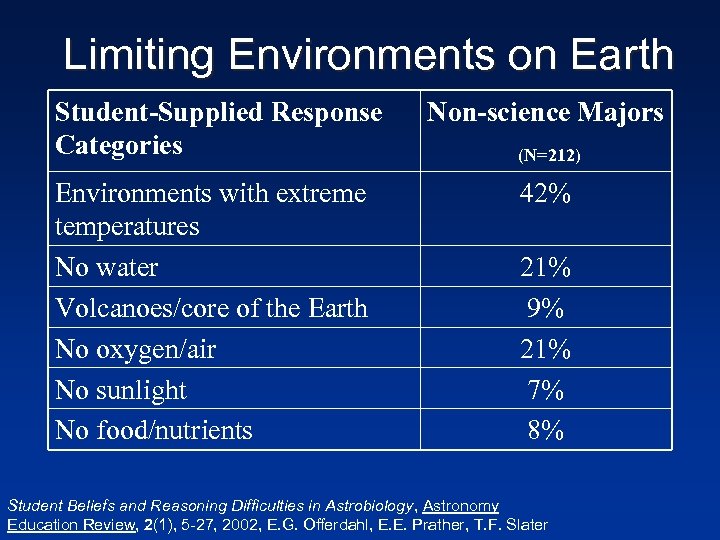 Limiting Environments on Earth Student-Supplied Response Categories Non-science Majors Environments with extreme temperatures No water Volcanoes/core of the Earth No oxygen/air No sunlight No food/nutrients 42% (N=212) 21% 9% 21% 7% 8% Student Beliefs and Reasoning Difficulties in Astrobiology, Astronomy Education Review, 2(1), 5 -27, 2002, E. G. Offerdahl, E. E. Prather, T. F. Slater
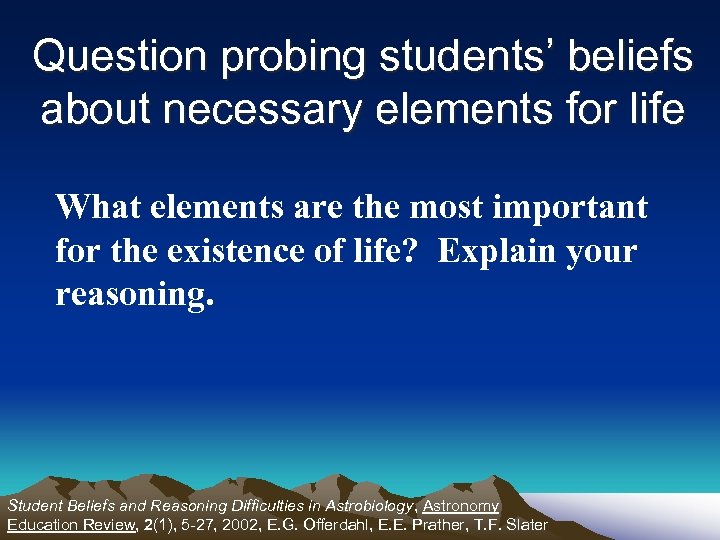 Question probing students’ beliefs about necessary elements for life What elements are the most important for the existence of life? Explain your reasoning. Student Beliefs and Reasoning Difficulties in Astrobiology, Astronomy Education Review, 2(1), 5 -27, 2002, E. G. Offerdahl, E. E. Prather, T. F. Slater
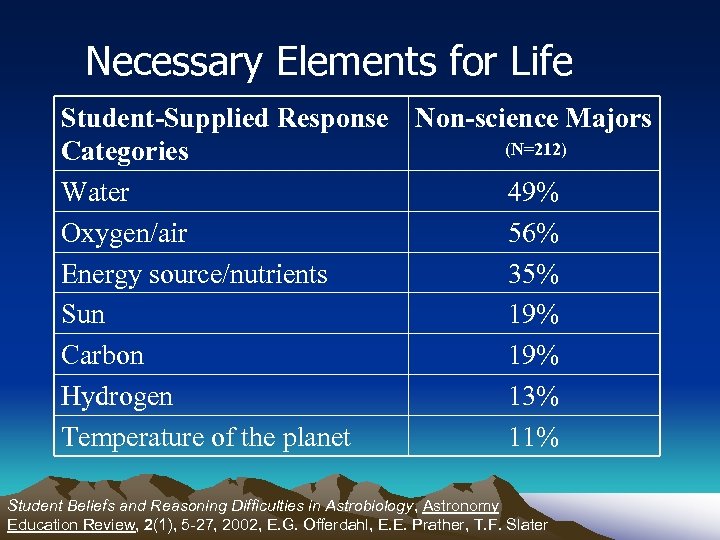 Necessary Elements for Life Student-Supplied Response Non-science Majors (N=212) Categories Water 49% Oxygen/air 56% Energy source/nutrients 35% Sun 19% Carbon 19% Hydrogen 13% Temperature of the planet 11% Student Beliefs and Reasoning Difficulties in Astrobiology, Astronomy Education Review, 2(1), 5 -27, 2002, E. G. Offerdahl, E. E. Prather, T. F. Slater
 Summary of students’ ideas Most students correctly identify that life can exist without sunlight & in extreme temperatures and that life requires at least intermittent liquid water. Many students believe that life cannot exist without oxygen. Students largely failed to cite high concentrations of salt, extreme p. H, or extreme cold temperatures as limiting conditions for life. Students most often cited complex organisms (such as plants, animals, and humans) rather than the more ubiquitous microorganisms. Student Beliefs and Reasoning Difficulties in Astrobiology, Astronomy Education Review, 2(1), 5 -27, 2002, E. G. Offerdahl, E. E. Prather, T. F. Slater
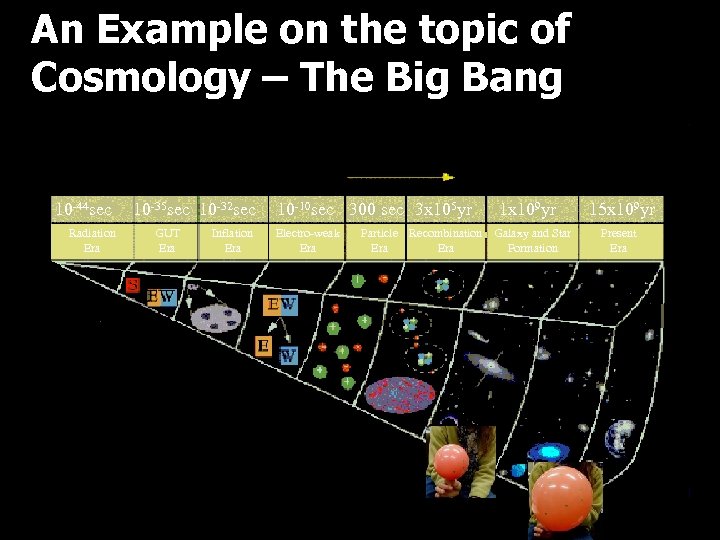 An Example on the topic of Cosmology – The Big Bang 10 -44 sec Radiation Era 10 -35 sec 10 -32 sec GUT Era Inflation Era 10 -10 sec 300 sec 3 x 10⁵ yr Electro-weak Era 1 x 10⁹ yr Particle Recombination Galaxy and Star Era Formation 15 x 109 yr Present Era
 An Example on the Topic of Cosmology – The Big Bang Initial Question • Have you ever heard of the Big Bang? – Describe what you think it is, and provide a sketch, if possible, to illustrate your answer. Follow-up Questions Describe what you think existed or was occurring just before the Big Bang. Describe what you think existed or was occurring during the Big Bang. Hints of a Fundamental Misconception in Cosmology, Astronomy Education Review, 1, (2), 2002 , Edward E. Prather, Timothy F. Slater and Erika G. Offerdahl
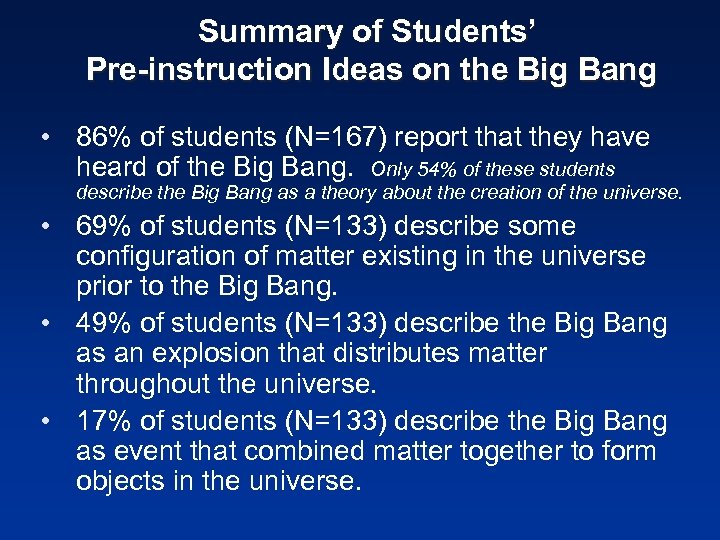 Summary of Students’ Pre-instruction Ideas on the Big Bang • 86% of students (N=167) report that they have heard of the Big Bang. Only 54% of these students describe the Big Bang as a theory about the creation of the universe. • 69% of students (N=133) describe some configuration of matter existing in the universe prior to the Big Bang. • 49% of students (N=133) describe the Big Bang as an explosion that distributes matter throughout the universe. • 17% of students (N=133) describe the Big Bang as event that combined matter together to form objects in the universe.
 What’s wrong with these students? Hints of a Fundamental Misconception in Cosmology, Astronomy Education Review, 1, (2), 2002 , Edward E. Prather, Timothy F. Slater and Erika G. Offerdahl
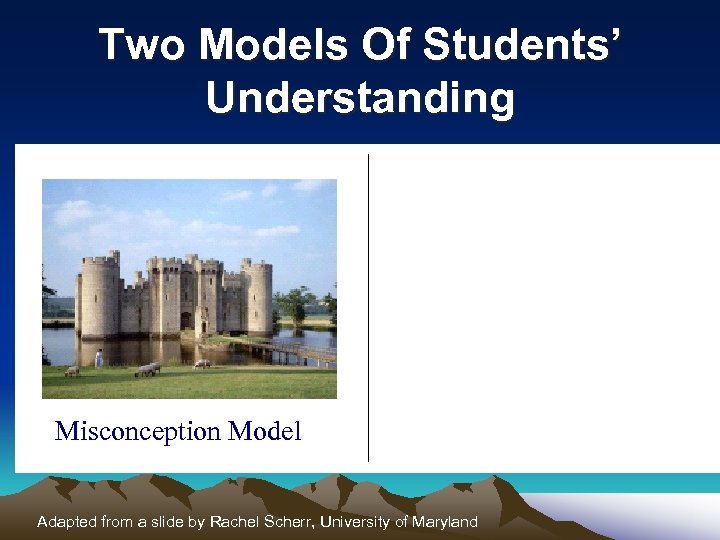 Two Models Of Students’ Understanding Primitives Model Misconception Model Adapted from a slide by Rachel Scherr, University of Maryland
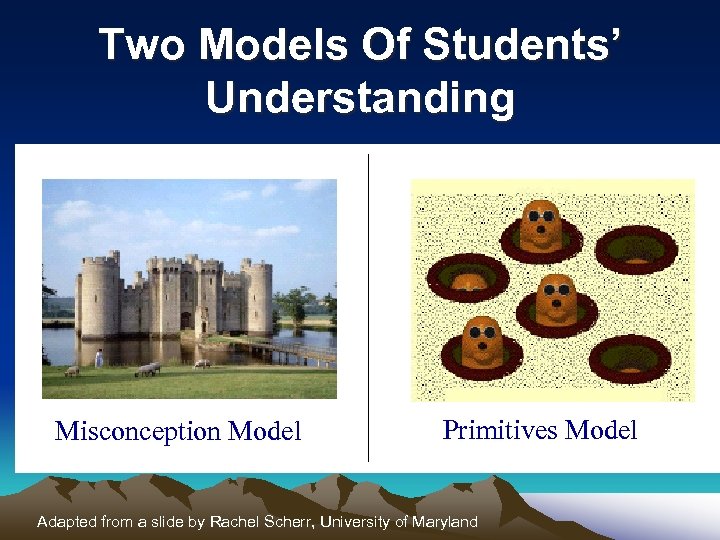 Two Models Of Students’ Understanding Misconception Model Primitives Model Adapted from a slide by Rachel Scherr, University of Maryland
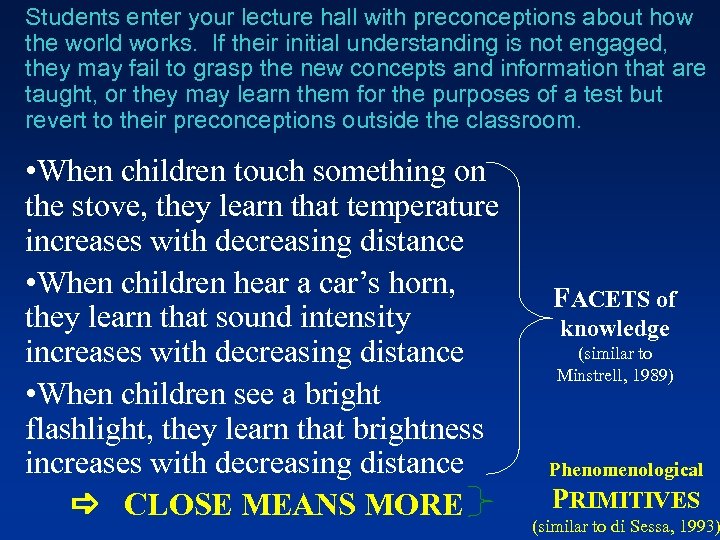 Students enter your lecture hall with preconceptions about how the world works. If their initial understanding is not engaged, they may fail to grasp the new concepts and information that are taught, or they may learn them for the purposes of a test but revert to their preconceptions outside the classroom. • When children touch something on the stove, they learn that temperature increases with decreasing distance • When children hear a car’s horn, they learn that sound intensity increases with decreasing distance • When children see a bright flashlight, they learn that brightness increases with decreasing distance CLOSE MEANS MORE FACETS of knowledge (similar to Minstrell, 1989) Phenomenological PRIMITIVES (similar to di Sessa, 1993)
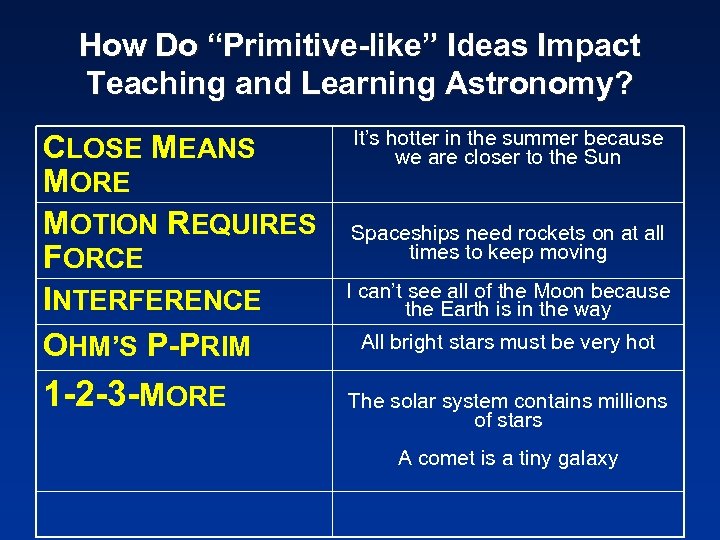 How Do “Primitive-like” Ideas Impact Teaching and Learning Astronomy? CLOSE MEANS MORE MOTION REQUIRES FORCE INTERFERENCE OHM’S P-PRIM 1 -2 -3 -MORE It’s hotter in the summer because we are closer to the Sun Spaceships need rockets on at all times to keep moving I can’t see all of the Moon because the Earth is in the way All bright stars must be very hot The solar system contains millions of stars A comet is a tiny galaxy
 What’s wrong with our students? What’s underlying their thoughts about the beginning of everything? Hints of a Fundamental Misconception in Cosmology, Astronomy Education Review, 1, (2), 2002 , Edward E. Prather, Timothy F. Slater and Erika G. Offerdahl
 You can’t make something from nothing!! Hints of a Fundamental Misconception in Cosmology, Astronomy Education Review, 1, (2), 2002 , Edward E. Prather, Timothy F. Slater and Erika G. Offerdahl
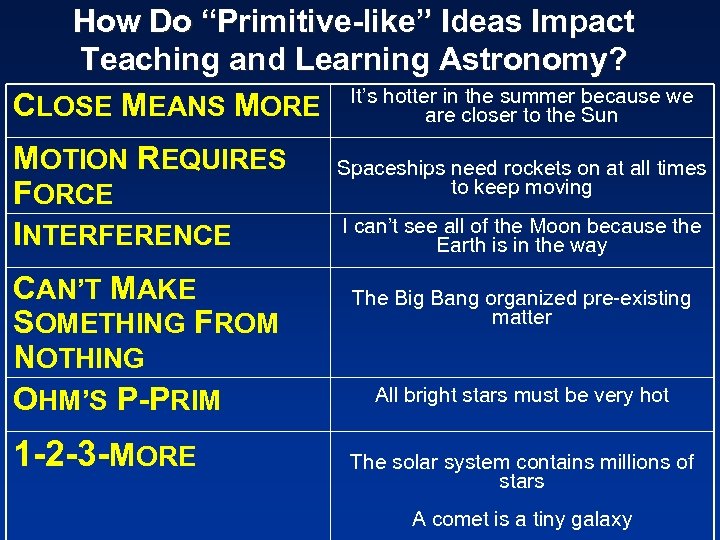 How Do “Primitive-like” Ideas Impact Teaching and Learning Astronomy? the summer CLOSE MEANS MORE It’s hotter in closer to the because we are Sun MOTION REQUIRES FORCE INTERFERENCE CAN’T MAKE SOMETHING FROM NOTHING OHM’S P-PRIM 1 -2 -3 -MORE Spaceships need rockets on at all times to keep moving I can’t see all of the Moon because the Earth is in the way The Big Bang organized pre-existing matter All bright stars must be very hot The solar system contains millions of stars A comet is a tiny galaxy
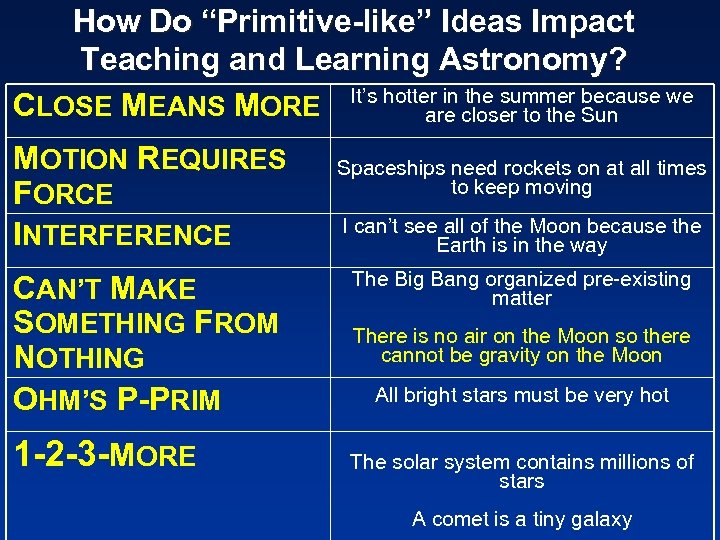 How Do “Primitive-like” Ideas Impact Teaching and Learning Astronomy? the summer CLOSE MEANS MORE It’s hotter in closer to the because we are Sun MOTION REQUIRES FORCE INTERFERENCE CAN’T MAKE SOMETHING FROM NOTHING OHM’S P-PRIM 1 -2 -3 -MORE Spaceships need rockets on at all times to keep moving I can’t see all of the Moon because the Earth is in the way The Big Bang organized pre-existing matter There is no air on the Moon so there cannot be gravity on the Moon All bright stars must be very hot The solar system contains millions of stars A comet is a tiny galaxy
 Just the tip of the iceberg AJP Resource Letter: Astronomy Education Research. J. M. Bailey & T. F. Slater, American Journal of Physics , 2005
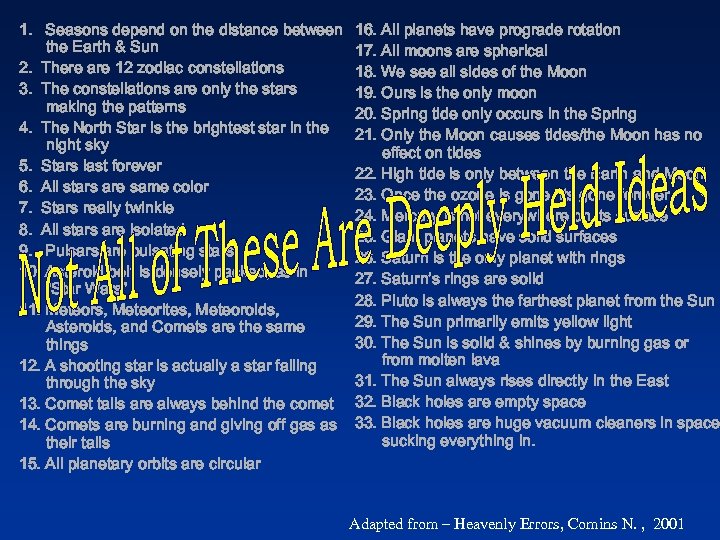
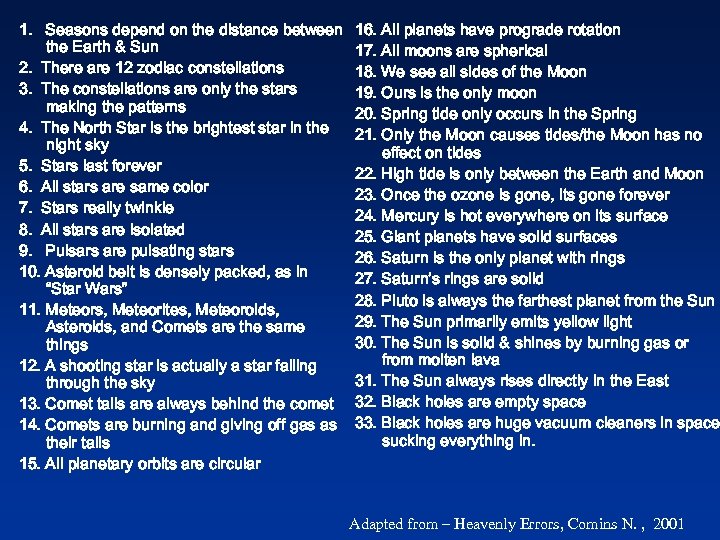 1. Seasons depend on the distance between the Earth & Sun 2. There are 12 zodiac constellations 3. The constellations are only the stars making the patterns 4. The North Star is the brightest star in the night sky 5. Stars last forever 6. All stars are same color 7. Stars really twinkle 8. All stars are isolated 9. Pulsars are pulsating stars 10. Asteroid belt is densely packed, as in “Star Wars” 11. Meteors, Meteorites, Meteoroids, Asteroids, and Comets are the same things 12. A shooting star is actually a star falling through the sky 13. Comet tails are always behind the comet 14. Comets are burning and giving off gas as their tails 15. All planetary orbits are circular 16. All planets have prograde rotation 17. All moons are spherical 18. We see all sides of the Moon 19. Ours is the only moon 20. Spring tide only occurs in the Spring 21. Only the Moon causes tides/the Moon has no effect on tides 22. High tide is only between the Earth and Moon 23. Once the ozone is gone, its gone forever 24. Mercury is hot everywhere on its surface 25. Giant planets have solid surfaces 26. Saturn is the only planet with rings 27. Saturn’s rings are solid 28. Pluto is always the farthest planet from the Sun 29. The Sun primarily emits yellow light 30. The Sun is solid & shines by burning gas or from molten lava 31. The Sun always rises directly in the East 32. Black holes are empty space 33. Black holes are huge vacuum cleaners in space sucking everything in. Adapted from – Heavenly Errors, Comins N. , 2001
 1. Seasons depend on the distance between the Earth & Sun 2. There are 12 zodiac constellations 3. The constellations are only the stars making the patterns 4. The North Star is the brightest star in the night sky 5. Stars last forever 6. All stars are same color 7. Stars really twinkle 8. All stars are isolated 9. Pulsars are pulsating stars 10. Asteroid belt is densely packed, as in “Star Wars” 11. Meteors, Meteorites, Meteoroids, Asteroids, and Comets are the same things 12. A shooting star is actually a star falling through the sky 13. Comet tails are always behind the comet 14. Comets are burning and giving off gas as their tails 15. All planetary orbits are circular 16. All planets have prograde rotation 17. All moons are spherical 18. We see all sides of the Moon 19. Ours is the only moon 20. Spring tide only occurs in the Spring 21. Only the Moon causes tides/the Moon has no effect on tides 22. High tide is only between the Earth and Moon 23. Once the ozone is gone, its gone forever 24. Mercury is hot everywhere on its surface 25. Giant planets have solid surfaces 26. Saturn is the only planet with rings 27. Saturn’s rings are solid 28. Pluto is always the farthest planet from the Sun 29. The Sun primarily emits yellow light 30. The Sun is solid & shines by burning gas or from molten lava 31. The Sun always rises directly in the East 32. Black holes are empty space 33. Black holes are huge vacuum cleaners in space sucking everything in. Adapted from – Heavenly Errors, Comins N. , 2001
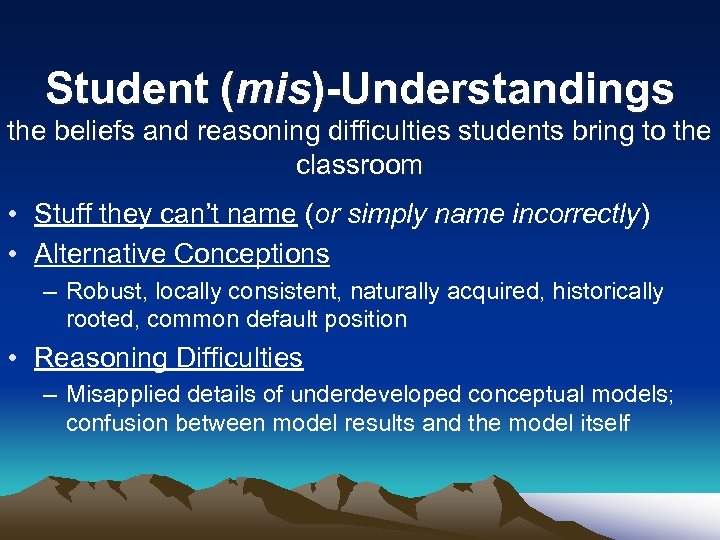 Student (mis)-Understandings the beliefs and reasoning difficulties students bring to the classroom • Stuff they can’t name (or simply name incorrectly) • Alternative Conceptions – Robust, locally consistent, naturally acquired, historically rooted, common default position • Reasoning Difficulties – Misapplied details of underdeveloped conceptual models; confusion between model results and the model itself
 FIRST RESPONSE • Buy computer video projectors • Provide students with copies of our Power. Point slides • Create JAVA & FLASH simulations so we can demonstrate complicated models to students • Create extensive www sites for students to read outside of class
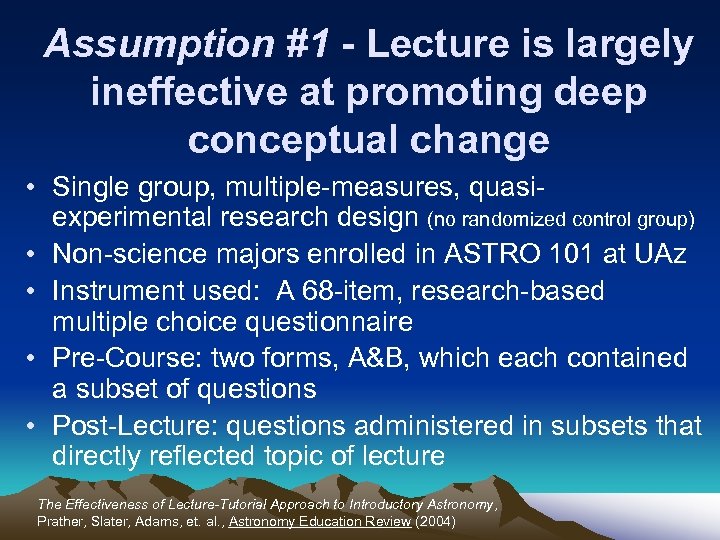 Assumption #1 - Lecture is largely ineffective at promoting deep conceptual change • Single group, multiple-measures, quasiexperimental research design (no randomized control group) • Non-science majors enrolled in ASTRO 101 at UAz • Instrument used: A 68 -item, research-based multiple choice questionnaire • Pre-Course: two forms, A&B, which each contained a subset of questions • Post-Lecture: questions administered in subsets that directly reflected topic of lecture The Effectiveness of Lecture-Tutorial Approach to Introductory Astronomy, Prather, Slater, Adams, et. al. , Astronomy Education Review (2004)
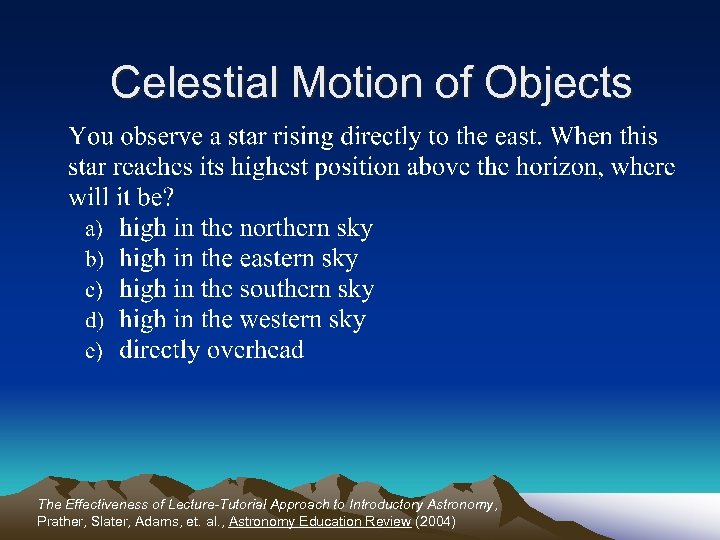 Celestial Motion of Objects The Effectiveness of Lecture-Tutorial Approach to Introductory Astronomy, Prather, Slater, Adams, et. al. , Astronomy Education Review (2004)
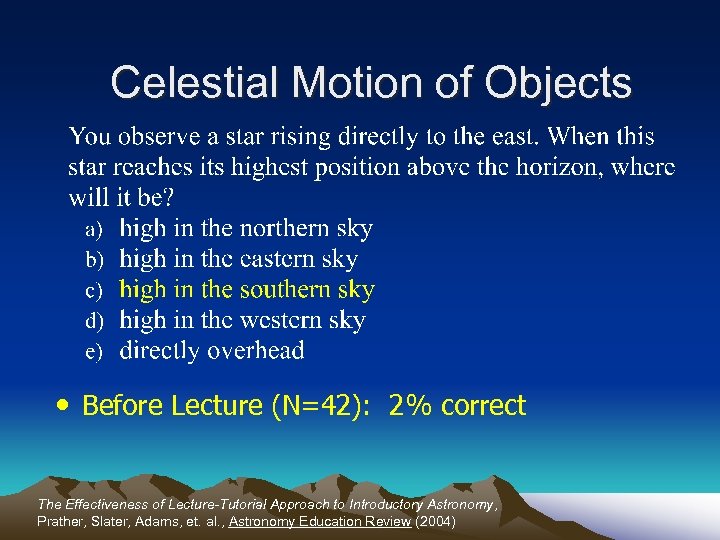 Celestial Motion of Objects • Before Lecture (N=42): 2% correct The Effectiveness of Lecture-Tutorial Approach to Introductory Astronomy, Prather, Slater, Adams, et. al. , Astronomy Education Review (2004)
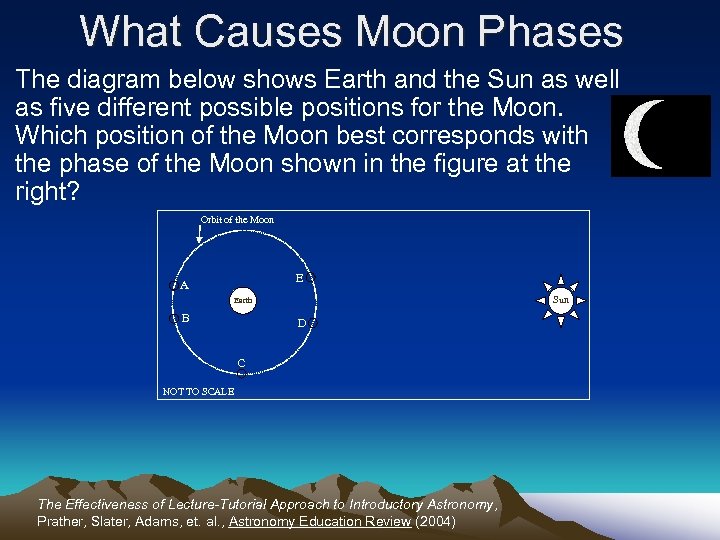 What Causes Moon Phases The diagram below shows Earth and the Sun as well as five different possible positions for the Moon. Which position of the Moon best corresponds with the phase of the Moon shown in the figure at the right? Orbit of the Moon E A Sun Earth B D C NOT TO SCALE The Effectiveness of Lecture-Tutorial Approach to Introductory Astronomy, Prather, Slater, Adams, et. al. , Astronomy Education Review (2004)
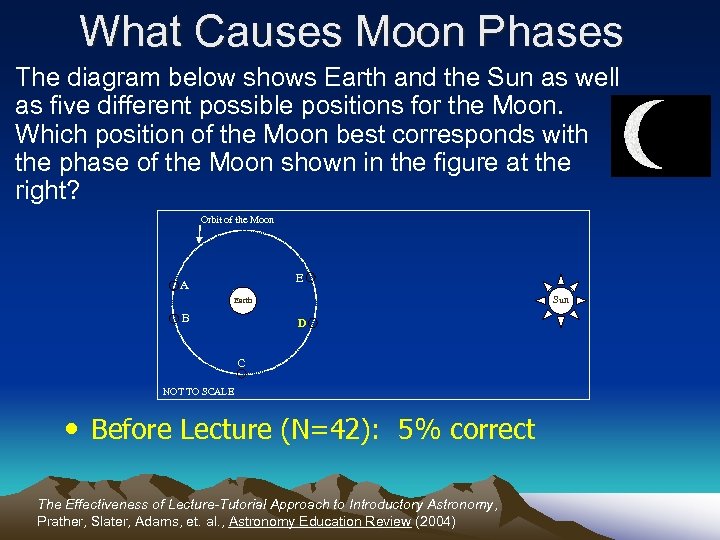 What Causes Moon Phases The diagram below shows Earth and the Sun as well as five different possible positions for the Moon. Which position of the Moon best corresponds with the phase of the Moon shown in the figure at the right? Orbit of the Moon E A Sun Earth B D C NOT TO SCALE • Before Lecture (N=42): 5% correct The Effectiveness of Lecture-Tutorial Approach to Introductory Astronomy, Prather, Slater, Adams, et. al. , Astronomy Education Review (2004)
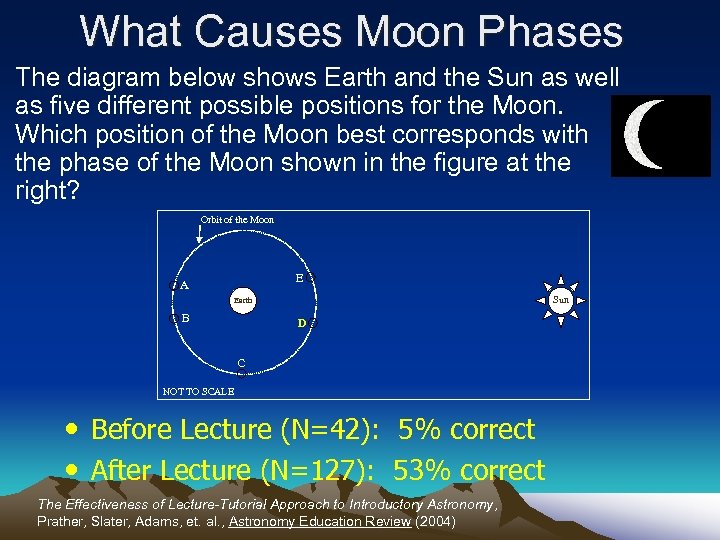 What Causes Moon Phases The diagram below shows Earth and the Sun as well as five different possible positions for the Moon. Which position of the Moon best corresponds with the phase of the Moon shown in the figure at the right? Orbit of the Moon E A Sun Earth B D C NOT TO SCALE • Before Lecture (N=42): 5% correct • After Lecture (N=127): 53% correct The Effectiveness of Lecture-Tutorial Approach to Introductory Astronomy, Prather, Slater, Adams, et. al. , Astronomy Education Review (2004)
 Volcanoes are usually found in places where a) the low pressure of the atmosphere pulls the lava/magma to the surface. b) earthquakes occur from oceanic plates colliding with continental plates. c) deep-rooted mountains have cracked Earth's crust. d) Earth's rotation has caused weak spots in its crust.
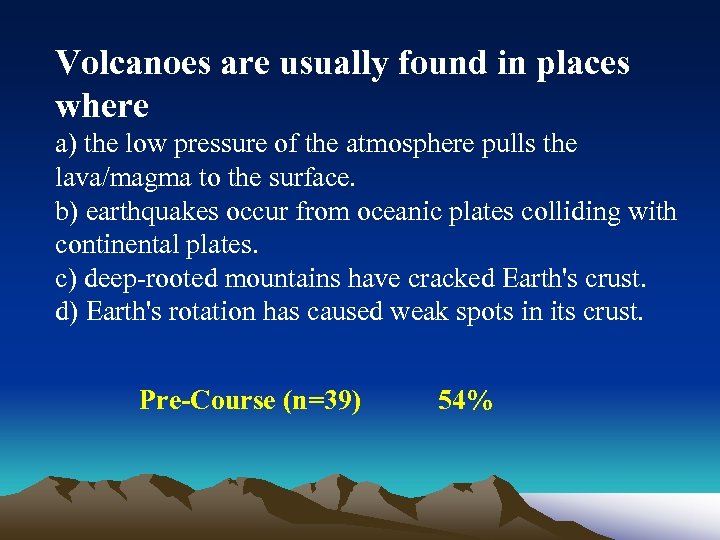 Volcanoes are usually found in places where a) the low pressure of the atmosphere pulls the lava/magma to the surface. b) earthquakes occur from oceanic plates colliding with continental plates. c) deep-rooted mountains have cracked Earth's crust. d) Earth's rotation has caused weak spots in its crust. Pre-Course (n=39) 54%
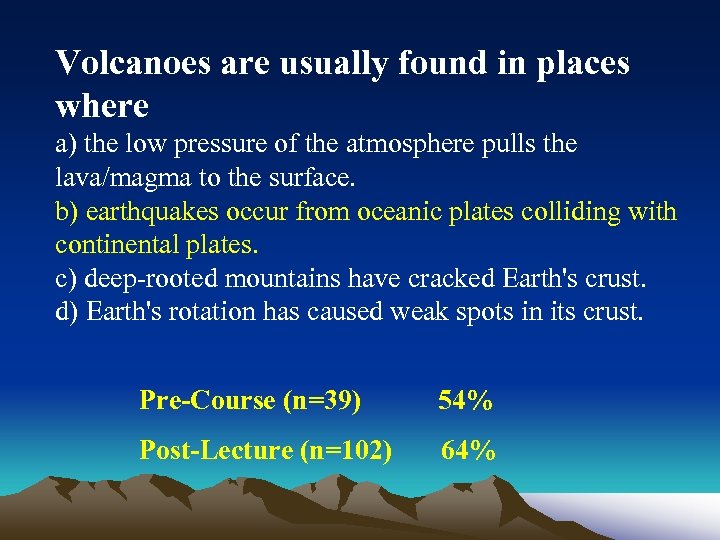 Volcanoes are usually found in places where a) the low pressure of the atmosphere pulls the lava/magma to the surface. b) earthquakes occur from oceanic plates colliding with continental plates. c) deep-rooted mountains have cracked Earth's crust. d) Earth's rotation has caused weak spots in its crust. Pre-Course (n=39) 54% Post-Lecture (n=102) 64%
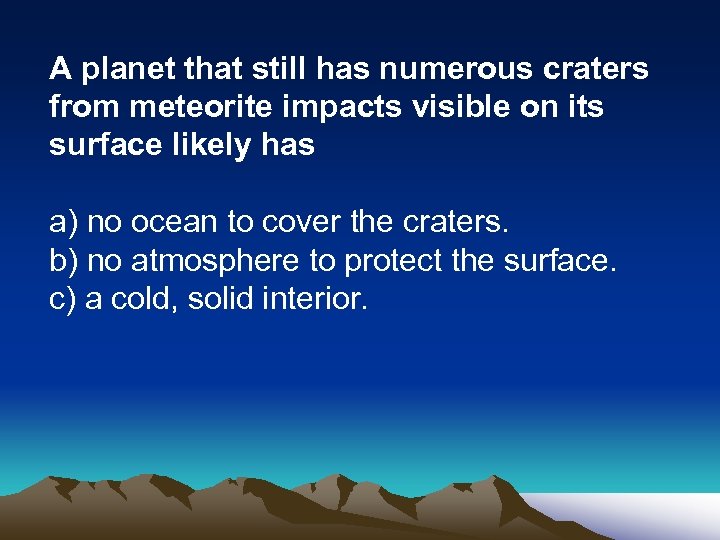 A planet that still has numerous craters from meteorite impacts visible on its surface likely has a) no ocean to cover the craters. b) no atmosphere to protect the surface. c) a cold, solid interior.
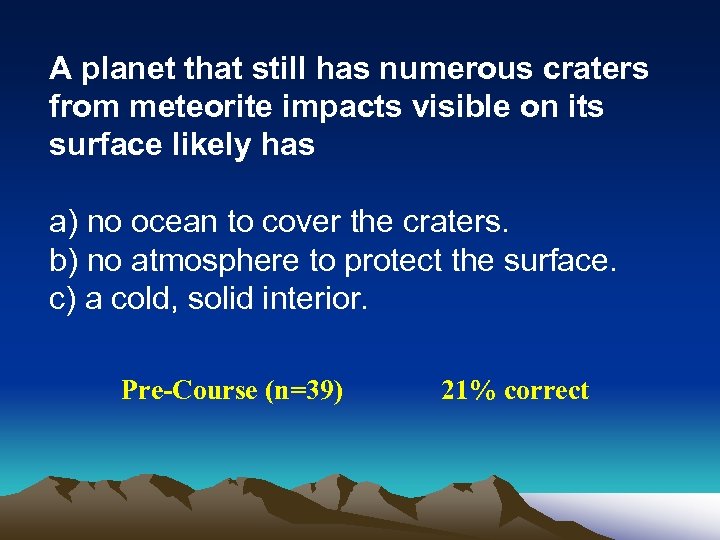 A planet that still has numerous craters from meteorite impacts visible on its surface likely has a) no ocean to cover the craters. b) no atmosphere to protect the surface. c) a cold, solid interior. Pre-Course (n=39) 21% correct
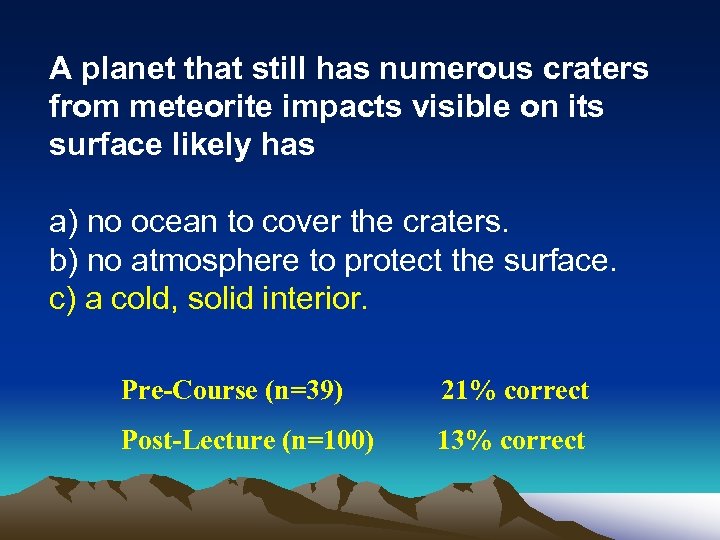 A planet that still has numerous craters from meteorite impacts visible on its surface likely has a) no ocean to cover the craters. b) no atmosphere to protect the surface. c) a cold, solid interior. Pre-Course (n=39) 21% correct Post-Lecture (n=100) 13% correct
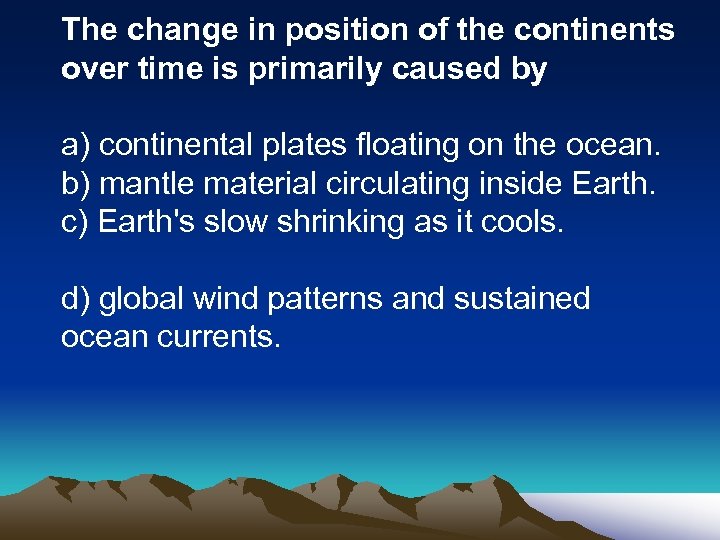 The change in position of the continents over time is primarily caused by a) continental plates floating on the ocean. b) mantle material circulating inside Earth. c) Earth's slow shrinking as it cools. d) global wind patterns and sustained ocean currents.
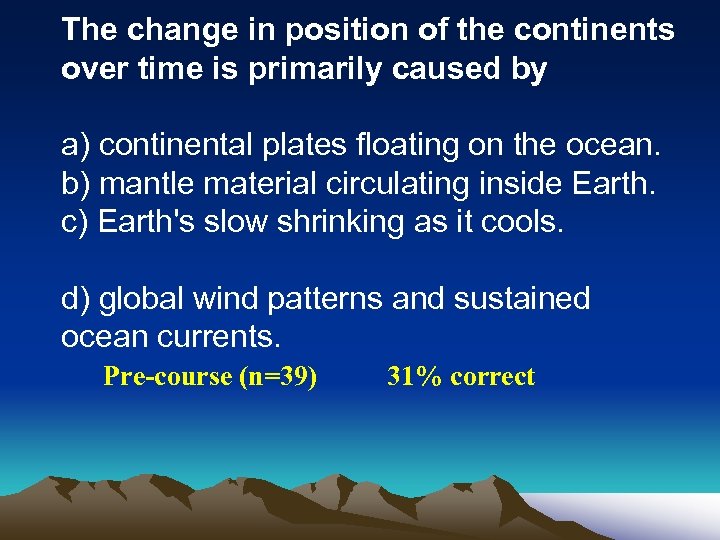 The change in position of the continents over time is primarily caused by a) continental plates floating on the ocean. b) mantle material circulating inside Earth. c) Earth's slow shrinking as it cools. d) global wind patterns and sustained ocean currents. Pre-course (n=39) 31% correct
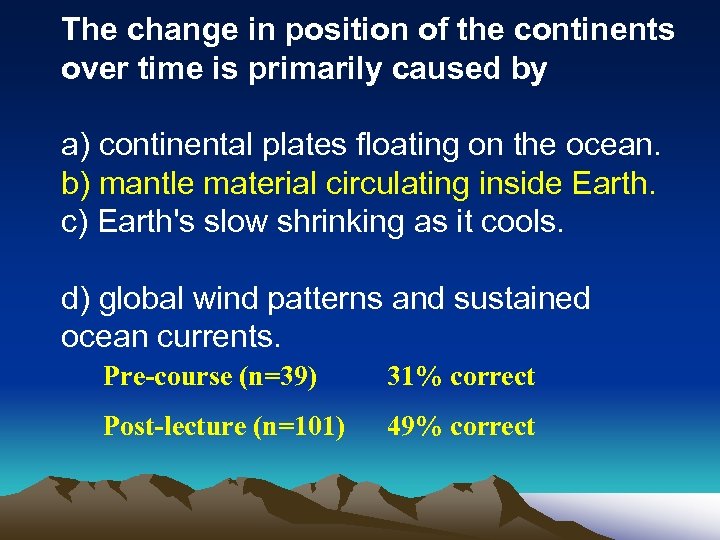 The change in position of the continents over time is primarily caused by a) continental plates floating on the ocean. b) mantle material circulating inside Earth. c) Earth's slow shrinking as it cools. d) global wind patterns and sustained ocean currents. Pre-course (n=39) 31% correct Post-lecture (n=101) 49% correct
 If you were to build a telescope on Earth's surface, which of the following wavelengths of light would be most easily observed by this telescope? a) gamma ray b) X-ray c) ultraviolet d) radio
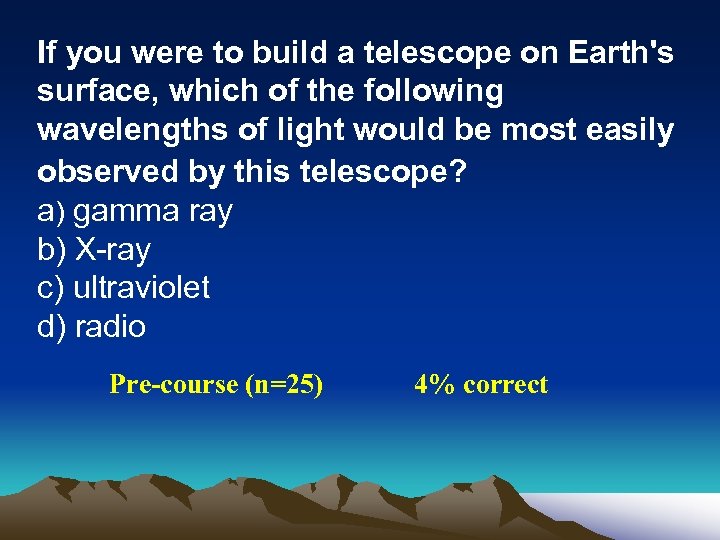 If you were to build a telescope on Earth's surface, which of the following wavelengths of light would be most easily observed by this telescope? a) gamma ray b) X-ray c) ultraviolet d) radio Pre-course (n=25) 4% correct
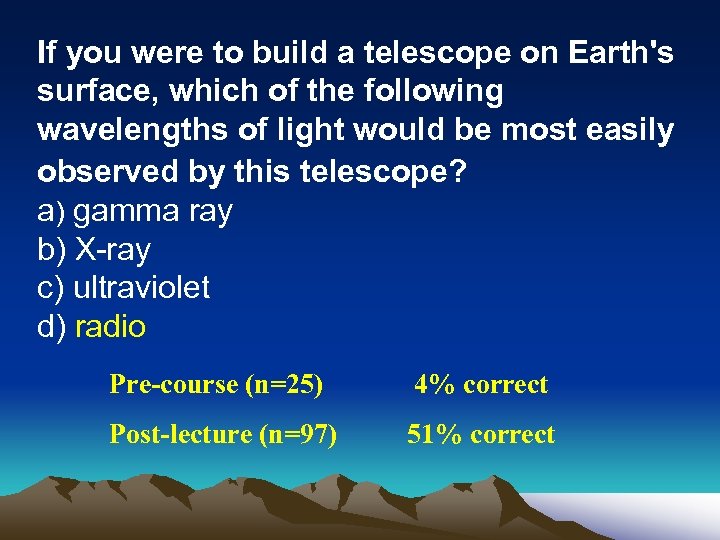 If you were to build a telescope on Earth's surface, which of the following wavelengths of light would be most easily observed by this telescope? a) gamma ray b) X-ray c) ultraviolet d) radio Pre-course (n=25) 4% correct Post-lecture (n=97) 51% correct
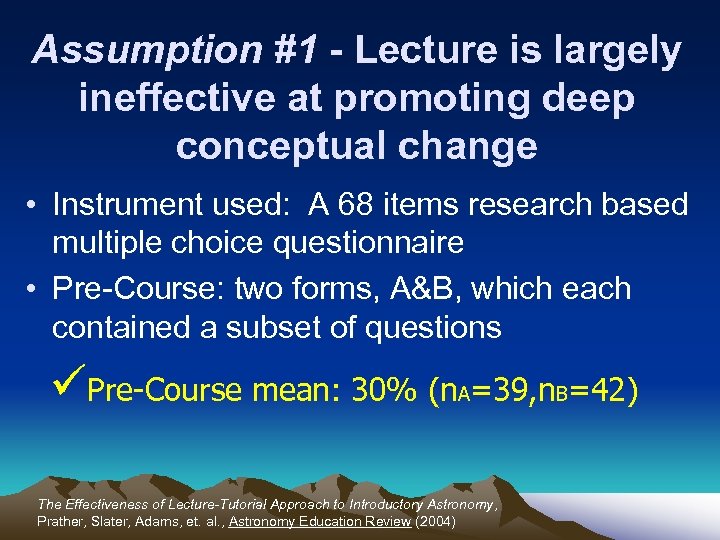 Assumption #1 - Lecture is largely ineffective at promoting deep conceptual change • Instrument used: A 68 items research based multiple choice questionnaire • Pre-Course: two forms, A&B, which each contained a subset of questions üPre-Course mean: 30% (n. A=39, n. B=42) The Effectiveness of Lecture-Tutorial Approach to Introductory Astronomy, Prather, Slater, Adams, et. al. , Astronomy Education Review (2004)
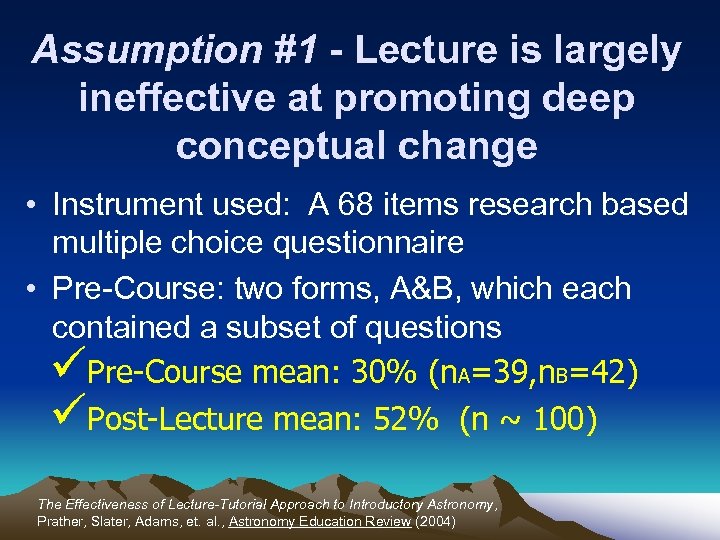 Assumption #1 - Lecture is largely ineffective at promoting deep conceptual change • Instrument used: A 68 items research based multiple choice questionnaire • Pre-Course: two forms, A&B, which each contained a subset of questions üPre-Course mean: 30% (n. A=39, n. B=42) üPost-Lecture mean: 52% (n ~ 100) The Effectiveness of Lecture-Tutorial Approach to Introductory Astronomy, Prather, Slater, Adams, et. al. , Astronomy Education Review (2004)
 FIRST RESPONSE • Buy computer video projectors • Provide students with copies of our Power. Point slides • Create JAVA & FLASH simulations so we can demonstrate complicated models to students • Create extensive www sites for students to read outside of class
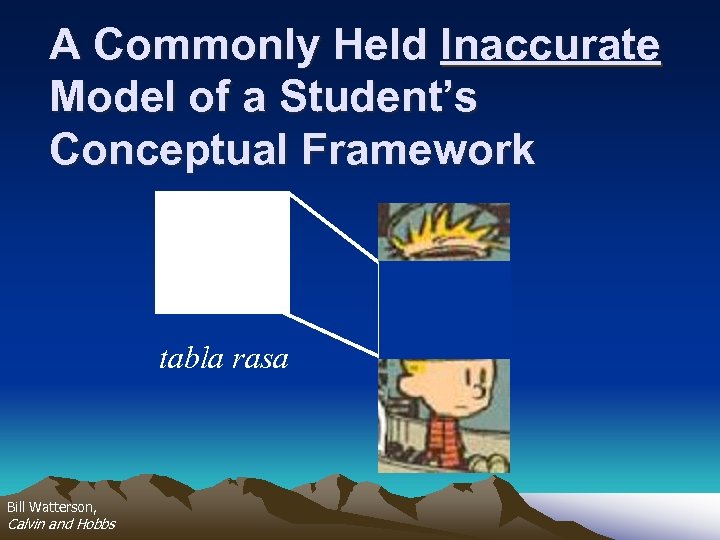 A Commonly Held Inaccurate Model of a Student’s Conceptual Framework tabla rasa Bill Watterson, Calvin and Hobbs
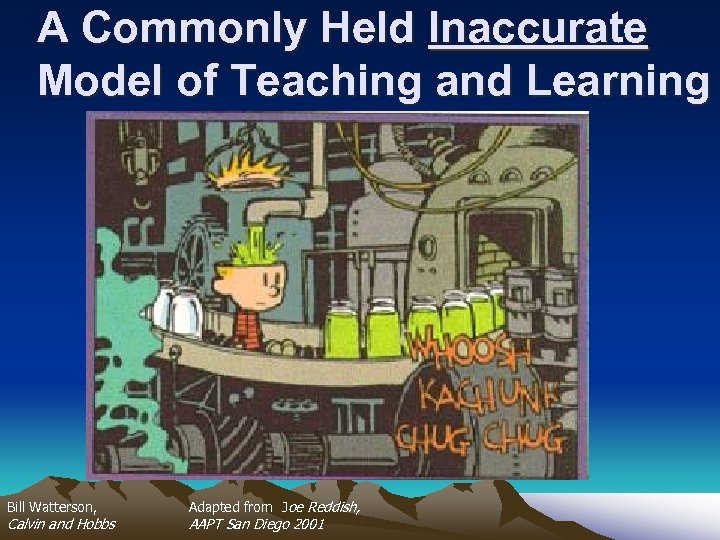 A Commonly Held Inaccurate Model of Teaching and Learning Bill Watterson, Calvin and Hobbs Adapted from Joe Reddish, AAPT San Diego 2001
 FIRST RESPONSE • Buy computer video projectors • Provide students with copies of our Power. Point slides • Create JAVA & FLASH simulations so we can demonstrate complicated models to students • Create extensive www sites for students to read outside of class
 FIRST RESPONSE • Buy computer video projectors • Provide students with copies of our Power. Point slides • Create JAVA & FLASH simulations so we can demonstrate complicated models to students • Create extensive www sites for students to read outside of class
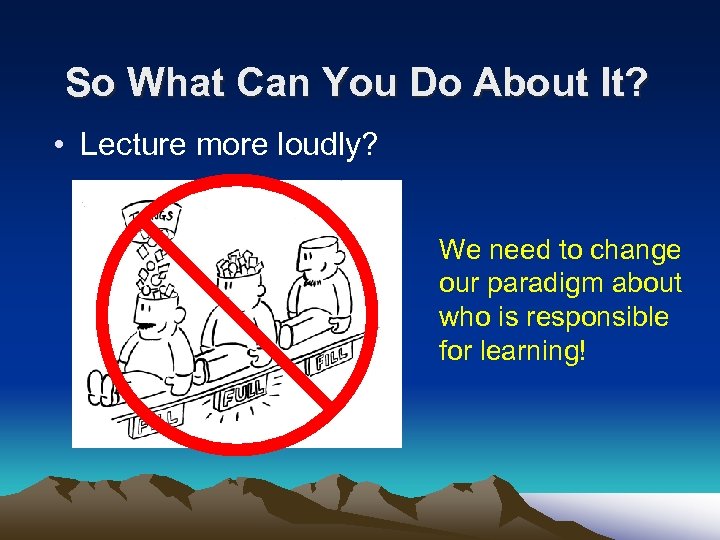 So What Can You Do About It? • Lecture more loudly? We need to change our paradigm about who is responsible for learning!
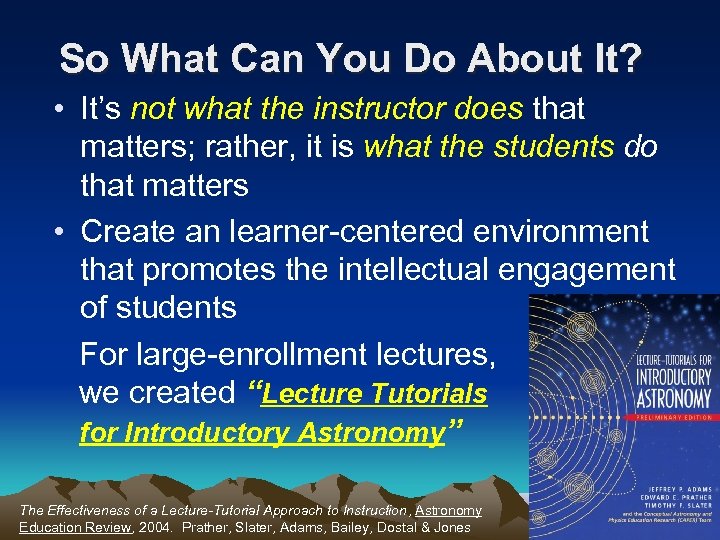 So What Can You Do About It? • It’s not what the instructor does that matters; rather, it is what the students do that matters • Create an learner-centered environment that promotes the intellectual engagement of students For large-enrollment lectures, we created “Lecture Tutorials for Introductory Astronomy” The Effectiveness of a Lecture-Tutorial Approach to Instruction, Astronomy Education Review, 2004. Prather, Slater, Adams, Bailey, Dostal & Jones
 Development of Lecture-Tutorials for Introductory Astronomy • Based on the topics faculty most often cover • Require 15 -minutes and are designed for easy implementation into existing traditional lecture courses • Socratic-dialogue driven, highly-structured collaborative learning activities designed to: • elicit misconceptions • confront naïve, incomplete, or inaccurate ideas • resolve contradictions • demonstrate the power of THEIR conceptual models The Effectiveness of a Lecture-Tutorial Approach to Instruction, Astronomy Education Review, 2004. Prather, Slater, Adams, Bailey, Dostal & Jones
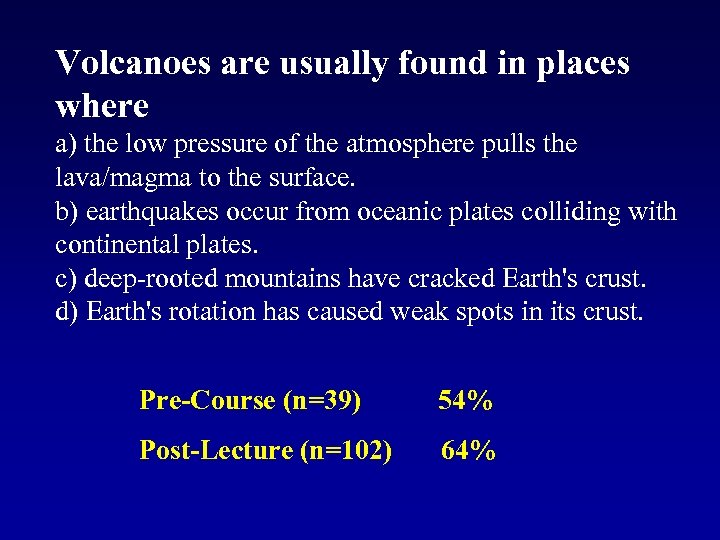 Volcanoes are usually found in places where a) the low pressure of the atmosphere pulls the lava/magma to the surface. b) earthquakes occur from oceanic plates colliding with continental plates. c) deep-rooted mountains have cracked Earth's crust. d) Earth's rotation has caused weak spots in its crust. Pre-Course (n=39) 54% Post-Lecture (n=102) 64%
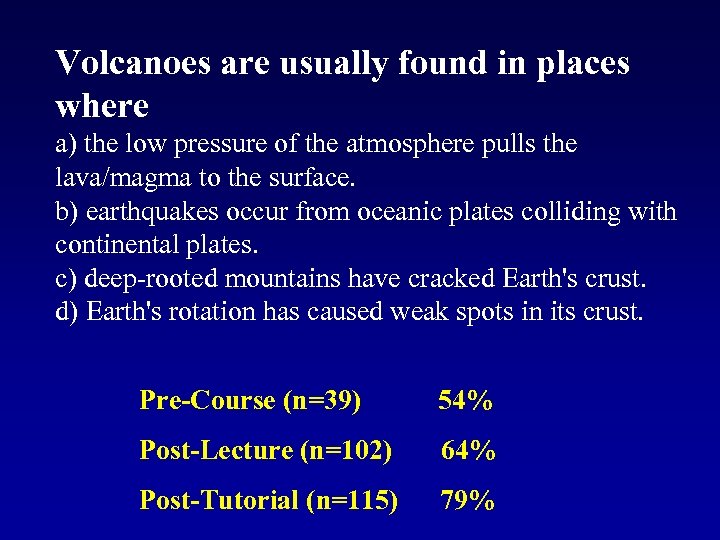 Volcanoes are usually found in places where a) the low pressure of the atmosphere pulls the lava/magma to the surface. b) earthquakes occur from oceanic plates colliding with continental plates. c) deep-rooted mountains have cracked Earth's crust. d) Earth's rotation has caused weak spots in its crust. Pre-Course (n=39) 54% Post-Lecture (n=102) 64% Post-Tutorial (n=115) 79%
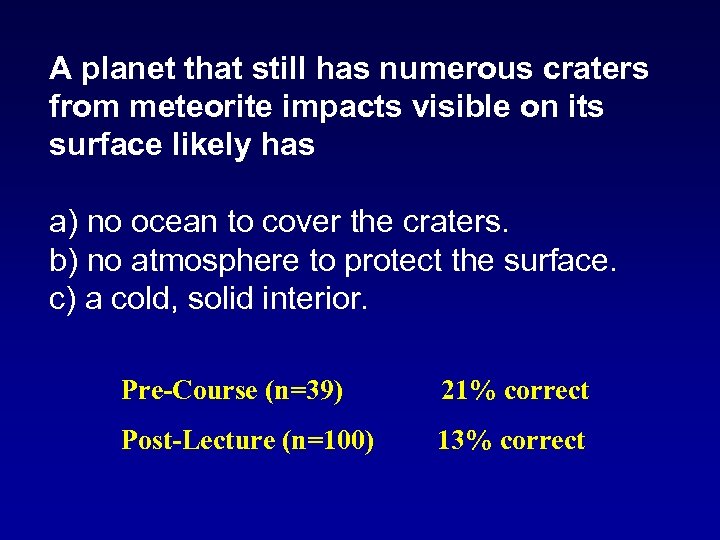 A planet that still has numerous craters from meteorite impacts visible on its surface likely has a) no ocean to cover the craters. b) no atmosphere to protect the surface. c) a cold, solid interior. Pre-Course (n=39) 21% correct Post-Lecture (n=100) 13% correct
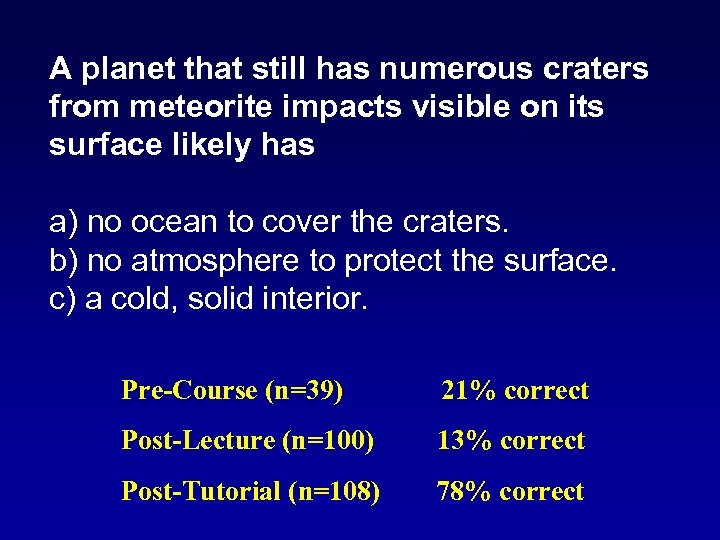 A planet that still has numerous craters from meteorite impacts visible on its surface likely has a) no ocean to cover the craters. b) no atmosphere to protect the surface. c) a cold, solid interior. Pre-Course (n=39) 21% correct Post-Lecture (n=100) 13% correct Post-Tutorial (n=108) 78% correct
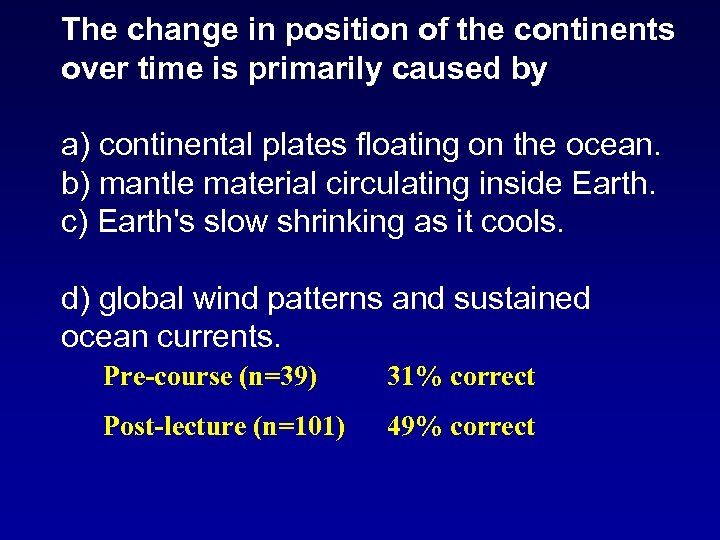 The change in position of the continents over time is primarily caused by a) continental plates floating on the ocean. b) mantle material circulating inside Earth. c) Earth's slow shrinking as it cools. d) global wind patterns and sustained ocean currents. Pre-course (n=39) 31% correct Post-lecture (n=101) 49% correct
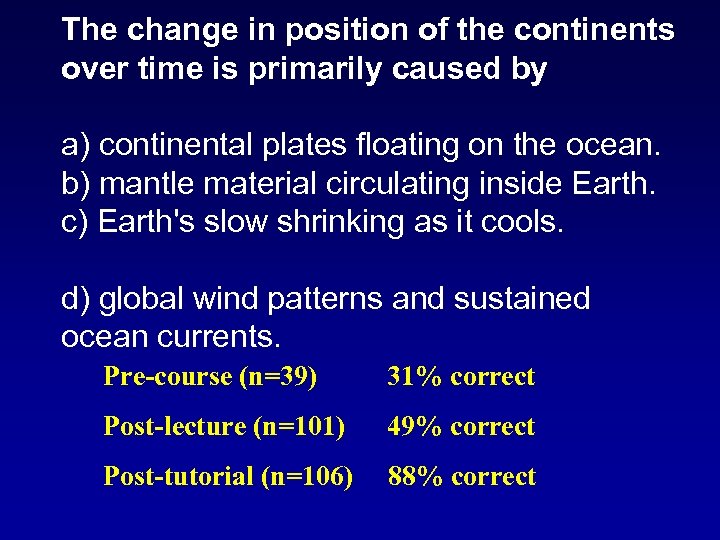 The change in position of the continents over time is primarily caused by a) continental plates floating on the ocean. b) mantle material circulating inside Earth. c) Earth's slow shrinking as it cools. d) global wind patterns and sustained ocean currents. Pre-course (n=39) 31% correct Post-lecture (n=101) 49% correct Post-tutorial (n=106) 88% correct
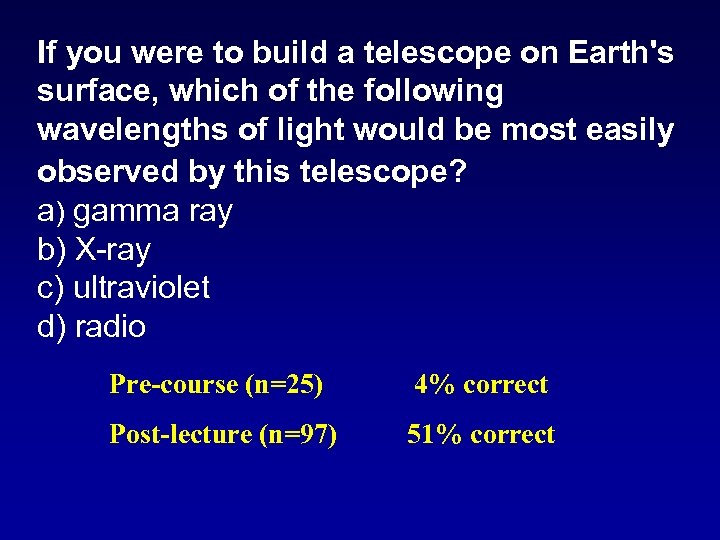 If you were to build a telescope on Earth's surface, which of the following wavelengths of light would be most easily observed by this telescope? a) gamma ray b) X-ray c) ultraviolet d) radio Pre-course (n=25) 4% correct Post-lecture (n=97) 51% correct
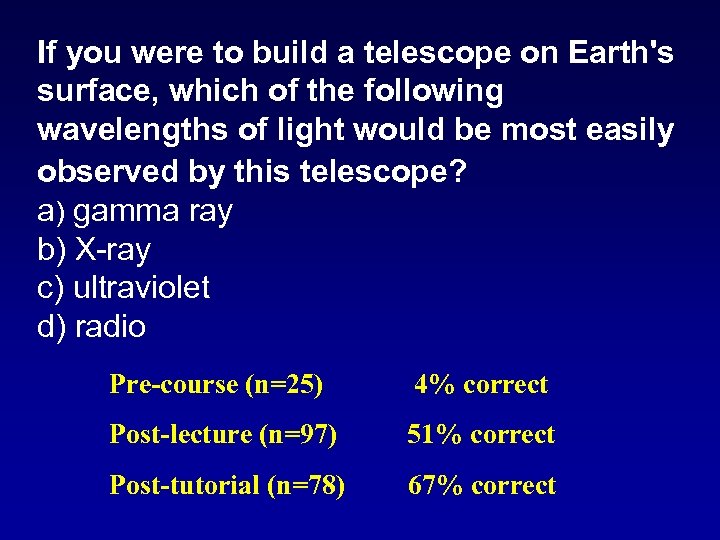 If you were to build a telescope on Earth's surface, which of the following wavelengths of light would be most easily observed by this telescope? a) gamma ray b) X-ray c) ultraviolet d) radio Pre-course (n=25) 4% correct Post-lecture (n=97) 51% correct Post-tutorial (n=78) 67% correct
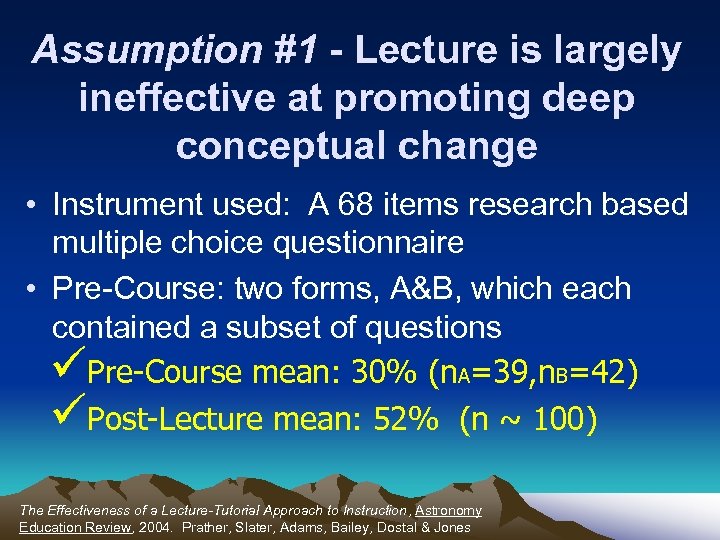 Assumption #1 - Lecture is largely ineffective at promoting deep conceptual change • Instrument used: A 68 items research based multiple choice questionnaire • Pre-Course: two forms, A&B, which each contained a subset of questions üPre-Course mean: 30% (n. A=39, n. B=42) üPost-Lecture mean: 52% (n ~ 100) The Effectiveness of a Lecture-Tutorial Approach to Instruction, Astronomy Education Review, 2004. Prather, Slater, Adams, Bailey, Dostal & Jones
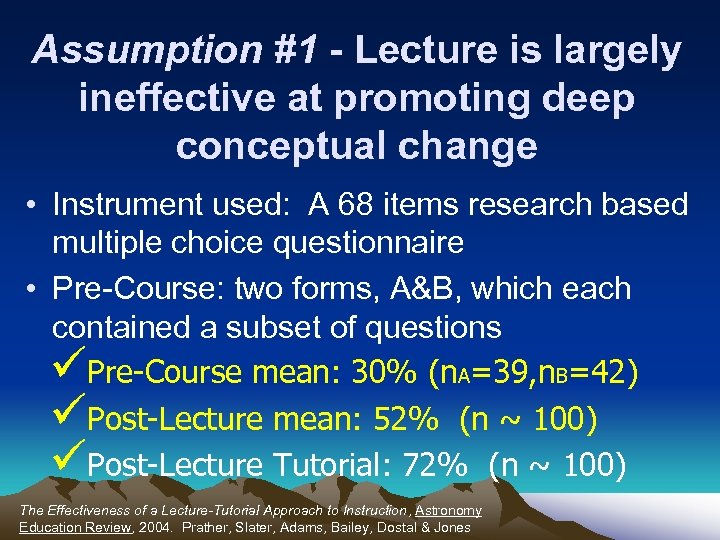 Assumption #1 - Lecture is largely ineffective at promoting deep conceptual change • Instrument used: A 68 items research based multiple choice questionnaire • Pre-Course: two forms, A&B, which each contained a subset of questions üPre-Course mean: 30% (n. A=39, n. B=42) üPost-Lecture mean: 52% (n ~ 100) üPost-Lecture Tutorial: 72% (n ~ 100) The Effectiveness of a Lecture-Tutorial Approach to Instruction, Astronomy Education Review, 2004. Prather, Slater, Adams, Bailey, Dostal & Jones
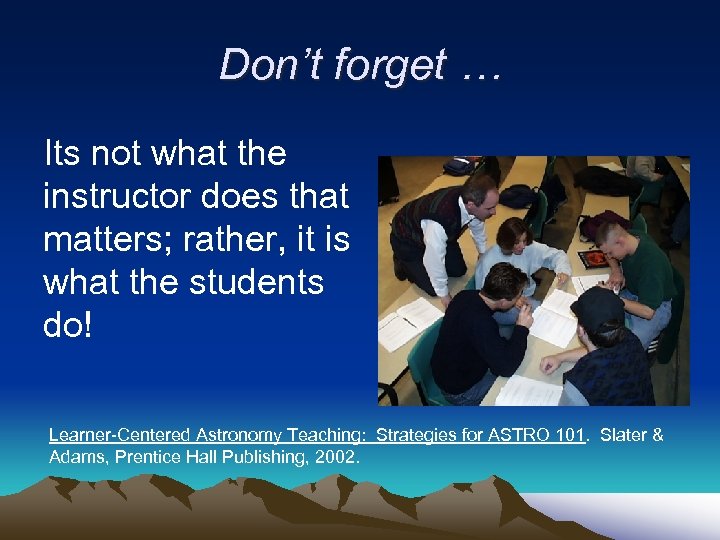 Don’t forget … Its not what the instructor does that matters; rather, it is what the students do! Learner-Centered Astronomy Teaching: Strategies for ASTRO 101. Slater & Adams, Prentice Hall Publishing, 2002.
 Activity activity or activity = Just having students DO STUFF OR Activity = Repeatedly intellectually engage students with meaningful phenomena to create deep conceptual understanding
 Activity activity or activity = Just having students DO STUFF HOW DO YOU KNOW THE DIFFERENCE? Activity = Repeatedly intellectually engage students with meaningful phenomena to create deep conceptual understanding
 Activity or activity Rigorous evaluation – We made this stuff, they liked it, they had a good time, they manipulated data and got reasonable results
 Activity or activity Rigorous evaluation – We made this stuff, they liked it, they had a good time, they manipulated data and got reasonable results – Assessment of pre-existing student ideas and reasoning difficulties learners bring to the table – Repeated evaluation of pre- to –post learning gains cause interactive improvements – Triangulated with other data (other diagnostics, interviews, observations, etc. )
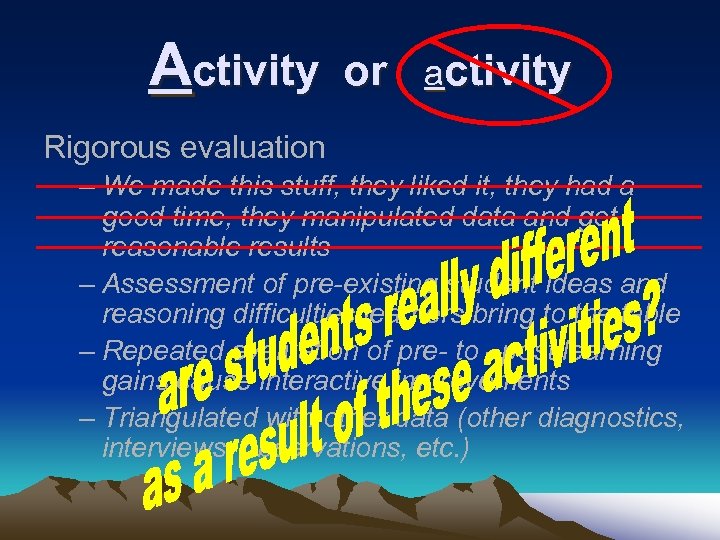 Activity or activity Rigorous evaluation – We made this stuff, they liked it, they had a good time, they manipulated data and got reasonable results – Assessment of pre-existing student ideas and reasoning difficulties learners bring to the table – Repeated evaluation of pre- to –post learning gains cause interactive improvements – Triangulated with other data (other diagnostics, interviews, observations, etc. )
 Activity or activity • Active learning is when students take active responsibility for participating in and monitoring of their own learning by engaging in critical reasoning about the ideas presented in the class. • The educational effectiveness of activities must be meaningfully evaluated both to make improvements and for our community to make progress.
 So what? • Research results are impacting the creation of new activities • Ranking Tasks • Sorting Tasks • Vocabulary in Context
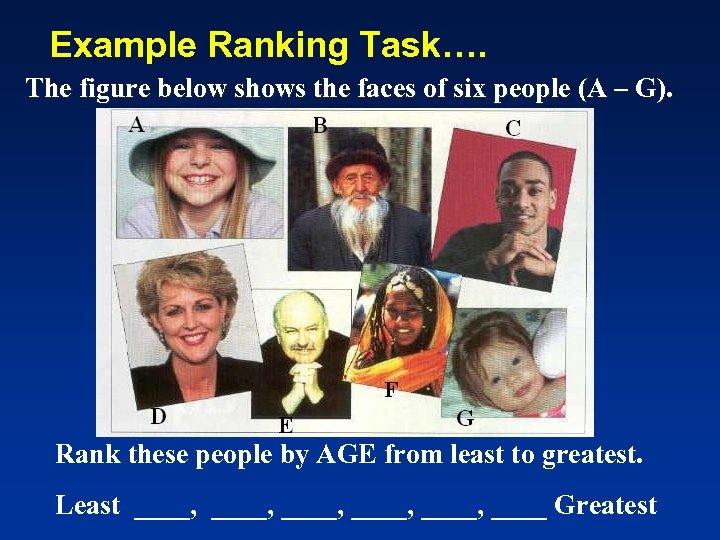 Example Ranking Task…. The figure below shows the faces of six people (A – G). Rank these people by AGE from least to greatest. Least ____, ____, ____ Greatest
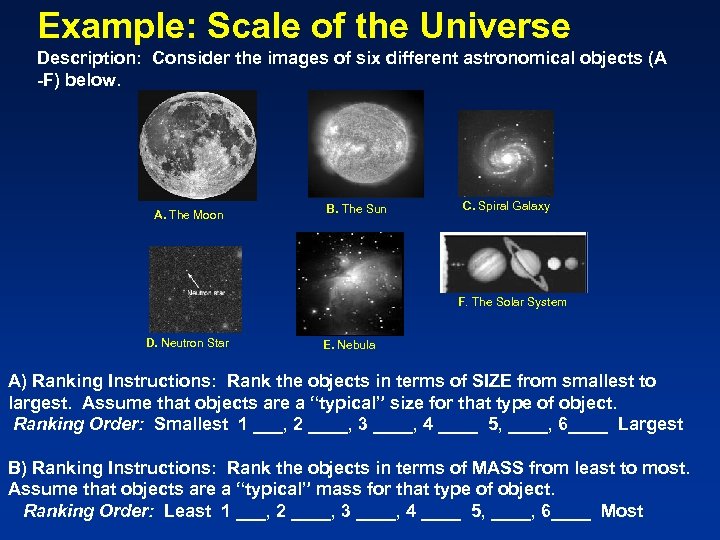 Example: Scale of the Universe Description: Consider the images of six different astronomical objects (A -F) below. A. The Moon B. The Sun C. Spiral Galaxy F. The Solar System D. Neutron Star E. Nebula A) Ranking Instructions: Rank the objects in terms of SIZE from smallest to largest. Assume that objects are a “typical” size for that type of object. Ranking Order: Smallest 1 ___, 2 ____, 3 ____, 4 ____ 5, ____, 6____ Largest B) Ranking Instructions: Rank the objects in terms of MASS from least to most. Assume that objects are a “typical” mass for that type of object. Ranking Order: Least 1 ___, 2 ____, 3 ____, 4 ____ 5, ____, 6____ Most
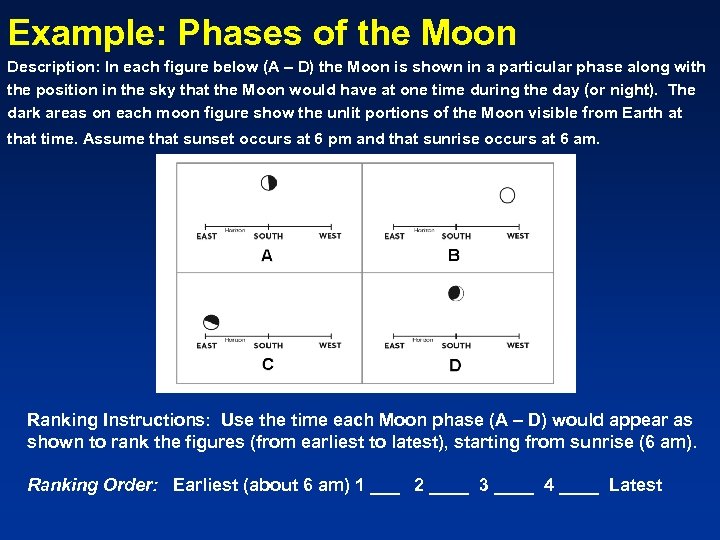 Example: Phases of the Moon Description: In each figure below (A – D) the Moon is shown in a particular phase along with the position in the sky that the Moon would have at one time during the day (or night). The dark areas on each moon figure show the unlit portions of the Moon visible from Earth at that time. Assume that sunset occurs at 6 pm and that sunrise occurs at 6 am. Ranking Instructions: Use the time each Moon phase (A – D) would appear as shown to rank the figures (from earliest to latest), starting from sunrise (6 am). Ranking Order: Earliest (about 6 am) 1 ___ 2 ____ 3 ____ 4 ____ Latest
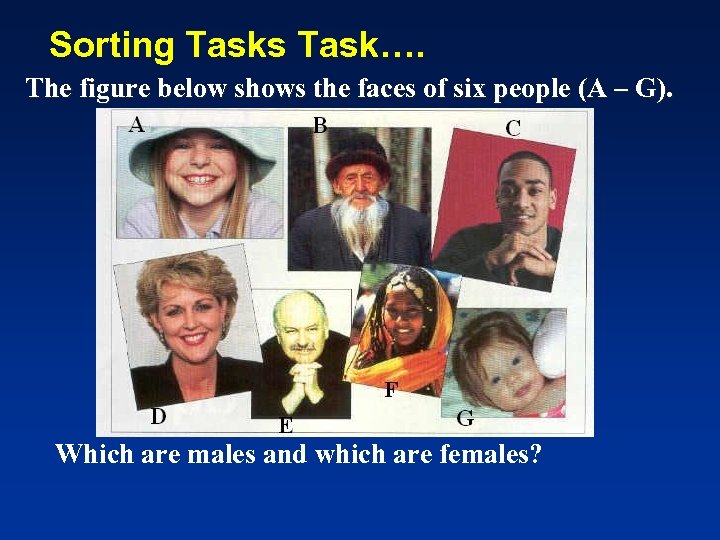 Sorting Tasks Task…. The figure below shows the faces of six people (A – G). Which are males and which are females?
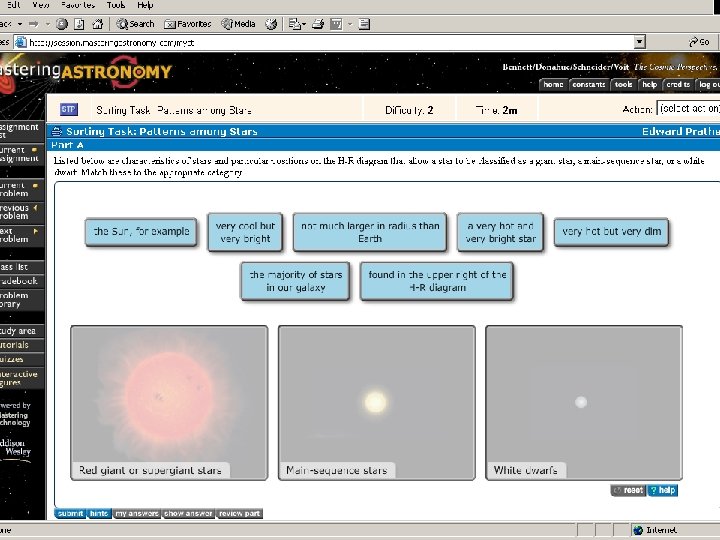
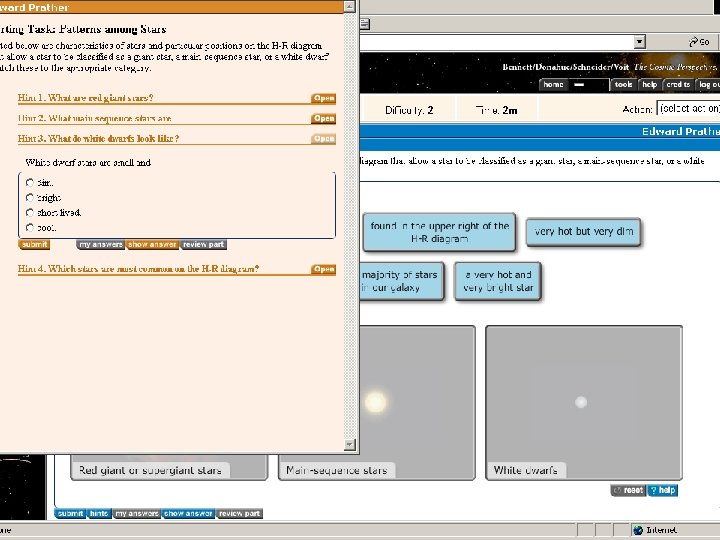
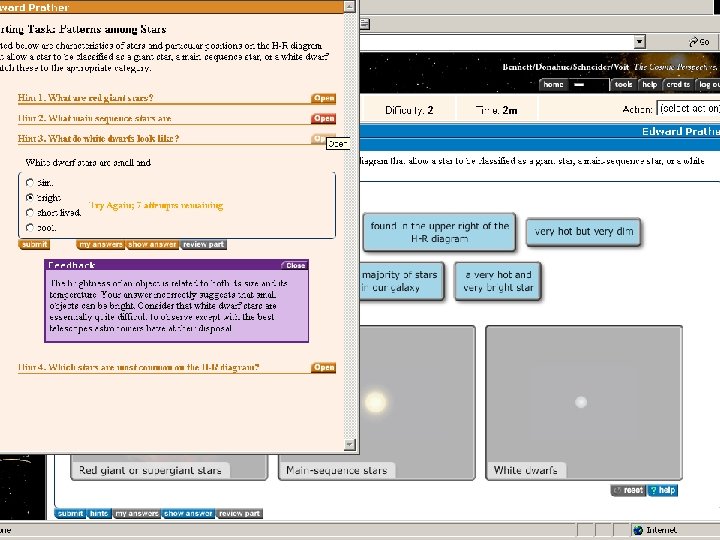
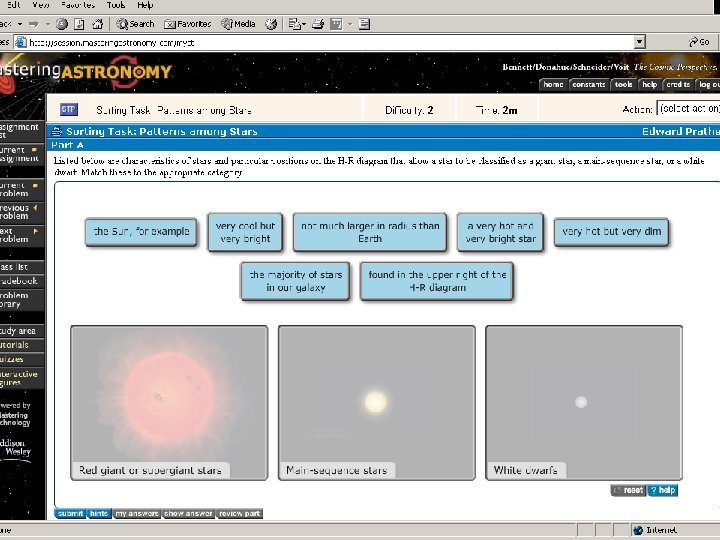
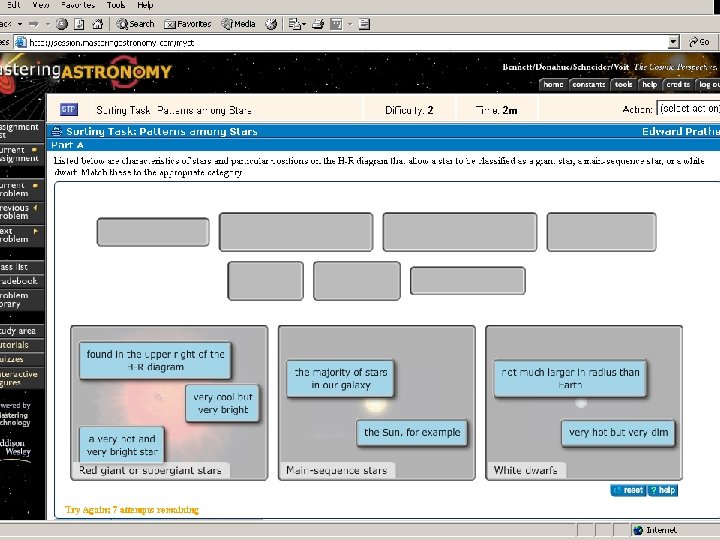
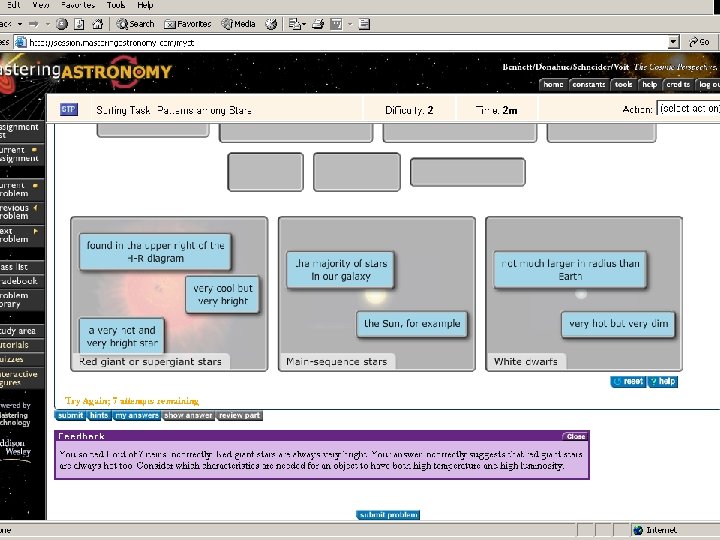
 Vocabulary in Context
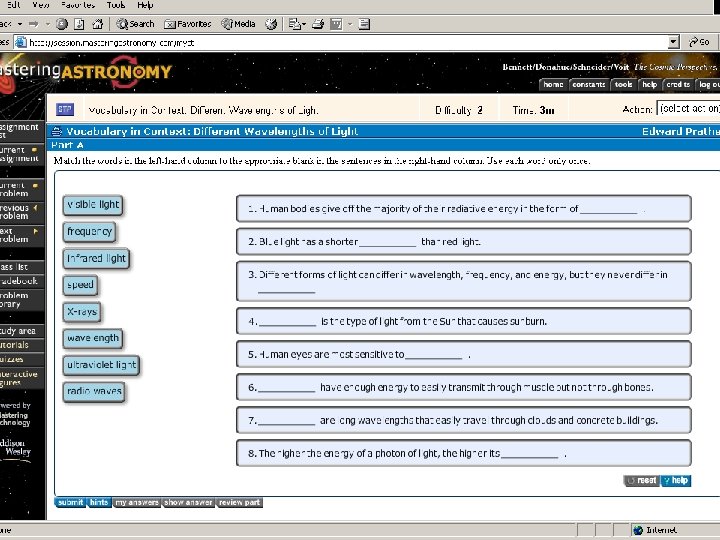
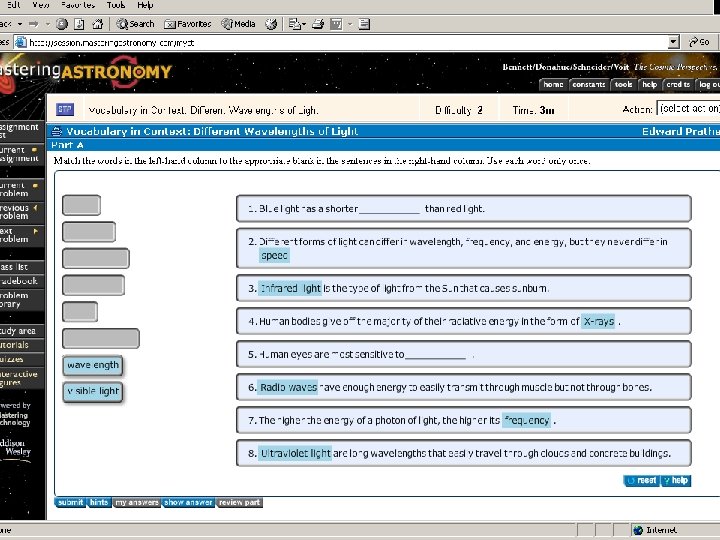
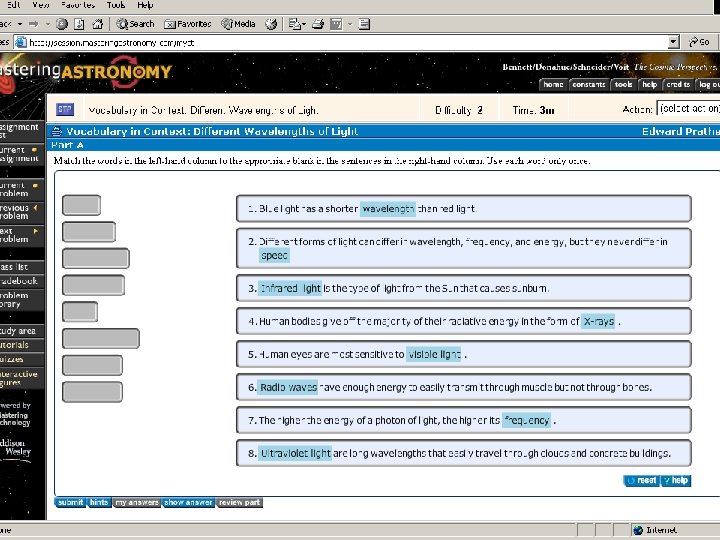
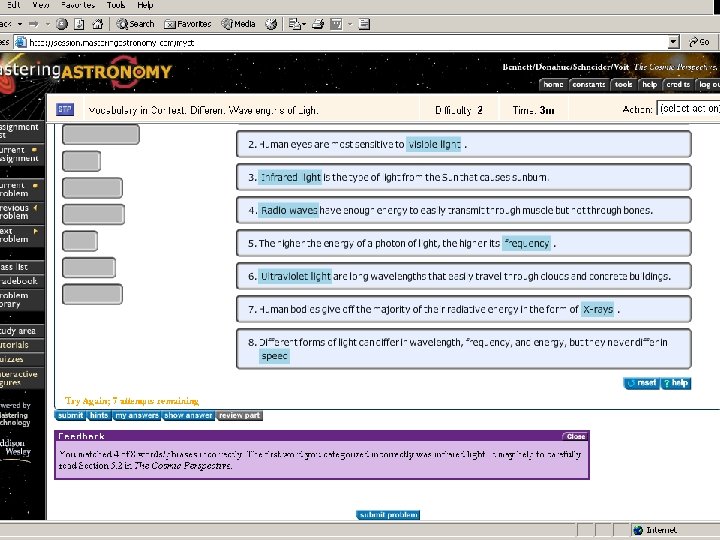
 New Tools to Measure Impact • Astronomy Diagnostic Test • Lunar Phases Concept Inventory • Stars and Star Formation Concept Inventory • Global Warming Concept Inventory • Light and Spectra Concept Inventory
 Light and Spectra Concept Inventory
 How Do I Keep Up With It All? • Astronomy Education Review – http: //aer. noao. edu • ASP/AAE Astro. Ed_News – Send blank email to astroed_newssubscribe@yahoogroups. com • National Digital Libraries – DLESE. org and Astronomy. Center. org • What else?
 Using Research on How Students Learn Astronomy to Improve Teaching Tim Slater University of Arizona Department of Astronomy Conceptual Astronomy and Physics Education Research (CAPER) Team http: //caperteam. as. arizona. edu Project BETA – July 26, 2007 – NASA Goddard