 Скачать презентацию Using Real-time CORBA Effectively Patterns Principles Angelo
67cacc797de288ea6e7159ca1450a154.ppt
- Количество слайдов: 89



Using Real-time CORBA Effectively Patterns & Principles Angelo Corsaro Carlos O’Ryan Douglas Schmidt { } corsaro coryan @uci. edu schmidt Irfan Pyarali irfan@cs. wustl. edu Department of Computer Science, Washington University of St. Louis Elec. & Comp. Eng. Dept. University of California, Irvine www. cs. wustl. edu/~schmidt/tutorials-corba. html
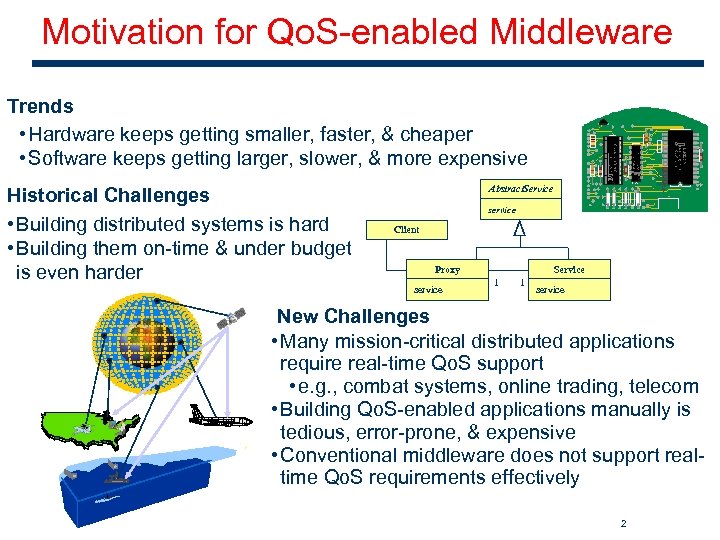
Motivation for Qo. S-enabled Middleware Trends • Hardware keeps getting smaller, faster, & cheaper • Software keeps getting larger, slower, & more expensive Historical Challenges • Building distributed systems is hard • Building them on-time & under budget is even harder Abstract. Service service Client Proxy service Service 1 1 service New Challenges • Many mission-critical distributed applications require real-time Qo. S support • e. g. , combat systems, online trading, telecom • Building Qo. S-enabled applications manually is tedious, error-prone, & expensive • Conventional middleware does not support realtime Qo. S requirements effectively 2
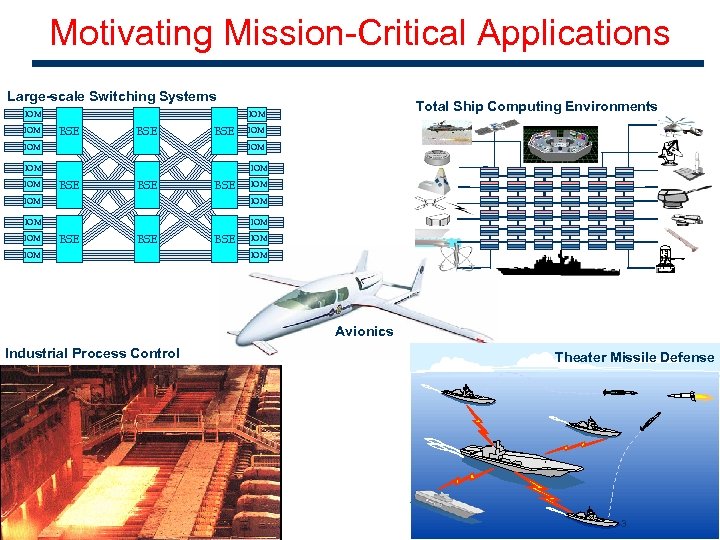
Motivating Mission-Critical Applications Large-scale Switching Systems IOM BSE BSE IOM Total Ship C&C Center IOM IOM Total Ship Computing Environments IOM BSE BSE IOM IOM IOM BSE IOM Avionics Industrial Process Control Theater Missile Defense 3
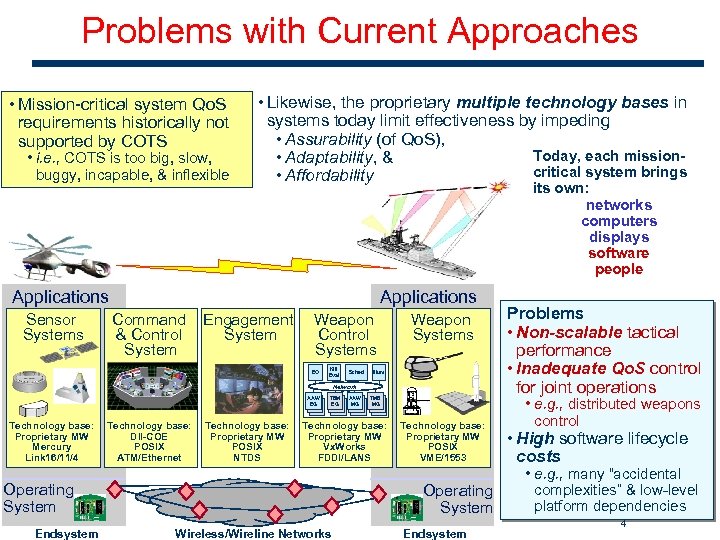
Problems with Current Approaches • Mission-critical system Qo. S requirements historically not supported by COTS • i. e. , COTS is too big, slow, buggy, incapable, & inflexible • Likewise, the proprietary multiple technology bases in systems today limit effectiveness by impeding • Assurability (of Qo. S), Today, each mission • Adaptability, & critical system brings • Affordability its own: networks computers displays software people Applications Sensor Systems Applications Command & Control System Engagement System Weapon Control Systems EO Kill Eval Sched Weapon Systems Illum Network AAW EG Technology base: Proprietary MW Mercury Link 16/11/4 Technology base: DII-COE POSIX ATM/Ethernet Technology base: Proprietary MW POSIX NTDS TBM AAW AAW AAW EG MG Technology base: Proprietary MW Vx. Works FDDI/LANS Operating System Endsystem TMB MG Technology base: Proprietary MW POSIX VME/1553 Operating System Wireless/Wireline Networks Endsystem Problems • Non-scalable tactical performance • Inadequate Qo. S control for joint operations • e. g. , distributed weapons control • High software lifecycle costs • e. g. , many “accidental complexities” & low-level platform dependencies 4
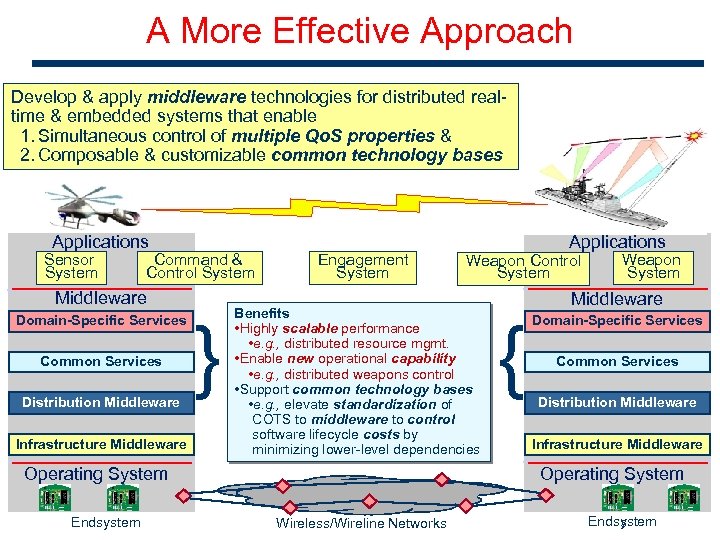
A More Effective Approach Develop & apply middleware technologies for distributed realtime & embedded systems that enable 1. Simultaneous control of multiple Qo. S properties & 2. Composable & customizable common technology bases Sensor System Command & Control System Middleware Domain-Specific Services Common Services Distribution Middleware Infrastructure Middleware } Engagement System Endsystem Weapon Control System Benefits • Highly scalable performance • e. g. , distributed resource mgmt. • Enable new operational capability • e. g. , distributed weapons control • Support common technology bases • e. g. , elevate standardization of COTS to middleware to control software lifecycle costs by minimizing lower-level dependencies Operating System Applications Weapon System Middleware } Applications Domain-Specific Services Common Services Distribution Middleware Infrastructure Middleware Operating System Wireless/Wireline Networks Endsystem 5
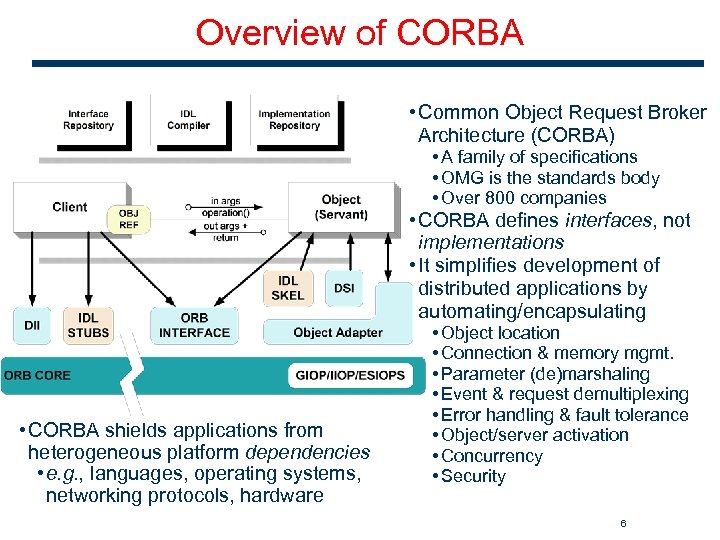
Overview of CORBA • Common Object Request Broker Architecture (CORBA) • A family of specifications • OMG is the standards body • Over 800 companies • CORBA defines interfaces, not implementations • It simplifies development of distributed applications by automating/encapsulating • CORBA shields applications from heterogeneous platform dependencies • e. g. , languages, operating systems, networking protocols, hardware • Object location • Connection & memory mgmt. • Parameter (de)marshaling • Event & request demultiplexing • Error handling & fault tolerance • Object/server activation • Concurrency • Security 6
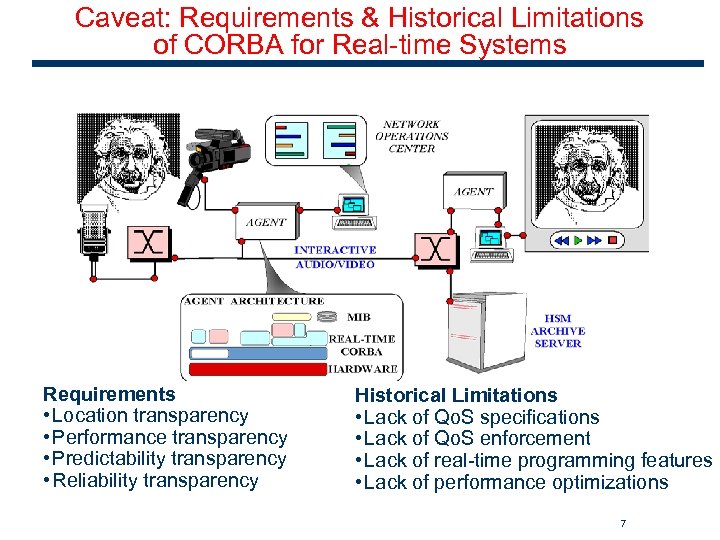
Caveat: Requirements & Historical Limitations of CORBA for Real-time Systems Requirements • Location transparency • Performance transparency • Predictability transparency • Reliability transparency Historical Limitations • Lack of Qo. S specifications • Lack of Qo. S enforcement • Lack of real-time programming features • Lack of performance optimizations 7
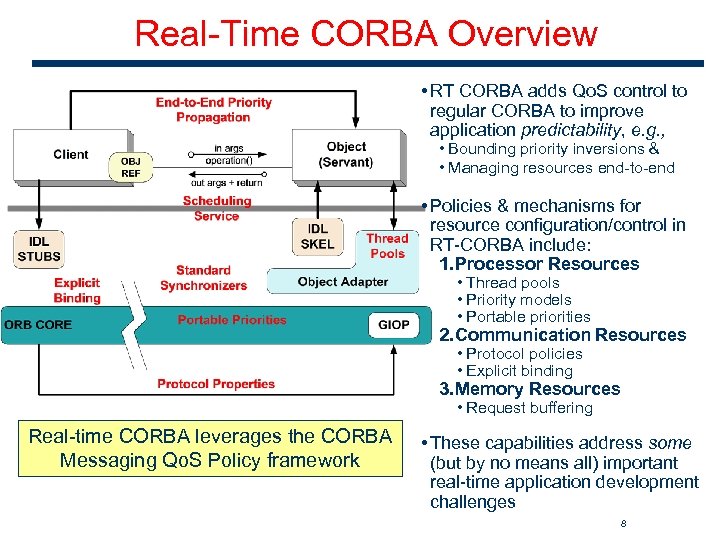
Real-Time CORBA Overview • RT CORBA adds Qo. S control to regular CORBA to improve application predictability, e. g. , • Bounding priority inversions & • Managing resources end-to-end • Policies & mechanisms for resource configuration/control in RT-CORBA include: 1. Processor Resources • Thread pools • Priority models • Portable priorities 2. Communication Resources • Protocol policies • Explicit binding 3. Memory Resources • Request buffering Real-time CORBA leverages the CORBA Messaging Qo. S Policy framework • These capabilities address some (but by no means all) important real-time application development challenges 8
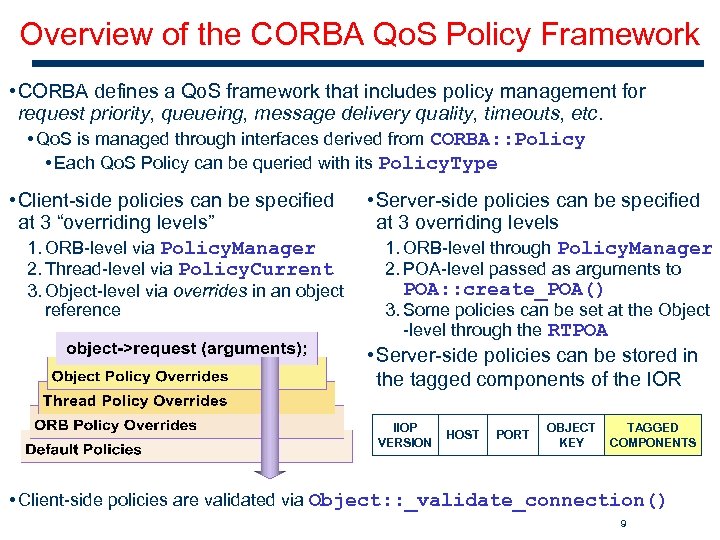
Overview of the CORBA Qo. S Policy Framework • CORBA defines a Qo. S framework that includes policy management for request priority, queueing, message delivery quality, timeouts, etc. • Qo. S is managed through interfaces derived from CORBA: : Policy • Each Qo. S Policy can be queried with its Policy. Type • Client-side policies can be specified at 3 “overriding levels” 1. ORB-level via Policy. Manager 2. Thread-level via Policy. Current 3. Object-level via overrides in an object reference • Server-side policies can be specified at 3 overriding levels 1. ORB-level through Policy. Manager 2. POA-level passed as arguments to POA: : create_POA() 3. Some policies can be set at the Object -level through the RTPOA • Server-side policies can be stored in the tagged components of the IOR IIOP VERSION HOST PORT OBJECT KEY TAGGED COMPONENTS • Client-side policies are validated via Object: : _validate_connection() 9
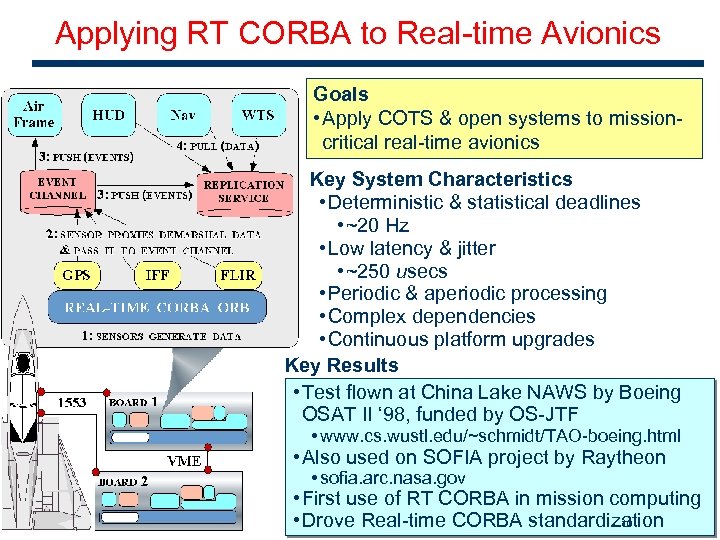
Applying RT CORBA to Real-time Avionics Goals • Apply COTS & open systems to missioncritical real-time avionics Key System Characteristics • Deterministic & statistical deadlines • ~20 Hz • Low latency & jitter • ~250 usecs • Periodic & aperiodic processing • Complex dependencies • Continuous platform upgrades Key Results • Test flown at China Lake NAWS by Boeing OSAT II ‘ 98, funded by OS-JTF • www. cs. wustl. edu/~schmidt/TAO-boeing. html • Also used on SOFIA project by Raytheon • sofia. arc. nasa. gov • First use of RT CORBA in mission computing • Drove Real-time CORBA standardization 10
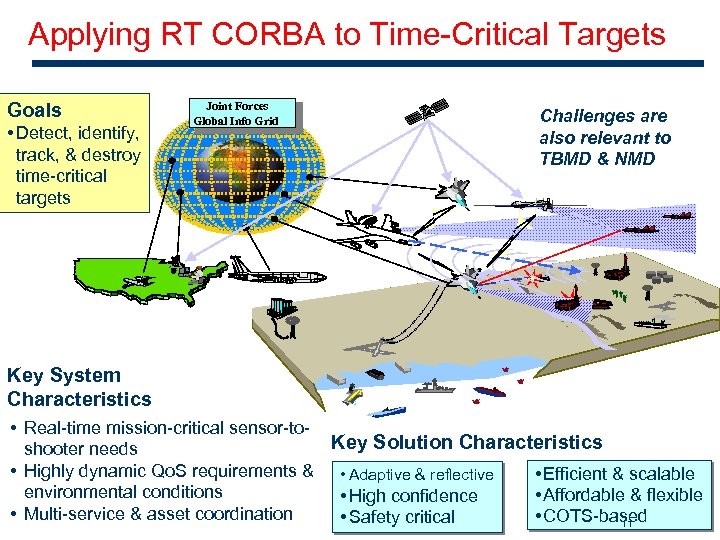
Applying RT CORBA to Time-Critical Targets Goals • Detect, identify, track, & destroy time-critical targets Joint Forces Global Info Grid Challenges are also relevant to TBMD & NMD Key System Characteristics Adapted from “The Future of AWACS”, • Real-time mission-critical sensor-toby Lt. Col Joe Chapa Key Solution Characteristics shooter needs • Highly dynamic Qo. S requirements & • Adaptive &immediate response because: Time-critical targets require reflective • Efficient & scalable environmental conditions • friendly & flexible • High confidence • They pose a clear and present danger to. Affordable forces & • Multi-service & asset coordination • COTS-based • Safety critical 11 • Are highly lucrative, fleeting targets of opportunity
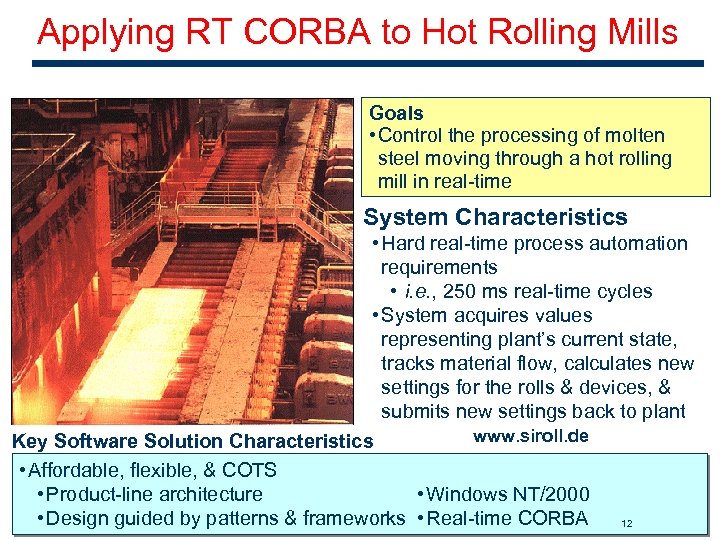
Applying RT CORBA to Hot Rolling Mills Goals • Control the processing of molten steel moving through a hot rolling mill in real-time System Characteristics • Hard real-time process automation requirements • i. e. , 250 ms real-time cycles • System acquires values representing plant’s current state, tracks material flow, calculates new settings for the rolls & devices, & submits new settings back to plant www. siroll. de Key Software Solution Characteristics • Affordable, flexible, & COTS • Product-line architecture • Windows NT/2000 • Design guided by patterns & frameworks • Real-time CORBA 12
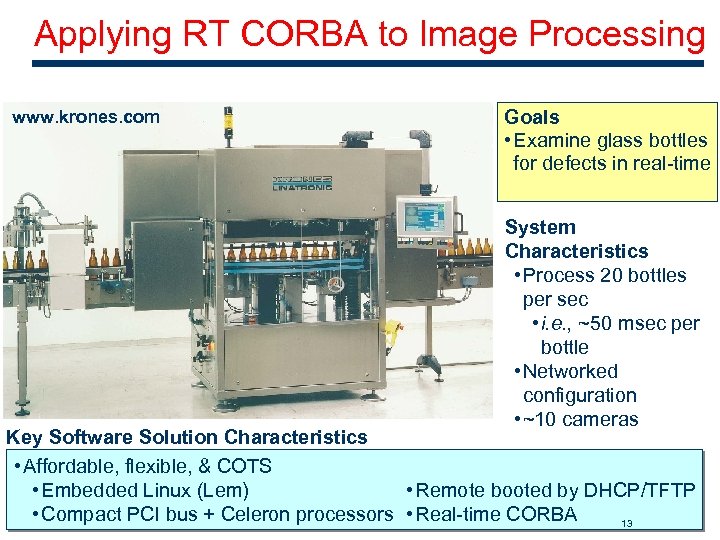
Applying RT CORBA to Image Processing www. krones. com Goals • Examine glass bottles for defects in real-time System Characteristics • Process 20 bottles per sec • i. e. , ~50 msec per bottle • Networked configuration • ~10 cameras Key Software Solution Characteristics • Affordable, flexible, & COTS • Embedded Linux (Lem) • Remote booted by DHCP/TFTP • Compact PCI bus + Celeron processors • Real-time CORBA 13
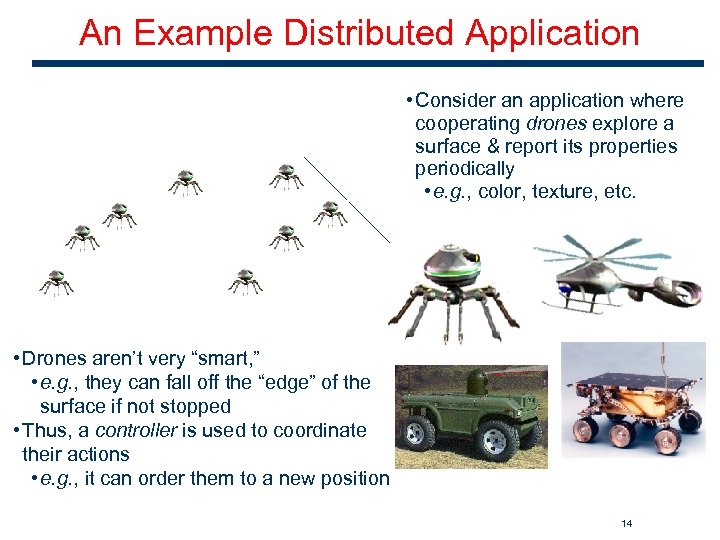
An Example Distributed Application • Consider an application where cooperating drones explore a surface & report its properties periodically • e. g. , color, texture, etc. • Drones aren’t very “smart, ” • e. g. , they can fall off the “edge” of the surface if not stopped • Thus, a controller is used to coordinate their actions • e. g. , it can order them to a new position 14
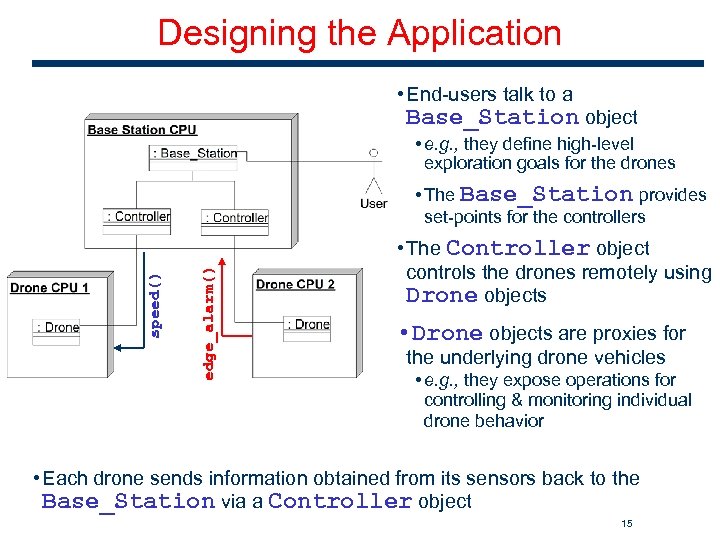
Designing the Application • End-users talk to a Base_Station object • e. g. , they define high-level exploration goals for the drones edge_alarm() speed() • The Base_Station provides set-points for the controllers • The Controller object controls the drones remotely using Drone objects • Drone objects are proxies for the underlying drone vehicles • e. g. , they expose operations for controlling & monitoring individual drone behavior • Each drone sends information obtained from its sensors back to the Base_Station via a Controller object 15
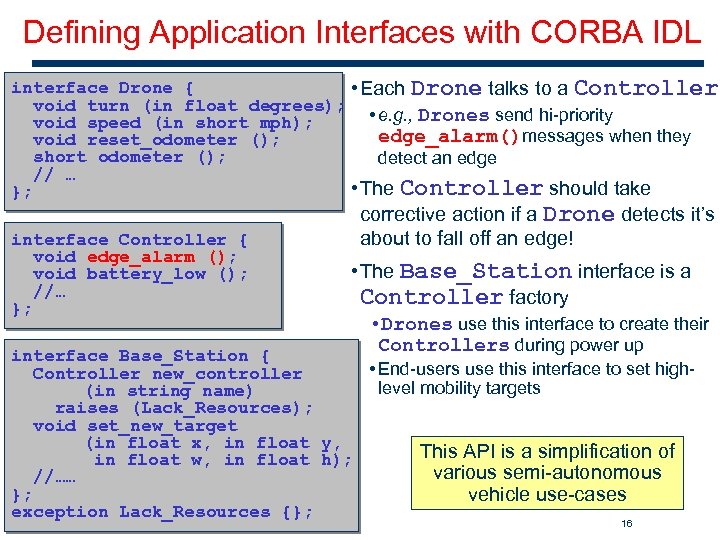
Defining Application Interfaces with CORBA IDL interface Drone { • Each Drone talks to a Controller void turn (in float degrees); • e. g. , Drones send hi-priority void speed (in short mph); edge_alarm()messages when they void reset_odometer (); short odometer (); detect an edge // … • The Controller should take }; interface Controller { void edge_alarm (); void battery_low (); //… }; corrective action if a Drone detects it’s about to fall off an edge! • The Base_Station interface is a Controller factory • Drones use this interface to create their Controllers during power up interface Base_Station { • End-users use this interface to set high. Controller new_controller level mobility targets (in string name) raises (Lack_Resources); void set_new_target (in float x, in float y, This API is a simplification of in float w, in float h); various semi-autonomous //…… }; vehicle use-cases exception Lack_Resources {}; 16
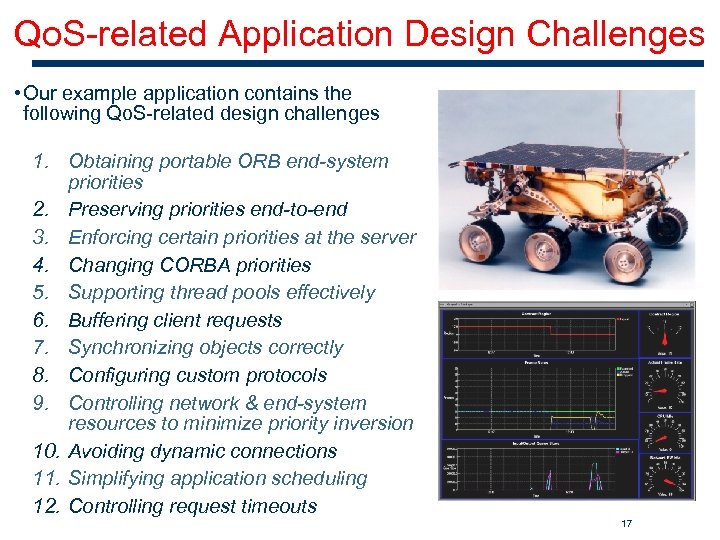
Qo. S-related Application Design Challenges • Our example application contains the following Qo. S-related design challenges 1. Obtaining portable ORB end-system priorities 2. Preserving priorities end-to-end 3. Enforcing certain priorities at the server 4. Changing CORBA priorities 5. Supporting thread pools effectively 6. Buffering client requests 7. Synchronizing objects correctly 8. Configuring custom protocols 9. Controlling network & end-system resources to minimize priority inversion 10. Avoiding dynamic connections 11. Simplifying application scheduling 12. Controlling request timeouts 17
Portable End-to-End Priorities • Problem: How can we map global priorities onto heterogeneous native OS host thread priorities consistently end-to-end? • Solution: Use Standard RT CORBA priority mapping interfaces 18
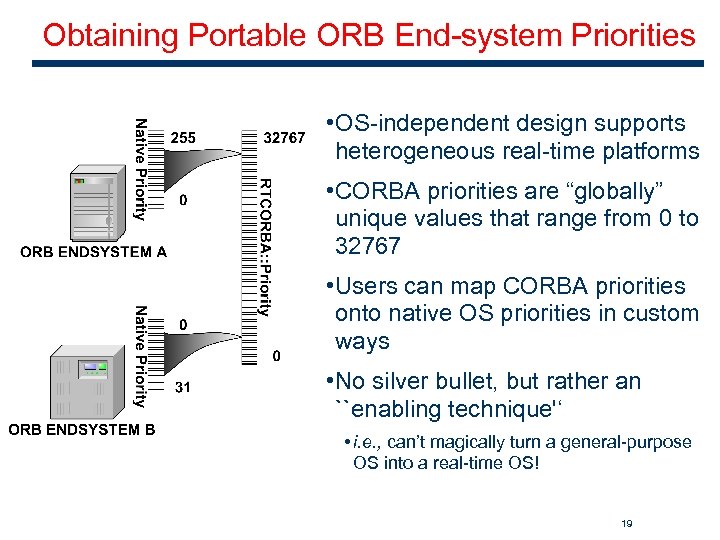
Obtaining Portable ORB End-system Priorities • OS-independent design supports heterogeneous real-time platforms • CORBA priorities are “globally” unique values that range from 0 to 32767 • Users can map CORBA priorities onto native OS priorities in custom ways • No silver bullet, but rather an ``enabling technique'‘ • i. e. , can’t magically turn a general-purpose OS into a real-time OS! 19
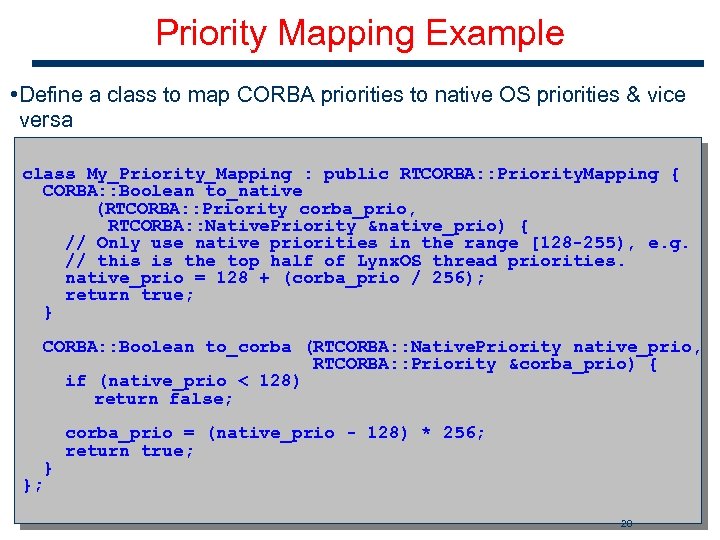
Priority Mapping Example • Define a class to map CORBA priorities to native OS priorities & vice versa class My_Priority_Mapping : public RTCORBA: : Priority. Mapping { CORBA: : Boolean to_native (RTCORBA: : Priority corba_prio, RTCORBA: : Native. Priority &native_prio) { // Only use native priorities in the range [128 -255), e. g. // this is the top half of Lynx. OS thread priorities. native_prio = 128 + (corba_prio / 256); return true; } CORBA: : Boolean to_corba (RTCORBA: : Native. Priority native_prio, RTCORBA: : Priority &corba_prio) { if (native_prio < 128) return false; } corba_prio = (native_prio - 128) * 256; return true; }; 20
Setting Custom Priority Mapping • Problem: How do we configure the Priority. Mapping that the ORB should use? • Solution: Use TAO’s Priority. Mapping. Manager! 21
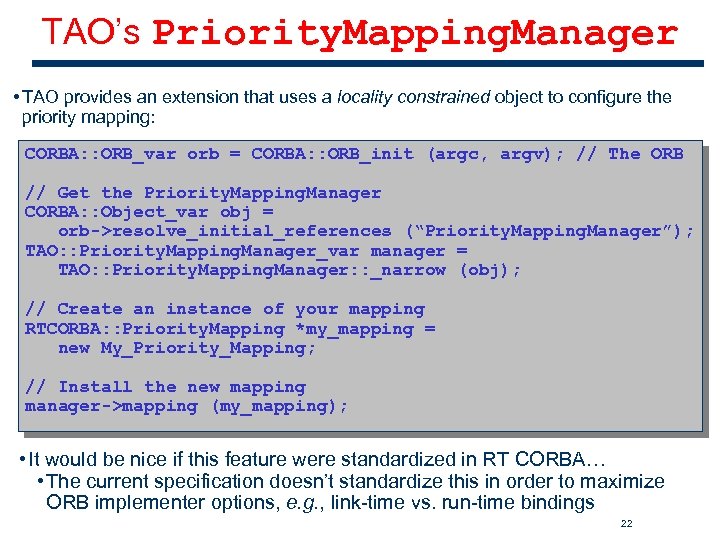
TAO’s Priority. Mapping. Manager • TAO provides an extension that uses a locality constrained object to configure the priority mapping: CORBA: : ORB_var orb = CORBA: : ORB_init (argc, argv); // The ORB // Get the Priority. Mapping. Manager CORBA: : Object_var obj = orb->resolve_initial_references (“Priority. Mapping. Manager”); TAO: : Priority. Mapping. Manager_var manager = TAO: : Priority. Mapping. Manager: : _narrow (obj); // Create an instance of your mapping RTCORBA: : Priority. Mapping *my_mapping = new My_Priority_Mapping; // Install the new mapping manager->mapping (my_mapping); • It would be nice if this feature were standardized in RT CORBA… • The current specification doesn’t standardize this in order to maximize ORB implementer options, e. g. , link-time vs. run-time bindings 22
Preserving Priorities End-to-End • Problem: How can we ensure requests don’t run at the wrong priority on the server? • e. g. , this can cause major problems if edge_alarm() operations are processed too late!!! • Solution: Use RT CORBA priority model policies 23
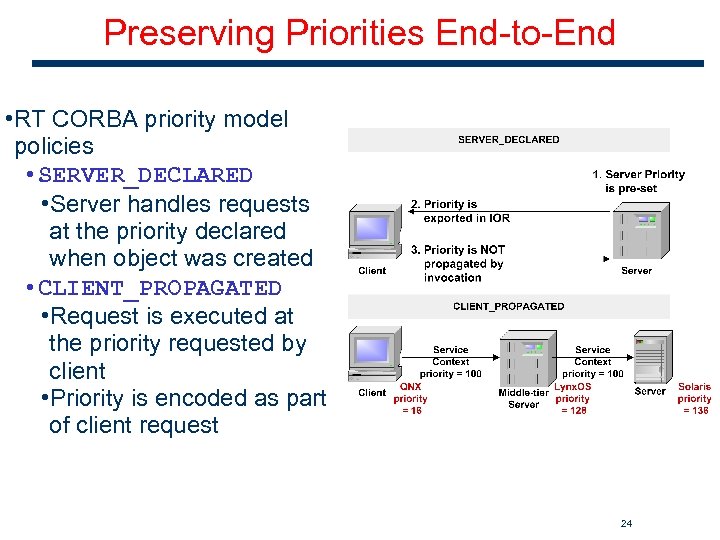
Preserving Priorities End-to-End • RT CORBA priority model policies • SERVER_DECLARED • Server handles requests at the priority declared when object was created • CLIENT_PROPAGATED • Request is executed at the priority requested by client • Priority is encoded as part of client request 24
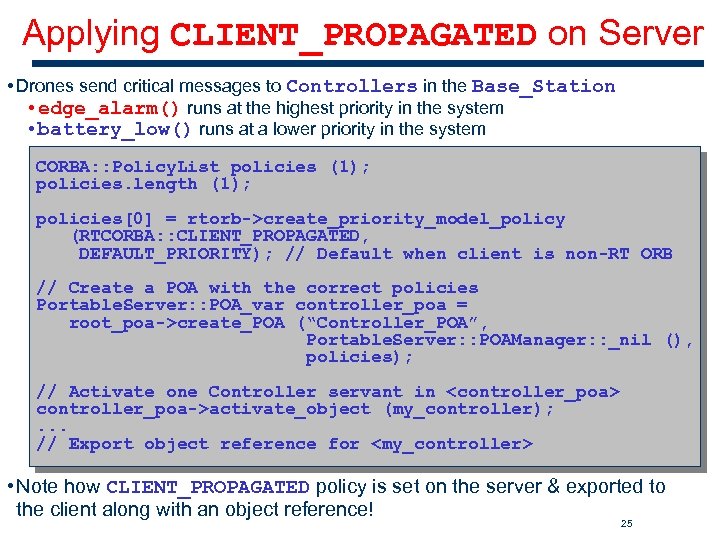
Applying CLIENT_PROPAGATED on Server • Drones send critical messages to Controllers in the Base_Station • edge_alarm() runs at the highest priority in the system • battery_low() runs at a lower priority in the system CORBA: : Policy. List policies (1); policies. length (1); policies[0] = rtorb->create_priority_model_policy (RTCORBA: : CLIENT_PROPAGATED, DEFAULT_PRIORITY); // Default when client is non-RT ORB // Create a POA with the correct policies Portable. Server: : POA_var controller_poa = root_poa->create_POA (“Controller_POA”, Portable. Server: : POAManager: : _nil (), policies); // Activate one Controller servant in <controller_poa> controller_poa->activate_object (my_controller); . . . // Export object reference for <my_controller> • Note how CLIENT_PROPAGATED policy is set on the server & exported to the client along with an object reference! 25
Changing CORBA Priorities • Problem: How can RT-CORBA client application change the priority of operations? • Solution: Use the RTCurrent to change the priority of the current client thread explicitly 26
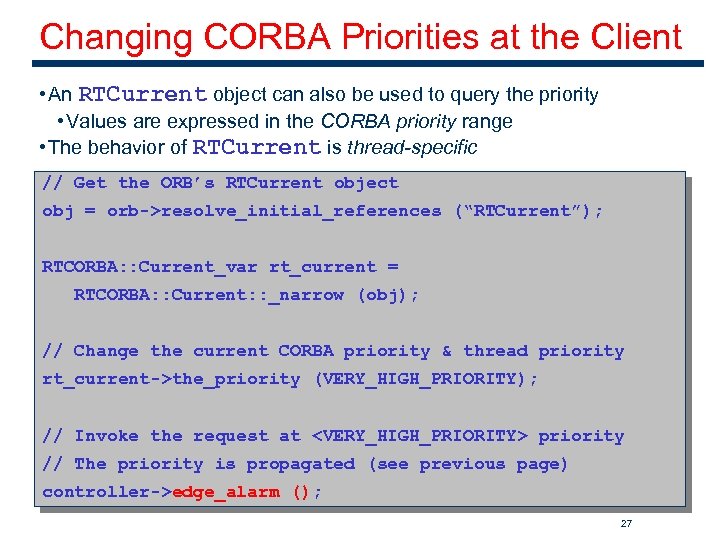
Changing CORBA Priorities at the Client • An RTCurrent object can also be used to query the priority • Values are expressed in the CORBA priority range • The behavior of RTCurrent is thread-specific // Get the ORB’s RTCurrent object obj = orb->resolve_initial_references (“RTCurrent”); RTCORBA: : Current_var rt_current = RTCORBA: : Current: : _narrow (obj); // Change the current CORBA priority & thread priority rt_current->the_priority (VERY_HIGH_PRIORITY); // Invoke the request at <VERY_HIGH_PRIORITY> priority // The priority is propagated (see previous page) controller->edge_alarm (); 27
Design Interlude: The RT-ORB Interface • Problem: How can an ORB be extended to support RT-CORBA without changing the CORBA: : ORB interface? • Solution: Use Extension Interface pattern from POSA 2 book <www. posa. uci. edu> • Use resolve_initial_references() interface to obtain the extension • Thus, non real-time ORBs and applications are not affected by RT CORBA enhancements! 28
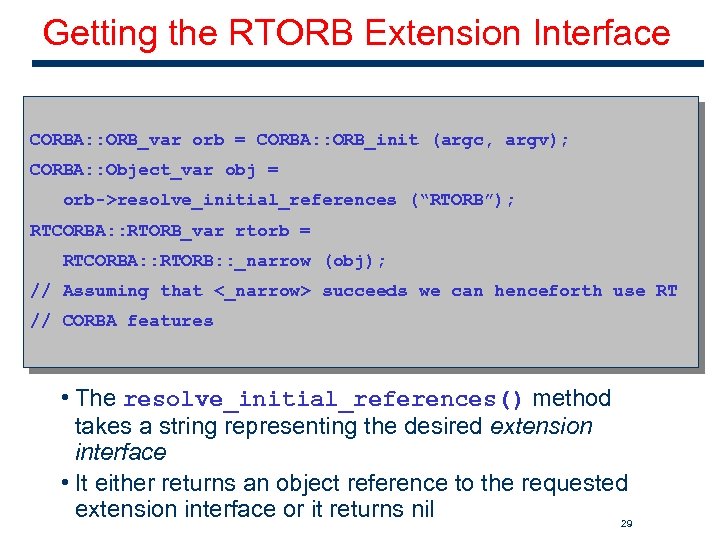
Getting the RTORB Extension Interface CORBA: : ORB_var orb = CORBA: : ORB_init (argc, argv); CORBA: : Object_var obj = orb->resolve_initial_references (“RTORB”); RTCORBA: : RTORB_var rtorb = RTCORBA: : RTORB: : _narrow (obj); // Assuming that <_narrow> succeeds we can henceforth use RT // CORBA features • The resolve_initial_references() method takes a string representing the desired extension interface • It either returns an object reference to the requested extension interface or it returns nil 29
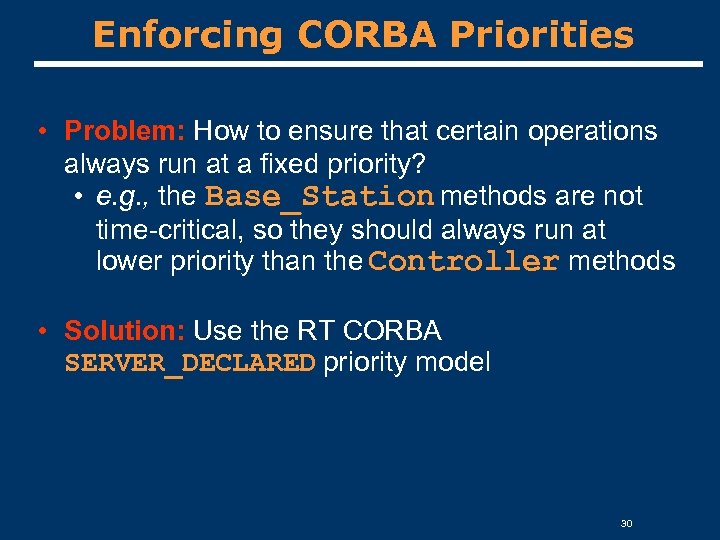
Enforcing CORBA Priorities • Problem: How to ensure that certain operations always run at a fixed priority? • e. g. , the Base_Station methods are not time-critical, so they should always run at lower priority than the Controller methods • Solution: Use the RT CORBA SERVER_DECLARED priority model 30
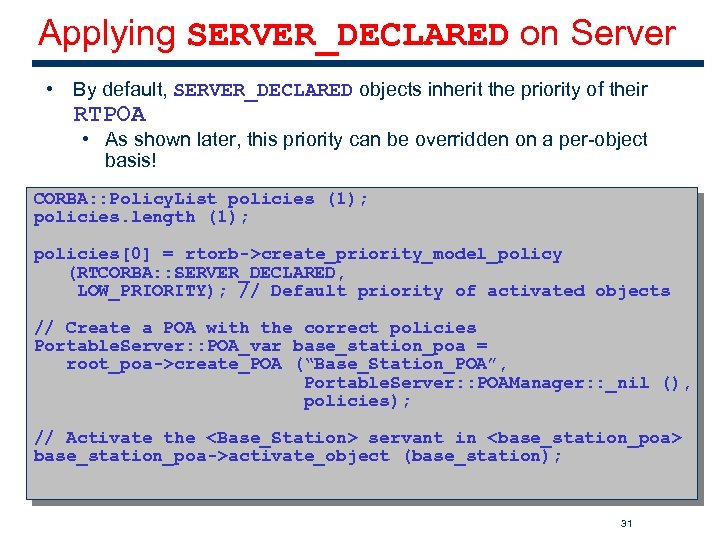
Applying SERVER_DECLARED on Server • By default, SERVER_DECLARED objects inherit the priority of their RTPOA • As shown later, this priority can be overridden on a per-object basis! CORBA: : Policy. List policies (1); policies. length (1); policies[0] = rtorb->create_priority_model_policy (RTCORBA: : SERVER_DECLARED, LOW_PRIORITY); // Default priority of activated objects // Create a POA with the correct policies Portable. Server: : POA_var base_station_poa = root_poa->create_POA (“Base_Station_POA”, Portable. Server: : POAManager: : _nil (), policies); // Activate the <Base_Station> servant in <base_station_poa> base_station_poa->activate_object (base_station); 31
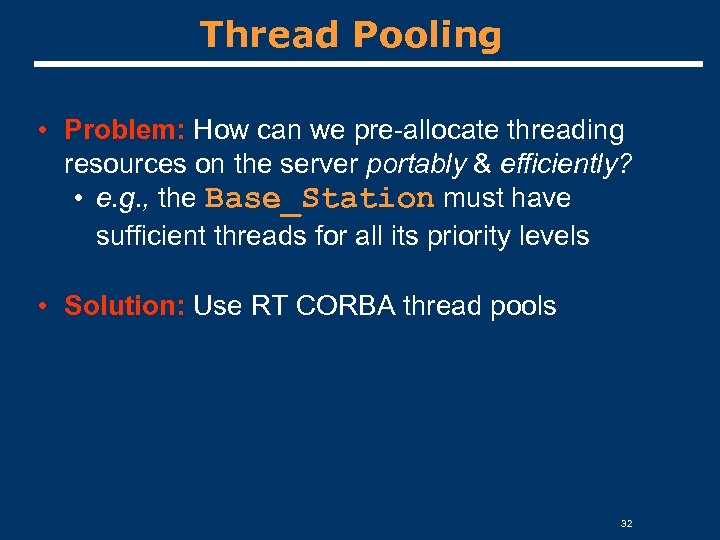
Thread Pooling • Problem: How can we pre-allocate threading resources on the server portably & efficiently? • e. g. , the Base_Station must have sufficient threads for all its priority levels • Solution: Use RT CORBA thread pools 32
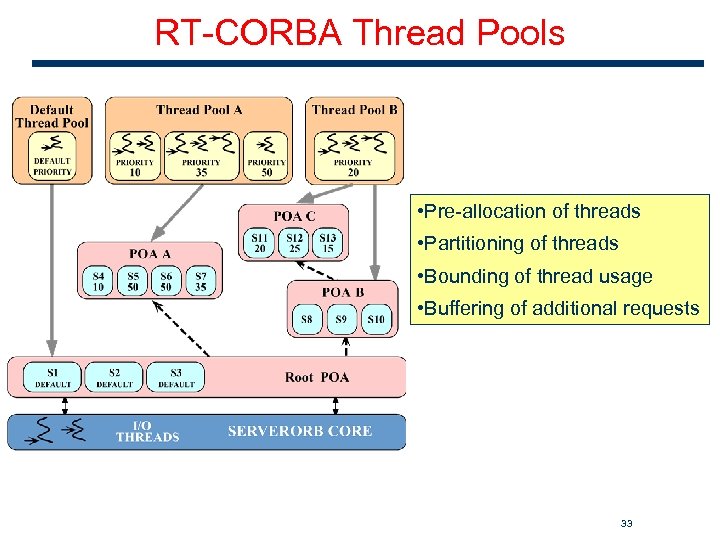
RT-CORBA Thread Pools • Pre-allocation of threads • Partitioning of threads • Bounding of thread usage • Buffering of additional requests 33
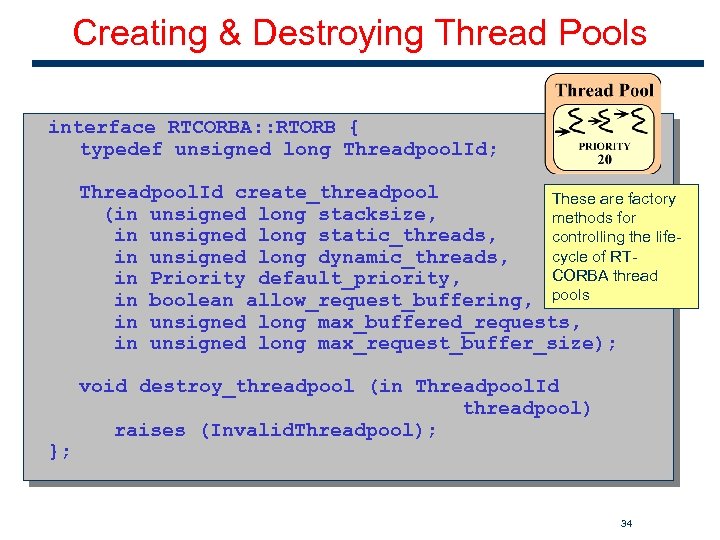
Creating & Destroying Thread Pools interface RTCORBA: : RTORB { typedef unsigned long Threadpool. Id; Threadpool. Id create_threadpool These are factory (in unsigned long stacksize, methods for in unsigned long static_threads, controlling the lifecycle of RTin unsigned long dynamic_threads, CORBA thread in Priority default_priority, in boolean allow_request_buffering, pools in unsigned long max_buffered_requests, in unsigned long max_request_buffer_size); }; void destroy_threadpool (in Threadpool. Id threadpool) raises (Invalid. Threadpool); 34
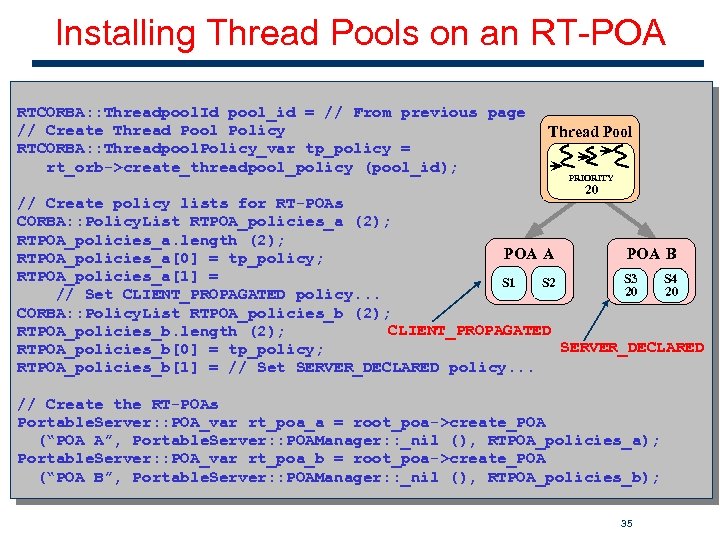
Installing Thread Pools on an RT-POA RTCORBA: : Threadpool. Id pool_id = // From previous page // Create Thread Pool Policy RTCORBA: : Threadpool. Policy_var tp_policy = rt_orb->create_threadpool_policy (pool_id); Thread Pool PRIORITY 20 // Create policy lists for RT-POAs CORBA: : Policy. List RTPOA_policies_a (2); RTPOA_policies_a. length (2); POA A POA B RTPOA_policies_a[0] = tp_policy; RTPOA_policies_a[1] = S 3 S 4 S 1 S 2 20 20 // Set CLIENT_PROPAGATED policy. . . CORBA: : Policy. List RTPOA_policies_b (2); CLIENT_PROPAGATED RTPOA_policies_b. length (2); SERVER_DECLARED RTPOA_policies_b[0] = tp_policy; RTPOA_policies_b[1] = // Set SERVER_DECLARED policy. . . // Create the RT-POAs Portable. Server: : POA_var rt_poa_a = root_poa->create_POA (“POA A”, Portable. Server: : POAManager: : _nil (), RTPOA_policies_a); Portable. Server: : POA_var rt_poa_b = root_poa->create_POA (“POA B”, Portable. Server: : POAManager: : _nil (), RTPOA_policies_b); 35
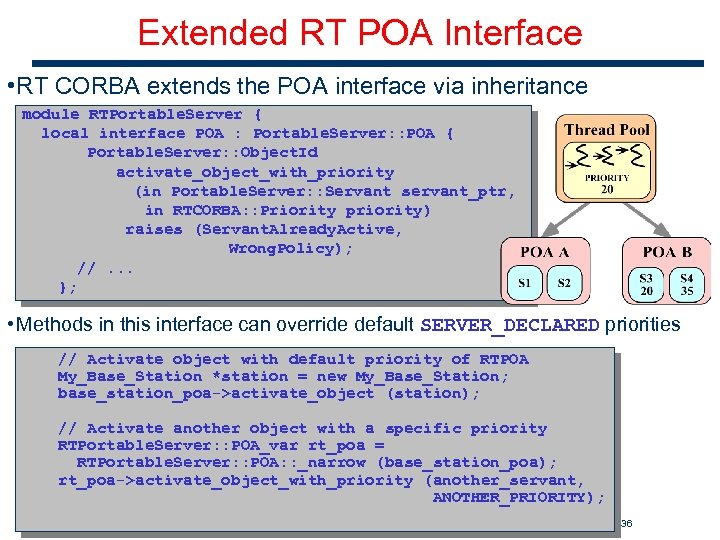
Extended RT POA Interface • RT CORBA extends the POA interface via inheritance module RTPortable. Server { local interface POA : Portable. Server: : POA { Portable. Server: : Object. Id activate_object_with_priority (in Portable. Server: : Servant servant_ptr, in RTCORBA: : Priority priority) raises (Servant. Already. Active, Wrong. Policy); //. . . }; • Methods in this interface can override default SERVER_DECLARED priorities // Activate object with default priority of RTPOA My_Base_Station *station = new My_Base_Station; base_station_poa->activate_object (station); // Activate another object with a specific priority RTPortable. Server: : POA_var rt_poa = RTPortable. Server: : POA: : _narrow (base_station_poa); rt_poa->activate_object_with_priority (another_servant, ANOTHER_PRIORITY); 36
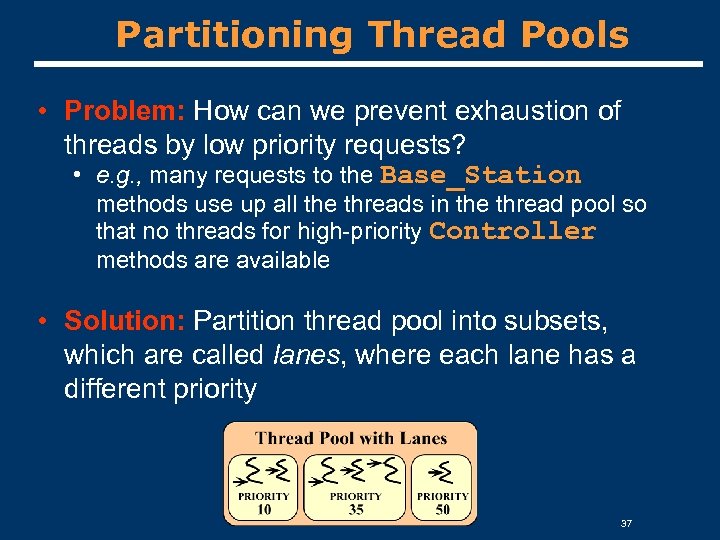
Partitioning Thread Pools • Problem: How can we prevent exhaustion of threads by low priority requests? • e. g. , many requests to the Base_Station methods use up all the threads in the thread pool so that no threads for high-priority Controller methods are available • Solution: Partition thread pool into subsets, which are called lanes, where each lane has a different priority 37
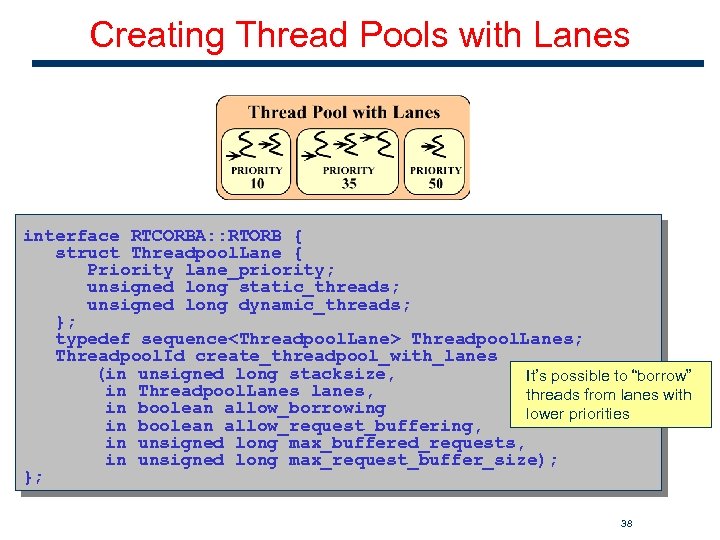
Creating Thread Pools with Lanes interface RTCORBA: : RTORB { struct Threadpool. Lane { Priority lane_priority; unsigned long static_threads; unsigned long dynamic_threads; }; typedef sequence<Threadpool. Lane> Threadpool. Lanes; Threadpool. Id create_threadpool_with_lanes (in unsigned long stacksize, It’s possible to “borrow” in Threadpool. Lanes lanes, threads from lanes with in boolean allow_borrowing lower priorities in boolean allow_request_buffering, in unsigned long max_buffered_requests, in unsigned long max_request_buffer_size); }; 38
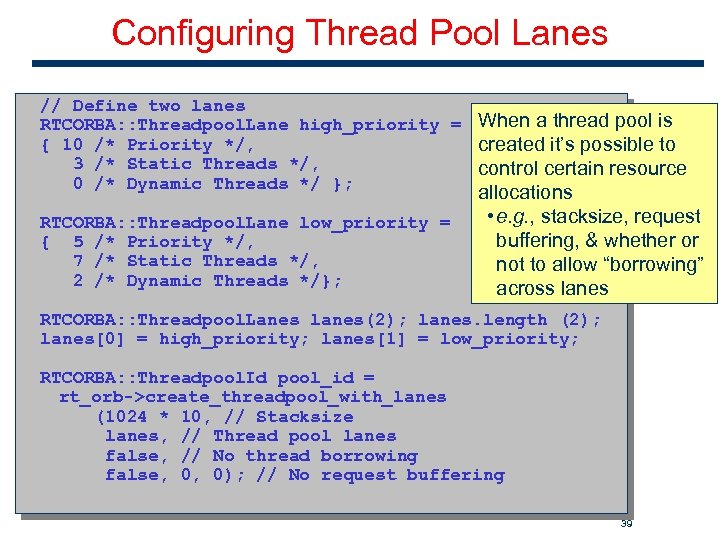
Configuring Thread Pool Lanes // Define two lanes RTCORBA: : Threadpool. Lane high_priority = When a thread pool is { 10 /* Priority */, created it’s possible to 3 /* Static Threads */, control certain resource 0 /* Dynamic Threads */ }; RTCORBA: : Threadpool. Lane low_priority = { 5 /* Priority */, 7 /* Static Threads */, 2 /* Dynamic Threads */}; allocations • e. g. , stacksize, request buffering, & whether or not to allow “borrowing” across lanes RTCORBA: : Threadpool. Lanes lanes(2); lanes. length (2); lanes[0] = high_priority; lanes[1] = low_priority; RTCORBA: : Threadpool. Id pool_id = rt_orb->create_threadpool_with_lanes (1024 * 10, // Stacksize lanes, // Thread pool lanes false, // No thread borrowing false, 0, 0); // No request buffering 39
When you run out of Threads… • Problem: How can we prevent bursts or longrunning requests from exhausting maximum number of static & dynamic threads in the lane? • Solution: Use the Real-time CORBA thread pool lane borrowing feature 40
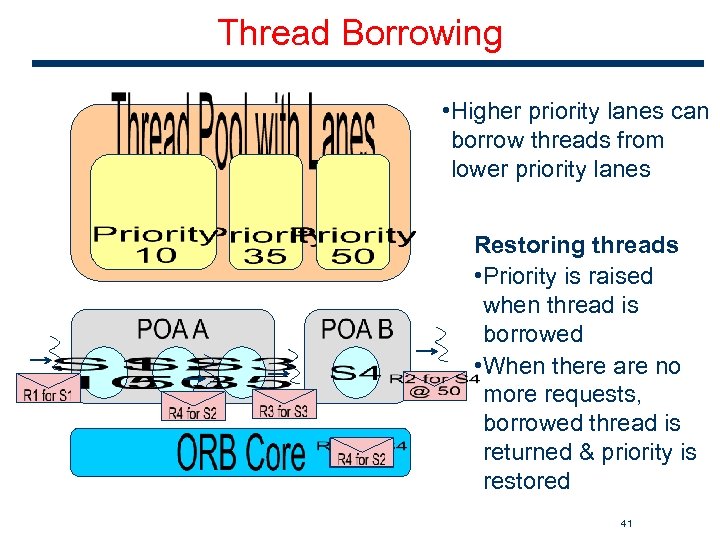
Thread Borrowing • Higher priority lanes can borrow threads from lower priority lanes Restoring threads • Priority is raised when thread is borrowed • When there are no more requests, borrowed thread is returned & priority is restored 41
Managing Bursty Requests • Problem: How can we support real-time applications that need more buffering than is provided by the OS I/O subsystem • e. g. , to handle “burstly” client traffic • Solution: Buffer client requests in ORB 42
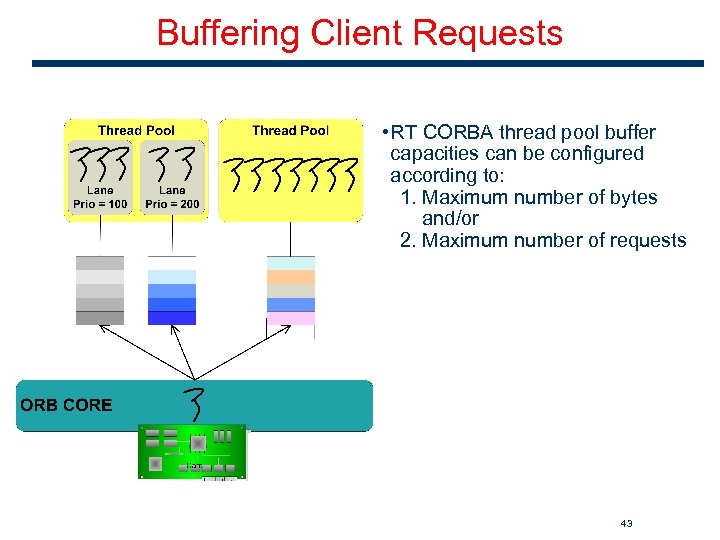
Buffering Client Requests • RT CORBA thread pool buffer capacities can be configured according to: 1. Maximum number of bytes and/or 2. Maximum number of requests 43
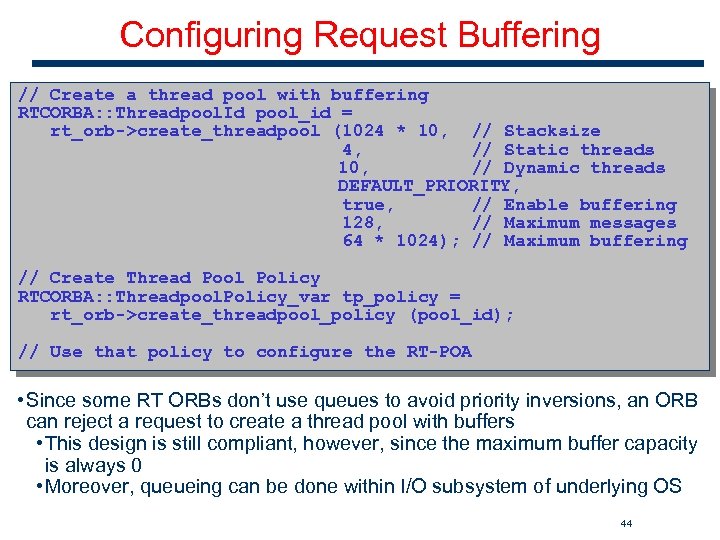
Configuring Request Buffering // Create a thread pool with buffering RTCORBA: : Threadpool. Id pool_id = rt_orb->create_threadpool (1024 * 10, // Stacksize 4, // Static threads 10, // Dynamic threads DEFAULT_PRIORITY, true, // Enable buffering 128, // Maximum messages 64 * 1024); // Maximum buffering // Create Thread Pool Policy RTCORBA: : Threadpool. Policy_var tp_policy = rt_orb->create_threadpool_policy (pool_id); // Use that policy to configure the RT-POA • Since some RT ORBs don’t use queues to avoid priority inversions, an ORB can reject a request to create a thread pool with buffers • This design is still compliant, however, since the maximum buffer capacity is always 0 • Moreover, queueing can be done within I/O subsystem of underlying OS 44
Thread Pools Implementation Strategies • There are two general strategies to implement RT CORBA thread pools: 1. Use the Half-Sync/Half-Async pattern to have I/O thread(s) buffer client requests in a queue & then have worker threads in the pool process the requests 2. Use the Leader/Followers pattern to demultiplex I/O events into threads in the pool without requiring additional I/O threads • Each strategy is appropriate for certain application domains • e. g. , certain hard-real time applications cannot incur the nondeterminism & priority inversion of additional request queues • To evaluate each approach we must understand their consequences • Their pattern descriptions capture this information • Good metrics to compare RT-CORBA implementations 45
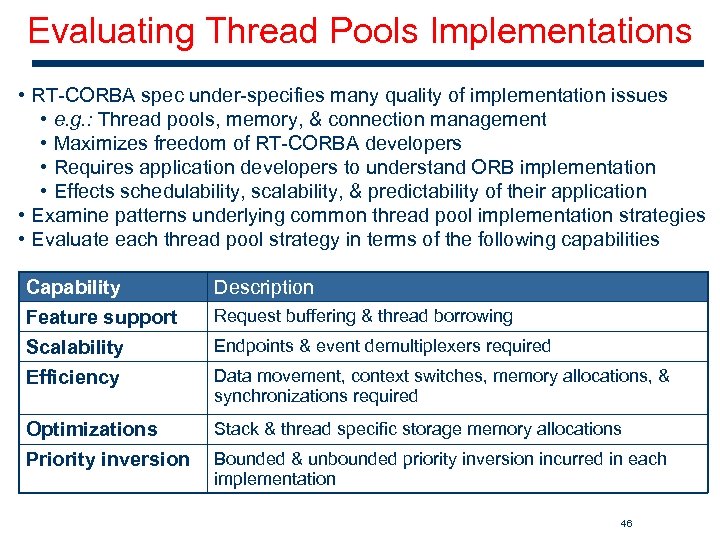
Evaluating Thread Pools Implementations • RT-CORBA spec under-specifies many quality of implementation issues • e. g. : Thread pools, memory, & connection management • Maximizes freedom of RT-CORBA developers • Requires application developers to understand ORB implementation • Effects schedulability, scalability, & predictability of their application • Examine patterns underlying common thread pool implementation strategies • Evaluate each thread pool strategy in terms of the following capabilities Capability Feature support Scalability Efficiency Description Optimizations Priority inversion Stack & thread specific storage memory allocations Request buffering & thread borrowing Endpoints & event demultiplexers required Data movement, context switches, memory allocations, & synchronizations required Bounded & unbounded priority inversion incurred in each implementation 46
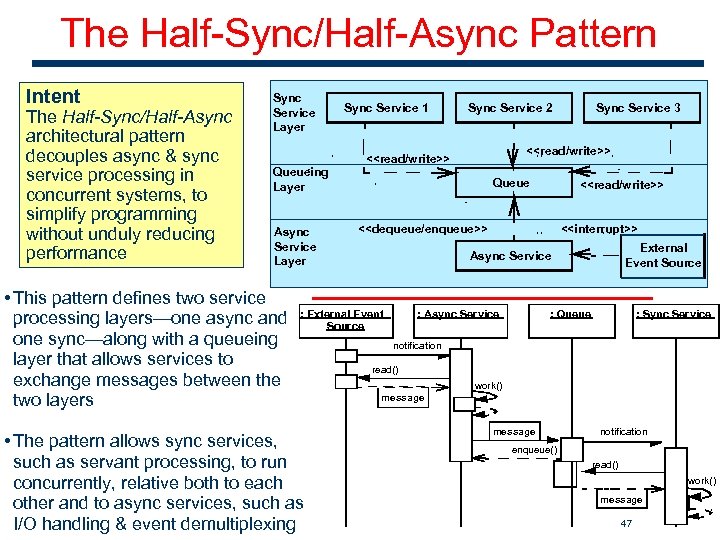
The Half-Sync/Half-Async Pattern Intent The Half-Sync/Half-Async architectural pattern decouples async & sync service processing in concurrent systems, to simplify programming without unduly reducing performance Sync Service Layer Queueing Layer Async Service Layer • This pattern defines two service processing layers—one async and one sync—along with a queueing layer that allows services to exchange messages between the two layers Sync Service 1 Sync Service 3 <<read/write>> Queue <<read/write>> <<dequeue/enqueue>> <<interrupt>> External Event Source Async Service : External Event Source • The pattern allows sync services, such as servant processing, to run concurrently, relative both to each other and to async services, such as I/O handling & event demultiplexing Sync Service 2 : Async Service : Queue : Sync Service notification read() work() message notification enqueue() read() work() message 47
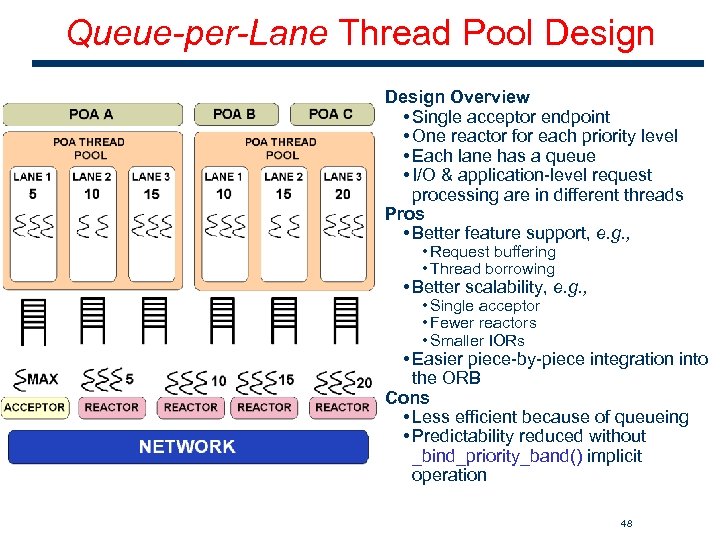
Queue-per-Lane Thread Pool Design Overview • Single acceptor endpoint • One reactor for each priority level • Each lane has a queue • I/O & application-level request processing are in different threads Pros • Better feature support, e. g. , • Request buffering • Thread borrowing • Better scalability, e. g. , • Single acceptor • Fewer reactors • Smaller IORs • Easier piece-by-piece integration into the ORB Cons • Less efficient because of queueing • Predictability reduced without _bind_priority_band() implicit operation 48
Evaluation of Half-Sync/Half-Async Thread Pools 49
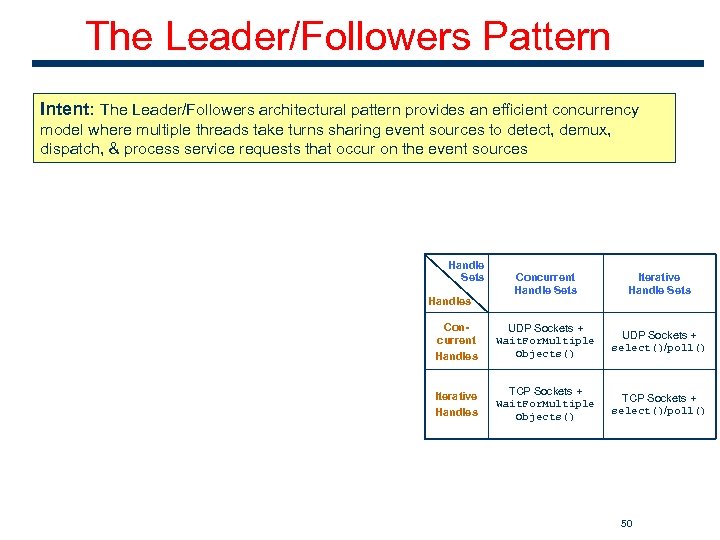
The Leader/Followers Pattern Intent: The Leader/Followers architectural pattern provides an efficient concurrency model where multiple threads take turns sharing event sources to detect, demux, dispatch, & process service requests that occur on the event sources Handle Sets Concurrent Handle Sets Iterative Handle Sets Concurrent Handles UDP Sockets + Wait. For. Multiple Objects() UDP Sockets + select()/poll() Iterative Handles TCP Sockets + Wait. For. Multiple Objects() TCP Sockets + select()/poll() Handles 50
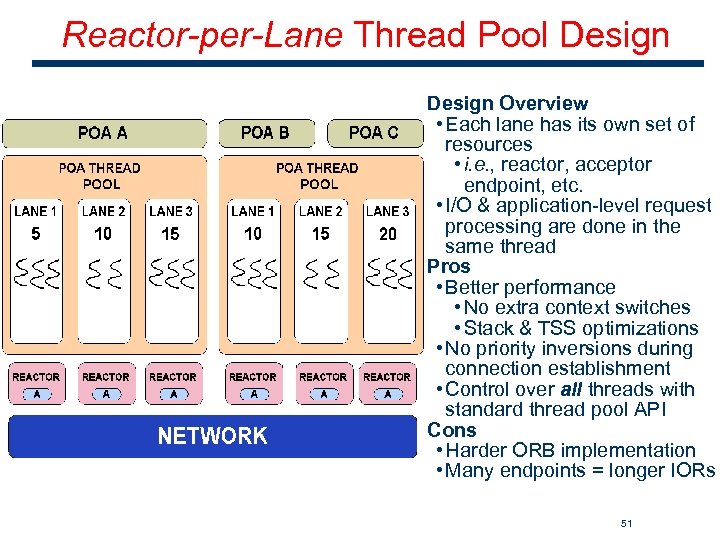
Reactor-per-Lane Thread Pool Design Overview • Each lane has its own set of resources • i. e. , reactor, acceptor endpoint, etc. • I/O & application-level request processing are done in the same thread Pros • Better performance • No extra context switches • Stack & TSS optimizations • No priority inversions during connection establishment • Control over all threads with standard thread pool API Cons • Harder ORB implementation • Many endpoints = longer IORs 51
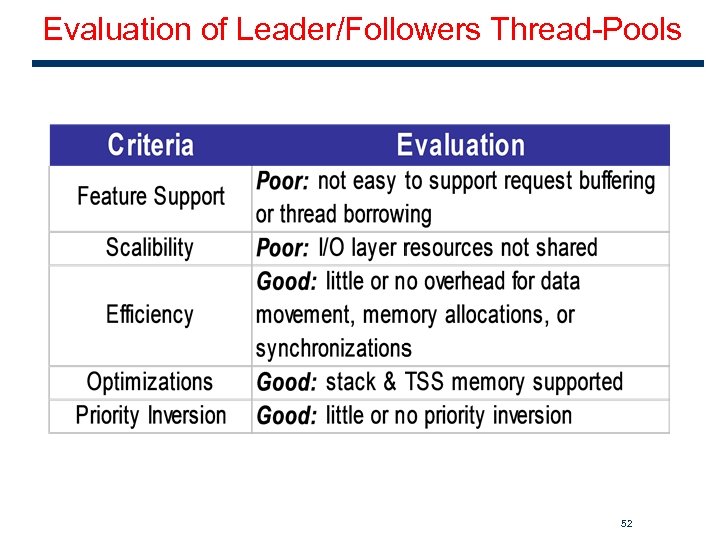
Evaluation of Leader/Followers Thread-Pools 52
Consistent Synchronizers • Problem: An ORB & application may need to use the same type of mutex to avoid priority inversions • e. g. , using priority ceiling or priority inheritance protocols • Solution: Use the RTCORBA: : Mutex synchronizer 53
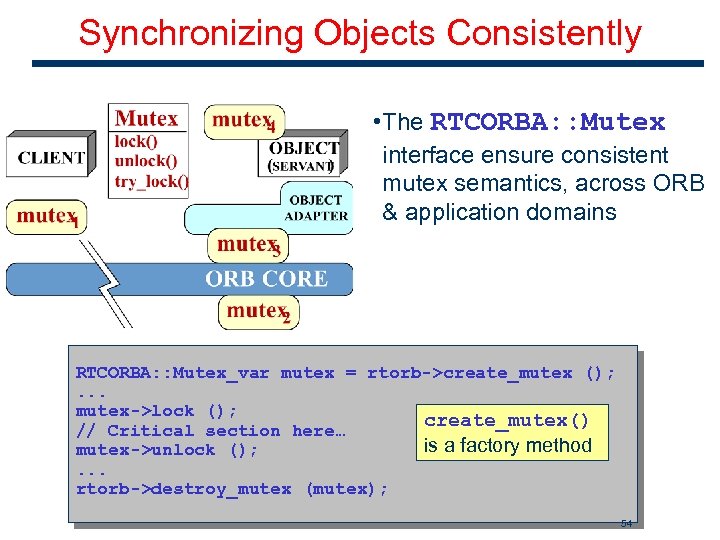
Synchronizing Objects Consistently • The RTCORBA: : Mutex interface ensure consistent mutex semantics, across ORB & application domains RTCORBA: : Mutex_var mutex = rtorb->create_mutex (); . . . mutex->lock (); create_mutex() // Critical section here… is a factory method mutex->unlock (); . . . rtorb->destroy_mutex (mutex); 54
Custom Protocol Configuration • Problem: Selecting communication protocol(s) is crucial to obtaining Qo. S • TCP/IP is inadequate to provide end-to-end real-time response • Thus, communication between Base_Station, Controllers, & Drones must use a different protocol • Moreover, some messages between Drone & Controller cannot be delayed • Solution: Use RT-CORBA Protocol Policies to select and/or configure communication protocols 55
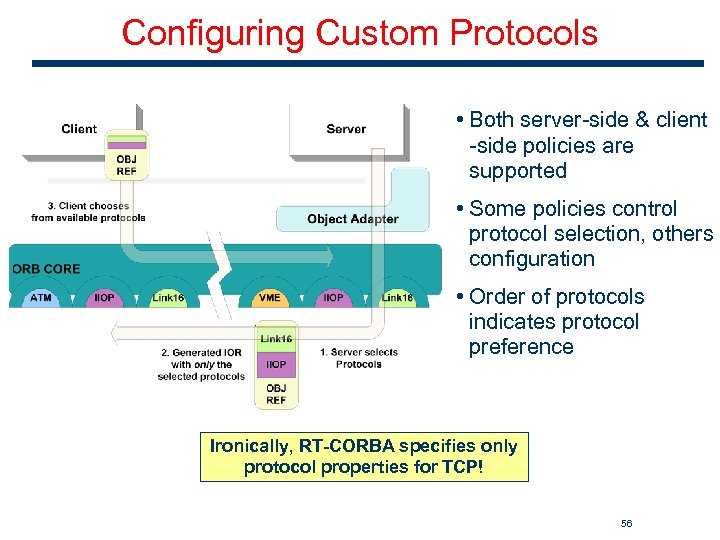
Configuring Custom Protocols • Both server-side & client -side policies are supported • Some policies control protocol selection, others configuration • Order of protocols indicates protocol preference Ironically, RT-CORBA specifies only protocol properties for TCP! 56
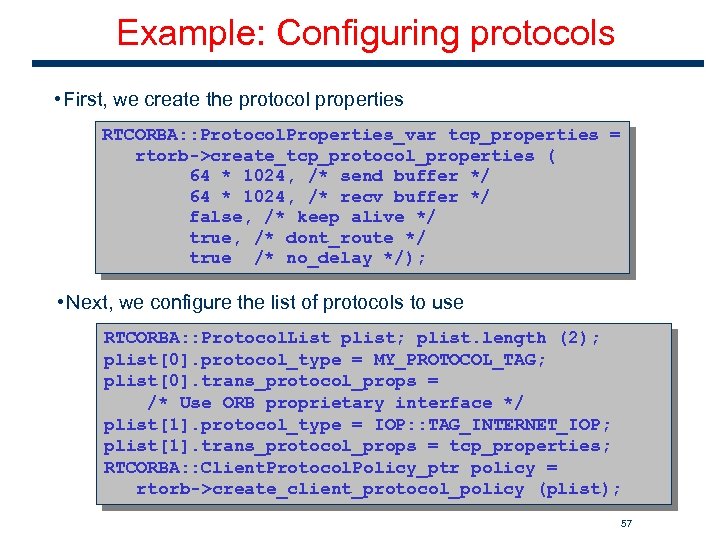
Example: Configuring protocols • First, we create the protocol properties RTCORBA: : Protocol. Properties_var tcp_properties = rtorb->create_tcp_protocol_properties ( 64 * 1024, /* send buffer */ 64 * 1024, /* recv buffer */ false, /* keep alive */ true, /* dont_route */ true /* no_delay */); • Next, we configure the list of protocols to use RTCORBA: : Protocol. List plist; plist. length (2); plist[0]. protocol_type = MY_PROTOCOL_TAG; plist[0]. trans_protocol_props = /* Use ORB proprietary interface */ plist[1]. protocol_type = IOP: : TAG_INTERNET_IOP; plist[1]. trans_protocol_props = tcp_properties; RTCORBA: : Client. Protocol. Policy_ptr policy = rtorb->create_client_protocol_policy (plist); 57
Network Resource Issues • Problem: How can we achieve the following? • Control jitter due to connection setup • Minimize thread-level priority inversions • Avoid request-level (“head-of-line”) priority inversions • Solution: Use RT CORBA explicit binding mechanisms 58
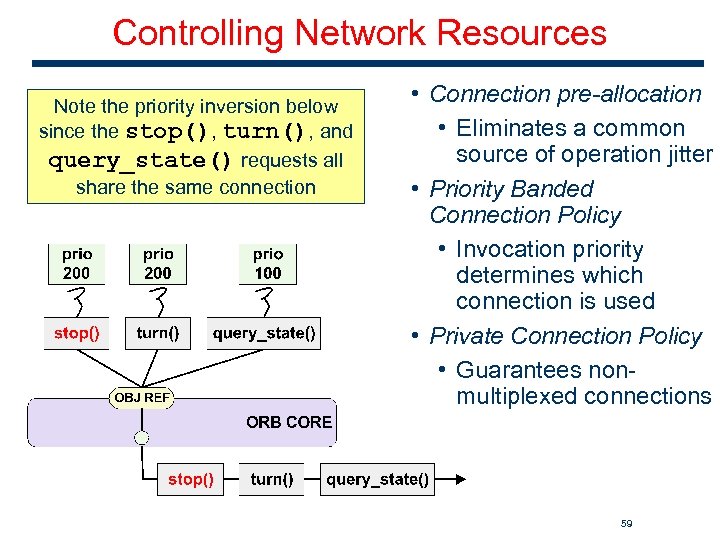
Controlling Network Resources Note the priority inversion below since the stop(), turn(), and query_state() requests all share the same connection • Connection pre-allocation • Eliminates a common source of operation jitter • Priority Banded Connection Policy • Invocation priority determines which connection is used • Private Connection Policy • Guarantees nonmultiplexed connections 59
Connection Establishment • Problem: How can we prevent connection establishment between the base station and the drones from resulting in unacceptable jitter? • Jitter is detrimental to time-critical applications • Solution: Pre-allocate one or more connections using the Object: : _validate_connection() operation 60
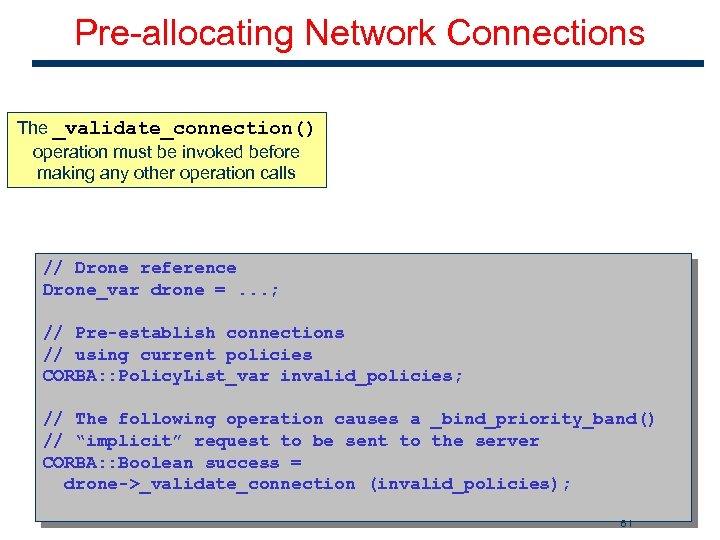
Pre-allocating Network Connections The _validate_connection() operation must be invoked before making any other operation calls // Drone reference Drone_var drone =. . . ; // Pre-establish connections // using current policies CORBA: : Policy. List_var invalid_policies; // The following operation causes a _bind_priority_band() // “implicit” request to be sent to the server CORBA: : Boolean success = drone->_validate_connection (invalid_policies); 61
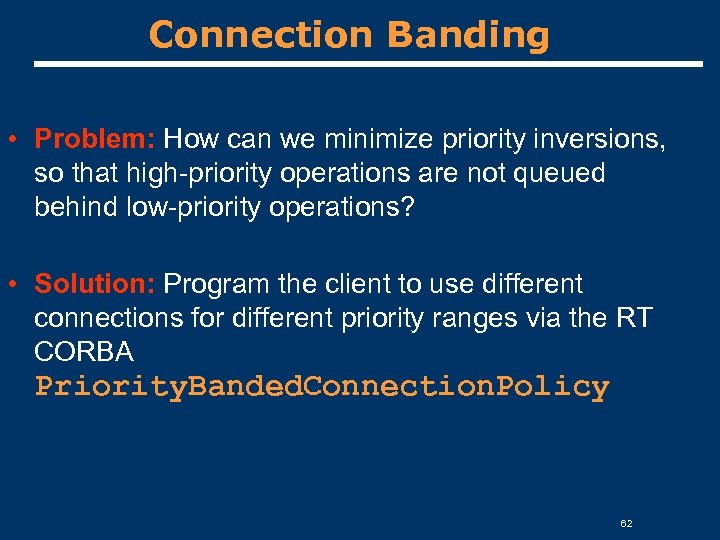
Connection Banding • Problem: How can we minimize priority inversions, so that high-priority operations are not queued behind low-priority operations? • Solution: Program the client to use different connections for different priority ranges via the RT CORBA Priority. Banded. Connection. Policy 62
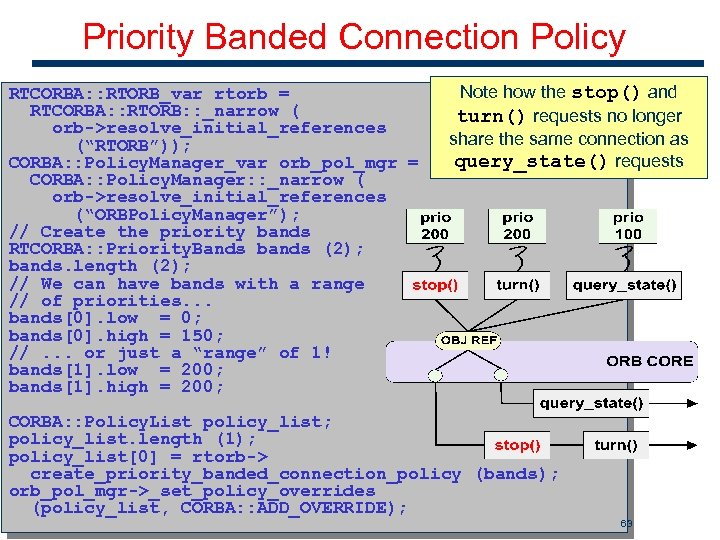
Priority Banded Connection Policy RTCORBA: : RTORB_var rtorb = RTCORBA: : RTORB: : _narrow ( orb->resolve_initial_references (“RTORB”)); CORBA: : Policy. Manager_var orb_pol_mgr = CORBA: : Policy. Manager: : _narrow ( orb->resolve_initial_references (“ORBPolicy. Manager”); // Create the priority bands RTCORBA: : Priority. Bands bands (2); bands. length (2); // We can have bands with a range // of priorities. . . bands[0]. low = 0; bands[0]. high = 150; //. . . or just a “range” of 1! bands[1]. low = 200; bands[1]. high = 200; Note how the stop() and turn() requests no longer share the same connection as query_state() requests CORBA: : Policy. List policy_list; policy_list. length (1); policy_list[0] = rtorb-> create_priority_banded_connection_policy (bands); orb_pol_mgr->_set_policy_overrides (policy_list, CORBA: : ADD_OVERRIDE); 63
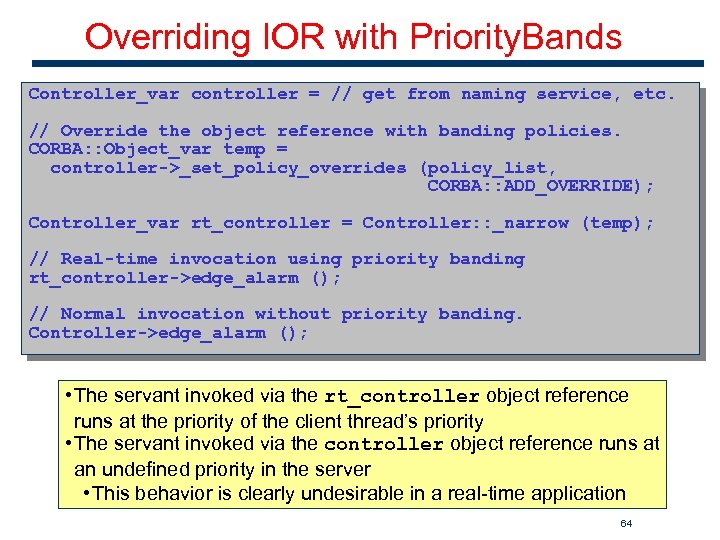
Overriding IOR with Priority. Bands Controller_var controller = // get from naming service, etc. // Override the object reference with banding policies. CORBA: : Object_var temp = controller->_set_policy_overrides (policy_list, CORBA: : ADD_OVERRIDE); Controller_var rt_controller = Controller: : _narrow (temp); // Real-time invocation using priority banding rt_controller->edge_alarm (); // Normal invocation without priority banding. Controller->edge_alarm (); • The servant invoked via the rt_controller object reference runs at the priority of the client thread’s priority • The servant invoked via the controller object reference runs at an undefined priority in the server • This behavior is clearly undesirable in a real-time application 64
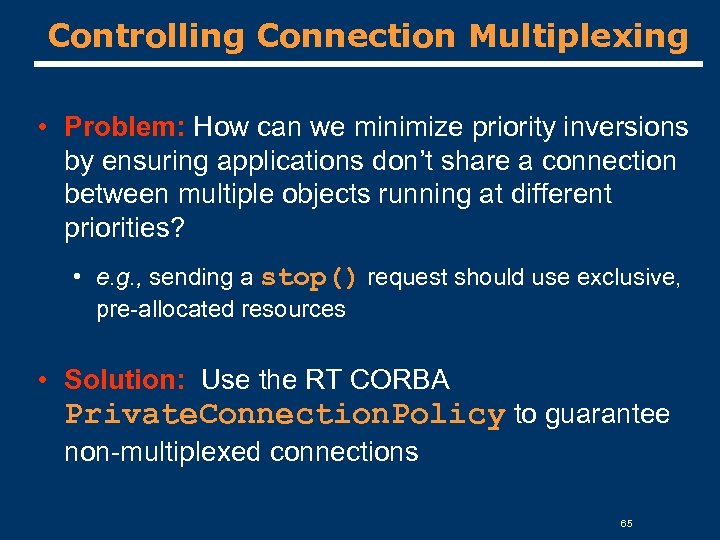
Controlling Connection Multiplexing • Problem: How can we minimize priority inversions by ensuring applications don’t share a connection between multiple objects running at different priorities? • e. g. , sending a stop() request should use exclusive, pre-allocated resources • Solution: Use the RT CORBA Private. Connection. Policy to guarantee non-multiplexed connections 65
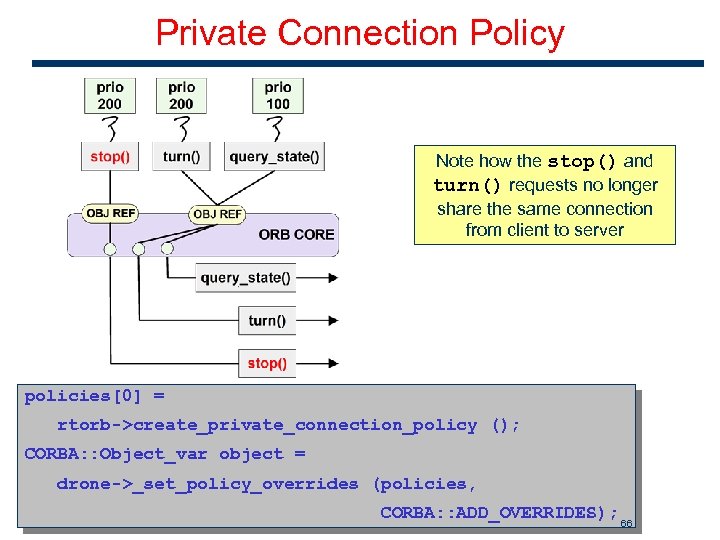
Private Connection Policy Note how the stop() and turn() requests no longer share the same connection from client to server policies[0] = rtorb->create_private_connection_policy (); CORBA: : Object_var object = drone->_set_policy_overrides (policies, CORBA: : ADD_OVERRIDES); 66
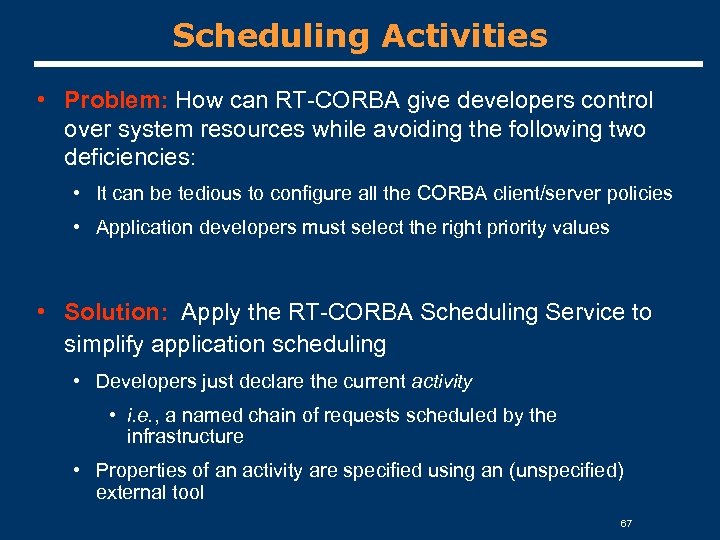
Scheduling Activities • Problem: How can RT-CORBA give developers control over system resources while avoiding the following two deficiencies: • It can be tedious to configure all the CORBA client/server policies • Application developers must select the right priority values • Solution: Apply the RT-CORBA Scheduling Service to simplify application scheduling • Developers just declare the current activity • i. e. , a named chain of requests scheduled by the infrastructure • Properties of an activity are specified using an (unspecified) external tool 67
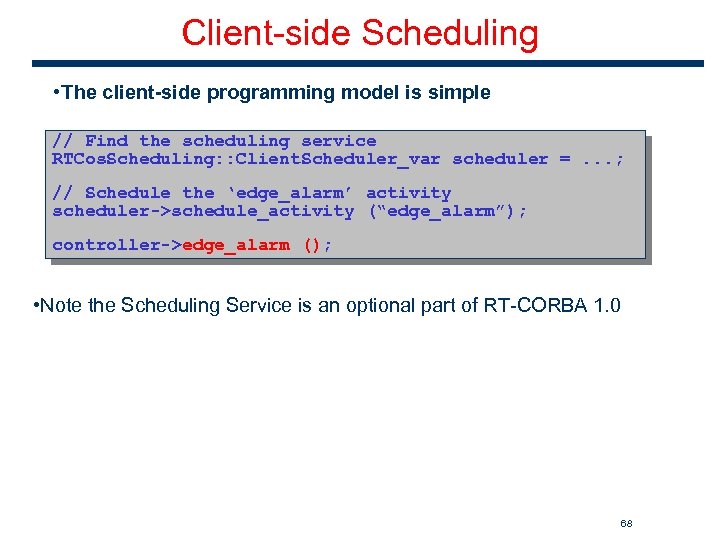
Client-side Scheduling • The client-side programming model is simple // Find the scheduling service RTCos. Scheduling: : Client. Scheduler_var scheduler =. . . ; // Schedule the ‘edge_alarm’ activity scheduler->schedule_activity (“edge_alarm”); controller->edge_alarm (); • Note the Scheduling Service is an optional part of RT-CORBA 1. 0 68
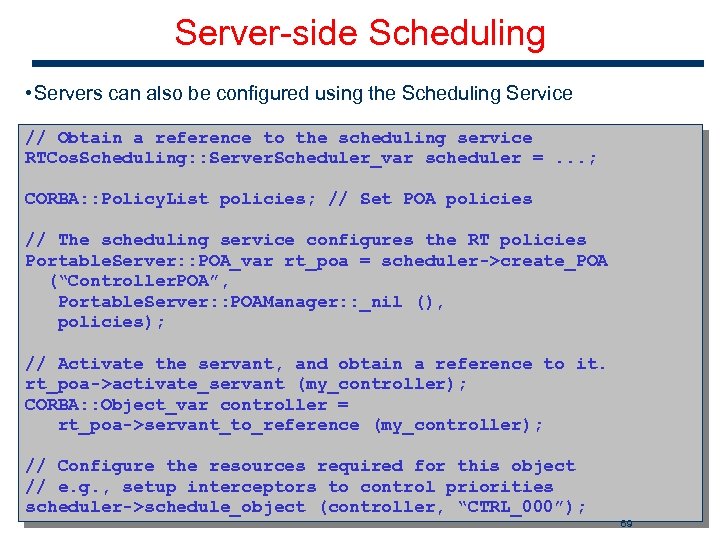
Server-side Scheduling • Servers can also be configured using the Scheduling Service // Obtain a reference to the scheduling service RTCos. Scheduling: : Server. Scheduler_var scheduler =. . . ; CORBA: : Policy. List policies; // Set POA policies // The scheduling service configures the RT policies Portable. Server: : POA_var rt_poa = scheduler->create_POA (“Controller. POA”, Portable. Server: : POAManager: : _nil (), policies); // Activate the servant, and obtain a reference to it. rt_poa->activate_servant (my_controller); CORBA: : Object_var controller = rt_poa->servant_to_reference (my_controller); // Configure the resources required for this object // e. g. , setup interceptors to control priorities scheduler->schedule_object (controller, “CTRL_000”); 69
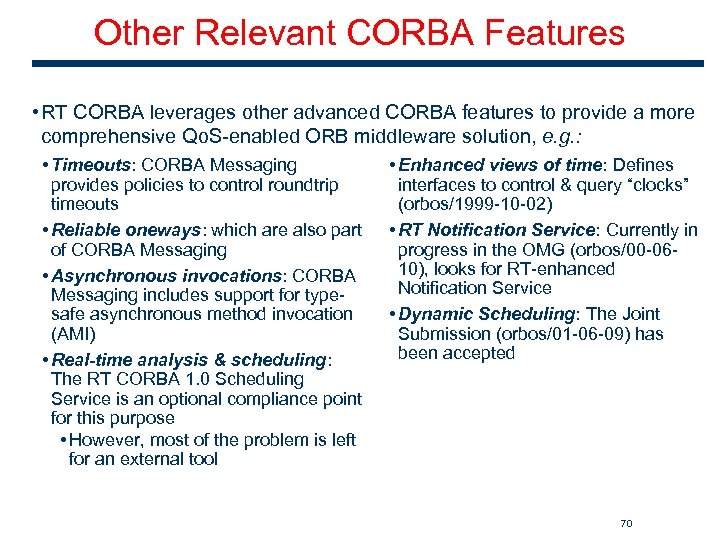
Other Relevant CORBA Features • RT CORBA leverages other advanced CORBA features to provide a more comprehensive Qo. S-enabled ORB middleware solution, e. g. : • Timeouts: CORBA Messaging provides policies to control roundtrip timeouts • Reliable oneways: which are also part of CORBA Messaging • Asynchronous invocations: CORBA Messaging includes support for typesafe asynchronous method invocation (AMI) • Real-time analysis & scheduling: The RT CORBA 1. 0 Scheduling Service is an optional compliance point for this purpose • However, most of the problem is left for an external tool • Enhanced views of time: Defines interfaces to control & query “clocks” (orbos/1999 -10 -02) • RT Notification Service: Currently in progress in the OMG (orbos/00 -0610), looks for RT-enhanced Notification Service • Dynamic Scheduling: The Joint Submission (orbos/01 -06 -09) has been accepted 70
Controlling Request Timeouts • Problem: How can we keep our Controller objects from blocking indefinitely when trying to stop a drone that’s about to fall off an edge? ! • Solution: Override the timeout policy in the Drone object reference 71
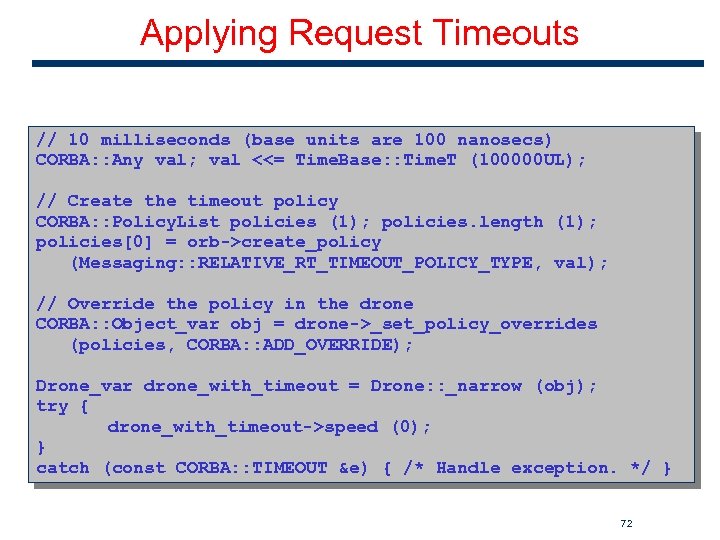
Applying Request Timeouts // 10 milliseconds (base units are 100 nanosecs) CORBA: : Any val; val <<= Time. Base: : Time. T (100000 UL); // Create the timeout policy CORBA: : Policy. List policies (1); policies. length (1); policies[0] = orb->create_policy (Messaging: : RELATIVE_RT_TIMEOUT_POLICY_TYPE, val); // Override the policy in the drone CORBA: : Object_var obj = drone->_set_policy_overrides (policies, CORBA: : ADD_OVERRIDE); Drone_var drone_with_timeout = Drone: : _narrow (obj); try { drone_with_timeout->speed (0); } catch (const CORBA: : TIMEOUT &e) { /* Handle exception. */ } 72
Oneway Calls • Problem: How can we handle the fact that CORBA one-way operation semantics aren’t precise enough for real-time applications? • Solution: Use the Sync. Scope policy to control one-way semantics 73
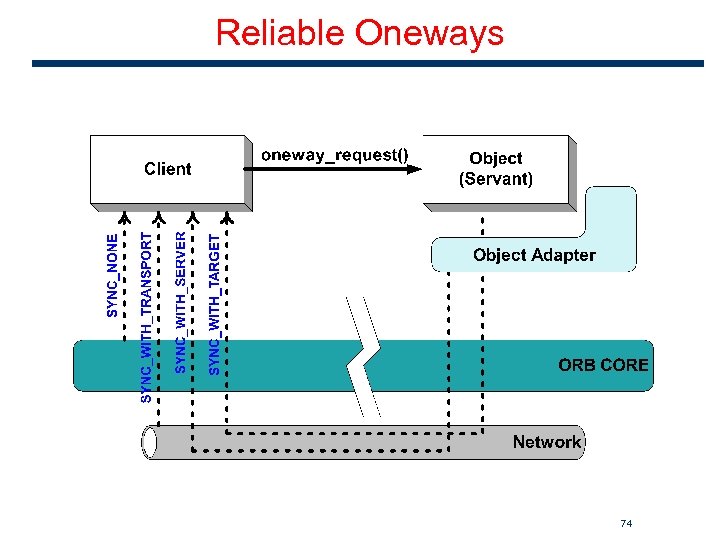
Reliable Oneways 74
Asynchronous Method Invocation • Problem: How can we simultaneously 1. Prevent clients from blocking while long-duration requests complete & 2. Allow many requests to be issued concurrently • Solution: Use the CORBA Asynchronous Method Invocation (AMI) interfaces to separate (in time & space) the thread issuing the request from the thread processing the reply 75
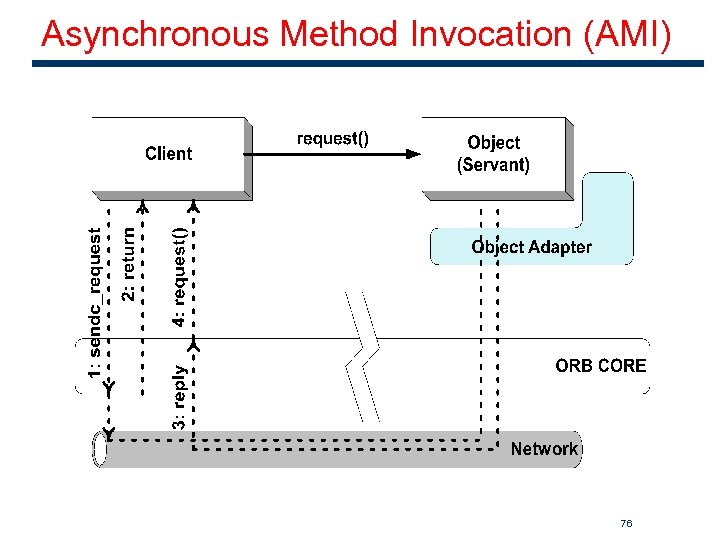
Asynchronous Method Invocation (AMI) 76
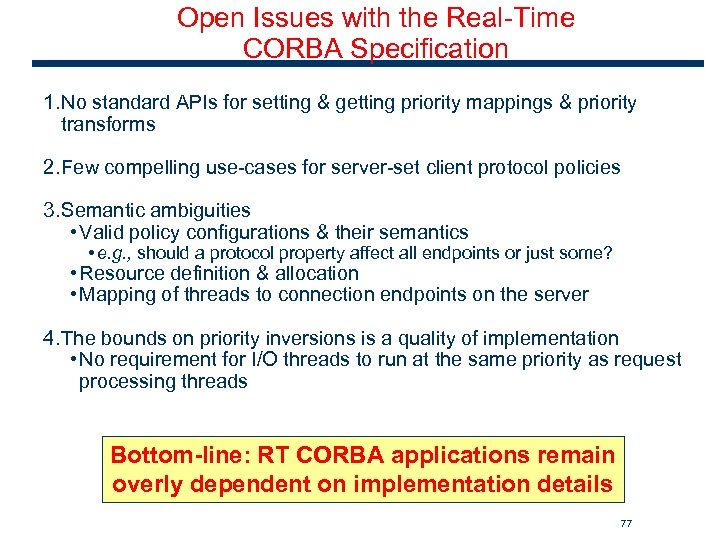
Open Issues with the Real-Time CORBA Specification 1. No standard APIs for setting & getting priority mappings & priority transforms 2. Few compelling use-cases for server-set client protocol policies 3. Semantic ambiguities • Valid policy configurations & their semantics • e. g. , should a protocol property affect all endpoints or just some? • Resource definition & allocation • Mapping of threads to connection endpoints on the server 4. The bounds on priority inversions is a quality of implementation • No requirement for I/O threads to run at the same priority as request processing threads Bottom-line: RT CORBA applications remain overly dependent on implementation details 77
Additional Information • CORBA 2. 4 specification (includes RT-CORBA) • www. omg. org/technology/documents/formal/corbaiiop. htm • Patterns for concurrent & networked objects • www. posa. uci. edu • ACE & TAO open-source middleware • www. cs. wustl. edu/~schmidt/ACE. html • www. cs. wustl. edu/~schmidt/TAO. html • CORBA research papers • www. cs. wustl. edu/~schmidt/corba-research. html • CORBA tutorials • www. cs. wustl. edu/~schmidt/tutorials-corba. html • CORBA columns • www. cs. wustl. edu/~schmidt/report-doc. html 79
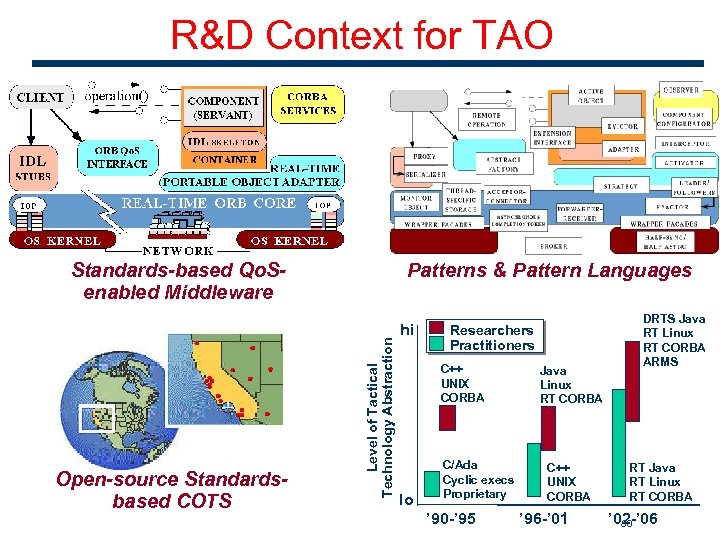
R&D Context for TAO Patterns & Pattern Languages Open-source Standardsbased COTS Level of Tactical Technology Abstraction Standards-based Qo. Senabled Middleware hi Researchers Practitioners C++ UNIX CORBA lo C/Ada Cyclic execs Proprietary ’ 90 -’ 95 Java Linux RT CORBA C++ UNIX CORBA ’ 96 -’ 01 DRTS Java RT Linux RT CORBA ARMS RT Java RT Linux RT CORBA ’ 02 -’ 06 80
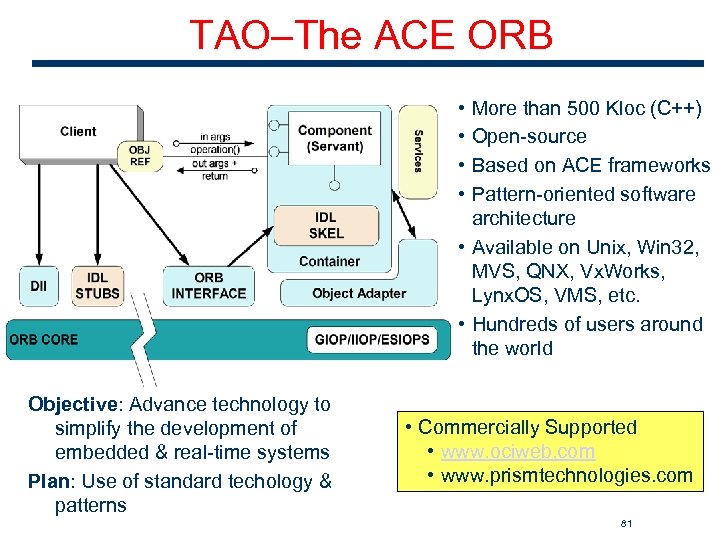
TAO–The ACE ORB • • More than 500 Kloc (C++) Open-source Based on ACE frameworks Pattern-oriented software architecture • Available on Unix, Win 32, MVS, QNX, Vx. Works, Lynx. OS, VMS, etc. • Hundreds of users around the world Objective: Advance technology to simplify the development of embedded & real-time systems Plan: Use of standard techology & patterns • Commercially Supported • www. ociweb. com • www. prismtechnologies. com 81
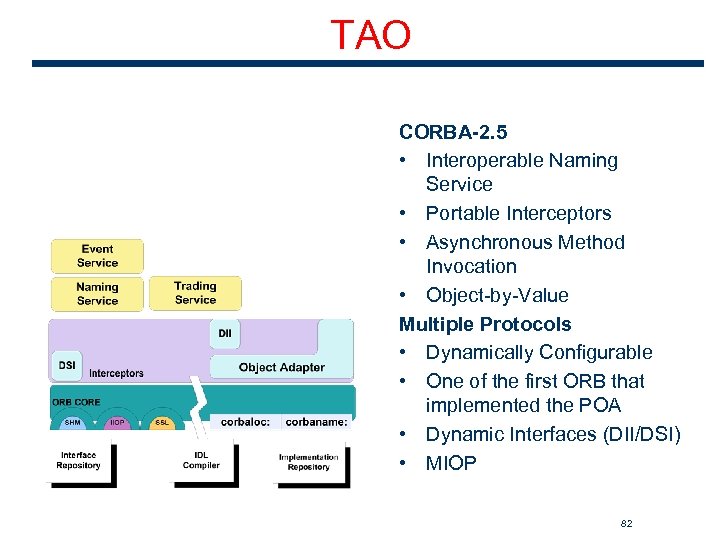
TAO CORBA-2. 5 • Interoperable Naming Service • Portable Interceptors • Asynchronous Method Invocation • Object-by-Value Multiple Protocols • Dynamically Configurable • One of the first ORB that implemented the POA • Dynamic Interfaces (DII/DSI) • MIOP 82
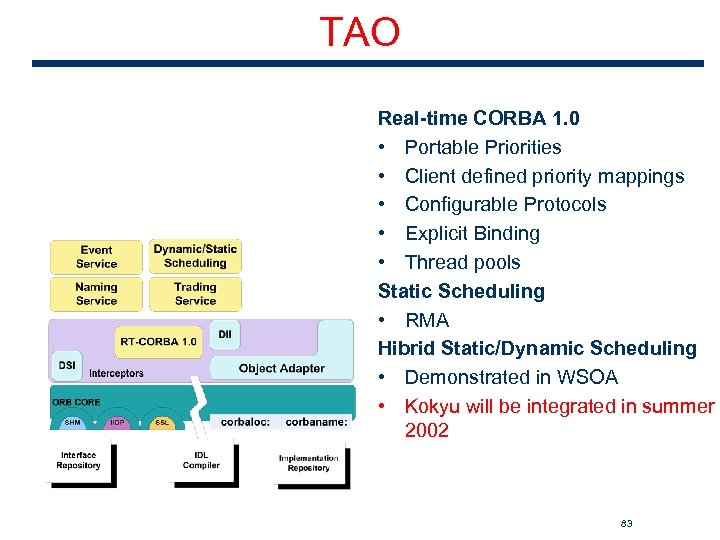
TAO Real-time CORBA 1. 0 • Portable Priorities • Client defined priority mappings • Configurable Protocols • Explicit Binding • Thread pools Static Scheduling • RMA Hibrid Static/Dynamic Scheduling • Demonstrated in WSOA • Kokyu will be integrated in summer 2002 83
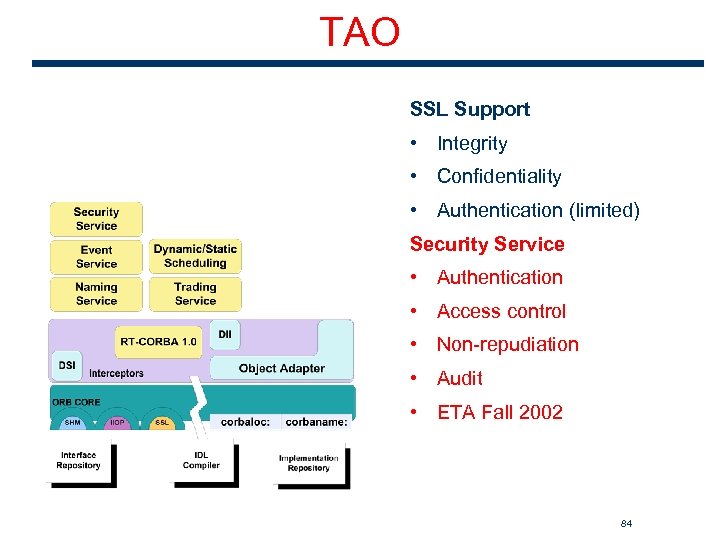
TAO SSL Support • Integrity • Confidentiality • Authentication (limited) Security Service • Authentication • Access control • Non-repudiation • Audit • ETA Fall 2002 84
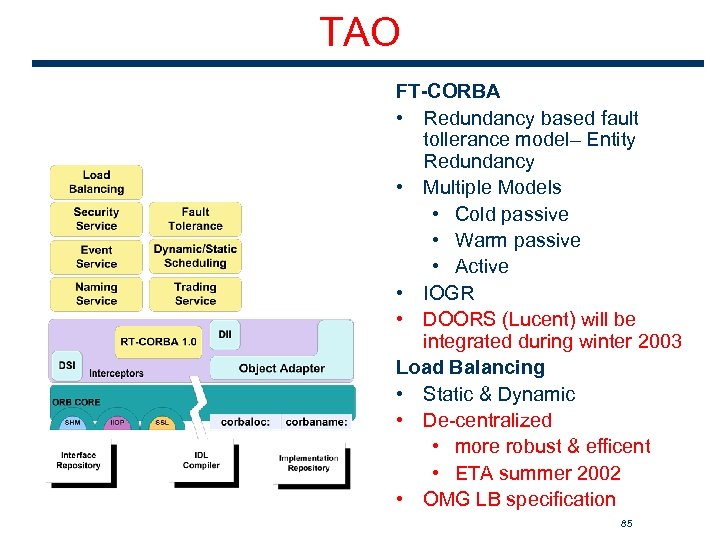
TAO FT-CORBA • Redundancy based fault tollerance model– Entity Redundancy • Multiple Models • Cold passive • Warm passive • Active • IOGR • DOORS (Lucent) will be integrated during winter 2003 Load Balancing • Static & Dynamic • De-centralized • more robust & efficent • ETA summer 2002 • OMG LB specification 85
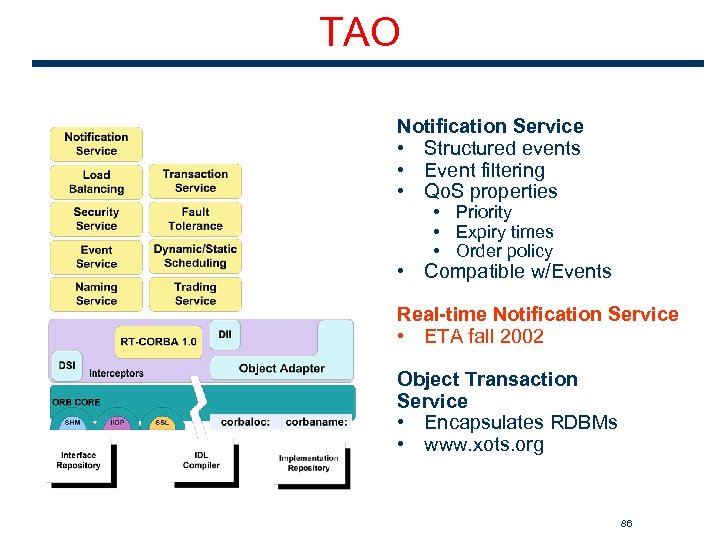
TAO Notification Service • Structured events • Event filtering • Qo. S properties • Priority • Expiry times • Order policy • Compatible w/Events Real-time Notification Service • ETA fall 2002 Object Transaction Service • Encapsulates RDBMs • www. xots. org 86
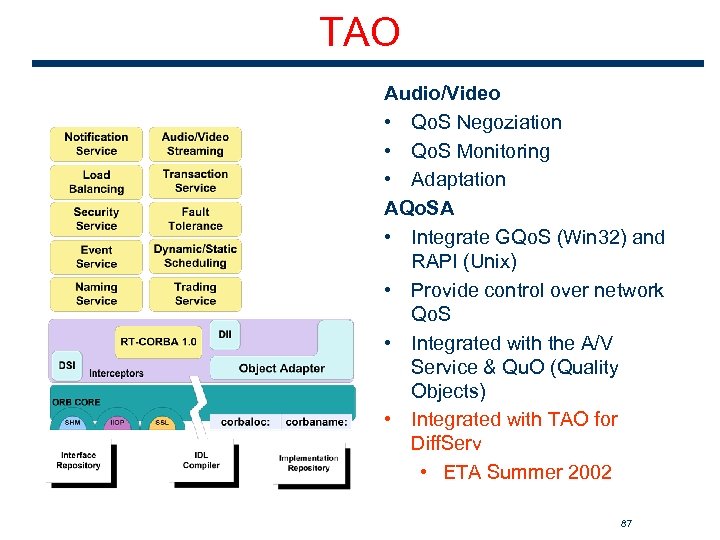
TAO Audio/Video • Qo. S Negoziation • Qo. S Monitoring • Adaptation AQo. SA • Integrate GQo. S (Win 32) and RAPI (Unix) • Provide control over network Qo. S • Integrated with the A/V Service & Qu. O (Quality Objects) • Integrated with TAO for Diff. Serv • ETA Summer 2002 87
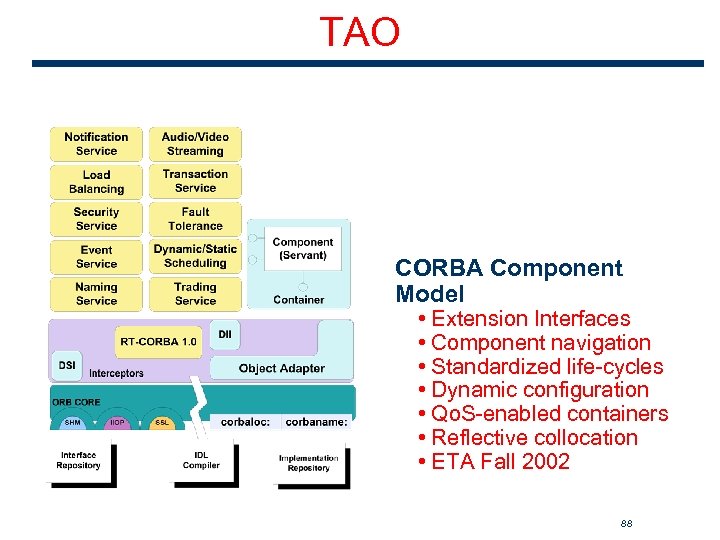
TAO CORBA Component Model • Extension Interfaces • Component navigation • Standardized life-cycles • Dynamic configuration • Qo. S-enabled containers • Reflective collocation • ETA Fall 2002 88
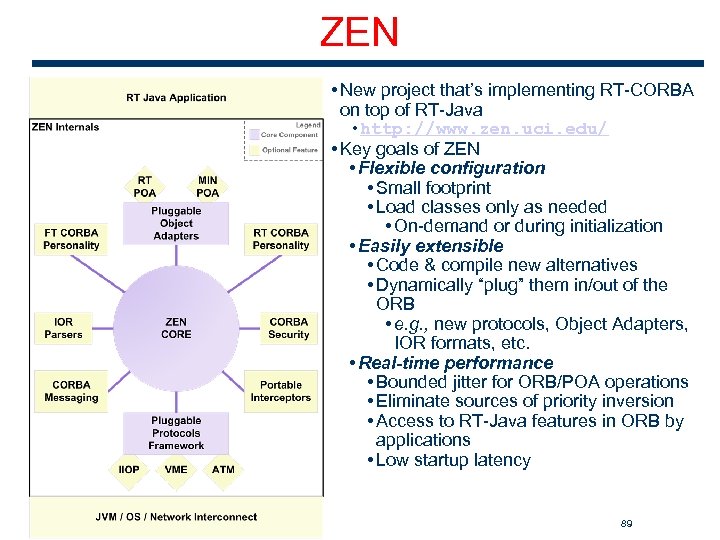
ZEN • New project that’s implementing RT-CORBA on top of RT-Java • http: //www. zen. uci. edu/ • Key goals of ZEN • Flexible configuration • Small footprint • Load classes only as needed • On-demand or during initialization • Easily extensible • Code & compile new alternatives • Dynamically “plug” them in/out of the ORB • e. g. , new protocols, Object Adapters, IOR formats, etc. • Real-time performance • Bounded jitter for ORB/POA operations • Eliminate sources of priority inversion • Access to RT-Java features in ORB by applications • Low startup latency 89
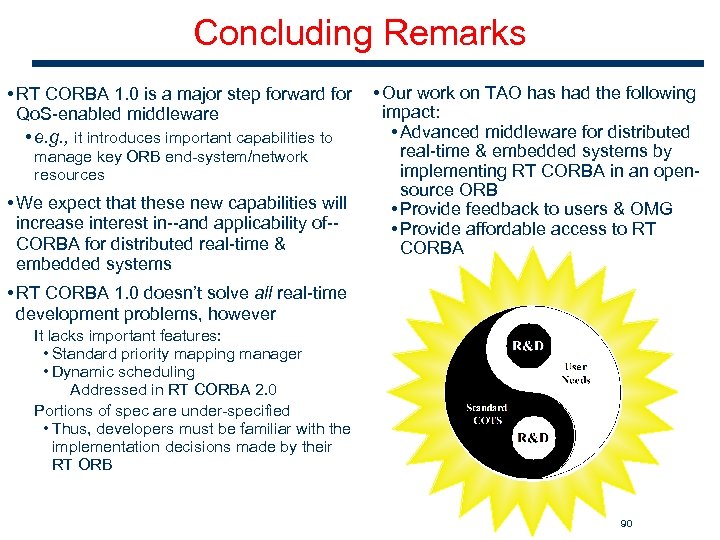
Concluding Remarks • RT CORBA 1. 0 is a major step forward for Qo. S-enabled middleware • e. g. , it introduces important capabilities to manage key ORB end-system/network resources • We expect that these new capabilities will increase interest in--and applicability of-CORBA for distributed real-time & embedded systems • Our work on TAO has had the following impact: • Advanced middleware for distributed real-time & embedded systems by implementing RT CORBA in an opensource ORB • Provide feedback to users & OMG • Provide affordable access to RT CORBA • RT CORBA 1. 0 doesn’t solve all real-time development problems, however • It lacks important features: • Standard priority mapping manager • Dynamic scheduling • Addressed in RT CORBA 2. 0 • Portions of spec are under-specified • Thus, developers must be familiar with the implementation decisions made by their RT ORB 90
Скачать презентацию Using Real-time CORBA Effectively Patterns Principles Angelo
67cacc797de288ea6e7159ca1450a154.ppt