


 Скачать презентацию Using Metacognition to Effect an Extreme Academic Makeover
2388c9125eafe4a5309fa2d8ee06e5f2.ppt
- Количество слайдов: 20
 Using Metacognition to Effect an Extreme Academic Makeover Different Strokes for Different Folks Saundra Y. Mc. Guire, Ph. D. Director, Center for Academic Success Adj. Professor, Department of Chemistry Louisiana State University "The mind is not a vessel to be filled, but a fire to be ignited. " -Plutarch
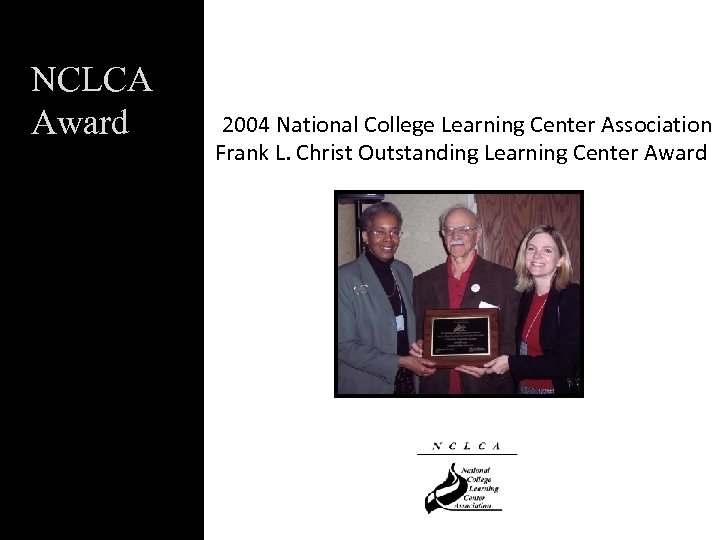 NCLCA Award 2004 National College Learning Center Association Frank L. Christ Outstanding Learning Center Award
 The General Approach ing earn ful L ning Mea § Providing Data on the Impact of Using Metacognitive Strategies § Reflecting on the “gap” § Defining metacognition § Discussing Levels of Learning (Bloom’s Taxonomy) § Presenting Metacognitive Strategies § Discussing Motivational Strategies Rote ning Lear
 Before and After ing earn ful L ning Mea Travis, junior psychology student 47, 52, 86 Robert, freshman chemistry student 42, 100, 100 Michael, senior pre-med organic student 30, 28, 80, 91 Miriam, freshman calculus student 37. 5, 83, 93 Charles, junior mathematics major GPA 1. 8 cum, 4. 0 (S 08) Rote ning Lear
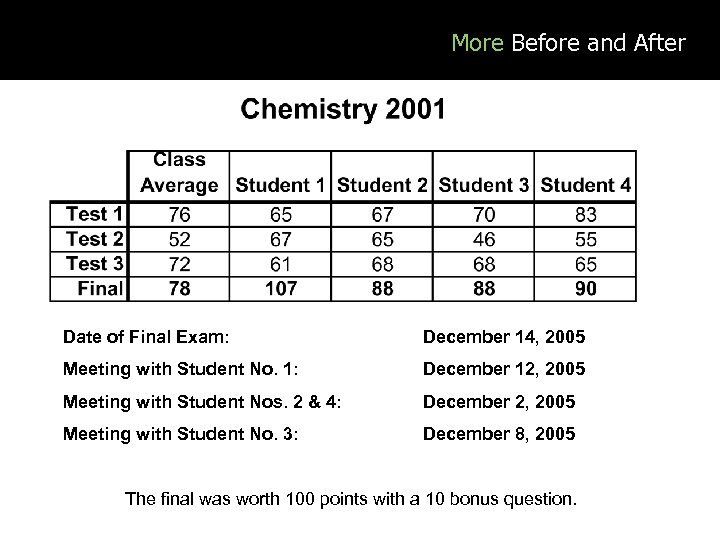 More Before and After Date of Final Exam: December 14, 2005 Meeting with Student No. 1: December 12, 2005 Meeting with Student Nos. 2 & 4: December 2, 2005 Meeting with Student No. 3: December 8, 2005 The final was worth 100 points with a 10 bonus question.
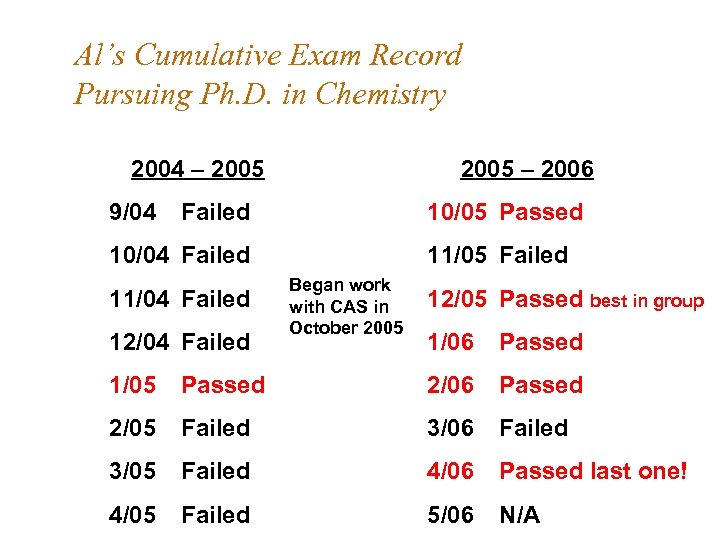 Al’s Cumulative Exam Record Pursuing Ph. D. in Chemistry 2004 – 2005 9/04 2005 – 2006 Failed 10/05 Passed 10/04 Failed 11/04 Failed 12/04 Failed 11/05 Failed Began work with CAS in October 2005 12/05 Passed best in group 1/06 Passed 1/05 Passed 2/06 Passed 2/05 Failed 3/06 Failed 3/05 Failed 4/06 Passed last one! 4/05 Failed 5/06 N/A
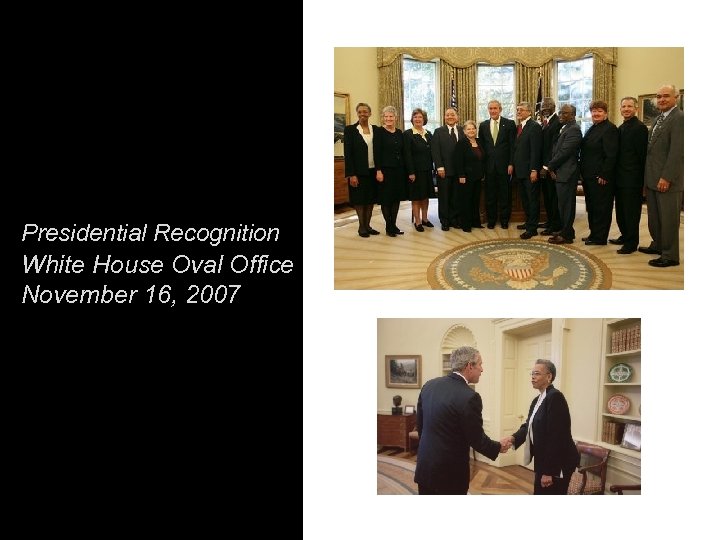 Presidential Recognition White House Oval Office November 16, 2007
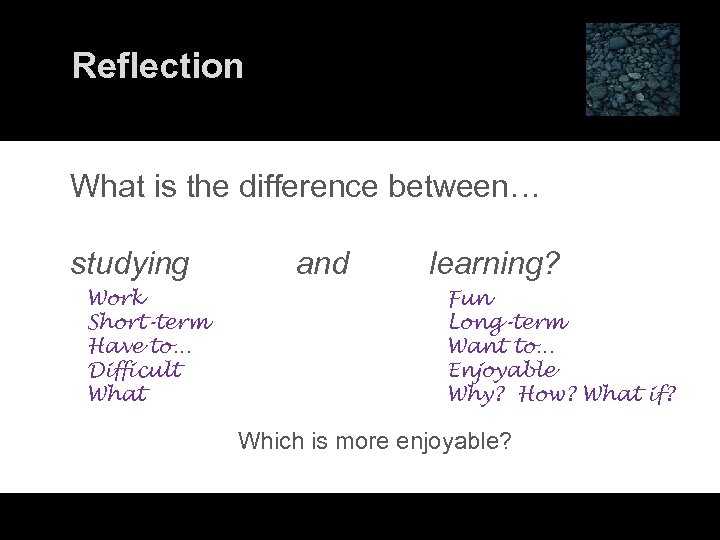 Reflection What is the difference between… studying Work Short-term Have to… Difficult What and learning? Fun Long-term Want to… Enjoyable Why? How? What if? Which is more enjoyable?
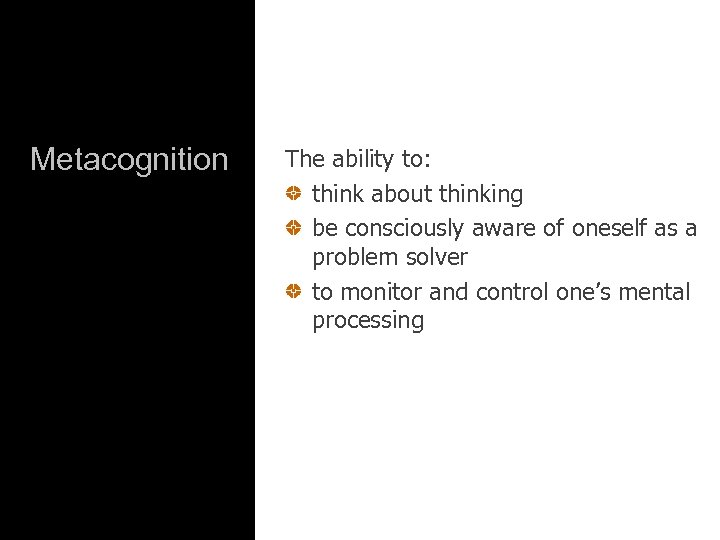 Metacognition The ability to: think about thinking be consciously aware of oneself as a problem solver to monitor and control one’s mental processing
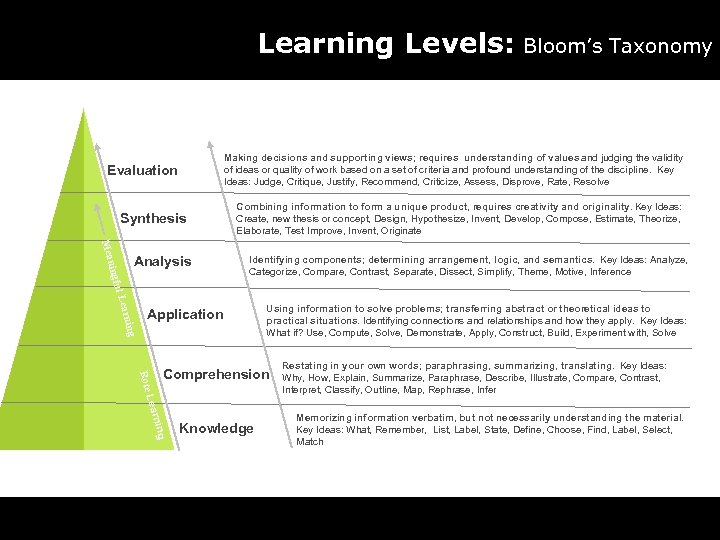 Learning Levels: Bloom’s Taxonomy Making decisions and supporting views; requires understanding of values and judging the validity of ideas or quality of work based on a set of criteria and profound understanding of the discipline. Key Ideas: Judge, Critique, Justify, Recommend, Criticize, Assess, Disprove, Rate, Resolve Evaluation Synthesis ning Mea Analysis Combining information to form a unique product, requires creativity and originality. Key Ideas: Create, new thesis or concept, Design, Hypothesize, Invent, Develop, Compose, Estimate, Theorize, Elaborate, Test Improve, Invent, Originate Identifying components; determining arrangement, logic, and semantics. Key Ideas: Analyze, Categorize, Compare, Contrast, Separate, Dissect, Simplify, Theme, Motive, Inference earn ful L Application ing Using information to solve problems; transferring abstract or theoretical ideas to practical situations. Identifying connections and relationships and how they apply. Key Ideas: What if? Use, Compute, Solve, Demonstrate, Apply, Construct, Build, Experiment with, Solve Rote Comprehension ning Lear Knowledge Restating in your own words; paraphrasing, summarizing, translating. Key Ideas: Why, How, Explain, Summarize, Paraphrase, Describe, Illustrate, Compare, Contrast, Interpret, Classify, Outline, Map, Rephrase, Infer Memorizing information verbatim, but not necessarily understanding the material. Key Ideas: What, Remember, List, Label, State, Define, Choose, Find, Label, Select, Match
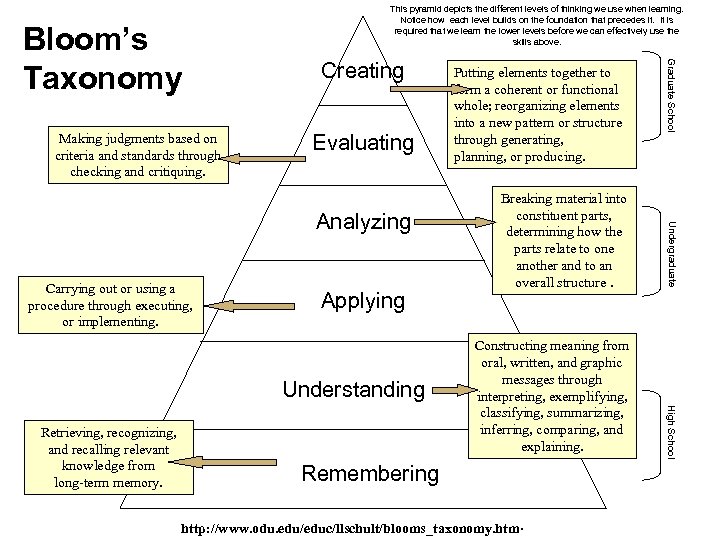 Making judgments based on criteria and standards through checking and critiquing. Creating Evaluating Applying Understanding Retrieving, recognizing, and recalling relevant knowledge from long-term memory. Constructing meaning from oral, written, and graphic messages through interpreting, exemplifying, classifying, summarizing, inferring, comparing, and explaining. High School Carrying out or using a procedure through executing, or implementing. Breaking material into constituent parts, determining how the parts relate to one another and to an overall structure. Undergraduate Analyzing Putting elements together to form a coherent or functional whole; reorganizing elements into a new pattern or structure through generating, planning, or producing. Graduate School Bloom’s Taxonomy This pyramid depicts the different levels of thinking we use when learning. Notice how each level builds on the foundation that precedes it. It is required that we learn the lower levels before we can effectively use the skills above. Remembering http: //www. odu. edu/educ/llschult/blooms_taxonomy. htm
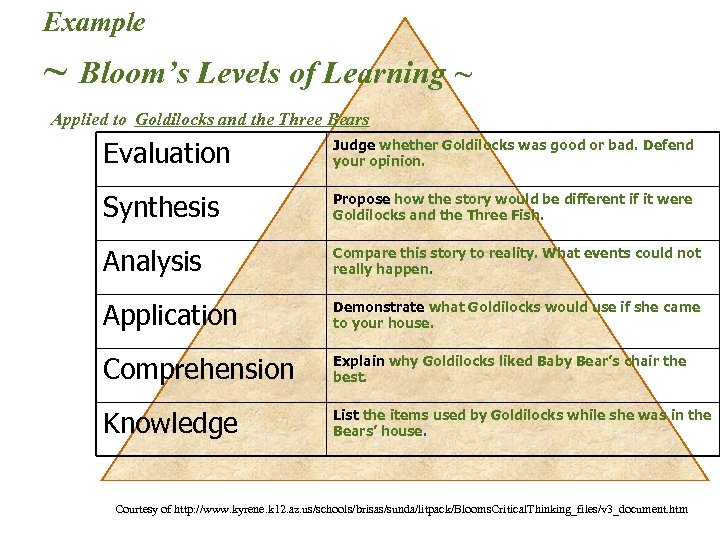 Example ~ Bloom’s Levels of Learning ~ Applied to Goldilocks and the Three Bears Evaluation Judge whether Goldilocks was good or bad. Defend your opinion. Synthesis Propose how the story would be different if it were Goldilocks and the Three Fish. Analysis Compare this story to reality. What events could not really happen. Application Demonstrate what Goldilocks would use if she came to your house. Comprehension Explain why Goldilocks liked Baby Bear’s chair the best. Knowledge List the items used by Goldilocks while she was in the Bears’ house. Courtesy of http: //www. kyrene. k 12. az. us/schools/brisas/sunda/litpack/Blooms. Critical. Thinking_files/v 3_document. htm
 Counting Vowels How ACCURATE are you?
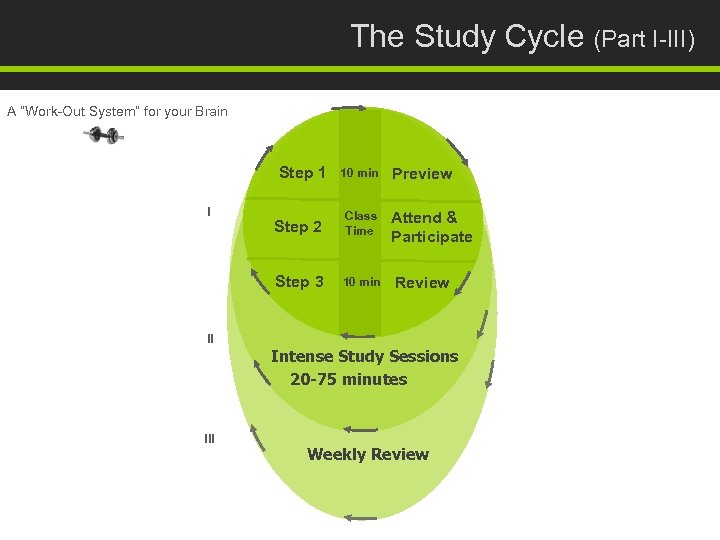 The Study Cycle (Part I-III) A “Work-Out System” for your Brain Step 1 I 10 min III Class Time Step 3 II Step 2 10 min Preview Attend & Participate Review Intense Study Sessions 20 -75 minutes Weekly Review
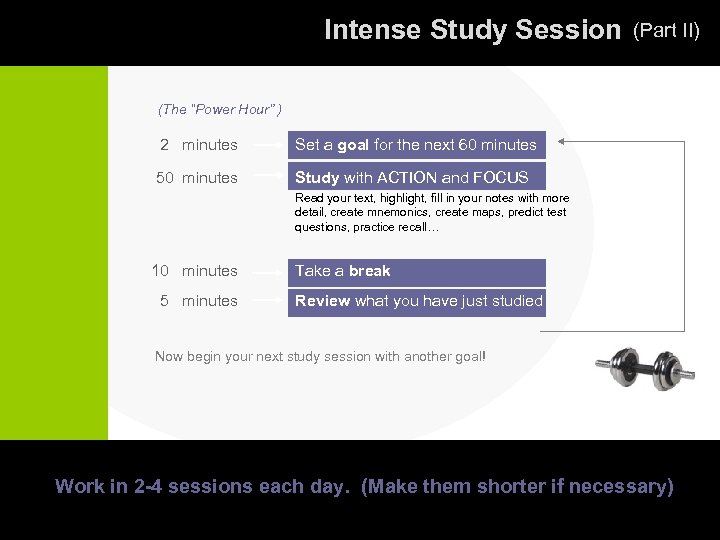 Intense Study Session (Part II) (The “Power Hour” ) 2 minutes Set a goal for the next 60 minutes 50 minutes Study with ACTION and FOCUS Read your text, highlight, fill in your notes with more detail, create mnemonics, create maps, predict test questions, practice recall… 10 minutes 5 minutes Take a break Review what you have just studied Now begin your next study session with another goal! Work in 2 -4 sessions each day. (Make them shorter if necessary)
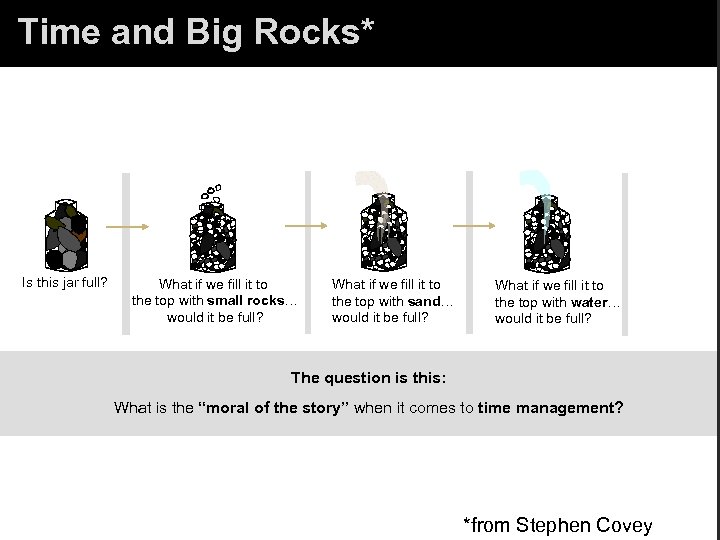 Time and Big Rocks* Is this jar full? What if we fill it to the top with small rocks… would it be full? What if we fill it to the top with sand… would it be full? What if we fill it to the top with water… would it be full? The question is this: What is the “moral of the story” when it comes to time management? *from Stephen Covey
 Time Tools Semester Calendar Weekly Planning Master To Do List
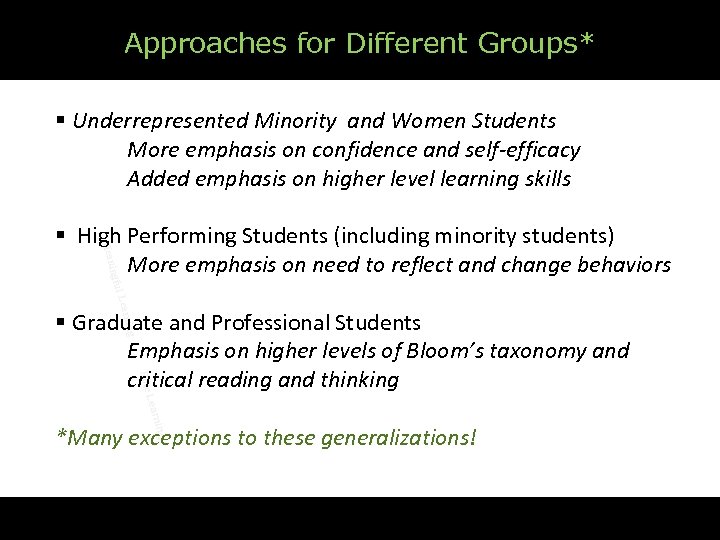 Approaches for Different Groups* § Underrepresented Minority and Women Students More emphasis on confidence and self-efficacy Added emphasis on higher level learning skills earn ful L ning Mea § High Performing Students (including minority students) More emphasis on need to reflect and change behaviors ing § Graduate and Professional Students Emphasis on higher levels of Bloom’s taxonomy and critical reading and thinking Rote ning Lear *Many exceptions to these generalizations!
 Final Note Please visit our website at www. cas. lsu. edu We have on-line workshops and information that teach more effective learning strategies. We wish your students an enjoyable learning journey! Dr. Saundra Mc. Guire
 Resources Bruer, John T. , 2000. Schools For Thought: A Science of Learning in the Classroom. MIT Press. Bransford, J. D. , Brown, A. L. , Cocking, R. R. (Eds. ), 2000. How people learn: Brain, Mind, Experience, and School. Washington, DC: National Academy Press. ful L ning Mea Cromley, Jennifer, 2000. Learning to Think, Learning to Learn: What the Science of Thinking and Learning Has to Offer Adult Education. Washington, DC: National Institute for Literacy. ing earn Ellis, David, 2006. Becoming a Master Student*. New York: Houghton-Mifflin. Rote Taylor, S. (1999). Better learning through better thinking: Developing students’ metacognitive abilities. Journal of College Reading and Learning, 30(1), 34 ff. Retrieved November 9, 2002, from Expanded Academic Index ASAP. http: //academic. pg. cc. md. us/~wpeirce/MCCCTR/metacognition. htm ning Lear Zull, James (2004). The Art of Changing the Brain. Sterling, VA: Stylus Publishing.