 Скачать презентацию Using Membrane Computers to Find Nearly-Optimal Solutions to
d4ff527a7930de1f6a3df9648a11f2ea.ppt
- Количество слайдов: 36



Using Membrane Computers to Find Nearly-Optimal Solutions to Cost-Based Abduction Curry Guinn Department of Computer Science University of North Carolina at Wilmington
Acknowledgements v Lexxle, Inc. Ø Ed Addison Department of Computer Science University of North Carolina at Wilmington v Dr. Jeff Brown v Bill Shipman v Eric Harris v Dave Crist v Brian Bullard v Rose Rahinemejad v Special thanks to Dr. Ashraf Abdelbar and Shawn Chivers
Talk Outline v What is membrane computing? v What is cost-based abduction (CBA)? v What does. Lexxle’s ABC system do? v How does one model CBA on a membrane computer? v What are some experimental results? Department of Computer Science University of North Carolina at Wilmington v What are some open questions?
What is Membrane Computing? v Biologically-inspired branch of natural computing v Abstracting computing models from the structure and functioning of living cells and from the organization of cells in tissues or other higher order structures v The basic elements of a membrane system are the membrane structure and the sets of evolution rules which process multisetsof objects placed in the compartments of the membrane architecture Department of Computer Science University of North Carolina at Wilmington Ø Also known as a P-System after Gheorghe Păun.
How are membranes composed? v A membrane structure is a hierarchically arranged set of membranes. v Objects within membranes evolve through a set of rules which maycombine objects, mutate objects, delete objects, or pass objects through membranes. v Rules potentially can change membrane structures themselves dissolving dividingor creating ( , membranes). v Object selection and rule selection is nona deterministicprocess. Department of Computer Science University of North Carolina at Wilmington v Certain classes of membrane architectures have been shown to be equivalent to Turing Machines and thus are capable of any computation
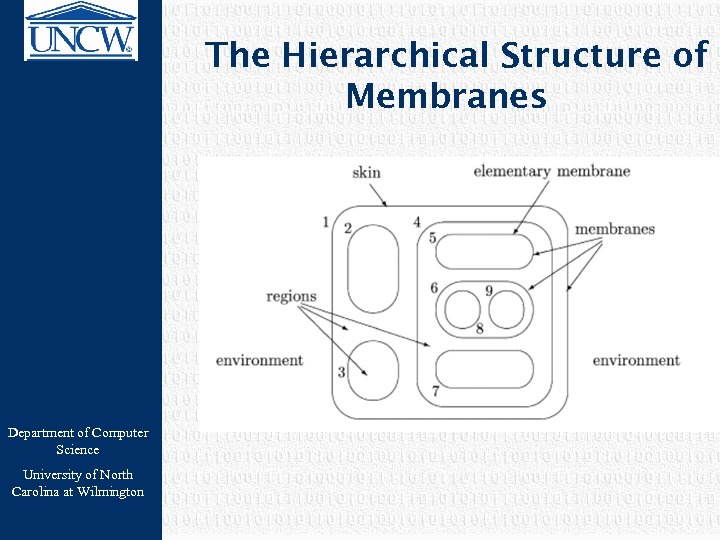
The Hierarchical Structure of Membranes Department of Computer Science University of North Carolina at Wilmington
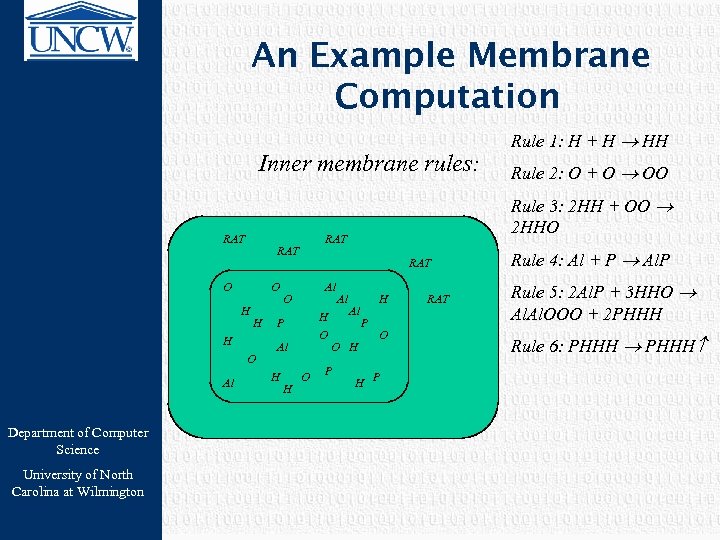
An Example Membrane Computation Inner membrane rules: RAT O O H H H O Al Department of Computer Science University of North Carolina at Wilmington RAT Al O H O P Al H H O Al Al O H P Rule 2: O + O OO Rule 3: 2 HH + OO 2 HHO RAT Rule 1: H + H HH H P O H P RAT Rule 4: Al + P Al. P Rule 5: 2 Al. P + 3 HHO Al. OOO + 2 PHHH Rule 6: PHHH
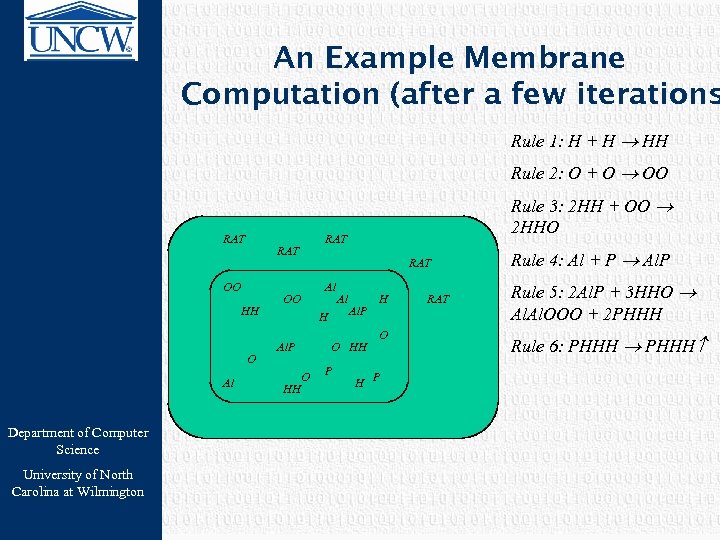
An Example Membrane Computation (after a few iterations Rule 1: H + H HH Rule 2: O + O OO RAT HH O Al Department of Computer Science University of North Carolina at Wilmington RAT OO RAT Al OO H Al. P HH Rule 3: 2 HH + OO 2 HHO Al Al. P O HH O P H O H P RAT Rule 4: Al + P Al. P Rule 5: 2 Al. P + 3 HHO Al. OOO + 2 PHHH Rule 6: PHHH
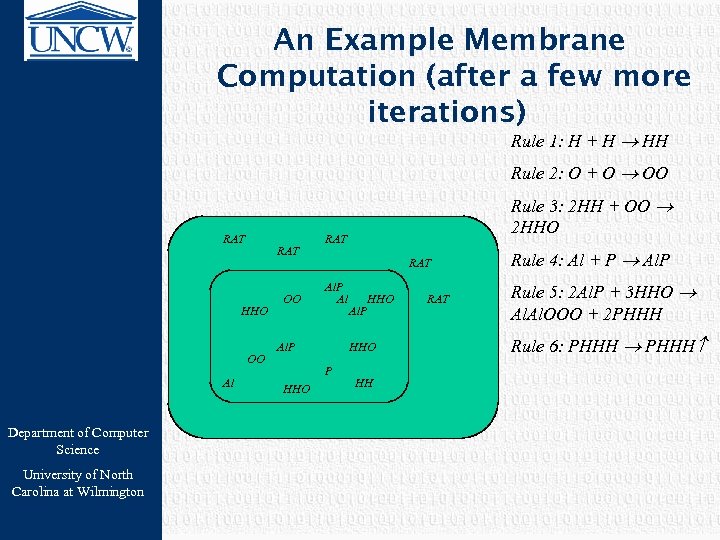
An Example Membrane Computation (after a few more iterations) Rule 1: H + H HH Rule 2: O + O OO RAT HHO OO Al Department of Computer Science University of North Carolina at Wilmington OO RAT Al. P HHO P HHO Rule 3: 2 HH + OO 2 HHO HH RAT Rule 4: Al + P Al. P Rule 5: 2 Al. P + 3 HHO Al. OOO + 2 PHHH Rule 6: PHHH
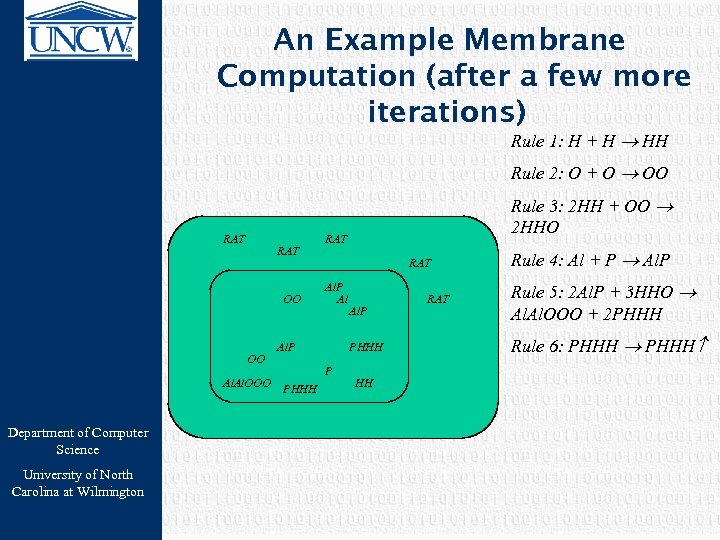
An Example Membrane Computation (after a few more iterations) Rule 1: H + H HH Rule 2: O + O OO RAT OO OO Al. OOO Department of Computer Science University of North Carolina at Wilmington RAT Al. P PHHH Rule 3: 2 HH + OO 2 HHO HH RAT Rule 4: Al + P Al. P Rule 5: 2 Al. P + 3 HHO Al. OOO + 2 PHHH Rule 6: PHHH
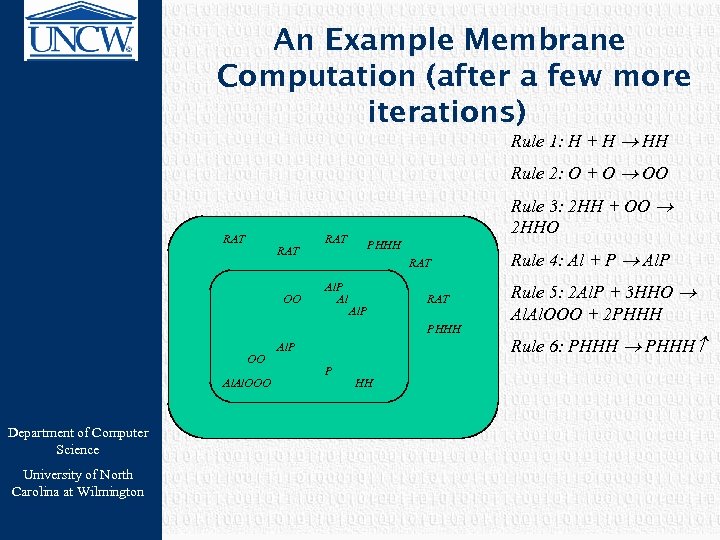
An Example Membrane Computation (after a few more iterations) Rule 1: H + H HH Rule 2: O + O OO RAT OO Rule 3: 2 HH + OO 2 HHO RAT PHHH RAT Al. P Al Al. P RAT PHHH OO Al. OOO Department of Computer Science University of North Carolina at Wilmington Al. P P HH Rule 4: Al + P Al. P Rule 5: 2 Al. P + 3 HHO Al. OOO + 2 PHHH Rule 6: PHHH
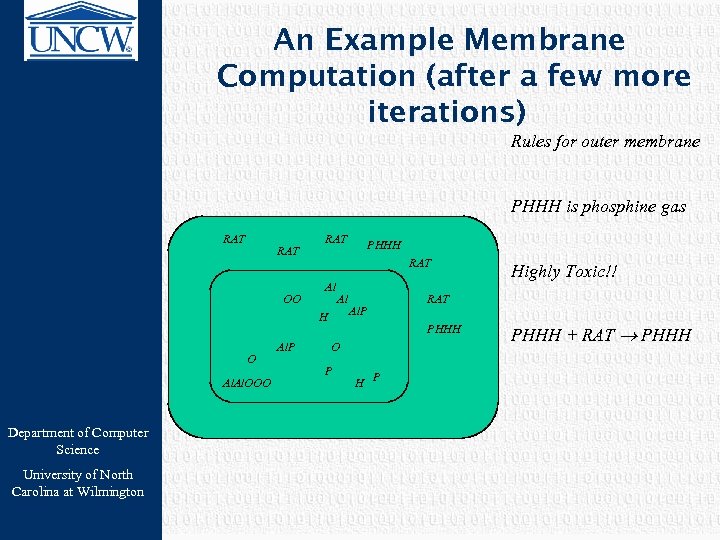
An Example Membrane Computation (after a few more iterations) Rules for outer membrane PHHH is phosphine gas RAT OO RAT Al Al H O Al. OOO Department of Computer Science University of North Carolina at Wilmington Al. P PHHH Al. P RAT PHHH O P Highly Toxic!! PHHH + RAT PHHH
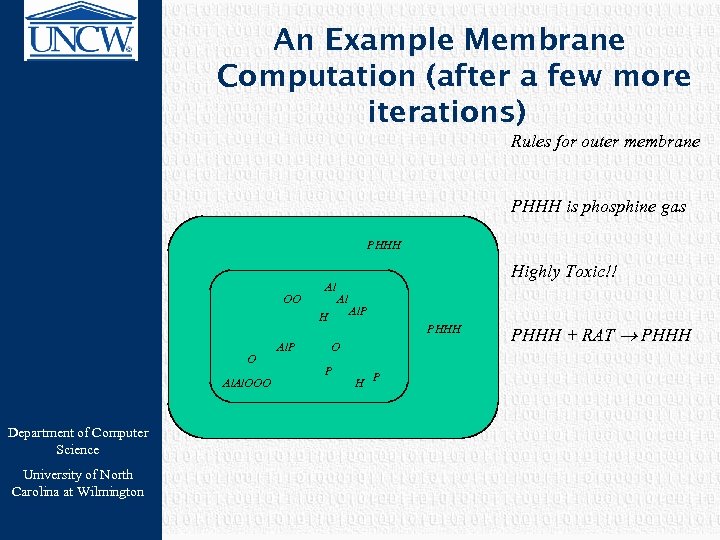
An Example Membrane Computation (after a few more iterations) Rules for outer membrane PHHH is phosphine gas PHHH Highly Toxic!! OO Al Al H O Al. OOO Department of Computer Science University of North Carolina at Wilmington Al. P PHHH O P H P PHHH + RAT PHHH
What is Cost-Based Abduction (CBA)? v. An attempt to find a proof with the lowest cost v. Reasoning under uncertainty v. NP-Hard Department of Computer Science University of North Carolina at Wilmington
CBA v Abductionis the process of proceeding from data describing observations or events, to a set of hypotheses, which best explains or accounts for the data. v Employed in a variety of application domains including medical diagnostics natural language processing , , belief revision , and automated planning. v Cost-based abduction is a formalism in which Ø Evidence to be explained is treated as a goal to be proven, Ø Proofs have costs based on how much needs to be assumed to complete the proof, and Ø The set of assumptions needed to complete the least-cost proof are taken as the best explanation for the given evidence. Department of Computer Science University of North Carolina at Wilmington
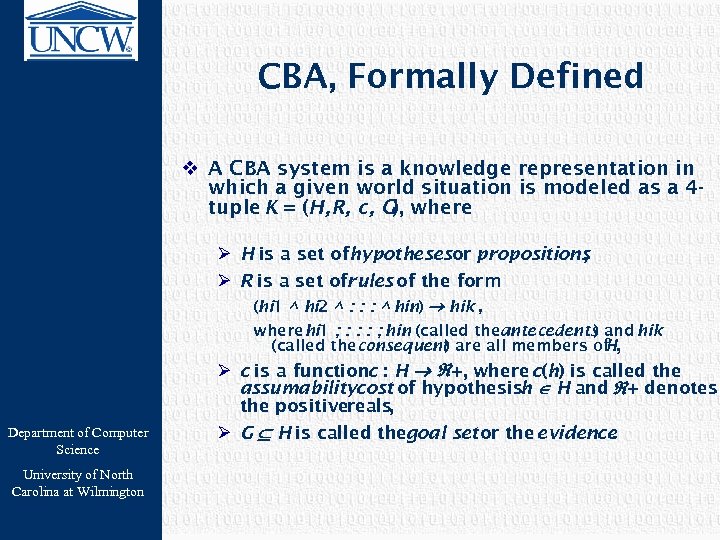
CBA, Formally Defined v A CBA system is a knowledge representation in which a given world situation is modeled as a 4 tuple K = (H, R, c, G), where Ø H is a set ofhypothesesor propositions , Ø R is a set ofrules of the form (hi 1 ^ hi 2 ^ : : : ^ hin) hik , where hi 1 ; : : : ; hin (called theantecedents and hik ) (called theconsequent are all members of ) H, Department of Computer Science University of North Carolina at Wilmington Ø c is a functionc : H +, where c(h) is called the assumabilitycost of hypothesish H and + denotes the positivereals, Ø G H is called thegoal set or the evidence.
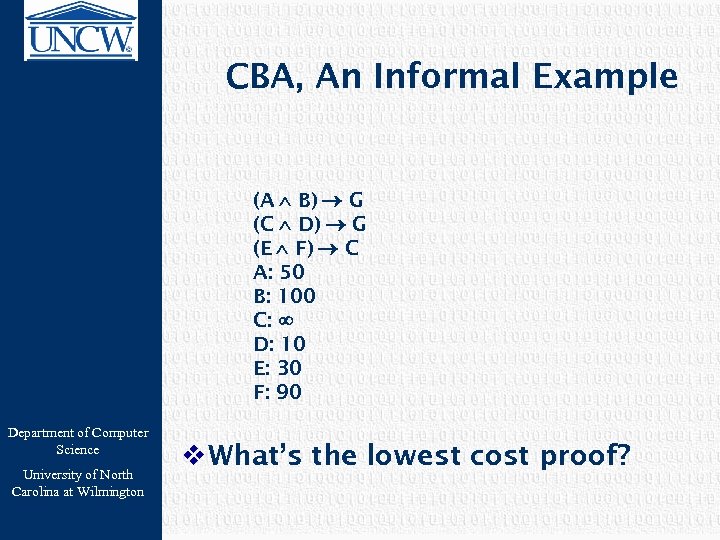
CBA, An Informal Example (A B) G (C D) G (E F) C A: 50 B: 100 C: D: 10 E: 30 F: 90 Department of Computer Science University of North Carolina at Wilmington v What’s the lowest cost proof?
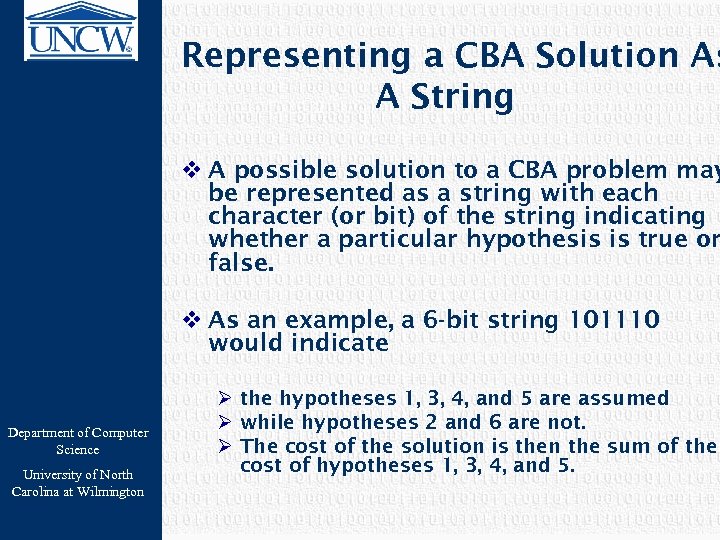
Representing a CBA Solution As A String v A possible solution to a CBA problem may be represented as a string with each character (or bit) of the string indicating whether a particular hypothesis is true or false. v As an example, a 6 -bit string 101110 would indicate Department of Computer Science University of North Carolina at Wilmington Ø the hypotheses 1, 3, 4, and 5 are assumed Ø while hypotheses 2 and 6 are not. Ø The cost of the solution is then the sum of the cost of hypotheses 1, 3, 4, and 5.
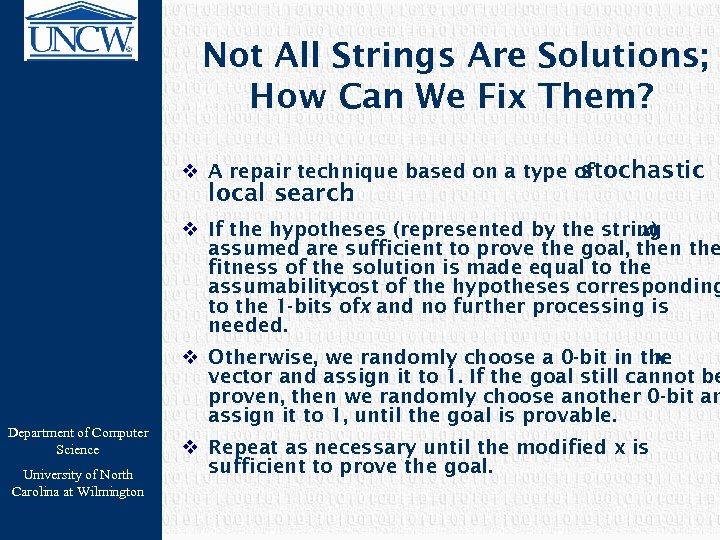
Not All Strings Are Solutions; How Can We Fix Them? v A repair technique based on a type of stochastic local search. v If the hypotheses (represented by the string x) assumed are sufficient to prove the goal, then the fitness of the solution is made equal to the assumabilitycost of the hypotheses corresponding to the 1 -bits ofx and no further processing is needed. Department of Computer Science University of North Carolina at Wilmington v Otherwise, we randomly choose a 0 -bit in the x vector and assign it to 1. If the goal still cannot be proven, then we randomly choose another 0 -bit an assign it to 1, until the goal is provable. v Repeat as necessary until the modified x is sufficient to prove the goal.
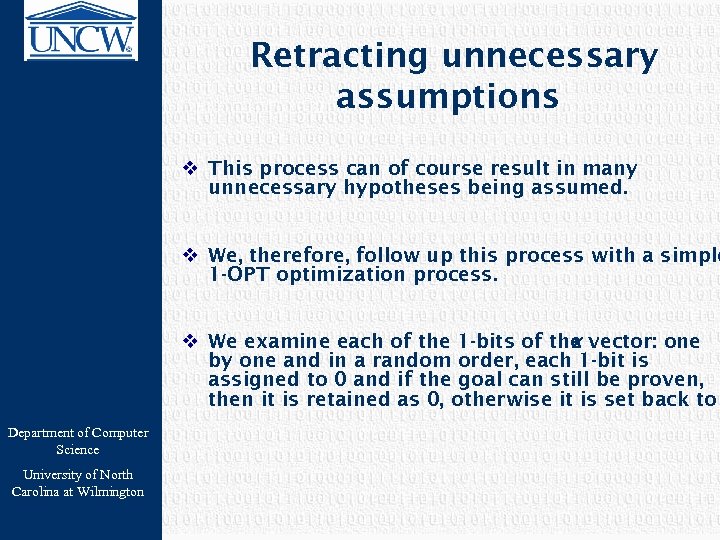
Retracting unnecessary assumptions v This process can of course result in many unnecessary hypotheses being assumed. v We, therefore, follow up this process with a simple 1 -OPT optimization process. v We examine each of the 1 -bits of the vector: one x by one and in a random order, each 1 -bit is assigned to 0 and if the goal can still be proven, then it is retained as 0, otherwise it is set back to Department of Computer Science University of North Carolina at Wilmington
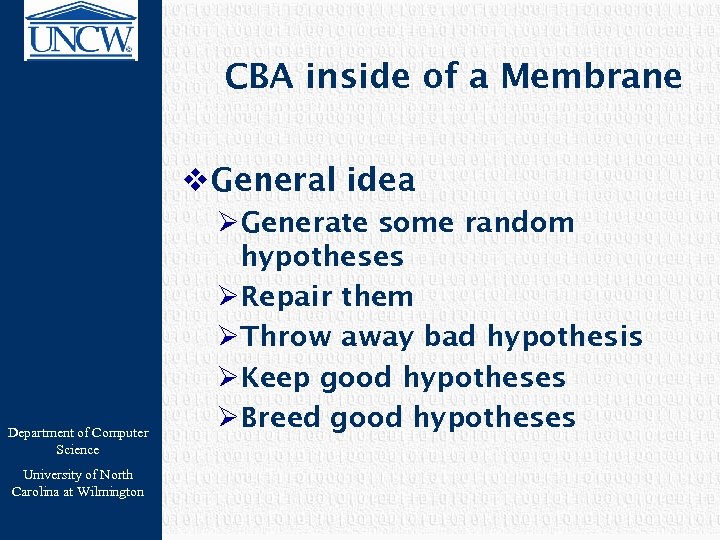
CBA inside of a Membrane v. General idea Department of Computer Science University of North Carolina at Wilmington ØGenerate some random hypotheses ØRepair them ØThrow away bad hypothesis ØKeep good hypotheses ØBreed good hypotheses
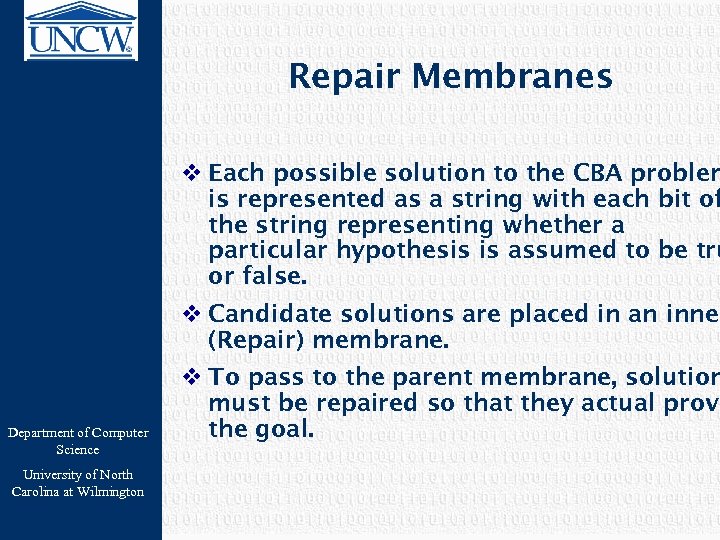
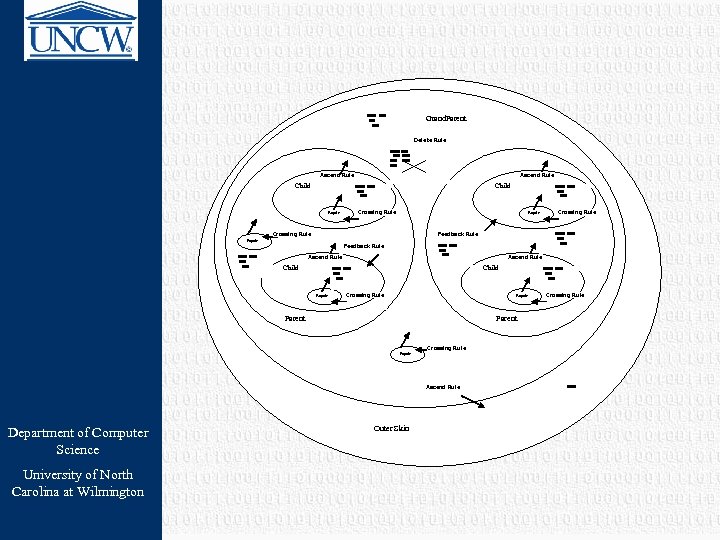
Repair Membranes v Each possible solution to the CBA problem is represented as a string with each bit of the string representing whether a particular hypothesis is assumed to be tru or false. v Candidate solutions are placed in an inner (Repair) membrane. Department of Computer Science University of North Carolina at Wilmington v To pass to the parent membrane, solution must be repaired so that they actual prove the goal.
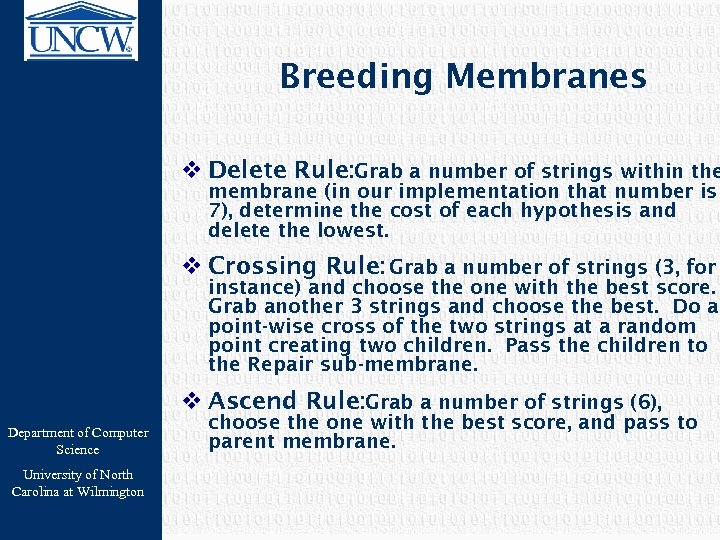
Breeding Membranes v Delete Rule: Grab a number of strings within the membrane (in our implementation that number is 7), determine the cost of each hypothesis and delete the lowest. v Crossing Rule: Grab a number of strings (3, for instance) and choose the one with the best score. Grab another 3 strings and choose the best. Do a point-wise cross of the two strings at a random point creating two children. Pass the children to the Repair sub-membrane. v Ascend Rule: Grab a number of strings (6), Department of Computer Science University of North Carolina at Wilmington choose the one with the best score, and pass to parent membrane.
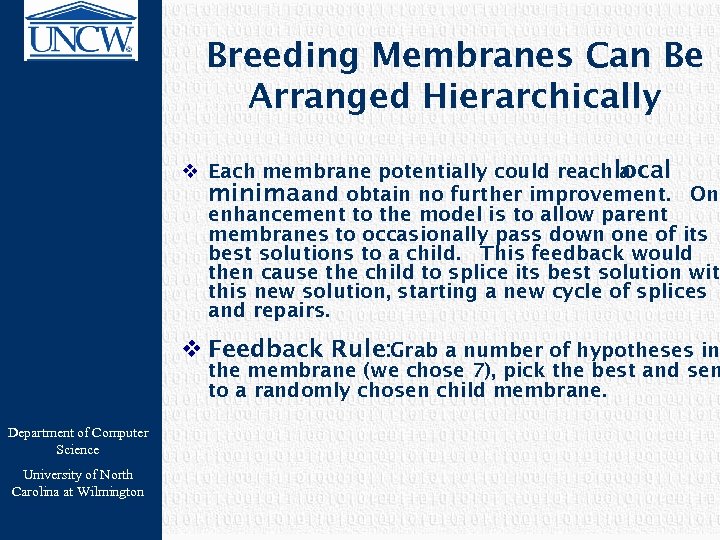
Breeding Membranes Can Be Arranged Hierarchically v Each membrane potentially could reach local a minima and obtain no further improvement. One enhancement to the model is to allow parent membranes to occasionally pass down one of its best solutions to a child. This feedback would then cause the child to splice its best solution wit this new solution, starting a new cycle of splices and repairs. v Feedback Rule: Grab a number of hypotheses in the membrane (we chose 7), pick the best and sen to a randomly chosen child membrane. Department of Computer Science University of North Carolina at Wilmington
10011011 100011 111100 Grand. Parent Delete Rule 10011011 110011 111001 101010 111100 001101 111110 Ascend Rule Child 10011011 100011 111100 Crossing Rule Repair 10011011 Crossing Rule Ascend Rule Child 10011011 100011 110011 111100 Repair 10011011 100011 111100 Feedback Rule Crossing Rule 101011011 Feedback Rule Splice Repair 10011011 100011 110011 111100 Crossing Rule 10011011 100011 111100 Repair Crossing Rule 10011011 Parent Crossing Rule Repair Ascend Rule Department of Computer Science University of North Carolina at Wilmington Outer Skin 10011011
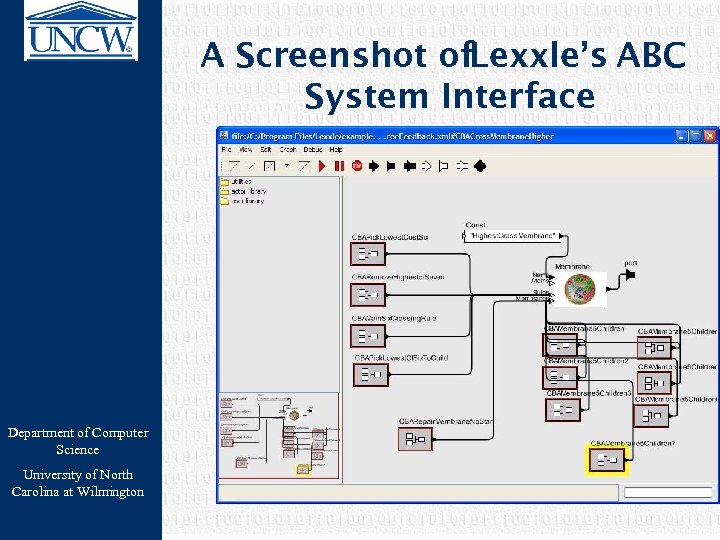
Lexxle’s ABC System v Our implementation of the membrane computer is accomplished using the Lexxl P-System/ABC System Toolkit by Lexxle, Inc. developed specifically for use on cluster computers. Department of Computer Science University of North Carolina at Wilmington v Design and testing of the architecture is accomplished using a graphical user interface supported by the Grid. Nexus software developed at the University of North Carolina Wilmington.
A Screenshot of. Lexxle’s ABC System Interface Department of Computer Science University of North Carolina at Wilmington
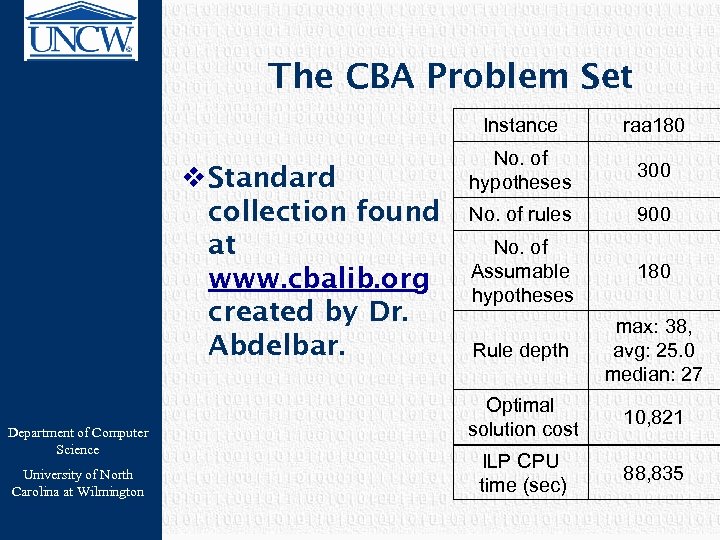
The CBA Problem Set Instance v Standard collection found at www. cbalib. org created by Dr. Abdelbar. Department of Computer Science University of North Carolina at Wilmington raa 180 No. of hypotheses 300 No. of rules 900 No. of Assumable hypotheses 180 Rule depth max: 38, avg: 25. 0 median: 27 Optimal solution cost 10, 821 ILP CPU time (sec) 88, 835
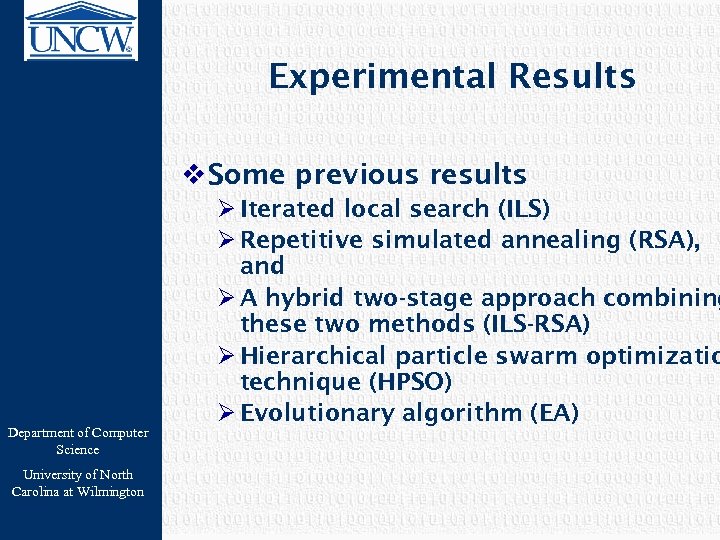
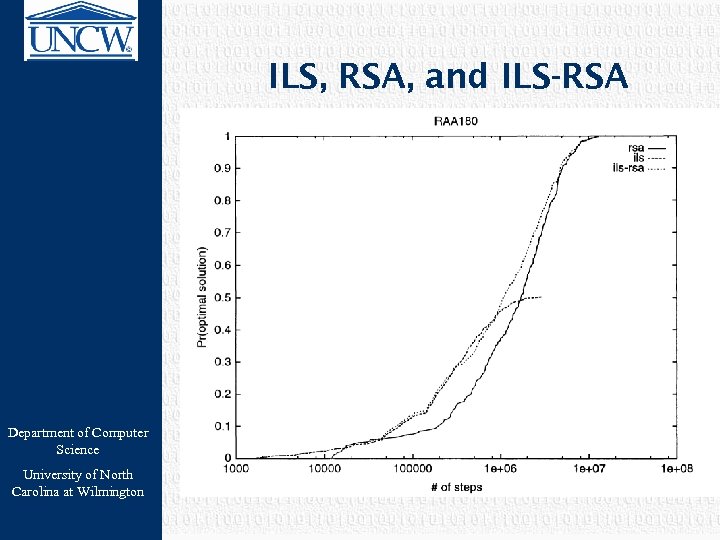
Experimental Results v Some previous results Department of Computer Science University of North Carolina at Wilmington Ø Iterated local search (ILS) Ø Repetitive simulated annealing (RSA), and Ø A hybrid two-stage approach combining these two methods (ILS-RSA) Ø Hierarchical particle swarm optimizatio technique (HPSO) Ø Evolutionary algorithm (EA)
ILS, RSA, and ILS-RSA Department of Computer Science University of North Carolina at Wilmington
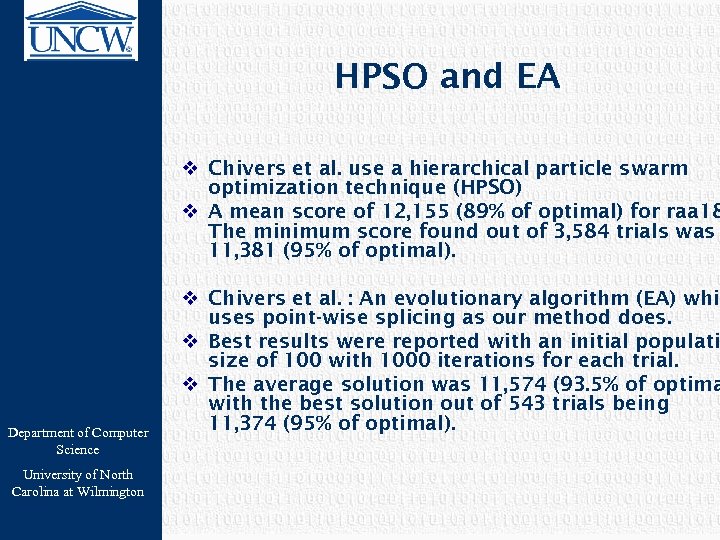
HPSO and EA v Chivers et al. use a hierarchical particle swarm optimization technique (HPSO) v A mean score of 12, 155 (89% of optimal) for raa 18 The minimum score found out of 3, 584 trials was 11, 381 (95% of optimal). Department of Computer Science University of North Carolina at Wilmington v Chivers et al. : An evolutionary algorithm (EA) whic uses point-wise splicing as our method does. v Best results were reported with an initial populati size of 100 with 1000 iterations for each trial. v The average solution was 11, 574 (93. 5% of optima with the best solution out of 543 trials being 11, 374 (95% of optimal).
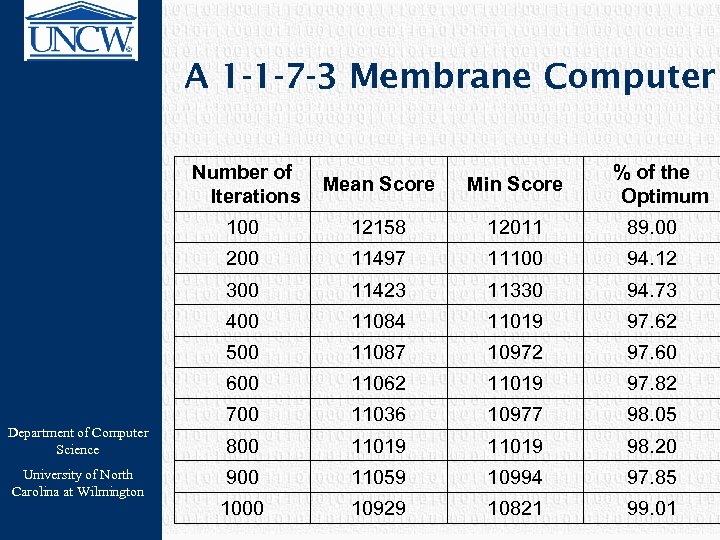
A 1 -1 -7 -3 Membrane Computer Number of Iterations 12158 12011 89. 00 200 11497 11100 94. 12 300 11423 11330 94. 73 400 11084 11019 97. 62 500 11087 10972 97. 60 600 University of North Carolina at Wilmington Min Score 100 Department of Computer Science Mean Score % of the Optimum 11062 11019 97. 82 700 11036 10977 98. 05 800 11019 98. 20 900 11059 10994 97. 85 1000 10929 10821 99. 01
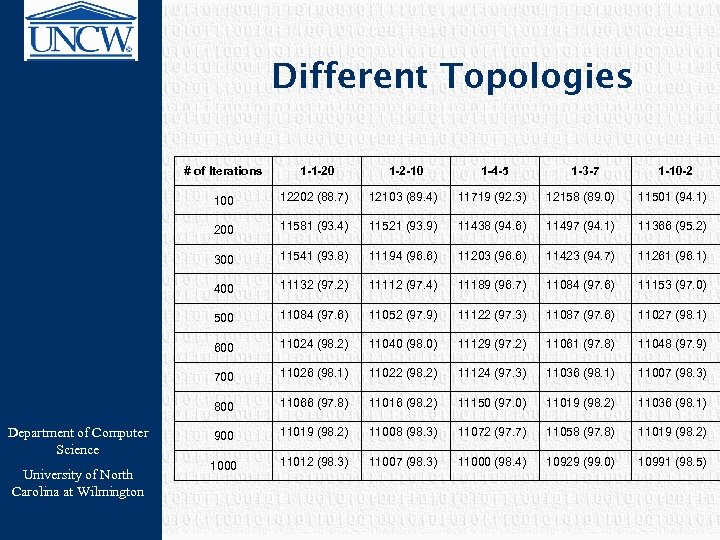
Different Topologies # of Iterations 1 -4 -5 12202 (88. 7) 12103 (89. 4) 11719 (92. 3) 12158 (89. 0) 11501 (94. 1) 200 11581 (93. 4) 11521 (93. 9) 11438 (94. 6) 11497 (94. 1) 11366 (95. 2) 300 11541 (93. 8) 11194 (96. 6) 11203 (96. 6) 11423 (94. 7) 11261 (96. 1) 400 11132 (97. 2) 11112 (97. 4) 11189 (96. 7) 11084 (97. 6) 11153 (97. 0) 500 11084 (97. 6) 11052 (97. 9) 11122 (97. 3) 11087 (97. 6) 11027 (98. 1) 600 11024 (98. 2) 11040 (98. 0) 11129 (97. 2) 11061 (97. 8) 11048 (97. 9) 700 11026 (98. 1) 11022 (98. 2) 11124 (97. 3) 11036 (98. 1) 11007 (98. 3) 800 University of North Carolina at Wilmington 1 -2 -10 100 Department of Computer Science 1 -1 -20 1 -3 -7 1 -10 -2 11066 (97. 8) 11016 (98. 2) 11150 (97. 0) 11019 (98. 2) 11036 (98. 1) 900 11019 (98. 2) 11008 (98. 3) 11072 (97. 7) 11058 (97. 8) 11019 (98. 2) 1000 11012 (98. 3) 11007 (98. 3) 11000 (98. 4) 10929 (99. 0) 10991 (98. 5)
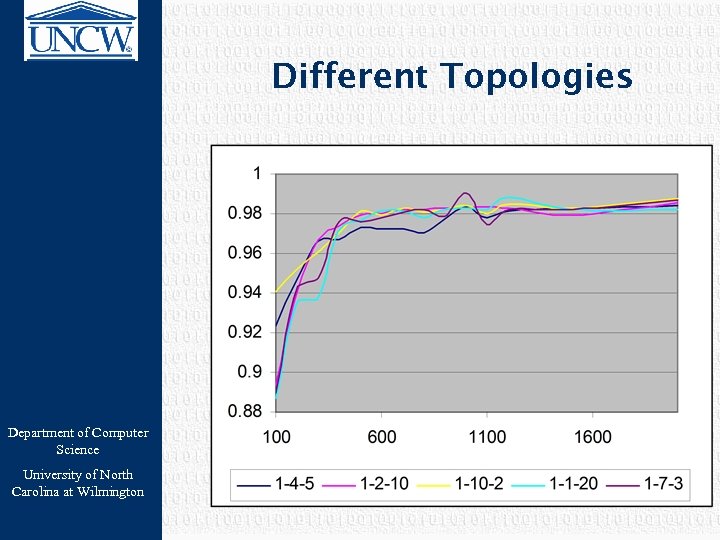
Different Topologies Department of Computer Science University of North Carolina at Wilmington
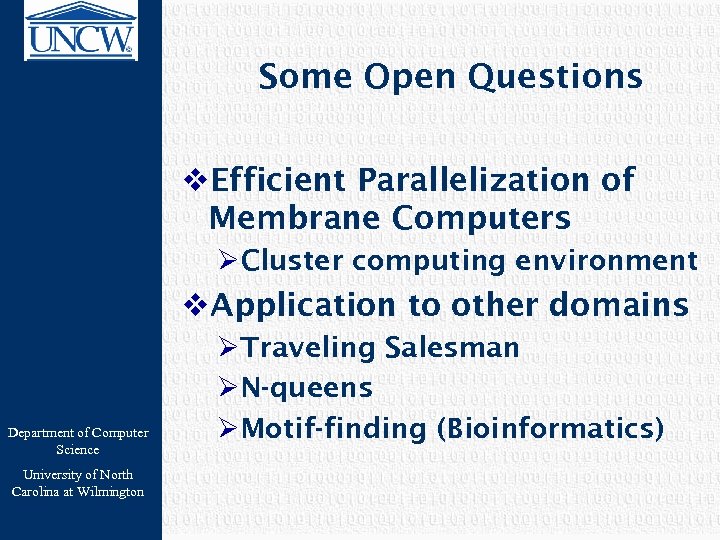
Some Open Questions v. Efficient Parallelization of Membrane Computers ØCluster computing environment v. Application to other domains Department of Computer Science University of North Carolina at Wilmington ØTraveling Salesman ØN-queens ØMotif-finding (Bioinformatics)
Thank you! v. Your Questions? Department of Computer Science University of North Carolina at Wilmington
Скачать презентацию Using Membrane Computers to Find Nearly-Optimal Solutions to
d4ff527a7930de1f6a3df9648a11f2ea.ppt