 Скачать презентацию Using IP-Based Applications for Improving Disaster Response Henning
c9cda1924b872f1b80b4dcac139233e5.ppt
- Количество слайдов: 49



Using IP-Based Applications for Improving Disaster Response Henning Schulzrinne Dept. of Computer Science, Columbia University, New York hgs@cs. columbia. edu (with Jong Yul Kim, Wonsang Song, Anshuman Rawat, Matthew Mintz-Habib, Amrita Rajagopal and Xiaotao Wu) Net. Cri 2007 (IPCCC) New Orleans, LA April 13, 2007 Net. Cri'07
Outline • Needs & status vs. new toys • Emergency coordination – going beyond ad hoc networks • Emergency calling – the challenge of two transitions: mobility and Vo. IP • Emergency alerts – multi-modal alerting – beyond siren replacement Net. Cri'07 2
General requirements • Low cost – may only be used very rarely • Ease of use – most users are non-techies (or worse) – volunteers with range of capabilities – tools that are familiar to volunteers (web browser vs. custom application) • Robust – spikes of usage • example: FEMA application crash – outdoor & hostile environment • example: sun glare rendered laptops useless • no chargers for cell phones • unreliable network connections --> delay-tolerant networks, data mules, 7 DS, … • Daily use, not just major catastrophes – nobody wants to learn a new tool during a hurricane Net. Cri'07 3
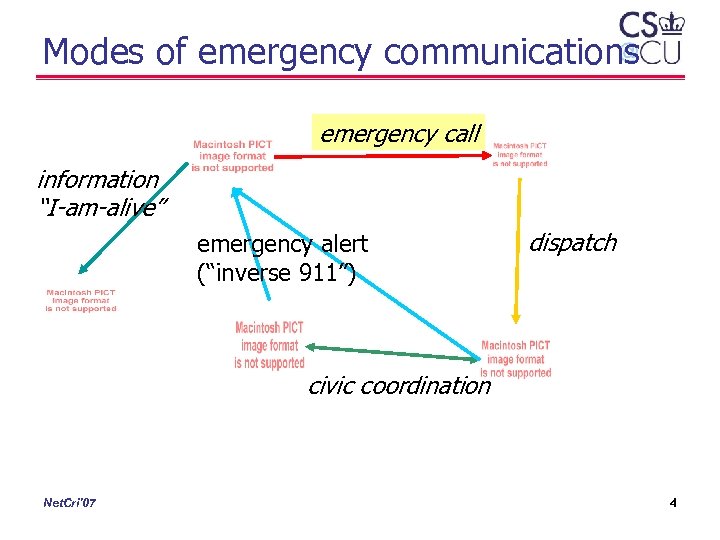
Modes of emergency communications emergency call information “I-am-alive” emergency alert (“inverse 911”) dispatch civic coordination Net. Cri'07 4
Outline • Needs & status vs. new toys • Emergency coordination – going beyond ad hoc networks • Emergency calling – the challenge of two transitions: mobility and Vo. IP • Emergency alerts – multi-modal alerting – beyond siren replacement Net. Cri'07 5
Emergency coordination • Structured coordination – directories (people, vehicles, equipment, . . . ) • see COMCARE effort – – resource tracking “trouble tickets” avoid current low-bandwidth radio-based coordination most (? ) police cars have laptops with data links • Unstructured coordination – unpredictable needs – leverage existing content creation tools: Wikis, blogs, Google Base, Backpack, . . . – combinations of existing tools (e. g. , Google maps and databases) Net. Cri'07 6
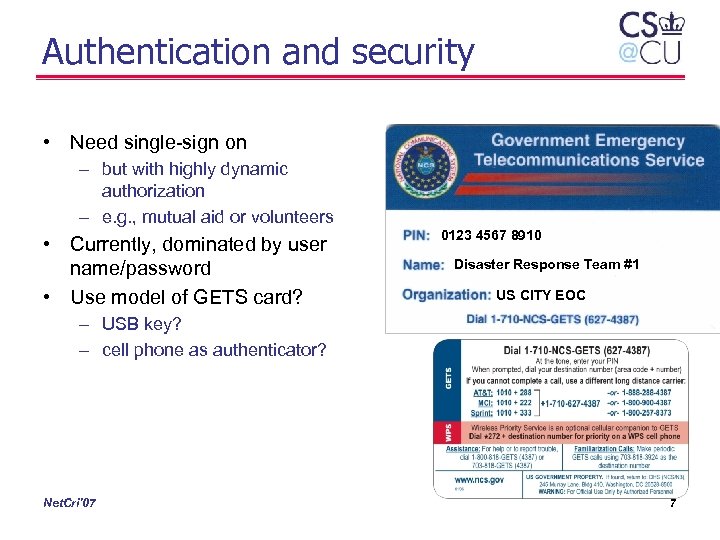
Authentication and security • Need single-sign on – but with highly dynamic authorization – e. g. , mutual aid or volunteers • Currently, dominated by user name/password • Use model of GETS card? 0123 4567 8910 Disaster Response Team #1 US CITY EOC – USB key? – cell phone as authenticator? Net. Cri'07 7
Example: Sahana • Developed in 2004 after tsunami (in three weeks) • Open source (PHP, my. SQL) • Component-based – organization and people registry – inventory management – situation mapping – synchronization • allows for disconnected operation – XML synchronization © ACM CACM 2007 50(3) Net. Cri'07 8
Outline • Needs & status vs. new toys • Emergency coordination – going beyond ad hoc networks • Emergency calling – the challenge of two transitions: mobility and Vo. IP • Emergency alerts – multi-modal alerting – beyond siren replacement Net. Cri'07 9
Background on 9 -1 -1 • Established in Feb. 1968 – – 1970 s: selective call routing late 1990 s: 93% of population/96% of area covered by 9 -1 -1 95% of 9 -1 -1 is Enhanced 9 -1 -1 US and Canada • Roughly 200 mio. calls a year (6 calls/second) – 1/3 wireless • 6146 PSAPs in 3135 counties – most are small (2 -6 call takers) – 83. 1% of population have some Phase II (April 2007) • “ 12 -15 million households will be using Vo. IP as either primary or secondary line by end of 2008” (NENA) Net. Cri'07 http: //www. nena. org/ 10
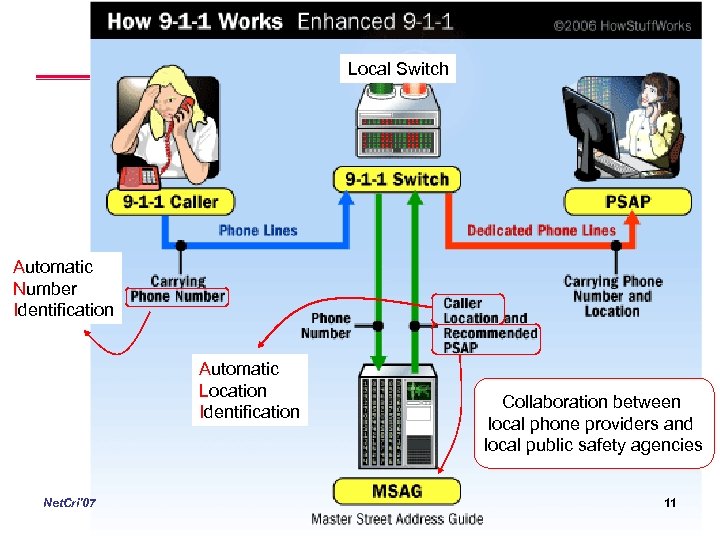
Local Switch Automatic Number Identification Automatic Location Identification Net. Cri'07 Collaboration between local phone providers and local public safety agencies 11
911 technology failures • NY Times (“An S O S for 911 Systems in Age of High-Tech”), 4/6/07: – “ 40% of … counties, most of them rural or small-town …, cannot yet pinpoint the location of the cellphone callers, though the technology to do so has been available for at least five years. ” “In … Okmulgee, Okla. , last November, 4 -year-old Graciella Mathews. Tiger died in a house fire after a 911 operator who lacked the technology to pinpoint the call misheard the address. ” • Phase II wireless; billions of dollars spent • In Mississippi, only 1 of out 5 counties – “As it ages, it is cracking, with problems like system overload, understaffing, misrouted calls and bug-ridden databases leading to unanswered calls and dangerous errors. ” • operator (CAMA) trunks, with 8 -digit number delivery • MSAG and ALI databases Net. Cri'07 12
![911 technology failures, cont’d • “In Cherokee County [OK], for instance, the volume has](https://present5.com/presentation/c9cda1924b872f1b80b4dcac139233e5/image-13.jpg "911 technology failures, cont’d • “In Cherokee County [OK], for instance, the volume has")
911 technology failures, cont’d • “In Cherokee County [OK], for instance, the volume has increased by 20 percent a year. ” “… answer 911 lines, then transfer calls to dispatchers for individual fire and police departments in the county, a system that requires callers to repeat themselves. ” – Inefficient call handling – Vermont dispatch-by-printer • “Officials in Riverside County, Calif. , fed up with misrouted calls, have been advising residents to call the sheriff or local fire department directly. ” – incomplete MSAG – cumbersome ALI update procedures Net. Cri'07 13
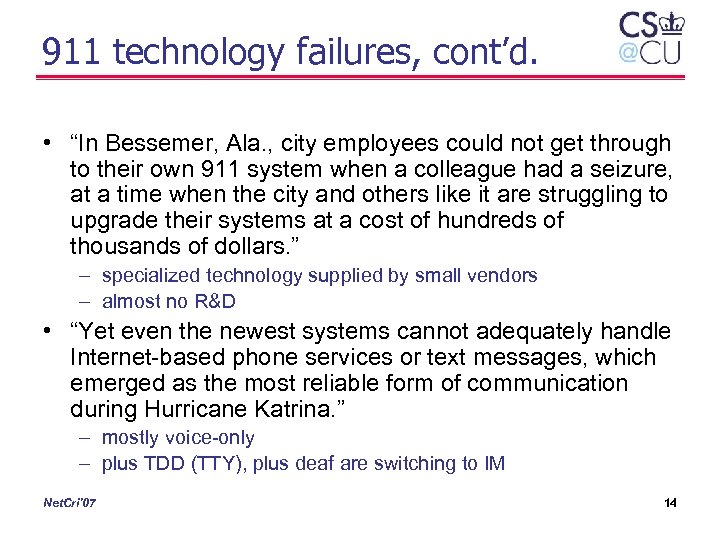
911 technology failures, cont’d. • “In Bessemer, Ala. , city employees could not get through to their own 911 system when a colleague had a seizure, at a time when the city and others like it are struggling to upgrade their systems at a cost of hundreds of thousands of dollars. ” – specialized technology supplied by small vendors – almost no R&D • “Yet even the newest systems cannot adequately handle Internet-based phone services or text messages, which emerged as the most reliable form of communication during Hurricane Katrina. ” – mostly voice-only – plus TDD (TTY), plus deaf are switching to IM Net. Cri'07 14
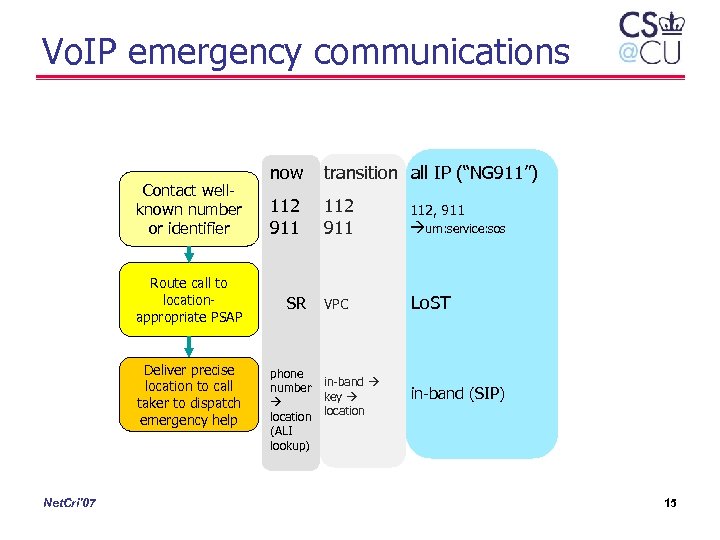
Vo. IP emergency communications Contact wellknown number dispatch or identifier Route call to locationappropriate PSAP Deliver precise location to call taker to dispatch emergency help Net. Cri'07 now transition all IP (“NG 911”) 112 911 112, 911 VPC Lo. ST in-band key location in-band (SIP) SR phone number location (ALI lookup) urn: service: sos 15
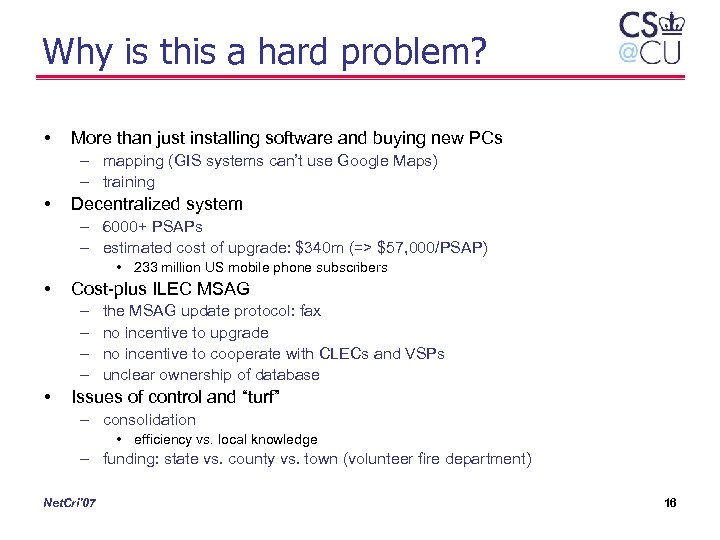
Why is this a hard problem? • More than just installing software and buying new PCs – mapping (GIS systems can’t use Google Maps) – training • Decentralized system – 6000+ PSAPs – estimated cost of upgrade: $340 m (=> $57, 000/PSAP) • 233 million US mobile phone subscribers • Cost-plus ILEC MSAG – – • the MSAG update protocol: fax no incentive to upgrade no incentive to cooperate with CLECs and VSPs unclear ownership of database Issues of control and “turf” – consolidation • efficiency vs. local knowledge – funding: state vs. county vs. town (volunteer fire department) Net. Cri'07 16
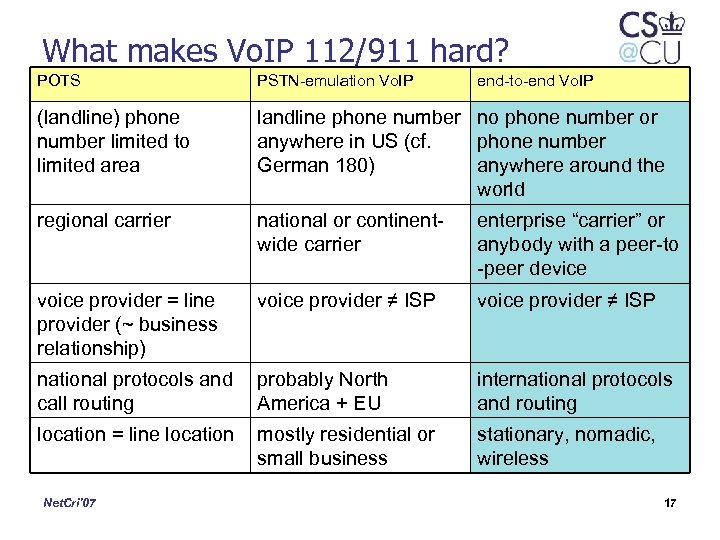
What makes Vo. IP 112/911 hard? POTS PSTN-emulation Vo. IP (landline) phone number limited to limited area landline phone number no phone number or anywhere in US (cf. phone number German 180) anywhere around the world regional carrier national or continentwide carrier enterprise “carrier” or anybody with a peer-to -peer device voice provider = line provider (~ business relationship) voice provider ≠ ISP national protocols and call routing probably North America + EU international protocols and routing location = line location mostly residential or small business stationary, nomadic, wireless Net. Cri'07 end-to-end Vo. IP 17
More than pain… • Multimedia from the caller – video capture from cell phones – video for sign language – text messaging and real-time text for the deaf • Data delivery – caller data: floor plan, hazmat data, medical alerts – measurement data input: automobile crash data, EKGs, … • Delivering video to the caller – e. g. , CPR training • Load balancing and redundancy – currently only limited secondary PSAP – Vo. IP can transfer overload calls anywhere • Location delivery – carry location with forwarded and transferred calls – multiple location objects (civic + geo) Net. Cri'07 18
Four Phases of Emergency Calls Phase 1 Net. Cri'07 Phase 2 Phase 3 Phase 4 19
IETF ECRIT working group • • Emergency Contact Resolution with Internet Technologies Solve four major pieces of the puzzle: – – • location conveyance (with SIP & GEOPRIV) emergency call identification mapping geo and civic caller locations to PSAP URI discovery of local and visited emergency dial string Not solving – location discovery --> IETF GEOPRIV WG, IEEE – inter-PSAP communication and coordination – citizen notification • Current status: – finishing general and security requirements – agreement on mapping protocol (Lo. ST) and identifier (sos URN) – working on overall architecture and UA requirements Net. Cri'07 20
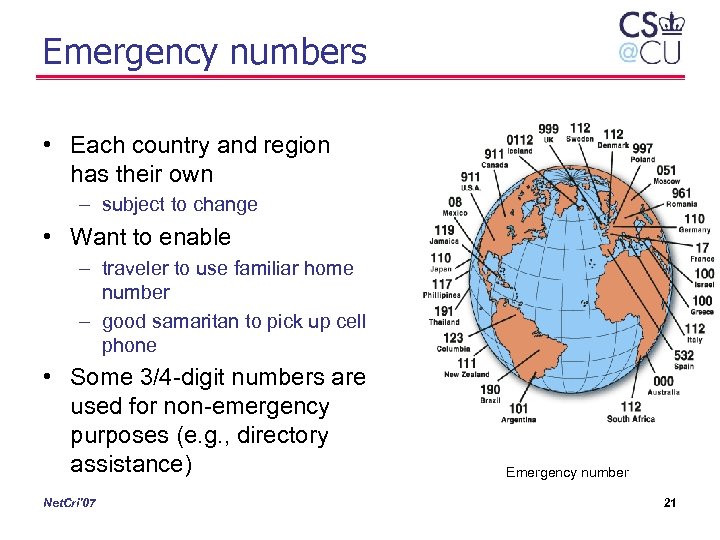
Emergency numbers • Each country and region has their own – subject to change • Want to enable – traveler to use familiar home number – good samaritan to pick up cell phone • Some 3/4 -digit numbers are used for non-emergency purposes (e. g. , directory assistance) Net. Cri'07 Emergency number 21
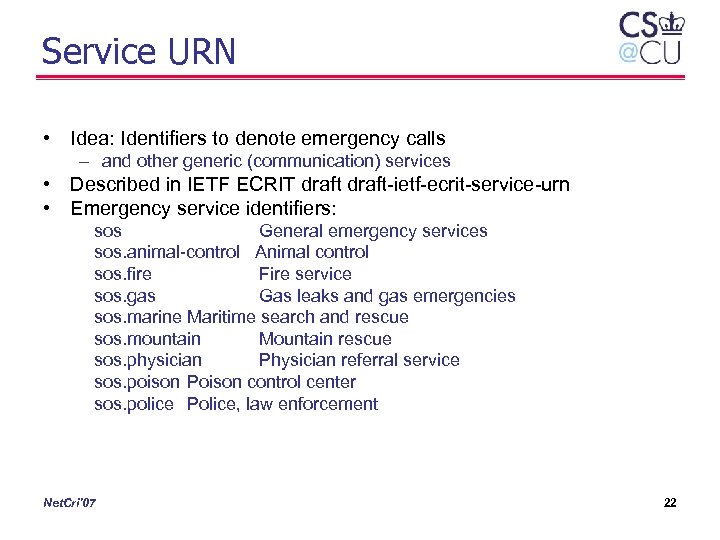
Service URN • Idea: Identifiers to denote emergency calls – and other generic (communication) services • Described in IETF ECRIT draft-ietf-ecrit-service-urn • Emergency service identifiers: sos General emergency services sos. animal-control Animal control sos. fire Fire service sos. gas Gas leaks and gas emergencies sos. marine Maritime search and rescue sos. mountain Mountain rescue sos. physician Physician referral service sos. poison Poison control center sos. police Police, law enforcement Net. Cri'07 22
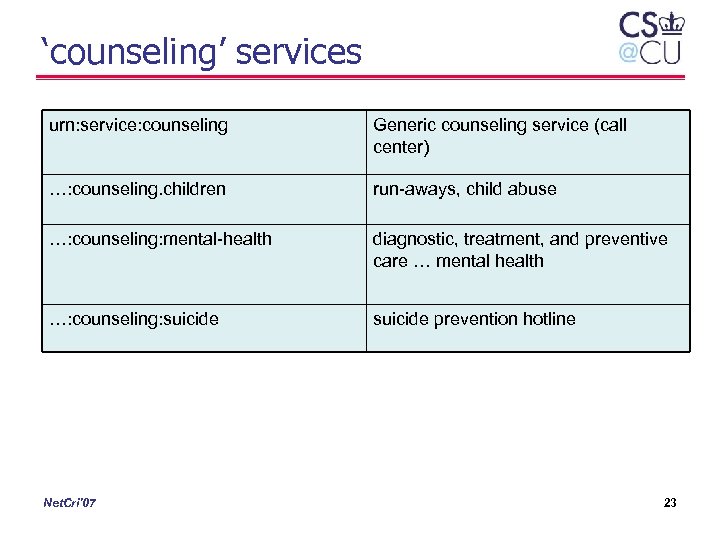
‘counseling’ services urn: service: counseling Generic counseling service (call center) …: counseling. children run-aways, child abuse …: counseling: mental-health diagnostic, treatment, and preventive care … mental health …: counseling: suicide prevention hotline Net. Cri'07 23
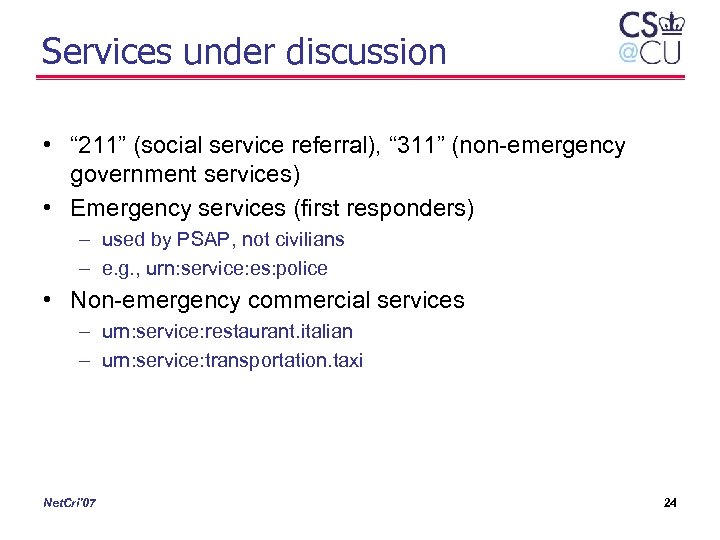
Services under discussion • “ 211” (social service referral), “ 311” (non-emergency government services) • Emergency services (first responders) – used by PSAP, not civilians – e. g. , urn: service: es: police • Non-emergency commercial services – urn: service: restaurant. italian – urn: service: transportation. taxi Net. Cri'07 24
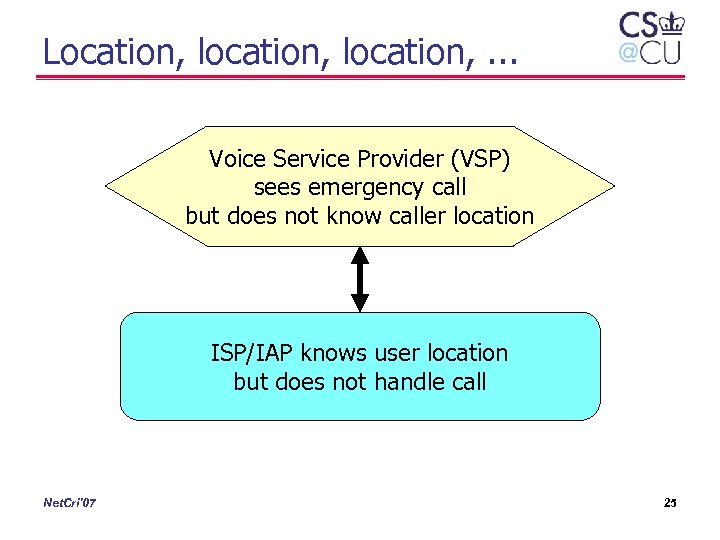
Location, location, . . . Voice Service Provider (VSP) sees emergency call but does not know caller location ISP/IAP knows user location but does not handle call Net. Cri'07 25
Locating Caller using LLDP-MED stands for: * * From Wikipedia Link Layer Discovery Protocol “a vendor-neutral Layer 2 protocol that allows a network device to advertise its identity and capabilities on the local network. ” Media Endpoint Discovery “an enhancement to the LLDP that allows discovery of other things including location “ “I am LLDP-MED Capable. I can process location information. ” Net. Cri'07 “Your location is: 26 500 W 120 TH st. New York NY 10027”
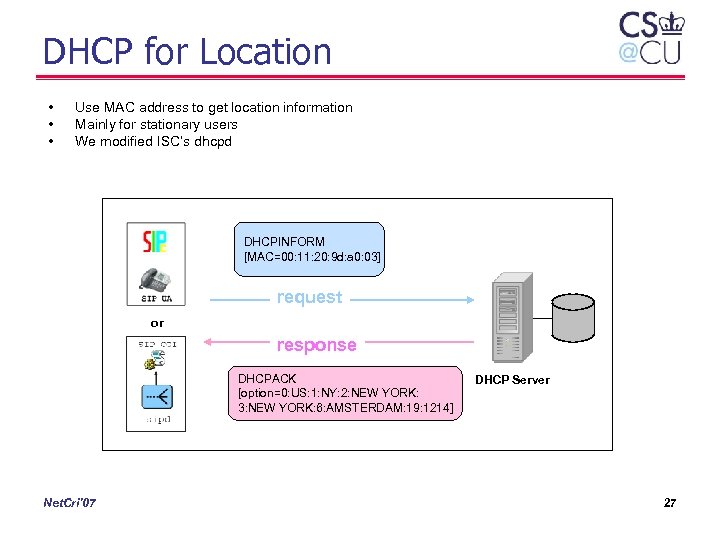
DHCP for Location • • • Use MAC address to get location information Mainly for stationary users We modified ISC’s dhcpd DHCPINFORM [MAC=00: 11: 20: 9 d: a 0: 03] request or response DHCPACK [option=0: US: 1: NY: 2: NEW YORK: 3: NEW YORK: 6: AMSTERDAM: 19: 1214] Net. Cri'07 DHCP Server 27
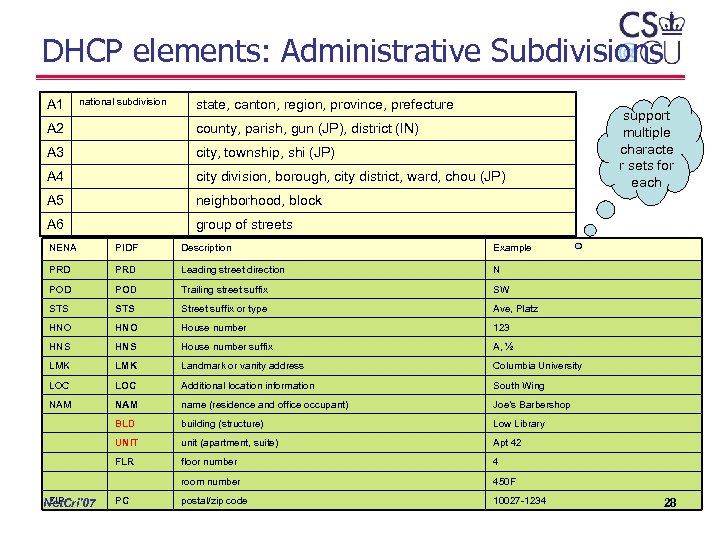
DHCP elements: Administrative Subdivisions A 1 national subdivision state, canton, region, province, prefecture A 2 county, parish, gun (JP), district (IN) A 3 city, township, shi (JP) A 4 city division, borough, city district, ward, chou (JP) A 5 neighborhood, block A 6 support multiple characte r sets for each group of streets NENA PIDF Description Example PRD Leading street direction N POD Trailing street suffix SW STS Street suffix or type Ave, Platz HNO House number 123 HNS House number suffix A, ½ LMK Landmark or vanity address Columbia University LOC Additional location information South Wing NAM name (residence and office occupant) Joe’s Barbershop BLD building (structure) Low Library UNIT unit (apartment, suite) Apt 42 FLR floor number 4 room number 450 F postal/zip code 10027 -1234 ZIP Net. Cri'07 PC 28
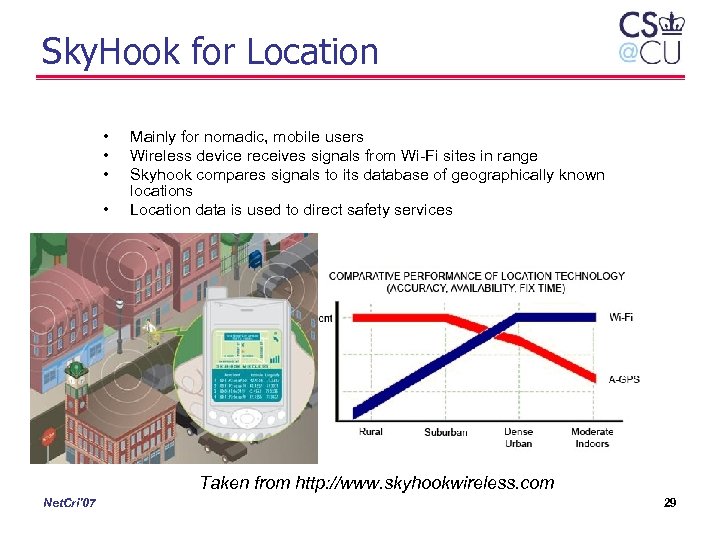
Sky. Hook for Location • • Mainly for nomadic, mobile users Wireless device receives signals from Wi-Fi sites in range Skyhook compares signals to its database of geographically known locations Location data is used to direct safety services Taken from http: //www. skyhookwireless. com Net. Cri'07 29
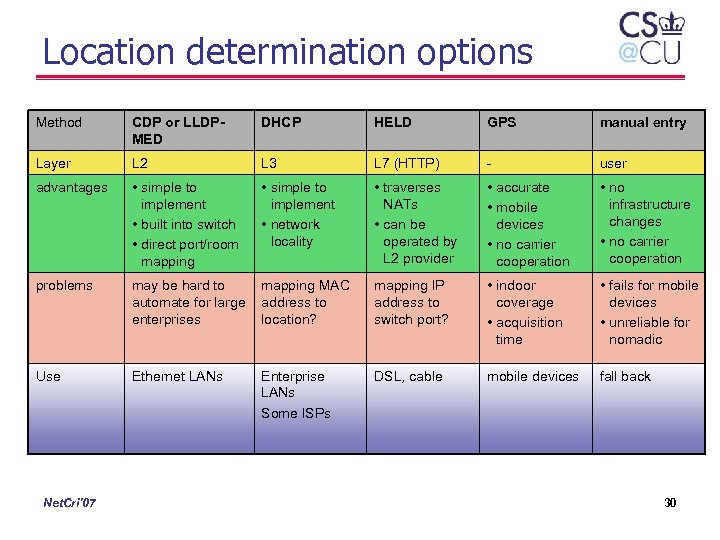
Location determination options Method CDP or LLDPMED DHCP HELD GPS manual entry Layer L 2 L 3 L 7 (HTTP) - user advantages • simple to implement • built into switch • direct port/room mapping • simple to implement • network locality • traverses NATs • can be operated by L 2 provider • accurate • mobile devices • no carrier cooperation • no infrastructure changes • no carrier cooperation problems may be hard to automate for large enterprises mapping MAC address to location? mapping IP address to switch port? • indoor coverage • acquisition time • fails for mobile devices • unreliable for nomadic Use Ethernet LANs Enterprise LANs Some ISPs DSL, cable mobile devices fall back Net. Cri'07 30
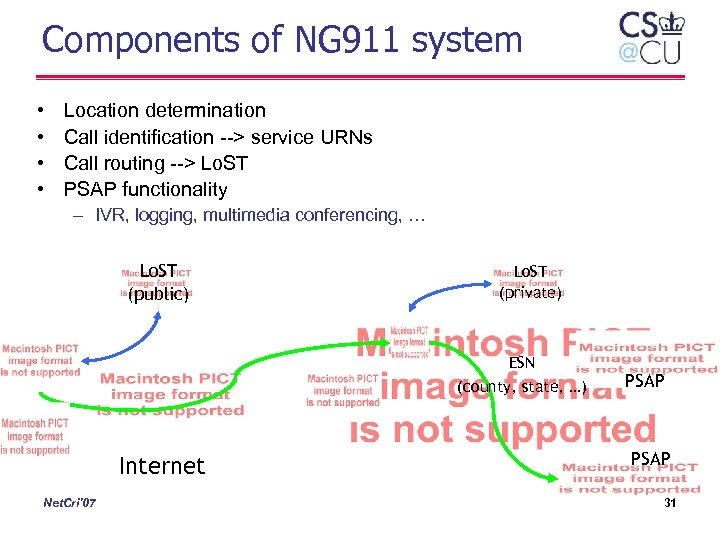
Components of NG 911 system • • Location determination Call identification --> service URNs Call routing --> Lo. ST PSAP functionality – IVR, logging, multimedia conferencing, … Lo. ST (public) Lo. ST (private) ESN (county, state, …) Internet Net. Cri'07 PSAP 31
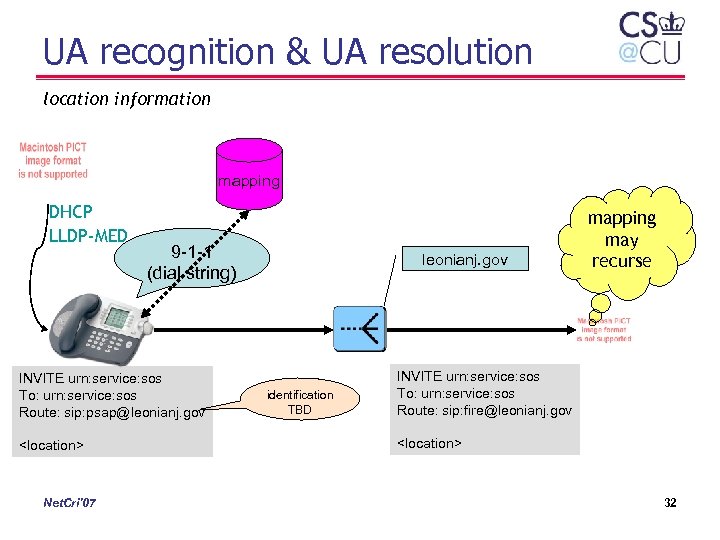
UA recognition & UA resolution location information mapping DHCP LLDP-MED 9 -1 -1 (dial string) INVITE urn: service: sos To: urn: service: sos Route: sip: psap@leonianj. gov <location> Net. Cri'07 leonianj. gov identification TBD mapping may recurse INVITE urn: service: sos To: urn: service: sos Route: sip: fire@leonianj. gov <location> 32
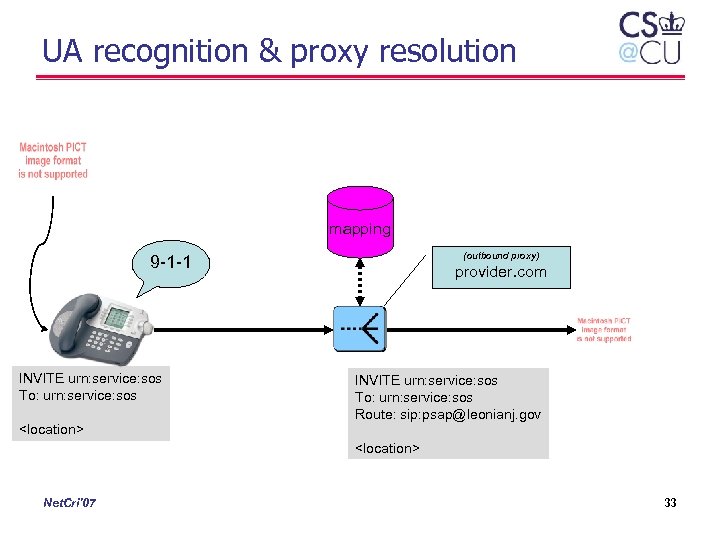
UA recognition & proxy resolution mapping (outbound proxy) 9 -1 -1 INVITE urn: service: sos To: urn: service: sos <location> provider. com INVITE urn: service: sos To: urn: service: sos Route: sip: psap@leonianj. gov <location> Net. Cri'07 33
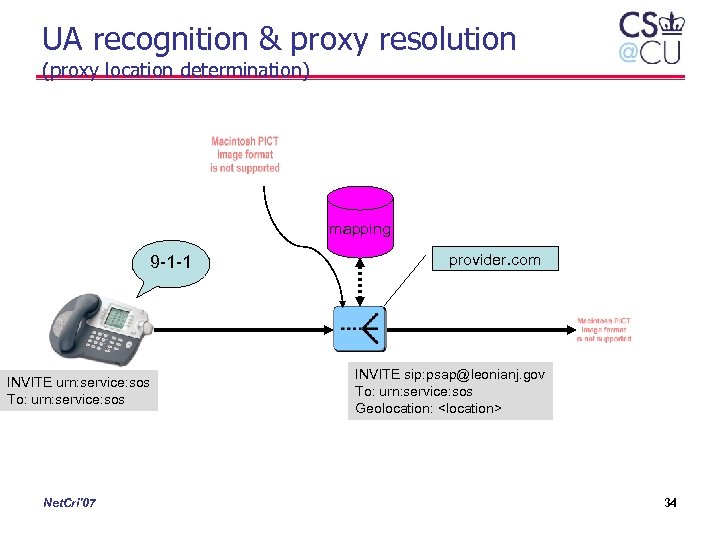
UA recognition & proxy resolution (proxy location determination) mapping 9 -1 -1 INVITE urn: service: sos To: urn: service: sos Net. Cri'07 provider. com INVITE sip: psap@leonianj. gov To: urn: service: sos Geolocation: <location> 34
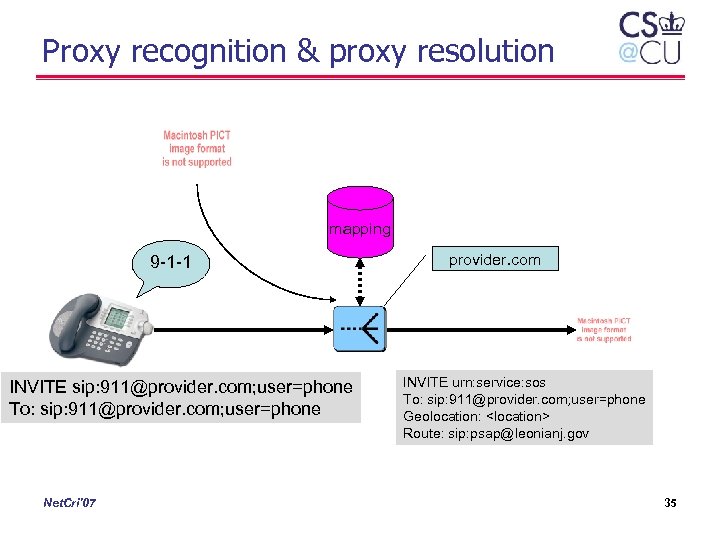
Proxy recognition & proxy resolution mapping 9 -1 -1 INVITE sip: 911@provider. com; user=phone To: sip: 911@provider. com; user=phone Net. Cri'07 provider. com INVITE urn: service: sos To: sip: 911@provider. com; user=phone Geolocation: <location> Route: sip: psap@leonianj. gov 35
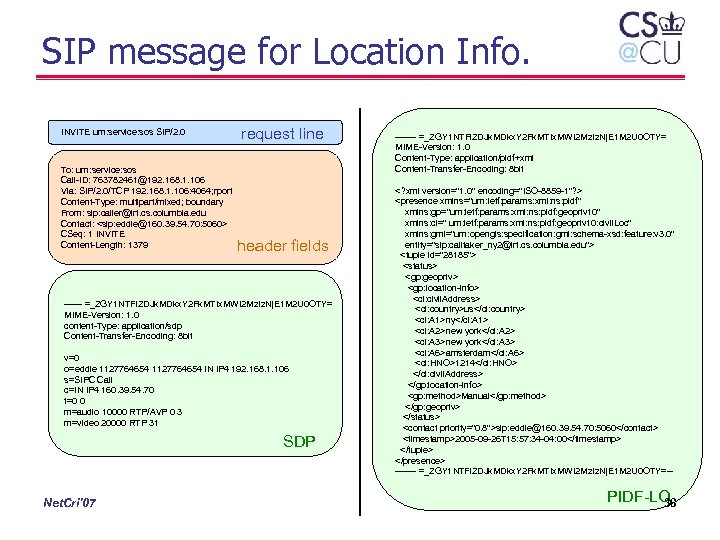
SIP message for Location Info. INVITE urn: service: sos SIP/2. 0 To: urn: service: sos Call-ID: 763782461@192. 168. 1. 106 Via: SIP/2. 0/TCP 192. 168. 1. 106: 4064; rport Content-Type: multipart/mixed; boundary From: sip: caller@irt. cs. columbia. edu Contact: <sip: eddie@160. 39. 54. 70: 5060> CSeq: 1 INVITE Content-Length: 1379 request line header fields ------ =_ZGY 1 NTFl. ZDJk. MDkx. Y 2 Fk. MTIx. MWI 2 Mz. Iz. Nj. E 1 M 2 U 0 OTY= MIME-Version: 1. 0 content-Type: application/sdp Content-Transfer-Encoding: 8 bit v=0 o=eddie 1127764654 IN IP 4 192. 168. 1. 106 s=SIPC Call c=IN IP 4 160. 39. 54. 70 t=0 0 m=audio 10000 RTP/AVP 0 3 m=video 20000 RTP 31 SDP Net. Cri'07 ------- =_ZGY 1 NTFl. ZDJk. MDkx. Y 2 Fk. MTIx. MWI 2 Mz. Iz. Nj. E 1 M 2 U 0 OTY= MIME-Version: 1. 0 Content-Type: application/pidf+xml Content-Transfer-Encoding: 8 bit <? xml version="1. 0" encoding="ISO-8859 -1"? > <presence xmlns="urn: ietf: params: xml: ns: pidf" xmlns: gp="urn: ietf: params: xml: ns: pidf: geopriv 10" xmlns: cl=" urn: ietf: params: xml: ns: pidf: geopriv 10: civil. Loc" xmlns: gml="urn: opengis: specification: gml: schema-xsd: feature: v 3. 0" entity="sip: calltaker_ny 2@irt. cs. columbia. edu"> <tuple id="28185"> <status> <gp: geopriv> <gp: location-info> <cl: civil. Address> <cl: country>us</cl: country> <cl: A 1>ny</cl: A 1> <cl: A 2>new york</cl: A 2> <cl: A 3>new york</cl: A 3> <cl: A 6>amsterdam</cl: A 6> <cl: HNO>1214</cl: HNO> </cl: civil. Address> </gp: location-info> <gp: method>Manual</gp: method> </gp: geopriv> </status> <contact priority="0. 8">sip: eddie@160. 39. 54. 70: 5060</contact> <timestamp>2005 -09 -26 T 15: 57: 34 -04: 00</timestamp> </tuple> </presence> ------- =_ZGY 1 NTFl. ZDJk. MDkx. Y 2 Fk. MTIx. MWI 2 Mz. Iz. Nj. E 1 M 2 U 0 OTY=-- PIDF-LO 36
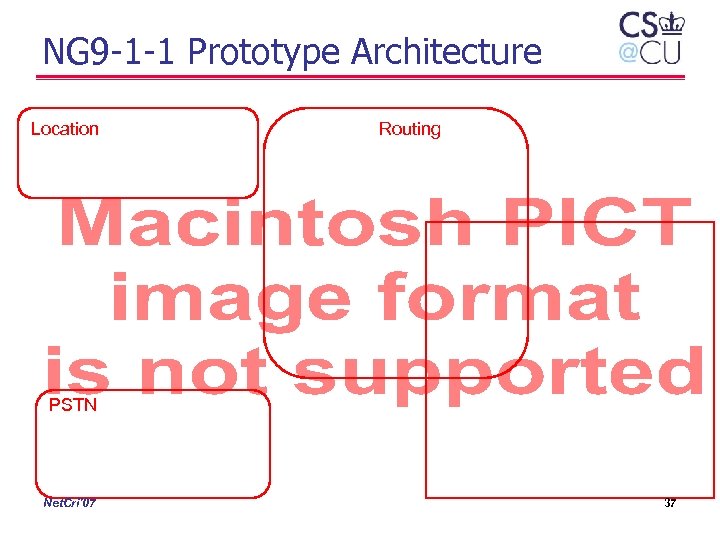
NG 9 -1 -1 Prototype Architecture Location Routing PSTN Net. Cri'07 37
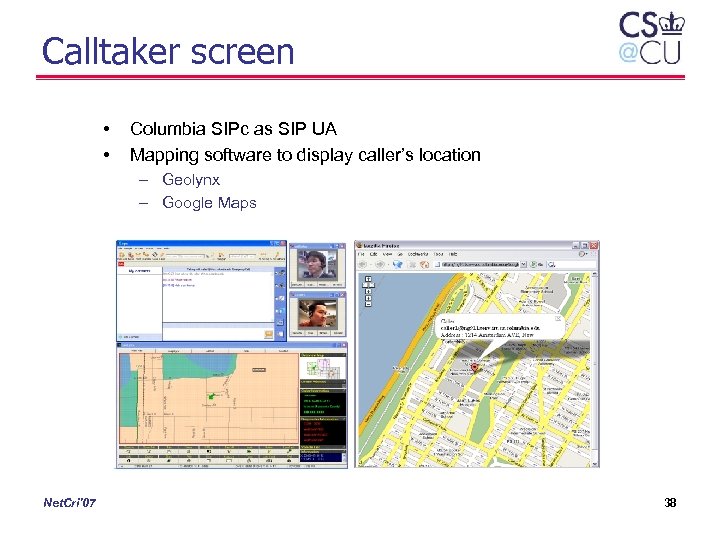
Calltaker screen • • Columbia SIPc as SIP UA Mapping software to display caller’s location – Geolynx – Google Maps Net. Cri'07 38
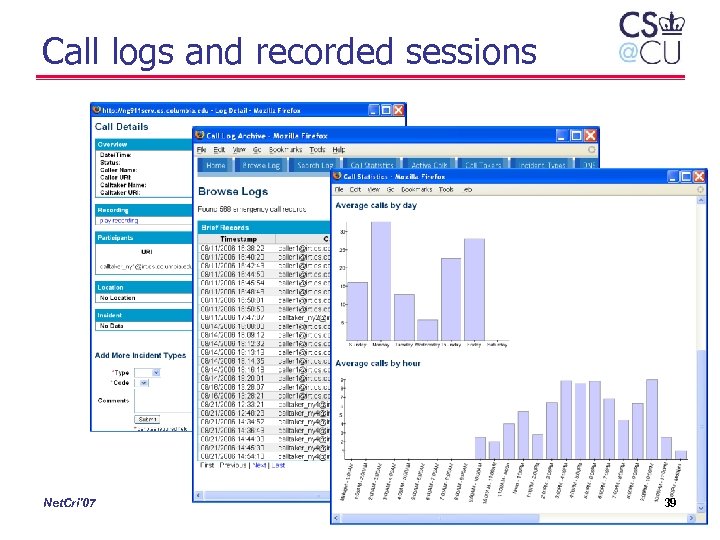
Call logs and recorded sessions Net. Cri'07 39
NG 911 trial: Lessons learned • • Tested NG 911 prototype in 3 PSAPs in TX and VA Surprise: PSAP is really a conferencing system – Language. Line, first responders, … • Surprise: no uniform incident description – every jurisdiction uses their own variation and level of detail • What is desirable behavior – rather than current behavior – e. g. , for transfer, overflow • Need to integrate call taker management – presence (availability) – a specialized call center • Special requirements: partial mute – not typically supported on conference servers Net. Cri'07 40
Challenges for NG 911 • Technically, much simpler than E 911 Phase II – hopefully, cheaper, too – but security challenges: location and identity verification – co-existence between E 911 and NG 911 • Logistical challenges – deployment of new infrastructure • location and Lo. ST servers • Legal and regulatory challenges – will ISPs give out location information to VSPs or customers? – liability for misrouted calls? Net. Cri'07 41
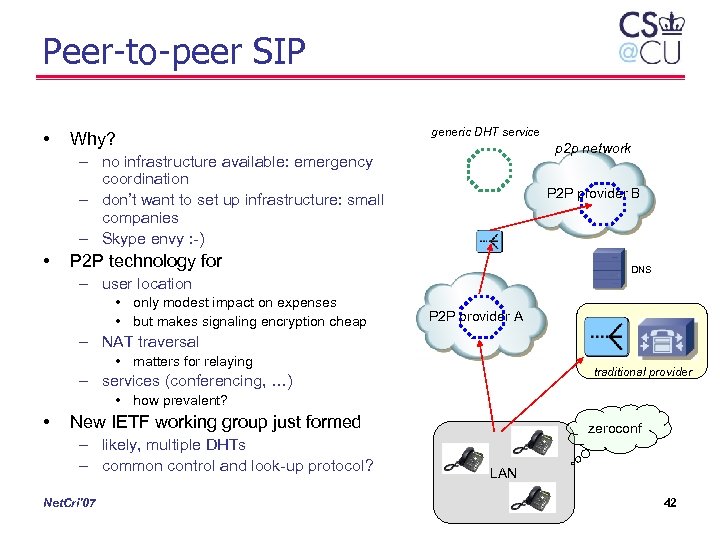
Peer-to-peer SIP • Why? generic DHT service p 2 p network – no infrastructure available: emergency coordination – don’t want to set up infrastructure: small companies – Skype envy : -) • P 2 P provider B P 2 P technology for DNS – user location • only modest impact on expenses • but makes signaling encryption cheap P 2 P provider A – NAT traversal • matters for relaying traditional provider – services (conferencing, …) • how prevalent? • New IETF working group just formed – likely, multiple DHTs – common control and look-up protocol? Net. Cri'07 zeroconf LAN 42
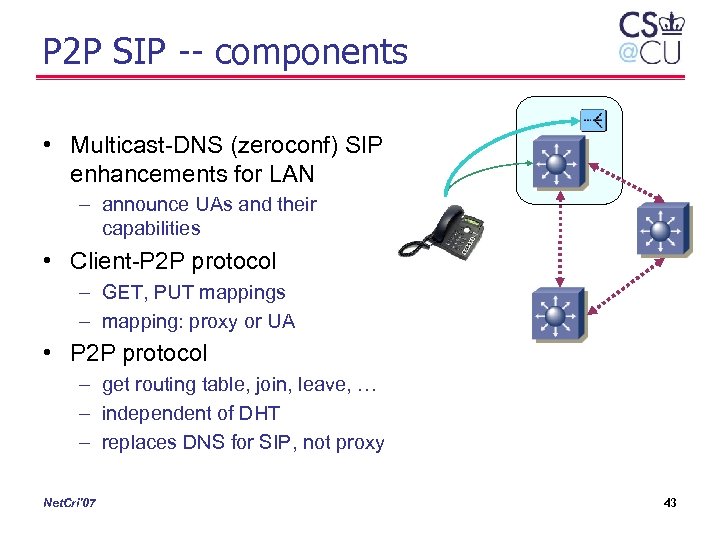
P 2 P SIP -- components • Multicast-DNS (zeroconf) SIP enhancements for LAN – announce UAs and their capabilities • Client-P 2 P protocol – GET, PUT mappings – mapping: proxy or UA • P 2 P protocol – get routing table, join, leave, … – independent of DHT – replaces DNS for SIP, not proxy Net. Cri'07 43
Outline • Needs & status vs. new toys • Emergency coordination – going beyond ad hoc networks • Emergency calling – the challenge of two transitions: mobility and Vo. IP • Emergency alerts – multi-modal alerting – beyond siren replacement Net. Cri'07 44
Alerting • Current emergency notification: – TV and radio (EAS) • not helpful when watching You. Tube – “Inverse 911” • landline only • doesn’t alert care takers, relatives – CAP (OASIS) • doesn’t specify transport and event notification mechanism • Need flexible alerting protocol – authority-citizen – authority-authority (FBI to local police) – citizen-citizen (smoke detector to neighbor) Net. Cri'07 45
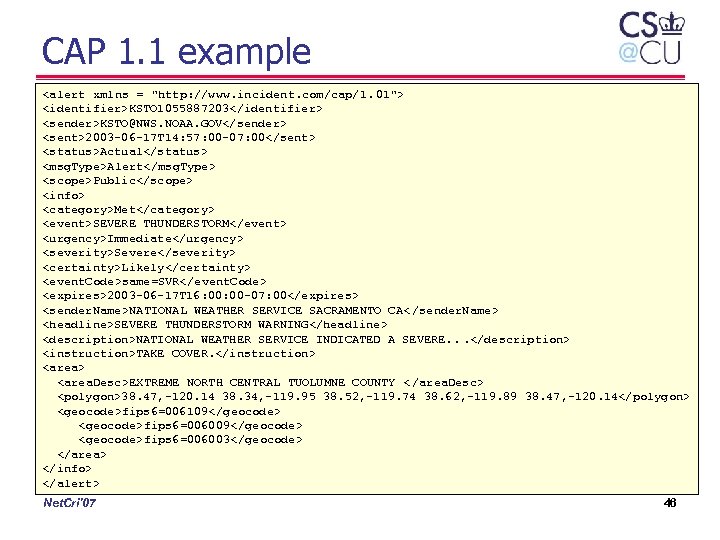
CAP 1. 1 example <alert xmlns = "http: //www. incident. com/cap/1. 01"> <identifier>KSTO 1055887203</identifier> <sender>KSTO@NWS. NOAA. GOV</sender> <sent>2003 -06 -17 T 14: 57: 00 -07: 00</sent> <status>Actual</status> <msg. Type>Alert</msg. Type> <scope>Public</scope> <info> <category>Met</category> <event>SEVERE THUNDERSTORM</event> <urgency>Immediate</urgency> <severity>Severe</severity> <certainty>Likely</certainty> <event. Code>same=SVR</event. Code> <expires>2003 -06 -17 T 16: 00 -07: 00</expires> <sender. Name>NATIONAL WEATHER SERVICE SACRAMENTO CA< /sender. Name> <headline>SEVERE THUNDERSTORM WARNING</headline> <description>NATIONAL WEATHER SERVICE INDICATED A SEVERE. . . </description> <instruction>TAKE COVER. </instruction> <area. Desc>EXTREME NORTH CENTRAL TUOLUMNE COUNTY < /area. Desc> <polygon>38. 47, -120. 14 38. 34, -119. 95 38. 52, -119. 74 38. 62, -119. 89 38. 47, -120. 14</polygon> <geocode>fips 6=006109</geocode> <geocode>fips 6=006003</geocode> </area> </info> </alert> Net. Cri'07 46
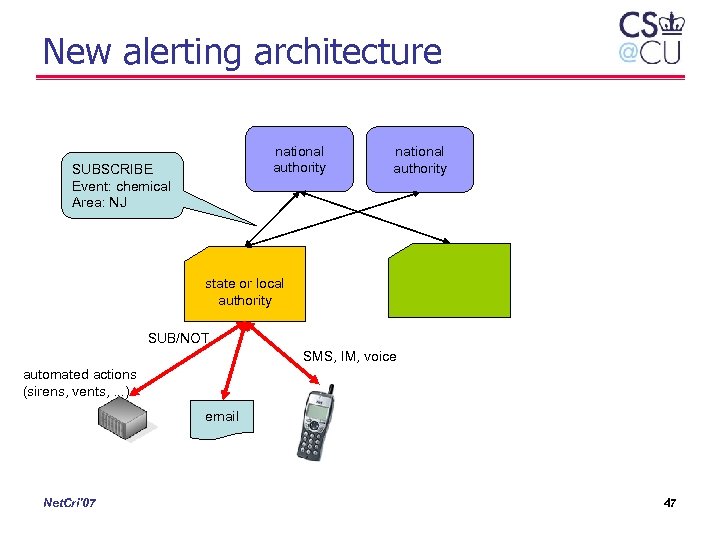
New alerting architecture national authority SUBSCRIBE Event: chemical Area: NJ national authority state or local authority SUB/NOT SMS, IM, voice automated actions (sirens, vents, . . . ) email Net. Cri'07 47
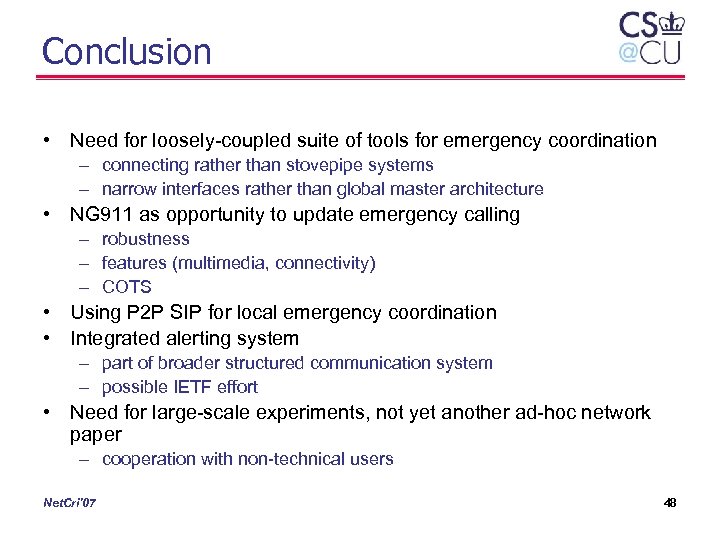
Conclusion • Need for loosely-coupled suite of tools for emergency coordination – connecting rather than stovepipe systems – narrow interfaces rather than global master architecture • NG 911 as opportunity to update emergency calling – robustness – features (multimedia, connectivity) – COTS • Using P 2 P SIP for local emergency coordination • Integrated alerting system – part of broader structured communication system – possible IETF effort • Need for large-scale experiments, not yet another ad-hoc network paper – cooperation with non-technical users Net. Cri'07 48
More information • A Vo. IP Emergency Services Architecture and Prototype – M. Mintz-Habib, A. Rawat, H. Schulzrinne, and X. Wu, ICCCN 2005, Oct. 2005 • An Enhanced Vo. IP Emergency Services Prototype – Jong Yul Kim, Wonsang Song, and Henning Schulzrinne, ISCRAM 2006, May 2006 • Providing emergency services in Internet telephony • – H. Schulzrinne & K. Arabshian, IEEE Internet Computing, May/June 2002 Requirements for Emergency Context Resolution with Internet Technologies, draft-ietf-ecritrequirements Dynamic Host Configuration Protocol (DHCPv 4 and DHCPv 6) Option for Civic Addresses Configuration Information, RFC 4776 Dynamic Host Configuration Protocol Option for Coordinate-based Location Configuration Information, RFC 3825 A Presence-based GEOPRIV Location Object Format, RFC 4119 A Uniform Resource Name (URN) for Services, draft-ietf-ecrit-service-urn Lo. ST: A Location-to-Service Translation Protocol, draft-ietf-ecrit-lost Best current practices for third party call control (3 pcc) in the session initiation protocol (SIP), RFC 3725 GETS: http: //gets. ncs. gov/ • NG 911 project information at http: //ng 911. tamu. edu • • Net. Cri'07 49
Скачать презентацию Using IP-Based Applications for Improving Disaster Response Henning
c9cda1924b872f1b80b4dcac139233e5.ppt