


 Скачать презентацию Using Honeynets for Internet Situational Awareness Vinod Yegneswaran
35ac234592aa4b18332118be9cac3294.ppt
- Количество слайдов: 23
 Using Honeynets for Internet Situational Awareness Vinod Yegneswaran, Paul Barford University of Wisconsin, Madison Hotnets 2005 Vern Paxson ICSI, LBNL
 Motivation o Currrent tasks for security analysts o Abuse monitoring o Audit and forensic analysis o NIDS/Firewall/ACL configuration o Vulnerability testing o Policy maintenance o Liaison activities o Network management o End host management 2
 NIDS: State of the art o Pinpoint descriptions of low-level activities o Source A launched CVE-XXX against Dest B o Large volume of alerts o Too many false alarms o Vulnerable to flooding attacks / IP spoofing o Continual manual update of signatures o Lack of “longitudinal” baseline o Lack of breadth for root-cause inference 3
 Our vision o Network “Situational Awareness” (Net. SA) o “Degree of consistency between one’s perception of their situation and reality” -- US Navy o “an accurate set of information about one’s environment scaled to specific level of interest” -- NCOIC o Elevate quality and timeliness of alerts 4
 Our approach o Developing Net. SA “building blocks” toward o o Automated incident discovery Robust classification Real-time event notification Forensic analysis capabilities o Honeynet situational awareness o Rich source of information of large-scale malicious activity o Accurate attribution of events such as botnets, worms and misconfiguration 5
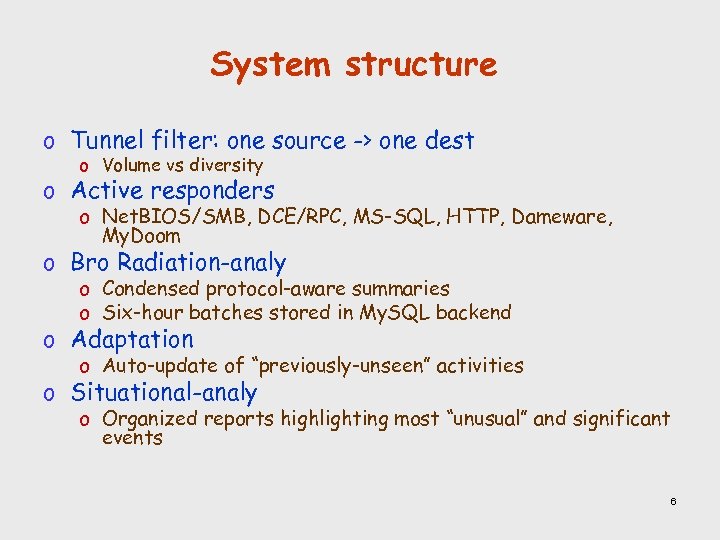 System structure o Tunnel filter: one source -> one dest o Volume vs diversity o Active responders o Net. BIOS/SMB, DCE/RPC, MS-SQL, HTTP, Dameware, My. Doom o Bro Radiation-analy o Condensed protocol-aware summaries o Six-hour batches stored in My. SQL backend o Adaptation o Auto-update of “previously-unseen” activities o Situational-analy o Organized reports highlighting most “unusual” and significant events 6
 Radiation-analy summarization o Leverage Bro’s protocol knowledge and attack semantics o Distill activity into high-level abstractions o Quickly validate against past history to check for previous instances o Types of summaries o Connection profiles o Source Profiles o Infer connection-profile associations o Session Profiles o Hard to summarize due to high degree of variability 7
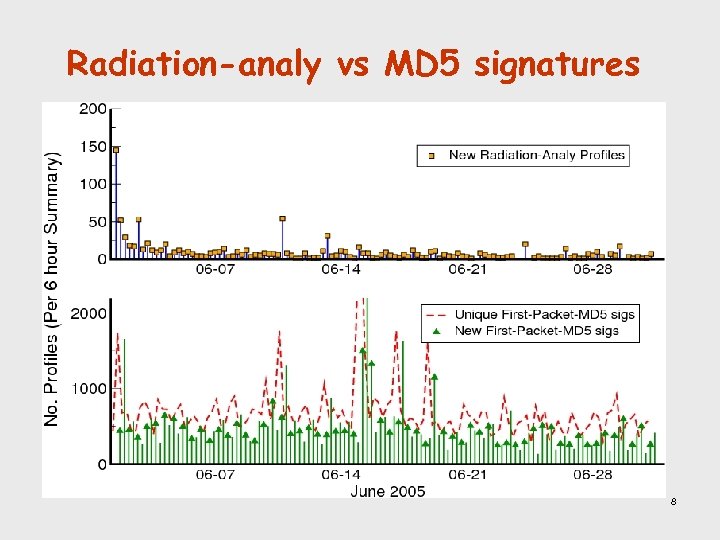 Radiation-analy vs MD 5 signatures 8
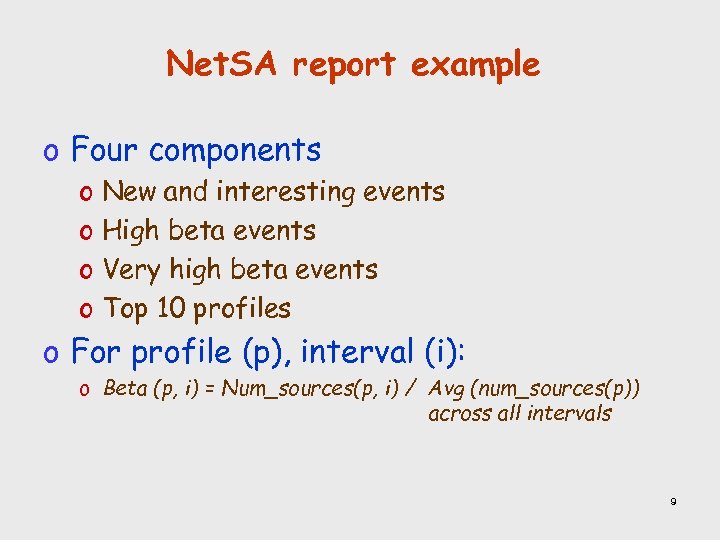 Net. SA report example o Four components o New and interesting events o High beta events o Very high beta events o Top 10 profiles o For profile (p), interval (i): o Beta (p, i) = Num_sources(p, i) / Avg (num_sources(p)) across all intervals 9
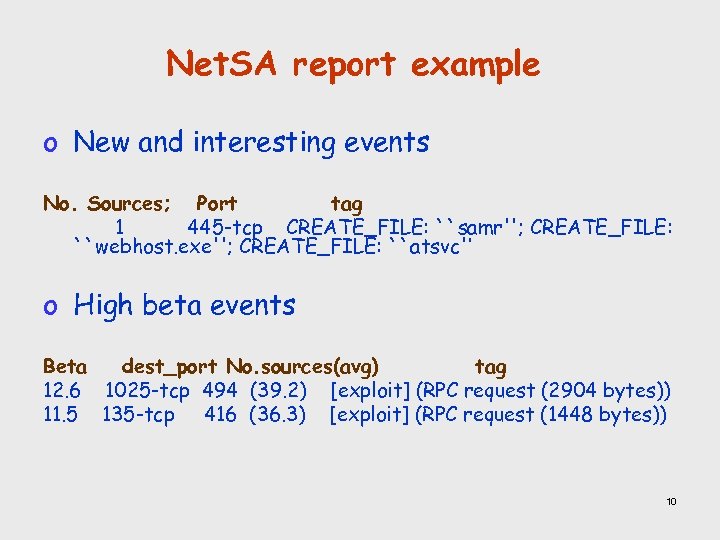 Net. SA report example o New and interesting events No. Sources; Port tag 1 445 -tcp CREATE_FILE: ``samr''; CREATE_FILE: ``webhost. exe''; CREATE_FILE: ``atsvc'‘ o High beta events Beta dest_port No. sources(avg) tag 12. 6 1025 -tcp 494 (39. 2) [exploit] (RPC request (2904 bytes)) 11. 5 135 -tcp 416 (36. 3) [exploit] (RPC request (1448 bytes)) 10
![Net. SA report example o Very high beta events (beta > 10) TAG: 1025/tcp/[exploit]](https://present5.com/presentation/35ac234592aa4b18332118be9cac3294/image-11.jpg "Net. SA report example o Very high beta events (beta > 10) TAG: 1025/tcp/[exploit]") Net. SA report example o Very high beta events (beta > 10) TAG: 1025/tcp/[exploit] (RPC request (2904 bytes)) Hour 0. . 5 srcs: 97, 93, 79, 74, 68, 94, src-overlaps: 0, 8, 13, 10, 8, 10, /8 s: 25, 26, 19, 21, 16, 19, dsts: 103, 97, 80, 71, 76, 96, dst-overlaps: 0, 14, 12, 8, 8, 8, o Top 10 profiles Port 135 -tcp 1025 -tcp 135 -tcp … No. Sources Tag 591 RPC bind: afa 8 bd 80 -7 d 8 a-11 c 9 -bef 4 -08002 b 10298 len=72; RPC request (24 bytes) 494 [exploit] (RPC request (2904 bytes)) 416 [exploit] (RPC request (1448 bytes)) 11
Net. SA report example o Very high beta events (beta > 10) TAG: 1025/tcp/[exploit] (RPC request (2904 bytes)) Hour 0. . 5 srcs: 97, 93, 79, 74, 68, 94, src-overlaps: 0, 8, 13, 10, 8, 10, /8 s: 25, 26, 19, 21, 16, 19, dsts: 103, 97, 80, 71, 76, 96, dst-overlaps: 0, 14, 12, 8, 8, 8, o Top 10 profiles Port 135 -tcp 1025 -tcp 135 -tcp … No. Sources Tag 591 RPC bind: afa 8 bd 80 -7 d 8 a-11 c 9 -bef 4 -08002 b 10298 len=72; RPC request (24 bytes) 494 [exploit] (RPC request (2904 bytes)) 416 [exploit] (RPC request (1448 bytes)) 11
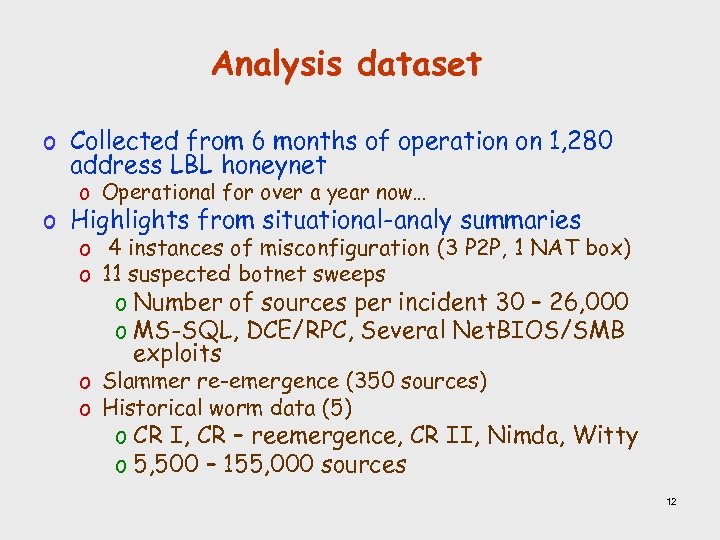 Analysis dataset o Collected from 6 months of operation on 1, 280 address LBL honeynet o Operational for over a year now… o Highlights from situational-analy summaries o 4 instances of misconfiguration (3 P 2 P, 1 NAT box) o 11 suspected botnet sweeps o Number of sources per incident 30 – 26, 000 o MS-SQL, DCE/RPC, Several Net. BIOS/SMB exploits o Slammer re-emergence (350 sources) o Historical worm data (5) o CR I, CR – reemergence, CR II, Nimda, Witty o 5, 500 – 155, 000 sources 12
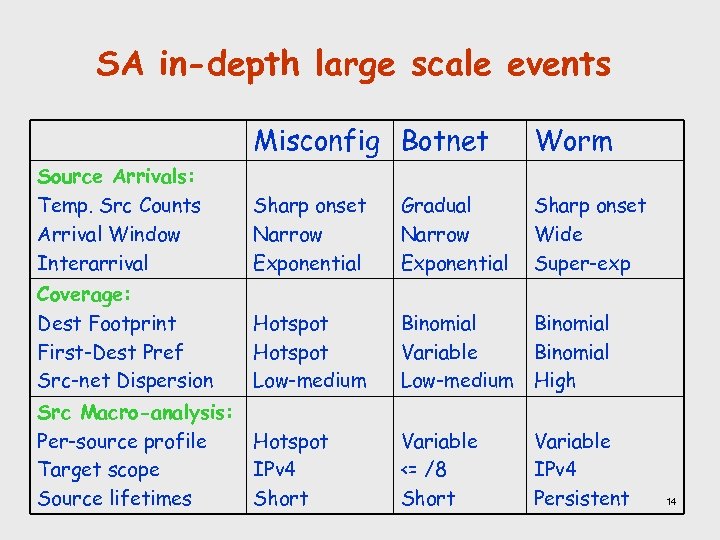
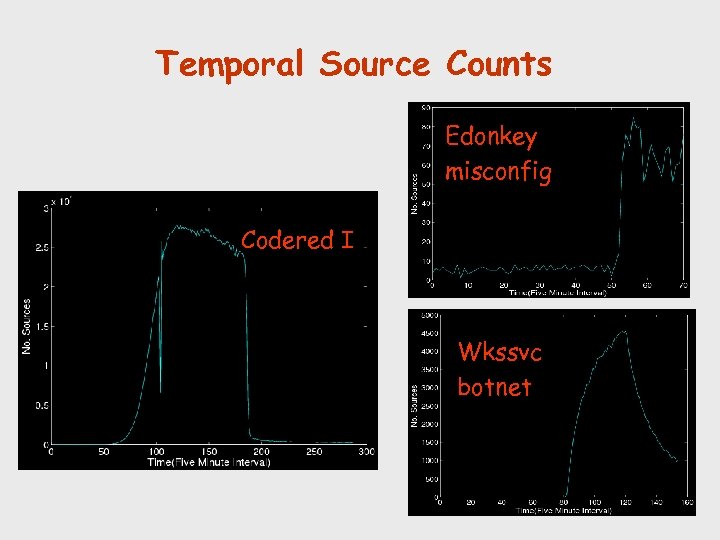
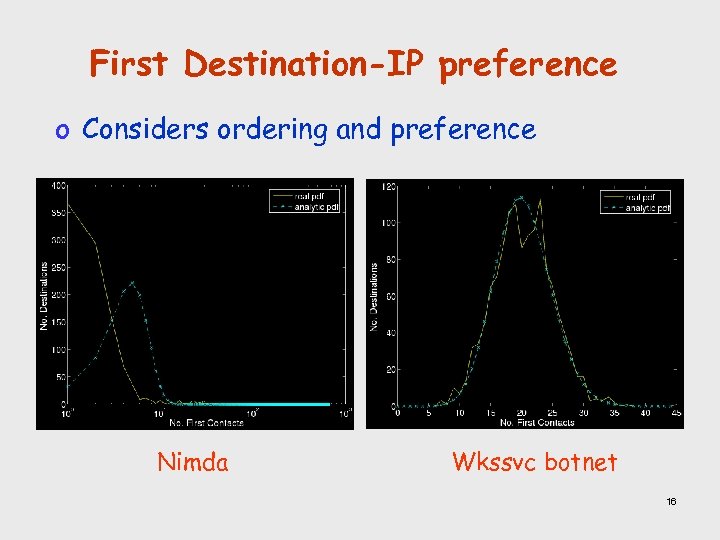
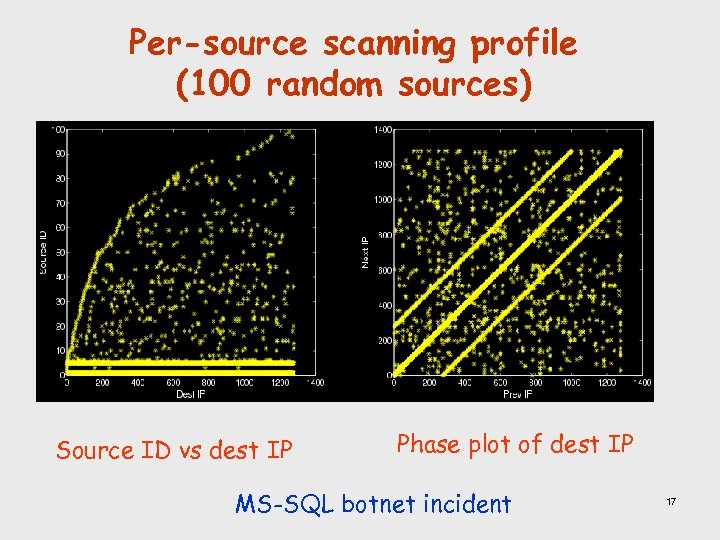
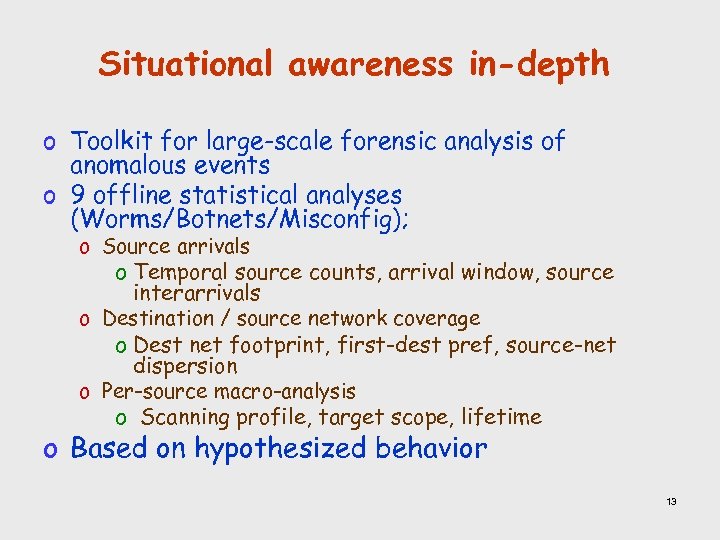 Situational awareness in-depth o Toolkit for large-scale forensic analysis of anomalous events o 9 offline statistical analyses (Worms/Botnets/Misconfig); o Source arrivals o Temporal source counts, arrival window, source interarrivals o Destination / source network coverage o Dest net footprint, first-dest pref, source-net dispersion o Per-source macro-analysis o Scanning profile, target scope, lifetime o Based on hypothesized behavior 13
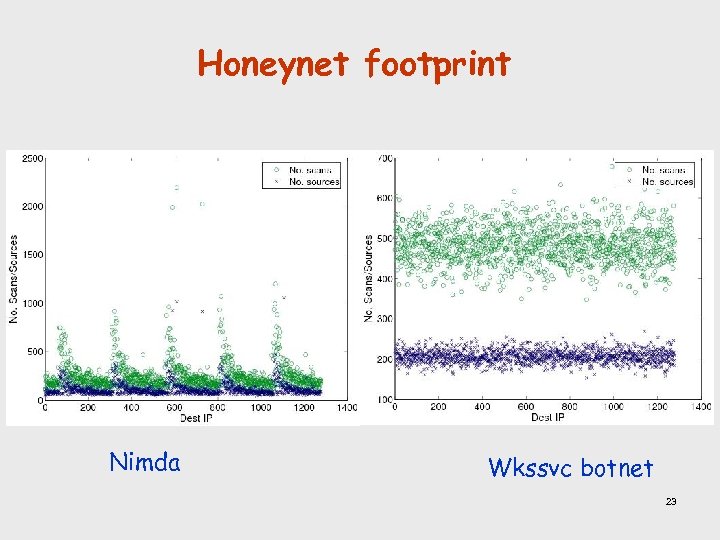
 SA in-depth large scale events Misconfig Botnet Worm Source Arrivals: Temp. Src Counts Arrival Window Interarrival Sharp onset Narrow Exponential Gradual Narrow Exponential Sharp onset Wide Super-exp Coverage: Dest Footprint First-Dest Pref Src-net Dispersion Hotspot Low-medium Binomial Variable Binomial Low-medium High Src Macro-analysis: Per-source profile Hotspot Target scope IPv 4 Source lifetimes Short Variable <= /8 Short Variable IPv 4 Persistent 14
 Temporal Source Counts Edonkey misconfig Codered I Wkssvc botnet 15
 First Destination-IP preference o Considers ordering and preference Nimda Wkssvc botnet 16
 Per-source scanning profile (100 random sources) Source ID vs dest IP Phase plot of dest IP MS-SQL botnet incident 17
 Inferring target scope o How broadly was a given event scoped? o Was our network specifically targeted? o Assumption: sources are not just sequentially scanning the honeynet o IDEA 1: Estimate global packet rate from change of IPID o Often cannot look at all packet pairs due to honeynet size (multiple wrap-arounds) o IDEA 2: Look at IPID spacing between retransmitted SYNs from passive traces o For UDP look at packets arriving less than 3 secs apart o Target scope = Honeynet size * (global rate / local rate) 18
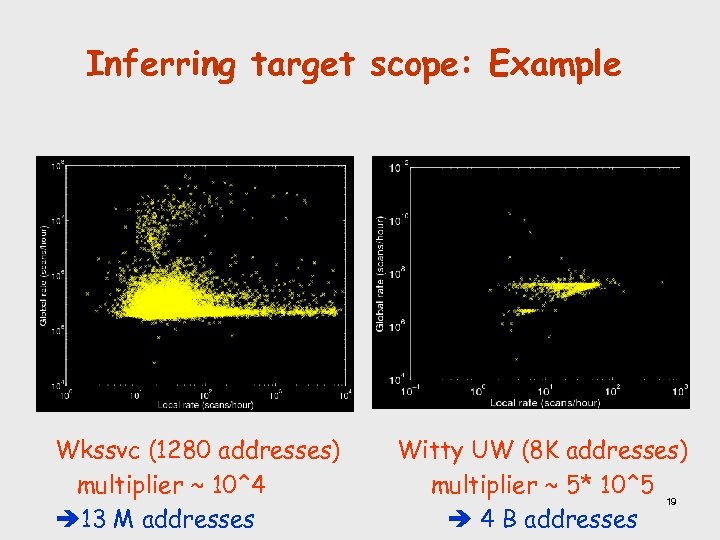 Inferring target scope: Example Wkssvc (1280 addresses) multiplier ~ 10^4 13 M addresses Witty UW (8 K addresses) multiplier ~ 5* 10^5 19 4 B addresses
 Summary o Objective: Internet situational awareness o Accurate timely summaries of honeynet data o Bro Net. SA (radiation-analy / situation-analy) o My. SQL backend o Situational in-depth statistical analyses o Provide different yet valuable perspectives on individual events o Toward real time classification of events o Future work o Refinement and extension of in-depth SA analyses o Distributed Net. SA 20
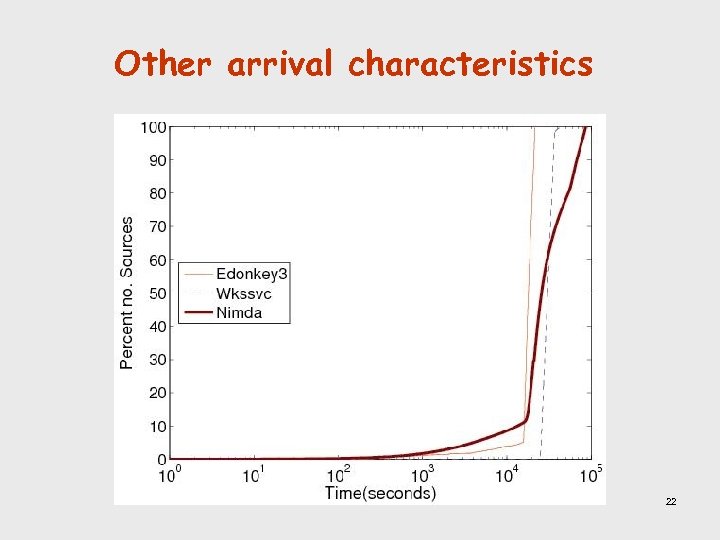
 Other arrival characteristics o Arrival window o Expectation: botnets should see sharp spike in arrivals o Often not true – botnets don’t have to push commands, instead zombies could poll and pull o phatbot zombies wake up every 1000 seconds to check for new commands o Source interarrivals o Bots poll independently, implies their arrivals will appear to be poisson with exponential interarrivals o Worm interarrival rate should increase during the initial stages of the outbreak 21
 Other arrival characteristics 22
 Honeynet footprint Nimda Wkssvc botnet 23