


 Скачать презентацию Using First-Order Theorem Provers in Data Structure Verification
e306efc48be7b38d1fb735dd5aac4e0c.ppt
- Количество слайдов: 52
 Using First-Order Theorem Provers in Data Structure Verification Charles Bouillaguet Viktor Kuncak Martin Rinard Ecole Normale Supérieure, Cachan, France MIT CSAIL
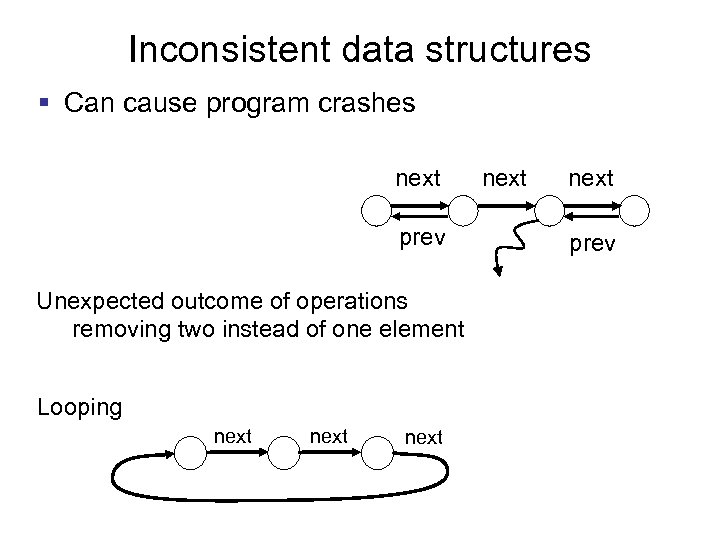 Inconsistent data structures § Can cause program crashes next prev Unexpected outcome of operations removing two instead of one element Looping next next prev
 Implementing data structures is hard § § Often small, but complex code Lots of pointers unbounded, dynamic allocation Complex shape invariants § dag, parents pointers § Properties involving arithmetic (ordering…) § Need strong invariants to guarantee correctness § e. g. lookup in ordered tree needs sortedness
 How to obtain reliable data structure implementations? § Approach § Prove that the program is correct § for all program executions (sound) § Verified properties: § Program does not crash in data structure § Data structure invariants are preserved § Data structure content is correctly updated § Goal: high level of automation § Infrastructure: Jahob system for verifying data structure implementation
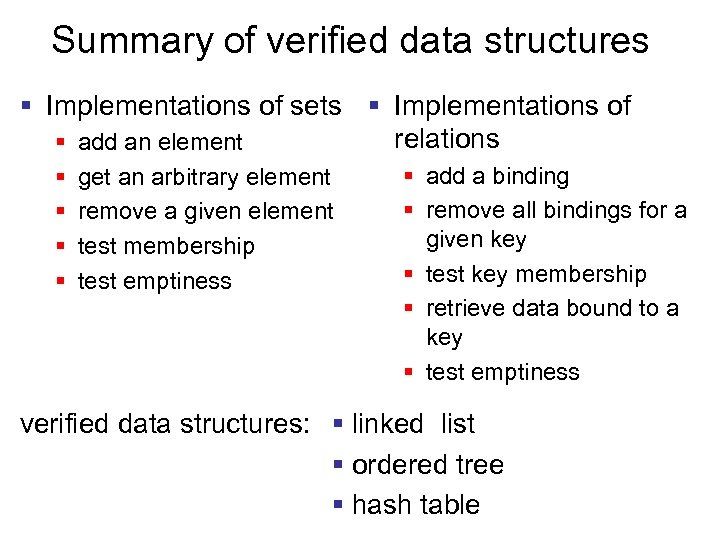 Summary of verified data structures § Implementations of sets § Implementations of relations § add an element § § get an arbitrary element remove a given element test membership test emptiness § add a binding § remove all bindings for a given key § test key membership § retrieve data bound to a key § test emptiness verified data structures: § linked list § ordered tree § hash table
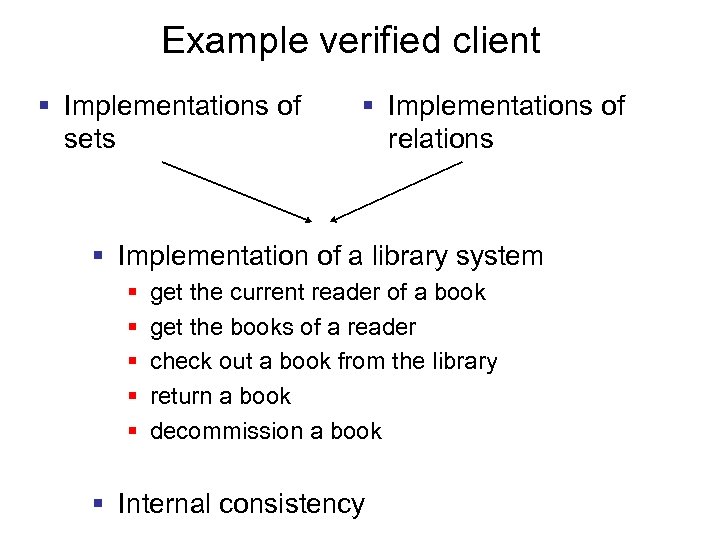 Example verified client § Implementations of sets § Implementations of relations § Implementation of a library system § § § get the current reader of a book get the books of a reader check out a book from the library return a book decommission a book § Internal consistency
 Outline § § § § § Introduction Example: ordered trees Overview of the verification process Translation to First-Order Logic Sorts elimination Assumption filtering Experimental results Related work Conclusions
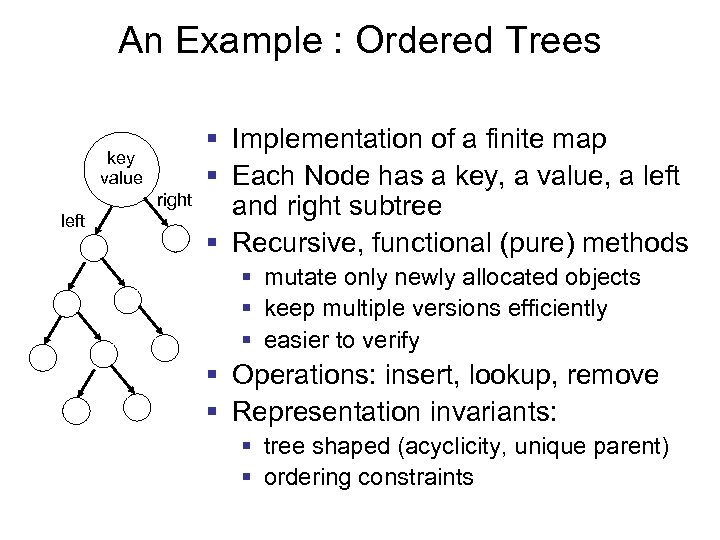 An Example : Ordered Trees key value right left § Implementation of a finite map § Each Node has a key, a value, a left and right subtree § Recursive, functional (pure) methods § mutate only newly allocated objects § keep multiple versions efficiently § easier to verify § Operations: insert, lookup, remove § Representation invariants: § tree shaped (acyclicity, unique parent) § ordering constraints
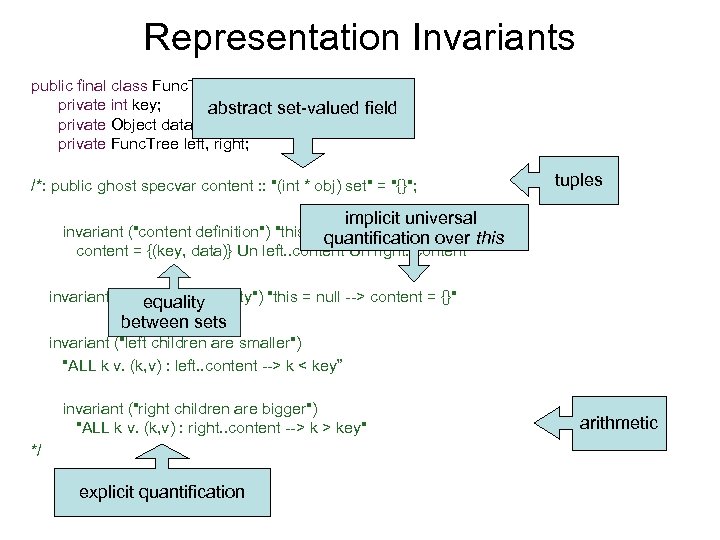 Representation Invariants public final class Func. Tree{ private int key; abstract set-valued field private Object data; private Func. Tree left, right; /*: public ghost specvar content : : "(int * obj) set" = "{}"; tuples implicit universal invariant ("content definition") "this ~= null --> quantification over this content = {(key, data)} Un left. . content Un right. . content" invariant ("null implies empty") "this = null --> content = {}" equality between sets invariant ("left children are smaller") "ALL k v. (k, v) : left. . content --> k < key” invariant ("right children are bigger") "ALL k v. (k, v) : right. . content --> k > key" */ explicit quantification arithmetic
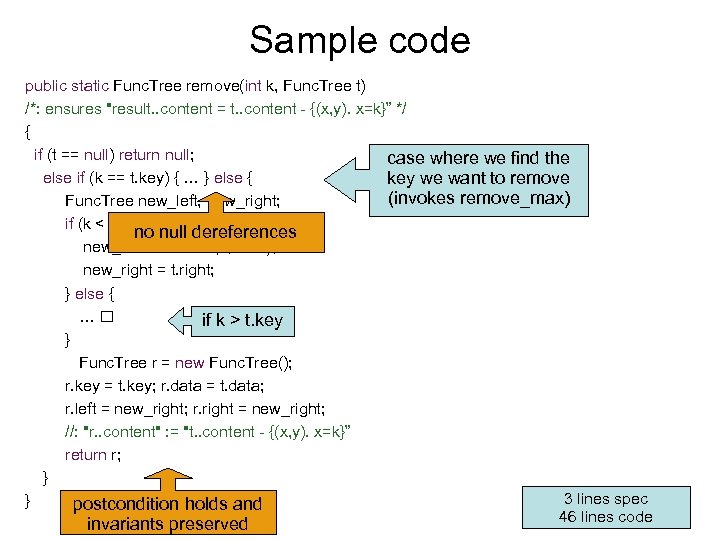 Sample code public static Func. Tree remove(int k, Func. Tree t) /*: ensures "result. . content = t. . content - {(x, y). x=k}” */ { if (t == null) return null; case where we find the else if (k == t. key) { … } else { key we want to remove (invokes remove_max) Func. Tree new_left, new_right; if (k < t. key) { no null dereferences new_left = remove(k, t. left); new_right = t. right; } else { … if k > t. key } Func. Tree r = new Func. Tree(); r. key = t. key; r. data = t. data; r. left = new_right; r. right = new_right; //: "r. . content" : = "t. . content - {(x, y). x=k}” return r; } 3 lines spec } postcondition holds and 46 lines code invariants preserved
 How to verify these properties ?
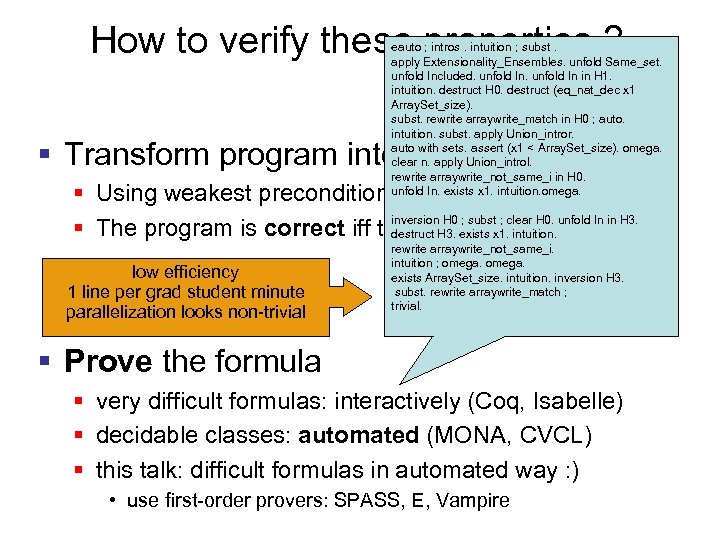 How to verify these properties ? eauto ; intros. intuition ; subst. apply Extensionality_Ensembles. unfold Same_set. unfold Included. unfold In in H 1. intuition. destruct H 0. destruct (eq_nat_dec x 1 Array. Set_size). subst. rewrite arraywrite_match in H 0 ; auto. intuition. subst. apply Union_intror. auto with sets. assert (x 1 < Array. Set_size). omega. clear n. apply Union_introl. rewrite arraywrite_not_same_i in H 0. unfold In. exists x 1. intuition. omega. § Transform program into a logic formula § Using weakest precondition inversion H 0 ; subst ; H 0. unfold § The program is correct iff the formulax 1. clearvalid In in H 3. destruct H 3. exists is intuition. low efficiency 1 line per grad student minute parallelization looks non-trivial rewrite arraywrite_not_same_i. intuition ; omega. exists Array. Set_size. intuition. inversion H 3. subst. rewrite arraywrite_match ; trivial. § Prove the formula § very difficult formulas: interactively (Coq, Isabelle) § decidable classes: automated (MONA, CVCL) § this talk: difficult formulas in automated way : ) • use first-order provers: SPASS, E, Vampire
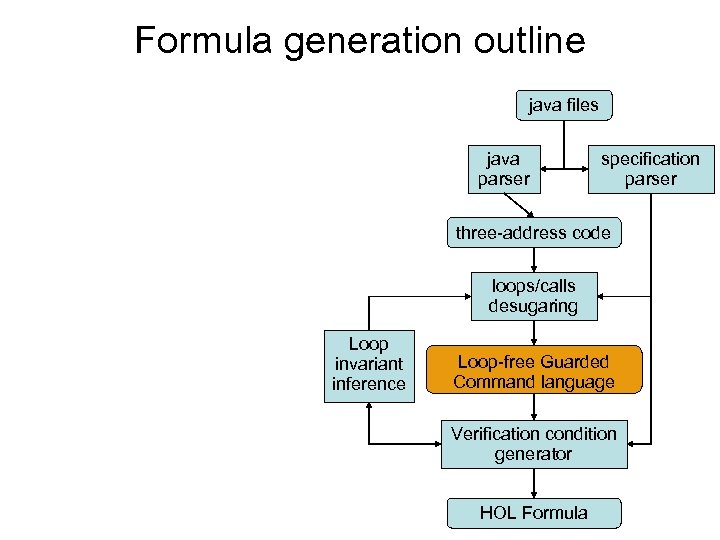
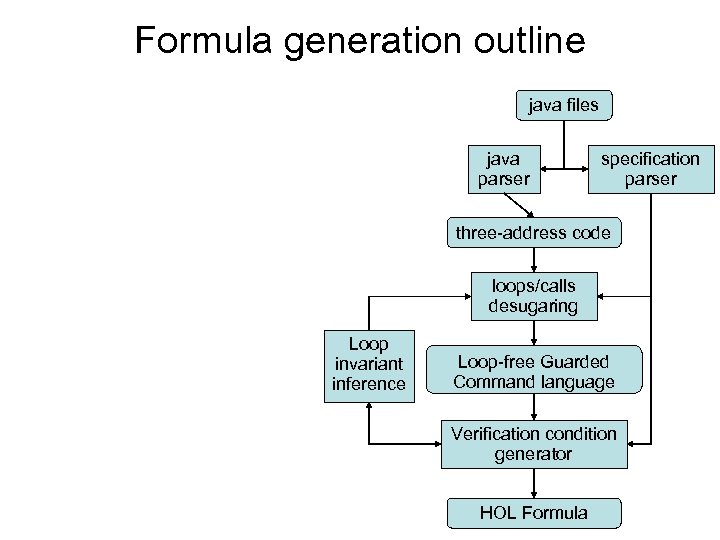 Formula generation outline java files java parser specification parser three-address code loops/calls desugaring Loop invariant inference Loop-free Guarded Command language Verification condition generator HOL Formula
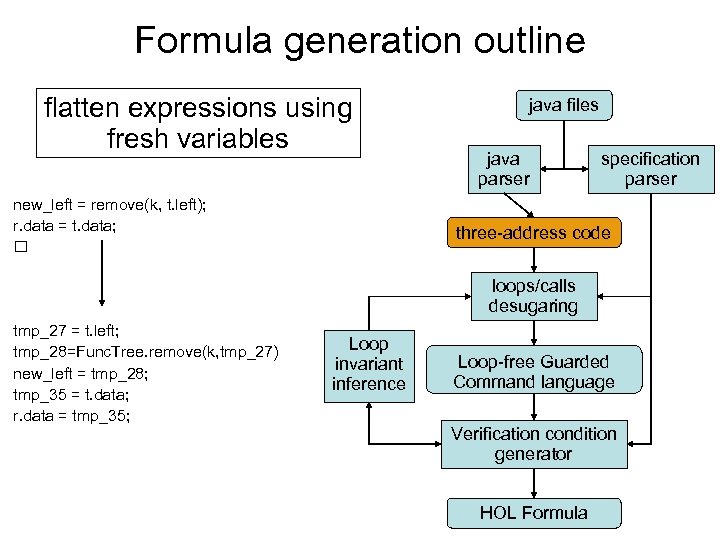 Formula generation outline flatten expressions using fresh variables new_left = remove(k, t. left); r. data = t. data; java files java parser specification parser three-address code loops/calls desugaring tmp_27 = t. left; tmp_28=Func. Tree. remove(k, tmp_27) new_left = tmp_28; tmp_35 = t. data; r. data = tmp_35; Loop invariant inference Loop-free Guarded Command language Verification condition generator HOL Formula
 Formula generation outline java files java parser specification parser three-address code loops/calls desugaring Loop invariant inference Loop-free Guarded Command language Verification condition generator HOL Formula
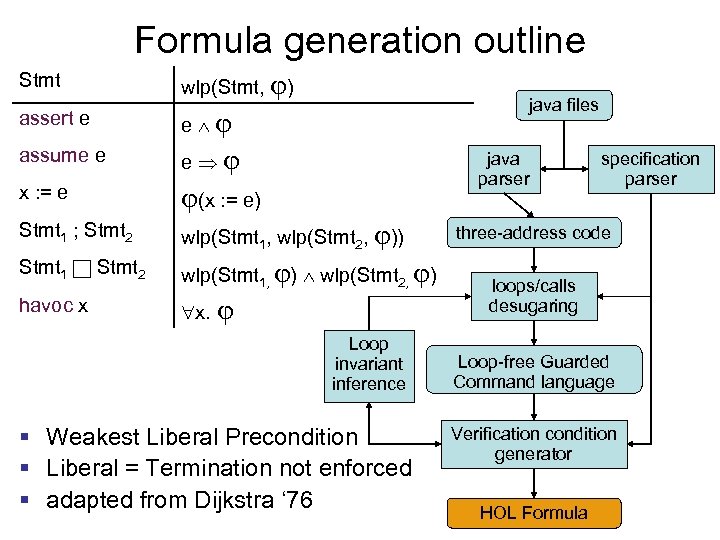 Formula generation outline Stmt wlp(Stmt, ) java files assert e e assume e e x : = e (x : = e) Stmt 1 ; Stmt 2 wlp(Stmt 1, wlp(Stmt 2, )) Stmt 1 Stmt 2 wlp(Stmt 1, ) wlp(Stmt 2, ) havoc x x. java parser Loop invariant inference § Weakest Liberal Precondition § Liberal = Termination not enforced § adapted from Dijkstra ‘ 76 specification parser three-address code loops/calls desugaring Loop-free Guarded Command language Verification condition generator HOL Formula
 Formulas in Jahob § Specification language: rich subset of Isabelle’s language. § Convenient to express complex properties § Higher-Order features § Sets, set comprehension, cardinality, first-class functions, lambda binders, tuples, arbitrary quantification … § We can use Isabelle to prove these formulas § by hand… § little automation, and slow § How can we do it in a more automated way?
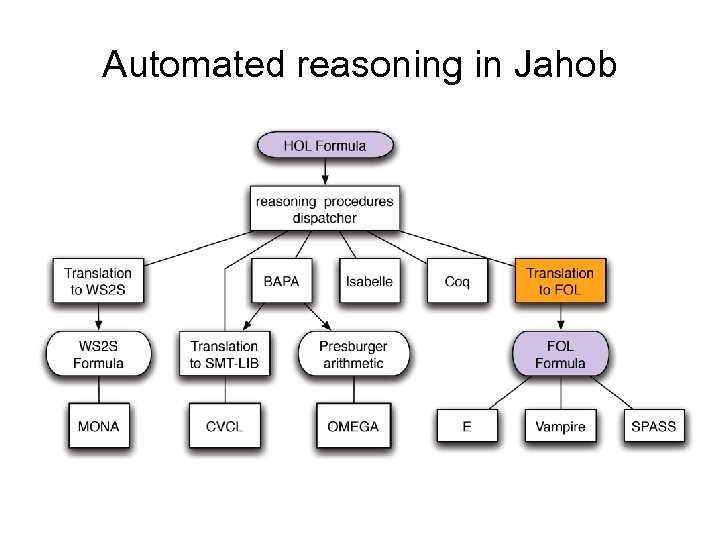 Automated reasoning in Jahob
 First-Order Theorem Provers § Resolution: complete (semi-algorithm for validity) § may loop/run out of memory on non-valid formulas § Resolution-based automated theorem provers: § SPASS, E, Vampire, Theo, Prover 9, Darwin § continuously improving (yearly competition) § effective on formulas with short proofs § Can we use them to improve automation? § Input: unsorted first-order logic with equality
 Outline § § § § § Introduction Example: ordered trees Verification process Translation to First-Order Logic Sorts elimination Assumption filtering Experimental results Related work Conclusions
 Approach to translation HOL FOL § idea: translate what you can § § § lambda reduction and substitution cardinality constraints set expressions detupling fields, flattening § Avoid translations with many axioms § e. g. avoid axiomatizing set theory § Sound approximation for the rest § replace by True in assumptions § replace by False in goal (but take polarity into account)
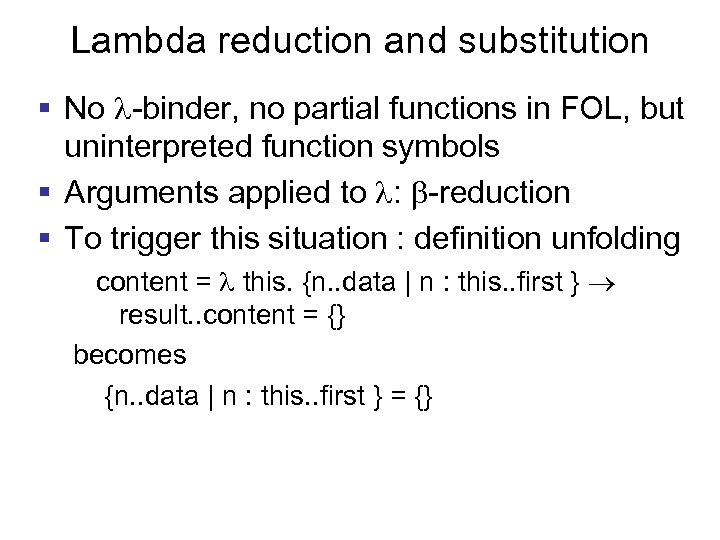 Lambda reduction and substitution § No -binder, no partial functions in FOL, but uninterpreted function symbols § Arguments applied to : -reduction § To trigger this situation : definition unfolding content = this. {n. . data | n : this. . first } result. . content = {} becomes {n. . data | n : this. . first } = {}
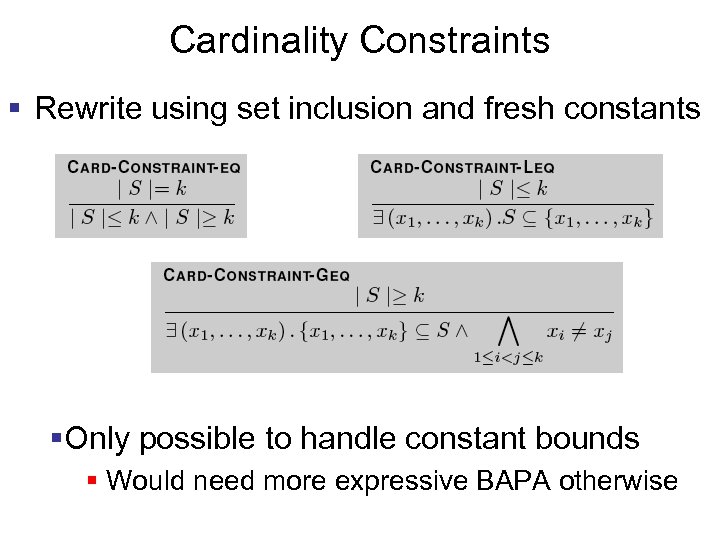 Cardinality Constraints § Rewrite using set inclusion and fresh constants §Only possible to handle constant bounds § Would need more expressive BAPA otherwise
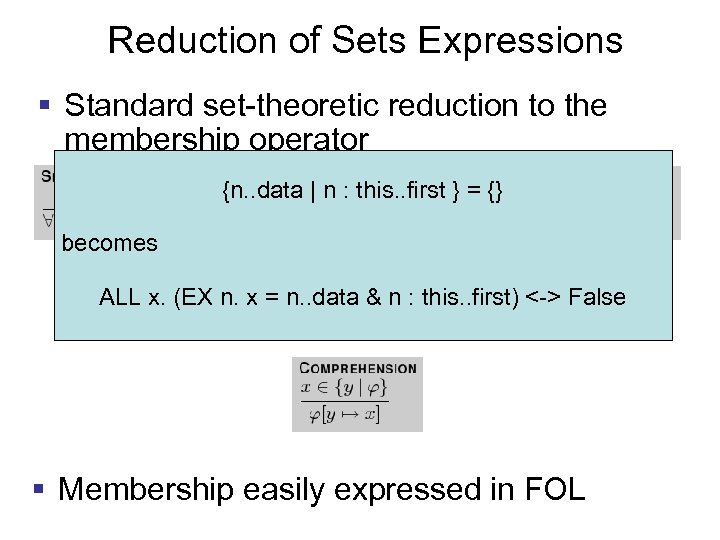 Reduction of Sets Expressions § Standard set-theoretic reduction to the membership operator {n. . data | n : this. . first } = {} becomes ALL x. (EX n. x = n. . data & n : this. . first) <-> False § Membership easily expressed in FOL
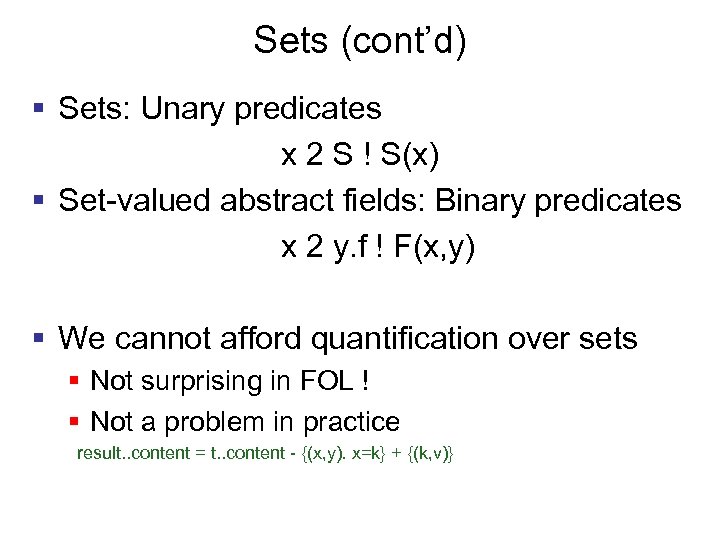 Sets (cont’d) § Sets: Unary predicates x 2 S ! S(x) § Set-valued abstract fields: Binary predicates x 2 y. f ! F(x, y) § We cannot afford quantification over sets § Not surprising in FOL ! § Not a problem in practice result. . content = t. . content - {(x, y). x=k} + {(k, v)}
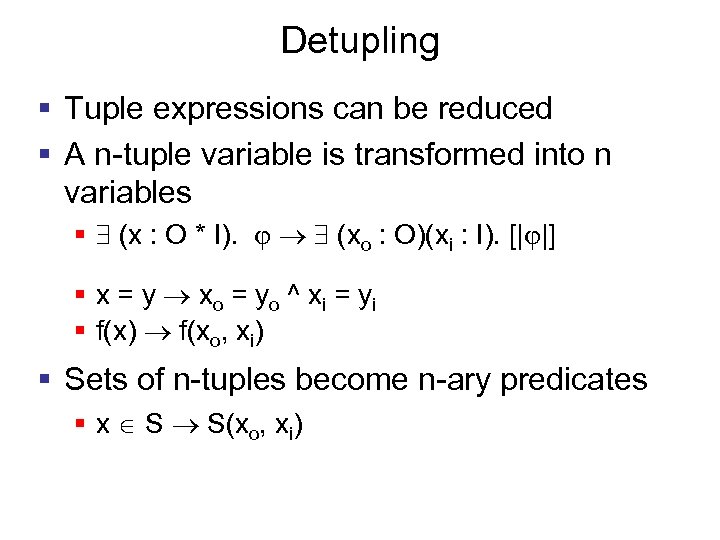 Detupling § Tuple expressions can be reduced § A n-tuple variable is transformed into n variables § (x : O * I). (xo : O)(xi : I). [| |] § x = y xo = yo ^ xi = yi § f(x) f(xo, xi) § Sets of n-tuples become n-ary predicates § x S S(xo, xi)
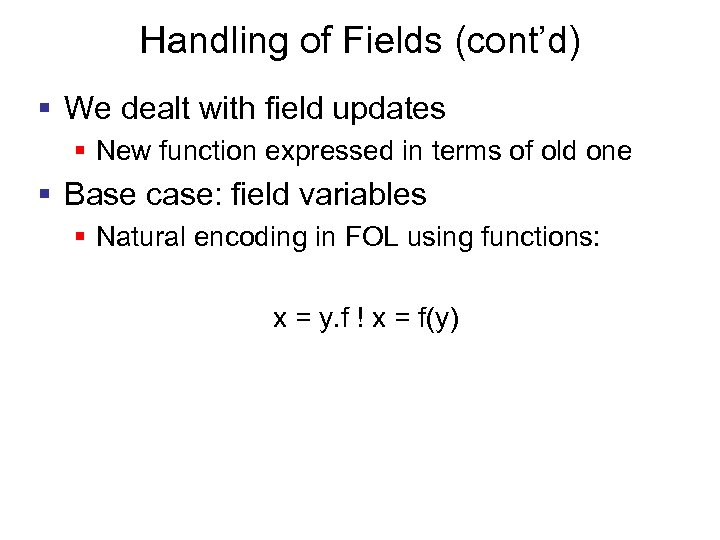
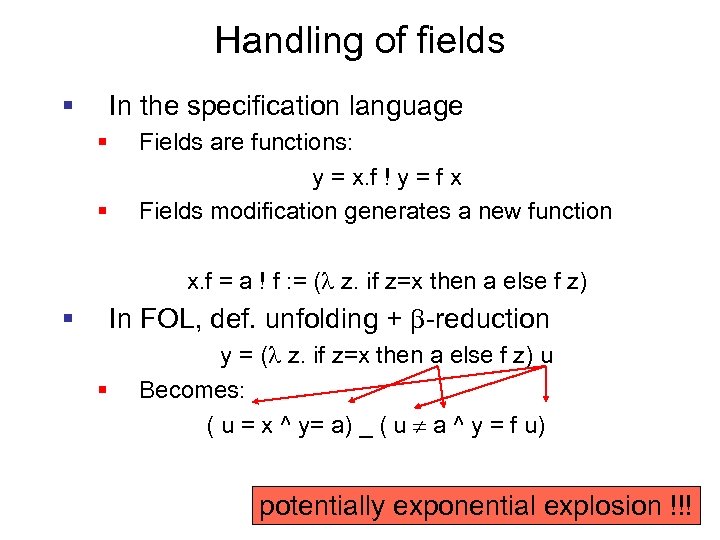 Handling of fields § In the specification language § § Fields are functions: y = x. f ! y = f x Fields modification generates a new function x. f = a ! f : = ( z. if z=x then a else f z) In FOL, def. unfolding + -reduction § § y = ( z. if z=x then a else f z) u Becomes: ( u = x ^ y= a) _ ( u a ^ y = f u) potentially exponential explosion !!!
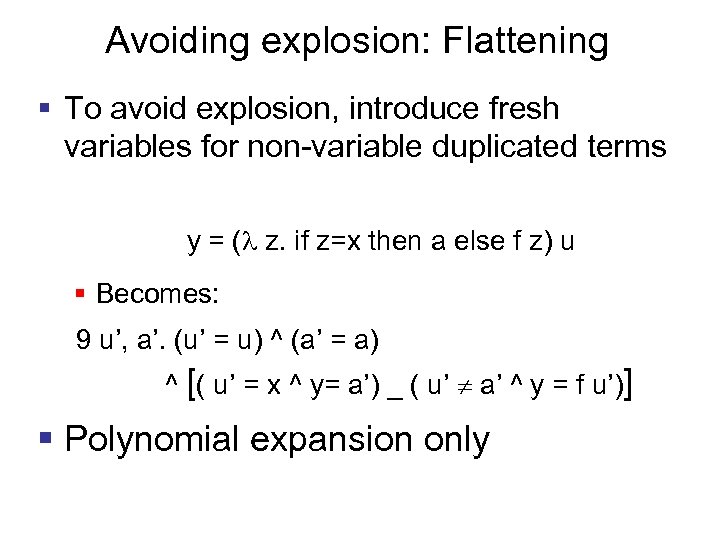 Avoiding explosion: Flattening § To avoid explosion, introduce fresh variables for non-variable duplicated terms y = ( z. if z=x then a else f z) u § Becomes: 9 u’, a’. (u’ = u) ^ (a’ = a) ^ [( u’ = x ^ y= a’) _ ( u’ a’ ^ y = f u’)] § Polynomial expansion only
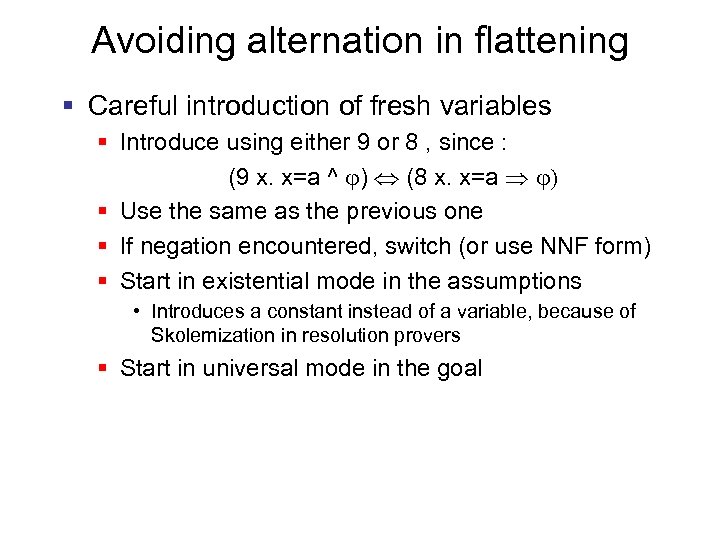 Avoiding alternation in flattening § Careful introduction of fresh variables § Introduce using either 9 or 8 , since : (9 x. x=a ^ ) (8 x. x=a § Use the same as the previous one § If negation encountered, switch (or use NNF form) § Start in existential mode in the assumptions • Introduces a constant instead of a variable, because of Skolemization in resolution provers § Start in universal mode in the goal
 Arithmetic § Numbers are uninterpreted constants in FOL § Provers do not know that 1+1=2 ! § Solutions § Provide an encoding: Peano (unary) or binary, and give rules for “+”, “·“ • Would be complete, but tremendously inefficient § Provide partial, incomplete axiomatization • Cannot deduce 1+1=2 ! • Usual order relation, comparison between constants in formula • Optionally, compatibility of “+” with “·“ • Satisfactory results in practice • Prove ordering constraint of the ordered tree
 Observation § Most formulas are fast/easy to prove § Problem often concentrated in a small number that take very long to prove § Next: two techniques to make them easier
 Outline § § § § § Introduction Example: ordered trees Verification process Translation to First-Order Logic Sorts elimination Assumption filtering Experimental results Related work Conclusions
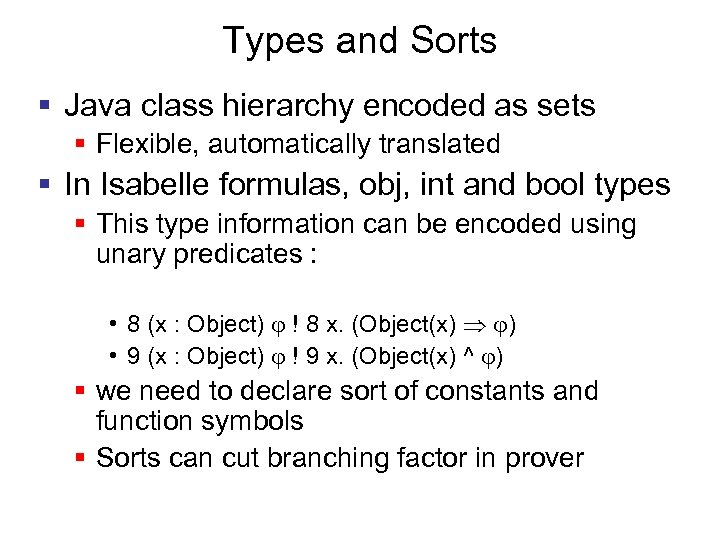 Types and Sorts § Java class hierarchy encoded as sets § Flexible, automatically translated § In Isabelle formulas, obj, int and bool types § This type information can be encoded using unary predicates : • 8 (x : Object) ! 8 x. (Object(x) ) • 9 (x : Object) ! 9 x. (Object(x) ^ ) § we need to declare sort of constants and function symbols § Sorts can cut branching factor in prover
 Omitting Sort Information § Sort information is making formulas bigger and proofs longer. § On Tree. remove, average proof length grows from 10 to 20 when putting sort guards (in # of resolution steps) § Makes some formula much harder
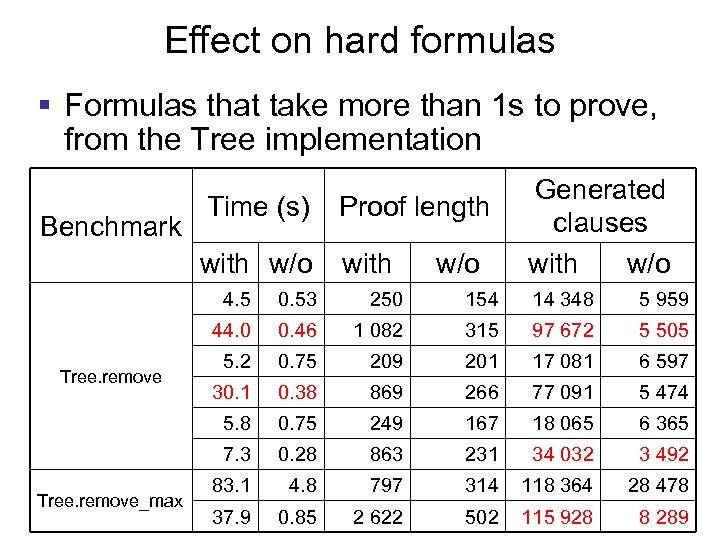 Effect on hard formulas § Formulas that take more than 1 s to prove, from the Tree implementation Proof length with w/o Benchmark Time (s) with w/o Generated clauses with w/o 4. 5 154 14 348 5 959 0. 46 1 082 315 97 672 5 505 5. 2 0. 75 209 201 17 081 6 597 30. 1 0. 38 869 266 77 091 5 474 5. 8 0. 75 249 167 18 065 6 365 7. 3 Tree. remove_max 250 44. 0 Tree. remove 0. 53 0. 28 863 231 34 032 3 492 83. 1 4. 8 797 314 118 364 28 478 37. 9 0. 85 2 622 502 115 928 8 289
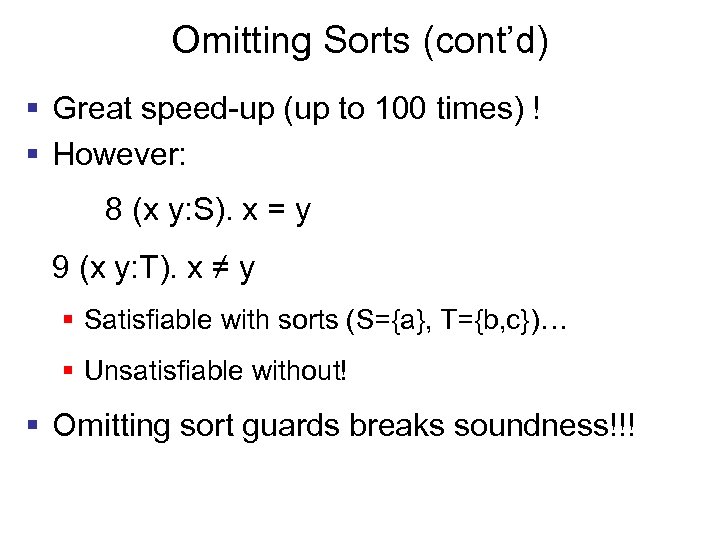 Omitting Sorts (cont’d) § Great speed-up (up to 100 times) ! § However: 8 (x y: S). x = y 9 (x y: T). x ≠ y § Satisfiable with sorts (S={a}, T={b, c})… § Unsatisfiable without! § Omitting sort guards breaks soundness!!!
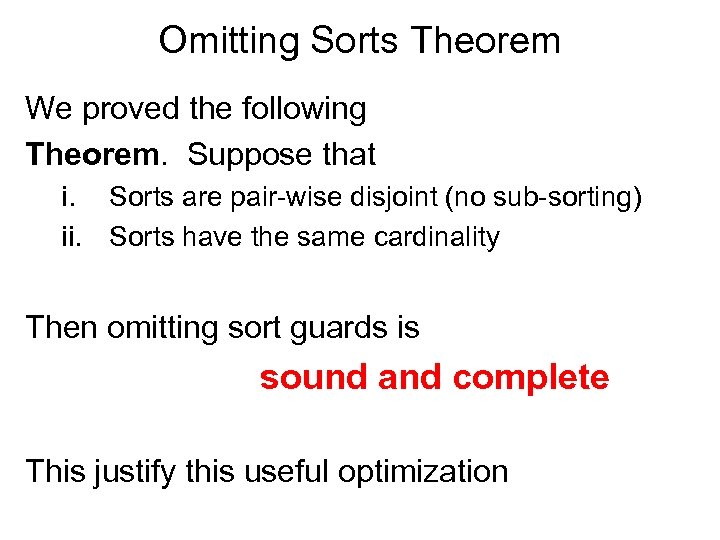 Omitting Sorts Theorem We proved the following Theorem. Suppose that i. Sorts are pair-wise disjoint (no sub-sorting) ii. Sorts have the same cardinality Then omitting sort guards is sound and complete This justify this useful optimization
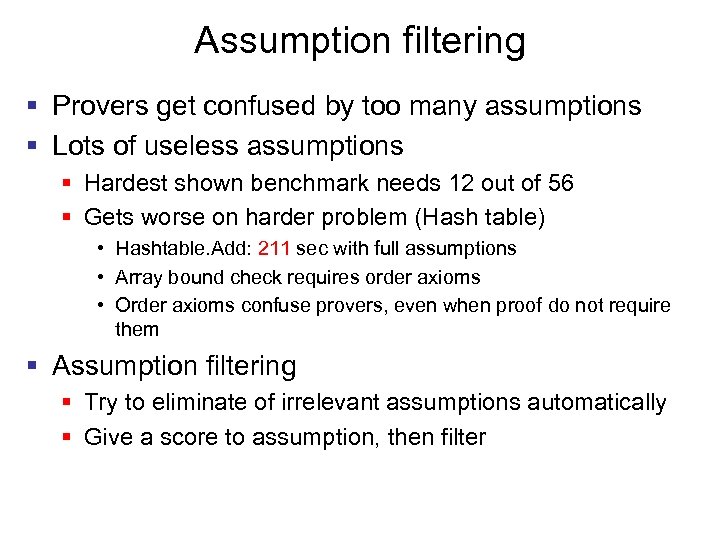 Assumption filtering § Provers get confused by too many assumptions § Lots of useless assumptions § Hardest shown benchmark needs 12 out of 56 § Gets worse on harder problem (Hash table) • Hashtable. Add: 211 sec with full assumptions • Array bound check requires order axioms • Order axioms confuse provers, even when proof do not require them § Assumption filtering § Try to eliminate of irrelevant assumptions automatically § Give a score to assumption, then filter
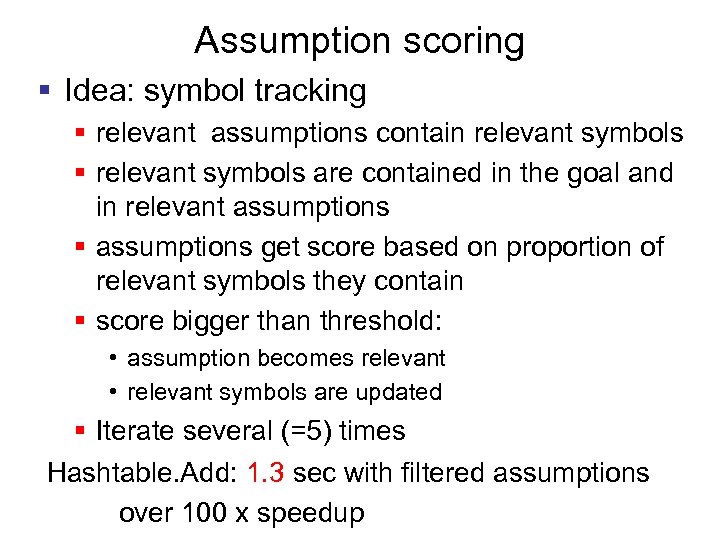 Assumption scoring § Idea: symbol tracking § relevant assumptions contain relevant symbols § relevant symbols are contained in the goal and in relevant assumptions § assumptions get score based on proportion of relevant symbols they contain § score bigger than threshold: • assumption becomes relevant • relevant symbols are updated § Iterate several (=5) times Hashtable. Add: 1. 3 sec with filtered assumptions over 100 x speedup
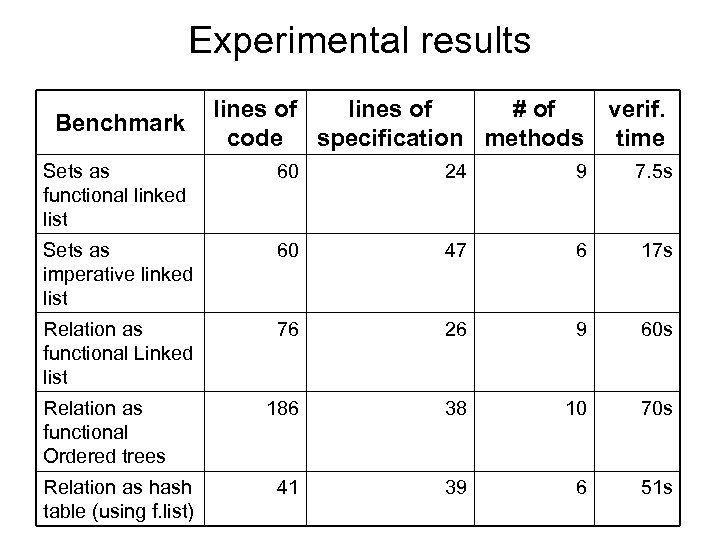 Experimental results Benchmark lines of # of code specification methods verif. time Sets as functional linked list 60 24 9 7. 5 s Sets as imperative linked list 60 47 6 17 s Relation as functional Linked list 76 26 9 60 s 186 38 10 70 s 41 39 6 51 s Relation as functional Ordered trees Relation as hash table (using f. list)
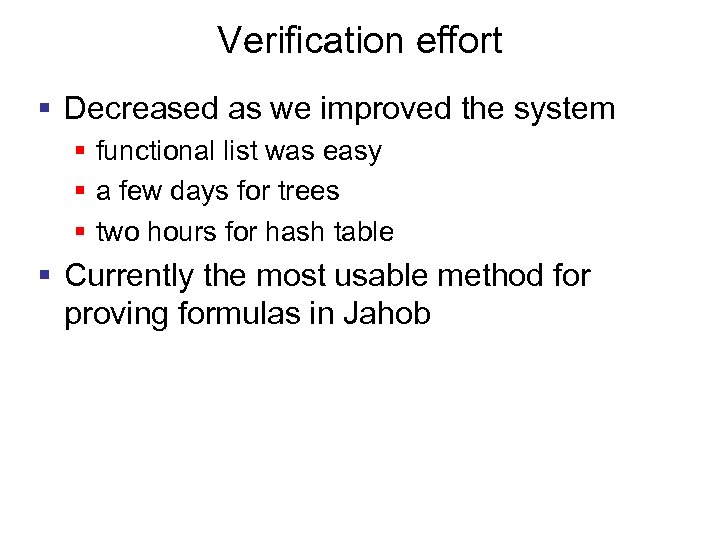 Verification effort § Decreased as we improved the system § functional list was easy § a few days for trees § two hours for hash table § Currently the most usable method for proving formulas in Jahob
 Related work § Interactive Provers – Isabelle, Coq, HOL, PVS, ACL 2 § First-Order ATP § Vampire – Voronkov [04] § SPASS – Weidenbach [01] § E – Shultz [IJCAR 04] § Program Checking § ESC/Java – Flanagan, Leino, Lillibridge, Nelson, Saxe, Stata ‘ 02 § Krakatoa – Marche, Paulin-Mohring, Urbain [03] § Spec# – Barnett, De. Line, Jacobs, Fähndrich, Leino, Schulte, Venter [05] § Hob system: verify set implementations (we verify relations) § Shape analysis § PALE - Møller and Schwartzbach [PLDI 01] § TVLA - Sagiv, Reps, and Wilheim [TOPLAS 02] § Roles - Kuncak, Lam, and Rinard [POPL 02]
 Conclusion § Jahob verification system § Automation by translation HOL FOL § omitting sorts theorem gives speedup § filtering automates selection of assumptions § Promising experimental results § strong properties: correct implementation • Do not crash • operations correctly update the content, clarifies behavior in case of duplicate keys, … • representation invariants preserved (ordering, treeness, each element is in appropriate bucket) § 180 lines in 70 seconds, hash table in seconds § verification effort much smaller than using interactive provers
 Formal Methods are the Future of computer Science. Always have been… Always will be. Questions ?
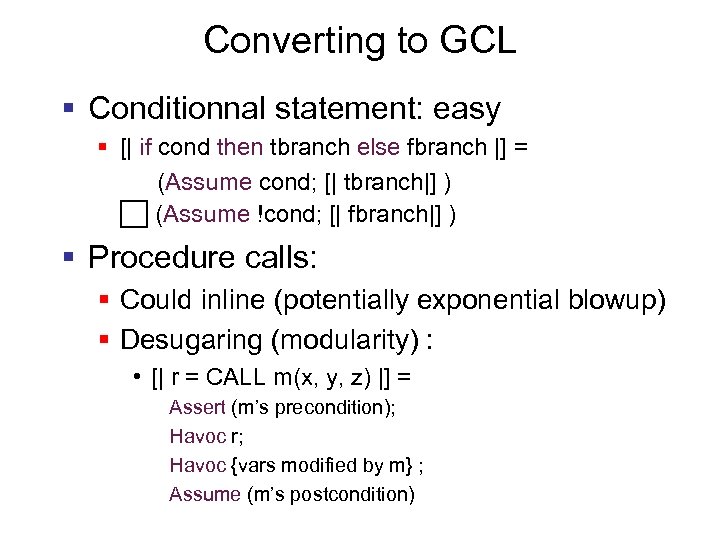 Converting to GCL § Conditionnal statement: easy § [| if cond then tbranch else fbranch |] = (Assume cond; [| tbranch|] ) (Assume !cond; [| fbranch|] ) § Procedure calls: § Could inline (potentially exponential blowup) § Desugaring (modularity) : • [| r = CALL m(x, y, z) |] = Assert (m’s precondition); Havoc r; Havoc {vars modified by m} ; Assume (m’s postcondition)
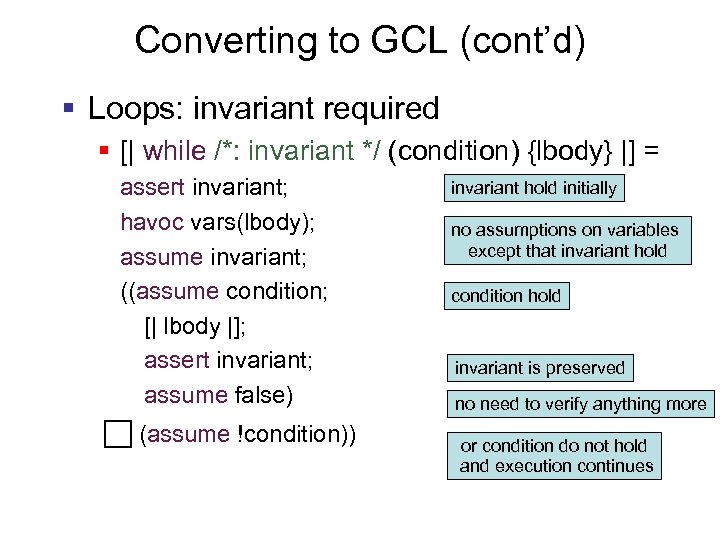 Converting to GCL (cont’d) § Loops: invariant required § [| while /*: invariant */ (condition) {lbody} |] = assert invariant; havoc vars(lbody); assume invariant; ((assume condition; [| lbody |]; assert invariant; assume false) (assume !condition)) invariant hold initially no assumptions on variables except that invariant hold condition hold invariant is preserved no need to verify anything more or condition do not hold and execution continues
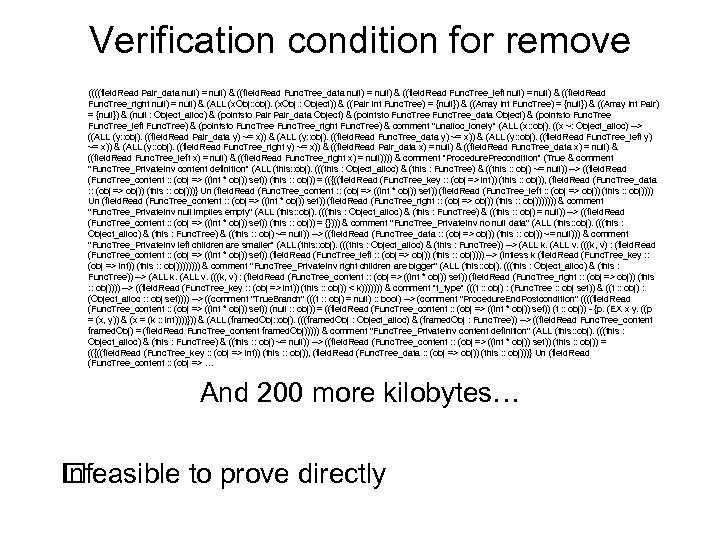 Verification condition for remove ((((field. Read Pair_data null) = null) & ((field. Read Func. Tree_left null) = null) & ((field. Read Func. Tree_right null) = null) & (ALL (x. Obj: : obj). (x. Obj : Object)) & ((Pair Int Func. Tree) = {null}) & ((Array Int Pair) = {null}) & (null : Object_alloc) & (pointsto Pair_data Object) & (pointsto Func. Tree_left Func. Tree) & (pointsto Func. Tree_right Func. Tree) & comment ''unalloc_lonely'' (ALL (x: : obj). ((x ~: Object_alloc) --> ((ALL (y: : obj). ((field. Read Pair_data y) ~= x)) & (ALL (y: : obj). ((field. Read Func. Tree_left y) ~= x)) & (ALL (y: : obj). ((field. Read Func. Tree_right y) ~= x)) & ((field. Read Pair_data x) = null) & ((field. Read Func. Tree_left x) = null) & ((field. Read Func. Tree_right x) = null)))) & comment ''Procedure. Precondition'' (True & comment ''Func. Tree_Private. Inv content definition'' (ALL (this: : obj). (((this : Object_alloc) & (this : Func. Tree) & ((this : : obj) ~= null)) --> ((field. Read (Func. Tree_content : : (obj => ((int * obj)) set)) (this : : obj)) = (({((field. Read (Func. Tree_key : : (obj => int)) (this : : obj)), (field. Read (Func. Tree_data : : (obj => obj)) (this : : obj)))} Un (field. Read (Func. Tree_content : : (obj => ((int * obj)) set)) (field. Read (Func. Tree_left : : (obj => obj)) (this : : obj)))) Un (field. Read (Func. Tree_content : : (obj => ((int * obj)) set)) (field. Read (Func. Tree_right : : (obj => obj)) (this : : obj))))))) & comment ''Func. Tree_Private. Inv null implies empty'' (ALL (this: : obj). (((this : Object_alloc) & (this : Func. Tree) & ((this : : obj) = null)) --> ((field. Read (Func. Tree_content : : (obj => ((int * obj)) set)) (this : : obj)) = {}))) & comment ''Func. Tree_Private. Inv no null data'' (ALL (this: : obj). (((this : Object_alloc) & (this : Func. Tree) & ((this : : obj) ~= null)) --> ((field. Read (Func. Tree_data : : (obj => obj)) (this : : obj)) ~= null))) & comment ''Func. Tree_Private. Inv left children are smaller'' (ALL (this: : obj). (((this : Object_alloc) & (this : Func. Tree)) --> (ALL k. (ALL v. (((k, v) : (field. Read (Func. Tree_content : : (obj => ((int * obj)) set)) (field. Read (Func. Tree_left : : (obj => obj)) (this : : obj)))) --> (intless k (field. Read (Func. Tree_key : : (obj => int)) (this : : obj)))) & comment ''Func. Tree_Private. Inv right children are bigger'' (ALL (this: : obj). (((this : Object_alloc) & (this : Func. Tree)) --> (ALL k. (ALL v. (((k, v) : (field. Read (Func. Tree_content : : (obj => ((int * obj)) set)) (field. Read (Func. Tree_right : : (obj => obj)) (this : : obj)))) --> ((field. Read (Func. Tree_key : : (obj => int)) (this : : obj)) < k))))))) & comment ''t_type'' (((t : : obj) : (Func. Tree : : obj set)) & ((t : : obj) : (Object_alloc : : obj set)))) --> ((comment ''True. Branch'' (((t : : obj) = null) : : bool) --> (comment ''Procedure. End. Postcondition'' ((((field. Read (Func. Tree_content : : (obj => ((int * obj)) set)) (null : : obj)) = ((field. Read (Func. Tree_content : : (obj => ((int * obj)) set)) (t : : obj)) - {p. (EX x y. ((p = (x, y)) & (x = (k : : int))))})) & (ALL (framed. Obj: : obj). (((framed. Obj : Object_alloc) & (framed. Obj : Func. Tree)) --> ((field. Read Func. Tree_content framed. Obj) = (field. Read Func. Tree_content framed. Obj))))) & comment ''Func. Tree_Private. Inv content definition'' (ALL (this: : obj). (((this : Object_alloc) & (this : Func. Tree) & ((this : : obj) ~= null)) --> ((field. Read (Func. Tree_content : : (obj => ((int * obj)) set)) (this : : obj)) = (({((field. Read (Func. Tree_key : : (obj => int)) (this : : obj)), (field. Read (Func. Tree_data : : (obj => obj)) (this : : obj)))} Un (field. Read (Func. Tree_content : : (obj => … And 200 more kilobytes… Infeasible to prove directly
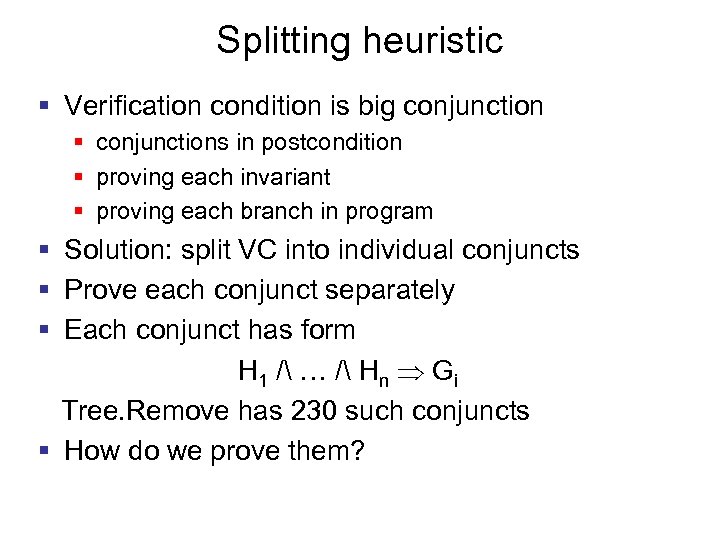 Splitting heuristic § Verification condition is big conjunction § conjunctions in postcondition § proving each invariant § proving each branch in program § Solution: split VC into individual conjuncts § Prove each conjunct separately § Each conjunct has form H 1 / … / Hn Gi Tree. Remove has 230 such conjuncts § How do we prove them?
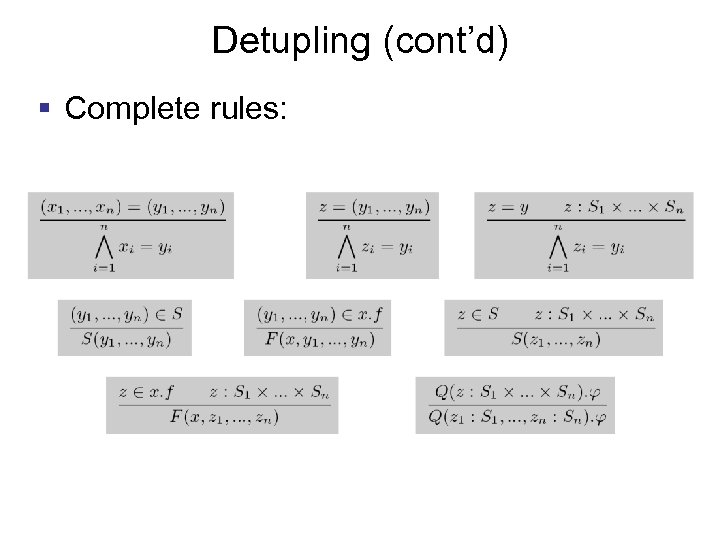 Detupling (cont’d) § Complete rules:
 Handling of Fields (cont’d) § We dealt with field updates § New function expressed in terms of old one § Base case: field variables § Natural encoding in FOL using functions: x = y. f ! x = f(y)
 Future work § Verify more examples § balanced trees § fancy priority queues (binomial, Fibonacci, …) § hash table with dynamic resizing § hash function § verify clients of data structures § Improve assumption filtering § take rarity of symbols into account § check for occurring polarity §…