


 Скачать презентацию Using English Phrases in the Taiwan University Classroom
df3d606cd7eec549f6224ff9f560993e.ppt
- Количество слайдов: 119
 Using English Phrases in the Taiwan University Classroom Dr. Steve Wallace
 Introduction to the speaker • 13 years teaching Taiwanese university students • Scholarly Writing and Scholarly Presentations in public and private universities • Speeches and workshops on writing and teaching at 118 universities • Collected notes on teaching for 15 years
 The First Professors • • • Sages, Witchdoctors or Shamans Not hunters or warriors Old, experienced, specialized, respected and useful Sang the knowledge of survival skills Carried a map – geographical, mineral, biological World today is less dangerous but more complicated
 The Professor’s Goal: • To give information meaning • To make students care about the underlying questions of our domain • To make independent learners • To create the learning habit
 How do we improve our teaching? • We learn through teaching • Beneficiaries of good teaching: The student, the university, the industry, the nation, the domain
 Show passion and enthusiasm for your topic • • • You are the salesperson for your topic If you are not interested your students will not Point out the fascinating aspects Do not only read your slides “Only think of his sword and your sword”
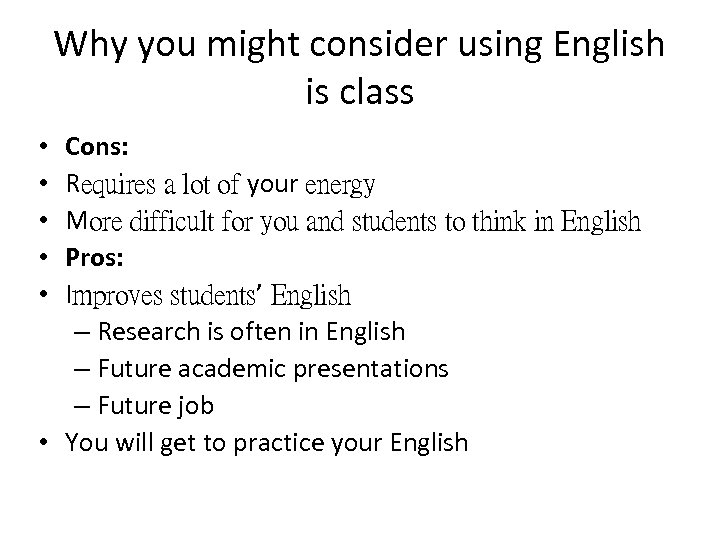 Why you might consider using English is class Cons: Requires a lot of your energy More difficult for you and students to think in English Pros: Improves students’ English – Research is often in English – Future academic presentations – Future job • You will get to practice your English • • •
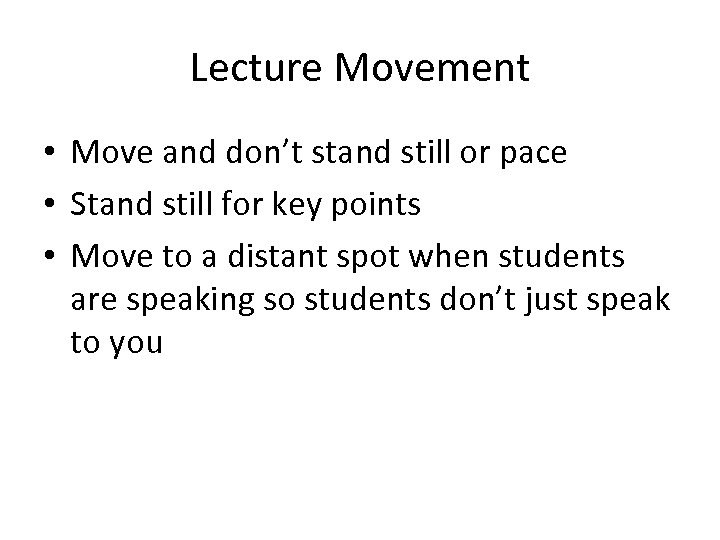 Lecture Movement • Move and don’t stand still or pace • Stand still for key points • Move to a distant spot when students are speaking so students don’t just speak to you
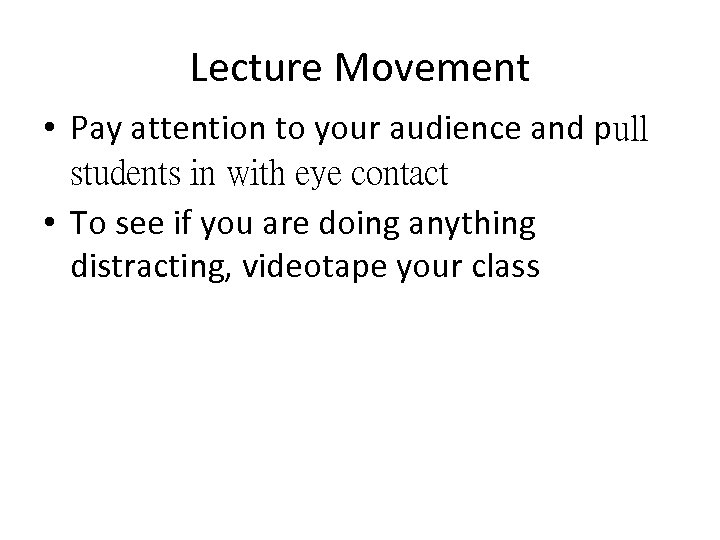 Lecture Movement • Pay attention to your audience and pull students in with eye contact • To see if you are doing anything distracting, videotape your class
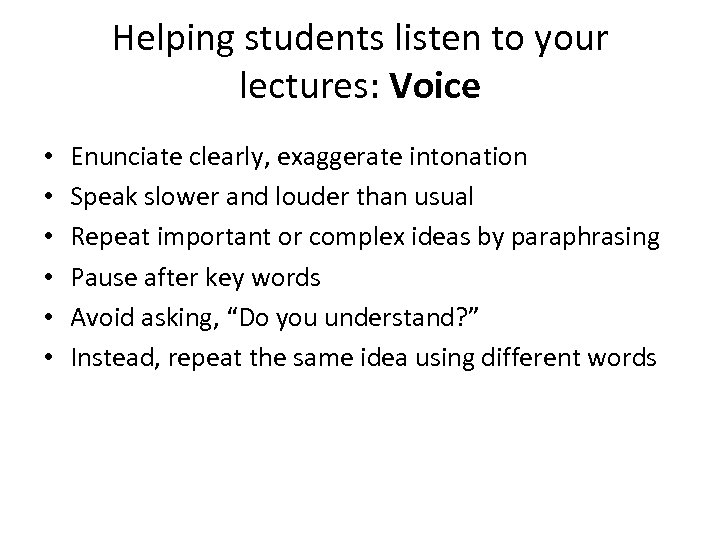 Helping students listen to your lectures: Voice • • • Enunciate clearly, exaggerate intonation Speak slower and louder than usual Repeat important or complex ideas by paraphrasing Pause after key words Avoid asking, “Do you understand? ” Instead, repeat the same idea using different words
 Pauses • Especially before new information or key point in a sentence “The most important thing we can conclude about this is. . . that these effects cannot be underestimated, and if you do, you do so at your own risk. ”
 Pauses emphasize a point • “We operate behind what is called … the “veil of ignorance, ” meaning that we cannot know or predict outcomes. The problem is that we fail to treat others with dignity and respect, and only think of our longer term goals. Another problem is that our decision making processes are often … clouded by our own psychological biases. Psychologists have provided ample evidence of a number of such biases … hindsight bias, attribution biases … self-preservation biases, and others. ”
 Repeat your points in two or three different ways • Students may not have heard it, or understood it, or had time to write it down • Stress important points. This can be done with your tone of voice or what you say • “Write this down” • “This is important” • “This will be on the test” • Pause to give your listeners time to think and write
 Repetition “There is absolutely no proof for the effectiveness of this drug – let me repeat – there is absolutely no proof for its effectiveness. ”
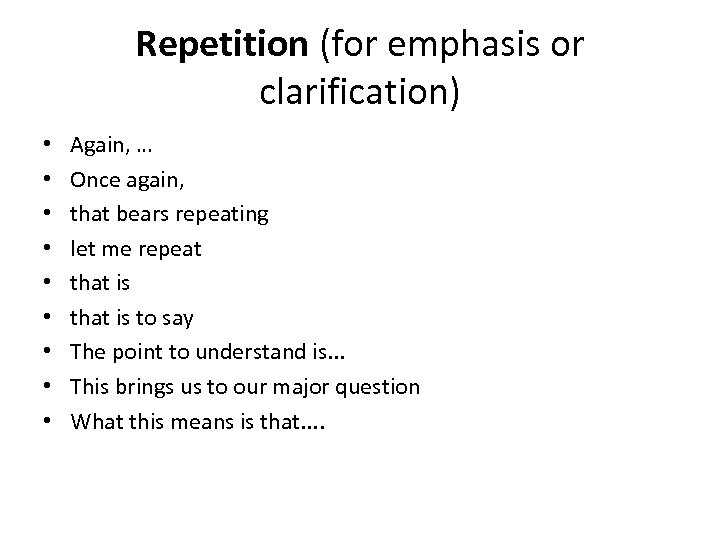 Repetition (for emphasis or clarification) • • • Again, … Once again, that bears repeating let me repeat that is to say The point to understand is. . . This brings us to our major question What this means is that. .
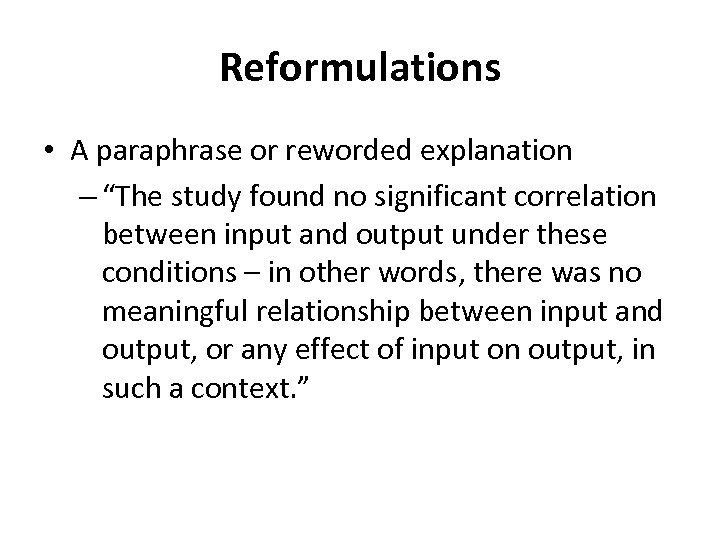 Reformulations • A paraphrase or reworded explanation – “The study found no significant correlation between input and output under these conditions – in other words, there was no meaningful relationship between input and output, or any effect of input on output, in such a context. ”
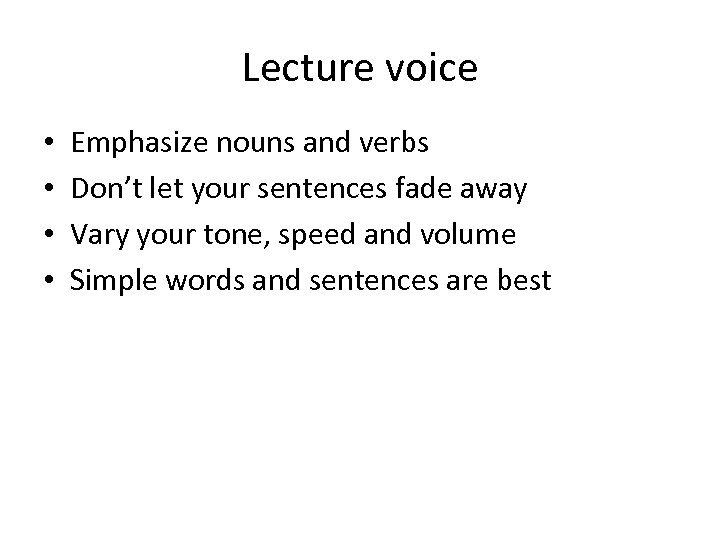 Lecture voice • • Emphasize nouns and verbs Don’t let your sentences fade away Vary your tone, speed and volume Simple words and sentences are best
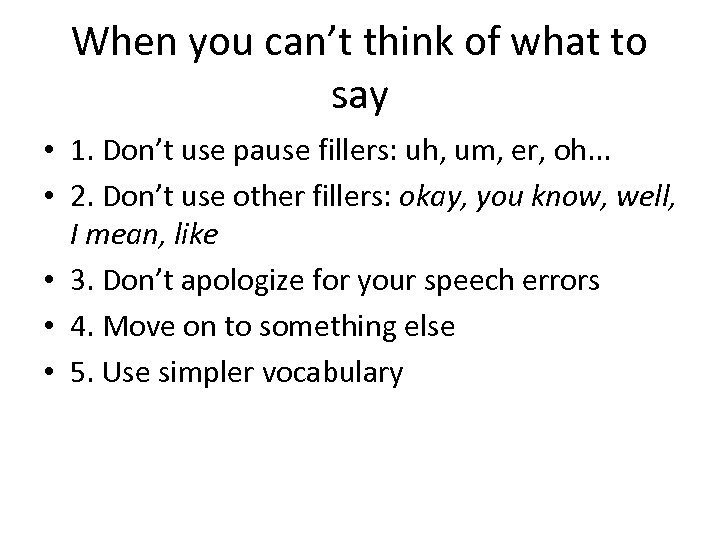 When you can’t think of what to say • 1. Don’t use pause fillers: uh, um, er, oh. . . • 2. Don’t use other fillers: okay, you know, well, I mean, like • 3. Don’t apologize for your speech errors • 4. Move on to something else • 5. Use simpler vocabulary
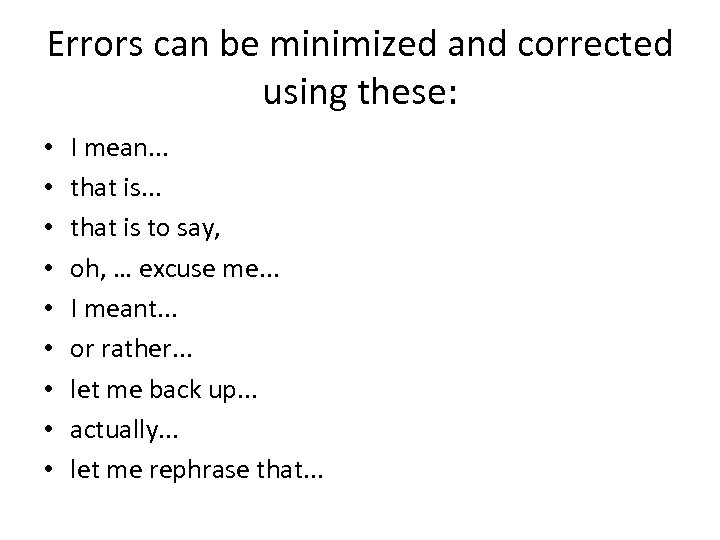 Errors can be minimized and corrected using these: • • • I mean. . . that is to say, oh, … excuse me. . . I meant. . . or rather. . . let me back up. . . actually. . . let me rephrase that. . .
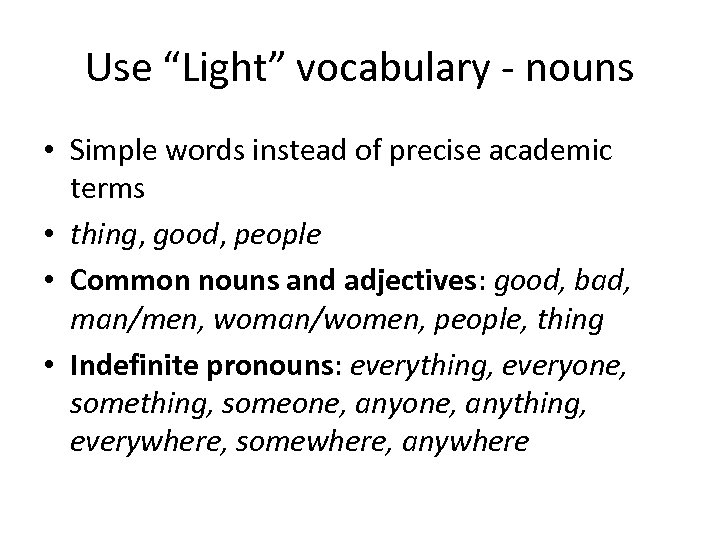 Use “Light” vocabulary - nouns • Simple words instead of precise academic terms • thing, good, people • Common nouns and adjectives: good, bad, man/men, woman/women, people, thing • Indefinite pronouns: everything, everyone, something, someone, anything, everywhere, somewhere, anywhere
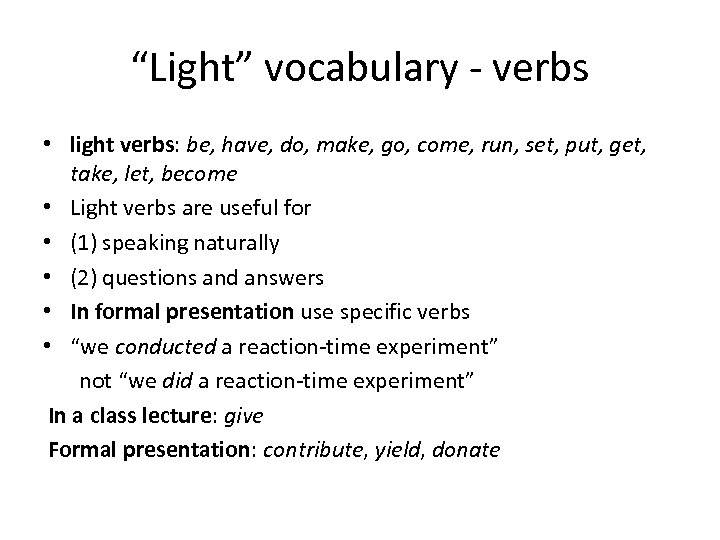 “Light” vocabulary - verbs • light verbs: be, have, do, make, go, come, run, set, put, get, take, let, become • Light verbs are useful for • (1) speaking naturally • (2) questions and answers • In formal presentation use specific verbs • “we conducted a reaction-time experiment” not “we did a reaction-time experiment” In a class lecture: give Formal presentation: contribute, yield, donate
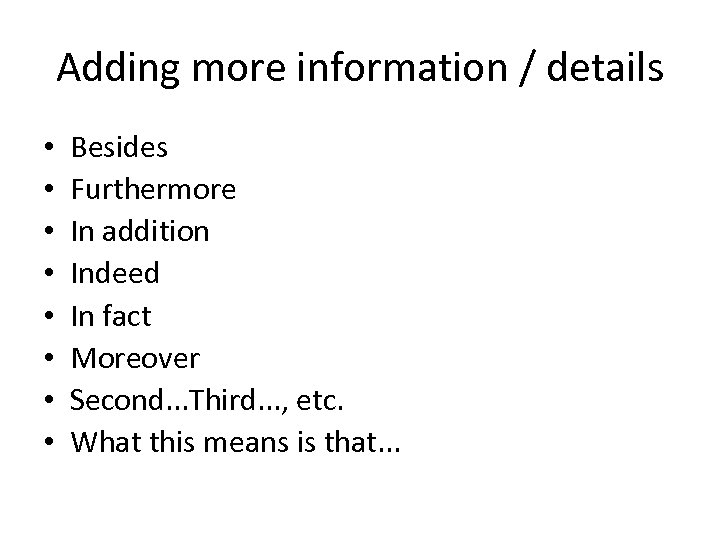 Adding more information / details • • Besides Furthermore In addition Indeed In fact Moreover Second. . . Third. . . , etc. What this means is that. . .
 Avoid lengthy digressions • “My professor tells stories and makes us laugh all the time, but he never writes on the board and at the end of class, it’s hard to know what the main points were, and what to study. ”
 Explaining processes • • at first / initially begin / began by / with the second step / stage afterward then / next / later as / as soon as upon (+noun or gerund phrase) finally, at last
 Analysis • • Let’s analyze this in more detail Where does that lead us? Let’s examine the implications of this In real terms, this means in terms of
 Reason, cause, purpose • • • because of due to for (conjunction) for the reason that since in the hope that in order to so / so that with __ in mind for the purpose of
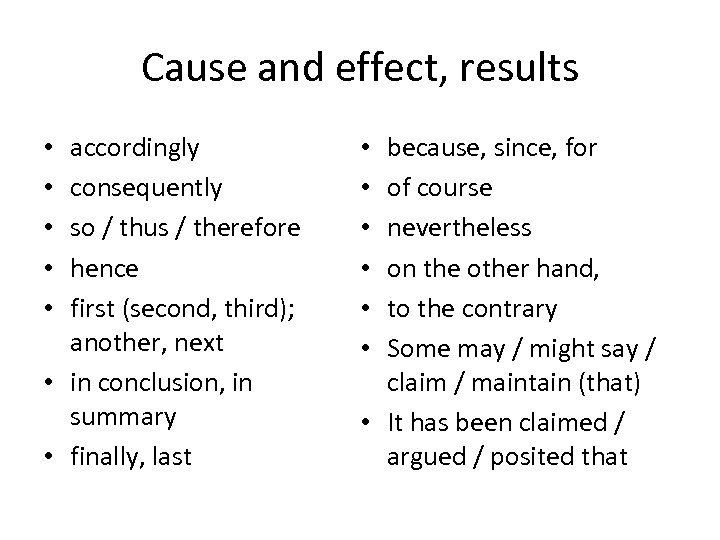 Cause and effect, results accordingly consequently so / thus / therefore hence first (second, third); another, next • in conclusion, in summary • finally, last • • • because, since, for of course nevertheless on the other hand, to the contrary Some may / might say / claim / maintain (that) • It has been claimed / argued / posited that • • •
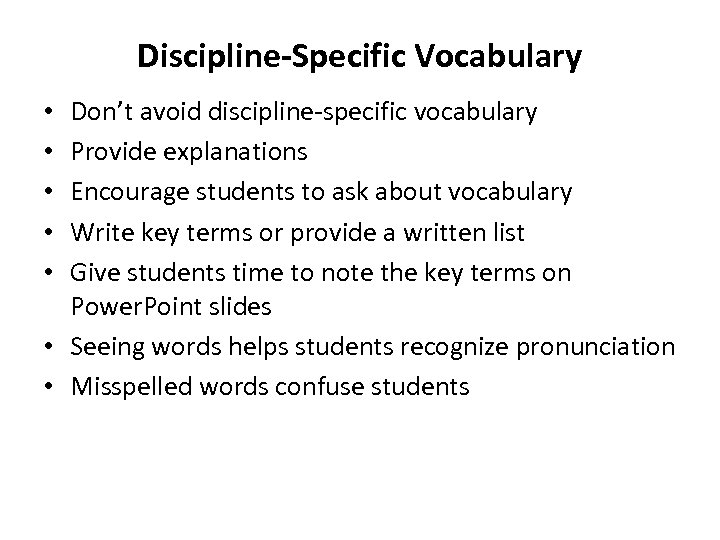 Discipline-Specific Vocabulary Don’t avoid discipline-specific vocabulary Provide explanations Encourage students to ask about vocabulary Write key terms or provide a written list Give students time to note the key terms on Power. Point slides • Seeing words helps students recognize pronunciation • Misspelled words confuse students • • •
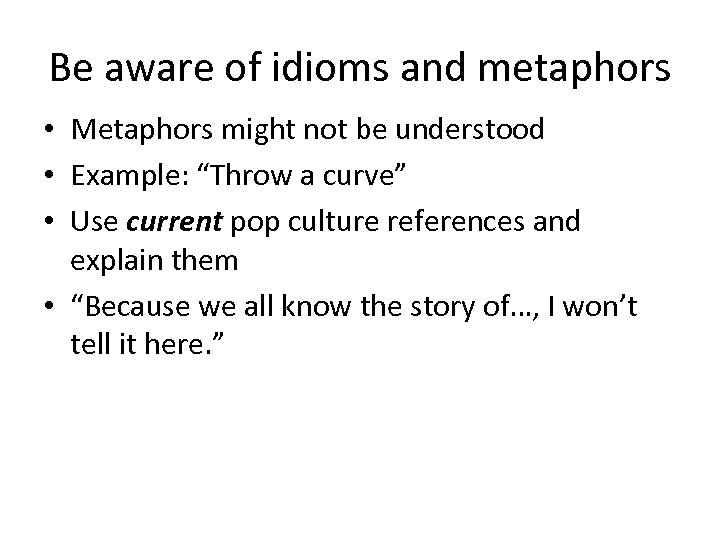 Be aware of idioms and metaphors • Metaphors might not be understood • Example: “Throw a curve” • Use current pop culture references and explain them • “Because we all know the story of…, I won’t tell it here. ”
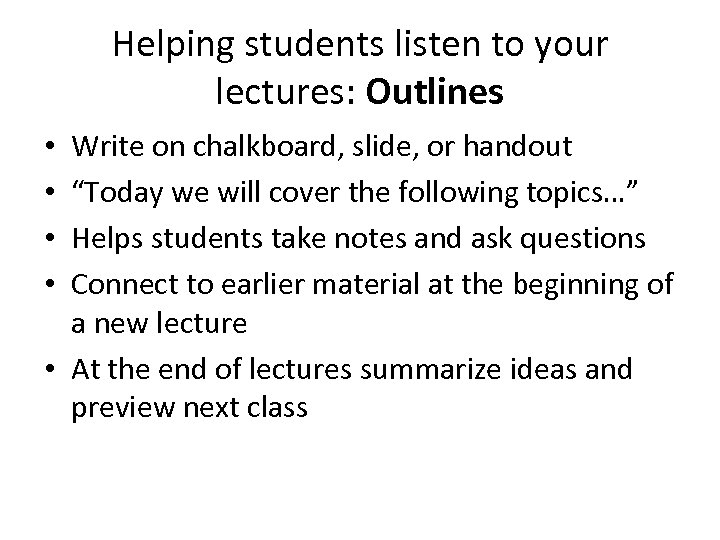 Helping students listen to your lectures: Outlines Write on chalkboard, slide, or handout “Today we will cover the following topics…” Helps students take notes and ask questions Connect to earlier material at the beginning of a new lecture • At the end of lectures summarize ideas and preview next class • •
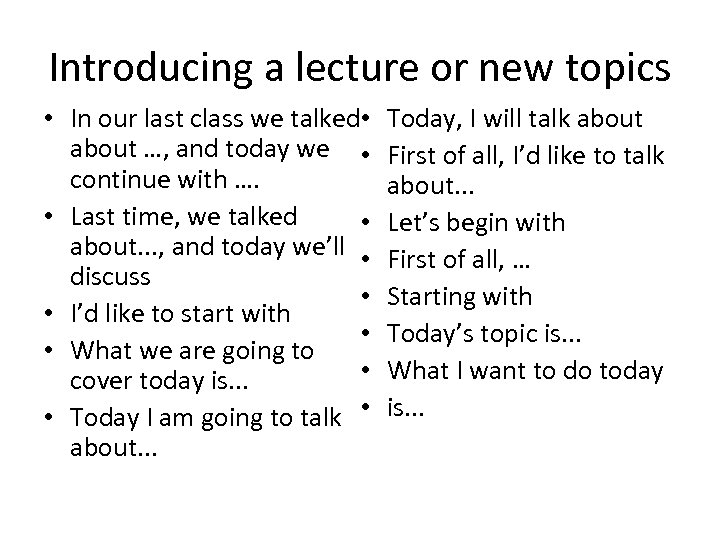 Introducing a lecture or new topics • • In our last class we talked about …, and today we • continue with …. • Last time, we talked • about. . . , and today we’ll • discuss • • I’d like to start with • • What we are going to • cover today is. . . • Today I am going to talk • about. . . Today, I will talk about First of all, I’d like to talk about. . . Let’s begin with First of all, … Starting with Today’s topic is. . . What I want to do today is. . .
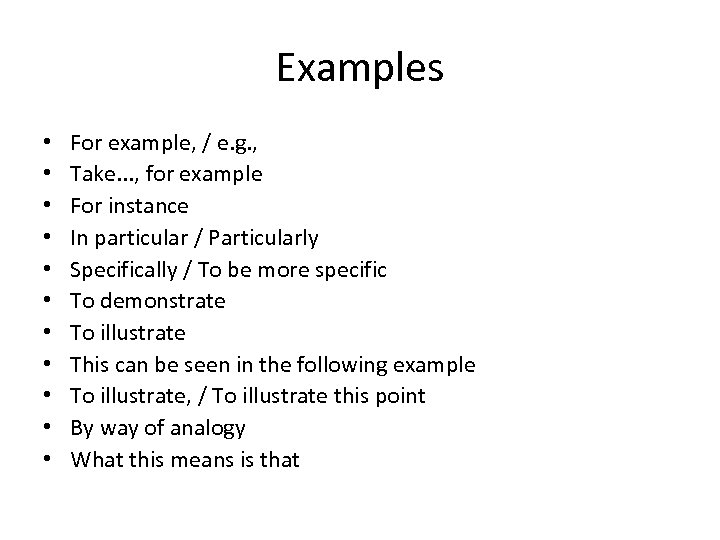 Examples • • • For example, / e. g. , Take. . . , for example For instance In particular / Particularly Specifically / To be more specific To demonstrate To illustrate This can be seen in the following example To illustrate, / To illustrate this point By way of analogy What this means is that
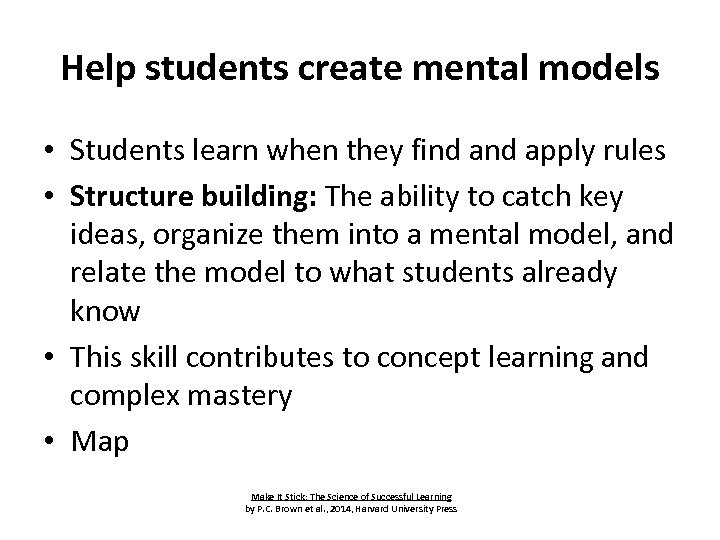 Help students create mental models • Students learn when they find apply rules • Structure building: The ability to catch key ideas, organize them into a mental model, and relate the model to what students already know • This skill contributes to concept learning and complex mastery • Map Make It Stick: The Science of Successful Learning by P. C. Brown et al. , 2014, Harvard University Press
 Highlighting, emphasizing
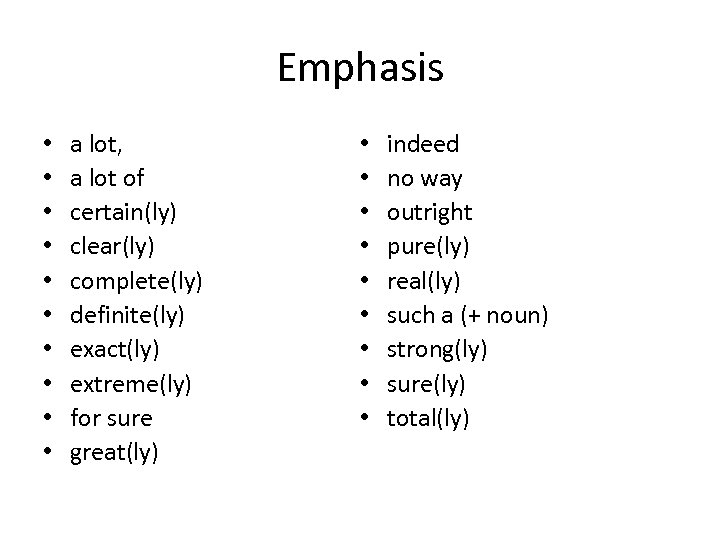 Emphasis • • • a lot, a lot of certain(ly) clear(ly) complete(ly) definite(ly) exact(ly) extreme(ly) for sure great(ly) • • • indeed no way outright pure(ly) real(ly) such a (+ noun) strong(ly) sure(ly) total(ly)
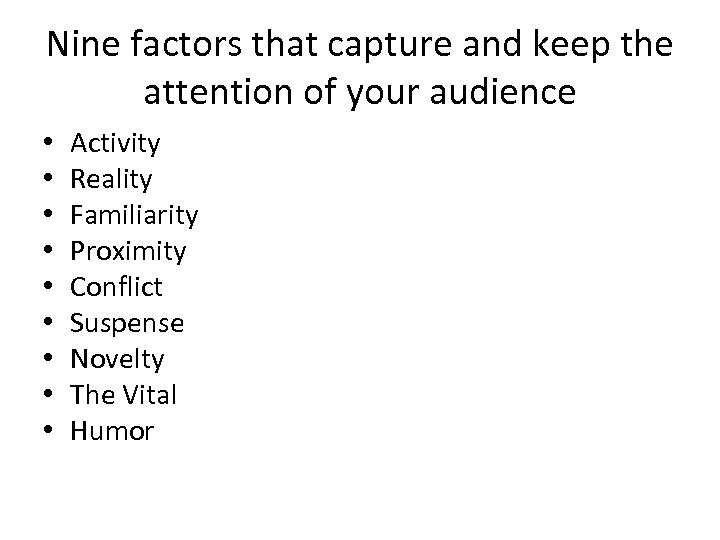 Nine factors that capture and keep the attention of your audience • • • Activity Reality Familiarity Proximity Conflict Suspense Novelty The Vital Humor
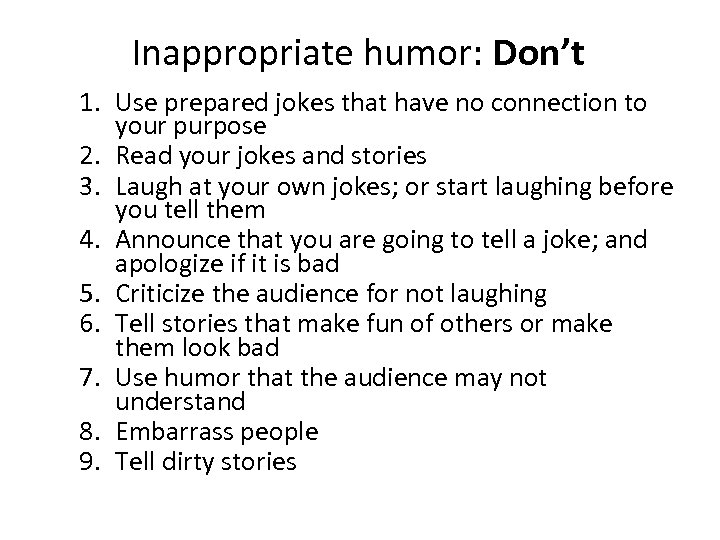 Inappropriate humor: Don’t 1. Use prepared jokes that have no connection to your purpose 2. Read your jokes and stories 3. Laugh at your own jokes; or start laughing before you tell them 4. Announce that you are going to tell a joke; and apologize if it is bad 5. Criticize the audience for not laughing 6. Tell stories that make fun of others or make them look bad 7. Use humor that the audience may not understand 8. Embarrass people 9. Tell dirty stories
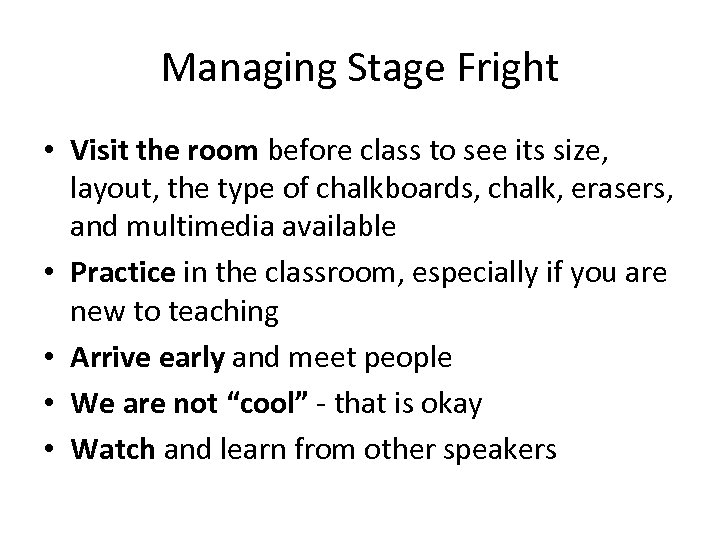 Managing Stage Fright • Visit the room before class to see its size, layout, the type of chalkboards, chalk, erasers, and multimedia available • Practice in the classroom, especially if you are new to teaching • Arrive early and meet people • We are not “cool” - that is okay • Watch and learn from other speakers
 4 P’s for gaining confidence in presenting • • Pretend Predetermine Practice Prepare
 After the Lecture • Rethink, retool, revise • Each time you deliver a lecture, you learn something • Note how each lecture went and use to improve • rethinking the material • rewriting the lecture • developing ideas for future teaching • Include these notes with your lecture notes
 Questions in the Classroom
 Purpose of asking good questions • Students become active participants in learning • Students engage in higher-level cognitive processes – analysis – synthesis – evaluation – critical thinking
 Getting students to talk • Try to get everyone to speak in the first two weeks • Your manner should be kind Participation and discussion should be part of grade • Try a self reported grade for participation • TA enters or modifies score Don’t clamp down on tangents right away • Find treads to pull back class or “we are getting away from topic”
 When you ask a question in class, don’t immediately call for volunteers • Problem: Most students avoid eye contact • The same student always volunteers or you answer • Few students think, since they know that someone else will provide the answer
 Don’t call on students cold • Problem: You stop in mid-lecture and point • “Joe, what’s the next step? ” • If you don’t give student’s time to think, they won’t be learning but praying that you don’t call them • As soon as you call on someone, the others are relieved and stop thinking
 Calling on studnets - solution • 1) Ask question and give a short time to create answer • 2) Call on a few to report • 3) If you did not get a complete response, call for volunteers • 4) Most students will try to come up with a response • You’ll avoid the fear of cold-calling and get better answers • The important answer is not the one we give and they forget but the one they keep for themselves
 Try pair first, questions second • Let students try out their answers by quickly discussing them in pairs or by writing for a minute or two • Students are much more willing to share their answers with the class when they have had this opportunity
 Wait for a response from students • Do not answer the question yourself • Don’t repeat it, rephrase it, modify it, call on another student to answer it, or replace it • Wait three to five seconds • Average “wait time” is 0. 9 seconds • Students will respond more, use complex cognitive processes, and ask more questions
 A series of questions confuses students • Do not ask, “How are apes and humans alike? Are they alike in bone structure and/or family structure and/or places where they live? ” • “Hands will go up in response to the first question, and a few will go down during the second, and those hands remaining up will gradually get lower and lower as the instructor finally concludes with a question very different from the one for which the hands were raised. ” (Napell, 1978)
 Collect several answers to your question, even if the first is perfect • Not all students think at the same speed • Encourage those not first to continue reflecting • Third or fourth answers will add dimensions
 Avoid asking questions without context “Any questions? ” • Context questions: • “What questions or clarifications of points need to be raised? ” • “Please ask questions about the main characters or the minor characters, whichever you wish at this point, ” • “In light of Sally’s allusion to Lady Macbeth, I invite you to ask her some questions for clarification. ”
 There are no stupid questions • “Questions are not a sign of stupidity but rather show concern and thought about the topic” • Do not subtly show that a student is stupid for asking for a clarification of an idea already raised in class or in the text • Easy to do this – Inappropriate smile
 For specific information ask specific questions • Avoid using “why” and “explain” • What type of explanation do you want? • Ask for causal, functional, or chronological explanations • For a chronological explanation: • Not “Why did we have a depression in the 1930 s? ” • Better “What series of events led up to the stock market crash of 1929 and the high unemployment in the 1930 s? ”
 Prevent one student from dominating the class • “Only two comments unless everyone has spoken” • “Don’t make Kevin do all the work today” • Post it notes on desk for points after two no new points
 Tell studnets how to answer questions • Tell students what is expected: – Participate when called upon – Answer questions as carefully and clearly as possible – Address the whole class so that everyone can hear their answers – Be as short as possible to maximize classroom time
 When Answering Students’ Questions • If the question matches class goals: give an answer or redirect for discussion • If not related: tell the student where she can find an answer or offer to discuss after class • Not necessary to know the answer to every question • Students can sense when an instructor “fakes” an answer • Instead, offer to find the answer or suggest where the student can find the answer
 Praise the student in a strong, positive way for a correct or positive response • “Excellent answer, ” “Absolutely correct, ” and “Interesting point” • Better than “O. K. , ” “hmm hum, ” and “all right. ” • When response is long, find at least part that deserves praise and comment
 Tell the student why the answer is good • Question: “What function did the invasion of the Kuwait serve for Iraq? ” • Teacher’s comment: • “That was excellent, Patty. You included national political reasons as well as mentioning the Iraqi drive to become a pan. Arabic leader. ” • Encourage student strongly and specifically • Demonstrate that you listened carefully
 Build on the student’s response • If you continue to discuss, try to use the response • “As Patty pointed out, Kuwait’s political status. . . ” • Acknowledging the student’s response shows you listened
 Rewarding Student Participation • Support with encouraging statements • Sometimes must find good among the bad • Encourage personal reflection and independence • Statements that support initiative, cooperation and perseverance follow:
 Description • To avoid making a personal evaluation, state an accepted conclusion: – 'You have addressed each item. ' – 'That question is probably shared by many here today. ' – 'That writing exercise was completed just like in the book. '
 Narration • Narrations usually begin with 'You. . . ' – 'You're raising an issue that needs discussion. ' – 'You're obviously trying to fit the pieces together. ' – 'You remembered the first step. '
 Self-Talk • Talk about your own thoughts or prior personal experience – 'I have wondered that, too. ' – 'Questions like that have always intrigued me. ' – 'It took me four years to write like that. '
 Nonverbal • Use body language and facial expressions – Smile broadly – Thumbs up – Move to convey excitement and enjoyment
 Intrinsically-Phrased Reward Statements Emphasize feelings of self-satisfaction • Enjoyment: 'That was fun!' 'What a pleasure it must have been to do. ' • Competence: 'You did it!' 'An accomplishment. ' • Cleverness: 'That was tricky. ' 'Intelligent. ' 'Unique. ' • Growth: 'You've taken a step forward. ' 'What changes have occurred? '
 Praise effort not intelligence Fixed mindset = Success inborn Growth mindset = Success is based on effort Examples “Great job! Clearly, you are very good at math. ” • “Great job! You must have worked hard at that problem! Nice effort!” • • • Dweck, C. S. (2006). Mindset: The New Psychology of Success. New York: Random House.
 Using Socratic Questioning • Quote: “Can it be, Ischomachus, that asking questions is teaching? I am just beginning to see what is behind all your questions. You lead me on by means of things I know, point to things that resemble them, and persuade me that I know things that I thought I had no knowledge of. ” - Socrates (Quoted in Xenophon's "Economics")
 What is Socratic Questioning? • The teacher pretends ignorance about a subject to get the student’s fullest knowledge • Students recognize contradictions, so inaccurate ideas are corrected through questioning • Builds on the mental model the student already has
 Socratic Method Uses Discoverable Questions • Questions with follow-up questions help students answer using his knowledge • A lesson to the student that he knows how to think • None of these questions asks for recall of facts (Didactic questions)
 Discoverable Questions (1) • Description: What did you see? • What happened? • What is the difference between. . ? • Reflection: What was interesting? • What was surprising? • Analogy: What else does it remind you of? • What else does it look like?
 Discoverable Questions (2) • Common Purpose: What is the purpose of. . . ? • What is the usual function of. . . ? • Procedures: How does one normally do. . . ? • How was this done? • What is the normal (non- creative) next step? • Possibilities: What else could. . . ? • How could we. . . ? • If we didn't have, or couldn't use, . . . , what could. . . . ?
 Discoverable Questions (3) • Prediction: What will happen next? • What will you see? What will be the effect? • Justification: How can you tell? • What evidence led you to. . . ? • Theorizing: Why is it that way? • What is the reason for it? • Generalization: What is the same about. . . . and. . . ? What could you generalize from these events? • What principle is operating? • Definition: What does. . . mean? • Define the word. . .
 How to respond during Socratic questioning? • We “lose our hands” • Three reflective responses • Listed by amount of teacher control, starting with the lightest level
 Paraphrase Rephrase in your own words Avoid 'parroting' student’s words or beginning with 'I hear you saying. . . ' Example: Student says, “I am confused. I still don't know what you want from me. ” • Paraphrase: 'You see no way to start, huh? ' • • •
 Parallel Personal Comment • Your feelings that match what the student has said • Validate the student’s perspective or confirm your understanding • Start with 'I. . ' • “I was confused about that myself when I first read it. ”
 Questions on student’s response • • • Ask for clarification Dig deeper into the response “Where does it break down? ” “Could you elaborate or give an example? ” “Who else can build on what she is saying? ”
 Sentences for asking and answering questions
 Asking questions • Now I’d like to take some • questions • • Do you have any questions? • • Who would like to say something? • • Could you say a little more about that? • Can you elaborate on • that? • Do you agree? What do you think? How do you feel about. . . ? What comparisons can you make between? What is the point made by the author of this article? How would you summarize this theory?
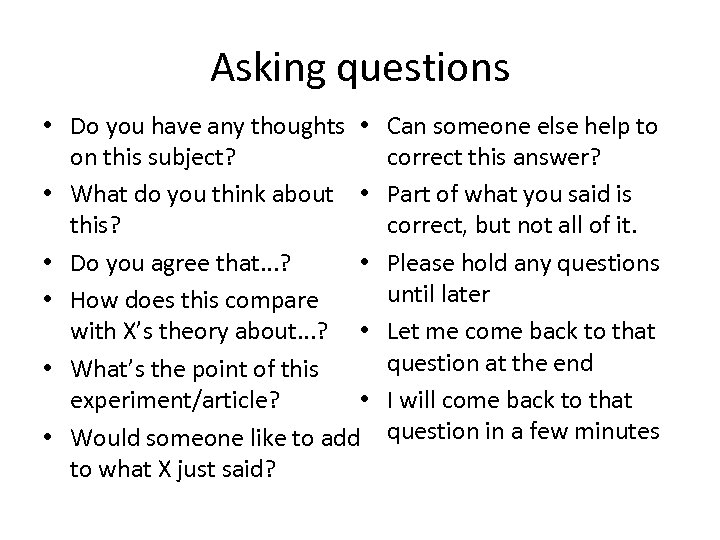 Asking questions • Do you have any thoughts • on this subject? • What do you think about • this? • Do you agree that. . . ? • • How does this compare with X’s theory about. . . ? • • What’s the point of this experiment/article? • • Would someone like to add to what X just said? Can someone else help to correct this answer? Part of what you said is correct, but not all of it. Please hold any questions until later Let me come back to that question at the end I will come back to that question in a few minutes
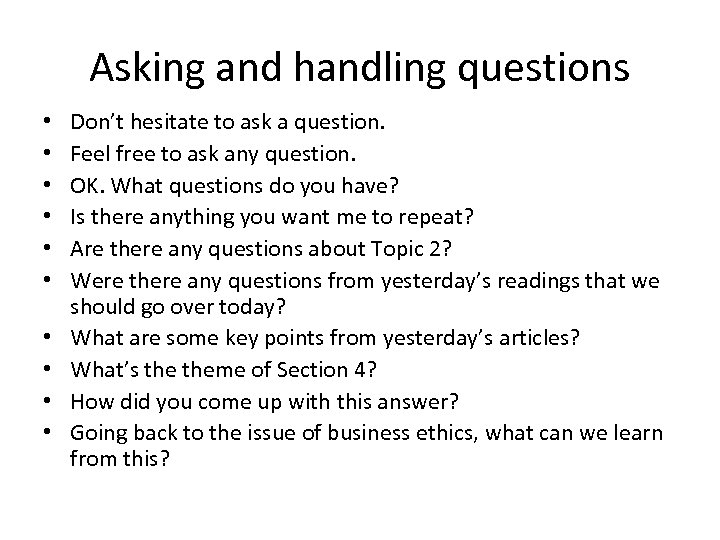 Asking and handling questions • • • Don’t hesitate to ask a question. Feel free to ask any question. OK. What questions do you have? Is there anything you want me to repeat? Are there any questions about Topic 2? Were there any questions from yesterday’s readings that we should go over today? What are some key points from yesterday’s articles? What’s theme of Section 4? How did you come up with this answer? Going back to the issue of business ethics, what can we learn from this?
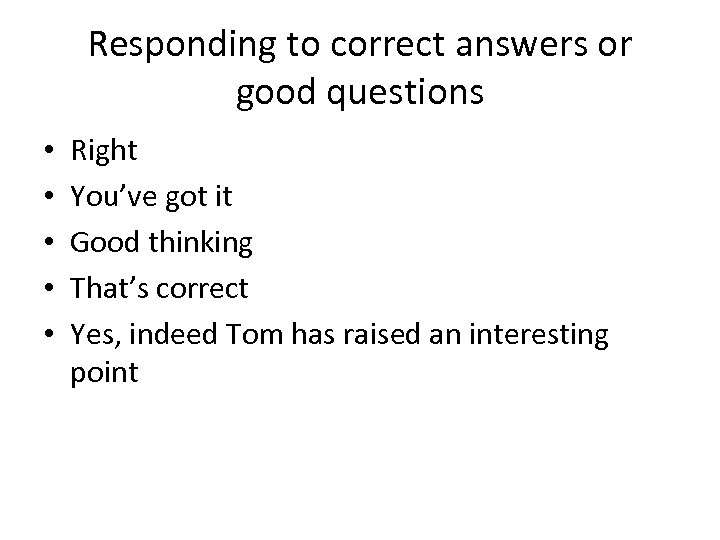 Responding to correct answers or good questions • • • Right You’ve got it Good thinking That’s correct Yes, indeed Tom has raised an interesting point
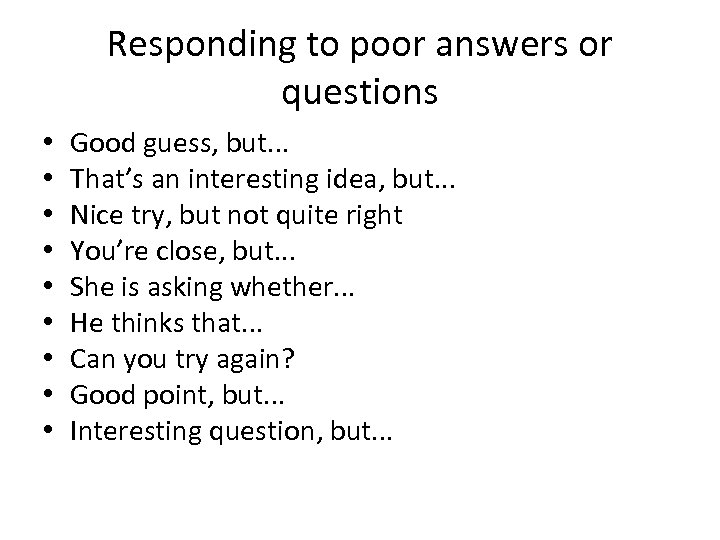 Responding to poor answers or questions • • • Good guess, but. . . That’s an interesting idea, but. . . Nice try, but not quite right You’re close, but. . . She is asking whether. . . He thinks that. . . Can you try again? Good point, but. . . Interesting question, but. . .
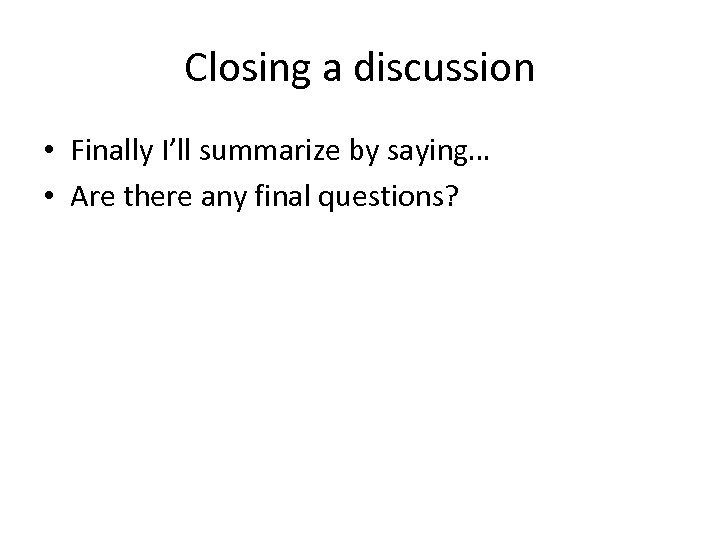 Closing a discussion • Finally I’ll summarize by saying… • Are there any final questions?
 Changing or shifting to new topics, points or sections
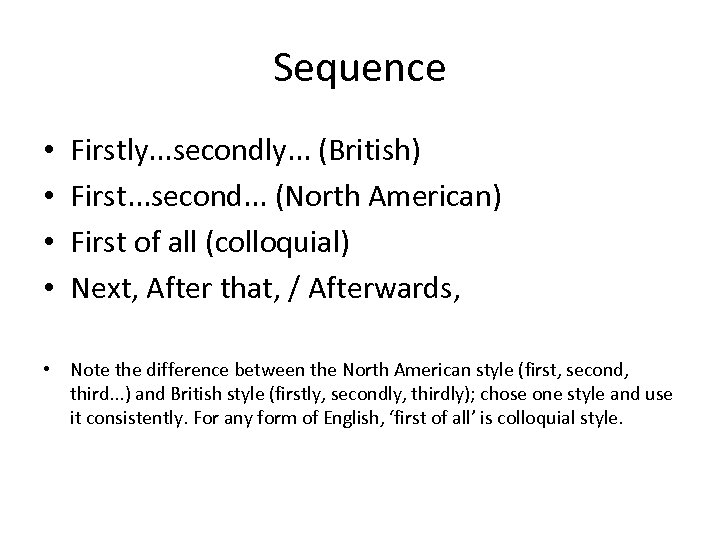 Sequence • • Firstly. . . secondly. . . (British) First. . . second. . . (North American) First of all (colloquial) Next, After that, / Afterwards, • Note the difference between the North American style (first, second, third. . . ) and British style (firstly, secondly, thirdly); chose one style and use it consistently. For any form of English, ‘first of all’ is colloquial style.
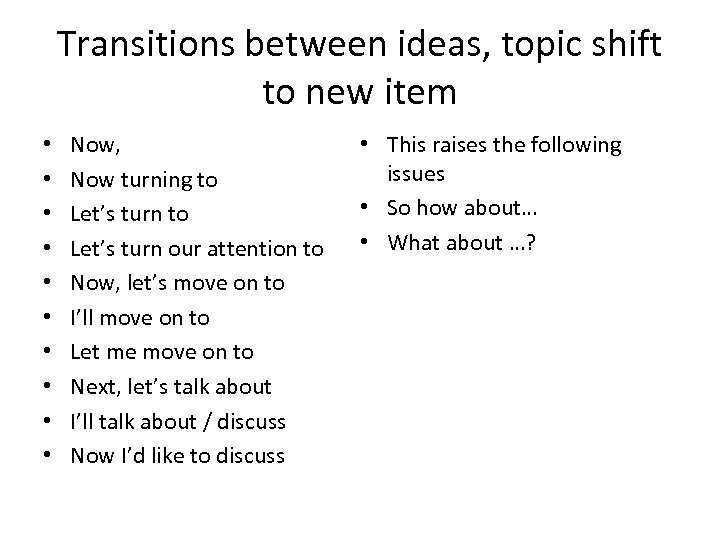 Transitions between ideas, topic shift to new item • • • Now, Now turning to Let’s turn our attention to Now, let’s move on to I’ll move on to Let me move on to Next, let’s talk about I’ll talk about / discuss Now I’d like to discuss • This raises the following issues • So how about… • What about …?
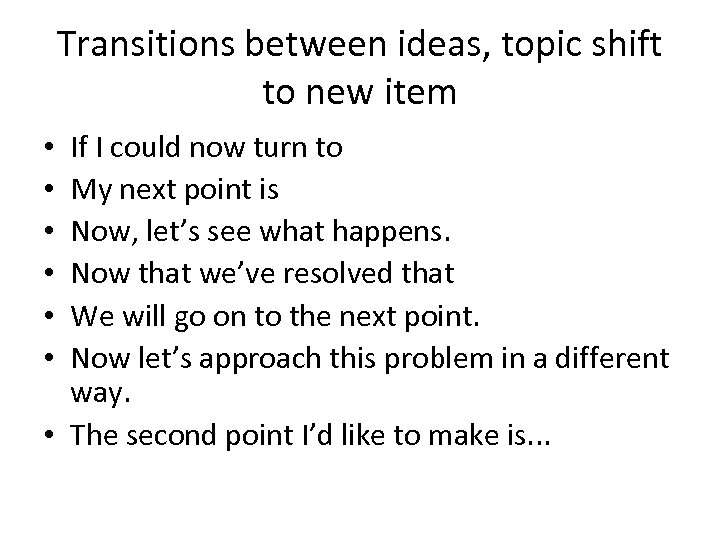 Transitions between ideas, topic shift to new item If I could now turn to My next point is Now, let’s see what happens. Now that we’ve resolved that We will go on to the next point. Now let’s approach this problem in a different way. • The second point I’d like to make is. . . • • •
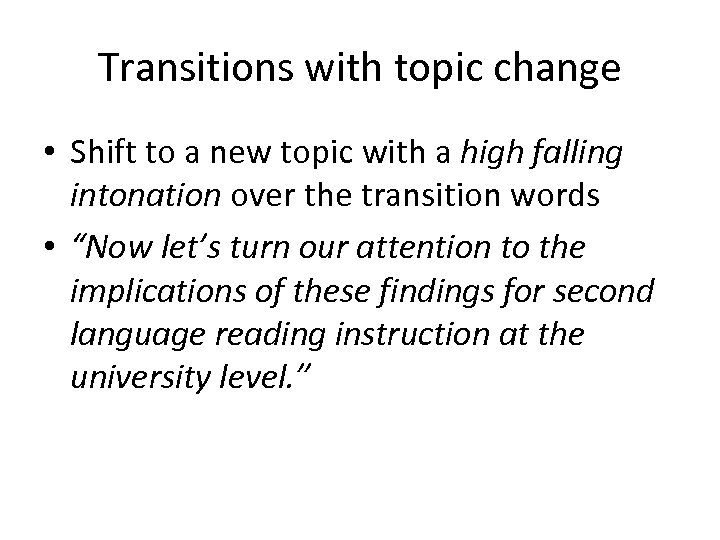 Transitions with topic change • Shift to a new topic with a high falling intonation over the transition words • “Now let’s turn our attention to the implications of these findings for second language reading instruction at the university level. ”
 Minor Topic Shifts
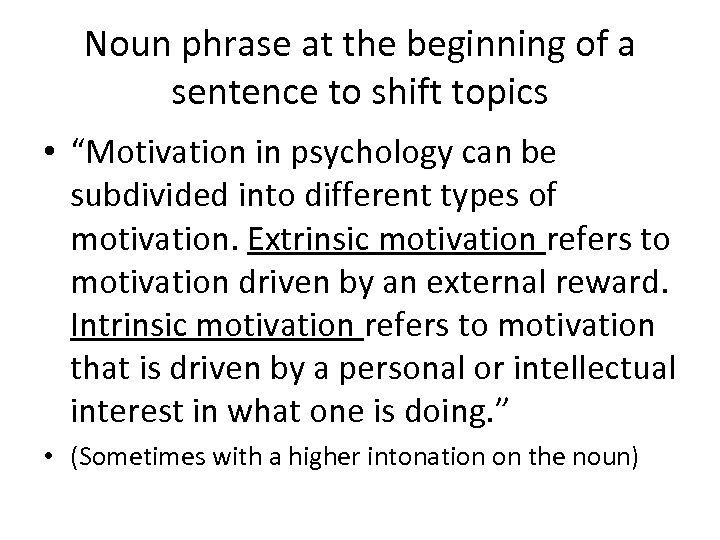 Noun phrase at the beginning of a sentence to shift topics • “Motivation in psychology can be subdivided into different types of motivation. Extrinsic motivation refers to motivation driven by an external reward. Intrinsic motivation refers to motivation that is driven by a personal or intellectual interest in what one is doing. ” • (Sometimes with a higher intonation on the noun)
 Prepositional phrase to shift topics • The order of Coleoptera represents a large and diverse grouping of insects. Within Coleoptera we find that 90% of species belong to the suborder Polyphaga.
 There is / are + subject: • “These were traditionally viewed as mutually exclusive categories. There is another way to look at this, however, as we will see later. ”
 There + verb: • “At the time, no one dared challenge the reigning paradigm until the late 50 s, except in certain subfields. There seemed to be no substantial opposition to this view until two fronts opened up in what would become a paradigm war. ”
 Returning to previous topic • • Now, as for As regards Regarding Anyway, Anyhow, Returning to. . .
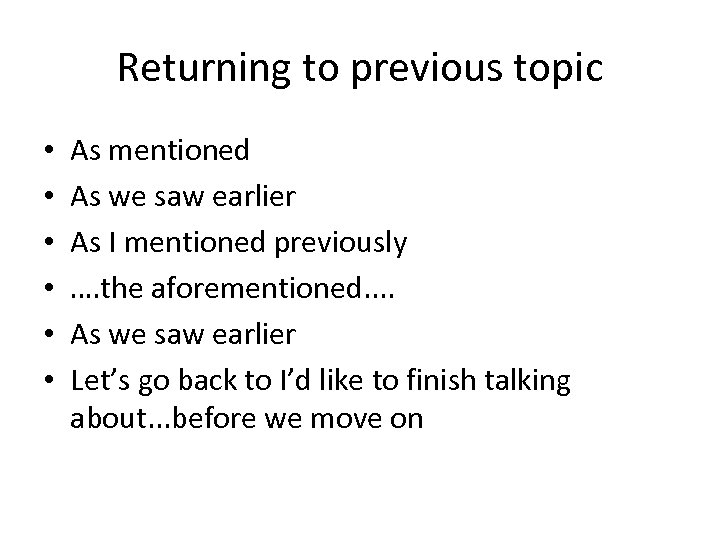 Returning to previous topic • • • As mentioned As we saw earlier As I mentioned previously …. the aforementioned. . As we saw earlier Let’s go back to I’d like to finish talking about. . . before we move on
 Explanations
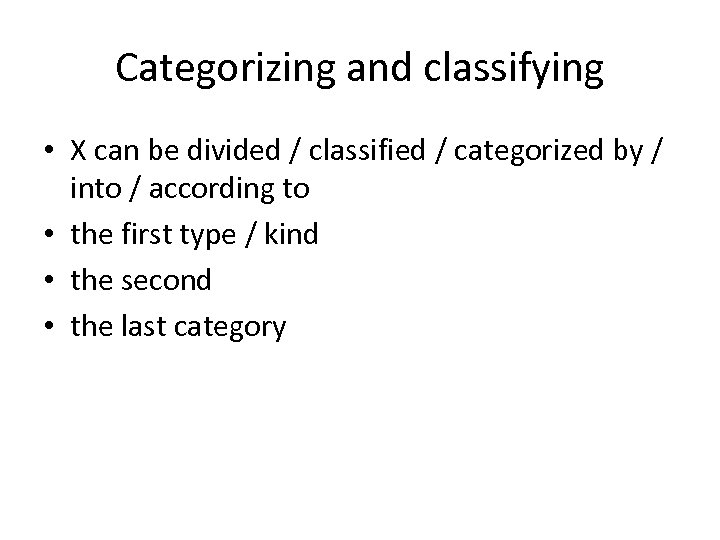 Categorizing and classifying • X can be divided / classified / categorized by / into / according to • the first type / kind • the second • the last category
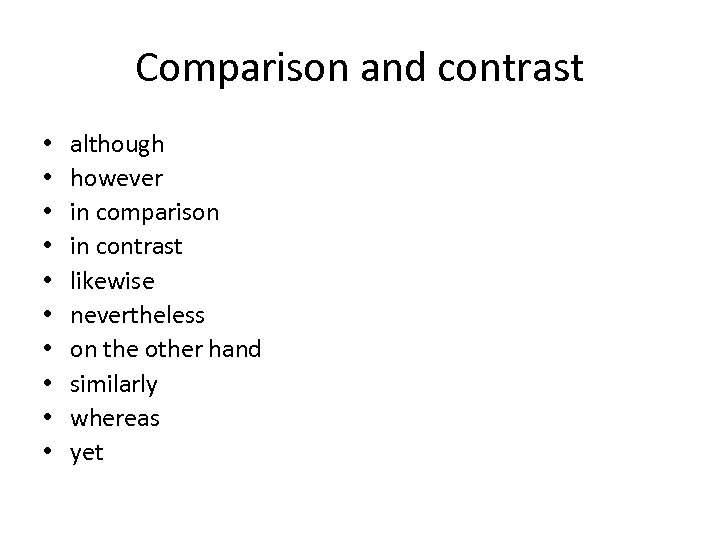 Comparison and contrast • • • although however in comparison in contrast likewise nevertheless on the other hand similarly whereas yet
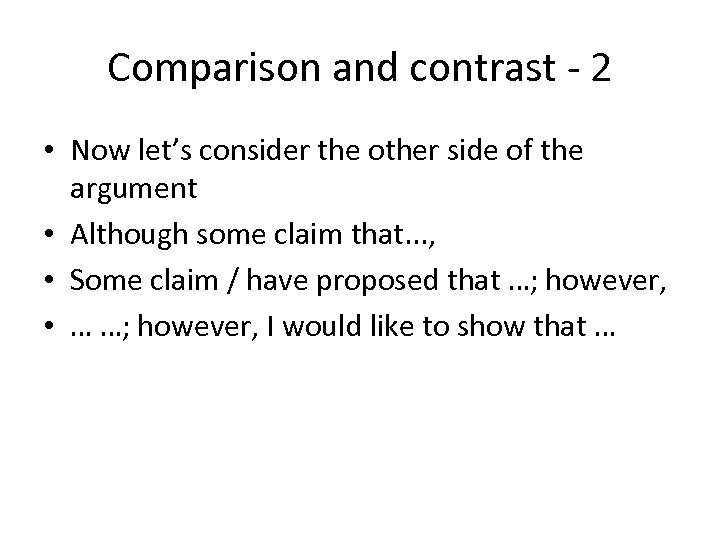 Comparison and contrast - 2 • Now let’s consider the other side of the argument • Although some claim that. . . , • Some claim / have proposed that …; however, • … …; however, I would like to show that …
 Hedges • Phrases used to soften or “hedge” statements, for politeness or to qualify • The following classifies hedges into linguistic categories:
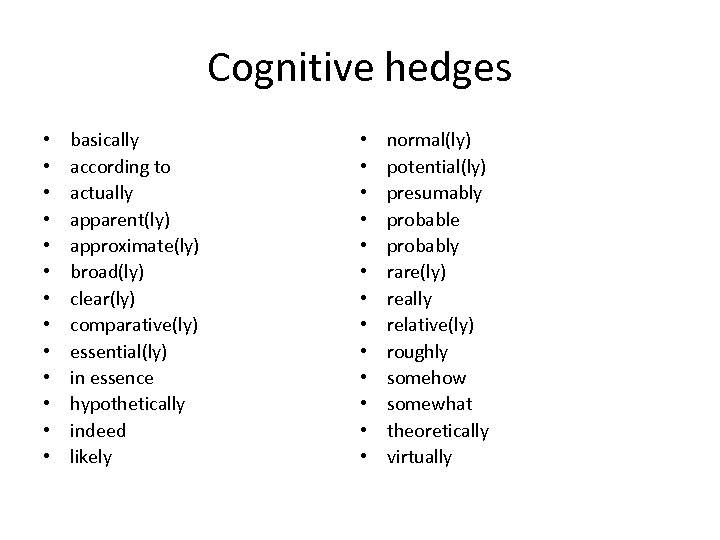 Cognitive hedges • • • • basically according to actually apparent(ly) approximate(ly) broad(ly) clear(ly) comparative(ly) essential(ly) in essence hypothetically indeed likely • • • • normal(ly) potential(ly) presumably probable probably rare(ly) really relative(ly) roughly somehow somewhat theoretically virtually
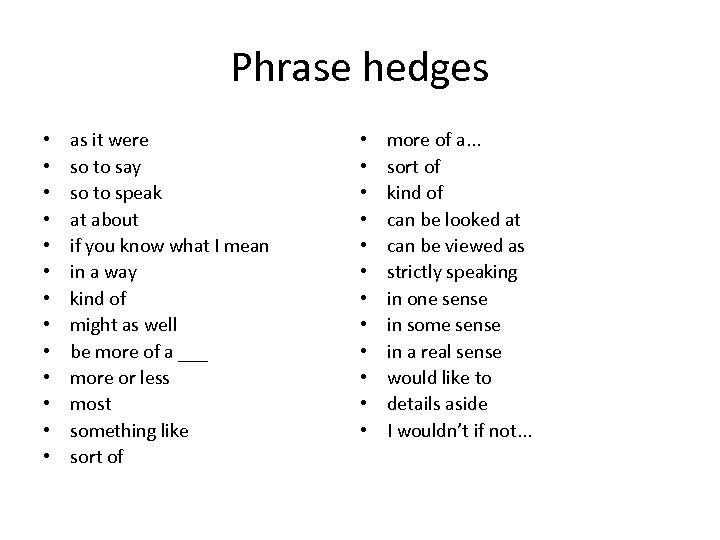 Phrase hedges • • • • as it were so to say so to speak at about if you know what I mean in a way kind of might as well be more of a ___ more or less most something like sort of • • • more of a. . . sort of kind of can be looked at can be viewed as strictly speaking in one sense in some sense in a real sense would like to details aside I wouldn’t if not. . .
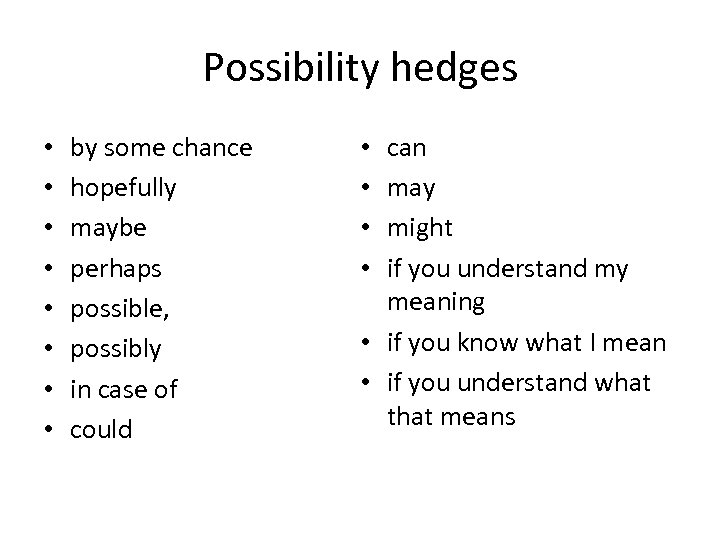 Possibility hedges • • by some chance hopefully maybe perhaps possible, possibly in case of could can may might if you understand my meaning • if you know what I mean • if you understand what that means • •
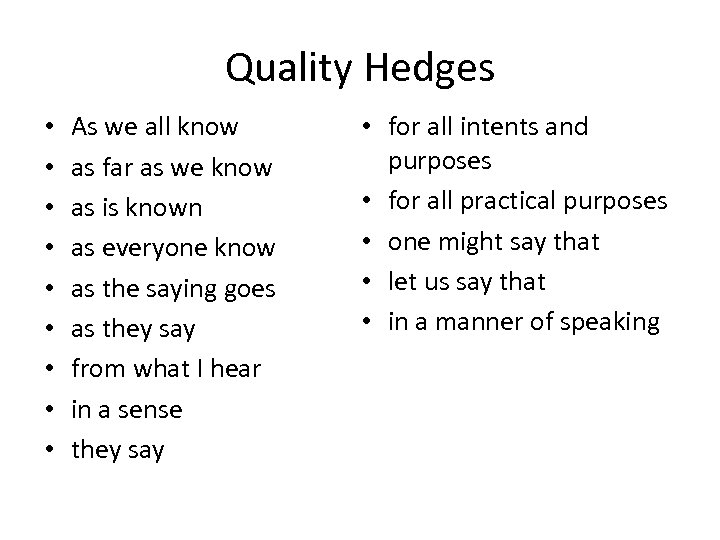 Quality Hedges • • • As we all know as far as we know as is known as everyone know as the saying goes as they say from what I hear in a sense they say • for all intents and purposes • for all practical purposes • one might say that • let us say that • in a manner of speaking
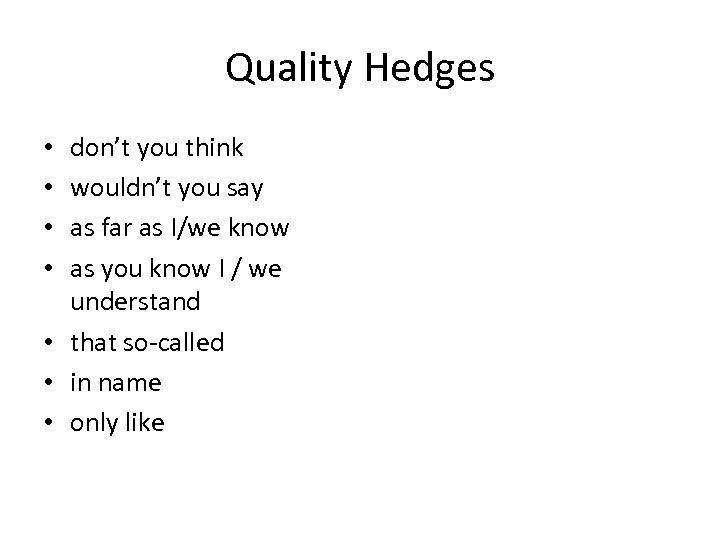 Quality Hedges don’t you think wouldn’t you say as far as I/we know as you know I / we understand • that so-called • in name • only like • •
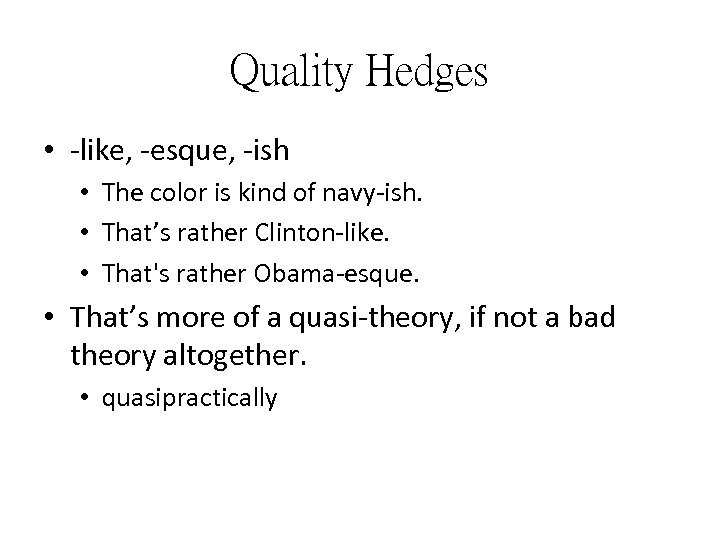 Quality Hedges • -like, -esque, -ish • The color is kind of navy-ish. • That’s rather Clinton-like. • That's rather Obama-esque. • That’s more of a quasi-theory, if not a bad theory altogether. • quasipractically
 Attitude adverbs • Used for explanations and topic shifts • Fortunately, a way has been found to resolve this long-standing problem. • Naturally, one would want to assess the risks first. • Especially, we would like to contain our company’s bleeding of cash.
 Attitude adverbs • • • actually apparently basically by the way briefly certainly clearly conceivably confidentially curiously especially evidently • • • fortunately hopefully hypothetically ideally incidentally indeed interestingly ironically naturally oddly predictably presumably • • • regrettably seriously strangely surprisingly thankfully theoretically Therefore truthfully ultimately unfortunately wisely
 Topical adverbs • Identify the topic of the coming clause – to make the topic clear – to emphasize the speaker’s point – to shift the topic to a new but somewhat related topic
 Example sentences with topical adverbs • Economically, this would be infeasible to implement while the markets are too unstable. • Politically, it would be unwise for the senator to suddenly propose such an outrageously expensive funding project at such an economically depressed time as this. • Biologically speaking, it would be imprecise to call this a virus.
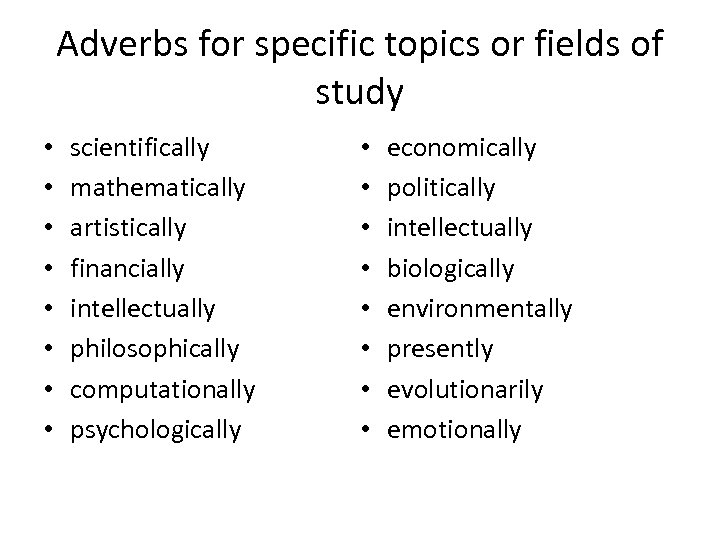 Adverbs for specific topics or fields of study • • scientifically mathematically artistically financially intellectually philosophically computationally psychologically • • economically politically intellectually biologically environmentally presently evolutionarily emotionally
 Summarizing and concluding
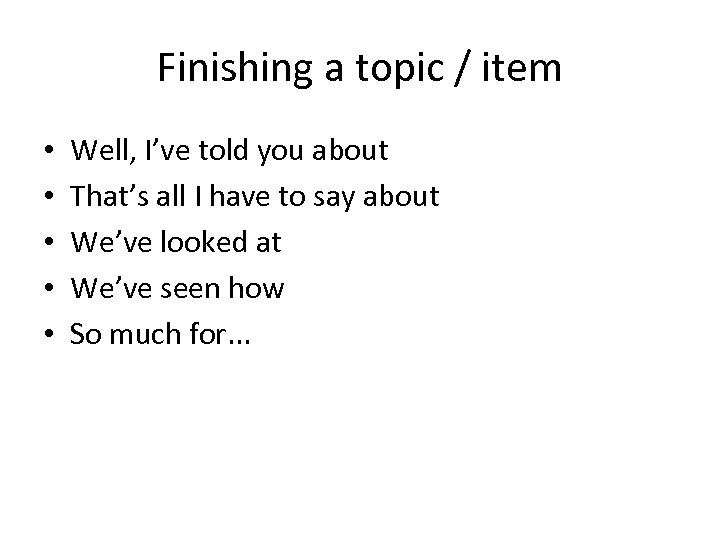 Finishing a topic / item • • • Well, I’ve told you about That’s all I have to say about We’ve looked at We’ve seen how So much for. . .
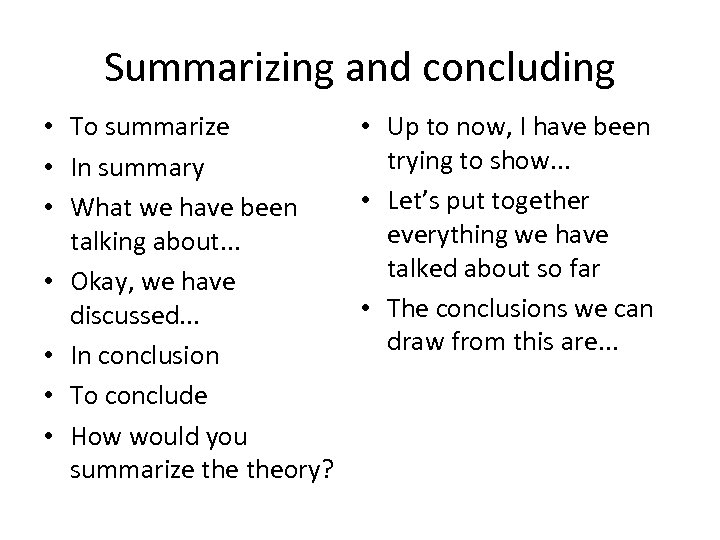 Summarizing and concluding • To summarize • Up to now, I have been trying to show. . . • In summary • Let’s put together • What we have been everything we have talking about. . . talked about so far • Okay, we have • The conclusions we can discussed. . . draw from this are. . . • In conclusion • To conclude • How would you summarize theory?
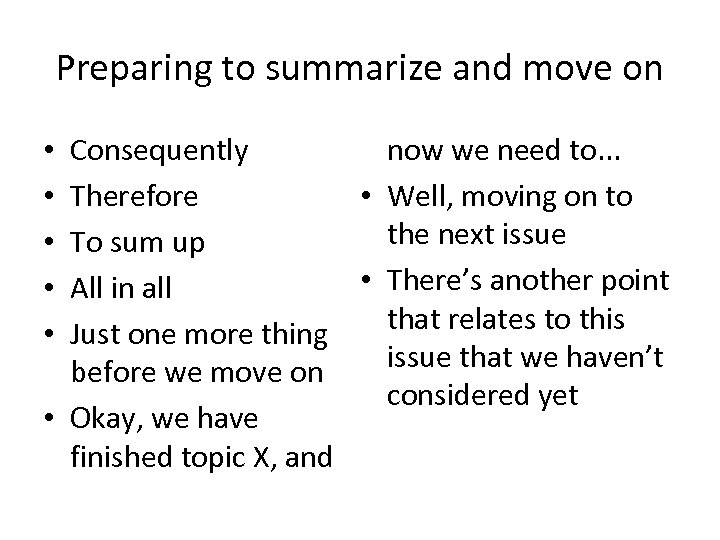 Preparing to summarize and move on now we need to. . . Consequently • Well, moving on to Therefore the next issue To sum up • There’s another point All in all that relates to this Just one more thing issue that we haven’t before we move on considered yet • Okay, we have finished topic X, and • • •
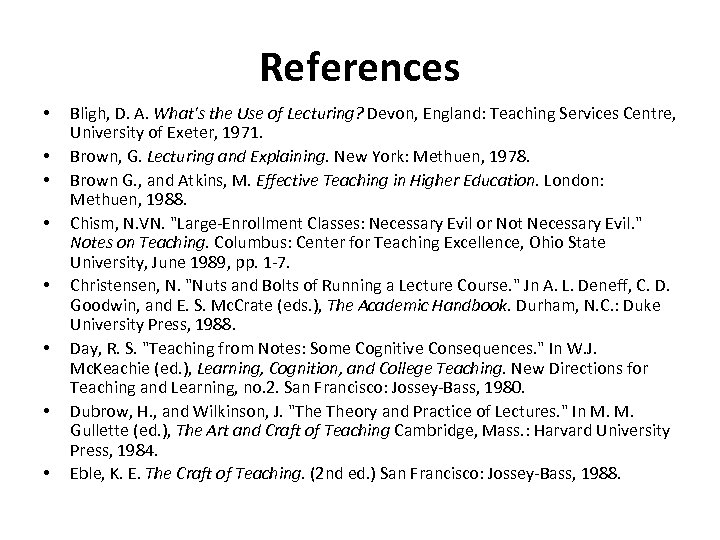 References • • Bligh, D. A. What's the Use of Lecturing? Devon, England: Teaching Services Centre, University of Exeter, 1971. Brown, G. Lecturing and Explaining. New York: Methuen, 1978. Brown G. , and Atkins, M. Effective Teaching in Higher Education. London: Methuen, 1988. Chism, N. VN. "Large-Enrollment Classes: Necessary Evil or Not Necessary Evil. " Notes on Teaching. Columbus: Center for Teaching Excellence, Ohio State University, June 1989, pp. 1 -7. Christensen, N. "Nuts and Bolts of Running a Lecture Course. " Jn A. L. Deneff, C. D. Goodwin, and E. S. Mc. Crate (eds. ), The Academic Handbook. Durham, N. C. : Duke University Press, 1988. Day, R. S. "Teaching from Notes: Some Cognitive Consequences. " In W. J. Mc. Keachie (ed. ), Learning, Cognition, and College Teaching. New Directions for Teaching and Learning, no. 2. San Francisco: Jossey-Bass, 1980. Dubrow, H. , and Wilkinson, J. "The Theory and Practice of Lectures. " In M. M. Gullette (ed. ), The Art and Craft of Teaching Cambridge, Mass. : Harvard University Press, 1984. Eble, K. E. The Craft of Teaching. (2 nd ed. ) San Francisco: Jossey-Bass, 1988.
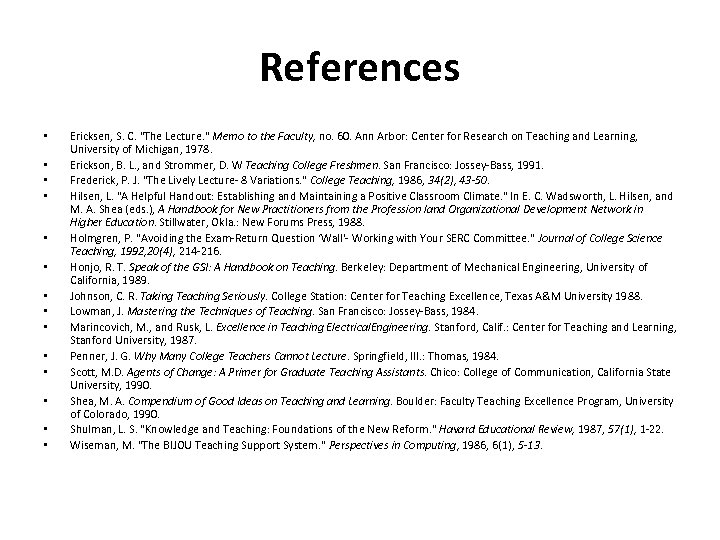 References • • • • Ericksen, S. C. "The Lecture. " Memo to the Faculty, no. 60. Ann Arbor: Center for Research on Teaching and Learning, University of Michigan, 1978. Erickson, B. L. , and Strommer, D. W Teaching College Freshmen. San Francisco: Jossey-Bass, 1991. Frederick, P. J. "The Lively Lecture- 8 Variations. " College Teaching, 1986, 34(2), 43 -50. Hilsen, L. "A Helpful Handout: Establishing and Maintaining a Positive Classroom Climate. " In E. C. Wadsworth, L. Hilsen, and M. A. Shea (eds. ), A Handbook for New Practitioners from the Profession land Organizational Development Network in Higher Education. Stillwater, Ok. Ia. : New Forums Press, 1988. Holmgren, P. "Avoiding the Exam-Return Question ‘Wall'- Working with Your SERC Committee. " Journal of College Science Teaching, 1992, 20(4), 214 -216. Honjo, R. T. Speak of the GSI: A Handbook on Teaching. Berkeley: Department of Mechanical Engineering, University of California, 1989. Johnson, C. R. Taking Teaching Seriously. College Station: Center for Teaching Excellence, Texas A&M University 1988. Lowman, J. Mastering the Techniques of Teaching. San Francisco: Jossey-Bass, 1984. Marincovich, M. , and Rusk, L. Excellence in Teaching Electrical. Engineering. Stanford, Calif. : Center for Teaching and Learning, Stanford University, 1987. Penner, J. G. Why Many College Teachers Cannot Lecture. Springfield, Ill. : Thomas, 1984. Scott, M. D. Agents of Change: A Primer for Graduate Teaching Assistants. Chico: College of Communication, California State University, 1990. Shea, M. A. Compendium of Good Ideas on Teaching and Learning. Boulder: Faculty Teaching Excellence Program, University of Colorado, 1990. Shulman, L. S. "Knowledge and Teaching: Foundations of the New Reform. " Havard Educational Review, 1987, 57(1), 1 -22. Wiseman, M. "The BIJOU Teaching Support System. " Perspectives in Computing, 1986, 6(1), 5 -13.
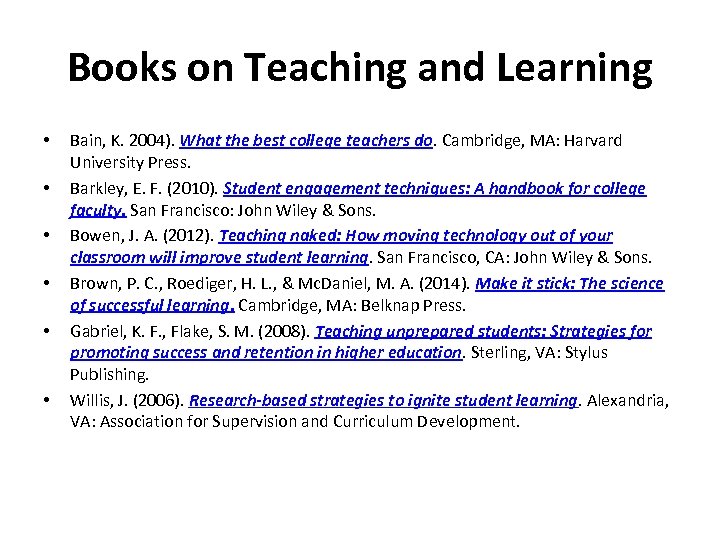 Books on Teaching and Learning • • • Bain, K. 2004). What the best college teachers do. Cambridge, MA: Harvard University Press. Barkley, E. F. (2010). Student engagement techniques: A handbook for college faculty. San Francisco: John Wiley & Sons. Bowen, J. A. (2012). Teaching naked: How moving technology out of your classroom will improve student learning. San Francisco, CA: John Wiley & Sons. Brown, P. C. , Roediger, H. L. , & Mc. Daniel, M. A. (2014). Make it stick: The science of successful learning. Cambridge, MA: Belknap Press. Gabriel, K. F. , Flake, S. M. (2008). Teaching unprepared students: Strategies for promoting success and retention in higher education. Sterling, VA: Stylus Publishing. Willis, J. (2006). Research-based strategies to ignite student learning. Alexandria, VA: Association for Supervision and Curriculum Development.
 For more information • www. editing. tw/blog