


 Скачать презентацию Using Early Warning Indicators to Identify Students at
dbc7e50e9aa1825a4c8bb4bfef69ecf6.ppt
- Количество слайдов: 32
 Using Early Warning Indicators to Identify Students at Highest Risk of Dropping Out Ruth Curran Neild Center for Social Organization of Schools, Johns Hopkins University
 Relationship to college and career readiness • Earning high school diploma is a critical juncture in the pipeline • Provides a conceptual model for tracking likelihood of young adult success in postsecondary education and/or work Copyright © 2010. All rights reserved.
 The Checklist Manifesto Copyright © 2010. All rights reserved.
 All professions in the 21 st century face increasing complexity in their work Copyright © 2010. All rights reserved.
 The Modern Challenge: Keeping Track of a Lot of “Moving Pieces” • It’s easy for well-trained professionals to: • • Forget Fail to communicate Overlook Fail to “connect the dots” Copyright © 2010. All rights reserved.
 Most errors of are those of ineptitude Mistakes that occur because we do not make proper use of what we know (As contrasted with errors of ignorance – mistakes that arise from not knowing what to do) Copyright © 2010. All rights reserved.
 Like other professions, teachers operate in an environment of increasing complexity • Increased responsibility for outcomes of all students, including those who are disengaging from school • Increased responsibility to “individualize” education - to find the “right solution” or “right fit” for each student • Substantial amounts of data about students collected and made available to teachers Copyright © 2010. All rights reserved.
 Early Warning Indicator Systems enable teachers to: • Use empirically-developed data indicators that are most predictive of a given outcome as a “flag” that a student are in trouble • Track interventions that have been assigned to particular students • Systematically track associations between interventions and outcomes for students at their school Copyright © 2010. All rights reserved.
 Logic of Early Warning Indicators Of High School Dropout Copyright © 2010. All rights reserved.
 There are many underlying reasons for dropping out of school • Social science research using secondary data sets has helped us to understand correlates of dropping out and…most importantly, that… • Dropping out is the culmination of a gradual process of disengagement from school Copyright © 2010. All rights reserved.
 For educators, this research has real limitations How do we know which specific individuals are most likely to drop out so that we can target interventions to them? How early in students’ careers can we reliably identify those on the path to dropping out? Can we identify students with readily-available data or do we need specialized assessments? Copyright © 2010. All rights reserved.
 Developed in the Context of “Dropout Factory” Schools • At these schools, 40% or more of the students fail to graduate • Family income, family structure, race/ethnicity, scores on nationally-normed tests are usually the same or within a narrow band in these schools Copyright © 2010. All rights reserved.
 Four questions about EWIs • What are the characteristics of a good EWI system? • What are the signals? • What technological and organizational infrastructure is needed to “capture” the signal? • What can schools and districts do once the signals are identified and captured? Copyright © 2010. All rights reserved.
 Characteristics of a good EWI system Empirically developed: The “signals” are identified through analysis of longitudinal data for prior cohorts of students. High accuracy: A high percentage of students with the “signals” drop out. Conversely, a low percentage of students without the “signals” graduate. High yield: These “signals” capture most of the dropouts (avoiding the “ 1% problem”). Accessible data: Data that provide the “signals” are readily available and relatively inexpensive to access. Copyright © 2010. All rights reserved.
 How did we identify the “signals” of eventual dropout? • Empirical analysis of cohorts in Philadelphia, starting with 6 th graders (Balfanz, Herzog, & Mac. Iver), and 8 th graders (Neild & Balfanz, 2006) • Data scan of longitudinal student record data – – – – Test scores Report card grades Attendance Special education and ELL status Gender Age Race/ethnic background Copyright © 2010. All rights reserved.
 Looked for a 75% threshold – why? • Choosing a “strong signal” – students who are at highest risk of dropping out • By not making the net too broad, scarce resources can be targeted at those students who are greatest risk Copyright © 2010. All rights reserved.
 The Big Four in 6 th grade • • Failing Math Failing English Attendance <80% At least one poor behavior mark Copyright © 2010. All rights reserved. (Balfanz, Herzog, & Mac. Iver)
 8 th grade warning signals • Three factors gave students at least a 75% probability of dropping out: 1. 2. 3. Copyright © 2010. All rights reserved. Failing math in 8 th grade Failing English in 8 th grade Attending less than 80% of the time
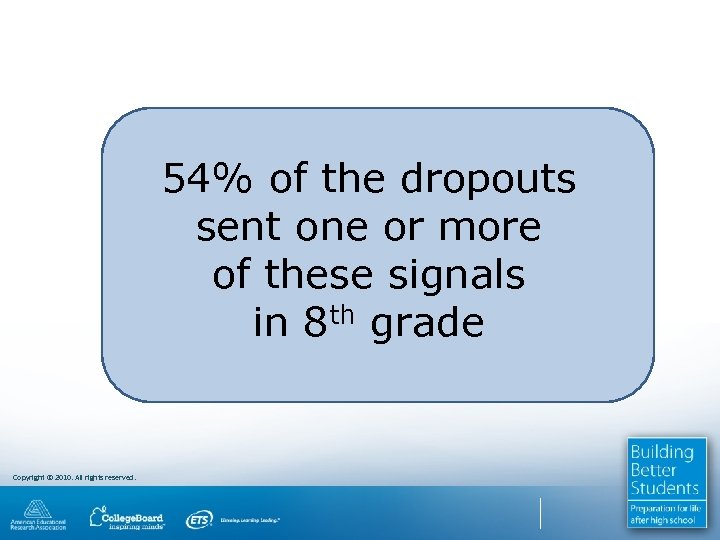 54% of the dropouts sent one or more of these signals in 8 th grade Copyright © 2010. All rights reserved.
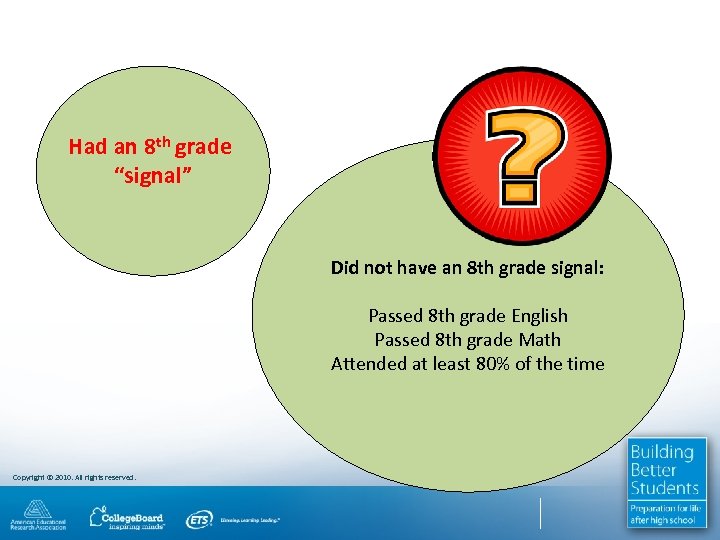 Had an 8 th grade “signal” Did not have an 8 th grade signal: Passed 8 th grade English Passed 8 th grade Math Attended at least 80% of the time Copyright © 2010. All rights reserved.
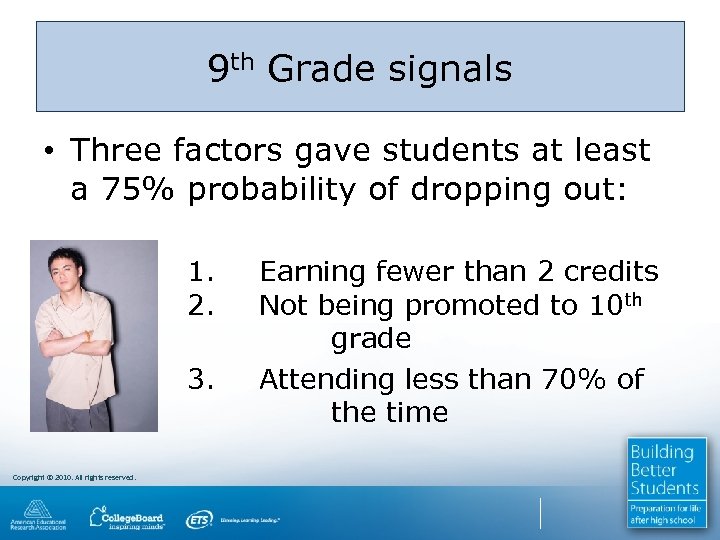 9 th Grade signals • Three factors gave students at least a 75% probability of dropping out: 1. 2. 3. Copyright © 2010. All rights reserved. Earning fewer than 2 credits Not being promoted to 10 th grade Attending less than 70% of the time
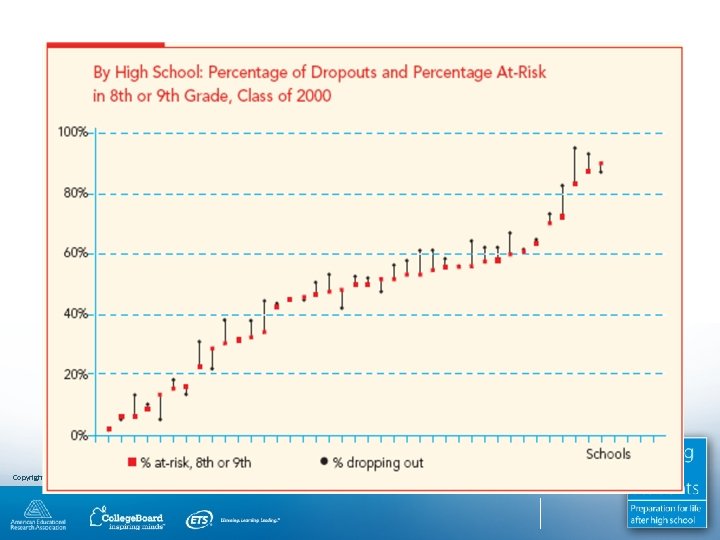
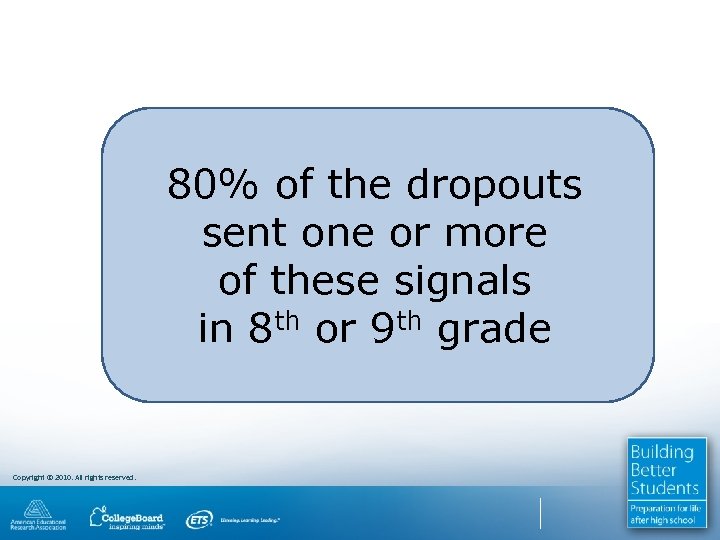 80% of the dropouts sent one or more of these signals in 8 th or 9 th grade Copyright © 2010. All rights reserved.
 Copyright © 2010. All rights reserved.
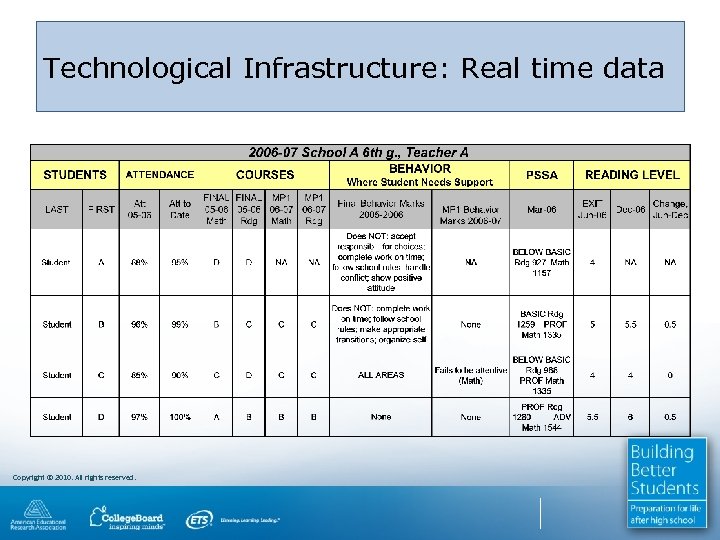 Technological Infrastructure: Real time data Copyright © 2010. All rights reserved.
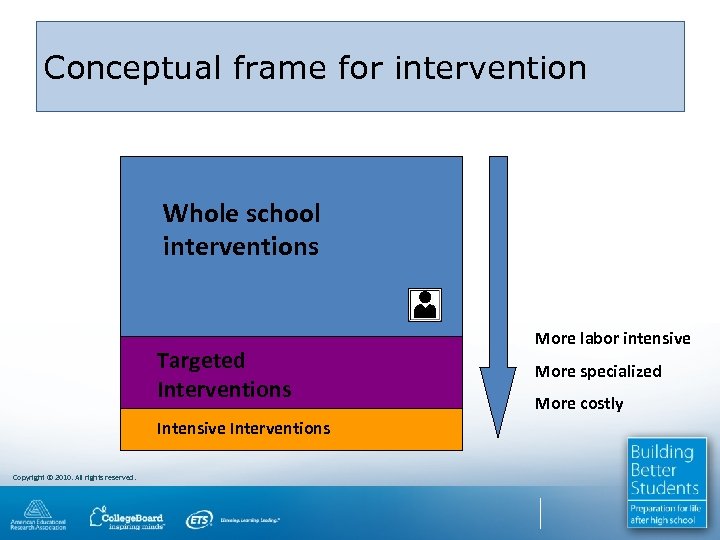 Conceptual frame for intervention Whole school interventions Targeted Interventions Intensive Interventions Copyright © 2010. All rights reserved. More labor intensive More specialized More costly
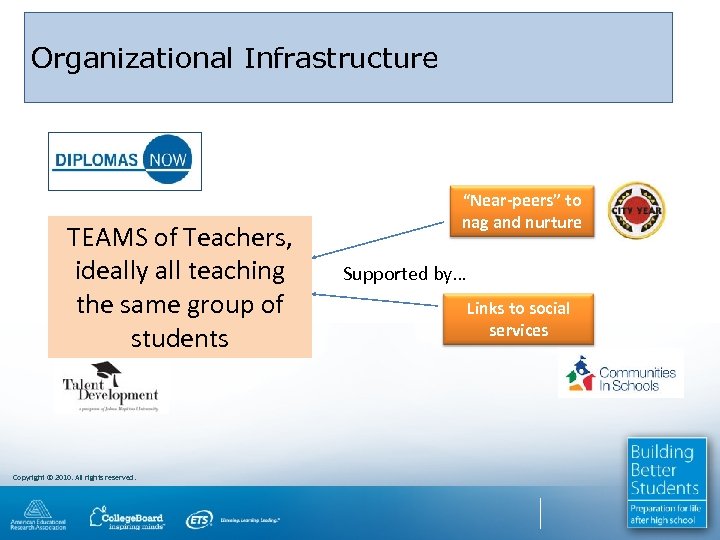 Organizational Infrastructure TEAMS of Teachers, ideally all teaching the same group of students Copyright © 2010. All rights reserved. “Near-peers” to nag and nurture Supported by… Links to social services
 Implications for College and Career Readiness Possibility of using indicators across systems to address readiness EXAMPLE Connecting school district and local college data to identify high school predictors of key postsecondary outcomes, such as: v. Placement out of remedial courses v. Overall credit accumulation and in key areas v. Return for a second semester or a second year Copyright © 2010. All rights reserved.
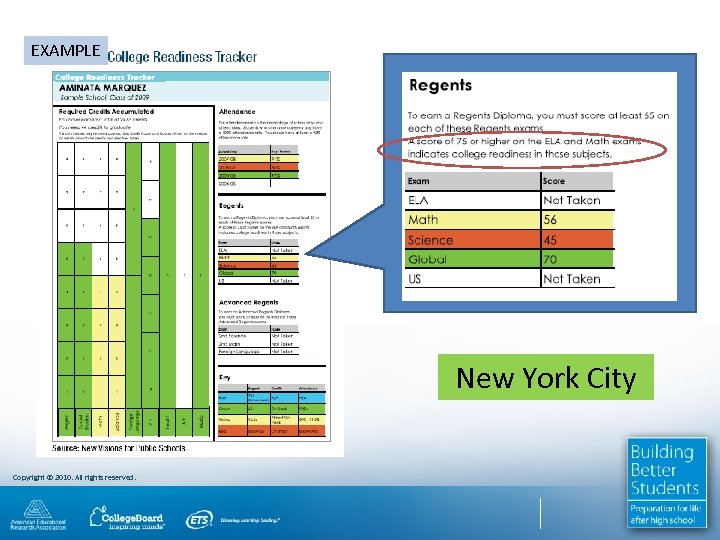 EXAMPLE New York City Copyright © 2010. All rights reserved.
 Implications for College and Career Readiness Possibility of using indicators across systems to address readiness There is a great deal that is unknown about whethere are readily accessible, high accuracy, high-yield high school predictors of postsecondary outcomes Copyright © 2010. All rights reserved. ?
 Implications for College and Career Readiness Possibility of using indicators within a higher education system to identify students at-risk of course failure EXAMPLE Survey data about study habits in high school and other non-cognitive predictors, combined with data on class attendance and interim grades Copyright © 2010. All rights reserved.
 The Checklist Manifesto The purpose of a good checklist EWI System is not to fill out paperwork or to prove to others that we’ve “covered our bases, ” but to help teachers well-trained professionals cope with the complexity and detail of their work keeping students on track in the modern world. Copyright © 2010. All rights reserved.
 Ruth Curran Neild Center for Social Organization of Schools Johns Hopkins University rneild@csos. jhu. edu Copyright © 2010. All rights reserved.