


 Скачать презентацию Using Differentiated Instruction to Implement Connecticut Standards CCSS
89a7571d415583f772e0158a85ef1a6e.ppt
- Количество слайдов: 102
 Using Differentiated Instruction to Implement Connecticut Standards (CCSS): Day 2 1
 One Agenda: • Introductions • What is the philosophy that supports the differentiated classroom? • How can we come to know our students in a short period of time? • How do we know if we have rigorous curriculum? • How can I preassess my students? • Once I figure out the critical learning difference I will address, how can I best use flexible small groups in my room? • What are some sample strategies—related to choice and tiering—that I can use in my classroom to address 2 critical student learning differences?
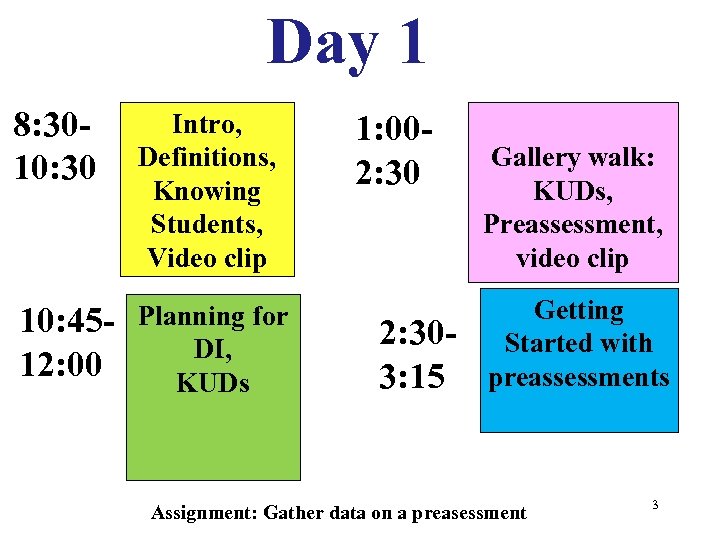 Day 1 8: 3010: 30 Intro, Definitions, Knowing Students, Video clip 10: 4512: 00 Planning for DI, KUDs 1: 002: 303: 15 Gallery walk: KUDs, Preassessment, video clip Getting Started with preassessments Assignment: Gather data on a preasessment 3
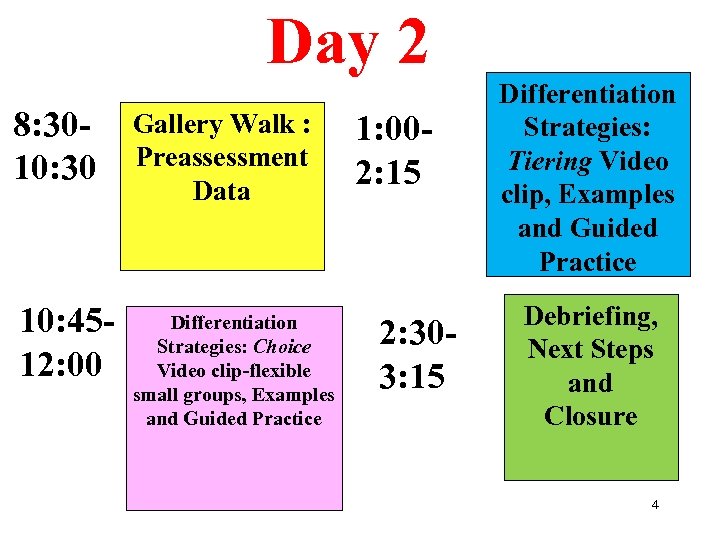 Day 2 8: 3010: 30 10: 4512: 00 Gallery Walk : Preassessment Data Differentiation Strategies: Choice Video clip-flexible small groups, Examples and Guided Practice 1: 002: 15 2: 303: 15 Differentiation Strategies: Tiering Video clip, Examples and Guided Practice Debriefing, Next Steps and Closure 4
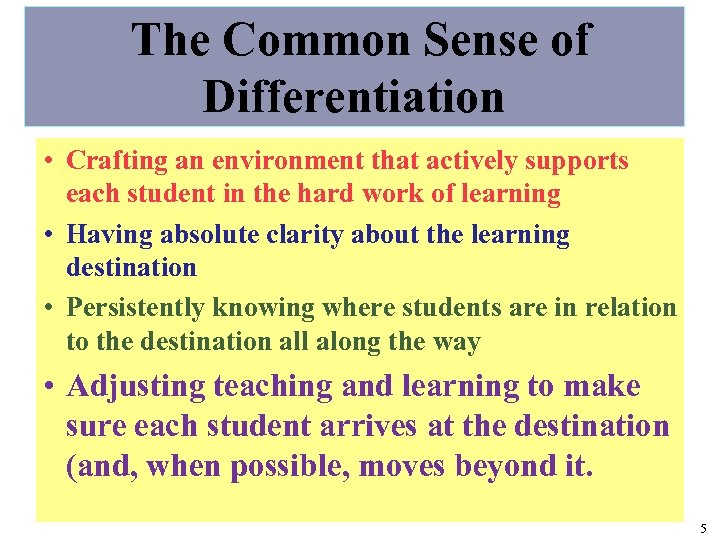 The Common Sense of Differentiation • Crafting an environment that actively supports each student in the hard work of learning • Having absolute clarity about the learning destination • Persistently knowing where students are in relation to the destination all along the way • Adjusting teaching and learning to make sure each student arrives at the destination (and, when possible, moves beyond it. 5
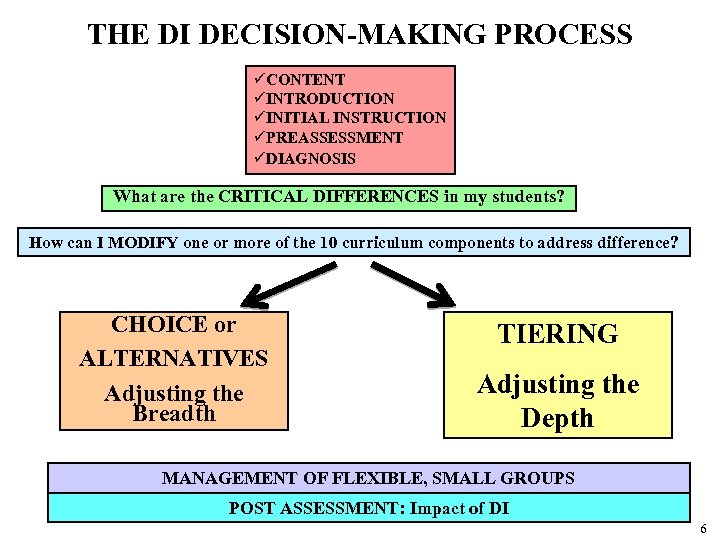 THE DI DECISION-MAKING PROCESS üCONTENT üINTRODUCTION üINITIAL INSTRUCTION üPREASSESSMENT üDIAGNOSIS What are the CRITICAL DIFFERENCES in my students? How can I MODIFY one or more of the 10 curriculum components to address difference? CHOICE or ALTERNATIVES Adjusting the Breadth TIERING Adjusting the Depth MANAGEMENT OF FLEXIBLE, SMALL GROUPS POST ASSESSMENT: Impact of DI 6
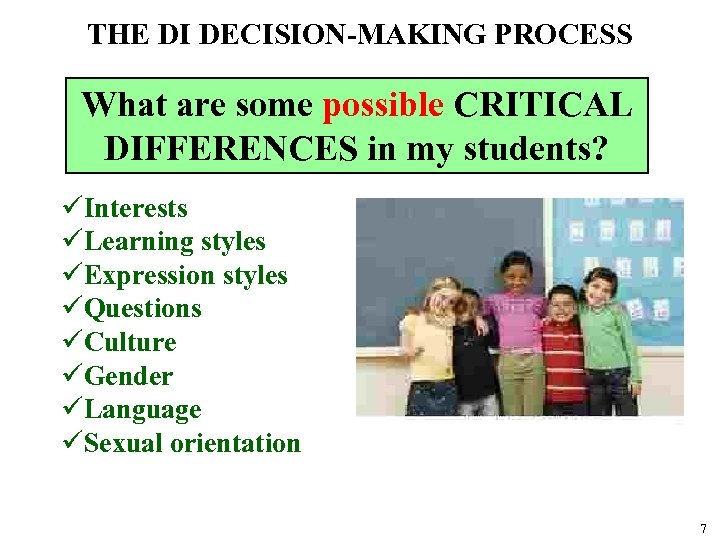 THE DI DECISION-MAKING PROCESS What are some possible CRITICAL DIFFERENCES in my students? üInterests üLearning styles üExpression styles üQuestions üCulture üGender üLanguage üSexual orientation 7
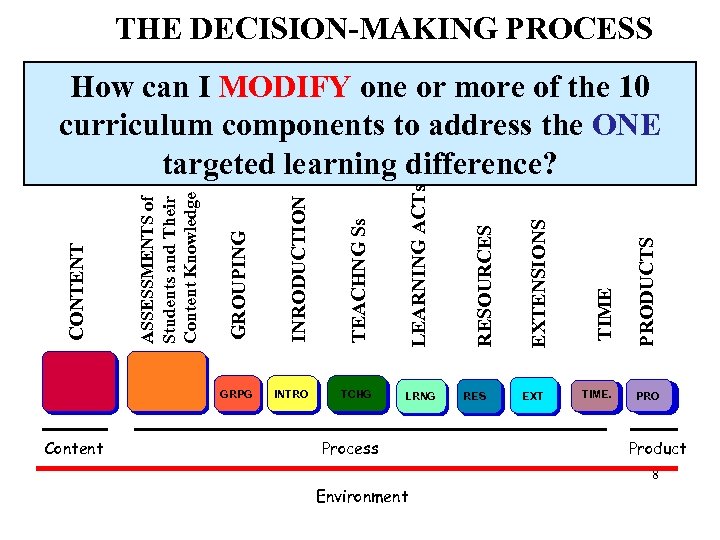 THE DECISION-MAKING PROCESS Process RES EXT TIME. PRODUCTS LRNG TIME LEARNING ACTs TCHG EXTENSIONS TEACHNG Ss INTRO RESOURCES INRODUCTION ASSESSMENTS of Students and Their Content Knowledge CONTENT GRPG Content GROUPING How can I MODIFY one or more of the 10 curriculum components to address the ONE targeted learning difference? PRO Product 8 Environment
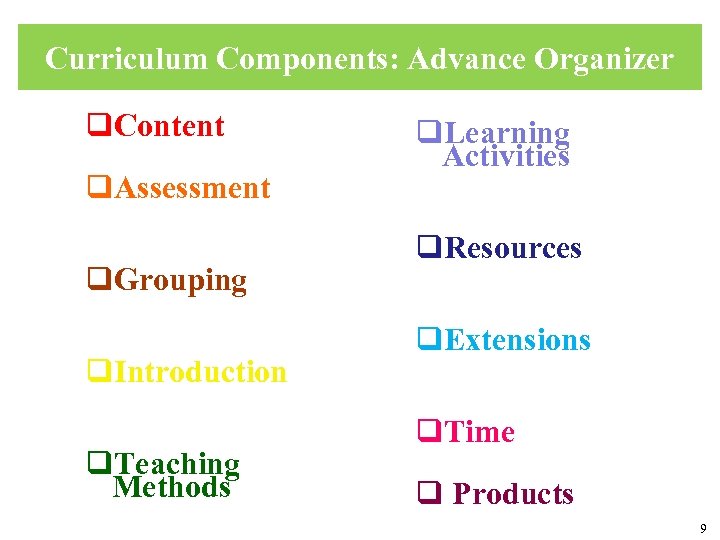 Curriculum Components: Advance Organizer q. Content q. Assessment q. Grouping q. Introduction q. Teaching Methods q. Learning Activities q. Resources q. Extensions q. Time q Products 9
 Grouping Strategies Definition: Purpose: The varied approaches to arranging students for effective learning in the classroom To enhance the depth or breadth of student learning; to promote reflection, to address student differences; to provide teachers with opportunities to observe students in varied settings; to provide students with opportunities to work in varied settings that nurture their unique abilities and talents; to minimize heterogeneity, to make learning more efficient Characteristics: Aligned with the content goals, teaching methods and students’ learning needs; varied 10
 PROCESS HOW STUDENTS COME TO UNDERSTAND OWN THE KNOWLEDGE, UNDERSTANDING AND SKILLS 11
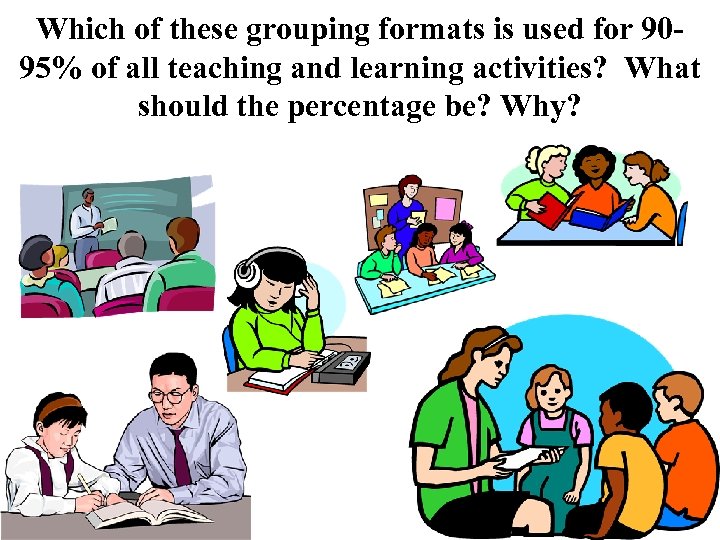 Which of these grouping formats is used for 9095% of all teaching and learning activities? What should the percentage be? Why? 12
 The Classroom Observation Study “Across five subject areas and 92 observation days, observed students experienced no instructional or curriculum differentiation in 84% of their instructional activities. ” NRC G/T Westberg, 1993, 2003 13
 Comparing Small Group Options Cooperative Groups Ability Groups - - Flexible, Small Groups - - - - - 14
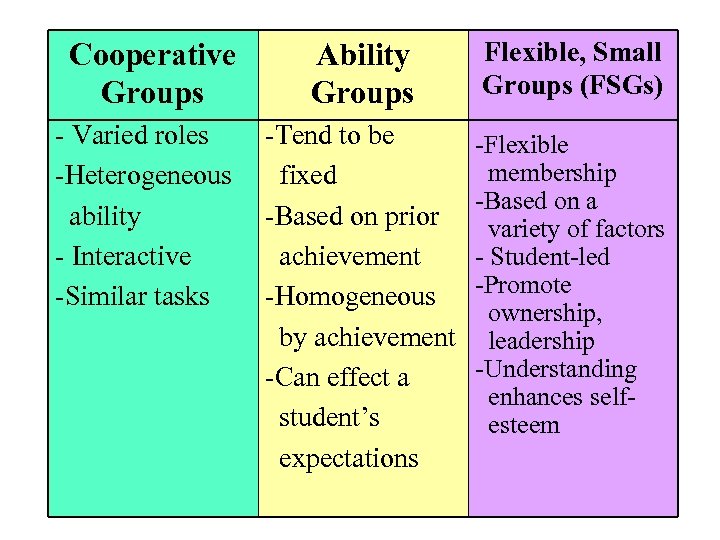 Cooperative Groups - Varied roles -Heterogeneous ability - Interactive -Similar tasks Ability Groups Flexible, Small Groups (FSGs) -Tend to be fixed -Based on prior achievement -Homogeneous by achievement -Can effect a student’s expectations -Flexible membership -Based on a variety of factors - Student-led -Promote ownership, leadership -Understanding enhances selfesteem 15
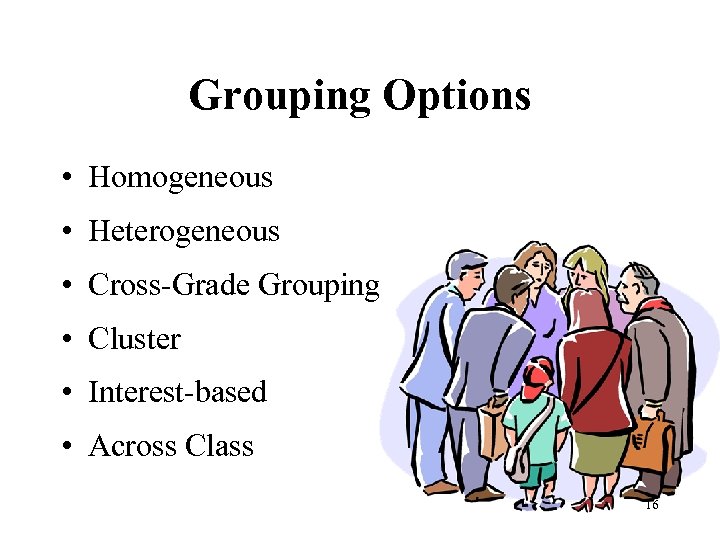 Grouping Options • Homogeneous • Heterogeneous • Cross-Grade Grouping • Cluster • Interest-based • Across Class 16
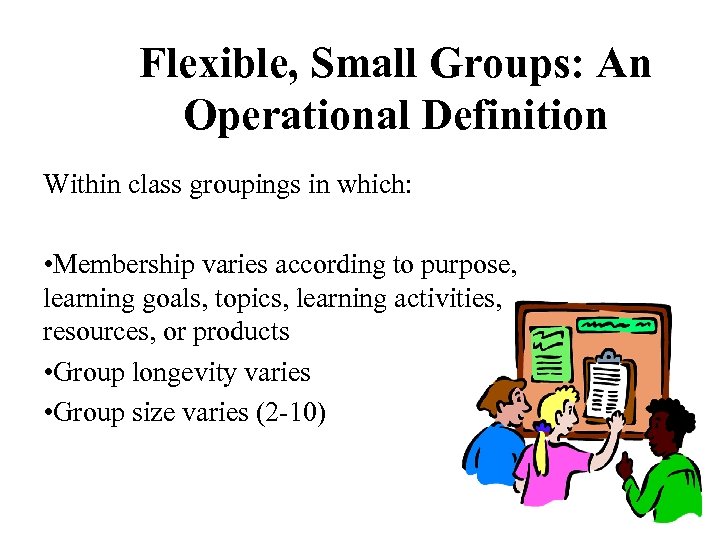 Flexible, Small Groups: An Operational Definition Within class groupings in which: • Membership varies according to purpose, learning goals, topics, learning activities, resources, or products • Group longevity varies • Group size varies (2 -10) 17
 Within-Class Grouping: A Meta-Analysis “To be maximally effective, within-class grouping practices require the adaptation of instruction methods and materials for small-group learning. ” Lou, Y, Abrami, P, Spence, J. C. , Poulsen, C. , Chambers, B. , & d’Apollonia, S. (1996). Within-class grouping: A meta-anal. ysis. 19 Review of Educational Research, 66 (4) 423 -458
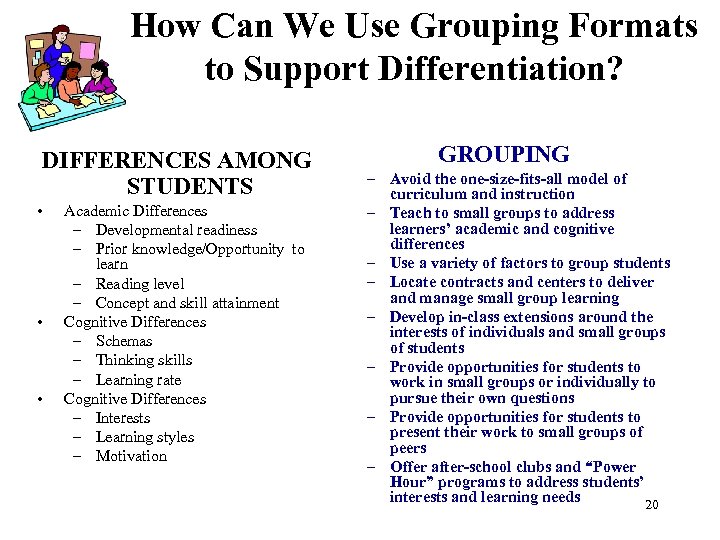 How Can We Use Grouping Formats to Support Differentiation? DIFFERENCES AMONG STUDENTS • • • Academic Differences – Developmental readiness – Prior knowledge/Opportunity to learn – Reading level – Concept and skill attainment Cognitive Differences – Schemas – Thinking skills – Learning rate Cognitive Differences – Interests – Learning styles – Motivation GROUPING – Avoid the one-size-fits-all model of curriculum and instruction – Teach to small groups to address learners’ academic and cognitive differences – Use a variety of factors to group students – Locate contracts and centers to deliver and manage small group learning – Develop in-class extensions around the interests of individuals and small groups of students – Provide opportunities for students to work in small groups or individually to pursue their own questions – Provide opportunities for students to present their work to small groups of peers – Offer after-school clubs and “Power Hour” programs to address students’ interests and learning needs 20
 Which ONE Difference Will I Address With Choice? • Prior Knowledge? • Learning Styles? • Interests? • Reading Ability? 21
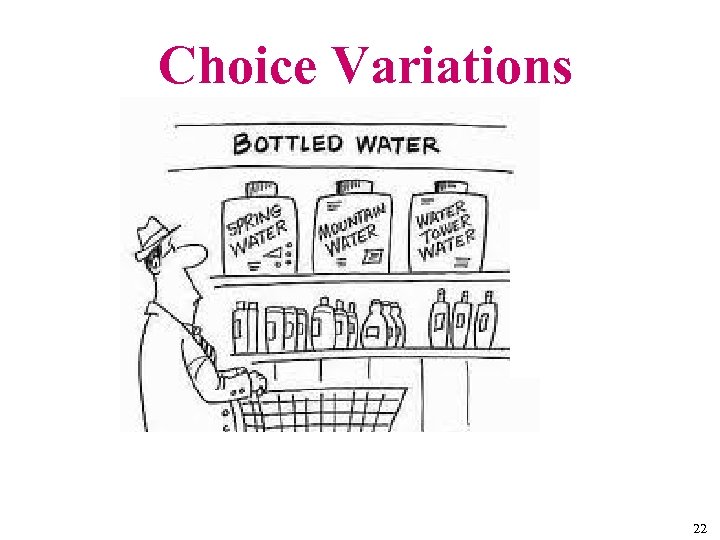 Choice Variations 22
 Grade 5: Explorers • STRAND 1. 1 – Significant events and themes in United States history. – 1. Explain how specific individuals and their ideas and beliefs influenced U. S. history (e. g. John Smith, Anne Hutchison, Uncas, Benjamin Franklin). • STRAND 2. 1 Access and gather information from a variety of primary and secondary sources including electronic media, recordings and text. – 1. Locate and gather information from primary and secondary sources. – 2. Answer questions about content gathered from print and non-print sources. – 3. Summarize information about primary and secondary sources. • STRAND 3. 1 Use evidence to identify, analyze and evaluate historical interpretations – 1. Make and support judgments about the quality of information in text material. • The Class – Very diverse: interests, levels of motivation, ability to engage in abstract thinking 24
 Example 1: Grade 5: Explorers Ms. Johnson thoroughly enjoyed the social studies unit on explorers that she covered at the beginning of school in grade 5. She always began with a story about explorers to the new world because students always enjoyed hearing the life stories of famous explorers like Columbus. She even used some primary source documents like excepts from Columbus’s ship log Subsequently, she covered other significant explorers including Jacques Cartier (French), Henry Hudson (Dutch), and John Cabot and Francis Drake (English). For the final project, she had each student create a log of a sea voyage. They had to include the following key terms in sentences that demonstrated they understood the meaning of the terms: colony, contagious disease, expedition, navigate, Northwest Passage, and technology. 25
 Example 2: Grade 5 Explorers "We’re going to make our own definition of explorer at the end of this unit. Before we are able to make our definition, I want you to consider the names of American people on this list. When you have done some initial research about two or three, you are to choose one explorer and answer the following questions about him: 1. Who was this explorer to the Americas? 2. What adjectives describe him most accurately? 3. Describe the historical time period in which he lived. 4. Which group(s) of people value his contribution? 5. Why is the contribution valued? 6. In your opinion, what impact or legacy does the exploration have on American history? 7. Should students study explorers? Defend your answer. You will use at least five resources, one of which must be electronic and one must be a primary source document. You will be making a presentation—alone, with a partner or in a group of three--to the class on your explorer in any format you wish. When everyone has made his or her presentation, we will work as a class to define the word ‘explorer, ’ what role explorers played/play in the course of American history, and discuss the value of studying explorers. " 26
 Curriculum Components: Advance Organizer q. Content q. Assessment q. Grouping q. Introduction q. Teaching Methods q. Learning Activities q. Resources q. Extensions q. Time q Products 27
 “PEELING BACK” Purposeful Choice • CHOICE of ALIGNED CONTENT (interest) • CHOICE of RESOURCES (reading level) • CHOICE of LEARNING ACTIVITIES, LEARNING PARTNERS (learning style preferences) • CHOICE of PRODUCTS (expression style preferences) 28
 A RAFT is… • … an engaging, high level strategy that encourages writing across the curriculum • … a way to encourage students to… – – …assume a role …consider their audience …write in a particular format …examine a topic from a relevant perspective • All of the above can serve as motivators by giving students choice, appealing to their interests and learning profiles, and adapting to student readiness levels. Carol Tomlinson 29
 The RAFT strategy… • Forces students to process information, rather than just writing out answers to questions. • Students are motivated to undertake the writing assignment because it involves them personally and allows for more creative responses to learning the materials 30
 RAFTs can… • Be differentiated in a variety of ways: readiness level, learning profile, and/or student interest • Be created by the students or Incorporate a blank row for that option • Be used as introductory “hooks” into a unit of study • Keep one column consistent while varying the other columns in the RAFT grid 31 Carol Tomlinson
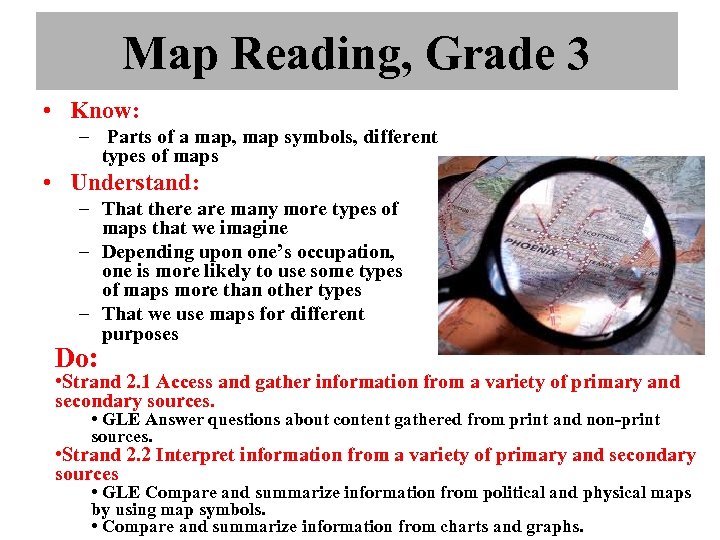 Map Reading, Grade 3 • Know: – Parts of a map, map symbols, different types of maps • Understand: – That there are many more types of maps that we imagine – Depending upon one’s occupation, one is more likely to use some types of maps more than other types – That we use maps for different purposes Do: • Strand 2. 1 Access and gather information from a variety of primary and secondary sources. • GLE Answer questions about content gathered from print and non-print sources. • Strand 2. 2 Interpret information from a variety of primary and secondary sources • GLE Compare and summarize information from political and physical maps by using map symbols. • Compare and summarize information from charts and graphs.
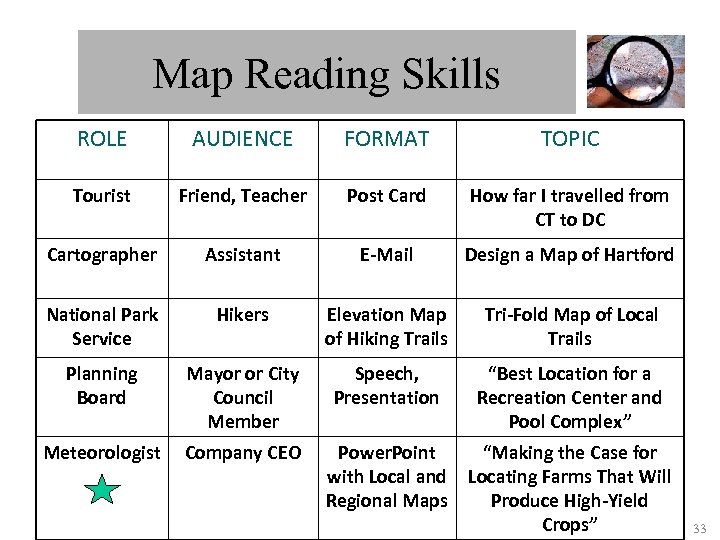 Map Reading Skills ROLE AUDIENCE FORMAT TOPIC Tourist Friend, Teacher Post Card How far I travelled from CT to DC Cartographer Assistant E-Mail Design a Map of Hartford National Park Service Hikers Elevation Map of Hiking Trails Tri-Fold Map of Local Trails Planning Board Mayor or City Council Member Speech, Presentation “Best Location for a Recreation Center and Pool Complex” Meteorologist Company CEO Power. Point “Making the Case for with Local and Locating Farms That Will Regional Maps Produce High-Yield Crops” 33
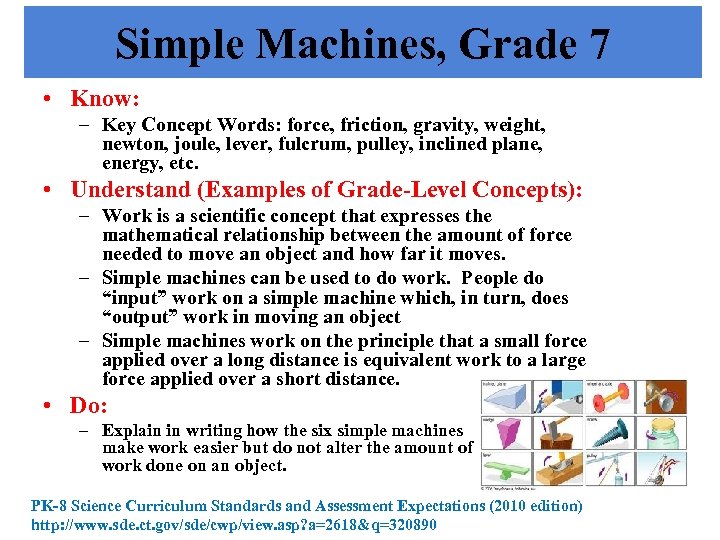 Simple Machines, Grade 7 • Know: – Key Concept Words: force, friction, gravity, weight, newton, joule, lever, fulcrum, pulley, inclined plane, energy, etc. • Understand (Examples of Grade-Level Concepts): – Work is a scientific concept that expresses the mathematical relationship between the amount of force needed to move an object and how far it moves. – Simple machines can be used to do work. People do “input” work on a simple machine which, in turn, does “output” work in moving an object – Simple machines work on the principle that a small force applied over a long distance is equivalent work to a large force applied over a short distance. • Do: – Explain in writing how the six simple machines make work easier but do not alter the amount of work done on an object. PK-8 Science Curriculum Standards and Assessment Expectations (2010 edition) http: //www. sde. ct. gov/sde/cwp/view. asp? a=2618&q=320890
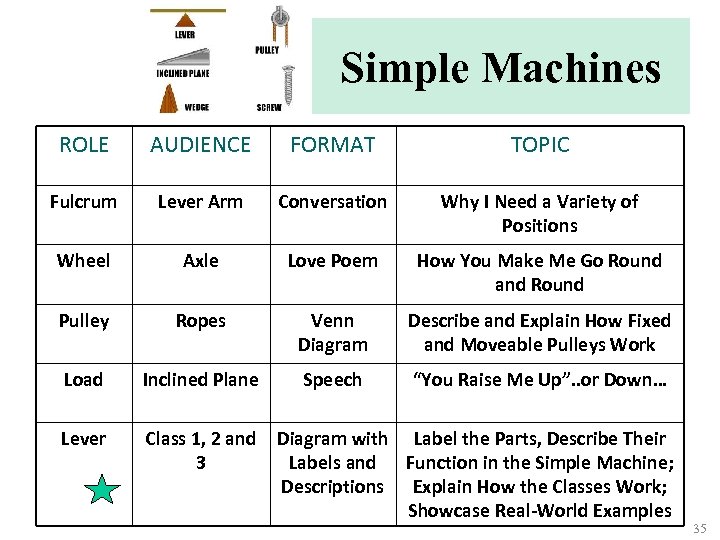 Simple Machines ROLE AUDIENCE FORMAT TOPIC Fulcrum Lever Arm Conversation Why I Need a Variety of Positions Wheel Axle Love Poem How You Make Me Go Round and Round Pulley Ropes Venn Diagram Describe and Explain How Fixed and Moveable Pulleys Work Load Inclined Plane Speech “You Raise Me Up”. . or Down… Lever Class 1, 2 and 3 Diagram with Label the Parts, Describe Their Labels and Function in the Simple Machine; Descriptions Explain How the Classes Work; Showcase Real-World Examples 35
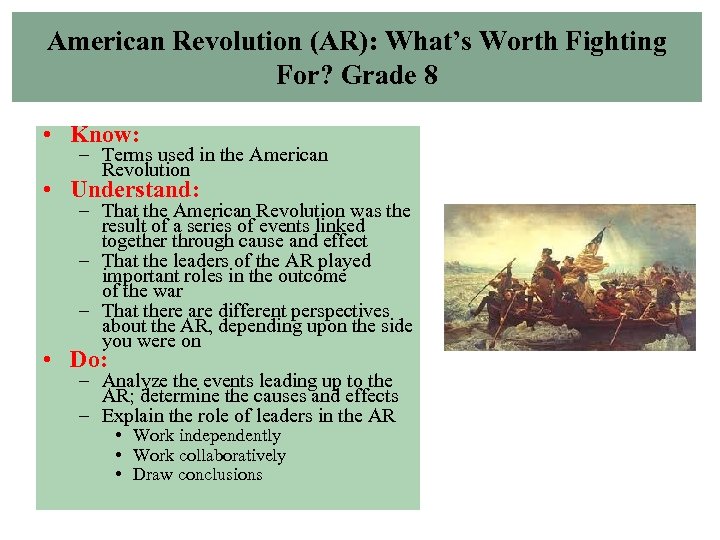 American Revolution (AR): What’s Worth Fighting For? Grade 8 • Know: – Terms used in the American Revolution • Understand: – That the American Revolution was the result of a series of events linked together through cause and effect – That the leaders of the AR played important roles in the outcome of the war – That there are different perspectives about the AR, depending upon the side you were on • Do: – Analyze the events leading up to the AR; determine the causes and effects – Explain the role of leaders in the AR • Work independently • Work collaboratively • Draw conclusions
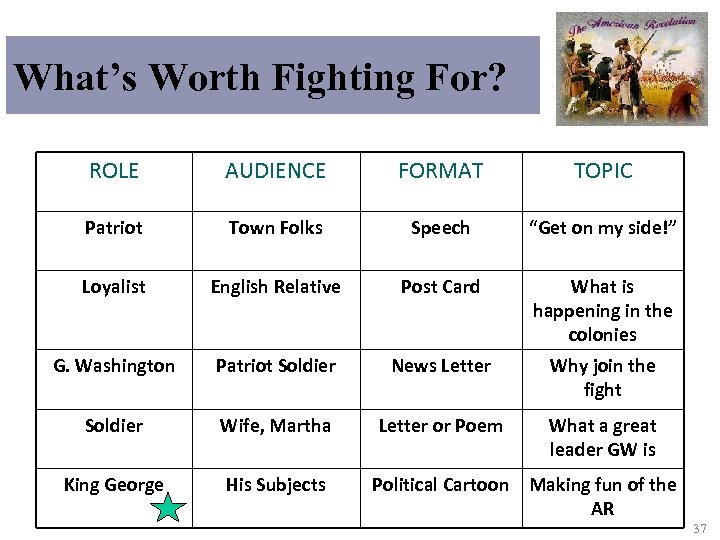 What’s Worth Fighting For? ROLE AUDIENCE FORMAT TOPIC Patriot Town Folks Speech “Get on my side!” Loyalist English Relative Post Card What is happening in the colonies G. Washington Patriot Soldier News Letter Why join the fight Soldier Wife, Martha Letter or Poem What a great leader GW is King George His Subjects Political Cartoon Making fun of the AR 37
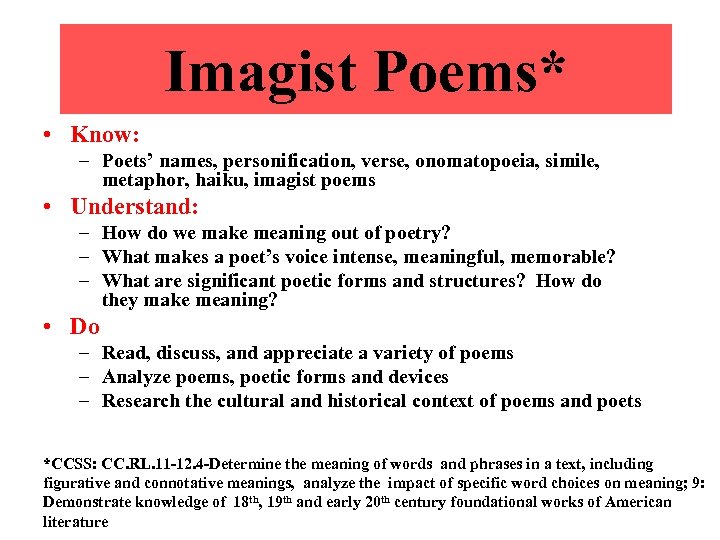 Imagist Poems* • Know: – Poets’ names, personification, verse, onomatopoeia, simile, metaphor, haiku, imagist poems • Understand: – How do we make meaning out of poetry? – What makes a poet’s voice intense, meaningful, memorable? – What are significant poetic forms and structures? How do they make meaning? • Do – Read, discuss, and appreciate a variety of poems – Analyze poems, poetic forms and devices – Research the cultural and historical context of poems and poets *CCSS: CC. RL. 11 -12. 4 -Determine the meaning of words and phrases in a text, including figurative and connotative meanings, analyze the impact of specific word choices on meaning; 9: Demonstrate knowledge of 18 th, 19 th and early 20 th century foundational works of American literature
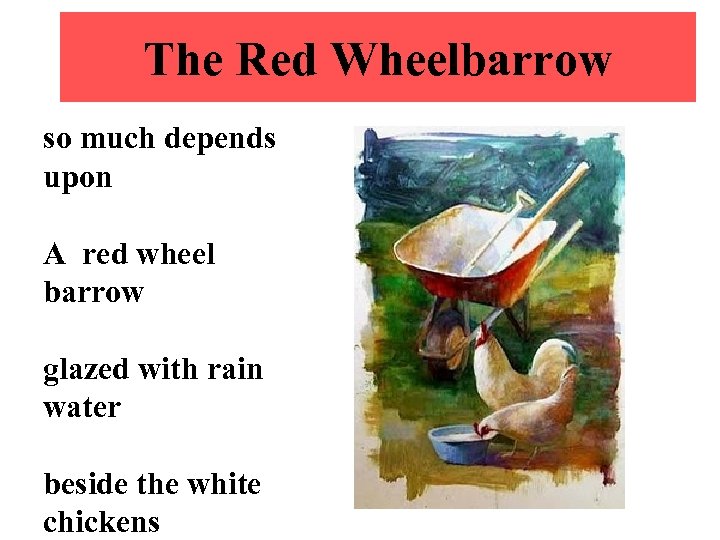 The Red Wheelbarrow so much depends upon A red wheel barrow glazed with rain water beside the white chickens
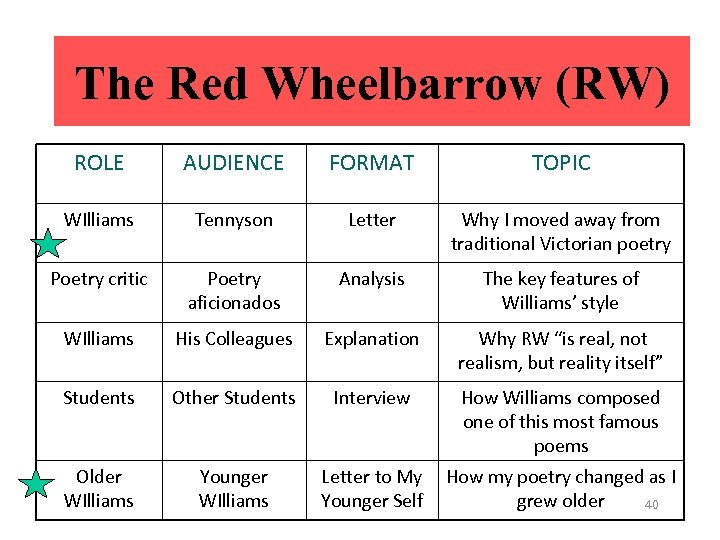 Crayfish The Red Wheelbarrow (RW) ROLE AUDIENCE FORMAT TOPIC WIlliams Tennyson Letter Why I moved away from traditional Victorian poetry Poetry critic Poetry aficionados Analysis The key features of Williams’ style WIlliams His Colleagues Explanation Why RW “is real, not realism, but reality itself” Students Other Students Interview How Williams composed one of this most famous poems Older WIlliams Younger WIlliams Letter to My Younger Self How my poetry changed as I grew older 40
 Guided Practice Creating a RAFT on a content area and topic of choice 41
 Completing Your RAFT • Target the lesson • Identify the KUDs • Select the important info and ideas • Complete one column at a time • Brainstorm critical roles • With whom might each converse? • What is a likely format? • What are some likely topics 42
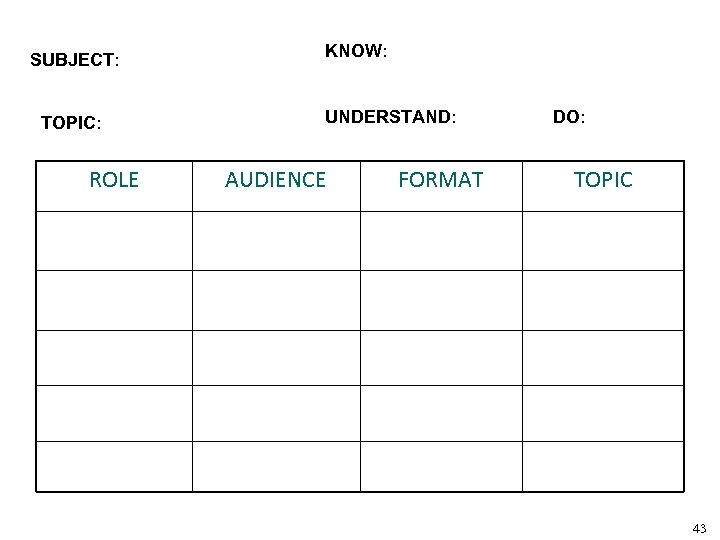 SUBJECT: TOPIC: ROLE KNOW: UNDERSTAND: AUDIENCE FORMAT DO: TOPIC 43
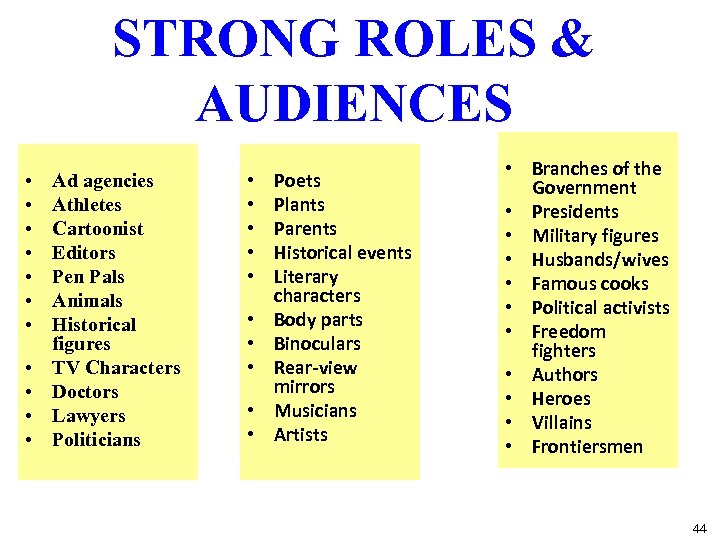 STRONG ROLES & AUDIENCES • • • Ad agencies Athletes Cartoonist Editors Pen Pals Animals Historical figures TV Characters Doctors Lawyers Politicians • • • Poets Plants Parents Historical events Literary characters Body parts Binoculars Rear-view mirrors Musicians Artists • Branches of the Government • Presidents • Military figures • Husbands/wives • Famous cooks • Political activists • Freedom fighters • Authors • Heroes • Villains • Frontiersmen 44
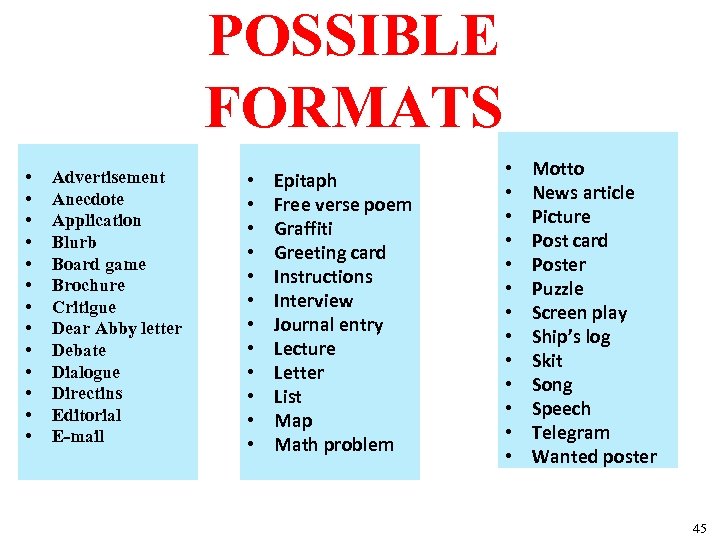 POSSIBLE FORMATS • • • • Advertisement Anecdote Application Blurb Board game Brochure Critigue Dear Abby letter Debate Dialogue Directins Editorial E-mail • • • Epitaph Free verse poem Graffiti Greeting card Instructions Interview Journal entry Lecture Letter List Map Math problem • • • • Motto News article Picture Post card Poster Puzzle Screen play Ship’s log Skit Song Speech Telegram Wanted poster 45
 Which ONE Difference Will I Address With Tiering? • Prior Knowledge? • Learning Styles? • Interests? • Readiness to Learn? 46
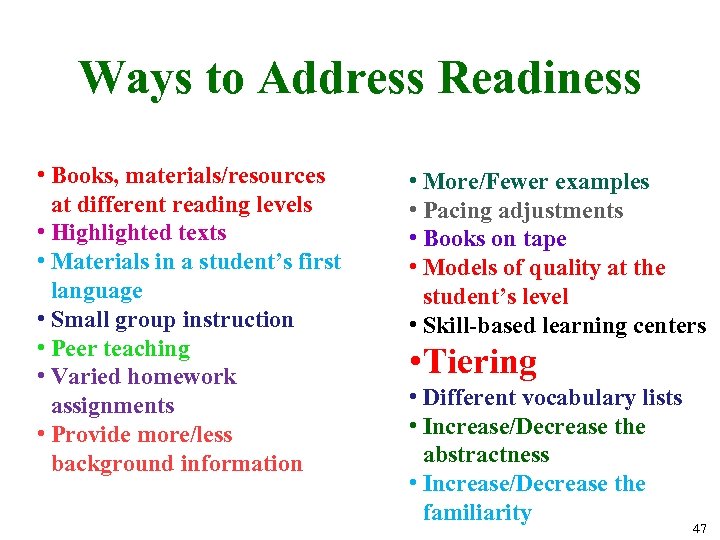 Ways to Address Readiness • Books, materials/resources at different reading levels • Highlighted texts • Materials in a student’s first language • Small group instruction • Peer teaching • Varied homework assignments • Provide more/less background information • More/Fewer examples • Pacing adjustments • Books on tape • Models of quality at the student’s level • Skill-based learning centers • Tiering • Different vocabulary lists • Increase/Decrease the abstractness • Increase/Decrease the familiarity 47
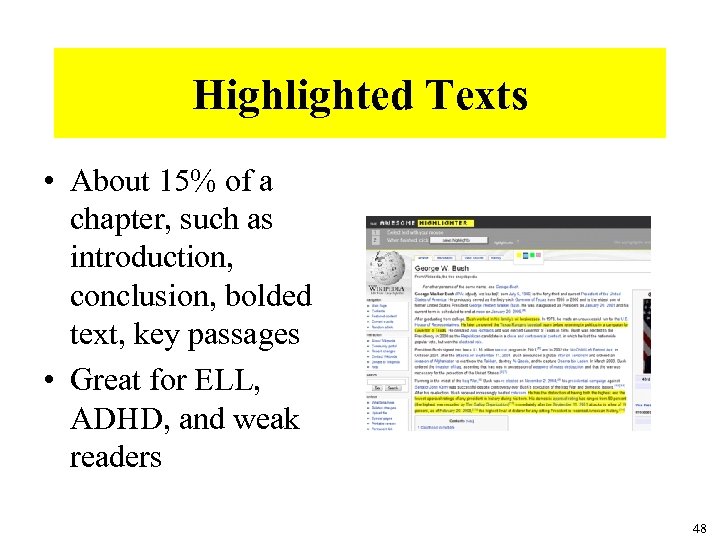 Highlighted Texts • About 15% of a chapter, such as introduction, conclusion, bolded text, key passages • Great for ELL, ADHD, and weak readers 48
 Front-Loaded Vocabulary WHAT? • Teach the few vocab words on which the topic pivots • Teach them before the unit to students who need extra time • Post them; refer to them; review with them • Teach root words as possible WHO? • ELL learners • Students who struggle with vocabulary • Students with learning challenges • Students with weak background knowledge • Students who didn’t know the words on the preassessment 49
 Which Components Were Modified? q. Content q. Assessment q. Grouping q. Introduction q. Teaching Methods q. Learning Activities q. Resources q. Extensions q. Time q Products 50
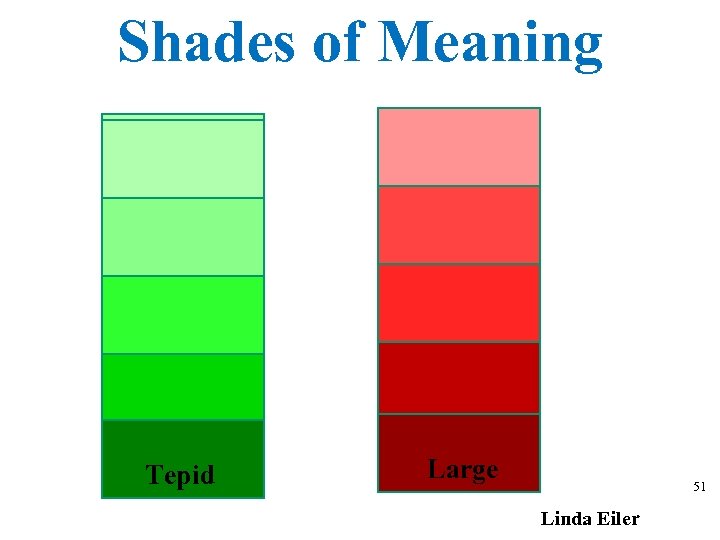 Shades of Meaning Tepid Large 51 Linda Eiler
 What is TIERING? • Tiering is a strategy teachers use to increase the match between students’ various levels of learning readiness to the content and instruction of particular lessons • It is NOT TEARING!! 52 52
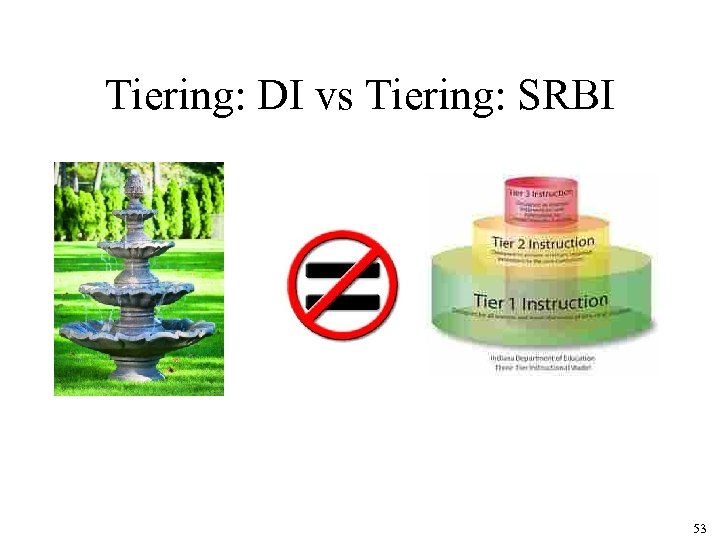 Tiering: DI vs Tiering: SRBI 53
 Movie Time Corey Berg’s high school class: • What is this teacher’s mindset? • How does she differentiate for her students? • What techniques does she use to manage the classroom? • What implications does this video clip have for our practice? 54
 Two Minute Pause Talk in groups of 2 -3 Compare what you are currently doing with the examples of tiering that we have been discussing. Discuss the implications of your conclusions? 55
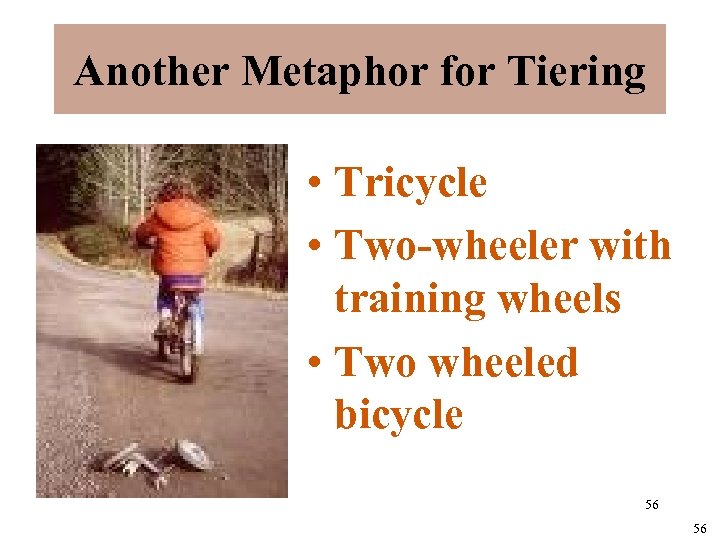 Another Metaphor for Tiering • Tricycle • Two-wheeler with training wheels • Two wheeled bicycle 56 56
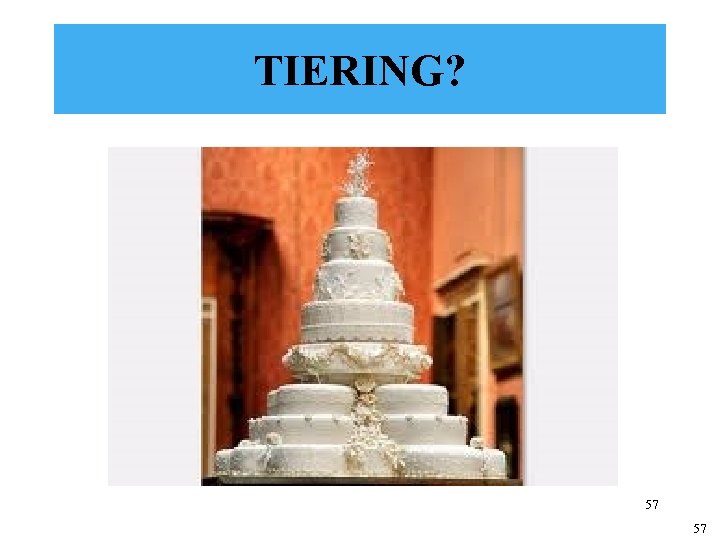 TIERING? 57 57
 Tiering for Struggling Learners: DECREASING the Cognitive Load • What is the representative topic? – How can I break it down into smaller parts? – Can I change it into something more familiar? – Can I provide more examples to help ensure understanding? – Can I gather reading materials that are at students’ instructional reading level? Instructional reading level: Students recognize between 90%-95% of the words Independent reading level: Students recognize more than 95% of the words 58
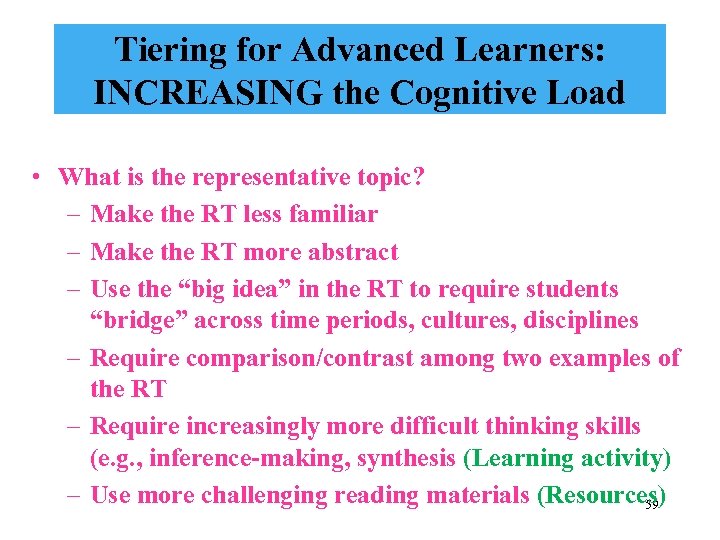 Tiering for Advanced Learners: INCREASING the Cognitive Load • What is the representative topic? – Make the RT less familiar – Make the RT more abstract – Use the “big idea” in the RT to require students “bridge” across time periods, cultures, disciplines – Require comparison/contrast among two examples of the RT – Require increasingly more difficult thinking skills (e. g. , inference-making, synthesis (Learning activity) – Use more challenging reading materials (Resources) 59
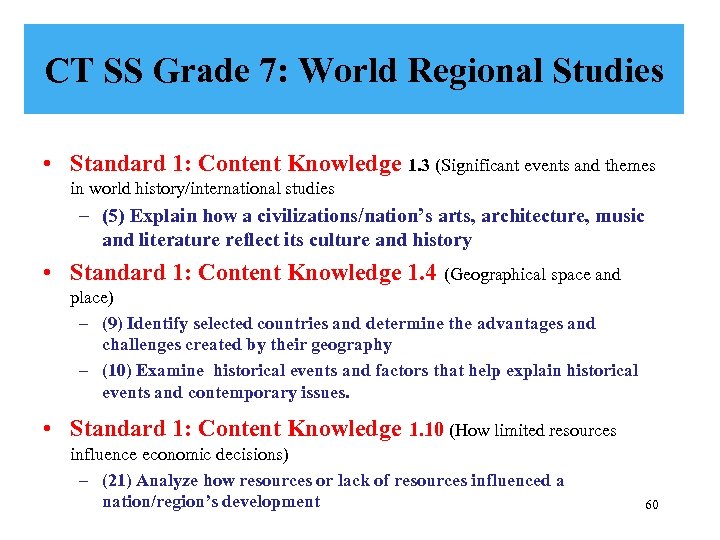 CT SS Grade 7: World Regional Studies • Standard 1: Content Knowledge 1. 3 (Significant events and themes in world history/international studies – (5) Explain how a civilizations/nation’s arts, architecture, music and literature reflect its culture and history • Standard 1: Content Knowledge 1. 4 (Geographical space and place) – (9) Identify selected countries and determine the advantages and challenges created by their geography – (10) Examine historical events and factors that help explain historical events and contemporary issues. • Standard 1: Content Knowledge 1. 10 (How limited resources influence economic decisions) – (21) Analyze how resources or lack of resources influenced a nation/region’s development 60
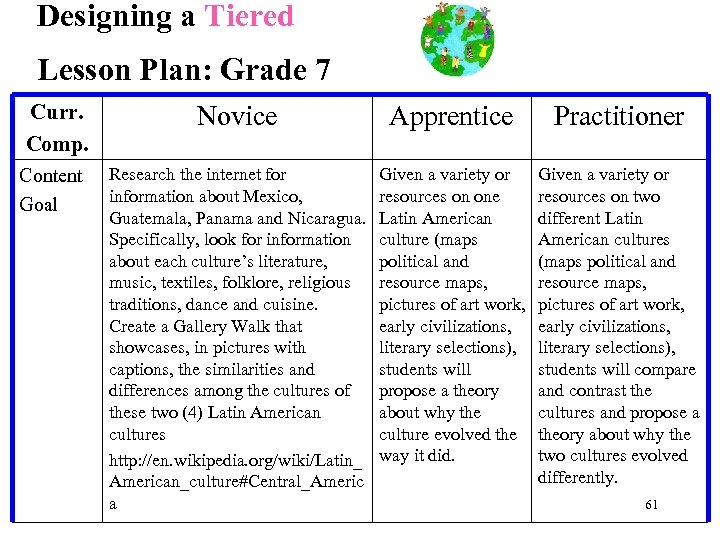 Designing a Tiered Lesson Plan: Grade 7 Curr. Comp. Content Goal Novice Apprentice Practitioner Research the internet for information about Mexico, Guatemala, Panama and Nicaragua. Specifically, look for information about each culture’s literature, music, textiles, folklore, religious traditions, dance and cuisine. Create a Gallery Walk that showcases, in pictures with captions, the similarities and differences among the cultures of these two (4) Latin American cultures http: //en. wikipedia. org/wiki/Latin_ American_culture#Central_Americ a Given a variety or resources on one Latin American culture (maps political and resource maps, pictures of art work, early civilizations, literary selections), students will propose a theory about why the culture evolved the way it did. Given a variety or resources on two different Latin American cultures (maps political and resource maps, pictures of art work, early civilizations, literary selections), students will compare and contrast the cultures and propose a theory about why the two cultures evolved differently. 61
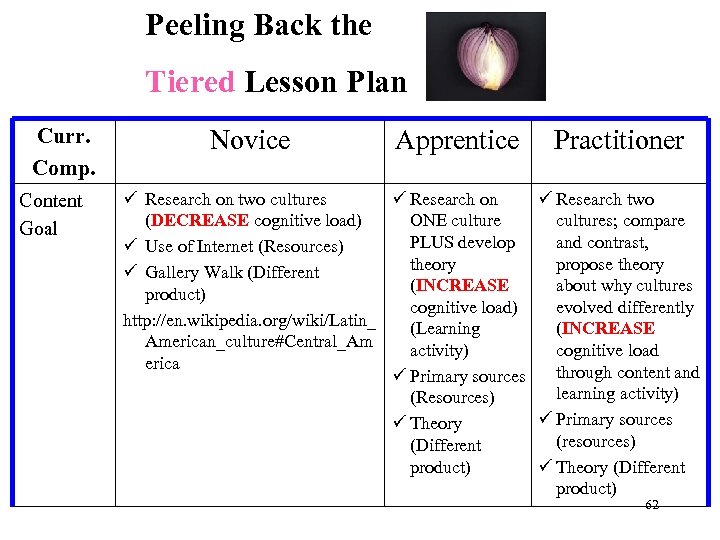 Peeling Back the Tiered Lesson Plan Curr. Comp. Content Goal Novice Apprentice Practitioner ü Research on two cultures ü Research on ü Research two (DECREASE cognitive load) ONE cultures; compare PLUS develop and contrast, ü Use of Internet (Resources) theory propose theory ü Gallery Walk (Different (INCREASE about why cultures product) cognitive load) evolved differently http: //en. wikipedia. org/wiki/Latin_ (Learning (INCREASE American_culture#Central_Am activity) cognitive load erica through content and ü Primary sources learning activity) (Resources) ü Primary sources ü Theory (resources) (Different product) ü Theory (Different product) 62
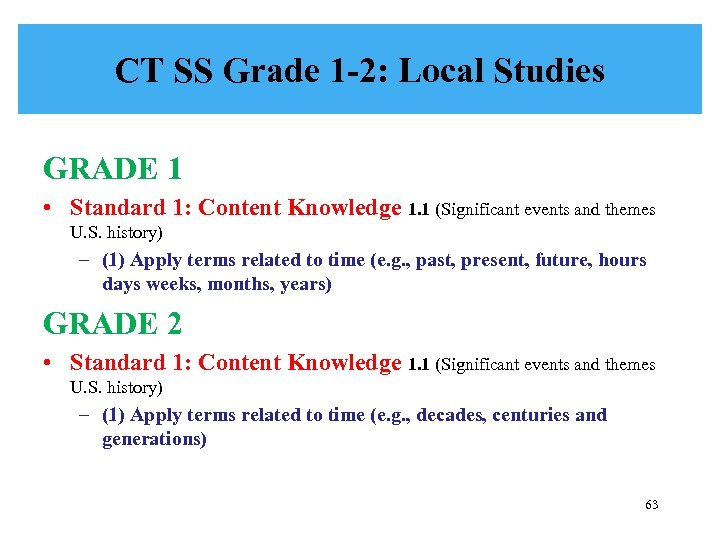 CT SS Grade 1 -2: Local Studies GRADE 1 • Standard 1: Content Knowledge 1. 1 (Significant events and themes U. S. history) – (1) Apply terms related to time (e. g. , past, present, future, hours days weeks, months, years) GRADE 2 • Standard 1: Content Knowledge 1. 1 (Significant events and themes U. S. history) – (1) Apply terms related to time (e. g. , decades, centuries and generations) 63
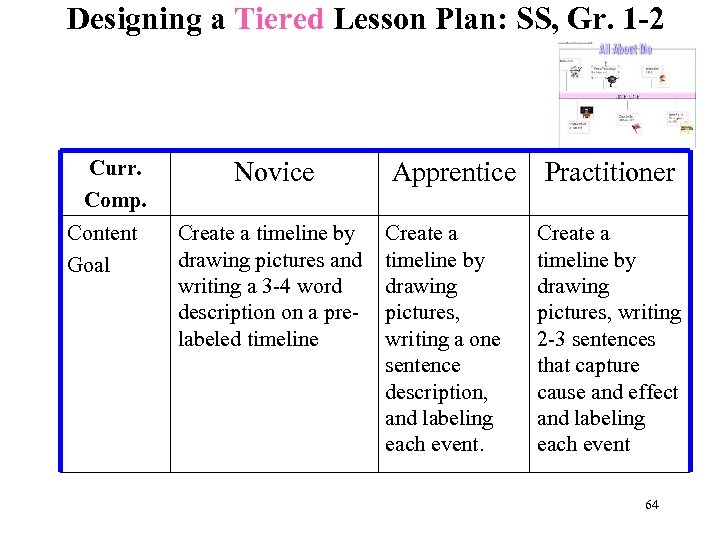 Designing a Tiered Lesson Plan: SS, Gr. 1 -2 Curr. Comp. Content Goal Novice Create a timeline by drawing pictures and writing a 3 -4 word description on a prelabeled timeline Apprentice Create a timeline by drawing pictures, writing a one sentence description, and labeling each event. Practitioner Create a timeline by drawing pictures, writing 2 -3 sentences that capture cause and effect and labeling each event 64
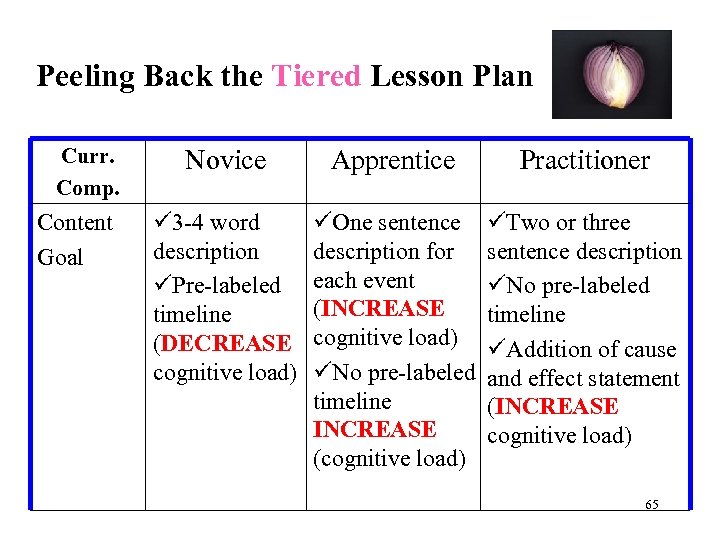 Peeling Back the Tiered Lesson Plan Curr. Comp. Content Goal Novice Apprentice Practitioner ü 3 -4 word description üPre-labeled timeline (DECREASE cognitive load) üOne sentence description for each event (INCREASE cognitive load) üNo pre-labeled timeline INCREASE (cognitive load) üTwo or three sentence description üNo pre-labeled timeline üAddition of cause and effect statement (INCREASE cognitive load) 65
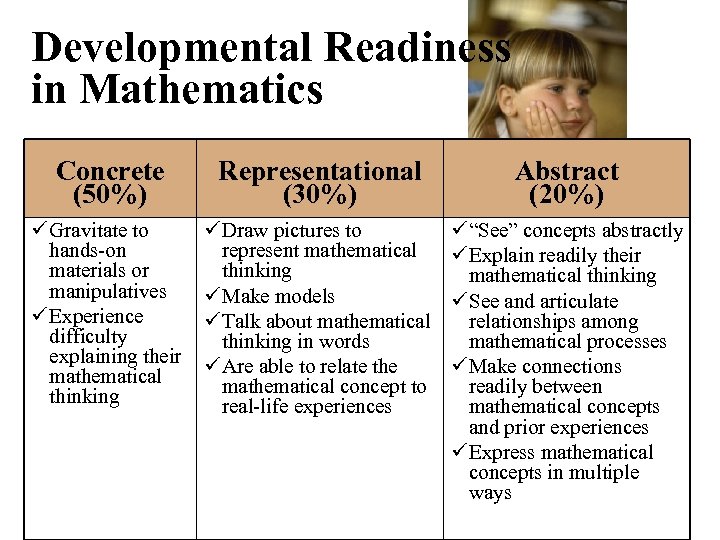 Developmental Readiness in Mathematics Concrete (50%) Representational (30%) Abstract (20%) ü Gravitate to hands-on materials or manipulatives ü Experience difficulty explaining their mathematical thinking ü Draw pictures to represent mathematical thinking ü Make models ü Talk about mathematical thinking in words ü Are able to relate the mathematical concept to real-life experiences ü “See” concepts abstractly ü Explain readily their mathematical thinking ü See and articulate relationships among mathematical processes ü Make connections readily between mathematical concepts and prior experiences ü Express mathematical concepts in multiple ways 66
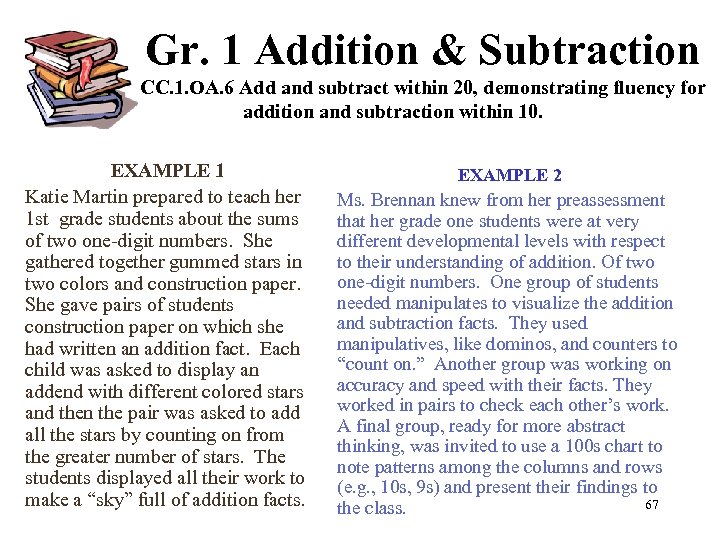 Gr. 1 Addition & Subtraction CC. 1. OA. 6 Add and subtract within 20, demonstrating fluency for addition and subtraction within 10. EXAMPLE 1 Katie Martin prepared to teach her 1 st grade students about the sums of two one-digit numbers. She gathered together gummed stars in two colors and construction paper. She gave pairs of students construction paper on which she had written an addition fact. Each child was asked to display an addend with different colored stars and then the pair was asked to add all the stars by counting on from the greater number of stars. The students displayed all their work to make a “sky” full of addition facts. EXAMPLE 2 Ms. Brennan knew from her preassessment that her grade one students were at very different developmental levels with respect to their understanding of addition. Of two one-digit numbers. One group of students needed manipulates to visualize the addition and subtraction facts. They used manipulatives, like dominos, and counters to “count on. ” Another group was working on accuracy and speed with their facts. They worked in pairs to check each other’s work. A final group, ready for more abstract thinking, was invited to use a 100 s chart to note patterns among the columns and rows (e. g. , 10 s, 9 s) and present their findings to 67 the class.
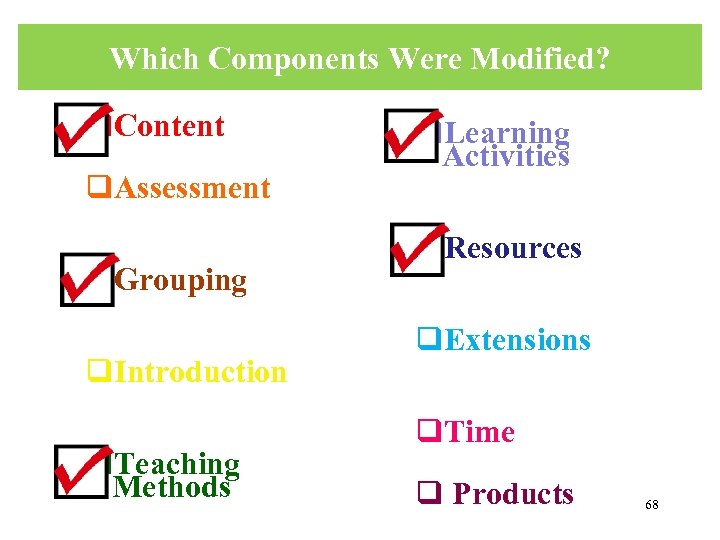 Which Components Were Modified? q. Content q. Assessment q. Grouping q. Introduction q. Teaching Methods q. Learning Activities q. Resources q. Extensions q. Time q Products 68
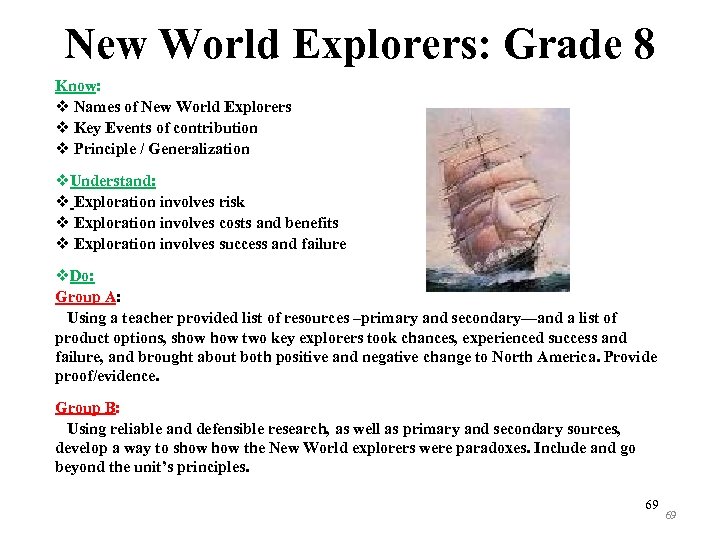 New World Explorers: Grade 8 Know: v Names of New World Explorers v Key Events of contribution v Principle / Generalization v. Understand: v Exploration involves risk v Exploration involves costs and benefits v Exploration involves success and failure v. Do: Group A: Using a teacher provided list of resources –primary and secondary—and a list of product options, show two key explorers took chances, experienced success and failure, and brought about both positive and negative change to North America. Provide proof/evidence. Group B: Using reliable and defensible research, as well as primary and secondary sources, develop a way to show the New World explorers were paradoxes. Include and go beyond the unit’s principles. 69 69
 New World Explorers: Grade 8 CCSS Standards • STRAND 1. 1 – Significant events and themes in United States history. – 1. Analyze how specific individuals and their ideas and beliefs influenced U. S. history. – • STRAND 2. 1 Access and gather information from a variety of primary and secondary sources including electronic media, recordings and text. • 1. Gather information from multiple print and digital sources. • 2. Cite specific textual evidence to support analysis of primary and secondary sources. • 3. Determine the central ideas or information of a primary or secondary source and provide an accurate summary. • 5. Analyze how a text makes connections among, and distinctions between, individuals, ideas, or events. • 6. Conduct short and sustained research projects based on focused questions, demonstrating understanding of the subject under 70 investigation. 70
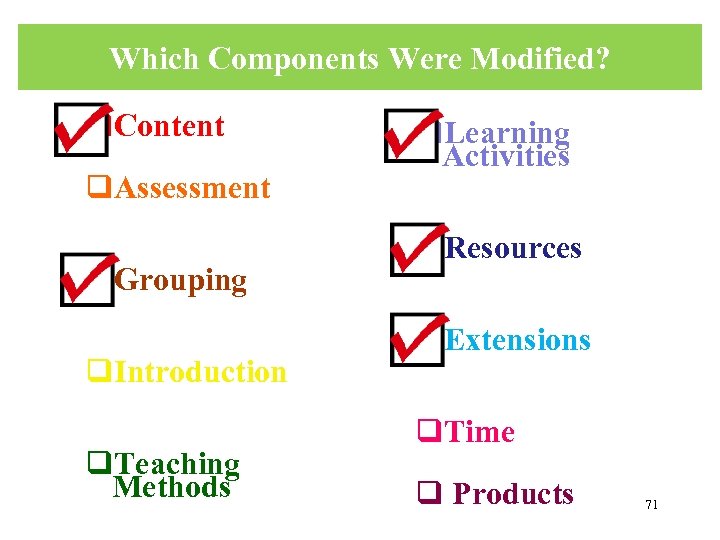 Which Components Were Modified? q. Content q. Assessment q. Grouping q. Introduction q. Teaching Methods q. Learning Activities q. Resources q. Extensions q. Time q Products 71
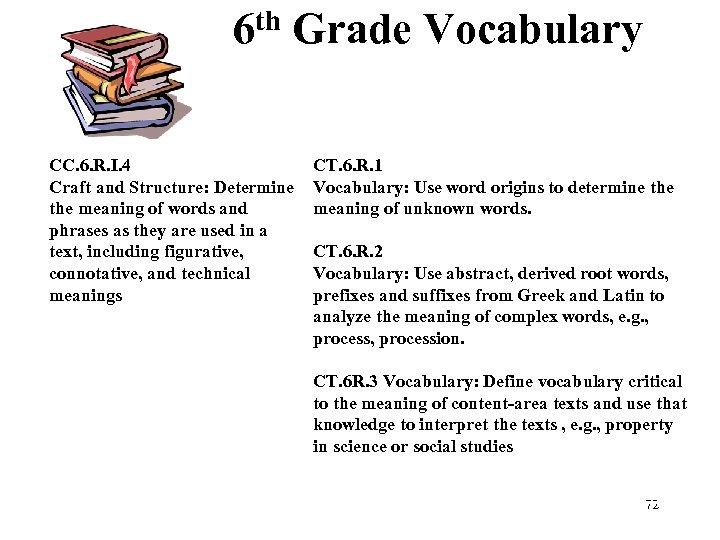 6 th Grade Vocabulary CC. 6. R. I. 4 Craft and Structure: Determine the meaning of words and phrases as they are used in a text, including figurative, connotative, and technical meanings CT. 6. R. 1 Vocabulary: Use word origins to determine the meaning of unknown words. CT. 6. R. 2 Vocabulary: Use abstract, derived root words, prefixes and suffixes from Greek and Latin to analyze the meaning of complex words, e. g. , process, procession. CT. 6 R. 3 Vocabulary: Define vocabulary critical to the meaning of content-area texts and use that knowledge to interpret the texts , e. g. , property in science or social studies 72
 th Grade Vocabulary 6 EXAMPLE 1 EXAMPLE 2 Mr. Jenkins pretests his students on the required lists of vocabulary words at two week intervals. When students demonstrate at least 80% mastery on the list, they do not have to write out the words, a definition, and an accompanying sentence. He does require all students to take the posttest at the end of the two week period because he want to make sure everyone really knows the words. Mr. Forrester pretests his students on the required lists of vocabulary words at two week intervals. Students have a vocabulary notebook in which they write the next ten words. Each writes the word, a definition, and a sentence. Students work in pairs, correcting each other’s work, which is then reviewed by the Mr. Forrester. Peers administer the quizzes. Words missed are recycled into next week’s list. Repetitions help students internalize key spelling patterns. Students who demonstrate mastery are provided with other words that emphasize roots and/or students’ own personal list of vocabulary words. 73
 74
74
 Algebra, Grade 8 CCSS Mathematics: Standard 8 - (Gr. 6 -8): Students will understand apply basic and advanced properties of functions and algebra EXAMPLE 1 Ms. Stanwood introduced this beginning lesson on slope by explaining what students would learn: “Today we will learn about slope, which is an important concept in algebra. We will spend about three weeks on this unit and by the time we are finished with the unit, you will see how civil engineers, builders, surveyors, and landscapers use this concept in their work. She invited students to arrange themselves in groups of four because they were about to begin a scavenger hunt about slope (www. quia. com). Small groups were a way of differentiating because they were responsive to students’ individual questions. As groups, they were going to use the web to find the answers to the following questions: – – What is slope? What letter of the Greek alphabet is used to represent slope? If a line rises from let to right is the slope positive or negative? What is the slope of a vertical line? Horizontal line? While students were working, she rotated among the groups, responded to questions, and listened to students’ questions. Later in the period, Ms. Stanwood assigned them some homework, which she knew would help students internalize the concept of slope and answer that arose in their small group work.
 Algebra, Grade 8 CCSS Mathematics: Standard 8 - (Gr. 6 -8): Students will understand apply basic and advanced properties of functions and algebra EXAMPLE 2 Mr. Grenke prepared to begin a 3 week algebra unit on slope with his 8 th graders. From past experiences, he anticipated that there would be critical differences among his students with respect to conceptual understanding and abstract thinking, so he gathered a variety of resources as he planned his teaching strategies. He would begin with a motivating problem, that could “double” as a hook: “How Steep Can a Ramp Be? ” (www. figurethis. org) He would listen carefully to students’ mathematical discourse about the problem to diagnose students’ foundational understanding and misconceptions. Based upon his diagnosis, he would initially divide the students into two groups: those who had incomplete or missing foundational concepts and those who already had some knowledge of the concepts and skills. For the first group, he would scaffold mini-lessons around the concepts students didn’t know. He might use a geoboard applet (www. enc. org) that allows students to use virtual elastics and pegs to draw conclusions about rise and run. He would use demonstration, the concept attainment model, Socratic questioning and feedback to support the first group’s learning. He went on the web and located another real-world problem related to slope that would extend the second group’s understanding of slope and rate of change: “The Lost House Keys. ” (http: //mathcentral. uregina. ca) Working in a small group, he would invite students to discuss and answer a series of open-ended questions: What is this problem about? What are some of the factors that are important when you set up the ladder? What is causing the steepness if the ladder to change? What is the relationship between the amount of vertical distance covered with respect to that covered by the horizontal distance? How is this problem similar/different to the one done by the whole class? Can rise and run be expressed mathematically? What new questions do I/we have? He planned to use Socratic questioning and feedback to support the second group’s learning. Based upon student learning at the outset of this lesson, he would reevaluate group membership before proceeding with the next phase of the lesson, determine their learning needs and the best teaching strategy to support their learning.
 Core Science Curriculum Framework ENRICHMENT CONTENT STANDARDS for HIGH SCHOOL SCIENCE: High School Chemistry • Reaction Rates Chemical reaction rates depend upon factors that influence the frequency of collision of reactant molecules – The rate of reaction is the decrease in concentration of reactants or the increase in concentration of products with time. – Reaction rates depend upon factors such as concentration, temperature and pressure. – Equilibrium is established when forward and reverse reaction rates are equal. – Catalysts play a role in increasing the reaction rate by changing 77 the activation energy in a chemical reaction.
 Reactions and Interactions Enrichment Content Standards for High School Science (Appendix) from Core Science Curriculum Framework. . EXAMPLE 1 Ms. Barnes prepared for the lab on simple reactions between metals and acids. At the conclusion of the experiment, she wanted students to understand that there is a direct relationship between the concentration of an acid and the reaction rate. To help them understand this important direct relationship, she set up different test stations for students to observe. Each station had the same mass of a given metal. Each of the containers held increasing concentrations of HCl. Students had to combine the reactants and analyze the data for trends in the reaction rates. EXAMPLE 2 Mr. Luther knew at the outset of his chemistry unit on reaction rates that he had students who not only had different levels of prior knowledge about aspects of chemistry, but also learned more quickly than others in the class. He decided to provide most of his students with a hands-on lab that helped students understand that there is a direct relationship between the concentration of an acid and the reaction rate. He provided the remaining students with the same metal and solutions as the other group, but invited them to find the ideal conditions for the fastest 78 reaction time.
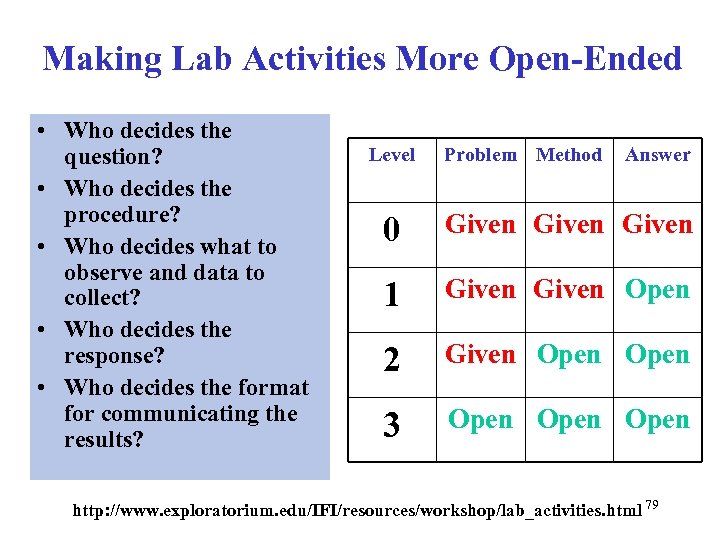 Making Lab Activities More Open-Ended • Who decides the question? • Who decides the procedure? • Who decides what to observe and data to collect? • Who decides the response? • Who decides the format for communicating the results? Level Problem Method Answer 0 Given 1 Given Open 2 Given Open 3 Open http: //www. exploratorium. edu/IFI/resources/workshop/lab_activities. html 79
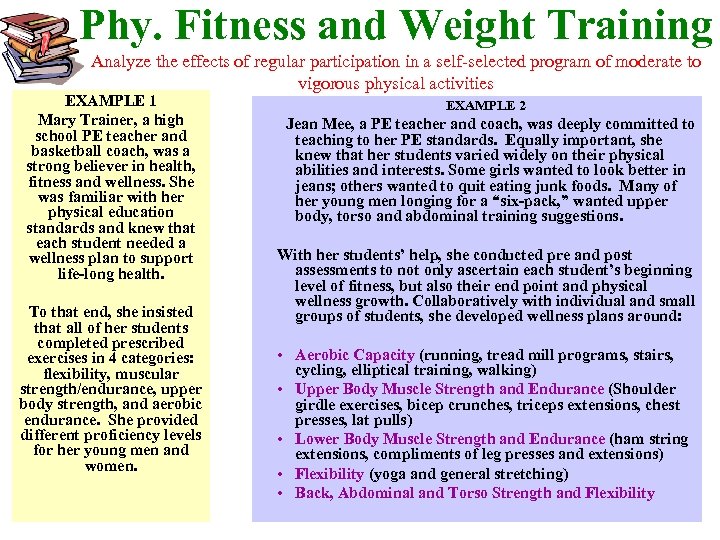 Phy. Fitness and Weight Training Analyze the effects of regular participation in a self-selected program of moderate to vigorous physical activities EXAMPLE 1 Mary Trainer, a high school PE teacher and basketball coach, was a strong believer in health, fitness and wellness. She was familiar with her physical education standards and knew that each student needed a wellness plan to support life-long health. To that end, she insisted that all of her students completed prescribed exercises in 4 categories: flexibility, muscular strength/endurance, upper body strength, and aerobic endurance. She provided different proficiency levels for her young men and women. EXAMPLE 2 Jean Mee, a PE teacher and coach, was deeply committed to teaching to her PE standards. Equally important, she knew that her students varied widely on their physical abilities and interests. Some girls wanted to look better in jeans; others wanted to quit eating junk foods. Many of her young men longing for a “six-pack, ” wanted upper body, torso and abdominal training suggestions. With her students’ help, she conducted pre and post assessments to not only ascertain each student’s beginning level of fitness, but also their end point and physical wellness growth. Collaboratively with individual and small groups of students, she developed wellness plans around: • Aerobic Capacity (running, tread mill programs, stairs, cycling, elliptical training, walking) • Upper Body Muscle Strength and Endurance (Shoulder girdle exercises, bicep crunches, triceps extensions, chest presses, lat pulls) • Lower Body Muscle Strength and Endurance (ham string extensions, compliments of leg presses and extensions) • Flexibility (yoga and general stretching) • Back, Abdominal and Torso Strength and Flexibility 80
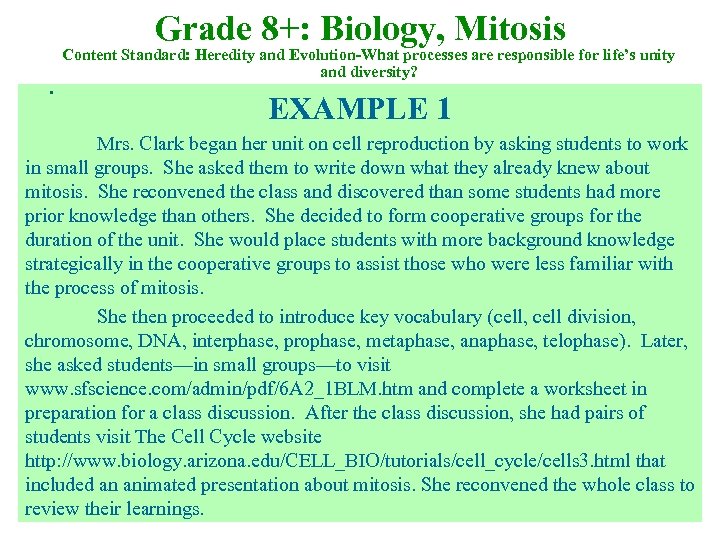 Grade 8+: Biology, Mitosis . Content Standard: Heredity and Evolution-What processes are responsible for life’s unity and diversity? EXAMPLE 1 Mrs. Clark began her unit on cell reproduction by asking students to work in small groups. She asked them to write down what they already knew about mitosis. She reconvened the class and discovered than some students had more prior knowledge than others. She decided to form cooperative groups for the duration of the unit. She would place students with more background knowledge strategically in the cooperative groups to assist those who were less familiar with the process of mitosis. She then proceeded to introduce key vocabulary (cell, cell division, chromosome, DNA, interphase, prophase, metaphase, anaphase, telophase). Later, she asked students—in small groups—to visit www. sfscience. com/admin/pdf/6 A 2_1 BLM. htm and complete a worksheet in preparation for a class discussion. After the class discussion, she had pairs of students visit The Cell Cycle website http: //www. biology. arizona. edu/CELL_BIO/tutorials/cell_cycle/cells 3. html that included an animated presentation about mitosis. She reconvened the whole class to 81 review their learnings.
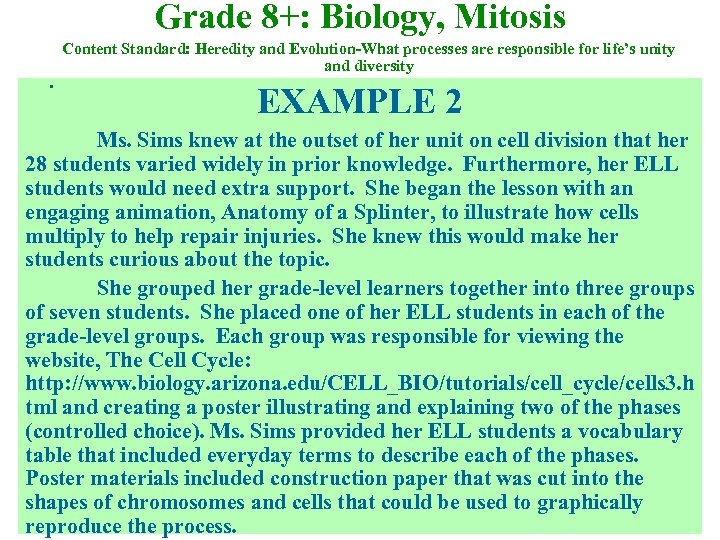 Grade 8+: Biology, Mitosis. Content Standard: Heredity and Evolution-What processes are responsible for life’s unity and diversity EXAMPLE 2 Ms. Sims knew at the outset of her unit on cell division that her 28 students varied widely in prior knowledge. Furthermore, her ELL students would need extra support. She began the lesson with an engaging animation, Anatomy of a Splinter, to illustrate how cells multiply to help repair injuries. She knew this would make her students curious about the topic. She grouped her grade-level learners together into three groups of seven students. She placed one of her ELL students in each of the grade-level groups. Each group was responsible for viewing the website, The Cell Cycle: http: //www. biology. arizona. edu/CELL_BIO/tutorials/cell_cycle/cells 3. h tml and creating a poster illustrating and explaining two of the phases (controlled choice). Ms. Sims provided her ELL students a vocabulary table that included everyday terms to describe each of the phases. Poster materials included construction paper that was cut into the shapes of chromosomes and cells that could be used to graphically 82 reproduce the process.
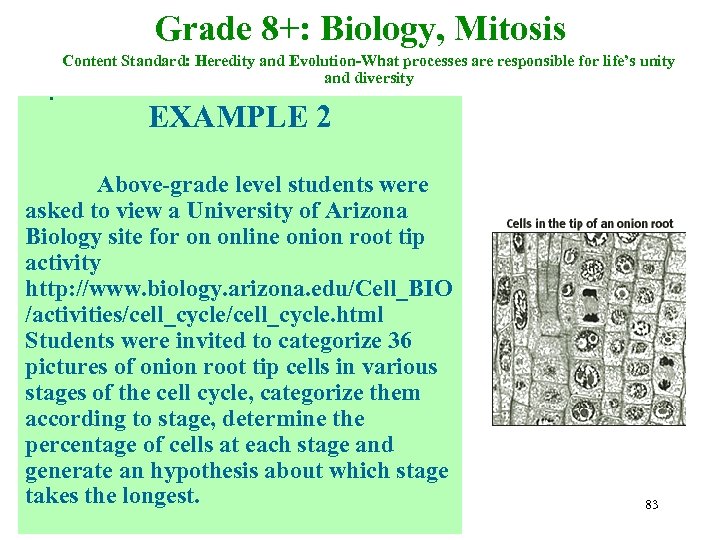 Grade 8+: Biology, Mitosis. Content Standard: Heredity and Evolution-What processes are responsible for life’s unity and diversity EXAMPLE 2 Above-grade level students were asked to view a University of Arizona Biology site for on online onion root tip activity http: //www. biology. arizona. edu/Cell_BIO /activities/cell_cycle. html Students were invited to categorize 36 pictures of onion root tip cells in various stages of the cell cycle, categorize them according to stage, determine the percentage of cells at each stage and generate an hypothesis about which stage takes the longest. 83
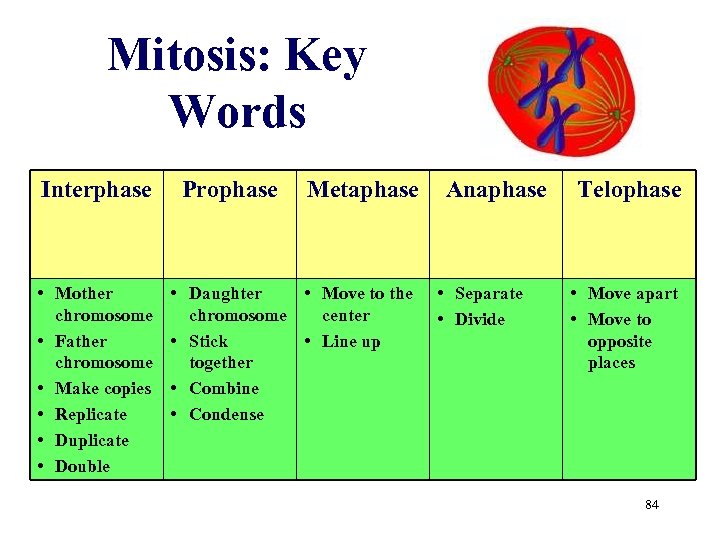 Mitosis: Key Words Interphase • Mother chromosome • Father chromosome • Make copies • Replicate • Duplicate • Double Prophase Metaphase • Daughter • Move to the chromosome center • Stick • Line up together • Combine • Condense Anaphase • Separate • Divide Telophase • Move apart • Move to opposite places 84
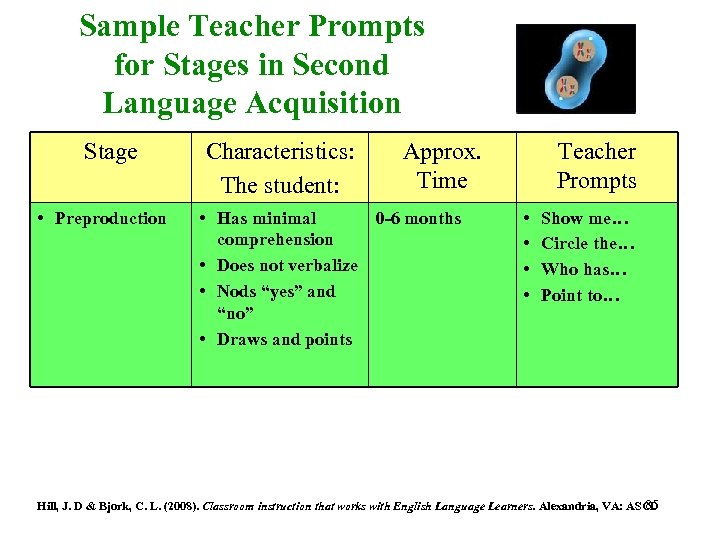 Sample Teacher Prompts for Stages in Second Language Acquisition Stage • Preproduction Characteristics: The student: Approx. Time • Has minimal 0 -6 months comprehension • Does not verbalize • Nods “yes” and “no” • Draws and points Teacher Prompts • • Show me… Circle the… Who has… Point to… 85 Hill, J. D & Bjork, C. L. (2008). Classroom instruction that works with English Language Learners. Alexandria, VA: ASCD
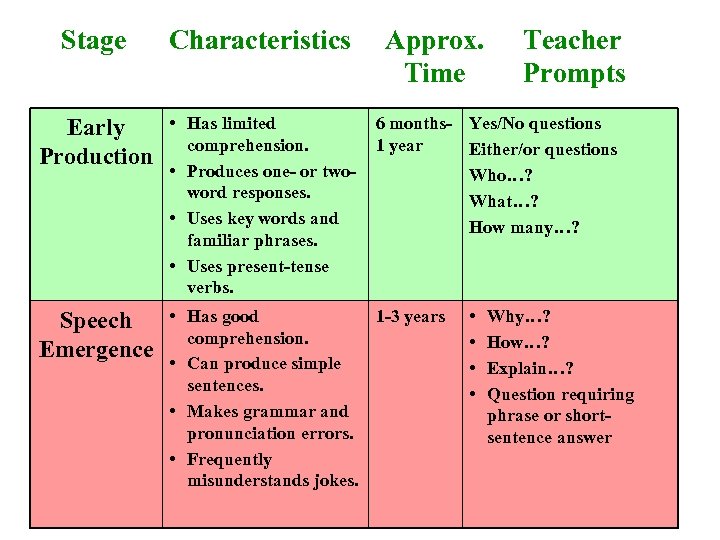 Approx. Time Stage Characteristics Early Production • Has limited comprehension. • Produces one- or twoword responses. • Uses key words and familiar phrases. • Uses present-tense verbs. Speech Emergence • Has good 1 -3 years comprehension. • Can produce simple sentences. • Makes grammar and pronunciation errors. • Frequently misunderstands jokes. Teacher Prompts 6 months- Yes/No questions 1 year Either/or questions Who…? What…? How many…? • • Why…? How…? Explain…? Question requiring phrase or shortsentence answer 86
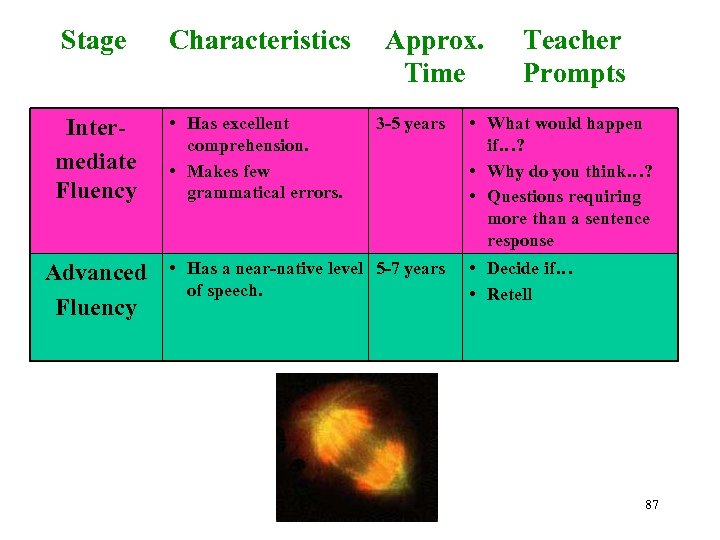 Stage Characteristics Intermediate Fluency • Has excellent comprehension. • Makes few grammatical errors. Advanced Fluency Approx. Time 3 -5 years • Has a near-native level 5 -7 years of speech. Teacher Prompts • What would happen if…? • Why do you think…? • Questions requiring more than a sentence response • Decide if… • Retell 87
 Thermal Energy Transfer: Grade 9 STRAND 1: Energy Transformations, 9. 1 Energy cannot be created or destroyed; it can be converted from one form to another. D 2. Explain how energy is transferred by conduction, CONVECTION and radiation EXAMPLE 1 To capture her students’ interest in the upcoming lesson, Ms. Winkler began her 4 -day unit on con with a film about rogue waves. Then, she led them into a class discussion about the movement of the upper layer of the ocean, its currents and the Earth’s rotation. She prepared a lab that would simulate the Coriolus Effect (drawing a straight line on a rotating disc). She rotated to student groups, asked questions and checked their answers. Ms. Winkler concluded her first segment of the unit with a discussion about how their “data” matched real-life current deflection. Over the next two days she led several student discussions about thermohaline currents, and she provided students with maps to illustrate the complexity of the ocean’s conveyor belt. 88
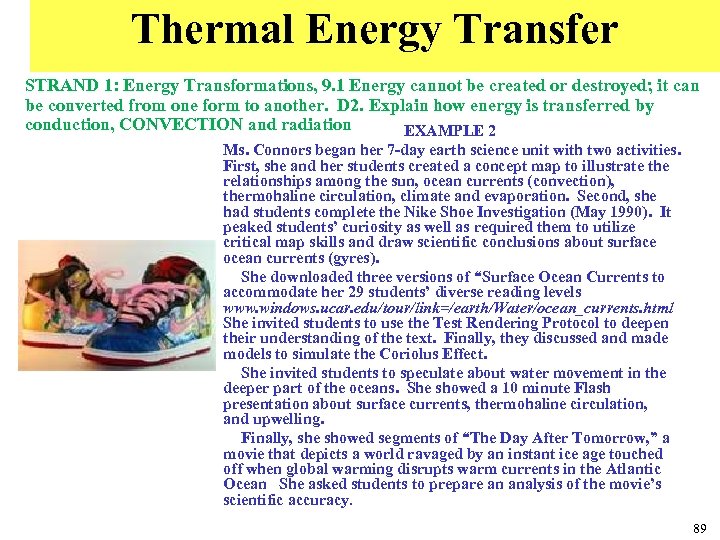 Thermal Energy Transfer STRAND 1: Energy Transformations, 9. 1 Energy cannot be created or destroyed; it can be converted from one form to another. D 2. Explain how energy is transferred by conduction, CONVECTION and radiation EXAMPLE 2 Ms. Connors began her 7 -day earth science unit with two activities. First, she and her students created a concept map to illustrate the relationships among the sun, ocean currents (convection), thermohaline circulation, climate and evaporation. Second, she had students complete the Nike Shoe Investigation (May 1990). It peaked students’ curiosity as well as required them to utilize critical map skills and draw scientific conclusions about surface ocean currents (gyres). She downloaded three versions of “Surface Ocean Currents to accommodate her 29 students’ diverse reading levels www. windows. ucar. edu/tour/link=/earth/Water/ocean_currents. html She invited students to use the Test Rendering Protocol to deepen their understanding of the text. Finally, they discussed and made models to simulate the Coriolus Effect. She invited students to speculate about water movement in the deeper part of the oceans. She showed a 10 minute Flash presentation about surface currents, thermohaline circulation, and upwelling. Finally, she showed segments of “The Day After Tomorrow, ” a movie that depicts a world ravaged by an instant ice age touched off when global warming disrupts warm currents in the Atlantic Ocean She asked students to prepare an analysis of the movie’s scientific accuracy. 89
 Greenhouse Effect: High School-Example 1 STRAND III: Global Interdependence: Science and Technology in Society – How do science and technology affect the quality of our lives? 9. 8 - The use of resources by human populations may affect the quality of the environment. D 23 Explain how the accumulation of carbon dioxide (CO 2) in the atmosphere increases Earth’s “greenhouse” effect and may cause climate changes Mrs. Moore began her week long unit on the Greenhouse Effect and global warming with two journal prompts: What is your definition of global warming? and How does it affect our environment? Students read, Early Signs of Spring and Global Warming (http: //www. ucsusa. org/global_warming/science_and_impacts/early-warning -signs-of-global-10. html), and Mrs. Moore asked questions such as: What is the urban heat-island effect and how does it contribute to our understanding of global warming? In addition, she reviewed the greenhouse effect as well as the enhanced greenhouse effect. The concluding activity was a simulation and students could choose the membership for their groups. Each group became an organization concerned about global warming and was about to attend an international global warming summit. Each group had to name themselves and come up with a series of strategy statements to better control greenhouse gases. They were invited to use any resources and given the following questions: What are greenhouse gases? What effects do the gases have on our environment? What solutions are already in place to restrict the emission of greenhouse gases? What other solutions would your team like to put into place? 90
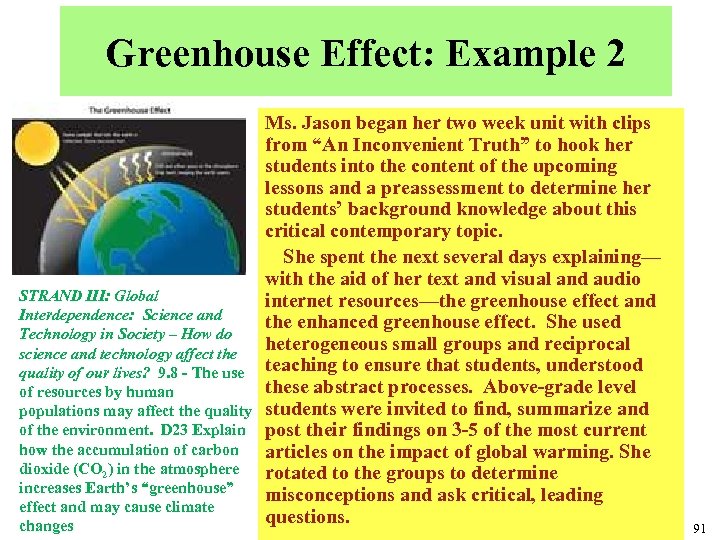 Greenhouse Effect: Example 2 STRAND III: Global Interdependence: Science and Technology in Society – How do science and technology affect the quality of our lives? 9. 8 - The use of resources by human populations may affect the quality of the environment. D 23 Explain how the accumulation of carbon dioxide (CO 2) in the atmosphere increases Earth’s “greenhouse” effect and may cause climate changes Ms. Jason began her two week unit with clips from “An Inconvenient Truth” to hook her students into the content of the upcoming lessons and a preassessment to determine her students’ background knowledge about this critical contemporary topic. She spent the next several days explaining— with the aid of her text and visual and audio internet resources—the greenhouse effect and the enhanced greenhouse effect. She used heterogeneous small groups and reciprocal teaching to ensure that students, understood these abstract processes. Above-grade level students were invited to find, summarize and post their findings on 3 -5 of the most current articles on the impact of global warming. She rotated to the groups to determine misconceptions and ask critical, leading questions. 91
 Greenhouse Effect: Example 2, con’t Ms. Jason left the last week for a culminating project in which students had to summarize the evidence for/against the role of human activity in global warming. Based on her observations, she assigned students to one of five groups based on their ability to handle abstract, complex material: (1) coral bleaching; (2) warming of the oceans; (3) glacial melting; (4) the relationship among the formation of ozone holes, global warming and the greenhouse effect; and (5) the chemistry of the STRAND III: Global enhanced greenhouse effect and gas concentrations over Interdependence: Science and time. Each group was responsible for a 5 -8 minute Technology in Society – How do presentation to share their evidence and conclusions science and technology affect the about the extent of the role of human activity in global quality of our lives? 9. 8 - The warming. Extension for interested students: View “An use of resources by human populations may affect the Inconvenient Truth in its entirety with the following quality of the environment. question in mind: Is there any evidence that Gore’s D 23 Explain how the hypothesis may be “hot air? ” accumulation of carbon dioxide http: //www. bbc. co. uk/blogs/today/tomfeilden/2009/09/a (CO ) in the atmosphere 2 n_inconvenient_truth_about_gl. html increases Earth’s “greenhouse” effect and may cause climate changes 92
 Fine Arts: Beginning Instrumental Performing on instruments, alone and with others, a varied repertoire of music. EXAMPLE 1 John Vee, a long-time, high school music teacher, loved his instrumental music classes. He especially loved his ensemble group that often played at school and town functions. He always auditioned his players to ascertain their skill level and—as they progressed through their high school years—moved them through the “chairs” in the orchestra. His top students were able to carry the rest of the students, who often “made it” by simply playing along imitating the section leaders. Some of his top students continued to play after high school, including two students who now play with the Philadelphia Orchestra. EXAMPLE 2 Scott Shuler, a long-time high school music teacher, always auditioned his instrumental students to determine their skill level. Although he assigned students to “chairs” as they progressed through their high school years, he also recognized his responsibility to cultivate achievement and talent in all of his students. Thus, he mixed his top students in different sections, asking all students to not only carry the melody, but also the harmony parts. Furthermore, he often disaggregated his orchestra. For example. when he knew that the wind players were strong and reasonably comfortable with a piece of literature, he excused them from whole group practice. This strategy provided him with more time to work with the rest of the orchestra members who needed more intense practice and a smaller teacherstudent ratio. He used his chamber groups to further differentiate his curriculum and instruction. His chamber groups were often co -operative clusters of students, and this grouping strategy allowed him tailor the literature to the expertise of the students. For his highest level students, Scott always found time to work with them on solos for school and community based programs. 93
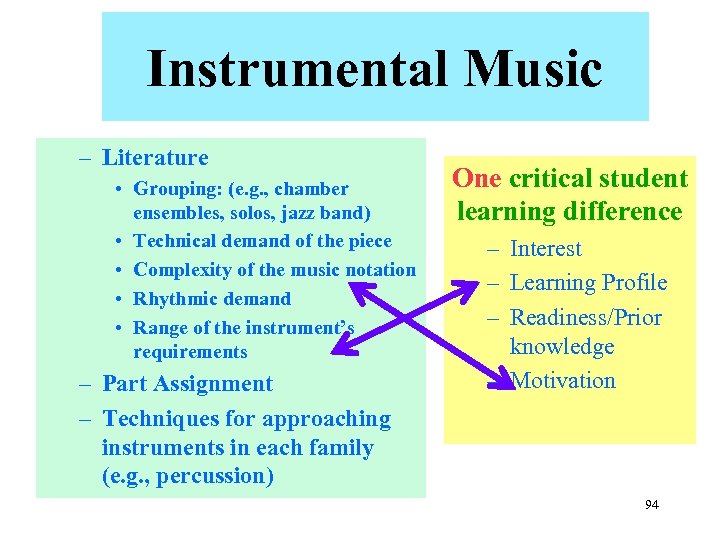 Instrumental Music – Literature • Grouping: (e. g. , chamber ensembles, solos, jazz band) • Technical demand of the piece • Complexity of the music notation • Rhythmic demand • Range of the instrument’s requirements – Part Assignment – Techniques for approaching instruments in each family (e. g. , percussion) One critical student learning difference – Interest – Learning Profile – Readiness/Prior knowledge – Motivation 94
 Guided Practice Create a TIERED LESSON in a content area and topic of choice 95
 Your Turn • Identify a grade level and select a unit of your choice. • Check your standards to make sure you are “on target. ” • Write down the “essential understandings: ” facts, concepts and principles (KUDs) related to your unit. • Anticipate ONE critical student difference that might emerge from preassessment data (e. g. prior knowledge, reading, learning rate). • Brainstorm 2 -3 different ways to differentiate the unit to attend to the targeted student difference. • Vary the content, teaching strategies, learning activities, resources, and/or products to address students’ readiness levels • Explain in 3 -4 sentence why you believe the differentiation will address your targeted student difference. 96
 Creating a Tiered Lesson 1. Identify grade level and subject 2. Target the concepts/principles that may require tiering 3. Target the critical students difference to be addressed (e. g. , learning rate, prior knowledge, readiness) 4. Visualize the differences in prior knowledge for above-grade level, on-grade level and below grade level students 5. Vary the content, teaching strategies, learning activities, resources, and/or products to address students’ readiness levels 6. Reflect 97
 Reflecting On My Tiered Lesson • Did I stick to my concepts/principles? • Is each of the tiers respectful to learners? • Do I have rubrics to share with students? • What resources will I need? • How will my students be grouped? • What other management issues do I need to consider? (e. g. anchor activities, how completed work will be shared? ) 98
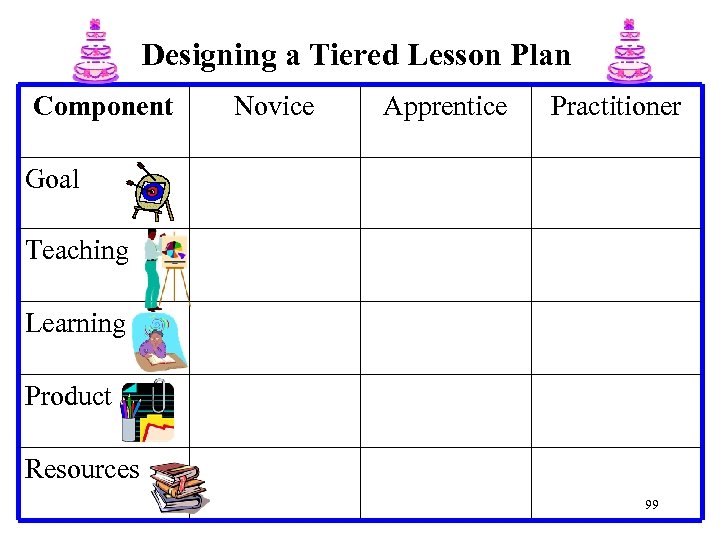 Designing a Tiered Lesson Plan Component Novice Apprentice Practitioner Goal Teaching Learning Product Resources 99
 Tiering: Pluses/Minuses Pluses 1. 2. 3. 4. 5. Minuses 1. 2. 3. 4. 5. 100
 Planning Next Steps… 1. 2. 3. 4. 5. 6. 7. 8. 101
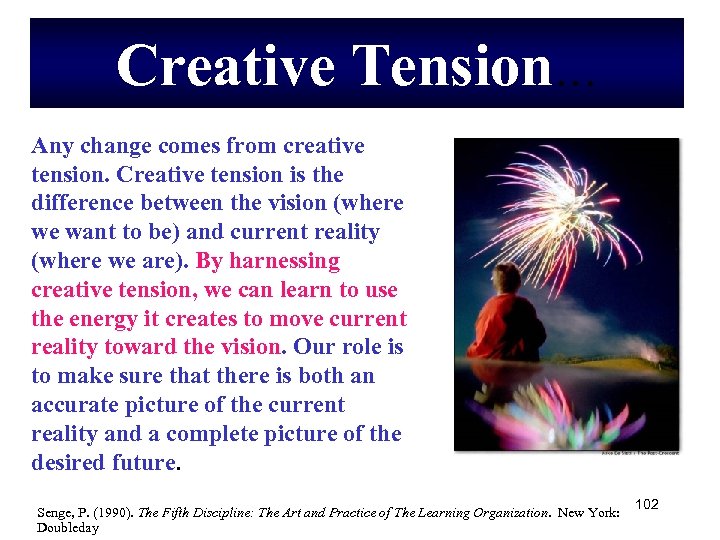 Creative Tension… Any change comes from creative tension. Creative tension is the difference between the vision (where we want to be) and current reality (where we are). By harnessing creative tension, we can learn to use the energy it creates to move current reality toward the vision. Our role is to make sure that there is both an accurate picture of the current reality and a complete picture of the desired future. Senge, P. (1990). The Fifth Discipline: The Art and Practice of The Learning Organization. New York: Doubleday 102
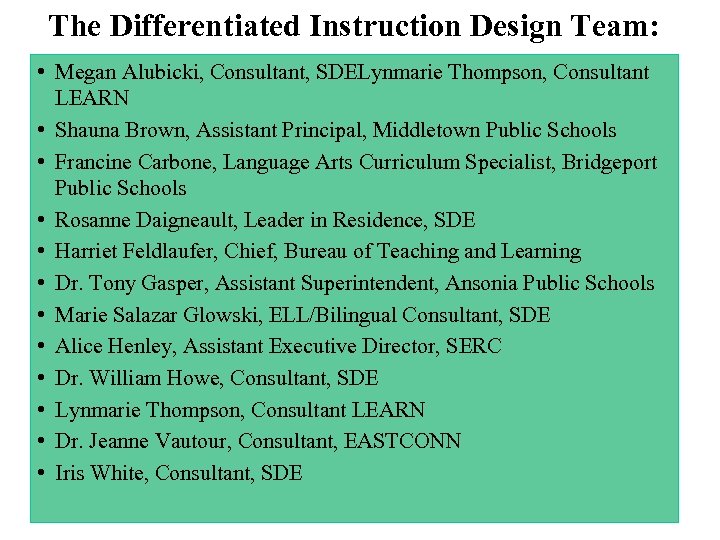 The Differentiated Instruction Design Team: • Megan Alubicki, Consultant, SDELynmarie Thompson, Consultant LEARN • Shauna Brown, Assistant Principal, Middletown Public Schools • Francine Carbone, Language Arts Curriculum Specialist, Bridgeport Public Schools • Rosanne Daigneault, Leader in Residence, SDE • Harriet Feldlaufer, Chief, Bureau of Teaching and Learning • Dr. Tony Gasper, Assistant Superintendent, Ansonia Public Schools • Marie Salazar Glowski, ELL/Bilingual Consultant, SDE • Alice Henley, Assistant Executive Director, SERC • Dr. William Howe, Consultant, SDE • Lynmarie Thompson, Consultant LEARN • Dr. Jeanne Vautour, Consultant, EASTCONN • Iris White, Consultant, SDE
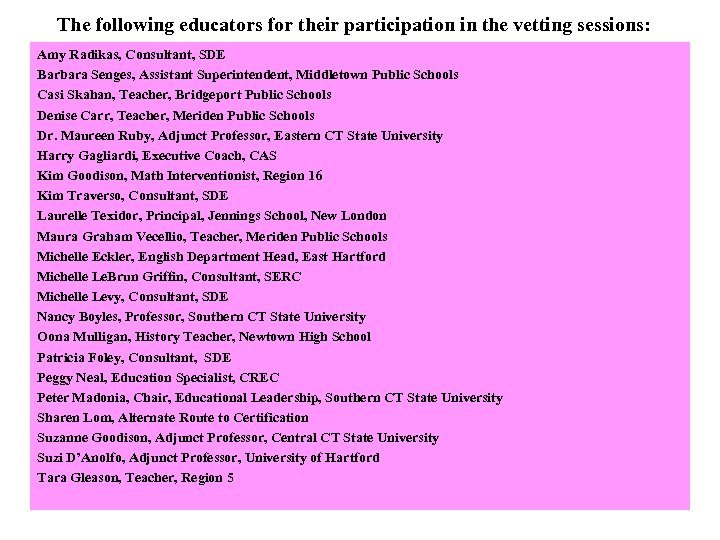 The following educators for their participation in the vetting sessions: Amy Radikas, Consultant, SDE Barbara Senges, Assistant Superintendent, Middletown Public Schools Casi Skahan, Teacher, Bridgeport Public Schools Denise Carr, Teacher, Meriden Public Schools Dr. Maureen Ruby, Adjunct Professor, Eastern CT State University Harry Gagliardi, Executive Coach, CAS Kim Goodison, Math Interventionist, Region 16 Kim Traverso, Consultant, SDE Laurelle Texidor, Principal, Jennings School, New London Maura Graham Vecellio, Teacher, Meriden Public Schools Michelle Eckler, English Department Head, East Hartford Michelle Le. Brun Griffin, Consultant, SERC Michelle Levy, Consultant, SDE Nancy Boyles, Professor, Southern CT State University Oona Mulligan, History Teacher, Newtown High School Patricia Foley, Consultant, SDE Peggy Neal, Education Specialist, CREC Peter Madonia, Chair, Educational Leadership, Southern CT State University Sharen Lom, Alternate Route to Certification Suzanne Goodison, Adjunct Professor, Central CT State University Suzi D’Anolfo, Adjunct Professor, University of Hartford Tara Gleason, Teacher, Region 5