


 Скачать презентацию Using CP When You Don t Know CP Christian
699d02a75c23277283ec8fcccd27a22f.ppt
- Количество слайдов: 43
 Using CP When You Don't Know CP Christian Bessiere LIRMM (CNRS/U. Montpellier)
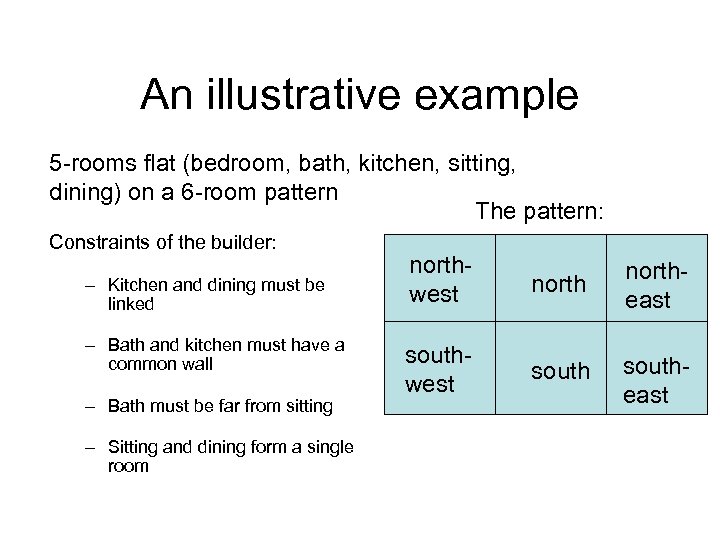 An illustrative example 5 -rooms flat (bedroom, bath, kitchen, sitting, dining) on a 6 -room pattern The pattern: Constraints of the builder: – Kitchen and dining must be linked – Bath and kitchen must have a common wall – Bath must be far from sitting – Sitting and dining form a single room northwest northeast southwest southeast
 Problem • How to propose all possible plans? a constraint network that encodes the constraints of the builder
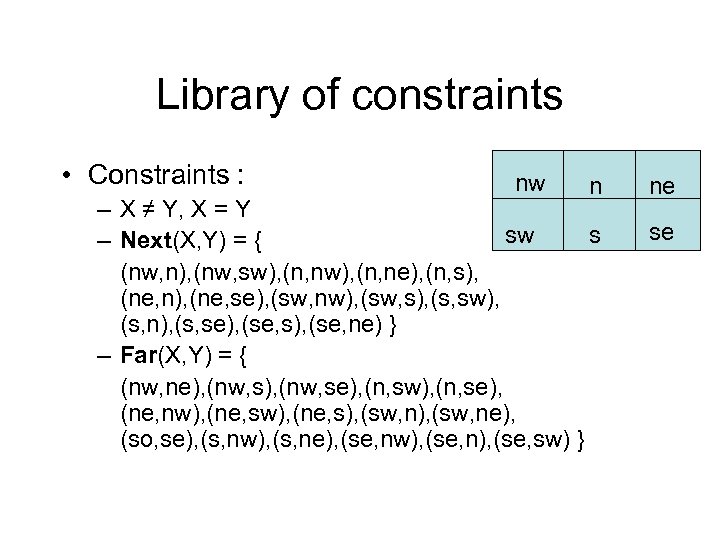 Library of constraints • Constraints : nw n – X ≠ Y, X = Y sw s – Next(X, Y) = { (nw, n), (nw, sw), (n, ne), (n, s), (ne, n), (ne, se), (sw, nw), (sw, s), (s, sw), (s, n), (s, se), (se, s), (se, ne) } – Far(X, Y) = { (nw, ne), (nw, se), (n, sw), (n, se), (ne, nw), (ne, s), (sw, ne), (so, se), (s, nw), (s, ne), (se, nw), (se, n), (se, sw) } ne se
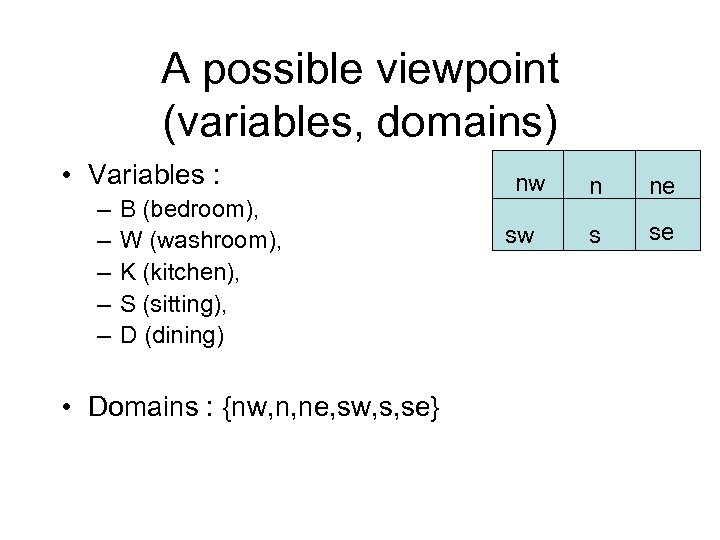 A possible viewpoint (variables, domains) • Variables : – – – B (bedroom), W (washroom), K (kitchen), S (sitting), D (dining) • Domains : {nw, n, ne, sw, s, se} nw n ne sw s se
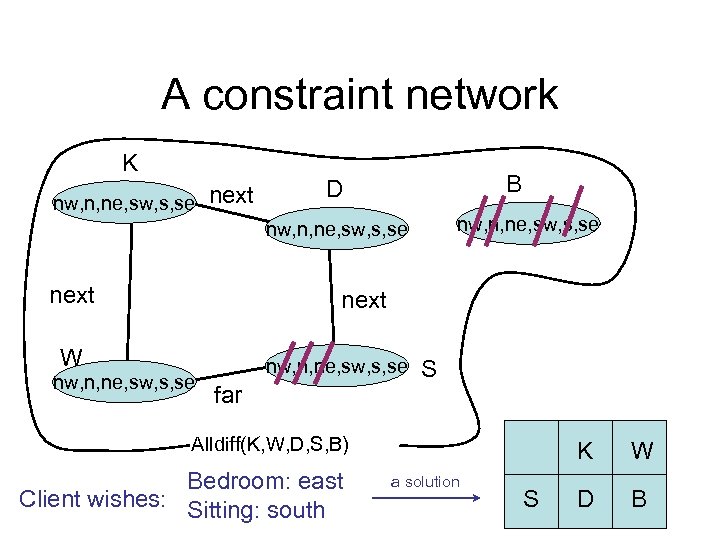 A constraint network K nw, n, ne, sw, s, se next B D nw, n, ne, sw, s, se next W nw, n, ne, sw, s, se far S Alldiff(K, W, D, S, B) Bedroom: east Client wishes: Sitting: south K a solution S W D B
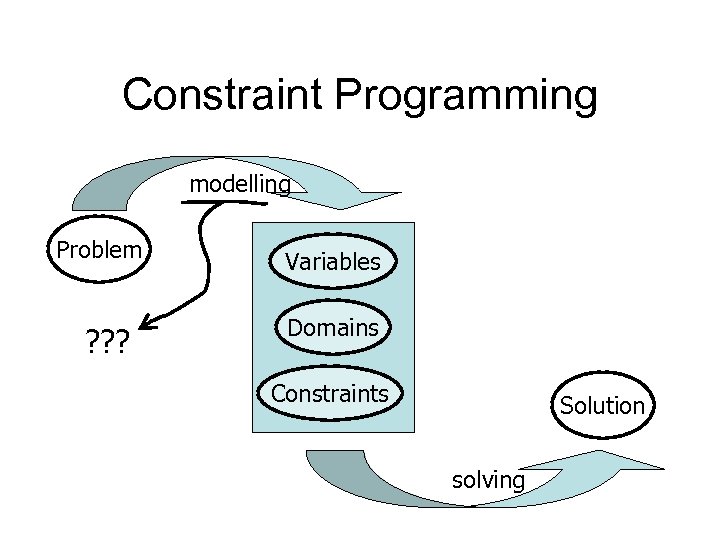 Constraint Programming modelling Problem ? ? ? Variables Domains Constraints Solution solving
 Modelling (“it’s an art, not a science”) • In the 80 s, it was considered as trivial – Zebra problem (Lewis Carroll) or random problems • But on “real” problems: – Which variables ? Which domains ? – Which constraints for encoding the problem? • And efficiency? – Which constraints for speeding up the solver? • Global constraints, symmetries… All is in the expertise of the user
 If you’re not an expert? 1. Choice of variables/domains 2. Constraint acquisition 3. Improve a basic model
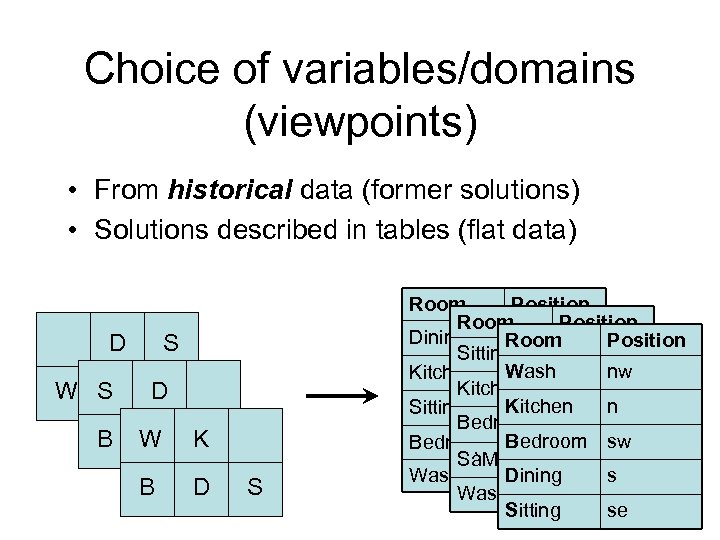 Choice of variables/domains (viewpoints) • From historical data (former solutions) • Solutions described in tables (flat data) D S W SK D C B W K K S B D S Room Position Dining nw Room Position Sitting nw nw Kitchen Wash n Kitchen n Sitting ne Bedroom sw sw SàM Wash s Dining s Wash se Sitting se
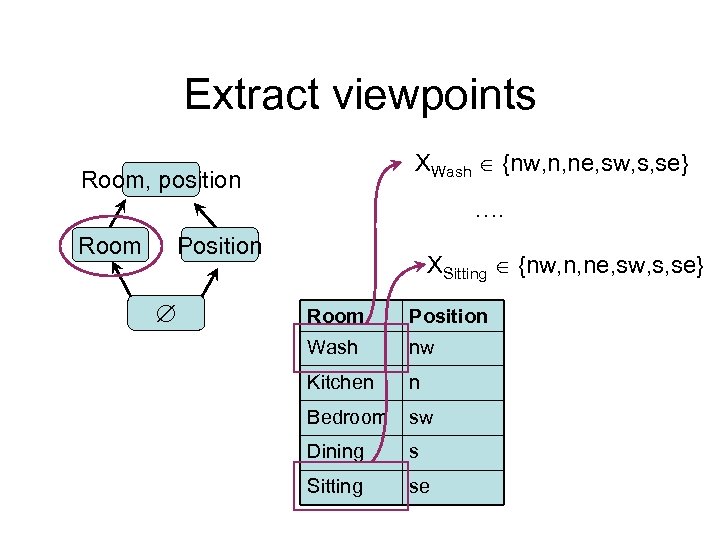 Extract viewpoints XWash {nw, n, ne, sw, s, se} Room, position …. Room Position XSitting {nw, n, ne, sw, s, se} Room Position Wash nw Kitchen n Bedroom sw Dining s Sitting se
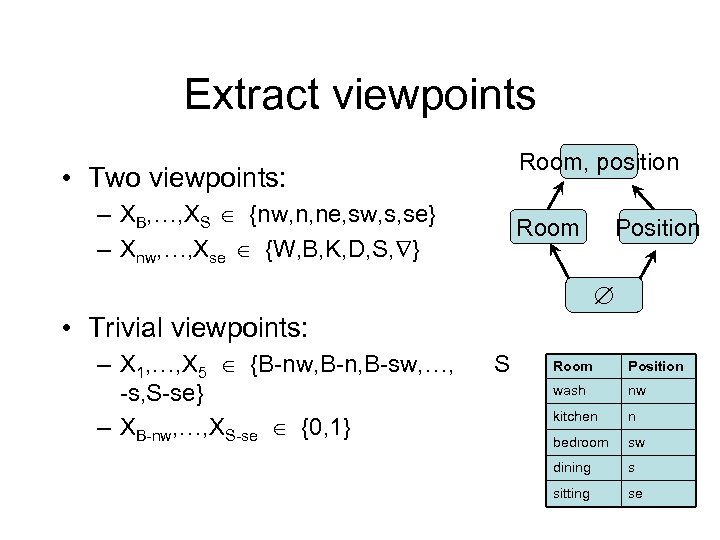 Extract viewpoints • Two viewpoints: – XB, …, XS {nw, n, ne, sw, s, se} – Xnw, …, Xse {W, B, K, D, S, } Room, position Room Position • Trivial viewpoints: – X 1, …, X 5 {B-nw, B-n, B-sw, …, S -s, S-se} – XB-nw, …, XS-se {0, 1} Room Position wash nw kitchen n bedroom sw dining s sitting se
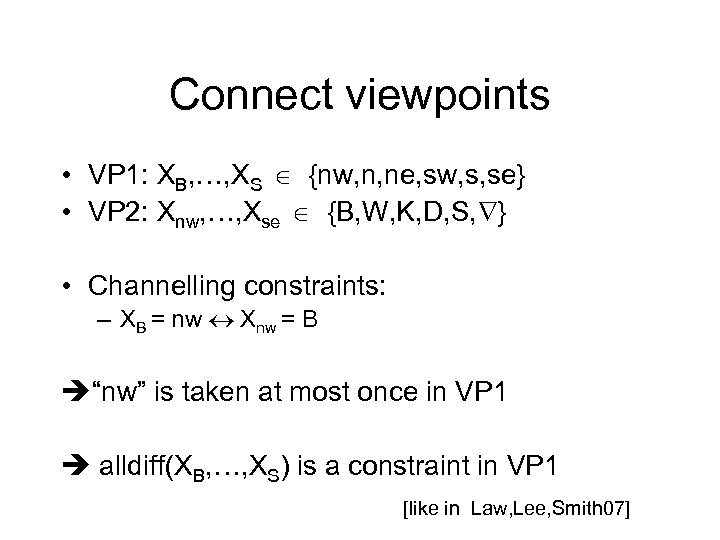 Connect viewpoints • VP 1: XB, …, XS {nw, n, ne, sw, s, se} • VP 2: Xnw, …, Xse {B, W, K, D, S, } • Channelling constraints: – XB = nw Xnw = B “nw” is taken at most once in VP 1 alldiff(XB, …, XS) is a constraint in VP 1 [like in Law, Lee, Smith 07]
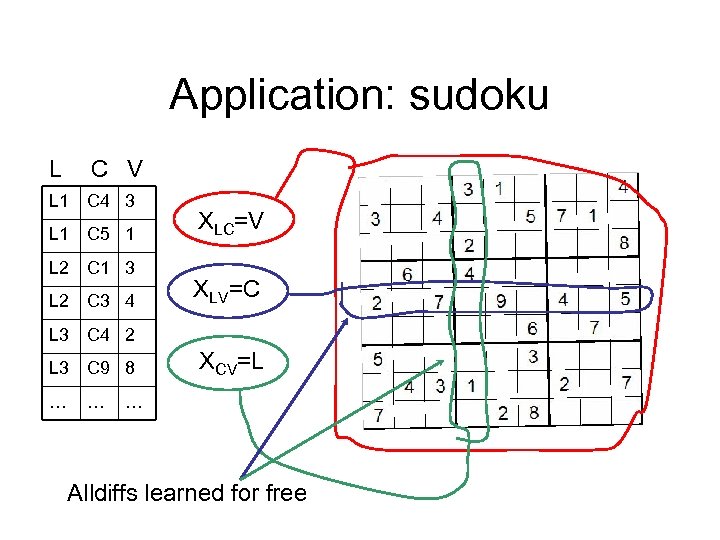 Application: sudoku L C V L 1 C 4 3 L 1 C 5 1 L 2 C 1 3 L 2 C 3 4 XLC=V XLV=C L 3 C 4 2 L 3 C 9 8 … … XCV=L … Alldiffs learned for free
 Connect viewpoints • We can derive more than just alldiff • Cardinality constraints can be detected • Example: a timetabling in which 3 math courses are given one of the viewpoints will contain 3 variables representing these 3 courses In all other viewpoints, we can put a cardinality constraint forcing value “math” to be taken 3 times
 If you’re not an expert? • Choice of variables/domains • Constraint Acquisition – Space of networks – Redundancy – Queries • Improve a basic model
 Acquire constraints • The user doesn’t know how to specify constraints • She knows how to discriminate solutions from non-solutions – Ex: valid flat vs invalid flat Use of machine learning techniques – Interaction by examples (positive e+ or negative e) – Acquisition of a network describing the problem
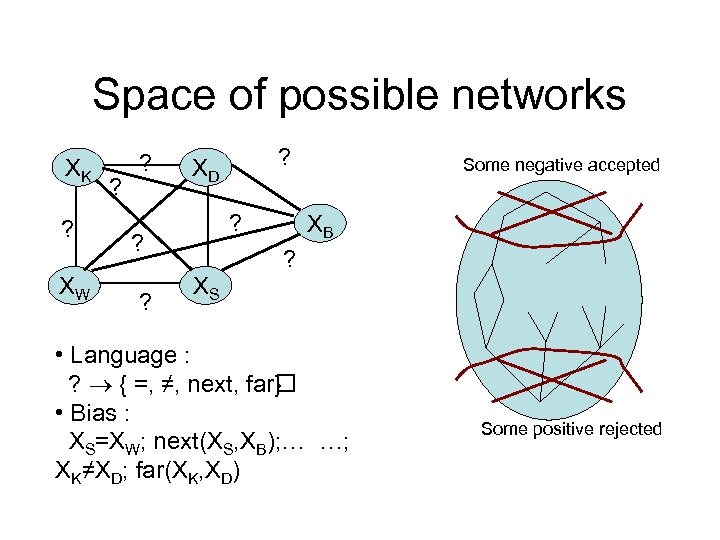 Space of possible networks XK ? XW ? ? XD Some negative accepted XB ? XS • Language : ? { =, ≠, next, far } • Bias : XS=XW; next(XS, XB); … …; XK≠XD; far(XK, XD) Some positive rejected
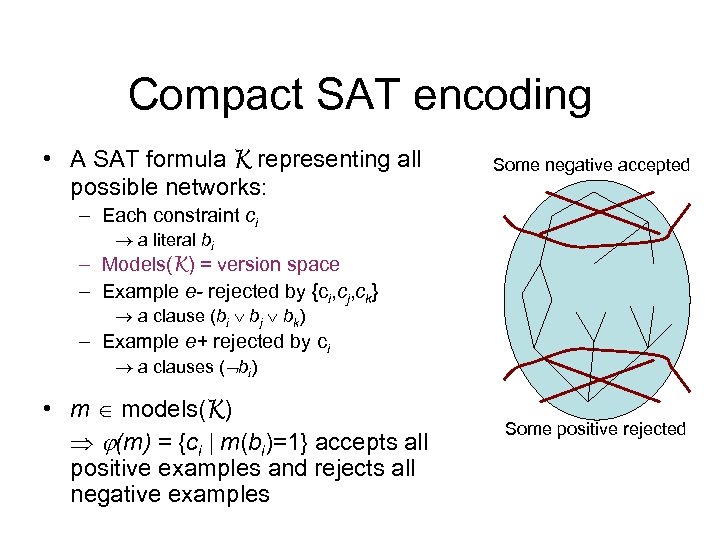 Compact SAT encoding • A SAT formula K representing all possible networks: Some negative accepted – Each constraint ci a literal bi – Models(K) = version space – Example e- rejected by {ci, cj, ck} a clause (bi bj bk) – Example e+ rejected by ci a clauses ( bi) • m models(K) (m) = {ci m(bi)=1} accepts all positive examples and rejects all negative examples Some positive rejected
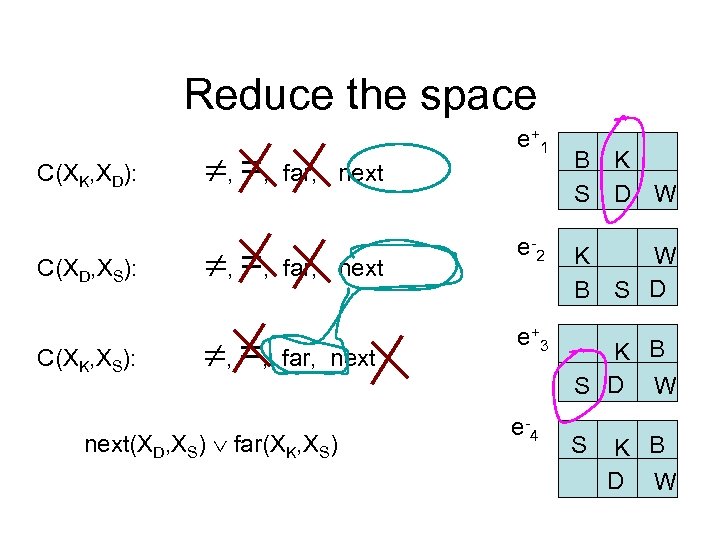 Reduce the space = e+ 1 C(XK, XD): , , far, next B K S D W = e -2 K W B S D = e+ 3 K B S D W C(XD, XS): , , far, next C(XK, XS): , , far, next(XD, XS) far(XK, XS) e -4 S K B D M W
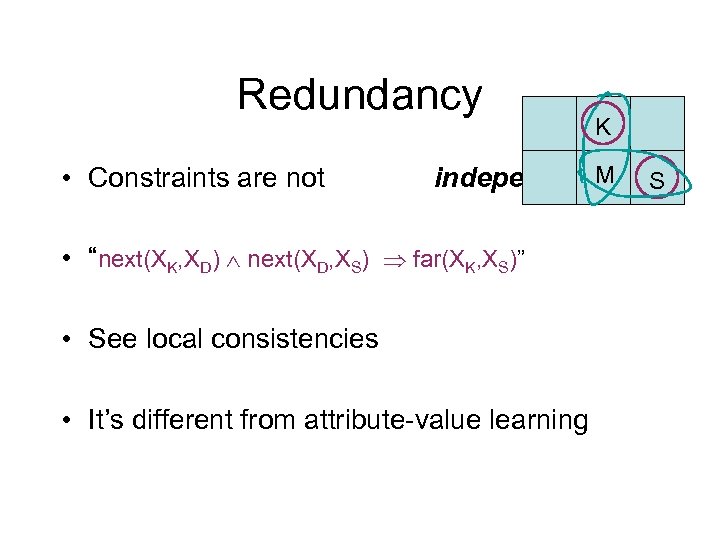 Redundancy K • Constraints are not independent. M S • “next(XK, XD) next(XD, XS) far(XK, XS)” • See local consistencies • It’s different from attribute-value learning
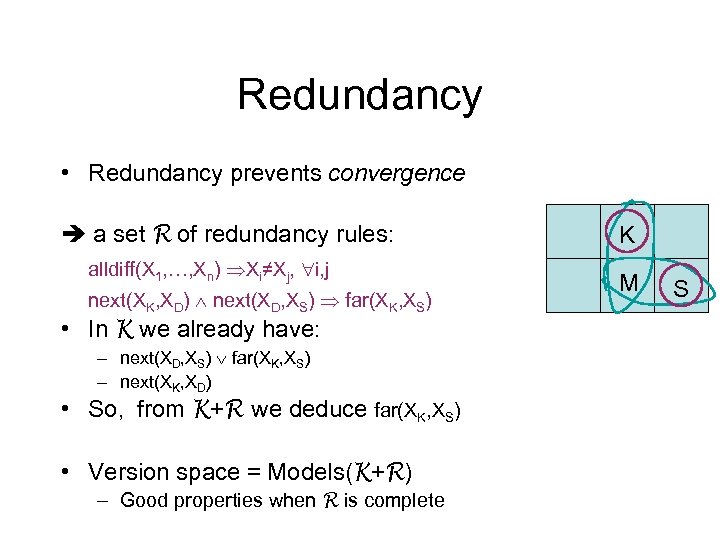 Redundancy • Redundancy prevents convergence a set R of redundancy rules: alldiff(X 1, …, Xn) Xi≠Xj, i, j next(XK, XD) next(XD, XS) far(XK, XS) • In K we already have: – next(XD, XS) far(XK, XS) – next(XK, XD) • So, from K+R we deduce far(XK, XS) • Version space = Models(K+R) – Good properties when R is complete K M S
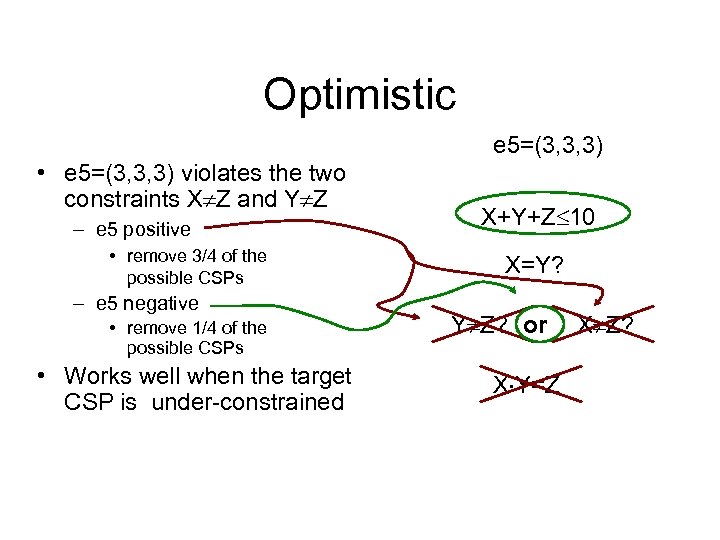
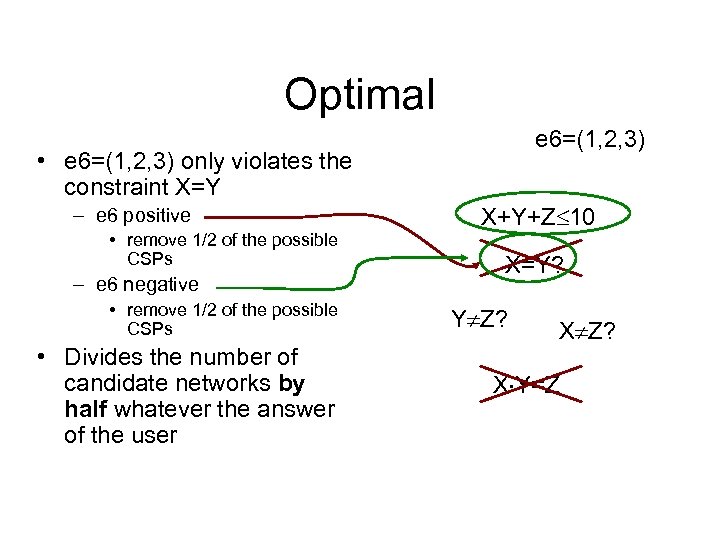
 Queries (active learning) • Examples often lead to little new information (eg, negative plan with kitchen far from dining) • The system will propose examples (queries) to speed up convergence • Example e rejected by k constraints from the space – e positive k constraints discarded from the space – e negative a clause of size k • Good query = example which reduces the space as much as possible whatever the answer
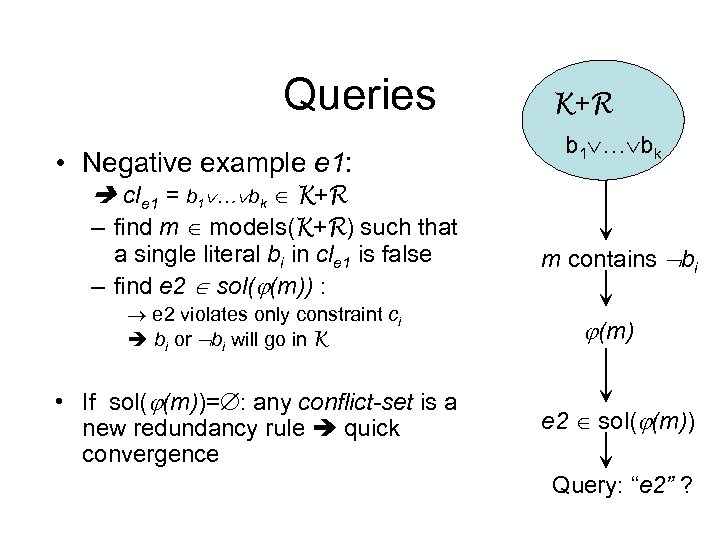 Queries • Negative example e 1: K+R b 1 … bk cle 1 = b 1 … bk K+R – find m models(K+R) such that a single literal bi in cle 1 is false – find e 2 sol( (m)) : e 2 violates only constraint ci bi or bi will go in K • If sol( (m))= : any conflict-set is a new redundancy rule quick convergence m contains bi (m) e 2 sol( (m)) Query: “e 2” ?
 An example of constraint acquisition in robotics (by Mathias Paulin) • The goal is to automate the burden of implementing elementary actions of a robot • Elementary actions are usually implemented by hand by engineers (complex physic laws, kinetic momentum, derivative equations, etc. )
 No need for a user • Instead of interacting with a user, classification of examples will be done by a run of the robot with given values of its sensorimotor actuators • If the action has correctly performed, this is positive • With expensive humanoid robots, a simulator allows easy classification without actually running the robot
 Elementary actions • Each action has variables representing – the observed world before the action, – the power applied to each actuator – the world after the action • Constraint acquisition will learn a constraint network on these variables such that its solutions are valid actions
 Planning a task • The overall goal is to build a plan composed of elementary actions • The planning problem is solved by a CP solver • It is convenient to encode actions as sub-CSPs
 Tribot Mindstorms NXT • • 3 motors 4 sensors 5 elementary actions to combine Discretization of variables
![Experiment Modelling by CONACQ Conacq generates a CHOCO model used by CSP-Plan [Lopez 2003]](https://present5.com/presentation/699d02a75c23277283ec8fcccd27a22f/image-30.jpg "Experiment Modelling by CONACQ Conacq generates a CHOCO model used by CSP-Plan [Lopez 2003]") Experiment Modelling by CONACQ Conacq generates a CHOCO model used by CSP-Plan [Lopez 2003] Objective : catch the mug!
Experiment Modelling by CONACQ Conacq generates a CHOCO model used by CSP-Plan [Lopez 2003] Objective : catch the mug!
 If you’re not an expert? • Choice of variables/domains • Constraint acquisition • Improve the basic model
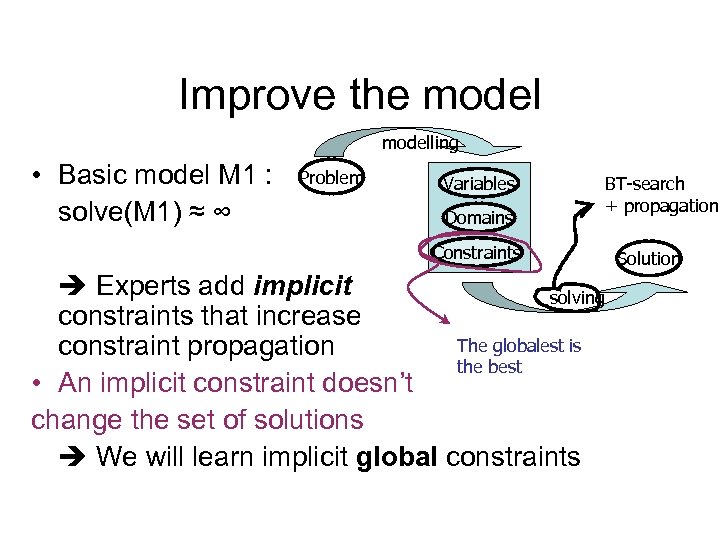 Improve the modelling • Basic model M 1 : solve(M 1) ≈ ∞ Problem Variables Domains Constraints BT-search + propagation Solution Experts add implicit solving constraints that increase The globalest is constraint propagation the best • An implicit constraint doesn’t change the set of solutions We will learn implicit global constraints
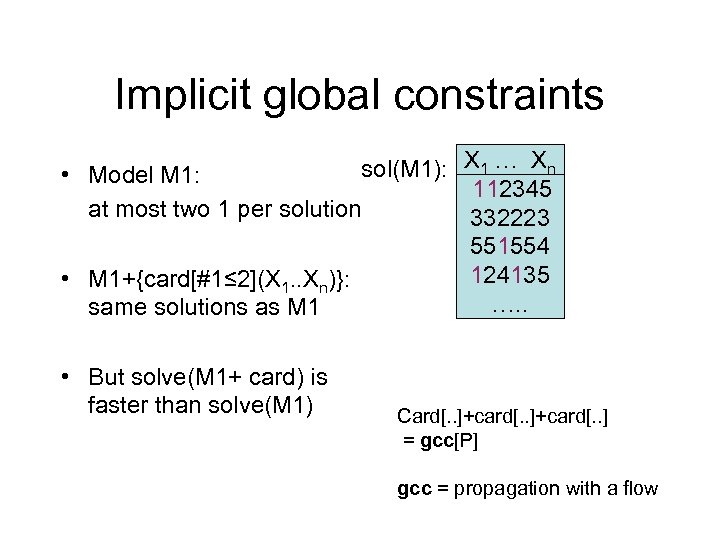 Implicit global constraints sol(M 1): X 1 … Xn • Model M 1: 112345 at most two 1 per solution 332223 551554 124135 • M 1+{card[#1≤ 2](X 1. . Xn)}: …. . same solutions as M 1 • But solve(M 1+ card) is faster than solve(M 1) Card[. . ]+card[. . ] = gcc[P] gcc = propagation with a flow
 Very hard Very easy relax M](https://present5.com/presentation/699d02a75c23277283ec8fcccd27a22f/image-34.jpg "Learn parameters P of gcc[P](X 1. . Xn) Very hard Very easy relax M") Learn parameters P of gcc[P](X 1. . Xn) Very hard Very easy relax M 1 Sol(M 1) M 2 Sol(M 2) M 1+ gcc[P’](X 1. . Xn) Easy gcc[P](X 1. . Xn)
Learn parameters P of gcc[P](X 1. . Xn) Very hard Very easy relax M 1 Sol(M 1) M 2 Sol(M 2) M 1+ gcc[P’](X 1. . Xn) Easy gcc[P](X 1. . Xn)
 Example: Task allocation • Projects to be assigned to students while minimising disappointment • Model M 1 designed by some of the students (2 h of courses on CP) : • optimize(M 1) > 12 h
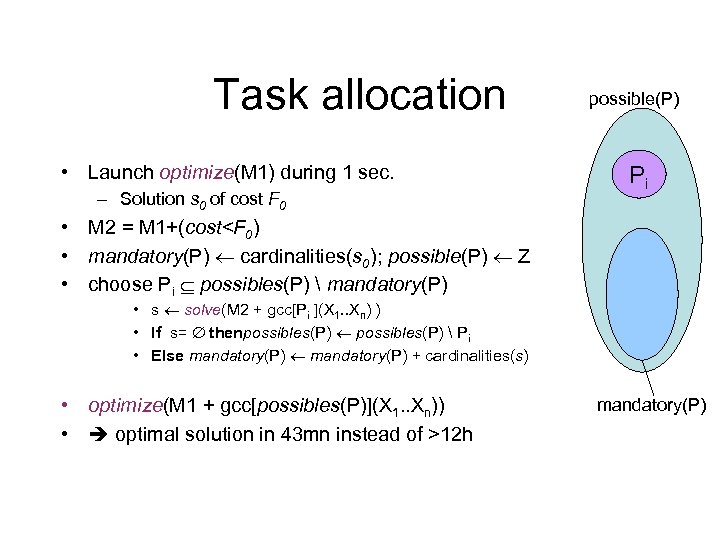 Task allocation • Launch optimize(M 1) during 1 sec. – Solution s 0 of cost F 0 possible(P) Pi • M 2 = M 1+(cost
 Summary • There are possible ways to assist a non expert user in: – Finding viewpoints – Specifying constraints – Improving models • Once CP modelling is automated, this opens new fields where to use CP
 Perspectives • Take into account background knowledge (eg, ontologies in a company) reduce the size of the learning space • Robustness to errors from the user • Vizualization tools for novices
 Thanks to. . .
 Bibliographie C. Bessiere, R. Coletta, T. Petit. "Learning Implied Global Constraints” Proceedings IJCAI'07, Hyderabad, India, pages 50 -55. C. Bessiere, R. Coletta, B O'Sullivan, M. Paulin. "Query-driven Constraint Acquisition” Proceedings IJCAI'07, Hyderabad, India, pages 44 -49. C. Bessiere, R. Coletta, F. Koriche, B. O'Sullivan. "Acquiring Constraint Networks using a SAT-based Version Space Algorithm” Proceedings AAAI'06, Nectar paper, Boston MA, pages 1565 -1568. C. Bessiere, J. Quinqueton, G. Raymond. "Mining historical data to build constraint viewpoints” Proceedings CP'06 Workshop on Modelling and Reformulation, Nantes, France, pages 1 -16. C. Bessiere, R. Coletta, F. Koriche, B. O'Sullivan. "A SAT-Based Version Space Algorithm for Acquiring Constraint Satisfaction Problems” Proceedings ECML'05, Porto, Portugal, pages 23 -34. C. Bessiere, R. Coletta, E. Freuder, B. O'Sullivan. "Leveraging the Learning Power of Examples in Automated Constraint Acquisition” Proceedings CP'04, Toronto, Canada, pages 123 -137. R. Coletta, C. Bessiere, B. O'Sullivan, E. Freuder, S. O'Connell and J. Quinqueton. "Constraint Acquisition as Semi-Automatic Modelling” Proceedings AI-2003, Cambridge, UK, pages 111 --124.
 Optimistic e 5=(3, 3, 3) • e 5=(3, 3, 3) violates the two constraints X Z and Y Z – e 5 positive • remove 3/4 of the possible CSPs – e 5 negative • remove 1/4 of the possible CSPs • Works well when the target CSP is under-constrained X+Y+Z 10 X=Y? Y Z? or X Y=Z X Z?
 Optimal e 6=(1, 2, 3) • e 6=(1, 2, 3) only violates the constraint X=Y – e 6 positive • remove 1/2 of the possible CSPs – e 6 negative • remove 1/2 of the possible CSPs • Divides the number of candidate networks by half whatever the answer of the user X+Y+Z 10 X=Y? Y Z? X Y=Z
 Expérimentation : Tribot Mindstorms (2) Modélisation automatique par CONACQ Implémentation en CHOCO du planificateur CSP-Plan [Lopez 2003] Commande du robot via le langage URBI Objectif : Saisie d’un objet par le robot Tribot!