


 Скачать презентацию Using corpora in critical discourse analysis Corpus Linguistics
a4a23e5b279bc4d779db6f07617505cf.ppt
- Количество слайдов: 48
 Using corpora in critical discourse analysis Corpus Linguistics Richard Xiao lancsxiaoz@googlemail. com
 Aims of this session • Lecture – Corpora versus critical discourse analysis – The state of the art of corpus-based discourse studies – Case study: How is Islam constructed in the UK and US press before and after 9/11? • Lab session – Using Wmatrix to exploring political discourse: Michael Howard and Tony Blair’s farewell speech to their party
 Critical discourse analysis (CDA) • Discourse – Language use above the sentence level – Language use in context – Real language use • CDA examines language as a form of cultural and social practice, focusing on the relationship between power and discourse, and between language and ideology
 CL vs. CDA • Both rely heavily on real language • ‘a cultural divide’ (Leech 2000: 678 -680) – CDA emphasizes the integrity of text while CL tends to use representative samples – CDA is primarily qualitative while corpus linguistics is essentially quantitative – CDA focuses on the contents expressed by language while CL is interested in language (form) per se – The collector, transcriber and analyst are often the same person(s) in CDA while this is rarely the case in CL – The data used in CDA is rarely widely available while corpora are typically made widely available
 A diminishing divide… • Some important ‘points of contact’ (Mc. Enery and Wilson 2001: 114) – The common computer-aided analytic techniques – The great potential of standard corpora in CDA as control data
 Use of corpora in CDA: pros and cons • Cons… – The corpus-based approach tends to obscure ‘the character of each text as a text’ and ‘the role of the text producer and the society of which they are a part’ (Hunston 2002: 110) • CL focuses on text, not text producer – Analyzing a lot of text from a corpus simultaneously would force the analyst to lose ‘contact with text’ (Martin 1999: 52) • Pros… – Corpora present a real opportunity to discourse analysis, because the automatic analysis of a large number of texts at one time ‘can throw into relief the non-obvious in a single text’ (Partington 2003: 7)
 Use of corpora in CDA: pros and cons • Pros – ‘Obviously, the methods for doing a ‘critical discourse analysis’ of corpus data are far from established yet. Even when we have examined a fairly large set of attestations, we cannot be certain whether our own interpretations of key items and collocations are genuinely representative of the large populations who produced the data. But we can be fairly confident of accessing a range of interpretative issues that is both wider and more precise than we could access by relying on our own personal usages and intuitions. Moreover, when we observe our own ideological position in contest with others, we are less likely to overlook it or take it for granted. ’ (de Beaugrande 1999: 287)
 CL and CDA: interaction and synergy • Partington (2003: 12) proposes a scalar view of the uses of CL, pointing towards a rationale for using CLrelated methods to carry out CDA – ‘At the simplest level, corpus technology helps find other examples of a phenomenon one has already noted. At the other extreme, it reveals patterns of use previously unthought of. In between, it can reinforce, refute or revise a researcher’s intuition and show them why and how much their suspicions were grounded. ’ • Partington (2004, 2006) provides a systematic description of CADS (corpus-assisted discourse studies)
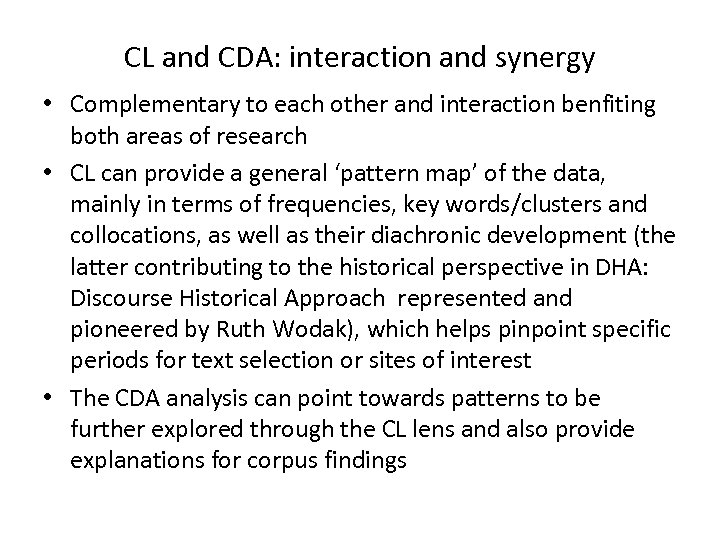 CL and CDA: interaction and synergy • Complementary to each other and interaction benfiting both areas of research • CL can provide a general ‘pattern map’ of the data, mainly in terms of frequencies, key words/clusters and collocations, as well as their diachronic development (the latter contributing to the historical perspective in DHA: Discourse Historical Approach represented and pioneered by Ruth Wodak), which helps pinpoint specific periods for text selection or sites of interest • The CDA analysis can point towards patterns to be further explored through the CL lens and also provide explanations for corpus findings
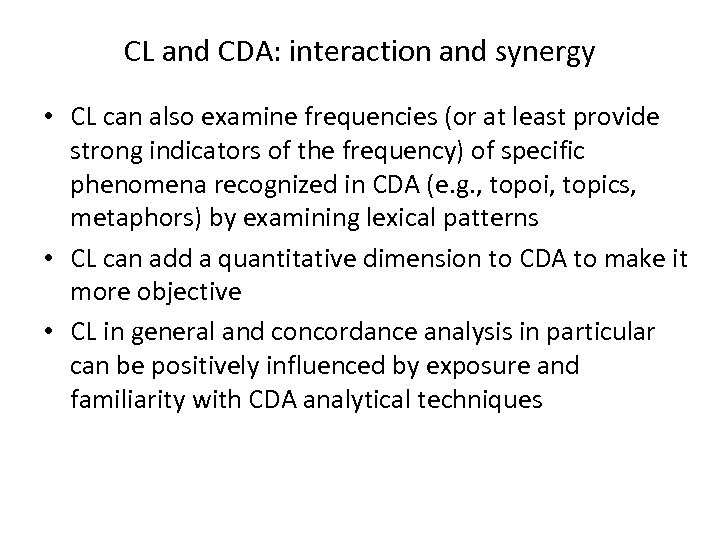 CL and CDA: interaction and synergy • CL can also examine frequencies (or at least provide strong indicators of the frequency) of specific phenomena recognized in CDA (e. g. , topoi, topics, metaphors) by examining lexical patterns • CL can add a quantitative dimension to CDA to make it more objective • CL in general and concordance analysis in particular can be positively influenced by exposure and familiarity with CDA analytical techniques
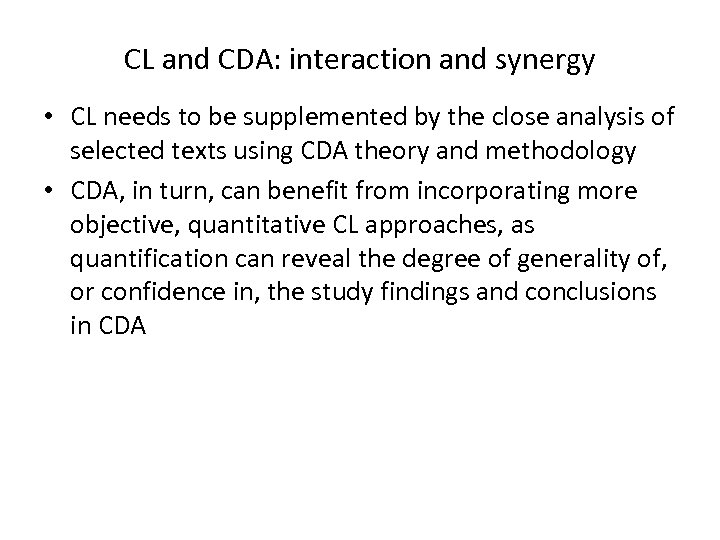 CL and CDA: interaction and synergy • CL needs to be supplemented by the close analysis of selected texts using CDA theory and methodology • CDA, in turn, can benefit from incorporating more objective, quantitative CL approaches, as quantification can reveal the degree of generality of, or confidence in, the study findings and conclusions in CDA
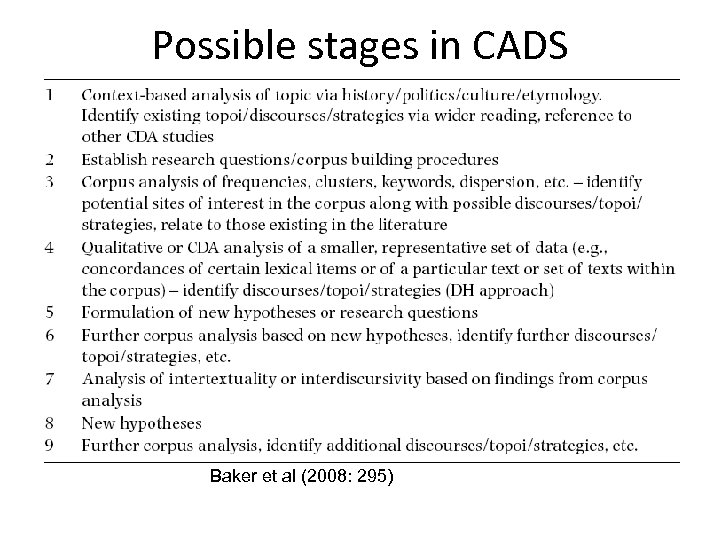 Possible stages in CADS Baker et al (2008: 295)
 Construction of Islam in UK and US press around 9/11 • How do news stories construct Islam? • Have there been any changes before and after 9/11? • Are there differences between reporting on Islam (as a religion) and Muslims (as a people)? • Are there any differences/similarities between tabloids and broadsheets? • Are there any differences/similarities between American and British newspapers?
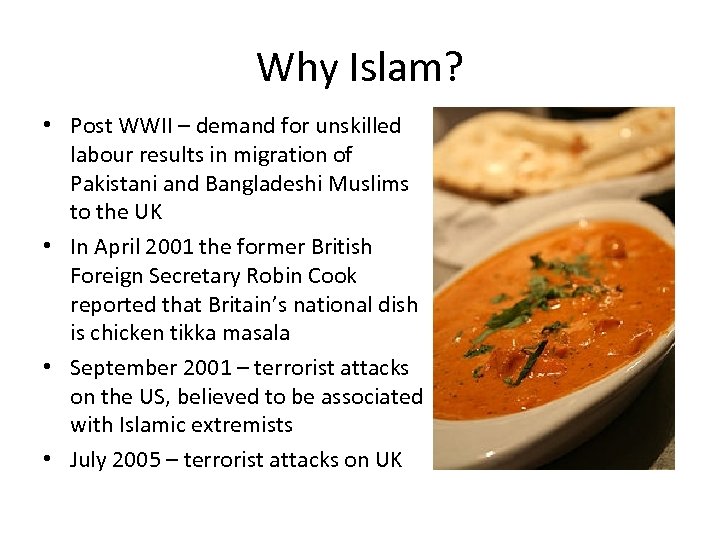 Why Islam? • Post WWII – demand for unskilled labour results in migration of Pakistani and Bangladeshi Muslims to the UK • In April 2001 the former British Foreign Secretary Robin Cook reported that Britain’s national dish is chicken tikka masala • September 2001 – terrorist attacks on the US, believed to be associated with Islamic extremists • July 2005 – terrorist attacks on UK
 Data • UK and US newspapers in 1998 -2005 (pre- and post 9/11) • 87 million words of British news – Broadsheets (65 M words): The Business, The Guardian, The Independent & Independent on Sunday, The Observer, The Times & Sunday Times, Daily Telegraph & Sunday Telegraph – Tabloids (22 M words): The Daily Express & Sunday Express, The Daily Mail & Mail on Sunday, Daily Mirror & Sunday Mirror, The People, Daily Star & Sunday Star, The Sun • 40 million words of American news – Financial Times, New York Times, Washington Post, San Francisco Chronicle
 Search terms related to Islam • Alah OR Allah OR ayatolah OR burka! OR burqa! OR chador! OR fatwa! OR hejab! OR imam! OR islam! OR Koran OR Mecca OR Medina OR Mohammedan! OR Moslem! OR Muslim! OR mosque OR mufti! OR mujaheddin! OR mujahedin! OR mullah! OR muslim! OR Prophet Mohammed OR Q'uran OR rupoush OR rupush OR sharia OR shari'a OR shia! OR shi-ite! OR Shi'ite! OR sunni! OR the Prophet OR wahabi OR yashmak! AND NOT Islamabad AND NOT shiatsu AND NOT sunnily
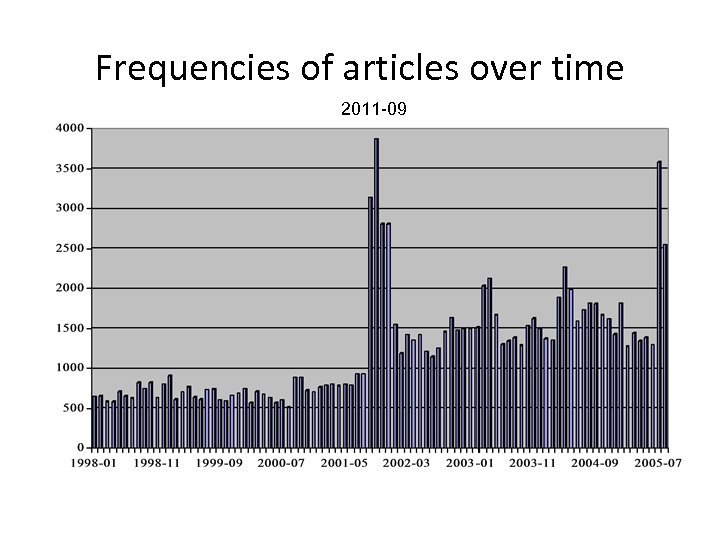 Frequencies of articles over time 2011 -09
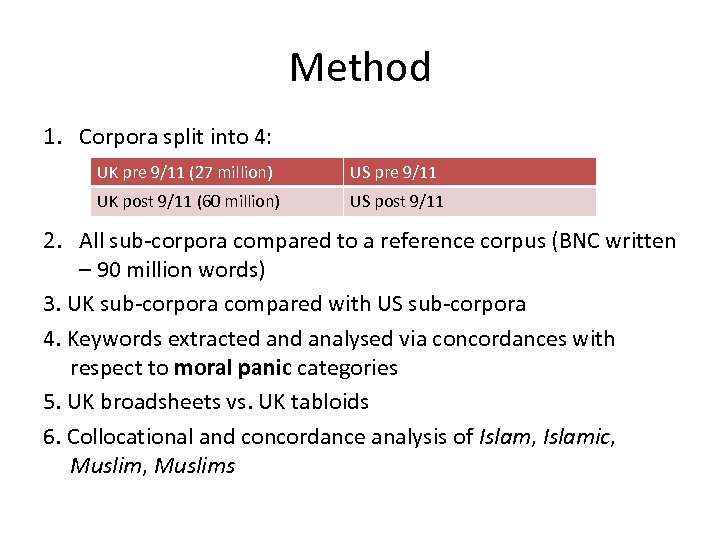 Method 1. Corpora split into 4: UK pre 9/11 (27 million) US pre 9/11 UK post 9/11 (60 million) US post 9/11 2. All sub-corpora compared to a reference corpus (BNC written – 90 million words) 3. UK sub-corpora compared with US sub-corpora 4. Keywords extracted analysed via concordances with respect to moral panic categories 5. UK broadsheets vs. UK tabloids 6. Collocational and concordance analysis of Islam, Islamic, Muslims
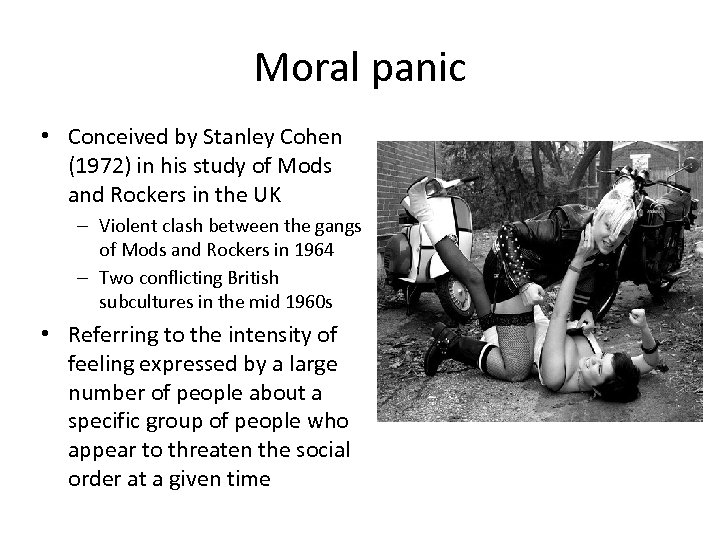 Moral panic • Conceived by Stanley Cohen (1972) in his study of Mods and Rockers in the UK – Violent clash between the gangs of Mods and Rockers in 1964 – Two conflicting British subcultures in the mid 1960 s • Referring to the intensity of feeling expressed by a large number of people about a specific group of people who appear to threaten the social order at a given time
 Features of moral panic • Build-up of concern over a social issue • A scapegoat (social group) • Solutions proposed: moral entrepreneurs – A person who seeks to influence a social group to adopt or maintain a norm, e. g. MADD (mothers against drunk driving), and the anti-tobacco lobby • Moral panic is often expressed as outrage rather than fear • Emotive language is used • Threat is normally exaggerated
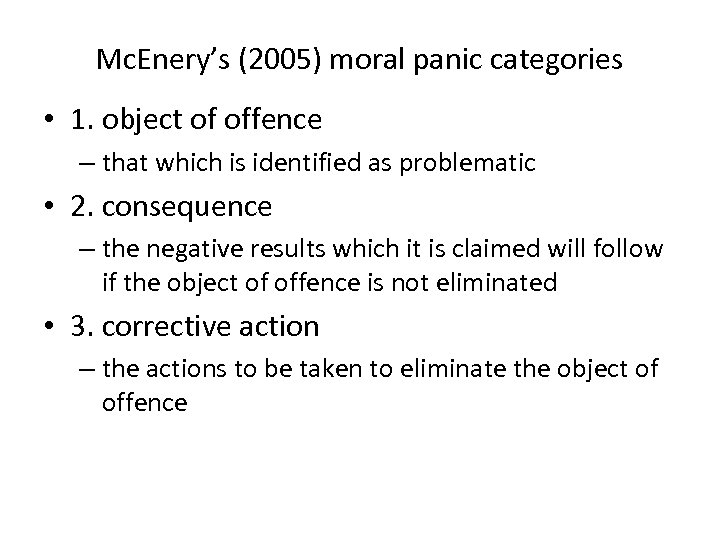 Mc. Enery’s (2005) moral panic categories • 1. object of offence – that which is identified as problematic • 2. consequence – the negative results which it is claimed will follow if the object of offence is not eliminated • 3. corrective action – the actions to be taken to eliminate the object of offence
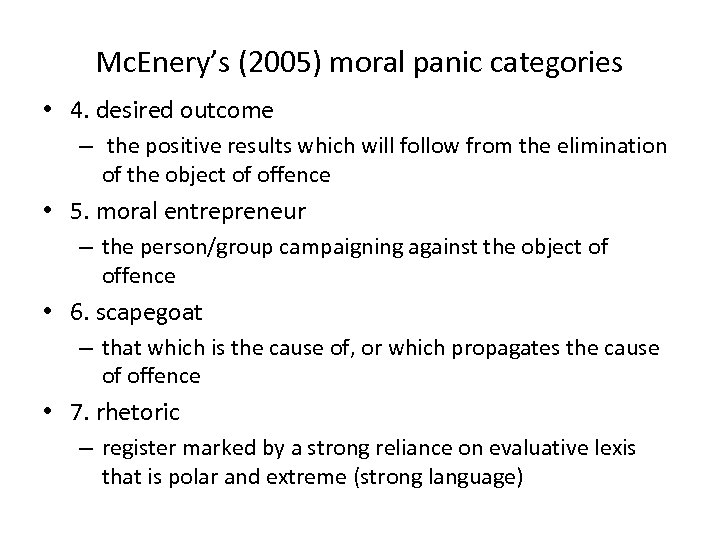 Mc. Enery’s (2005) moral panic categories • 4. desired outcome – the positive results which will follow from the elimination of the object of offence • 5. moral entrepreneur – the person/group campaigning against the object of offence • 6. scapegoat – that which is the cause of, or which propagates the cause of offence • 7. rhetoric – register marked by a strong reliance on evaluative lexis that is polar and extreme (strong language)
 UK keywords pre 9. 11 • No evidence of moral panic • References to Iraq, Israel, Kosovo, Palestine • Muslims often mentioned ‘in passing’ rather than as main subject of article • A wider range of contexts pre 911 – fashion, famous, tourists, music, hotel, cricket, sex, leisure, dance, ski, museum, divorce, café, wine, gardens, film, beer, holidays, football, exotic, fun
 UK - After 9/11 • British Muslims and what they believe – ‘The vast, vast majority, of Muslims living in the UK support policing efforts, fear terrorism and want to work with us, " said [Sir Ian]. ’ (The Guardian, October 29, 2004). • Focus on belief – moderate, militants, fanatics, fundamentalist, extremists • Focus on immigration, political correctness and scroungerphobia (taxpayers)
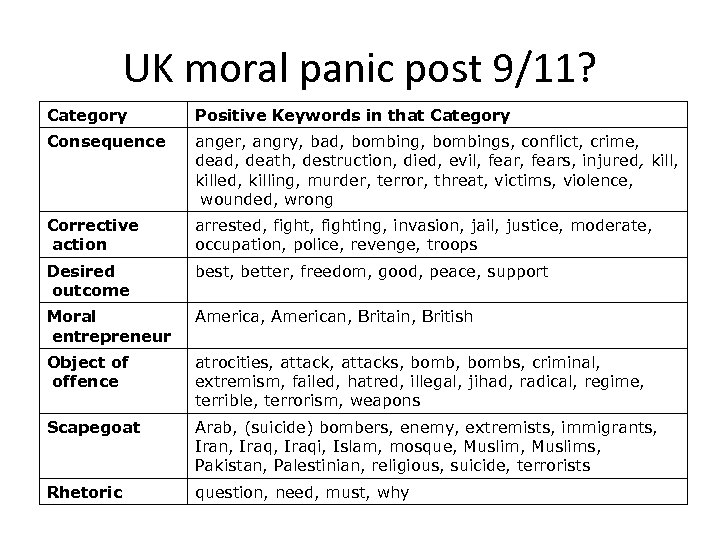 UK moral panic post 9/11? Category Positive Keywords in that Category Consequence anger, angry, bad, bombings, conflict, crime, dead, death, destruction, died, evil, fears, injured, killed, killing, murder, terror, threat, victims, violence, wounded, wrong Corrective action arrested, fighting, invasion, jail, justice, moderate, occupation, police, revenge, troops Desired outcome best, better, freedom, good, peace, support Moral entrepreneur America, American, Britain, British Object of offence atrocities, attacks, bombs, criminal, extremism, failed, hatred, illegal, jihad, radical, regime, terrible, terrorism, weapons Scapegoat Arab, (suicide) bombers, enemy, extremists, immigrants, Iran, Iraqi, Islam, mosque, Muslims, Pakistan, Palestinian, religious, suicide, terrorists Rhetoric question, need, must, why
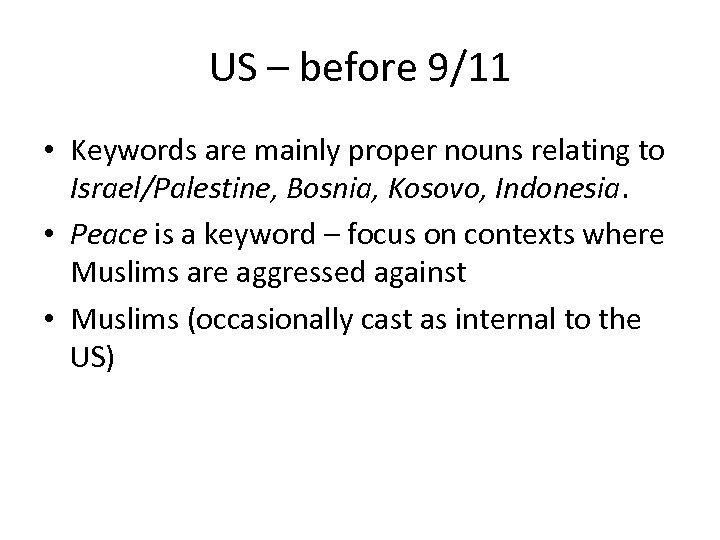 US – before 9/11 • Keywords are mainly proper nouns relating to Israel/Palestine, Bosnia, Kosovo, Indonesia. • Peace is a keyword – focus on contexts where Muslims are aggressed against • Muslims (occasionally cast as internal to the US)
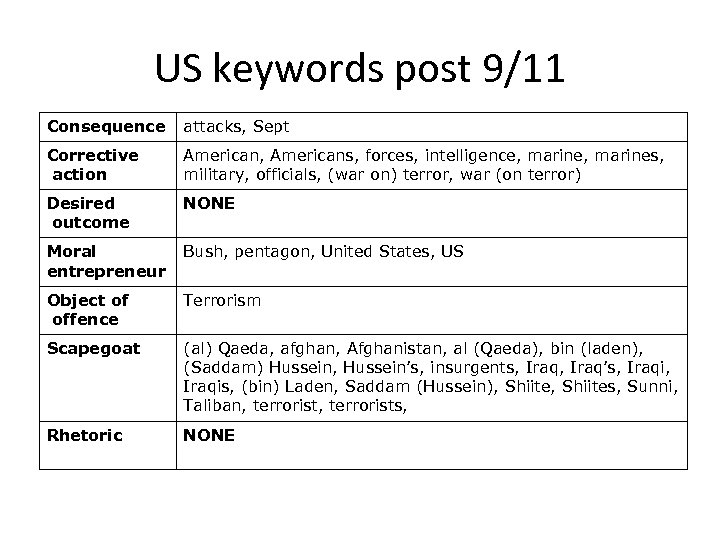 US keywords post 9/11 Consequence attacks, Sept Corrective action American, Americans, forces, intelligence, marines, military, officials, (war on) terror, war (on terror) Desired outcome NONE Moral entrepreneur Bush, pentagon, United States, US Object of offence Terrorism Scapegoat (al) Qaeda, afghan, Afghanistan, al (Qaeda), bin (laden), (Saddam) Hussein, Hussein’s, insurgents, Iraq’s, Iraqis, (bin) Laden, Saddam (Hussein), Shiites, Sunni, Taliban, terrorists, Rhetoric NONE
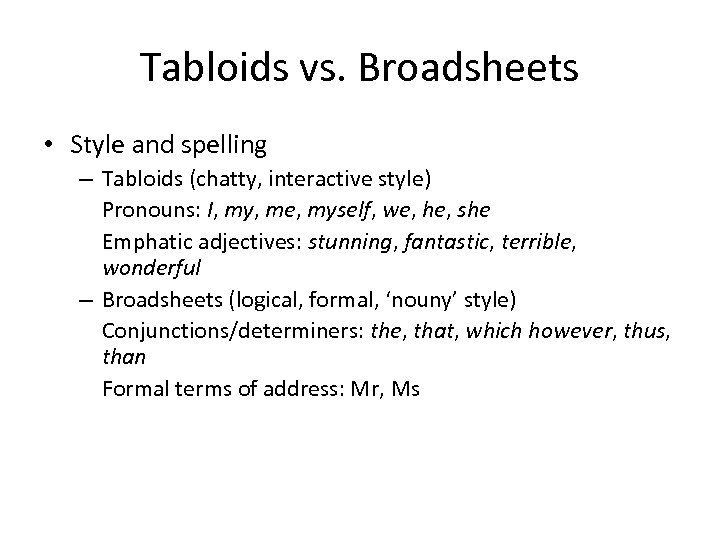 Tabloids vs. Broadsheets • Style and spelling – Tabloids (chatty, interactive style) Pronouns: I, my, me, myself, we, he, she Emphatic adjectives: stunning, fantastic, terrible, wonderful – Broadsheets (logical, formal, ‘nouny’ style) Conjunctions/determiners: the, that, which however, thus, than Formal terms of address: Mr, Ms
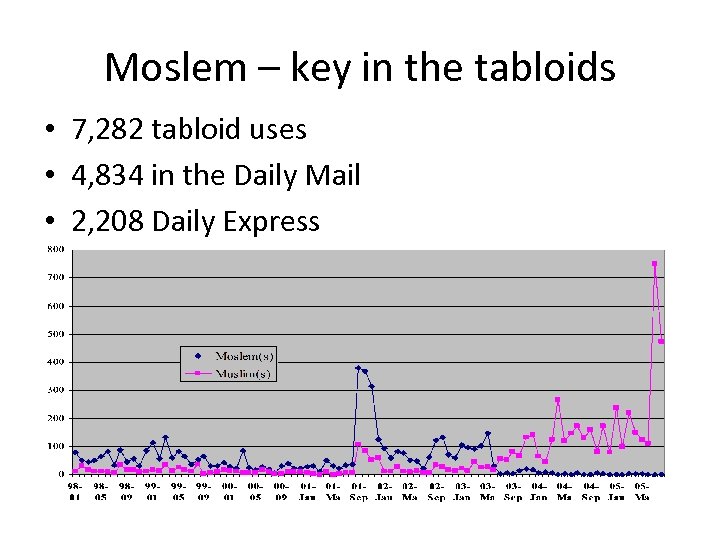 Moslem – key in the tabloids • 7, 282 tabloid uses • 4, 834 in the Daily Mail • 2, 208 Daily Express
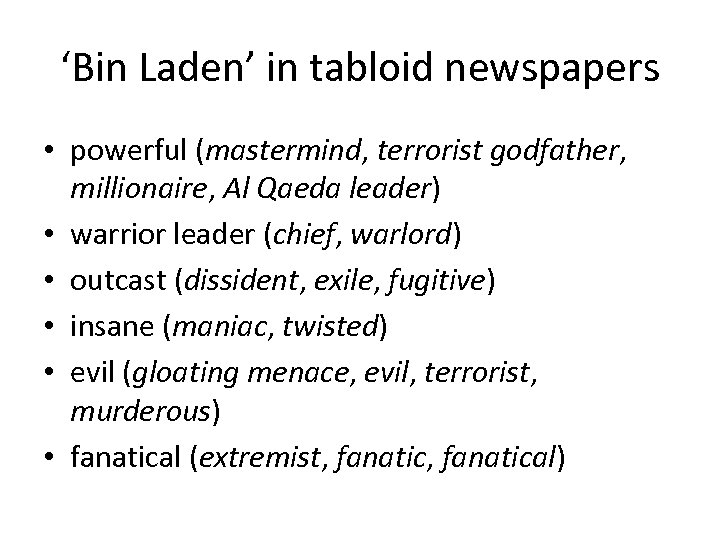 ‘Bin Laden’ in tabloid newspapers • powerful (mastermind, terrorist godfather, millionaire, Al Qaeda leader) • warrior leader (chief, warlord) • outcast (dissident, exile, fugitive) • insane (maniac, twisted) • evil (gloating menace, evil, terrorist, murderous) • fanatical (extremist, fanatical)
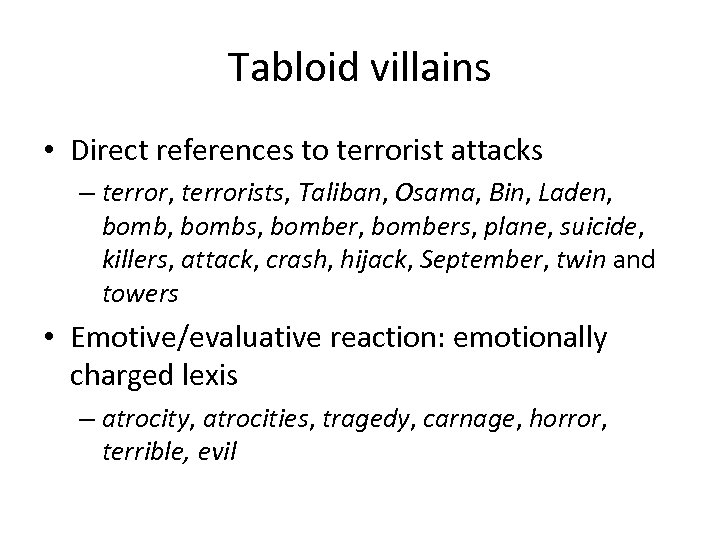 Tabloid villains • Direct references to terrorist attacks – terror, terrorists, Taliban, Osama, Bin, Laden, bombs, bombers, plane, suicide, killers, attack, crash, hijack, September, twin and towers • Emotive/evaluative reaction: emotionally charged lexis – atrocity, atrocities, tragedy, carnage, horror, terrible, evil
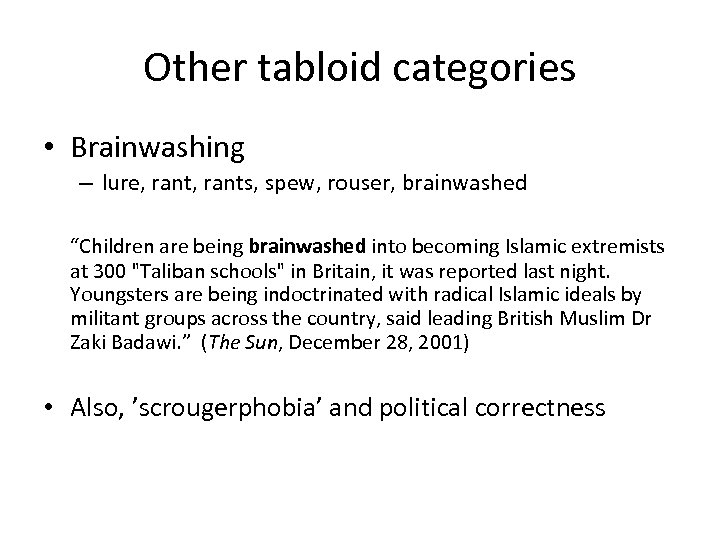 Other tabloid categories • Brainwashing – lure, rants, spew, rouser, brainwashed “Children are being brainwashed into becoming Islamic extremists at 300 "Taliban schools" in Britain, it was reported last night. Youngsters are being indoctrinated with radical Islamic ideals by militant groups across the country, said leading British Muslim Dr Zaki Badawi. ” (The Sun, December 28, 2001) • Also, ’scrougerphobia’ and political correctness
 Types of belief in tabloid vs. broadsheet • In the tabloids, Muslims are fanatics and extremists • In the broadsheets, Muslims are radicals, fundamentalists, separatists but also moderates and progressives
 Broadsheet keywords • More focus on Islam – The media: book, novel, television, film, poetry – Other religions: Hindu, Christian, Buddhist, Judaism – World events: Iran, Iraqi, Arab, Israeli, Israel, Palestinian, Baghdad, Jerusalem, Lebanon, Syria – War and conflict: military, conflict, army, resistance, violence, occupied, ceasefire, genocide, peace, invasion
 Muslim(s) vs. Islam(ic) • Tabloids: more focus on Muslims (the people) – Muslims as terrorists; evil preachers, Muslims as British and desiring peace, women as victims (honor killings, arranged marriage, hijab), men as potential terrorists or victims of racism • Broadsheets: more focus on Islam (as a religion) – Stories on terrorism restricted to the word Islamic
 Political discourse: Howard vs. Blair • Use Wmatrix to tag the following two texts – Tips: It’s a good practice to create one folder for each file • Michael Howard’s farewell speech to his party (2005) – Leader of Conservative Party in 2003 -2007 • Tony Blair’s farewell speech to his party (2006) – Leader of Labour Party in 1997 -2007
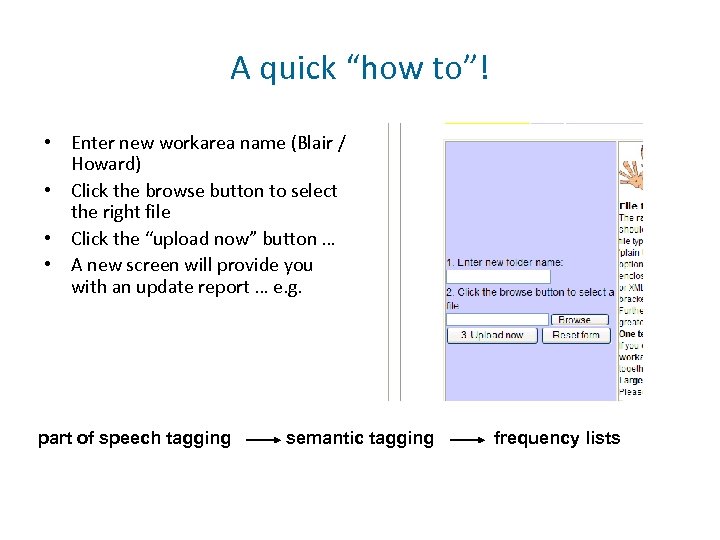 A quick “how to”! • Enter new workarea name (Blair / Howard) • Click the browse button to select the right file • Click the “upload now” button … • A new screen will provide you with an update report … e. g. part of speech tagging semantic tagging frequency lists
![You will then be taken to your work area [My folders]](https://present5.com/presentation/a4a23e5b279bc4d779db6f07617505cf/image-38.jpg "You will then be taken to your work area [My folders]") You will then be taken to your work area [My folders]
You will then be taken to your work area [My folders]
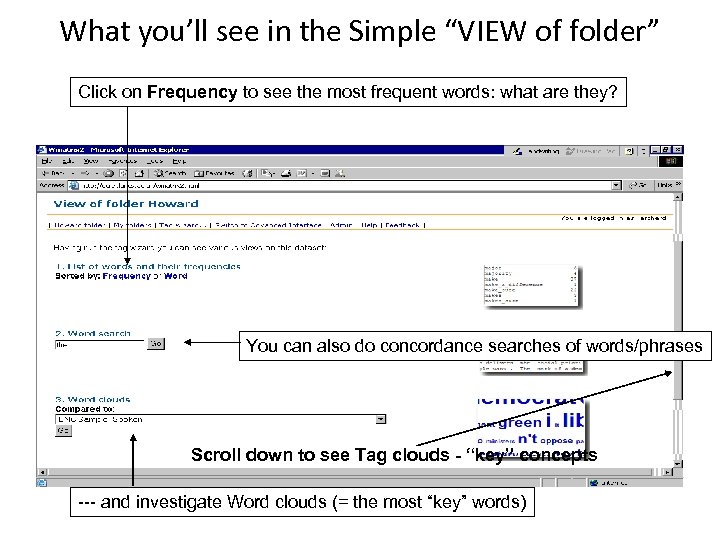 What you’ll see in the Simple “VIEW of folder” Click on Frequency to see the most frequent words: what are they? You can also do concordance searches of words/phrases Scroll down to see Tag clouds - “key” concepts --- and investigate Word clouds (= the most “key” words)
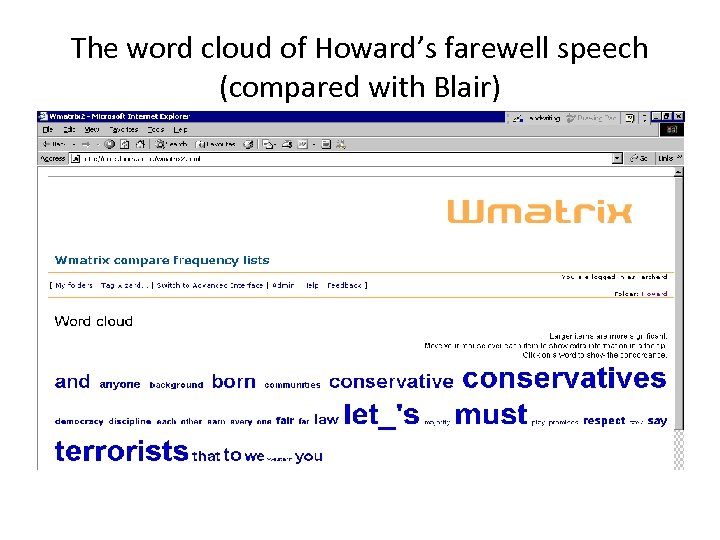 The word cloud of Howard’s farewell speech (compared with Blair)
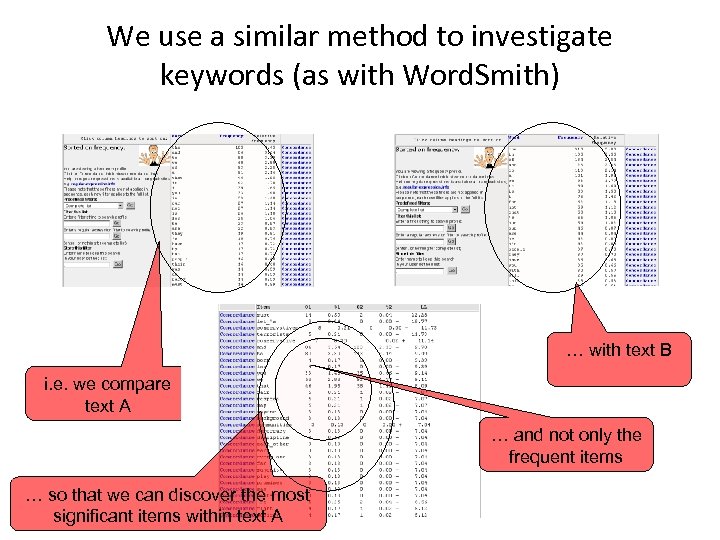 We use a similar method to investigate keywords (as with Word. Smith) … with text B i. e. we compare text A … and not only the frequent items … so that we can discover the most significant items within text A
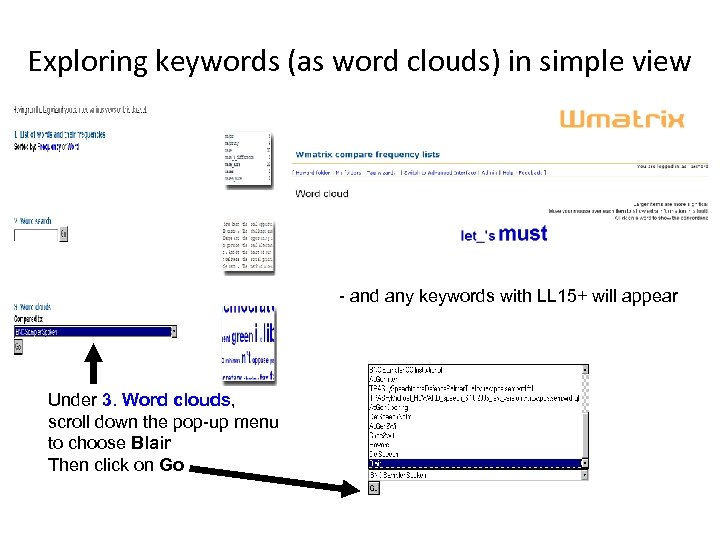 Exploring keywords (as word clouds) in simple view - and any keywords with LL 15+ will appear Under 3. Word clouds, scroll down the pop-up menu to choose Blair Then click on Go
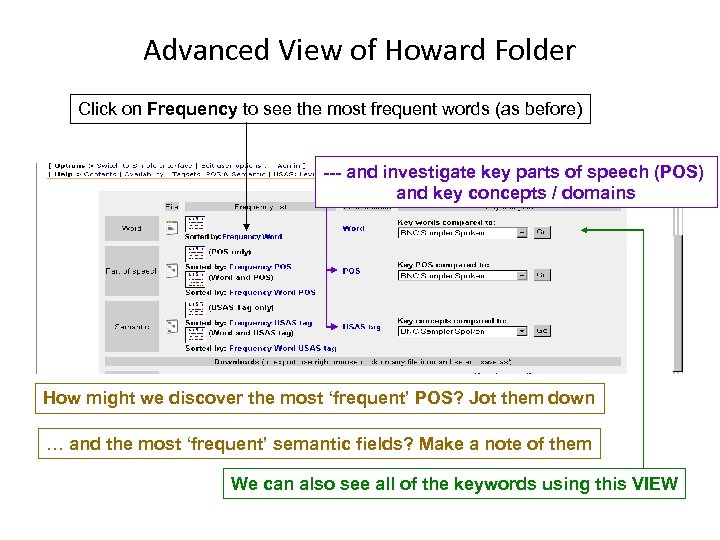 Advanced View of Howard Folder Click on Frequency to see the most frequent words (as before) --- and investigate key parts of speech (POS) and key concepts / domains How might we discover the most ‘frequent’ POS? Jot them down … and the most ‘frequent’ semantic fields? Make a note of them We can also see all of the keywords using this VIEW
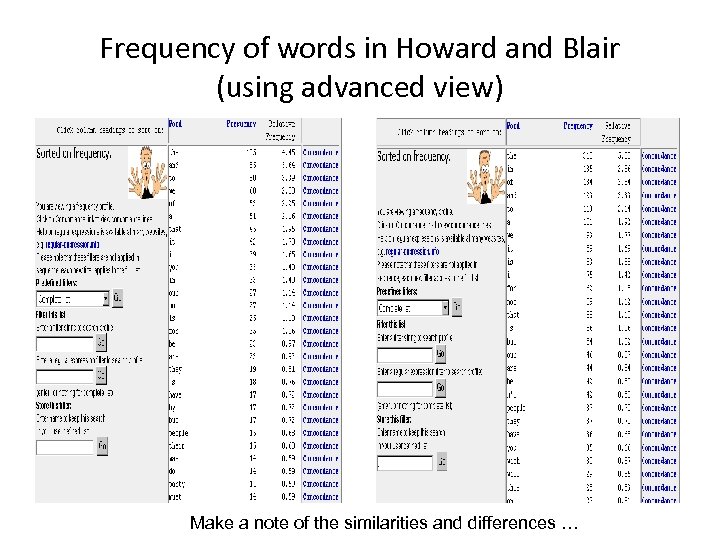 Frequency of words in Howard and Blair (using advanced view) Make a note of the similarities and differences …
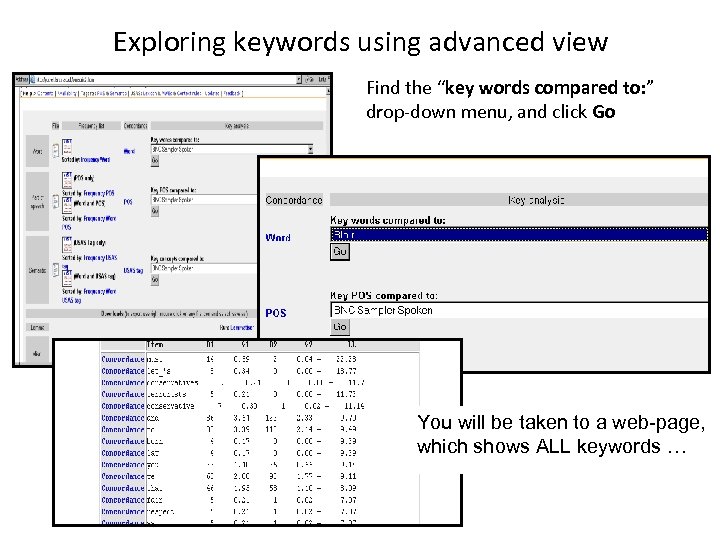 Exploring keywords using advanced view Find the “key words compared to: ” drop-down menu, and click Go You will be taken to a web-page, which shows ALL keywords …
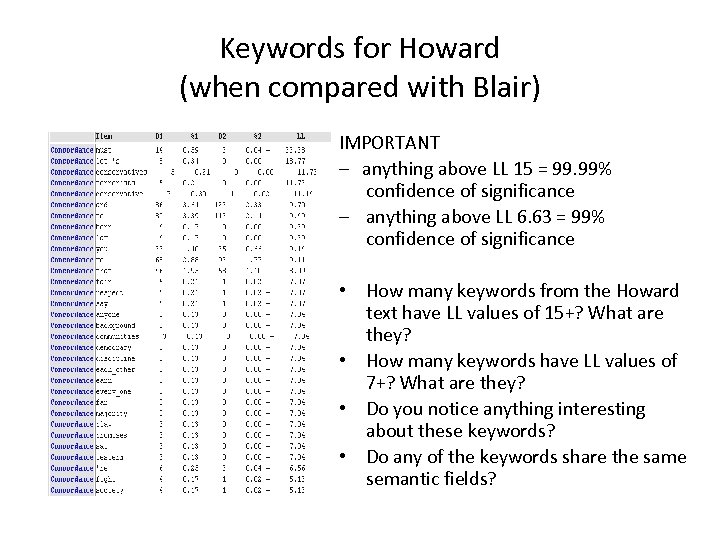 Keywords for Howard (when compared with Blair) IMPORTANT – anything above LL 15 = 99. 99% confidence of significance – anything above LL 6. 63 = 99% confidence of significance • How many keywords from the Howard text have LL values of 15+? What are they? • How many keywords have LL values of 7+? What are they? • Do you notice anything interesting about these keywords? • Do any of the keywords share the same semantic fields?
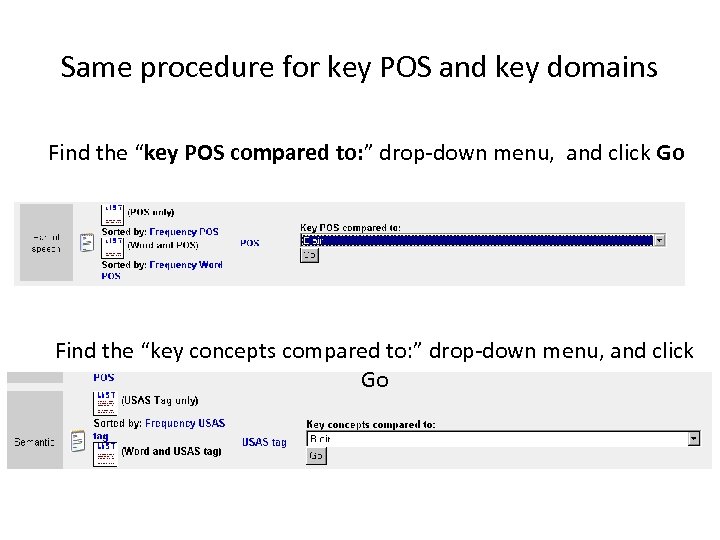 Same procedure for key POS and key domains Find the “key POS compared to: ” drop-down menu, and click Go Find the “key concepts compared to: ” drop-down menu, and click Go
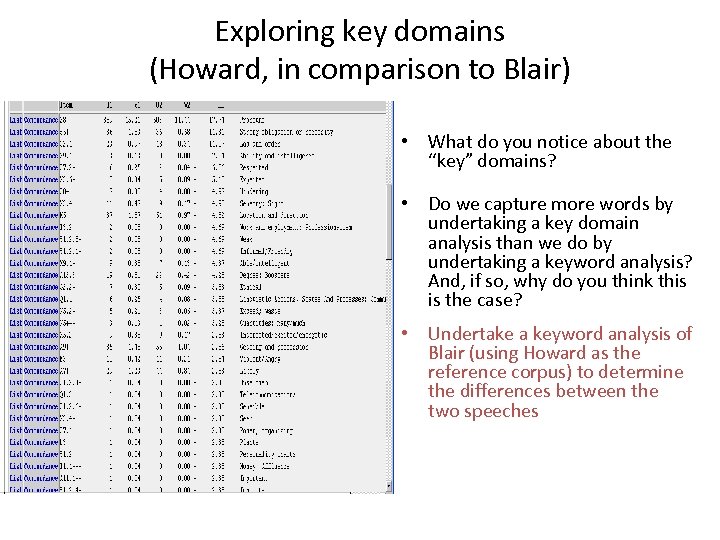 Exploring key domains (Howard, in comparison to Blair) • What do you notice about the “key” domains? • Do we capture more words by undertaking a key domain analysis than we do by undertaking a keyword analysis? And, if so, why do you think this is the case? • Undertake a keyword analysis of Blair (using Howard as the reference corpus) to determine the differences between the two speeches