


 Скачать презентацию Using Common Logic Mapping other KR techniques
0c73d8f58cdea42455afdb96c264af72.ppt
- Количество слайдов: 21
 Using Common Logic = Mapping other KR techniques to CL. = Eliminating dongles. = The zero case Pat Hayes Florida IHMC
 John Sowa talked about this side. Now we will look more closely at this side, using the CLIF dialect.
 Wild West Syntax (CLIF) Any character string can be a name, and any name can play any syntactic role, and any name can be quantified. Anything that can be named can also be the value of a function. All this gives a lot of freedom to say exactly what we want, and to write axioms which convert between different notational conventions. It also allows many other 'conventional' notations to be transcribed into CLIF directly and naturally. It also makes CLIF into a genuine network logic, because CLIF texts retain their full meaning when transported across a network, archived, or freely combined with other CLIF texts. (Unlike OWL-DL and GOFOL)
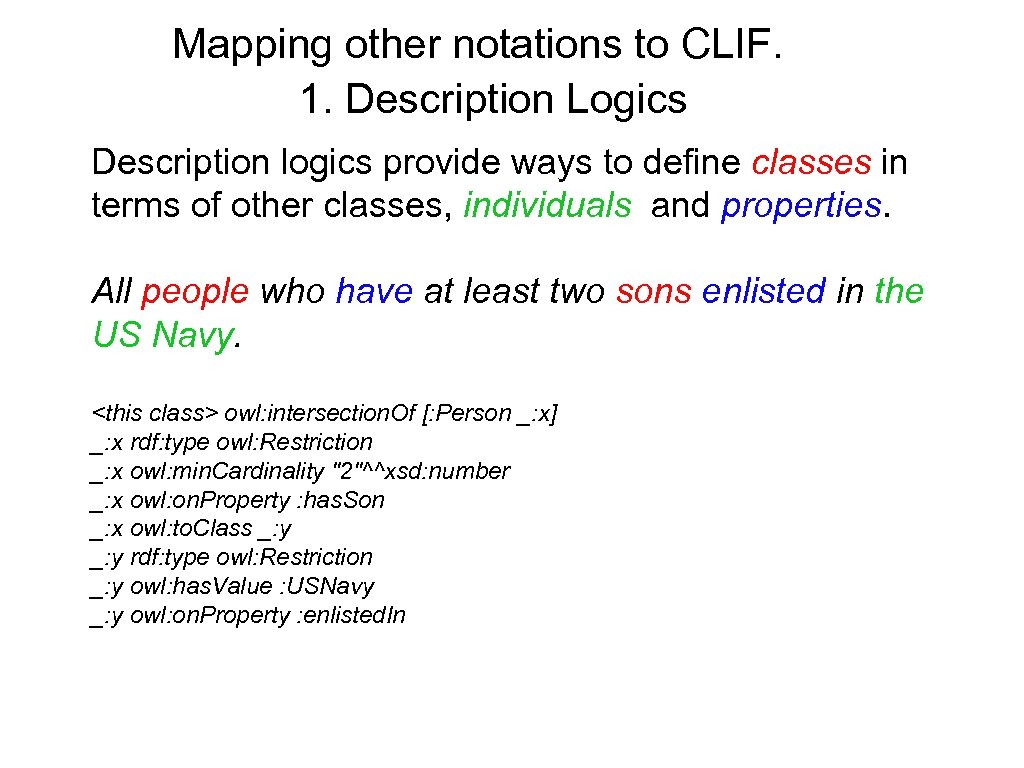 Mapping other notations to CLIF. 1. Description Logics Description logics provide ways to define classes in terms of other classes, individuals and properties. All people who have at least two sons enlisted in the US Navy.
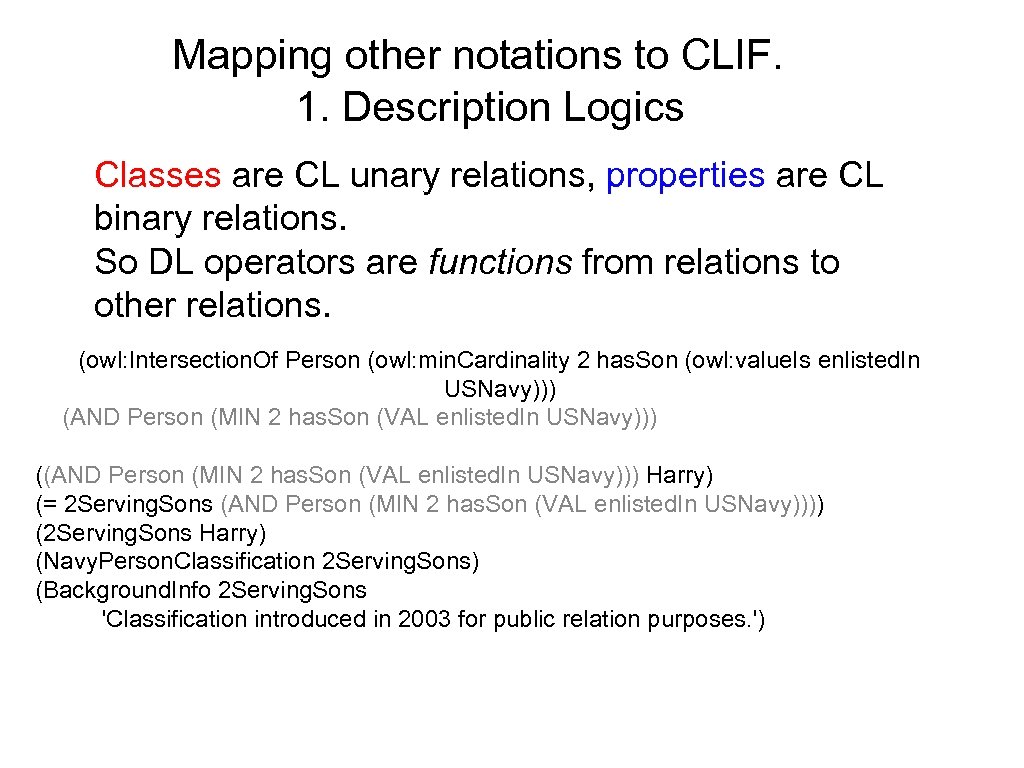 Mapping other notations to CLIF. 1. Description Logics Classes are CL unary relations, properties are CL binary relations. So DL operators are functions from relations to other relations. (owl: Intersection. Of Person (owl: min. Cardinality 2 has. Son (owl: value. Is enlisted. In USNavy))) (AND Person (MIN 2 has. Son (VAL enlisted. In USNavy))) ((AND Person (MIN 2 has. Son (VAL enlisted. In USNavy))) Harry) (= 2 Serving. Sons (AND Person (MIN 2 has. Son (VAL enlisted. In USNavy)))) (2 Serving. Sons Harry) (Navy. Person. Classification 2 Serving. Sons) (Background. Info 2 Serving. Sons 'Classification introduced in 2003 for public relation purposes. ')
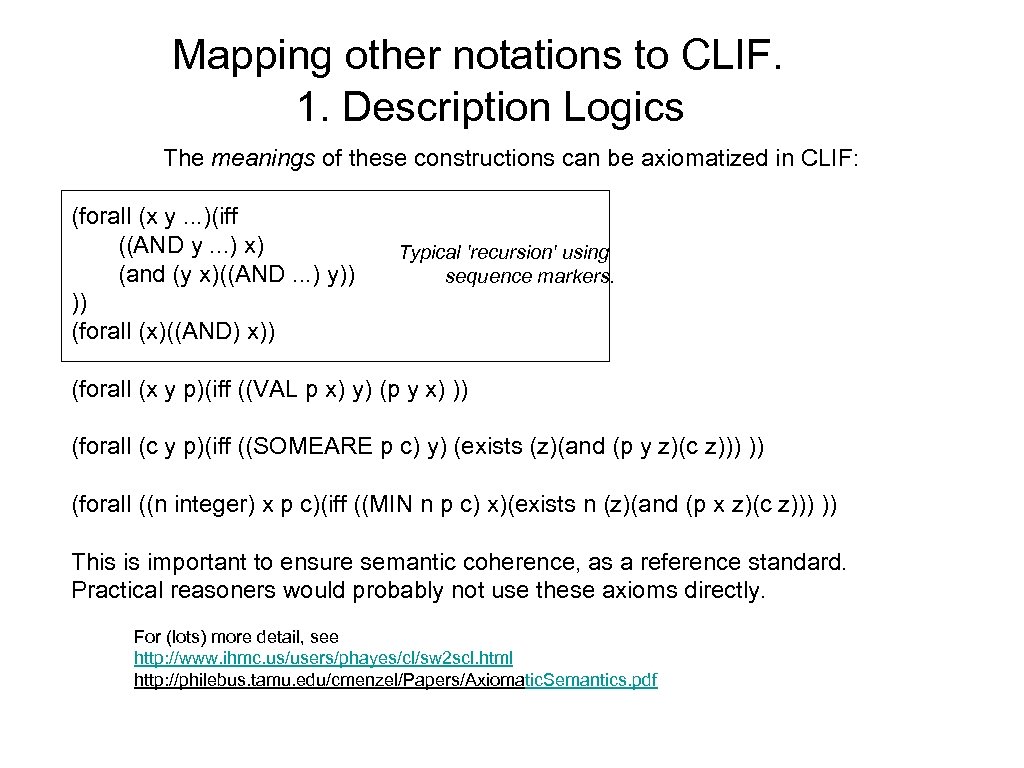 Mapping other notations to CLIF. 1. Description Logics The meanings of these constructions can be axiomatized in CLIF: (forall (x y. . . )(iff ((AND y. . . ) x) (and (y x)((AND. . . ) y)) )) (forall (x)((AND) x)) Typical 'recursion' using sequence markers. (forall (x y p)(iff ((VAL p x) y) (p y x) )) (forall (c y p)(iff ((SOMEARE p c) y) (exists (z)(and (p y z)(c z))) )) (forall ((n integer) x p c)(iff ((MIN n p c) x)(exists n (z)(and (p x z)(c z))) )) This is important to ensure semantic coherence, as a reference standard. Practical reasoners would probably not use these axioms directly. For (lots) more detail, see http: //www. ihmc. us/users/phayes/cl/sw 2 scl. html http: //philebus. tamu. edu/cmenzel/Papers/Axiomatic. Semantics. pdf
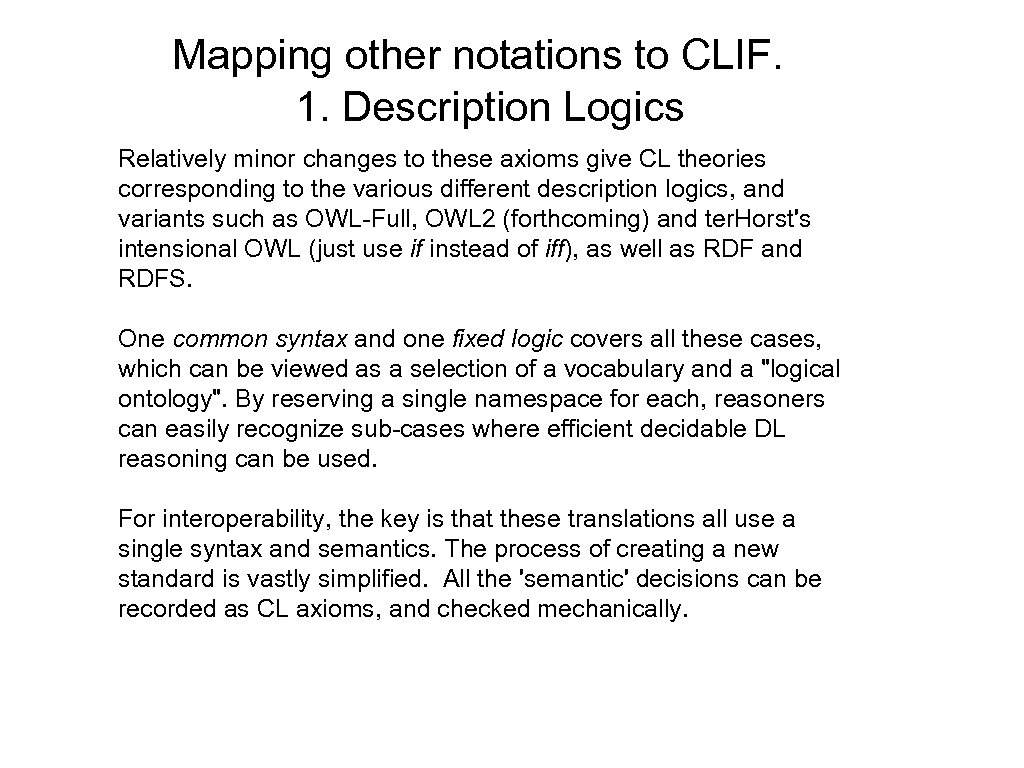 Mapping other notations to CLIF. 1. Description Logics Relatively minor changes to these axioms give CL theories corresponding to the various different description logics, and variants such as OWL-Full, OWL 2 (forthcoming) and ter. Horst's intensional OWL (just use if instead of iff), as well as RDF and RDFS. One common syntax and one fixed logic covers all these cases, which can be viewed as a selection of a vocabulary and a "logical ontology". By reserving a single namespace for each, reasoners can easily recognize sub-cases where efficient decidable DL reasoning can be used. For interoperability, the key is that these translations all use a single syntax and semantics. The process of creating a new standard is vastly simplified. All the 'semantic' decisions can be recorded as CL axioms, and checked mechanically.
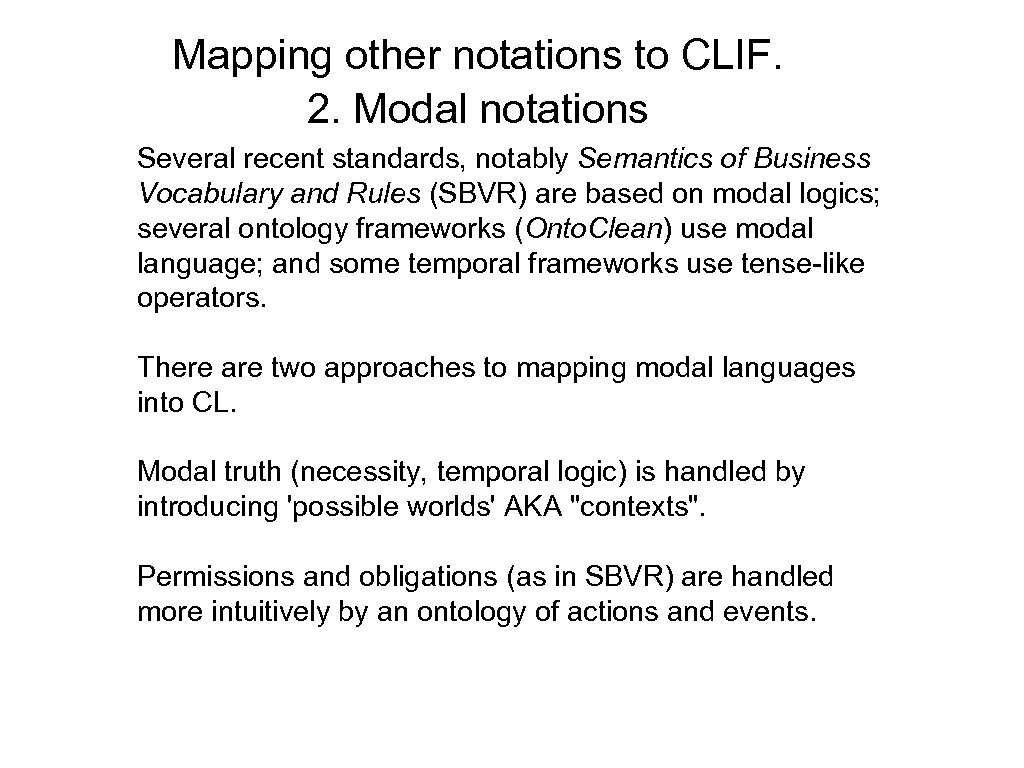 Mapping other notations to CLIF. 2. Modal notations Several recent standards, notably Semantics of Business Vocabulary and Rules (SBVR) are based on modal logics; several ontology frameworks (Onto. Clean) use modal language; and some temporal frameworks use tense-like operators. There are two approaches to mapping modal languages into CL. Modal truth (necessity, temporal logic) is handled by introducing 'possible worlds' AKA "contexts". Permissions and obligations (as in SBVR) are handled more intuitively by an ontology of actions and events.
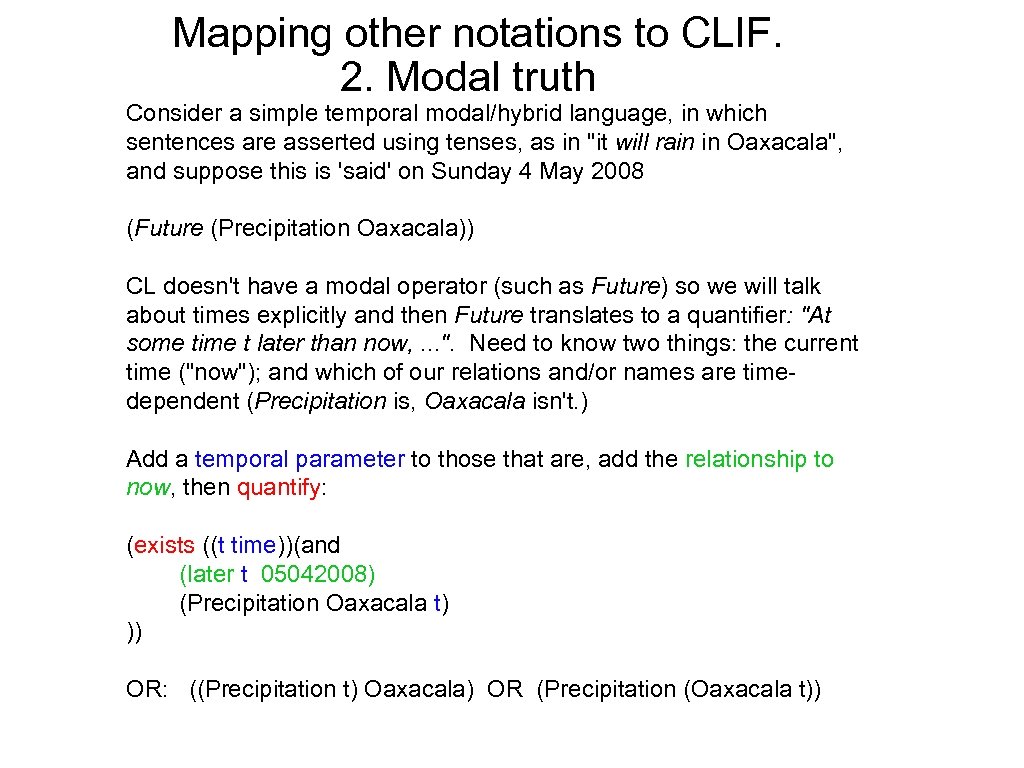 Mapping other notations to CLIF. 2. Modal truth Consider a simple temporal modal/hybrid language, in which sentences are asserted using tenses, as in "it will rain in Oaxacala", and suppose this is 'said' on Sunday 4 May 2008 (Future (Precipitation Oaxacala)) CL doesn't have a modal operator (such as Future) so we will talk about times explicitly and then Future translates to a quantifier: "At some time t later than now, . . . ". Need to know two things: the current time ("now"); and which of our relations and/or names are timedependent (Precipitation is, Oaxacala isn't. ) Add a temporal parameter to those that are, add the relationship to now, then quantify: (exists ((t time))(and (later t 05042008) (Precipitation Oaxacala t) )) OR: ((Precipitation t) Oaxacala) OR (Precipitation (Oaxacala t))
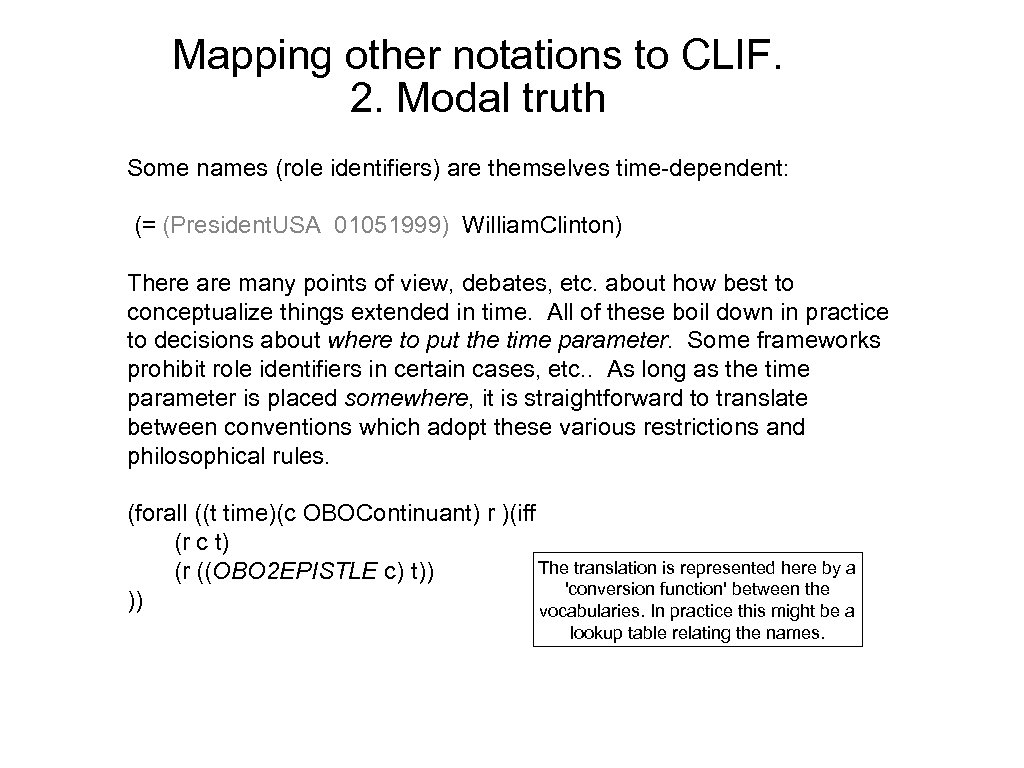 Mapping other notations to CLIF. 2. Modal truth Some names (role identifiers) are themselves time-dependent: (= (President. USA 01051999) William. Clinton) There are many points of view, debates, etc. about how best to conceptualize things extended in time. All of these boil down in practice to decisions about where to put the time parameter. Some frameworks prohibit role identifiers in certain cases, etc. . As long as the time parameter is placed somewhere, it is straightforward to translate between conventions which adopt these various restrictions and philosophical rules. (forall ((t time)(c OBOContinuant) r )(iff (r c t) The translation is represented here by a (r ((OBO 2 EPISTLE c) t)) 'conversion function' between the )) vocabularies. In practice this might be a lookup table relating the names.
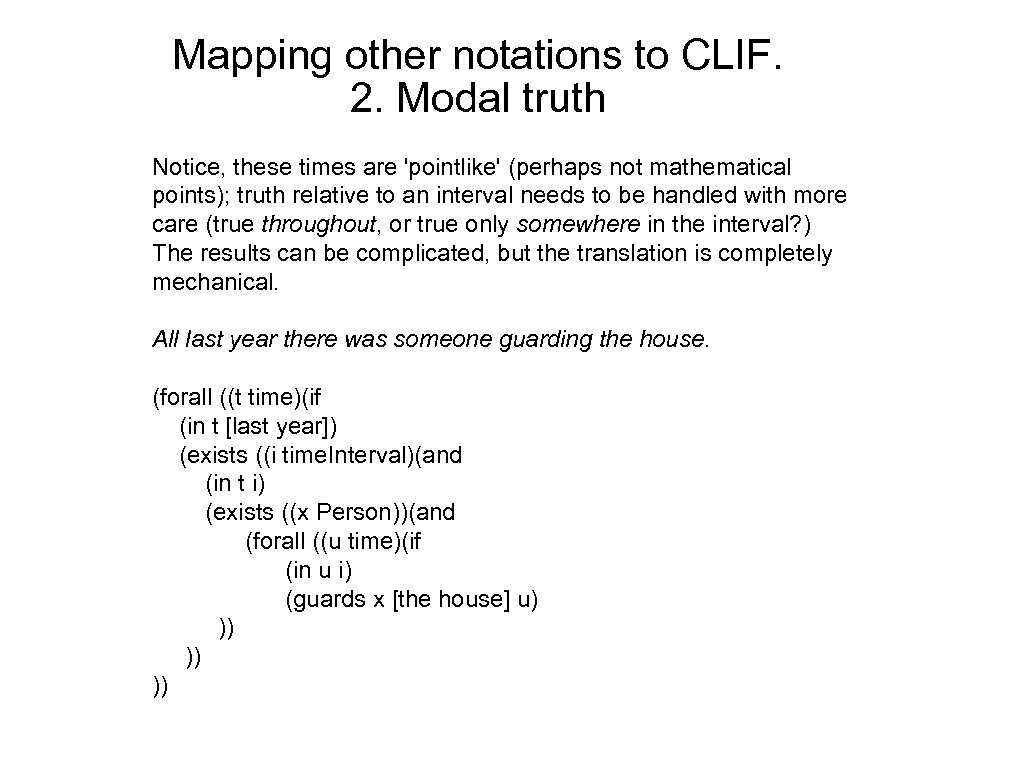 Mapping other notations to CLIF. 2. Modal truth Notice, these times are 'pointlike' (perhaps not mathematical points); truth relative to an interval needs to be handled with more care (true throughout, or true only somewhere in the interval? ) The results can be complicated, but the translation is completely mechanical. All last year there was someone guarding the house. (forall ((t time)(if (in t [last year]) (exists ((i time. Interval)(and (in t i) (exists ((x Person))(and (forall ((u time)(if (in u i) (guards x [the house] u) )) )) ))
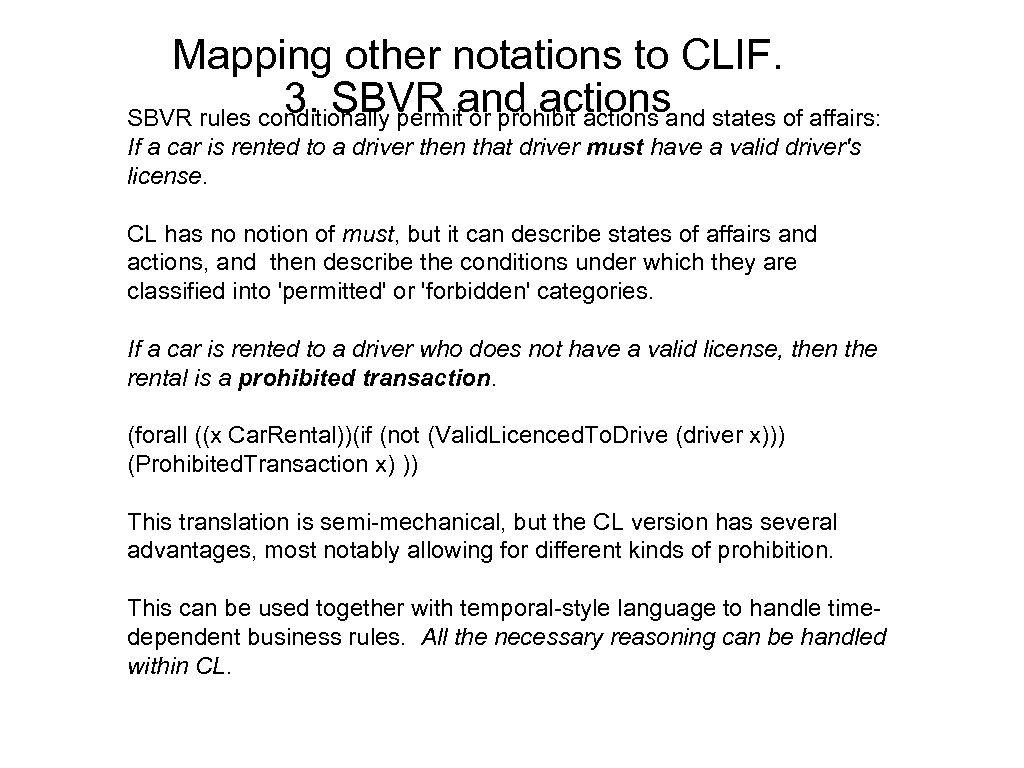 Mapping other notations to CLIF. 3. SBVR and actions SBVR rules conditionally permit or prohibit actions and states of affairs: If a car is rented to a driver then that driver must have a valid driver's license. CL has no notion of must, but it can describe states of affairs and actions, and then describe the conditions under which they are classified into 'permitted' or 'forbidden' categories. If a car is rented to a driver who does not have a valid license, then the rental is a prohibited transaction. (forall ((x Car. Rental))(if (not (Valid. Licenced. To. Drive (driver x))) (Prohibited. Transaction x) )) This translation is semi-mechanical, but the CL version has several advantages, most notably allowing for different kinds of prohibition. This can be used together with temporal-style language to handle timedependent business rules. All the necessary reasoning can be handled within CL.
 Wild West Syntax (CLIF) = Eliminating dongles. Any character string can be a name, and any name can play any syntactic role, and any name can be quantified. Anything that can be named can also be the value of a function. All this gives a lot of freedom to say exactly what we want, and to write axioms which convert between different notational conventions.
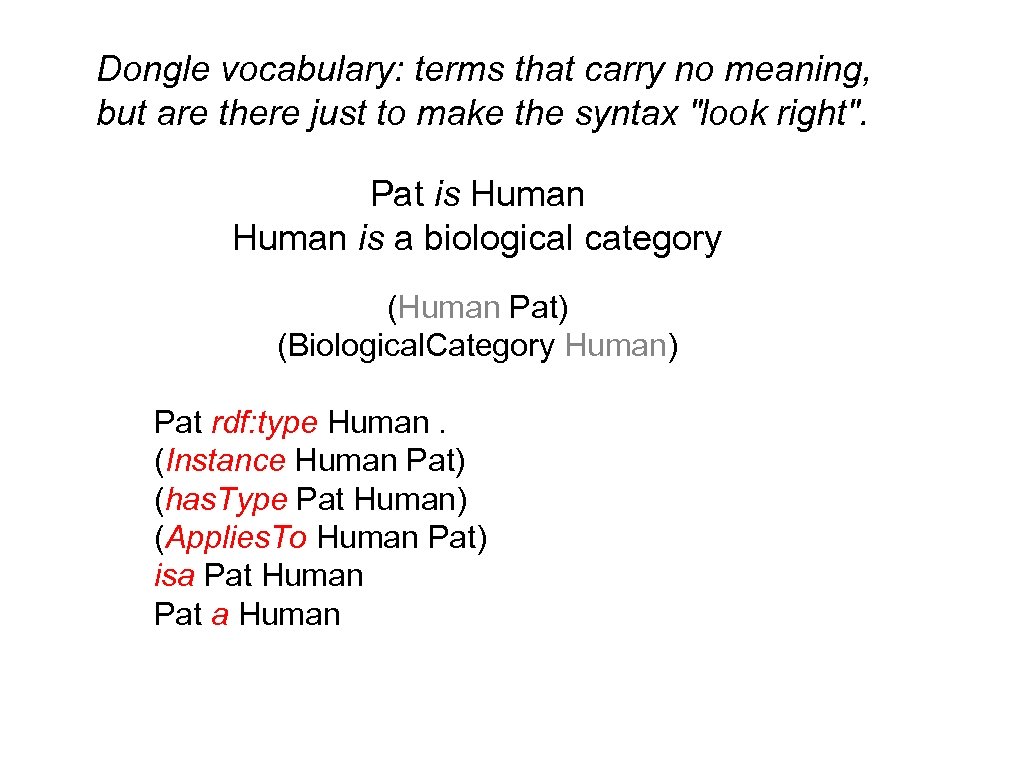 Dongle vocabulary: terms that carry no meaning, but are there just to make the syntax "look right". Pat is Human is a biological category (Human Pat) (Biological. Category Human) Pat rdf: type Human. (Instance Human Pat) (has. Type Pat Human) (Applies. To Human Pat) isa Pat Human Pat a Human
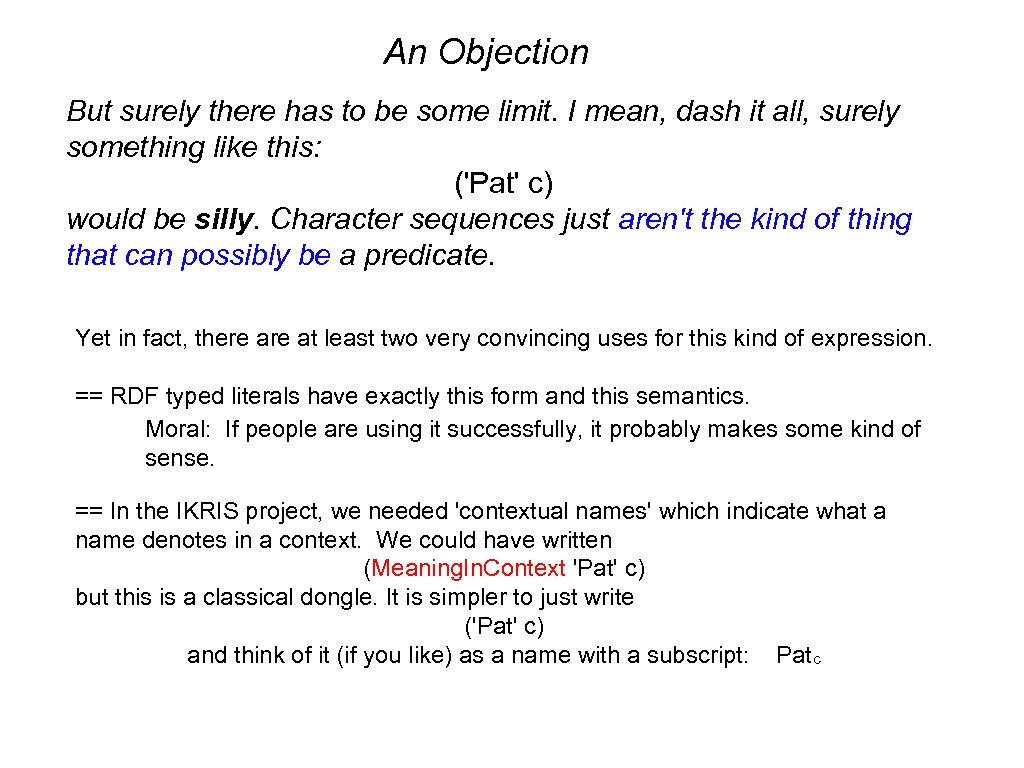 An Objection But surely there has to be some limit. I mean, dash it all, surely something like this: ('Pat' c) would be silly. Character sequences just aren't the kind of thing that can possibly be a predicate. Yet in fact, there at least two very convincing uses for this kind of expression. == RDF typed literals have exactly this form and this semantics. Moral: If people are using it successfully, it probably makes some kind of sense. == In the IKRIS project, we needed 'contextual names' which indicate what a name denotes in a context. We could have written (Meaning. In. Context 'Pat' c) but this is a classical dongle. It is simpler to just write ('Pat' c) and think of it (if you like) as a name with a subscript: Patc
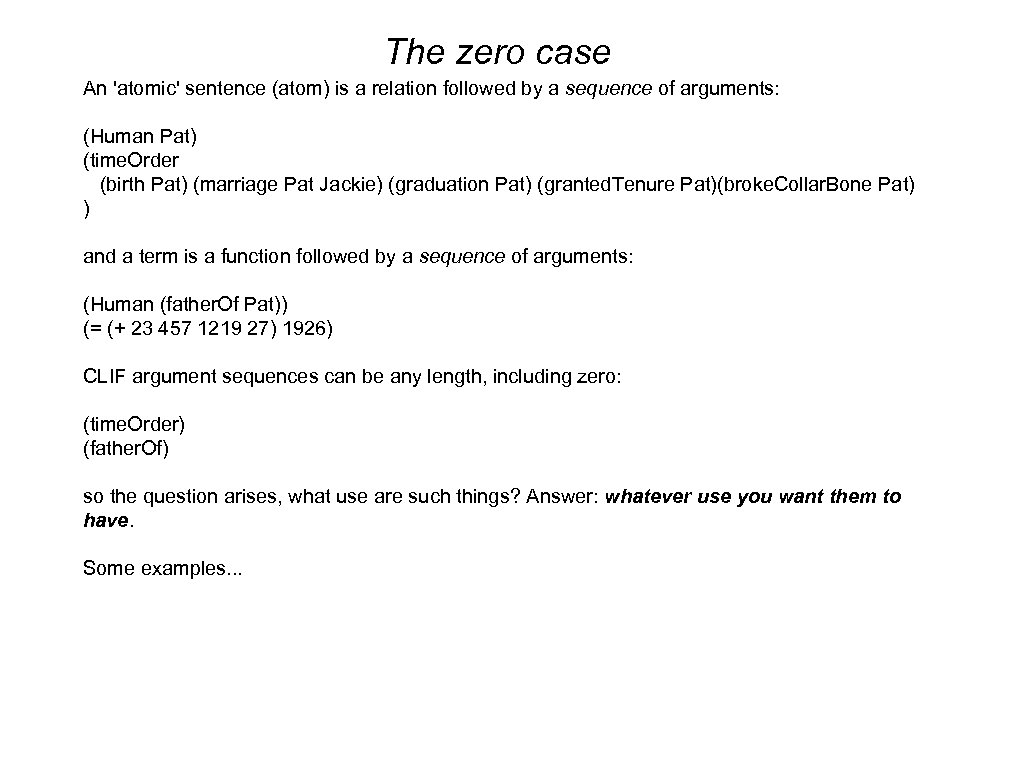 The zero case An 'atomic' sentence (atom) is a relation followed by a sequence of arguments: (Human Pat) (time. Order (birth Pat) (marriage Pat Jackie) (graduation Pat) (granted. Tenure Pat)(broke. Collar. Bone Pat) ) and a term is a function followed by a sequence of arguments: (Human (father. Of Pat)) (= (+ 23 457 1219 27) 1926) CLIF argument sequences can be any length, including zero: (time. Order) (father. Of) so the question arises, what use are such things? Answer: whatever use you want them to have. Some examples. . .
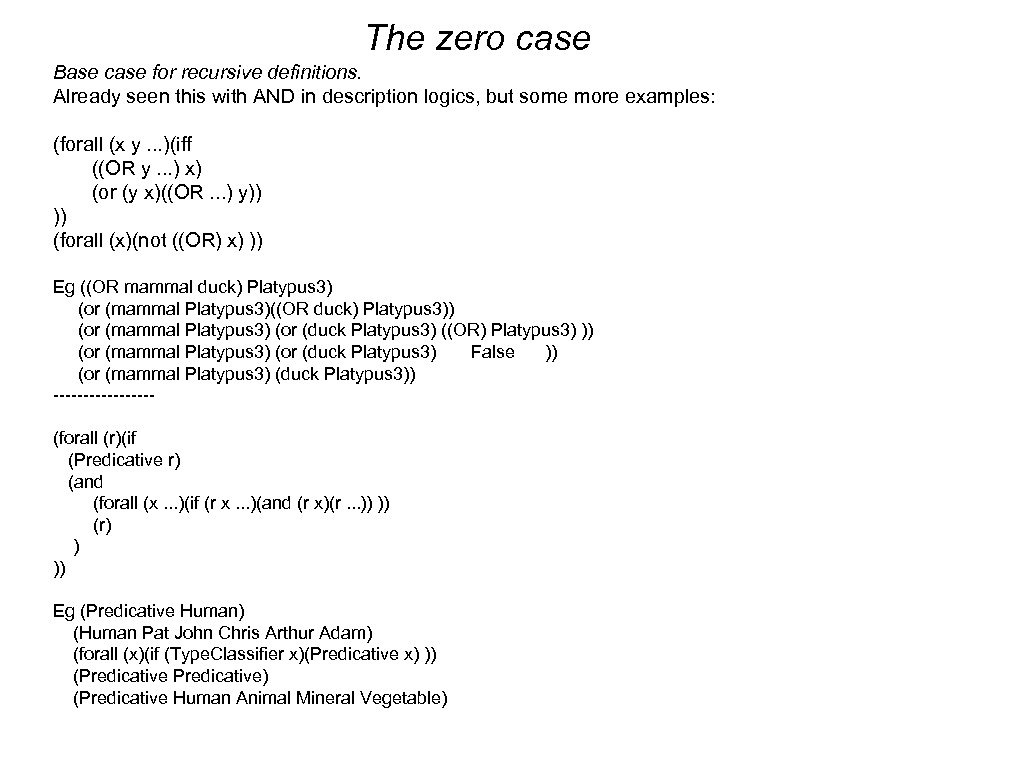 The zero case Base case for recursive definitions. Already seen this with AND in description logics, but some more examples: (forall (x y. . . )(iff ((OR y. . . ) x) (or (y x)((OR. . . ) y)) )) (forall (x)(not ((OR) x) )) Eg ((OR mammal duck) Platypus 3) (or (mammal Platypus 3)((OR duck) Platypus 3)) (or (mammal Platypus 3) (or (duck Platypus 3) ((OR) Platypus 3) )) (or (mammal Platypus 3) (or (duck Platypus 3) False )) (or (mammal Platypus 3) (duck Platypus 3)) --------(forall (r)(if (Predicative r) (and (forall (x. . . )(if (r x. . . )(and (r x)(r. . . )) )) (r) ) )) Eg (Predicative Human) (Human Pat John Chris Arthur Adam) (forall (x)(if (Type. Classifier x)(Predicative x) )) (Predicative) (Predicative Human Animal Mineral Vegetable)
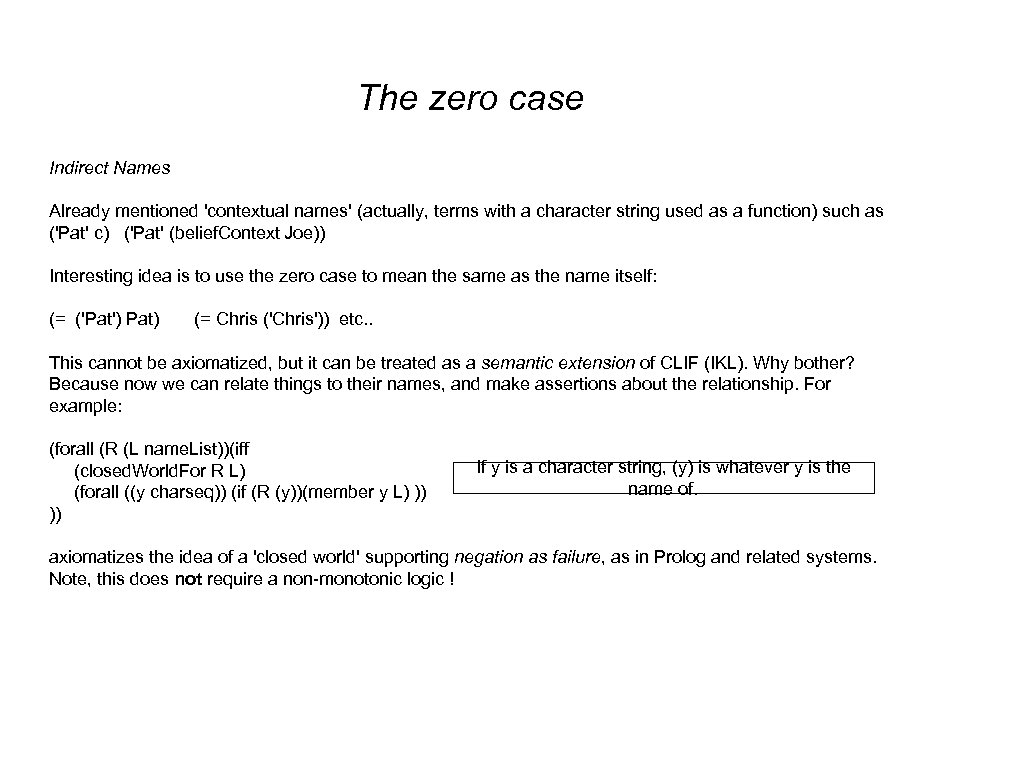 The zero case Indirect Names Already mentioned 'contextual names' (actually, terms with a character string used as a function) such as ('Pat' c) ('Pat' (belief. Context Joe)) Interesting idea is to use the zero case to mean the same as the name itself: (= ('Pat') Pat) (= Chris ('Chris')) etc. . This cannot be axiomatized, but it can be treated as a semantic extension of CLIF (IKL). Why bother? Because now we can relate things to their names, and make assertions about the relationship. For example: (forall (R (L name. List))(iff (closed. World. For R L) (forall ((y charseq)) (if (R (y))(member y L) )) )) If y is a character string, (y) is whatever y is the name of. axiomatizes the idea of a 'closed world' supporting negation as failure, as in Prolog and related systems. Note, this does not require a non-monotonic logic !
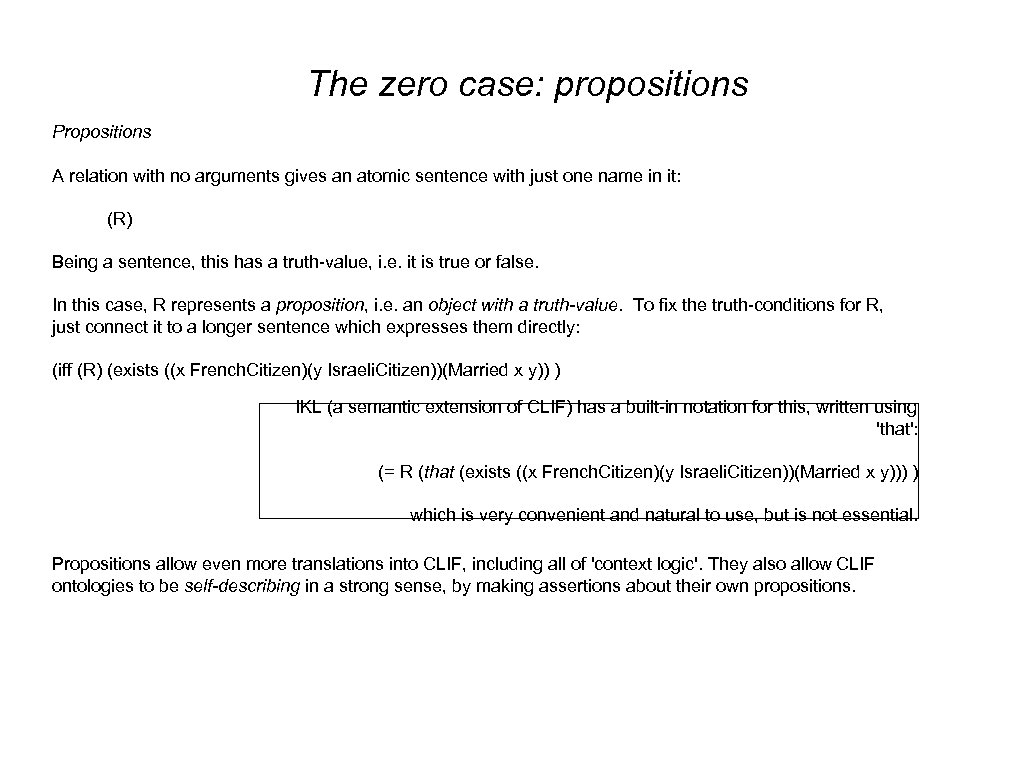 The zero case: propositions Propositions A relation with no arguments gives an atomic sentence with just one name in it: (R) Being a sentence, this has a truth-value, i. e. it is true or false. In this case, R represents a proposition, i. e. an object with a truth-value. To fix the truth-conditions for R, just connect it to a longer sentence which expresses them directly: (iff (R) (exists ((x French. Citizen)(y Israeli. Citizen))(Married x y)) ) IKL (a semantic extension of CLIF) has a built-in notation for this, written using 'that': (= R (that (exists ((x French. Citizen)(y Israeli. Citizen))(Married x y))) ) which is very convenient and natural to use, but is not essential. Propositions allow even more translations into CLIF, including all of 'context logic'. They also allow CLIF ontologies to be self-describing in a strong sense, by making assertions about their own propositions.
 The zero case: a moral When CL was being designed, we had not thought of any of these uses. We included the 'zero case' simply because there was no reason not to, and we wanted the Wild West Syntax to be as free as possible from unnecessary restrictions, on general grounds of economy and elegance. In every case, the 'peculiar' constructions thus allowed have turned out to be practically useful. They provide for more compact, efficient ways to write axioms, more powerful reasoning, far more flexibility of expression for interoperability, and entire new areas of important expressivity. They surprised us. We think that the logic is telling us something. First-order logic has long been seen as the foundational formalism for knowledge representation. But it is even better than it has traditionally seemed to be. All it needed was to be set free.
 More. . . SBVR IKL http: //www. businessrulesgroup. org/sbvr. shtml http: //tinyurl. com/6 yyzxe Description Logics into CL http: //www. ihmc. us/users/phayes/cl/sw 2 scl. html http: //philebus. tamu. edu/cmenzel/Papers/Axiomatic. Semantic s. pdf These Slides In Powerpoint: http: //tinyurl. com/6 rq 643 In PDF: http: //tinyurl. com/5 wreyp