 Скачать презентацию Using a Deliberative Democratic Evaluation tool to evaluate
0b28ca76ff0f057a743be51dad9eb639.ppt
- Количество слайдов: 25



Using a Deliberative Democratic Evaluation tool to evaluate, educate, and prevent Border Violence: Contextually Rich Service-to-Science Study By Terrence Tutchings, Ph. D, Sandra Eames, Ed. D, and Martin Arocena, Ph. D
Mission and Goals Create a culturally appropriate curriculum based on EBP for disaster preparedness that addresses the specific needs of the Lower Rio Grande Valley “Evaluation’s most important purpose is not to prove, but to improve” Source: Stufflebeam, 2007
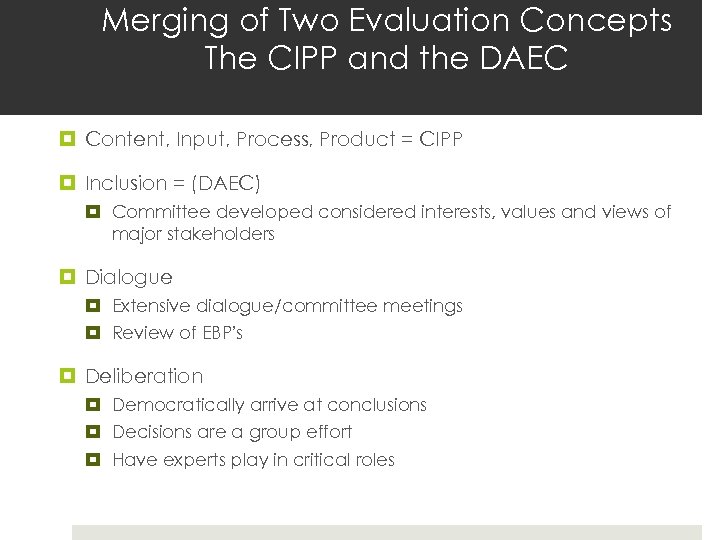
Merging of Two Evaluation Concepts The CIPP and the DAEC Content, Input, Process, Product = CIPP Inclusion = (DAEC) Committee developed considered interests, values and views of major stakeholders Dialogue Extensive dialogue/committee meetings Review of EBP’s Deliberation Democratically arrive at conclusions Decisions are a group effort Have experts play in critical roles
First Case Study Disaster Preparedness Checklist in Spanish and English, compiled from federal and state evidence-based materials For example, most of the federal and state evidencebased practices involve resources not accessible to residents of colonias—things such as telephones, emergency generators, storm shelters, health facilities, public water supplies, and grocery stores.
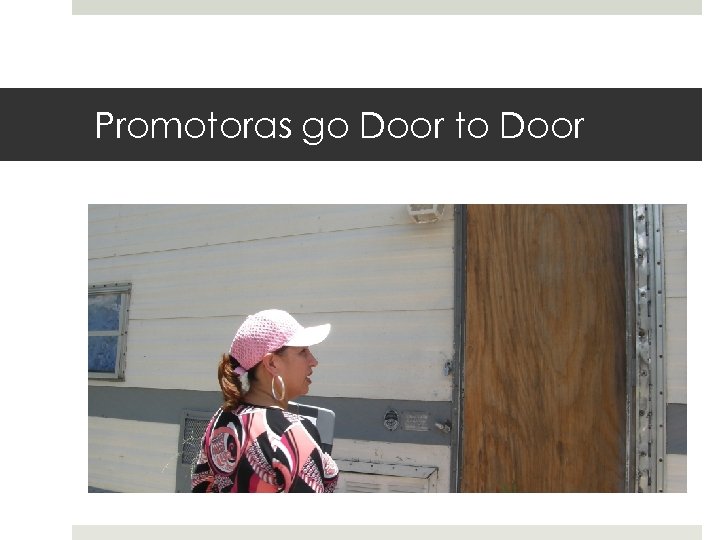
Promotoras go Door to Door
Phase I: Expansion of Rural Border Intervention (RBI) efforts Additional RBI staff (Promotoras) to increase SA prevention and intervention efforts to underserved Ike/Dolly affected counties (Hidalgo, Cameron, Willacy) with special emphasis on Colonias.
Phase II: Capacity Building Curriculum/Training Part A Developed a new Promotora certified training curriculum to train approx. 200 currently certified Promotoras and peer educators in the Valley on border violence prevention and disaster planning. Built capacity for prevention and intervention and community mobilization.
Phase II: Part B Developing the curricula focused on training professionals (SA treatment, family violence, law enforcement) along the border (Cameron, Hidalgo, Willacy counties). Curriculum included components on community mobilization, identifying needs/resources, child trauma, trauma related to the Hurricane, disaster planning, border trends, risks associated with residing on border, etc.
The Foundation of the Promotora Community Health Worker Training Curriculum Module I: Introduction to Border Violence Module II: The Impact of Border Violence Module III: Assessing Community Needs Module IV: Disaster Planning CHW/Promotora Curriculum, “Keeping My Family Well and Safe”
The Foundation of the Professional Training Curriculum Module I: Naming and Framing Border Violence Module II: Creating Public Awareness of Border Violence Module III: Border Violence and the Family Module IV: Mental Health Responses to Border Violence Module V: School-Based Strategies to Address Border Violence Among Youth Module VI: Community Mobilization and Capacity Building Honor Your Culture-Protect Your Peace/Honra Tu Cultura-Protege Tu Paz (HYC-PYP)
Phase III: Capacity Building – Community Mobilization Conference/Task Force - Part A Increased community participation along the border Held a forum for creating strategies to deal with the lack of resources, poverty within the communities, and needs that resulted from recent Hurricanes Youth, families and professionals participated in developing the conference and action plans for their specific communities.
Phase III: Part B Border Violence Prevention Conference for professionals highlighted trends, successes and collaboration efforts. Focus on reviewing efforts, the latest research, and the capacity building of trained professionals working on the border. Conference included a series of special meetings of a border binational task force which included national experts and those directly affected by Hurricanes Dolly and Ike and border violence.
What the Task Force Accomplished Created 2 curriculums / 10 Modules One with a focus on a certification process for Promotoras One with a focus on Clinicians/Educators/Police Both modules based on EBP and Best Practices Curriculum team revised and made changes Test taught modules at two state conferences Surveyed audience
Lesson Learned Early Success is Vital: A lively interaction among residents, promotoras and Task Force members resulted in feasible alternative actions and resources This is a solidly-executed example of service-to-science implementation in that an evidence-based product arose in services provided to persons with immediate needs.
Indicators of success Results of Phase I, Phase II and Phase III efforts were clear in the Eyeglass-Nuevas Opticas Border Violence Prevention Conference, held August 16 – 18 in the Mc. Allen Convention Center and, The Eyeglass-Nuevas Opticas Border Violence Prevention Conference, which took place September 14 – 16 at the South Padre Island Sheraton Resort
Who Attended? Occupations: Diverse group of Stakeholders Comparing where conference knowledge application will take place and who intends to make that happen are two important immediate impacts indicated for the RBI Project.
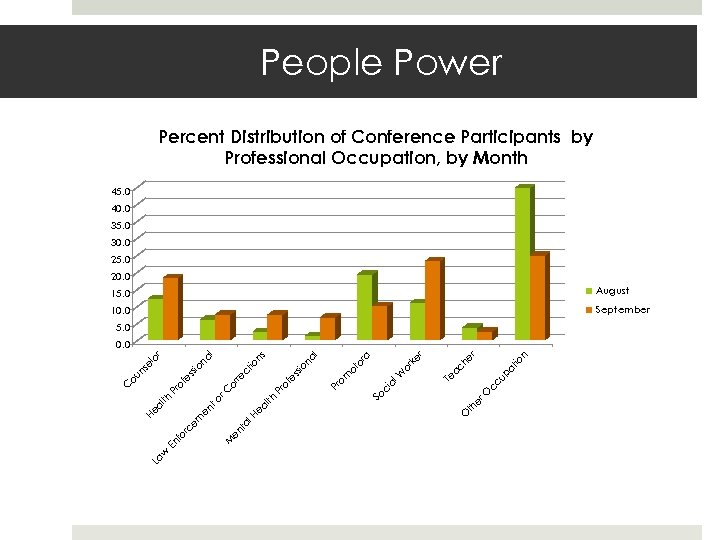
People Power Percent Distribution of Conference Participants by Professional Occupation, by Month 45. 0 40. 0 35. 0 30. 0 25. 0 20. 0 15. 0 August 10. 0 September 5. 0 La w n r up r. O cc Te ac at io he r ke th e O So ci al W or ot o om Pr of Pr lth ea l. H ta en ra l na es sio ct io re or r. C M En f or ce m He en al to th C Pr of e ou ss io ns el na ns l or 0. 0
Conference Survey Questions Overall Impacts Indicated by Outcomes Reported: “I will make use of what I learned in this conference” “At work, ” “At home, ” “In my neighborhood, ” “In the larger community. ”
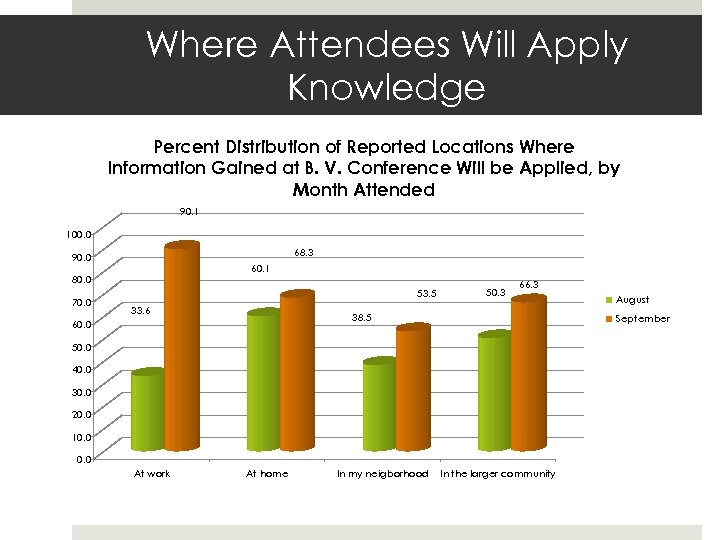
Where Attendees Will Apply Knowledge Percent Distribution of Reported Locations Where Information Gained at B. V. Conference Will be Applied, by Month Attended 90. 1 100. 0 68. 3 90. 0 60. 1 80. 0 70. 0 53. 5 33. 6 50. 3 66. 3 38. 5 60. 0 September 50. 0 40. 0 30. 0 20. 0 10. 0 At work At home In my neigborhood August In the larger community
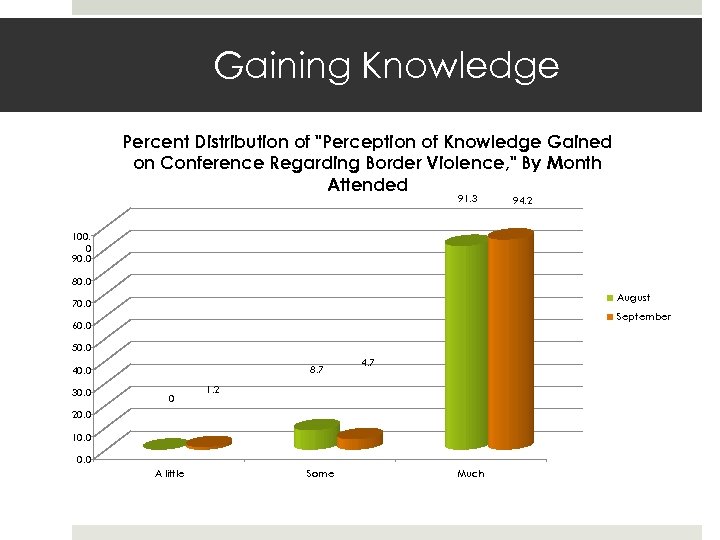
Gaining Knowledge Percent Distribution of "Perception of Knowledge Gained on Conference Regarding Border Violence, " By Month Attended 91. 3 94. 2 100. 0 90. 0 80. 0 August 70. 0 September 60. 0 50. 0 8. 7 40. 0 30. 0 0 4. 7 1. 2 20. 0 10. 0 A little Some Much
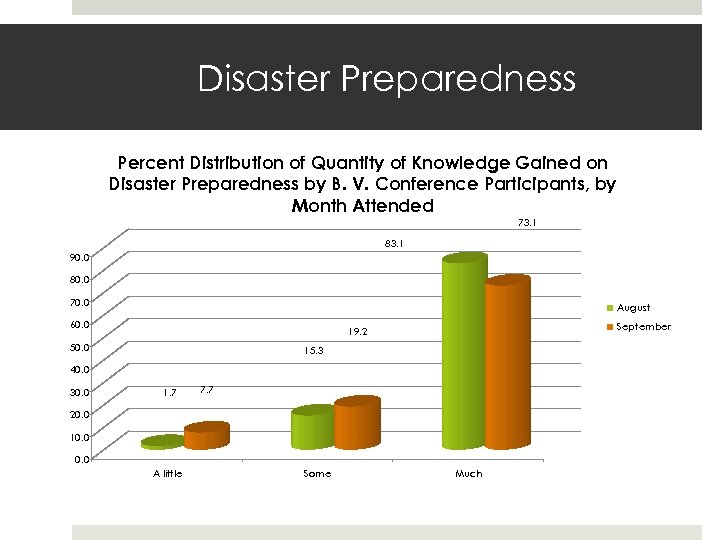
Disaster Preparedness Percent Distribution of Quantity of Knowledge Gained on Disaster Preparedness by B. V. Conference Participants, by Month Attended 73. 1 83. 1 90. 0 80. 0 70. 0 August 60. 0 September 19. 2 50. 0 15. 3 40. 0 30. 0 1. 7 7. 7 20. 0 10. 0 A little Some Much
Department of State Health Services Certified Curriculum Keeping My Family Safe/Mantener Seguras A Sus Familias Is being promoted widely by DSHS, the South Texas Promotora Association, and other agencies as a resource to be extended beyond Texas to other border States as a model outreach program
Service-to-Science Project Service-to-Science (STS)is utilized as an overall assessment of the curricula success Here we go back to the adapted tool for shaping the next steps in the STS process
Next Steps Service-To-Science Project Fast track Curricula to EBP status Dissemination, Dissemination
Source Adapted from Ernest R. House and Kenneth R. Howe (2000, p. 1). Deliberative Democratic Evaluation Checklists Project, www. wmich. edu/evalctr/checklists With great respect for Ernest R. House and Kenneth R. Howe, we apologize for any clumsiness they might find in our adaptation of their excellent work Rio Grande Valley Council, http: //www. rgvcouncil. org/index. php Sandra Eames: www. seames@austin. rr. com
Скачать презентацию Using a Deliberative Democratic Evaluation tool to evaluate
0b28ca76ff0f057a743be51dad9eb639.ppt