 Скачать презентацию Uses and Abuses of Market Research and Opinion
bc4d519836f82fc37289055e455e2134.ppt
- Количество слайдов: 53



Uses and Abuses of Market Research and Opinion Polls South Bank University 1 November 2011 Sir Robert Worcester, KBE DL Founder, MORI Chancellor, University of Kent
Outline of the Presentation History of market & opinion research Role of market & opinion research Uses and Abuses of research Comments / questions
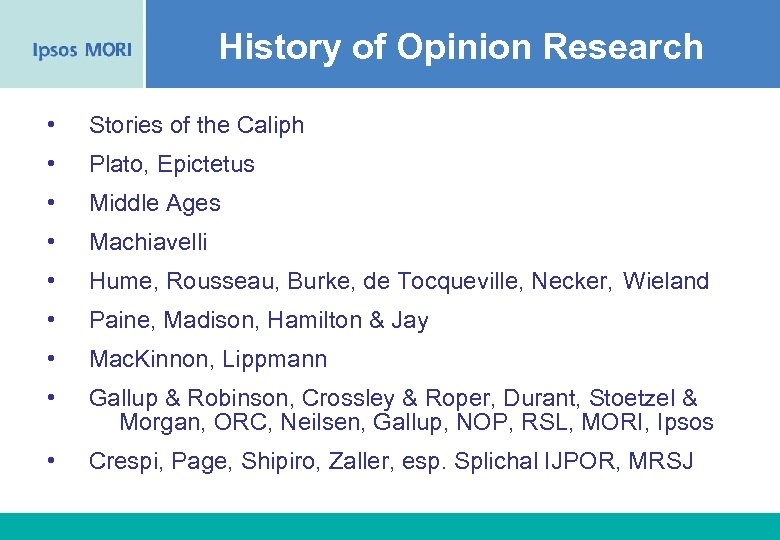
History of Opinion Research • Stories of the Caliph • Plato, Epictetus • Middle Ages • Machiavelli • Hume, Rousseau, Burke, de Tocqueville, Necker, Wieland • Paine, Madison, Hamilton & Jay • Mac. Kinnon, Lippmann • Gallup & Robinson, Crossley & Roper, Durant, Stoetzel & Morgan, ORC, Neilsen, Gallup, NOP, RSL, MORI, Ipsos • Crespi, Page, Shipiro, Zaller, esp. Splichal IJPOR, MRSJ 3
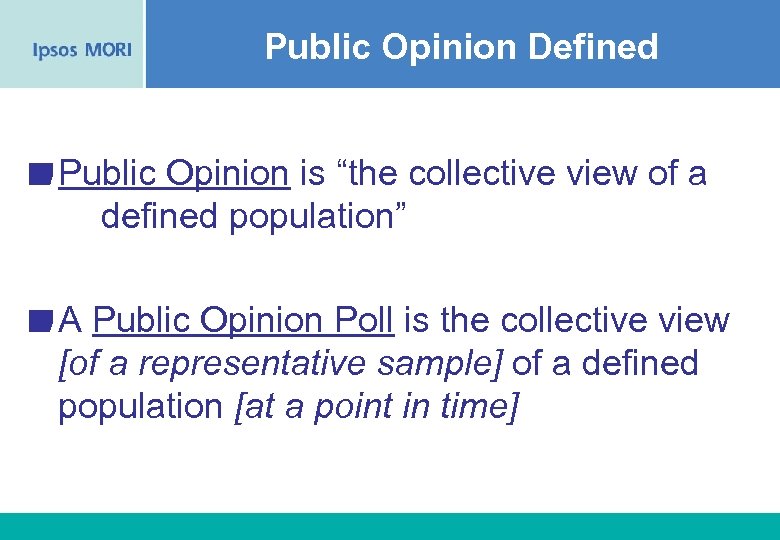
Public Opinion Defined Public Opinion is “the collective view of a defined population” A Public Opinion Poll is the collective view [of a representative sample] of a defined population [at a point in time] 4
A Word about Research We measure perceptions, not facts Two kinds of findings we bring to our clients: reality, and misperceptions Five things we can find: behaviour, knowledge, and… three levels of ‘views’: § Opinions § Attitudes § Values 5
Describing “public opinion” Public opinion is an aggregation of individual opinions Public opinion reflects majority beliefs Public opinion is found in the clash of group interests (some term this ‘activated’ public opinion) Public opinion is media and elite opinion Public opinion has power Public opinion is a fiction
Why is public opinion important in a democracy? Policy in democratic states should rest on public opinion § Global opinions about institutions/leaders § Specific policies and priorities Respect for public opinion is a safeguard against tyranny Public opinion must at times be mobilised Public opinion provides clues about culture
No lack of critics… A public opinion poll is no substitute for thought Warren Buffett How far would Moses have gone if he’d taken a poll in Egypt? Harry S Truman Public opinion polls are rather like children in a garden, digging things up all the time to see how they’re growing JB Priestley 8
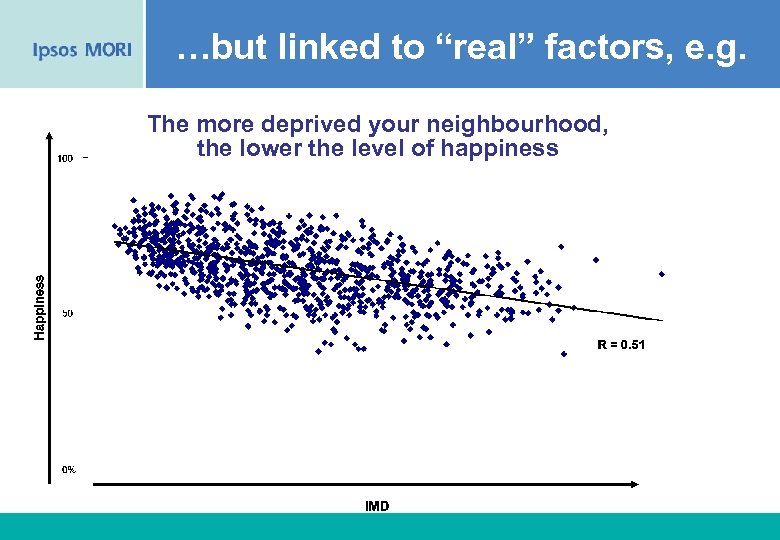
…but linked to “real” factors, e. g. The more deprived your neighbourhood, the lower the level of happiness 9
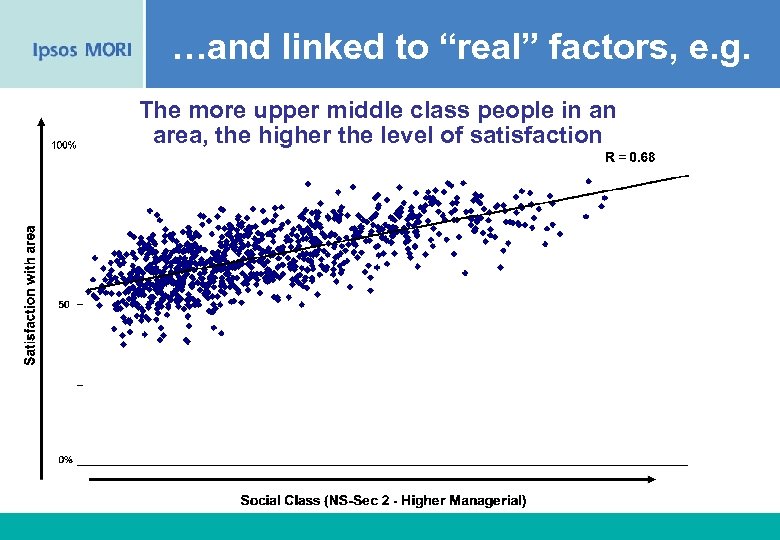
…and linked to “real” factors, e. g. The more upper middle class people in an area, the higher the level of satisfaction 10
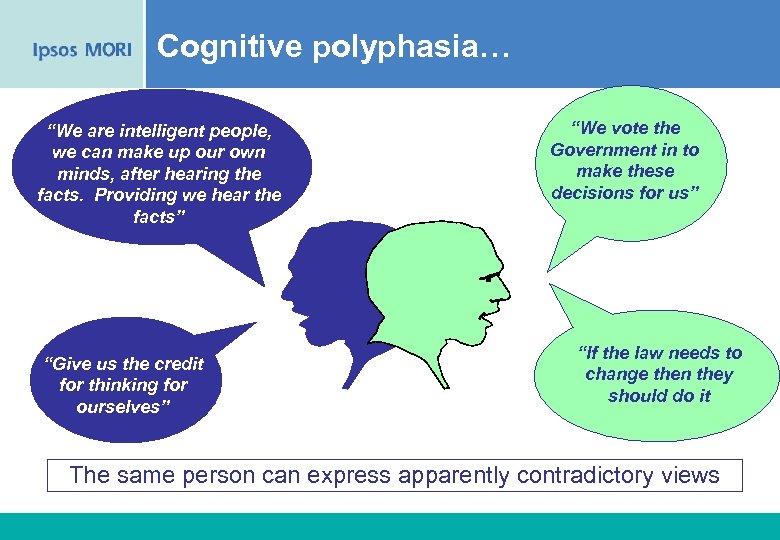
Cognitive polyphasia… “We are intelligent people, we can make up our own minds, after hearing the facts. Providing we hear the facts” “Give us the credit for thinking for ourselves” “We vote the Government in to make these decisions for us” “If the law needs to change then they should do it The same person can express apparently contradictory views 11
What is public opinion research? And what is it good for? 12
The role of the pollster Objective: to measure public opinion systematically and objectively, at a point in time Quantitative: research defines who, where, does, knows, and thinks what Qualitative research seeks to discover why people think the way they do and to gain understanding of if, and how, their views might change and the means by which these changes might occur 13
Quant and Qual approaches Qualitative n. In-depth interviews n. Small group discussions n. Larger consultation workshops Quantitative n. Telephone n. Face-to-face n. Online 14
Survey Research (quant). . . a simple business really! All you have to do is: nask the right questions nof the right sample nadd up the figures correctly nand report the findings accurately 15
The art of asking questions Six Functions: 1. Maintaining the respondent's co-operation and involvement 2. Communicating to the respondent 3. Helping the respondent to work out how to answer 4. Avoiding bias 5. Making the interviewer's task easier 6. Providing a basis for data processing 16
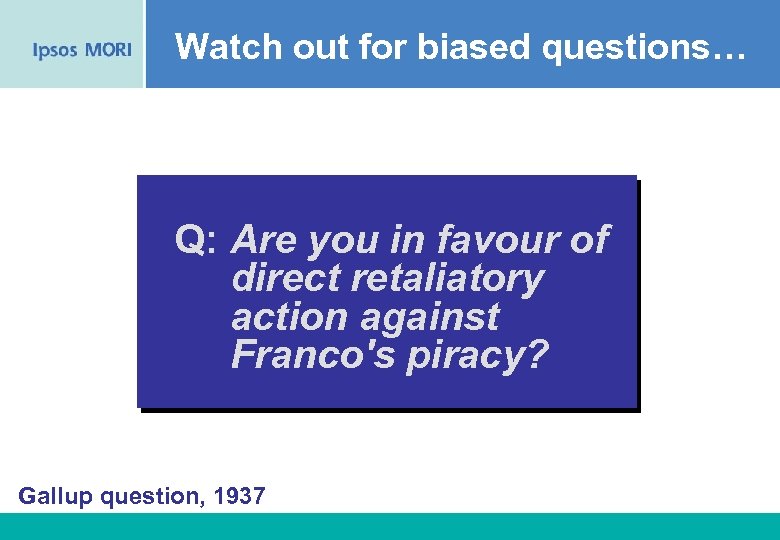
Watch out for biased questions… Q: Are you in favour of direct retaliatory action against Franco's piracy? Gallup question, 1937 17
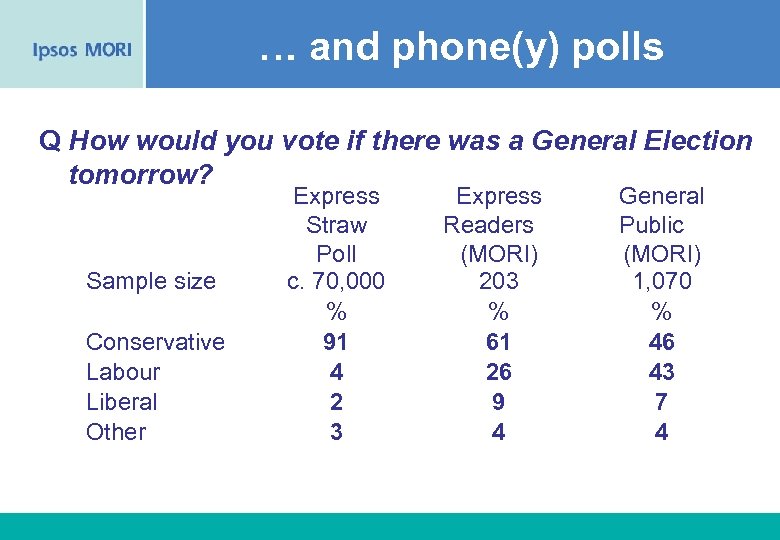
… and phone(y) polls Q How would you vote if there was a General Election tomorrow? Sample size Conservative Labour Liberal Other Express Straw Poll c. 70, 000 % 91 4 2 3 Express Readers (MORI) 203 % 61 26 9 4 General Public (MORI) 1, 070 % 46 43 7 4 18
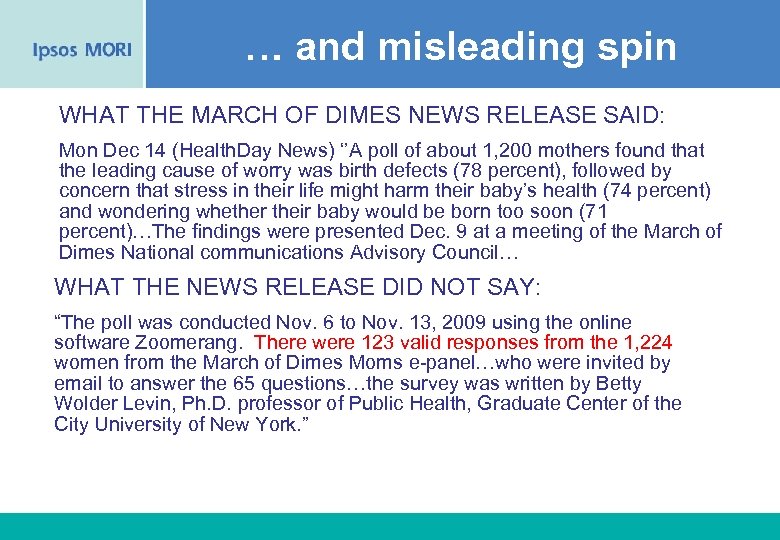
… and misleading spin WHAT THE MARCH OF DIMES NEWS RELEASE SAID: Mon Dec 14 (Health. Day News) ‘’A poll of about 1, 200 mothers found that the leading cause of worry was birth defects (78 percent), followed by concern that stress in their life might harm their baby’s health (74 percent) and wondering whether their baby would be born too soon (71 percent)…The findings were presented Dec. 9 at a meeting of the March of Dimes National communications Advisory Council… WHAT THE NEWS RELEASE DID NOT SAY: “The poll was conducted Nov. 6 to Nov. 13, 2009 using the online software Zoomerang. There were 123 valid responses from the 1, 224 women from the March of Dimes Moms e-panel…who were invited by email to answer the 65 questions…the survey was written by Betty Wolder Levin, Ph. D. professor of Public Health, Graduate Center of the City University of New York. ” 19
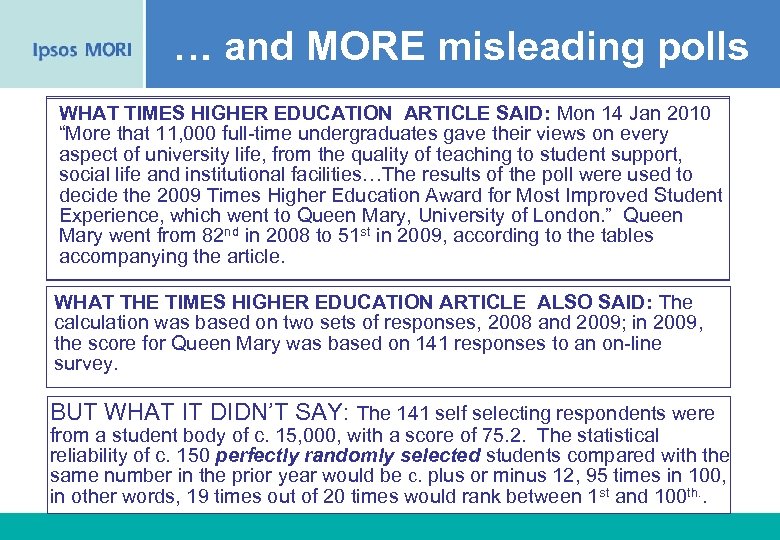
… and MORE misleading polls WHAT TIMES HIGHER EDUCATION ARTICLE SAID: Mon 14 Jan 2010 “More that 11, 000 full-time undergraduates gave their views on every aspect of university life, from the quality of teaching to student support, social life and institutional facilities…The results of the poll were used to decide the 2009 Times Higher Education Award for Most Improved Student Experience, which went to Queen Mary, University of London. ” Queen Mary went from 82 nd in 2008 to 51 st in 2009, according to the tables accompanying the article. WHAT THE TIMES HIGHER EDUCATION ARTICLE ALSO SAID: The calculation was based on two sets of responses, 2008 and 2009; in 2009, the score for Queen Mary was based on 141 responses to an on-line survey. BUT WHAT IT DIDN’T SAY: The 141 self selecting respondents were from a student body of c. 15, 000, with a score of 75. 2. The statistical reliability of c. 150 perfectly randomly selected students compared with the same number in the prior year would be c. plus or minus 12, 95 times in 100, in other words, 19 times out of 20 times would rank between 1 st and 100 th. . 20
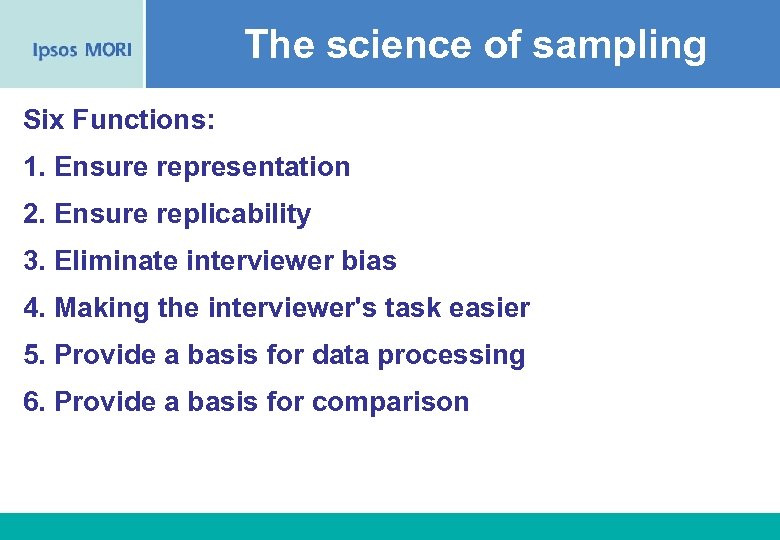
The science of sampling Six Functions: 1. Ensure representation 2. Ensure replicability 3. Eliminate interviewer bias 4. Making the interviewer's task easier 5. Provide a basis for data processing 6. Provide a basis for comparison 21
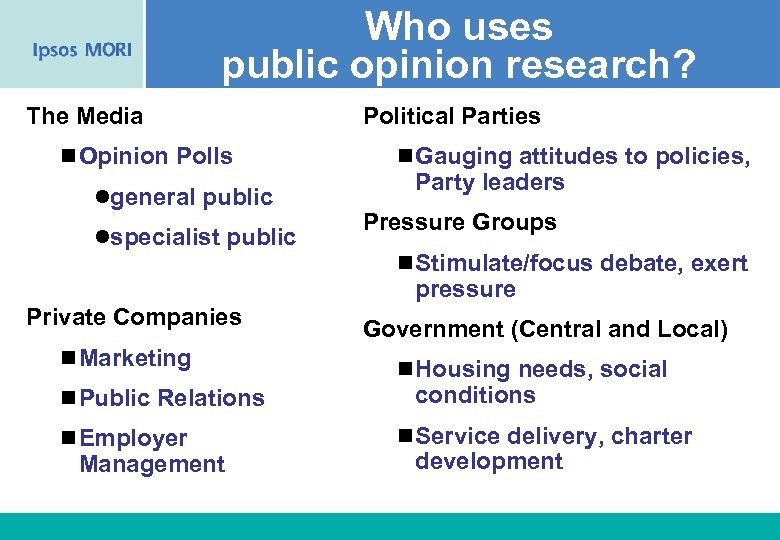
Who uses public opinion research? The Media n Opinion Polls lgeneral public lspecialist public Political Parties n Gauging attitudes to policies, Party leaders Pressure Groups n Stimulate/focus debate, exert pressure Private Companies n Marketing n Public Relations n Employer Management Government (Central and Local) n Housing needs, social conditions n Service delivery, charter development 24
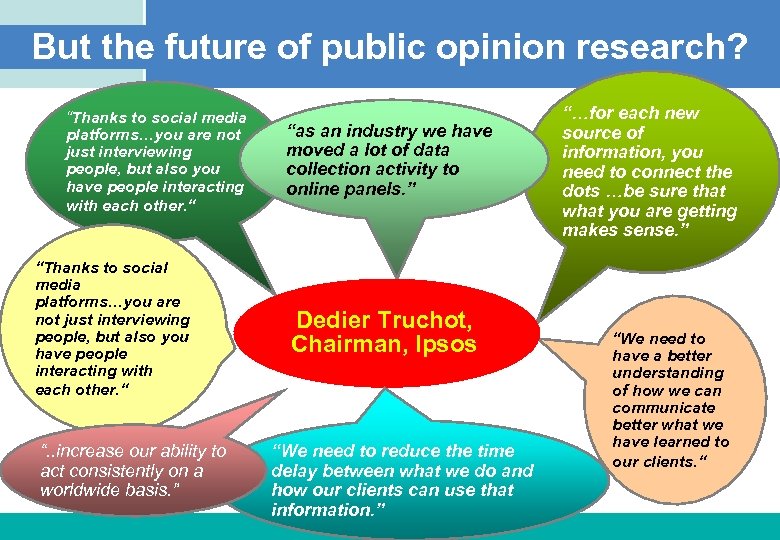
But the future of public opinion research? “Thanks to social media platforms…you are not just interviewing people, but also you have people interacting with each other. “ “. . increase our ability to act consistently on a worldwide basis. ” “as an industry we have moved a lot of data collection activity to online panels. ” Dedier Truchot, Chairman, Ipsos “We need to reduce the time delay between what we do and how our clients can use that information. ” “…for each new source of information, you need to connect the dots …be sure that what you are getting makes sense. ” “We need to have a better understanding of how we can communicate better what we have learned to our clients. “ 25
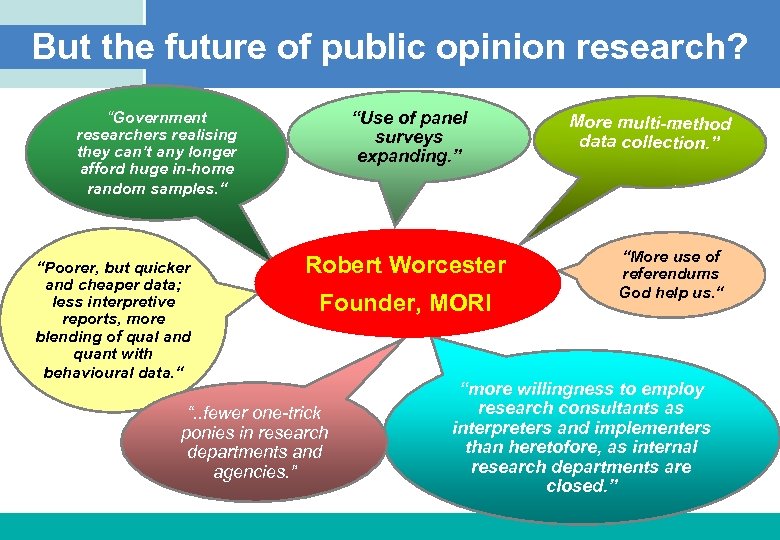
But the future of public opinion research? “Use of panel surveys expanding. ” “Government researchers realising they can’t any longer afford huge in-home random samples. “ “Poorer, but quicker and cheaper data; less interpretive reports, more blending of qual and quant with behavioural data. “ Robert Worcester Bob Worcester Founder, MORI “. . fewer one-trick ponies in research departments and agencies. ” More multi-method data collection. ” “More use of referendums God help us. “ “more willingness to employ research consultants as interpreters and implementers than heretofore, as internal research departments are closed. ” 26
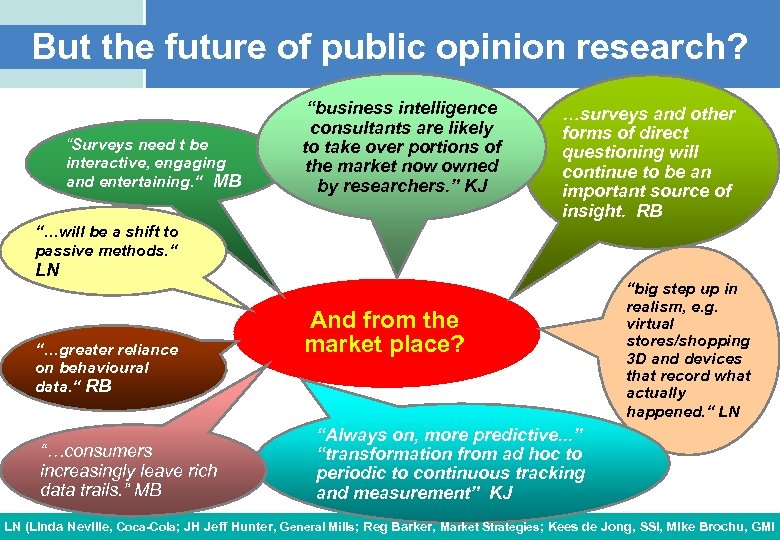
But the future of public opinion research? “Surveys need t be interactive, engaging and entertaining. “ MB “business intelligence consultants are likely to take over portions of the market now owned by researchers. ” KJ …surveys and other forms of direct questioning will continue to be an important source of insight. RB “…will be a shift to passive methods. “ LN “…greater reliance on behavioural data. “ RB “…consumers increasingly leave rich data trails. ” MB And from the market place? “big step up in realism, e. g. virtual stores/shopping 3 D and devices that record what actually happened. “ LN “Always on, more predictive. . . ” “transformation from ad hoc to periodic to continuous tracking and measurement” KJ LN (Linda Neville, Coca-Cola; JH Jeff Hunter, General Mills; Reg Barker, Market Strategies; Kees de Jong, SSI, Mike Brochu, GMI 27
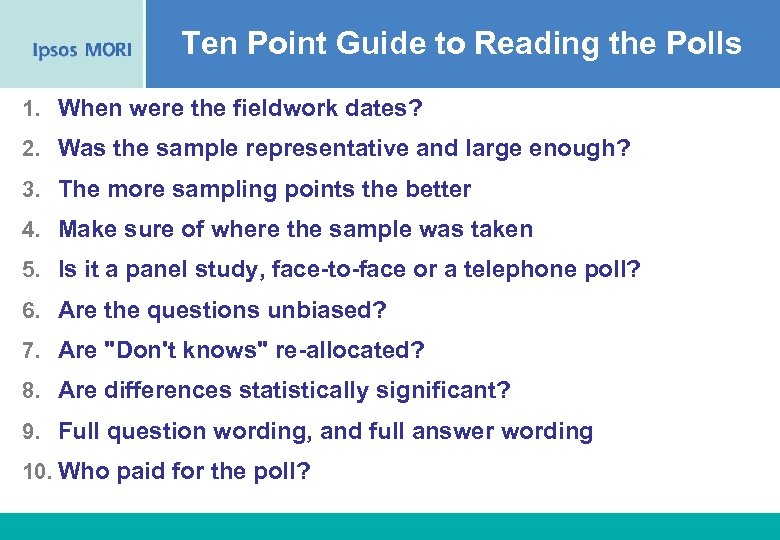
Ten Point Guide to Reading the Polls 1. When were the fieldwork dates? 2. Was the sample representative and large enough? 3. The more sampling points the better 4. Make sure of where the sample was taken 5. Is it a panel study, face-to-face or a telephone poll? 6. Are the questions unbiased? 7. Are "Don't knows" re-allocated? 8. Are differences statistically significant? 9. Full question wording, and full answer wording 10. Who paid for the poll? 28
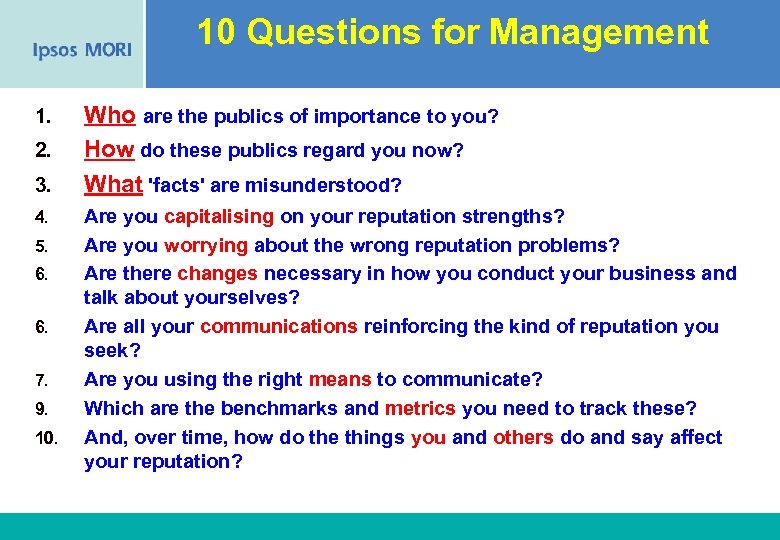
10 Questions for Management 1. 2. 3. 4. 5. 6. 6. 7. 9. 10. Who are the publics of importance to you? How do these publics regard you now? What 'facts' are misunderstood? Are you capitalising on your reputation strengths? Are you worrying about the wrong reputation problems? Are there changes necessary in how you conduct your business and talk about yourselves? Are all your communications reinforcing the kind of reputation you seek? Are you using the right means to communicate? Which are the benchmarks and metrics you need to track these? And, over time, how do the things you and others do and say affect your reputation? 29
Brands, Tracking, Communications: Opinions, Attitudes and Values Professor Sir Robert Worcester Chancellor, University of Kent South Bank Unversity 1 November 2011
Outline of the Presentation Reflections on… § The Nature of Public Opinion § 40 Years of Measuring Brands… - and Tracking - and Communication 31
Public Opinion 32
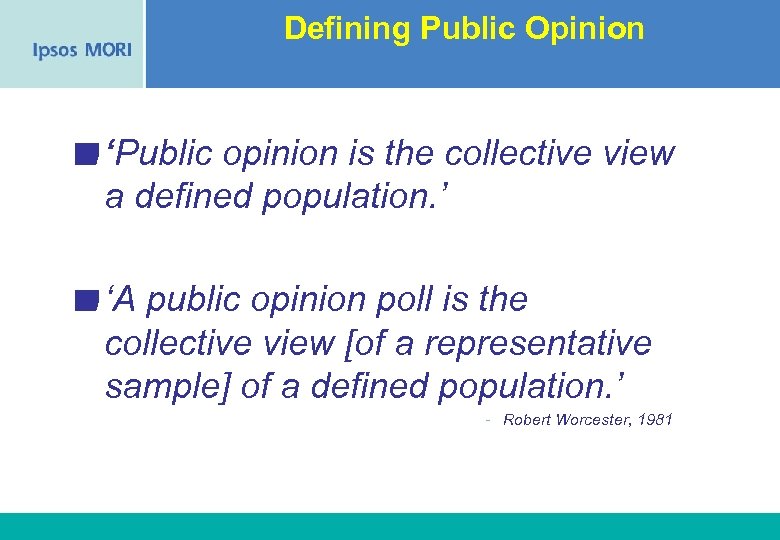
Defining Public Opinion ‘Public opinion is the collective view a defined population. ’ ‘A public opinion poll is the collective view [of a representative sample] of a defined population. ’ - Robert Worcester, 1981 33
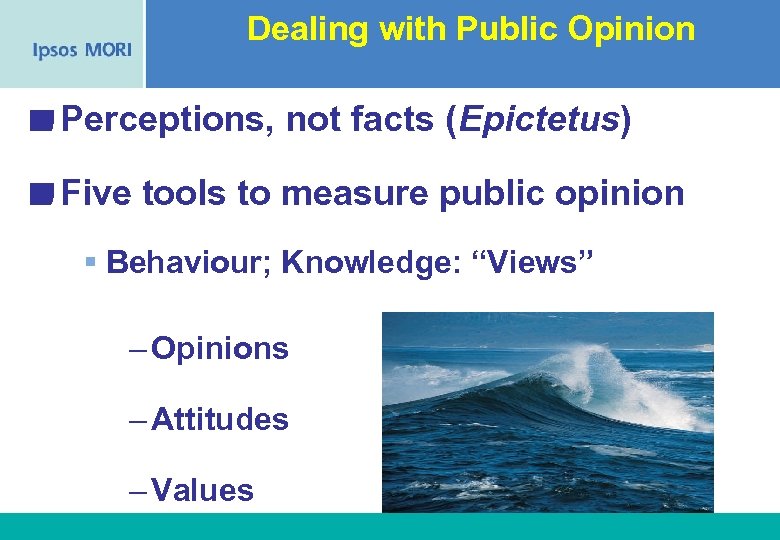
Dealing with Public Opinion Perceptions, not facts (Epictetus) Five tools to measure public opinion § Behaviour; Knowledge: “Views” – Opinions – Attitudes – Values 34
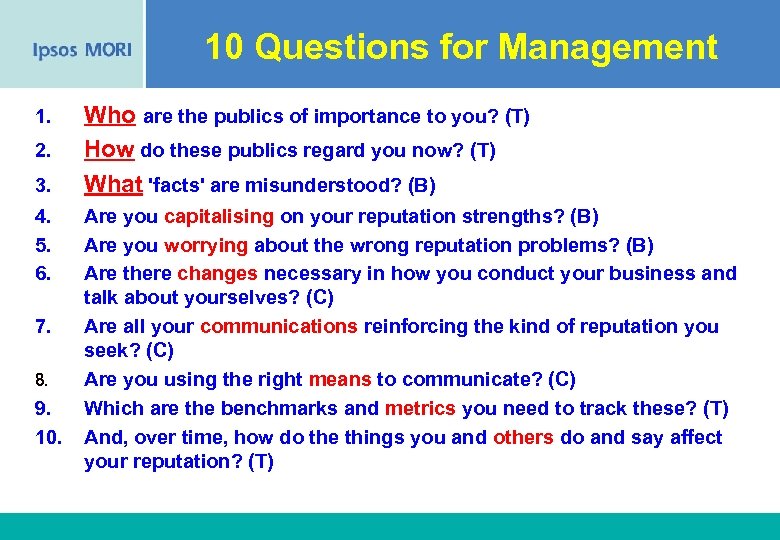
10 Questions for Management 1. 2. 3. 4. 5. 6. 7. 8. 9. 10. Who are the publics of importance to you? (T) How do these publics regard you now? (T) What 'facts' are misunderstood? (B) Are you capitalising on your reputation strengths? (B) Are you worrying about the wrong reputation problems? (B) Are there changes necessary in how you conduct your business and talk about yourselves? (C) Are all your communications reinforcing the kind of reputation you seek? (C) Are you using the right means to communicate? (C) Which are the benchmarks and metrics you need to track these? (T) And, over time, how do the things you and others do and say affect your reputation? (T) 35
B The four ‘brands’ (sometimes five) 36
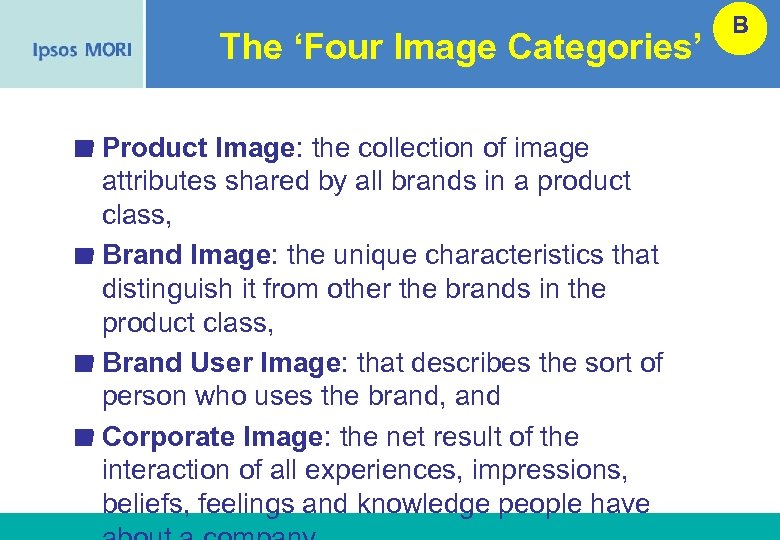
The ‘Four Image Categories’ B Product Image: the collection of image attributes shared by all brands in a product class, Brand Image: the unique characteristics that distinguish it from other the brands in the product class, Brand User Image: that describes the sort of person who uses the brand, and Corporate Image: the net result of the interaction of all experiences, impressions, beliefs, feelings and knowledge people have 37
The fifth ‘brand’ B The Image of the Country of (perceived) Ownership of the company that produces the brands and services. -Robert Worcester & Geoffrey Morris, 1973 38
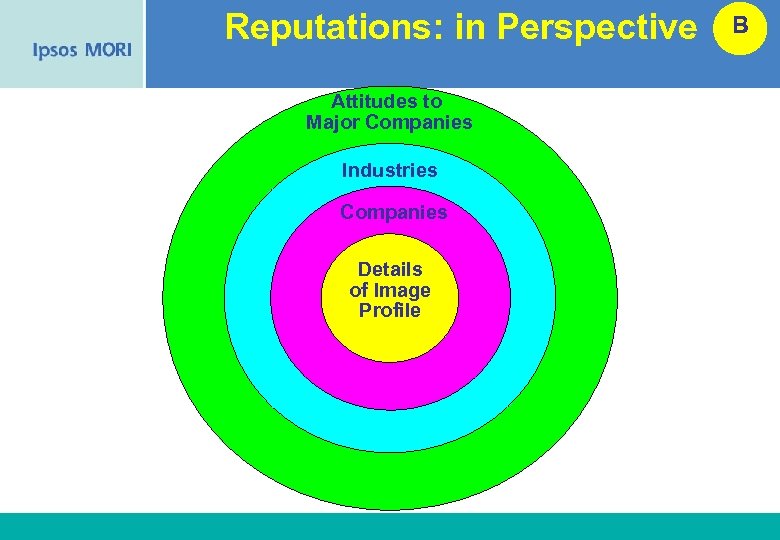
Reputations: in Perspective B Attitudes to Major Companies Industries Companies Details of Image Profile 39
Definition of “Corporate Reputation” B “The net result of the interaction of all experiences, impressions, beliefs, feelings and knowledge people have about a company”… industry, political party, religion…” -Robert Worcester, 1969 40
B Definition of “Corporate Identity” “The visible manifestation of the corporate image. ” -Robert Worcester, 1969 41
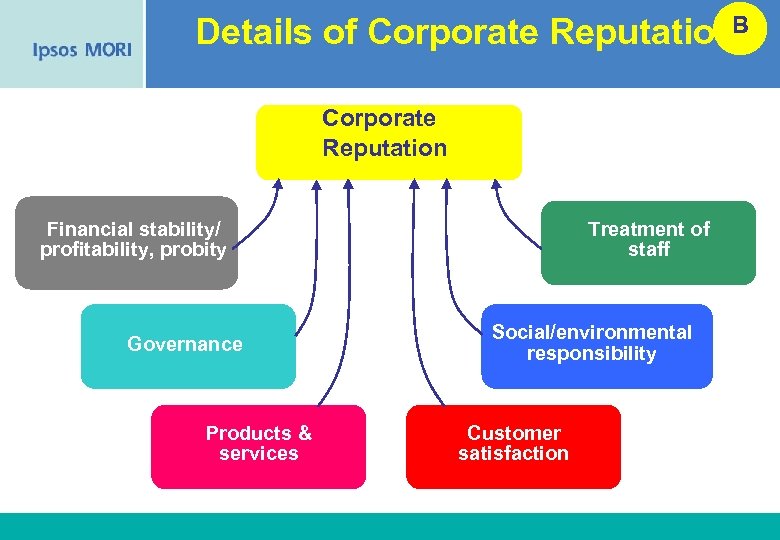
Details of Corporate Reputation. B Corporate Reputation Financial stability/ profitability, probity Governance Products & services Treatment of staff Social/environmental responsibility Customer satisfaction 42
A stakeholder is… “Anyone who can bugger up the business” 43
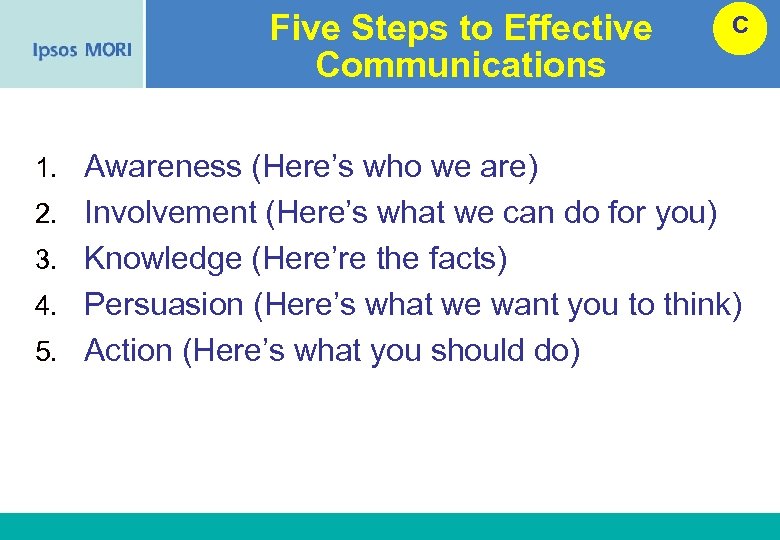
Five Steps to Effective Communications C 1. Awareness (Here’s who we are) 2. Involvement (Here’s what we can do for you) 3. Knowledge (Here’re the facts) 4. Persuasion (Here’s what we want you to think) 5. Action (Here’s what you should do) 44
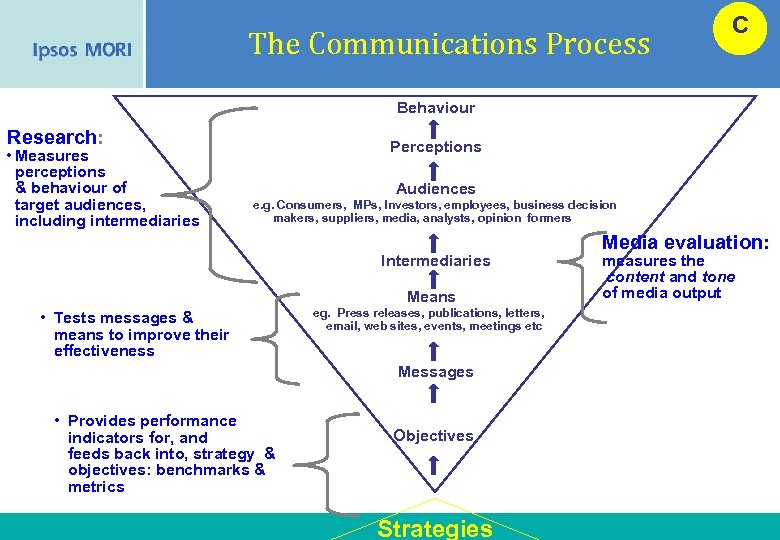
The Communications Process C Behaviour Research: • Measures perceptions & behaviour of target audiences, including intermediaries Perceptions Audiences e. g. Consumers, MPs, Investors, employees, business decision makers, suppliers, media, analysts, opinion formers Intermediaries Means • Tests messages & means to improve their effectiveness Media evaluation: measures the content and tone of media output eg. Press releases, publications, letters, email, web sites, events, meetings etc Messages • Provides performance indicators for, and feeds back into, strategy & objectives: benchmarks & metrics Objectives Strategies 45
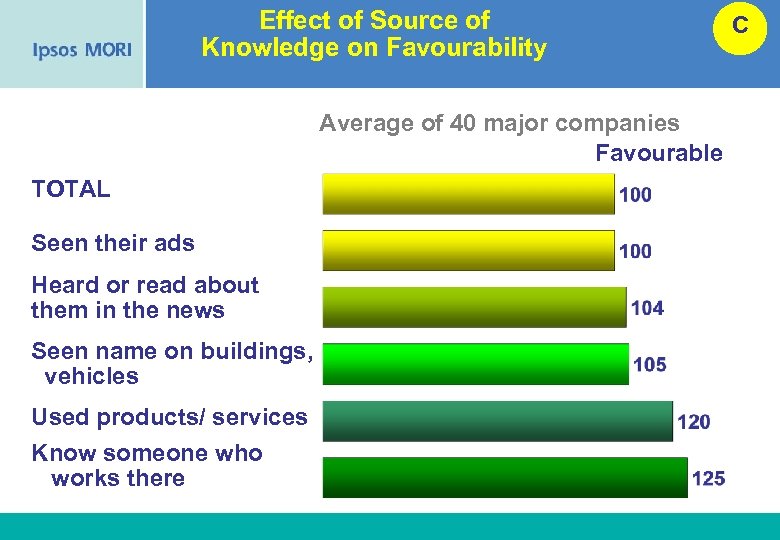
Effect of Source of Knowledge on Favourability C Average of 40 major companies Favourable TOTAL Seen their ads Heard or read about them in the news Seen name on buildings, vehicles Used products/ services Know someone who works there 46
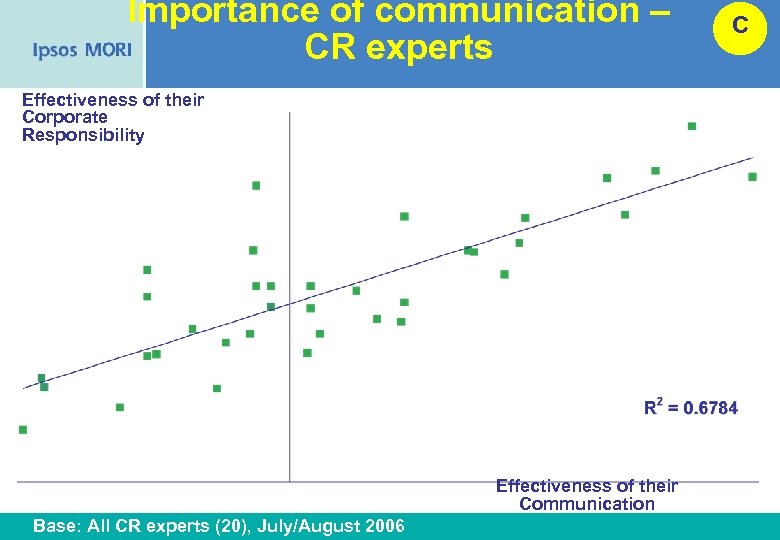
Importance of communication – CR experts C Effectiveness of their Corporate Responsibility Effectiveness of their Communication Base: All CR experts (20), July/August 2006 47
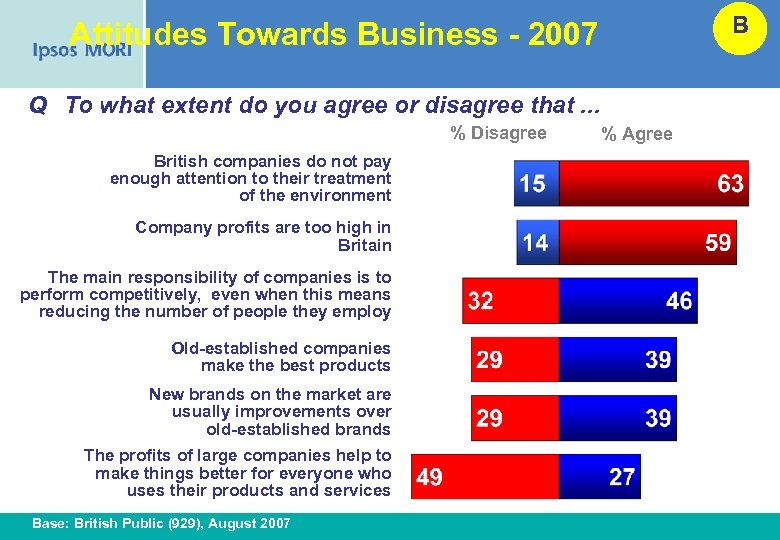
B Attitudes Towards Business - 2007 Q To what extent do you agree or disagree that. . . % Disagree % Agree British companies do not pay enough attention to their treatment of the environment Company profits are too high in Britain The main responsibility of companies is to perform competitively, even when this means reducing the number of people they employ Old-established companies make the best products New brands on the market are usually improvements over old-established brands The profits of large companies help to make things better for everyone who uses their products and services Base: British Public (929), August 2007 48
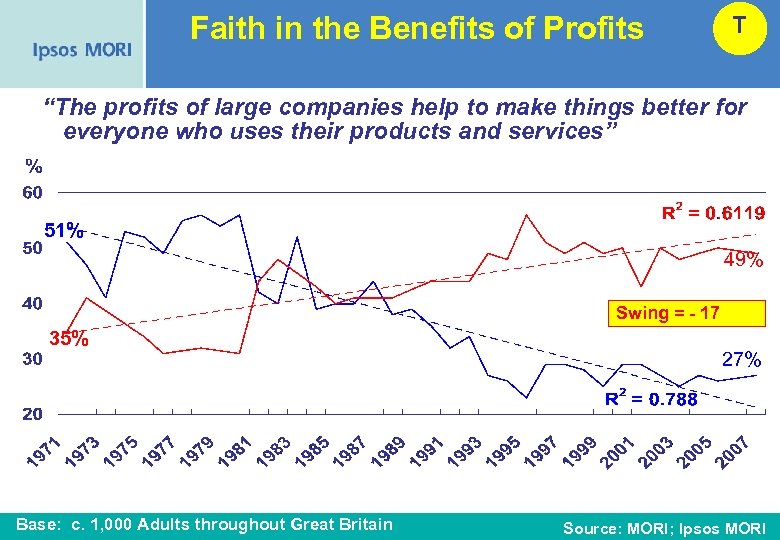
Faith in the Benefits of Profits T “The profits of large companies help to make things better for everyone who uses their products and services” 51% 49% Swing = - 17 35% Base: c. 1, 000 Adults throughout Great Britain 27% 49 Source: MORI; Ipsos MORI
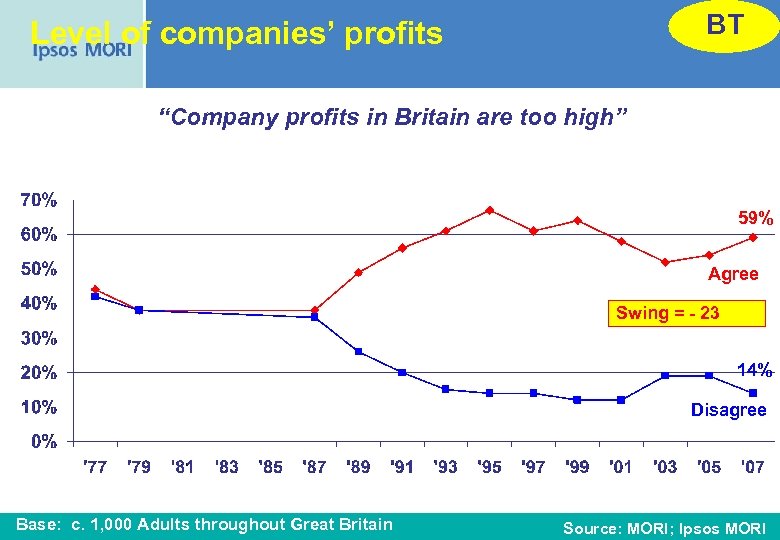
BT Level of companies’ profits “Company profits in Britain are too high” 59% Agree Swing = - 23 14% Disagree Base: c. 1, 000 Adults throughout Great Britain 50 Source: MORI; Ipsos MORI
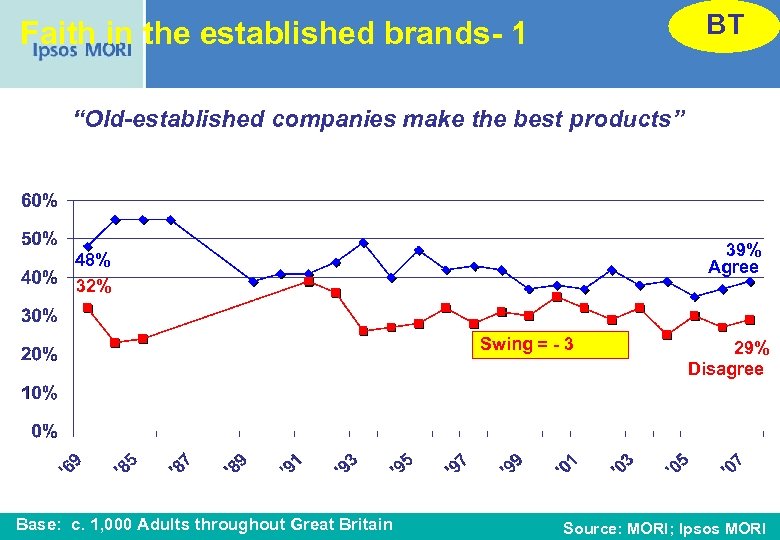
BT Faith in the established brands- 1 “Old-established companies make the best products” 39% Agree 48% 32% Swing = - 3 Base: c. 1, 000 Adults throughout Great Britain 29% Disagree 51 Source: MORI; Ipsos MORI
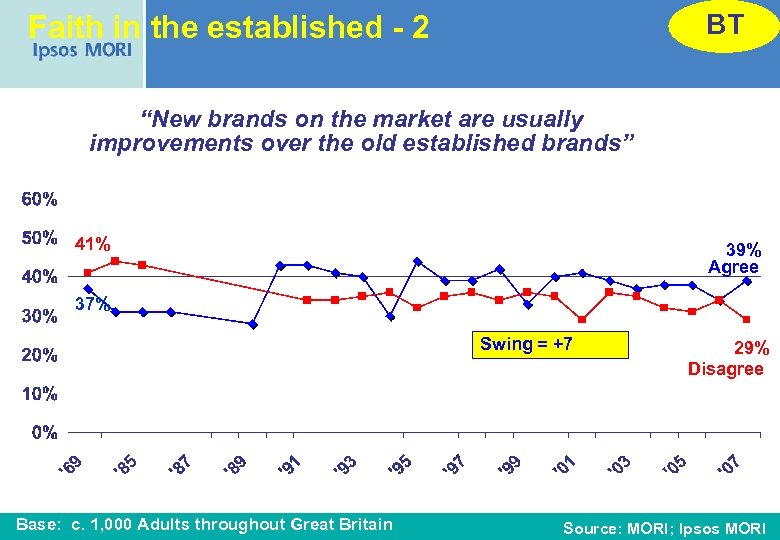
BT Faith in the established - 2 “New brands on the market are usually improvements over the old established brands” 41% 39% Agree 37% Swing = +7 Base: c. 1, 000 Adults throughout Great Britain 29% Disagree 52 Source: MORI; Ipsos MORI
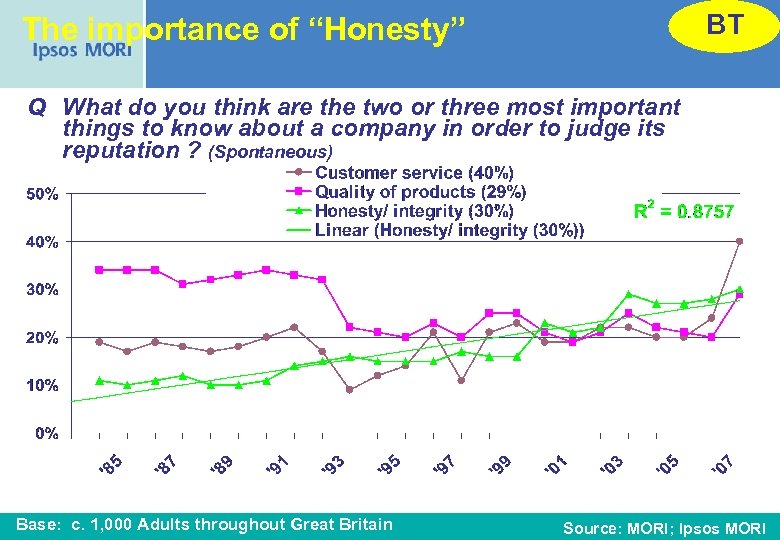
BT The importance of “Honesty” Q What do you think are the two or three most important things to know about a company in order to judge its reputation ? (Spontaneous) Base: c. 1, 000 Adults throughout Great Britain 53 Source: MORI; Ipsos MORI
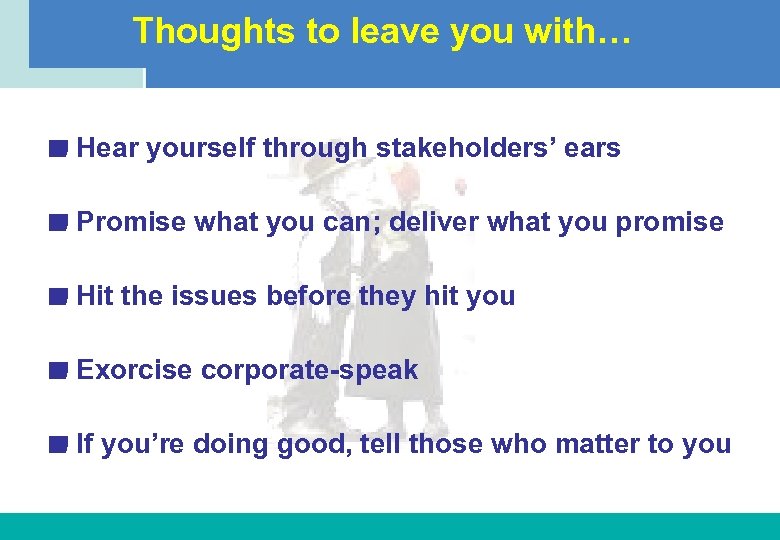
Thoughts to leave you with… Hear yourself through stakeholders’ ears Promise what you can; deliver what you promise Hit the issues before they hit you Exorcise corporate-speak If you’re doing good, tell those who matter to you 54
Thank you chancellor@kent. ac. uk 55
Скачать презентацию Uses and Abuses of Market Research and Opinion
bc4d519836f82fc37289055e455e2134.ppt