


 Скачать презентацию User Authentication Principles and Methods David Groep NIKHEF
38d9f685dd8872d228cb7e8c52617b6c.ppt
- Количество слайдов: 27
 User Authentication Principles and Methods David Groep, NIKHEF User Authentication - Principles and Methods 1
 Principles and Methods • Authorization factors • Cryptographic methods • Authentication for login • How secure is security? User Authentication - Principles and Methods 2
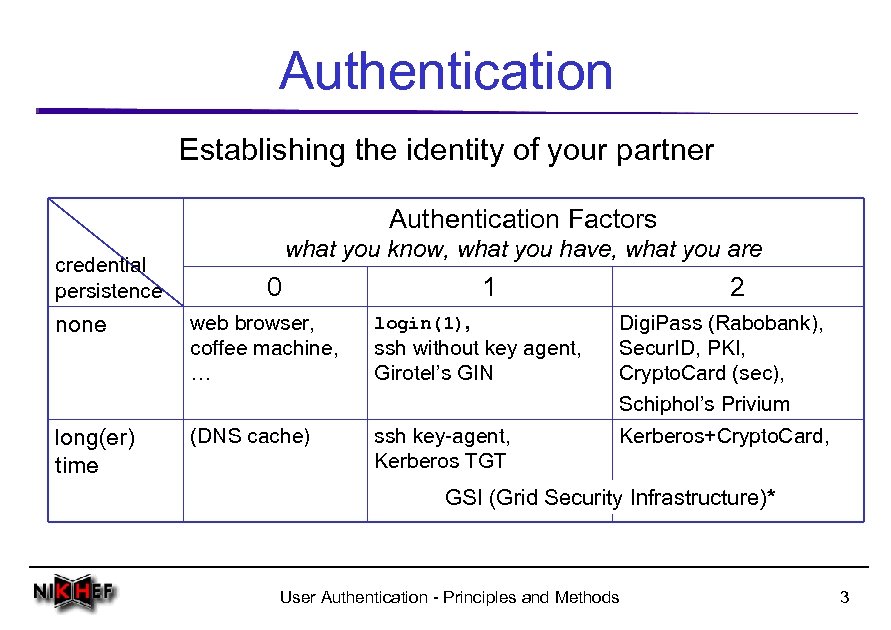 Authentication Establishing the identity of your partner Authentication Factors credential persistence what you know, what you have, what you are 0 1 none web browser, coffee machine, … login(1), long(er) time (DNS cache) ssh key-agent, Kerberos TGT ssh without key agent, Girotel’s GIN 2 Digi. Pass (Rabobank), Secur. ID, PKI, Crypto. Card (sec), Schiphol’s Privium Kerberos+Crypto. Card, GSI (Grid Security Infrastructure)* User Authentication - Principles and Methods 3
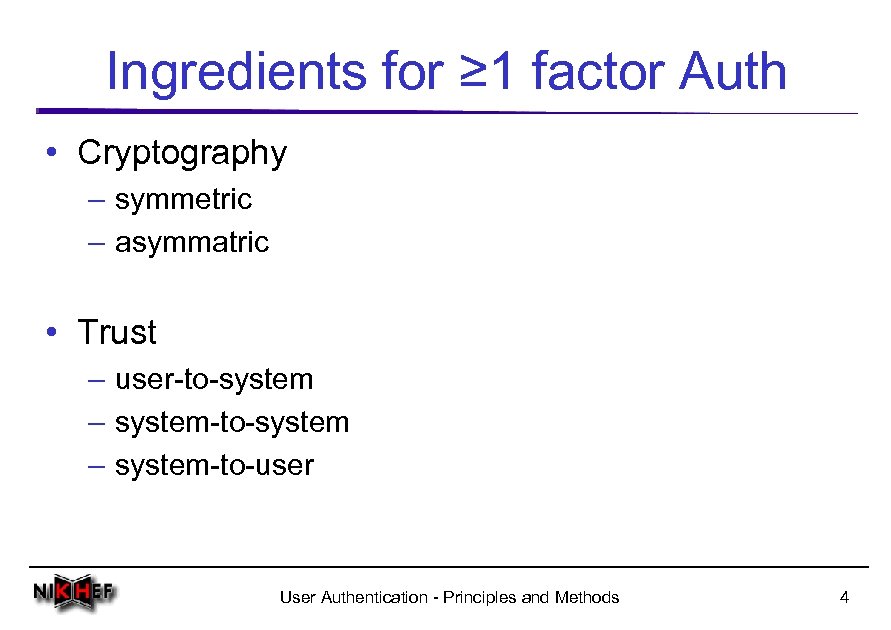 Ingredients for ≥ 1 factor Auth • Cryptography – symmetric – asymmatric • Trust – user-to-system – system-to-user User Authentication - Principles and Methods 4
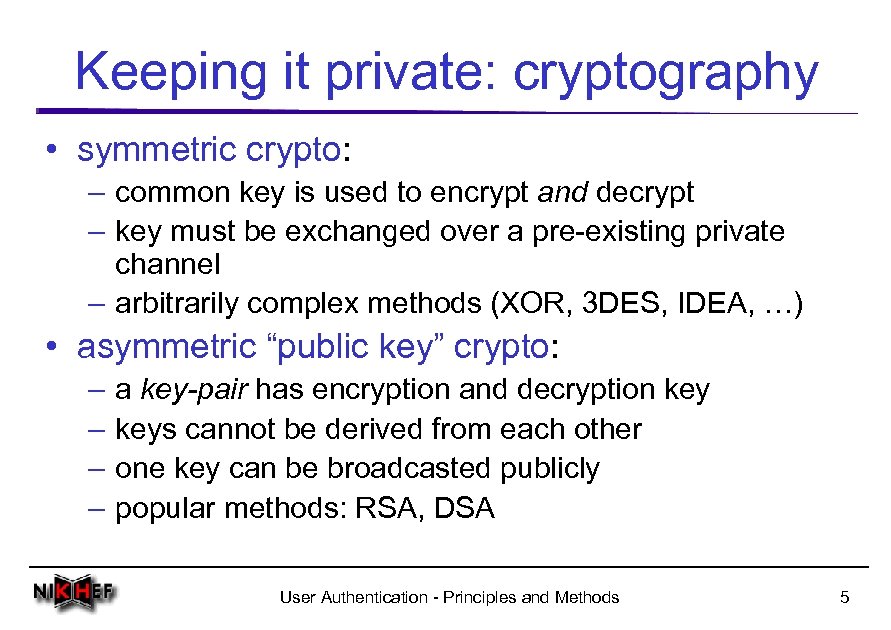 Keeping it private: cryptography • symmetric crypto: – common key is used to encrypt and decrypt – key must be exchanged over a pre-existing private channel – arbitrarily complex methods (XOR, 3 DES, IDEA, …) • asymmetric “public key” crypto: – – a key-pair has encryption and decryption keys cannot be derived from each other one key can be broadcasted publicly popular methods: RSA, DSA User Authentication - Principles and Methods 5
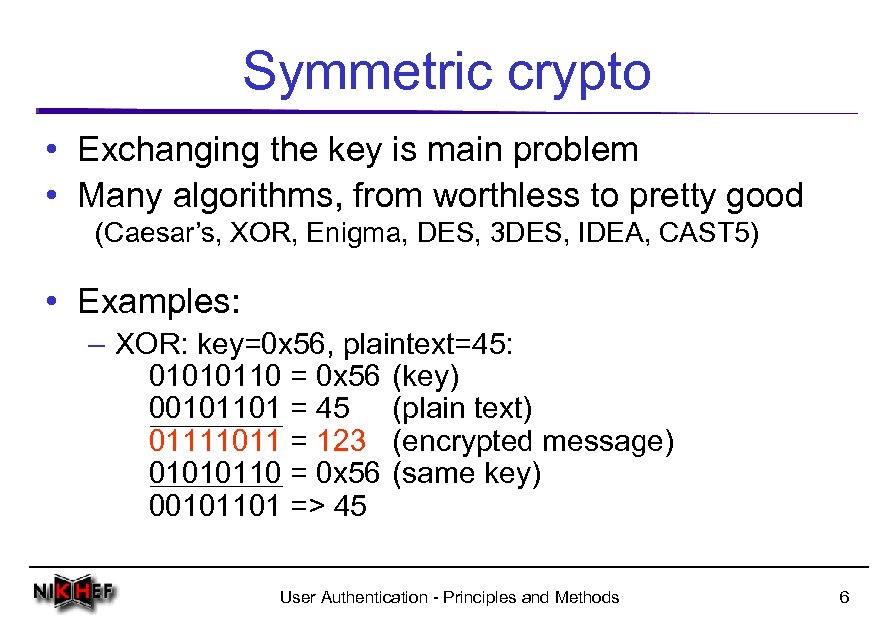 Symmetric crypto • Exchanging the key is main problem • Many algorithms, from worthless to pretty good (Caesar’s, XOR, Enigma, DES, 3 DES, IDEA, CAST 5) • Examples: – XOR: key=0 x 56, plaintext=45: 01010110 = 0 x 56 (key) 00101101 = 45 (plain text) 01111011 = 123 (encrypted message) 01010110 = 0 x 56 (same key) 00101101 => 45 User Authentication - Principles and Methods 6
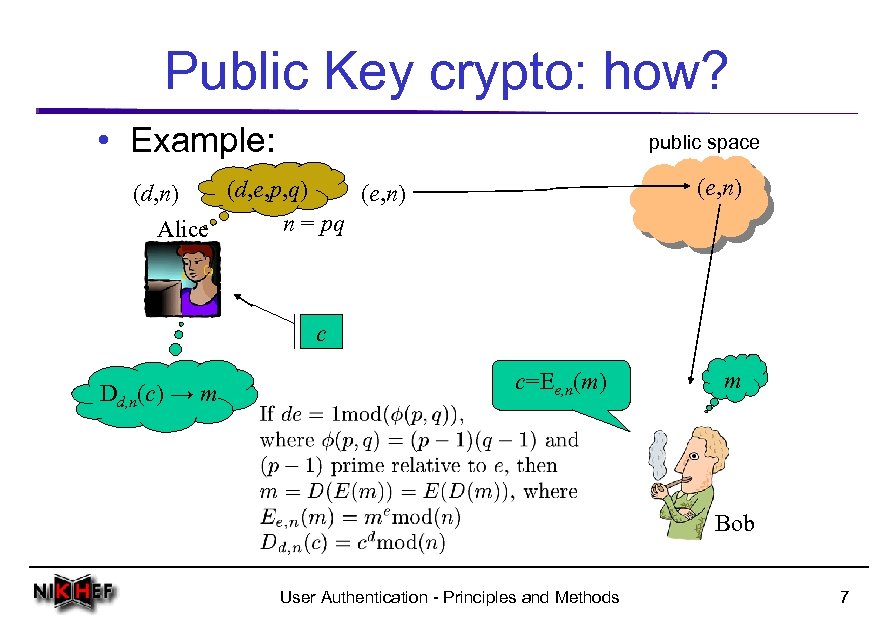 Public Key crypto: how? • Example: public space (e, n) (d, e, p, q) (d, n) (e, n) n = pq Alice c Dd, n(c) → m c=Ee, n(m) m Bob User Authentication - Principles and Methods 7
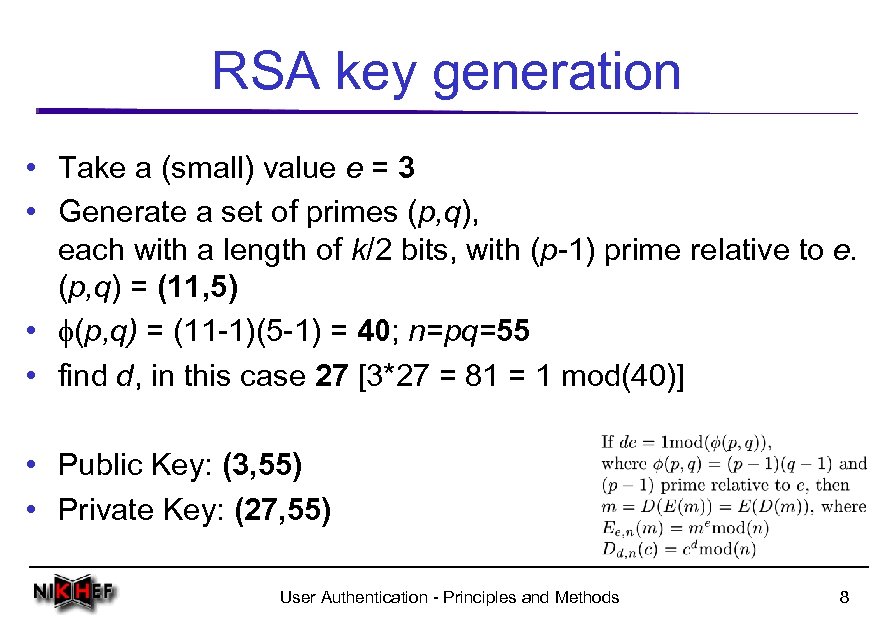 RSA key generation • Take a (small) value e = 3 • Generate a set of primes (p, q), each with a length of k/2 bits, with (p-1) prime relative to e. (p, q) = (11, 5) • (p, q) = (11 -1)(5 -1) = 40; n=pq=55 • find d, in this case 27 [3*27 = 81 = 1 mod(40)] • Public Key: (3, 55) • Private Key: (27, 55) User Authentication - Principles and Methods 8
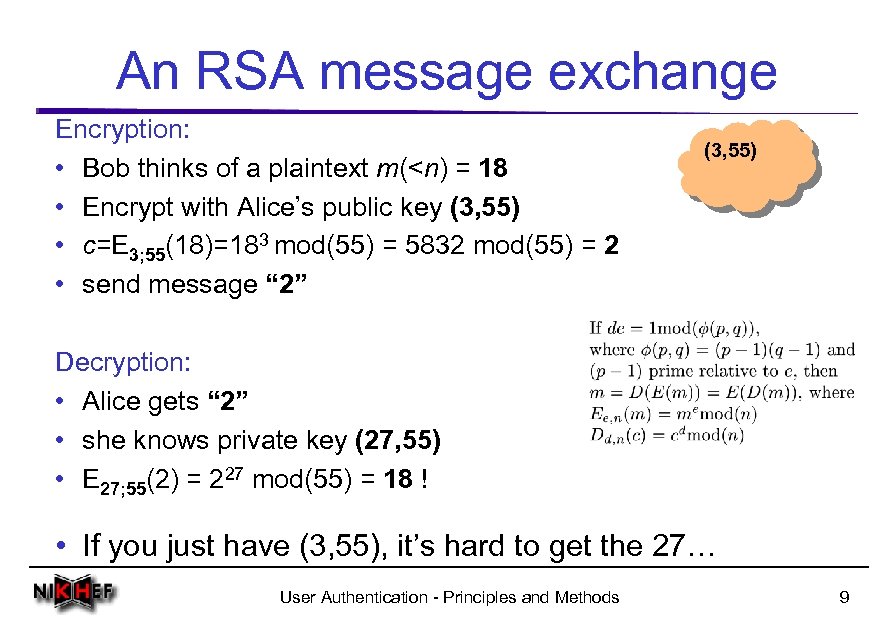 An RSA message exchange Encryption: • Bob thinks of a plaintext m(
 Uses of public-key crypto • Confidentiality no-one but the recipient can read what you say • Message integrity encrypt a digest of your message with a private key • Non-repudiation similar to integrity • This encryption works both ways with 2 key pairs User Authentication - Principles and Methods 10
 From public-key crypto to trust • You establish communication between key pairs but not between entities! • Binding needed between key pair and an identity (this is implicit in symmetric solutions, but not here!) • in a trusted way … • Anarchic models (SSH) • Distributed trust models (PGP) • Hierarchical (authoritarian) model (PKI) User Authentication - Principles and Methods 11
 Methods (1): login/telnet -style • Only one factor, a password in the user’s memory • Password must be kept secret – should not be sent in clear over networks – user must not write it down in clear – should not be guessable problems with all of the above… User Authentication - Principles and Methods 12
 Methods (2): ssh with passwords • still only one factor: the password • but each SSH daemon as a RSA* key pair: – public key is sent to the client – this is used to encrypt a (symmetric) session key – password and future data are sent within the encrypted session User Authentication - Principles and Methods 13
 Methods (2): ssh with passwords • Problems with SSH password authentication: – key distribution problem • how can the client verify that the host public key is correct? • only trivial alerts against change of host key – no single sign-on (login to a new host requires typing the password) – leads to guessable passwords or writing them down! User Authentication - Principles and Methods 14
 Methods (3): ssh with client keys • Have the client generate an RSA key pair locally: ssh-keygen → ~/. ssh/id_rsa & ~/. ssh/id_rsa. pub • The public part of this key is stored on remote server in user homedir: ~remoteuser/. ssh/authorized_keys 2 • ssh remoteuser@remotehost challenge encrypted with public key sent to user; can he decrypt it? • same keypair can be used for all hosts User Authentication - Principles and Methods 15
 Methods (3): ssh with client keys • The (local) user keypair is a very valuable target! • Need to (symmetrically) encrypt the private key (~/. ssh/id_rsa) • to get single sign-on: – in-memory proxy agent can serve the private key to new clients (ssh-agent, ssh-add ~/. ssh/id_rsa) – protected with unix file privileges on socket – contact information in environment variables • Key distribution problem is still there… User Authentication - Principles and Methods 16
 Methods (4): Kerberos • Based on symmetric cryptography • One Key Distribution Centre (KDC) per `Realm’ – Authentication Service (AS) and – Ticket Granting Service (TGS) • KDC supplies limited-lifetime “tickets” to principals – Ticket Granting Ticket, encrypted with hash of password – Service Tickets (ST), verified using the TGT • Every service also shares a secret with the KDC (kadmin: add_principal host/satan. hell. org@HELL. ORG) User Authentication - Principles and Methods 17
 Methods (4): Kerberos • User contacts KDC and gets TGT, encrypted using 3 DES with hash of password as key • • TGT used to encrypt session where ST is requested from KDC user gets ticket only when authorized by the KDC AS ST encrypted with password of service’s principal If service can decrypt ticket, it can be used to exchange new session key • KDC has copy of every principal’s password! • Has active role, thus central point of failure User Authentication - Principles and Methods 18
 Methods (5): PKI • Public Key Infrastructure, PKI, aims to solve the key distribution problem for public key crypto • Trusted third party (Certification Authority) binds authentication data to a public key: the Certificate User Authentication - Principles and Methods 19
 Methods (5): PKI • The PKI Certificate `X. 509’ – – structured message with: public key identifier(s) digitally signed by a trusted third party • Certification Authority (CA) – binds identifiers to a public key – in accordance with a defined Certification Policy – following the guidelines of a C. Practice Statement User Authentication - Principles and Methods 20
 Methods (5): PKI • Certificate used without interaction with CA • Life-time: usually 1 year (should depend on RSA key length) • Used in TLS protocols (formerly SSL) • Public key encrypts a (symmetric) session key • Can be used both ways (client authentication) • Also for message security • Applications: https, S/MIME. • Popular CA’s: Verisign, Thawte User Authentication - Principles and Methods 21
 Methods (5): PKI • Problems with PKI – public keys for trusted CA’s need to be distributed – difficult to invalidate credentials (`revocation’) – need to protect private key with passphrase, no implicit single sign-on; key may still be on disk… – CA is accountable for the binding he makes – heavy registration procedure (RA’s, etc. ) – site admins risk doing double work when working with user certs for sensitive work/login User Authentication - Principles and Methods 22
 Methods (6): GSI • Grid Security Infrastructure (GSI), based on PKI • user generates limited `proxies’ of long-living credential • • • proxy secured by regular unix file permissions life-time usually 12 hours possible to limit capabilities (`only read e-mail’) proxy signed by long-lived key, that is signed by CA proxy implements single sign-on other PKI problems remain: key on disk, double work, heavy CA • applications: grid job run, file access, gsi-ssh User Authentication - Principles and Methods 23
 One-time pads • Adds extra factor to authentication (cryptocard) • Cryptocard serves as password generator but needs activation data (PIN code) • Clock syncronization cryptocard & host/server • can be used over any channel (login, telnet, ssh, …) User Authentication - Principles and Methods 24
 Hardware tokens • Store precious credentials on detached active storage • Examples: – Secur. ID*: small processor on-board decrypts challenge with the built-in private key, key never leaves card (RSA or symmetric key) – Chipknip (3 DES symmetric key) User Authentication - Principles and Methods 25
 Summary of Methods 1. 2. 3. 4. 5. 6. Login, Telnet ssh with password authentication ssh with RSA authentication Kerberos PKI GSI • Additional bonus options for (almost) all: – one-time pads – hardware tokens User Authentication - Principles and Methods 26
 Conclusions • Plenty of options, – from weak to strong, – for harmless stuff and for military-grade secrets • No silver bullet – Security is about reducing risk, not eliminating risk – Users are oblivious to security: if it’s too difficult, they will: • • write their password on the wyteboard type their password in plain text in scripts to renew credentials install their own back-doors …… User Authentication - Principles and Methods 27