


 Скачать презентацию Use of Remote Sensing for Routine Coastal Water
dce2f9b388ee06cd0366ef4c6df6f4ed.ppt
- Количество слайдов: 28
 Use of Remote Sensing for Routine Coastal Water Monitoring by a State Agency Bob Connell New Jersey Department of Environmental Protection Bureau of Marine Water Monitoring
 Mission for Monitoring • Characterize the variability of some parameter – Temporal variability (over time) – Spatial variability – At various scales of both time and space
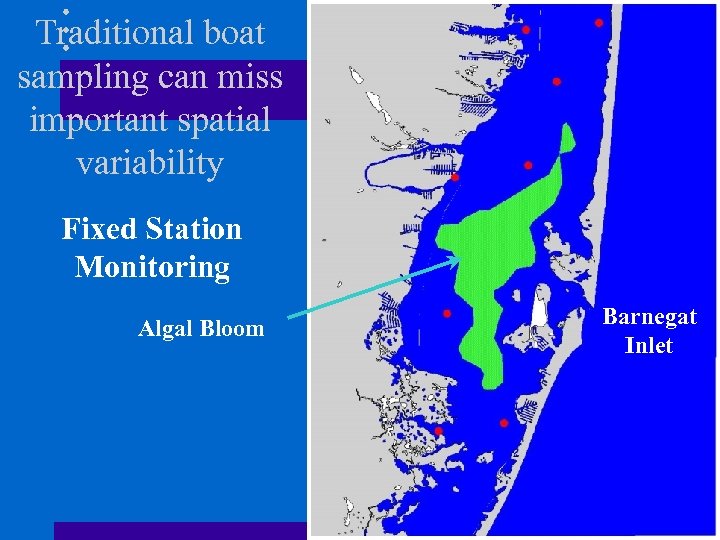 Traditional boat sampling can miss important spatial variability Fixed Station Monitoring Algal Bloom Barnegat Inlet
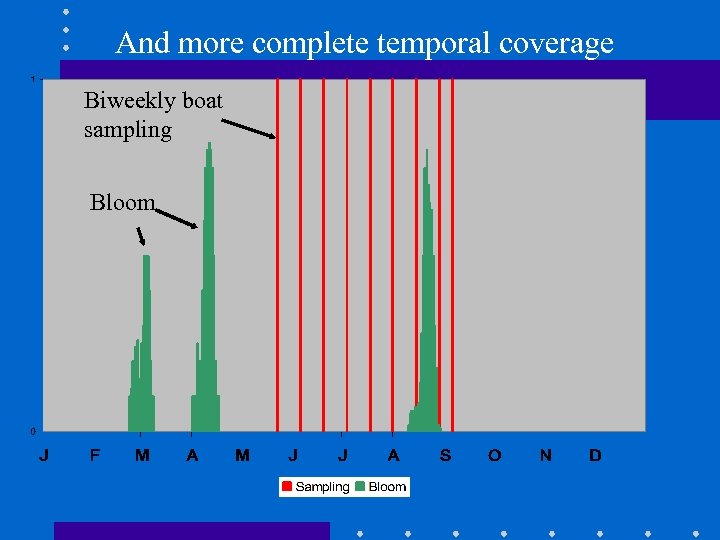 And more complete temporal coverage Biweekly boat sampling Bloom
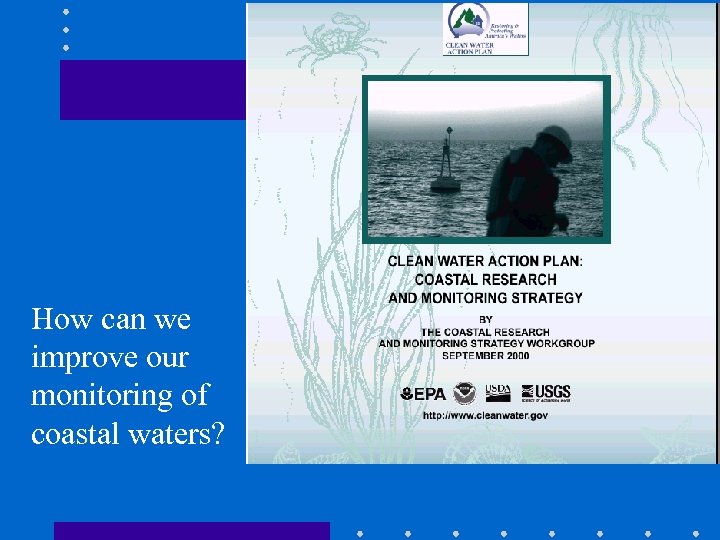 How can we improve our monitoring of coastal waters?
 Coastal Monitoring Strategy Key Attributes: • Co-funding by Federal and State programs • Nested designs to allow State-specific issues to be addressed in a national context
 Coastal Monitoring Strategy: • Enhance the density of coastal buoy and shore-based meteorological and water-level observing system network by adding temperature, salinity, nutrients, hazardous algal blooms and other chemical and biological sensors.
 Coastal Monitoring Strategy: • Enhance remote sensing efforts to provide high resolution laser and acoustic substrate/habitat maps, operational ocean color, turbidity, and sea surface temperature (SST) products, as well as coastal land habitat coverage change.
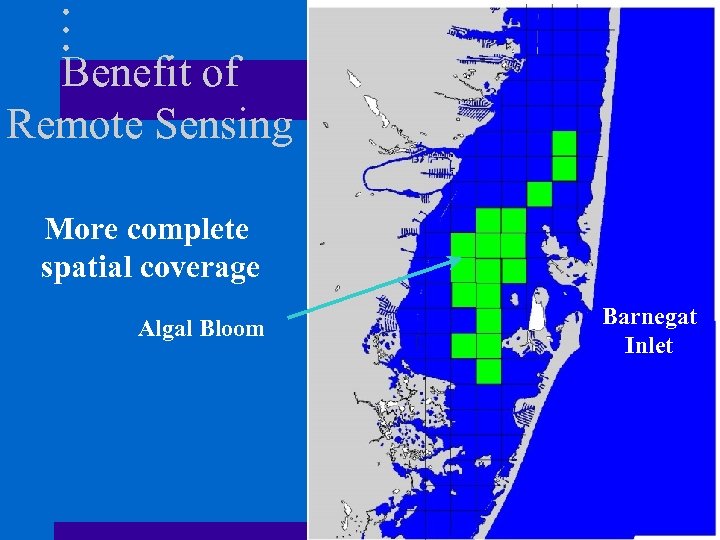 Benefit of Remote Sensing More complete spatial coverage Algal Bloom Barnegat Inlet
 State Responsibilities That Can Benefit from Remote Sensing • • Water Quality Inventory Reporting National Shellfish Sanitation Program Bathing Beach monitoring Pollution Source Tracking Spill Response (Oil Spill Surveillance System) Fisheries Management (Maine Lobster Project) Benthic Habitat Monitoring (SAV mapping)
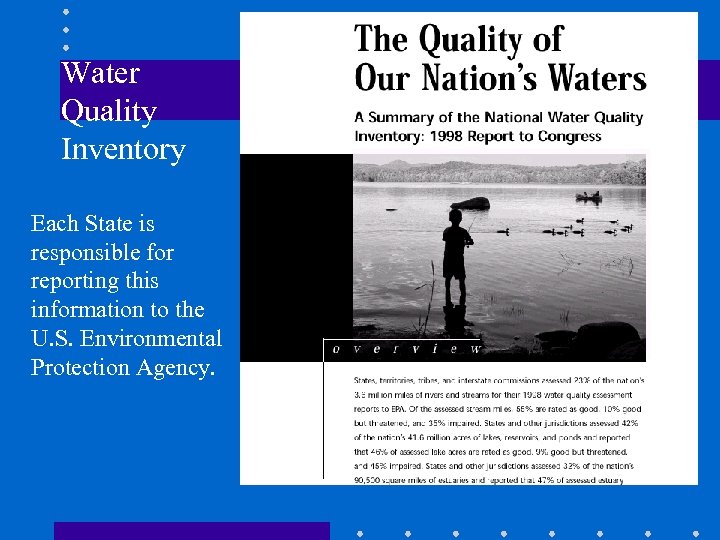 Water Quality Inventory Each State is responsible for reporting this information to the U. S. Environmental Protection Agency.
 National Shellfish Sanitation Program • Requires shellfish-producing States to monitor their coastal waters for substances that could render shellfish unfit for human consumption • The list of substances includes biotoxins from harmful algal blooms. • First line of defense is a good monitoring program for the presence of algal blooms.
 Paralytic Shellfish Poisoning (PSP) • Occurs in all coastal New England states and along much of the west coast from Alaska to California. • Causative species - the dinoflagellates Alexandrium tamarense, A. fundyense, and A. catenella
 Amnesic Shellfish Poisoning (ASP) • Occurred first in southeastern Canada, but has recently been a problem for the U. S. Pacific coast states • Causative species - the diatoms Pseudonitzschia pungens forma multiseries and Pseudonitzschia australis;
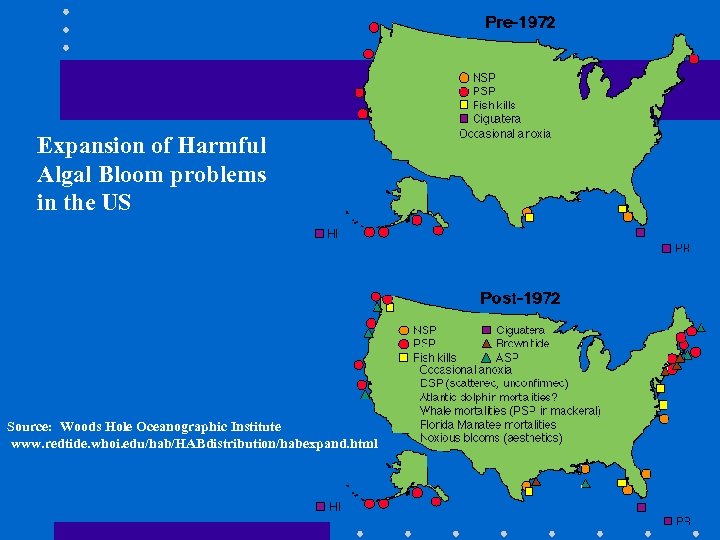 Expansion of Harmful Algal Bloom problems in the US Source: Woods Hole Oceanographic Institute www. redtide. whoi. edu/hab/HABdistribution/habexpand. html
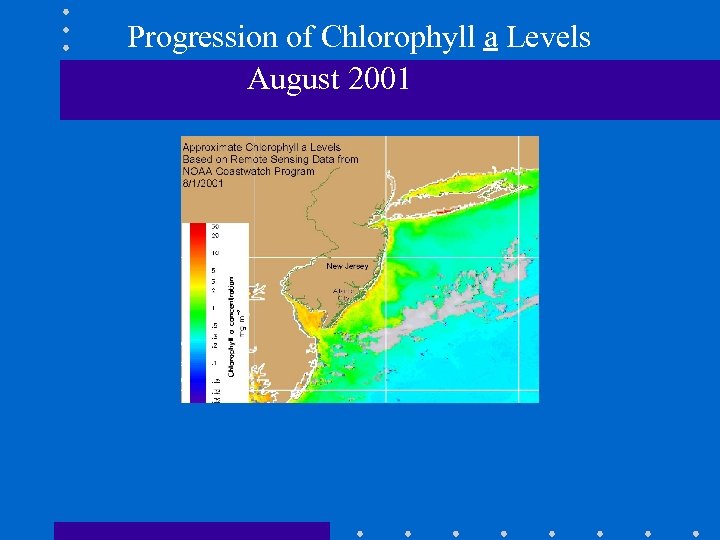 Progression of Chlorophyll a Levels August 2001
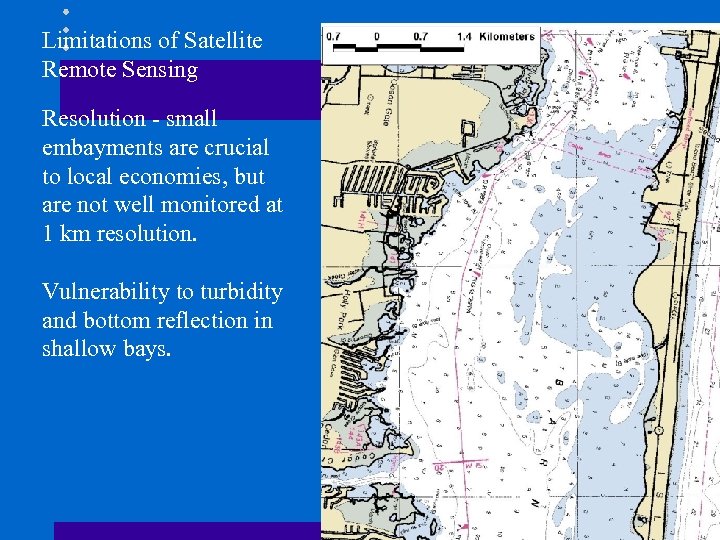 Limitations of Satellite Remote Sensing Resolution - small embayments are crucial to local economies, but are not well monitored at 1 km resolution. Vulnerability to turbidity and bottom reflection in shallow bays.
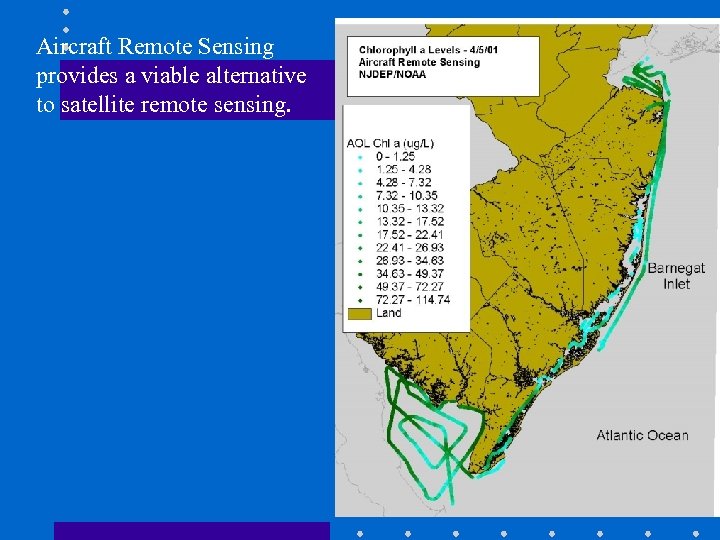 Aircraft Remote Sensing provides a viable alternative to satellite remote sensing.
 Application of AVHRR data to oyster resource issue in New Jersey • Unusually high levels of a naturally occurring bacterium in New Jersey oysters for 1 -2 weeks in June 2001. • Since this had never occurred before, we needed to identify unique conditions that might have caused it. • The bacteria involved (Vibrio parahaemolyticus) are primarily responsive to temperature conditions.
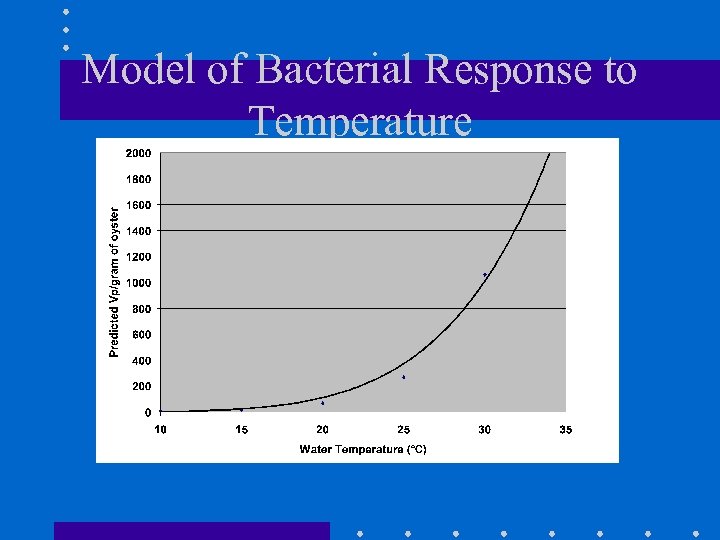 Model of Bacterial Response to Temperature
 Problems with assessing temperature • Affected oyster beds were not near any continuous monitoring location for temperature. • Boat sampling occurs, but only 1 -2 times/month and not at the same location as the beds. Temperatures could change dramatically over 2 -4 weeks.
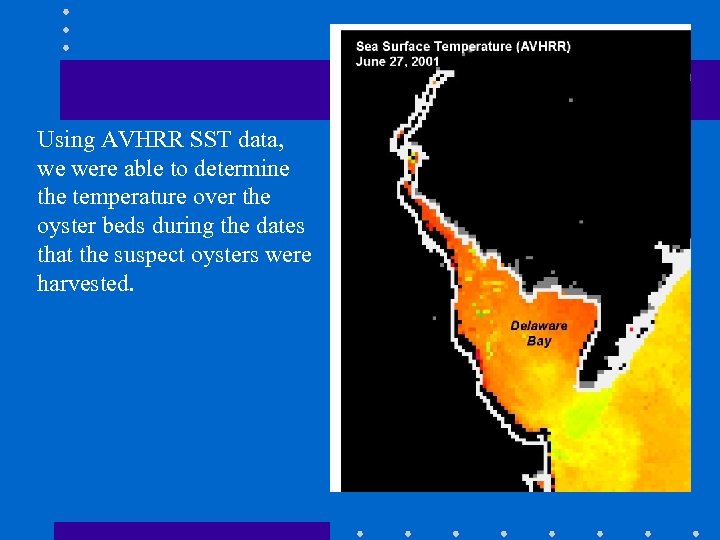 Using AVHRR SST data, we were able to determine the temperature over the oyster beds during the dates that the suspect oysters were harvested.
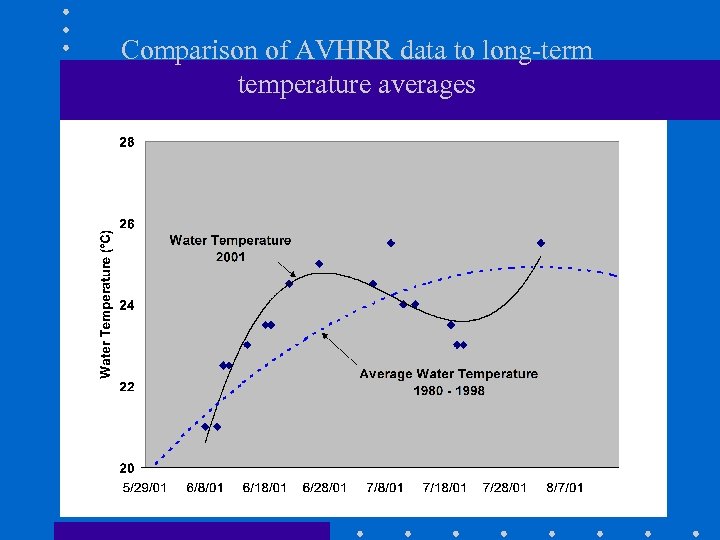 Comparison of AVHRR data to long-term temperature averages
 What is needed for greater use of Remote Sensing data by the States in their coastal water quality monitoring programs?
 Parameters • • Chlorophyll Temperature Turbidity Thermal imaging
 RS Needs of State Monitoring Programs • Rapid, reliable access to processed data – Processed • In general, State agencies do not have staff with extensive RS experience to process data • Geo-referenced data (e. g. Geo. TIFF) is a plus – Rapid • Often responding to rapidly changing conditions. Data that is 1 -2 weeks old may not be useful. – Reliable • Consistent data availability and consistent procedures to access the data
 RS Needs of State Monitoring Programs • Nationally recognized processing methods • Resolution on a scale to assess water quality conditions in small bays and estuaries – Access to data from new satellite sensors – Sensors to mount on agency owned aircraft • Reasonable cost with incremental buy-in – States are reeling from budget deficits & balanced budget requirements – Need to demonstrate value to management
 Summary • Remote sensing will be increasing used by State agencies to perform their coastal monitoring responsibilities • Partnerships among government agencies, industry and academic institutions will bring this about. Bob. Connell@dep. state. nj. us