


 Скачать презентацию USE OF REMOTE CAMERAS IN WILDLIFE ECOLOGY Shawn
8aa1f86bcbdd691e6bbf443962ac32db.ppt
- Количество слайдов: 18
 USE OF REMOTE CAMERAS IN WILDLIFE ECOLOGY Shawn L. Locke, Israel D. Parker, and Roel R. Lopez Department of Wildlife and Fisheries Sciences, Texas A&M University College Station, TX 77843, USA
 Battery Longevity § Battery longevity is a product of: • • • § temperature age number of pictures taken flash configuration or presence battery quality Battery life has advanced significantly and many models can run up to 150 days or take ≥ 1, 000 photos.
 Data Storage § Data storage capacity • Continues to improve with relatively inexpensive storage units (e. g. , SD cards) holding thousands of pictures and videos. • This is a vast improvement over film-based cameras that are generally limited to a maximum of 36 images before film replacement.
 Picture Quality § Picture quality • Images recorded by cameras can vary in quality and size depending on equipment specifications. • Researchers must balance resolution requirements with storage capabilities. • Researchers should determine storage and resolution requirements prior to beginning research or management activities.
 DATA MANAGEMENT § Data management • A data management plan is important prior to the initiation of a camera project. • Studies involving cameras can generate thousands of images therefore, organization and data storage are critical. • It is helpful to have photo editing software to enhance photo quality and clarity for interpretation.
 REMOTE CAMERAS § Two types of remote cameras: • Active infrared or beam-break sensors use an infrared emitter and receiver creating a beam of infrared light or trip line. • Passive infrared sensors detect movement and radiation emitted by animals within a field of view.
 Remote Camera Features
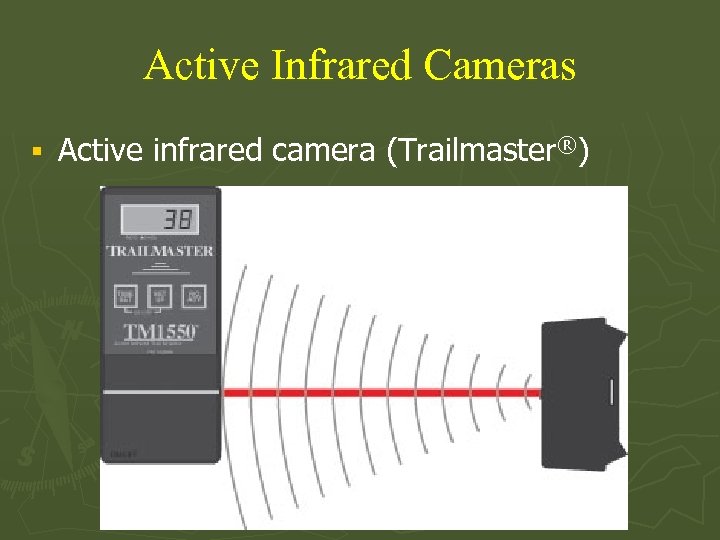 Active Infrared Cameras § Active infrared camera (Trailmaster®)
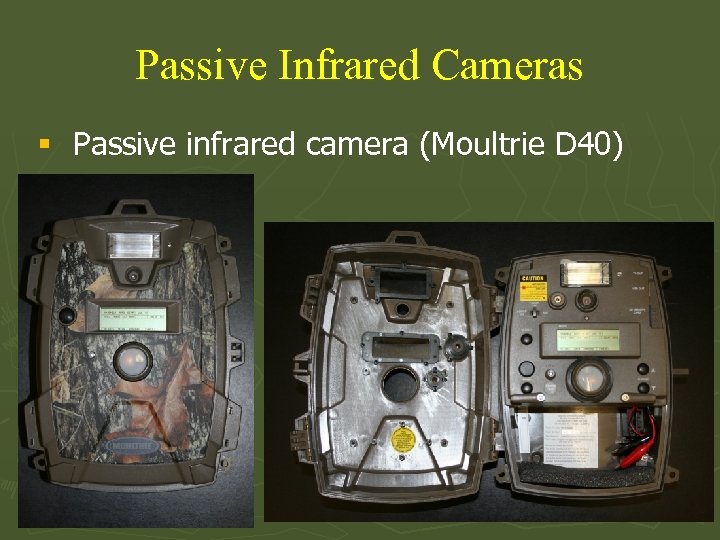 Passive Infrared Cameras § Passive infrared camera (Moultrie D 40)
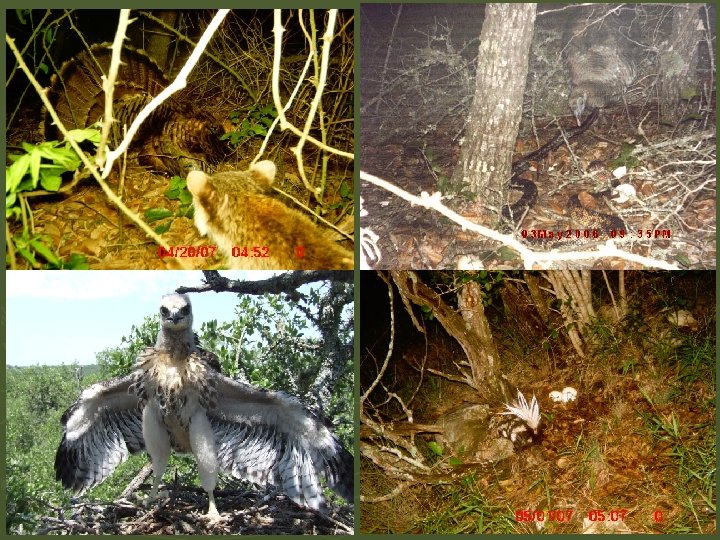
 Types of Data Gathered § Remote cameras can assist in determining: • • • Occupancy and distribution Population estimation Nest predation Animal behavior and activity Diet
 Thermal Infrared Cameras A limiting factor in studying mammals is observing them. § Mammals often can be cryptic or nocturnal thereby making them difficult to see using only human vision. § The use of thermal infrared imagery devices can aid researchers by converting the nonvisible, infrared spectrum (0. 8– 14. 0 µm) into a visible spectrum. §
 Pros and Cons of Thermal Cameras § Pros • Works well in optimal conditions • Declining costs • Detects spectrum outside of human vision • Increasing utility in wildlife disease § Cons • Cost • Detection varies among vegetation structure • Animal size impacts detectability • Poikilothermic organisms are problematic • Seasonally dependent
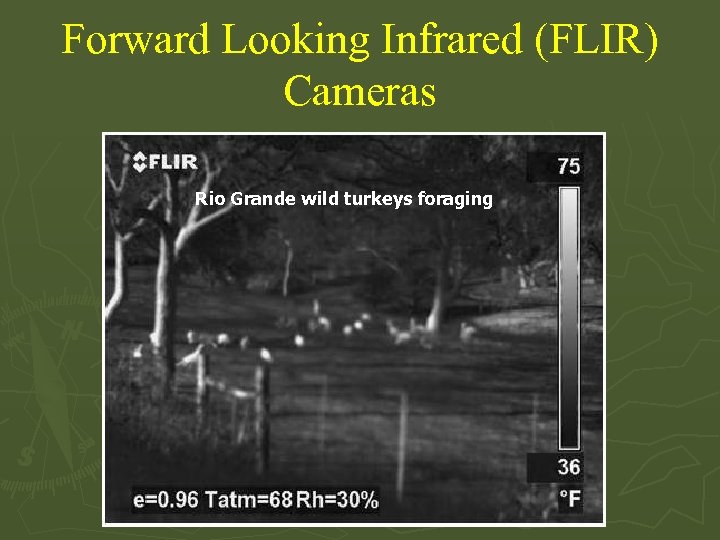 Forward Looking Infrared (FLIR) Cameras Rio Grande wild turkeys foraging
 Innovative Camera Techniques Improvements in component miniaturization and capability, storage capacity, build quality, and price have spurred the use of cameras (both still and video) in ecology in a variety of new directions. § Companies are now designing camera (both still and video) systems to answer specific research questions. §
 Examples of Camera Techniques § Examples • Peep cameras for monitoring nest activity • Live streaming video broadcast on the internet of nesting/denning activities (e. g. , bald eagles, bears) • Cameras on small remote controlled aircraft • Telescoping or flexible tubing cameras for snaking into dens or burrows
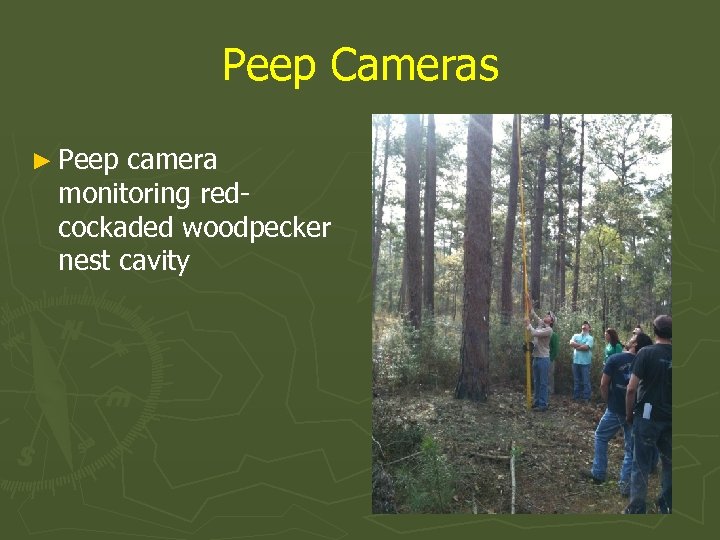 Peep Cameras ► Peep camera monitoring redcockaded woodpecker nest cavity
 SUMMARY Cameras are a useful tool in wildlife ecology, but their usefulness depends upon the quality of the study design and capabilities of the operator. ► Cameras are appropriate in research where: ► § § § humans would cause disturbance to wildlife behavior, extended observational periods are required, observation must take place in dangerous, inclement, or remote areas, permanent and verifiable data is needed, or different capabilities from the human eye are required.