 Скачать презентацию Use Cases and Scenarios 2006 -07 Betty
60439f0211d3b7cf08702993ee0ef021.ppt
- Количество слайдов: 26



Use Cases and Scenarios © 2006 -07 Betty H. C. Cheng. This presentation is available free for non-commercial use with attribution under a creative commons license.
We Will Cover • What is a use-case – Use-case versus user interaction • Use-Case diagrams – The constructs in the use-case diagrams • Capturing the use-case – High-level use-case – Extended use-case – Difference between use case and scenario © 2006 -07 Betty H. C. Cheng. This presentation is available free for non-commercial use with attribution under a creative commons license.
What is a Use-Case • A use-case captures some user visible function • This may be a large or small function – Depends on the level of detail in your modeling effort • A use-case achieves a discrete goal for the user • Examples – Format a document – Request an elevator • How are the use cases found (captured or elicited)? © 2006 -07 Betty H. C. Cheng. This presentation is available free for non-commercial use with attribution under a creative commons license.
User Goals versus User Interactions • Consider the following when formatting a document • Define a style • Change a style • Copy a style from one document to the next – versus • Format a document • Ensure consistent formatting of two documents • The latter is a user goal – Something the user wants to achieve • The former are user interactions – Things the user does to the system to achieve the goal © 2006 -07 Betty H. C. Cheng. This presentation is available free for non-commercial use with attribution under a creative commons license.
Goals and Interactions • There is a place for both goals and interactions • Understand what the system shall do – Capture the user goals • Understand how the user will achieve the goals – Capture user interactions – Sequences of user interactions • Thus, start with the user goals and then refine the user goals into several (many) user interactions © 2006 -07 Betty H. C. Cheng. This presentation is available free for non-commercial use with attribution under a creative commons license.
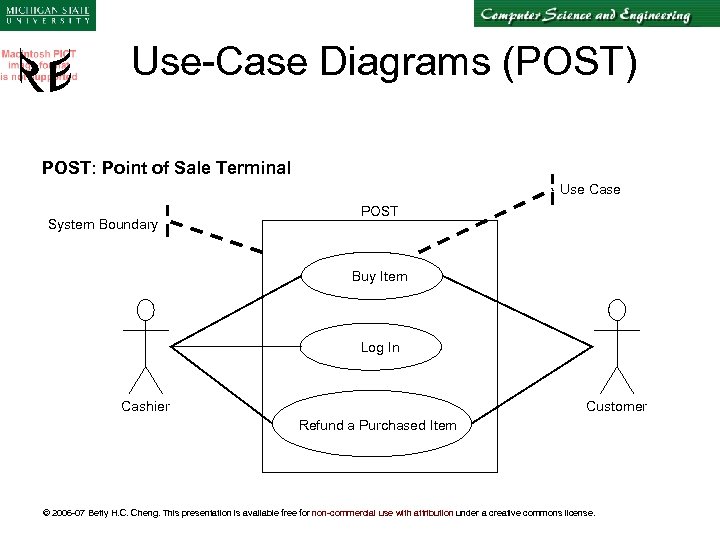
Use-Case Diagrams (POST) POST: Point of Sale Terminal Use Case System Boundary POST Buy Item Log In Cashier Customer Refund a Purchased Item Adapted from Larman “Applying UML and Patterns” © 2006 -07 Betty H. C. Cheng. This presentation is available free for non-commercial use with attribution under a creative commons license.
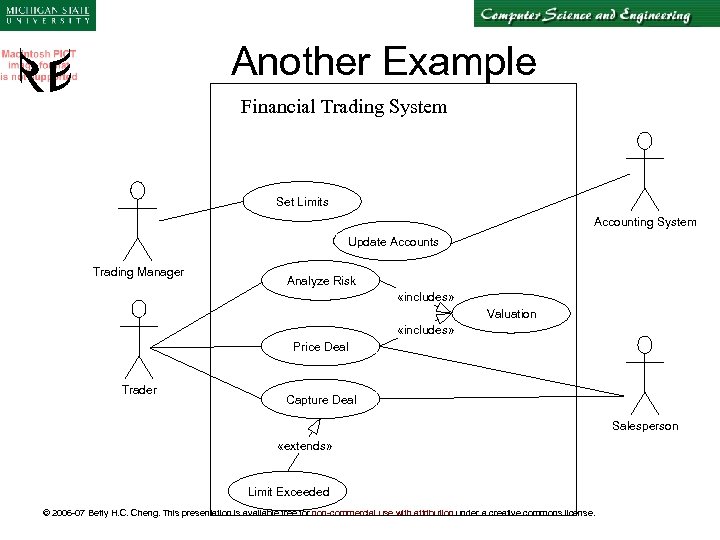
Another Example Financial Trading System Set Limits Accounting System Update Accounts Trading Manager Analyze Risk «includes» Valuation «includes» Price Deal Trader Capture Deal Salesperson «extends» Adapted from Fowler “UML Distilled” Limit Exceeded © 2006 -07 Betty H. C. Cheng. This presentation is available free for non-commercial use with attribution under a creative commons license.
Includes and Extends • Includes – You have a piece of behavior that is similar across many use cases – Break this out as a separate use-case and let the other ones “include” it – Examples include • Valuation • Validate user interaction • Sanity check on sensor inputs • Check for proper authorization • Extends – A use-case is similar to another one but does a little bit more – Put the normal behavior in one use-case and the exceptional behavior somewhere else • Capture the normal behavior • Try to figure out what can go wrong in each step • Capture the exceptional cases in separate use-cases – Makes it a lot easier to understand © 2006 -07 Betty H. C. Cheng. This presentation is available free for non-commercial use with attribution under a creative commons license.
Setting the System Boundary • The system boundary will affect your actors and use-cases Adapted from Larman “Applying UML and Patterns” © 2006 -07 Betty H. C. Cheng. This presentation is available free for non-commercial use with attribution under a creative commons license.
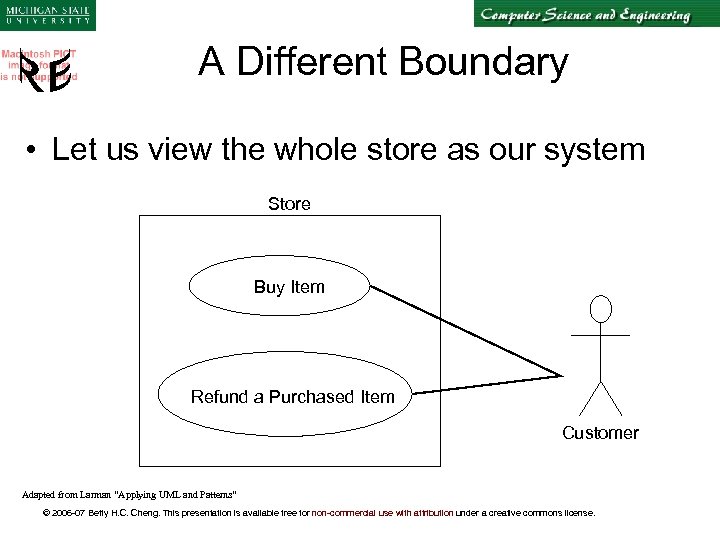
A Different Boundary • Let us view the whole store as our system Store Buy Item Refund a Purchased Item Customer Adapted from Larman “Applying UML and Patterns” © 2006 -07 Betty H. C. Cheng. This presentation is available free for non-commercial use with attribution under a creative commons license.
Partial POST Adapted from Larman “Applying UML and Patterns” © 2006 -07 Betty H. C. Cheng. This presentation is available free for non-commercial use with attribution under a creative commons license.
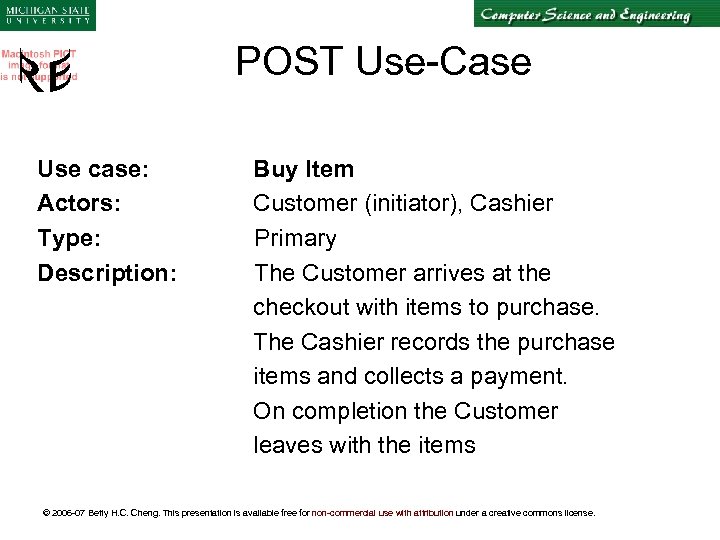
POST Use-Case Use case: Actors: Type: Description: Buy Item Customer (initiator), Cashier Primary The Customer arrives at the checkout with items to purchase. The Cashier records the purchase items and collects a payment. On completion the Customer leaves with the items © 2006 -07 Betty H. C. Cheng. This presentation is available free for non-commercial use with attribution under a creative commons license.
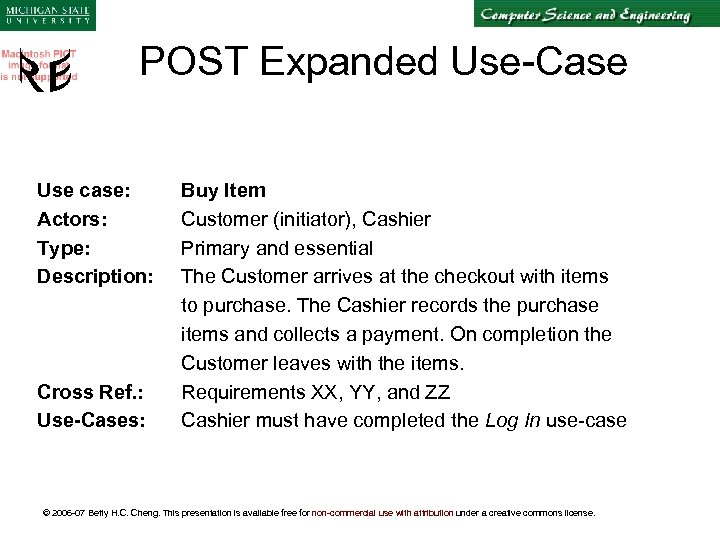
POST Expanded Use-Case Use case: Actors: Type: Description: Cross Ref. : Use-Cases: Buy Item Customer (initiator), Cashier Primary and essential The Customer arrives at the checkout with items to purchase. The Cashier records the purchase items and collects a payment. On completion the Customer leaves with the items. Requirements XX, YY, and ZZ Cashier must have completed the Log In use-case © 2006 -07 Betty H. C. Cheng. This presentation is available free for non-commercial use with attribution under a creative commons license.
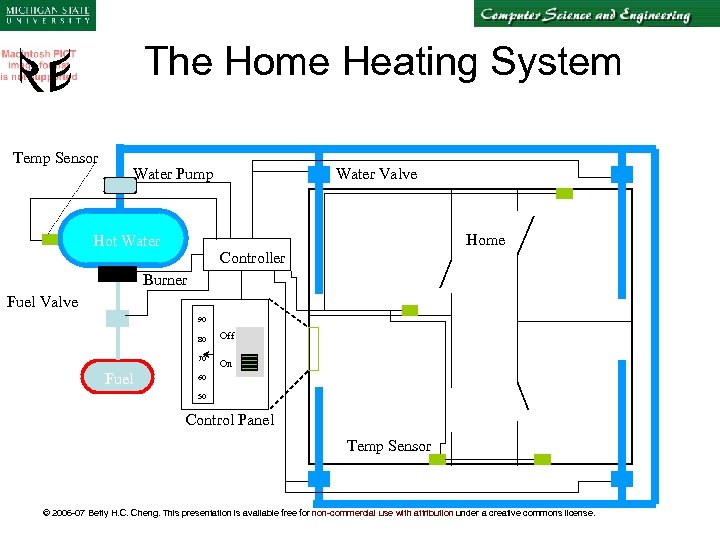
The Home Heating System Temp Sensor Water Pump Hot Water Valve Home Controller Burner Fuel Valve 90 80 70 Fuel Off On 60 50 Control Panel Temp Sensor © 2006 -07 Betty H. C. Cheng. This presentation is available free for non-commercial use with attribution under a creative commons license.
Home Heating Use-Case Diagram © 2006 -07 Betty H. C. Cheng. This presentation is available free for non-commercial use with attribution under a creative commons license.
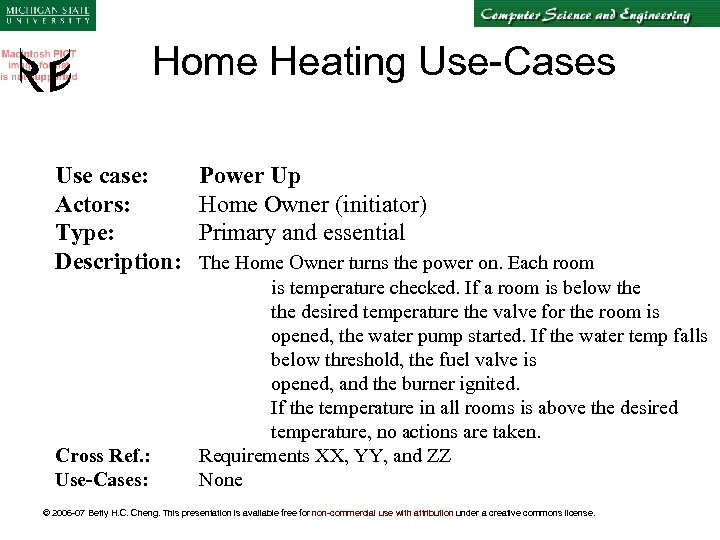
Home Heating Use-Cases Use case: Actors: Type: Description: Cross Ref. : Use-Cases: Power Up Home Owner (initiator) Primary and essential The Home Owner turns the power on. Each room is temperature checked. If a room is below the desired temperature the valve for the room is opened, the water pump started. If the water temp falls below threshold, the fuel valve is opened, and the burner ignited. If the temperature in all rooms is above the desired temperature, no actions are taken. Requirements XX, YY, and ZZ None © 2006 -07 Betty H. C. Cheng. This presentation is available free for non-commercial use with attribution under a creative commons license.
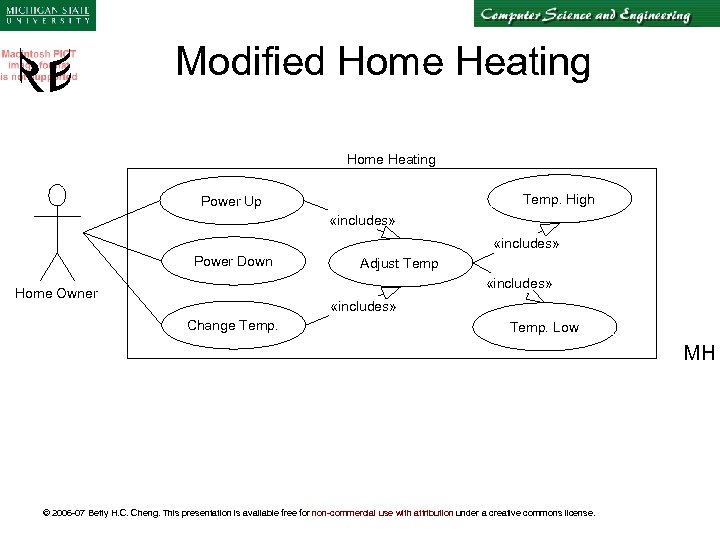
Modified Home Heating Temp. High Power Up «includes» Power Down Adjust Temp «includes» Home Owner «includes» Change Temp. Low MH © 2006 -07 Betty H. C. Cheng. This presentation is available free for non-commercial use with attribution under a creative commons license.
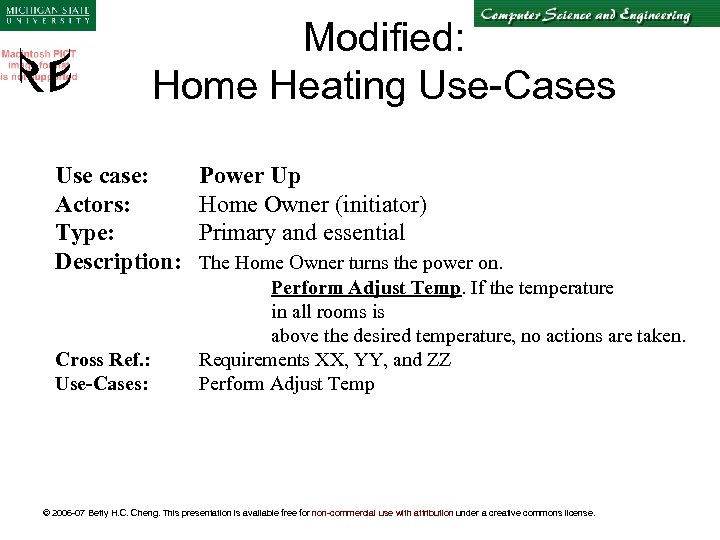
Modified: Home Heating Use-Cases Use case: Actors: Type: Description: Cross Ref. : Use-Cases: Power Up Home Owner (initiator) Primary and essential The Home Owner turns the power on. Perform Adjust Temp. If the temperature in all rooms is above the desired temperature, no actions are taken. Requirements XX, YY, and ZZ Perform Adjust Temp © 2006 -07 Betty H. C. Cheng. This presentation is available free for non-commercial use with attribution under a creative commons license.
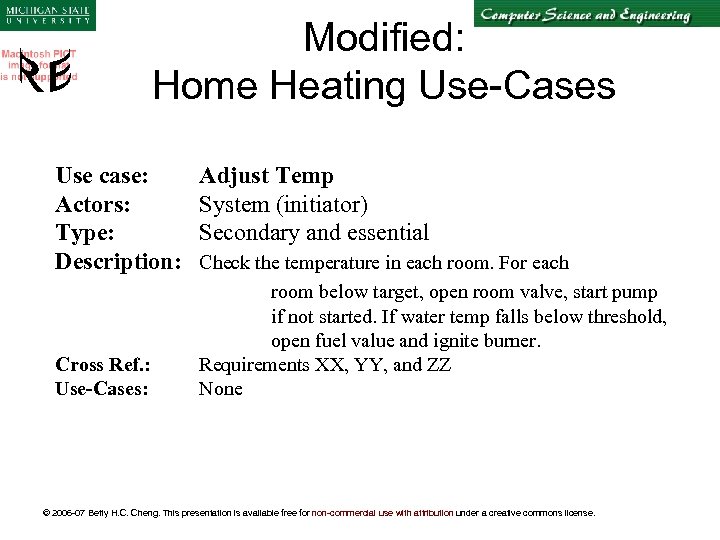
Modified: Home Heating Use-Cases Use case: Actors: Type: Description: Cross Ref. : Use-Cases: Adjust Temp System (initiator) Secondary and essential Check the temperature in each room. For each room below target, open room valve, start pump if not started. If water temp falls below threshold, open fuel value and ignite burner. Requirements XX, YY, and ZZ None © 2006 -07 Betty H. C. Cheng. This presentation is available free for non-commercial use with attribution under a creative commons license.
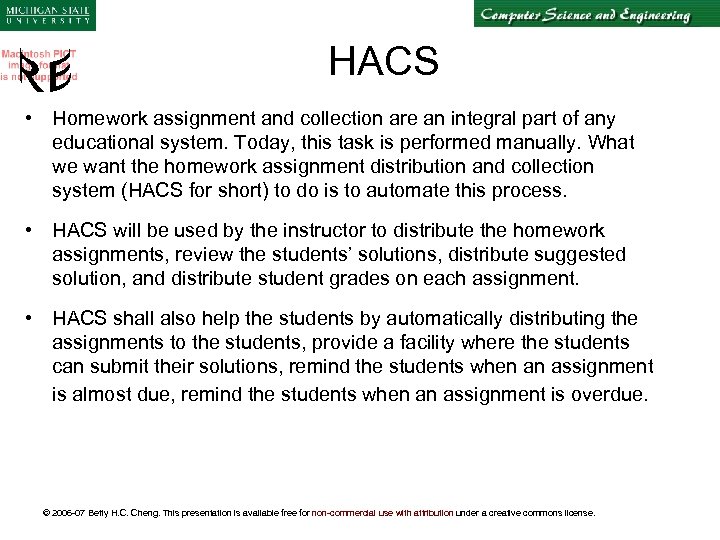
HACS • Homework assignment and collection are an integral part of any educational system. Today, this task is performed manually. What we want the homework assignment distribution and collection system (HACS for short) to do is to automate this process. • HACS will be used by the instructor to distribute the homework assignments, review the students’ solutions, distribute suggested solution, and distribute student grades on each assignment. • HACS shall also help the students by automatically distributing the assignments to the students, provide a facility where the students can submit their solutions, remind the students when an assignment is almost due, remind the students when an assignment is overdue. © 2006 -07 Betty H. C. Cheng. This presentation is available free for non-commercial use with attribution under a creative commons license.
HACS Use-Case Diagram © 2006 -07 Betty H. C. Cheng. This presentation is available free for non-commercial use with attribution under a creative commons license.
HACS Use-Cases Use case: Actors: Type: Description: Distribute Assignments Instructor (initiator) Primary and essential The Instructor completes an assignment and submits it to the system. The instructor will also submit the due date and the class the assignment is assigned for. Cross Ref. : Use-Cases: Requirements XX, YY, and ZZ Configure HACS must be done before any user (Instructor or Student) can use HACS © 2006 -07 Betty H. C. Cheng. This presentation is available free for non-commercial use with attribution under a creative commons license.
Alternate HACS © 2006 -07 Betty H. C. Cheng. This presentation is available free for non-commercial use with attribution under a creative commons license.
Alternate HACS Use-Cases Use case: Distribute Assignments Actors: Instructor (initiator), Student Type: Primary and essential Description: The Instructor completes an assignment and submits it to the system. The instructor will also submit the delivery date, due date, and the class the assignment is assigned for. The system will at the due date mail the assignment to the student. Cross Ref. : Requirements XX, YY, and ZZ Use-Cases: Configure HACS must be done before any user (Instructor or Student) can use HACS © 2006 -07 Betty H. C. Cheng. This presentation is available free for non-commercial use with attribution under a creative commons license.
When to use Use-Cases • In short, always!!! • Requirements is the toughest part of software development – Use-Cases is a powerful tool to understand • Who your users are (including interacting systems) • What functions the system shall provide • How these functions work at a high level • Spend adequate time on requirements and in the elaboration phase © 2006 -07 Betty H. C. Cheng. This presentation is available free for non-commercial use with attribution under a creative commons license.
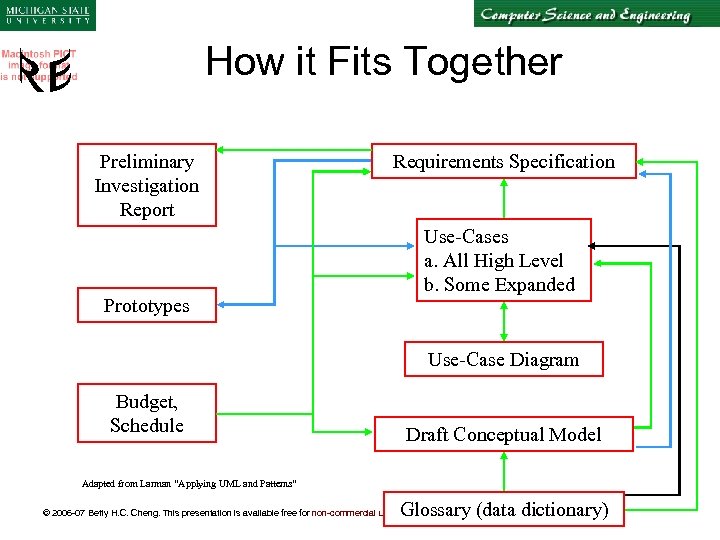
How it Fits Together Preliminary Investigation Report Prototypes Requirements Specification Use-Cases a. All High Level b. Some Expanded Use-Case Diagram Budget, Schedule Draft Conceptual Model Adapted from Larman “Applying UML and Patterns” Glossary (data dictionary) © 2006 -07 Betty H. C. Cheng. This presentation is available free for non-commercial use with attribution under a creative commons license.
Скачать презентацию Use Cases and Scenarios 2006 -07 Betty
60439f0211d3b7cf08702993ee0ef021.ppt