 Скачать презентацию USCG — Triggers Becoming the Leaders that We
6bfdbba1f1cb9683b72adcaefe00e169.ppt
- Количество слайдов: 34



USCG - Triggers Becoming the Leaders that We Want to Be and Building Engagement Dr. Marshall Goldsmith Marshall@Marshall. Goldsmith. com www. Marshall. Goldsmith. com
Goals • Understand the concept of triggers - how we create our world and how it creates us. • Understand why we do not achieve our goals and share practical tools that enable us to use structure to improve lives. • Improve skills in building relationships without direct line authority. • Be ready to use The Wheel of Change in planning and development. • Learn the daily question process and how active questions can be used to help achieve personal goals and increase personal engagement.
What happens? • If we know the people that we want to become • Why don’t we become these people? • Millions of employees around the world: – Disengaged – Depressed – Not achieving personal goals • Many teams and organizations are dysfunctional
Why is change so difficult? • New Year’s resolutions that are never achieved? • Coaching clients that don’t change? • Our daily failures to do – even the small things – that we plan?
What is a trigger? TRIGGER – ANY STIMULUS THAT MAY IMPACT OUR BEHAVIOR
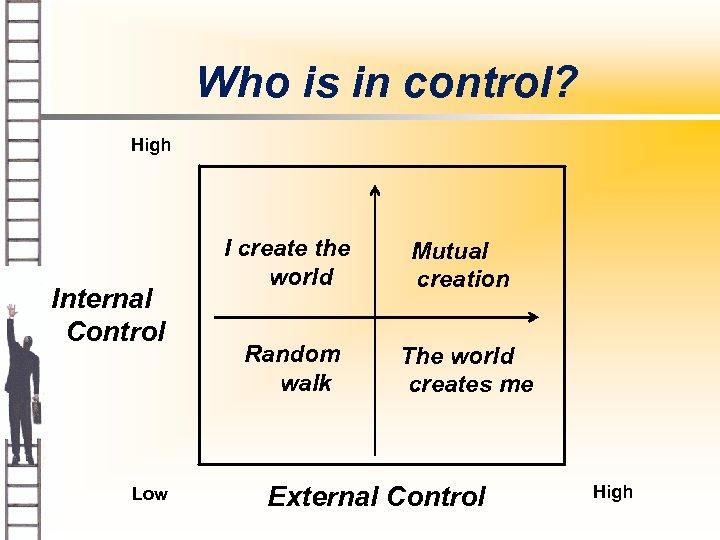
Who is in control? High Internal Control Low I create the world Mutual creation Random walk The world creates me External Control High
Mutual creation I am creating my world and at the same time triggers in my world are creating me
Fate vs. choice • Fate – The hand of cards that we have been dealt. • Choice – How we play the hand.
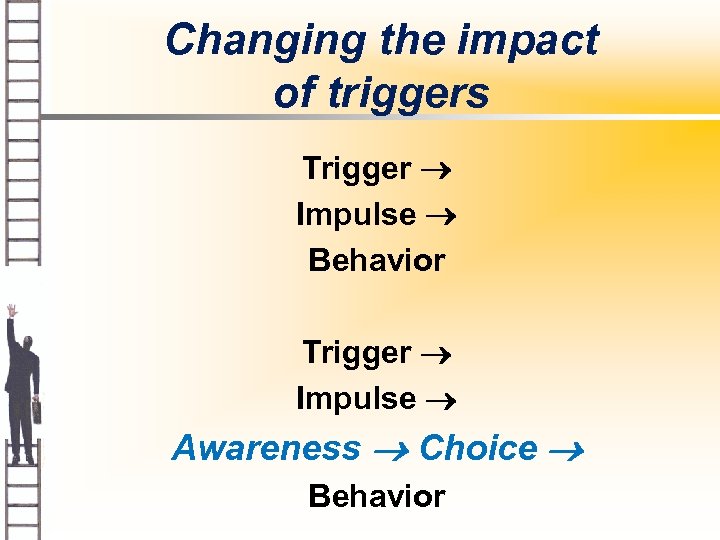
Changing the impact of triggers Trigger Impulse Behavior Trigger Impulse Awareness Choice Behavior
Dealing with triggers • The negative case – the hard day • The positive case – buy the flowers
Triggers: today’s ‘perfect storm’ for distraction • • Emails, cell phones, tablets, texting On demand TV, movies, games Social media Multi-tasking • ‘The dream’
Classic delusions • • • Planner bias, understanding – doing gap It won’t take that long or be that hard High probability of low probability events Today is a ‘special day’ Tomorrow will be different I have the wisdom and courage to objectively evaluate my own behavior • I have willpower. I don’t need help or structure.
It is OK to need help and structure • The changing role of coaching – from ‘fixing losers’ to ‘helping winners’ • 27 top executive endorsements • Athletes, movie stars, world leaders • If could have fixed it by yourself, it would probably be fixed by now • ‘I need help and it is OK!’
The value of structure • • • The Checklist Manifesto Stakeholder centered coaching process Alan Mulally and the Ford turnaround The Wheel of Change Daily question process
Alan Mulally: the Ford turnaround story Establishing clear leadership behavior: • Determining the desired behavior • Communicating across the company • Zero tolerance for behavior violations Getting clear on priorities • The ‘top five’ person • Red, yellow, green • Complete alignment to the plan
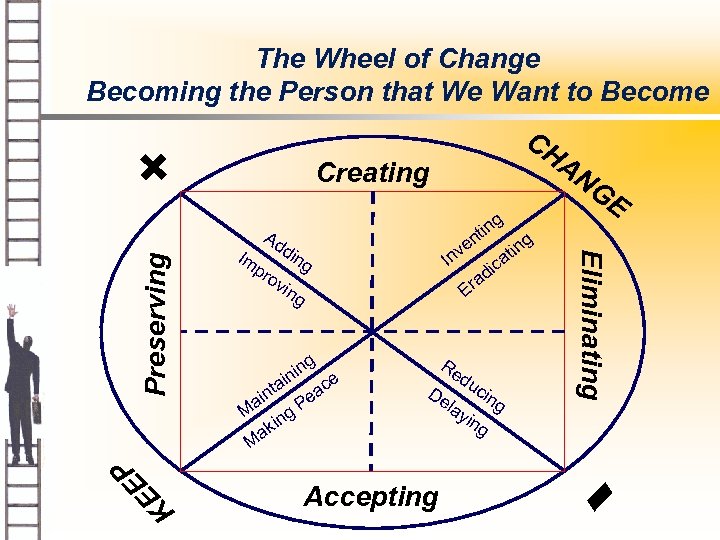
The Wheel of Change Becoming the Person that We Want to Become K g in nt Ad din Im g pr ov ing g nin ce i ta a ain Pe M ng i ak M GE g e in nv at I c di a Er Re du cin De g lay ing Accepting - + Preserving E AN Creating Eliminating P E CH
Creating Who is the you – that you want to create? • • Creating that person that you want to become Blocks to creating Fears that inhibit creating The role of identity (self-stereotyping) Hope for the future Visualizing the future Focus on process – not just outcomes
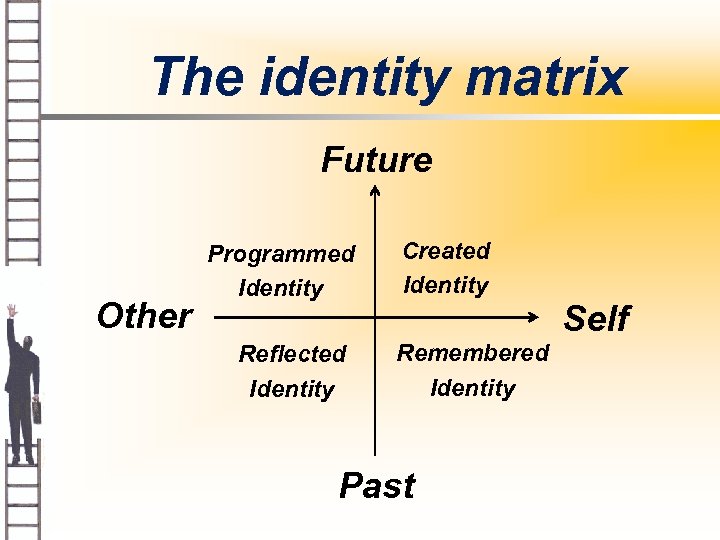
The identity matrix Future Other Programmed Identity Reflected Identity Created Identity Self Remembered Identity Past
Preserving Who is the you – that you want to preserve? • • What do we want to preserve? Gratitude for the past – Frances Hesselbein The challenge of executing vs. generating Why too much focus on preserving can be a problem – Kodak – The old IBM
Eliminating What part of you – do you want to eliminate? • • Knowing what to eliminate Knowing when to eliminate The danger of over-commitment The challenge of new technology
Accepting What is it that you – need to learn to accept? • • • ‘Letting go’ of the past Am I willing at this time? Forgiving Prioritizing Accepting environmental limitations
AIWATT AM I WILLING AT THIS TIME TO MAKE THE INVESTMENT REQUIRED TO MAKE A POSITIVE DIFFERENCE ON THIS TOPIC?
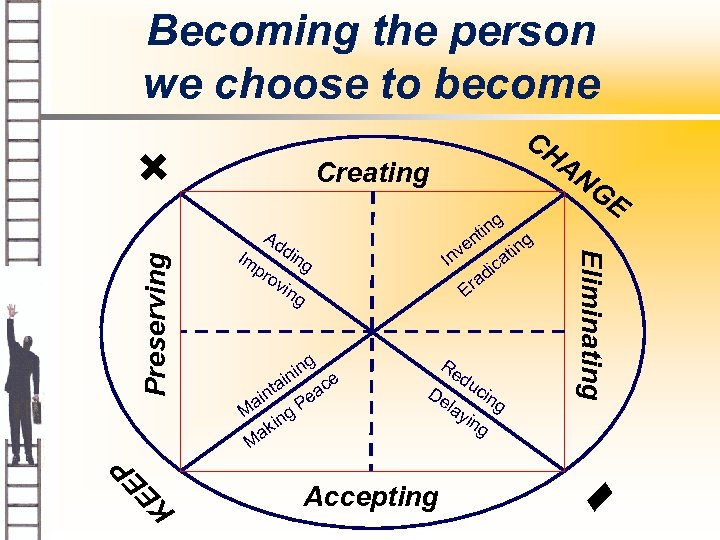
Becoming the person we choose to become K g in nt Ad din Im g pr ov ing g nin ce i ta a ain Pe M ng i ak M GE g e in nv at I c di a Er Re du cin De g lay ing Accepting - + Preserving E AN Creating Eliminating P E CH
Applying this model • • To ourselves To our team To our function To our company
Effectively influencing people without direct line authority • • • Learning from Peter Drucker Understanding the dynamics of power The decision maker as customer AIWATT How the model applies when you are the decision maker
Previous work on employee engagement • NAHR presentation • Recognition, reward programs, training, compensation, empowerment • In spite of all previous efforts, global employee engagement is near an all-time low • Focus on what the organization can do to engage you – not what you can do to engage yourself – JFK in reverse • The two flight attendants
Active questions vs. passive questions • How active questions focus on what you can do to make a positive difference for yourself and the world • How passive questions focus on what the world needs to do to make a positive difference for you
Six active questions Did I do my best to: • Set clear goals? • Make progress toward goal achievement? • Find meaning? • Be happy? • Build positive relationships? • Be fully engaged?
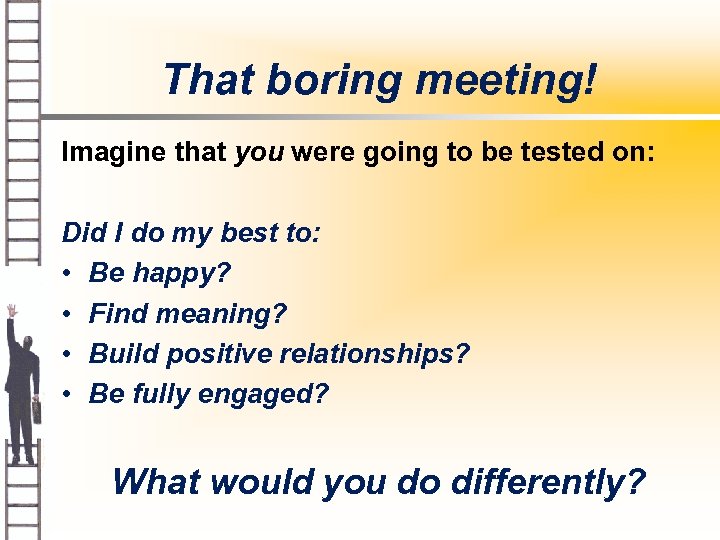
That boring meeting! Imagine that you were going to be tested on: Did I do my best to: • Be happy? • Find meaning? • Build positive relationships? • Be fully engaged? What would you do differently?
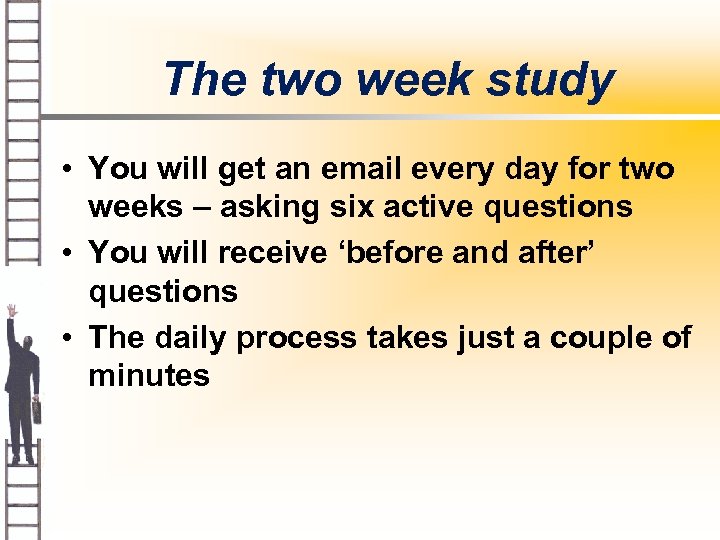
The two week study • You will get an email every day for two weeks – asking six active questions • You will receive ‘before and after’ questions • The daily process takes just a couple of minutes
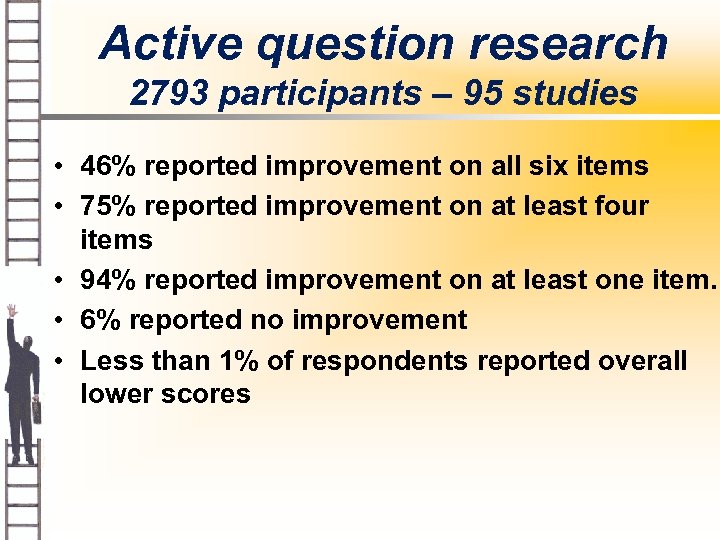
Active question research 2793 participants – 95 studies • 46% reported improvement on all six items • 75% reported improvement on at least four items • 94% reported improvement on at least one item. • 6% reported no improvement • Less than 1% of respondents reported overall lower scores
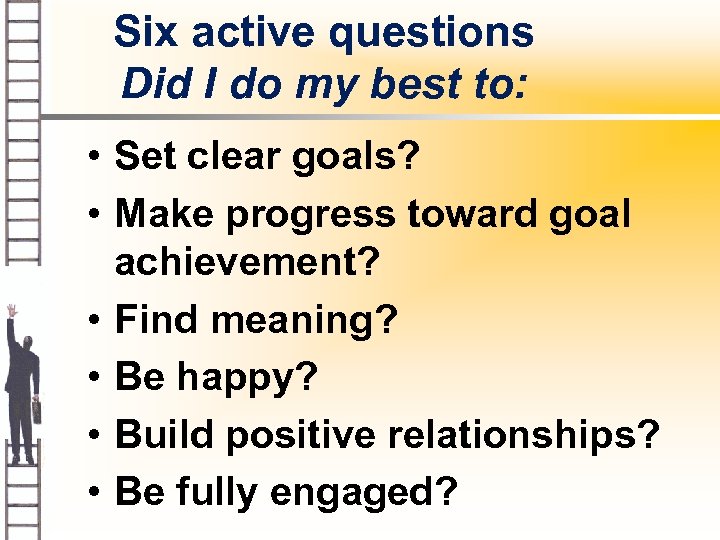
Six active questions Did I do my best to: • Set clear goals? • Make progress toward goal achievement? • Find meaning? • Be happy? • Build positive relationships? • Be fully engaged?
Daily Question Process • Why the process works • How the process works • Applications on employee engagement
The best coaching advice • For you as a person • For you as a professional
Скачать презентацию USCG — Triggers Becoming the Leaders that We
6bfdbba1f1cb9683b72adcaefe00e169.ppt