


 Скачать презентацию Usage Policy UPL Research for Gri Phy N
fe348ee2302e3c18299fecb547e880db.ppt
- Количество слайдов: 11
 Usage Policy (UPL) Research for Gri. Phy. N & i. VDGL Catalin L. Dumitrescu, Michael Wilde, Ian Foster The University of Chicago
 Outline ➢ Grid 03 Deployment Model ➢ What is UPL ➢ Motivating Scenario ➢ Problems ➢ Time Frame ➢ Evaluation Methodology ➢ Open Questions
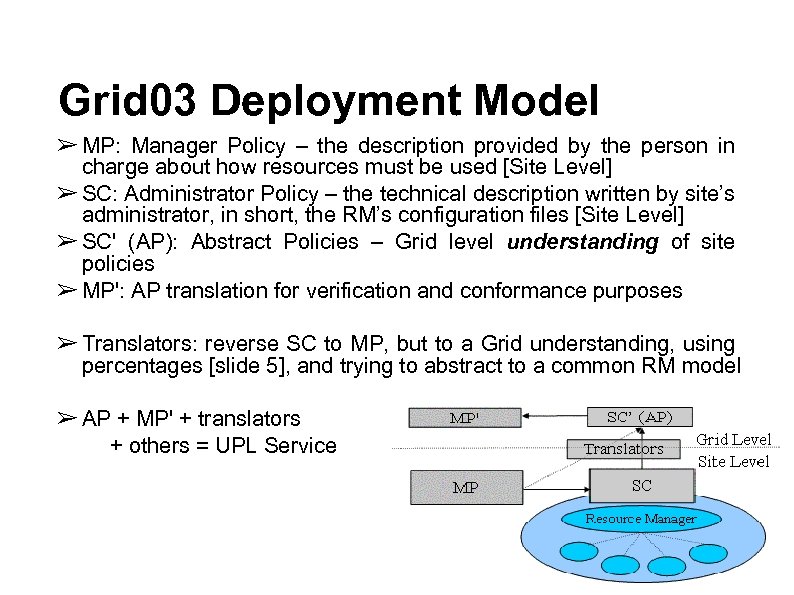 Grid 03 Deployment Model ➢ MP: Manager Policy – the description provided by the person in charge about how resources must be used [Site Level] ➢ SC: Administrator Policy – the technical description written by site’s administrator, in short, the RM’s configuration files [Site Level] ➢ SC' (AP): Abstract Policies – Grid level understanding of site policies ➢ MP': AP translation for verification and conformance purposes ➢ Translators: reverse SC to MP, but to a Grid understanding, using percentages [slide 5], and trying to abstract to a common RM model ➢ AP + MP' + translators + others = UPL Service
 What is UPL? ➢ ➢ ➢ UPL: resource owners’ (local policy makers) statements about how their resources must be allocated (high level descriptions) – high level GOAL or MP RM Priorities/Rules: resource administrators mappings of resource owners' statements to different software RMs' syntaxes – the local POLICY that is actually implemented or SC Abstract Policies: grid level understanding of the UPL, extracted from the SC – reverse translation from SC to MP done by means of automated tools
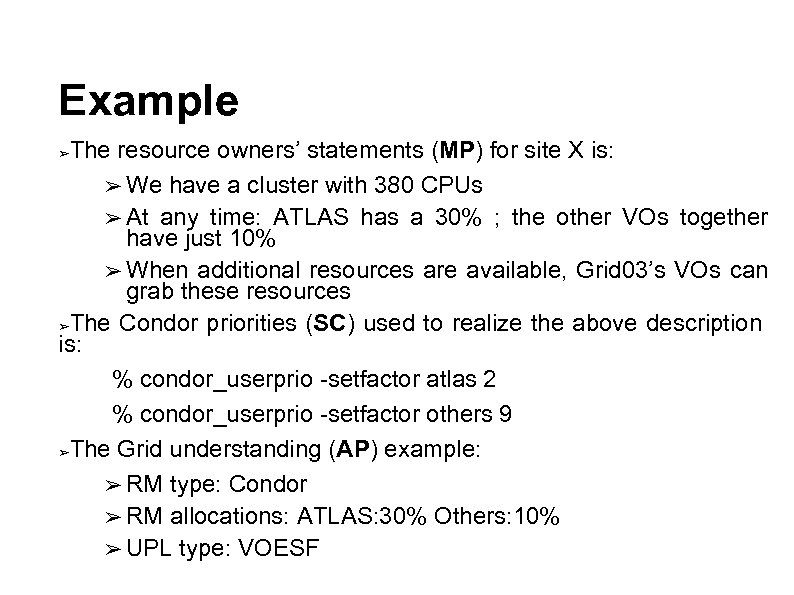 Example The resource owners’ statements (MP) for site X is: ➢ We have a cluster with 380 CPUs ➢ At any time: ATLAS has a 30% ; the other VOs together have just 10% ➢ When additional resources are available, Grid 03’s VOs can grab these resources ➢The Condor priorities (SC) used to realize the above description is: % condor_userprio -setfactor atlas 2 % condor_userprio -setfactor others 9 ➢The Grid understanding (AP) example: ➢ RM type: Condor ➢ RM allocations: ATLAS: 30% Others: 10% ➢ UPL type: VOESF ➢
 Problems ➢ ➢ Is the UPL GOAL really necessary? Is it useful for the Grid environment? If yes, why? Roles identification Amount of information to be made available from individual sites Heterogeneity considerations: ✗ ✗ Different RM models (Condor, PBS, LSF, others) RM priorities: ➔ local vs. remote users ➔ Atlas vs. CMStest
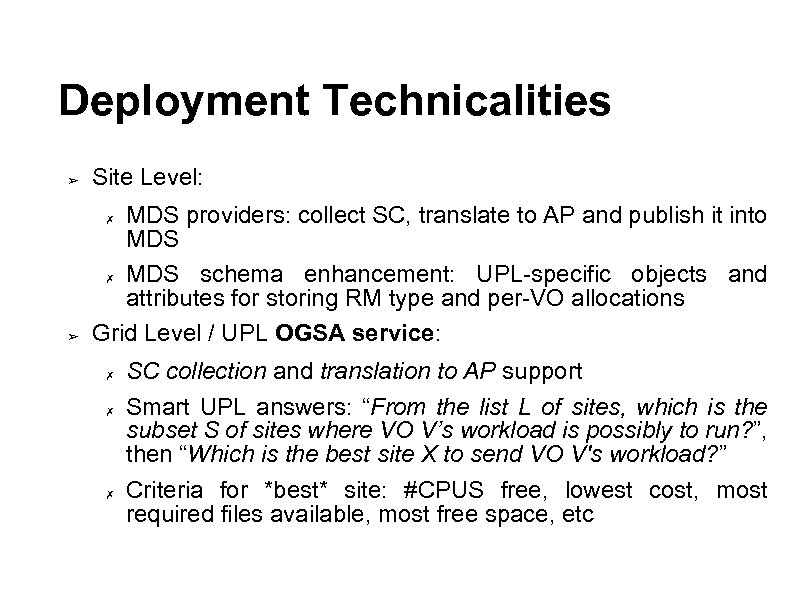 Deployment Technicalities ➢ Site Level: ➢ MDS providers: collect SC, translate to AP and publish it into MDS ✗ MDS schema enhancement: UPL-specific objects and attributes for storing RM type and per-VO allocations Grid Level / UPL OGSA service: ✗ ✗ SC collection and translation to AP support Smart UPL answers: “From the list L of sites, which is the subset S of sites where VO V’s workload is possibly to run? ”, then “Which is the best site X to send VO V's workload? ” Criteria for *best* site: #CPUS free, lowest cost, most required files available, most free space, etc
 Time Frame
 Gains ➢ ➢ Additional information that give grid schedulers hints about where to submit jobs – for example, when a site is busy with work from a VO which had grabbed all resources when they were free Time-based entitlement to resources – VOs are guarantied under different FS policies that they can use resources when they need them instead of maintaining constant workloads
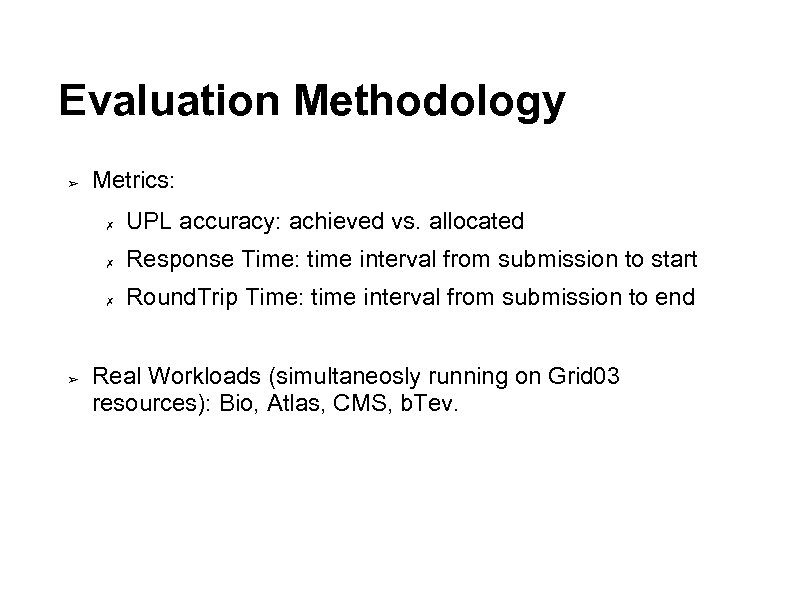 Evaluation Methodology ➢ Metrics: ✗ ✗ Response Time: time interval from submission to start ✗ ➢ UPL accuracy: achieved vs. allocated Round. Trip Time: time interval from submission to end Real Workloads (simultaneosly running on Grid 03 resources): Bio, Atlas, CMS, b. Tev.
 Open Questions ➢ Is UPL based resource allocation really necessary? ➢ Is the proposed model good enough to achieve initial goals? ➢ How do I know that I have succeded?