


 Скачать презентацию Usage of the Cluster Data in ILWS Studies
d8cba35afcb62ba11eb4b5436c7fef55.ppt
- Количество слайдов: 28
 Usage of the Cluster Data in ILWS Studies Harri Laakso, Philippe Escoubet, Matt Taylor, and Arnaud Masson European Space Agency (ESA) Science and Robotic Exploration Directorate Noordwijk, The Netherlands Contents: q Introduction to Cluster observations q Introduction to Cluster data archive* * An ESA contribution to the ILWS 2009, Ubatuba, Brazil, 4 -9 October 2009 1
 Introduction to the Cluster Mission q Cluster is a four-satellite constellation mission where the satellite separations are controlled and varied between 100 – 10 000 km q The satellites are on a polar-orbit with the orbital period, perigee distance and apogee distance of 55 hours, <4 Re and 19 Re, respectively q The spacecraft were launched in summer 2000 and the science operations started on 1 February 2001. The mission has been extended until December 2012 q The key dayside investigations: solar wind, bow shock, magnetopause and cusp q The key nightside investigations: auroral zone, plasma sheet, radiation belts and plasmasphere q Two Cluster workshops are organized annually: there are usually 100+ participants and are open to all scientists, for details, see http: //caa. estec. esa. int/wksp/cluster_workshop_home. xml 2
 Cluster Instruments Particle experiments: Fields & waves experiments: q PEACE Thermal electrons with energies <30 ke. V q FGM DC magnetic fields at 22 Hz (66 Hz in burst mode) q CIS Thermal ions (including composition) below 40 ke. V q EFW DC electric fields at 25 Hz (450 Hz) q q q RAPID High energy electrons and ions below 450 ke. V (Ei>10 ke. V, Ee>20 ke. V) EDI Plasma drift velocity and DC electric fields, with electron beam injection ASPOC Spacecraft potential control, with ion current emission q STAFF Magnetic and electric fluctuations <4 k. Hz (use search coil & EFW sensors) q WHISPER Electron density (0. 1 -80 cc) and plasma waves (2 -80 k. Hz) q WBD Electric field waveforms <500 k. Hz q DWP Wave processor and wave-particle correlator 3
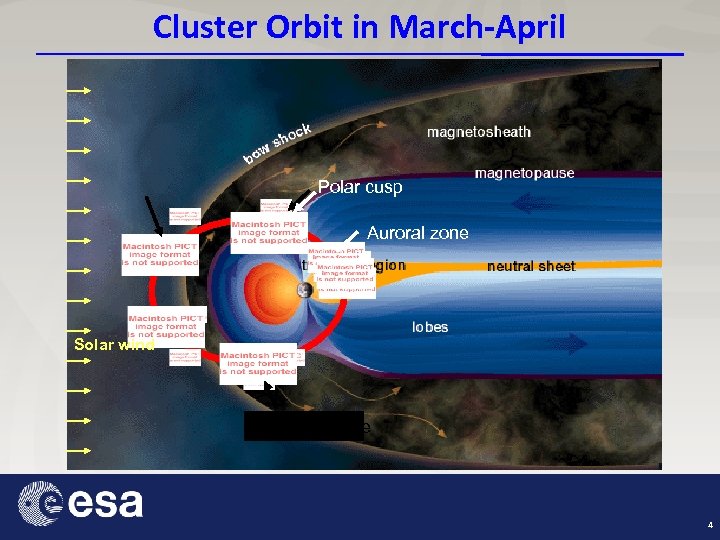 Cluster Orbit in March-April Polar cusp Auroral zone Solar wind Magnetopause 4
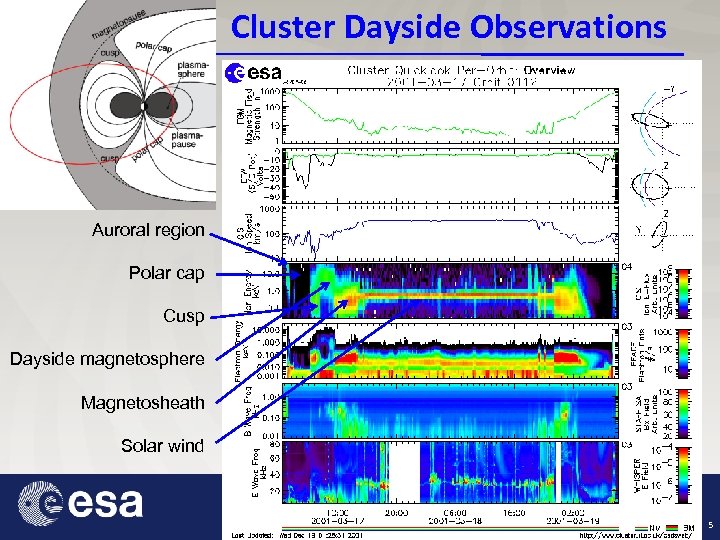 Cluster Dayside Observations Auroral region Polar cap Cusp Dayside magnetosphere Magnetosheath Solar wind 5
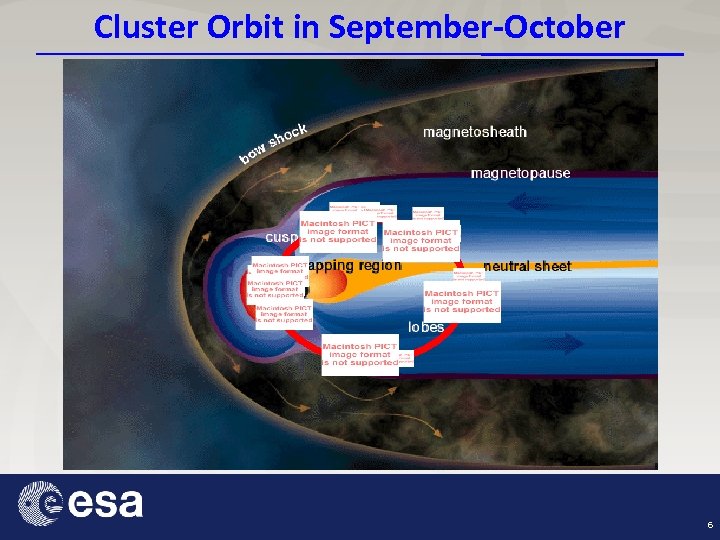 Cluster Orbit in September-October 6
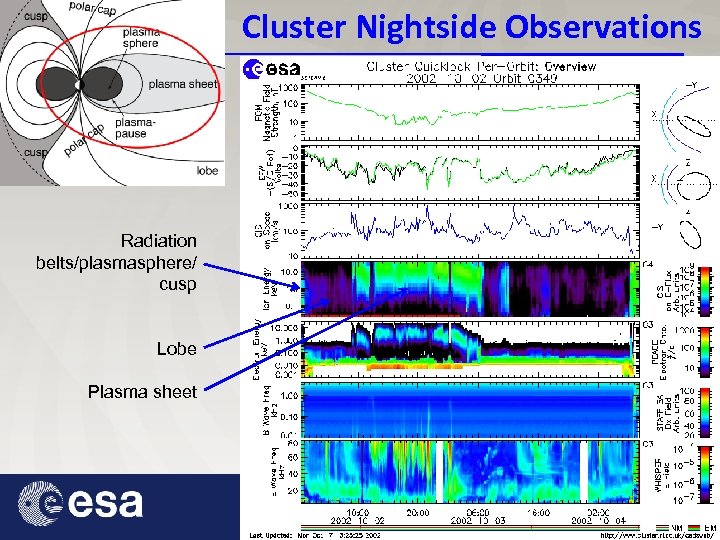 Cluster Nightside Observations Radiation belts/plasmasphere/ cusp Lobe Plasma sheet 7
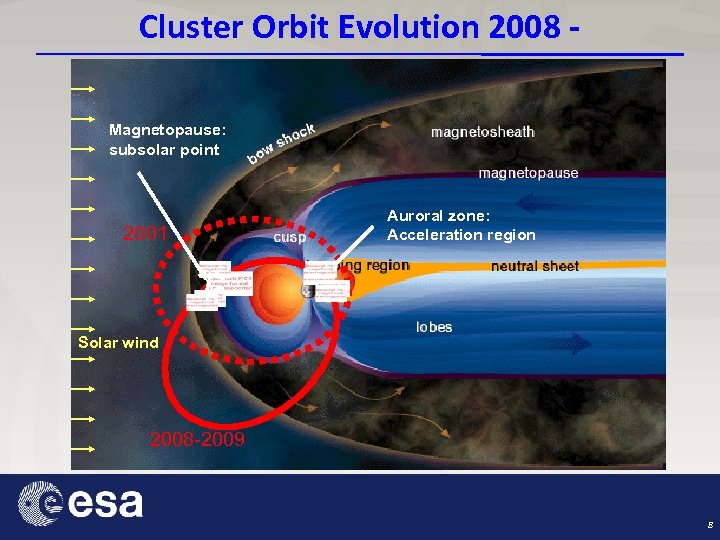 Cluster Orbit Evolution 2008 Magnetopause: subsolar point 2001 Auroral zone: Acceleration region Solar wind 2008 -2009 8
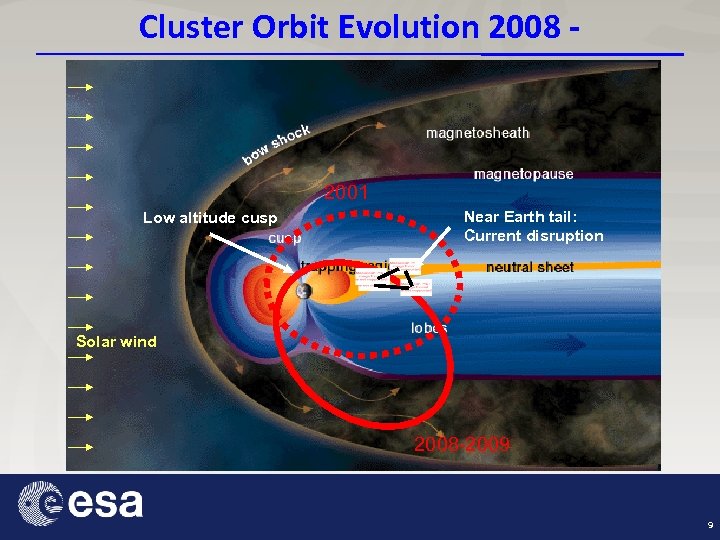 Cluster Orbit Evolution 2008 - 2001 Low altitude cusp Near Earth tail: Current disruption Solar wind 2008 -2009 9
 What is CAA? q The Cluster Active Archive CAA (http: //caa. estec. esa. int/) aims to ensure that § The CAA will contain all Cluster high-resolution data as well as allied (supporting) data products necessary to the full interpretation of the fullresolution datasets § the entire high- and low-resolution datasets are fully calibrated (to the level achievable within the limited resources available) § the data should be suitable for science use and publication by the worldwide scientific community § all data are provided in a standard format (CEF - Cluster Exchange Format) and with a complete set of metadata in machine readable form § the CAA will provide user friendly services for searching and accessing these data 10
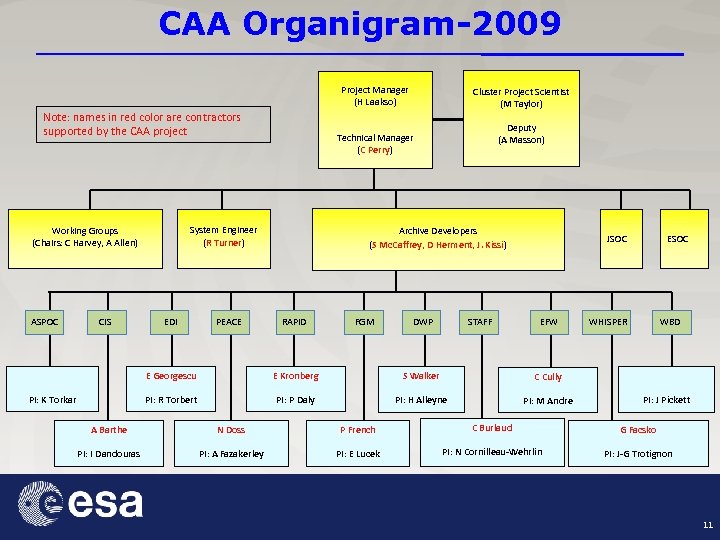 CAA Organigram-2009 Project Manager (H Laakso) Note: names in red color are contractors supported by the CAA project ASPOC CIS EDI PEACE Deputy (A Masson) Technical Manager (C Perry) System Engineer (R Turner) Working Groups (Chairs: C Harvey, A Allen) Cluster Project Scientist (M Taylor) Archive Developers (S Mc. Caffrey, D Herment, J. Kissi) RAPID FGM DWP STAFF JSOC EFW E Georgescu S Walker PI: P Daly PI: H Alleyne PI: M Andre WHISPER WBD C Cully PI: R Torbert PI: K Torkar E Kronberg ESOC PI: J Pickett A Barthe N Doss P French C Burlaud G Facsko PI: I Dandouras PI: A Fazakerley PI: E Lucek PI: N Cornilleau-Wehrlin PI: J-G Trotignon 11
 Status of the CAA Data Inventory q The coverage and range of products are being continually improved, currently with over 200 datasets available from each spacecraft, including § high-resolution DC and AC B- & E-fields § full 3 D electron & ion distributions for 0 e. V - 400 ke. V § various ancillary & browse products q Most/many of the teams have provided the data files for years 20012007 § a number of complicated products, mainly due to calibration difficulties, are still partly missing § currently the teams are producing and delivering files for year 2008 12
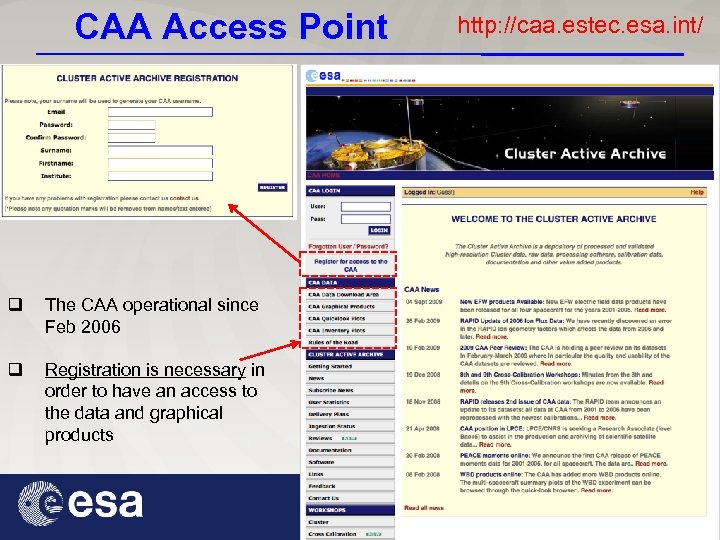 CAA Access Point q The CAA operational since Feb 2006 q http: //caa. estec. esa. int/ Registration is necessary in order to have an access to the data and graphical products 13
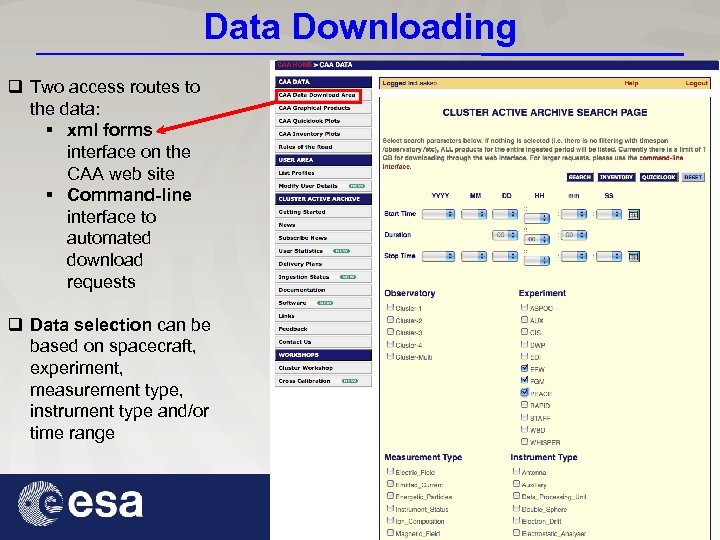 Data Downloading q Two access routes to the data: § xml forms interface on the CAA web site § Command-line interface to automated download requests q Data selection can be based on spacecraft, experiment, measurement type, instrument type and/or time range 14
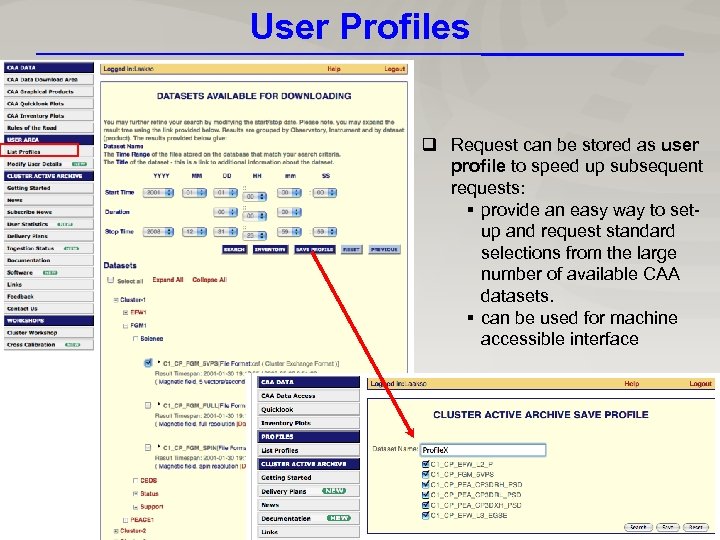 User Profiles q Request can be stored as user profile to speed up subsequent requests: § provide an easy way to setup and request standard selections from the large number of available CAA datasets. § can be used for machine accessible interface 15
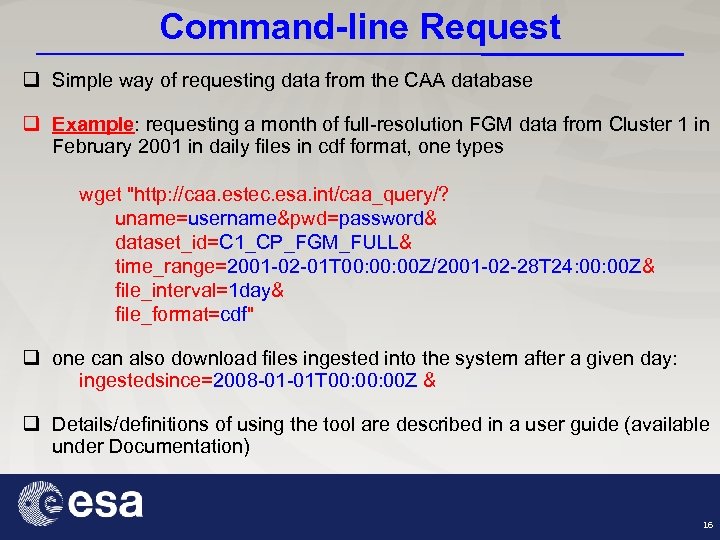 Command-line Request q Simple way of requesting data from the CAA database q Example: requesting a month of full-resolution FGM data from Cluster 1 in February 2001 in daily files in cdf format, one types wget "http: //caa. estec. esa. int/caa_query/? uname=username&pwd=password& dataset_id=C 1_CP_FGM_FULL& time_range=2001 -02 -01 T 00: 00 Z/2001 -02 -28 T 24: 00 Z& file_interval=1 day& file_format=cdf" q one can also download files ingested into the system after a given day: ingestedsince=2008 -01 -01 T 00: 00 Z & q Details/definitions of using the tool are described in a user guide (available under Documentation) 16
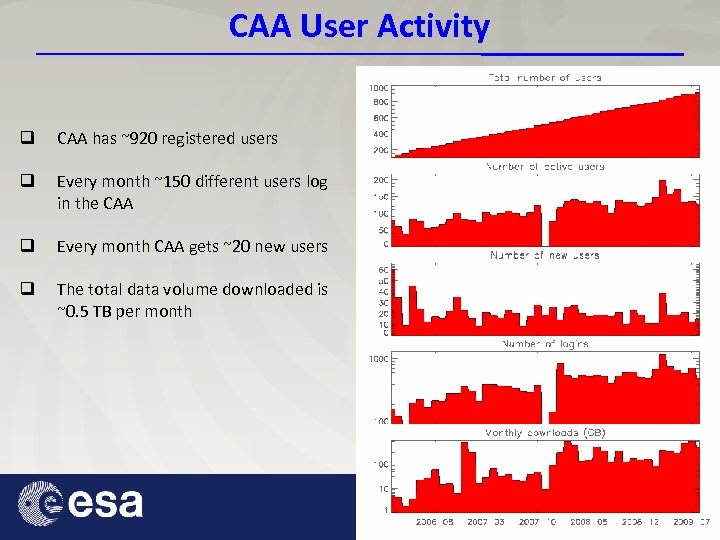 CAA User Activity q CAA has ~920 registered users q Every month ~150 different users log in the CAA q Every month CAA gets ~20 new users q The total data volume downloaded is ~0. 5 TB per month 17
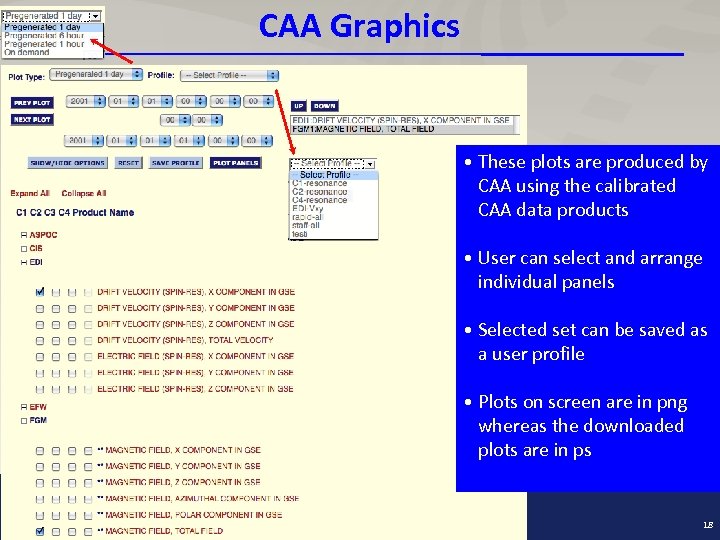 CAA Graphics • These plots are produced by CAA using the calibrated CAA data products • User can select and arrange individual panels • Selected set can be saved as a user profile • Plots on screen are in png whereas the downloaded plots are in ps 18
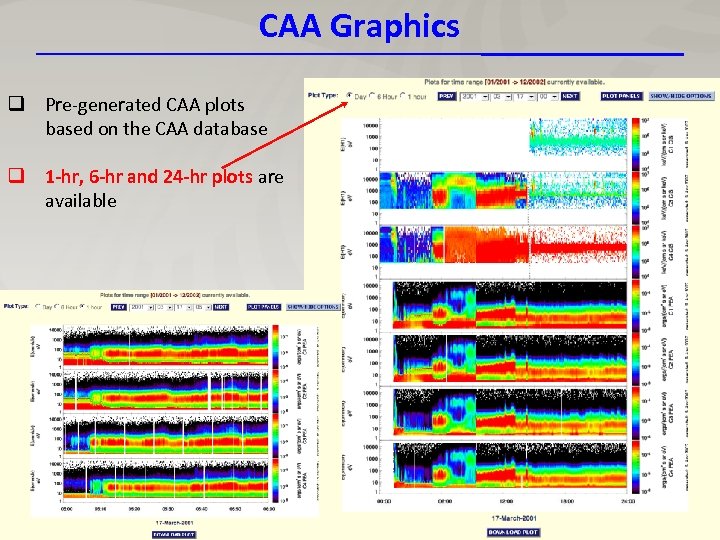 CAA Graphics q Pre-generated CAA plots based on the CAA database q 1 -hr, 6 -hr and 24 -hr plots are available 19
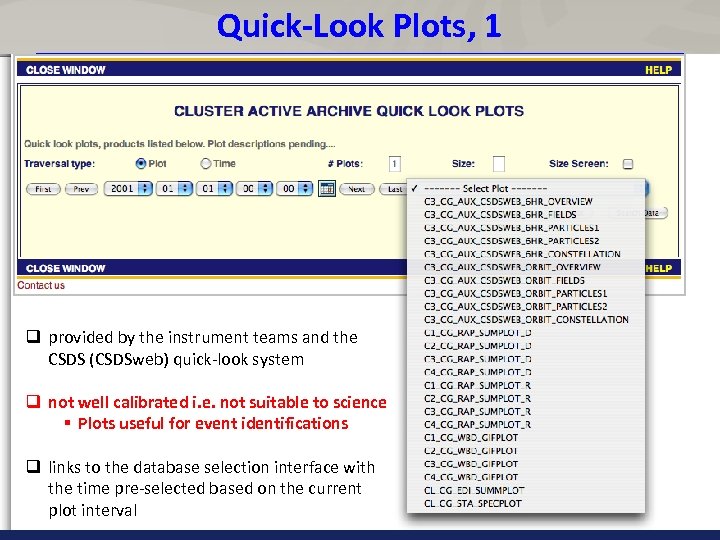 Quick-Look Plots, 1 q provided by the instrument teams and the CSDS (CSDSweb) quick-look system q not well calibrated i. e. not suitable to science § Plots useful for event identifications q links to the database selection interface with the time pre-selected based on the current plot interval 20
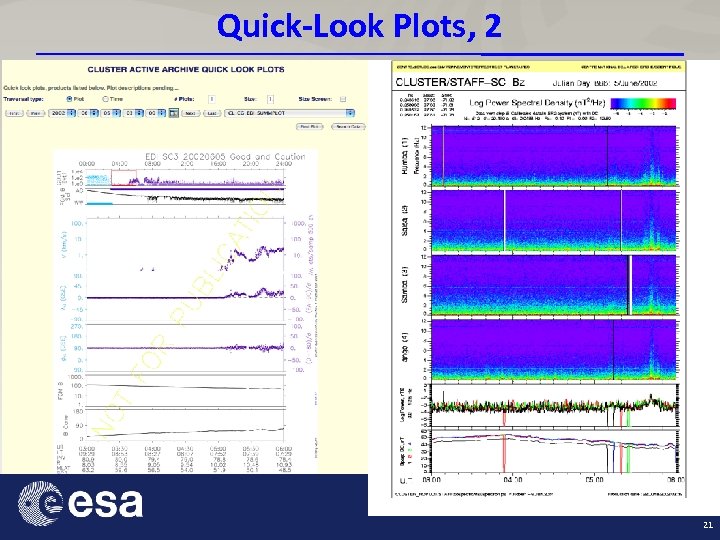 Quick-Look Plots, 2 21
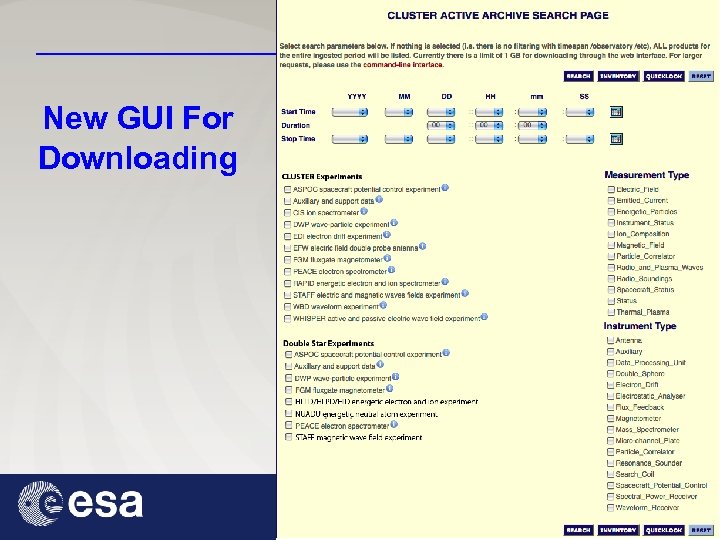 New GUI For Downloading 22
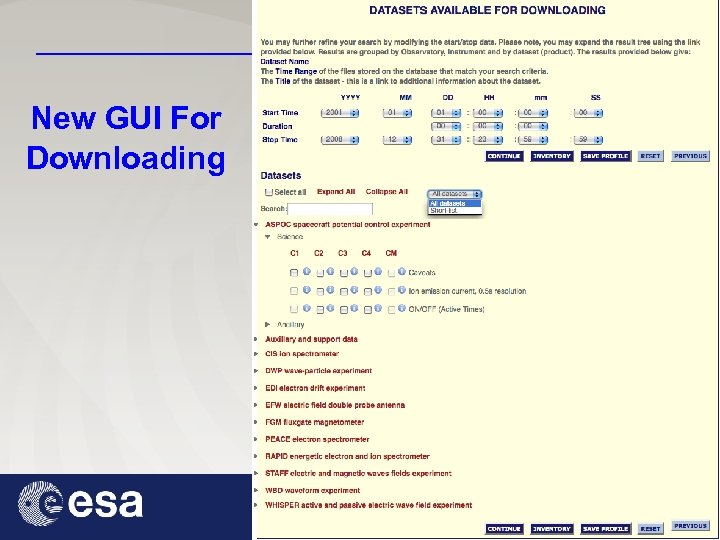 New GUI For Downloading 23
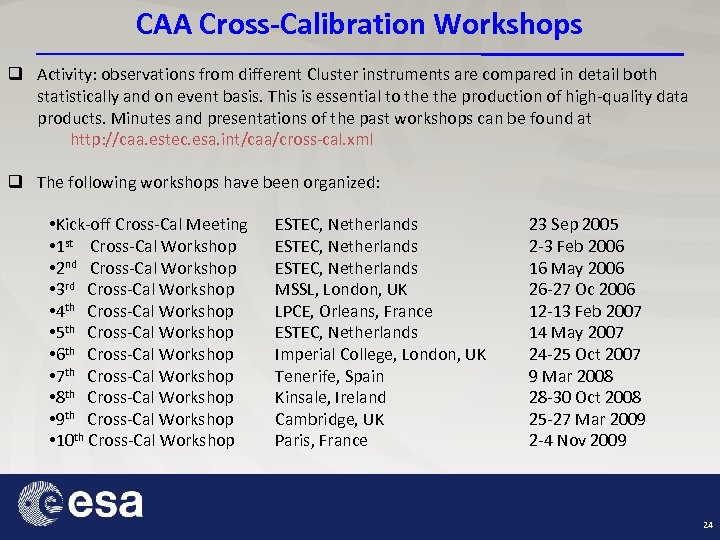 CAA Cross-Calibration Workshops q Activity: observations from different Cluster instruments are compared in detail both statistically and on event basis. This is essential to the production of high-quality data products. Minutes and presentations of the past workshops can be found at http: //caa. estec. esa. int/caa/cross-cal. xml q The following workshops have been organized: • Kick-off Cross-Cal Meeting • 1 st Cross-Cal Workshop • 2 nd Cross-Cal Workshop • 3 rd Cross-Cal Workshop • 4 th Cross-Cal Workshop • 5 th Cross-Cal Workshop • 6 th Cross-Cal Workshop • 7 th Cross-Cal Workshop • 8 th Cross-Cal Workshop • 9 th Cross-Cal Workshop • 10 th Cross-Cal Workshop ESTEC, Netherlands MSSL, London, UK LPCE, Orleans, France ESTEC, Netherlands Imperial College, London, UK Tenerife, Spain Kinsale, Ireland Cambridge, UK Paris, France 23 Sep 2005 2 -3 Feb 2006 16 May 2006 26 -27 Oc 2006 12 -13 Feb 2007 14 May 2007 24 -25 Oct 2007 9 Mar 2008 28 -30 Oct 2008 25 -27 Mar 2009 2 -4 Nov 2009 24
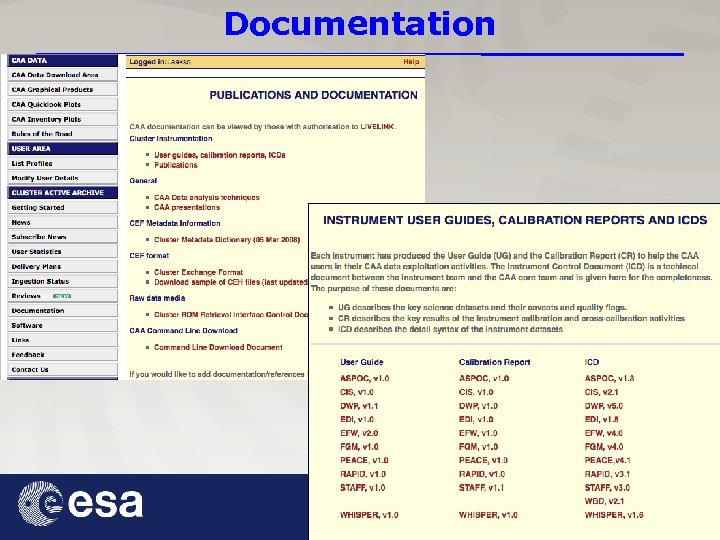 Documentation 25
 CEF FORMAT q All the science-quality digital data products are provided to the CAA in a standard representation, the Cluster Exchange Format (CEF) q Full descriptions of the data format and meta-data standards used by the CAA can be accessed from the documents area of the CAA web site http: //caa. estec. esa. int/caa/documentation. xml q The CEF § is an ASCII, comma separated, tabular format supporting multi-line records § has a fully self-describing header § offers straightforward long-term accessibility to the Cluster data q On download, products can optionally be converted to the widely used NASA Common Data Format (CDF) 26
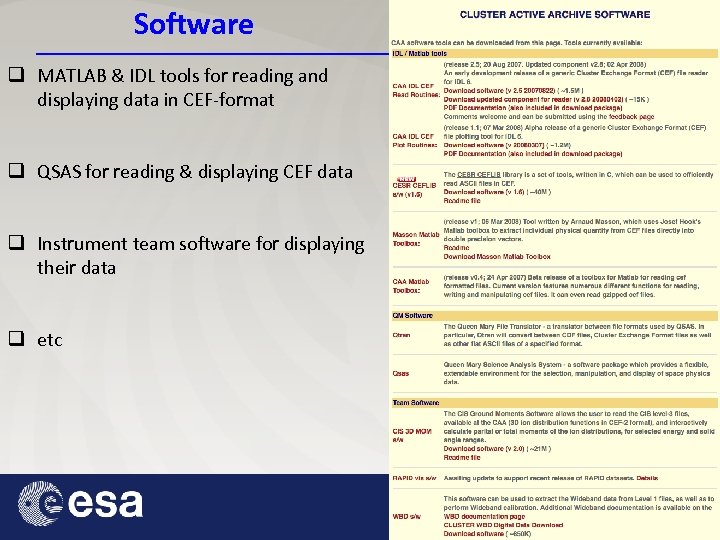 Software q MATLAB & IDL tools for reading and displaying data in CEF-format q QSAS for reading & displaying CEF data q Instrument team software for displaying their data q etc 27
 Summary q Cluster is a four-satellite constellation mission: § Cluster science: detailed investigations of physical processes in space plasmas around the Earth § Single satellite observations can be very valuable for global magnetospheric studies, e. g. , in the spring-time the spacecraft stays in the solar wind ~24 hours every few days, or in the autumn-time similarly in the plasma sheet § The Cluster observations are available since 1 February 2001 q All full- and spin-resolution Cluster data available to the world-wide science community through the Cluster Active Archive CAA (http: //caa. estec. esa. int/) § All data are aimed to be well calibrated (done with limited resources) § all data are provided in a standard format (CEF - Cluster Exchange Format) with a complete set of metadata in machine readable form § All data can also be downloaded in CDF format § Currently there about 20 -30 TB of data in compressed format § If there any issues on the usability and quality of the data products, one can contact the CAA by sending an e-mail to caateam@rssd. esa. int, or filling in a feedback form at http: //caa. estec. esa. int/caa/feedback_intro. xml 28