


 Скачать презентацию USA in Depression Mrs Williams Depression and
12e6040454510bc270bab7ec7461bfec.ppt
- Количество слайдов: 48
 USA in Depression Mrs Williams
 Depression and the New Deal: The USA, 1929 -41 Key issue: How serious were the effects of the Depression on the American people? Effects of the Wall Street Crash: collapse of business and industry; unemployment and its effects. Attempts of Hoover’s government to deal with the Depression; economic failure Unpopularity of Hoover and election of FDR. Key issue: How did Roosevelt deal with the Depression? Roosevelt’s fireside chats; banking crisis; New Deal helping farmers; unemployed; homeowners; workers; depressed areas. The main Alphabet Agencies: AAA, FERA, CWA, PWA, WPA, CCC and TVA. Helping industry: the NRA The HOLC and the Social Security Act. 2
 Key issue: How far was the New Deal successful in ending the Depression in the USA? Effectiveness of the New Deal in achieving its aims; its limitations; the Second ND. Criticisms and Opposition – from Supreme Court and politicians. Impact of WWII on economic recovery, 1939 -1941: increase in US exports; policy of Lend Lease; effects on USA. 3
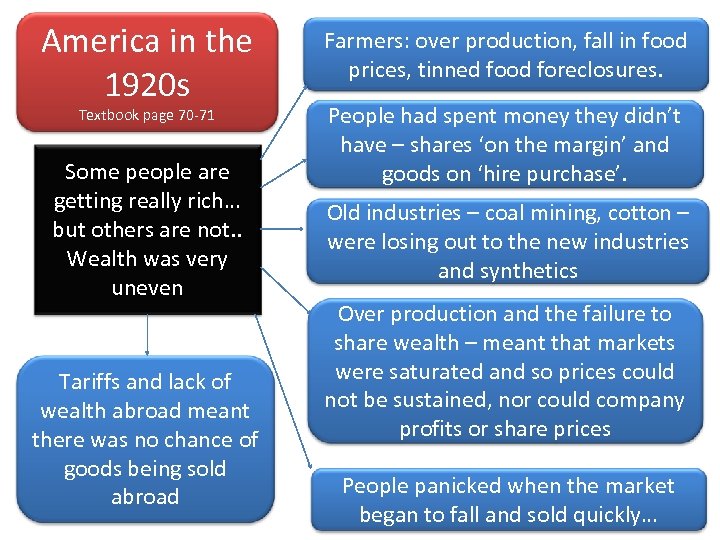 America in the 1920 s Textbook page 70 -71 Some people are getting really rich… but others are not. . Wealth was very uneven Tariffs and lack of wealth abroad meant there was no chance of goods being sold abroad Farmers: over production, fall in food prices, tinned food foreclosures. People had spent money they didn’t have – shares ‘on the margin’ and goods on ‘hire purchase’. Old industries – coal mining, cotton – were losing out to the new industries and synthetics Over production and the failure to share wealth – meant that markets were saturated and so prices could not be sustained, nor could company profits or share prices People panicked when the market began to fall and sold quickly… 4
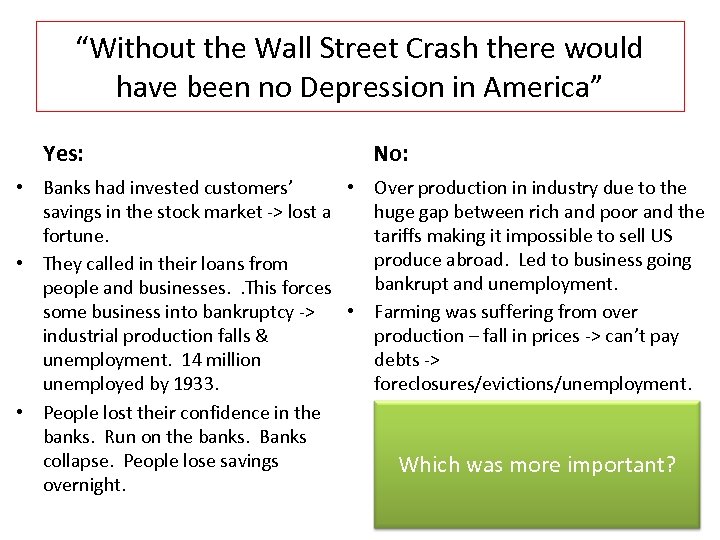 “Without the Wall Street Crash there would have been no Depression in America” Yes: No: • Banks had invested customers’ • Over production in industry due to the savings in the stock market -> lost a huge gap between rich and poor and the fortune. tariffs making it impossible to sell US produce abroad. Led to business going • They called in their loans from bankrupt and unemployment. people and businesses. . This forces some business into bankruptcy -> • Farming was suffering from over industrial production falls & production – fall in prices -> can’t pay unemployment. 14 million debts -> unemployed by 1933. foreclosures/evictions/unemployment. • People lost their confidence in the banks. Run on the banks. Banks collapse. People lose savings Which was more important? overnight. 5
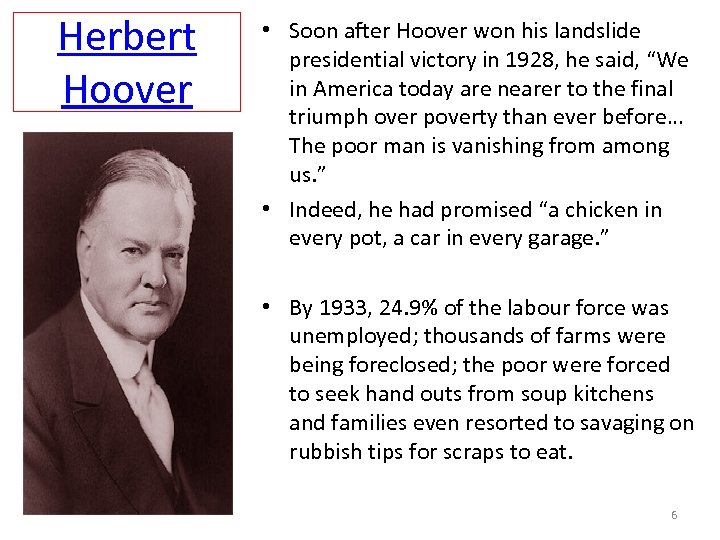 Herbert Hoover • Soon after Hoover won his landslide presidential victory in 1928, he said, “We in America today are nearer to the final triumph over poverty than ever before… The poor man is vanishing from among us. ” • Indeed, he had promised “a chicken in every pot, a car in every garage. ” • By 1933, 24. 9% of the labour force was unemployed; thousands of farms were being foreclosed; the poor were forced to seek hand outs from soup kitchens and families even resorted to savaging on rubbish tips for scraps to eat. 6
 October 1929: The Wall Street Crash 1) 12 million people out of work 2) 12, 000 people being made • unemployed every day 3) 20, 000 companies had gone bankrupt • 4) 1616 banks had gone bankrupt 5) 1 farmer in 20 evicted 6) 23, 000 people committed suicide in one year - the highest ever • The strength of America's economy in the 1920's came to a sudden end in October 1929 - even if the signs of problems had existed before the Wall Street Crash. Suddenly the 'glamour' of the Jazz Age and gangsters disappeared and America was faced with a major crisis. The huge wealth that appeared to exist in America in the 1920’s was an illusion. For example the African Americans and the farmers had not benefited in the Jazz Age but neither had 60% of the whole population as it is estimated that a family needed a basic minimum of $2, 000 a year to live (about £ 440) and 60% of US families earned less than this. Almost certainly some of the 60% included those who had gambled some money on Wall Street and could least afford to lose it in the crash of October ‘ 29. The very rich lost money on Wall Street but they could just about afford it. But the vast bulk could not afford any loss of money. This had a very important economic impact as these people could no longer afford to spend money and therefore did not buy consumer products. Therefore as there was no buying, shops went bust and factories had no reason to employ people who were making products that were not being sold. Therefore unemployment became a major issue. The depression took a while to get going but by the winter of 1932 it was at its worse. 7
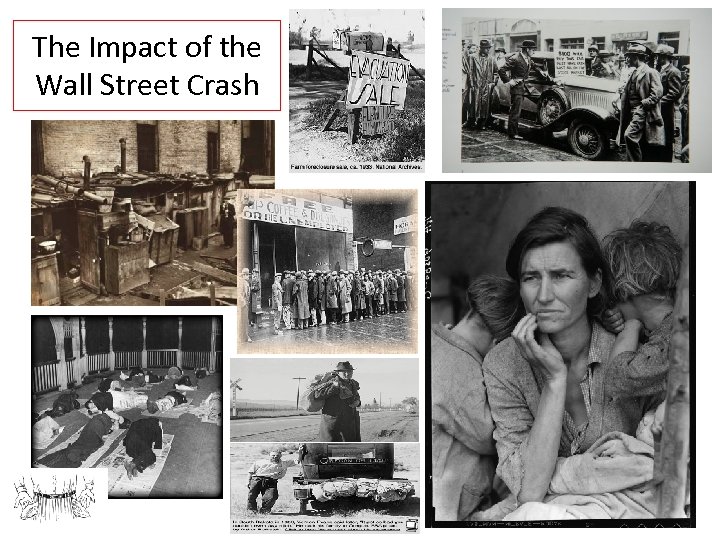 The Impact of the Wall Street Crash 8
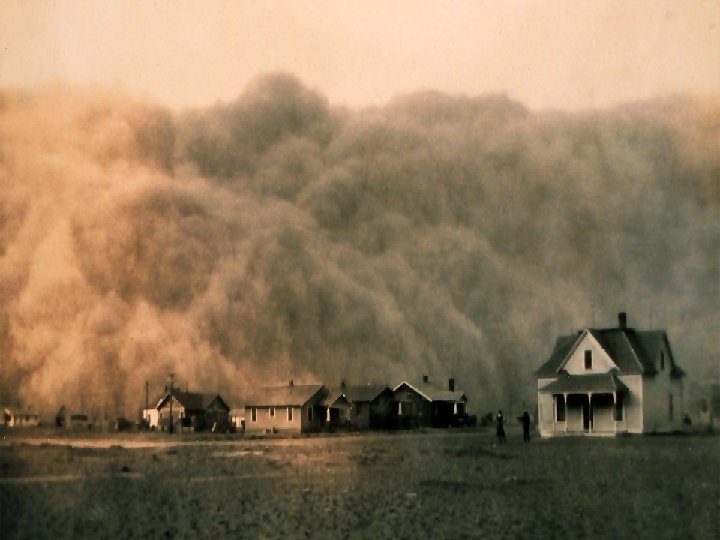 Don’t forget the South and Mid West had to deal with the Dust Bowl too • 1930 -36 South and mid West suffered from a drought. • This compounded by the over farming of the land – where the soil had lost its fertility. • Without the grass covering the soil and under the hot sun, the land turned to dust which was whipped up in storms and smothered everything in sight. Thousands of farmers were ruined. 9
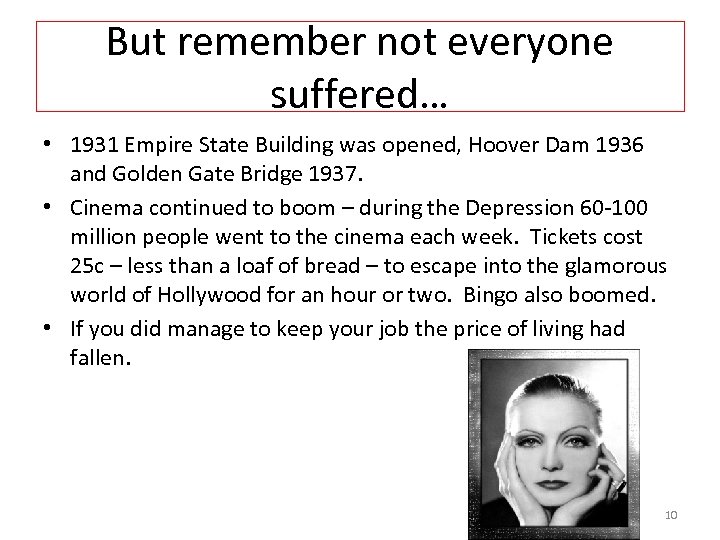 But remember not everyone suffered… • 1931 Empire State Building was opened, Hoover Dam 1936 and Golden Gate Bridge 1937. • Cinema continued to boom – during the Depression 60 -100 million people went to the cinema each week. Tickets cost 25 c – less than a loaf of bread – to escape into the glamorous world of Hollywood for an hour or two. Bingo also boomed. • If you did manage to keep your job the price of living had fallen. 10
 ‘The collapse of business and industry was the most serious effect of the Depression in the USA in the years 1929 to 1932. ’ Do you agree? Explain your answer. • Yes Collapse of stock market and shares on average lost 80% of value by 1932. Business failed and couldn’t repay the banks. Over 100, 000 companies went bankrupt by 1933. Production of manufactured goods fell to less than one-fifth by 1933. Industrial collapse led to huge increase in unemployment (to 12 m). Unemployment especially in heavy industry. • No Countryside also badly affected – eg farmers. Farm incomes dropped by 60%. Many farmers had to sell up. Many roaming in rural areas looking for work, and in cities looking to make money eg selling newspapers, apples, etc. Many houses repossessed by banks; creation of Hoovervilles. Social misery; suicides. • explains at least three features, the answer is detailed and balanced, with a substantiated judgement regarding the quotation for top of level.
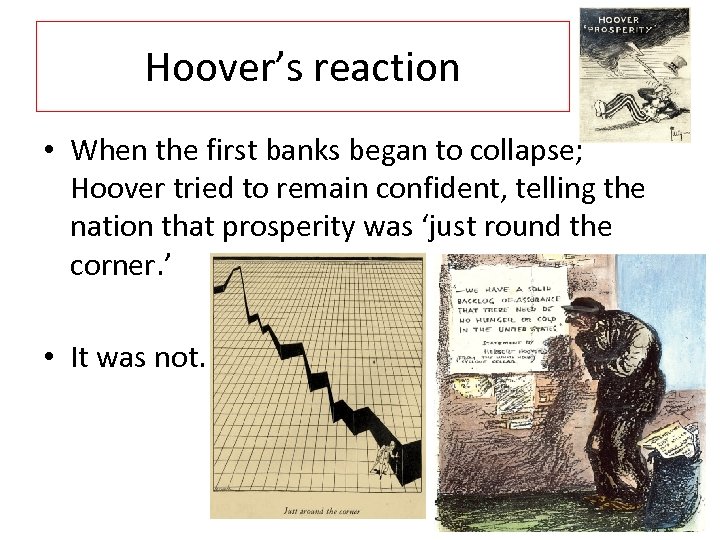 Hoover’s reaction • When the first banks began to collapse; Hoover tried to remain confident, telling the nation that prosperity was ‘just round the corner. ’ • It was not. 12
 Rugged Individualism • Hoover believed in ‘rugged individualism’. This is what he believed made America great. If you were prepared to work hard, be determined and strong; you could achieve anything. He did not want to give government hand-outs. He feared this would cost too much money and make people lazy; they would become dependent, lose their sense of responsibility and the nation’s moral fibre would be destroyed. He thought that only charities should give unemployment relief. • Hoover was determined that the government should not go in debt. With so many people losing their income however, there was less taxation being paid; so Hoover cut government spending in 1932 and supported a sharp increase in taxes. 13
 By 1932, his government had started to take action… • In 1930 Hawley – Smoot Tariff Act: this dramatically increased the tariffs on foreign goods entering the US. Countries across the world retaliated; this had a disastrous effect on world trade. • In 1932 Hoover blocked the Garner-Wagner Relief Bill, with would have allowed Congress to provide $2. 1 billion to create jobs. Why was this not a good idea? 14
 But he did… • In 1929 Hoover cut taxes by $160 million – but income tax was already low and so this was not effective in stimulating the economy. • Also in 1929, The Farm Board bought surplus farm produce to keep prices up – but it had little effect as the board could not afford to compensate farmers sufficiently. • In 1932 he set up the Reconstruction Finance Corporation (RFC) to lend money ($1500 million) to ailing banks, railroads and insurance companies. The bulk of the share went to banks – how would people view this? • In 1932, He began to realise that federal money would have to be spent: the Relief and Construction Act empowered the RFC to lend state governments $1. 5 billion for public works – Hoover Dam. But money had to be repaid at a later date. • Hoover signed a bill authorising the RFC to spend up to $300 to provide shelter, food and clothing for the unemployed. What do you think of these measures? 15
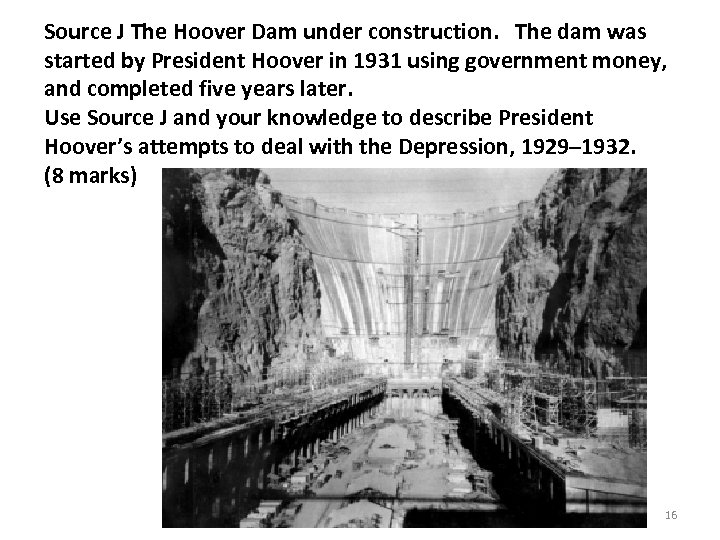 Source J The Hoover Dam under construction. The dam was started by President Hoover in 1931 using government money, and completed five years later. Use Source J and your knowledge to describe President Hoover’s attempts to deal with the Depression, 1929– 1932. (8 marks) 16
 Detailed description of several aspects using source and own knowledge e. g. Several aspects described in detail. Reference must be made to Source J. • Details on Hoover Dam project which symbolised action and determination. Money to help other major construction projects in building industries, totalling $4000 million, e. g. Hoover Dam. • Raising import duties even more (Hawley-Smoot Tariff, 1930). • Providing states with $300 million to help the unemployed (Emergency Relief Act, 1932) • Giving loans to construction industries to help recovery (Reconstruction Finance Corporation, 1932). 17
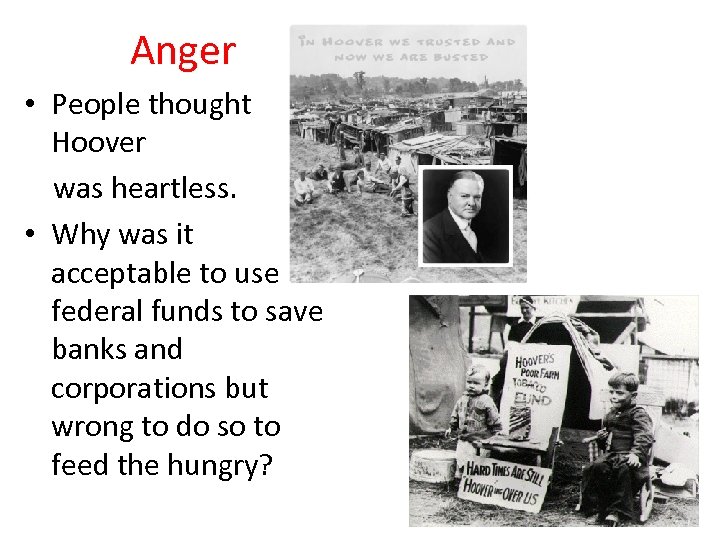 Anger • People thought Hoover was heartless. • Why was it acceptable to use federal funds to save banks and corporations but wrong to do so to feed the hungry? 18
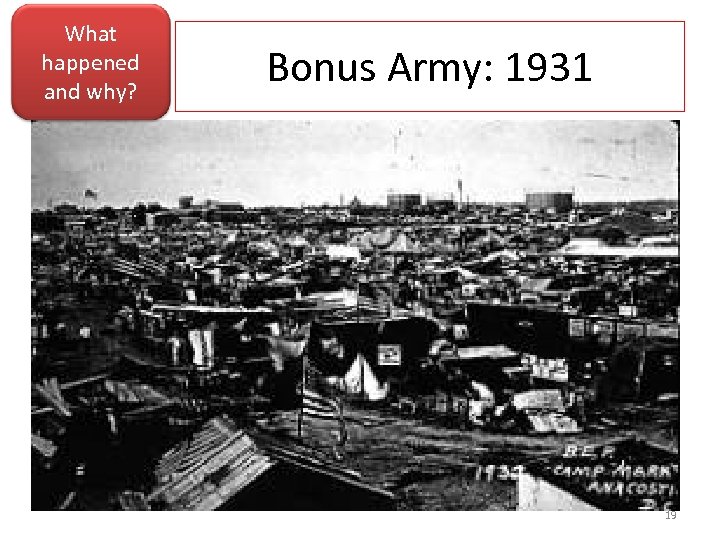 What happened and why? Bonus Army: 1931 19
 20
20
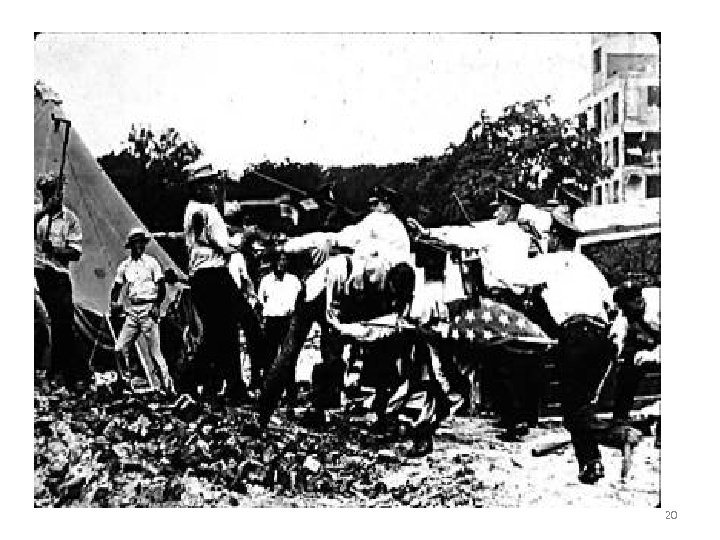
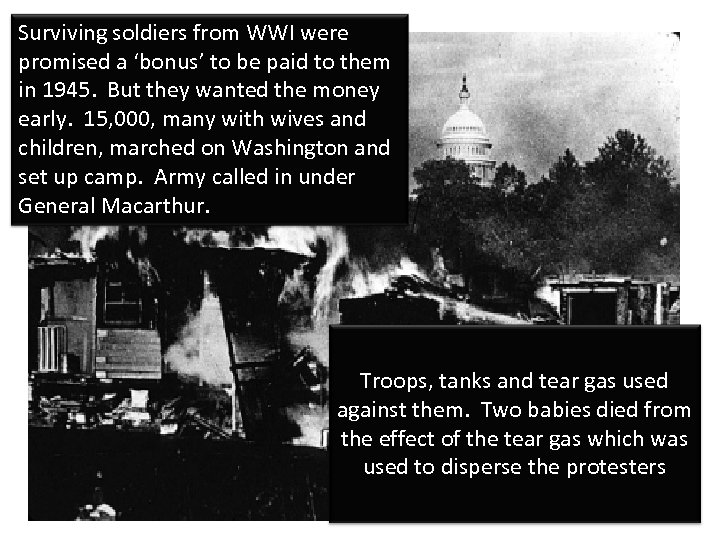 Surviving soldiers from WWI were promised a ‘bonus’ to be paid to them in 1945. But they wanted the money early. 15, 000, many with wives and children, marched on Washington and set up camp. Army called in under General Macarthur. Troops, tanks and tear gas used against them. Two babies died from the effect of the tear gas which was used to disperse the protesters 21
 Can you answer the key questions? • Was the Wall Street Crash the main cause of the Depression in the USA? • How serious were the effects of the Depression on Americans, 1929 -32? • Do you agree that Hoover failed to act against the Depression? 22
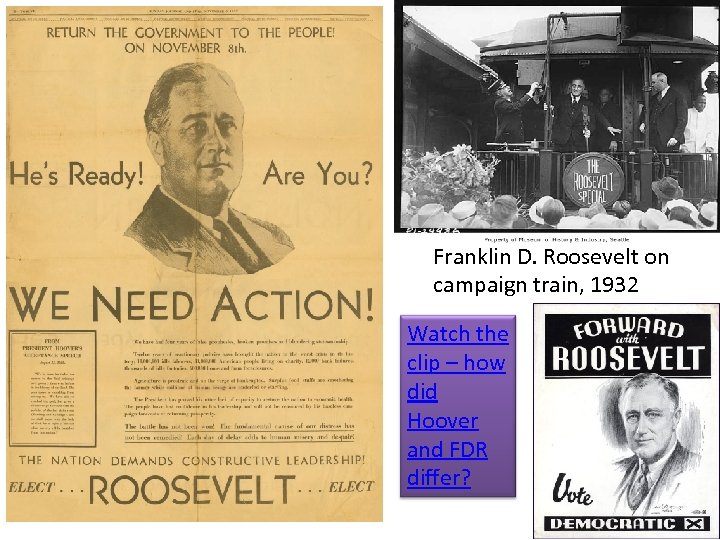 Franklin D. Roosevelt on campaign train, 1932 Watch the clip – how did Hoover and FDR differ? 23
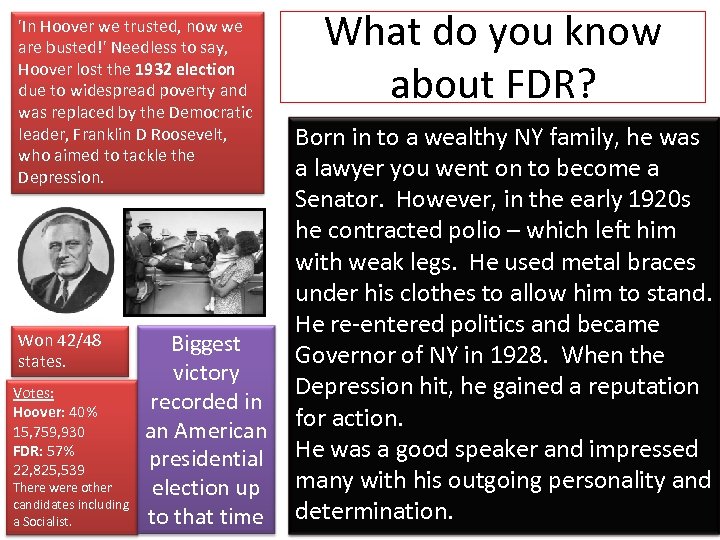 'In Hoover we trusted, now we are busted!' Needless to say, Hoover lost the 1932 election due to widespread poverty and was replaced by the Democratic leader, Franklin D Roosevelt, who aimed to tackle the Depression. Won 42/48 states. Votes: Hoover: 40% 15, 759, 930 FDR: 57% 22, 825, 539 There were other candidates including a Socialist. What do you know about FDR? Roosevelt was the first president to … Born in to a wealthy NY family, he was Speak on television a lawyer you went on to become a F. D. Roosevelt was one of the eight Senator. However, in the early 1920 s presidents that… he contracted polio – which left him Died while in office. with weak legs. He used metal braces He was the first president to have… under his clothes to allow him to stand. A presidential aircraft. He re-entered politics and became Biggest He was the first president whose Governor of NY in 1928. When the victory mother was … Depression hit, he gained a reputation recorded in Allowed to vote for him. for action. an American He was a good speaker and impressed presidential Franklin D. Roosevelt was the only many with his outgoing personality and election up president… 24 determination. to that time To be elected for four terms.
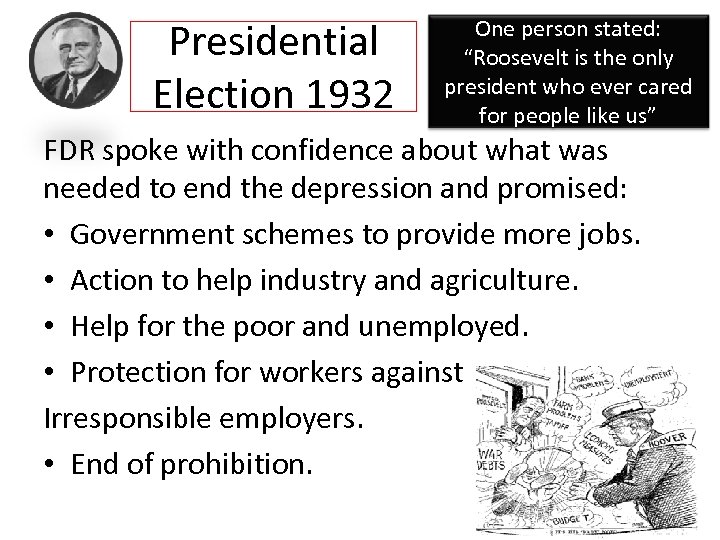 Presidential Election 1932 One person stated: “Roosevelt is the only president who ever cared for people like us” FDR spoke with confidence about what was needed to end the depression and promised: • Government schemes to provide more jobs. • Action to help industry and agriculture. • Help for the poor and unemployed. • Protection for workers against Irresponsible employers. • End of prohibition. 25
 “President Hoover’s failure to deal with the Depression in the years 1929 -1932 made sure that Roosevelt would be elected as President. ” Do you agree? Explain your answer. An analytical, linked answer clearly focused on the question, reaching a balanced conclusion about the extent of agreement. e. g. Details on several aspects, with a balanced conclusion. The answer will also probably try partly to rescue Hoover’s reputation. It may also explain that Roosevelt’s election was not a foregone conclusion – Roosevelt only received 57% of the popular vote; Hoover received 40%, and 6 states voted for Hoover’s belief in rugged individualism; his economic failures; Hoovervilles; attitude to bonus marchers; his limited attempts to revive economy through Hawley-Smoot Tariff 1930, help for construction industries (e. g. through Hoover Dam project), and 1932 Emergency Relief Act; Roosevelt’s background; his style of campaigning; his promises of a New Deal. 26
 I agree with this partly, as I also believe that FDR’s positives were also a major benefactor in Roosevelt’s ‘landslide’ win elections. Firstly, Herbert Hoover was a self-made republican who was a great believer in ‘laissez-faire- politics which do not involve much interaction from the Federal government. Herbert Hoover’s failure largely stemmed from his stubborn approach; not allowing any criticisms get in the way of his ‘rugged individualism’. Hoover’s failures and lack of involvement made all the USA’s shantytowns become known as ‘Hoovervilles’ and the newspapers that people slept beneath were defined as ‘Hoover blankets’. Hoover did not however, do nothing at all, but what he did simply wasn’t enough. He first tried to help the farms out of the Great Dust Bowl problem – the Farm Board Association tried to buy goods off farms but simply didn’t have enough investment to work effectively. Hoover also tried to protect the economy by news of the Hawley-Smoot Tariff Act, the thought that by protecting the domestic market, people would be forced to buy American goods and reboot industry. However, in order to do this he decided to increase tariffs on foreign goods. This idea backfired and Hoover ended up reducing trade as the foreign countries increased their tariffs in retaliation. He also didn’t realise the Americans couldn’t afford their own goods and the US spiralled into further depression. Hoover’s grave mistakes resulted in Iowa farmers protesting that: ‘In Hoover we trusted and now we are busted’. Between 1929 and 1939 109, 371 businesses collapsed due to Hoover, reflecting how ineffective he was. FDR, on the other hand was presented in great contrast to his opponent in the ’ 32 election. People liked his active polices on his proposition of the New Deal. FDR gained the confidence of his people via the radio by his ‘fireside chats. ’ They also saw that he had overcome polio and this give his people confidence that he can do the same for the country. FDR toured the country on his train the ‘Roosevelt Express’ getting to know his nation. People also liked him and he promised to save the ‘forgotten man’ – the blue collar worker would be remembered and helped. People also liked FDR’s promise to end prohibition and all the gang violence it involved. In conclusion, it was not only Hoover’s failure which resulted in the landslide victory of FDR, such as the backfiring Hawley-Smoot Tariff, the FBA but also FDR’s positive acts which made more people attracted to the idea of FDR and his New Deal. 27 Level 3/ 10 Marks
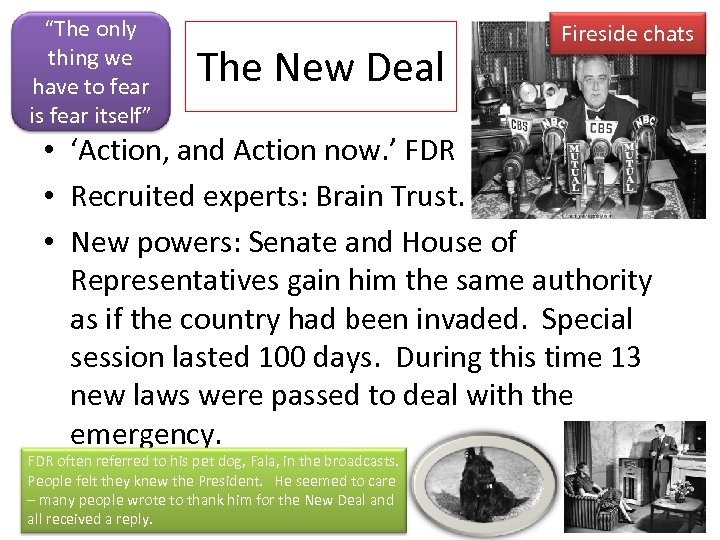 “The only thing we have to fear is fear itself” The New Deal Fireside chats • ‘Action, and Action now. ’ FDR • Recruited experts: Brain Trust. • New powers: Senate and House of Representatives gain him the same authority as if the country had been invaded. Special session lasted 100 days. During this time 13 new laws were passed to deal with the emergency. FDR often referred to his pet dog, Fala, in the broadcasts. People felt they knew the President. He seemed to care – many people wrote to thank him for the New Deal and all received a reply. 28
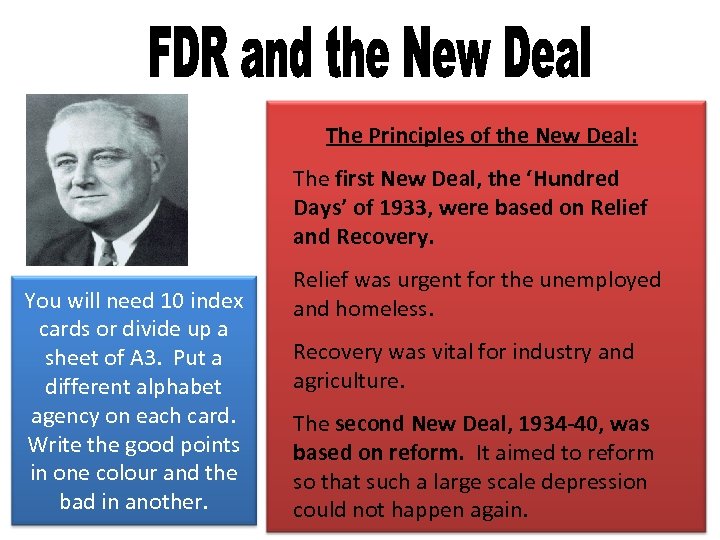 The Principles of the New Deal: The first New Deal, the ‘Hundred Days’ of 1933, were based on Relief and Recovery. You will need 10 index cards or divide up a sheet of A 3. Put a different alphabet agency on each card. Write the good points in one colour and the bad in another. Relief was urgent for the unemployed and homeless. Recovery was vital for industry and agriculture. The second New Deal, 1934 -40, was based on reform. It aimed to reform so that such a large scale depression could not happen again.
 In March 1933, about 60 million Americans gathered around their radios to be told in a warm tone - "I can assure you that it is safer to keep your money in a reopened bank than under the mattress". The Emergency Banking Act 1933 By March 1933 4, 000 banks had collapsed, and 15% of the population’s life savings had been lost. Roosevelt closed all banks for 4 days, and government officials conducted inspections. Only banks with sufficient cash reserves were allowed to reopen after the 4 days. It officially backed 5, 000 banks. This restored public confidence in the banking system. Quickly, $300 million of gold deposits The Beer Act, 1933 To end the Depression, the government urgently needed money through tax revenue. The Beer Act made the manufacture and distribution of beer legal again, ending the Prohibition. The Beer Act succeeded in bringing in much needed revenue, and had a beneficial side-effect of reducing one of the main sources of income of organised crime.
 • AAA – Agricultural Adjustment Act, 1933 • Led by Henry Wallace, the AAA paid farmers to produce less food, and artificially force prices to rise. Farmers were paid to burn crops and slaughter cattle. In 1933 10 million acres of cotton was ploughed up, and 6 million pigs slaughtered. (Public outcry when people were hungry and in need of clothes). Some of the meat was tinned and given to the poor, but about 9/10 ths was destroyed. • Gradually the AAA had a beneficial impact. Between 1932 and 1939 the average income of American farmers doubled. However, critics claimed the AAA was unjustified interference in the free market. • AAA helped farmers but not the tenants and sharecroppers (blacks) many of them were evicted as there was less work for them to do; they were also replaced with machinery bought with government money.
 Civilian Conservation Corps – CCC, 1933 • Unemployment was particularly bad among the young. • The CCC provided work schemes for single men aged 18 -25. Men who joined the CCC were paid a $ a day, but had to send $25 a month back home. Civil Works Administration – CWA, 1933 Mass unemployment had meant that a large number of public services had ground to a halt. The CWA aimed to provide public works schemes to be done by the unemployed. • Between 1933 and 1941 over 2, 000 Within months of its conception the men benefited from work offered by CWA was providing over 4, 000 the CCC. They learnt news skills which jobs of various civic building projects would help them find employment. – dams, roads, schools, public toilets • Critics compared the CCC to the Hitler and so on. youth, and trade unions complained Some men who were forced to that CCC work was exploitation. accept CWA work felt shame that they could not find an alternative job. Others hated the CWA because they thought the jobs they did were a waste of time – ‘boondoggles’.
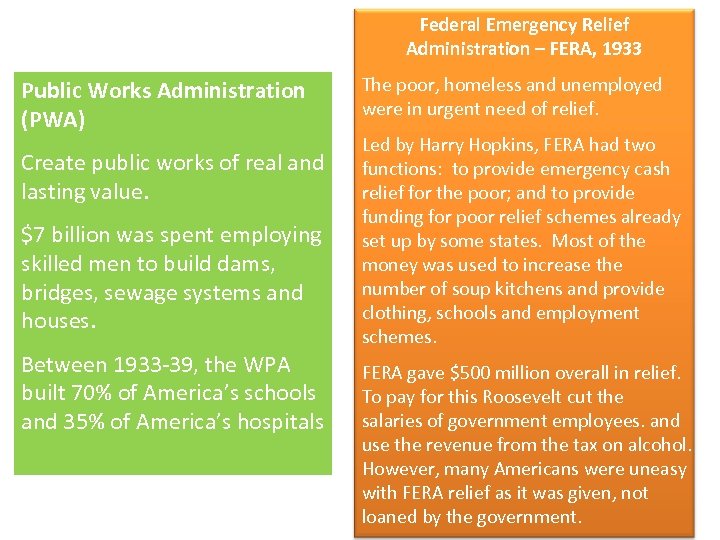 Federal Emergency Relief Administration – FERA, 1933 Public Works Administration (PWA) Create public works of real and lasting value. $7 billion was spent employing skilled men to build dams, bridges, sewage systems and houses. Between 1933 -39, the WPA built 70% of America’s schools and 35% of America’s hospitals The poor, homeless and unemployed were in urgent need of relief. Led by Harry Hopkins, FERA had two functions: to provide emergency cash relief for the poor; and to provide funding for poor relief schemes already set up by some states. Most of the money was used to increase the number of soup kitchens and provide clothing, schools and employment schemes. FERA gave $500 million overall in relief. To pay for this Roosevelt cut the salaries of government employees. and use the revenue from the tax on alcohol. However, many Americans were uneasy with FERA relief as it was given, not loaned by the government.
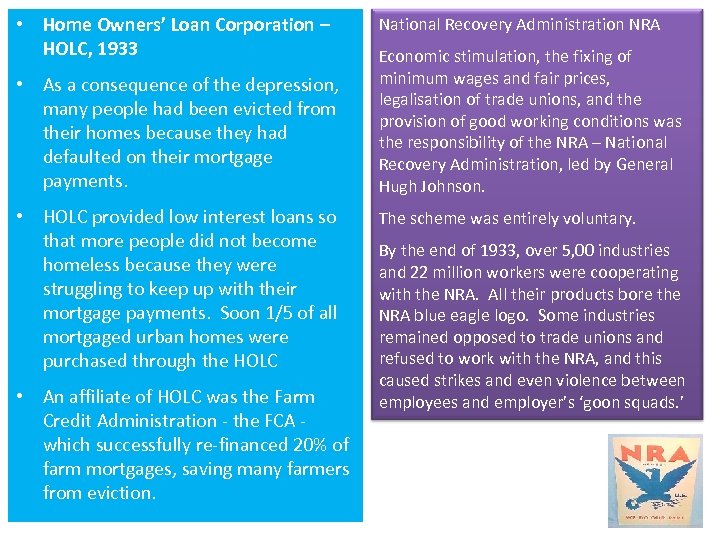 • Home Owners’ Loan Corporation – HOLC, 1933 • As a consequence of the depression, many people had been evicted from their homes because they had defaulted on their mortgage payments. • HOLC provided low interest loans so that more people did not become homeless because they were struggling to keep up with their mortgage payments. Soon 1/5 of all mortgaged urban homes were purchased through the HOLC • An affiliate of HOLC was the Farm Credit Administration - the FCA - which successfully re-financed 20% of farm mortgages, saving many farmers from eviction. National Recovery Administration NRA Economic stimulation, the fixing of minimum wages and fair prices, legalisation of trade unions, and the provision of good working conditions was the responsibility of the NRA – National Recovery Administration, led by General Hugh Johnson. The scheme was entirely voluntary. By the end of 1933, over 5, 00 industries and 22 million workers were cooperating with the NRA. All their products bore the NRA blue eagle logo. Some industries remained opposed to trade unions and refused to work with the NRA, and this caused strikes and even violence between employees and employer’s ‘goon squads. ’
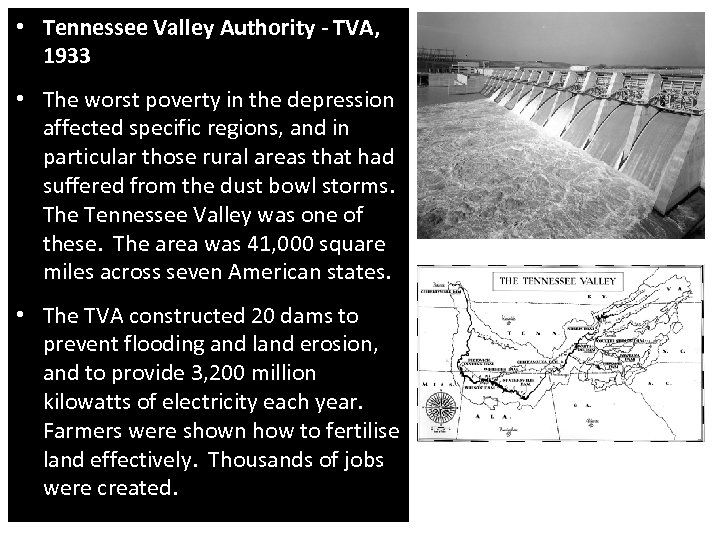 • Tennessee Valley Authority - TVA, 1933 • The worst poverty in the depression affected specific regions, and in particular those rural areas that had suffered from the dust bowl storms. The Tennessee Valley was one of these. The area was 41, 000 square miles across seven American states. • The TVA constructed 20 dams to prevent flooding and land erosion, and to provide 3, 200 million kilowatts of electricity each year. Farmers were shown how to fertilise land effectively. Thousands of jobs were created. • Roosevelt was criticised to taking
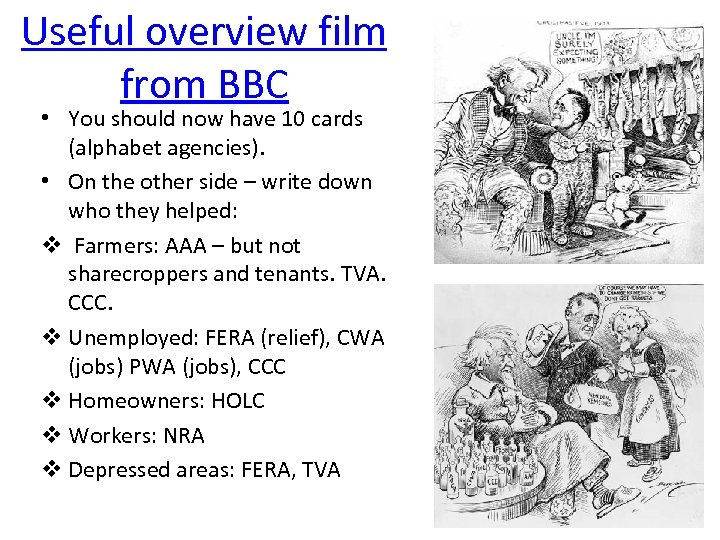 Useful overview film from BBC • You should now have 10 cards (alphabet agencies). • On the other side – write down who they helped: v Farmers: AAA – but not sharecroppers and tenants. TVA. CCC. v Unemployed: FERA (relief), CWA (jobs) PWA (jobs), CCC v Homeowners: HOLC v Workers: NRA v Depressed areas: FERA, TVA 36
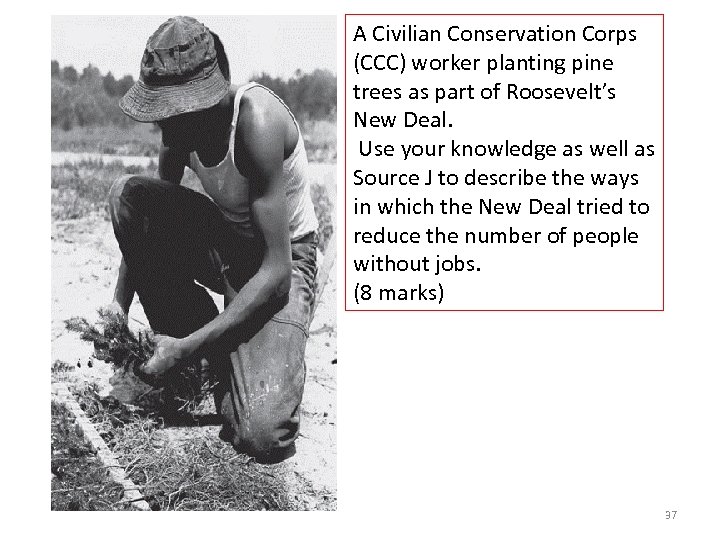 A Civilian Conservation Corps (CCC) worker planting pine trees as part of Roosevelt’s New Deal. Use your knowledge as well as Source J to describe the ways in which the New Deal tried to reduce the number of people without jobs. (8 marks) 37
 Supreme Court Decision, 1935 The Schechter Poultry Corporation, which had signed the NRA codes of fair trading, had been found to have sold a butcher ‘unfit chicken’. They were found guilty of breaking the codes – but kept appealing until the case reached the Supreme Court. In 1935 the Supreme Court declared the NRA unconstitutional as the President had no right to make laws to control businesses. In 1936, it declared the AAA unconstitutional on the grounds that regulations about agriculture could only be made by individual states and not national government.
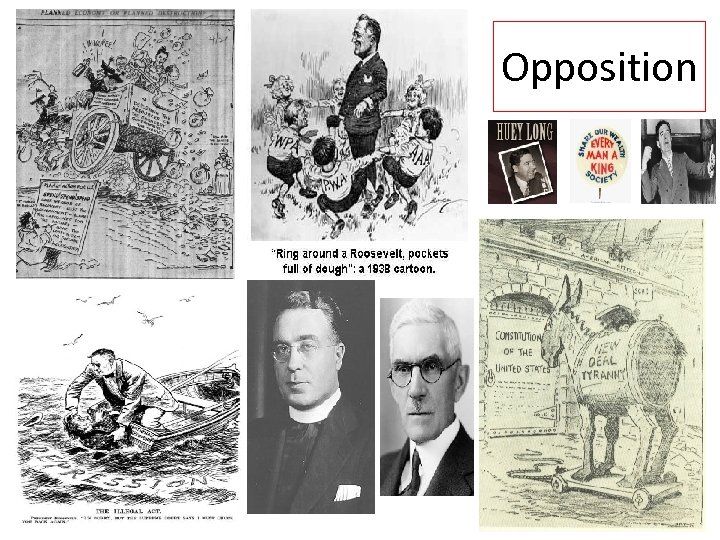 Opposition 39
 Roosevelt was re-elected in 1936, 1940 and 1944. He once joked that everyone was against him except the voters. Why was this? Republicans Can you explain why each opposed FDR? Which was his biggest threat? Supreme Court Dr Francis Townsend Charles Coughlin Huey Long 40
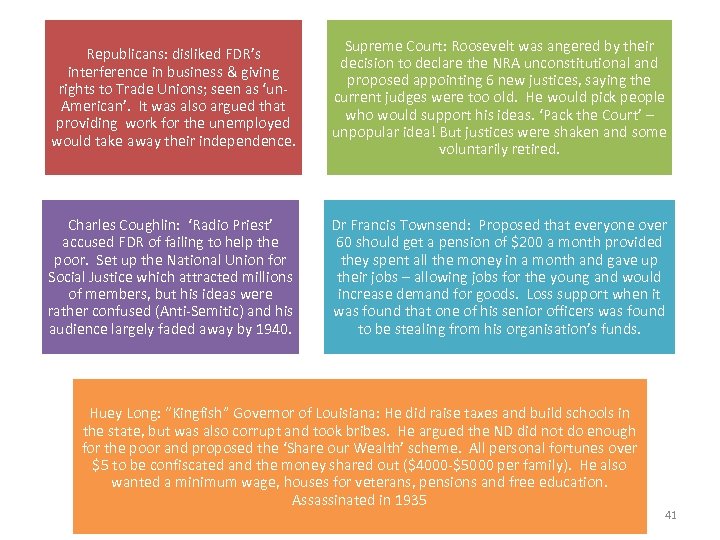 Republicans: disliked FDR’s interference in business & giving rights to Trade Unions; seen as ‘un. American’. It was also argued that providing work for the unemployed would take away their independence. Supreme Court: Roosevelt was angered by their decision to declare the NRA unconstitutional and proposed appointing 6 new justices, saying the current judges were too old. He would pick people who would support his ideas. ‘Pack the Court’ – unpopular idea! But justices were shaken and some voluntarily retired. Charles Coughlin: ‘Radio Priest’ accused FDR of failing to help the poor. Set up the National Union for Social Justice which attracted millions of members, but his ideas were rather confused (Anti-Semitic) and his audience largely faded away by 1940. Dr Francis Townsend: Proposed that everyone over 60 should get a pension of $200 a month provided they spent all the money in a month and gave up their jobs – allowing jobs for the young and would increase demand for goods. Loss support when it was found that one of his senior officers was found to be stealing from his organisation’s funds. Huey Long: “Kingfish” Governor of Louisiana: He did raise taxes and build schools in the state, but was also corrupt and took bribes. He argued the ND did not do enough for the poor and proposed the ‘Share our Wealth’ scheme. All personal fortunes over $5 to be confiscated and the money shared out ($4000 -$5000 per family). He also wanted a minimum wage, houses for veterans, pensions and free education. Assassinated in 1935 41
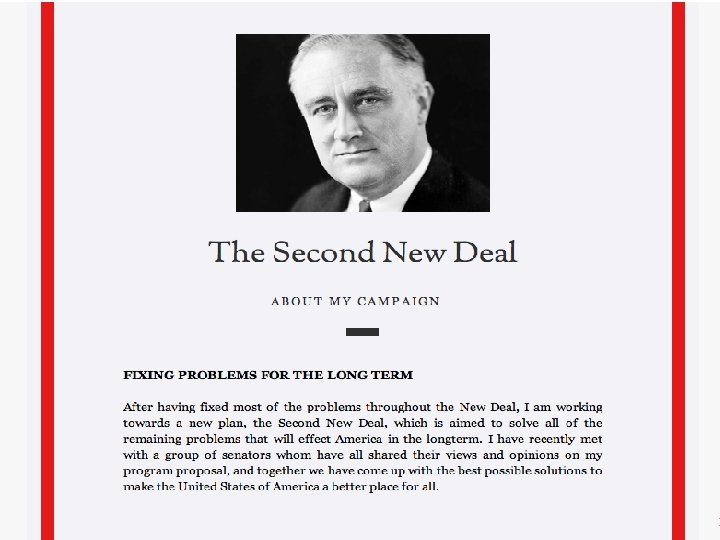 1935 Wagner Act The Wagner Act represented a charter for all workers. It formalised a worker’s right to join a trade union, and made it illegal for employers to obstruct this right. Workers’ rights were to be protected by the National Labor Relations Board. Unions gained more and more power. By 1939 trade union membership had tripled from 3 million in 1933 to 9 million. In 1936 the Miners leader, John Lewis, joined all trade unions into one giant union, the Congress of Industrial Organisations (CIO). This provoked strikes and violence. Works Progress Administration - WPA, 1934 FDR needed to make sure that the job creation schemes begun by the CWA and the PWA continued in the longer term. By 1937 it had constructed 11, 000 schools and other public buildings, and 69, 000 kilometres of road. The WPA even commissioned artists to paint murals, and actors to tour shows. Social Security Act - 1935 This provided pensions for old people and widows for up to $85 each month, help for children and disabled people, and created a national system of insurance for the unemployed. This was the first reform of this kind in American history, and has been called the ‘most far reaching piece of social legislation in US history. ’ Resettlement Administration, 1935 Later re-named Farm Security Administration - FSA Given that the depression had hit rural communities more severely than anywhere else, the poorest element of the rural community, the sharecroppers, were in a desperate situation. The FSA provided loans to assist sharecroppers to find new tenancies or to prevent eviction. 42
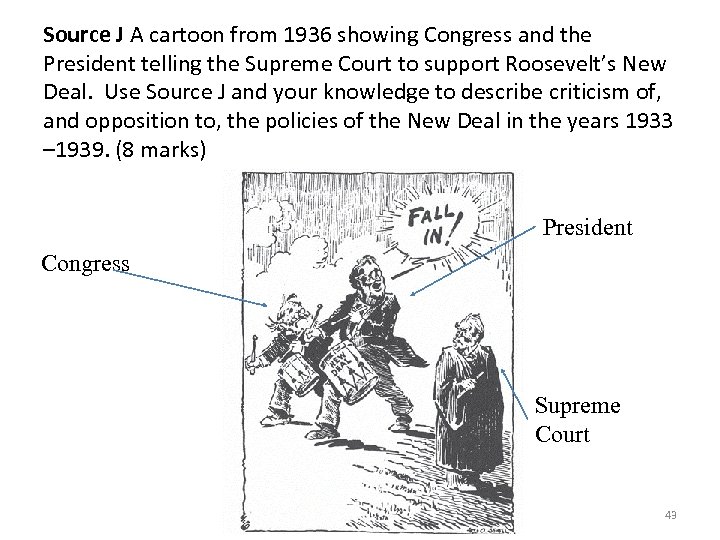 Source J A cartoon from 1936 showing Congress and the President telling the Supreme Court to support Roosevelt’s New Deal. Use Source J and your knowledge to describe criticism of, and opposition to, the policies of the New Deal in the years 1933 – 1939. (8 marks) President Congress Supreme Court 43
 • • • As we can see in Source J, one of the main critics to the New Deal was the Supreme Court. In 1936, as shown in the sources the Supreme Court and FDR conflicted. The dispute was originated from a Jewish Chicken farms selling sick chickens to a business. The NIRA (The National Industrial Recovery Administration) got included with the business and interfered with it. This, deemed by the largely republican court was ‘unconstitutional’ and felt the actions of FDR’s NIRA and NRA were wrong and not for him to get involved with. Other criticisms steamed from the idea that the New Deal was not doing enough for the country’s recovery and some said that it was not only unfair on the tax payer to have to contribute so much, but also that it was a large waste of money. There is a famous political cartoon which stresses both these ideas showing FDR ineffectively ‘pumping’ the New Deal pump and wasting $16 billion on schemes that did not work. Another famous critic of the New Deal was Henry Long who claimed that the New Deal was providing no recovery for the American economy, just vague relief for its people. There was also a priest who, in contrast and opposition to FDR’s fireside chats, criticised the New Deal publically on the radio. There were also criticisms of some of the alphabet agencies such as the Civilian Conservation Corps, which only paid its workers £ 1 per day, described as ‘cheap labour’. Also the AAA infamously slaughtered 6, 000 chickens as well or only giving to of its food to ten poor and destroying 9/10 in an effort to increase the value of food. Criticisms also stem from the result of the spending cuts of 1937 where, unemployment rose again by 2, 000. People jumped on the fact that the New Deal relied on too much investment and wasn’t stable. This answer achieved full marks – why? 44
 Mark scheme • Detailed description of opposition by the Supreme Court to parts of the New Deal legislation: The cost of the New Deal; the Supreme Court judgements finding some laws unconstitutional; some such as Senator Huey Long arguing that the New Deal was not going far enough to help the poor; Father Coughlin’s radio broadcasts; insufficient help for Black Americans; Republican Party preference for return of “rugged individualism”. • The answer must include a reference to Source J and the Supreme Court. 45
 Did the New Deal achieve it aims? Recovery of industry and agriculture and to get people back to work In the US, Depression did not lead to extreme movements like Communism or Nazism. Roosevelt restored Americans’ faith in democracy. Many millions of jobs were created and vital relief (food, shelter, clothing) was supplied to the poor. Rescued the banking system. When Roosevelt cut back his programmes in 1937, unemployment shot up. Unemployment (9. 5 million) was only really solved by the US entry into WW 2 in 1941. The US trade (and the world’s trade) did not recover. He failed to convince his supporters to change the organisation of the Supreme Court to stop it opposing his reforms. Black Americans gained little under the New Deal. Labour unrest grew in the 1930 s and there was sometimes violence. Needed the war…. 46
 War helped the US: q. America was able to sell weapons to GB. q. March 1941, Lend-Lease Act – GB handed overseas military bases to the USA in return , USA supplied GB and USSR with war materials as necessary, to be paid for after the war (in the end it supplied weapons to the cost of $50 billion). This stimulated American industry. q. From December 1941, America was involved in WW 2 – weapons, equipment, supplies, goods, soldiers… lifted the US economy out of the Depression. 47
 ‘By 1939 the New Deal had achieved its aims. ’ Do you agree? Explain your answer. • Yes - New Deal led to restoration of some confidence; Banking reforms; Alphabet Agencies provided a lot of relief; Alphabet Agencies tried to help economic recovery (with an example or two); Roosevelt was popular and kept getting re-elected; • No - A lot of the agencies offered short-term temporary solutions; There was a recession in 1937; Unemployment was still high in 1939; It was Lend-Lease policies in 1941 and WW 2 which led to full recovery of economy. • The answer is detailed and balanced, with a substantiated judgement regarding the quotation for top of Level. This may include details on what happened to the US economy 1939– 1941 to explain the limited nature of the New Deal’s achievements, or it may assess 1933 -1939 with detailed reference to the economic recession in 1937 following government reductions in spending on the New Deal. The answer demonstrates highly developed/ complex understanding of the rules of spelling, punctuation and grammar. It is well structured, with an appropriate form and style of writing. Specialist vocabulary is used effectively. 48