 Скачать презентацию US Spectrum Efficiency Initiatives Darrell Ernst October 2001
14cdd7b12e70e3e0919cef624bf1031b.ppt
- Количество слайдов: 13



US Spectrum Efficiency Initiatives Darrell Ernst October 2001
Agenda l Background l DOT&E Spectrum Stewardship Initiative l Central Test & Evaluation Investment Program l Science & Technology Initiative
Background - DOT&E Mission l Mr. Tom Christie, Director, Operational Test & Evaluation l Responsible to Sec. Def, Congress for operational test & evaluation of all DOD weapon systems l Assumed responsibility for oversight of DOD test resources and test ranges in 1999
Background - Resources & Ranges l Mr. John Gehrig, DOT&E Deputy Director for Resources & Ranges (R&R) l Responsible for administrative oversight of DOD Major Range and Test Facility Base (MRTFB) l Manages research & development of technologies for T&E - Includes CTEIP and S&T programs
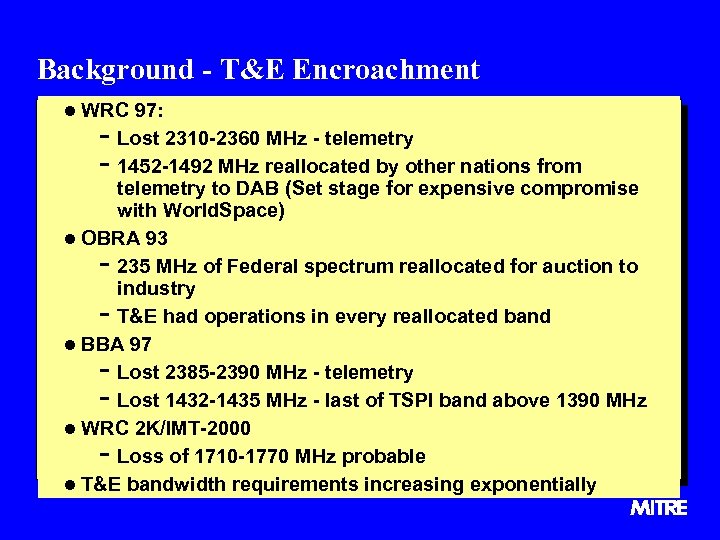
Background - T&E Encroachment l WRC 97: - Lost 2310 -2360 MHz - telemetry - 1452 -1492 MHz reallocated by other nations from telemetry to DAB (Set stage for expensive compromise with World. Space) l OBRA 93 235 MHz of Federal spectrum reallocated for auction to industry T&E had operations in every reallocated band l BBA 97 Lost 2385 -2390 MHz - telemetry Lost 1432 -1435 MHz - last of TSPI band above 1390 MHz l WRC 2 K/IMT-2000 Loss of 1710 -1770 MHz probable l T&E bandwidth requirements increasing exponentially -
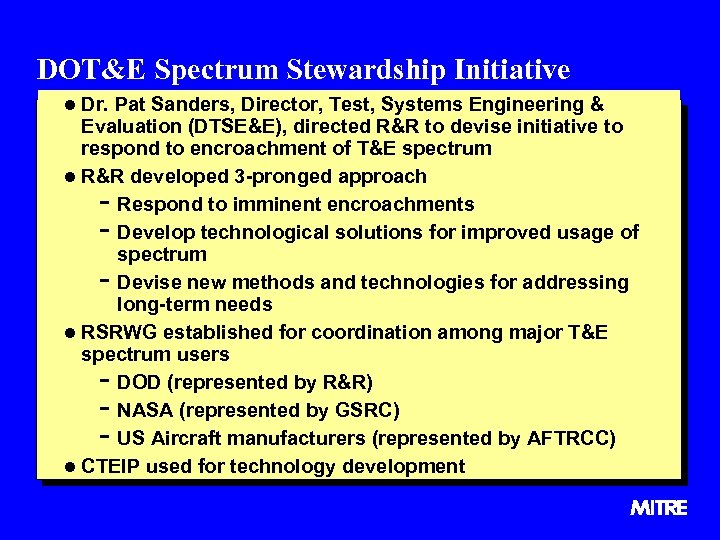
DOT&E Spectrum Stewardship Initiative l Dr. Pat Sanders, Director, Test, Systems Engineering & Evaluation (DTSE&E), directed R&R to devise initiative to respond to encroachment of T&E spectrum l R&R developed 3 -pronged approach Respond to imminent encroachments Develop technological solutions for improved usage of spectrum Devise new methods and technologies for addressing long-term needs l RSRWG established for coordination among major T&E spectrum users DOD (represented by R&R) NASA (represented by GSRC) US Aircraft manufacturers (represented by AFTRCC) l CTEIP used for technology development -
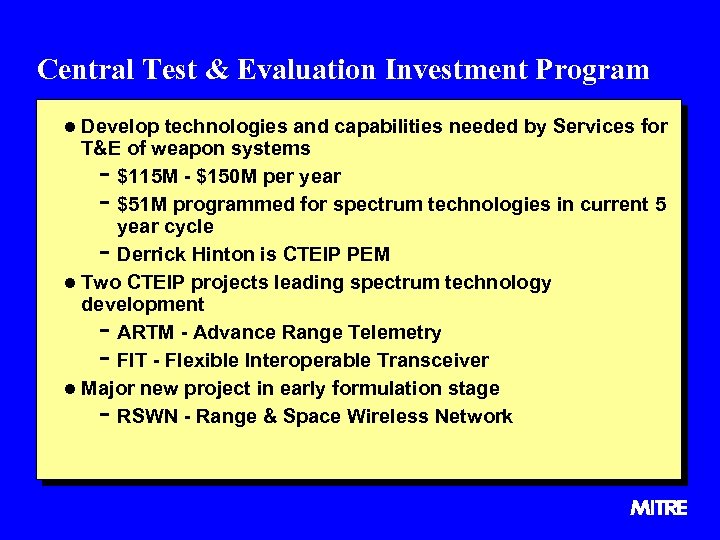
Central Test & Evaluation Investment Program l Develop technologies and capabilities needed by Services for T&E of weapon systems $115 M - $150 M per year $51 M programmed for spectrum technologies in current 5 year cycle Derrick Hinton is CTEIP PEM l Two CTEIP projects leading spectrum technology development ARTM - Advance Range Telemetry FIT - Flexible Interoperable Transceiver l Major new project in early formulation stage RSWN - Range & Space Wireless Network -
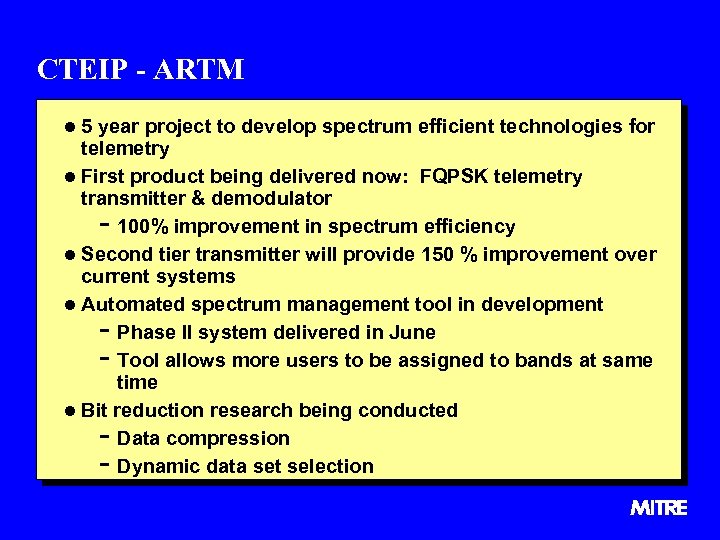
CTEIP - ARTM l 5 year project to develop spectrum efficient technologies for telemetry l First product being delivered now: FQPSK telemetry transmitter & demodulator 100% improvement in spectrum efficiency l Second tier transmitter will provide 150 % improvement over current systems l Automated spectrum management tool in development Phase II system delivered in June Tool allows more users to be assigned to bands at same time l Bit reduction research being conducted Data compression Dynamic data set selection -
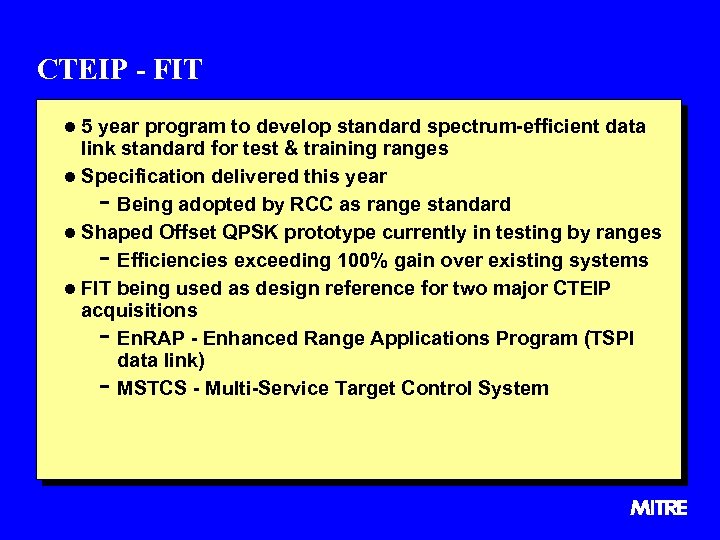
CTEIP - FIT l 5 year program to develop standard spectrum-efficient data link standard for test & training ranges l Specification delivered this year Being adopted by RCC as range standard l Shaped Offset QPSK prototype currently in testing by ranges Efficiencies exceeding 100% gain over existing systems l FIT being used as design reference for two major CTEIP acquisitions En. RAP - Enhanced Range Applications Program (TSPI data link) MSTCS - Multi-Service Target Control System -
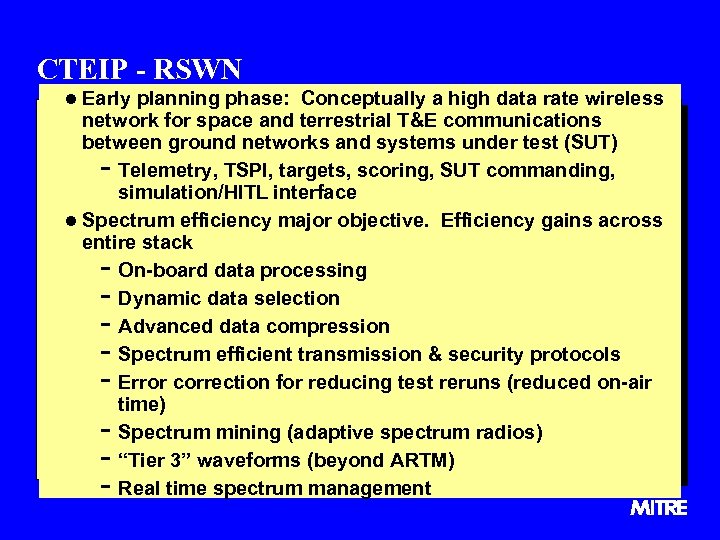
CTEIP - RSWN l Early planning phase: Conceptually a high data rate wireless network for space and terrestrial T&E communications between ground networks and systems under test (SUT) Telemetry, TSPI, targets, scoring, SUT commanding, simulation/HITL interface l Spectrum efficiency major objective. Efficiency gains across entire stack On-board data processing Dynamic data selection Advanced data compression Spectrum efficient transmission & security protocols Error correction for reducing test reruns (reduced on-air time) Spectrum mining (adaptive spectrum radios) “Tier 3” waveforms (beyond ARTM) Real time spectrum management -
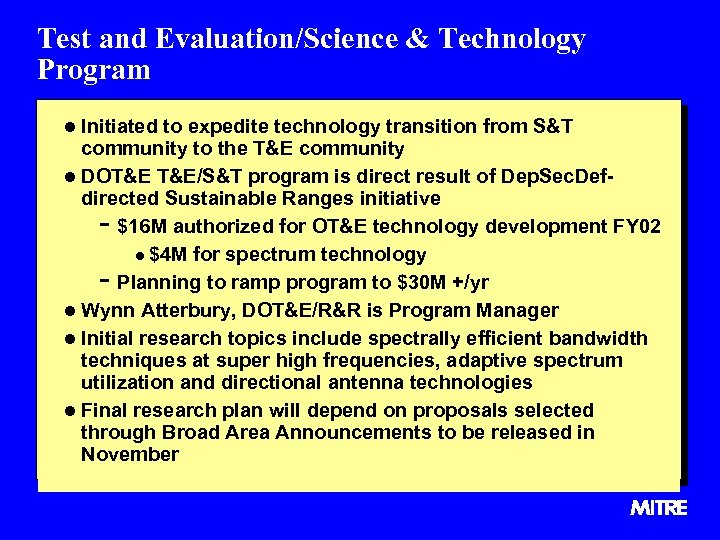
Test and Evaluation/Science & Technology Program l Initiated to expedite technology transition from S&T community to the T&E community l DOT&E T&E/S&T program is direct result of Dep. Sec. Defdirected Sustainable Ranges initiative $16 M authorized for OT&E technology development FY 02 l $4 M for spectrum technology Planning to ramp program to $30 M +/yr l Wynn Atterbury, DOT&E/R&R is Program Manager l Initial research topics include spectrally efficient bandwidth techniques at super high frequencies, adaptive spectrum utilization and directional antenna technologies l Final research plan will depend on proposals selected through Broad Area Announcements to be released in November -
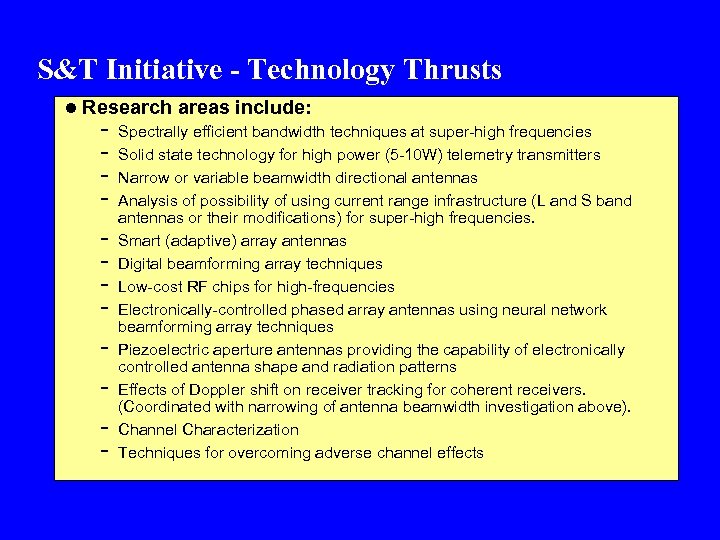
S&T Initiative - Technology Thrusts l Research areas include: - Spectrally efficient bandwidth techniques at super-high frequencies Solid state technology for high power (5 -10 W) telemetry transmitters Narrow or variable beamwidth directional antennas Analysis of possibility of using current range infrastructure (L and S band antennas or their modifications) for super-high frequencies. Smart (adaptive) array antennas Digital beamforming array techniques Low-cost RF chips for high-frequencies Electronically-controlled phased array antennas using neural network beamforming array techniques Piezoelectric aperture antennas providing the capability of electronically controlled antenna shape and radiation patterns Effects of Doppler shift on receiver tracking for coherent receivers. (Coordinated with narrowing of antenna beamwidth investigation above). Channel Characterization Techniques for overcoming adverse channel effects
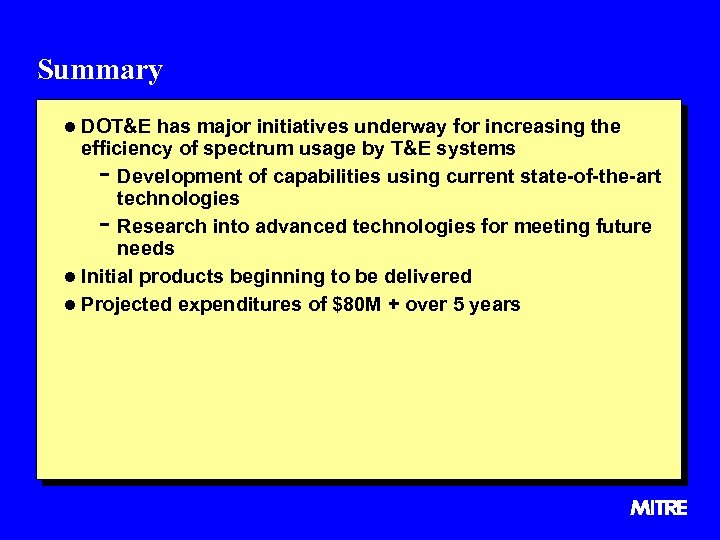
Summary l DOT&E has major initiatives underway for increasing the efficiency of spectrum usage by T&E systems Development of capabilities using current state-of-the-art technologies Research into advanced technologies for meeting future needs l Initial products beginning to be delivered l Projected expenditures of $80 M + over 5 years -
Скачать презентацию US Spectrum Efficiency Initiatives Darrell Ernst October 2001
14cdd7b12e70e3e0919cef624bf1031b.ppt