


 Скачать презентацию US REVIEW SESSION 4 1920 Modern Era
2bb755c1b8de415c15b71a25458cd1ab.ppt
- Количество слайдов: 19
 US REVIEW SESSION #4 1920 – Modern Era
 1920 s Key Terms Quotas: Prohibition: Made alcohol illegal (18 th amendment) On Margin: Set the number of immigrants allowed into the country each year. Buying stock on credit, little $ down; contributed to stock market crash Flapper: Emerging new women of the 1920 s: smoke, drank, danced, new clothes, etc.
 Key ideas and concepts Relationship between Immigrants, Government, and KKK: Teapot Dome Scandal: Harding; leased government land for oil, public lost faith in government Stock Market Crash: October, 1929 Nativism: immigrants were discriminated against, led to passage of national origins act Cause: Buying on margin, overproduction Effects: Unemployment (25%) Calvin Coolidge: Laissez-faire, free enterprise, government helps businesses
 1930 s Key Terms Wagner Act: Hoovervilles: Shanty towns, made of cardboard, etc. Dust Bowl: Boost to unions, allowed collective bargaining Drought in Midwest, destroyed farms What was depression like? Significance? High unemployment, very poor, soup kitchens; Movies played a large role, way to escape reality
 FDR What was FDR’s New Deal and what was its goal? Court Packing Plan: Increase the number of justices from 9 -> 15 Successful: Programs designed to get the US out of the Depression (AAA, PWA, TVA, etc. ) No, Congress did not pass it Why he wanted to do it? Help gain support for his New Deal Programs
 WWII Key Terms Appeasement: Lend Lease Act: Policy of isolation What caused US entrance? Women who worked in factories during war Why did the US not want to get involved in the war? Selling military supplies to allied powers Rosie the Riveter: Giving in to the demands of an aggressor (Munich Conference: France and GB gave into Hitler) Pearl Harbor, December 7, 1941 Korematsu v. The US: Japanese were allowed to be placed in internment camps; rights of citizens decrease during times of war
 Cold War Key Terms Domino Theory: Suburbanization: Mass movement to suburbs; helped by highways and cars Brinkmanship: Fear that if one country falls to communism, surrounding countries will too On the brink of war: ex. Cuban Missile Crisis Containment: Policy to keep communism from spreading (Truman Doctrine, Marshall Plan)
 More 1950 s Significance of Truman Doctrine and Marshall Plan: Joe Mc. Carthy: Senator from Wisconsin: Started Red Scare of 1950 s, fear of communism in US Baby Boom: Both forms of containment: Truman (military), Marshall (Money) Major increase in population after WWII Eisenhower Prosperity: Increase in consumer spending, tax cuts, etc.
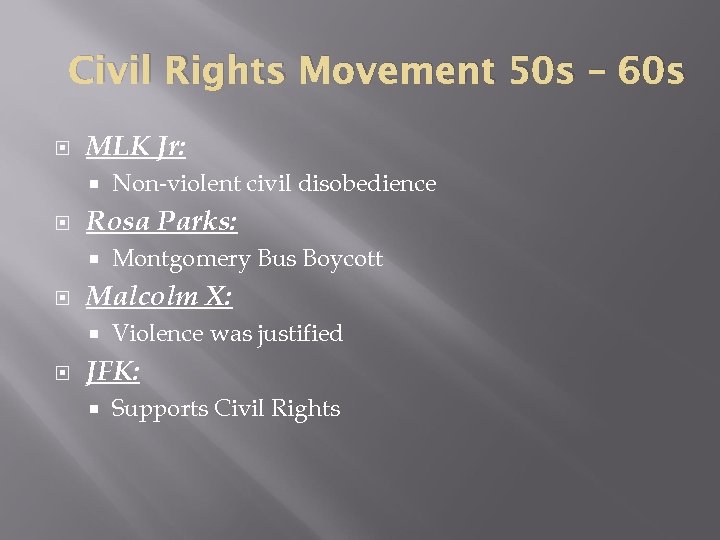 Civil Rights Movement 50 s – 60 s MLK Jr: Rosa Parks: Montgomery Bus Boycott Malcolm X: Non-violent civil disobedience Violence was justified JFK: Supports Civil Rights
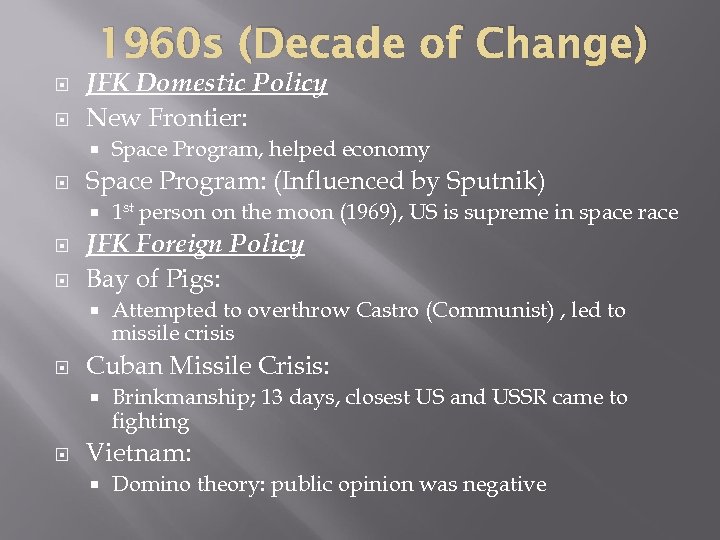 1960 s (Decade of Change) JFK Domestic Policy New Frontier: Space Program: (Influenced by Sputnik) Attempted to overthrow Castro (Communist) , led to missile crisis Cuban Missile Crisis: 1 st person on the moon (1969), US is supreme in space race JFK Foreign Policy Bay of Pigs: Space Program, helped economy Brinkmanship; 13 days, closest US and USSR came to fighting Vietnam: Domino theory: public opinion was negative
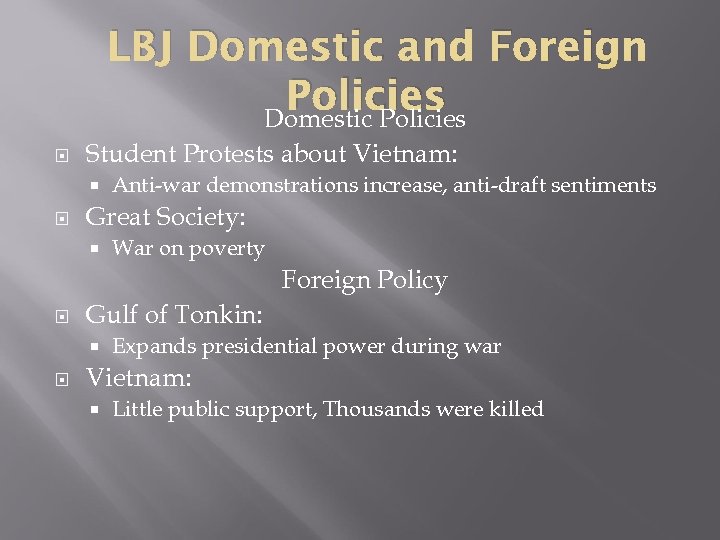 LBJ Domestic and Foreign Policies Domestic Policies Student Protests about Vietnam: Anti-war demonstrations increase, anti-draft sentiments Great Society: War on poverty Foreign Policy Gulf of Tonkin: Expands presidential power during war Vietnam: Little public support, Thousands were killed
 1970 S
 Nixon War Powers Act Watergate Scandal Easing of tensions between US and USSR SALT GOP broke into Democratic headquarters, Nixon gave OK Détente Limits power of president to commit troops without consent of Congress Limited number of nukes produced by US and USSR Space Program Developed Space Shuttle
 Gerald Ford Nixon’s Pardon: Amnesty for Draft Dodgers: Pardoned (forgave) Nixon for breaking law, upset many Americans Allowed draft dodgers to return without punishment Oil Embargo: OPEC Embargo, price of oil skyrocketed
 Jimmy Carter ***Camp David Accords*** First peace treaty between Israel and an Arab country (Egypt) Helps set the stage for future presidents to promote peace talks in the Middle East
 Ronald Reaganomics (Supply Side Economics) Star Wars: Billions of $ spent on scientific defense system, never materialized Iran Contra Tax breaks for businesses and wealthy, with belief they will spend money and help economy US secretly sold weapons to Iran during embargo Terrorism Middle East terrorism (Pan Am flight 103) ordered by Libyan president Gaddafi
 George Bush Senior Bad Economy: Economy goes into recession (possibly from Reaganomics? ) “Read my lips, no new taxes” L. A. Race Riots: Gulf War I: Rodney King verdict, Dozens die, Billions $ in damages US and NATO invasion of Iraq because Iraq invaded Kuwait Panama: US invasion of Panama to overthrow the dictator
 Bill Clinton Health Care: Economic Prosperity: Proposed health care plan, failed to gain support 1990 s were booming (bull market) Scandal and Impeachment: Lied under oath about affair Only other president that was impeached? Middle East: More peace talks, still no peace Balkans: Genocide, US and NATO bombed Meloslovich
 George W. Bush Election 2000 Significance: Tax Cuts: Creation of Homeland Security and Patriot Act Gulf War II: Reaganomics part II 9/11/01 Votes in Florida, goes to Supreme Court, Bush wins Overthrew Saddam Hussein, alleged connections to terrorism and WMD’s Capture of Saddam: