


 Скачать презентацию US Module Production Status Joe Incandela University of
8ccbfdec42b47375c0d0af0485176027.ppt
- Количество слайдов: 14
 US Module Production Status Joe Incandela University of California Santa Barbara for the US CMS Silicon Tracker Group CERN Tracker Week July 2004
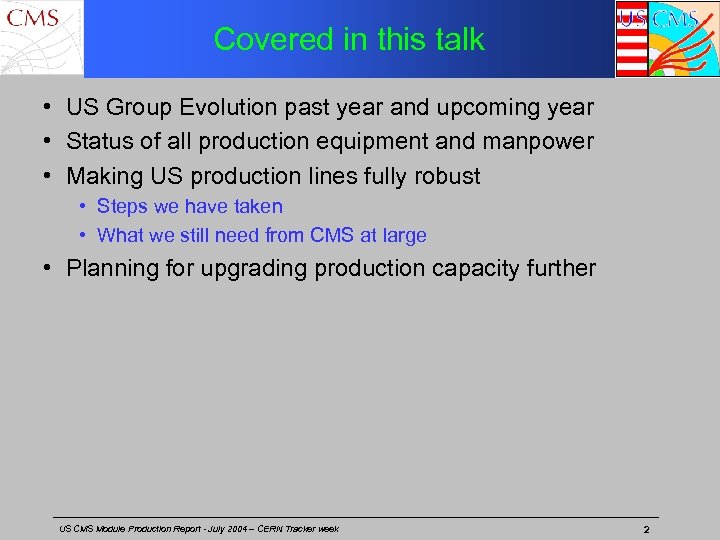 Covered in this talk • US Group Evolution past year and upcoming year • Status of all production equipment and manpower • Making US production lines fully robust • Steps we have taken • What we still need from CMS at large • Planning for upgrading production capacity further US CMS Module Production Report - July 2004 – CERN Tracker week 2
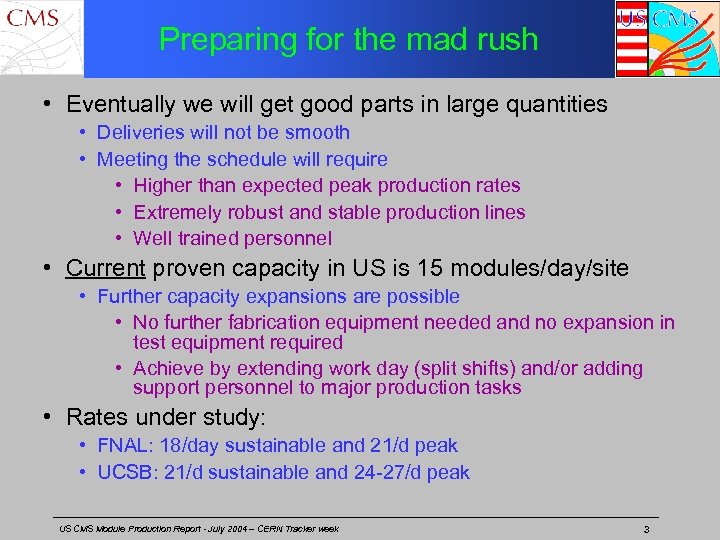 Preparing for the mad rush • Eventually we will get good parts in large quantities • Deliveries will not be smooth • Meeting the schedule will require • Higher than expected peak production rates • Extremely robust and stable production lines • Well trained personnel • Current proven capacity in US is 15 modules/day/site • Further capacity expansions are possible • No further fabrication equipment needed and no expansion in test equipment required • Achieve by extending work day (split shifts) and/or adding support personnel to major production tasks • Rates under study: • FNAL: 18/day sustainable and 21/d peak • UCSB: 21/d sustainable and 24 -27/d peak US CMS Module Production Report - July 2004 – CERN Tracker week 3
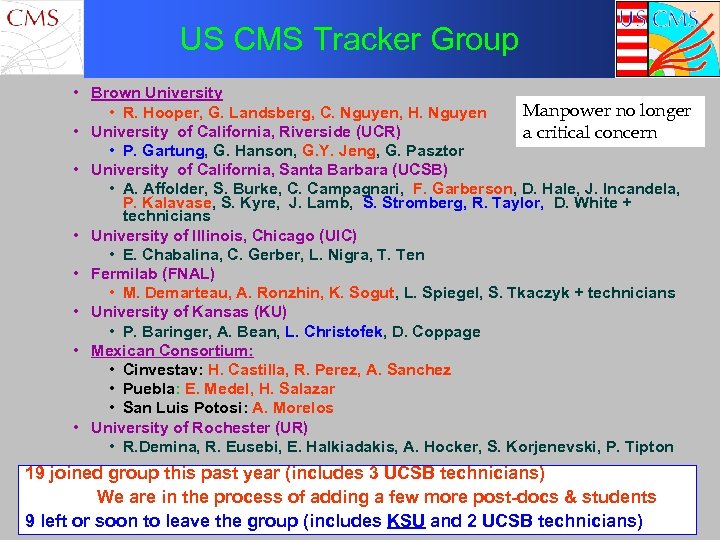 US CMS Tracker Group • Brown University Manpower no longer • R. Hooper, G. Landsberg, C. Nguyen, H. Nguyen • University of California, Riverside (UCR) a critical concern • P. Gartung, G. Hanson, G. Y. Jeng, G. Pasztor • University of California, Santa Barbara (UCSB) • A. Affolder, S. Burke, C. Campagnari, F. Garberson, D. Hale, J. Incandela, P. Kalavase, S. Kyre, J. Lamb, S. Stromberg, R. Taylor, D. White + technicians • University of Illinois, Chicago (UIC) • E. Chabalina, C. Gerber, L. Nigra, T. Ten • Fermilab (FNAL) • M. Demarteau, A. Ronzhin, K. Sogut, L. Spiegel, S. Tkaczyk + technicians • University of Kansas (KU) • P. Baringer, A. Bean, L. Christofek, D. Coppage • Mexican Consortium: • Cinvestav: H. Castilla, R. Perez, A. Sanchez • Puebla: E. Medel, H. Salazar • San Luis Potosi: A. Morelos • University of Rochester (UR) • R. Demina, R. Eusebi, E. Halkiadakis, A. Hocker, S. Korjenevski, P. Tipton 19 joined group this past year (includes 3 UCSB technicians) We are in the process of adding a few more post-docs & students 9 left or soon to leave. July 2004 group (includes KSU and 2 UCSB technicians)4 the – CERN Tracker week US CMS Module Production Report -
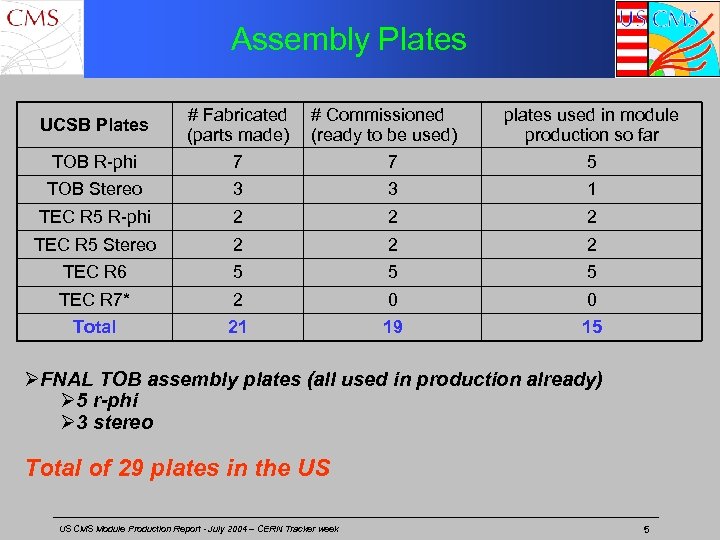 Assembly Plates TOB R-phi # Fabricated (parts made) 7 TOB Stereo 3 3 1 TEC R 5 R-phi 2 2 2 TEC R 5 Stereo 2 2 2 TEC R 6 5 5 5 TEC R 7* 2 0 0 Total 21 19 15 UCSB Plates # Commissioned (ready to be used) 7 plates used in module production so far 5 ØFNAL TOB assembly plates (all used in production already) Ø 5 r-phi Ø 3 stereo Total of 29 plates in the US US CMS Module Production Report - July 2004 – CERN Tracker week 5
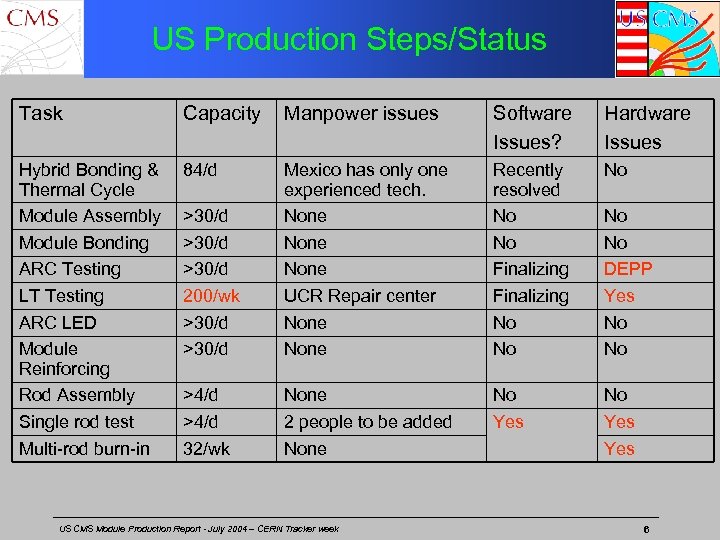 US Production Steps/Status Task Capacity Manpower issues Software Issues? Hardware Issues Hybrid Bonding & Thermal Cycle Module Assembly Module Bonding ARC Testing LT Testing ARC LED Module Reinforcing Rod Assembly Single rod test Multi-rod burn-in 84/d Recently resolved No No Finalizing No No No >30/d 200/wk >30/d Mexico has only one experienced tech. None UCR Repair center None >4/d 32/wk None 2 people to be added None No Yes Yes US CMS Module Production Report - July 2004 – CERN Tracker week No No DEPP Yes No No 6
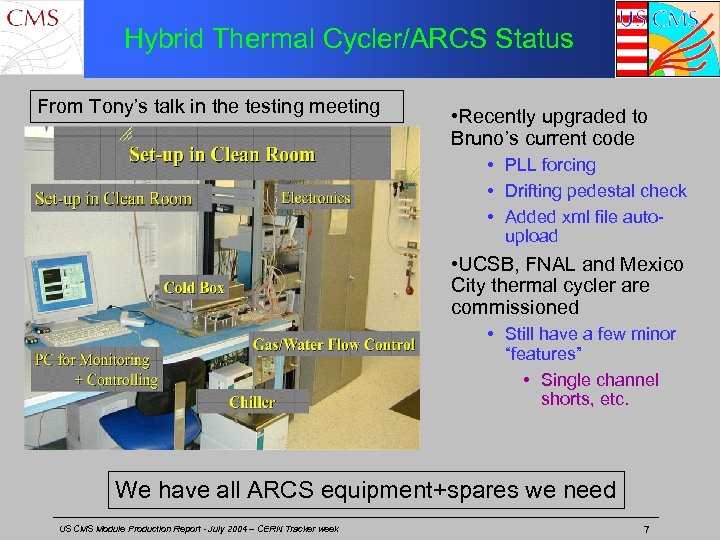 Hybrid Thermal Cycler/ARCS Status From Tony’s talk in the testing meeting • Recently upgraded to Bruno’s current code • PLL forcing • Drifting pedestal check • Added xml file autoupload • UCSB, FNAL and Mexico City thermal cycler are commissioned • Still have a few minor “features” • Single channel shorts, etc. We have all ARCS equipment+spares we need US CMS Module Production Report - July 2004 – CERN Tracker week 7
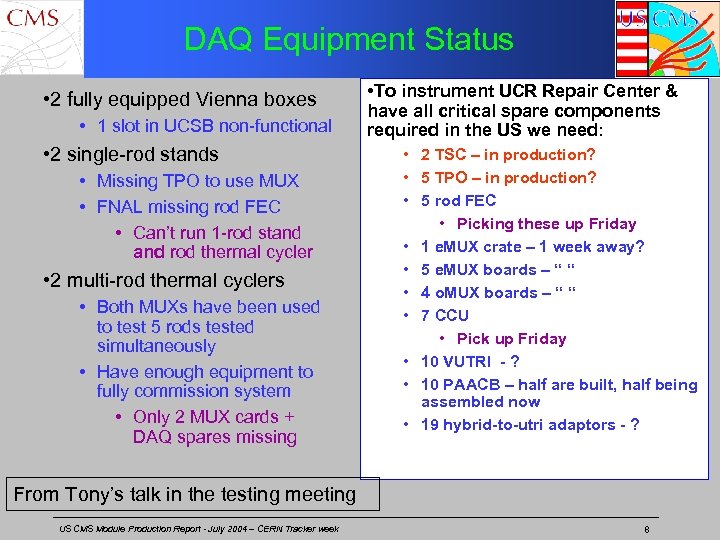 DAQ Equipment Status • 2 fully equipped Vienna boxes • 1 slot in UCSB non-functional • 2 single-rod stands • Missing TPO to use MUX • FNAL missing rod FEC • Can’t run 1 -rod stand rod thermal cycler • 2 multi-rod thermal cyclers • Both MUXs have been used to test 5 rods tested simultaneously • Have enough equipment to fully commission system • Only 2 MUX cards + DAQ spares missing • To instrument UCR Repair Center & have all critical spare components required in the US we need: • 2 TSC – in production? • 5 TPO – in production? • 5 rod FEC • Picking these up Friday • 1 e. MUX crate – 1 week away? • 5 e. MUX boards – “ “ • 4 o. MUX boards – “ “ • 7 CCU • Pick up Friday • 10 VUTRI - ? • 10 PAACB – half are built, half being assembled now • 19 hybrid-to-utri adaptors - ? From Tony’s talk in the testing meeting US CMS Module Production Report - July 2004 – CERN Tracker week 8
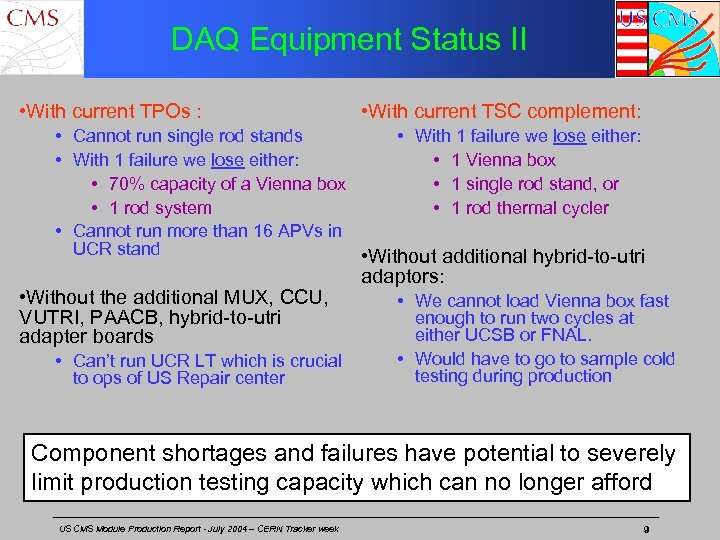 DAQ Equipment Status II • With current TPOs : • With current TSC complement: • Cannot run single rod stands • With 1 failure we lose either: • 1 Vienna box • 70% capacity of a Vienna box • 1 single rod stand, or • 1 rod system • 1 rod thermal cycler • Cannot run more than 16 APVs in UCR stand • Without additional hybrid-to-utri • Without the additional MUX, CCU, VUTRI, PAACB, hybrid-to-utri adapter boards • Can’t run UCR LT which is crucial to ops of US Repair center adaptors: • We cannot load Vienna box fast enough to run two cycles at either UCSB or FNAL. • Would have to go to sample cold testing during production Component shortages and failures have potential to severely limit production testing capacity which can no longer afford US CMS Module Production Report - July 2004 – CERN Tracker week 9
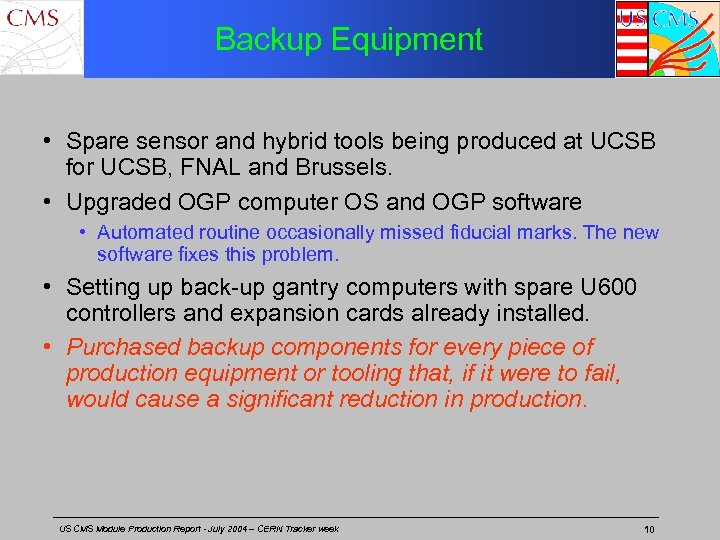 Backup Equipment • Spare sensor and hybrid tools being produced at UCSB for UCSB, FNAL and Brussels. • Upgraded OGP computer OS and OGP software • Automated routine occasionally missed fiducial marks. The new software fixes this problem. • Setting up back-up gantry computers with spare U 600 controllers and expansion cards already installed. • Purchased backup components for every piece of production equipment or tooling that, if it were to fail, would cause a significant reduction in production. US CMS Module Production Report - July 2004 – CERN Tracker week 10
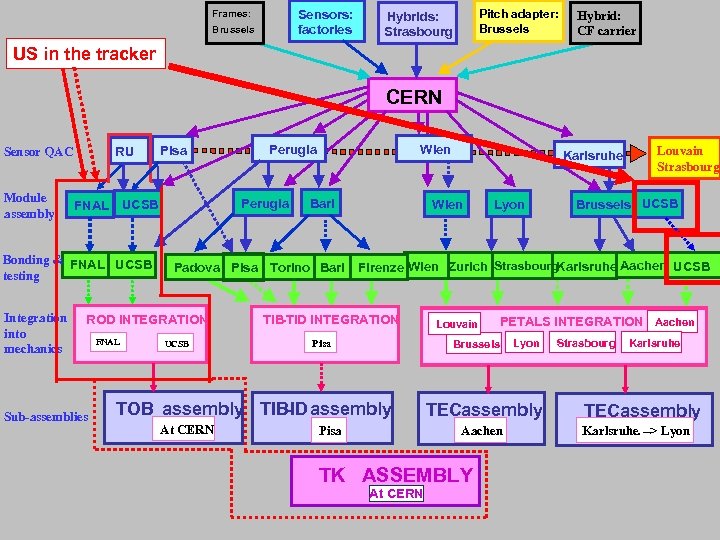 Sensors: factories Frames: Brussels Pitch adapter: Brussels Hybrids: Strasbourg Hybrid: CF carrier US in the tracker CERN RU Sensor QAC Module assembly Sub-assemblies Wien Bari Padova Pisa Torino Bari ROD INTEGRATION FNAL Perugia FNAL UCSB Bonding & FNAL UCSB testing Integration into mechanics Pisa UCSB Wien Lyon Louvain Strasbourg Brussels UCSB Firenze Wien Zurich Strasbourg. Karlsruhe Aachen UCSB TIB-TID INTEGRATION Pisa Louvain PETALS INTEGRATION Aachen Brussels TOB assembly TIB assembly -ID At CERN Karlsruhe Pisa TECassembly Aachen TK ASSEMBLY At CERN Lyon Strasbourg Karlsruhe TECassembly Karlsruhe. --> Lyon
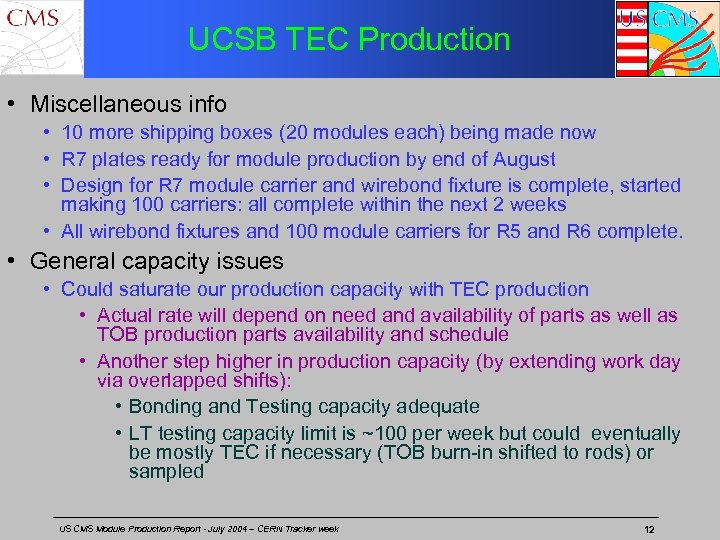 UCSB TEC Production • Miscellaneous info • 10 more shipping boxes (20 modules each) being made now • R 7 plates ready for module production by end of August • Design for R 7 module carrier and wirebond fixture is complete, started making 100 carriers: all complete within the next 2 weeks • All wirebond fixtures and 100 module carriers for R 5 and R 6 complete. • General capacity issues • Could saturate our production capacity with TEC production • Actual rate will depend on need and availability of parts as well as TOB production parts availability and schedule • Another step higher in production capacity (by extending work day via overlapped shifts): • Bonding and Testing capacity adequate • LT testing capacity limit is ~100 per week but could eventually be mostly TEC if necessary (TOB burn-in shifted to rods) or sampled US CMS Module Production Report - July 2004 – CERN Tracker week 12
 Other outstanding problems/issues • DB stability • For our production rates, we must automate all DB queries. • Need to standardize and maintain stable all data structures • We rely on data to be accurate and complete from all preceding processing of components and structures. • Old or un-installable components • Prefer to remove them physically from our production sites and to have them properly marked in DB US CMS Module Production Report - July 2004 – CERN Tracker week 13
 Summary • No longer have a manpower shortage • Have studied all possible threats to production stability • Purchased or manufactured spares • Some test equipment still needed • Studying further increases in capacity • Systems status • All stages of production have been exercised and are or are near to being finalized except rod testing • Multi-rod stands still have substantial work ahead • Testing protocols are very preliminary • Software has made huge progress but is very fresh and evolving • Full coordination of multi-rod daq and chiller systems still to be commissioned US CMS Module Production Report - July 2004 – CERN Tracker week 14