


 Скачать презентацию US History SATP Review Game Rules Groups
0c0d5eb425c0657fafa11be59a899dea.ppt
- Количество слайдов: 67
 US History SATP Review Game Rules ■ Groups compete against each other: –Teams will be presented a prompt & asked to provide as many correct answers as possible within 1 minute –Groups earn 1 point per correct answer –If any part of the response is incorrect, teams receive no points for that round
 1. After the Civil War, three groups of Americans settled in the West (between the Mississippi River & Pacific coast). Name two of these three groups 2. What was the Homestead Act of 1862? 3. The expansion of railroads after the Civil War was helped by two groups: the national government and immigrants. Explain how both groups helped expand railroads 4. What was the last Indian battle in US History? 5. Who was William Jennings Bryan? 6. Name 2 things the Populists demanded during the Gilded Age
 1. Miners, ranchers, farmers (homesteaders) 2. This law gave 160 acres of western land to farmers who promised to live on the land for at least 5 yrs 3. The national gov’t gave millions of acres of land grants to complete the transcontinental railroad; Chinese and Irish immigrants built the western and eastern legs of the transcontinental railroad 4. Wounded Knee 5. Bryan was a presidential candidate in the 1896 election. He represented the Populist Party. His “Cross of Gold” speech made him a national figure in the argument for a bi-metalism (gold and silver) 6. Populists demands included: gov’t regulation of railroads and banks, a national income tax, directelection of U. S. Senators, bi-metalism
 1. Four major industries helped push the USA into an Industrial Revolution during the Gilded Age. What were these four R. O. S. E. industries? 2. Monopolies began during the Gilded Age. What is a monopoly? 3. What industry did Carnegie monopolize? 4. What industry did Rockefeller monopolize? 5. During the Gilded Age, 23 million “new Immigrants” came to America. What is a “new” immigrant?
 1. 2. 3. 4. 5. Railroads, oil, steel, electricity A company that controls all or most of an industry Carnegie = Steel Rockefeller = Oil Immigrants from Southern and Eastern Europe (specifically Italy, Austria-Hungary, Russia, and Poland) rather than Northern Europe (England, Ireland, and Germany…which were always the dominant immigrant groups from the colonial era to the Civil War).
 1. Name 3 ways cities changed during the Gilded Age 2. How were the Knights of Labor different from the American Federation of Labor? 3. Who was the most famous “boss” of a political machine? 4. What do Crédit Mobilier and the Whiskey Ring have in common? 5. How did the Pendleton Act of 1883 try to end patronage?
 1. Skyscrapers, urbanization, new immigrants, mass transit, ethnic neighborhoods (enclaves), slums, tenement apartments, crime increased 2. Both were unions, but the Knights allowed any type of worker (regardless of race, sex, skill level); The AFL was a union that only allowed white, skilled workers to join. AFL was more successful 3. Boss Tweed of New York’s Tammany Hall machine 4. These were political scandals during President Grant’s administration. 5. Pendleton Act created an exam that civil service employees had to pass before they could get their jobs. This created a merit-based system.
 1. What were laws called that segregated blacks and whites in the South from 1877 to 1954? 2. What is a poll tax? 3. What is a literacy test? 4. What is a grandfather clause? 5. Which Supreme Court case said that segregation was legal as long as the options for blacks were equal (“separate but equal” doctrine)?
 1. Jim Crow laws 2. Yearly taxes that must be paid in order to vote; These were high fees that kept most poor black sharecroppers from voting 3. Voters must pass a reading test to be able to vote; This kept most African-Americans from qualifying to vote 4. Laws that allowed poor whites from not having to pay a poll tax or pass a literacy test if their father or grandfather could vote prior to 1867. 5. Plessy v Ferguson (1896)
 1. What is a muckraker? 2. Who wrote The Jungle? 3. Who created the first settlement houses? 4. Which U. S. presidents became the first “trustbuster”? 5. What law was used to break up monopolies? 6. Name 2 ways America became more “democratic” in the Progressive Era?
 1. A journalist who exposed the negative parts of American society during the Gilded Age 2. Upton Sinclair wrote The Jungle 3. Jane Addams 4. Theodore Roosevelt 5. Sherman Anti-Trust Act 6. In the West, state government allowed citizens to create initiatives, vote in referendums, and vote for recalls; Women gained the right to vote (19 th amendment); Americans were able to vote for their Senators (17 th amendment)
 • Essential Question: –What were the key concepts that will –be tested on the US History SATP?
 1. Name 2 reasons for the Spanish-American War in 1898 2. What caused the Philippine-American War (Filipino Insurrection)? 3. Which U. S. president used “big stick” diplomacy to build the Panama Canal? 4. Which foreign policy document declared that the USA was the “police power” of the Western Hemisphere and would protect the area from European intervention?
 1. Yellow journalism; Spain’s brutality towards the Cuban people; The explosion of the USS Maine (Remember the Maine and to hell with Spain); Willingness to show off the strength of the new American navy; Desire for imperialism 2. The USA took the Philippines after the Spanish. American War but did not offer the Philippines its independence which caused an uprising and threeyear war. 3. Theodore Roosevelt 4. The Roosevelt Corollary to the Monroe Doctrine
 1. Name 2 reasons the USA joined World War I 2. When the USA entered World War I in 1917, the nation had to mobilize. Name 2 ways the U. S. mobilized for war 3. How did World War I impact women? 4. How did the war impact African Americans? 5. Why was Eugene V Debs jailed during WWI?
 1. Unrestricted submarine warfare (freedom of the seas), sinking of the Lusitania, Germany’s Zimmerman Note to Mexico, President Wilson’s desire “to make the world safe for democracy” 2. Selective Service Act (draft), War Industries Board (WIB) to direct the economy, rationing, Committee on Public Information (propaganda) 3. Women got better jobs in war-related industries; Grew “victory gardens; ” Sold war bonds; Served as nurses in the Red Cross 4. African Americans fought in segregated units; Few were allowed to fight; Great Migration allowed blacks to move into the North for factory jobs 5. Debs was the leader of the American Socialist Party. During WWI, Debs violated the Espionage and Sedition Act; Part of Red Scare
 1. What were 2 of President Woodrow Wilson’s Fourteen Points? 2. Name 2 ways Germany was impacted by the Treaty of Versailles at the end of World War I 3. Name 2 ways the map of Europe was redrawn by the Treaty of Versailles at the end of World War I 4. Why did the Senate reject U. S. membership in the League of Nations? 5. What was Article X of the League of Nations covenant?
 1. Create a League of Nations; Divide Europe into new nations; Self-determination in Europe; Freedom of the seas; No secret treaties; Reduce militarism; Readjust colonial possessions 2. Germany was severely punished; Forced to accept war guilt, pay $33 billion in reparation; Lost colonies; Lost land in Europe; Limited military 3. Germany lost land; Austria-Hungary & Ottoman Empires were broken up; Russia lost land; Mandates were created in the Middle East 4. Reservationists & irreconcilables did not like Article X; They feared that joining the League would take away Congress’ power to declare war 5. Article X = all nations must help each other
 1. In the 1920 s, President Calvin Coolidge said the “business of America is business. ” What did he mean by this in terms of the role of the American government in the 1920 s? 2. What industry was the major force behind the economic boom of the 1920 s? 3. What was the most popular form of media in the 1920 s? 4. What did each of the following do that made them celebrities in the 1920 s: Jack Dempsey, Babe Ruth, Charles Lindbergh? 5. What was the name of the group of writers including Ernest Hemingway that were negative of the 1920 s and World War I?
 1. The US government should not control the economy. A return to “pro-business” policies to promote economic growth; Low taxes; No new progressive reforms 2. Automobiles 3. Either the Radio or “talking” movies 4. Jack Dempsey (Boxing), Babe Ruth (Baseball), Charles Lindberg (solo flight across Atlantic Ocean) 5. Lost Generation
 1. What was the celebration of African-American culture through new artistic, literary, and musical forms? 2. Who was Langston Hughes? 3. Who was Louis Armstrong? 4. What did the 18 th Amendment do? 5. What did the 19 th Amendment do? 6. What was the name of the young, urban women of who felt liberated in the 1920 s?
 1. Harlem Renaissance 2. Langston Hughes (author) 3. Louis Armstrong (jazz musician) 4. 18 th amendment outlawed alcohol (Prohibition) 5. 19 th amendment gave women voting rights (suffrage) 6. Flappers
 1. Rural Americans in the 1920 s saw a lot of things in cities that they thought were “un-American. ” What was the Scopes Trial? 2. What was the Red Scare? 3. Who were Nicola Sacco and Bartolomeo Vanzetti? 4. What were the National Origins Act of 1921 and Emergency Quota Act of 1924?
 1. The “monkey trial” in Tennessee that debated teaching evolution in public schools 2. Fear of communism and socialism in America 3. Two Italian immigrants and anarchists who were accused of murder. Sacco and Vanzetti were executed even though there was not much evidence 4. Laws that limited Southern and Eastern Europeans (the “new immigrants”) to America
 1. How did over-production/under-consumption lead to the Great Depression? 2. What was the weakest industry or profession throughout the 1920 s? 3. What is it called when a person borrows money to pay for a stock in hopes that the stock will make money 4. Name 2 reasons for the Dust Bowl of the 1930 s 5. What were the shanty towns called during the depression?
 1. Companies were making too many consumer goods and there were not enough buyers 2. Farmers struggled in the 1920 s because of the decline in demand for crops after World War I. Farmers had heavy debts and many lost their farms to the banks (foreclosure) 3. Buying on margin 4. Over-farming in the Plains, heavy droughts, lack of trees to block the winds, heavy windstorms, loose topsoil 5. Hoovervilles
 1. Name two ways President Hoover actively tried to fight the effects of the Great Depression? 2. Who beat Hoover in the 1932 election and became the only 4 -term president in US history? 3. What were the “three Rs” of the New Deal? 4. What was the first action FDR took as president to address the Great Depression? 5. What was the name of FDR’s radio communications to the American people about his plan to fight the depression?
 1. Hoover’s wanted people to work together (“rugged individualism”); Rejected active gov’t intervention; Later, offered relief checks & created the Reconstruction Finance Corps (RFC) which loaned money to keep businesses open; He create jobs through the Hoover Dam project 2. Franklin Roosevelt (FDR) 3. Relief (create jobs), recovery (end the depression), reform (keep another depression from occurring) 4. The bank holiday; Closed banks for four days so gov’t inspectors could check the banks 5. Fireside chats
 1. Which New Deal reform protected Americans’ bank accounts from bank failures? 2. Which was the largest, most comprehensive jobcreation program of the New Deal, creating relief and jobs for over 8 million Americans including artists, musicians, construction, teachers, doctors? 3. Which New Deal reform guaranteed union workers the right to strike and collectively bargain? 4. Which New Deal program created retirement for the elderly but was also the first welfare program in history because needy people got money too Word Bank: Tennessee Valley Authority (TVA), Social Security, Civilian Conservation Corps (CCC), Agricultural Adjustment Act (AAA), Wagner Act, Federal Deposit Insurance Corporation (FDIC), Works Progress Administration (AAA)
 1. Federal Deposit Insurance Corporation (FDIC) 2. Works Progress Administration (AAA) 3. Wagner Act 4. Social Security
 1. Which New Deal program built dams to create hydroelectric power in the Southeast? 2. Which New Deal reform regulated the stock market to avoid another stock market crash? 3. Which New Deal program created jobs for young men aged 18 to 25? 4. Who served as FDR’s “conscious” and listened to the concerns of women and African-Americans? 5. Who criticized FDR’s New Deal and proposed a “Share the Wealth” program to tax the rich and distribute money to all Americans? Word Bank: Huey Long, Civilian Conservation Corps (CCC), Agricultural Adjustment Act (AAA), Eleanor Roosevelt, Tennessee Valley Authority (TVA), Securities and Exchange Commission (SEC)
 1. Tennessee Valley Authority (TVA) 2. Securities and Exchange Commission (SEC) 3. Civilian Conservation Corps (CCC) 4. Eleanor Roosevelt 5. Huey Long
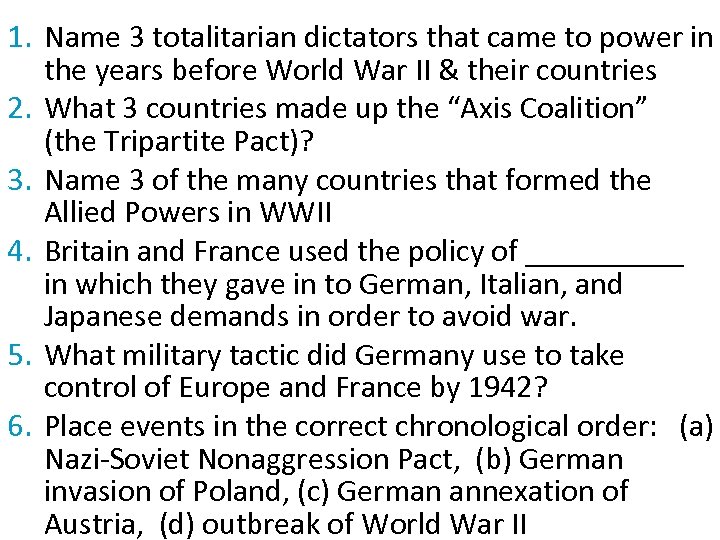 1. Name 3 totalitarian dictators that came to power in the years before World War II & their countries 2. What 3 countries made up the “Axis Coalition” (the Tripartite Pact)? 3. Name 3 of the many countries that formed the Allied Powers in WWII 4. Britain and France used the policy of _____ in which they gave in to German, Italian, and Japanese demands in order to avoid war. 5. What military tactic did Germany use to take control of Europe and France by 1942? 6. Place events in the correct chronological order: (a) Nazi-Soviet Nonaggression Pact, (b) German invasion of Poland, (c) German annexation of Austria, (d) outbreak of World War II
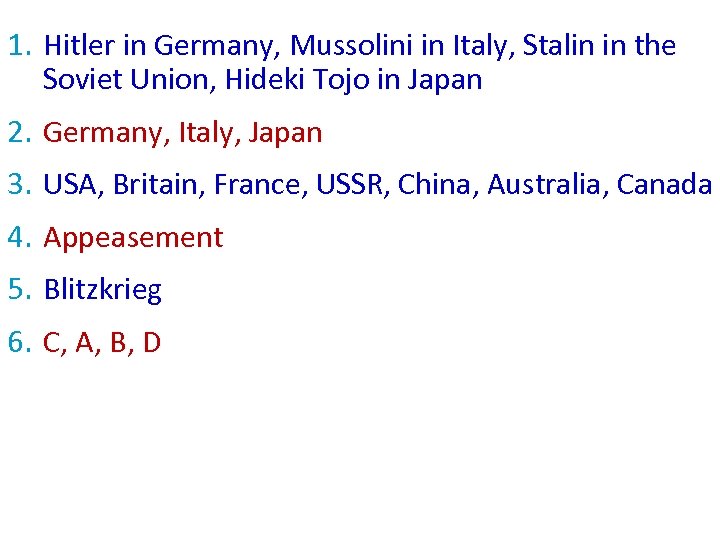 1. Hitler in Germany, Mussolini in Italy, Stalin in the Soviet Union, Hideki Tojo in Japan 2. Germany, Italy, Japan 3. USA, Britain, France, USSR, China, Australia, Canada 4. Appeasement 5. Blitzkrieg 6. C, A, B, D
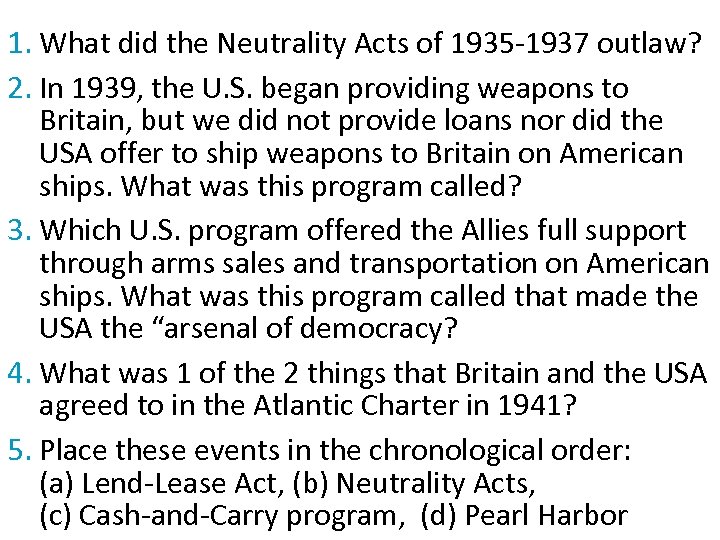 1. What did the Neutrality Acts of 1935 -1937 outlaw? 2. In 1939, the U. S. began providing weapons to Britain, but we did not provide loans nor did the USA offer to ship weapons to Britain on American ships. What was this program called? 3. Which U. S. program offered the Allies full support through arms sales and transportation on American ships. What was this program called that made the USA the “arsenal of democracy? 4. What was 1 of the 2 things that Britain and the USA agreed to in the Atlantic Charter in 1941? 5. Place these events in the chronological order: (a) Lend-Lease Act, (b) Neutrality Acts, (c) Cash-and-Carry program, (d) Pearl Harbor
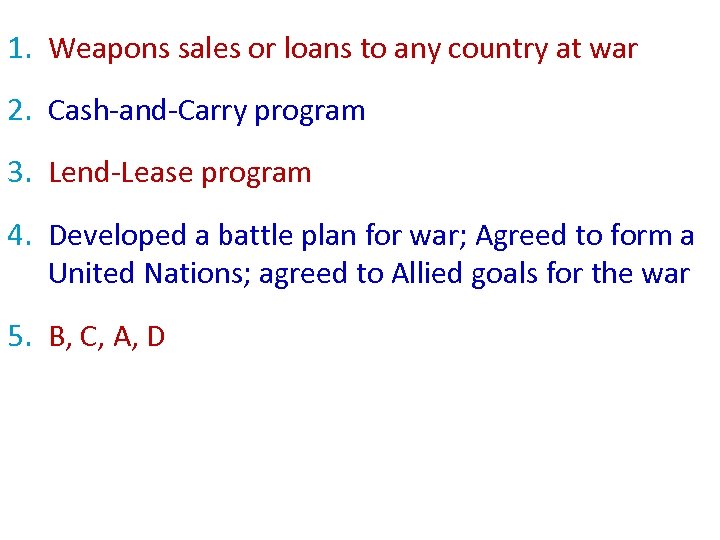 1. Weapons sales or loans to any country at war 2. Cash-and-Carry program 3. Lend-Lease program 4. Developed a battle plan for war; Agreed to form a United Nations; agreed to Allied goals for the war 5. B, C, A, D
 1. Name 1 way women were impacted by WWII 2. Name 1 way African Americans were impacted by WWII 3. Name 1 way Japanese Americans were impacted by WWII 4. Who was A Philip Randolph and what significant change did he help bring about on the U. S. home front during World War II? 5. What was the “Final Solution” during WWII?
 1. Women worked factory jobs; Women served in the military in clerical jobs; Helped ration goods & plant victory gardens; Received unequal pay 2. Great Migration to North & West; Drafted to fight in WWII; Fought in segregated units 3. Placed in internment camps 4. He was an African American civil rights leader who was upset by unequal pay scales for black workers; He threatened a march on Washington & forced FDR to create the Fair Employment Practices Commission to give black workers equal pay 5. Hitler’s plan to eliminate European Jews & non-Aryans; the Holocaust
 1. What was the turning point battle in Europe that allowed the Soviets to push towards Germany? 2. What was the turning point battle in the Pacific that allowed the USA to push towards Japan? 3. What strategy did the US use against the Japanese military that allowed them to shorten length of the war and move quickly towards Japan? 4. What was the invasion of Nazi-occupied France that allowed the Allies push towards Germany? 5. What was the code name for the secret U. S. plan to develop the atomic bomb? 6. At which war-time conference did FDR, Churchill, & Stalin agree to self-determination in Europe, to form a United Nations, occupy Germany?
 1. Stalingrad 2. Midway 3. Island-hopping 4. D-Day (Normandy Invasion) 5. Manhattan Project 6. Yalta Conference
 • Essential Question: –What were the key concepts that will –be tested on the US History SATP?
 1. What was the purpose of “containment”? 2. Which U. S. program was created during the Cold War to give military and economic aid to nations (like Greece & Turkey) to resist communism? 3. Which U. S. program was created during the Cold War to give $13 billion to European nations to help them recover from the devastation of WWII (and to resist communism)? 4. What military alliance did the USA join to protect the democratic nations of Western Europe? 5. How did the USA respond when Stalin cut off roads, railroads, & access to West Berlin in 1948?
 1. Stop the spread of communism 2. Truman Doctrine 3. Marshall Plan 4. North Atlantic Treaty Organization (NATO) 5. Berlin Airlift
 1. Name 3 Cold War events that showed that the Soviet Union was in the lead during the Cold War? 2. What caused the Korean War and how did the Korean War end? 3. Name 1 reason for the Red Scare of the late 1940 s and 1950 s 4. Who was the U. S. Senator who led the Red Scare accusations from 1950 to 1954? 5. What event in 1957 caused President Eisenhower to create NASA and the National Defense Education Act? 6. What did Eisenhower call his warning to Americans to avoid excessive military spending?
 1. China fell to communism in 1949; The USSR developed ICBMs in 1957; The USSR launched Sputnik in 1957; Cuba, North Korea, Vietnam fell to communism; USSR invaded Afghanistan in 1979 2. North Korea invaded South Korea; An armistice was called and the 38° line was restored that divided North & South Korea 3. Threat of communism in Europe; Discovery of spies in America like Alger Hiss & Julius/Ethel Rosenberg (atomic secrets) 4. Senator Joseph Mc. Carthy 5. The Soviet launching of Sputnik in 1957 6. The military-industrial complex
 1. What was Eisenhower’s policy of threatening to use nuclear weapons during the Cold War? 2. What was the name of the failed invasion of Cuba under President Kennedy in 1961? 3. How did the Kennedy administration respond in 1962 when spy planes discovered Soviet ICBMs in Cuba? 4. During the Vietnam War, what was the legislation passed by Congress that gave President Lyndon Johnson “authority to defend South Vietnam at any cost”? 5. What was the “turning point” of the Vietnam War after which many Americans though the war could not be won?
 1. Brinkmanship 2. Bay of Pigs invasion 3. Kennedy issued a “quarantine” (blockade) of Cuba to keep more Soviet missiles from arriving, he promised never to invade Cuba again, and he secretly removed U. S. missiles from Turkey 4. Gulf of Tonkin Resolution 5. Tet Offensive
 1. What is “Levittown”? 2. What was the law passed by Congress that gave college tuition and inexpensive government home loans to World War II veterans? 3. What is the name of the phenomenon of middle-class white residents moving to suburbs while African Americans remained in poor cities? 4. Who best represented the new musical style of rock n’ roll in the 1950 s? 5. What was the name of the large numbers of children born in the post-World War II era in the late 1940 s and the 1950 s?
 1. A example of a massive suburban community in the 1950 s 2. The GI Bill of Rights 3. White flight 4. Elvis Presley 5. Baby boom
 1. How did TV impact the civil rights movement? 2. How did TV impact the 1960 presidential election? 3. How did TV impact the Vietnam War? 4. Name 2 reasons why 1968 was a year of turmoil in U. S. history 5. Name 3 programs that were created as part of President Lyndon Johnson’s “Great Society”
 1. Violence in Birmingham led to the passage of the Civil Rights Act of 1964 and the violence at Selma led to the passage of the Voting Rights Act of 1965 2. TV debates helped Kennedy defeat Nixon 3. Vietnam became a “living room war” as news reports showed the body counts and violence 4. Tet Offensive in Vietnam; Assassination of MLK; Assassination of Robert Kennedy; Student protest at the Chicago Democratic National Convention 5. Medicare; Medicaid; Head Start; Civil Rights Act of 1964; Voting Rights Act of 1965; Clean Air /Water Acts; National Endowment for the Arts/Humanities (PBS & National Public Radio); “War on Poverty”; Dept of Housing & Urban Development (HUD), Office of Economic Opportunity, Food Stamps
 1. What did President Truman do in 1949 to take the lead on the civil rights? 2. Who was the first African American baseball player to play in the major leagues? 3. What was the Supreme Court case in 1896 that declared segregation was acceptable as long as facilities were “separate but equal”? 4. Which Supreme Court case overturned this case by declaring that “separate is inherently unequal”? 5. Which civil rights law ended Jim Crow segregation in public facilities? 6. Which civil rights group began the sit-in movement in 1960?
 1. Truman integrated the military in 1949 2. Jackie Robinson for the Brooklyn Dodgers 3. Plessy v Ferguson (1896) 4. Brown v the Board of Education of Topeka, Kansas (1954) 5. Civil Rights Act of 1964 6. Student Nonviolent Coordinating Committee (SNCC)
 1. What was the name of the civil rights event in which African Americans rode busses throughout the South to determine if integration orders were being enforced? 2. In which documents did Martin Luther King, Jr. declare that the civil rights movement “cannot wait” despite the violence that the movement is causing in the South? 3. Who used nonviolent protest, led boycotts, & formed the SCLC to fight for civil rights? 4. Who was a member of the Nation of Islam that believed in black separatism & civil rights by “any means necessary”? 5. Who transformed SNCC into a black power group? 6. Which black power group “policed the police”?
 1. Freedom Riders (CORE) 2. “Letter from a Birmingham Jail” in 1963 3. Martin Luther King, Jr. 4. Malcolm X 5. Stokely Carmichael 6. Black Panthers
 1. Which Supreme Court decision declared that accused persons should be informed of their rights to a lawyer and from self-incrimination? 2. Which Supreme Court decision protected a woman’s right to an abortion in the first trimester as a matter of privacy? 3. Which Supreme Court decision guaranteed that all accused persons are entitled to an attorney?
 1. Miranda v Arizona 2. Roe v Wade 3. Gideon v Wainwright
 1. Who wrote the “Feminine Mystique” in 1963 and formed the National Organization of Women? 2. Who wrote “Silent Spring” in 1962 which launched the modern environmental movement? 3. What is the difference between the ERA and the EPA? 4. What was the focus of the Bakke v Regents of California at Davis Supreme Court case? 5. What was the focus of Title IX legislation?
 1. Betty Friedan 2. Rachel Carson 3. The ERA is the Equal Rights Amendment that would have outlawed sexual discrimination (but it never passed); The EPA is the Environmental Protection Agency that was formed in 1970 4. Whether affirmative action policies were acceptable (The court said they were) 5. Education programs that accept money from the federal government cannot discriminate based on sex (so schools must have an equal number of boys and girls athletic programs)
 1. Name 3 conservative politicians from the 1960 s to the 1980 s 2. Name the 3 parts of Nixon’s triangular diplomacy 3. What was Nixon’s Vietnamization plan? 4. What did Nixon mean by “détente”? 5. What was the name of the scandal that led to Nixon’s resignation in 1974? 6. Why was Gerald Ford’s presidency impacted by this scandal?
 1. Barry Goldwater ran for president in 1964 but lost to Lyndon Johnson; Richard Nixon won the presidency in 1968 and 1972; Ronald Reagan won in 1980 and 1984; George Bush won in 1988 2. Ending the war in Vietnam; Visiting communist China under Mao; easing tensions (détente) with the Soviet Union 3. Gradually pull out American troops from Vietnam and replace them with South Vietnamese soldiers; 4. “Easing tensions” with the USSR, most famously accomplished by the SALT agreement in 1972 5. Watergate 6. Ford pardoned Nixon which hurt Ford’s reputation
 1. Name 1 reason Jimmy Carter’s presidency was not successful 2. What was the focus of President Jimmy Carter’s foreign policy? 3. What two nations agreed to President Carter’s Camp David Accords? 4. Name 2 reasons the economy was bad in the 1970 s 5. Who beat Carter in the 1980 presidential election?
 1. Increasing stagflation or the Iran-Hostage Crisis 2. Human rights 3. Camp David Accords = Egypt and Israel 4. Stagnant economy (no economic growth); high inflation; high unemployment; energy crisis due to the OPEC oil embargo; stagflation 5. Ronald Reagan
 1. What is the difference between the “New Left” and the “New Right”? 2. Name 2 parts of President Ronald Reagan’s economic plan for the USA 3. Name 1 foreign policy success of Reagan’s presidency 4. What was the name of the foreign policy scandal that occurred while Reagan was president? 5. What was the major problem with “Reaganomics”?
 1. “New Left” was a liberal movement that protested Vietnam, participated in civil rights, and wanted gov’t involvement in society; “New Right” was a conservative movement that called for tax cuts; reduced government spending; increased military spending; an emphasis on family values 2. Reaganomics = 25% tax cut (called “supply side economics”); Cuts to gov’t social programs; Increasing military budget; Ended stagflation 3. Return of hostages held in Iran; “Won” the Cold War; Berlin Wall came down in 1989; INF agreement between Reagan and Gorbachev that reduced nuclear missiles; SDI (“Star Wars”) 4. Iran-Contra Affair 5. Large government deficits
 1. What is the order of these presidencies: (a) Bill Clinton, (b) George Bush, (c) Barack Obama, (d) George W. Bush, (e) Ronald Reagan 2. Which president was famous for promising “no new taxes” and then raising taxes? 3. What was the difference between Operation Desert Shield and Operation Desert Storm? 4. Whose presidency was defined by the signing of NAFTA between the USA, Canada, and Mexico as well as impeachment due to the Lewinski scandal? 5. Whose presidency was defined by the September 11, 2001 terrorist attack and War on Terrorism? 6. What is the difference in motivation for the U. S. invasions of Afghanistan (2001) and Iraq (2003)
 1. E, B, A, D, C 2. George Bush 3. Desert Shield was designed to protect Saudi Arabia from a potential invasion by Iraq under Saddam Hussein; Desert Storm was the war fought to liberate Kuwait from Saddam’s Iraqi occupation 4. Bill Clinton 5. George W Bush 6. Afghanistan = find al-Qaeda & Osama bin Laden & replace the Taliban gov’t; Iraq = overthrow Saddam Hussein due to weapons of mass destruction