


 Скачать презентацию US Government Pre-Test Who is this man
9c44ea5a147a9355089bf77aa40f9481.ppt
- Количество слайдов: 50
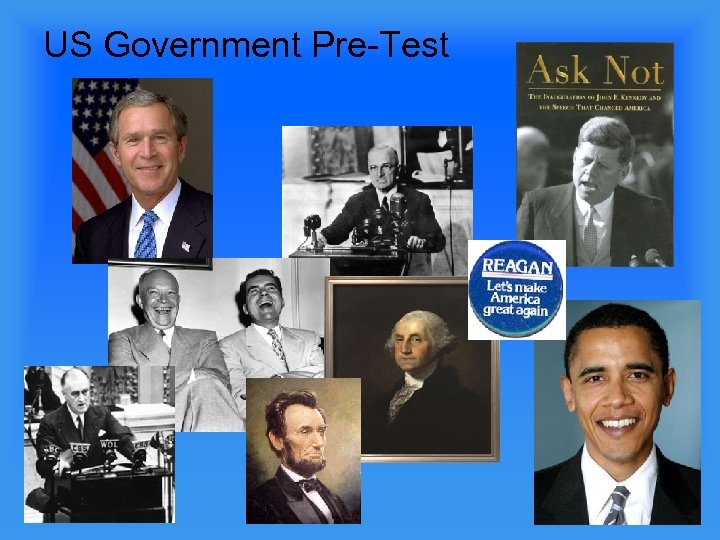 US Government Pre-Test
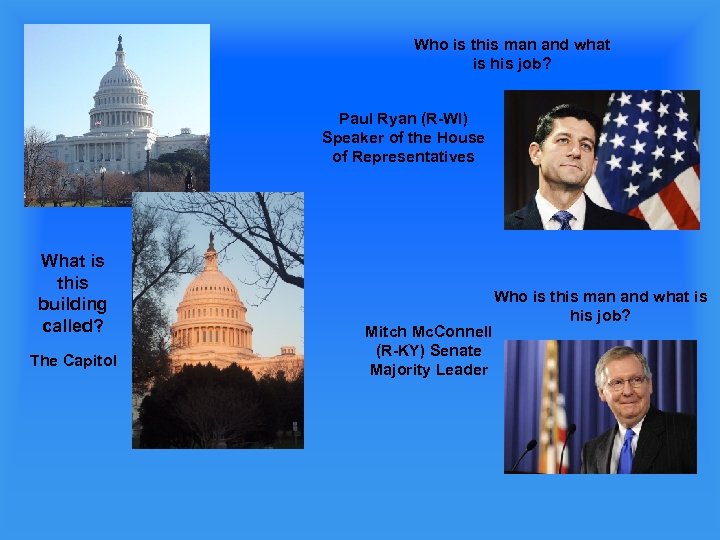 Who is this man and what is his job? Paul Ryan (R-WI) Speaker of the House of Representatives What is this building called? The Capitol Mitch Mc. Connell (R-KY) Senate Majority Leader Who is this man and what is his job?
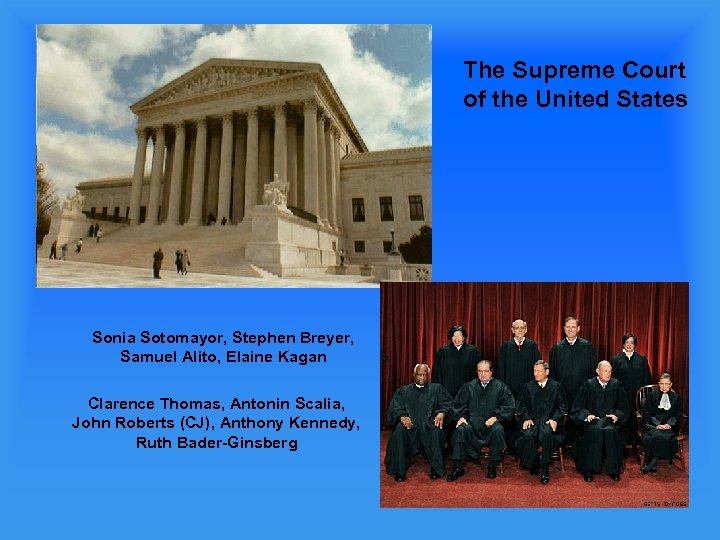 The Supreme Court of the United States Sonia Sotomayor, Stephen Breyer, Samuel Alito, Elaine Kagan Clarence Thomas, Antonin Scalia, John Roberts (CJ), Anthony Kennedy, Ruth Bader-Ginsberg
 What are three branches of government and what is the purpose of each branch as regards law? 1. Legislative: It “makes the law. ” 2. Executive: It carries out (enforces) the law. 3. Judicial: It interprets the law.
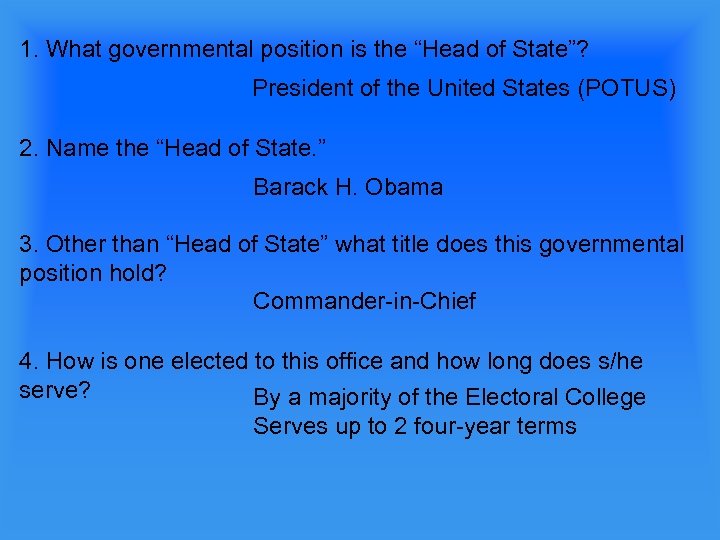 1. What governmental position is the “Head of State”? President of the United States (POTUS) 2. Name the “Head of State. ” Barack H. Obama 3. Other than “Head of State” what title does this governmental position hold? Commander-in-Chief 4. How is one elected to this office and how long does s/he serve? By a majority of the Electoral College Serves up to 2 four-year terms
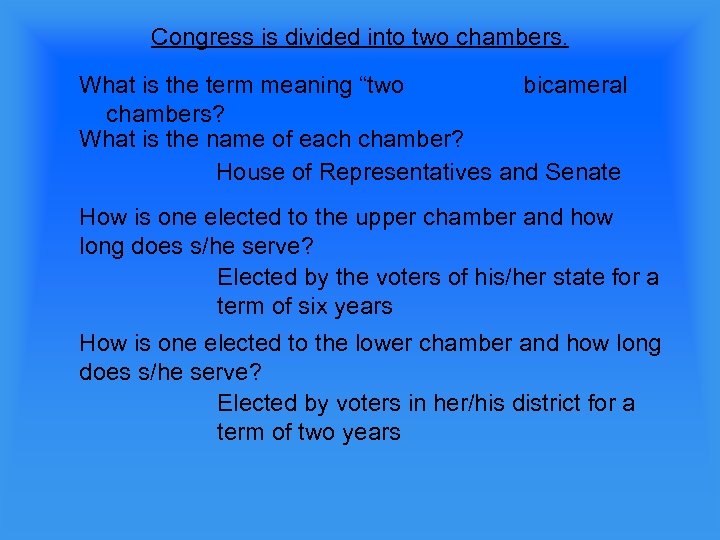 Congress is divided into two chambers. What is the term meaning “two bicameral chambers? What is the name of each chamber? House of Representatives and Senate How is one elected to the upper chamber and how long does s/he serve? Elected by the voters of his/her state for a term of six years How is one elected to the lower chamber and how long does s/he serve? Elected by voters in her/his district for a term of two years
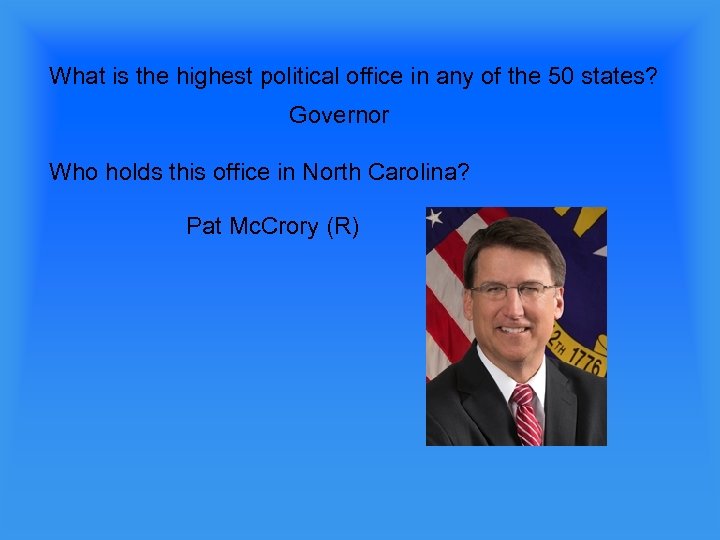 What is the highest political office in any of the 50 states? Governor Who holds this office in North Carolina? Pat Mc. Crory (R)
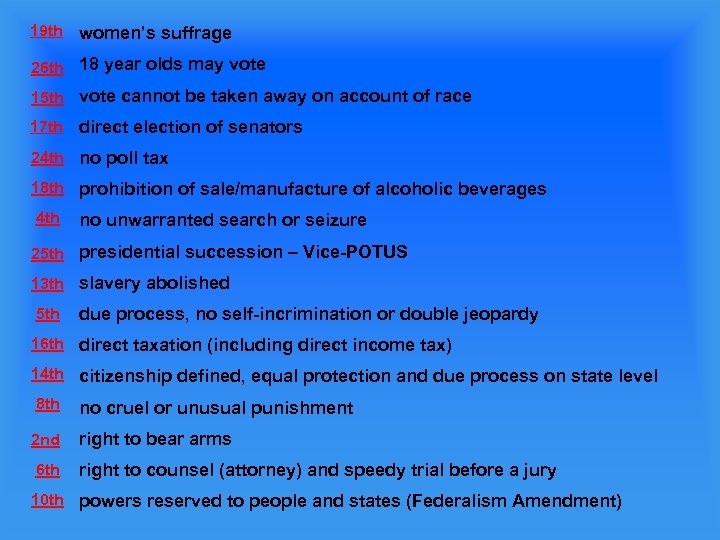 19 th women’s suffrage 26 th 18 year olds may vote 15 th vote cannot be taken away on account of race 17 th direct election of senators 24 th no poll tax 18 th prohibition of sale/manufacture of alcoholic beverages 4 th no unwarranted search or seizure 25 th presidential succession – Vice-POTUS 13 th slavery abolished 5 th due process, no self-incrimination or double jeopardy 16 th direct taxation (including direct income tax) 14 th citizenship defined, equal protection and due process on state level 8 th no cruel or unusual punishment 2 nd right to bear arms 6 th right to counsel (attorney) and speedy trial before a jury 10 th powers reserved to people and states (Federalism Amendment)
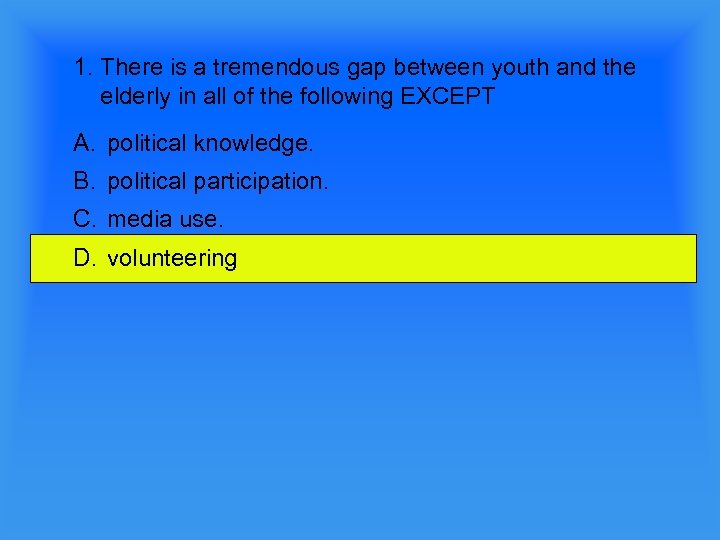 1. There is a tremendous gap between youth and the elderly in all of the following EXCEPT A. political knowledge. B. political participation. C. media use. D. volunteering
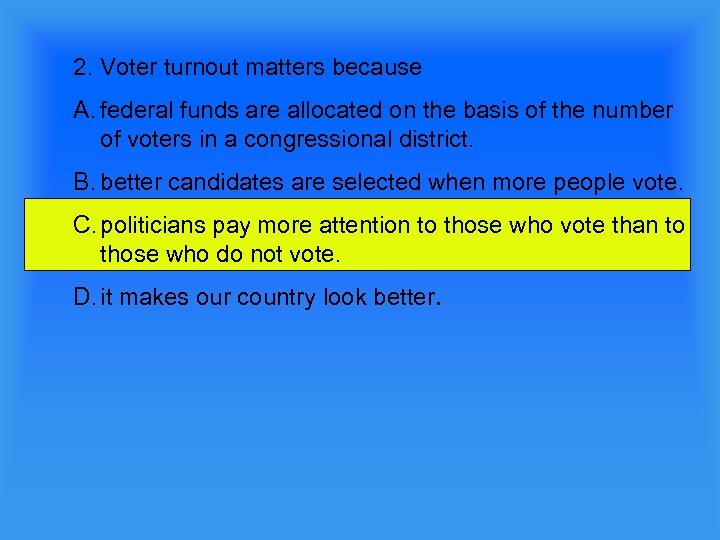 2. Voter turnout matters because A. federal funds are allocated on the basis of the number of voters in a congressional district. B. better candidates are selected when more people vote. C. politicians pay more attention to those who vote than to those who do not vote. D. it makes our country look better.
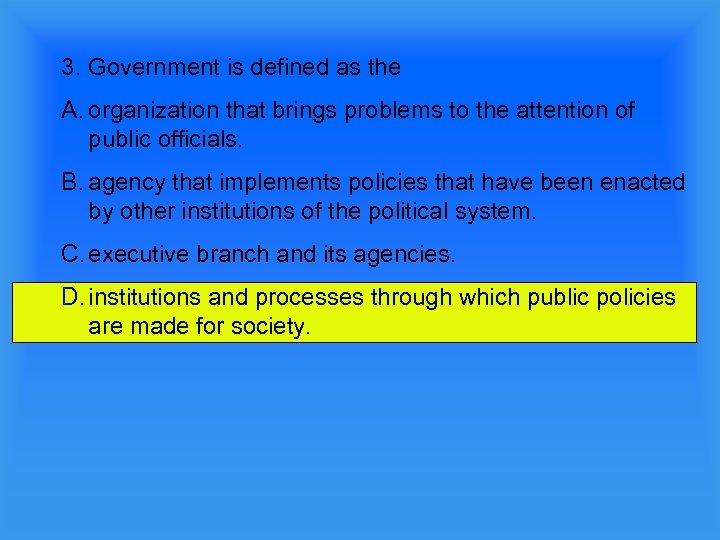 3. Government is defined as the A. organization that brings problems to the attention of public officials. B. agency that implements policies that have been enacted by other institutions of the political system. C. executive branch and its agencies. D. institutions and processes through which public policies are made for society.
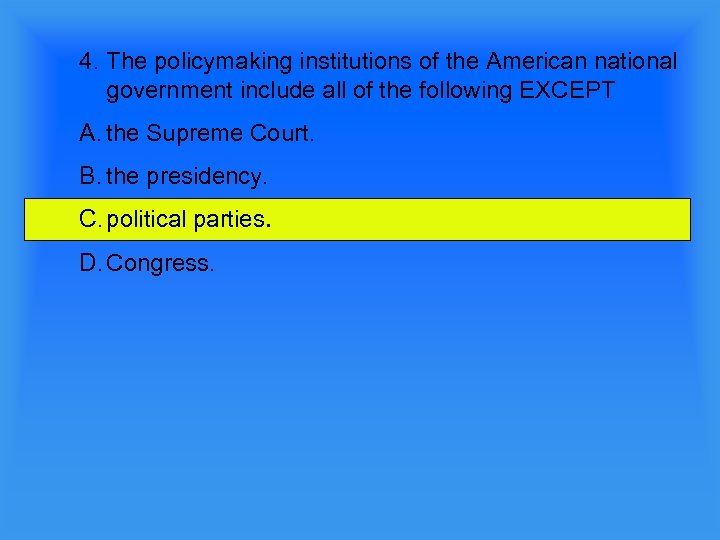 4. The policymaking institutions of the American national government include all of the following EXCEPT A. the Supreme Court. B. the presidency. C. political parties. D. Congress.
 5. One advantage of the Internet for democracy is that it A. provides less information than newspapers. B. makes it easy to avoid political topics. C. makes it easier for citizens to communicate directly with government. D. will provide more political information to political elites.
 6. The Declaration of Independence says that “all men are created equal. ” Which aspect of the American creed does this suggest? A. Individualism B. Egalitarianism C. Capitalism D. Liberty
 7. Which of the following statements about taxes is TRUE? A. One out of every three dollars earned by an American citizen is used to pay taxes. B. About one-tenth of American citizens pay income taxes. C. Despite the image presented by the media, survey data reveal that Americans feel they are getting their money's worth for the taxes they pay. D. The tax burden in the United States is higher than in most other democratic nations.
 8. All governments A. hold elections. B. provide services. C. have a legislature. D. have written constitutions.
 9. When compared with the rest of the world, America has a relatively low A. number of offices up for election. B. number of candidates who seek office. C. frequency of elections. D. voter turnout in elections.
 10. Which of the following means a group of people that supports a particular interest or person? A. Political party B. Agenda C. Faction D. Platform
 11. According to James Madison, factions are A. destructive of liberty. B. superior to political parties. C. an inevitable outgrowth of inequality. D. Both A and C
 12. The list of problems to which political leaders are paying serious attention is a(n) A. problem set. B. legislative package. C. policy agenda. D. party platform.
 13. An example of public policymaking would be A. a majority of the public supporting the idea of government dealing with unemployment. B. the press creating public concern about racial discrimination. C. a Congressman holding a townhall meeting with constituents. D. Congress and the president deciding not to act on the AIDS crisis.
 14. In what case did the Supreme Court had the power to rule laws unconstitutional? A. Marbury v. Madison B. Brown v. Board of Education of Topeka, KS C. Gideon v. Wainwright D. Roe v. Wade
 15. Which of the following statements about a government's policy agenda is FALSE? A. A government's policy agenda tends to remain constant over time. B. Bad news gets an issue on the policy agenda more quickly than good news. C. When people confront government officials with problems to be solved, they are trying to influence the government's policy agenda. D. Legislators pay little attention to local concerns or issues.
 16. Which of the following areas is the largest expenditure in the federal budget? A. Social Security B. Medicaid C. Environment D. Homeland security
 17. In the budget making process, Social Security, Medicare, and Medicaid are referred to as A. welfare. B. discretionary spending. C. entitlements. D. deficits.
 18. The Army is to the United States as the ____ is/are to North Carolina. A. militia B. National Guard C. State troopers D. Coast Guard
 19. ____ arise when people disagree about a problem or a public policy choice made to combat a problem. A. Revolutions B. Political issues C. Governments D. Wars
 20. Alexander Hamilton, John Jay, and James Madison wrote A. A Theory of Democracy. B. The Federalist Papers. C. Common Sense. D. Democracy in America.
 21. Thomas Paine’s more famous work is titled A. “Self-Reliance”. B. The Republic. C. Common Sense. D. The Art of War.
 22. Which of the following is NOT one of the cornerstones of an ideal democracy? A. a constitution B. effective participation C. citizen control of the agenda D. economic equality
 23. Two of the most important principles of democratic theory are majority rule and A. minority rights. B. judicial review. C. majority restraint. D. Roberts' Rules of Order.
 24. Pluralist theory contends that in the United States A. society is governed solely by upper-class elite. B. many groups vie for power with no one set of groups dominating. C. too many influential groups cripple government's ability to govern. D. because most citizens fail to pay attention to serious issues, government has become an elite institution.
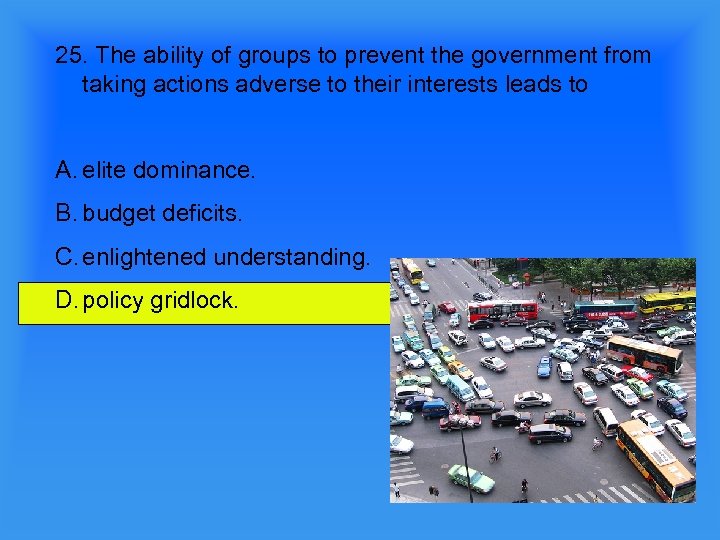 25. The ability of groups to prevent the government from taking actions adverse to their interests leads to A. elite dominance. B. budget deficits. C. enlightened understanding. D. policy gridlock.
 26. Representation refers to A. majority rule. B. electing office-holders in fair and free elections. C. the correspondence between the few leaders and the many followers in a democracy. D. all policy views being included in political debate.
 27. In all theories of “elite domination” of politics what/who controls the process? A. big business. B. the Congress. C. George Soros. D. the president.
 28. Which of these is most likely NOT considered a challenge to democracy? A. the diversity of the American people B. the level of political participation by Americans C. the specialization of knowledge held by experts D. the tendency of the American political system to change rapidly
 29. Escalating campaign costs are a challenge to democracy because A. it is believed that contributions by Political Action Committees (PACs) can affect the way members of Congress vote on single issues. B. they lead to policy gridlock. C. they reflect diverse interests. D. they make it easier for candidates to raise money.
 30. During the American Revolution, Patrick Henry said A. “This nation under God shall have a new birth of freedom, and that government of the people, by the people, for the people shall not perish from the earth. ” B. “I regret that I have but one life to give for my country. ” C. “Give me liberty or give me death. ” D. “Ask not what your country can do for you, but what you can do for your country. ”
 31. What was the name of the first constitution of the U. S. ? A. Mayflower Compact B. The Declaration of Independence C. The First Treatise of Government D. The Articles of Confederation
 32. The House of Burgesses in colonial Virginia is significant because A. it was the first government body to call for America’s independence B. it had the first African American legislator C. it was the first to have a woman legislator D. it was the first representative assembly in America
 33. All of the following were names of national political parties* in the United States EXCEPT A. Whig Party B. Reform Party C. Know Nothing Party D. Liberal Party *defined as a political party that ran candidates in Congressional or Presidential elections
 34. In what case did the NC Supreme Court say that a master may treat his slave as he wished, even to the point of killing him? A. State v. Mann B. Brown v. Board of Education of Topeka, KS C. Gideon v. Wainwright D. Roe v. Wade
 35. In what case did the Supreme Court say that racial segregation in public schools was unconstitutional? A. Mc. Culloch v. Maryland B. Brown v. Board of Education of Topeka, KS C. Gideon v. Wainwright D. Roe v. Wade
 36. In what case did the Supreme Court say that the government had to provide a defendant a lawyer if he couldn’t afford one? A. Baker v. Carr B. Plessy v. Fergusson C. Gideon v. Wainwright D. Roe v. Wade
 37. In what case did the Supreme Court say that burning the U. S. flag was a constitutionally protected form of protest under the free speech clause? A. Tinker v. De Moines School District (1968) B. Schenck v. United States (1919) C. Texas v. Johnson (1989) D. Korematsu v. United States (1944)
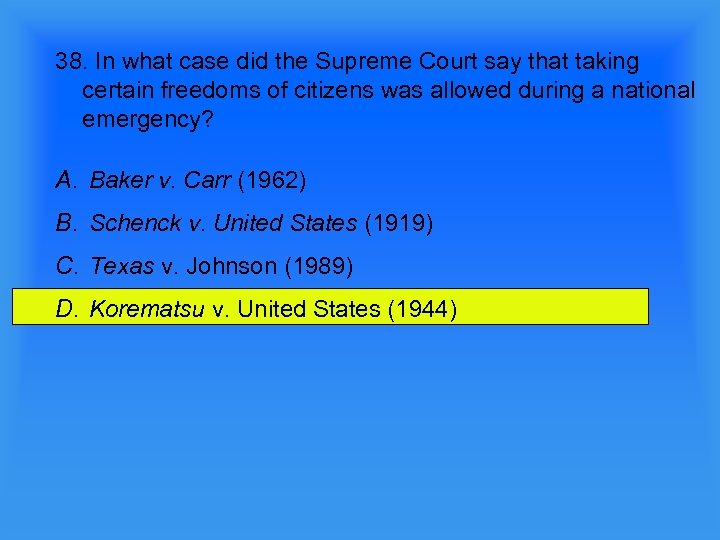 38. In what case did the Supreme Court say that taking certain freedoms of citizens was allowed during a national emergency? A. Baker v. Carr (1962) B. Schenck v. United States (1919) C. Texas v. Johnson (1989) D. Korematsu v. United States (1944)
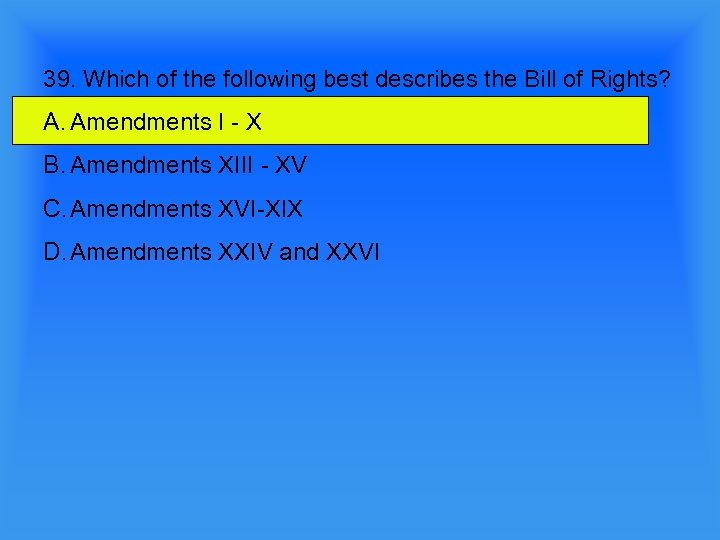 39. Which of the following best describes the Bill of Rights? A. Amendments I - X B. Amendments XIII - XV C. Amendments XVI-XIX D. Amendments XXIV and XXVI
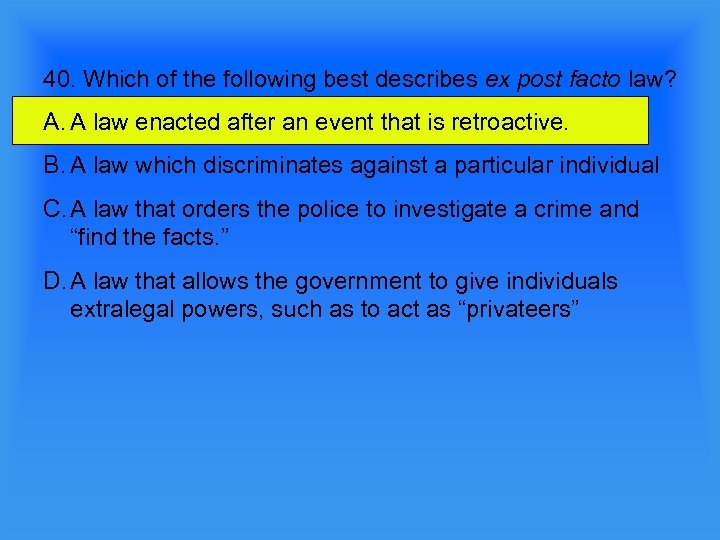 40. Which of the following best describes ex post facto law? A. A law enacted after an event that is retroactive. B. A law which discriminates against a particular individual C. A law that orders the police to investigate a crime and “find the facts. ” D. A law that allows the government to give individuals extralegal powers, such as to act as “privateers”
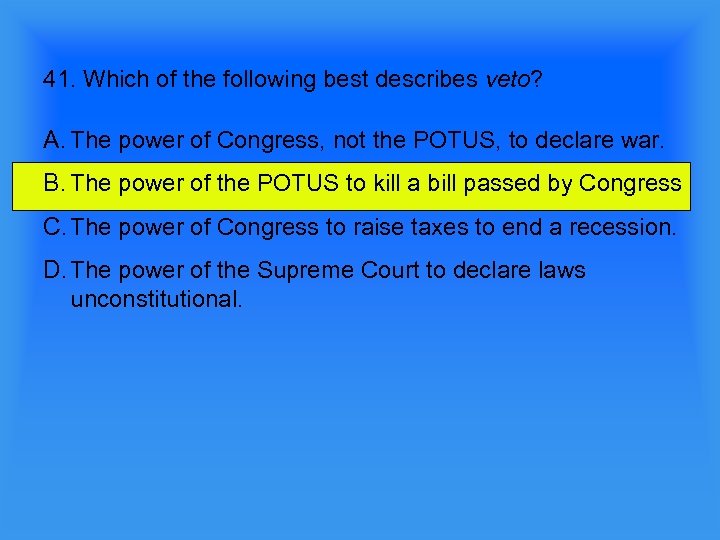 41. Which of the following best describes veto? A. The power of Congress, not the POTUS, to declare war. B. The power of the POTUS to kill a bill passed by Congress C. The power of Congress to raise taxes to end a recession. D. The power of the Supreme Court to declare laws unconstitutional.
 The End