


 Скачать презентацию US Concussion Legislation Finally Using Our Heads Legislative
2dc61ce66459314ae2255fba83d1f228.ppt
- Количество слайдов: 43
 US Concussion Legislation: Finally Using Our Heads Legislative Advocacy Block 4 Alex Glick, Laura Kurek, and Evan Sherman
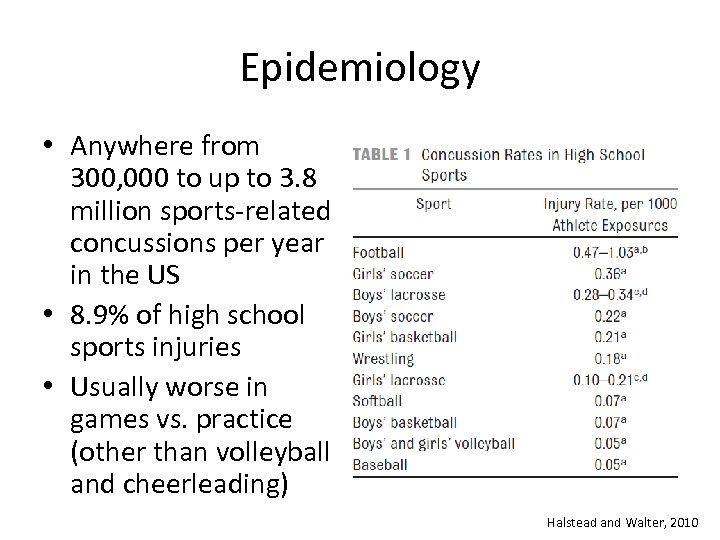 Epidemiology • Anywhere from 300, 000 to up to 3. 8 million sports-related concussions per year in the US • 8. 9% of high school sports injuries • Usually worse in games vs. practice (other than volleyball and cheerleading) Halstead and Walter, 2010
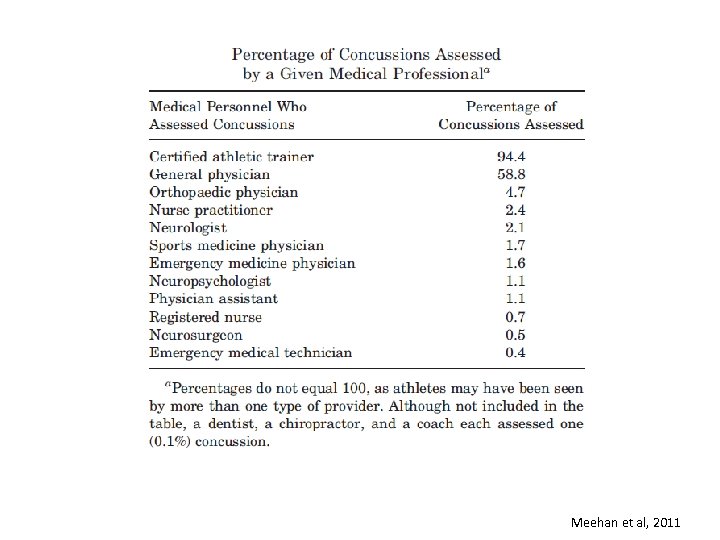
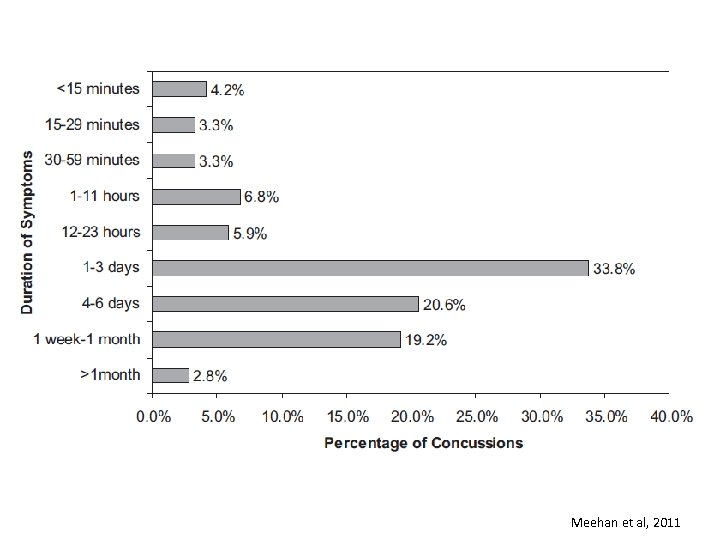
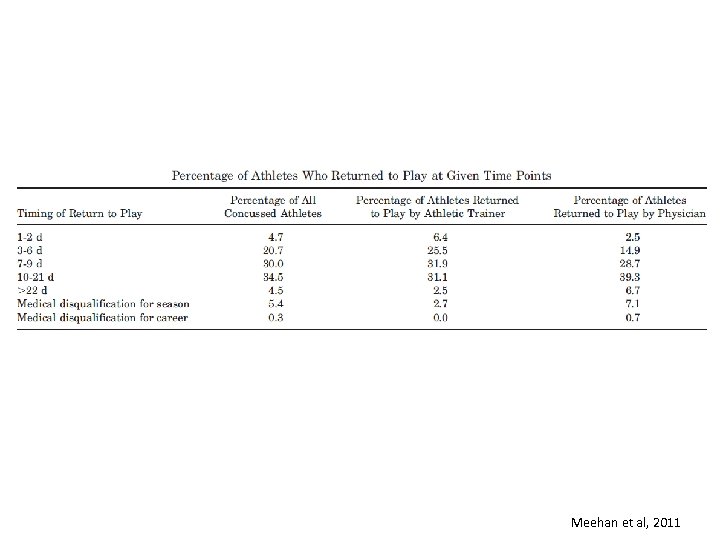
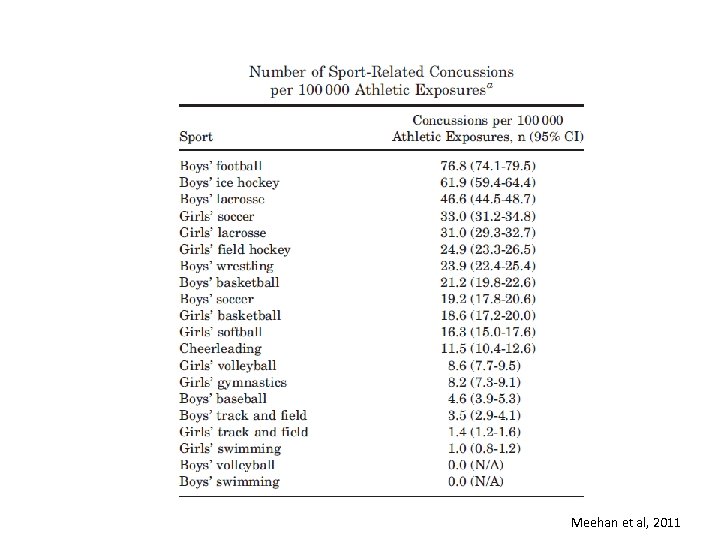 Meehan et al, 2011
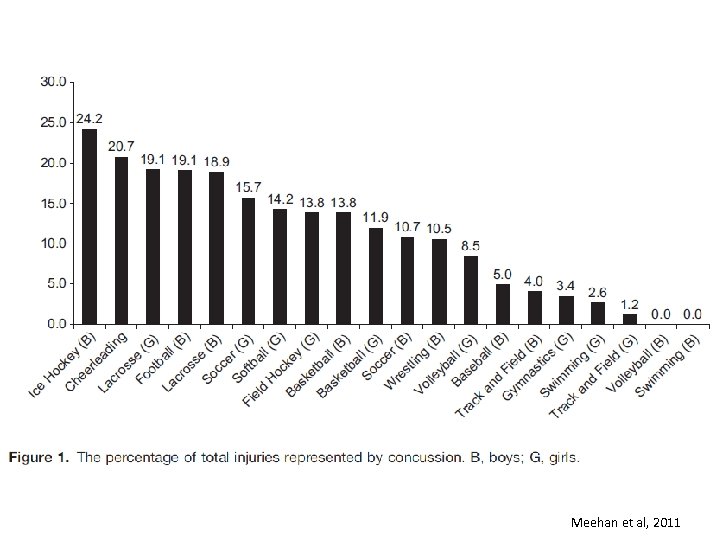 Meehan et al, 2011
 Meehan et al, 2011
 Meehan et al, 2011
 Meehan et al, 2011
 Im. PACT • Immediate Postconcussion Assessment and Cognitive Testing • Many other similar programs exist including SAC, Headminders’ CRI, Cog. Sport, ANAM • Beneficial in return to play decisions due to underreporting of symptoms
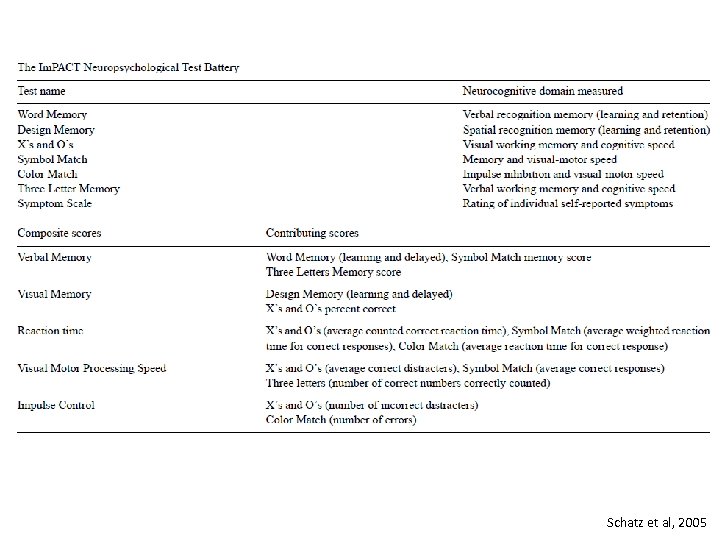 Schatz et al, 2005
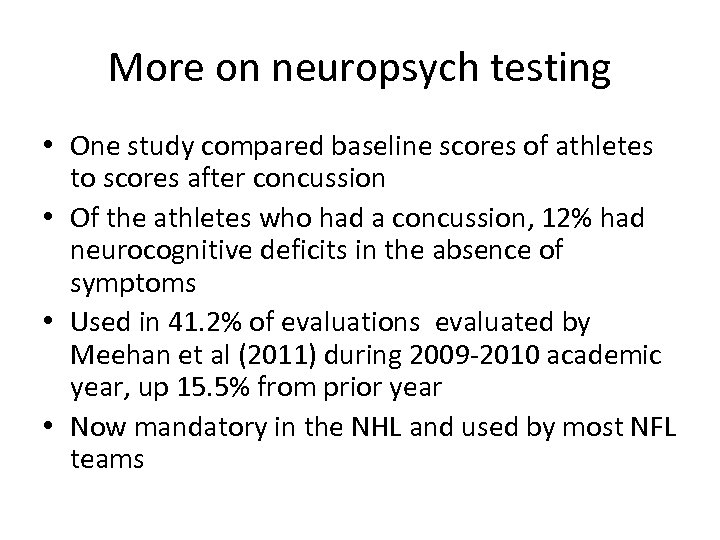 More on neuropsych testing • One study compared baseline scores of athletes to scores after concussion • Of the athletes who had a concussion, 12% had neurocognitive deficits in the absence of symptoms • Used in 41. 2% of evaluations evaluated by Meehan et al (2011) during 2009 -2010 academic year, up 15. 5% from prior year • Now mandatory in the NHL and used by most NFL teams
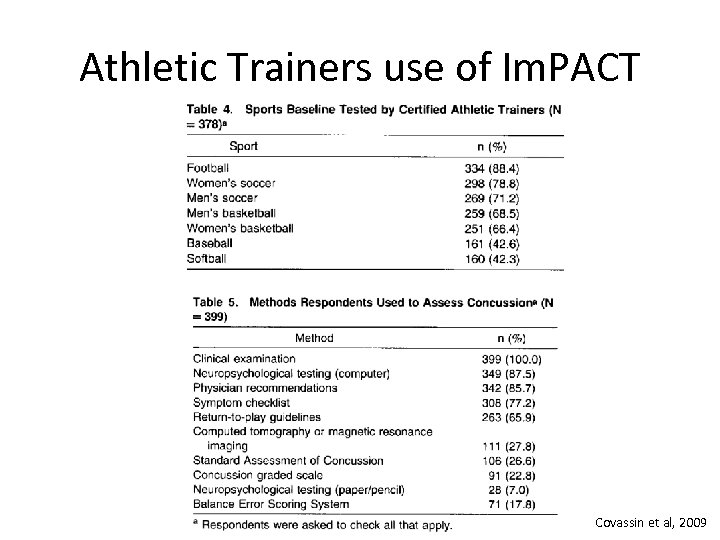 Athletic Trainers use of Im. PACT Covassin et al, 2009
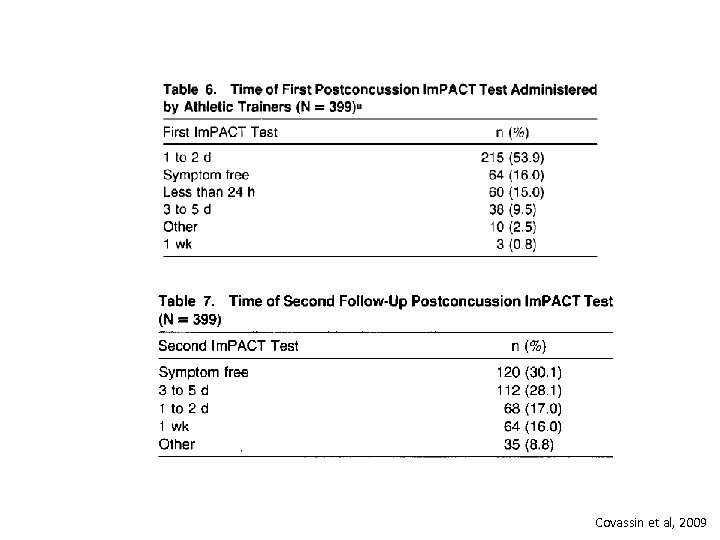 Covassin et al, 2009
 • 95. 5% of respondents would not return athlete to play if symptomatic with normal testing • If symptom free with scores below baseline, only 86. 5% would hold athlete from playing
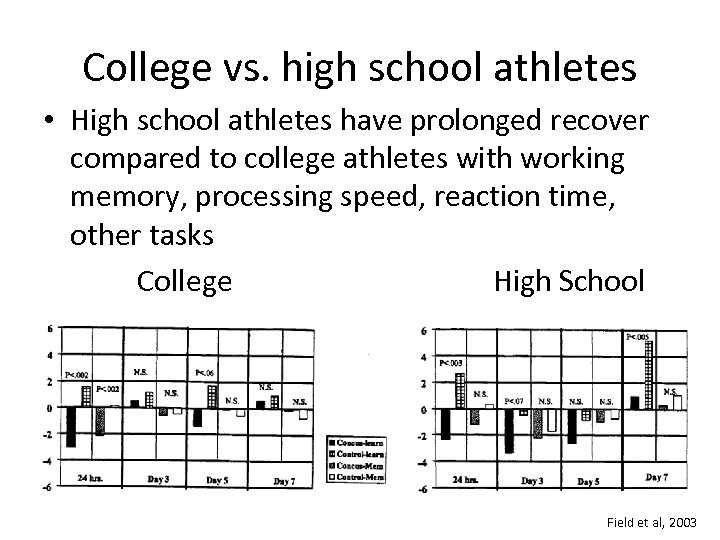 College vs. high school athletes • High school athletes have prolonged recover compared to college athletes with working memory, processing speed, reaction time, other tasks College High School Field et al, 2003
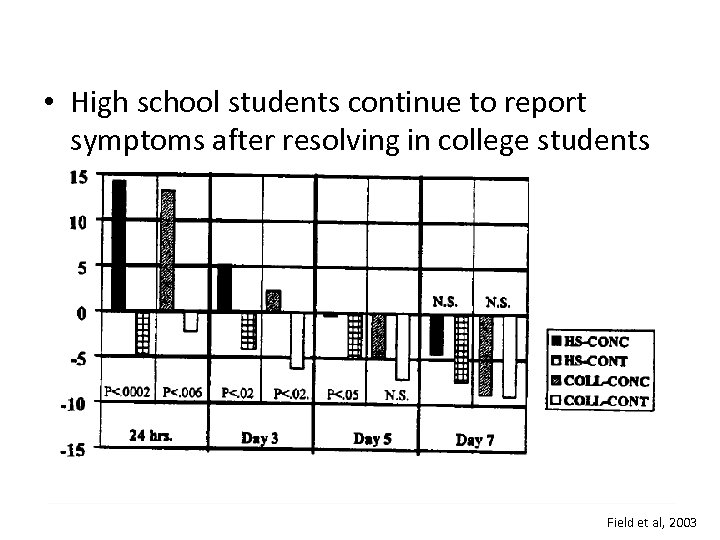 • High school students continue to report symptoms after resolving in college students Field et al, 2003
 Prolonged symptoms in high school athletes • One study showed difficulty in cognitive tasks in 23% of high school athletes 3 weeks after concussion • A similar study showed only 1. 6% of NFL players took >14 days to recover
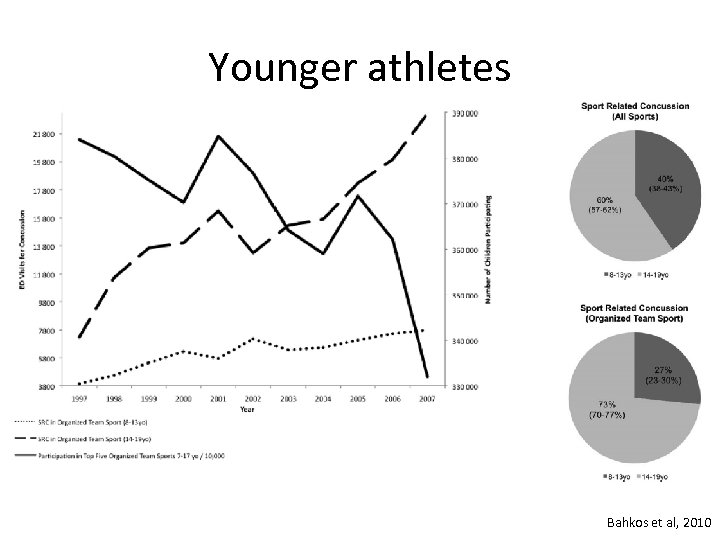 Younger athletes Bahkos et al, 2010
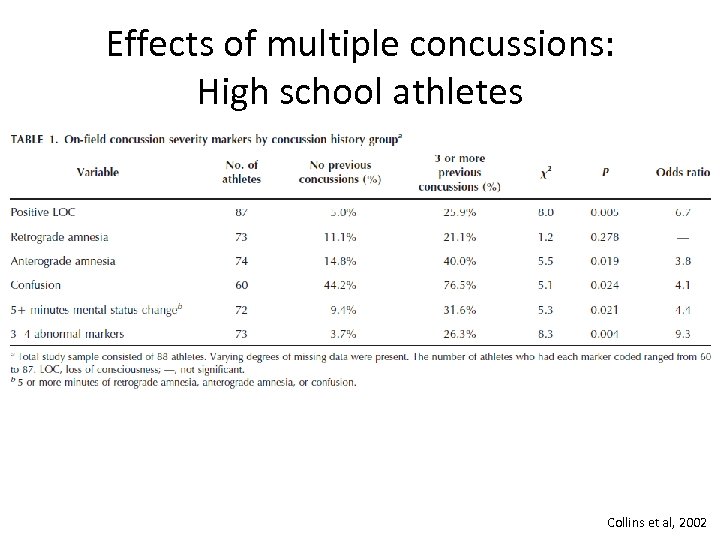 Effects of multiple concussions: High school athletes Collins et al, 2002
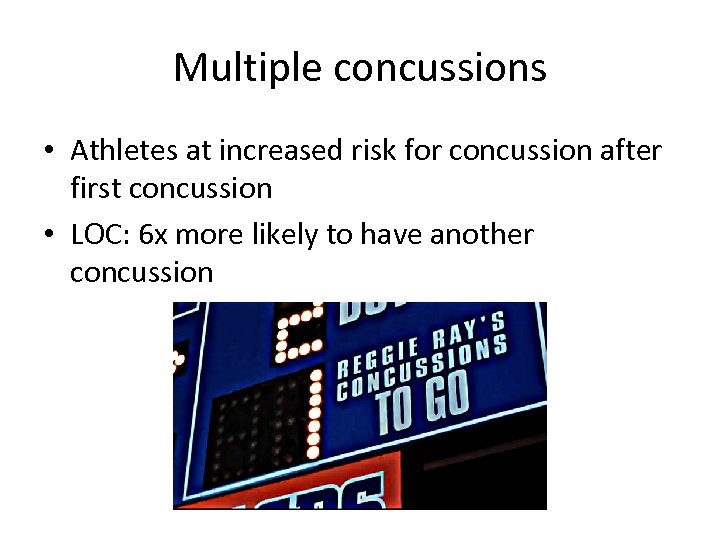 Multiple concussions • Athletes at increased risk for concussion after first concussion • LOC: 6 x more likely to have another concussion
 Second Impact Syndrome • Second (often mild) injury after first concussion • Loss of intracranial autoregulation, cerebral bleeding and edema, brainstem failure • Worst in athletes aged 16 -23 • High school football study showed 69% of players with LOC and 81% without LOC but with concussion returned to play the same day
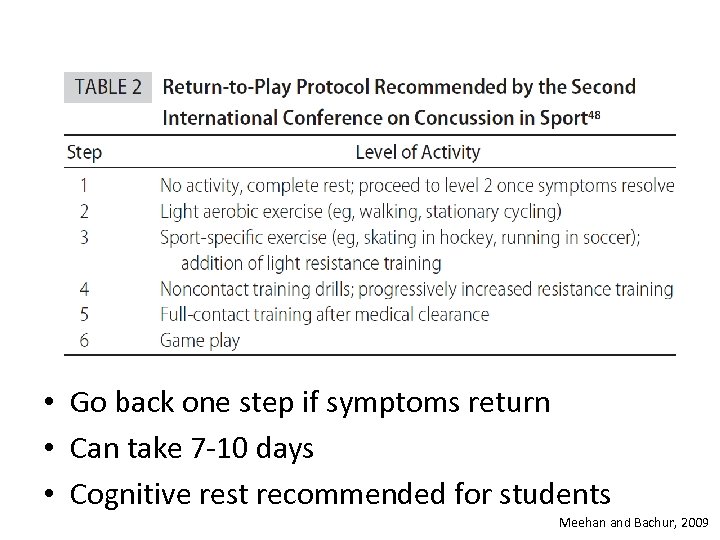 • Go back one step if symptoms return • Can take 7 -10 days • Cognitive rest recommended for students Meehan and Bachur, 2009
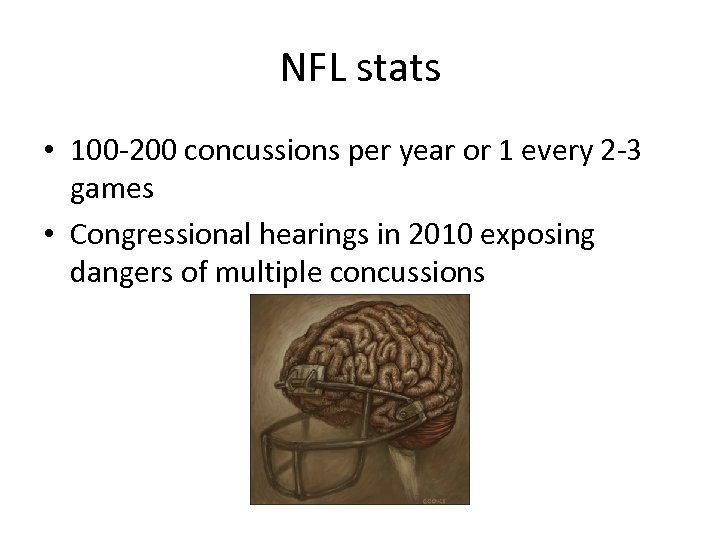 NFL stats • 100 -200 concussions per year or 1 every 2 -3 games • Congressional hearings in 2010 exposing dangers of multiple concussions
 NFL deaths • Andre Waters, age 44, committed suicide in 2006 – Forensic pathology: brain of an 85 y/o man, with evidence of early Alzheimer’s. – NFL’s TBI committee to examine link between concussions and depression • Dave Deurson, age 50, shot himself in the chest in 2011 – Chronic traumatic encephalopathy (CTE) • Ray Easterling, age 62, suicide in April 2012 – Moderately severe CTE • Junior Seau, age 43, suicide in May 2012 – Prelim autopsy shows normal brain. Investigation underway at Boston University
 Fuel to the fire • NFL facing huge concussion lawsuits from over 3, 000 players • First lawsuit filed in California by 75 players in July 2011. • Claim that NFL has known about long-term effects of brain trauma for decades but that this information was withheld from players. • Lawsuit also claims defective helmet design and manufacturing.
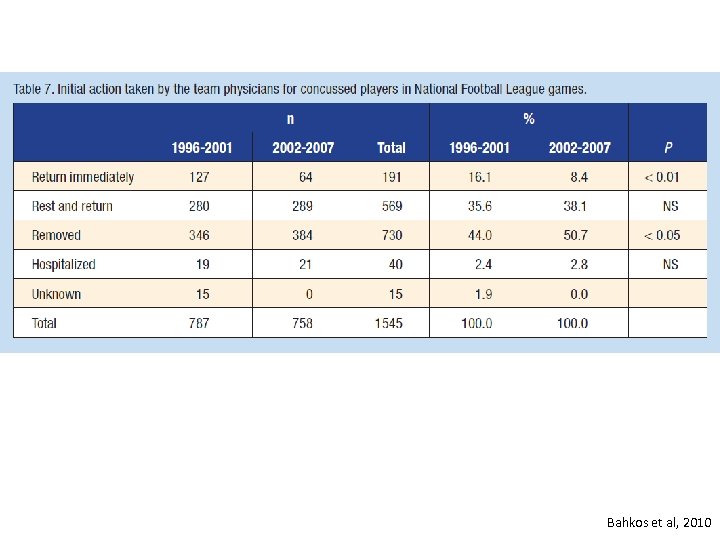 Bahkos et al, 2010
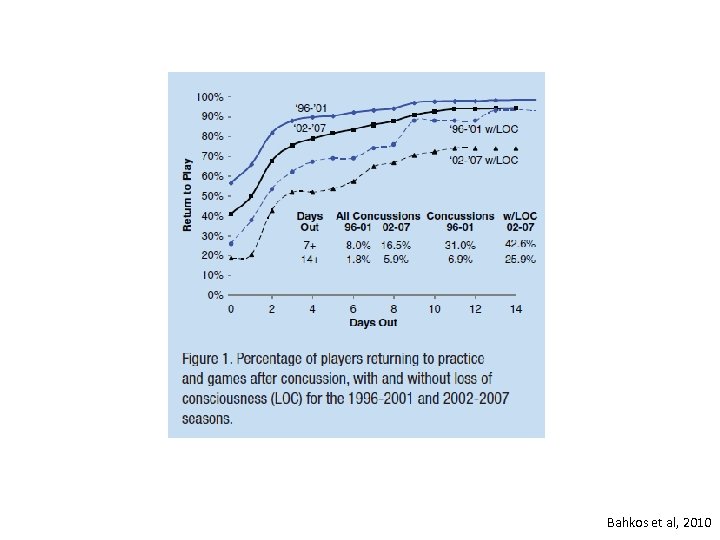 Bahkos et al, 2010
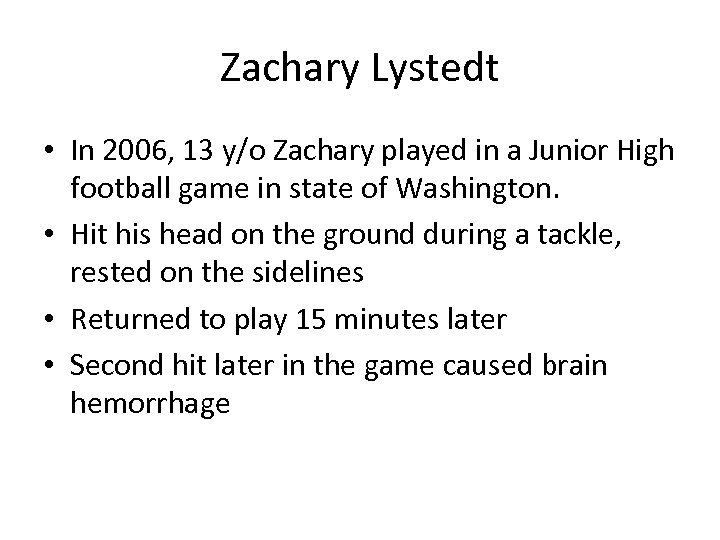 Zachary Lystedt • In 2006, 13 y/o Zachary played in a Junior High football game in state of Washington. • Hit his head on the ground during a tackle, rested on the sidelines • Returned to play 15 minutes later • Second hit later in the game caused brain hemorrhage
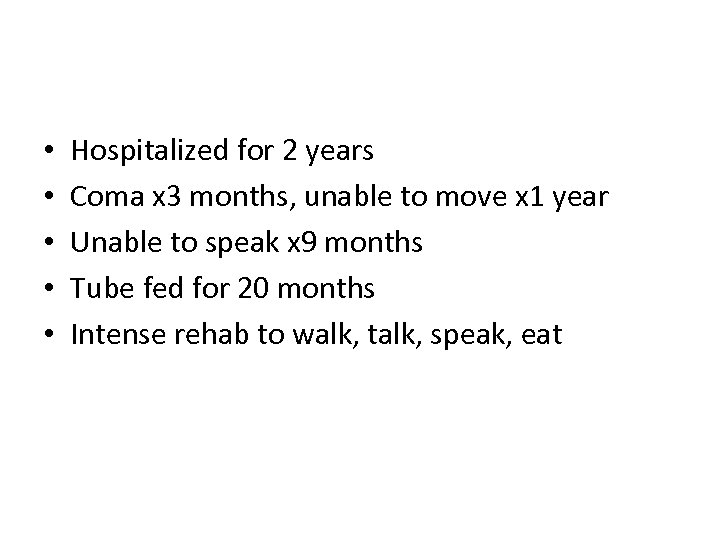 • • • Hospitalized for 2 years Coma x 3 months, unable to move x 1 year Unable to speak x 9 months Tube fed for 20 months Intense rehab to walk, talk, speak, eat
 Wheels of change • Richard Adler, president of the Brain Injury Association of Washington, visited Zachary and began to craft a bill • Seattle Seahawks helped distribute CDC posters and helped spread the word • Mike Holmgren wrote letters to all Washington HS coaches to stress removal from field of players who have appeared to have a concussion. • Dr. Stanley Herring, Seahawks physician and member of NFL Head, Neck, and Spine Committee, was soon on board
 Government involvement • At Adler’s request, state rep. Jay Rodne met Zachary in 2008. • Concussion legislation became “his #1 priority. ” • Bill passed unanimously in the house, and signed into law on May 14, 2009.
 • NFL commissioner Roger Goodell pledged support • Other states reached out to Washington to start similar legislation. • Zachary and family began speaking to legislators, doctors, athletic trainers, and school officials • Adler and Dr. Herring continued to push for national Lystedt Laws.
 • By the end of 2009, six states passed youth concussion laws • There are currently 42 states with similar legislation. • Gov. Cuomo signed NY’s Youth Concussion Law on Sept 17, 2011.
 The Concussion Management and Awareness Act Three Main Parts • Education • Guidelines • Plan for Implementation
 Education • Mandates a course for school coaches, PE teachers, nurses, athletic trainers • Teaches how to recognize sx of mild TBI and when to seek medical attention • This info is also posted on the websites for the Dept. of Health and the Dept. of Education
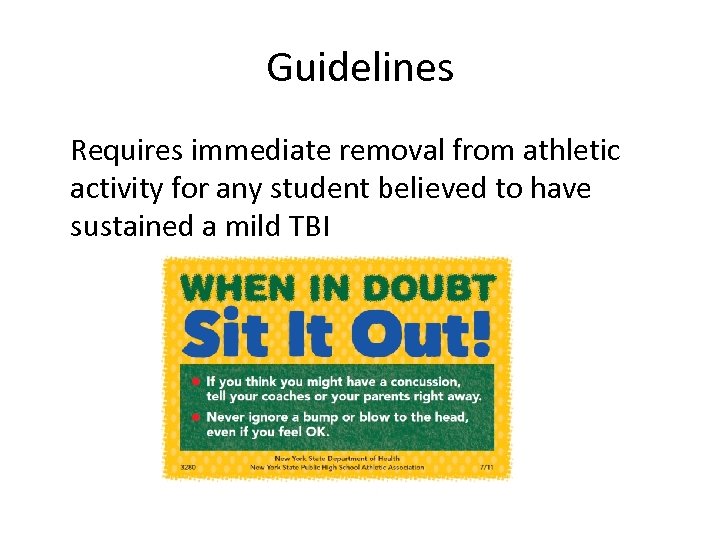 Guidelines Requires immediate removal from athletic activity for any student believed to have sustained a mild TBI
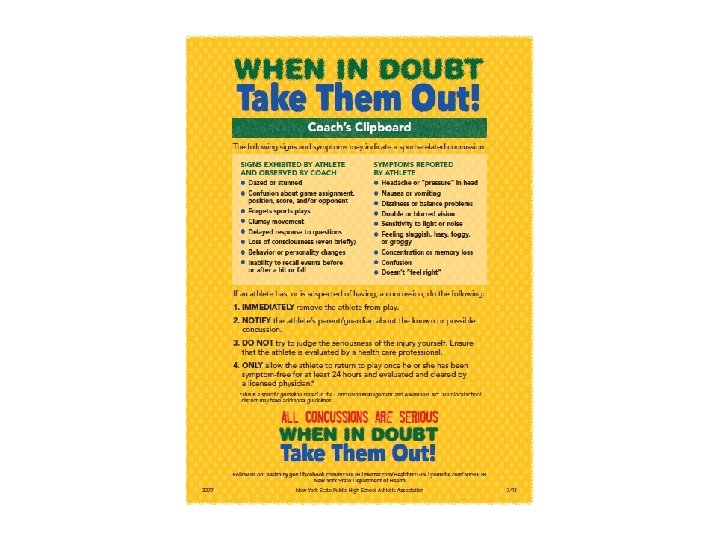
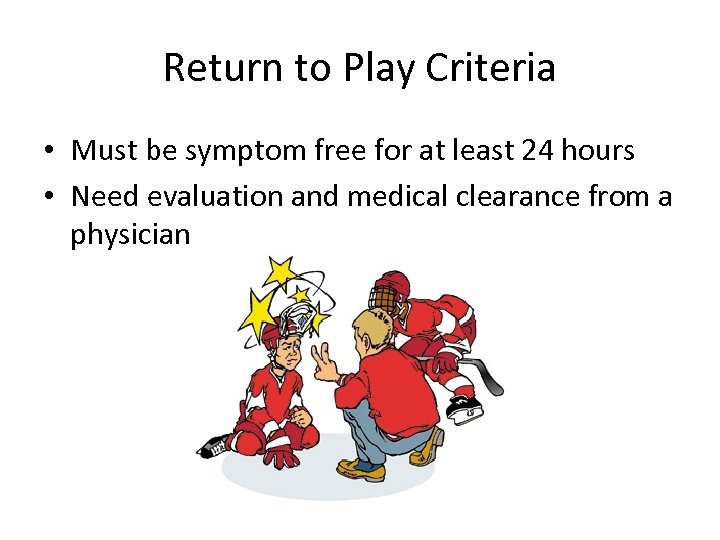 Return to Play Criteria • Must be symptom free for at least 24 hours • Need evaluation and medical clearance from a physician
 Wait… Physician Evaluation? • That’s us! • Students with possible mild TBIs may be sent to clinic or the ED to be evaluated
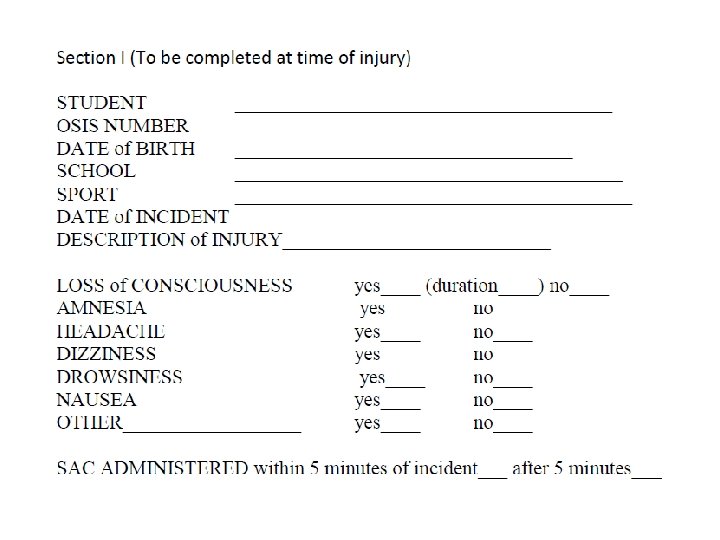
 Implementation • Suggests the establishment of a “Concussion Management Team” composed of the school athletic director, the school nurse, and at least one coach – This team will be responsible for teaching staff and students about mild TBIs – Also will make sure everyone’s following the rules • Went into effect July 1, 2012
 References • • • • Bakhos LL, Lockhart GR, Myers R, and Linakis JG. Emergency department visits for concussion in young child athletes. Pediatrics. 2010; 126: e 550 -e 556. Casson IR, Viano DC, Powell JW, and Pellman EJ. Twelve years of National Football League concussion data. Sports Health: A Multidisciplinary Approach. 2010; 2: 471 -483. Collins MW, Lovell MR, Iverson GL, Cantu RC, Maroon JC, Field M. Cumulative effects of concussion in high school athletes. Neurosurgery. 2002; 51: 1175 -1181. Covassin T, Elbin RJ, Stiller-Ostrowski JL, Kontos AP. Immediate post-concussion assessment and cognitive testing (Im. PACT) practices of sports medicine professionals. Journal of Athletic Training. 2009; 44: 639 -644. Field M, Collins MW, Lovell MR, Maroon J. Does age play a role in recovery from sports-related concussion? A comparison of high school and collegiate athletes. The Journal of Pediatrics. 2003; 142: 546 -553. Grindell SH, Lovell MR, Collins MW. The assessment of sport-related concussion: The evidence behind neuropsychological testing and management. Clinical Journal of Sport Medicine. 2001; 11: 134 -143. Halstead ME, Walter KD, and the Council on Sports Medicine and Fitness. Sport-related concussion in children and adolescents. Pediatrics. 2010; 126: 597 -615. Kirkwood MW, Yeates KO, and Wilson PE. Pediatric sport-related concussion: A review of the clinical management of an oftneglected population. Pediatrics. 2006; 117: 1359 -1371. Meehan WP and Bachur RG. Sport-related concussion. Pediatrics. 2009; 123: 114 -123. Meehan WP, d’Hemecourt P, Collins CL, and Comstock RD. Assessment and management of sport-related concussions in United States high schools. The American Journal of Sports Medicine. 2011; 39: 2304 -2310. Meehan WP, Taylor AM, and Proctor M. The pediatric athlete: Younger athletes with sports-related concussion. Clin Sports Med. 2011; 30: 133 -144. . Schatz P and Moser RS. Current issues in pediatric sports concussion. The Clinical Neuropsychologist. 2011; 25: 1042 -1057. Schatz P, Pardini JE, Lovell MR, Collins MW, and Podell K. Sensitivity and specificity of the Im. PACT test battery for concussion in athletes. Archives of Clinical Neuropsychology. 2006; 21: 91 -99