 Скачать презентацию Urbanization and Loss of Ecology with Special Reference
a86f63b3a674f1a78689e7918f97a212.ppt
- Количество слайдов: 38



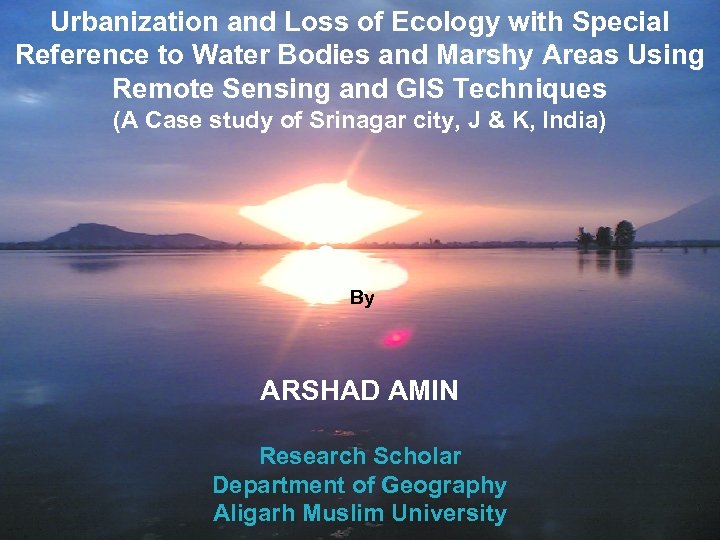
Urbanization and Loss of Ecology with Special Reference to Water Bodies and Marshy Areas Using Remote Sensing and GIS Techniques (A Case study of Srinagar city, J & K, India) By ARSHAD AMIN Research Scholar Department of Geography Aligarh Muslim University
Urbanization is one of the most evident global land use land cover change. During the last 200 years • World population increased 6 times. • Urban population increased over 100 times. • Presently 50% world population lives in urban areas. • This growth is rapid in developing nations.
Urban Population Scenario of Indian • 1951 (62. 5 million). • 2001 (285 million) an increase of over 350 percent. • Projected population by the year 2021 (533 million).
• Urban population growth leads to: Ø Urban expansion. Ø Land use/Land cover Transformation. • Urban expansion leads to : Ø Ø Loss of Wet lands. Loss of Forest area. Loss of Fertile Agricultural land. Increase of impervious surface.
• Land transformation is the most important fields of human induced environmental transformation which has taken many forms historically starting with fire management, herding practices, the development of agriculture, and culminating with urbanization including industrial development.
Srinagar city (Summer Capital of J&K) • General elevation : 1580 m above m. s. l. • Population in: 1951 - (255679) 2001 – (952324) • Primacy of the city: Population of Anantnag 1951 - (98720) Population of Srinagar city 1951 – (255679) • Srinagar city is garlanded with River Jhelum and numerous lakes: Dal Lake, Nigeen Lake, Brari Nambal, Khushalsar and wet lands
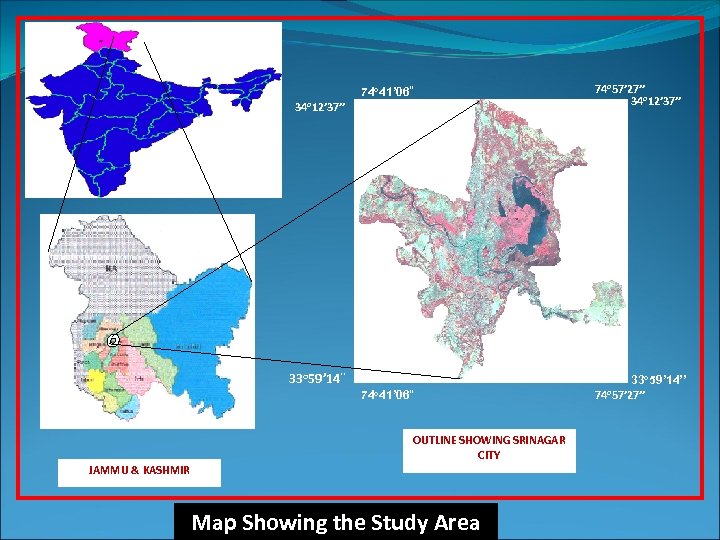
74 o 41’ 06’’ 34 o 12’ 37’’ 33 o 59’ 14’’ 74 o 41’ 06’’ OUTLINE SHOWING SRINAGAR CITY JAMMU & KASHMIR Map Showing the Study Area 74 o 57’ 27’’ 34 o 12’ 37’’ 33 o 59’ 14’’ 74 o 57’ 27’’
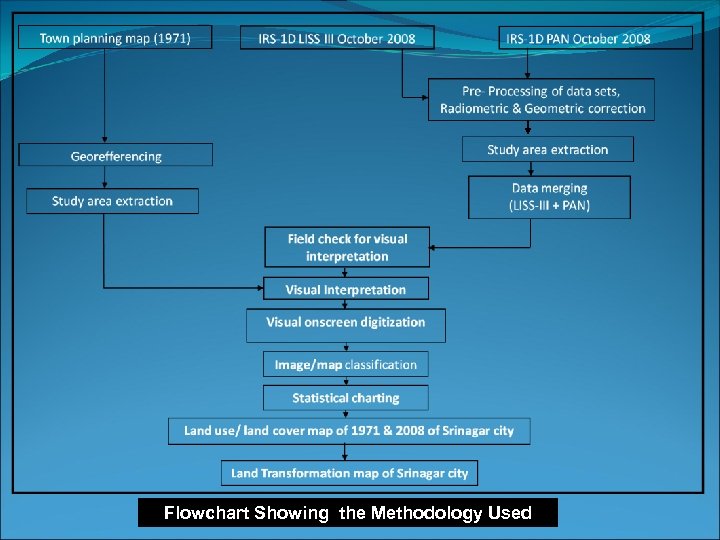
Flowchart Showing the Methodology Used
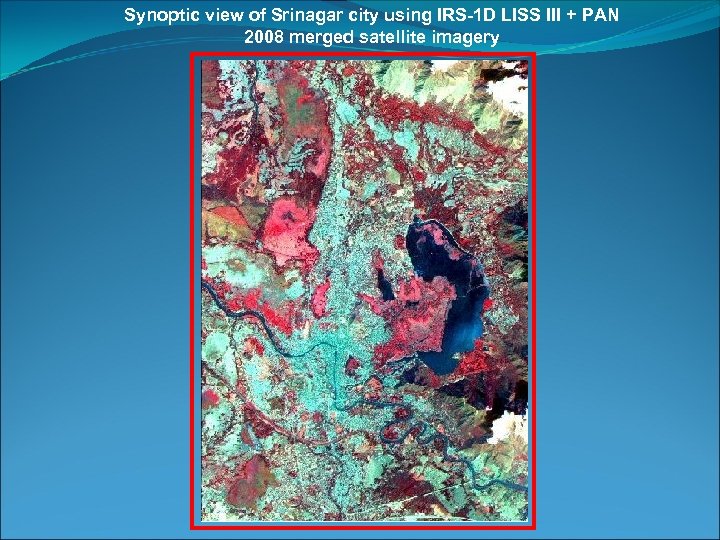
Synoptic view of Srinagar city using IRS-1 D LISS III + PAN 2008 merged satellite imagery
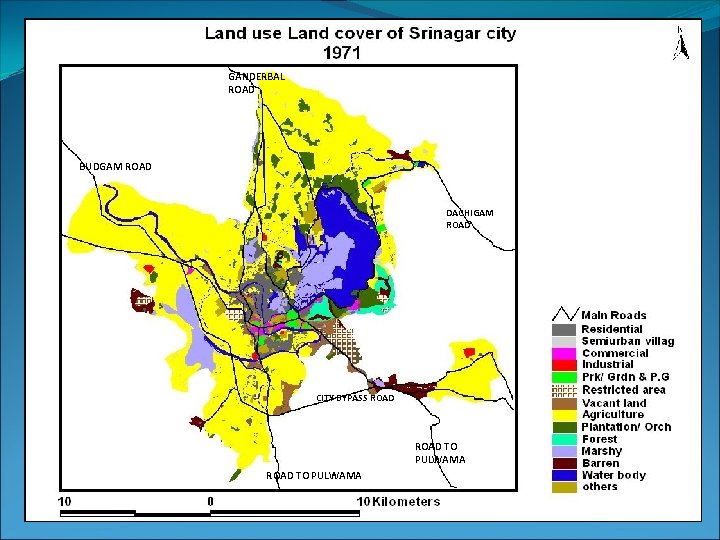
GANDERBAL ROAD BUDGAM ROAD DACHIGAM ROAD CITY BYPASS ROAD TO PULWAMA
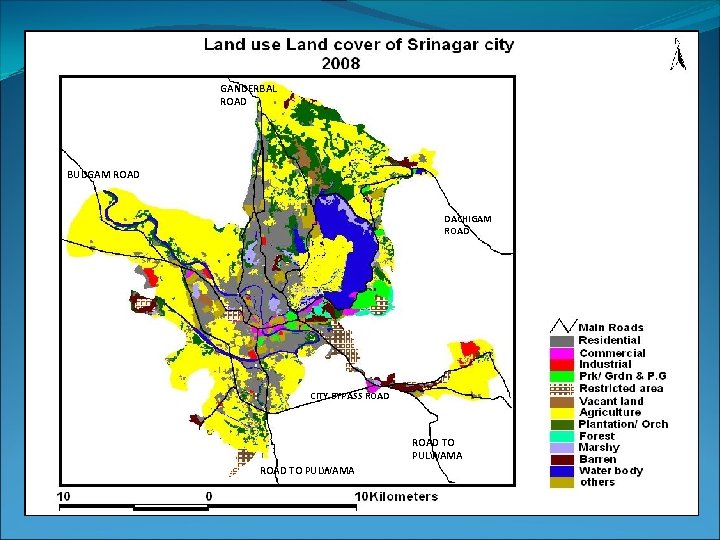
GANDERBAL ROAD BUDGAM ROAD DACHIGAM ROAD CITY BYPASS ROAD TO PULWAMA
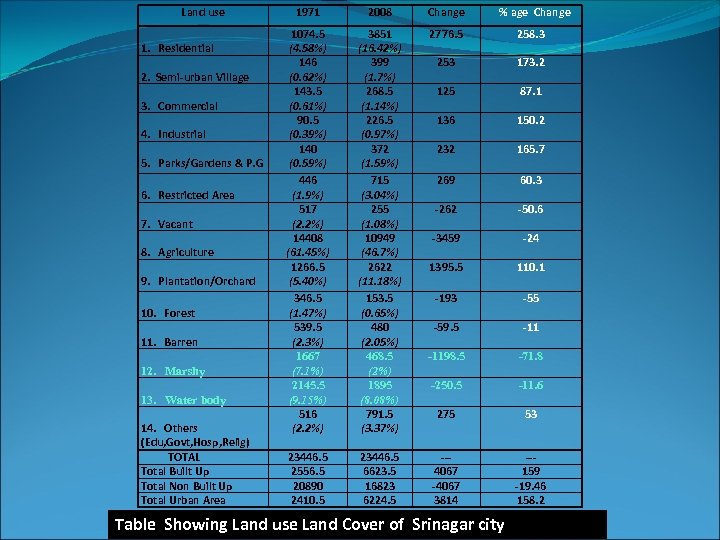
Land use 1. Residential 2. Semi-urban Village 3. Commercial 4. Industrial 5. Parks/Gardens & P. G 6. Restricted Area 7. Vacant 8. Agriculture 9. Plantation/Orchard 10. Forest 11. Barren 12. Marshy 13. Water body 14. Others (Edu, Govt, Hosp, Relig) TOTAL Total Built Up Total Non Built Up Total Urban Area 1971 2008 Change % age Change 1074. 5 (4. 58%) 146 (0. 62%) 143. 5 (0. 61%) 90. 5 (0. 39%) 140 (0. 59%) 446 (1. 9%) 517 (2. 2%) 14408 (61. 45%) 1266. 5 (5. 40%) 346. 5 (1. 47%) 539. 5 (2. 3%) 1667 (7. 1%) 2145. 5 (9. 15%) 516 (2. 2%) 3851 (16. 42%) 399 (1. 7%) 268. 5 (1. 14%) 226. 5 (0. 97%) 372 (1. 59%) 715 (3. 04%) 255 (1. 08%) 10949 (46. 7%) 2622 (11. 18%) 153. 5 (0. 65%) 480 (2. 05%) 468. 5 (2%) 1895 (8. 08%) 791. 5 (3. 37%) 2776. 5 258. 3 253 173. 2 125 87. 1 136 150. 2 232 165. 7 269 60. 3 -262 -50. 6 -3459 -24 1395. 5 110. 1 -193 -55 -59. 5 -1198. 5 -71. 8 -250. 5 -11. 6 275 53 23446. 5 2556. 5 20890 2410. 5 23446. 5 6623. 5 16823 6224. 5 --4067 3814 --159 -19. 46 158. 2 Table Showing Land use Land Cover of Srinagar city
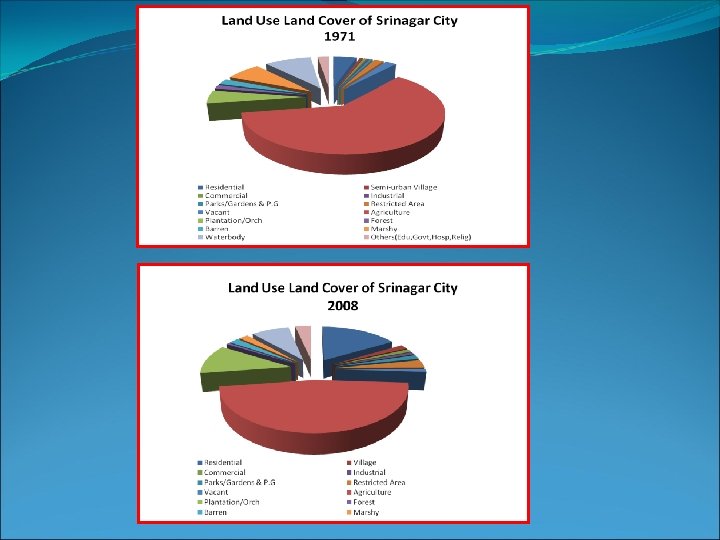
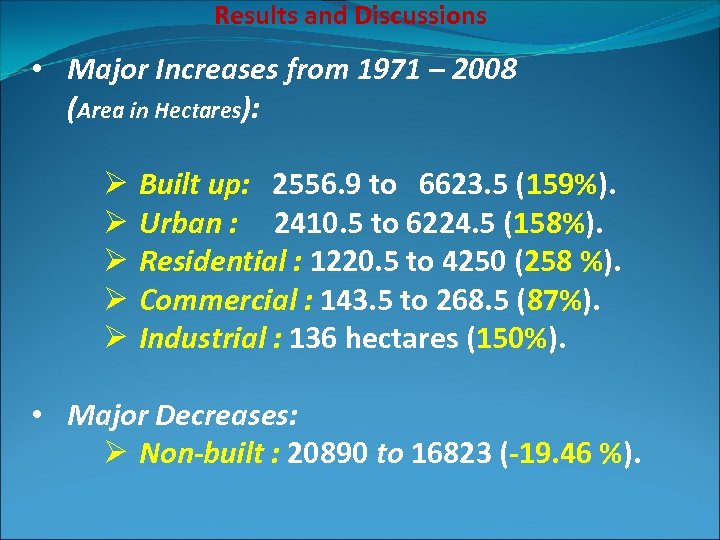
Results and Discussions • Major Increases from 1971 – 2008 (Area in Hectares): Ø Ø Ø Built up: 2556. 9 to 6623. 5 (159%). Urban : 2410. 5 to 6224. 5 (158%). Residential : 1220. 5 to 4250 (258 %). Commercial : 143. 5 to 268. 5 (87%). Industrial : 136 hectares (150%). • Major Decreases: Ø Non-built : 20890 to 16823 (-19. 46 %).
GANDERBAL ROAD BUDGAM ROAD DACHIGAM ROAD CITY BYPASS ROAD TO PULWAMA
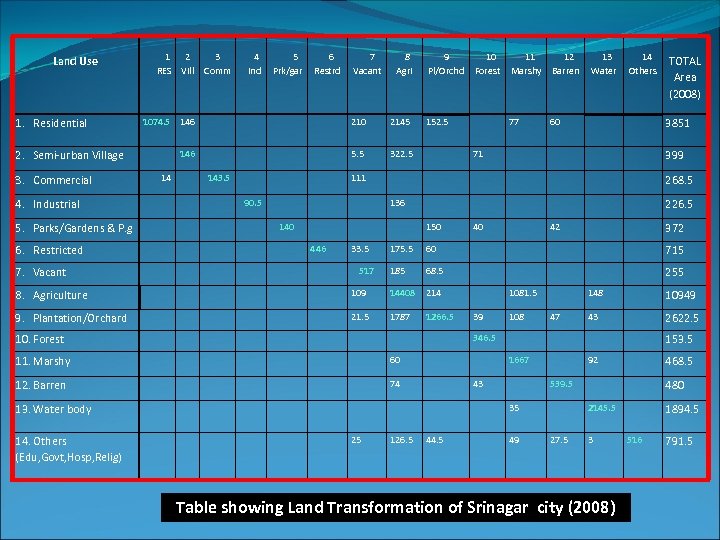
Land Use 1. Residential 1 2 RES Vill 4. Industrial 5. Parks/Gardens & P. g 6. Restricted 7. Vacant 4 Ind 5 Prk/gar 6 Restrd 7 Vacant 8 Agri 1074. 5 146 210 2145 146 5. 5 9 Pl/Orchd 322. 5 2. Semi-urban Village 3. Commercial 3 Comm 14 143. 5 10 Forest 13 Water 14 Others 60 399 111 90. 5 268. 5 136 140 226. 5 150 446 33. 5 517 40 42 372 175. 5 60 715 185 68. 5 255 109 14408 214 9. Plantation/Orchard 21. 5 1787 1266. 5 10. Forest 1081. 5 39 108 148 47 10949 43 2622. 5 346. 5 11. Marshy 60 12. Barren 74 153. 5 1667 43 92 126. 5 44. 5 468. 5 539. 5 35 13. Water body 25 TOTAL Area (2008) 3851 71 8. Agriculture 14. Others (Edu, Govt, Hosp, Relig) 12 Barren 77 152. 5 11 Marshy 49 480 2145. 5 27. 5 3 Table showing Land Transformation of Srinagar city (2008) 1894. 5 516 791. 5
Urban land transformation and its impact on water bodies of Srinagar city • The main thrust area of this research work is to assess the impact of urban expansion on Water bodies and Marshy areas of Srinagar city which are most important ecologically and also social, economic and cultural existence of the city depends on them. • The present study reveals that the expansion of Srinagar city and land transformation has severely affected the aerial extent of water bodies as well as the quality of water.
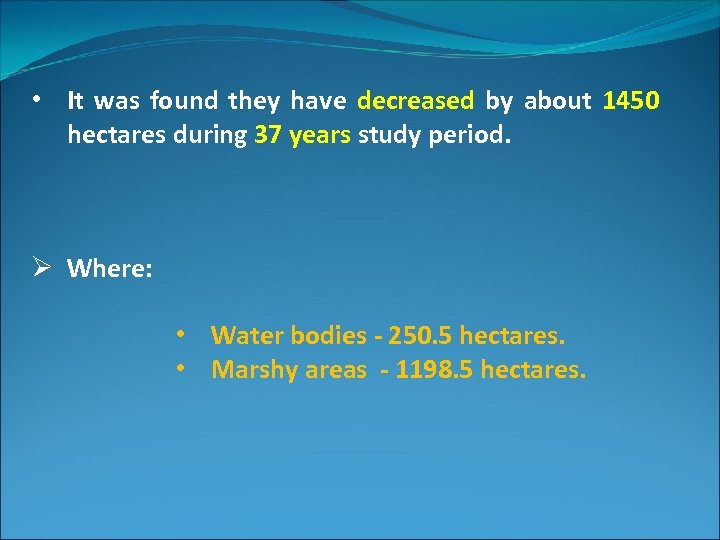
• It was found they have decreased by about 1450 hectares during 37 years study period. Ø Where: • Water bodies - 250. 5 hectares. • Marshy areas - 1198. 5 hectares.
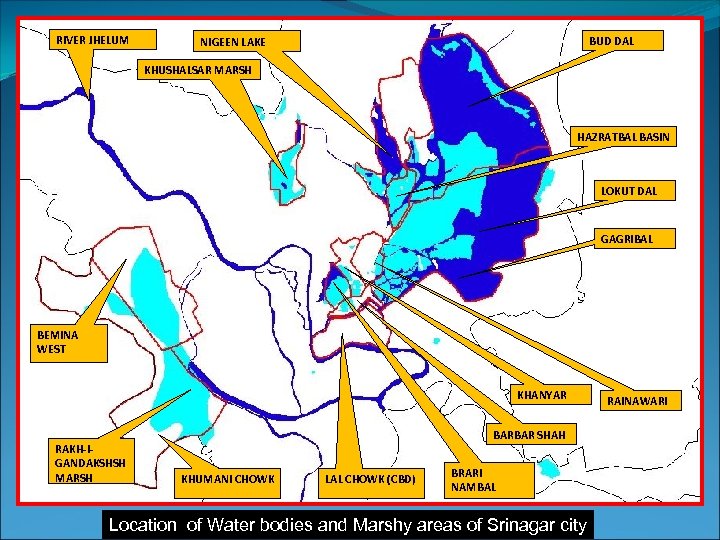
RIVER JHELUM BUD DAL NIGEEN LAKE KHUSHALSAR MARSH HAZRATBAL BASIN LOKUT DAL GAGRIBAL BEMINA WEST KHANYAR RAKH-IGANDAKSHSH MARSH BARBAR SHAH KHUMANI CHOWK LAL CHOWK (CBD) BRARI NAMBAL Location of Water bodies and Marshy areas of Srinagar city RAINAWARI
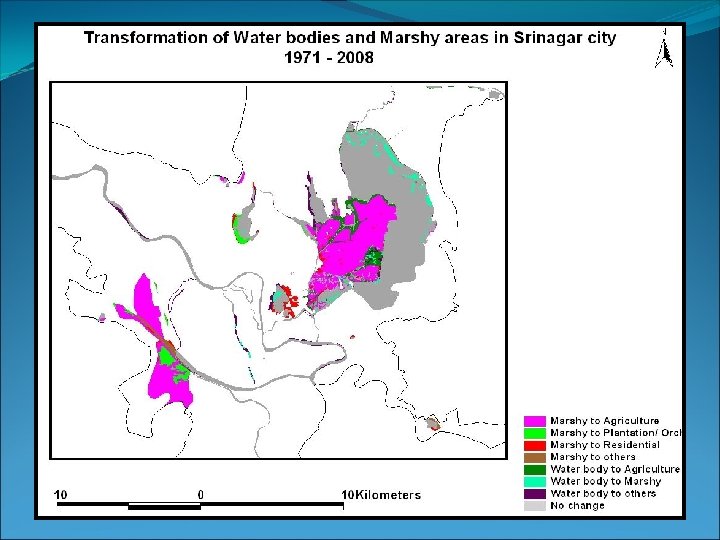
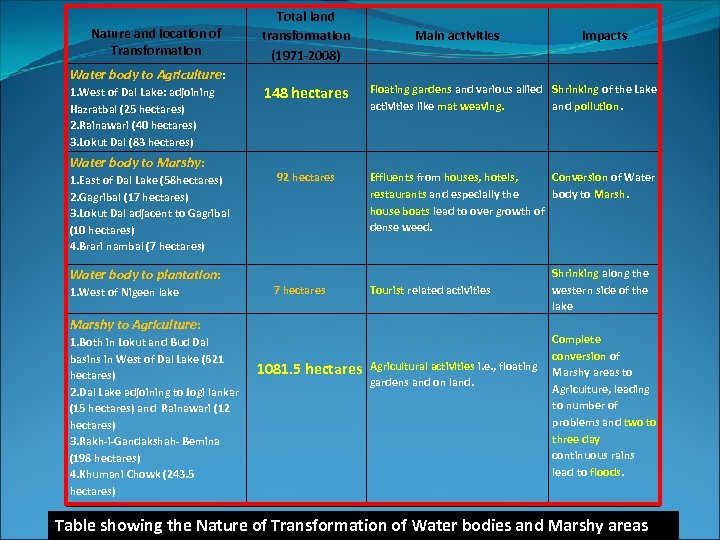
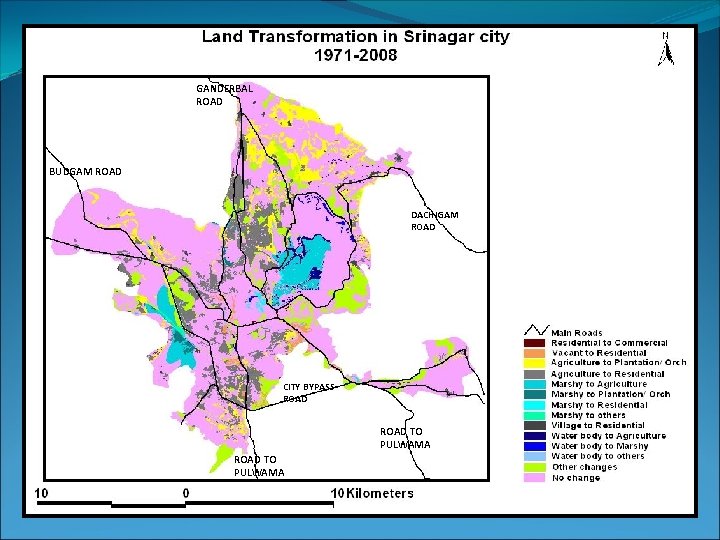
Nature and location of Transformation Water body to Agriculture: 1. West of Dal Lake: adjoining Hazratbal (25 hectares) 2. Rainawari (40 hectares) 3. Lokut Dal (83 hectares) Water body to Marshy: 1. East of Dal Lake (58 hectares) 2. Gagribal (17 hectares) 3. Lokut Dal adjacent to Gagribal (10 hectares) 4. Brari nambal (7 hectares) Water body to plantation: 1. West of Nigeen lake Total land transformation (1971 -2008) Main activities 148 hectares Floating gardens and various allied Shrinking of the Lake activities like mat weaving. and pollution. 92 hectares Effluents from houses, hotels, Conversion of Water restaurants and especially the body to Marsh. house boats lead to over growth of dense weed. 7 hectares Tourist related activities Marshy to Agriculture: 1. Both in Lokut and Bud Dal basins in West of Dal Lake (621 hectares) 2. Dal Lake adjoining to Jogi lankar (15 hectares) and Rainawari (12 hectares) 3. Rakh-i-Gandakshah- Bemina (198 hectares) 4. Khumani Chowk (243. 5 hectares) Impacts 1081. 5 hectares Agricultural activities i. e. , floating gardens and on land. Shrinking along the western side of the lake Complete conversion of Marshy areas to Agriculture, leading to number of problems and two to three day continuous rains lead to floods. Table showing the Nature of Transformation of Water bodies and Marshy areas
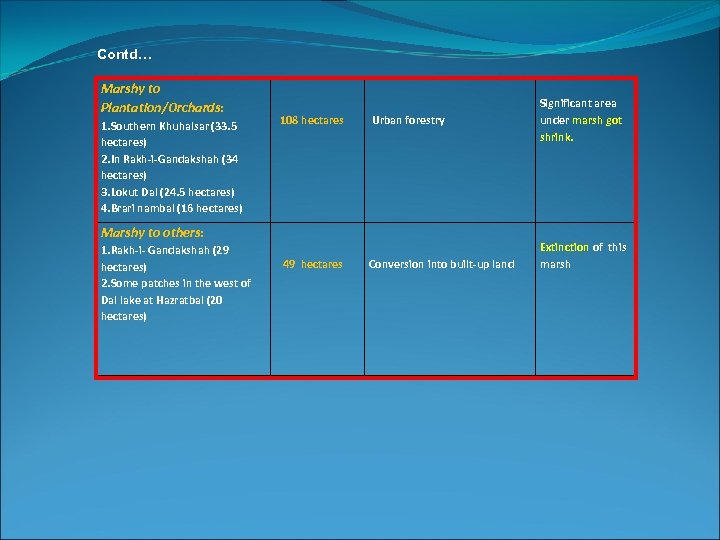
Contd… Marshy to Plantation/Orchards: 1. Southern Khuhalsar (33. 5 hectares) 2. In Rakh-i-Gandakshah (34 hectares) 3. Lokut Dal (24. 5 hectares) 4. Brari nambal (16 hectares) 108 hectares Urban forestry Marshy to others: 1. Rakh-i- Gandakshah (29 hectares) 2. Some patches in the west of Dal lake at Hazratbal (20 hectares) 49 hectares Conversion into built-up land Significant area under marsh got shrink. Extinction of this marsh
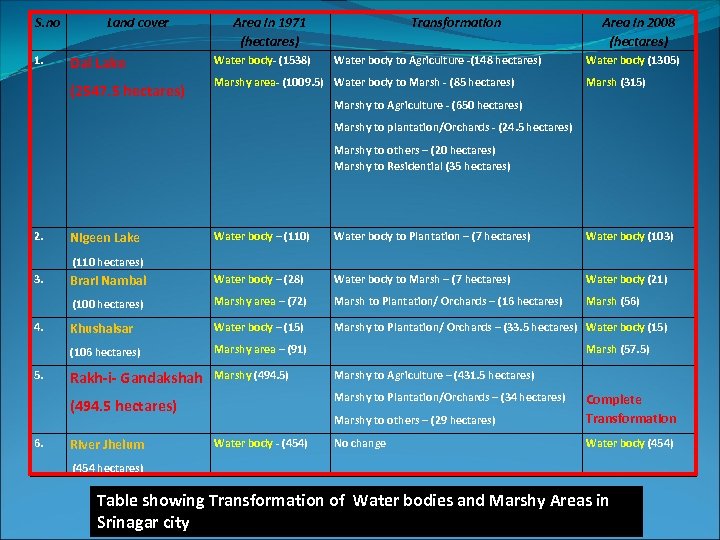
S. no 1. Land cover Dal Lake (2547. 5 hectares) Area in 1971 (hectares) Water body- (1538) Transformation Water body to Agriculture -(148 hectares) Marshy area- (1009. 5) Water body to Marsh - (85 hectares) Area in 2008 (hectares) Water body (1305) Marsh (315) Marshy to Agriculture - (650 hectares) Marshy to plantation/Orchards - (24. 5 hectares) Marshy to others – (20 hectares) Marshy to Residential (35 hectares) 2. Water body – (110) Water body to Plantation – (7 hectares) Water body (103) Brari Nambal Water body – (28) Water body to Marsh – (7 hectares) Water body (21) (100 hectares) Marshy area – (72) Marsh to Plantation/ Orchards – (16 hectares) Marsh (56) Khushalsar Water body – (15) Marshy to Plantation/ Orchards – (33. 5 hectares) Water body (15) (106 hectares) Marshy area – (91) Rakh-i- Gandakshah Marshy (494. 5) Nigeen Lake (110 hectares) 3. 4. 5. River Jhelum Marshy to Agriculture – (431. 5 hectares) Marshy to Plantation/Orchards – (34 hectares) Marshy to others – (29 hectares) (494. 5 hectares) 6. Marsh (57. 5) Water body - (454) Complete Transformation No change Water body (454) (454 hectares) Table showing Transformation of Water bodies and Marshy Areas in Srinagar city
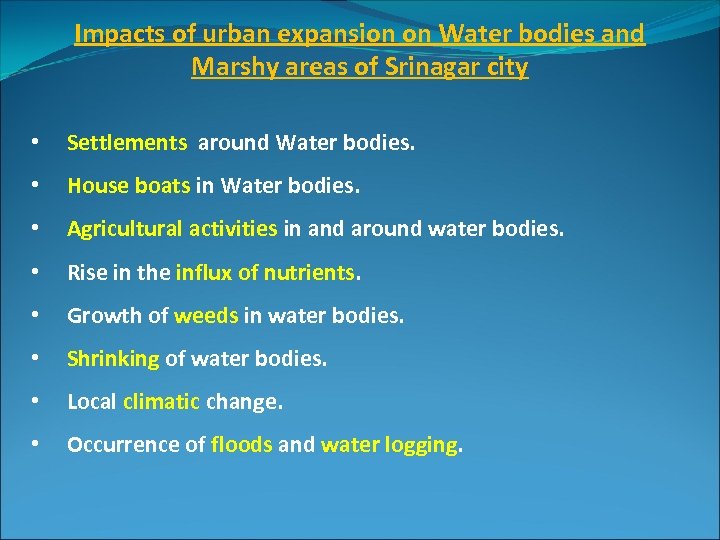
Impacts of urban expansion on Water bodies and Marshy areas of Srinagar city • Settlements around Water bodies. • House boats in Water bodies. • Agricultural activities in and around water bodies. • Rise in the influx of nutrients. • Growth of weeds in water bodies. • Shrinking of water bodies. • Local climatic change. • Occurrence of floods and water logging.
Settlements around Water bodies • Dal Lake sheltering about 50 hamlets with a population of over 50, 000 people, who have property rights over 300 hectares (6, 000 kanals) of agricultural land 670 hectares (13, 400 kanals) of water area.
House boats in Water bodies • • • Dal Lake is the Prime victim of Urban expansion in Srinagar city Presently there are more than 1200 house boats inside the Dal Lake Increased pollution because Increasing number of lake dwellers. Floating gardens. Entry of untreated sewage. Solid waste from the peripheral areas and from the hamlets and house boats. Ø Agricultural return flow from catchment into the lake. Ø Ø
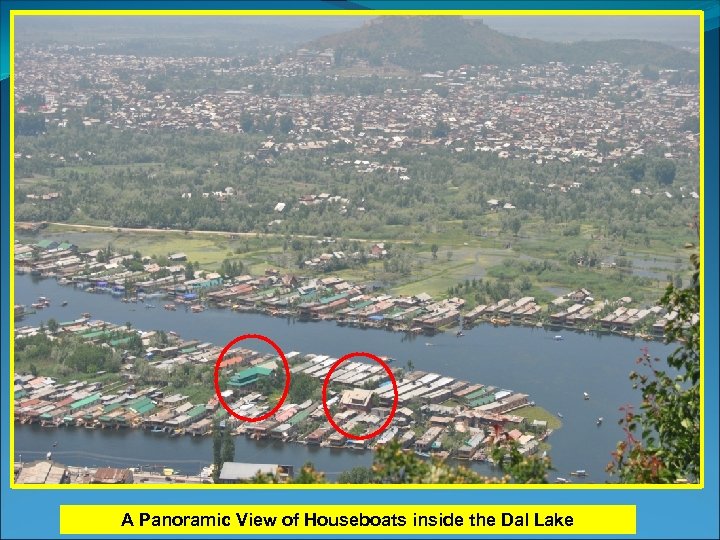
A Panoramic View of Houseboats inside the Dal Lake
Agricultural activities in and around water bodies • About 90 percent of the Dal dwellers have a very poor socio-economic base and they churn out their modest income from agricultural activities, mat weaving, tourist related activities like paddling Shikaras and deweeding of weeds.
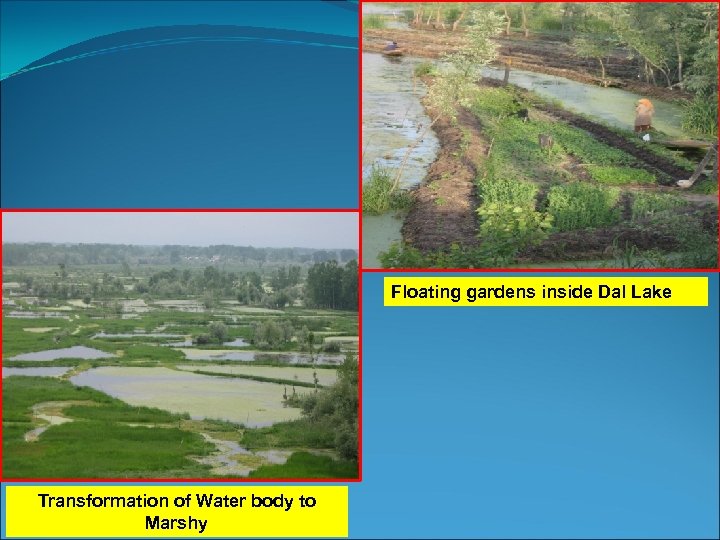
Floating gardens inside Dal Lake Transformation of Water body to Marshy
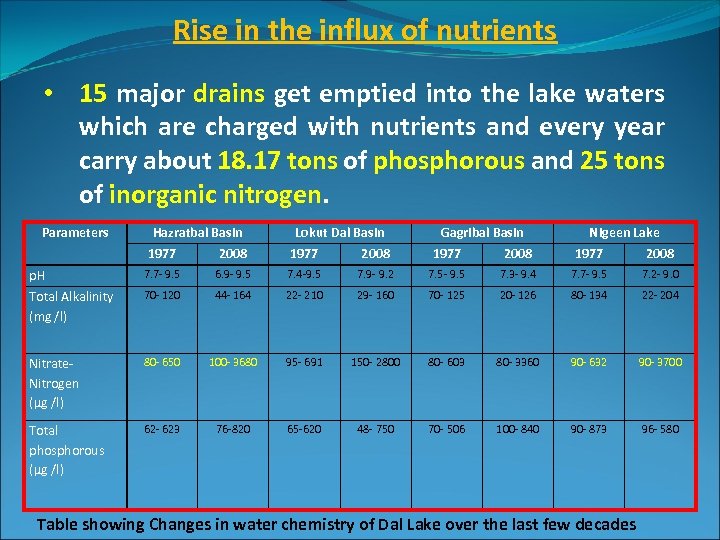
Rise in the influx of nutrients • 15 major drains get emptied into the lake waters which are charged with nutrients and every year carry about 18. 17 tons of phosphorous and 25 tons of inorganic nitrogen. Parameters Hazratbal Basin Lokut Dal Basin Gagribal Basin Nigeen Lake 1977 2008 p. H 7. 7 - 9. 5 6. 9 - 9. 5 7. 4 -9. 5 7. 9 - 9. 2 7. 5 - 9. 5 7. 3 - 9. 4 7. 7 - 9. 5 7. 2 - 9. 0 Total Alkalinity (mg /l) 70 - 120 44 - 164 22 - 210 29 - 160 70 - 125 20 - 126 80 - 134 22 - 204 Nitrate. Nitrogen (µg /l) 80 - 650 100 - 3680 95 - 691 150 - 2800 80 - 603 80 - 3360 90 - 632 90 - 3700 Total phosphorous (µg /l) 62 - 623 76 -820 65 -620 48 - 750 70 - 506 100 - 840 90 - 873 96 - 580 Table showing Changes in water chemistry of Dal Lake over the last few decades
Growth of weeds in water bodies • Recent grown up weed Azolla Pinnata has converted the water into dense marsh because of various nitrogen and phosphorous effluents from houses, hotels, restaurants and the house boats, which act as the fertilizer to these weeds.
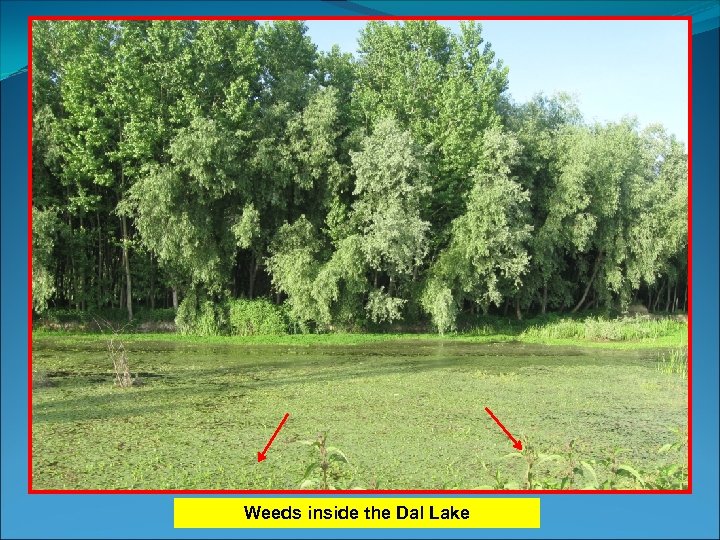
Weeds inside the Dal Lake
Shrinking of water bodies Present study: Ø Dal Lake waters decreased by 233 hectares. Ø Nigeen Lake waters decreased by 7 hectares. Ø Brari Nambal decreased by 7 hectares. Other Studies: Ø During the last century more than 50 percent of the water bodies have been lost in the suburbs of Srinagar city.
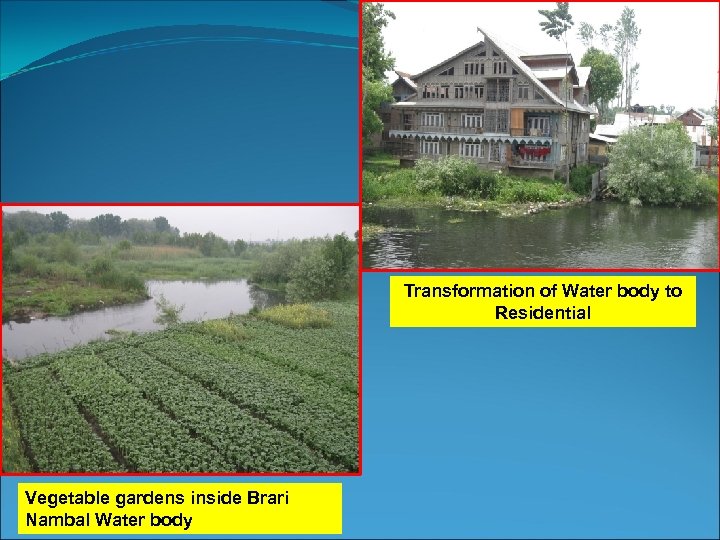
Transformation of Water body to Residential Vegetable gardens inside Brari Nambal Water body
Local climatic change • Modified the microclimate of the city. • On July 15, 1973, the highest temperature ever recorded in Srinagar city was 35. 5 degrees Celsius and on July 7, 2006, it was recorded at 39. 5 degree Celsius.
Occurrence of floods and water logging • These marshy areas and water bodies used to act as the sponges during the floods. • Now it happens that if it rains continuously for two to three days, the city is threatened with the floods.
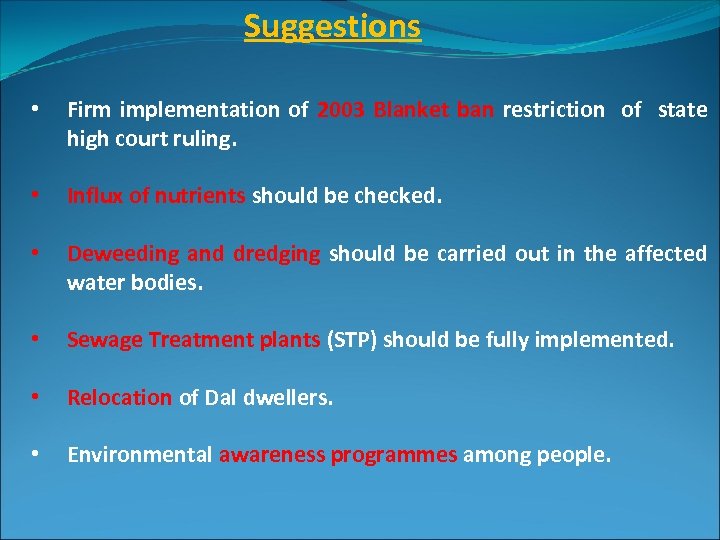
Suggestions • Firm implementation of 2003 Blanket ban restriction of state high court ruling. • Influx of nutrients should be checked. • Deweeding and dredging should be carried out in the affected water bodies. • Sewage Treatment plants (STP) should be fully implemented. • Relocation of Dal dwellers. • Environmental awareness programmes among people.
 Скачать презентацию Urbanization and Loss of Ecology with Special Reference
a86f63b3a674f1a78689e7918f97a212.ppt