 Скачать презентацию Urbanization and City Patterns Chapter 10 and 11
9484f5ca06cfc5aee87c7f98f4b0dd84.ppt
- Количество слайдов: 35



Urbanization and City Patterns Chapter 10 and 11 (Note: This covers 2 chapters. ) (I am testing both chapters. )
Urban Center Definitions • Urbanization: (increase in) the number and percentage of people living un urban settlements. (Urbanized Population) – Driving factors: • Jobs • Services • Convenience/Proximity (distance and access to services) • Primate City: a large city, dominating the country – Usually more than twice the next largest city • Often, dominant economic, political and cultural center • Jobs, services, convenience migration • These are often megacities, and may dominate regions.
Where have urban areas grown? • 3% urban in 1800, • now 50%+ and growing • Change in extent, density, heterogeneity • MDCs: – Ag. Mfg. Services, – Urbanization is effectively completed. – London, Tokyo, New York City, Los Angeles • LDCs: – Migration from country in search of jobs, – Local population growth often outstrips job availability. – Delhi, Jakarta, Mexico City, Mumbai (Bombay).
Historical growth: the rise of cities • Models: – Technical (ex: Thebes-Nile River, Mesopotamia) • Irrigation: make canals, surplus crops drive pop. growth – Religious (ex: Aztecs) • Religious activities bring people together. – Political (ex: London) – Trade (Silk Road cities) – War (every city with a fort, shield wall or barrier: Paris, ) – Multiple factors: • Technology, religion, politics, war, agriculture, and trade
City Hearths: • Mesoamerica: – Aztec, Toltec Empires • Andes – Incan Empire • Nile Valley – Pharohic Dynasties • Tigris-Euphrates Rivers: – Mesopotamia • Huang Ho River Valley: – Han Chinese, many successive dynastic cycles • Indus Valley
Cities and Religion • Many rulers used religion to maintain power. • Belief systems shaped cities and architecture. – Cosmomagical (Cosmological) Cities: • Sacred symbolic center, aka Axis Mundi – Near seat of power and granary » Forbidden City in present Beijing » Imperial Palaces in Kyoto, Nara » Mayan city temples • Orientation toward the 4 cardinal directions • City layout reflecting cosmologial form – Sometimes architectural forms, such as solar observatories – Align the world to mirror aspects of heaven or the universe
City Formation • Spontaneous – Free time specialization – Inventions arts and crafts, trade, storage – Square for trade, wall for defense, temple for prayer, fort for powerful… • Learned traits from other city patterns – Good ideas are copied. • Chang-an Nara, Kyoto, Roman colonies, etc. • Figure 10. 7, Map, p. 283
Cities and globalization • Global cities: global economy control centers. – Ex: London, NY City, Tokyo • Globalizing cities: are modified by globalizing economies and cultures – Ex: any city not politically isolated from the world. • Even Timbuktu has had some globalizing influences. – The degree of globalization depends on accessibility and desire.
Urban Ecology: Location • Trade – Natural trade advantages (site and situation) • Defense – Natural barriers to attack (site and situation) • Food Supply – e. g. city states: city + controlled countryside • hinterland • Risks – e. g. floods, quakes, hurricanes
Defense advantages • Site: characteristics of a place – Bluffs, rivers, islands, protected harbors, mesas, etc. – Local barriers of a city. • Situation: relative location of locations – Far from enemy, intervening marshes, mountains, seas, etc. • Barriers (outside the city site) between cities or states • Ex: marshes and distance from Germany and Moscow
Trade: Site and situation • Trade sites: – Route branches, portages, end of navigable rivers, fords, river mouths, bays, estuaries, etc. • Trade situations: – Closer to other cities • Berlin, Paris, London, Milan, etc. – Along trade routes • Singapore, Detroit, Venice (historical), Los Angeles – Access to nearby friendly ports • Mexico City, Beijing – Access to resources or production regions (agriculture/mfg. ) • Hong Kong, New Orleans, Chicago
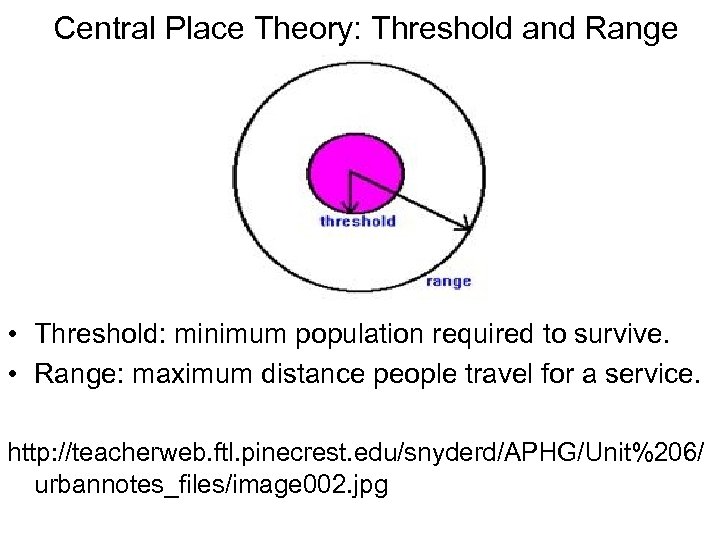
Central Place Theory: Threshold and Range • Threshold: minimum population required to survive. • Range: maximum distance people travel for a service. http: //teacherweb. ftl. pinecrest. edu/snyderd/APHG/Unit%206/ urbannotes_files/image 002. jpg
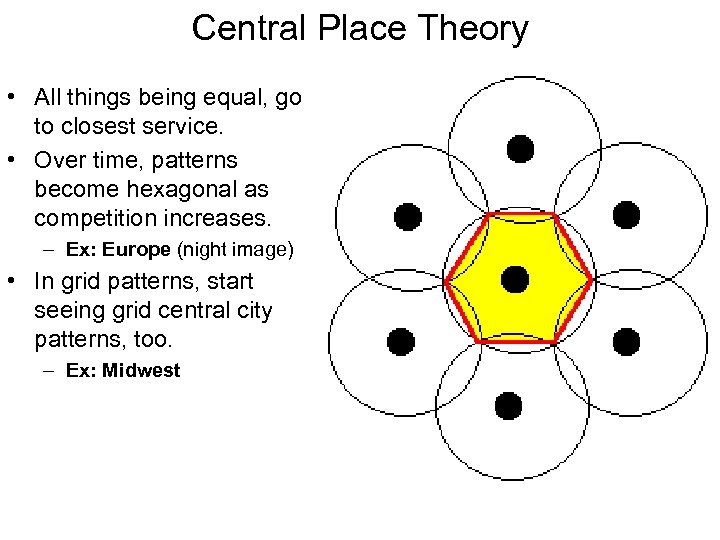
Central Place Theory • All things being equal, go to closest service. • Over time, patterns become hexagonal as competition increases. – Ex: Europe (night image) • In grid patterns, start seeing grid central city patterns, too. – Ex: Midwest
Globalizing City Problems • Squatter settlements – Insufficient income illegal housing, with poor/no services • Informal sectors – All cities have them, all economies have them, all countries have them. • Apartheid (There is a city model for this in the text. ) – Isolation of undesired ethnicities in all aspects of life • Central planned economy cities – Economic inefficiencies are costly, and quality is lower. – They may be as environmentally problematic as hyper-capitalist cities. (Central planning can miss local problems. ) • Hyper-capitalist cities (e. g. transition from communist) – – Business growth can result in illegally appropriated land. Illegal pollution is a larger problem. Laws may be less strictly enforced, and can be circumvented. Not limited to post-communist cities… See Singapore.
Chapter 11: Inside the City • Look at this as the other half of a single topic. • Differences between cities are also found as differences within cities. – Patterns often repeat at different scales.
Models of urban structure 1. Concentric Zone: Concentric rings: CBD, transition zone, independent worker houses, better houses, commuter zone. • 2. Like Von. Thunen’s concentric ring agricultural model Sector: initial land use patterns expand in wedges from the center. (think of this as being like wedges of different pizzas. ) 3. Multiple Nuclei: Initial nuclei form around basic activities, and land uses are attracted to those nuclei of development. – Nuclei: CBD, harbor, university, airport, park, railroad yards, manufacturing, military bases, etc. 4. Peripheral Model: Ring cities and a ring road (next page)
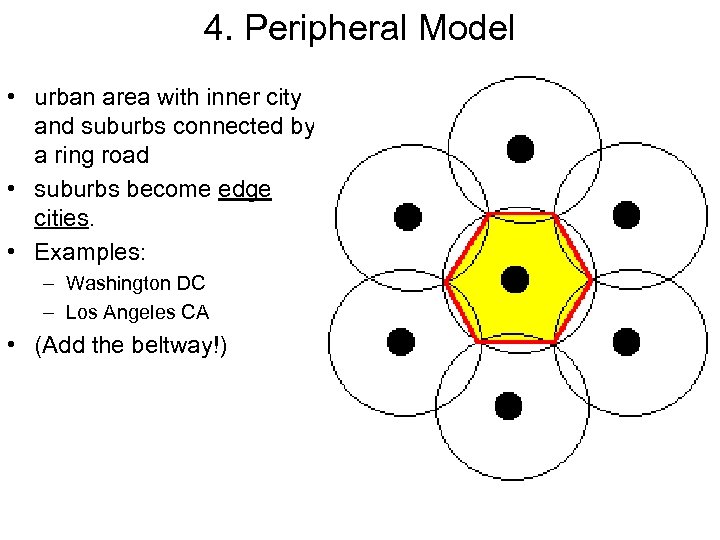
4. Peripheral Model • urban area with inner city and suburbs connected by a ring road • suburbs become edge cities. • Examples: – Washington DC – Los Angeles CA • (Add the beltway!)
SJ Map • • • Colonial mission Circles Sectors Nuclei (Google Earth)
Inner cities: distinctive problems • Deterioration and Blight (housing & services): – Housing ages. – Rent < maintenance skip it. – Rent < bills, etc abandon / raze / sell • Urban renewal (& public, private, or both types of housing): – Demolition of old housing dislocates people, – High rises can provide poor environments if not careful. • Renovation ( & gentrification): – Pay for renewal, – gentrification dislocates lower classes, usually affecting ethnicities.
Land use influences • Filtering: (a housing use/reuse pattern): Large houses subdivided, age, occupied by successive immigrant waves. • Red-Lining: (illegal denial of credit): drawing lines on a map to identify areas in which loans will not be given. • Public housing: units reserved for low income households, who pay reduced rates (e. g. 30% of their income) for rent.
Underclass: • (inner city text reference, only there? ) • peoples trapped in an unending cycle of economic and social problems. • Why?
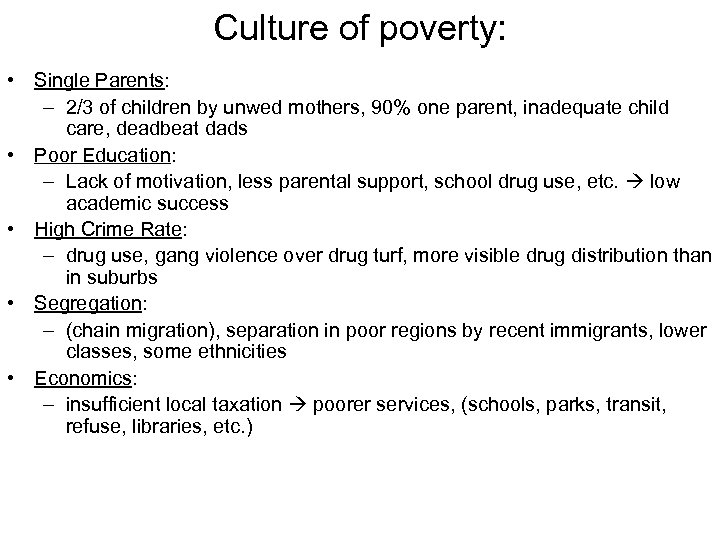
Culture of poverty: • Single Parents: – 2/3 of children by unwed mothers, 90% one parent, inadequate child care, deadbeat dads • Poor Education: – Lack of motivation, less parental support, school drug use, etc. low academic success • High Crime Rate: – drug use, gang violence over drug turf, more visible drug distribution than in suburbs • Segregation: – (chain migration), separation in poor regions by recent immigrants, lower classes, some ethnicities • Economics: – insufficient local taxation poorer services, (schools, parks, transit, refuse, libraries, etc. )
Partial Solutions: • Renovation (ex: urban renewal projects) – Problems – Benefits • Annexation – Problems – Benefits – (who wins, who loses? )
Suburbs • The Great American Dream (days gone by…) • (Alternatively, the Great Escape) – – – House Yard Garage Shopping Close Satellite workplace (Services and Industry)
Edge cities • Peripheral residences, gas station, & other services develop over time. – Established shopping centers and malls, – Then light manufacturing centers, • Often developed around nuclei of attraction. • These become edge cities. • Alternate explanation – (extension of central place theory) – original communities grow with increasing pop. density.
Density gradient • Change in density with distance • Once high, with CBD and nearby regions densely populated. • Decay and urban blight suburban flight, smaller cities farther out
Suburban Segregation by income… • Upper & middle class housing, separated, zone no apartments, min. acreage (more sale profit) • Jobs are often suburban, but the poor workforce is often urban. Need a transportation match for increased employment.
Suburban Sprawl • Progressive spread of development over the landscape. (Why? ) – Home ownership, lifestyle, Fed. auto subsidies, & • Costs: – Inefficient costly development, less farmland, less truck farming, patchwork development, higher utility costs, &. • Effects: – Increased dependence on transportation. – If inadequate, means, then less travel. – Lower class isolation.
Transportation • • • Loss of rail transit, partial recovery, 90% interstate automobile subsidies, ¼ of land transit and parking, congested Public transport: – Cheaper, less polluting, more energy efficient (if there are MANY commuters per bus). Separate rail services avoid delays of rush hour. – Under-funded in the US compared to the EU. – Arguably cheaper than building more roads. • Less pollution (tie to resources in previous chapters. )
Government Fragmentation: • Services in an urban area often cross multiple municipal boundaries, – e. g. transit, water, e-, schools. • Costs are higher, when handled separately, and confusion abounds. – Some cities cooperate, forming combined governments. – This leads to…
Inter-governmental Cooperation Approaches • Metropolitan Governments: coordination of service provision – Councils of Government: • cooperative agency with local government reps, often used for overall planning. – Federations: • two tiered structure, higher level control over taxation, assessment, and borrowing, local service responsibility – Consolidations: • City and county governments work together, sometimes formally separate, sometimes unified. – This cooperation also facilitates better growth strategies…
Smart Growth: • (Planning concept) • Legislation and regulation with limiting suburban sprawl, and preserving (open space, e. g. ) farmland – reduce infrastructure costs, • Encourages – Compact development, – Infill – possibly greenbelts – limits annexation / development outside the city limits – (other means and outcomes)

Questions? • (Pause, query, wait…)
(Time permitting) Tie back to: • • Population Migration Cultures Ethnicities Manufacturing Services Language Site and Situation
Tie back: Migration • Urban to suburban for quality of life, usually middle to upper middle class. • Near CBD: If poor transportation or high costs, migrate closer to work, prices permitting • Chain Migration ethnicity concentrations
Скачать презентацию Urbanization and City Patterns Chapter 10 and 11
9484f5ca06cfc5aee87c7f98f4b0dd84.ppt