 Скачать презентацию Urban Community Led Total Sanitation CLTS Case Study
fb8ae31dd4a3651a22987b1ea1e2f9f6.ppt
- Количество слайдов: 35



Urban Community Led Total Sanitation (CLTS) Case Study Kalyani Municipality Kolkata (India) By Dr. Shibani Goswami & Dr. Kasturi Bakshi
Kolkata Metropolis n n n 10 th most populous Metropolis in the world (12. 4 million) Highest population density in India Comprises of 3 Municipal Corporations with population of 5. 8 million & 38 Municipalities with population of 6. 6 million Has 55. 1% of the urban population of the state of West Bengal 33% of this urban population live in slums
KMA Slums n Total no. of slums 9000 n Total population of slums 4. 1 million n Deplorable environmental conditions n Poor sanitation is a major health hazard n DFID is funding for slum improvement since 1991 -92.
Kolkata Urban Services for the Poor (KUSP) n n KUSP is funded by DFID since 2003 -04 Total budget is Rs. 714. 77 million( US$ 17. 7 million) 30. 9% of total budget is for infrastructure improvement, with highest priority for household toilet construction Cost of each H/H toilet is Rs. 9900/- (US$ 236) provided free of cost to the slum dwellers
Urban Community Led Total Sanitation ? CLTS programme has been successful in rural areas of Maharashtra, Himachal Pradesh & Haryana in India n Concept of urban CLTS was conceived in late 2005 under KUSP n
Background of CLTS Pilot n n n Lack of community participation in accessing primary & public health care services amongst the urban slum communities observed Traditionally community depends on services delivered by Municipal Health Care system as passive recipient CLTS was the entry point to community Led Health Initiatives
Objectives Of CLTS Pilot Initiation of community driven health and sanitation improvement n Empowerment of local communities n Test out the model and approach of “Self Mobilisation” of urban slum community through facilitation (shift from the present mode of community “participation for material incentives/ subsidy” to more “interactive participation”) n
Why Kalyani Municipality? n n n Kalyani Municipality liked the idea of CLTS and offered to participate The Chairman of Kalyani Municipality showed political will to make Kalyani an Open Defecation Free (ODF) City The chief health officer of Kalyani Municipality showed keen interest in CLTS approach and coordinated and facilitated the implementation of the entire programme
Background of Kalyani Municipality & Slums One of the Municipalities out of 38 with population of 0. 1 million n Total 52 Slums in Kalyani Municipality having 10947 families n Many of the slums are existing for the last 40 -50 years n Most of the slum residents are migrants from neighboring states and refugees from Bangladesh n Livelihood is mostly daily wage laborer, vendors, hawkers, maid servants etc. n
What has been done over the past ten years, to improve sanitation profile of slum families before CLTS? n n n MDP sector built 700 toilets costing Rs. 5, 000/- each Refugee Rehabilitation Department built 3300 toilets costing about Rs. 8, 500 each KUSP built 365 toilets costing Rs. 9, 900/- each during year 2006 -07 More than 35 million Rupees (about US$ one million) spent for construction of H/H toilets for free Rampant open defecation was practised even by those who had own toilets
Experience with Subsidized Toilets n n n Low usage Facilities used for other purposes than the purpose for which it was built Poor maintenance Lack of ownership Subsidy cannot cover 100% population of all slums Total dependence on external subsidy
Process of CLTS Pilot in Kalyani Sensitised and exposed the stakeholders like: Elected Municipal Councillors and all departmental heads of the municipality n Local NGOs and CBOs n Health Workers n Community people including local community leaders n
Sensitisation of Councillors & Dept. Heads of Municipality It was made clear that n n Increasing the number of toilets only was not the goal Goal was to create ODF environment It was behavioral change, and not the model of toilet which was important to achieve this goal. Community Led Total Sanitation is the approach which totally eliminates open defecation.
Sensitization of Local NGO, CBO & Health Workers on n Goal of CLTS was explained in seminars and workshops n Hands-on training on CLTS were arranged with slum communities n Post triggering follow-up ensured in CLTS t slums n Developed field facilitators
Methodology Used in Slum Community n n n A total Participatory approach adopted where PRA tools were used extensively Facilitated community sanitation profile appraisal & analysis through: - Transect walk - Defecation area mapping - Fecal oral contamination analysis - Feces calculation - Calculation of H/H medical expenses ‘Handing over the stick’ at the ignition of moment by facilitators No outsider advised to construct toilets or lectured on the problems of Open Defecation or model of appropriate toilet models It was made clear that there was no subsidy of any kind Participatory Planning was facilitated
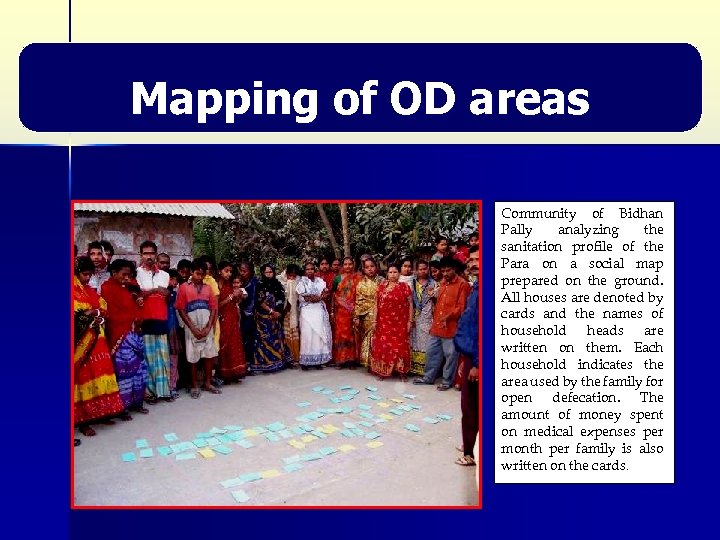
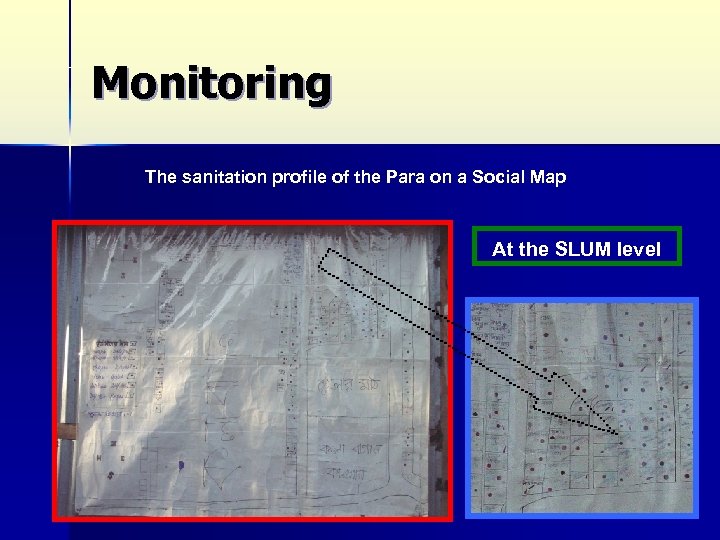
Mapping of OD areas Community of Bidhan Pally analyzing the sanitation profile of the Para on a social map prepared on the ground. All houses are denoted by cards and the names of household heads are written on them. Each household indicates the area used by the family for open defecation. The amount of money spent on medical expenses per month per family is also written on the cards.
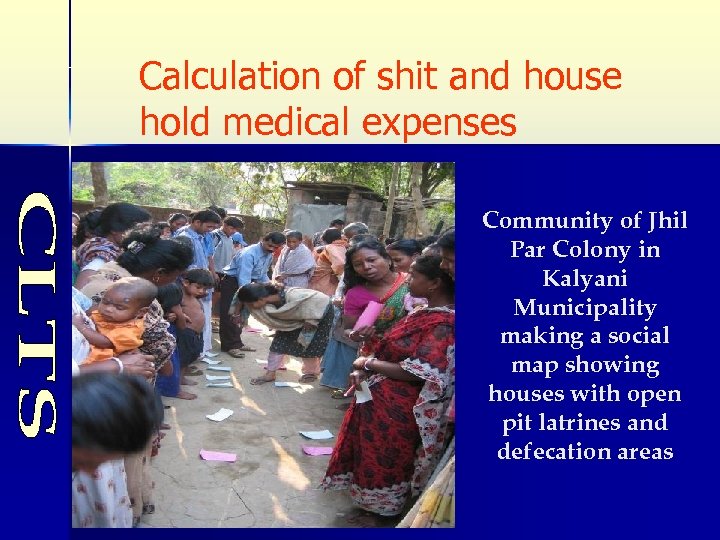
Calculation of shit and house hold medical expenses Community of Jhil Par Colony in Kalyani Municipality making a social map showing houses with open pit latrines and defecation areas
How it was possible to clean up entire Kalyani using CLTS ? Dr. Kasturi Bakshi Chief Health Officer Kalyani Municipality
Policy Decision by Board of Councillors Unanimous decision taken n n To stop subsidy for construction of toilets To give full support to CLTS Pilot in 5 slums To give support to the communities who stop open defecation totally 5 most backward slums were selected for piloting
What Community People didn’t know? Community people were fully aware of the ill effects of open defecation but they did not know n The concept of sanitary toilet n Sanitary toilets can be constructed at an affordable cost by all n Medical expenditure will only be reduced if everybody uses sanitary toilet
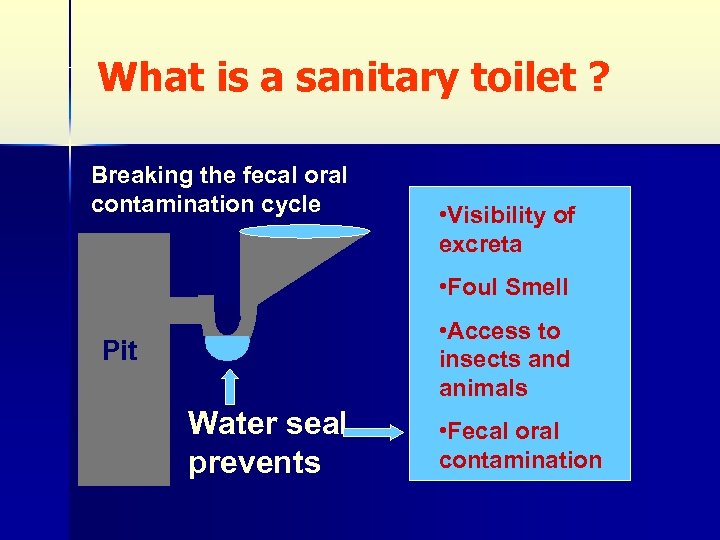
What is a sanitary toilet ? Breaking the fecal oral contamination cycle • Visibility of excreta • Foul Smell • Access to insects and animals Pit Water seal prevents • Fecal oral contamination
Progress of CLTS n n n First Triggering was done in Bhutta Bazar and it failed due to high expectation for subsidy which was provided in the neighbouring slum Simultaneously triggering was done in 4 other slums CLTS clicked in all these 4 slums as there was no expectation for outside subsidy Bhuttabazar also became ODF but took longer time than others All 5 slums eliminated open defecation in 6 months Good number of Natural Leaders emerged
Example of Vidyasagar Colony n n n In Vidyasagar Colony, number of toilets increased from initial 9 to 213 in 6 months without subsidy Platform of 69 hand tube wells repaired and plastered with cement by community themselves. Many years old clogged drain cleaned up by the community
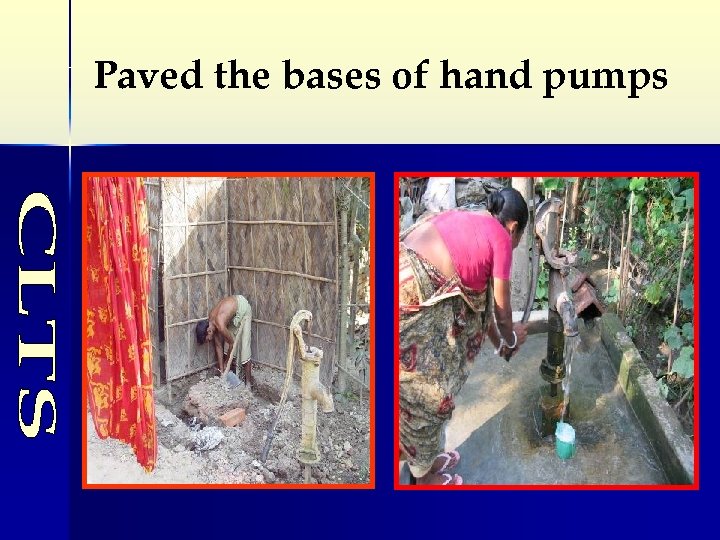
Paved the bases of hand pumps
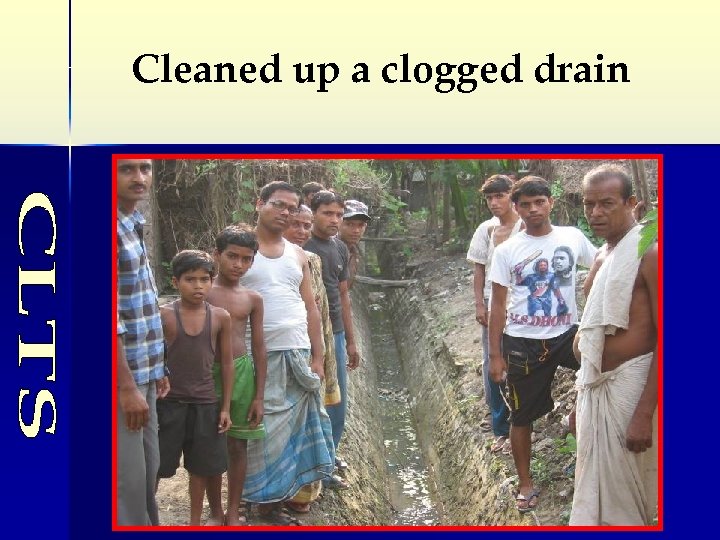
Cleaned up a clogged drain
Community Action n n Community took collective action locally towards making their environment ODF The poorest also joined in making the slum ODF Established mechanism for monitoring of progress of CLTS Started non-formal / adult education on their own after achieving ODF status Empowered community banned sale of country liquor in the slums
Monitoring of performance of Ward Councillors Coloured cards (Green, Yellow & Red) for each Councillors with their photo were used to show the sanitation status of their respective wards n Green – At least one ODF slum n Yellow – No ODF slum but collective community action started in the slums n Red – Nothing has been done
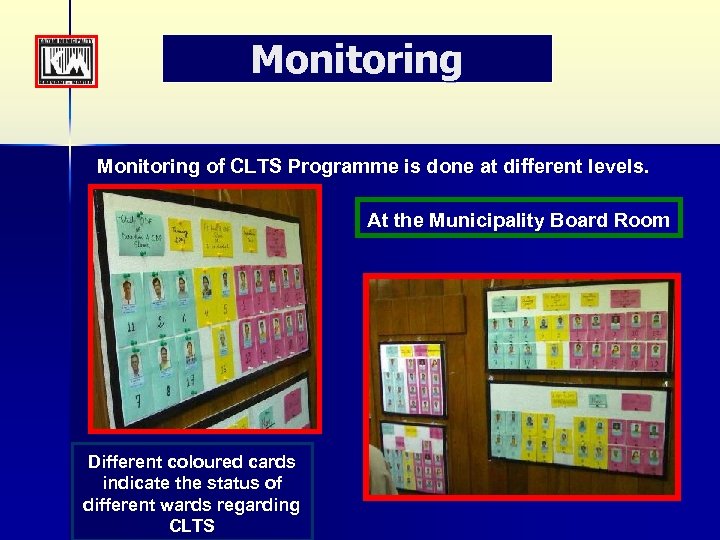
Monitoring of CLTS Programme is done at different levels. At the Municipality Board Room Different coloured cards indicate the status of different wards regarding CLTS
Monitoring The sanitation profile of the Para on a Social Map At the SLUM level
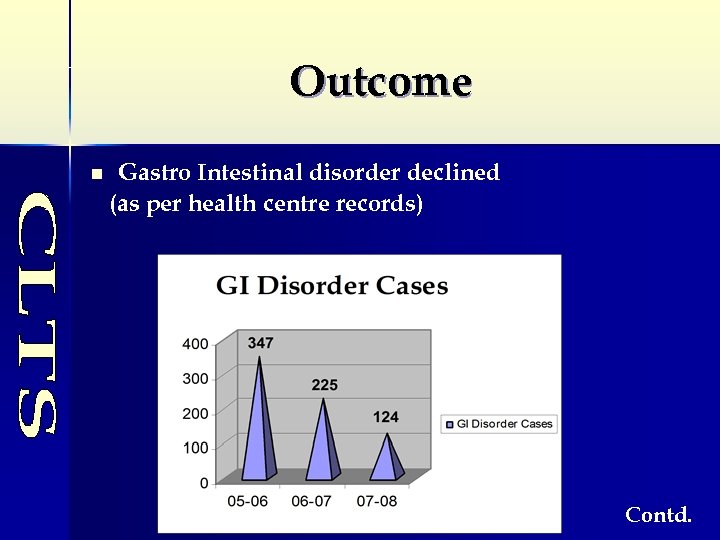
Outcome n Gastro Intestinal disorder declined (as per health centre records) Contd.
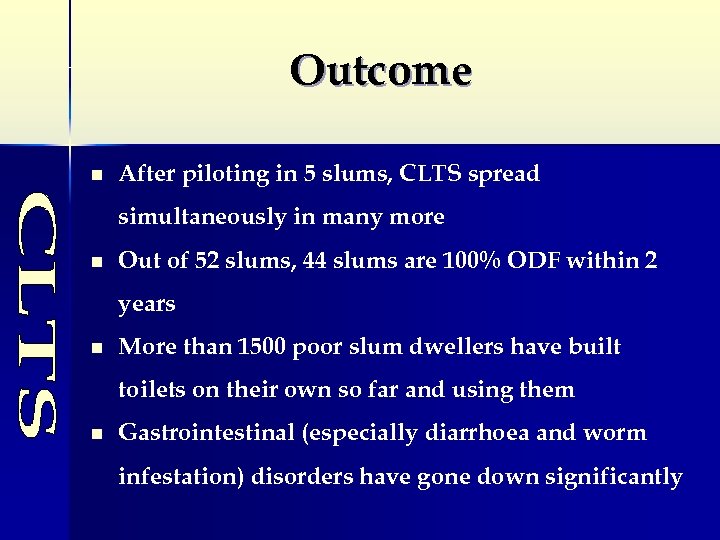
Outcome n After piloting in 5 slums, CLTS spread simultaneously in many more n Out of 52 slums, 44 slums are 100% ODF within 2 years n More than 1500 poor slum dwellers have built toilets on their own so far and using them n Gastrointestinal (especially diarrhoea and worm infestation) disorders have gone down significantly
Challenges at Policy Level n n Subsidy and associated local politics are the hurdles of community self mobilisation Political will of Municipality Leadership & attitude of Councillors Mind-set of technical people & philanthropic attitude of “doing for the poor” Non-flexibility of hardware design, project log frame & expenditure as approved by the Donors
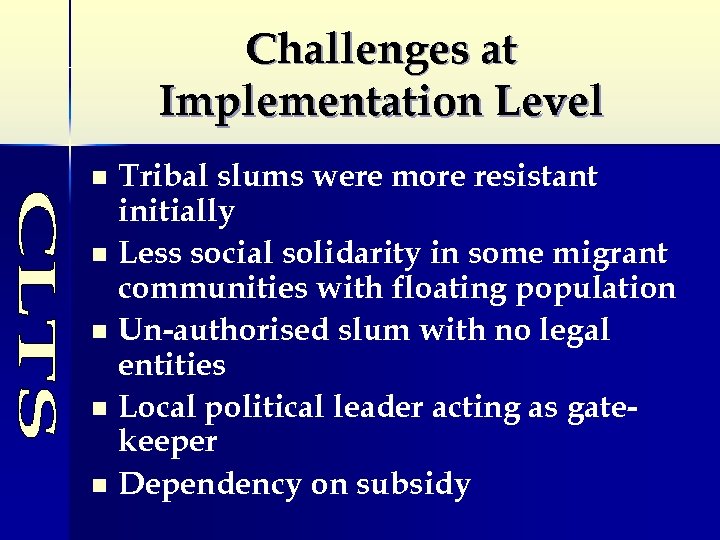
Challenges at Implementation Level Tribal slums were more resistant initially n Less social solidarity in some migrant communities with floating population n Un-authorised slum with no legal entities n Local political leader acting as gatekeeper n Dependency on subsidy n
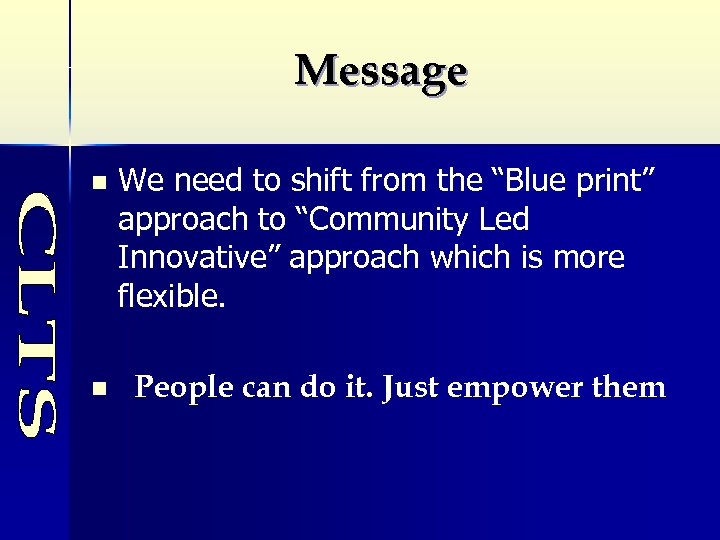
Message n n We need to shift from the “Blue print” approach to “Community Led Innovative” approach which is more flexible. People can do it. Just empower them

THANK YOU
Скачать презентацию Urban Community Led Total Sanitation CLTS Case Study
fb8ae31dd4a3651a22987b1ea1e2f9f6.ppt