


 Скачать презентацию Upgrade of the ATLAS Level-1 Muon trigger for
8e923110a912bae3ce0445fdf82096be.ppt
- Количество слайдов: 32
 Upgrade of the ATLAS Level-1 Muon trigger for Phase II R. Richter Max-Planck-Institute für Physik, München 3/15/2018 Upgrade of the L 1 Muon Trigger for phase II Robert Richter 1
 Why is the present L 1 -trigger of the ATLAS muon spectrometer insufficient for luminosities > 1034 cm-2 s-1 ? 3/15/2018 Upgrade of the L 1 Muon Trigger for phase II Robert Richter 2
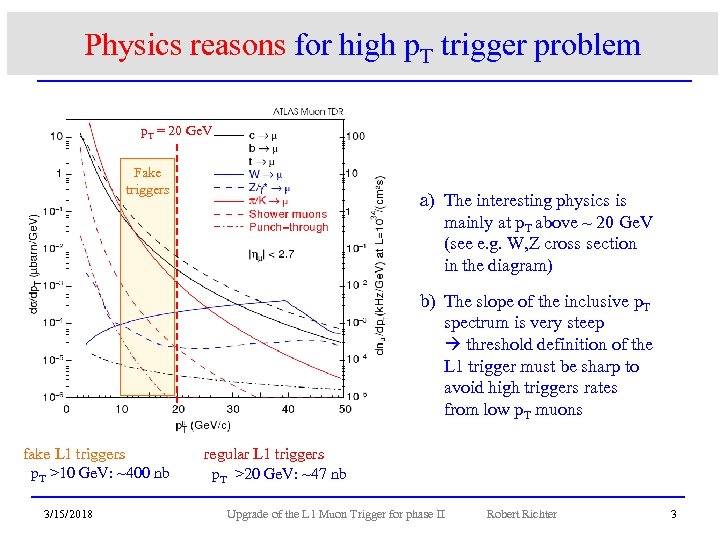 Physics reasons for high p. T trigger problem p. T = 20 Ge. V Fake triggers a) The interesting physics is mainly at p. T above ~ 20 Ge. V (see e. g. W, Z cross section in the diagram) b) The slope of the inclusive p. T spectrum is very steep threshold definition of the L 1 trigger must be sharp to avoid high triggers rates from low p. T muons fake L 1 triggers p. T >10 Ge. V: ~400 nb 3/15/2018 regular L 1 triggers p. T >20 Ge. V: ~47 nb Upgrade of the L 1 Muon Trigger for phase II Robert Richter 3
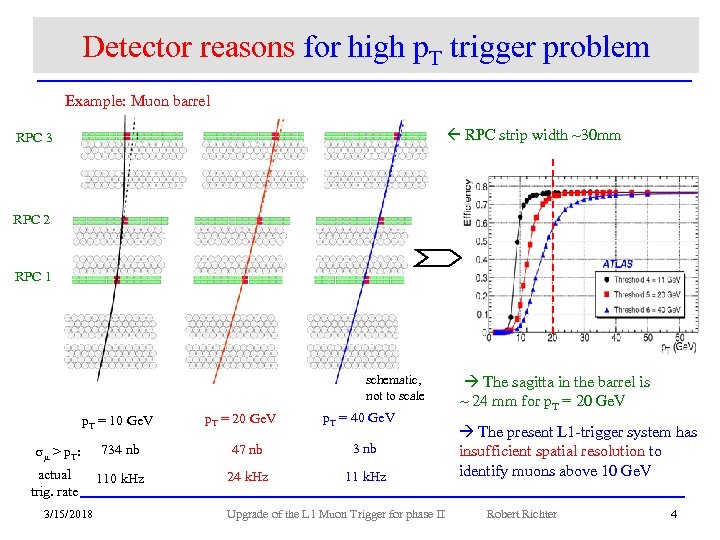 Detector reasons for high p. T trigger problem Example: Muon barrel RPC strip width ~30 mm RPC 3 RPC 2 RPC 1 schematic, not to scale p. T = 10 Ge. V p. T = 20 Ge. V p. T = 40 Ge. V sm > p. T: 734 nb 47 nb 3 nb actual trig. rate 110 k. Hz 24 k. Hz 11 k. Hz 3/15/2018 The sagitta in the barrel is ~ 24 mm for p. T = 20 Ge. V The present L 1 -trigger system has insufficient spatial resolution to identify muons above 10 Ge. V Upgrade of the L 1 Muon Trigger for phase II Robert Richter 4
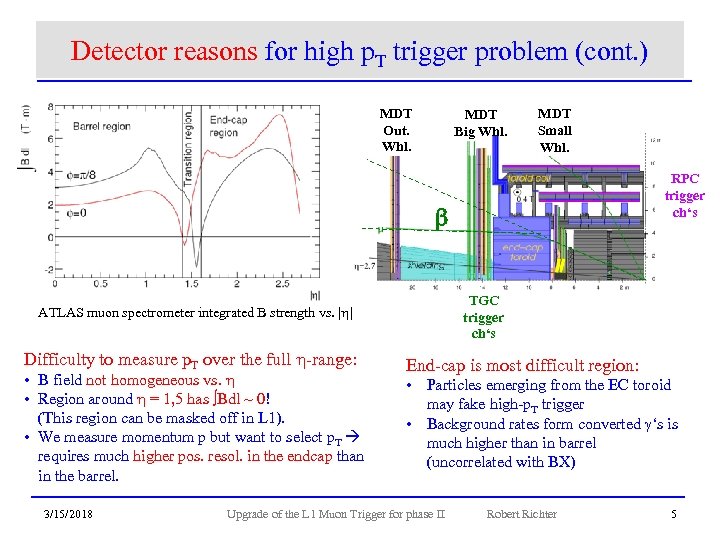 Detector reasons for high p. T trigger problem (cont. ) MDT Out. Whl. MDT Big Whl. MDT Small Whl. RPC trigger ch‘s b CSC note ATLAS muon spectrometer integrated B strength vs. |h| Difficulty to measure p. T over the full h-range: • B field not homogeneous vs. h • Region around h = 1, 5 has òBdl ~ 0! (This region can be masked off in L 1). • We measure momentum p but want to select p. T requires much higher pos. resol. in the endcap than in the barrel. 3/15/2018 TGC trigger ch‘s End-cap is most difficult region: • Particles emerging from the EC toroid may fake high-p. T trigger • Background rates form converted g‘s is much higher than in barrel (uncorrelated with BX) Upgrade of the L 1 Muon Trigger for phase II Robert Richter 5
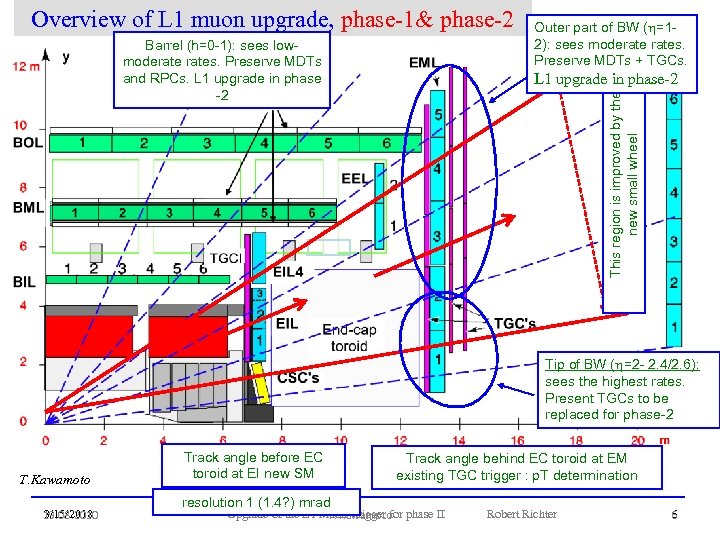 Overview of L 1 muon upgrade, phase-1& phase-2 L 1 upgrade in phase-2 This region is improved by the new small wheel Barrel (h=0 -1): sees lowmoderates. Preserve MDTs and RPCs. L 1 upgrade in phase -2 Outer part of BW (h=12): sees moderates. Preserve MDTs + TGCs. Tip of BW (h=2 - 2. 4/2. 6): sees the highest rates. Present TGCs to be replaced for phase-2 T. Kawamoto 3/15/2018 19. 08. 2010 Track angle before EC toroid at EI new SM resolution 1 (1. 4? ) mrad Track angle behind EC toroid at EM existing TGC trigger : p. T determination Upgrade of the L 1 Muon Trigger for phase II Robert Richter T. Kawamoto 6
 Technical limitations of the present L 1 -trigger • The transverse momentum resolution of the trigger chambers in barrel and end-cap was designed to just match the allowed L 1 muon rate of ~ 20 k. Hz (out of the total 100 k. Hz). Was the result of an optimisation of many parameters, including channel count. • Barrel: RPCs have 30 mm wide pick-up strips s ~ 10 mm in the bending direction. Insufficient for p. T > 20 Ge. V. • End-cap: § TGC wires are spaced 1, 8 mm, but are grouped by 6 – 31 wires along h, corresponding to a spatial resol. of 10. 8 – 55. 8 mm. § No tracking information from the Small Wheel (in front of the EC toroid) goes presently into L 1. No selection of tracks from IP vertex (only a flag per sector may be used to avoid curling tracks emerging from the toroid). • Historical reason: no notion of lumi-upgrade beyond 1034 cm-2 s-1 back in 1995! 3/15/2018 Upgrade of the L 1 Muon Trigger for phase II Robert Richter 7
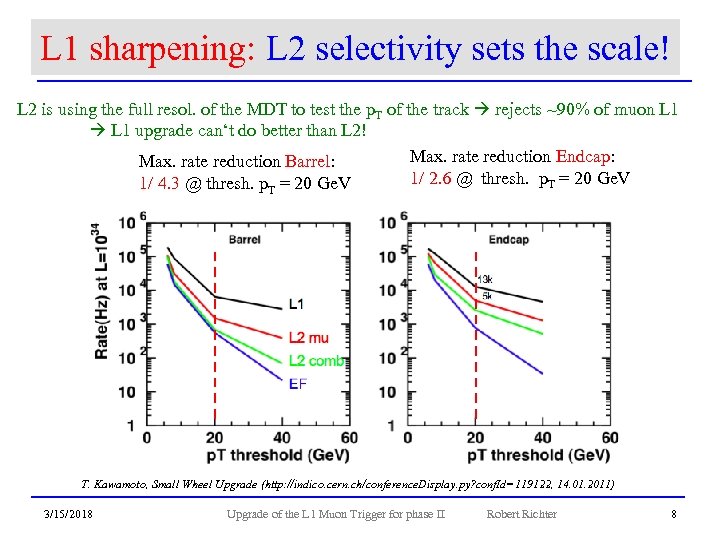 L 1 sharpening: L 2 selectivity sets the scale! L 2 is using the full resol. of the MDT to test the p. T of the track rejects ~90% of muon L 1 upgrade can‘t do better than L 2! Max. rate reduction Endcap: Max. rate reduction Barrel: 1/ 2. 6 @ thresh. p. T = 20 Ge. V 1/ 4. 3 @ thresh. p. T = 20 Ge. V T. Kawamoto, Small Wheel Upgrade (http: //indico. cern. ch/conference. Display. py? conf. Id=119122, 14. 01. 2011) 3/15/2018 Upgrade of the L 1 Muon Trigger for phase II Robert Richter 8
 Q: how to get better L 1 -selectivity for phase-1? Detailed discussion of phase-1 options given in the presentation by Osamu Sasaki • Sharpen the L 1 in the end-cap by determining the slope of the track in front of the toroid (h-range 1 – 2, 7) § The track must point to the IP vertex. This discards muons from p, K decays and other background sources. Also corrects for the effects of multiple scattering. § All proposed L 1 upgrade concepts for phase-1 require an extension of the current L 1 latency of 2, 5 ms to 3, 2 ms. This requires the upgrade of the LAr and Tile R/O electronics! § Upgrade concepts for phase-1 must interface with phase-2 upgrade § For phase-2 we assume a L 1 latency of 6, 4 ms 3/15/2018 Upgrade of the L 1 Muon Trigger for phase II Robert Richter 9
 Q: how to get better selectivity for phase-2? • Aim: improve L 1 trigger sharpness over the full h-range • Save time and cost: get the maximum out of the existing h/w. § Use the high accuracy track position measurement in the MDT for L 1 sharpening § However: • Present MDT R/O is serial and asychronous with BX (asynchroneous = time of availibility of data has no correlation with time of particle passage) not suited for fast L 1 decisions need a concept for fast MDT readout 3/15/2018 Upgrade of the L 1 Muon Trigger for phase II Robert Richter 10
 Include MDT info in L 1: design concepts • Concept for fast MDT readout : • § Reduce drift time accuracy to BX frequency (25 ns LSB error on drift time corresponds to 0, 5 mm pos. error = 0, 15 mm RMS! good enough) § Parallel R/O of drift tubes by individual scalers (one scaler per tube) data available at the same time § Synchronicity of R/O with BX: fixed time correlation with particle passage yields absolute drift time! 2 options for fast readout: § Use information from the trigger chambers to define Ro. I („tagged method“): • only act when high-p. T trigger candidate („L 0“) was found by trigger ch‘s much reduced rate of data transfer • use „Ro. I“ defined by trigger ch‘s to selectively read the confined region, where the candidate track crosses the MDT save data volume to be transferred ignore hits from g-conversions outside Ro. I! • requires about 2 ms extra latency, i. e. 4, 5 ms total L 1 latency not suited for phase-1 § Stand alone track finding in MDT chambers („un-tagged method“): • transfer the complete hit pattern of the MDT tubes to USA 15 for each BX and look for track candidates in the hit pattern. 3/15/2018 Upgrade of the L 1 Muon Trigger for phase II Robert Richter 11
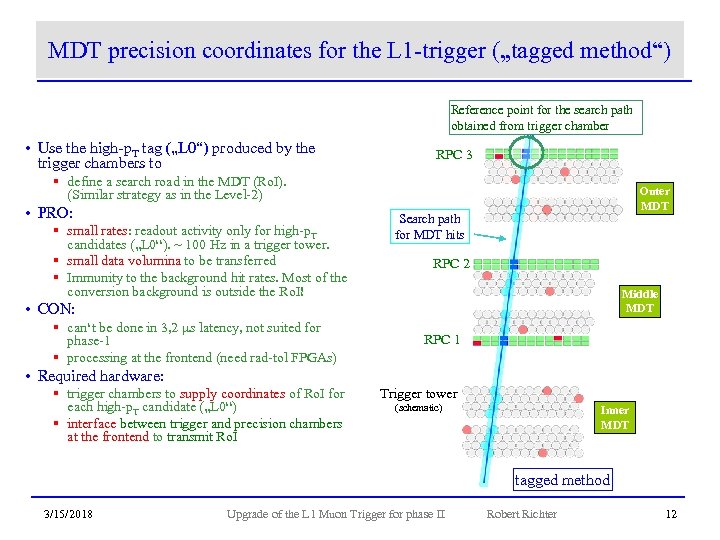 MDT precision coordinates for the L 1 -trigger („tagged method“) Reference point for the search path obtained from trigger chamber • Use the high-p. T tag („L 0“) produced by the trigger chambers to RPC 3 § define a search road in the MDT (Ro. I). (Similar strategy as in the Level-2) • PRO: § small rates: readout activity only for high-p. T candidates („L 0“). ~ 100 Hz in a trigger tower. § small data volumina to be transferred § Immunity to the background hit rates. Most of the conversion background is outside the Ro. I! Outer MDT Search path for MDT hits RPC 2 Middle MDT • CON: § can‘t be done in 3, 2 ms latency, not suited for phase-1 § processing at the frontend (need rad-tol FPGAs) RPC 1 • Required hardware: § trigger chambers to supply coordinates of Ro. I for each high-p. T candidate („L 0“) § interface between trigger and precision chambers at the frontend to transmit Ro. I Trigger tower (schematic) Inner MDT tagged method 3/15/2018 Upgrade of the L 1 Muon Trigger for phase II Robert Richter 12
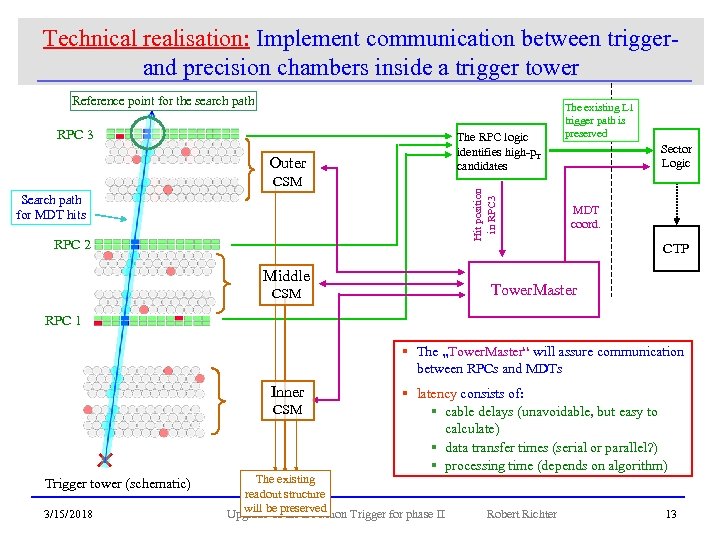 Technical realisation: Implement communication between trigger- and precision chambers inside a trigger tower Reference point for the search path Outer CSM Search path for MDT hits RPC 2 The RPC logic identifies high-p. T candidates Hit position in RPC 3 The existing L 1 trigger path is preserved Sector Logic MDT coord. CTP Middle CSM Tower. Master RPC 1 § The „Tower. Master“ will assure communication between RPCs and MDTs Inner CSM Trigger tower (schematic) 3/15/2018 § latency consists of: § cable delays (unavoidable, but easy to calculate) § data transfer times (serial or parallel? ) § processing time (depends on algorithm) The existing readout structure will be preserved Upgrade of the L 1 Muon Trigger for phase II Robert Richter 13
 MDT precision coordinates for the L 1 -trigger („un-tagged method“) • In the EC region of the detector high-p. T tracks coming from the IP will impinge under well-defined angles onto the MDT. § § § • PRO: § § § • Look for all patterns of drift times in the MDT, matching this projection angle The resolution of the drift time is 25 ns LSB = 0, 15 mm RMS Combine with TGC L 1 -trigger the sector logic (USA 15) No need for frontend communication Latency comes down to 2, 6 ms if faster precision chambers are used (e. g. Small Tube MDTs with only 200 ns drift time. ) Processing done in the radiation-safe USA 15 (only parallel-to-serial conversion and fiber drivers at the frontend). CON: § § Large bandwidth requirements, as the MDT hit pattern is transferred to USA 15 for each BX large number of fibers (e. g. 1 per mezzanine card) Angle of incoming track must be known most useful in the Small Wheel See O. Sasaki, MDT based L 1 (http: //indico. cern. ch/conference. Display. py? conf. Id=105234, 29. 09. 2010) 3/15/2018 Upgrade of the L 1 Muon Trigger for phase II Robert Richter 14
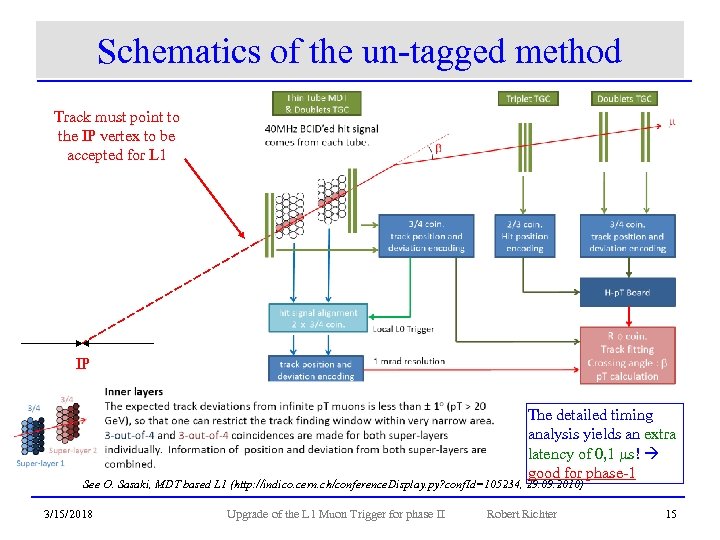 Schematics of the un-tagged method Track must point to the IP vertex to be accepted for L 1 IP The detailed timing analysis yields an extra latency of 0, 1 ms! good for phase-1 See O. Sasaki, MDT based L 1 (http: //indico. cern. ch/conference. Display. py? conf. Id=105234, 29. 09. 2010) 3/15/2018 Upgrade of the L 1 Muon Trigger for phase II Robert Richter 15
 Proposal of Precision TGC for the NEW Small Wheel and for the innermost part of the Big Wheel • • • Many details described in O. Sasaki‘s talk w. r. t. the use in the Small Wheel This technology is also relevant in phase-2 for regions of high track density Preformance aim: better spatial resolution and higher rate performance § Strips along h-coordinate with e. g. 3, 4 mm spacing and charge interpolation (using timeover-threshold) can obtain spatial resolution of 70 mm per layer and 0, 14 mrad angular resolution (lever arm = 350 mm) *) • PRO: § § • Excellent position resolution Excellent time resolution 95% in 1 BX high immunity to conversion background High rate capability due to low-resistive cathode coating was demonstrated Cathode layers with pads can be used to resolve ambiguities CON: § Resources needed for production of new chambers AND new electronics can‘t be done for the large areas of the Big Wheel *) see G. Mikenberg 3/15/2018 „TGC test beam results“ ( http: //indico. cern. ch/conference. Display. py? conf. Id=62717 , 15 July 2009 ) Upgrade of the L 1 Muon Trigger for phase II Robert Richter 16
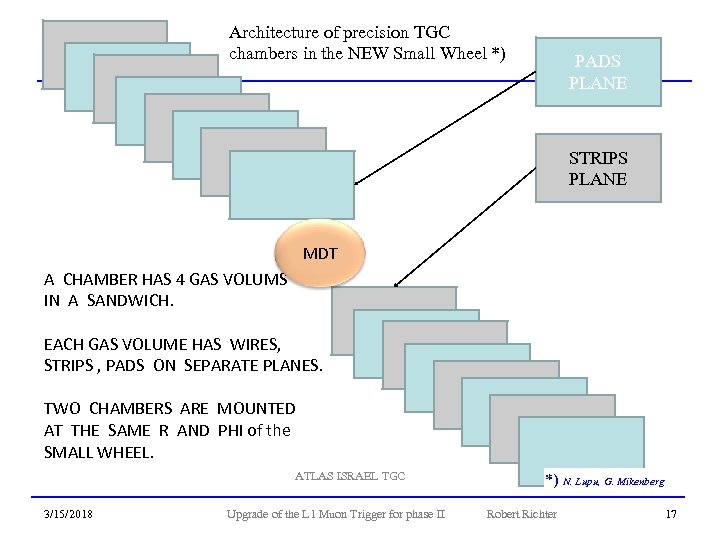 Architecture of precision TGC ARCHITECTURE of TGC CHAMBER chambers in the NEW Small Wheel *) PADS PLANE STRIPS PLANE MDT A CHAMBER HAS 4 GAS VOLUMS IN A SANDWICH. EACH GAS VOLUME HAS WIRES, STRIPS , PADS ON SEPARATE PLANES. TWO CHAMBERS ARE MOUNTED AT THE SAME R AND PHI of the SMALL WHEEL. ATLAS ISRAEL TGC 3/15/2018 *) N. Lupu, G. Mikenberg Upgrade of the L 1 Muon Trigger for phase II Robert Richter 17
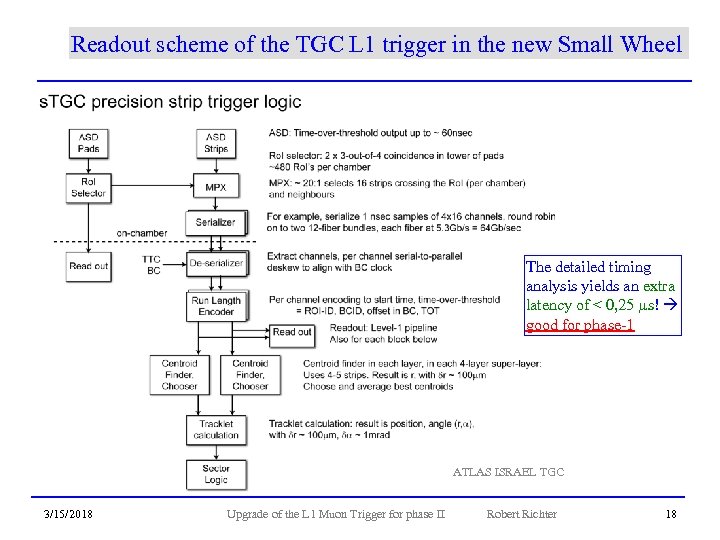 Readout scheme of the TGC L 1 trigger in the new Small Wheel The detailed timing analysis yields an extra latency of < 0, 25 ms! good for phase-1 ATLAS ISRAEL TGC 3/15/2018 Upgrade of the L 1 Muon Trigger for phase II Robert Richter 18
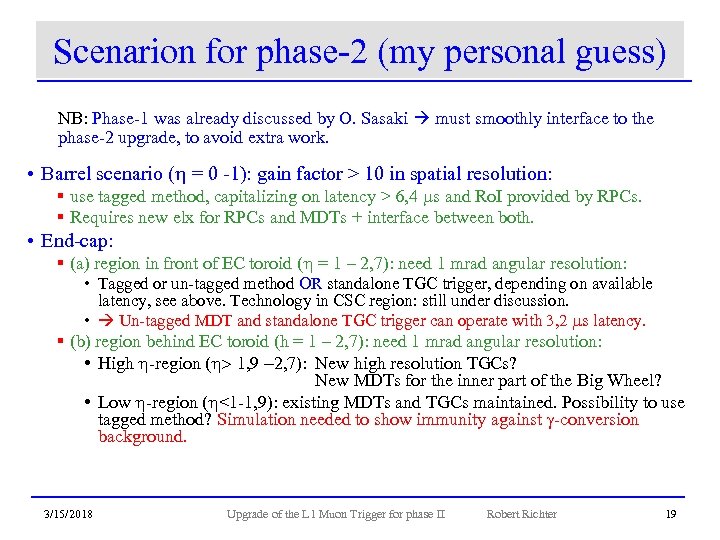 Scenarion for phase-2 (my personal guess) NB: Phase-1 was already discussed by O. Sasaki must smoothly interface to the phase-2 upgrade, to avoid extra work. • Barrel scenario (h = 0 -1): gain factor > 10 in spatial resolution: § use tagged method, capitalizing on latency > 6, 4 ms and Ro. I provided by RPCs. § Requires new elx for RPCs and MDTs + interface between both. • End-cap: § (a) region in front of EC toroid (h = 1 – 2, 7): need 1 mrad angular resolution: • Tagged or un-tagged method OR standalone TGC trigger, depending on available latency, see above. Technology in CSC region: still under discussion. • Un-tagged MDT and standalone TGC trigger can operate with 3, 2 ms latency. § (b) region behind EC toroid (h = 1 – 2, 7): need 1 mrad angular resolution: • High h-region (h> 1, 9 -2, 7): New high resolution TGCs? New MDTs for the inner part of the Big Wheel? • Low h-region (h<1 -1, 9): existing MDTs and TGCs maintained. Possibility to use tagged method? Simulation needed to show immunity against g-conversion background. 3/15/2018 Upgrade of the L 1 Muon Trigger for phase II Robert Richter 19
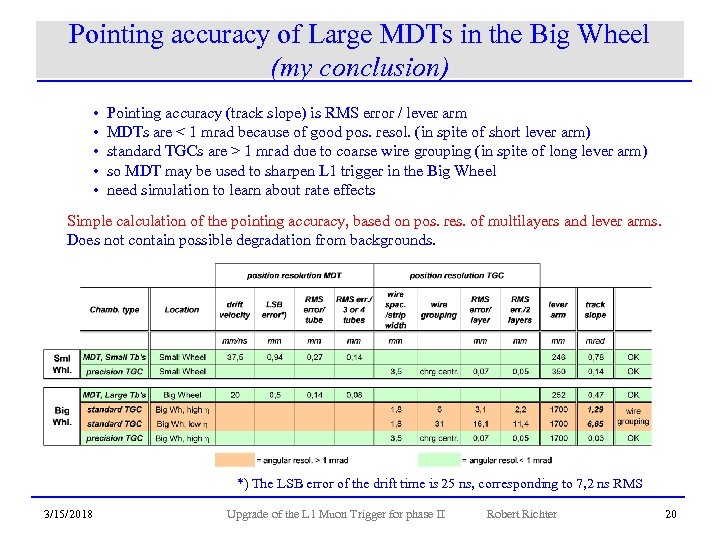 Pointing accuracy of Large MDTs in the Big Wheel (my conclusion) • • • Pointing accuracy (track slope) is RMS error / lever arm MDTs are < 1 mrad because of good pos. resol. (in spite of short lever arm) standard TGCs are > 1 mrad due to coarse wire grouping (in spite of long lever arm) so MDT may be used to sharpen L 1 trigger in the Big Wheel need simulation to learn about rate effects Simple calculation of the pointing accuracy, based on pos. res. of multilayers and lever arms. Does not contain possible degradation from backgrounds. *) The LSB error of the drift time is 25 ns, corresponding to 7, 2 ns RMS 3/15/2018 Upgrade of the L 1 Muon Trigger for phase II Robert Richter 20
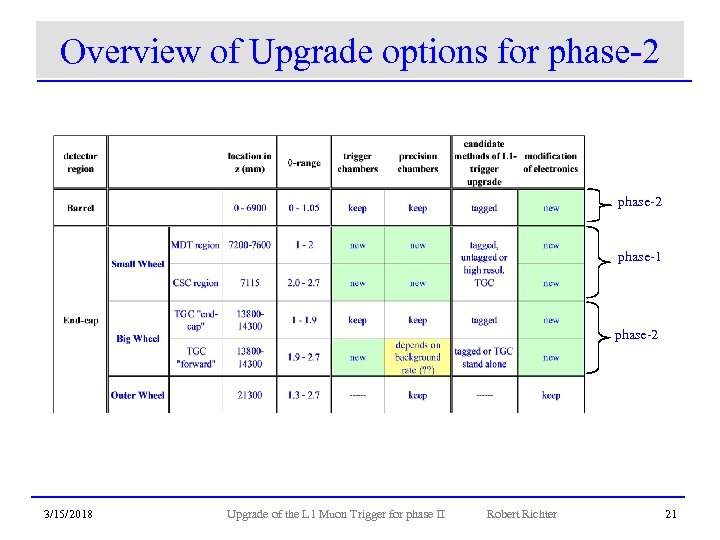 Overview of Upgrade options for phase-2 phase-1 phase-2 3/15/2018 Upgrade of the L 1 Muon Trigger for phase II Robert Richter 21
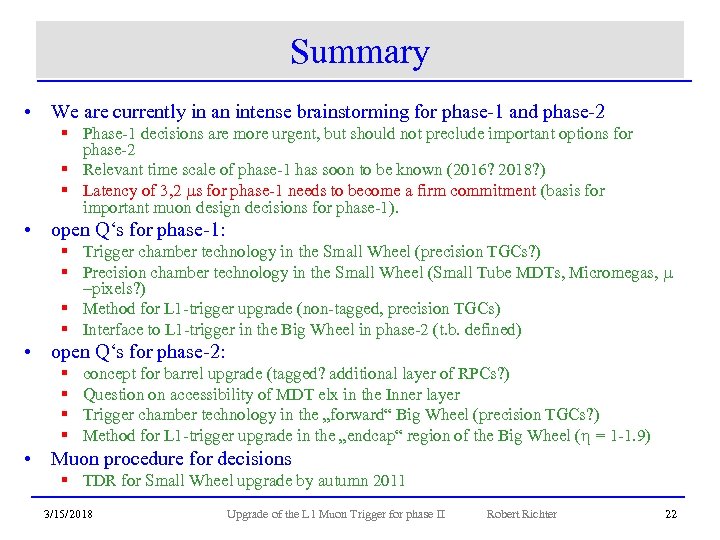 Summary • We are currently in an intense brainstorming for phase-1 and phase-2 § Phase-1 decisions are more urgent, but should not preclude important options for phase-2 § Relevant time scale of phase-1 has soon to be known (2016? 2018? ) § Latency of 3, 2 ms for phase-1 needs to become a firm commitment (basis for important muon design decisions for phase-1). • open Q‘s for phase-1: § Trigger chamber technology in the Small Wheel (precision TGCs? ) § Precision chamber technology in the Small Wheel (Small Tube MDTs, Micromegas, m -pixels? ) § Method for L 1 -trigger upgrade (non-tagged, precision TGCs) § Interface to L 1 -trigger in the Big Wheel in phase-2 (t. b. defined) • open Q‘s for phase-2: § § concept for barrel upgrade (tagged? additional layer of RPCs? ) Question on accessibility of MDT elx in the Inner layer Trigger chamber technology in the „forward“ Big Wheel (precision TGCs? ) Method for L 1 -trigger upgrade in the „endcap“ region of the Big Wheel (h = 1 -1. 9) • Muon procedure for decisions § TDR for Small Wheel upgrade by autumn 2011 3/15/2018 Upgrade of the L 1 Muon Trigger for phase II Robert Richter 22
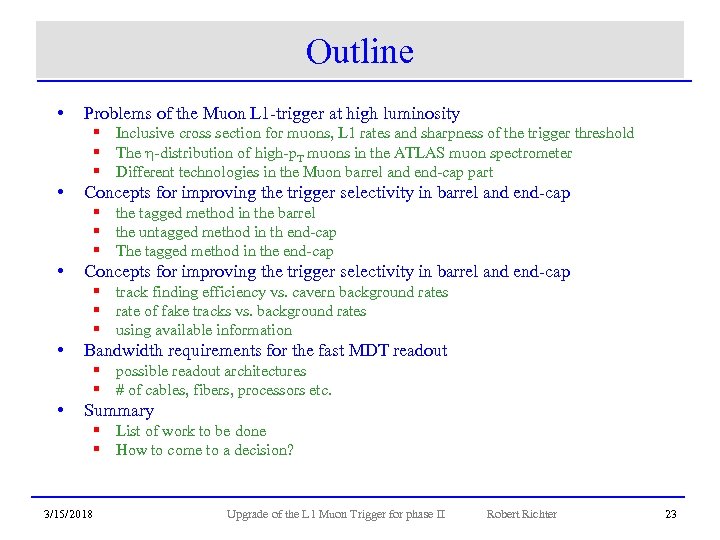 Outline • Problems of the Muon L 1 -trigger at high luminosity § Inclusive cross section for muons, L 1 rates and sharpness of the trigger threshold § The h-distribution of high-p. T muons in the ATLAS muon spectrometer § Different technologies in the Muon barrel and end-cap part • Concepts for improving the trigger selectivity in barrel and end-cap § the tagged method in the barrel § the untagged method in th end-cap § The tagged method in the end-cap • Concepts for improving the trigger selectivity in barrel and end-cap § track finding efficiency vs. cavern background rates § rate of fake tracks vs. background rates § using available information • Bandwidth requirements for the fast MDT readout § possible readout architectures § # of cables, fibers, processors etc. • Summary § List of work to be done § How to come to a decision? 3/15/2018 Upgrade of the L 1 Muon Trigger for phase II Robert Richter 23
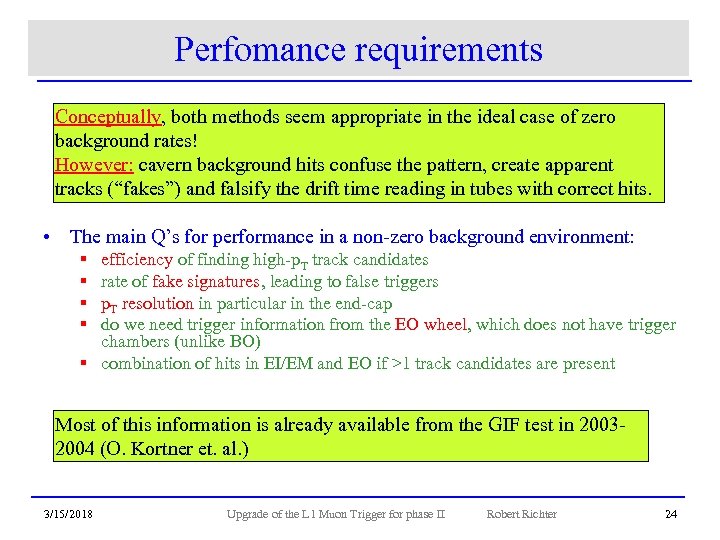 Perfomance requirements Conceptually, both methods seem appropriate in the ideal case of zero background rates! However: cavern background hits confuse the pattern, create apparent tracks (“fakes”) and falsify the drift time reading in tubes with correct hits. • The main Q’s for performance in a non-zero background environment: § § efficiency of finding high-p. T track candidates rate of fake signatures, leading to false triggers p. T resolution in particular in the end-cap do we need trigger information from the EO wheel, which does not have trigger chambers (unlike BO) § combination of hits in EI/EM and EO if >1 track candidates are present Most of this information is already available from the GIF test in 20032004 (O. Kortner et. al. ) 3/15/2018 Upgrade of the L 1 Muon Trigger for phase II Robert Richter 24
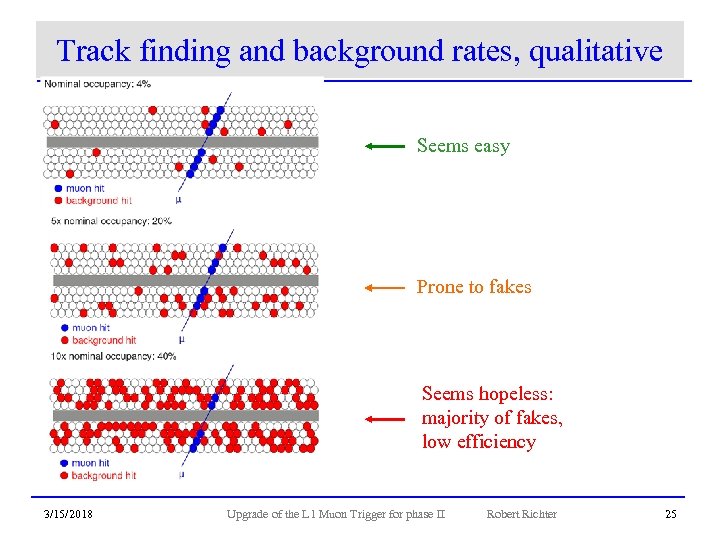 Track finding and background rates, qualitative Seems easy Prone to fakes Seems hopeless: majority of fakes, low efficiency 3/15/2018 Upgrade of the L 1 Muon Trigger for phase II Robert Richter 25
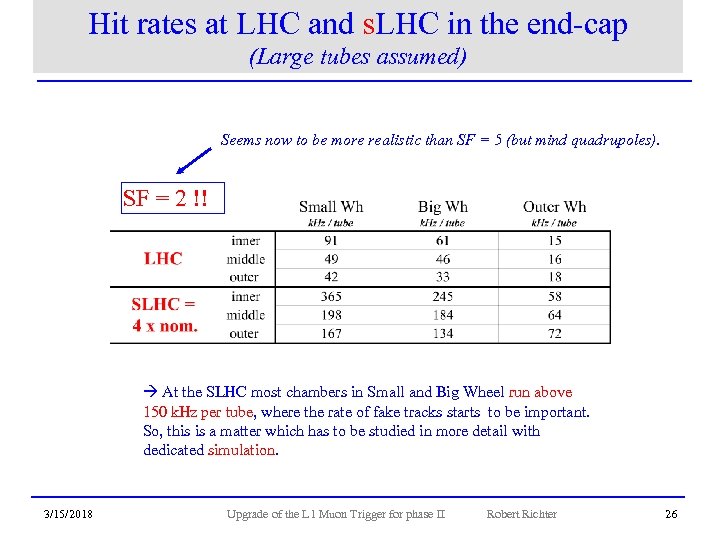 Hit rates at LHC and s. LHC in the end-cap (Large tubes assumed) Seems now to be more realistic than SF = 5 (but mind quadrupoles). SF = 2 !! At the SLHC most chambers in Small and Big Wheel run above 150 k. Hz per tube, where the rate of fake tracks starts to be important. So, this is a matter which has to be studied in more detail with dedicated simulation. 3/15/2018 Upgrade of the L 1 Muon Trigger for phase II Robert Richter 26
 Prelim. conclusion on sensitivity on background rates (up for discussion) • Both methods, tagged and untagged suffer from background hit rates, however § the tagged method receives info on the BX when the candidate track was passing the detector can compute absolute drift times, i. e. absolute hit positions (except left-right ambiguity) § the tagged method profits from the Ro. I delivered by the trigger chambers, thus being less exposed to false assignments („fakes“), only looking at a small fraction of the total data sample needs much reduced readout BW 3/15/2018 Upgrade of the L 1 Muon Trigger for phase II Robert Richter 27
 Spares 3/15/2018 Upgrade of the L 1 Muon Trigger for phase II Robert Richter 28
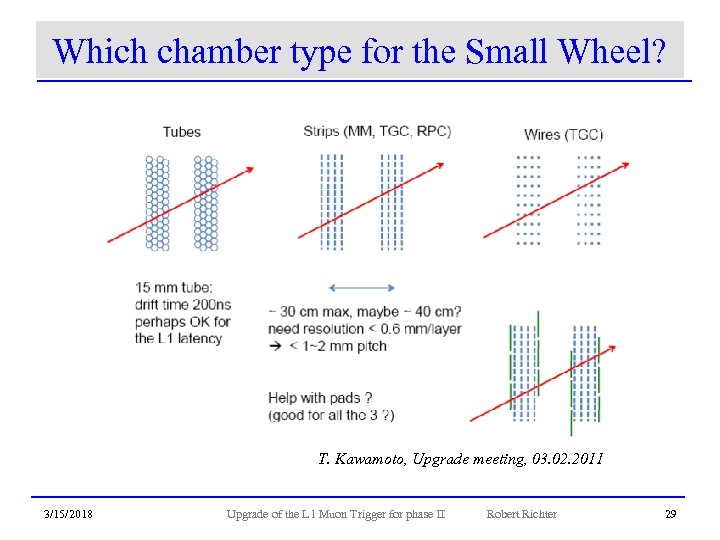 Which chamber type for the Small Wheel? T. Kawamoto, Upgrade meeting, 03. 02. 2011 3/15/2018 Upgrade of the L 1 Muon Trigger for phase II Robert Richter 29
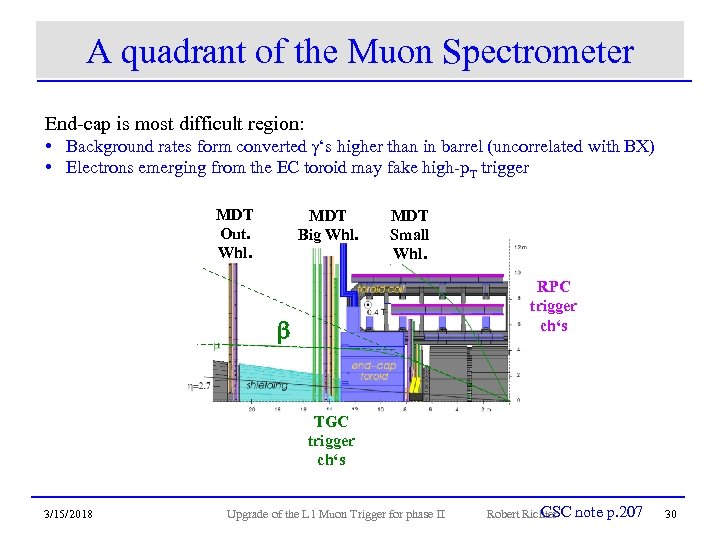 A quadrant of the Muon Spectrometer End-cap is most difficult region: • Background rates form converted g‘s higher than in barrel (uncorrelated with BX) • Electrons emerging from the EC toroid may fake high-p. T trigger MDT Out. Whl. MDT Big Whl. MDT Small Whl. RPC trigger ch‘s b TGC trigger ch‘s 3/15/2018 CSC note p. 207 Upgrade of the L 1 Muon Trigger for phase II Robert Richter 30
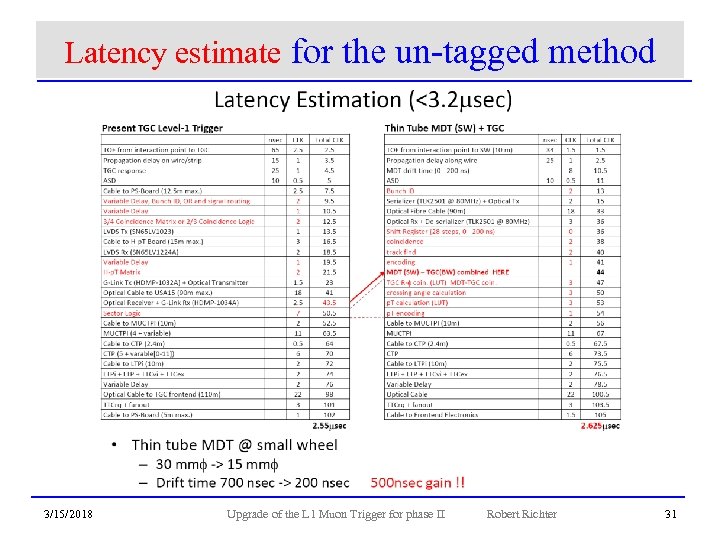 Latency estimate for the un-tagged method 3/15/2018 Upgrade of the L 1 Muon Trigger for phase II Robert Richter 31
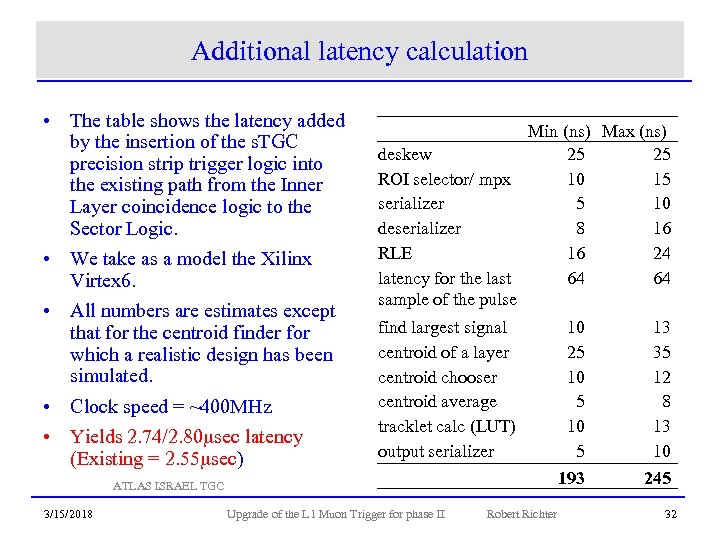 Additional latency calculation • The table shows the latency added by the insertion of the s. TGC precision strip trigger logic into the existing path from the Inner Layer coincidence logic to the Sector Logic. • We take as a model the Xilinx Virtex 6. • All numbers are estimates except that for the centroid finder for which a realistic design has been simulated. • Clock speed = ~400 MHz • Yields 2. 74/2. 80 msec latency (Existing = 2. 55 msec) Min (ns) Max (ns) deskew 25 25 ROI selector/ mpx 10 15 serializer 5 10 deserializer 8 16 RLE 16 24 latency for the last 64 64 sample of the pulse find largest signal centroid of a layer centroid chooser centroid average tracklet calc (LUT) output serializer ATLAS ISRAEL TGC 3/15/2018 Upgrade of the L 1 Muon Trigger for phase II Robert Richter 10 25 10 5 13 35 12 8 13 10 193 245 32