


 Скачать презентацию Updates on the Chinese Energy Sector Yanjia Wang
d7713cffaacf6297d77362f9cb9e67dd.ppt
- Количество слайдов: 50
 Updates on the Chinese Energy Sector Yanjia Wang, Alun Gu, Aling Zhang Tsinghua University, China EASS Workshop 23 rd September 2010, Beijing
 Part A: Targets, Efforts and Results WANG, Yanjia wangyjia@tsinghua. edu. cn Part B: China LEAP Modeling Efforts GU, Alun gal@tsinghua. edu. cn
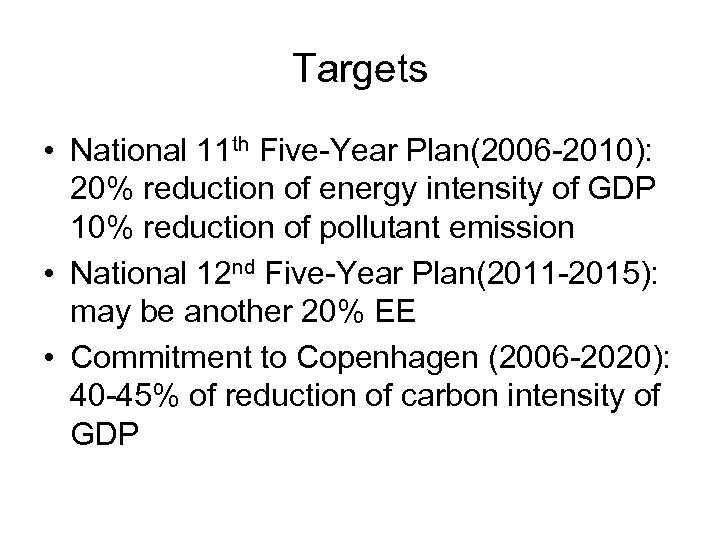 Targets • National 11 th Five-Year Plan(2006 -2010): 20% reduction of energy intensity of GDP 10% reduction of pollutant emission • National 12 nd Five-Year Plan(2011 -2015): may be another 20% EE • Commitment to Copenhagen (2006 -2020): 40 -45% of reduction of carbon intensity of GDP
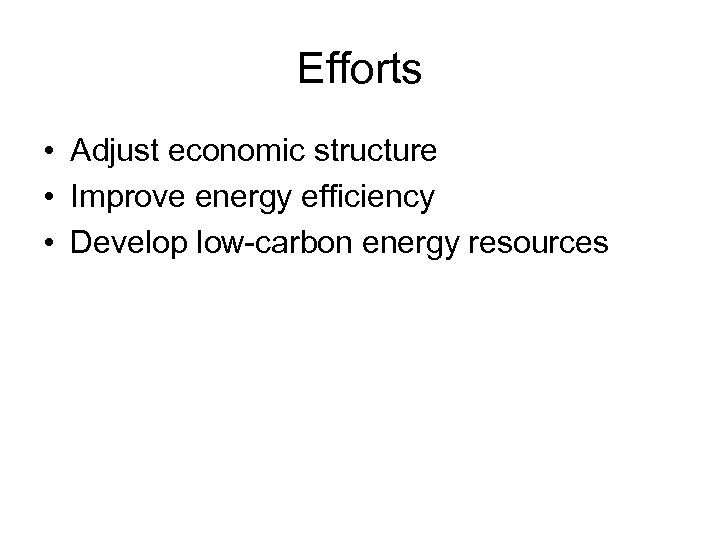 Efforts • Adjust economic structure • Improve energy efficiency • Develop low-carbon energy resources
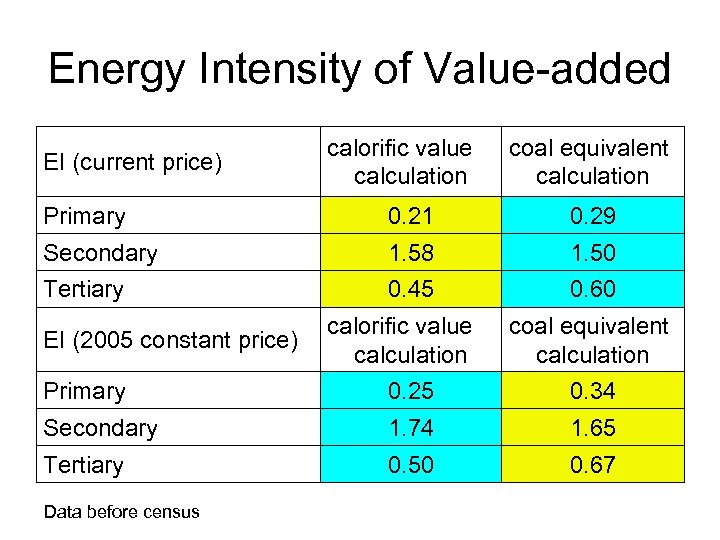 Energy Intensity of Value-added EI (current price) calorific value calculation coal equivalent calculation Primary 0. 21 0. 29 Secondary 1. 58 1. 50 Tertiary 0. 45 0. 60 EI (2005 constant price) calorific value calculation coal equivalent calculation Primary 0. 25 0. 34 Secondary 1. 74 1. 65 Tertiary 0. 50 0. 67 Data before census
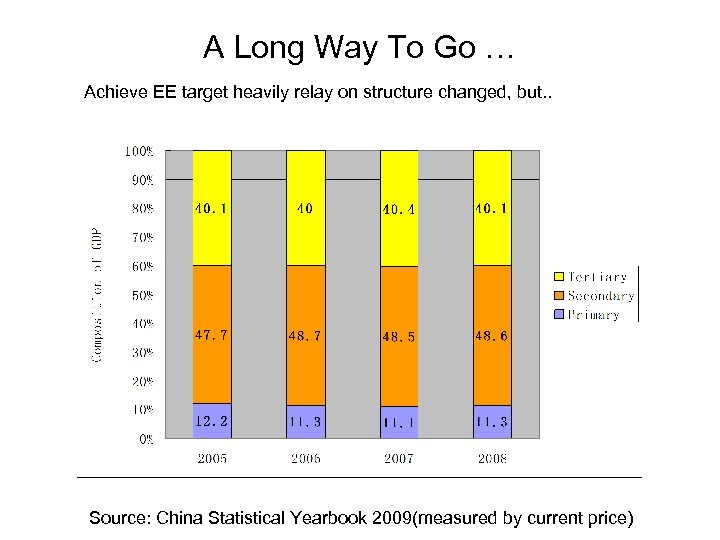 A Long Way To Go … Achieve EE target heavily relay on structure changed, but. . Source: China Statistical Yearbook 2009(measured by current price)
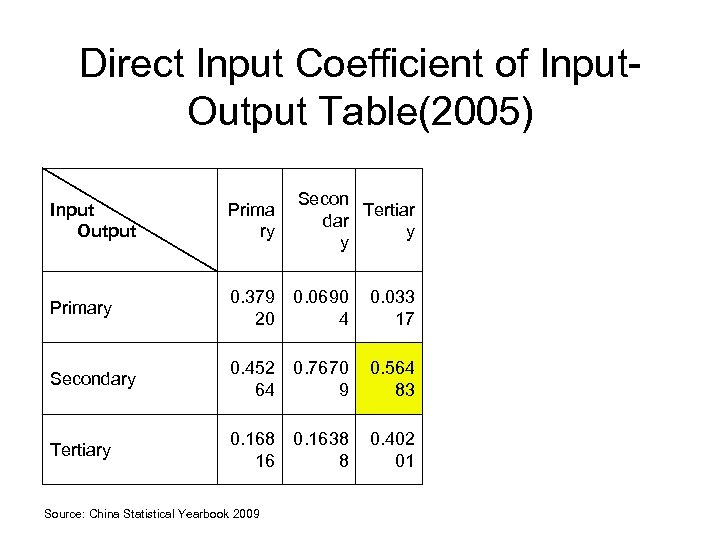 Direct Input Coefficient of Input. Output Table(2005) Secon Tertiar dar y y Input Output Prima ry Primary 0. 379 0. 0690 0. 033 20 4 17 Secondary 0. 452 0. 7670 0. 564 64 9 83 Tertiary 0. 168 0. 1638 0. 402 16 8 01 Source: China Statistical Yearbook 2009
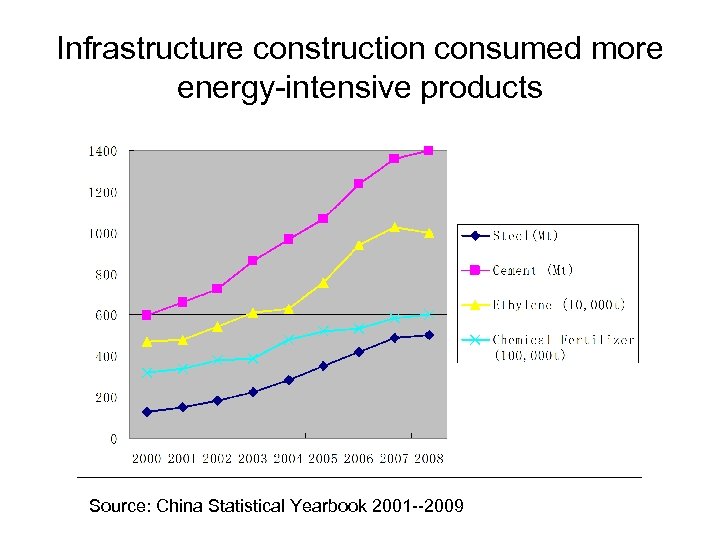 Infrastructure construction consumed more energy-intensive products Source: China Statistical Yearbook 2001 --2009
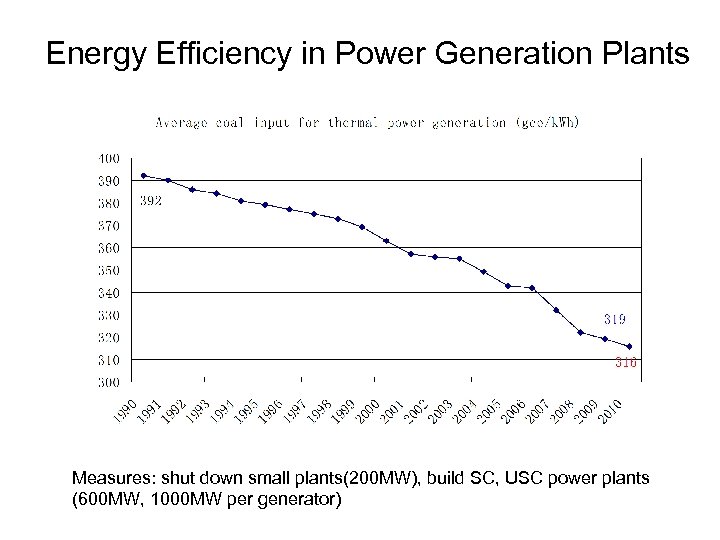 Energy Efficiency in Power Generation Plants Measures: shut down small plants(200 MW), build SC, USC power plants (600 MW, 1000 MW per generator)
 Mandatory Standards to Energy-intensive Products • Published norms of energy consumption per unit product in various industrial sectors (affected on June 1 st 2008). • Including three levels of EE: for existing plants, for new-built plants and for targeted plants. • Covered crude steel, ferroalloy, coke, cement, ceramics, flat glass, caustic soda, calcium carbide, synthetic ammonia, yellow phosphorus, copper, zinc, lead, nickel, tin, magnesium, antimony copper and copper-alloy tube, wrought aluminum alloy extruded profiles for architecture, electrolyzed aluminum. • More norms are under development.
 Award Energy Saving Projects • Central government: 300 yuan/tce (savings ≥ 10, 000 tce/a) • Some provincial government: 200300 yuan/tce (10, 000 ≤savings ≥thousands) • A few city government: 100 yuan/tce
 Efforts in Transport Sector • Build mass transit and inter-city rapid transit system • Consumption tax reduction(5% to 2. 5%) to compact cars and hybrid cars (2009) • Fuel tax on petrol consumption (2009) • Subsidy vehicle buyers if old car eliminated (2009) • Mandatory limitation of vehicle ages • Fuel economy standards
 Improving fuel efficiency by 19% • GB 19578 -2004 Limits of Fuel Consumption for Passenger Cars – Stage I: effected July 1 st 2005 for new certified cars; July 1 st 2006 for current produced cars – Stage II: effected January 1 st 2008 for new certified cars; January 1 st 2009 for current produced cars • Covered 2374 types of vehicles and 95 manufacturers in stage II, 444 types of vehicles (produced by 55 manufacturers) are failure to meet the standard. The manufacturers had to stop producing these 444 types of vehicles.
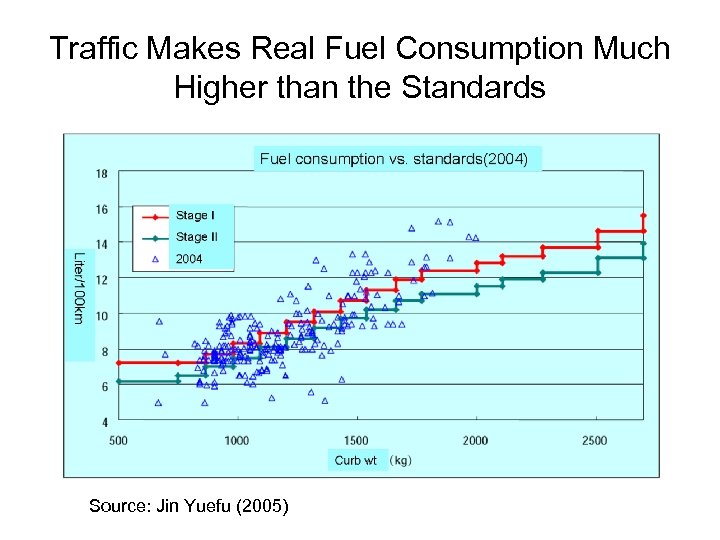 Traffic Makes Real Fuel Consumption Much Higher than the Standards Source: Jin Yuefu (2005)
 EE in Building Sector • Appliance standards and labels • Design standards for new buildings (big progress) • Retrofit existing buildings (no progress) • Monitoring governmental buildings (trial stage)
 Saving Targets: 30%, 50% & 66% • • • Regional based Baseline: 1980’s standard 30% saving standard: 1986 50% saving standards: 1996 65% savings standards: under development, effected in some regions.
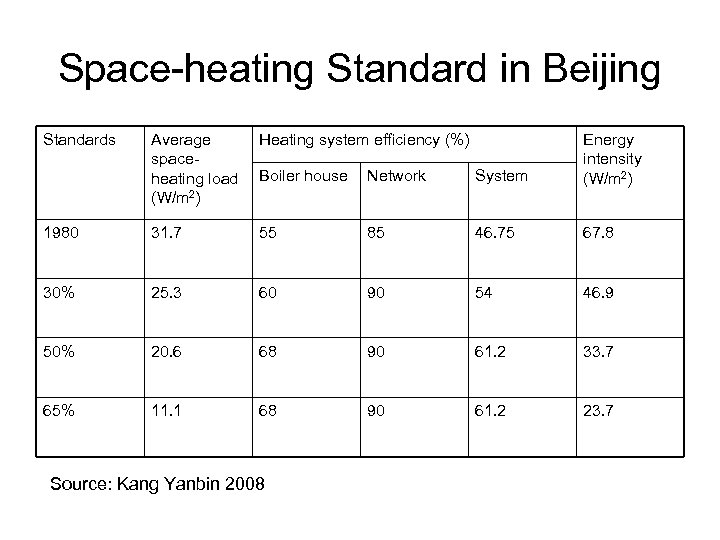 Space-heating Standard in Beijing Standards Average spaceheating load (W/m 2) Heating system efficiency (%) Boiler house Network System Energy intensity (W/m 2) 1980 31. 7 55 85 46. 75 67. 8 30% 25. 3 60 90 54 46. 9 50% 20. 6 68 90 61. 2 33. 7 65% 11. 1 68 90 61. 2 23. 7 Source: Kang Yanbin 2008
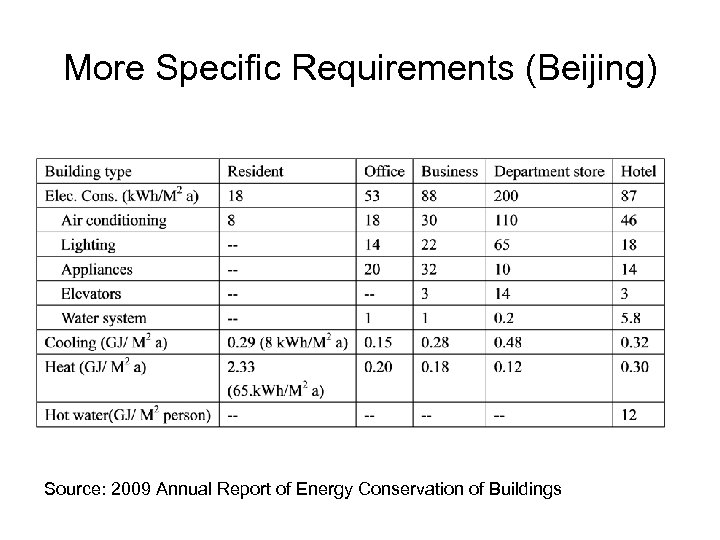 More Specific Requirements (Beijing) Source: 2009 Annual Report of Energy Conservation of Buildings
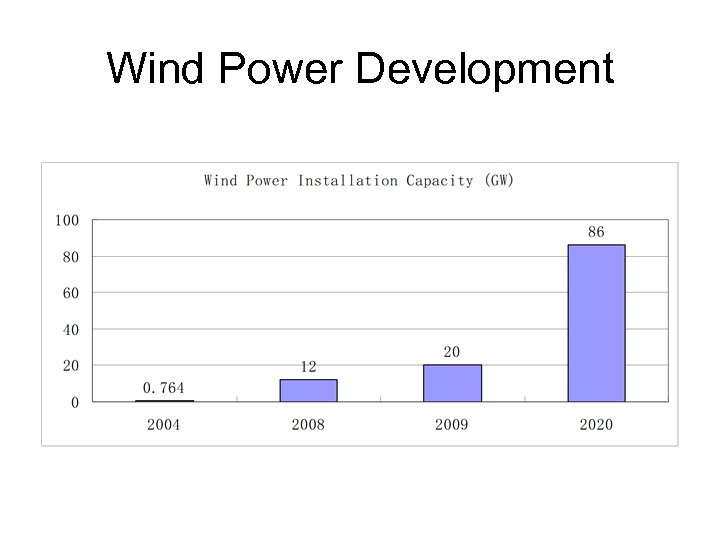 Wind Power Development
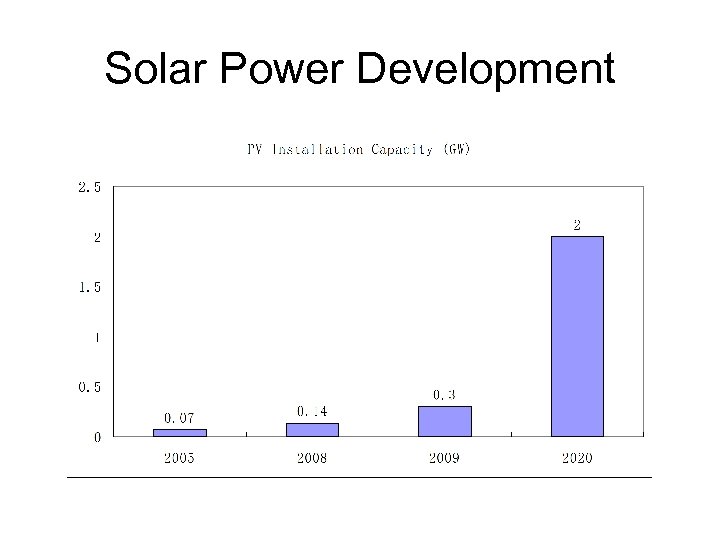 Solar Power Development
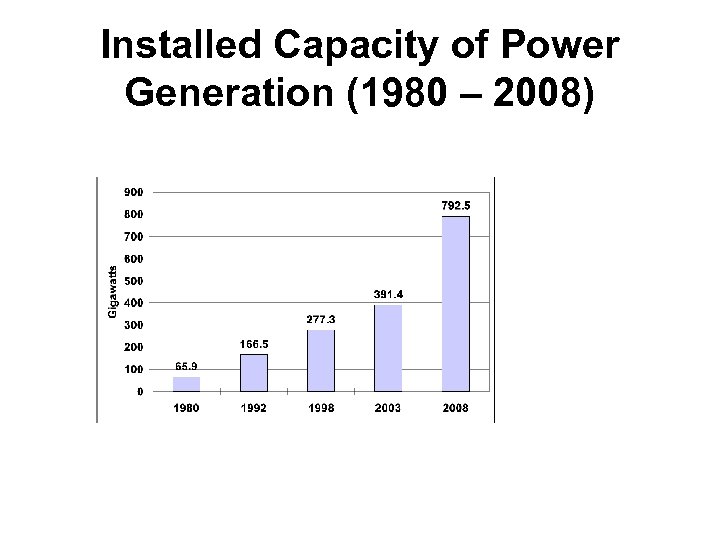 Installed Capacity of Power Generation (1980 – 2008)
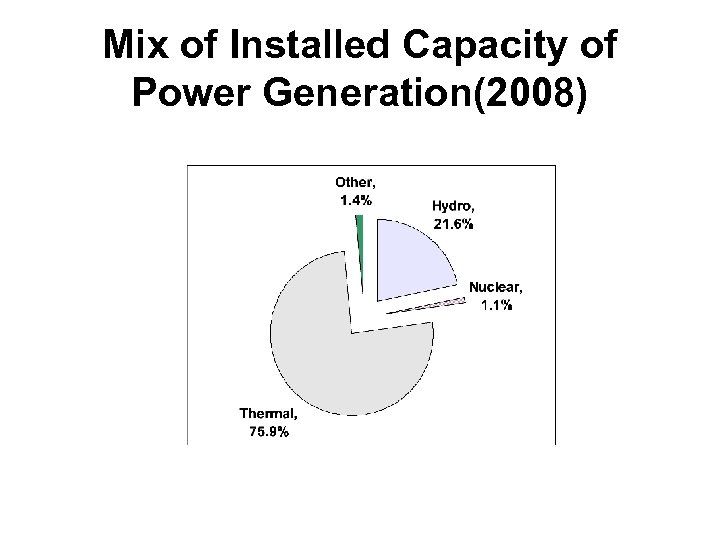 Mix of Installed Capacity of Power Generation(2008)
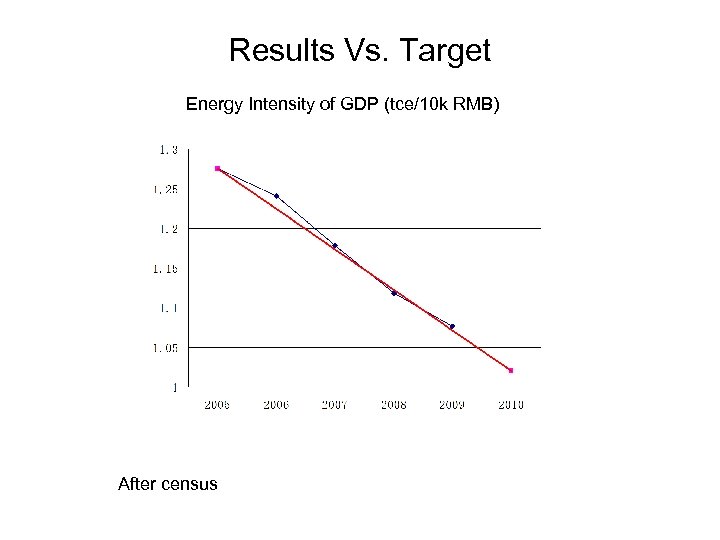 Results Vs. Target Energy Intensity of GDP (tce/10 k RMB) After census
 Build Baseline Economic census of 2008 conducted in 2009. Revised GDP and energy data. GHG inventory of 2005 is under development.
 General Published Data Source 1. Statistical Communiqué: Published by National Bureau of Statistics (NBS) in February of Year X+1, using statistical data of January to November Year X and the growth rate of December Year X-1 to estimate GDP and energy of Year X. 2. Yearbook: Published by NBS in autumn of Year X+1 to present GDP and energy of Year X. 3. National Economic Census: Leading by State Council and NBS. Published in January of Year X+1. Conducted in Year X to investigate data of Year X-1. Once in every 4 years.
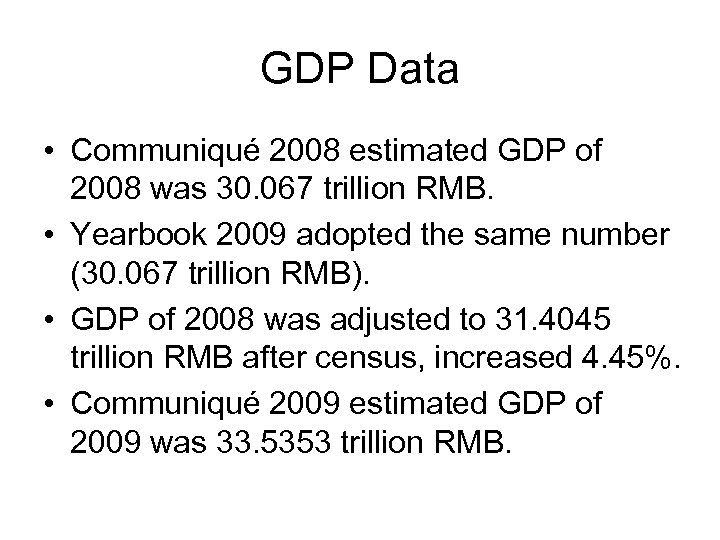 GDP Data • Communiqué 2008 estimated GDP of 2008 was 30. 067 trillion RMB. • Yearbook 2009 adopted the same number (30. 067 trillion RMB). • GDP of 2008 was adjusted to 31. 4045 trillion RMB after census, increased 4. 45%. • Communiqué 2009 estimated GDP of 2009 was 33. 5353 trillion RMB.
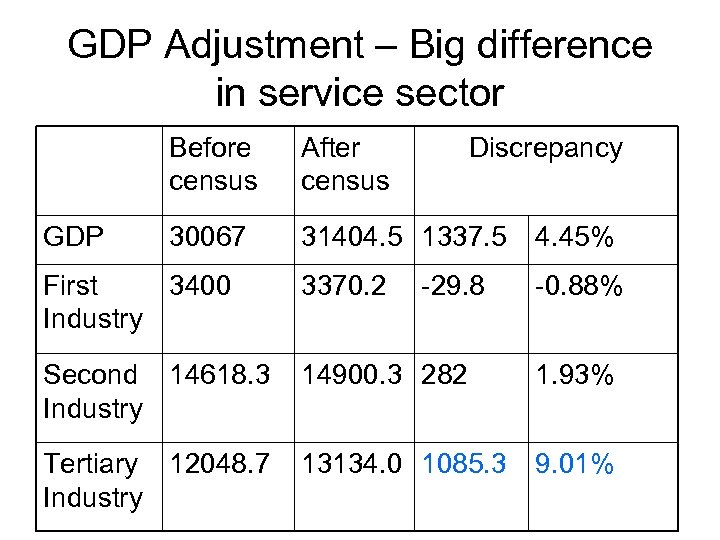 GDP Adjustment – Big difference in service sector Before census After census 30067 31404. 5 1337. 5 4. 45% First 3400 Industry 3370. 2 -0. 88% Second 14618. 3 Industry 14900. 3 282 1. 93% Tertiary 12048. 7 Industry 13134. 0 1085. 3 9. 01% GDP Discrepancy -29. 8
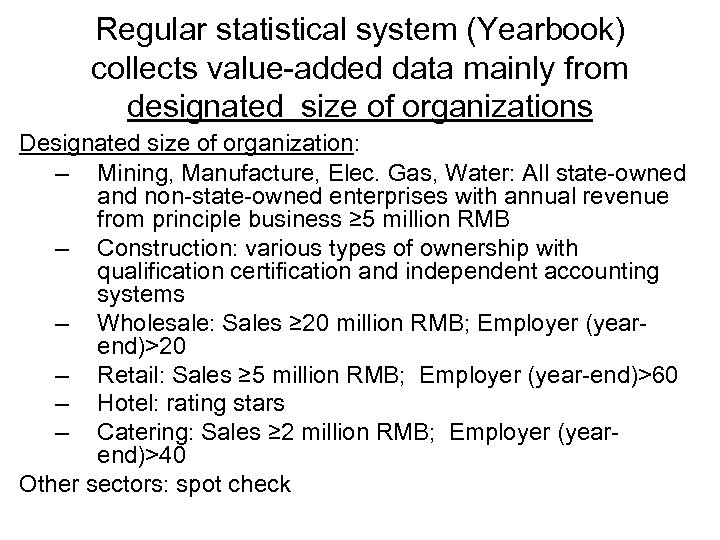 Regular statistical system (Yearbook) collects value-added data mainly from designated size of organizations Designated size of organization: – Mining, Manufacture, Elec. Gas, Water: All state-owned and non-state-owned enterprises with annual revenue from principle business ≥ 5 million RMB – Construction: various types of ownership with qualification certification and independent accounting systems – Wholesale: Sales ≥ 20 million RMB; Employer (yearend)>20 – Retail: Sales ≥ 5 million RMB; Employer (year-end)>60 – Hotel: rating stars – Catering: Sales ≥ 2 million RMB; Employer (yearend)>40 Other sectors: spot check
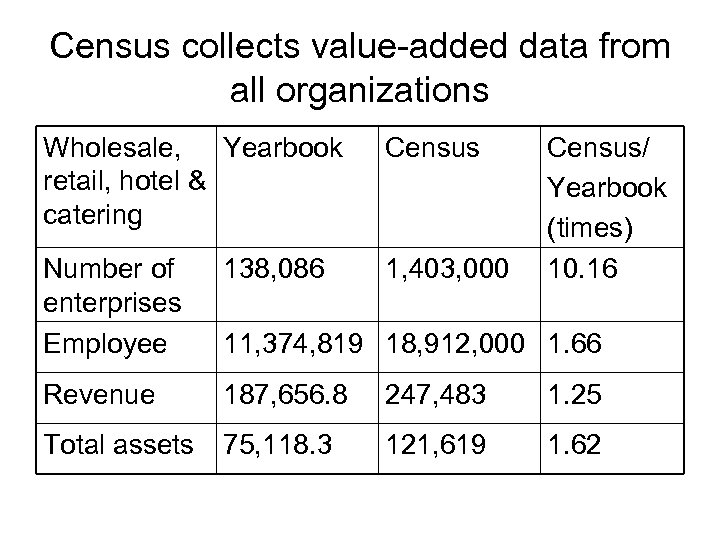 Census collects value-added data from all organizations Wholesale, Yearbook retail, hotel & catering Census/ Yearbook (times) 10. 16 Number of enterprises Employee 138, 086 1, 403, 000 Revenue 187, 656. 8 247, 483 1. 25 Total assets 75, 118. 3 121, 619 1. 62 11, 374, 819 18, 912, 000 1. 66
 Only collect gross output value from industrial enterprises by year • Following former Soviet system, industrial enterprise accounting didn’t use the concept of value-add before 2009. • The concept of value-add in constant price is even more difficult than for industrial enterprises. • All value-add data for agriculture and industrial sectors are estimated by national and local statistical bureaus.
 Key Energy Data Points • Statistical Communiqué on the 2008 National Economic and Social Development (issued on February 26 th 2009) estimated total energy consumption of 2008 was 2. 85 billion tce (coal equivalent calculation). • China Statistical Yearbook 2009 (published in September 2009) adopted the same number(2. 85 billion tce). • Total energy consumption of 2008 was adjusted to 2. 91 billion tce after census, increased 2. 12%. • Statistical Communiqué on the 2009 National Economic and Social Development (issued on February 25 th 2010) estimated total energy consumption of 2009 was 3. 10 billion tce.
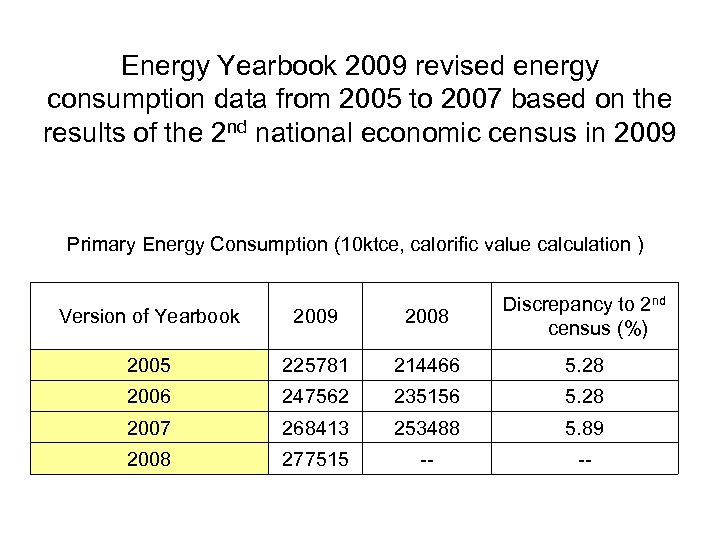 Energy Yearbook 2009 revised energy consumption data from 2005 to 2007 based on the results of the 2 nd national economic census in 2009 Primary Energy Consumption (10 ktce, calorific value calculation ) Version of Yearbook 2009 2008 Discrepancy to 2 nd census (%) 2005 225781 214466 5. 28 2006 247562 235156 5. 28 2007 268413 253488 5. 89 2008 277515 -- --
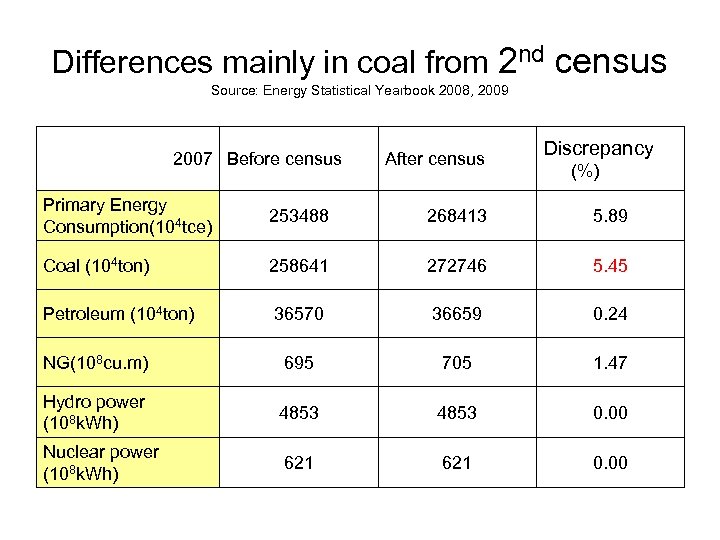 Differences mainly in coal from 2 nd census Source: Energy Statistical Yearbook 2008, 2009 2007 Before census After census Discrepancy (%) Primary Energy Consumption(104 tce) 253488 268413 5. 89 Coal (104 ton) 258641 272746 5. 45 Petroleum (104 ton) 36570 36659 0. 24 NG(108 cu. m) 695 705 1. 47 Hydro power (108 k. Wh) 4853 0. 00 Nuclear power (108 k. Wh) 621 0. 00
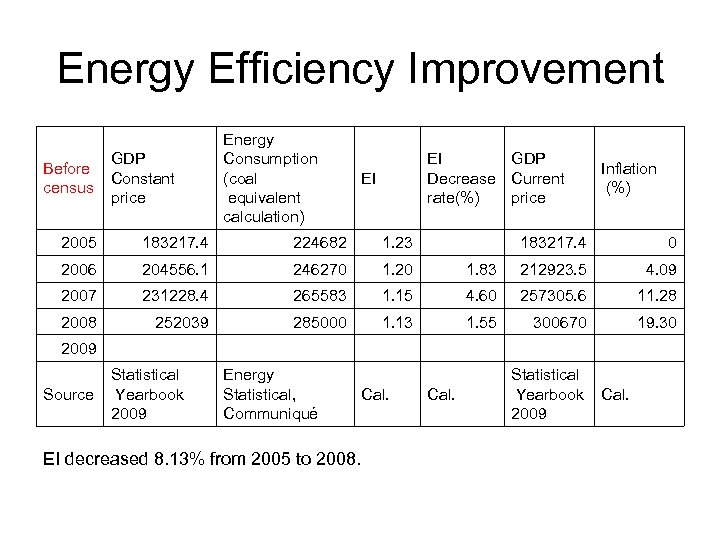 Energy Efficiency Improvement Before census GDP Constant price Energy Consumption (coal equivalent calculation) EI GDP Decrease Current rate(%) price EI 2005 183217. 4 224682 1. 23 2006 204556. 1 246270 1. 20 2007 231228. 4 265583 2008 252039 285000 Inflation (%) 183217. 4 0 1. 83 212923. 5 4. 09 1. 15 4. 60 257305. 6 11. 28 1. 13 1. 55 300670 19. 30 2009 Source Statistical Yearbook 2009 Energy Statistical, Communiqué EI decreased 8. 13% from 2005 to 2008. Cal. Statistical Yearbook 2009 Cal.
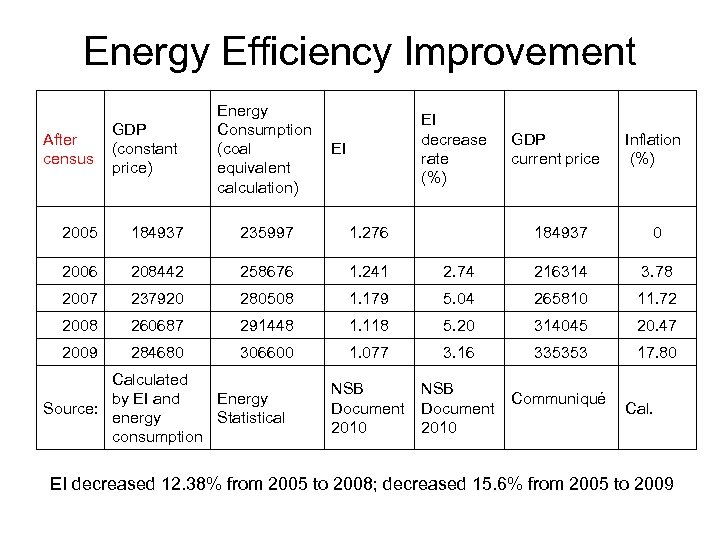 Energy Efficiency Improvement Energy Consumption (coal EI equivalent calculation) EI decrease rate (%) After census GDP (constant price) 2005 184937 235997 1. 276 2006 208442 258676 1. 241 2007 237920 280508 2008 260687 2009 284680 GDP current price Inflation (%) 184937 0 2. 74 216314 3. 78 1. 179 5. 04 265810 11. 72 291448 1. 118 5. 20 314045 20. 47 306600 1. 077 3. 16 335353 17. 80 NSB Document 2010 Calculated by EI and Energy Source: energy Statistical consumption Communiqué Cal. EI decreased 12. 38% from 2005 to 2008; decreased 15. 6% from 2005 to 2009
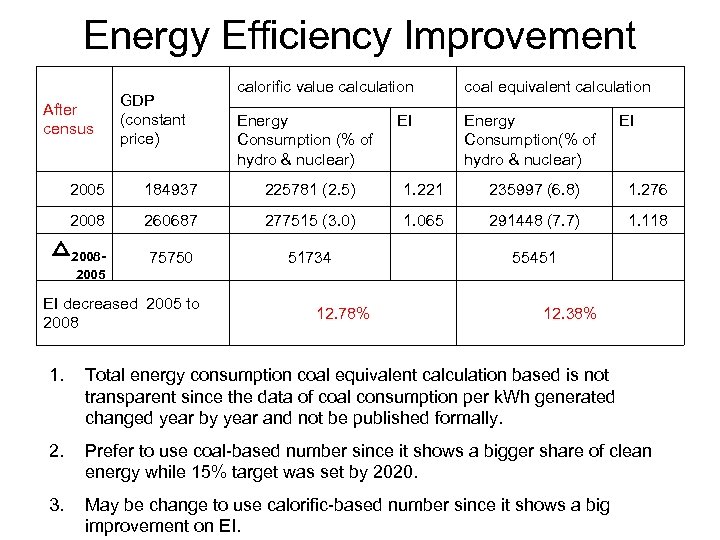 Energy Efficiency Improvement After census GDP (constant price) calorific value calculation coal equivalent calculation Energy Consumption (% of hydro & nuclear) Energy Consumption(% of hydro & nuclear) EI EI 2005 184937 225781 (2. 5) 1. 221 235997 (6. 8) 1. 276 2008 260687 277515 (3. 0) 1. 065 291448 (7. 7) 1. 118 △ 2008 - 75750 51734 55451 2005 EI decreased 2005 to 2008 12. 78% 12. 38% 1. Total energy consumption coal equivalent calculation based is not transparent since the data of coal consumption per k. Wh generated changed year by year and not be published formally. 2. Prefer to use coal-based number since it shows a bigger share of clean energy while 15% target was set by 2020. 3. May be change to use calorific-based number since it shows a big improvement on EI.
 Part B: China LEAP Modeling Efforts
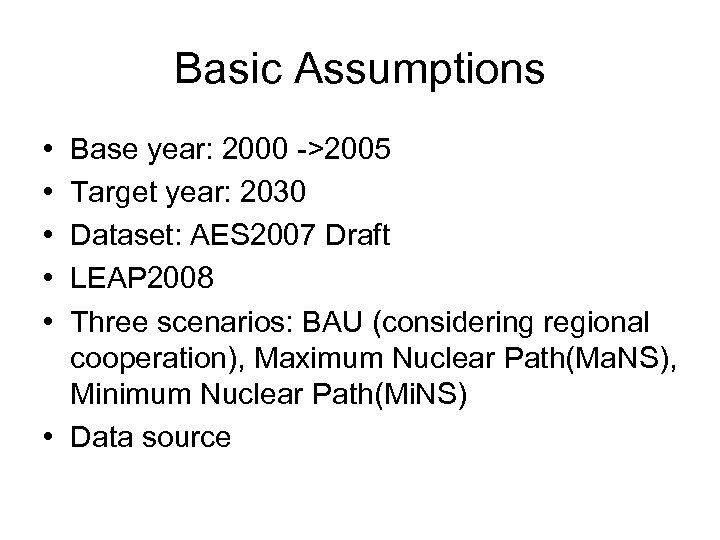 Basic Assumptions • • • Base year: 2000 ->2005 Target year: 2030 Dataset: AES 2007 Draft LEAP 2008 Three scenarios: BAU (considering regional cooperation), Maximum Nuclear Path(Ma. NS), Minimum Nuclear Path(Mi. NS) • Data source
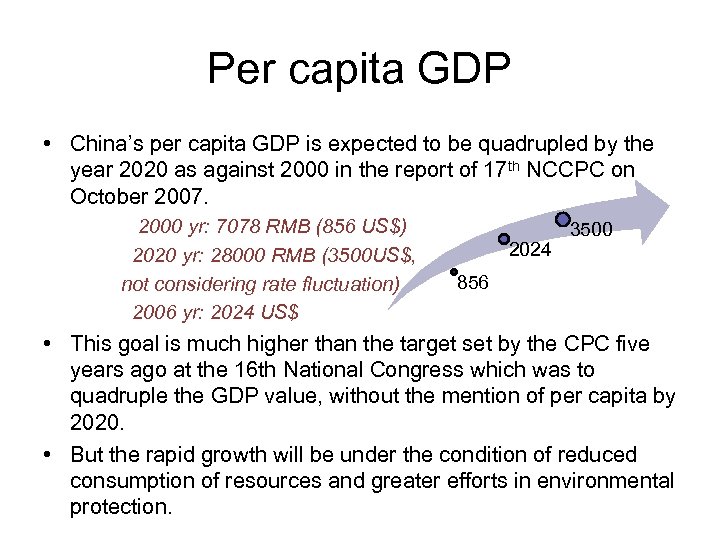 Per capita GDP • China’s per capita GDP is expected to be quadrupled by the year 2020 as against 2000 in the report of 17 th NCCPC on October 2007. 2000 yr: 7078 RMB (856 US$) 2020 yr: 28000 RMB (3500 US$, not considering rate fluctuation) 2006 yr: 2024 US$ 2024 3500 856 • This goal is much higher than the target set by the CPC five years ago at the 16 th National Congress which was to quadruple the GDP value, without the mention of per capita by 2020. • But the rapid growth will be under the condition of reduced consumption of resources and greater efforts in environmental protection.
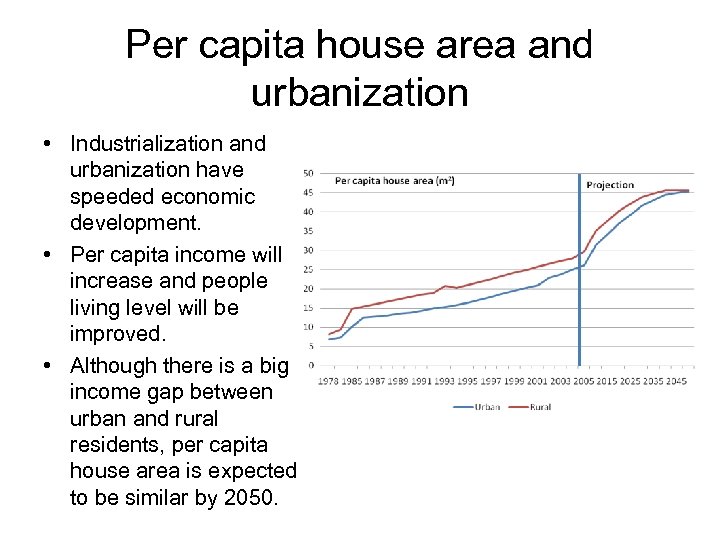 Per capita house area and urbanization • Industrialization and urbanization have speeded economic development. • Per capita income will increase and people living level will be improved. • Although there is a big income gap between urban and rural residents, per capita house area is expected to be similar by 2050.
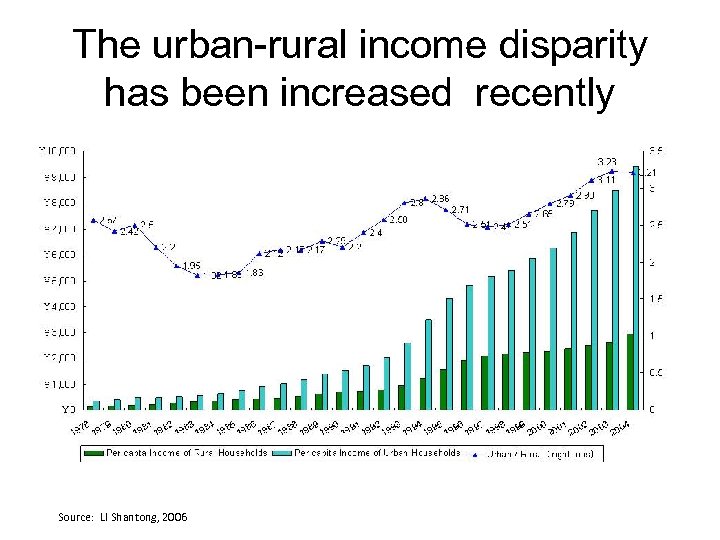 The urban-rural income disparity has been increased recently Source: LI Shantong, 2006
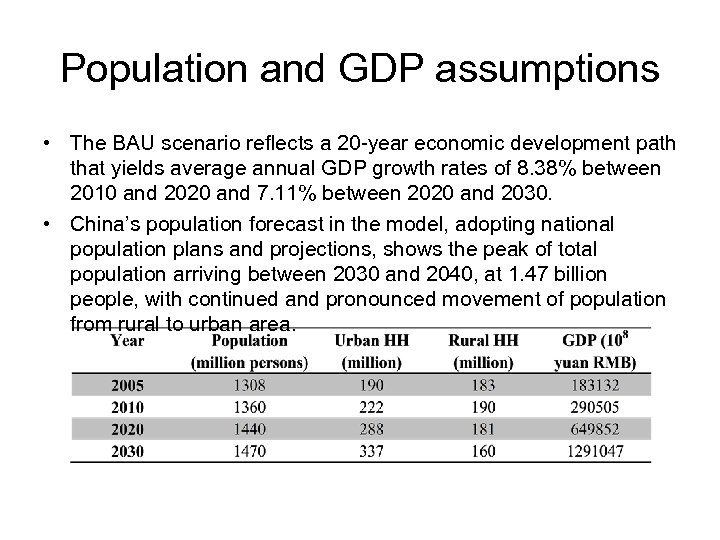 Population and GDP assumptions • The BAU scenario reflects a 20 -year economic development path that yields average annual GDP growth rates of 8. 38% between 2010 and 2020 and 7. 11% between 2020 and 2030. • China’s population forecast in the model, adopting national population plans and projections, shows the peak of total population arriving between 2030 and 2040, at 1. 47 billion people, with continued and pronounced movement of population from rural to urban area.
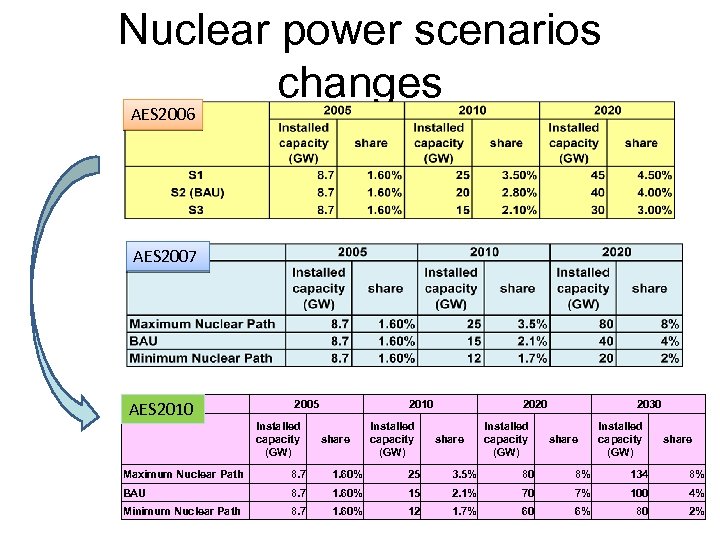 Nuclear power scenarios changes AES 2006 AES 2007 AES 2010 2005 Installed capacity (GW) 2010 share Installed capacity (GW) 2020 share Installed capacity (GW) 2030 share Installed capacity (GW) share Maximum Nuclear Path 8. 7 1. 60% 25 3. 5% 80 8% 134 8% BAU 8. 7 1. 60% 15 2. 1% 70 7% 100 4% Minimum Nuclear Path 8. 7 1. 60% 12 1. 7% 60 6% 80 2%
 Industry assumptions • Based on China’s government policy, growth in the most energy-intensive industrial sectors will be controlled and mainly used to fulfill domestic needs, and energy efficiency measures will be implemented in those sectors to enhance energy savings. • In the steel, cement, and pulp and paper sectors, for example, physical output is projected to rise through 2020, but then fall slightly (steel), remain unchanged (cement), or rise only slightly (pulp and paper) through 2030. • At the same time, the energy intensities per unit physical product in these industries is projected, in the BAU path, to fall by 1. 0 to 1. 8% annually, varying by industry and time period (China Low Carbon Scenario, 2009).
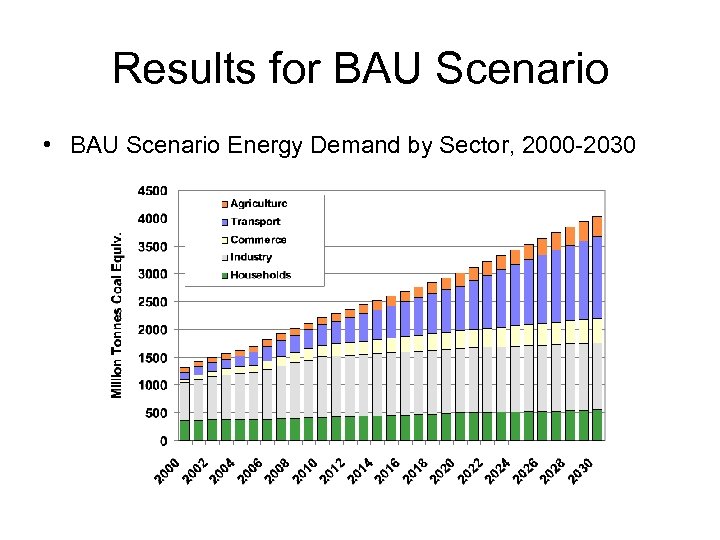 Results for BAU Scenario • BAU Scenario Energy Demand by Sector, 2000 -2030
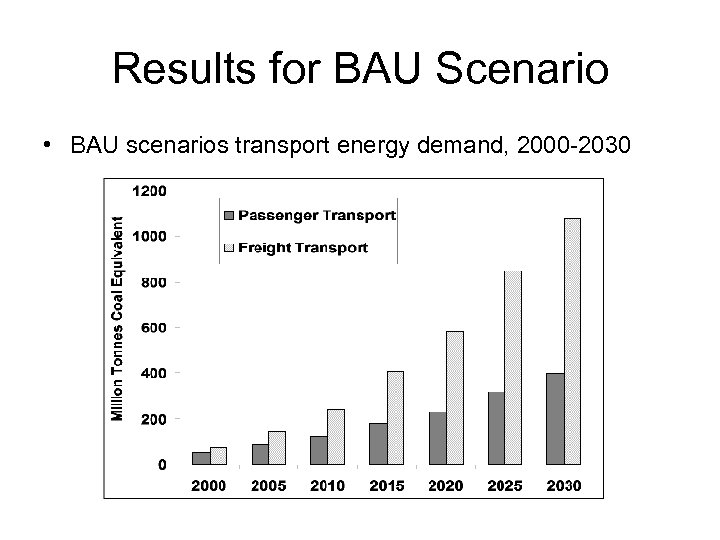 Results for BAU Scenario • BAU scenarios transport energy demand, 2000 -2030
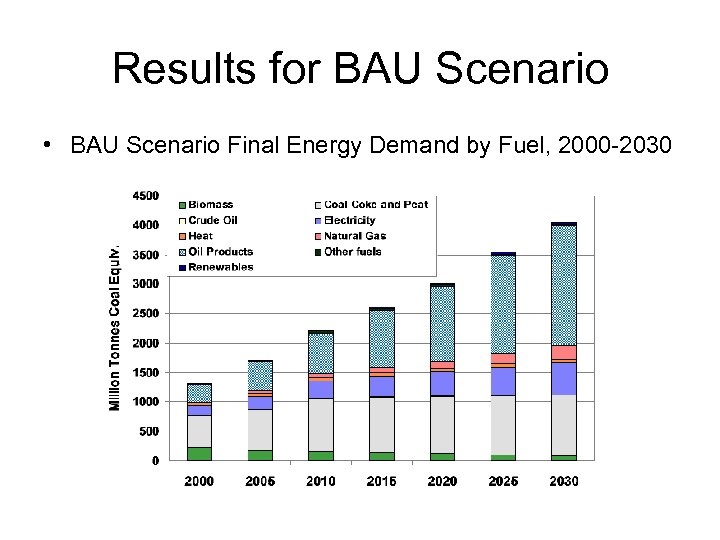 Results for BAU Scenario • BAU Scenario Final Energy Demand by Fuel, 2000 -2030
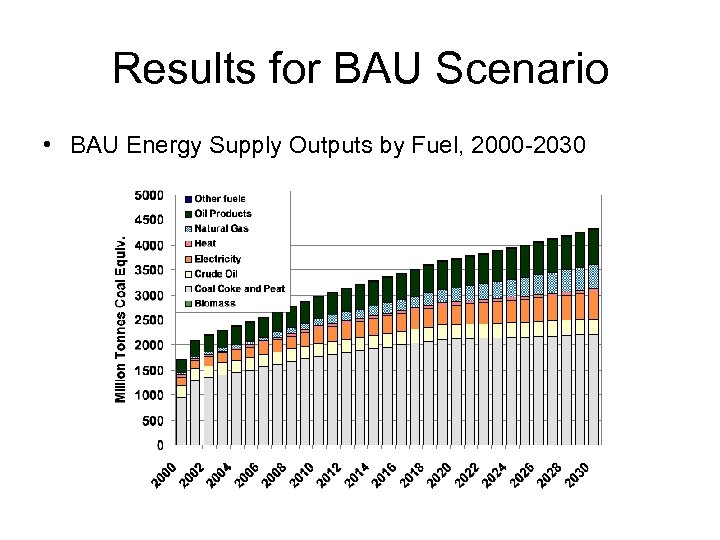 Results for BAU Scenario • BAU Energy Supply Outputs by Fuel, 2000 -2030
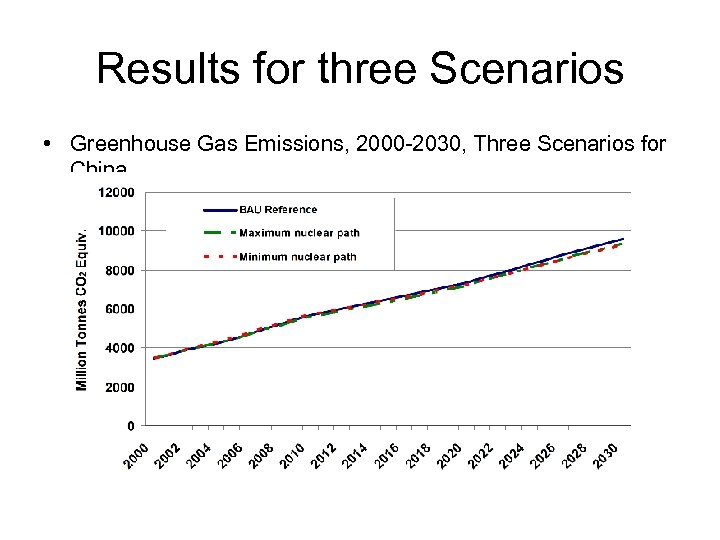 Results for three Scenarios • Greenhouse Gas Emissions, 2000 -2030, Three Scenarios for China
 Conclusions • China has experienced rapid growth in energy consumption in the recent years. Large amounts of investment have been provided for the power industry and for oil stockpile facility construction to secure energy supplies to support rapid economic growth. • To realize China’s sustainable development, the national energy development strategy includes an energy conservation priority policy, and at the same time is vigorously developing renewable energy and new energy in China. A cleaner energy system and energy development strategy are needed, and should be established through government involvement leading to changes in all production processes and lifestyles through the applications of laws, regulations and fiscal policies. • Vehicle emission problems in particular require special attention, especially those associated with increases in freight and passenger transport energy consumption.