


 Скачать презентацию Updated 7 May 2007 FINA 522 Project Finance
4eff2e20101a1e7fc67f106fab1f8143.ppt
- Количество слайдов: 63
 Updated: 7 May 2007 FINA 522: Project Finance and Risk Management Lecture Ten 0
 PRINCIPLES OF CONTRACTING, RISK SHARING AND RISK REDUCTION 1
 Risk Management • Problem: – Many projects have • large investment outlays • long periods of project payout • incomplete sharing of information and technology, especially with foreign investors • differences in the ability of the parties to bear risks • unstable contracts – Projects may be attractive in aggregate but are unattractive to one or more parties due to uncertainties about sharing risks and returns – The result is that attractive projects are not being undertaken 2
 DESIGNING CONTRACTS FOR CLIENT SPECIFIC PROJECTS EXAMPLES: • Solid Waste Disposal Plants • Water Supply Projects • Power Purchase Agreements • Road Concessions Contracts are required before investors will be willing to undertake projects. 3
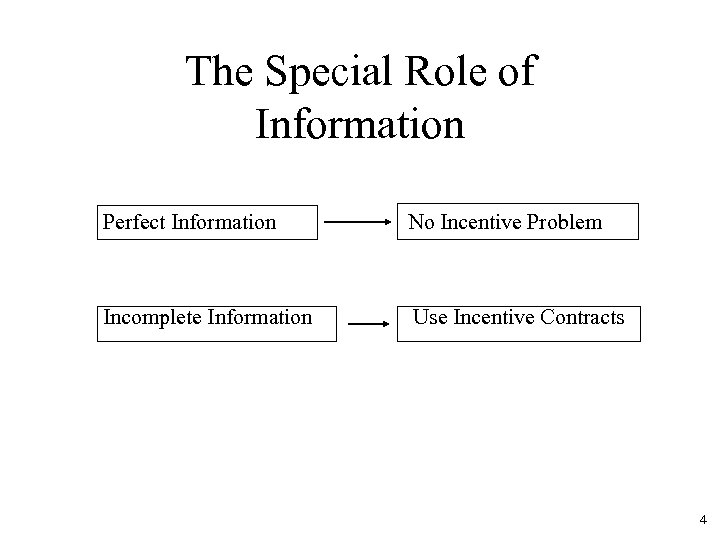 The Special Role of Information Perfect Information No Incentive Problem Incomplete Information Use Incentive Contracts 4
 RISK ANALYSIS EVALUATION OF A CEMENT ADDITIVES PLANT IN INDONESIA 5
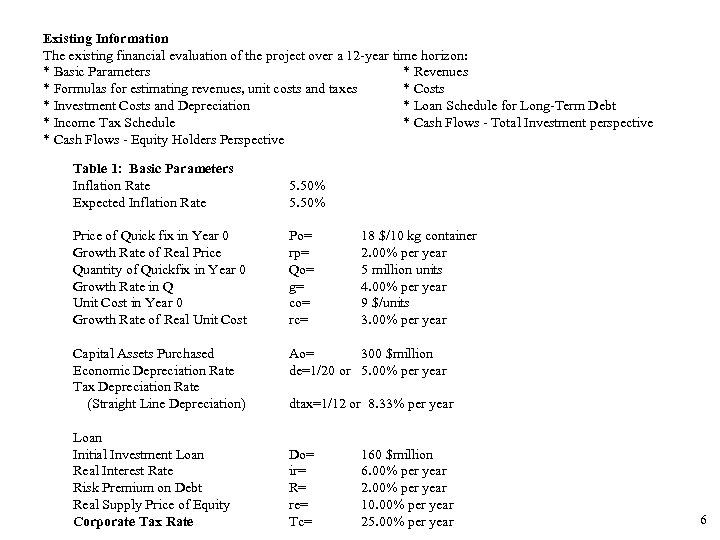 Existing Information The existing financial evaluation of the project over a 12 -year time horizon: * Basic Parameters * Revenues * Formulas for estimating revenues, unit costs and taxes * Costs * Investment Costs and Depreciation * Loan Schedule for Long-Term Debt * Income Tax Schedule * Cash Flows - Total Investment perspective * Cash Flows - Equity Holders Perspective Table 1: Basic Parameters Inflation Rate Expected Inflation Rate 5. 50% Price of Quick fix in Year 0 Growth Rate of Real Price Quantity of Quickfix in Year 0 Growth Rate in Q Unit Cost in Year 0 Growth Rate of Real Unit Cost Po= rp= Qo= g= co= rc= Capital Assets Purchased Economic Depreciation Rate Tax Depreciation Rate (Straight Line Depreciation) Ao= 300 $million de=1/20 or 5. 00% per year Loan Initial Investment Loan Real Interest Rate Risk Premium on Debt Real Supply Price of Equity Corporate Tax Rate 18 $/10 kg container 2. 00% per year 5 million units 4. 00% per year 9 $/units 3. 00% per year dtax=1/12 or 8. 33% per year Do= ir= R= re= Tc= 160 $million 6. 00% per year 2. 00% per year 10. 00% per year 25. 00% per year 6
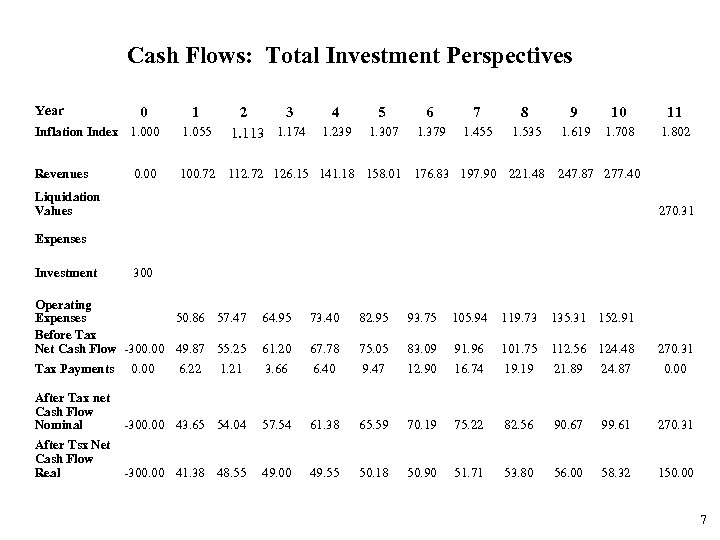 Cash Flows: Total Investment Perspectives Year 0 1 2 3 1. 113 1. 174 4 5 6 7 8 9 10 11 1. 239 1. 307 1. 379 1. 455 1. 535 1. 619 1. 708 1. 802 Inflation Index 1. 000 1. 055 Revenues 100. 72 112. 72 126. 15 141. 18 158. 01 176. 83 197. 90 221. 48 0. 00 247. 87 277. 40 Liquidation Values 270. 31 Expenses Investment 300 Operating Expenses 50. 86 57. 47 Before Tax Net Cash Flow -300. 00 49. 87 55. 25 64. 95 73. 40 82. 95 93. 75 105. 94 119. 73 135. 31 152. 91 61. 20 67. 78 75. 05 83. 09 91. 96 101. 75 112. 56 124. 48 1. 21 3. 66 6. 40 9. 47 12. 90 16. 74 19. 19 21. 89 24. 87 0. 00 After Tax net Cash Flow Nominal -300. 00 43. 65 54. 04 57. 54 61. 38 65. 59 70. 19 75. 22 82. 56 90. 67 99. 61 270. 31 After Tsx Net Cash Flow Real -300. 00 41. 38 48. 55 49. 00 49. 55 50. 18 50. 90 51. 71 53. 80 56. 00 58. 32 150. 00 Tax Payments 0. 00 6. 22 270. 31 7
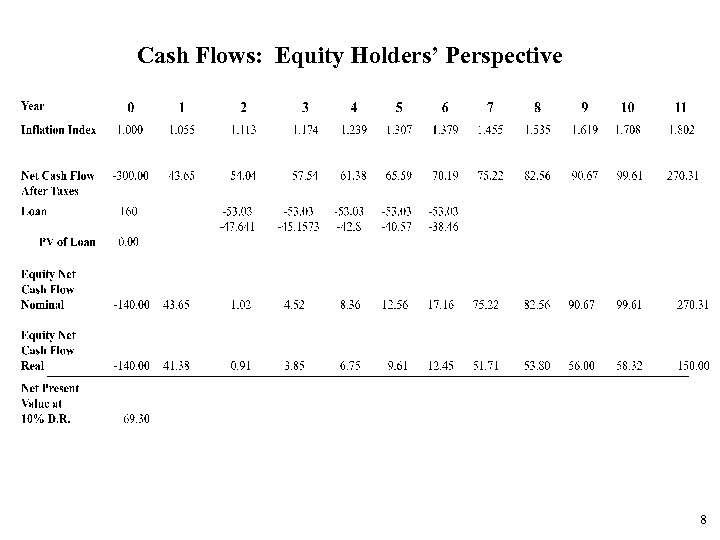 Cash Flows: Equity Holders’ Perspective 8
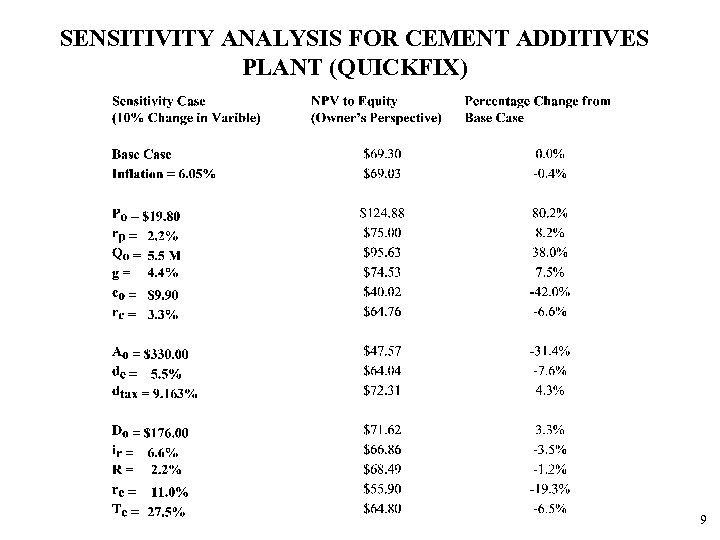 SENSITIVITY ANALYSIS FOR CEMENT ADDITIVES PLANT (QUICKFIX) 9
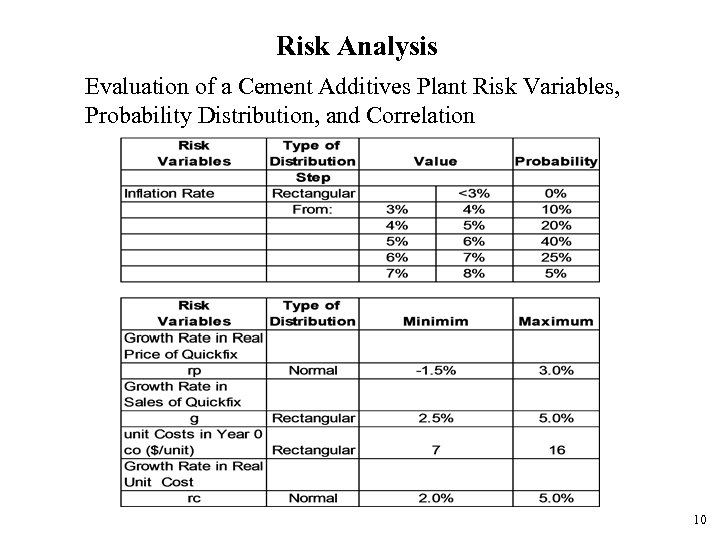 Risk Analysis Evaluation of a Cement Additives Plant Risk Variables, Probability Distribution, and Correlation 10
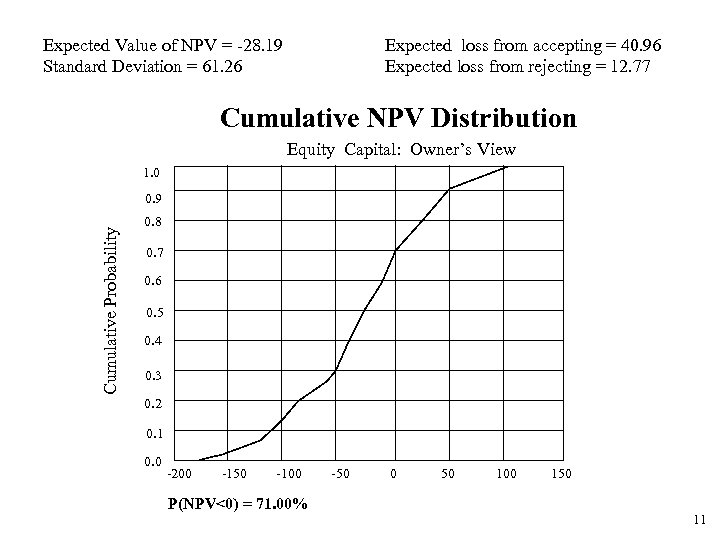 Expected Value of NPV = -28. 19 Standard Deviation = 61. 26 Expected loss from accepting = 40. 96 Expected loss from rejecting = 12. 77 Cumulative NPV Distribution Equity Capital: Owner’s View 1. 0 Cumulative Probability 0. 9 0. 8 0. 7 0. 6 0. 5 0. 4 0. 3 0. 2 0. 1 0. 0 -200 -150 -100 P(NPV<0) = 71. 00% -50 0 50 100 150 11
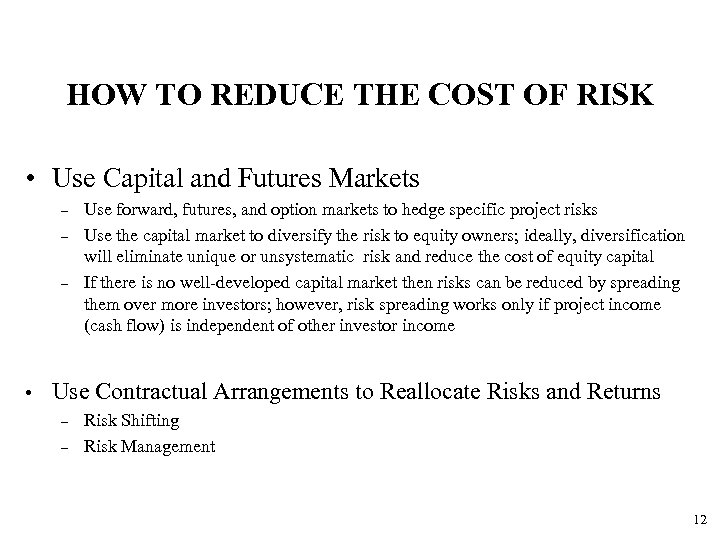 HOW TO REDUCE THE COST OF RISK • Use Capital and Futures Markets – – – • Use forward, futures, and option markets to hedge specific project risks Use the capital market to diversify the risk to equity owners; ideally, diversification will eliminate unique or unsystematic risk and reduce the cost of equity capital If there is no well-developed capital market then risks can be reduced by spreading them over more investors; however, risk spreading works only if project income (cash flow) is independent of other investor income Use Contractual Arrangements to Reallocate Risks and Returns – – Risk Shifting Risk Management 12
 Elements of Contracting • General Form – Exchange of x for y • Additional Considerations – – – Timing of x and y (when) Contingency of x and y (under what circumstances) Penalties in case on non-performance or bonus for good performance 13
 Contracting Criteria • Contract with lowest cost (highest return if investment occurs) not necessarily best contract • Efficient contracts may provide: – better risk shifting - better distribution of cost across circumstances • – i. e. Given probabilities, change the allocation of risk between participants better risk management - higher project returns or lower total project risk as result of incentive • i. e. Change the incentive structure to change the probabilities of outcomes 14
 Risk Reallocation Sources of Contracting Benefits • Risk Shifting – – – Differing risk preferences. e. g. , less risk averse investor willing to accept a lower return on a risky asset Differing capacity to diversify. e. g. , foreign investors may be able to diversify risk in more efficient capital markets Differing outlooks or predictions of future. e. g. , some investors are more tolerant and some are more optimistic • Risk Management – Differing ability to influence project outcomes 15
 RISK SHIFTING The following options are available: • Contracts that limit the range of values of a particular cash flow item, or of net cash flow. • For example, a purchaser may agree to purchase a minimum quantity or to pay a minimum price in order to be sure of delivery; these measures would put a lower bound on the sales revenue. Similar measures would include: • limited liability • a limited product price range • a fixed price growth path • an undertaking to pay a long-run average price • specific price escalator clauses that would maintain the competitiveness of the product, e. g. indexing price to the price of a close substitute 16
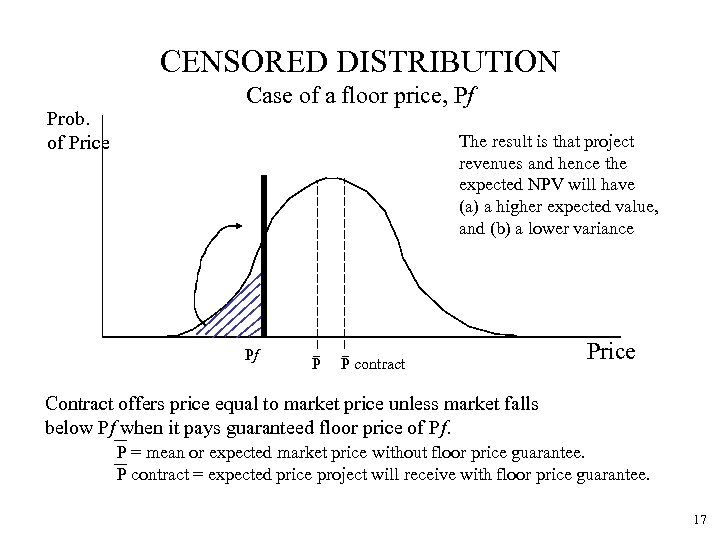 CENSORED DISTRIBUTION Prob. of Price Case of a floor price, Pf The result is that project revenues and hence the expected NPV will have (a) a higher expected value, and (b) a lower variance Pf P P contract Price Contract offers price equal to market price unless market falls below Pf when it pays guaranteed floor price of Pf. P = mean or expected market price without floor price guarantee. P contract = expected price project will receive with floor price guarantee. 17
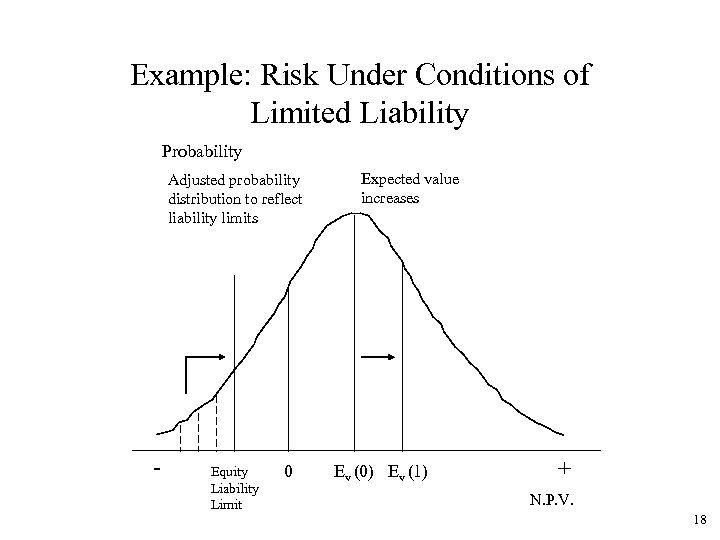 Example: Risk Under Conditions of Limited Liability Probability Adjusted probability distribution to reflect liability limits - Equity Liability Limit 0 Expected value increases Ev (0) Ev (1) + N. P. V. 18
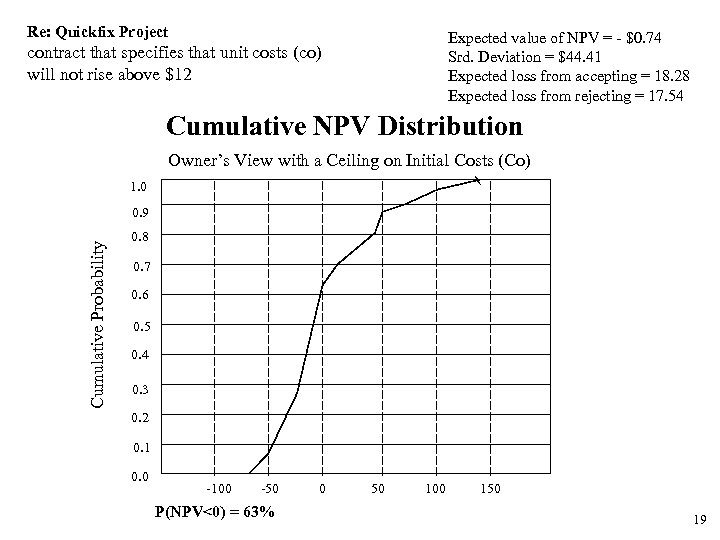 Re: Quickfix Project Expected value of NPV = - $0. 74 Srd. Deviation = $44. 41 Expected loss from accepting = 18. 28 Expected loss from rejecting = 17. 54 contract that specifies that unit costs (co) will not rise above $12 Cumulative NPV Distribution Owner’s View with a Ceiling on Initial Costs (Co) 1. 0 Cumulative Probability 0. 9 0. 8 0. 7 0. 6 0. 5 0. 4 0. 3 0. 2 0. 1 0. 0 -100 -50 P(NPV<0) = 63% 0 50 100 150 19
 Restructuring Intra-project Correlations • Risk-sharing contracts that reduce the risk borne by investors by increasing the correlation between sales revenue and some cost items, e. g. , • profit sharing contract with labor • bonds with interest rates indexed to the product’s sales price • Risk-sharing contracts that decrease the correlation between benefit items or alternatively between cost items. 20
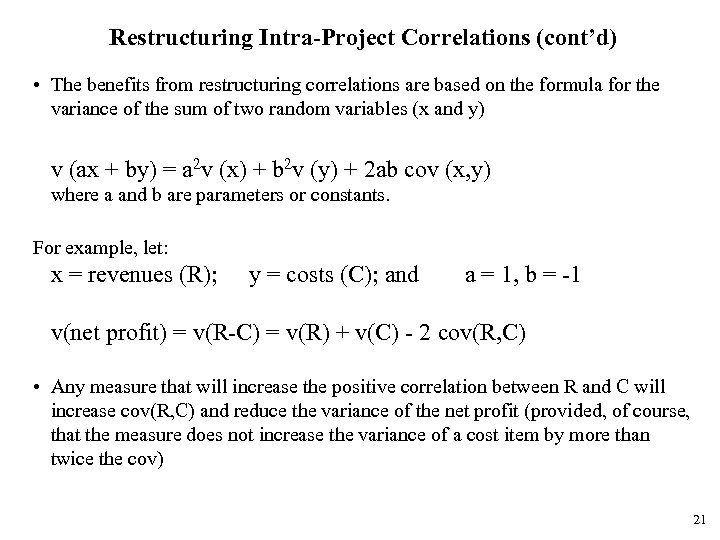 Restructuring Intra-Project Correlations (cont’d) • The benefits from restructuring correlations are based on the formula for the variance of the sum of two random variables (x and y) v (ax + by) = a 2 v (x) + b 2 v (y) + 2 ab cov (x, y) where a and b are parameters or constants. For example, let: x = revenues (R); y = costs (C); and a = 1, b = -1 v(net profit) = v(R-C) = v(R) + v(C) - 2 cov(R, C) • Any measure that will increase the positive correlation between R and C will increase cov(R, C) and reduce the variance of the net profit (provided, of course, that the measure does not increase the variance of a cost item by more than twice the cov) 21
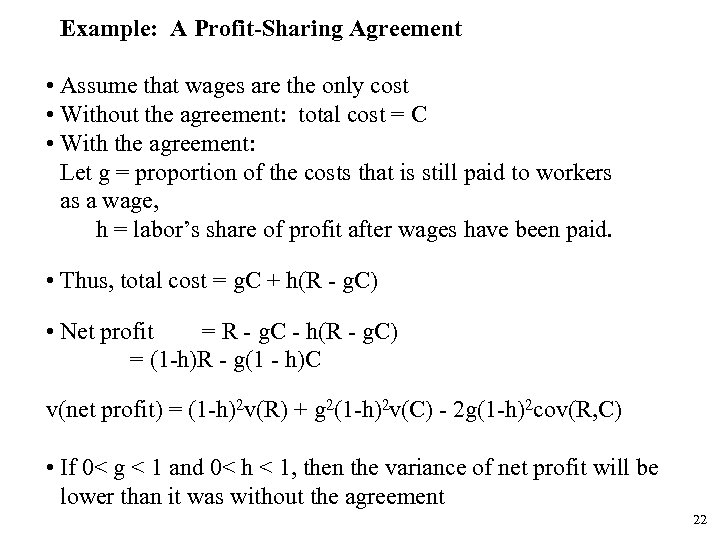 Example: A Profit-Sharing Agreement • Assume that wages are the only cost • Without the agreement: total cost = C • With the agreement: Let g = proportion of the costs that is still paid to workers as a wage, h = labor’s share of profit after wages have been paid. • Thus, total cost = g. C + h(R - g. C) • Net profit = R - g. C - h(R - g. C) = (1 -h)R - g(1 - h)C v(net profit) = (1 -h)2 v(R) + g 2(1 -h)2 v(C) - 2 g(1 -h)2 cov(R, C) • If 0< g < 1 and 0< h < 1, then the variance of net profit will be lower than it was without the agreement 22
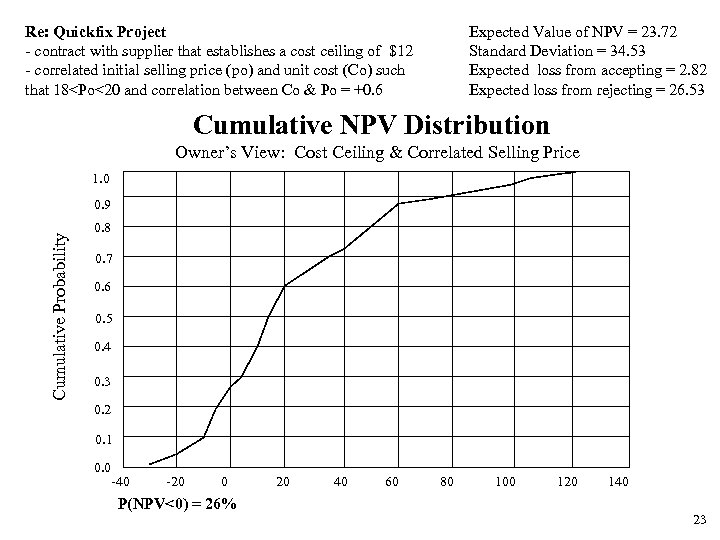 Re: Quickfix Project - contract with supplier that establishes a cost ceiling of $12 - correlated initial selling price (po) and unit cost (Co) such that 18
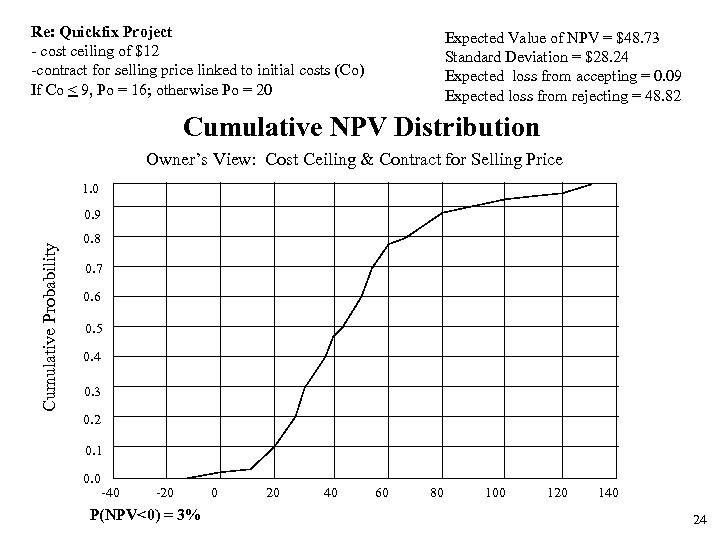 Re: Quickfix Project - cost ceiling of $12 -contract for selling price linked to initial costs (Co) If Co < 9, Po = 16; otherwise Po = 20 Expected Value of NPV = $48. 73 Standard Deviation = $28. 24 Expected loss from accepting = 0. 09 Expected loss from rejecting = 48. 82 Cumulative NPV Distribution Owner’s View: Cost Ceiling & Contract for Selling Price 1. 0 Cumulative Probability 0. 9 0. 8 0. 7 0. 6 0. 5 0. 4 0. 3 0. 2 0. 1 0. 0 -40 -20 P(NPV<0) = 3% 0 20 40 60 80 100 120 140 24
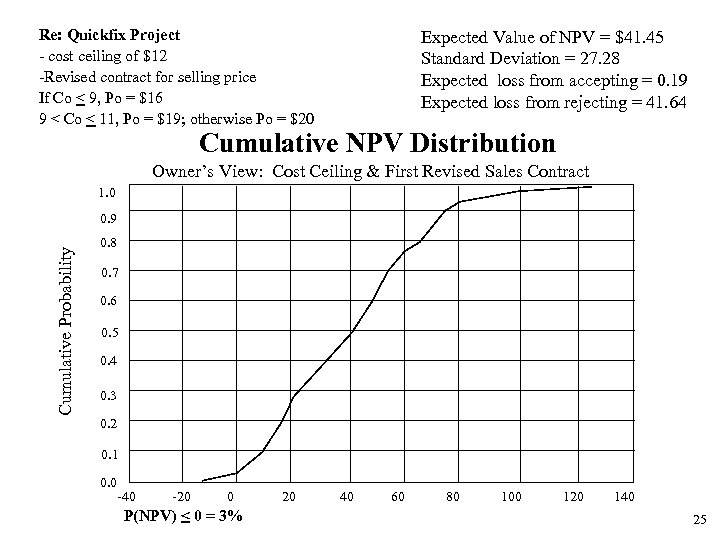 Re: Quickfix Project - cost ceiling of $12 -Revised contract for selling price If Co < 9, Po = $16 9 < Co < 11, Po = $19; otherwise Po = $20 Expected Value of NPV = $41. 45 Standard Deviation = 27. 28 Expected loss from accepting = 0. 19 Expected loss from rejecting = 41. 64 Cumulative NPV Distribution Owner’s View: Cost Ceiling & First Revised Sales Contract 1. 0 Cumulative Probability 0. 9 0. 8 0. 7 0. 6 0. 5 0. 4 0. 3 0. 2 0. 1 0. 0 -40 -20 0 P(NPV) < 0 = 3% 20 40 60 80 100 120 140 25
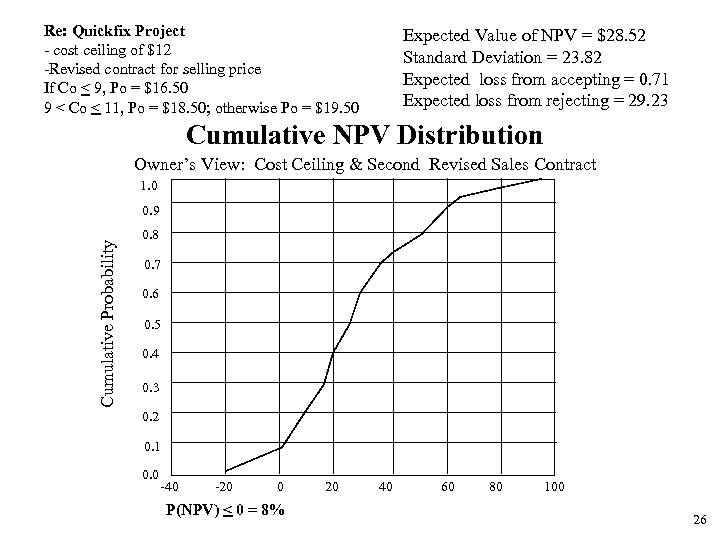 Re: Quickfix Project - cost ceiling of $12 -Revised contract for selling price If Co < 9, Po = $16. 50 9 < Co < 11, Po = $18. 50; otherwise Po = $19. 50 Expected Value of NPV = $28. 52 Standard Deviation = 23. 82 Expected loss from accepting = 0. 71 Expected loss from rejecting = 29. 23 Cumulative NPV Distribution Owner’s View: Cost Ceiling & Second Revised Sales Contract 1. 0 Cumulative Probability 0. 9 0. 8 0. 7 0. 6 0. 5 0. 4 0. 3 0. 2 0. 1 0. 0 -40 -20 0 P(NPV) < 0 = 8% 20 40 60 80 100 26
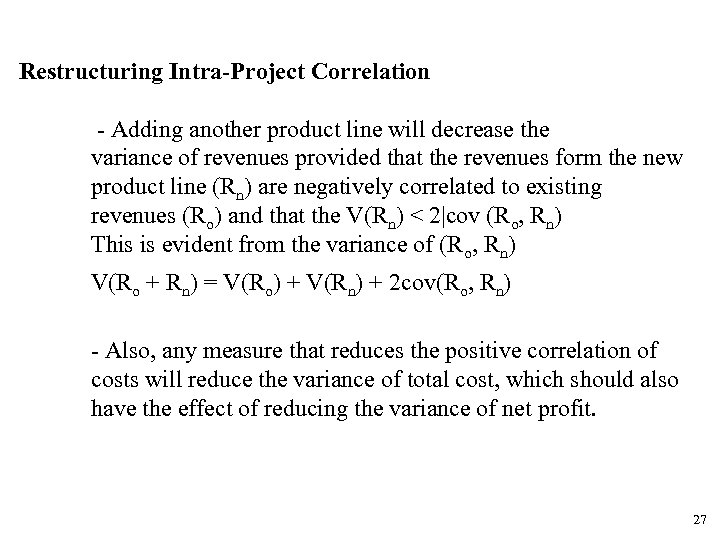 Restructuring Intra-Project Correlation - Adding another product line will decrease the variance of revenues provided that the revenues form the new product line (Rn) are negatively correlated to existing revenues (Ro) and that the V(Rn) < 2|cov (Ro, Rn) This is evident from the variance of (Ro, Rn) V(Ro + Rn) = V(Ro) + V(Rn) + 2 cov(Ro, Rn) - Also, any measure that reduces the positive correlation of costs will reduce the variance of total cost, which should also have the effect of reducing the variance of net profit. 27
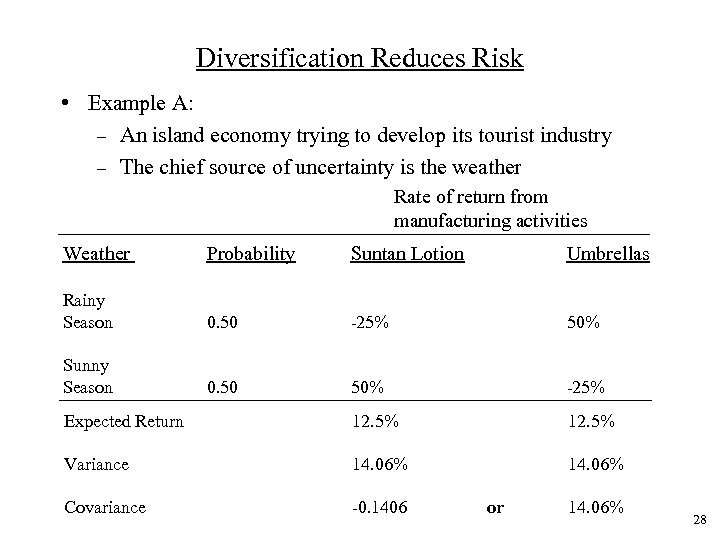 Diversification Reduces Risk • Example A: – An island economy trying to develop its tourist industry – The chief source of uncertainty is the weather Rate of return from manufacturing activities Weather Probability Suntan Lotion Umbrellas Rainy Season 0. 50 -25% 50% Sunny Season 0. 50 50% -25% Expected Return 12. 5% Variance 14. 06% Covariance -0. 1406 or 14. 06% 28
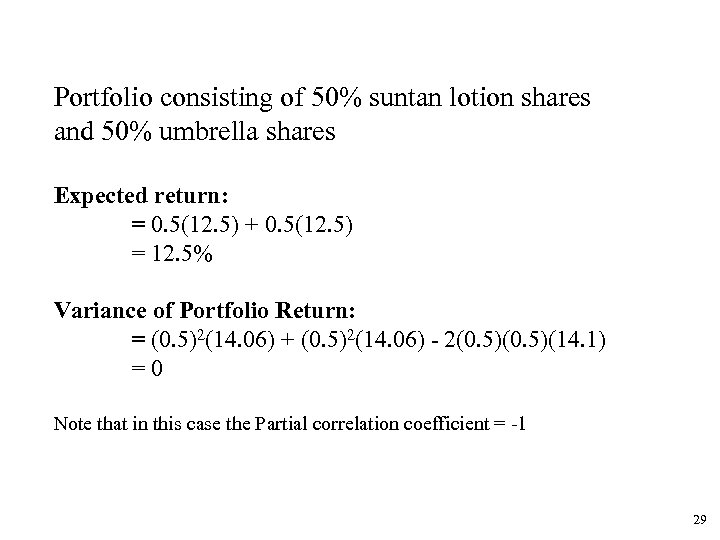 Portfolio consisting of 50% suntan lotion shares and 50% umbrella shares Expected return: = 0. 5(12. 5) + 0. 5(12. 5) = 12. 5% Variance of Portfolio Return: = (0. 5)2(14. 06) + (0. 5)2(14. 06) - 2(0. 5)(14. 1) =0 Note that in this case the Partial correlation coefficient = -1 29
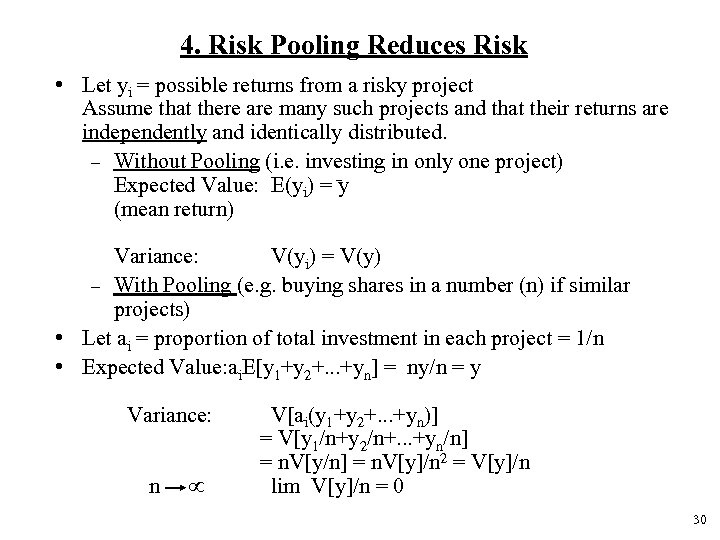 4. Risk Pooling Reduces Risk • Let yi = possible returns from a risky project Assume that there are many such projects and that their returns are independently and identically distributed. – Without Pooling (i. e. investing in only one project) Expected Value: E(yi) = y (mean return) Variance: V(yi) = V(y) – With Pooling (e. g. buying shares in a number (n) if similar projects) • Let ai = proportion of total investment in each project = 1/n • Expected Value: ai. E[y 1+y 2+. . . +yn] = ny/n = y Variance: n V[ai(y 1+y 2+. . . +yn)] = V[y 1/n+y 2/n+. . . +yn/n] = n. V[y]/n 2 = V[y]/n lim V[y]/n = 0 30
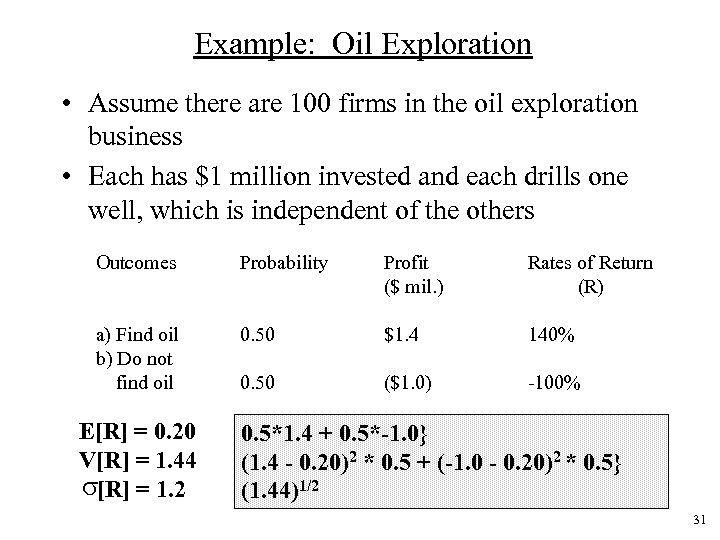 Example: Oil Exploration • Assume there are 100 firms in the oil exploration business • Each has $1 million invested and each drills one well, which is independent of the others Outcomes Probability Profit ($ mil. ) Rates of Return (R) a) Find oil b) Do not find oil 0. 50 $1. 4 140% 0. 50 ($1. 0) -100% E[R] = 0. 20 V[R] = 1. 44 [R] = 1. 2 0. 5*1. 4 + 0. 5*-1. 0} (1. 4 - 0. 20)2 * 0. 5 + (-1. 0 - 0. 20)2 * 0. 5} (1. 44)1/2 31
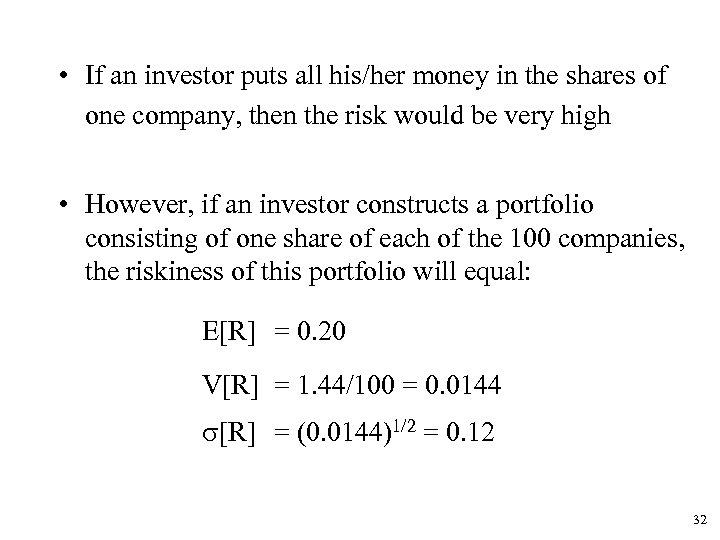 • If an investor puts all his/her money in the shares of one company, then the risk would be very high • However, if an investor constructs a portfolio consisting of one share of each of the 100 companies, the riskiness of this portfolio will equal: E[R] = 0. 20 V[R] = 1. 44/100 = 0. 0144 [R] = (0. 0144)1/2 = 0. 12 32
 Contracting Risks • Potential unilateral departures from contract terms by one party that jeopardizes the other party’s position • Examples – Downside Risks • • – Contractor walks away from project Government defaults on agreement if the share (of a smaller pie) going to the contractor is perceived to be too large Upside Risks • Government reduces payment to the contractor if the return is considered exorbitant – Uncertainty about whether contract terms will be fulfilled could result in costly gaming behavior 33
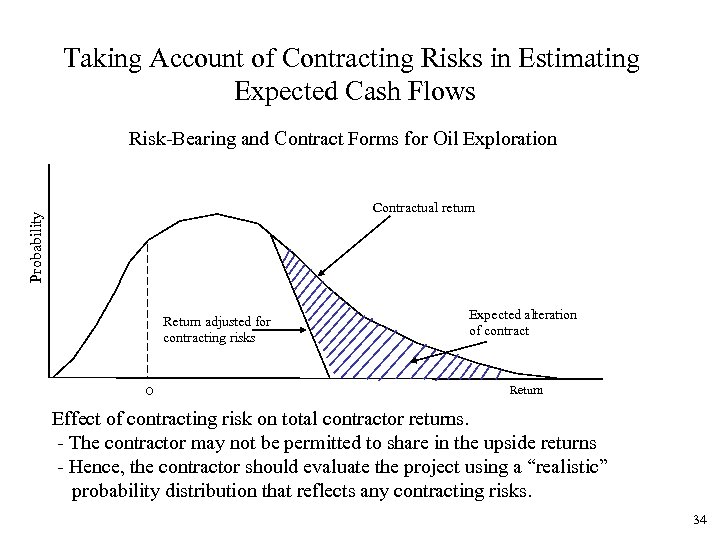 Taking Account of Contracting Risks in Estimating Expected Cash Flows Risk-Bearing and Contract Forms for Oil Exploration Probability Contractual return Return adjusted for contracting risks O Expected alteration of contract Return Effect of contracting risk on total contractor returns. - The contractor may not be permitted to share in the upside returns - Hence, the contractor should evaluate the project using a “realistic” probability distribution that reflects any contracting risks. 34
 Applications of Monte Carlo Simulation 35
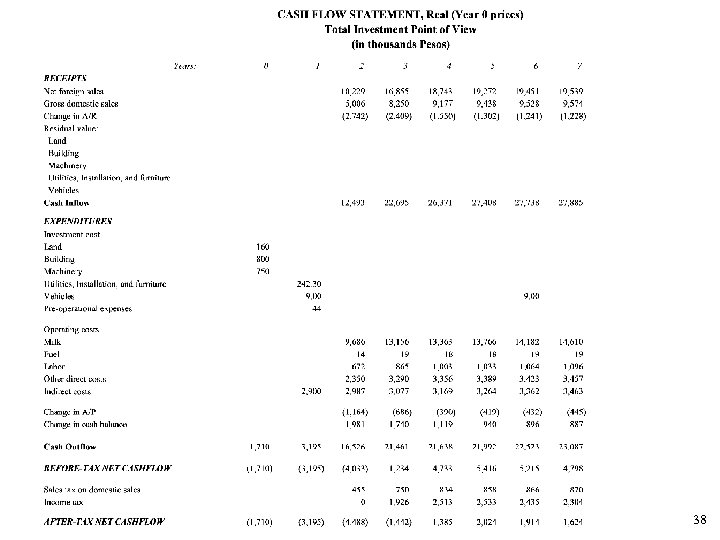
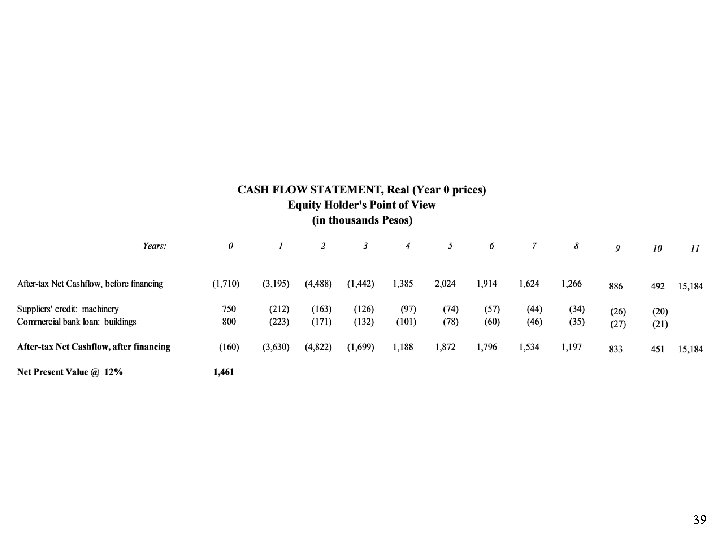
 Mexican Cheese Operation Queso OAXACA Inc. 1. Project to build cheese processing plant in Mexico. 2. Product sold 70 percent in the U. S. and 30 percent in Mexico 3. Investment of $2. 0 million pesos, financed by 23% equity and 77% debt 4. Initially loans and equity all from Mexican sources 5. Investment during first year, operations for a ten-year period. 6. No imported inputs 36
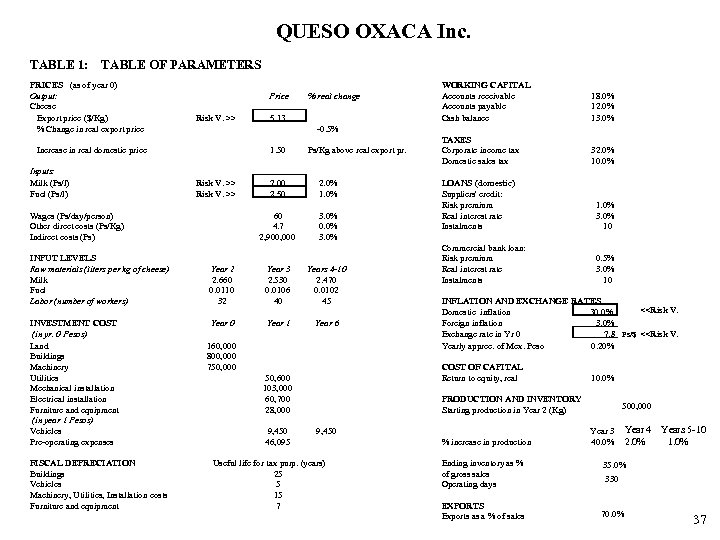 QUESO OXACA Inc. TABLE 1: TABLE OF PARAMETERS PRICES (as of year 0) Output: Cheese Export price ($/Kg) % Change in real export price Price Risk V. >> 1. 50 Risk V. >> INVESTMENT COST (in yr. 0 Pesos) Land Buildings Machinery Utilities Mechanical installation Electrical installation Furniture and equipment (in year 1 Pesos) Vehicles Pre-operating expenses FISCAL DEPRECIATION Buildings Vehicles Machinery, Utilities, Installation costs Furniture and equipment Ps/Kg above real export pr. 7. 00 2. 50 2. 0% 1. 0% 60 4. 7 2, 900, 000 Wages (Ps/day/person) Other direct costs (Ps/Kg) Indirect costs (Ps) INPUT LEVELS Raw materials (liters per kg of cheese) Milk Fuel Labor (number of workers) 5. 13 WORKING CAPITAL Accounts receivable Accounts payable Cash balance 18. 0% 12. 0% 13. 0% TAXES Corporate income tax Domestic sales tax 32. 0% 10. 0% LOANS (domestic) Suppliers' credit: Risk premium Real interest rate Instalments 1. 0% 3. 0% 10 Commercial bank loan: Risk premium Real interest rate Instalments 0. 5% 3. 0% 10 -0. 5% Increase in real domestic price Inputs: Milk (Ps/l) Fuel (Ps/l) % real change 3. 0% 0. 0% 3. 0% Year 2 2. 660 0. 0110 32 Year 3 2. 530 0. 0106 40 Years 4 -10 2. 470 0. 0102 45 Year 0 Year 1 Year 6 160, 000 800, 000 750, 000 COST OF CAPITAL Return to equity, real 50, 600 103, 000 60, 700 28, 000 9, 450 46, 095 INFLATION AND EXCHANGE RATES <
 38
38
 39
39
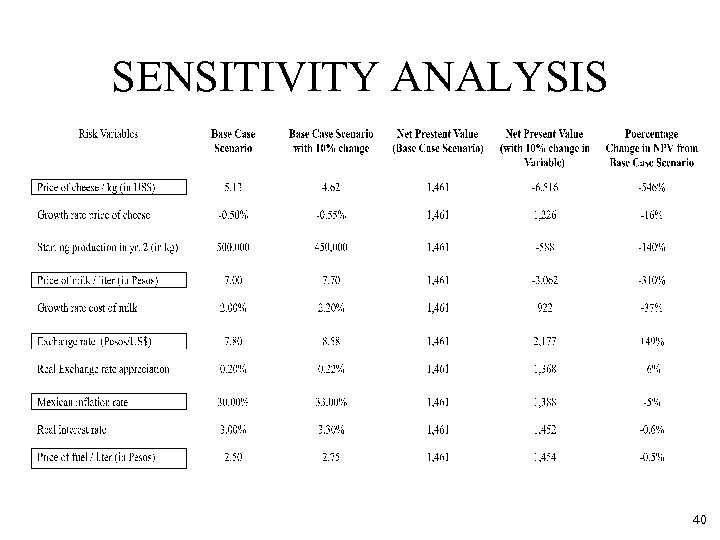 SENSITIVITY ANALYSIS 40
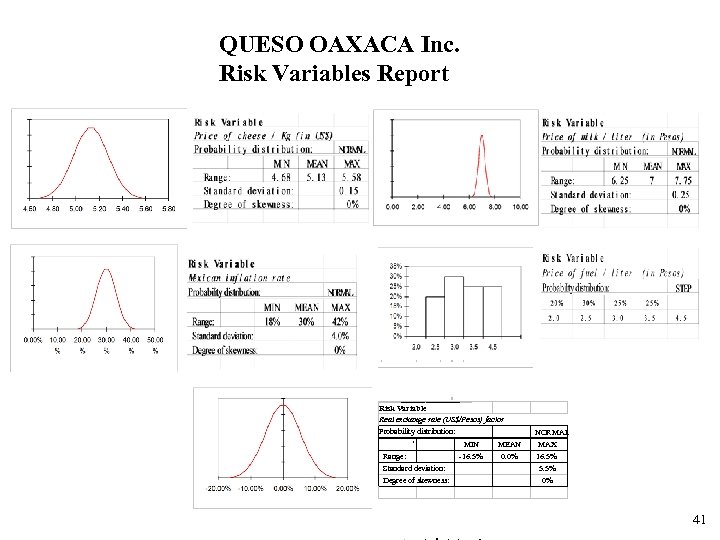 QUESO OAXACA Inc. Risk Variables Report Risk Variable Real exchange rate (US$/Pesos) factor Probability distribution: Range: Standard deviation: Degree of skewness: MIN -16. 5% MEAN 0. 0% NORMAL MAX 16. 5% 5. 5% 0% 41
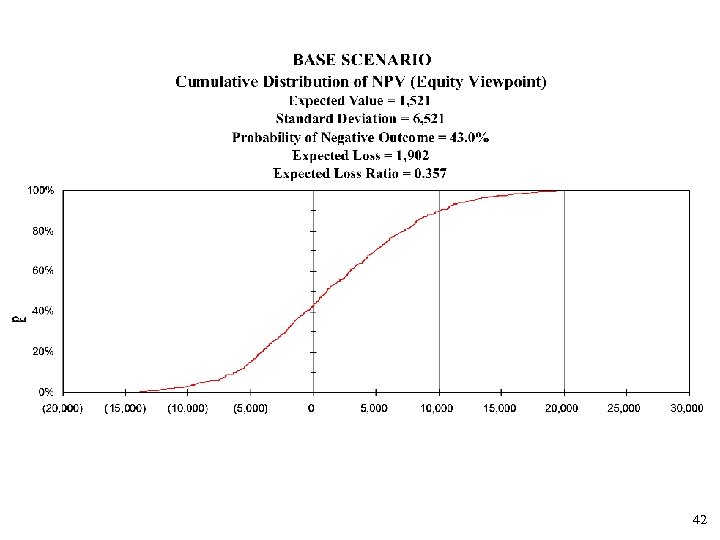 42
42
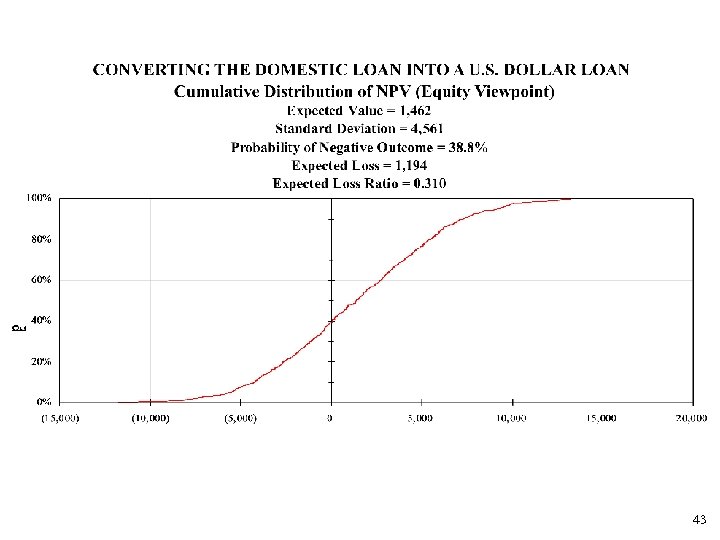 43
43
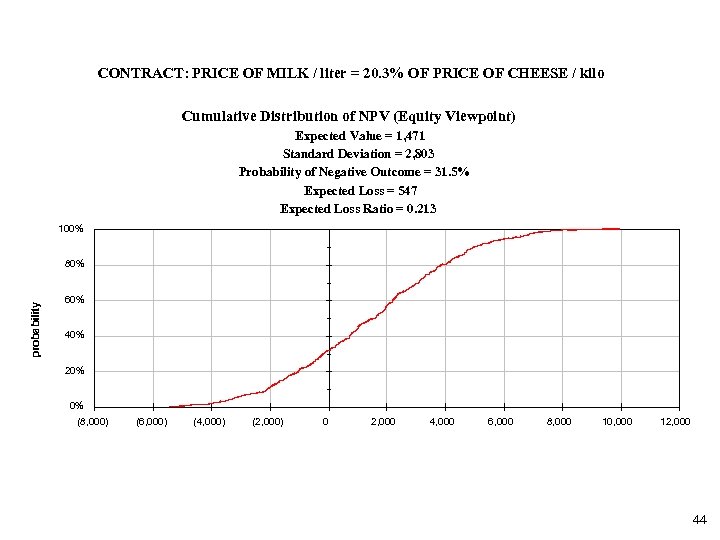 CONTRACT: PRICE OF MILK / liter = 20. 3% OF PRICE OF CHEESE / kilo Cumulative Distribution of NPV (Equity Viewpoint) Expected Value = 1, 471 Standard Deviation = 2, 803 Probability of Negative Outcome = 31. 5% Expected Loss = 547 Expected Loss Ratio = 0. 213 100% probability 80% 60% 40% 20% 0% (8, 000) (6, 000) (4, 000) (2, 000) 0 2, 000 4, 000 6, 000 8, 000 10, 000 12, 000 44
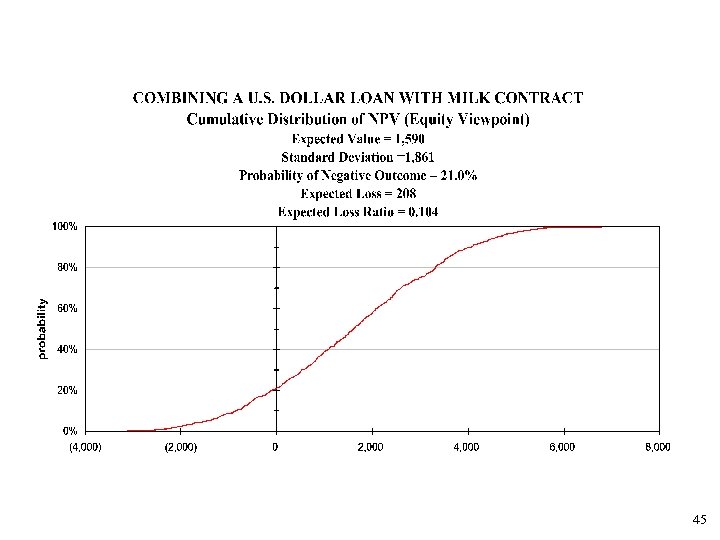 45
45
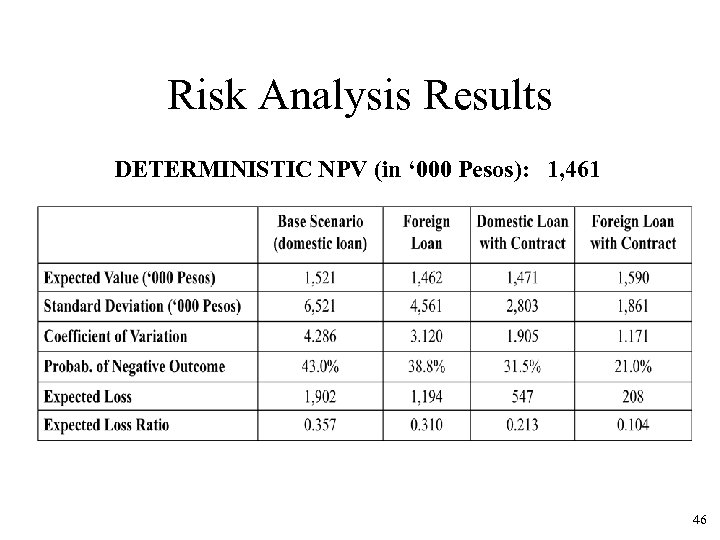 Risk Analysis Results DETERMINISTIC NPV (in ‘ 000 Pesos): 1, 461 46
 Input Variable Distributions Concessions and Contracts • Impact on the expected value of outcome • Impact on the standard deviation of outcome 47
 It’s all about Garbage In, Garbage Out 48
 Impact of Input Specification on Output of Monte Carlo Analysis Oil Speculation Project • Buy a barrel of oil today and sell it in a year's time • Today's price (P 0) is certain $20 • Next Year's price (P 1) is uncertain Steps: 1) What is the RANGE of possible values? – Minimum value: Zero probability of being below $10 – Maximum value: Zero probability of being higher than $60 2) What is the PROBABILITY of finding values between these extremes? 49
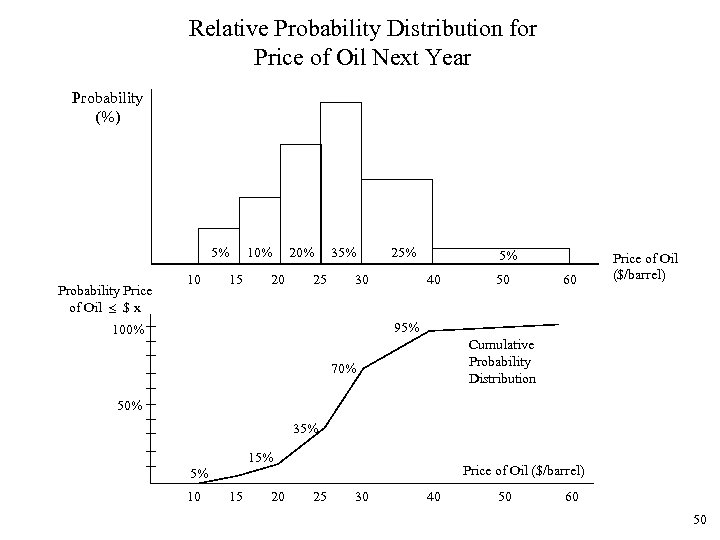 Relative Probability Distribution for Price of Oil Next Year Probability (%) 5% Probability Price of Oil $ x 100% 10 15 10% 20 20% 25 35% 25% 30 5% 40 50 60 Price of Oil ($/barrel) 95% Cumulative Probability Distribution 70% 50% 35% 15% Price of Oil ($/barrel) 5% 10 15 20 25 30 40 50 60 50
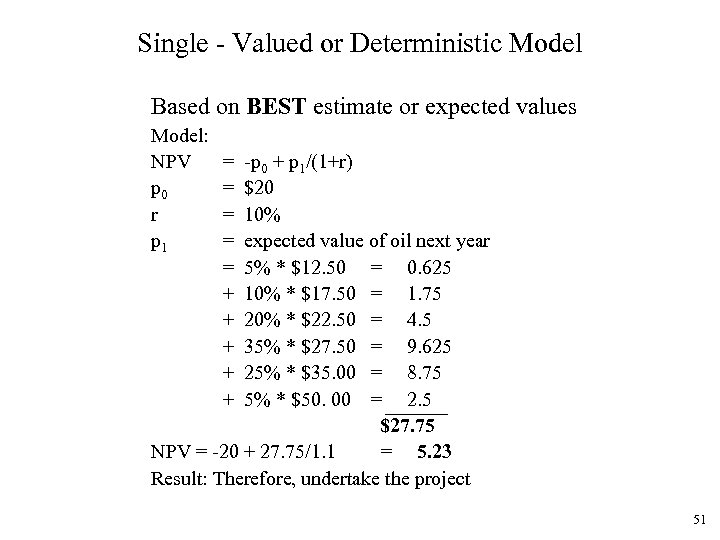 Single - Valued or Deterministic Model Based on BEST estimate or expected values Model: NPV p 0 r p 1 = = = + + + -p 0 + p 1/(1+r) $20 10% expected value of oil next year 5% * $12. 50 = 0. 625 10% * $17. 50 = 1. 75 20% * $22. 50 = 4. 5 35% * $27. 50 = 9. 625 25% * $35. 00 = 8. 75 5% * $50. 00 = 2. 5 $27. 75 NPV = -20 + 27. 75/1. 1 = 5. 23 Result: Therefore, undertake the project 51
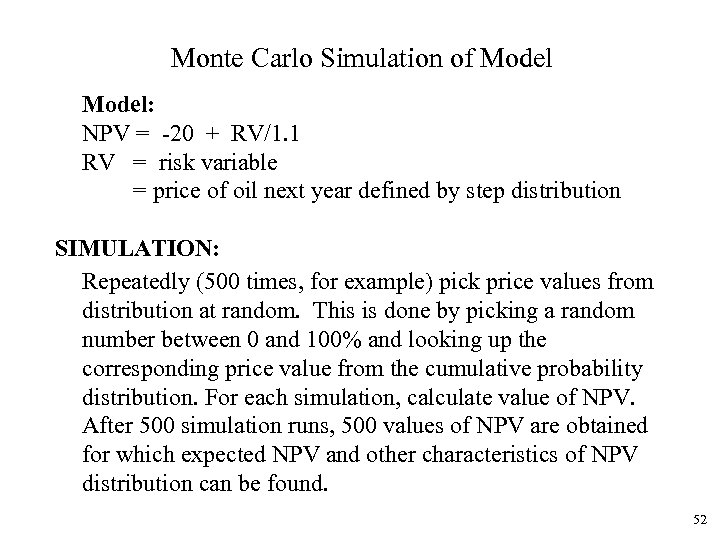 Monte Carlo Simulation of Model: NPV = -20 + RV/1. 1 RV = risk variable = price of oil next year defined by step distribution SIMULATION: Repeatedly (500 times, for example) pick price values from distribution at random. This is done by picking a random number between 0 and 100% and looking up the corresponding price value from the cumulative probability distribution. For each simulation, calculate value of NPV. After 500 simulation runs, 500 values of NPV are obtained for which expected NPV and other characteristics of NPV distribution can be found. 52
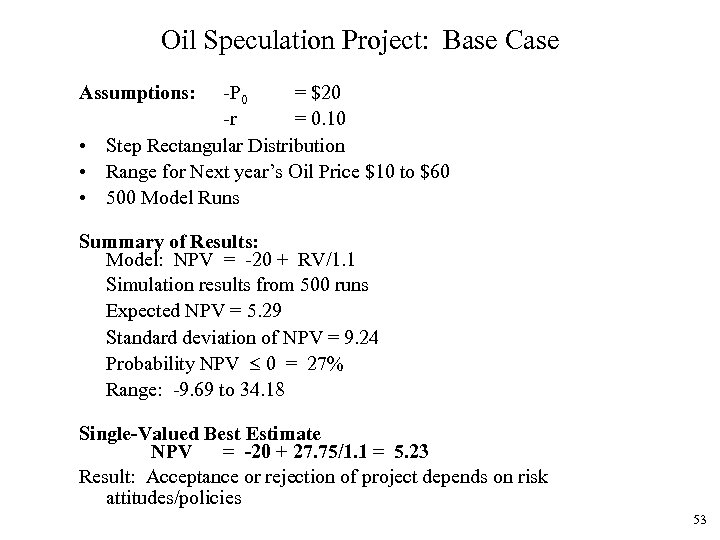 Oil Speculation Project: Base Case Assumptions: -P 0 = $20 -r = 0. 10 • Step Rectangular Distribution • Range for Next year’s Oil Price $10 to $60 • 500 Model Runs Summary of Results: Model: NPV = -20 + RV/1. 1 Simulation results from 500 runs Expected NPV = 5. 29 Standard deviation of NPV = 9. 24 Probability NPV 0 = 27% Range: -9. 69 to 34. 18 Single-Valued Best Estimate NPV = -20 + 27. 75/1. 1 = 5. 23 Result: Acceptance or rejection of project depends on risk attitudes/policies 53
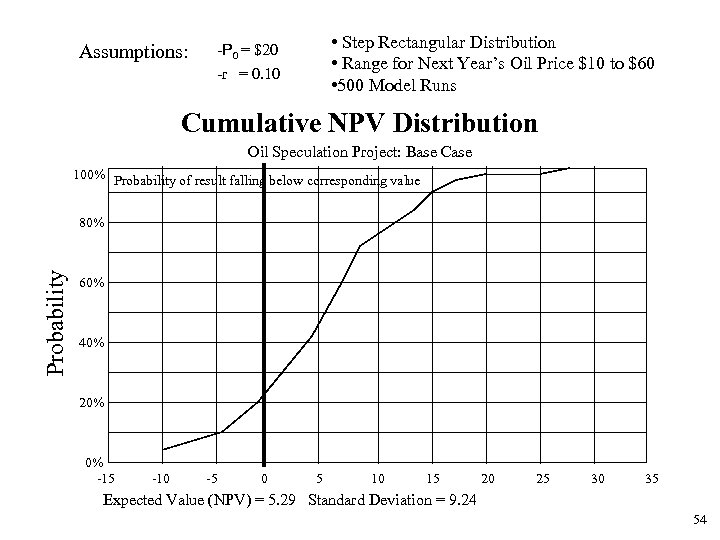 Assumptions: • Step Rectangular Distribution • Range for Next Year’s Oil Price $10 to $60 • 500 Model Runs -P 0 = $20 -r = 0. 10 Cumulative NPV Distribution Oil Speculation Project: Base Case 100% Probability of result falling below corresponding value Probability 80% 60% 40% 20% 0% -15 -10 -5 0 5 10 15 20 25 30 35 Expected Value (NPV) = 5. 29 Standard Deviation = 9. 24 54
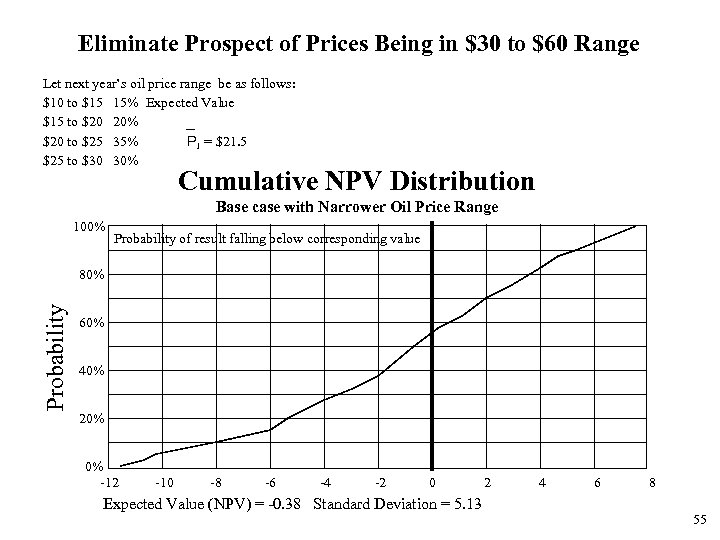 Eliminate Prospect of Prices Being in $30 to $60 Range Let next year’s oil price range be as follows: $10 to $15 15% Expected Value $15 to $20 20% $20 to $25 35% P 1 = $21. 5 $25 to $30 30% Cumulative NPV Distribution Base case with Narrower Oil Price Range 100% Probability of result falling below corresponding value Probability 80% 60% 40% 20% 0% -12 -10 -8 -6 -4 -2 0 Expected Value (NPV) = -0. 38 Standard Deviation = 5. 13 2 4 6 8 55
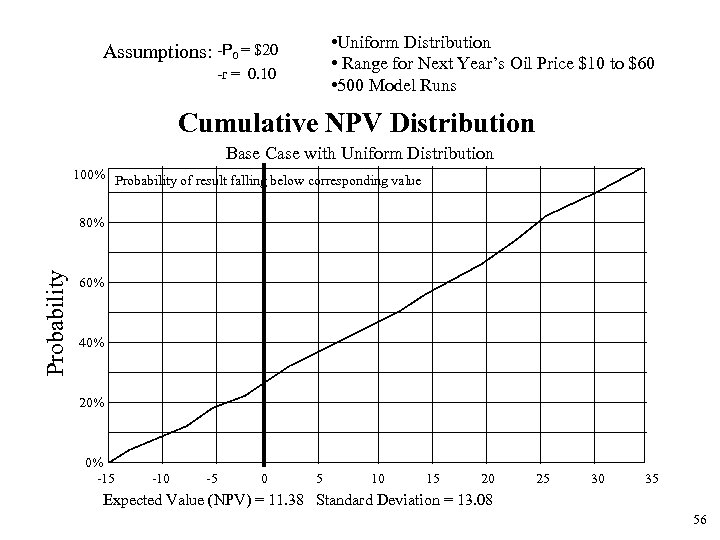 • Uniform Distribution • Range for Next Year’s Oil Price $10 to $60 • 500 Model Runs Assumptions: -P 0 = $20 -r = 0. 10 Cumulative NPV Distribution Base Case with Uniform Distribution 100% Probability of result falling below corresponding value Probability 80% 60% 40% 20% 0% -15 -10 -5 0 5 10 15 20 25 30 35 Expected Value (NPV) = 11. 38 Standard Deviation = 13. 08 56
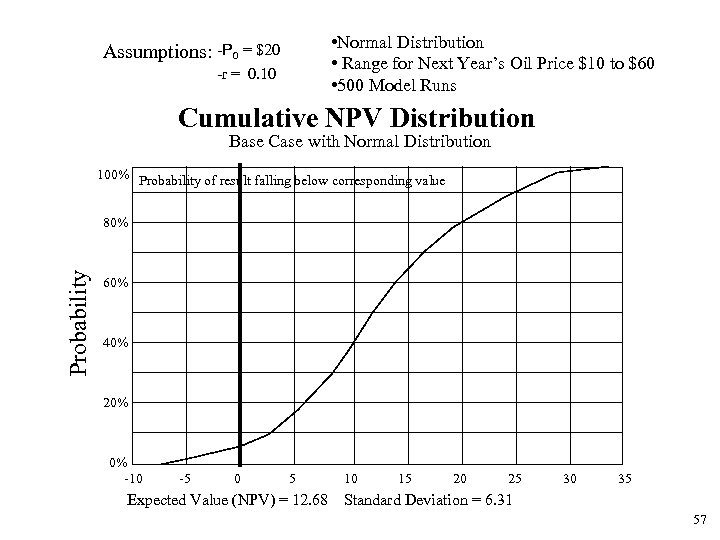 • Normal Distribution • Range for Next Year’s Oil Price $10 to $60 • 500 Model Runs Assumptions: -P 0 = $20 -r = 0. 10 Cumulative NPV Distribution Base Case with Normal Distribution 100% Probability of result falling below corresponding value Probability 80% 60% 40% 20% 0% -10 -5 0 5 Expected Value (NPV) = 12. 68 10 15 20 25 30 35 Standard Deviation = 6. 31 57
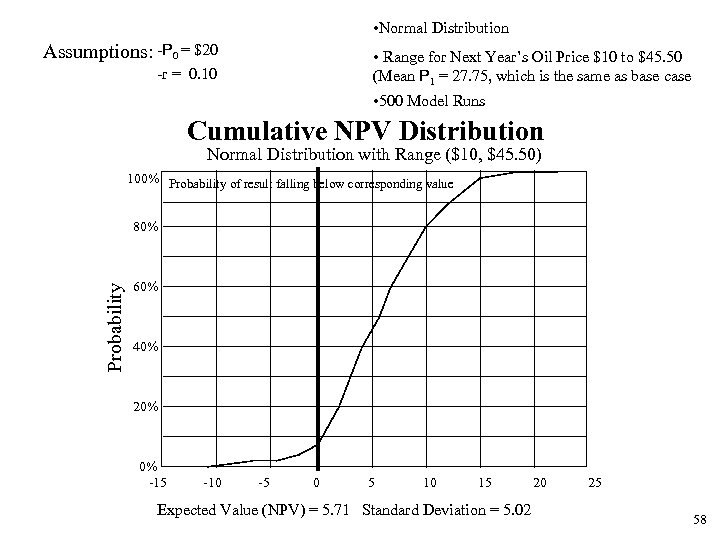 • Normal Distribution Assumptions: -P 0 = $20 • Range for Next Year’s Oil Price $10 to $45. 50 (Mean P 1 = 27. 75, which is the same as base case -r = 0. 10 • 500 Model Runs Cumulative NPV Distribution Normal Distribution with Range ($10, $45. 50) 100% Probability of result falling below corresponding value Probability 80% 60% 40% 20% 0% -15 -10 -5 0 5 10 15 Expected Value (NPV) = 5. 71 Standard Deviation = 5. 02 20 25 58
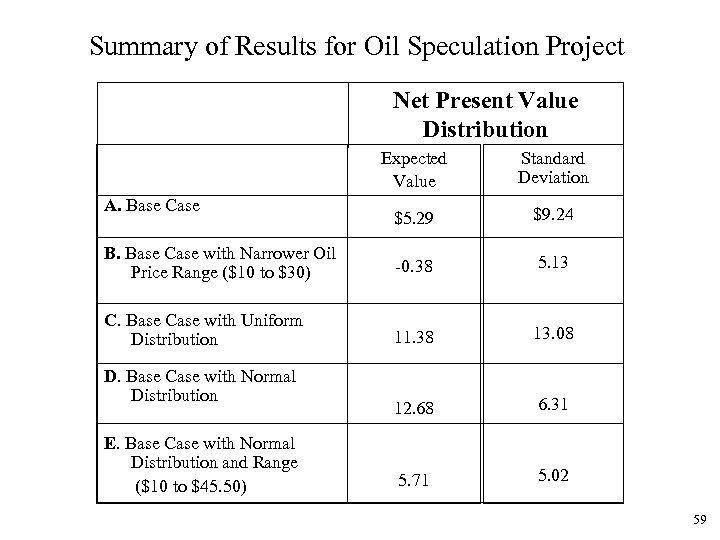 Summary of Results for Oil Speculation Project Net Present Value Distribution Expected Value Standard Deviation $5. 29 $9. 24 B. Base Case with Narrower Oil Price Range ($10 to $30) -0. 38 5. 13 C. Base Case with Uniform Distribution 11. 38 13. 08 12. 68 6. 31 5. 71 5. 02 A. Base Case D. Base Case with Normal Distribution E. Base Case with Normal Distribution and Range ($10 to $45. 50) 59
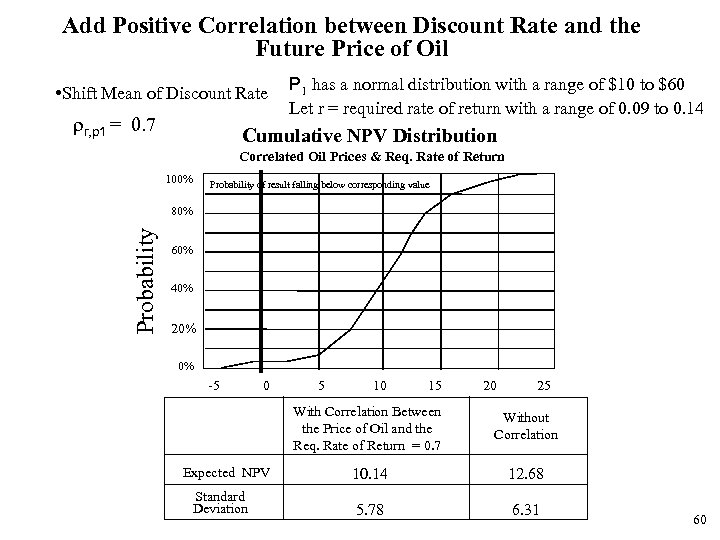 Add Positive Correlation between Discount Rate and the Future Price of Oil • Shift Mean of Discount Rate r, p 1 = 0. 7 P 1 has a normal distribution with a range of $10 to $60 Let r = required rate of return with a range of 0. 09 to 0. 14 Cumulative NPV Distribution Correlated Oil Prices & Req. Rate of Return 100% Probability of result falling below corresponding value Probability 80% 60% 40% 20% 0% -5 0 5 10 15 20 25 With Correlation Between the Price of Oil and the Req. Rate of Return = 0. 7 Expected NPV Standard Deviation Without Correlation 10. 14 12. 68 5. 78 6. 31 60
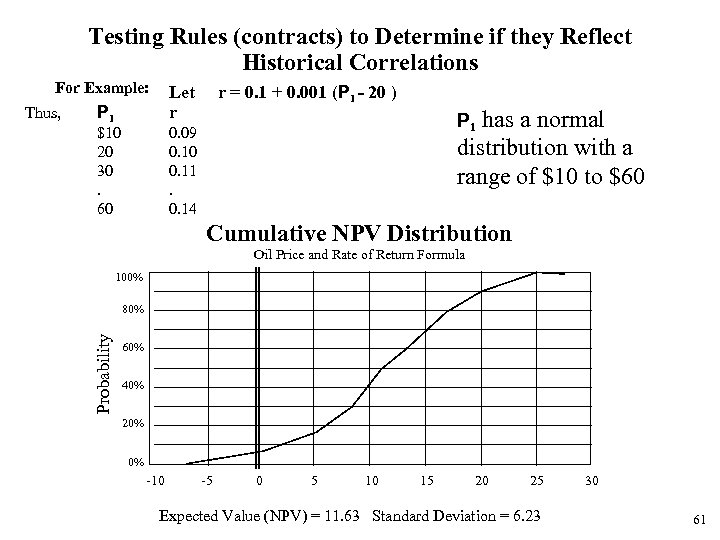 Testing Rules (contracts) to Determine if they Reflect Historical Correlations For Example: P 1 $10 20 30. 60 r = 0. 1 + 0. 001 (P 1 - 20 ) has a normal distribution with a range of $10 to $60 P 1 0. 09 0. 10 0. 11. 0. 14 Cumulative NPV Distribution Oil Price and Rate of Return Formula 100% 80% Probability Thus, Let r 60% 40% 20% 0% -10 -5 0 5 10 15 20 25 Expected Value (NPV) = 11. 63 Standard Deviation = 6. 23 30 61
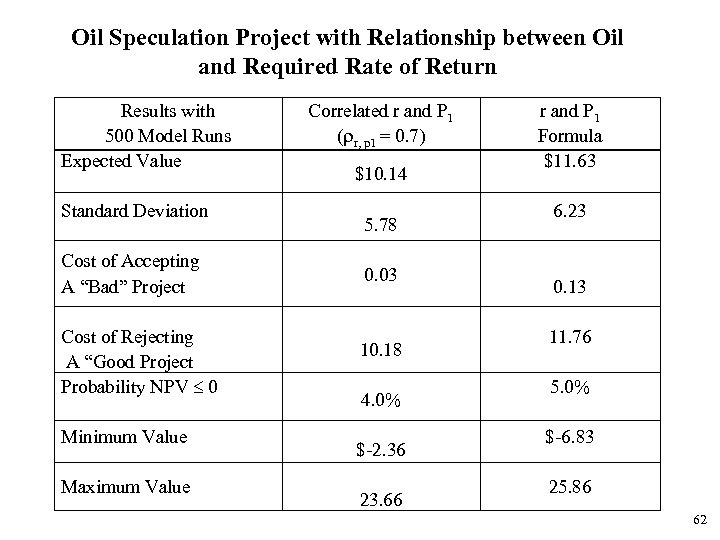 Oil Speculation Project with Relationship between Oil and Required Rate of Return Results with 500 Model Runs Expected Value Standard Deviation Cost of Accepting A “Bad” Project Cost of Rejecting A “Good Project Probability NPV 0 Minimum Value Maximum Value Correlated r and P 1 ( r, p 1 = 0. 7) $10. 14 5. 78 0. 03 10. 18 4. 0% $-2. 36 23. 66 r and P 1 Formula $11. 63 6. 23 0. 13 11. 76 5. 0% $-6. 83 25. 86 62