


 Скачать презентацию Update Report on Current Upcoming District State Assessments
dd27d4629e9832d90819ee5c191bf0d3.ppt
- Количество слайдов: 53

 Update Report on Current & Upcoming District/State Assessments Standing Committee March 11, 2014
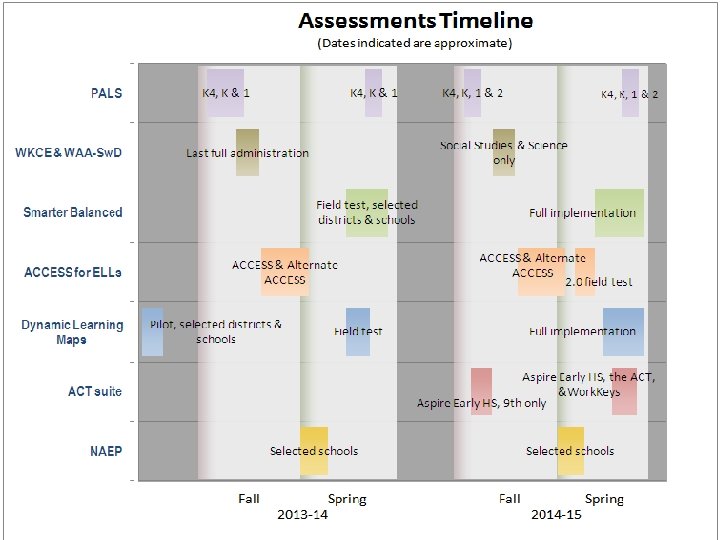
 Agenda • DPI Agenda • Migration to Technology Enhanced and/or Adaptive Assessments • State Assessments • District Assessments • Available Accommodations • Logistics & Concerns • Preparation
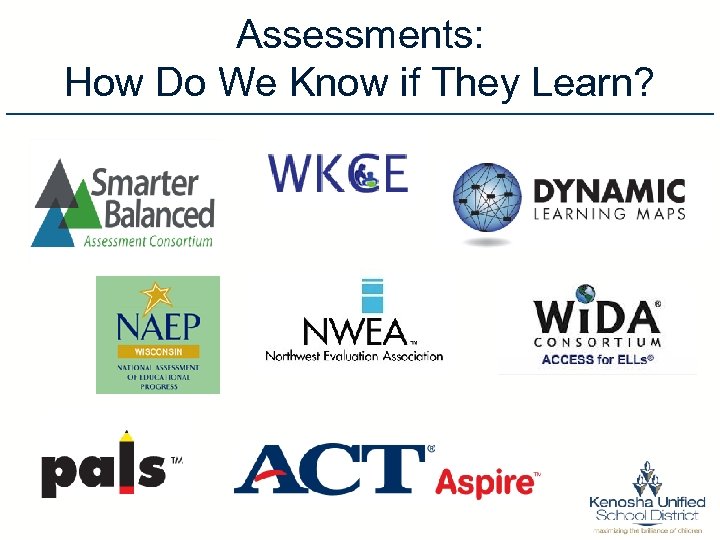 Assessments: How Do We Know if They Learn?
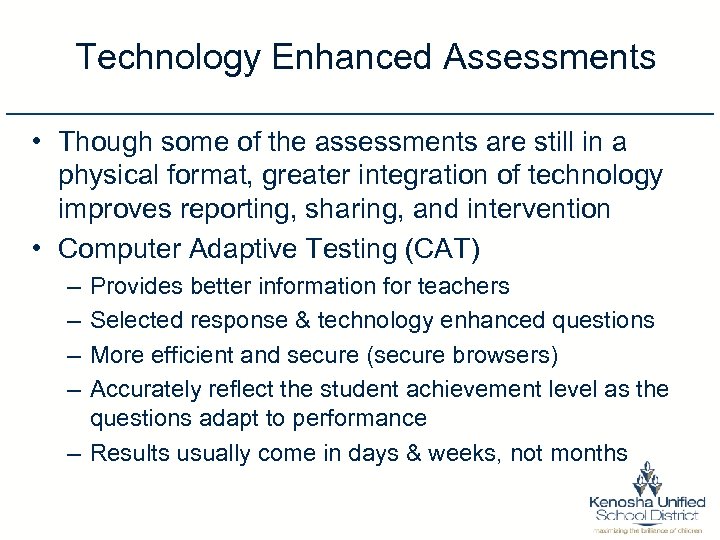 Technology Enhanced Assessments • Though some of the assessments are still in a physical format, greater integration of technology improves reporting, sharing, and intervention • Computer Adaptive Testing (CAT) – – Provides better information for teachers Selected response & technology enhanced questions More efficient and secure (secure browsers) Accurately reflect the student achievement level as the questions adapt to performance – Results usually come in days & weeks, not months
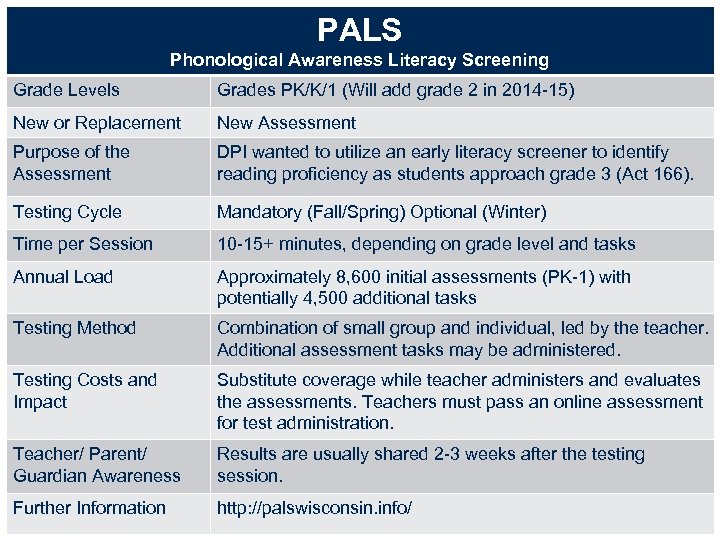 PALS Phonological Awareness Literacy Screening Grade Levels Grades PK/K/1 (Will add grade 2 in 2014 -15) New or Replacement New Assessment Purpose of the Assessment DPI wanted to utilize an early literacy screener to identify reading proficiency as students approach grade 3 (Act 166). Testing Cycle Mandatory (Fall/Spring) Optional (Winter) Time per Session 10 -15+ minutes, depending on grade level and tasks Annual Load Approximately 8, 600 initial assessments (PK-1) with potentially 4, 500 additional tasks Testing Method Combination of small group and individual, led by the teacher. Additional assessment tasks may be administered. Testing Costs and Impact Substitute coverage while teacher administers and evaluates the assessments. Teachers must pass an online assessment for test administration. Teacher/ Parent/ Guardian Awareness Results are usually shared 2 -3 weeks after the testing session. Further Information http: //palswisconsin. info/
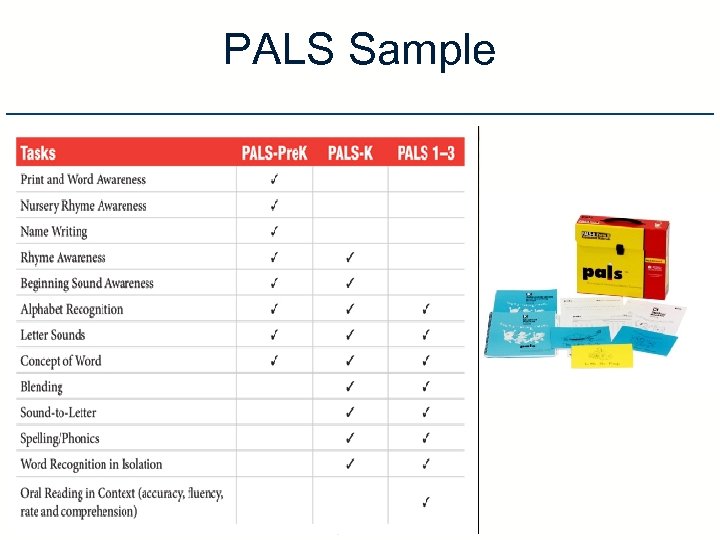 PALS Sample
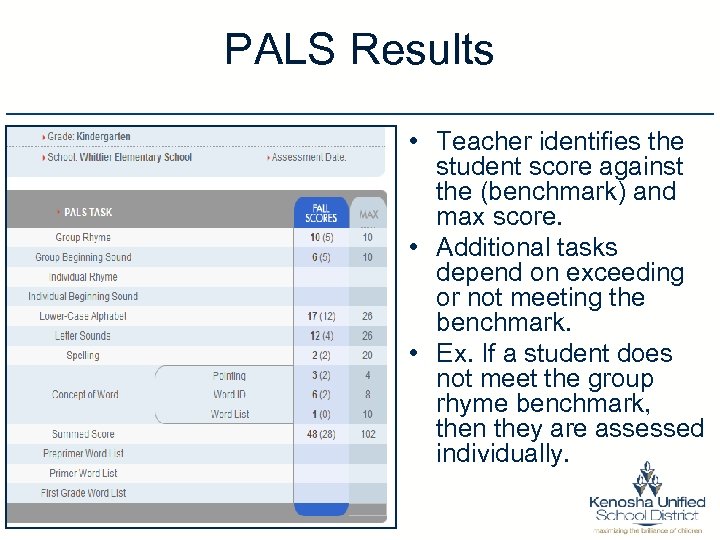 PALS Results • Teacher identifies the student score against the (benchmark) and max score. • Additional tasks depend on exceeding or not meeting the benchmark. • Ex. If a student does not meet the group rhyme benchmark, then they are assessed individually.
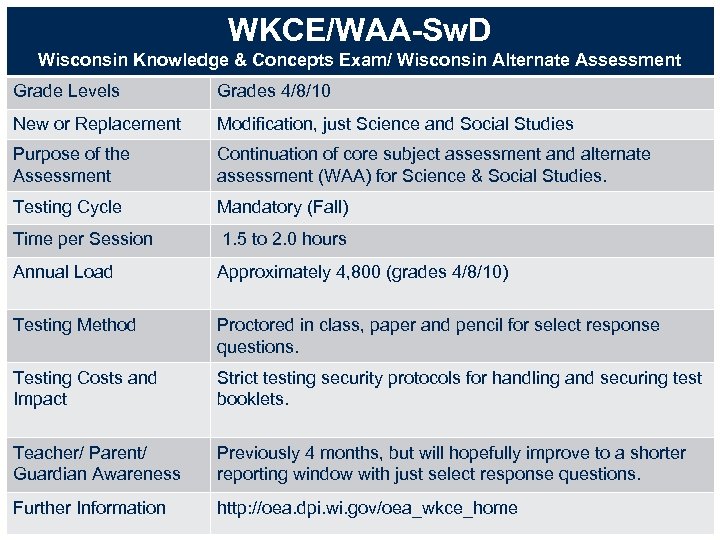 WKCE/WAA-Sw. D Wisconsin Knowledge & Concepts Exam/ Wisconsin Alternate Assessment Grade Levels Grades 4/8/10 New or Replacement Modification, just Science and Social Studies Purpose of the Assessment Continuation of core subject assessment and alternate assessment (WAA) for Science & Social Studies. Testing Cycle Mandatory (Fall) Time per Session 1. 5 to 2. 0 hours Annual Load Approximately 4, 800 (grades 4/8/10) Testing Method Proctored in class, paper and pencil for select response questions. Testing Costs and Impact Strict testing security protocols for handling and securing test booklets. Teacher/ Parent/ Guardian Awareness Previously 4 months, but will hopefully improve to a shorter reporting window with just select response questions. Further Information http: //oea. dpi. wi. gov/oea_wkce_home
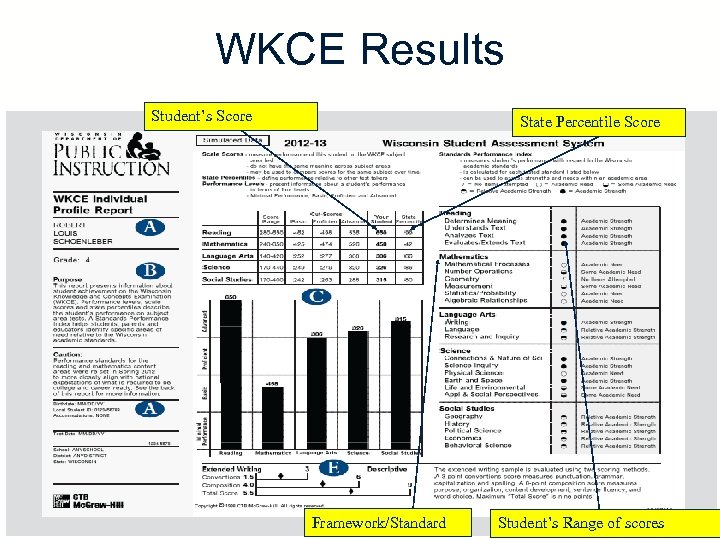 WKCE Results Student’s Score State Percentile Score Framework/Standard Student’s Range of scores
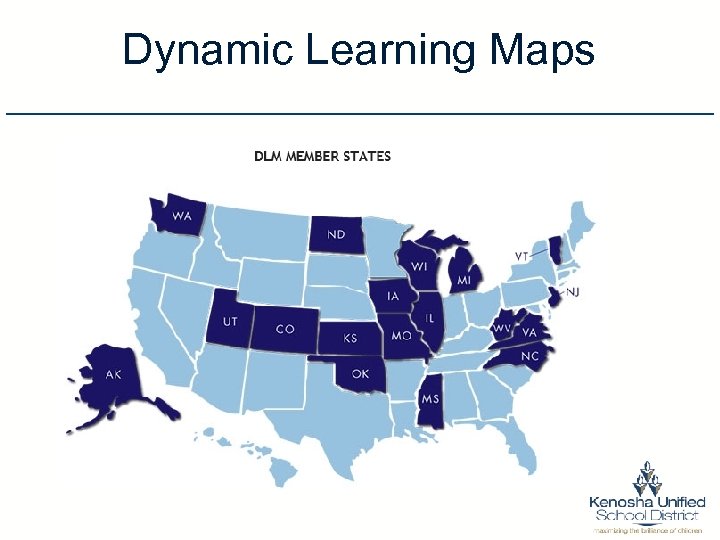 Dynamic Learning Maps
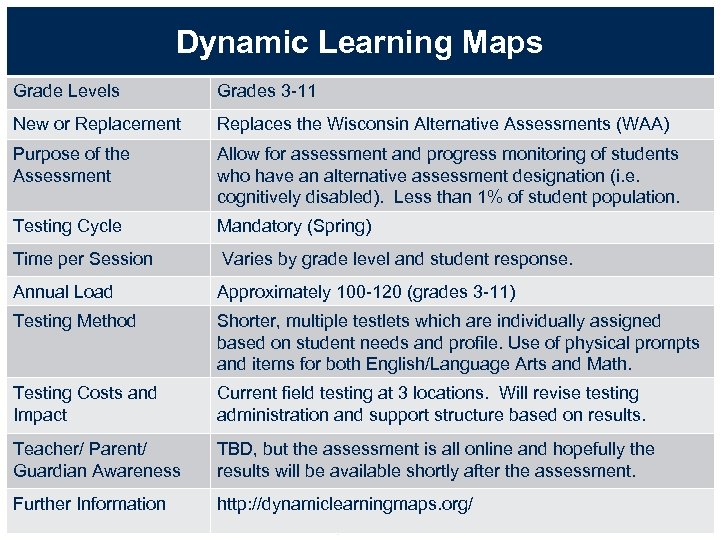 Dynamic Learning Maps Grade Levels Grades 3 -11 New or Replacement Replaces the Wisconsin Alternative Assessments (WAA) Purpose of the Assessment Allow for assessment and progress monitoring of students who have an alternative assessment designation (i. e. cognitively disabled). Less than 1% of student population. Testing Cycle Mandatory (Spring) Time per Session Varies by grade level and student response. Annual Load Approximately 100 -120 (grades 3 -11) Testing Method Shorter, multiple testlets which are individually assigned based on student needs and profile. Use of physical prompts and items for both English/Language Arts and Math. Testing Costs and Impact Current field testing at 3 locations. Will revise testing administration and support structure based on results. Teacher/ Parent/ Guardian Awareness TBD, but the assessment is all online and hopefully the results will be available shortly after the assessment. Further Information http: //dynamiclearningmaps. org/
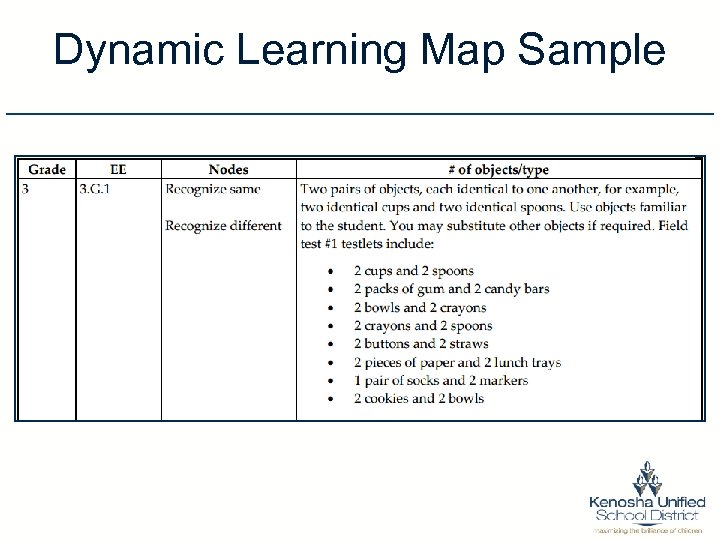 Dynamic Learning Map Sample
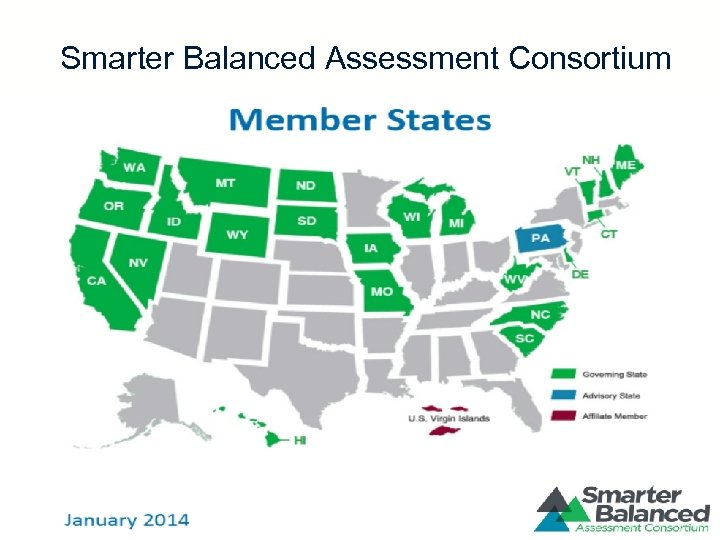 Smarter Balanced Assessment Consortium
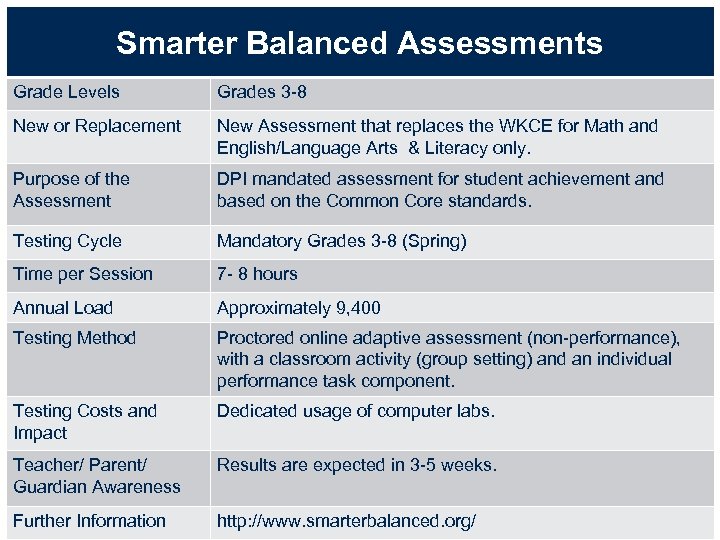 Smarter Balanced Assessments Grade Levels Grades 3 -8 New or Replacement New Assessment that replaces the WKCE for Math and English/Language Arts & Literacy only. Purpose of the Assessment DPI mandated assessment for student achievement and based on the Common Core standards. Testing Cycle Mandatory Grades 3 -8 (Spring) Time per Session 7 - 8 hours Annual Load Approximately 9, 400 Testing Method Proctored online adaptive assessment (non-performance), with a classroom activity (group setting) and an individual performance task component. Testing Costs and Impact Dedicated usage of computer labs. Teacher/ Parent/ Guardian Awareness Results are expected in 3 -5 weeks. Further Information http: //www. smarterbalanced. org/
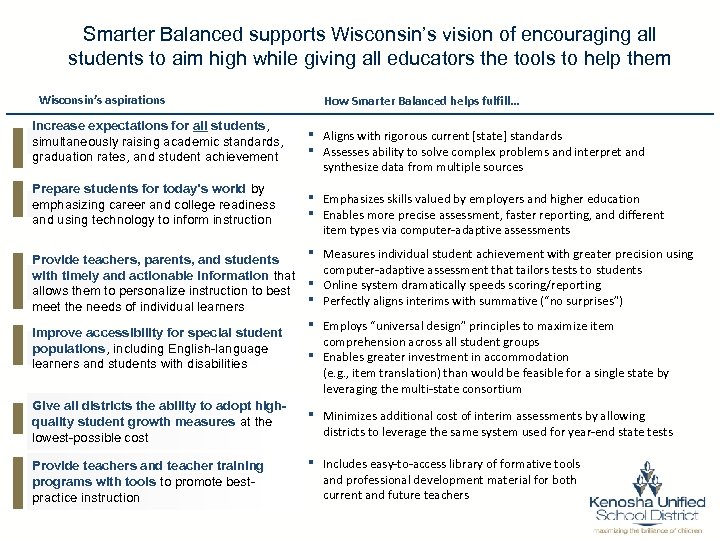 Smarter Balanced supports Wisconsin’s vision of encouraging all students to aim high while giving all educators the tools to help them Wisconsin’s aspirations How Smarter Balanced helps fulfill… Increase expectations for all students, simultaneously raising academic standards, graduation rates, and student achievement ▪ ▪ Aligns with rigorous current [state] standards Assesses ability to solve complex problems and interpret and synthesize data from multiple sources Prepare students for today’s world by emphasizing career and college readiness and using technology to inform instruction ▪ ▪ Emphasizes skills valued by employers and higher education Enables more precise assessment, faster reporting, and different item types via computer-adaptive assessments ▪ Measures individual student achievement with greater precision using computer-adaptive assessment that tailors tests to students Online system dramatically speeds scoring/reporting Perfectly aligns interims with summative (“no surprises”) Provide teachers, parents, and students with timely and actionable information that allows them to personalize instruction to best meet the needs of individual learners Improve accessibility for special student populations, including English-language learners and students with disabilities ▪ ▪ Employs “universal design” principles to maximize item comprehension across all student groups Enables greater investment in accommodation (e. g. , item translation) than would be feasible for a single state by leveraging the multi-state consortium Give all districts the ability to adopt highquality student growth measures at the lowest-possible cost ▪ Minimizes additional cost of interim assessments by allowing districts to leverage the same system used for year-end state tests Provide teachers and teacher training programs with tools to promote bestpractice instruction ▪ Includes easy-to-access library of formative tools and professional development material for both current and future teachers
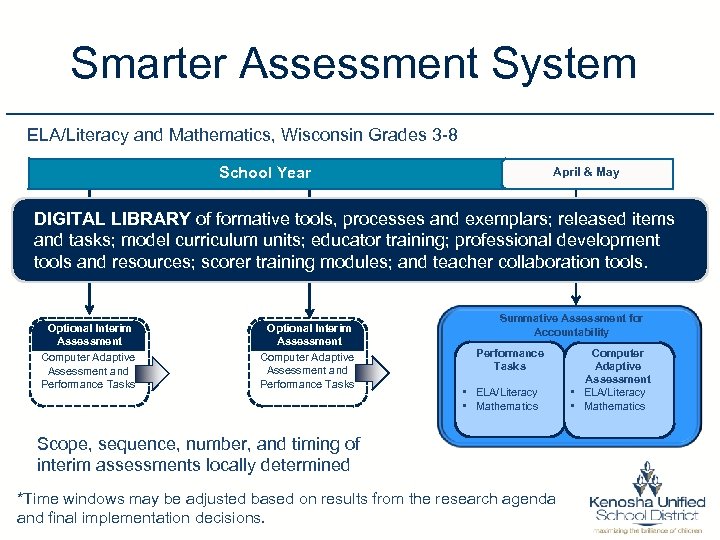 Smarter Assessment System ELA/Literacy and Mathematics, Wisconsin Grades 3 -8 School Year April & May DIGITAL LIBRARY of formative tools, processes and exemplars; released items and tasks; model curriculum units; educator training; professional development tools and resources; scorer training modules; and teacher collaboration tools. Optional Interim Assessment Computer Adaptive Assessment and Performance Tasks Summative Assessment for Accountability Performance Tasks • ELA/Literacy • Mathematics Scope, sequence, number, and timing of interim assessments locally determined *Time windows may be adjusted based on results from the research agenda and final implementation decisions. Computer Adaptive Assessment • ELA/Literacy • Mathematics
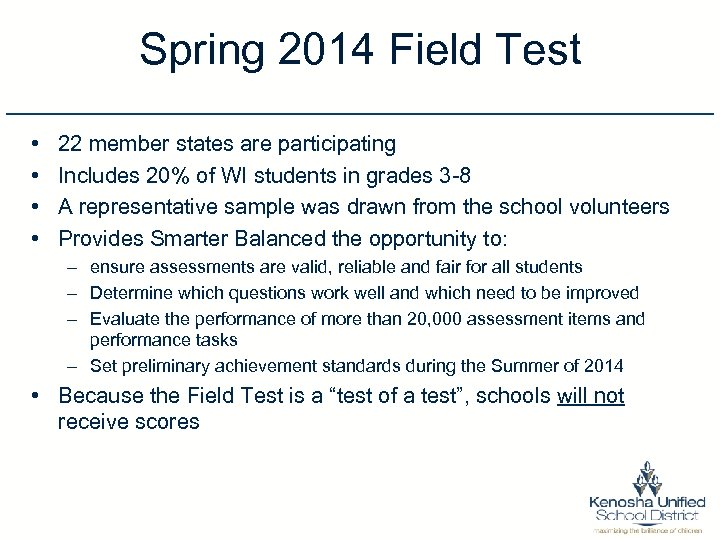 Spring 2014 Field Test • • 22 member states are participating Includes 20% of WI students in grades 3 -8 A representative sample was drawn from the school volunteers Provides Smarter Balanced the opportunity to: – ensure assessments are valid, reliable and fair for all students – Determine which questions work well and which need to be improved – Evaluate the performance of more than 20, 000 assessment items and performance tasks – Set preliminary achievement standards during the Summer of 2014 • Because the Field Test is a “test of a test”, schools will not receive scores
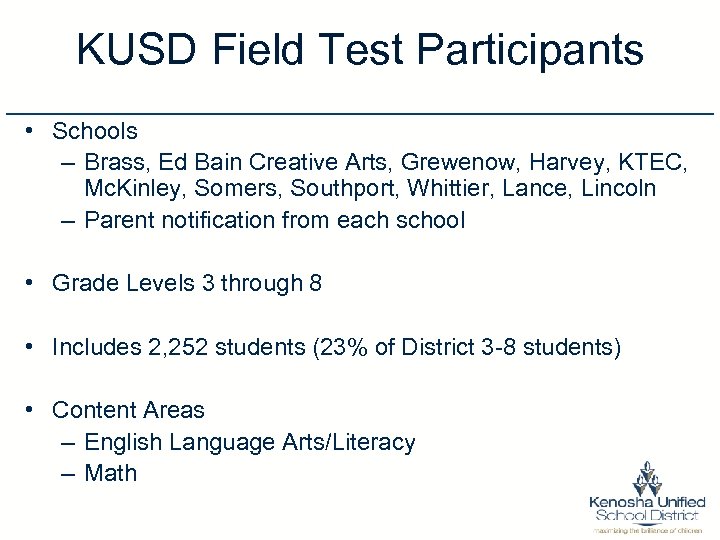 KUSD Field Test Participants • Schools – Brass, Ed Bain Creative Arts, Grewenow, Harvey, KTEC, Mc. Kinley, Somers, Southport, Whittier, Lance, Lincoln – Parent notification from each school • Grade Levels 3 through 8 • Includes 2, 252 students (23% of District 3 -8 students) • Content Areas – English Language Arts/Literacy – Math
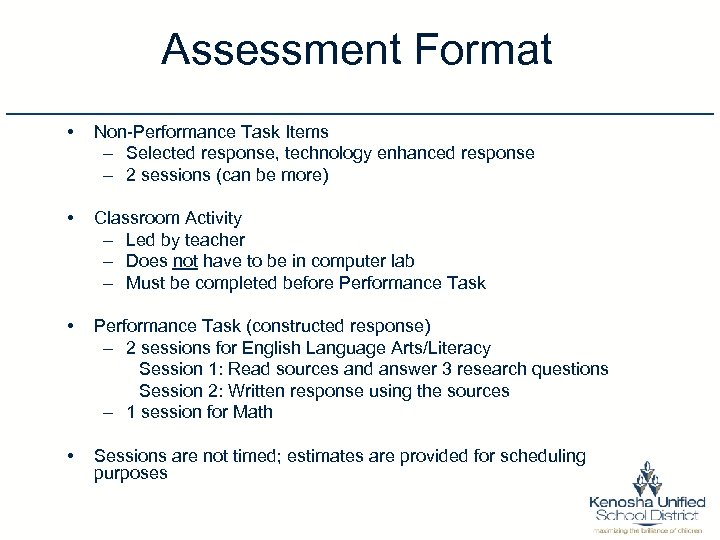 Assessment Format • Non-Performance Task Items – Selected response, technology enhanced response – 2 sessions (can be more) • Classroom Activity – Led by teacher – Does not have to be in computer lab – Must be completed before Performance Task • Performance Task (constructed response) – 2 sessions for English Language Arts/Literacy Session 1: Read sources and answer 3 research questions Session 2: Written response using the sources – 1 session for Math • Sessions are not timed; estimates are provided for scheduling purposes
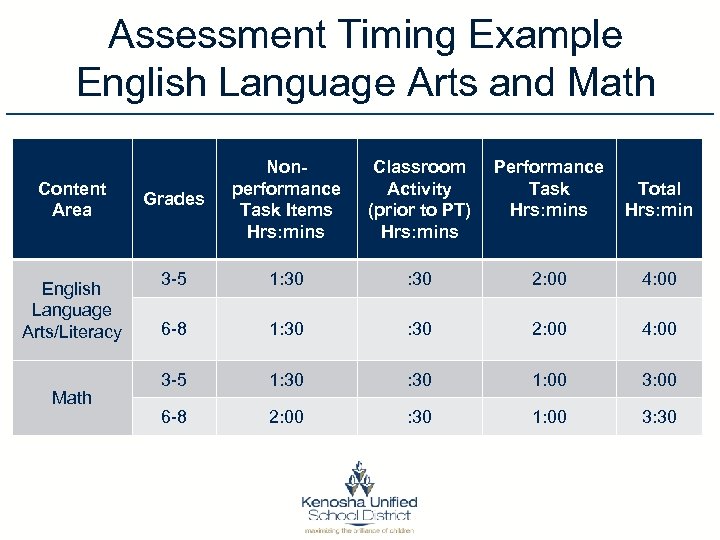 Assessment Timing Example English Language Arts and Math Content Area English Language Arts/Literacy Math Grades Nonperformance Task Items Hrs: mins Classroom Activity (prior to PT) Hrs: mins Performance Task Hrs: mins Total Hrs: min 3 -5 1: 30 2: 00 4: 00 6 -8 1: 30 2: 00 4: 00 3 -5 1: 30 1: 00 3: 00 6 -8 2: 00 : 30 1: 00 3: 30
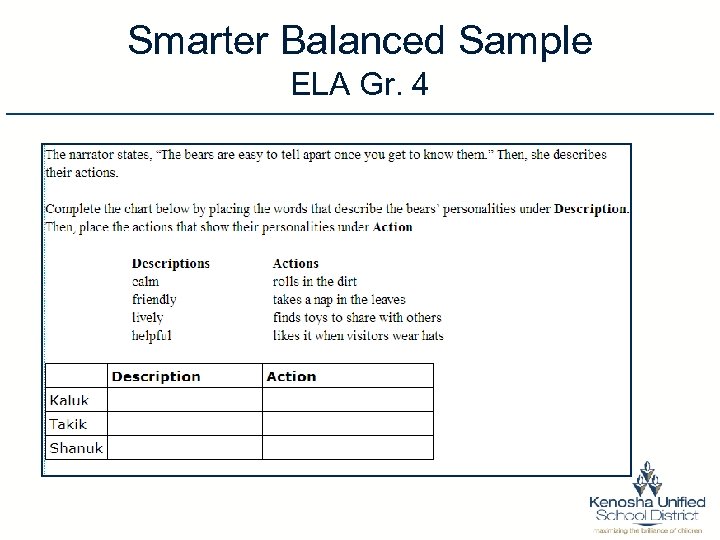 Smarter Balanced Sample ELA Gr. 4
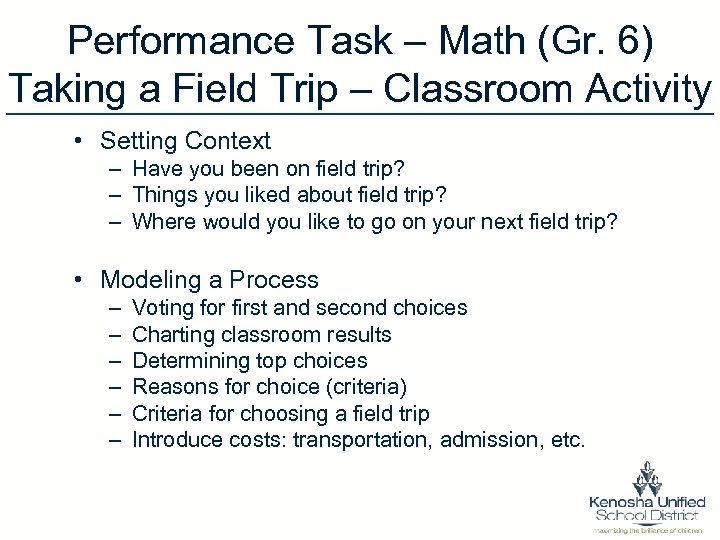 Performance Task – Math (Gr. 6) Taking a Field Trip – Classroom Activity • Setting Context – Have you been on field trip? – Things you liked about field trip? – Where would you like to go on your next field trip? • Modeling a Process – – – Voting for first and second choices Charting classroom results Determining top choices Reasons for choice (criteria) Criteria for choosing a field trip Introduce costs: transportation, admission, etc.
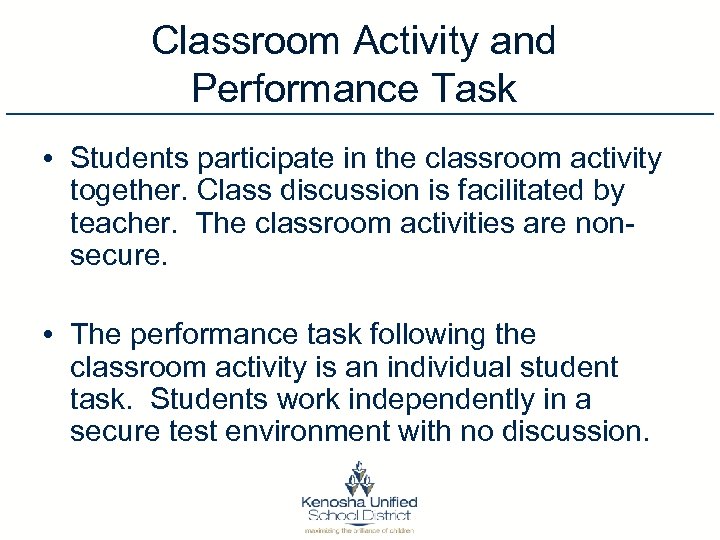 Classroom Activity and Performance Task • Students participate in the classroom activity together. Class discussion is facilitated by teacher. The classroom activities are nonsecure. • The performance task following the classroom activity is an individual student task. Students work independently in a secure test environment with no discussion.
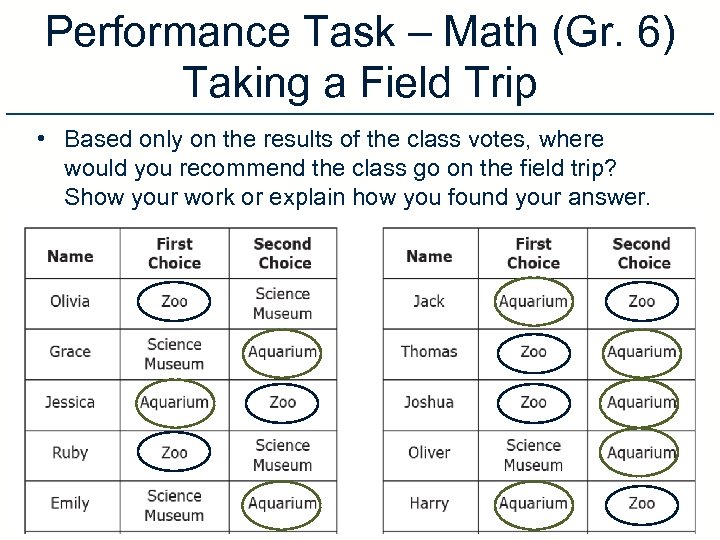 Performance Task – Math (Gr. 6) Taking a Field Trip • Based only on the results of the class votes, where would you recommend the class go on the field trip? Show your work or explain how you found your answer.
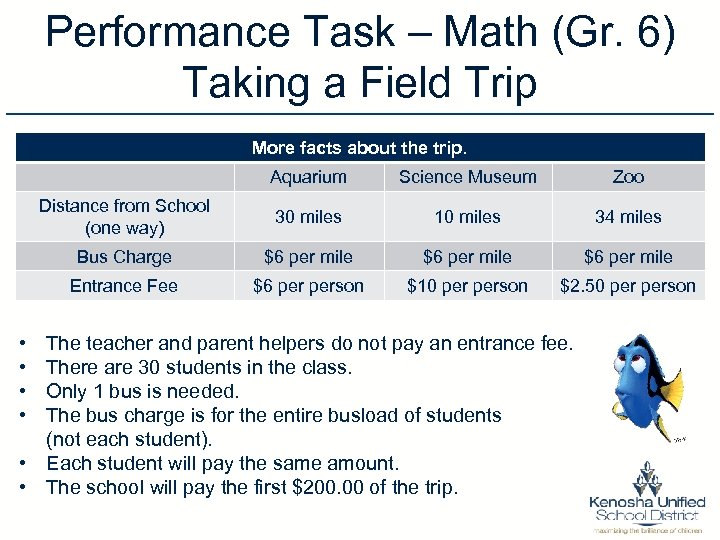 Performance Task – Math (Gr. 6) Taking a Field Trip More facts about the trip. Aquarium Zoo Distance from School (one way) 30 miles 10 miles 34 miles Bus Charge $6 per mile Entrance Fee • • Science Museum $6 person $10 person $2. 50 person The teacher and parent helpers do not pay an entrance fee. There are 30 students in the class. Only 1 bus is needed. The bus charge is for the entire busload of students (not each student). • Each student will pay the same amount. • The school will pay the first $200. 00 of the trip.
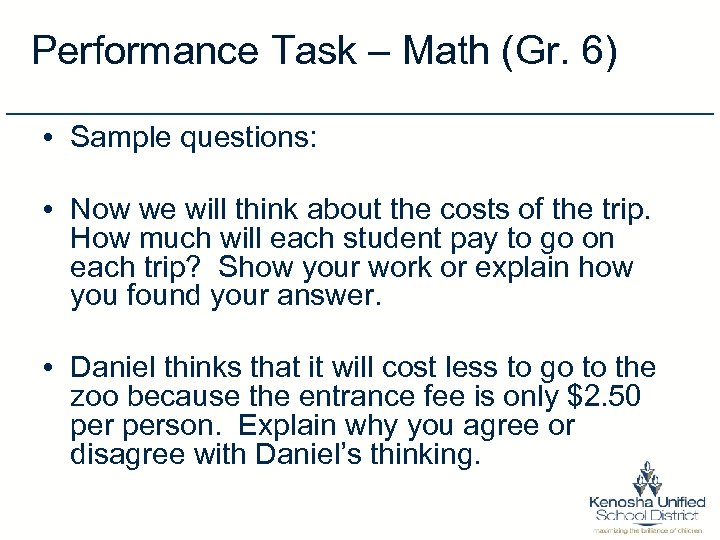 Performance Task – Math (Gr. 6) • Sample questions: • Now we will think about the costs of the trip. How much will each student pay to go on each trip? Show your work or explain how you found your answer. • Daniel thinks that it will cost less to go to the zoo because the entrance fee is only $2. 50 person. Explain why you agree or disagree with Daniel’s thinking.
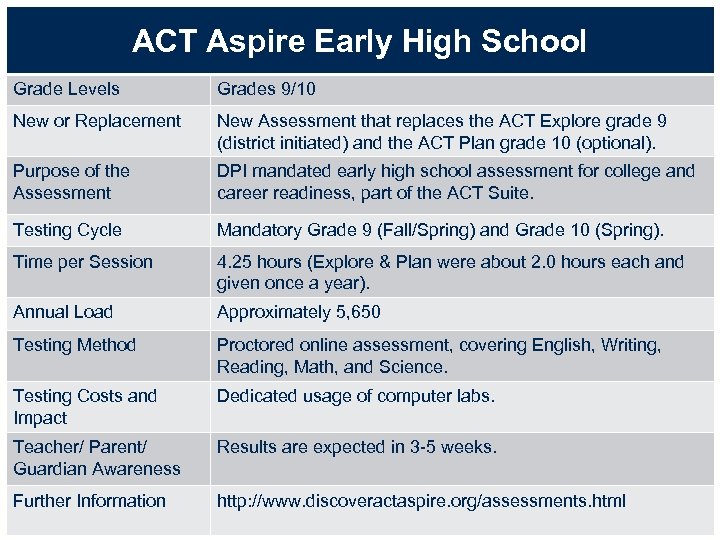 ACT Aspire Early High School Grade Levels Grades 9/10 New or Replacement New Assessment that replaces the ACT Explore grade 9 (district initiated) and the ACT Plan grade 10 (optional). Purpose of the Assessment DPI mandated early high school assessment for college and career readiness, part of the ACT Suite. Testing Cycle Mandatory Grade 9 (Fall/Spring) and Grade 10 (Spring). Time per Session 4. 25 hours (Explore & Plan were about 2. 0 hours each and given once a year). Annual Load Approximately 5, 650 Testing Method Proctored online assessment, covering English, Writing, Reading, Math, and Science. Testing Costs and Impact Dedicated usage of computer labs. Teacher/ Parent/ Guardian Awareness Results are expected in 3 -5 weeks. Further Information http: //www. discoveractaspire. org/assessments. html
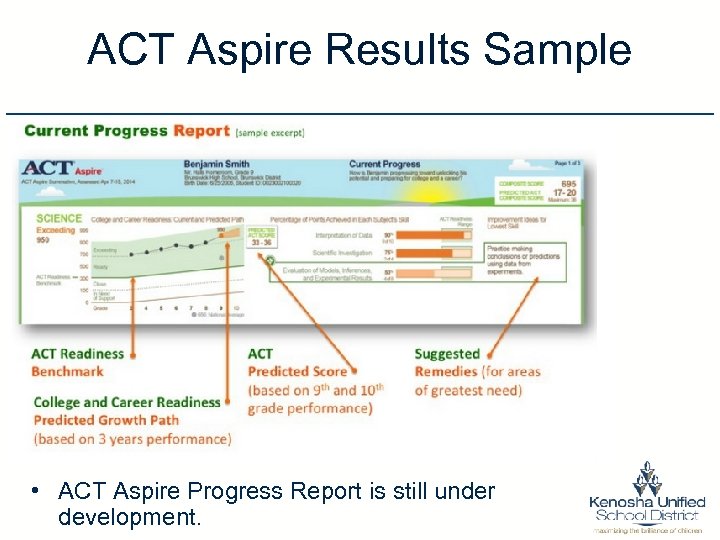 ACT Aspire Results Sample • ACT Aspire Progress Report is still under development.
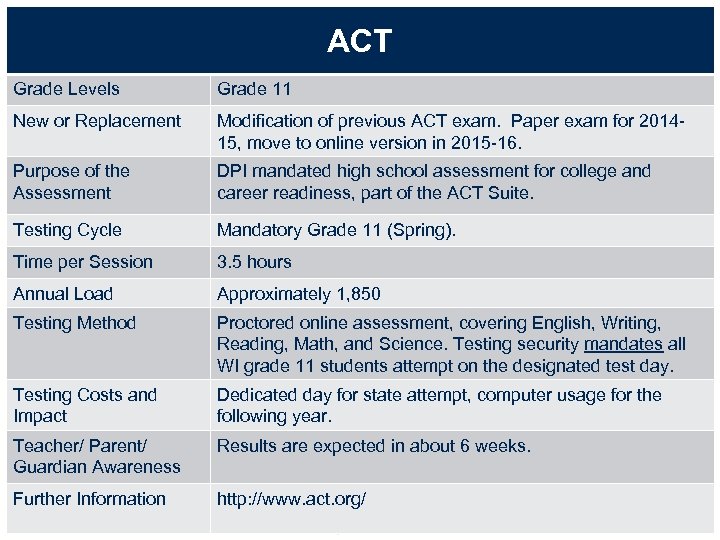 ACT Grade Levels Grade 11 New or Replacement Modification of previous ACT exam. Paper exam for 201415, move to online version in 2015 -16. Purpose of the Assessment DPI mandated high school assessment for college and career readiness, part of the ACT Suite. Testing Cycle Mandatory Grade 11 (Spring). Time per Session 3. 5 hours Annual Load Approximately 1, 850 Testing Method Proctored online assessment, covering English, Writing, Reading, Math, and Science. Testing security mandates all WI grade 11 students attempt on the designated test day. Testing Costs and Impact Dedicated day for state attempt, computer usage for the following year. Teacher/ Parent/ Guardian Awareness Results are expected in about 6 weeks. Further Information http: //www. act. org/
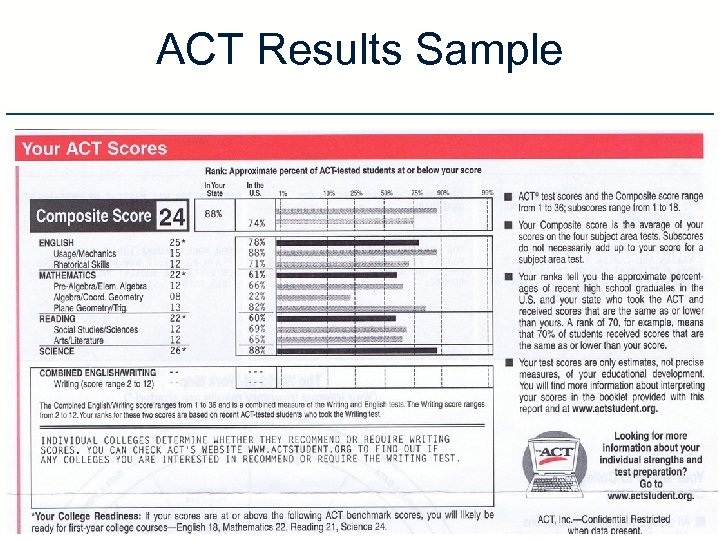 ACT Results Sample
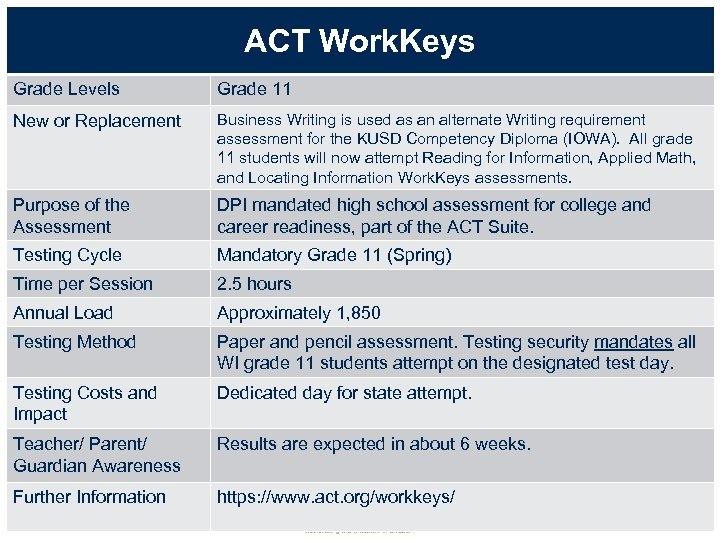 ACT Work. Keys Grade Levels Grade 11 New or Replacement Business Writing is used as an alternate Writing requirement assessment for the KUSD Competency Diploma (IOWA). All grade 11 students will now attempt Reading for Information, Applied Math, and Locating Information Work. Keys assessments. Purpose of the Assessment DPI mandated high school assessment for college and career readiness, part of the ACT Suite. Testing Cycle Mandatory Grade 11 (Spring) Time per Session 2. 5 hours Annual Load Approximately 1, 850 Testing Method Paper and pencil assessment. Testing security mandates all WI grade 11 students attempt on the designated test day. Testing Costs and Impact Dedicated day for state attempt. Teacher/ Parent/ Guardian Awareness Results are expected in about 6 weeks. Further Information https: //www. act. org/workkeys/
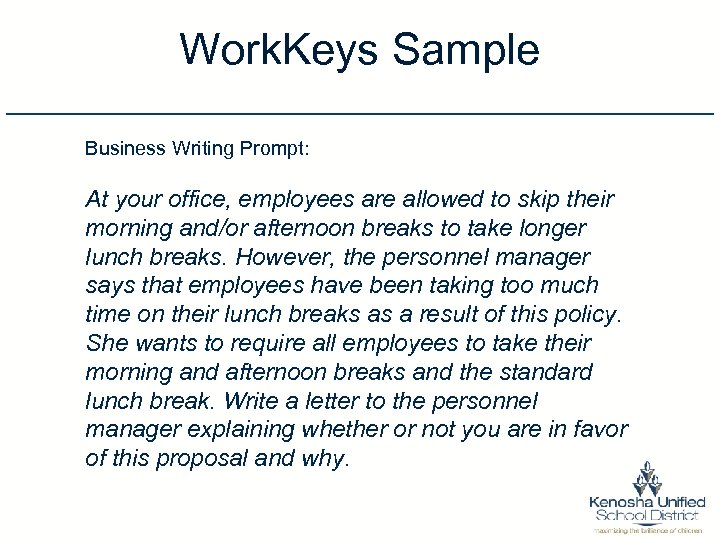 Work. Keys Sample Business Writing Prompt: At your office, employees are allowed to skip their morning and/or afternoon breaks to take longer lunch breaks. However, the personnel manager says that employees have been taking too much time on their lunch breaks as a result of this policy. She wants to require all employees to take their morning and afternoon breaks and the standard lunch break. Write a letter to the personnel manager explaining whether or not you are in favor of this proposal and why.
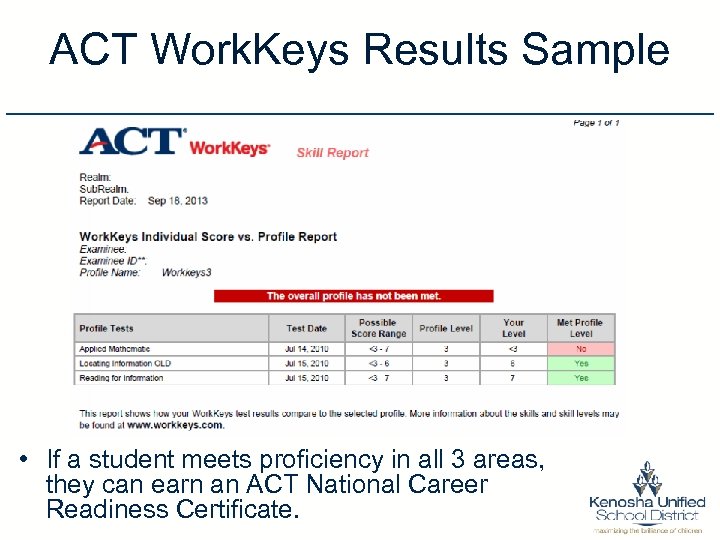 ACT Work. Keys Results Sample • If a student meets proficiency in all 3 areas, they can earn an ACT National Career Readiness Certificate.
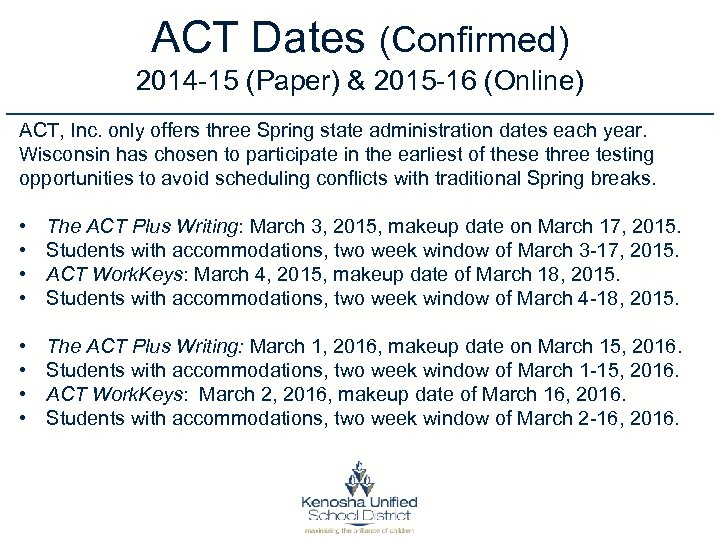 ACT Dates (Confirmed) 2014 -15 (Paper) & 2015 -16 (Online) ACT, Inc. only offers three Spring state administration dates each year. Wisconsin has chosen to participate in the earliest of these three testing opportunities to avoid scheduling conflicts with traditional Spring breaks. • The ACT Plus Writing: March 3, 2015, makeup date on March 17, 2015. • Students with accommodations, two week window of March 3 -17, 2015. • ACT Work. Keys: March 4, 2015, makeup date of March 18, 2015. • Students with accommodations, two week window of March 4 -18, 2015. • The ACT Plus Writing: March 1, 2016, makeup date on March 15, 2016. • Students with accommodations, two week window of March 1 -15, 2016. • ACT Work. Keys: March 2, 2016, makeup date of March 16, 2016. • Students with accommodations, two week window of March 2 -16, 2016.
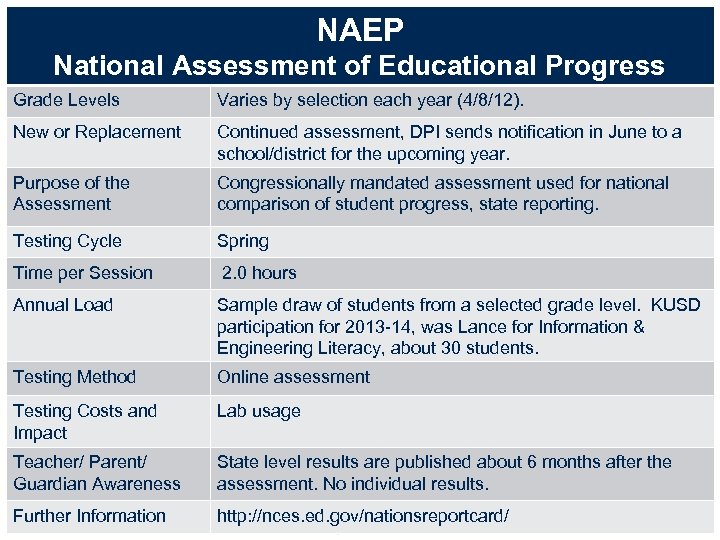 NAEP National Assessment of Educational Progress Grade Levels Varies by selection each year (4/8/12). New or Replacement Continued assessment, DPI sends notification in June to a school/district for the upcoming year. Purpose of the Assessment Congressionally mandated assessment used for national comparison of student progress, state reporting. Testing Cycle Spring Time per Session 2. 0 hours Annual Load Sample draw of students from a selected grade level. KUSD participation for 2013 -14, was Lance for Information & Engineering Literacy, about 30 students. Testing Method Online assessment Testing Costs and Impact Lab usage Teacher/ Parent/ Guardian Awareness State level results are published about 6 months after the assessment. No individual results. Further Information http: //nces. ed. gov/nationsreportcard/
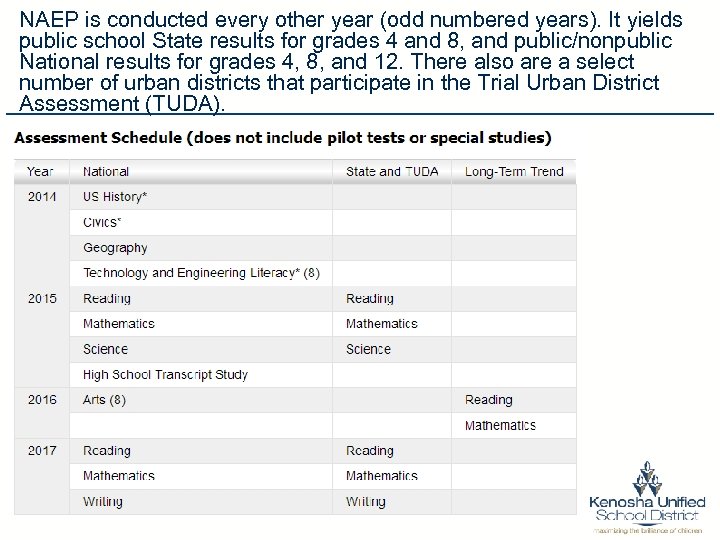 NAEP is conducted every other year (odd numbered years). It yields public school State results for grades 4 and 8, and public/nonpublic National results for grades 4, 8, and 12. There also are a select number of urban districts that participate in the Trial Urban District Assessment (TUDA).
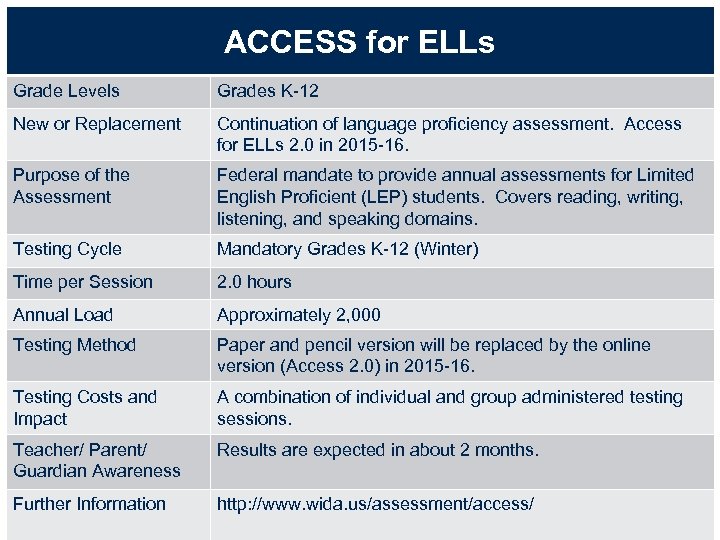 ACCESS for ELLs Grade Levels Grades K-12 New or Replacement Continuation of language proficiency assessment. Access for ELLs 2. 0 in 2015 -16. Purpose of the Assessment Federal mandate to provide annual assessments for Limited English Proficient (LEP) students. Covers reading, writing, listening, and speaking domains. Testing Cycle Mandatory Grades K-12 (Winter) Time per Session 2. 0 hours Annual Load Approximately 2, 000 Testing Method Paper and pencil version will be replaced by the online version (Access 2. 0) in 2015 -16. Testing Costs and Impact A combination of individual and group administered testing sessions. Teacher/ Parent/ Guardian Awareness Results are expected in about 2 months. Further Information http: //www. wida. us/assessment/access/
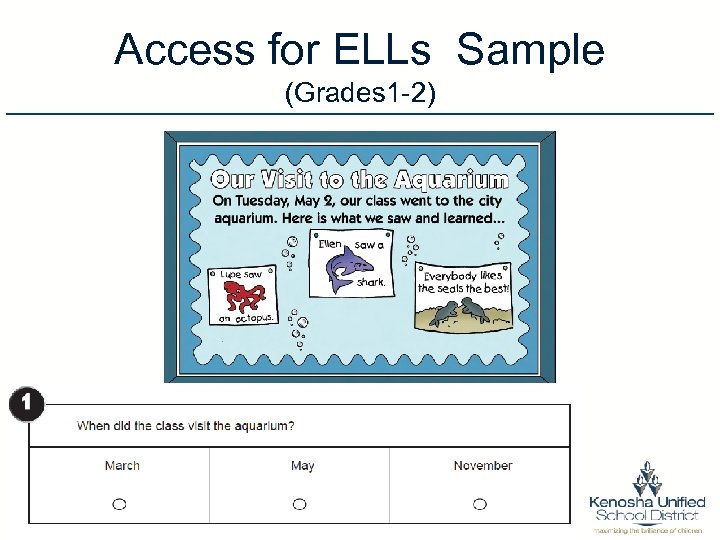 Access for ELLs Sample (Grades 1 -2)
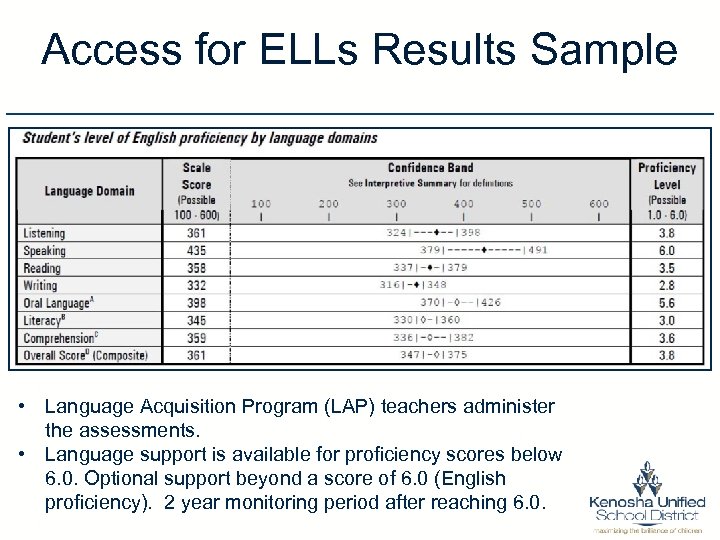 Access for ELLs Results Sample • Language Acquisition Program (LAP) teachers administer the assessments. • Language support is available for proficiency scores below 6. 0. Optional support beyond a score of 6. 0 (English proficiency). 2 year monitoring period after reaching 6. 0.
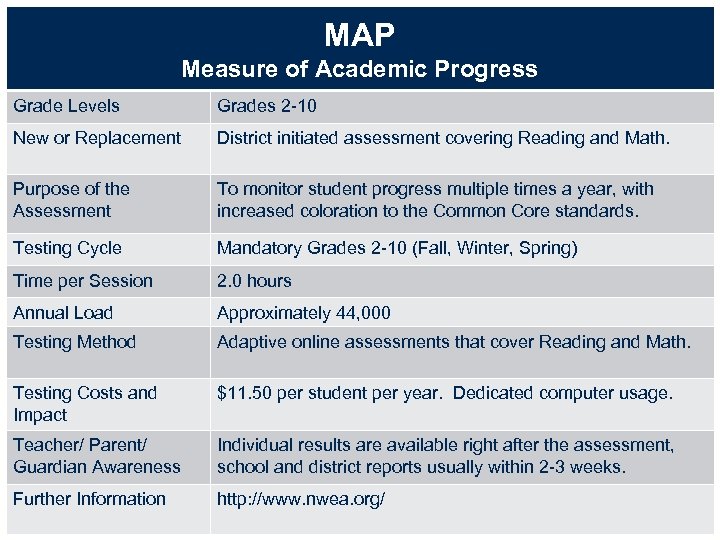 MAP Measure of Academic Progress Grade Levels Grades 2 -10 New or Replacement District initiated assessment covering Reading and Math. Purpose of the Assessment To monitor student progress multiple times a year, with increased coloration to the Common Core standards. Testing Cycle Mandatory Grades 2 -10 (Fall, Winter, Spring) Time per Session 2. 0 hours Annual Load Approximately 44, 000 Testing Method Adaptive online assessments that cover Reading and Math. Testing Costs and Impact $11. 50 per student per year. Dedicated computer usage. Teacher/ Parent/ Guardian Awareness Individual results are available right after the assessment, school and district reports usually within 2 -3 weeks. Further Information http: //www. nwea. org/
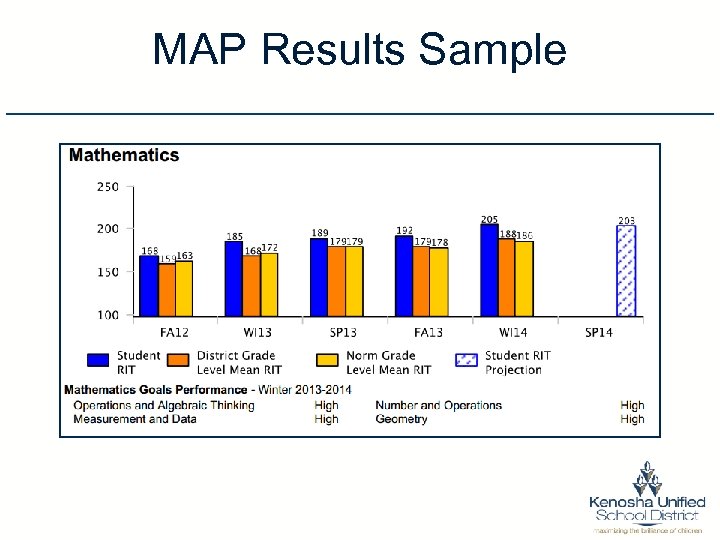 MAP Results Sample
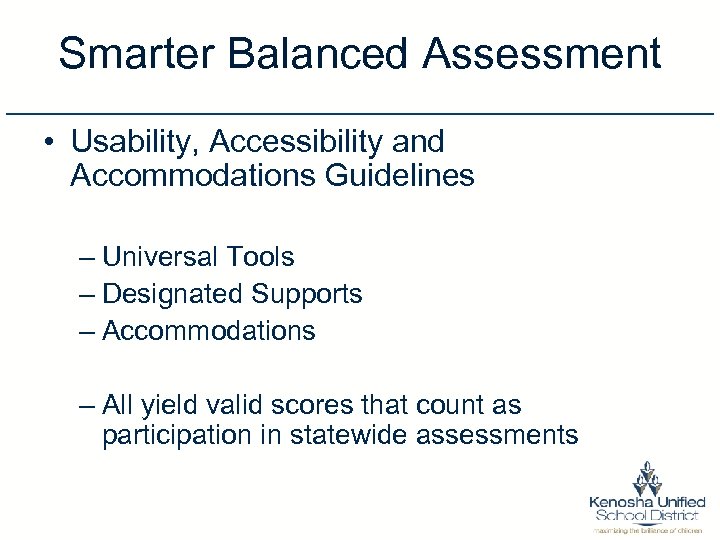 Smarter Balanced Assessment • Usability, Accessibility and Accommodations Guidelines – Universal Tools – Designated Supports – Accommodations – All yield valid scores that count as participation in statewide assessments
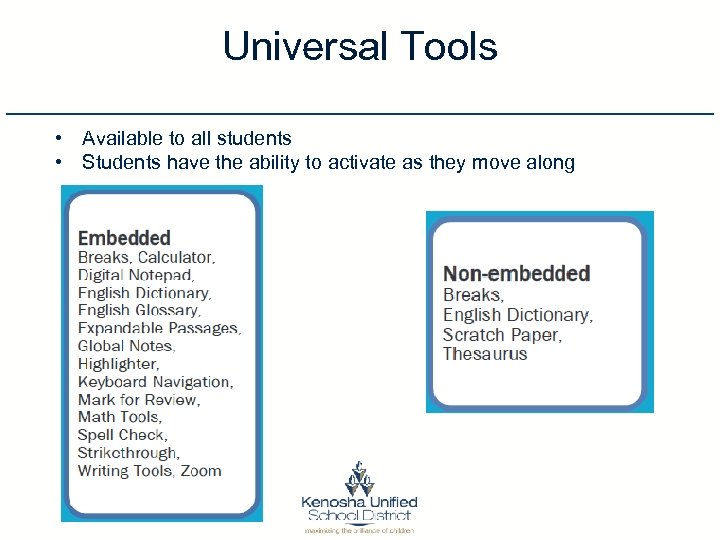 Universal Tools • Available to all students • Students have the ability to activate as they move along
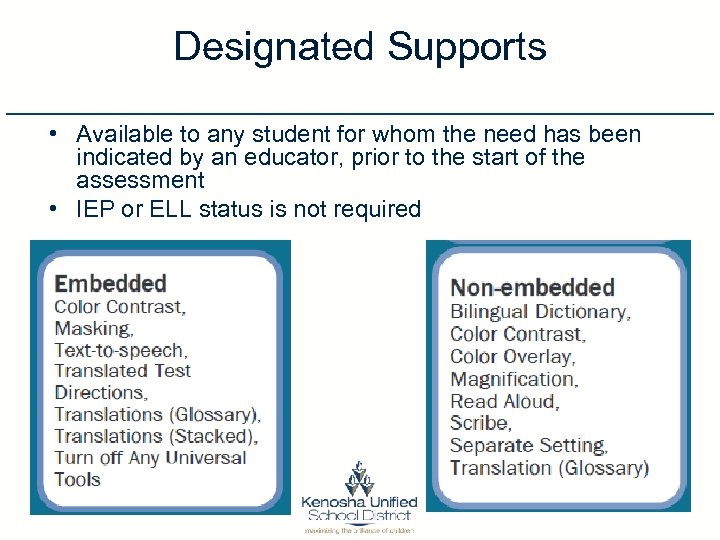 Designated Supports • Available to any student for whom the need has been indicated by an educator, prior to the start of the assessment • IEP or ELL status is not required
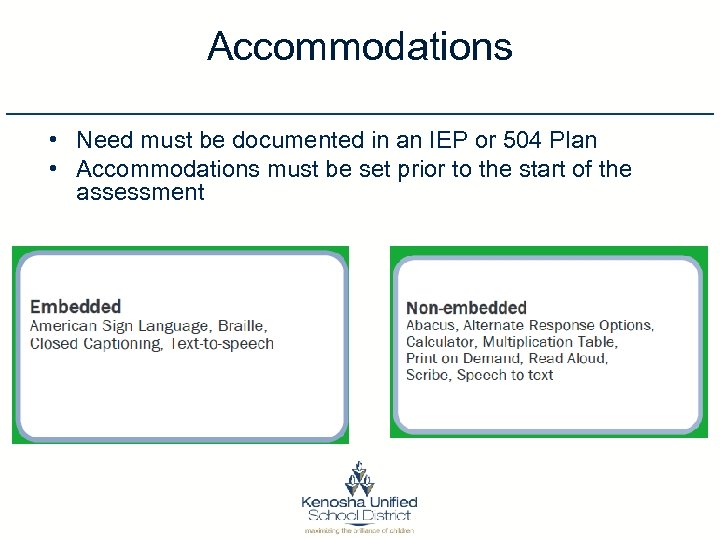 Accommodations • Need must be documented in an IEP or 504 Plan • Accommodations must be set prior to the start of the assessment
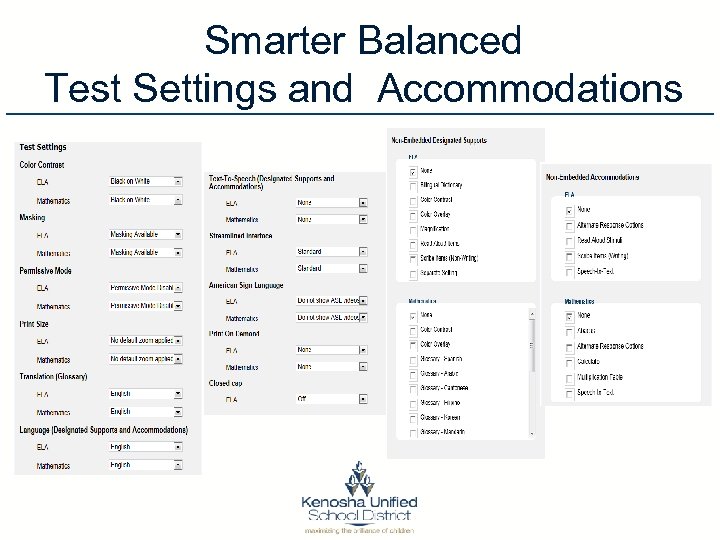 Smarter Balanced Test Settings and Accommodations
 Logistics Concerns • Testing logistics – Mental preparedness (challenging new method of questioning) – Preparing students, parents, and staff with regards to expectations – Scheduling the resources within each school • Test security – Still expect a high level of awareness and handling for physical items – Though online tests may provide a varied question sequence, we must still maintain quality monitoring practices • Proctoring – Some of the assessments may require additional validation (PALS) – All staff who proctor should understand all aspects of each assessment • Technology – Need to be aware of potential obstacles in the shared (online) medium – Technology integration will continue to increase – Bandwidth
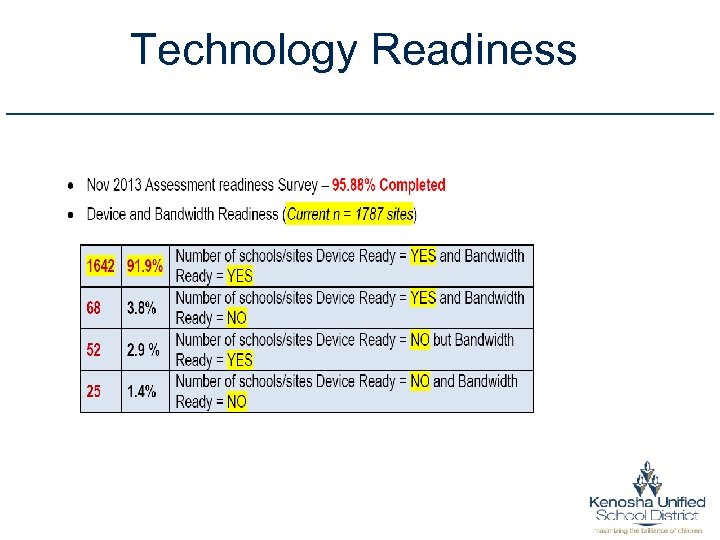 Technology Readiness
 Logistics Concerns “You are receiving this communication because you are participating in at least one of the Dynamic Learning Maps (DLM) field tests this spring. We wanted to send a special note to districts expressing our shared concerns regarding the DLM Field Test 1 experience. We understand that Wisconsin is one of many states in the DLM consortium who is experiencing these challenges. As such, DLM requests that districts who are part of Field Test 1 and who continue to experience difficulties with the system, withdraw from Field Test 1 and attempt to participate in Field Test 2 or 3. Districts who have not experienced difficulties or who are already testing students should continue to move forward with field testing. ” DPI: February Communication
 Preparation & Awareness • • • DPI Assessment update meetings Presentations for district staff & schools Counselor meetings Board presentations & updates Teacher training Practice exams when possible Parent communication Use of reports, custom data integration Secure tracking of scores (SIS, WISEdash) KUSD website (Office of Educational Accountability)