


 Скачать презентацию Update on NASA Uses of GPS 11 th
bb1eeb5dcdd13fe35648a98964f1b229.ppt
- Количество слайдов: 22
 Update on NASA Uses of GPS 11 th GNSS Workshop Seoul, South Korea 4 -5 November 2004 Dr. Scott Pace Office of Space Communications NASA Headquarters 1
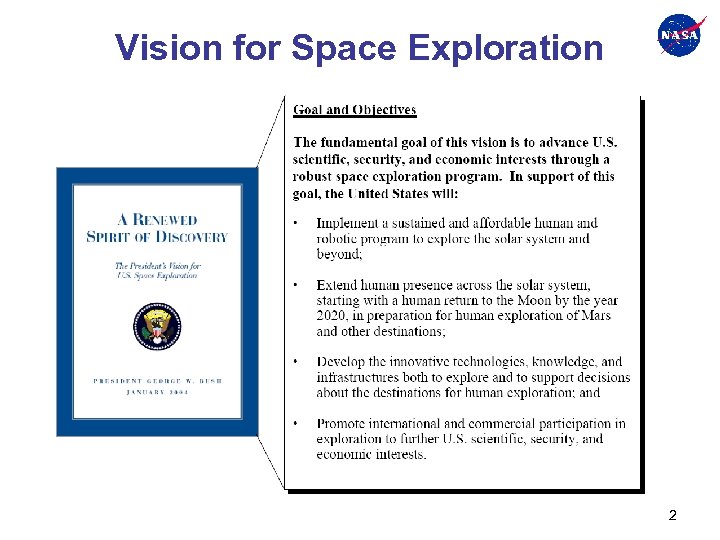 Vision for Space Exploration 2
 NASA Vision and Mission 3
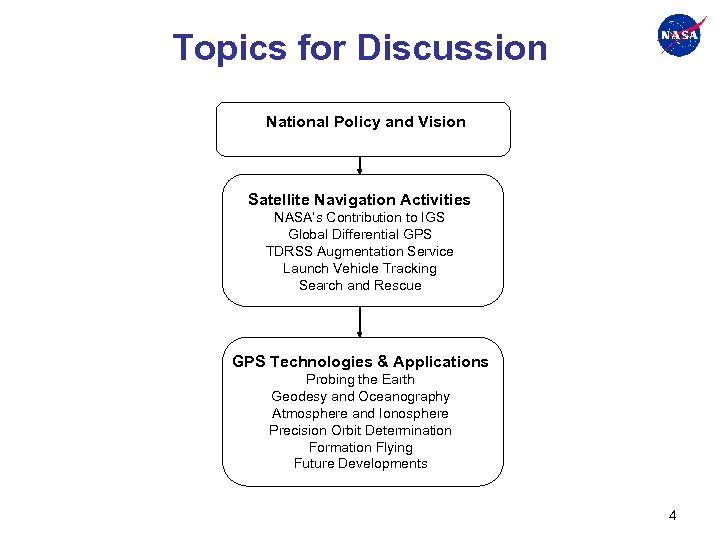 Topics for Discussion National Policy and Vision Satellite Navigation Activities NASA’s Contribution to IGS Global Differential GPS TDRSS Augmentation Service Launch Vehicle Tracking Search and Rescue GPS Technologies & Applications Probing the Earth Geodesy and Oceanography Atmosphere and Ionosphere Precision Orbit Determination Formation Flying Future Developments 4
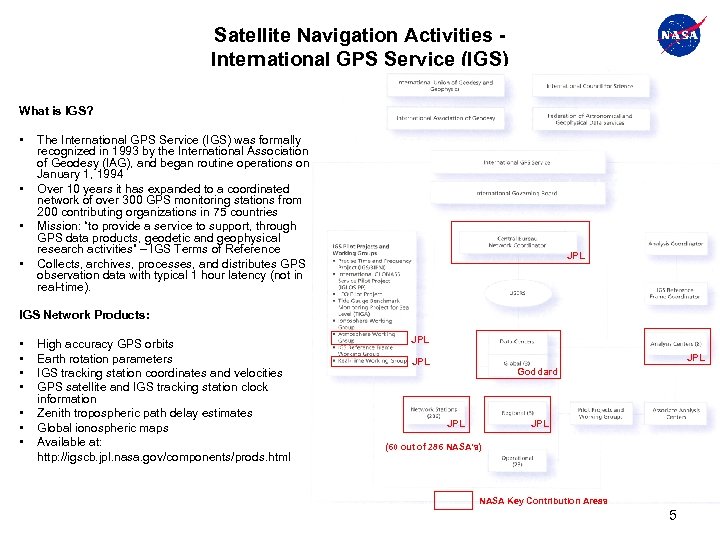 Satellite Navigation Activities International GPS Service (IGS) What is IGS? • • The International GPS Service (IGS) was formally recognized in 1993 by the International Association of Geodesy (IAG), and began routine operations on January 1, 1994 Over 10 years it has expanded to a coordinated network of over 300 GPS monitoring stations from 200 contributing organizations in 75 countries Mission: “to provide a service to support, through GPS data products, geodetic and geophysical research activities” – IGS Terms of Reference Collects, archives, processes, and distributes GPS observation data with typical 1 hour latency (not in real-time). JPL IGS Network Products: • • High accuracy GPS orbits Earth rotation parameters IGS tracking station coordinates and velocities GPS satellite and IGS tracking station clock information Zenith tropospheric path delay estimates Global ionospheric maps Available at: http: //igscb. jpl. nasa. gov/components/prods. html JPL JPL Goddard JPL (60 out of 286 NASA’s) NASA Key Contribution Areas 5
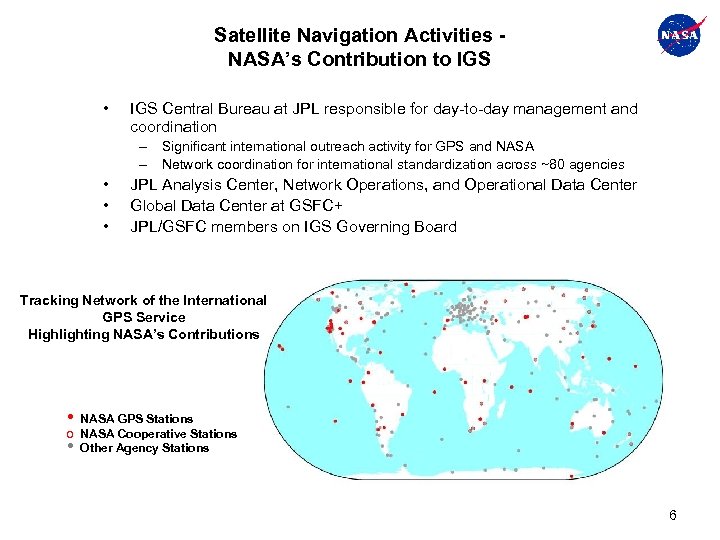 Satellite Navigation Activities NASA’s Contribution to IGS • IGS Central Bureau at JPL responsible for day-to-day management and coordination – Significant international outreach activity for GPS and NASA – Network coordination for international standardization across ~80 agencies • • • JPL Analysis Center, Network Operations, and Operational Data Center Global Data Center at GSFC+ JPL/GSFC members on IGS Governing Board Tracking Network of the International GPS Service Highlighting NASA’s Contributions • NASA GPS Stations o NASA Cooperative Stations • Other Agency Stations 6
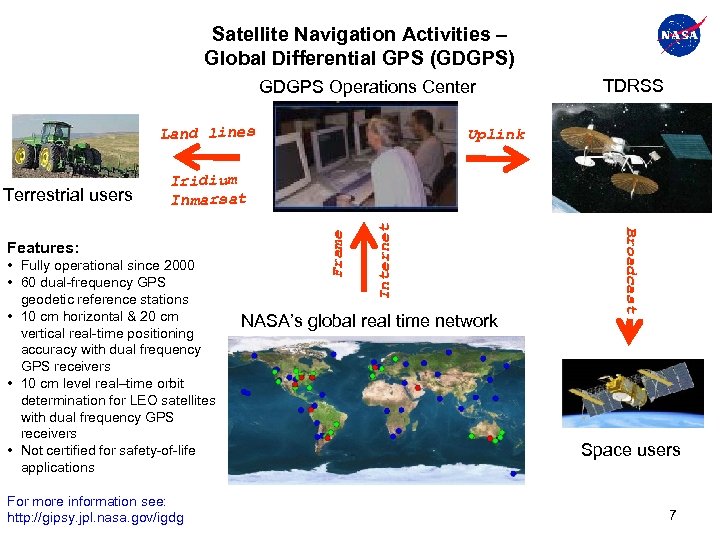 Satellite Navigation Activities – Global Differential GPS (GDGPS) GDGPS Operations Center Land lines Uplink • Fully operational since 2000 • 60 dual-frequency GPS geodetic reference stations • 10 cm horizontal & 20 cm vertical real-time positioning accuracy with dual frequency GPS receivers • 10 cm level real–time orbit determination for LEO satellites with dual frequency GPS receivers • Not certified for safety-of-life applications For more information see: http: //gipsy. jpl. nasa. gov/igdg NASA’s global real time network Broadcast Features: Internet Iridium Inmarsat Frame Terrestrial users TDRSS Space users 7
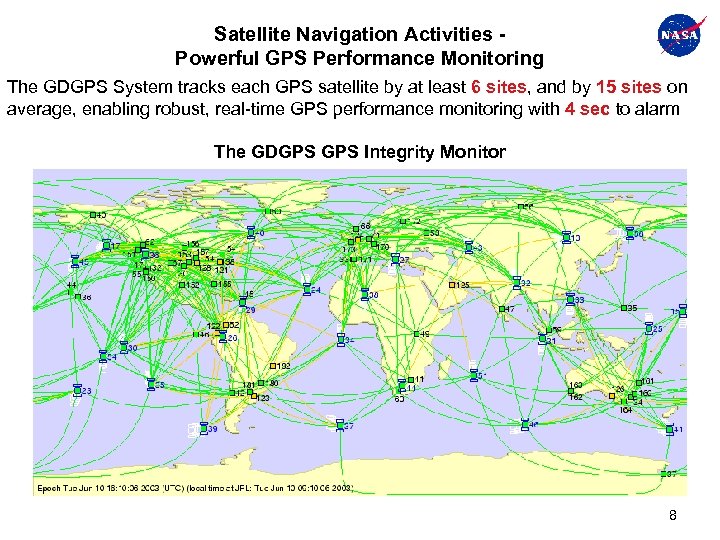 Satellite Navigation Activities Powerful GPS Performance Monitoring The GDGPS System tracks each GPS satellite by at least 6 sites, and by 15 sites on average, enabling robust, real-time GPS performance monitoring with 4 sec to alarm The GDGPS Integrity Monitor 8
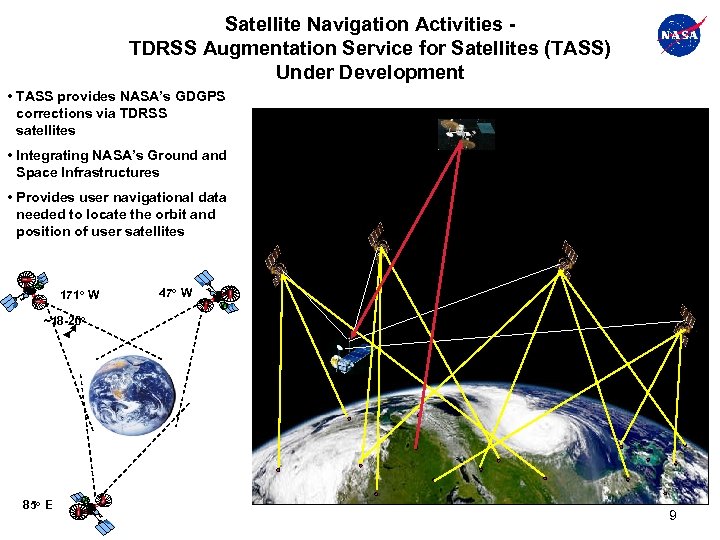 Satellite Navigation Activities TDRSS Augmentation Service for Satellites (TASS) Under Development • TASS provides NASA’s GDGPS corrections via TDRSS satellites • Integrating NASA’s Ground and Space Infrastructures • Provides user navigational data needed to locate the orbit and position of user satellites 171 o W 47 o W ~18 -20 o 85 o E 9
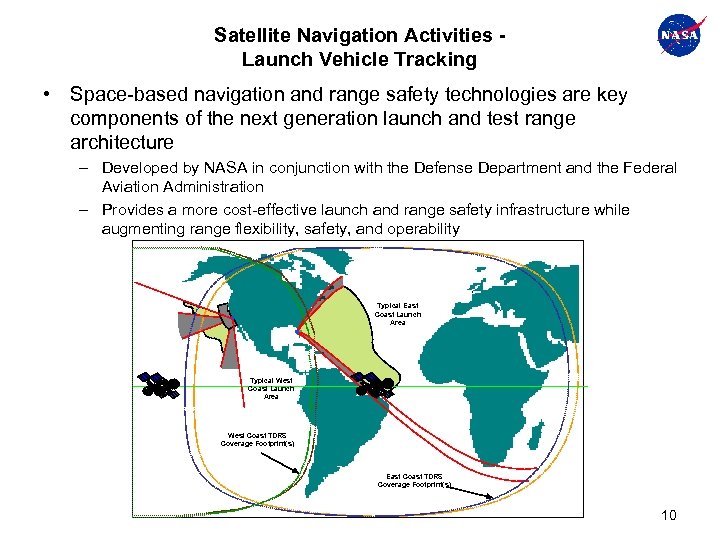 Satellite Navigation Activities Launch Vehicle Tracking • Space-based navigation and range safety technologies are key components of the next generation launch and test range architecture – Developed by NASA in conjunction with the Defense Department and the Federal Aviation Administration – Provides a more cost-effective launch and range safety infrastructure while augmenting range flexibility, safety, and operability Typical East Coast Launch Area Typical West Coast Launch Area West Coast TDRS Coverage Footprint(s) East Coast TDRS Coverage Footprint(s) 10
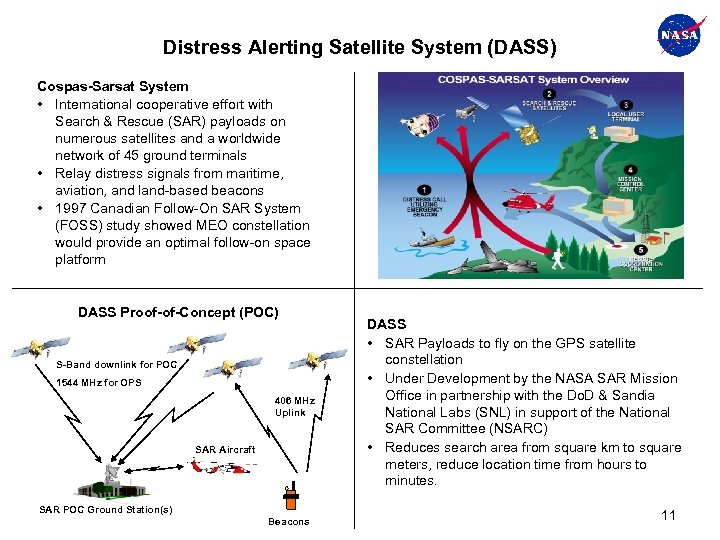 Distress Alerting Satellite System (DASS) Cospas-Sarsat System • International cooperative effort with Search & Rescue (SAR) payloads on numerous satellites and a worldwide network of 45 ground terminals • Relay distress signals from maritime, aviation, and land-based beacons • 1997 Canadian Follow-On SAR System (FOSS) study showed MEO constellation would provide an optimal follow-on space platform DASS Proof-of-Concept (POC) S-Band downlink for POC 1544 MHz for OPS 406 MHz Uplink SAR Aircraft SAR POC Ground Station(s) Beacons DASS • SAR Payloads to fly on the GPS satellite constellation • Under Development by the NASA SAR Mission Office in partnership with the Do. D & Sandia National Labs (SNL) in support of the National SAR Committee (NSARC) • Reduces search area from square km to square meters, reduce location time from hours to minutes. 11
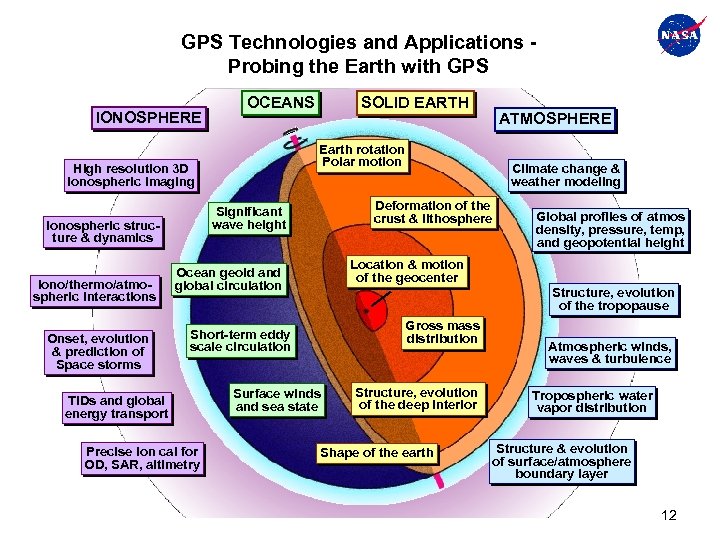 GPS Technologies and Applications Probing the Earth with GPS IONOSPHERE OCEANS Earth rotation Polar motion High resolution 3 D ionospheric imaging Onset, evolution & prediction of Space storms Structure, evolution of the tropopause Gross mass distribution Short-term eddy scale circulation Precise ion cal for OD, SAR, altimetry Global profiles of atmos density, pressure, temp, and geopotential height Location & motion of the geocenter Ocean geoid and global circulation TIDs and global energy transport ATMOSPHERE Climate change & weather modeling Deformation of the crust & lithosphere Significant wave height Ionospheric structure & dynamics Iono/thermo/atmospheric interactions SOLID EARTH Surface winds and sea state Structure, evolution of the deep interior Shape of the earth Atmospheric winds, waves & turbulence Tropospheric water vapor distribution Structure & evolution of surface/atmosphere boundary layer 12
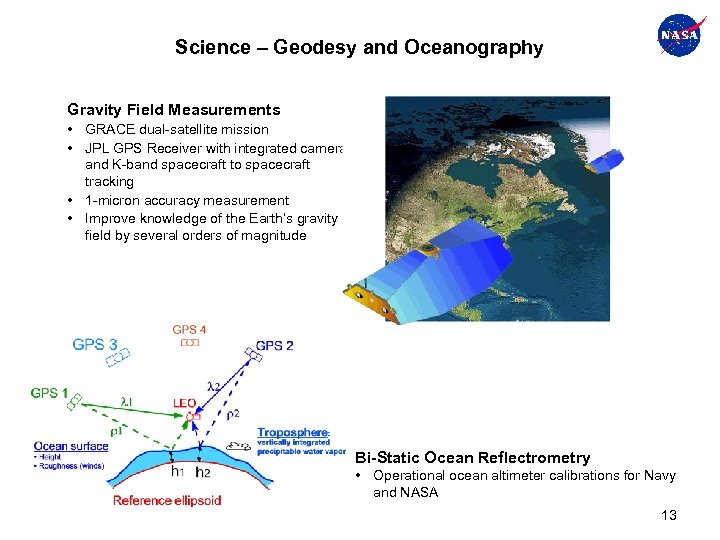 Science – Geodesy and Oceanography Gravity Field Measurements • GRACE dual-satellite mission • JPL GPS Receiver with integrated camera and K-band spacecraft to spacecraft tracking • 1 -micron accuracy measurement • Improve knowledge of the Earth’s gravity field by several orders of magnitude Bi-Static Ocean Reflectrometry • Operational ocean altimeter calibrations for Navy and NASA 13
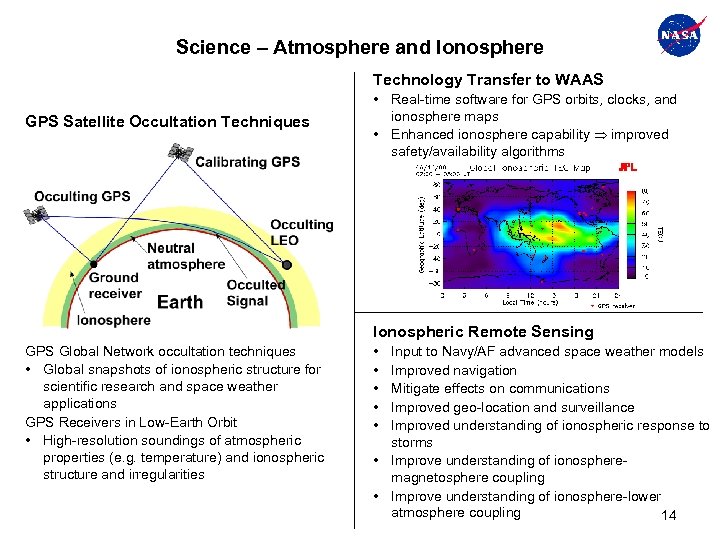 Science – Atmosphere and Ionosphere Technology Transfer to WAAS GPS Satellite Occultation Techniques • Real-time software for GPS orbits, clocks, and ionosphere maps • Enhanced ionosphere capability improved safety/availability algorithms Ionospheric Remote Sensing GPS Global Network occultation techniques • Global snapshots of ionospheric structure for scientific research and space weather applications GPS Receivers in Low-Earth Orbit • High-resolution soundings of atmospheric properties (e. g. temperature) and ionospheric structure and irregularities • • • Input to Navy/AF advanced space weather models Improved navigation Mitigate effects on communications Improved geo-location and surveillance Improved understanding of ionospheric response to storms • Improve understanding of ionospheremagnetosphere coupling • Improve understanding of ionosphere-lower atmosphere coupling 14
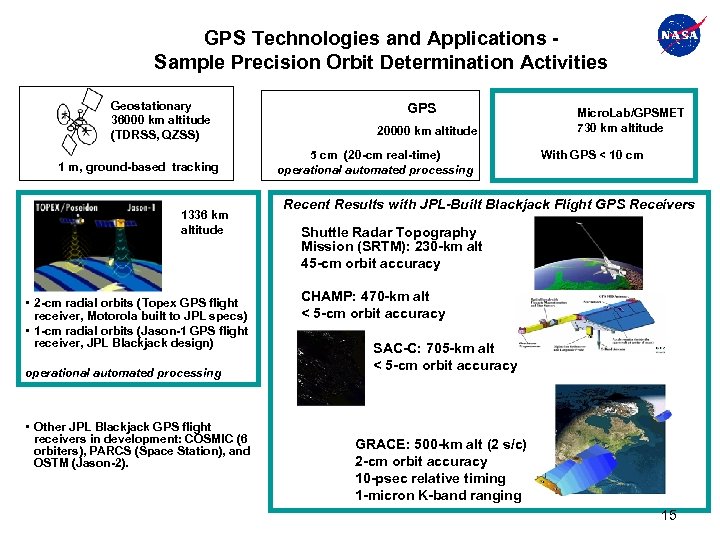 GPS Technologies and Applications Sample Precision Orbit Determination Activities Geostationary 36000 km altitude (TDRSS, QZSS) 1 m, ground-based tracking 1336 km altitude • 2 -cm radial orbits (Topex GPS flight receiver, Motorola built to JPL specs) • 1 -cm radial orbits (Jason-1 GPS flight receiver, JPL Blackjack design) operational automated processing • Other JPL Blackjack GPS flight receivers in development: COSMIC (6 orbiters), PARCS (Space Station), and OSTM (Jason-2). GPS 20000 km altitude 5 cm (20 -cm real-time) operational automated processing Micro. Lab/GPSMET 730 km altitude With GPS < 10 cm Recent Results with JPL-Built Blackjack Flight GPS Receivers Shuttle Radar Topography Mission (SRTM): 230 -km alt 45 -cm orbit accuracy CHAMP: 470 -km alt < 5 -cm orbit accuracy SAC-C: 705 -km alt < 5 -cm orbit accuracy GRACE: 500 -km alt (2 s/c) 2 -cm orbit accuracy 10 -psec relative timing 1 -micron K-band ranging 15
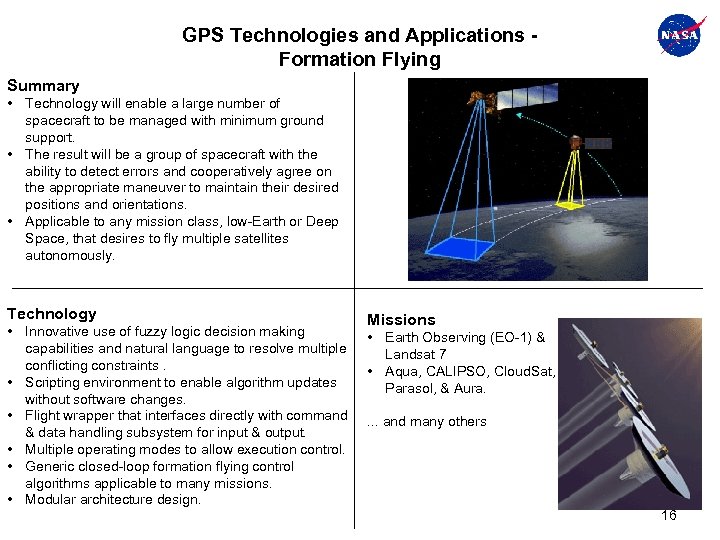 GPS Technologies and Applications Formation Flying Summary • Technology will enable a large number of spacecraft to be managed with minimum ground support. • The result will be a group of spacecraft with the ability to detect errors and cooperatively agree on the appropriate maneuver to maintain their desired positions and orientations. • Applicable to any mission class, low-Earth or Deep Space, that desires to fly multiple satellites autonomously. Technology • Innovative use of fuzzy logic decision making capabilities and natural language to resolve multiple conflicting constraints. • Scripting environment to enable algorithm updates without software changes. • Flight wrapper that interfaces directly with command & data handling subsystem for input & output. • Multiple operating modes to allow execution control. • Generic closed-loop formation flying control algorithms applicable to many missions. • Modular architecture design. Missions • Earth Observing (EO-1) & Landsat 7 • Aqua, CALIPSO, Cloud. Sat, Parasol, & Aura. . and many others 16
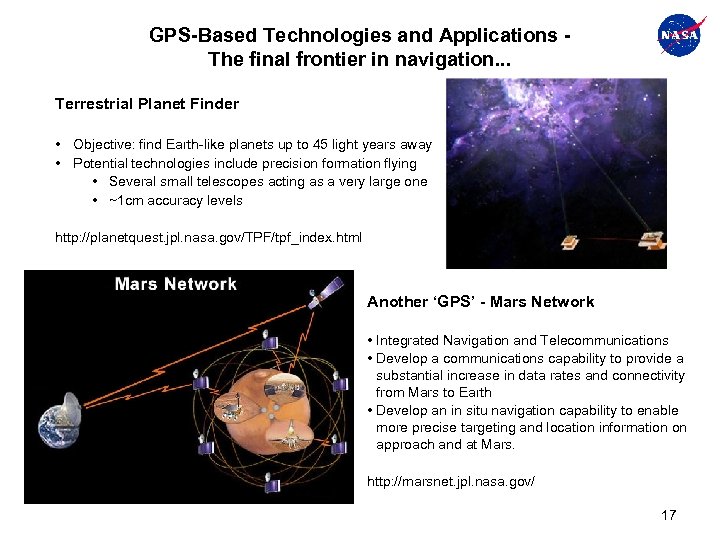 GPS-Based Technologies and Applications The final frontier in navigation. . . Terrestrial Planet Finder • Objective: find Earth-like planets up to 45 light years away • Potential technologies include precision formation flying • Several small telescopes acting as a very large one • ~1 cm accuracy levels http: //planetquest. jpl. nasa. gov/TPF/tpf_index. html Another ‘GPS’ - Mars Network • Integrated Navigation and Telecommunications • Develop a communications capability to provide a substantial increase in data rates and connectivity from Mars to Earth • Develop an in situ navigation capability to enable more precise targeting and location information on approach and at Mars. http: //marsnet. jpl. nasa. gov/ 17
 Backup Slides (Background Material) 18
 Contributors to this Presentation • • • Dr. Lawrence Young – Jet Propulsion Laboratory – 818 -354 -5018 Lawrence. E. Young@jpl. nasa. gov Allen Farrington – Jet Propulsion Laboratory – 818 -393 -5260 Allen. H. Farrington@jpl. nasa. gov Dr. Yoaz Bar-Sever – Jet Propulsion Laboratory – 818 -354 -2665 Yoaz. E. Bar-Sever@jpl. nasa. gov Dr. Frank Bauer – Goddard Space Flight Center – 301 -286 -3102 Frank. Bauer@nasa. gov Dr. Dave Affens - Goddard Space Flight Center – 301 -286 -9839 David. W. Affens@nasa. gov Dr. Michael Moreau – Goddard Space Flight Center – 301 -286 -8382 Mike. Moreau@nasa. gov Roger J. Flaherty – Goddard Space Flight Center – 301 -286 -7028 Roger. J. Flaherty@nasa. gov Scott Murray – Johnson Space Center – 281 -483 -8242 Scott. V. Murray@nasa. gov Dr. Scott Pace – NASA Headquarters – 202 -358 -1811 Scott. Pace@nasa. gov 19
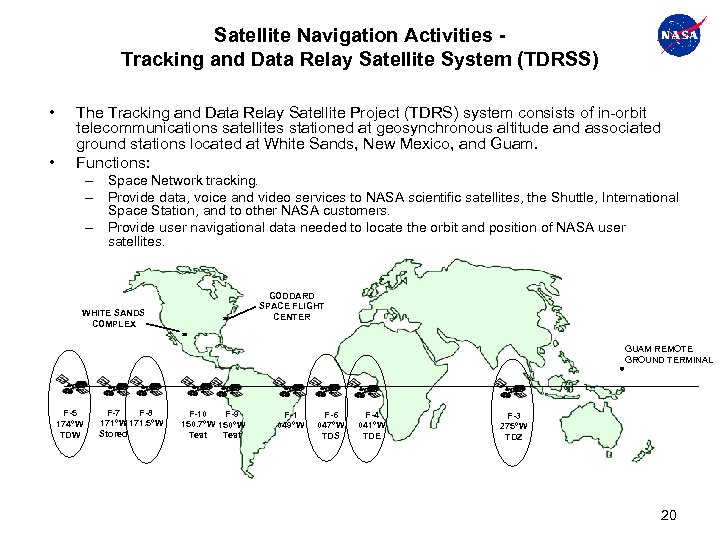 Satellite Navigation Activities Tracking and Data Relay Satellite System (TDRSS) • • The Tracking and Data Relay Satellite Project (TDRS) system consists of in-orbit telecommunications satellites stationed at geosynchronous altitude and associated ground stations located at White Sands, New Mexico, and Guam. Functions: – Space Network tracking. – Provide data, voice and video services to NASA scientific satellites, the Shuttle, International Space Station, and to other NASA customers. – Provide user navigational data needed to locate the orbit and position of NASA user satellites. GODDARD SPACE FLIGHT CENTER WHITE SANDS COMPLEX GUAM REMOTE GROUND TERMINAL F-5 174°W TDW F-7 F-8 171°W 171. 5°W Stored F-10 F-9 150. 7°W 150°W Test F-1 049°W F-6 047°W TDS F-4 041°W TDE F-3 275°W TDZ 20
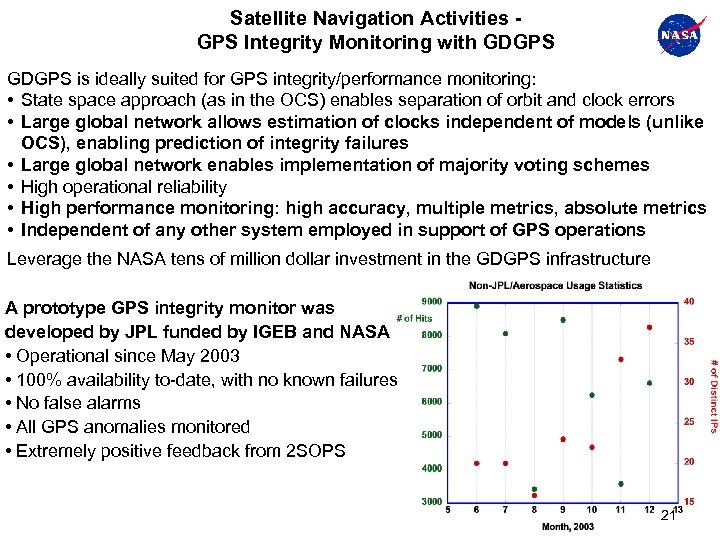 Satellite Navigation Activities GPS Integrity Monitoring with GDGPS is ideally suited for GPS integrity/performance monitoring: • State space approach (as in the OCS) enables separation of orbit and clock errors • Large global network allows estimation of clocks independent of models (unlike OCS), enabling prediction of integrity failures • Large global network enables implementation of majority voting schemes • High operational reliability • High performance monitoring: high accuracy, multiple metrics, absolute metrics • Independent of any other system employed in support of GPS operations Leverage the NASA tens of million dollar investment in the GDGPS infrastructure A prototype GPS integrity monitor was developed by JPL funded by IGEB and NASA • Operational since May 2003 • 100% availability to-date, with no known failures • No false alarms • All GPS anomalies monitored • Extremely positive feedback from 2 SOPS 21
 Distress Alerting Satellite System (DASS) DASS Provides • 406 MHz ‘bent pipe’ repeaters on future GPS satellites • Full compatibility with existing and future 406 MHz beacons • Global detection and location • Beacons without embedded GPS – greater than Cospas-Sarsat accuracy with 3 bursts or less • Self-locating beacons – GPS accuracy after single beacon burst • Support USAF/military SAR responsibilities • Alert data downlink freely available internationally • Low technical risk and low cost (uses modified existing GPS hardware) Optionally Could Provide • • • Short digital message return confirmation message Aids in false alarm mitigation Direct communications with survivors Support rescue force coordination Reduced interference susceptibility via confirmation Development Status On-Orbit Testing • Four DASS capable satellites, Block IIRs, in-orbit as of 2004 • Preliminary results support feasibility analysis DASS POC Ground Equipment • Antenna system installation completed 3 rd quarter 2004 • Ground station equipment acquisition underway • The DASS Local User Terminal being developed at GSFC Ground Station Site Selection • Antennas on GSFC Building 28 roof, ground station equipment in Building 25 • GSFC physical space construction begin 22