 Скачать презентацию Update FP 2020 Performance Monitoring Accountability
5ba738662b3742405678ce31d4ee734a.ppt
- Количество слайдов: 25



Update FP 2020 – Performance Monitoring & Accountability WG Roy Tjiong, dipresentasikan pada Coordination Meeting FP 2020 Indonesia, 3 September 2013
Task of PMA Working Group l enable the data collection and analysis necessary to bolster accountability for implementing financial, policy and programming commitments 2
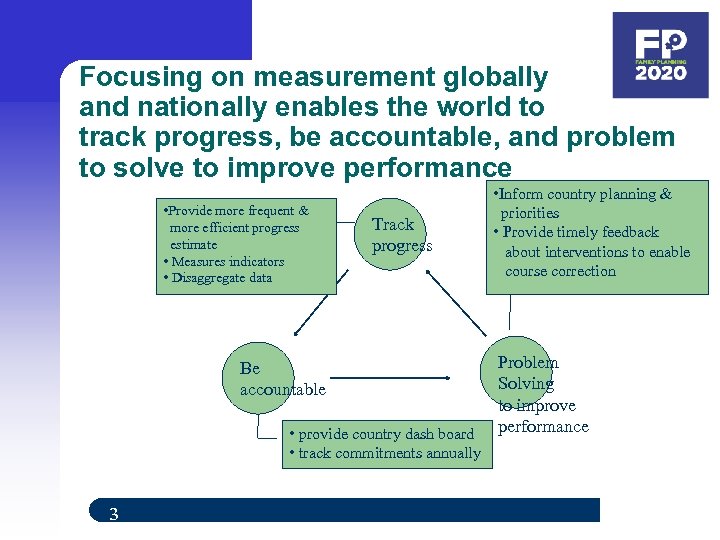
Focusing on measurement globally and nationally enables the world to track progress, be accountable, and problem to solve to improve performance • Provide more frequent & more efficient progress estimate • Measures indicators • Disaggregate data Track progress Be accountable • provide country dash board • track commitments annually 3 • Inform country planning & priorities • Provide timely feedback about interventions to enable course correction Problem Solving to improve performance
Performance Monitoring & Accountability Working Group l l is co-led by Dr. Zeba Sathar from the Population Council in Pakistan and Dr. Marleen Temmerman from the World Health Organization is managed on the FP 2020 Task Team by Jessica Dorney Schwartzman. 4
Member of PMA Working Group l l l Dr. Ian Askew, Population Council Ann Biddlecom, United Nations Population Division Dr. Win Brown, The Bill & Melinda Gates Foundation Julia Bunting, International Planned Parenthood Federation Abhijit Das, Centre for Health and Social Justice Dr. Luis Andres de Francisco Serpa, Partnership for Maternal, Newborn and Child Health 5
Member of PMA Working Group l l l Nel Druce, UK Department for International Development Desmond Koroma, United Nations Population Fund Dr. Cheikh Mbacke, William and Flora Hewlett Foundation Dr. Scott Radloff, The Bill & Melinda Gates Institute for Population and Reproductive Health, Bloomberg School of Public Health Dr. Sara Seims, London School of Economics; Packard Foundation 6
Member of PMA Working Group l l l Navendu Shekhar, Pathfinder International Duduzile Simelane, International HIV/AIDS Alliance Dr. Roy Tjiong, Indonesian Planned Parenthood Association Michelle Weinberg, Marie Stopes International Dr. Eliya Zulu, African Institute for Development Policy 7
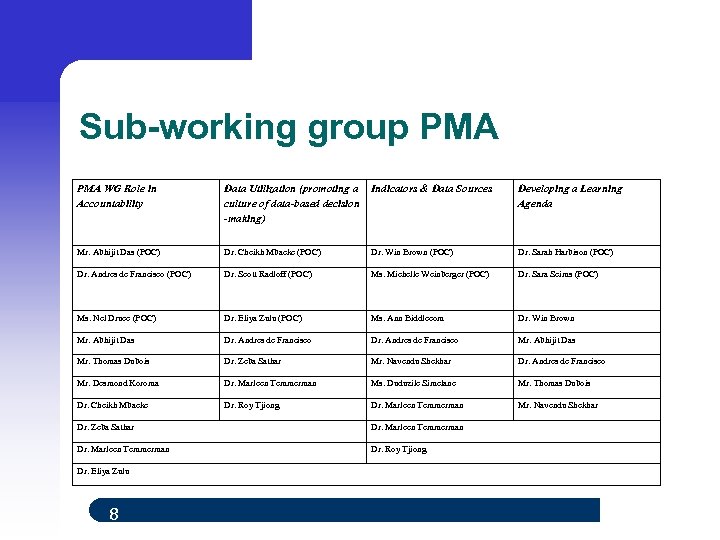
Sub-working group PMA WG Role in Accountability Data Utilization (promoting a culture of data-based decision -making) Indicators & Data Sources Developing a Learning Agenda Mr. Abhijit Das (POC) Dr. Cheikh Mbacke (POC) Dr. Win Brown (POC) Dr. Sarah Harbison (POC) Dr. Andres de Francisco (POC) Dr. Scott Radloff (POC) Ms. Michelle Weinberger (POC) Dr. Sara Seims (POC) Ms. Nel Druce (POC) Dr. Eliya Zulu (POC) Ms. Ann Biddlecom Dr. Win Brown Mr. Abhijit Das Dr. Andres de Francisco Mr. Abhijit Das Mr. Thomas Dubois Dr. Zeba Sathar Mr. Navendu Shekhar Dr. Andres de Francisco Mr. Desmond Koroma Dr. Marleen Temmerman Ms. Duduzile Simelane Mr. Thomas Dubois Dr. Cheikh Mbacke Dr. Roy Tjiong Dr. Marleen Temmerman Mr. Navendu Shekhar Dr. Zeba Sathar Dr. Marleen Temmerman Dr. Roy Tjiong Dr. Eliya Zulu 8
Monitoring Progress in Family Planning Futures Institute 9
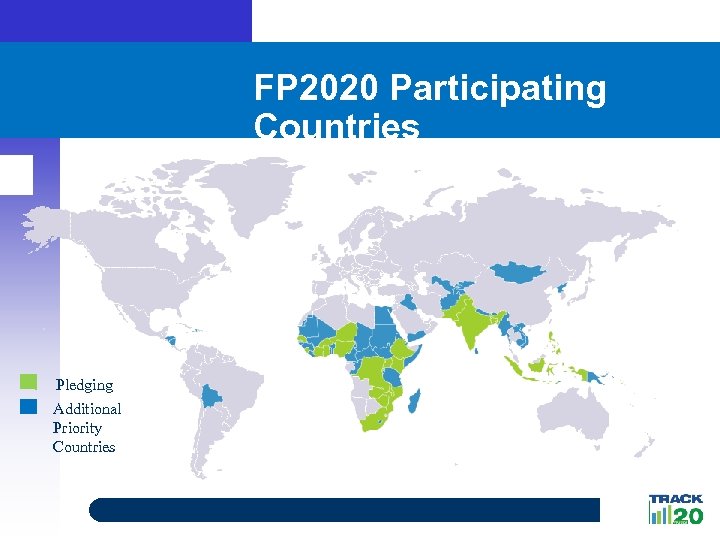
FP 2020 Participating Countries Pledging Additional Priority Countries
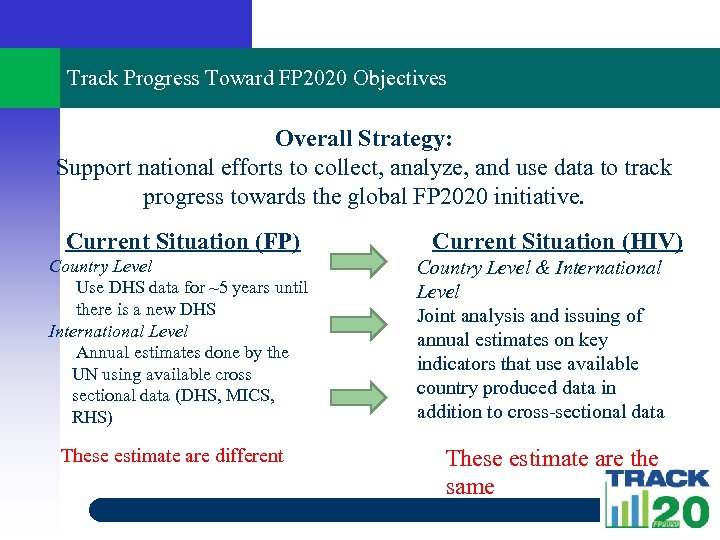
Track Progress Toward FP 2020 Objectives Overall Strategy: Support national efforts to collect, analyze, and use data to track progress towards the global FP 2020 initiative. Current Situation (FP) Country Level Use DHS data for ~5 years until there is a new DHS International Level Annual estimates done by the UN using available cross sectional data (DHS, MICS, RHS) These estimate are different Current Situation (HIV) Country Level & International Level Joint analysis and issuing of annual estimates on key indicators that use available country produced data in addition to cross-sectional data These estimate are the same
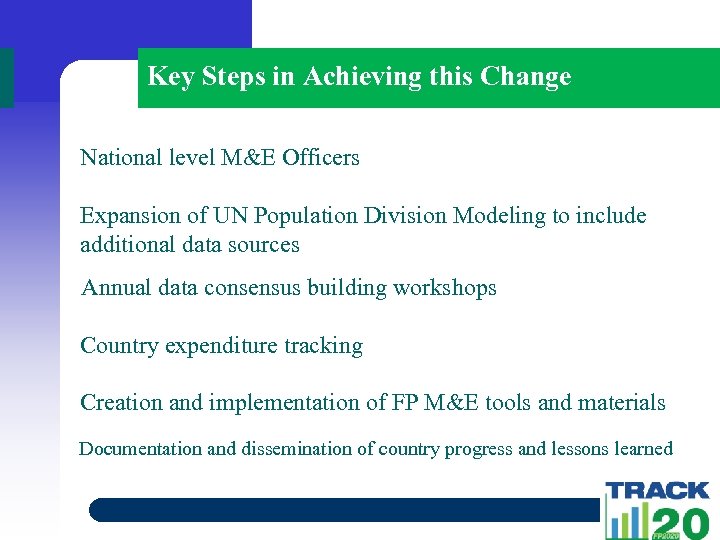
Key Steps in Achieving this Change National level M&E Officers Expansion of UN Population Division Modeling to include additional data sources Annual data consensus building workshops Country expenditure tracking Creation and implementation of FP M&E tools and materials Documentation and dissemination of country progress and lessons learned
National Level M&E Officers Offered to the 22 pledging countries (plus DRC) Placed in the MOH, Office of Population, or other relevant body Track 20 will pay salary for the first two years, will need a sustainability plan after that Point person for FP data, facilitate and support getting data moving through the system Track 20 will provide ongoing technical capacity building through regional trainings, country visits, and responding to technical requests Key partners in FP monitoring field will be integrated into these trainings to learn successes in other programs and global leaders in monitoring Provide a venue for cross-country sharing
Modeling with UN Pop Division Expand current model to include FP data available in countries Service statistics Commodity data Private sector NGO service providers Still use cross-sectional data as anchors, but will allow the additional data to contribute towards estimating the trend between surveys Produce uncertainty bands around the estimates
Annual Data Consensus Building Workshops Bring together partners (Gov, UN, USAID, NGO, etc. ) to review, discuss, and analyze available data Use expanded UN model to estimate annual m. CPR Issue annual estimates of key FP indicators m. CPR Stock-outs Unmet need FP expenditures FP info received Number of unintended pregnancies Number of maternal and child deaths averted Estimates will come from a variety of sources: DHS, MICS, RHS, PMA 2020, service statistics, project data, etc. and will be derived using different methodologies: direct estimates, adjusted estimates, modeling
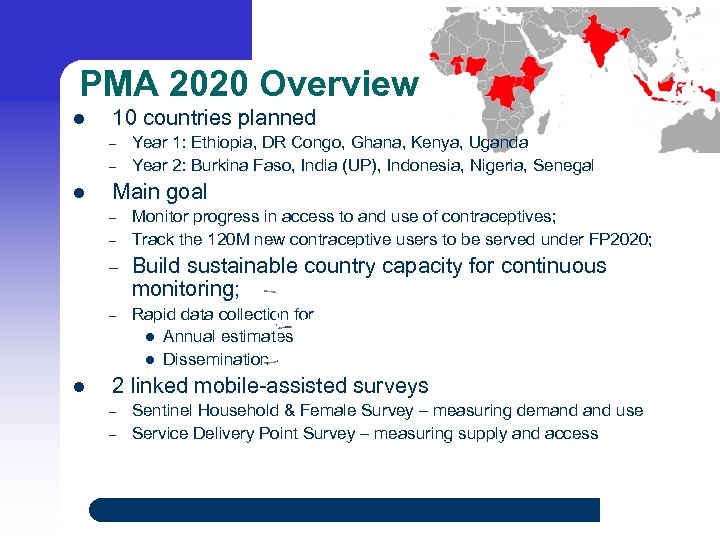
PMA 2020 Overview l 10 countries planned – – l Year 1: Ethiopia, DR Congo, Ghana, Kenya, Uganda Year 2: Burkina Faso, India (UP), Indonesia, Nigeria, Senegal Main goal – – Monitor progress in access to and use of contraceptives; Track the 120 M new contraceptive users to be served under FP 2020; – – l Build sustainable country capacity for continuous monitoring; Rapid data collection for mobile Assisted Data and l Annual estimates Dissemination System l Dissemination m. ADDS 2 linked mobile-assisted surveys – – Sentinel Household & Female Survey – measuring demand use Service Delivery Point Survey – measuring supply and access
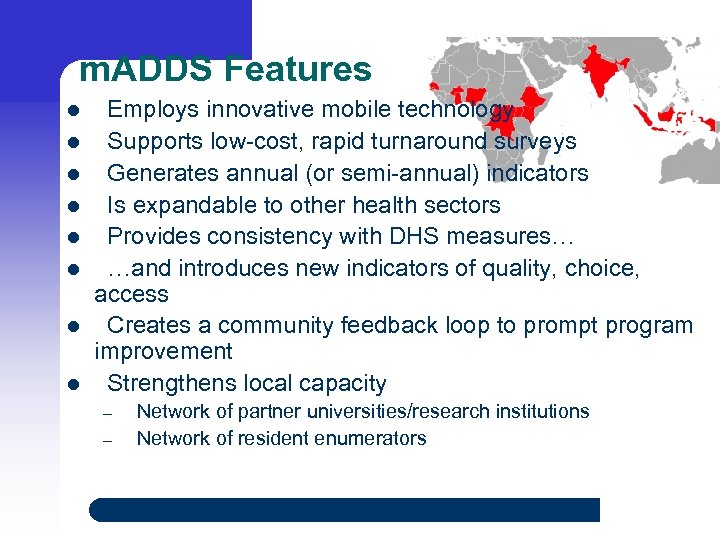
m. ADDS Features l l l l Employs innovative mobile technology Supports low-cost, rapid turnaround surveys Generates annual (or semi-annual) indicators Is expandable to other health sectors Provides consistency with DHS measures… …and introduces new indicators of quality, choice, access Creates a community feedback loop to prompt program improvement Strengthens local capacity – – Network of partner universities/research institutions Network of resident enumerators
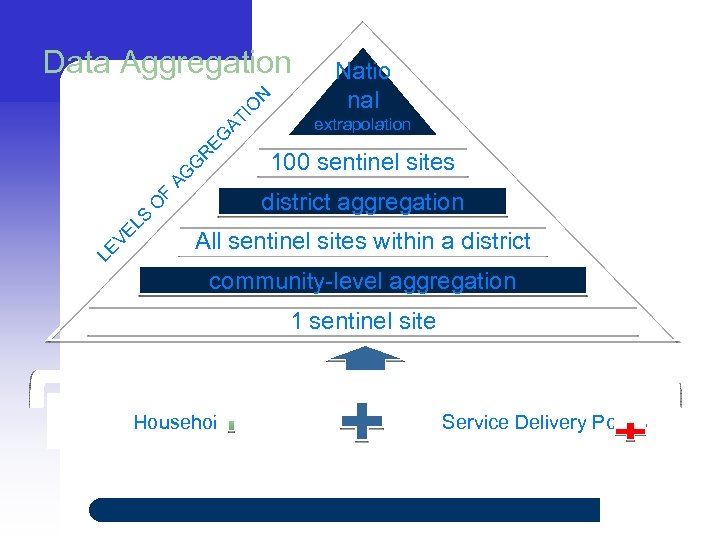
AG G R EG AT IO N Data Aggregation extrapolation 100 sentinel sites O F district aggregation S EL LE V Natio nal All sentinel sites within a district community-level aggregation 1 sentinel site Households Service Delivery Points
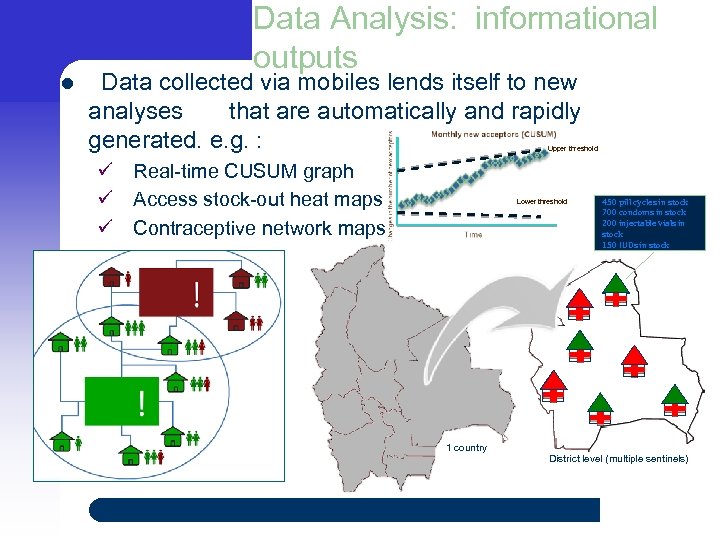
l Data Analysis: informational outputs Data collected via mobiles lends itself to new analyses that are automatically and rapidly generated. e. g. : Upper threshold ü Real-time CUSUM graph ü Access stock-out heat maps ü Contraceptive network maps Lower threshold 450 pill cycles in stock 700 condoms in stock 200 injectable vials in stock 150 IUDs in stock 1 country District level (multiple sentinels)
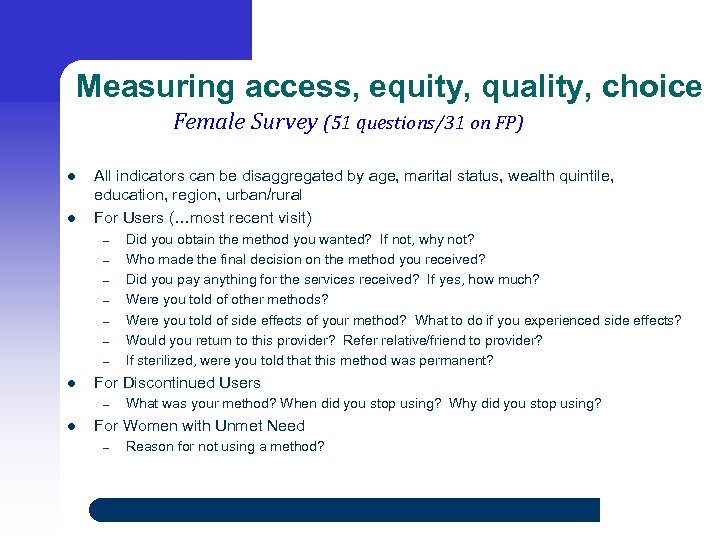
Measuring access, equity, quality, choice Female Survey (51 questions/31 on FP) l l All indicators can be disaggregated by age, marital status, wealth quintile, education, region, urban/rural For Users (…most recent visit) – – – – l For Discontinued Users – l Did you obtain the method you wanted? If not, why not? Who made the final decision on the method you received? Did you pay anything for the services received? If yes, how much? Were you told of other methods? Were you told of side effects of your method? What to do if you experienced side effects? Would you return to this provider? Refer relative/friend to provider? If sterilized, were you told that this method was permanent? What was your method? When did you stop using? Why did you stop using? For Women with Unmet Need – Reason for not using a method?
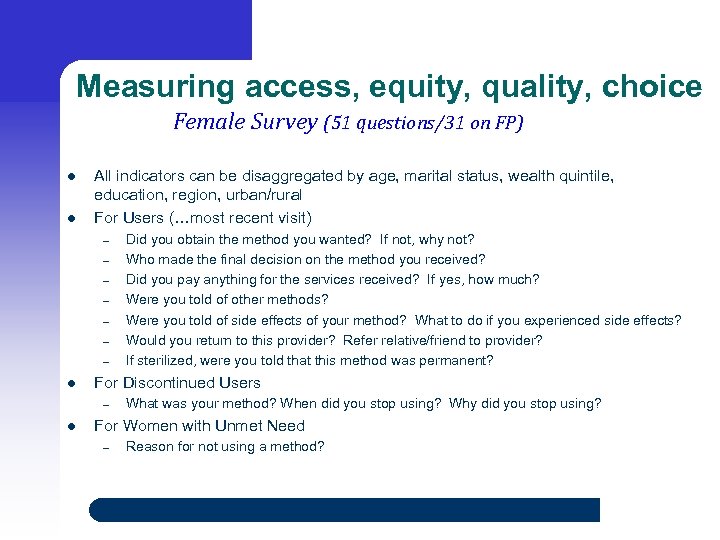
Measuring access, equity, quality, choice Female Survey (51 questions/31 on FP) l l All indicators can be disaggregated by age, marital status, wealth quintile, education, region, urban/rural For Users (…most recent visit) – – – – l For Discontinued Users – l Did you obtain the method you wanted? If not, why not? Who made the final decision on the method you received? Did you pay anything for the services received? If yes, how much? Were you told of other methods? Were you told of side effects of your method? What to do if you experienced side effects? Would you return to this provider? Refer relative/friend to provider? If sterilized, were you told that this method was permanent? What was your method? When did you stop using? Why did you stop using? For Women with Unmet Need – Reason for not using a method?
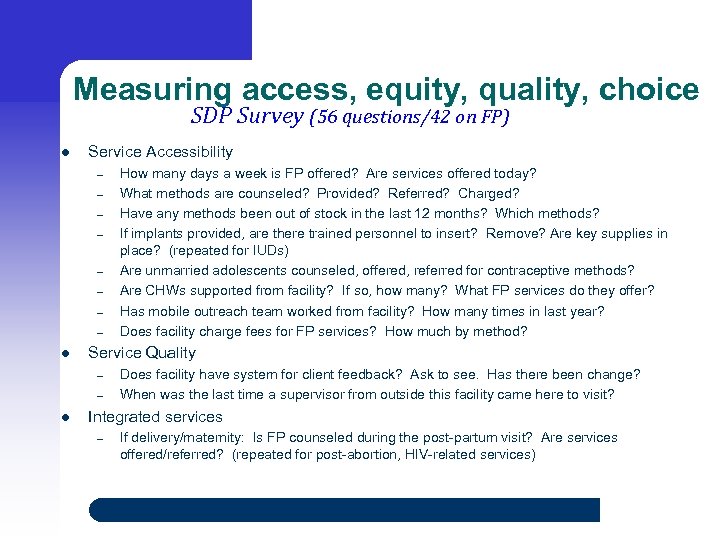
Measuring access, equity, quality, choice SDP Survey (56 questions/42 on FP) l Service Accessibility – – – – l Service Quality – – l How many days a week is FP offered? Are services offered today? What methods are counseled? Provided? Referred? Charged? Have any methods been out of stock in the last 12 months? Which methods? If implants provided, are there trained personnel to insert? Remove? Are key supplies in place? (repeated for IUDs) Are unmarried adolescents counseled, offered, referred for contraceptive methods? Are CHWs supported from facility? If so, how many? What FP services do they offer? Has mobile outreach team worked from facility? How many times in last year? Does facility charge fees for FP services? How much by method? Does facility have system for client feedback? Ask to see. Has there been change? When was the last time a supervisor from outside this facility came here to visit? Integrated services – If delivery/maternity: Is FP counseled during the post-partum visit? Are services offered/referred? (repeated for post-abortion, HIV-related services)
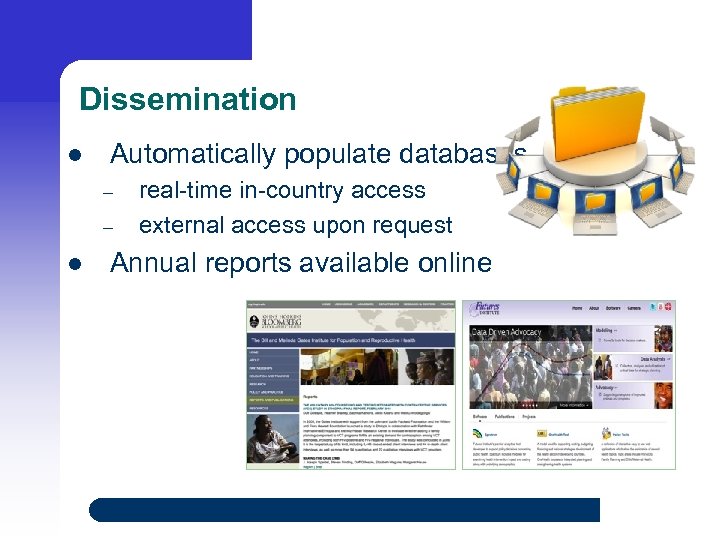
Dissemination l Automatically populate databases – – l real-time in-country access external access upon request Annual reports available online
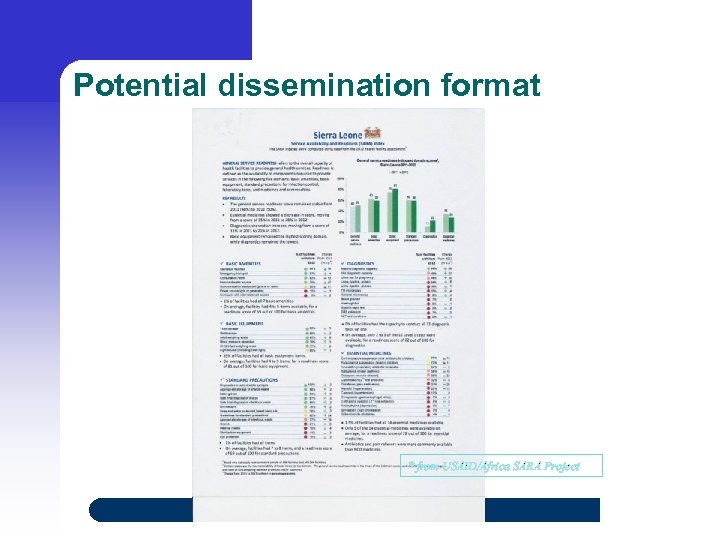
Potential dissemination format * from USAID/Africa SARA Project
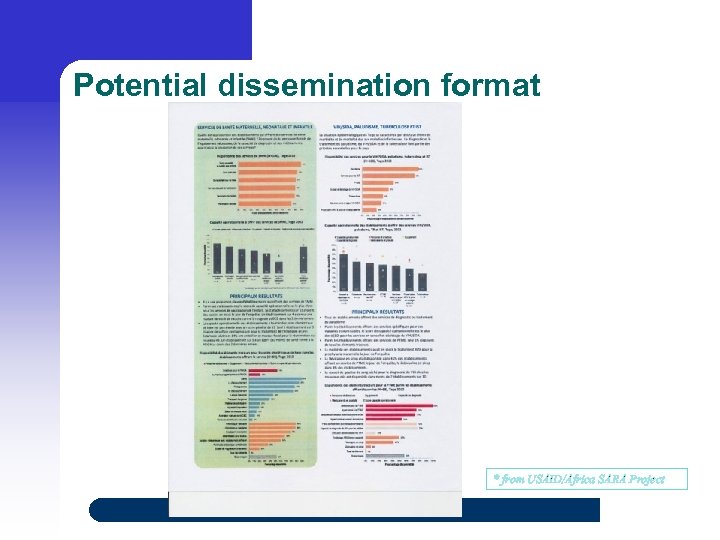
Potential dissemination format * from USAID/Africa SARA Project
Скачать презентацию Update FP 2020 Performance Monitoring Accountability
5ba738662b3742405678ce31d4ee734a.ppt