


 Скачать презентацию Upcoming Classes Tuesday Sept 4 th Fractal Worlds
8067d911c41ea4fbdfe19c953f4fa20e.ppt
- Количество слайдов: 41
 Upcoming Classes Tuesday, Sept. 4 th Fractal Worlds & Chaotic Systems Assignments due: * Topic of first oral presentation or written paper * Read “Order in Pollock's Chaos”; Scientific American, December 2002 Thursday, Sept. 6 th Motion, in the real world and in animated worlds Assignment due: * Read “It’s All in the Timing and the Spacing”, The Animator's Survival Kit, R. Williams, Pages 35 -51 * Homework #2
 Upcoming Deadlines Thursday, September 13 th First draft of your first term paper or your oral presentation Thursday, September 27 th First Set of Oral Presentations First term paper (if not giving presentation)
 Oral Presentations The following persons will give oral presentations on Thursday, September 27 th : • Batres, Adan • Boyd, Heidi • Chen, Emily • Kwiatkowski, Dajon • Lebedeff, Christopher • Lipton, Christopher For everyone else, your first term paper is due on that date.
 Physical Scale & Geometric Perspective
 Measurement is the foundation of modern, quantitative science. Three fundamental physical measurements: • Distance • Time • Matter (mass) Today we’ll consider how distance appears in the visual arts, such as in paintings.
 Perception of Distance Visually, we experience distance by • Occultation (objects hide what’s behind them) • Geometric Perspective (objects look smaller as they get further away) • Atmospheric Perspective (distant objects are hazy and bluish) • Lighting and shadows • Stereopsis (different view in each eye) • Relative motion (as you move, nearby objects shift more than distant objects) We’ll discuss some of these today, others in future lectures
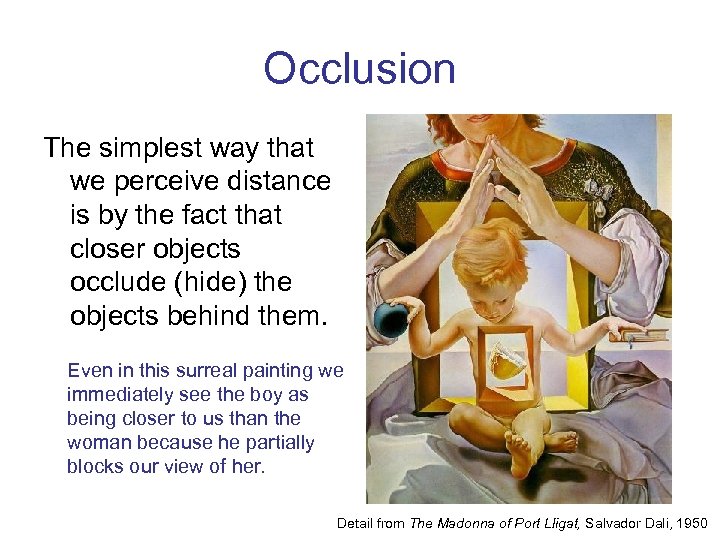 Occlusion The simplest way that we perceive distance is by the fact that closer objects occlude (hide) the objects behind them. Even in this surreal painting we immediately see the boy as being closer to us than the woman because he partially blocks our view of her. Detail from The Madonna of Port Lligat, Salvador Dali, 1950
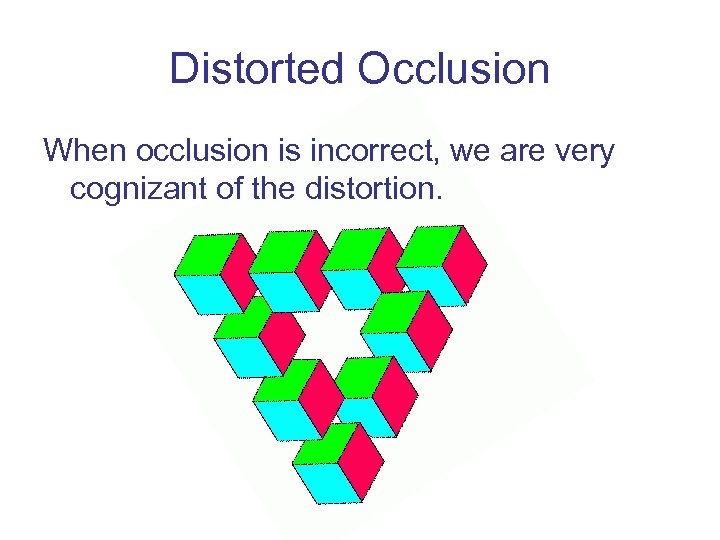 Distorted Occlusion When occlusion is incorrect, we are very cognizant of the distortion.
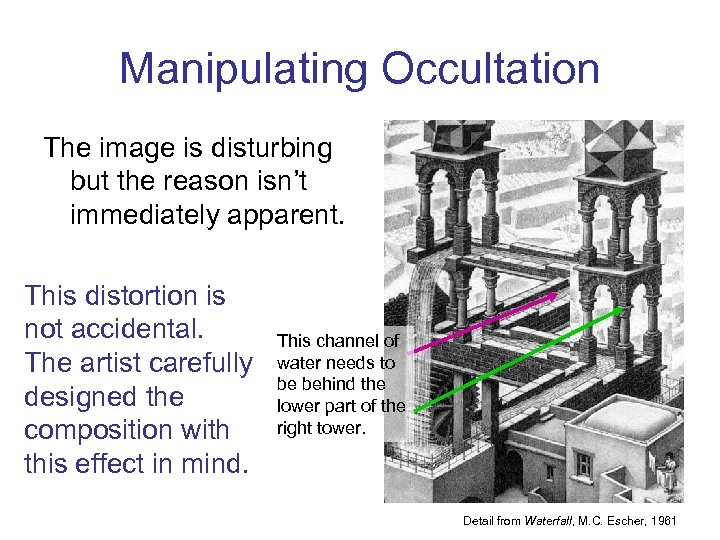 Manipulating Occultation The image is disturbing but the reason isn’t immediately apparent. This distortion is not accidental. The artist carefully designed the composition with this effect in mind. This channel of water needs to be behind the lower part of the right tower. Detail from Waterfall, M. C. Escher, 1961
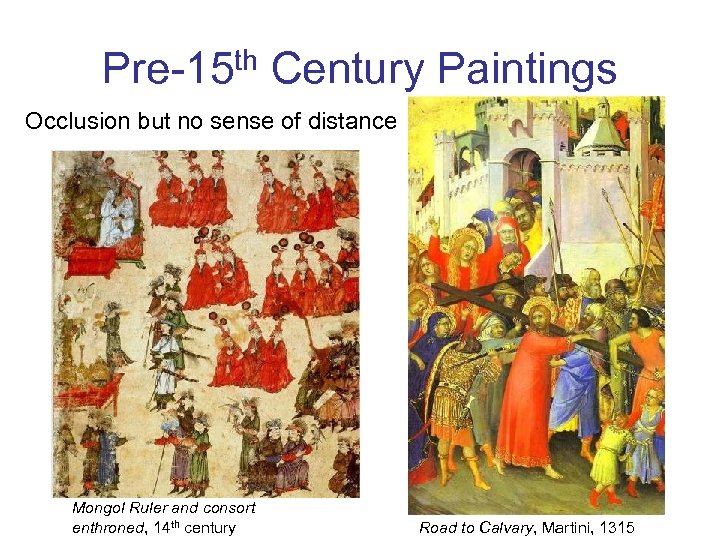 Pre-15 th Century Paintings Occlusion but no sense of distance Mongol Ruler and consort enthroned, 14 th century Road to Calvary, Martini, 1315
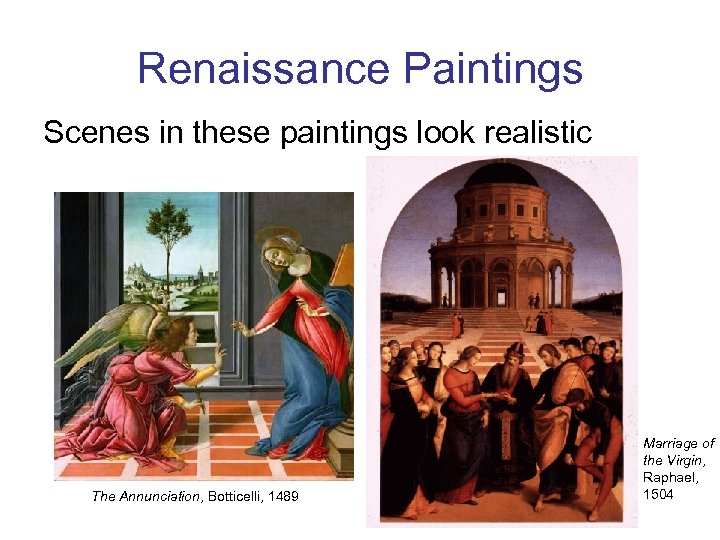 Renaissance Paintings Scenes in these paintings look realistic The Annunciation, Botticelli, 1489 Marriage of the Virgin, Raphael, 1504
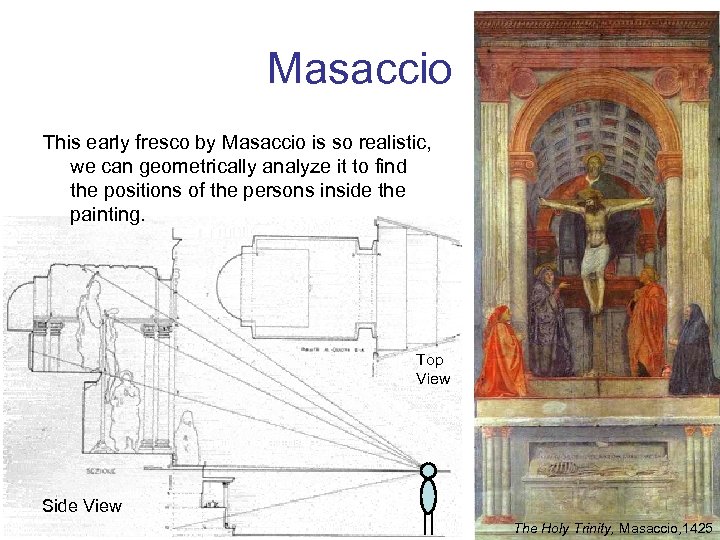 Masaccio This early fresco by Masaccio is so realistic, we can geometrically analyze it to find the positions of the persons inside the painting. Top View Side View The Holy Trinity, Masaccio, 1425
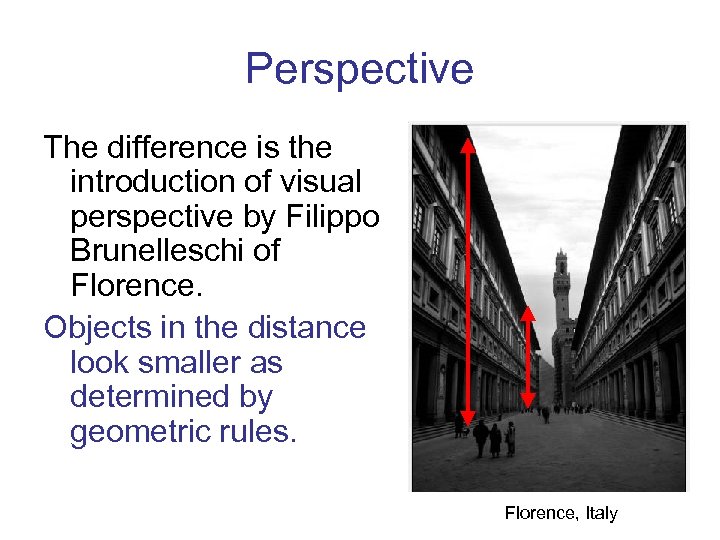 Perspective The difference is the introduction of visual perspective by Filippo Brunelleschi of Florence. Objects in the distance look smaller as determined by geometric rules. Florence, Italy
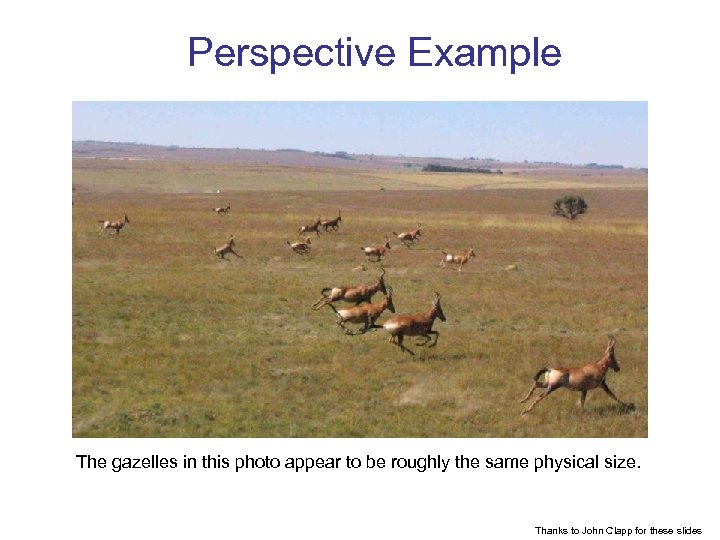 Perspective Example The gazelles in this photo appear to be roughly the same physical size. Thanks to John Clapp for these slides
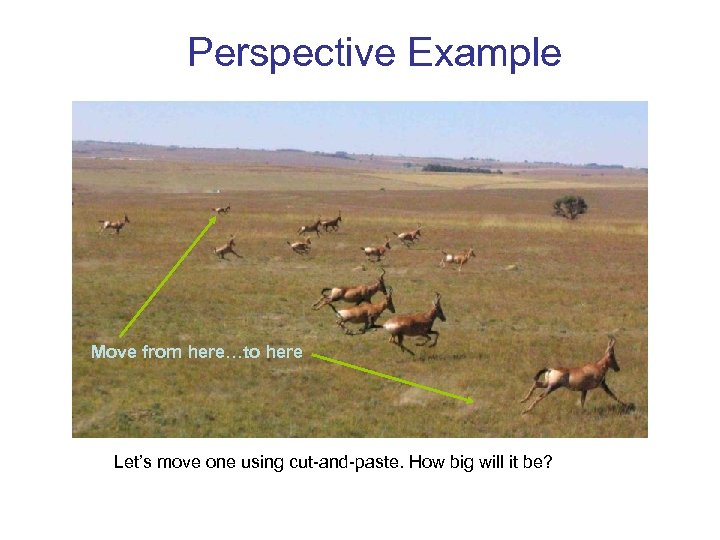 Perspective Example Move from here…to here Let’s move one using cut-and-paste. How big will it be?
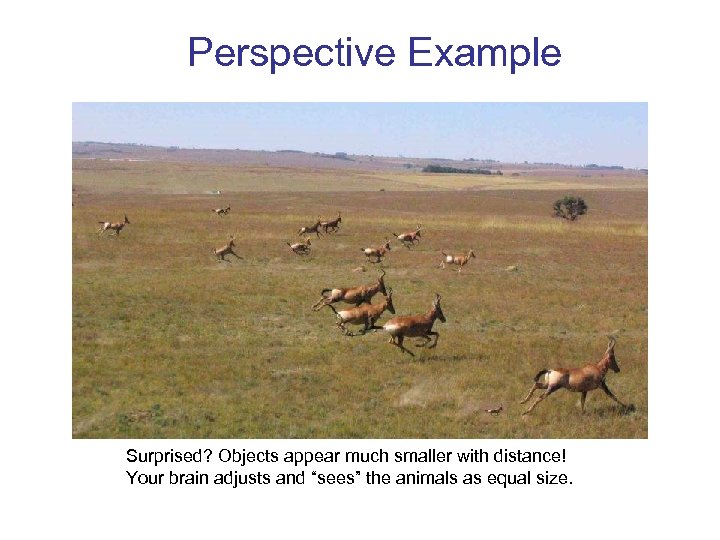 Perspective Example Surprised? Objects appear much smaller with distance! Your brain adjusts and “sees” the animals as equal size.
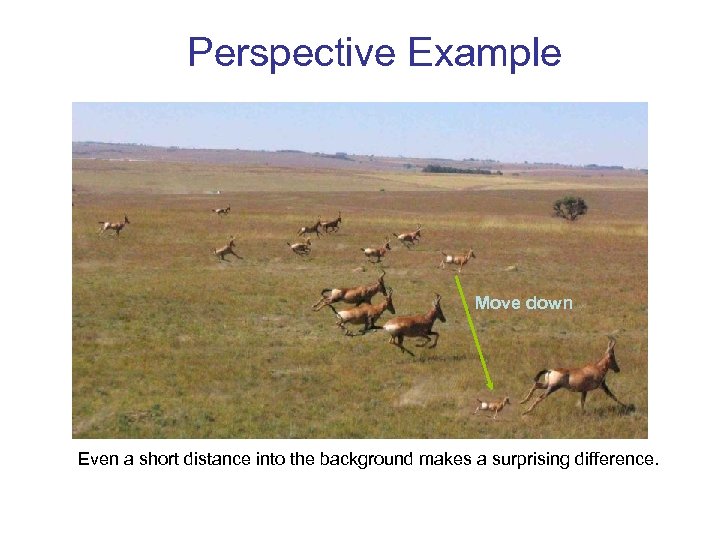 Perspective Example Move down Even a short distance into the background makes a surprising difference.
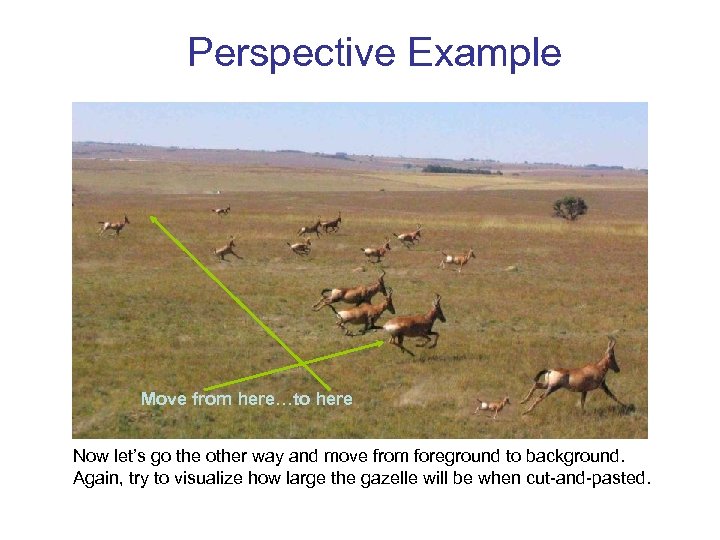 Perspective Example Move from here…to here Now let’s go the other way and move from foreground to background. Try to visualize it’s size… Again, try to visualize how large the gazelle will be when cut-and-pasted.
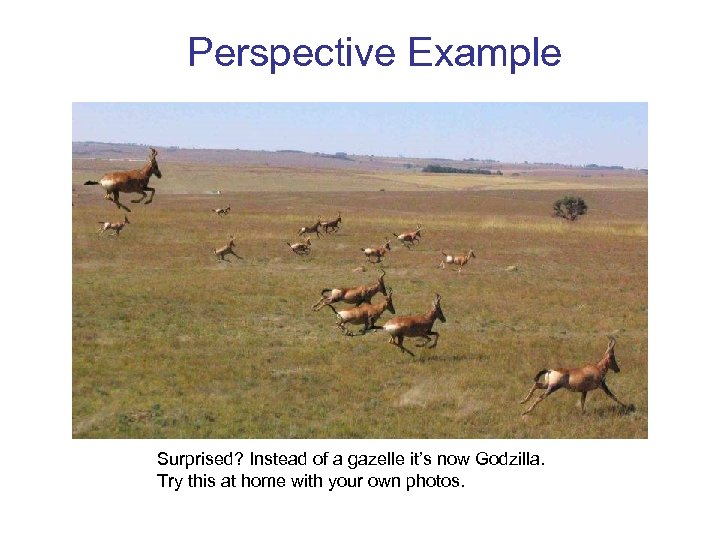 Perspective Example Surprised? Instead of a gazelle it’s now Godzilla. Try this at home with your own photos.
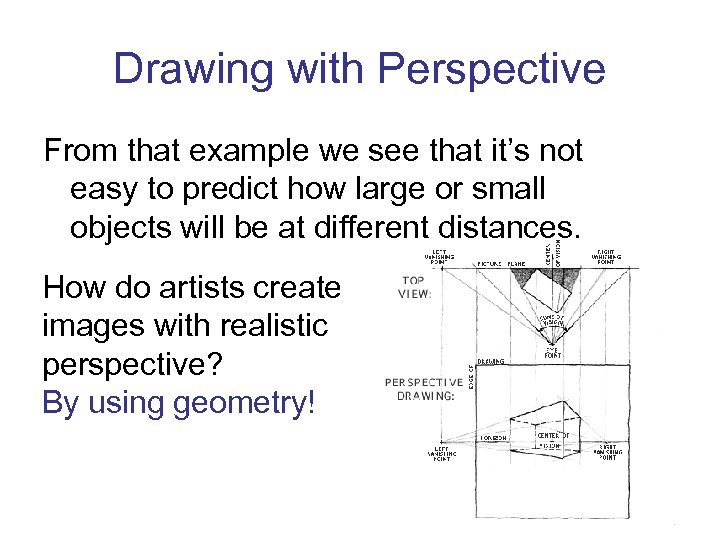 Drawing with Perspective From that example we see that it’s not easy to predict how large or small objects will be at different distances. How do artists create images with realistic perspective? By using geometry!
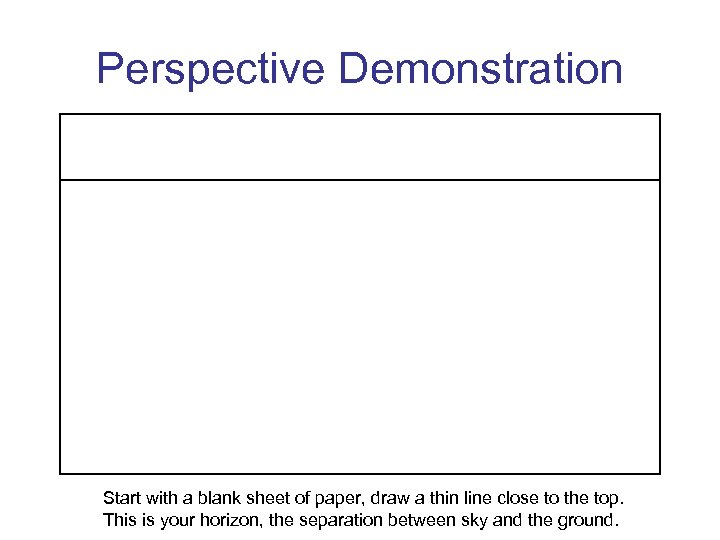 Perspective Demonstration Start with a blank sheet of paper, draw a thin line close to the top. This is your horizon, the separation between sky and the ground.
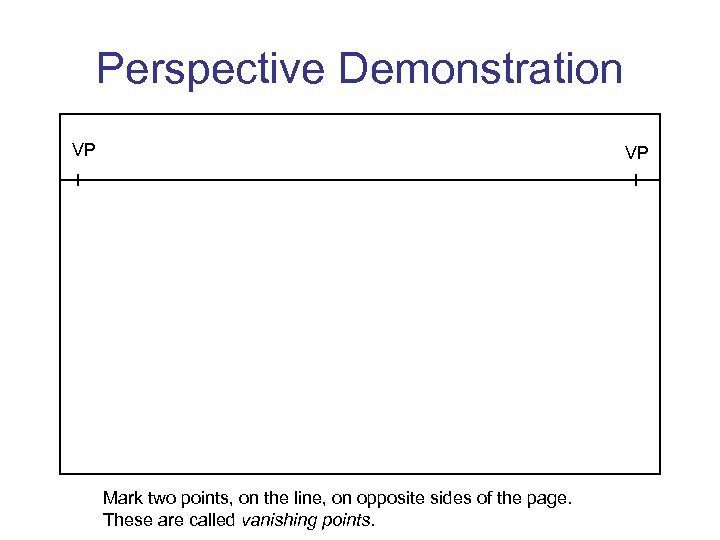 Perspective Demonstration VP VP Mark two points, on the line, on opposite sides of the page. These are called vanishing points.
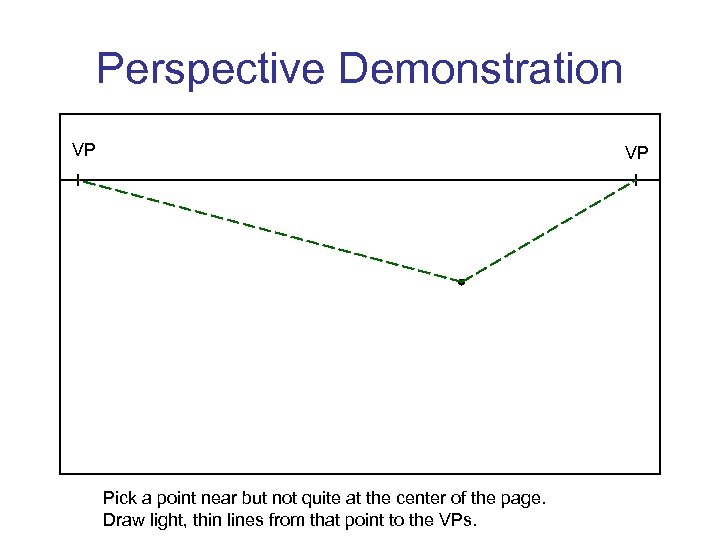 Perspective Demonstration VP VP Pick a point near but not quite at the center of the page. Draw light, thin lines from that point to the VPs.
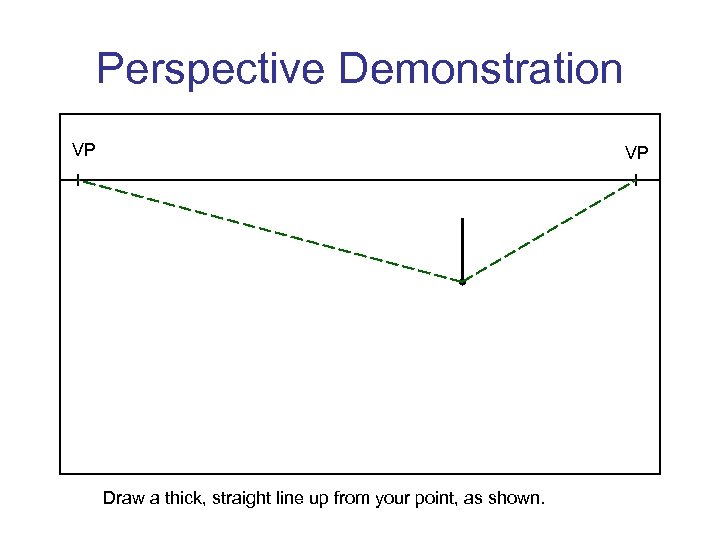 Perspective Demonstration VP VP Draw a thick, straight line up from your point, as shown.
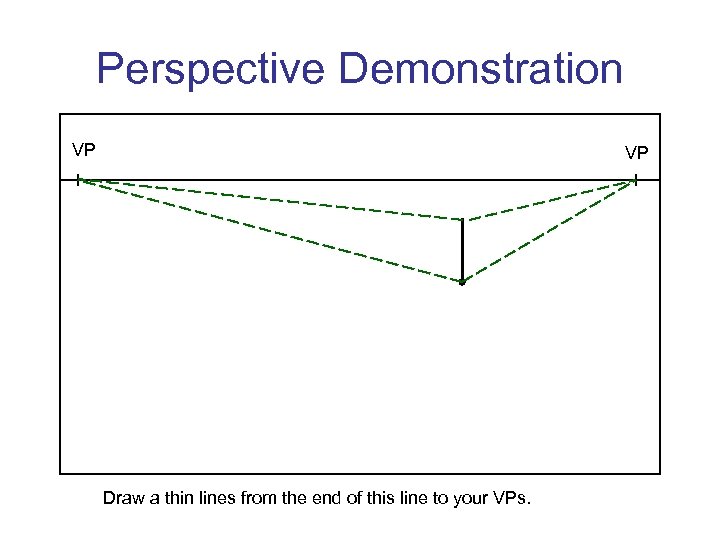 Perspective Demonstration VP VP Draw a thin lines from the end of this line to your VPs.
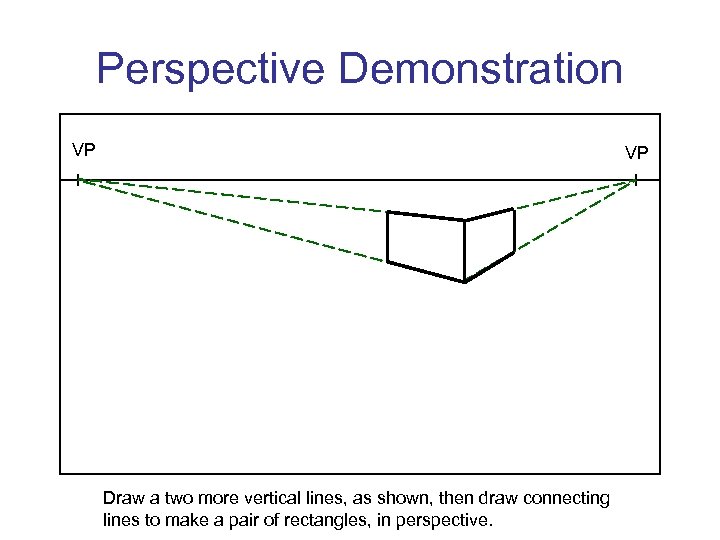 Perspective Demonstration VP VP Draw a two more vertical lines, as shown, then draw connecting lines to make a pair of rectangles, in perspective.
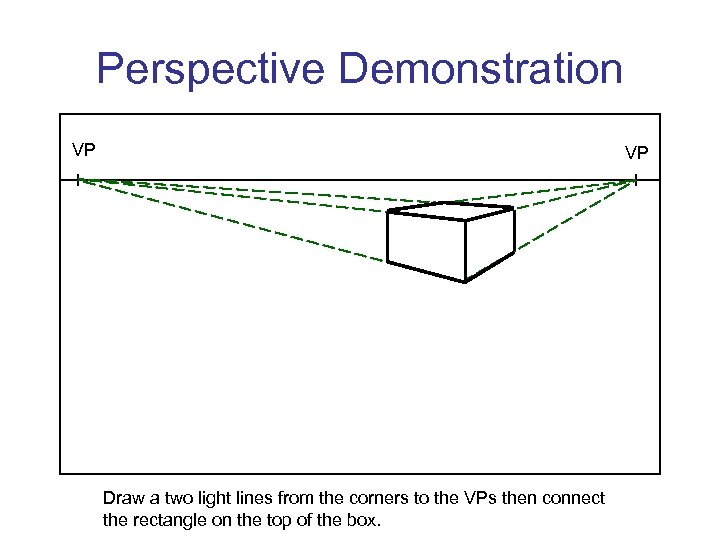 Perspective Demonstration VP VP Draw a two light lines from the corners to the VPs then connect the rectangle on the top of the box.
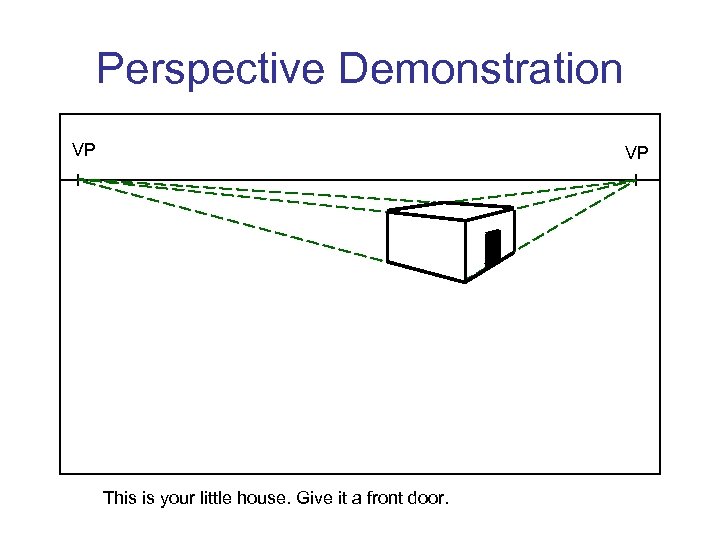 Perspective Demonstration VP VP This is your little house. Give it a front door.
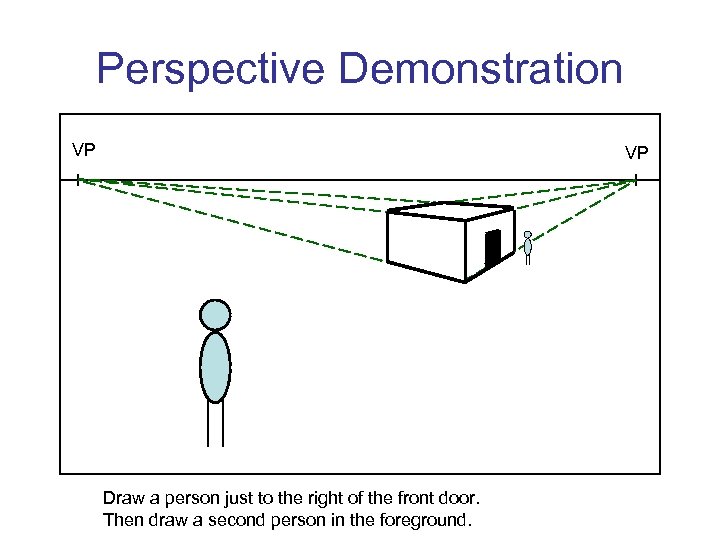 Perspective Demonstration VP VP Draw a person just to the right of the front door. Then draw a second person in the foreground.
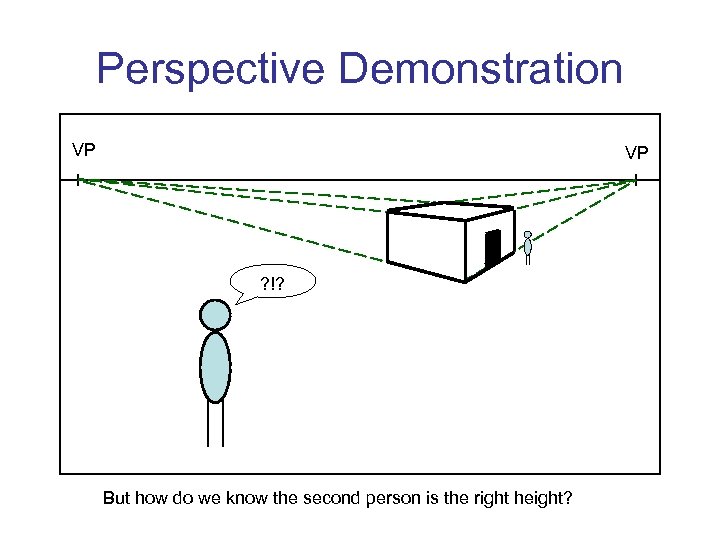 Perspective Demonstration VP VP ? !? But how do we know the second person is the right height?
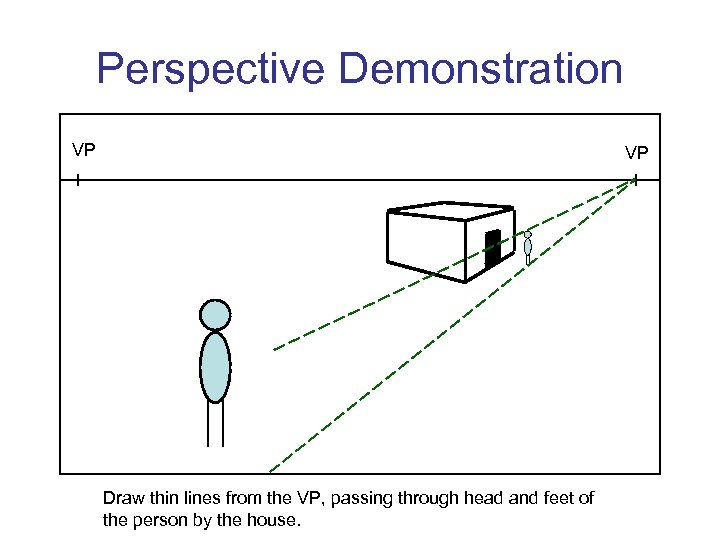 Perspective Demonstration VP VP Draw thin lines from the VP, passing through head and feet of the person by the house.
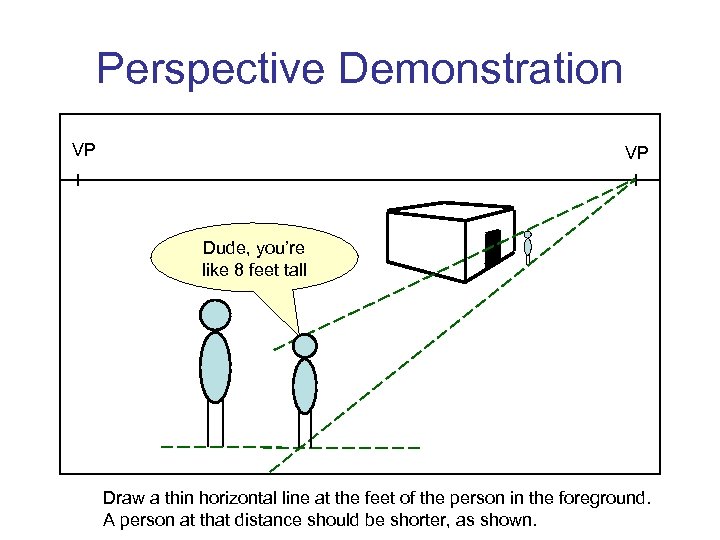 Perspective Demonstration VP VP Dude, you’re like 8 feet tall Draw a thin horizontal line at the feet of the person in the foreground. A person at that distance should be shorter, as shown.
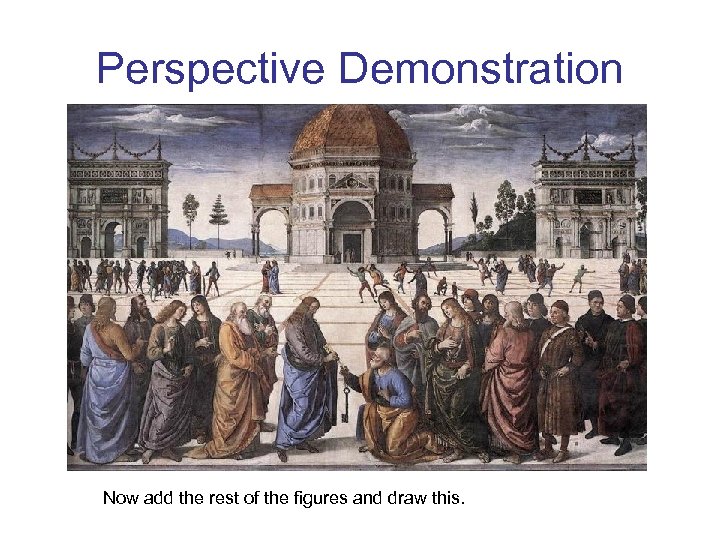 Perspective Demonstration Now add the rest of the figures and draw this.
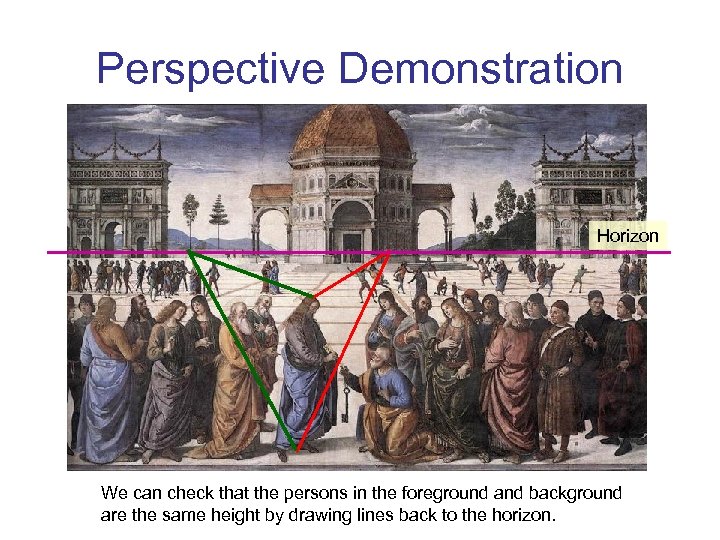 Perspective Demonstration Horizon We can check that the persons in the foreground and background are the same height by drawing lines back to the horizon.
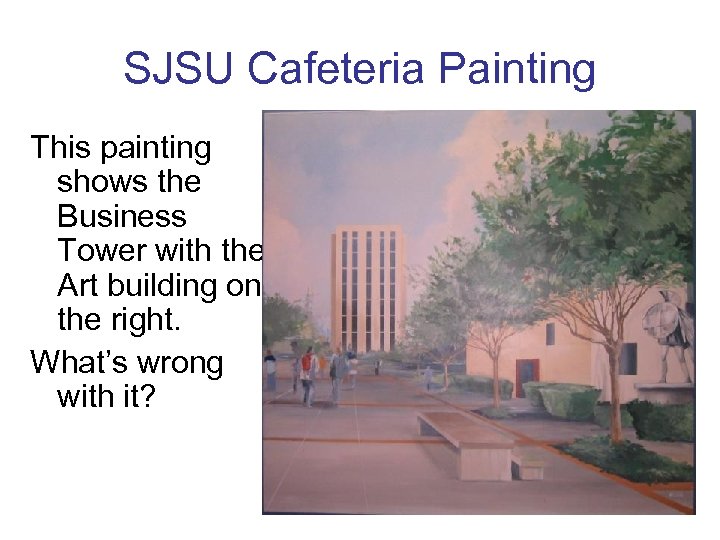 SJSU Cafeteria Painting This painting shows the Business Tower with the Art building on the right. What’s wrong with it?
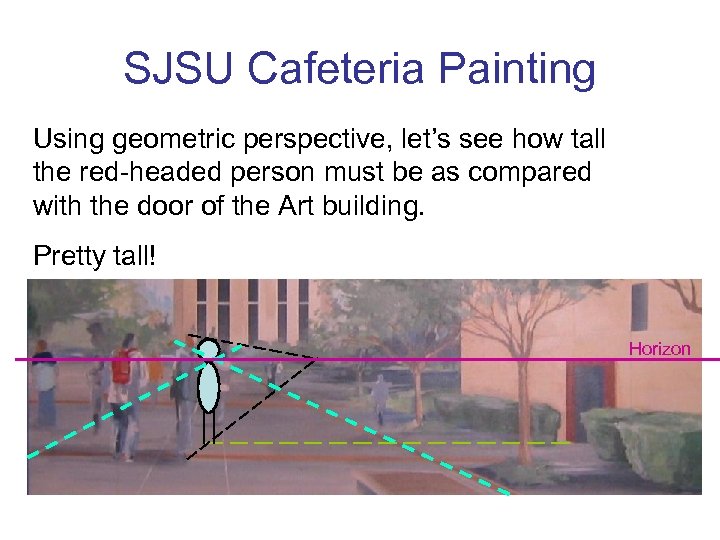 SJSU Cafeteria Painting Using geometric perspective, let’s see how tall the red-headed person must be as compared with the door of the Art building. Pretty tall! Horizon
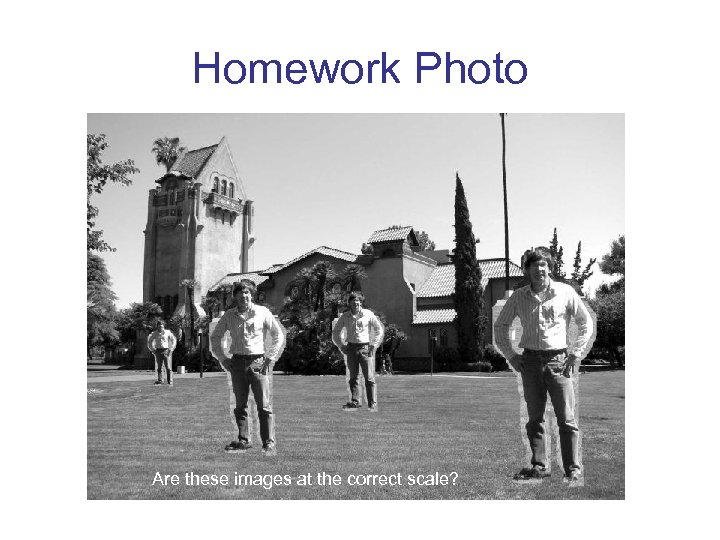 Homework Photo Are these images at the correct scale?
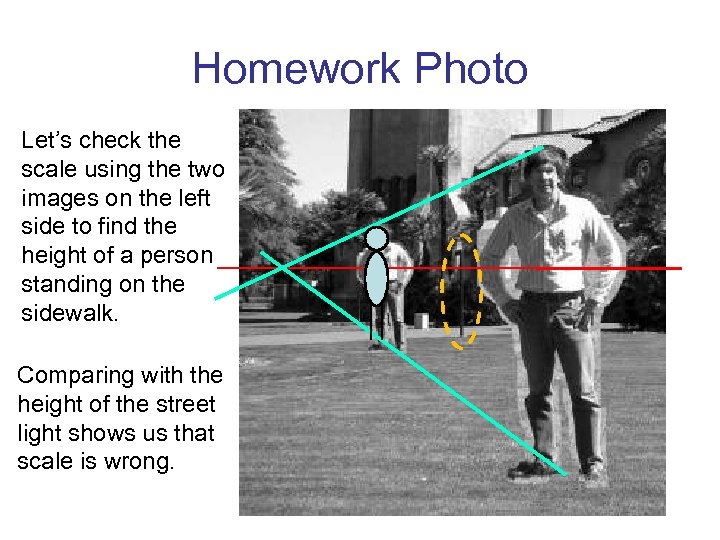 Homework Photo Let’s check the scale using the two images on the left side to find the height of a person standing on the sidewalk. Comparing with the height of the street light shows us that scale is wrong.
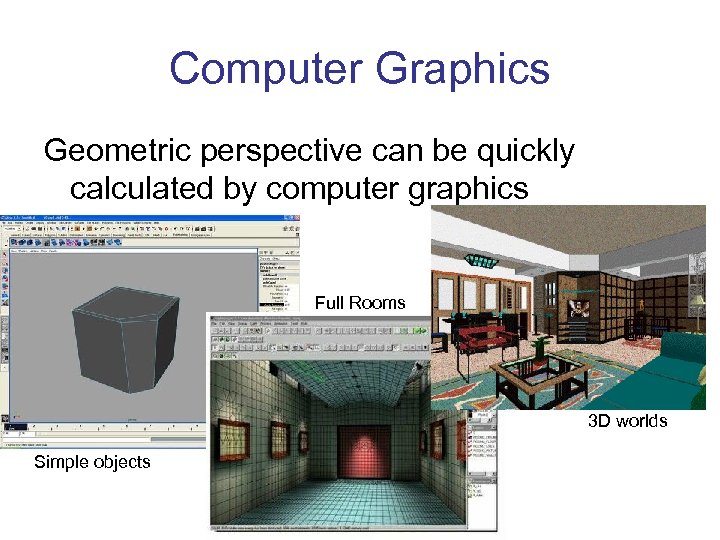 Computer Graphics Geometric perspective can be quickly calculated by computer graphics Full Rooms 3 D worlds Simple objects
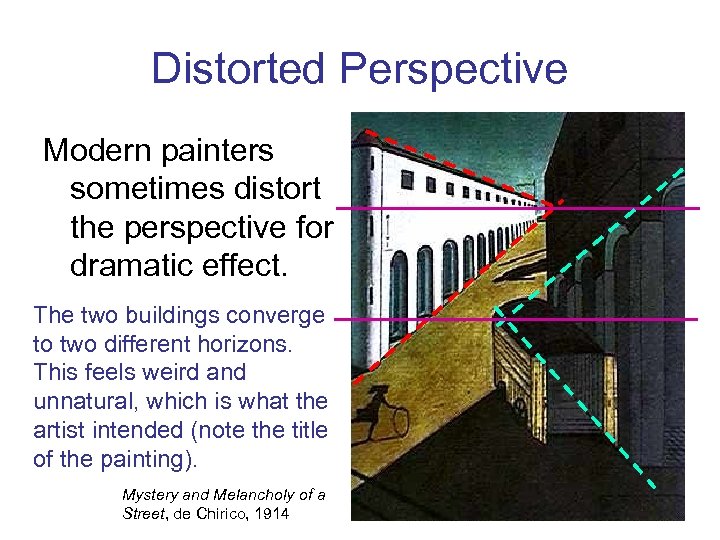 Distorted Perspective Modern painters sometimes distort the perspective for dramatic effect. The two buildings converge to two different horizons. This feels weird and unnatural, which is what the artist intended (note the title of the painting). Mystery and Melancholy of a Street, de Chirico, 1914
 Next Lecture Fractal worlds & Chaotic systems Remember: Pick a topic for your first paper/presentation Read “Order in Pollock’s Chaos”