


 Скачать презентацию UNSTACK THE ODDS ZAP THE ACHIEVEMENT GAP SO
84a74f9131331171845dc4aadf375f9c.ppt
- Количество слайдов: 130

 UNSTACK THE ODDS: ZAP THE ACHIEVEMENT GAP SO ALL STUDENTS CAN ACCESS COLLEGE—AND GRADUATE! OCAN ANNUAL CONFERENCE Wednesday, December 14, 2011
 UNSTACK THE ODDS: ZAP THE ACHIEVEMENT GAP SO ALL STUDENTS CAN ACCESS COLLEGE—AND GRADUATE! Dr. Joe Rottenborn Executive Director Mahoning Valley College Access Program (MVCAP)
 “Who gets a bachelor’s degree from college by age 24 is largely determined at birth. ” --Thomas Mortenson, “Family Income and Higher Education Opportunity, 1970 -2002, ” Postsecondary Education Opportunity 143 (May 2004): I-13 in Peter Sacks, Tearing Down the Gates: Confronting the Class Divide in American Education, Berkeley, CA: University of California Press, 2007, p. 4.
 “Because too many minority children grow up in families that bear the brunt of low-paying jobs and high levels of unemployment, the odds are stacked heavily against their graduating from high school, being admitted to a university, finding the money to pay for college, and then, finally, graduating with a bachelor’s degree. ”--Peter Sacks, Tearing Down the Gates: Confronting the Class Divide in American Education, Berkeley, CA: University of California Press, 2007, pp. 116 -117.
 For those who wonder “Why should we care—it’s not our kids? ” I quote the American educational philosopher John Dewey, who declared “What the best and wisest parent wants for his own child, that must the community want for all its children. ” (John Dewey, The School and Society, Chicago: The University of Chicago Press, 1900, p. 3. ) http: //books. google. com/books? id=GWYWAAAAIA AJ&printsec=frontcover#v=onepage&q&f=false
 Elaine Farris, the first African-American to hold a full-time superintendent's job in Kentucky, declared this: "Poverty and race are not destiny. We have to embrace the idea that we have a moral obligation to ensure that we provide an equitable education for all of our students. " (Dan Dickson, “Third in a series: The search for Fayette County’s next schools chief, ” Business Lexington, June 10, 2011. ) http: //www. bizlex. com/Articles-c-2011 -06 -10 -98003. 113117 -Third-in-a-series-The-searchfor-Fayette-Countys-next-schools-chief. html
 I’ll quote Nelson Mandela, who said: “There can be no keener revelation of a society’s soul than the way in which it treats its children. ” (Joel Bakan, “The Kids Are Not All Right, ” The New York Times —The Opinion Pages, August 21, 2011. ) http: //www. nytimes. com/2011/08/22/opinion/c orporate-interests-threaten-childrens-welfare. html
 And I’d recall these lines from Dr. Seuss: “Mister! He said with a sawdusty sneeze, I am the Lorax. I speak for the trees, for the trees have no tongues. And I’m asking you, sir, at the top of my lungs—. . UNLESS someone like you Cares a whole awful lot, Nothing is going to get better. It’s not. ” (Dr. Seuss, The Lorax, New York: Random House, 1999, unpaged. )
 “Over the next 10 years, nearly half of all new jobs will require education that goes beyond a high school education. And yet, as many as a quarter of our students aren’t even finishing high school. . That responsibility begins not in our classrooms, but in our homes and communities. It’s family that first instills the love of learning in a child. Only parents can make sure the TV is turned off and homework gets done. . We need to teach them that success is not a function of fame or PR, but of hard work and discipline. ” (Remarks by the President in State of Union Address, January 25, 2011. ) http: //www. whitehouse. gov/the-pressoffice/2011/01/25/remarks-president-state-un
 “Families are children’s most important educators. . If every child arrived in school wellnourished, healthy and ready to learn, from a family with a stable home and a steady income, many of our educational problems would be solved. And that would be a miracle. ” (Diane Ravitch, “Waiting for a School Miracle, ” The New York Times, May 31, 2011. ) http: //www. nytimes. com/2011/06/01/opinion/0 1 ravitch. html? _r=1&src=rechp
 “So it stands to reason that improving a child’s home environment to make it more conducive to learning is critical if we are to improve the educational achievement of the nation’s students and close the achievement gaps. To do this, we need to develop cooperative partnerships in which families are allies in the efforts of teachers and schools. ” (Paul E. Barton and Richard J. Coley, The Family: America’s Smallest School, Educational Testing Service, 2007, p. 3. ) http: //www. ets. org/Media/Education_Topics/pdf /5678_PERCReport_School. pdf
 “Some students arrive at school able to read and armed with large vocabularies; others arrive unable to read and with limited vocabularies. . ” (Paul E. Barton and Richard J. Coley, The Family: America’s Smallest School, Educational Testing Service, 2007, p. 39. ) http: //www. ets. org/Media/Education_Topics/pdf /5678_PERCReport_School. pdf
 “About 70 percent of all children -- but fewer than 40 percent of black children -- live with two parents. Twenty-three percent of all children and half of black children live with their mother only. Black children are more than twice as likely as white children, almost twice as likely as Hispanic children, and three-and-a-half times as likely as Asian/Pacific Islander children to live with neither parent. ” (Marian Wright Edelman, “A National Family Portrait, ” HUFF POST—IMPACT, July 29, 2011. ) http: //www. huffingtonpost. com/marianwright-edelman/a-national-familyportrai_b_913729. html
 Edelman described the situation of minority children in stark terms, as follows: “A toxic cocktail of poverty, illiteracy, racial disparity, violence, out of wedlock birth, and massive incarceration is sentencing millions of children of color to dead end, powerless, and hopeless lives and threatens to undermine the past half century of racial and social progress. ” (Marian Wright Edelman, “A Call to Black Families, ” HUFF POST— IMPACT, March 4, 2011. ) http: //www. huffingtonpost. com/marian-wrightedelman/a-call-to-black-families_b_831704. html
 Valerie Strauss, blogging in The Washington Post, was pointed in her comments about the importance of home in a child’s learning vs. school -based factors. According to Strauss, “. . . Decades of studies show that home-based factors, especially the education level of a child’s mother, has the most influence on student achievement. Teachers may be the significant factor in student progress in the school building. ” (Valerie Strauss, “Teach Plus changes Web site to reflect reality, ” The Washington Post: The Answer Sheet, May 23, 2011. ) http: //www. washingtonpost. com/blogs/answersheet/post/teach-plus-changes-web-site-to-reflect -reality/2011/05/23/AFe. DJv 9 G_blog. html
 “Poor children are more likely to live in fragile families, lag in early childhood development, suffer abuse and neglect, be uninsured and in poor health, be denied a quality education, and experience other gaps that put them far behind non-poor peers. Millions of Black children are facing one of the worst crises since slavery, and in many areas, Hispanic and American Indian children are not far behind. ” (Marian Wright Edelman, “The State of America’s Children, ” HUFF POST—IMPACT, July 15, 2011. ) http: //www. huffingtonpost. com/marian-wrightedelman/the-state-of-americaschi_b_900405. html
 Michael J. Petrilli, Executive Vice President of the Thomas B. Fordham Institute, blogging in the column of Valerie Strauss, said this: “This fall, about 1 million very poor children will enroll in kindergarten in the United States. The vast majority of them will live in single-parent families headed by women in their late teens or early twenties. Most of their mothers will have dropped out of high school; most of their fathers are nowhere to be seen. Most live in urban or rural communities hit hard by the recession, places where unemployment, addiction, and violence are all too commonplace. ” (Valerie Strauss, “A school reformer gets real, ” The Washington Post: The Answer Sheet, June 10, 2011. ) http: //www. washingtonpost. com/blogs/answersheet/post/a-school-reformer-getsreal/2011/06/09/AGc. NWv. NH_blog. html
 “Across all racial lines, mothers have borne the brunt of child-rearing responsibility, the numbers show. The percentage of white children living just with their mother went from 16% in 1991 to 19% in 2009, the census said. The corresponding percentage for Hispanic children went from 29% in 1991 to 26% in 2009. For black children, 47% lived with only their mother in 1991; 50% lived with only their mother in 2009. In 2009, 8% of Asian children lived just with their mother. ” (Craig Johnson, “Economy sends more kids to grandma’s house, CNN. com, July 28, 2011. ) http: //www. cnn. com/2011/LIVING/07/28/grandfamilies. ce nsus. rise/index. html? hpt=hp_bn 8 real/2011/06/09/AGc. NWv. NH_blog. html
 Michael Petrilli: “You acknowledge — privately at least — that it’s unrealistic to expect all kids growing up in poverty to be able to ‘beat the odds’ and graduate from college. (That’s why they’re called ‘odds. ’). . Is this making you uncomfortable? Good. If we are to get beyond the ‘ 100 percent proficiency’ or ‘all students college and career ready’ rhetoric, these are the conversations we need to have. ” (Valerie Strauss, “A school reformer gets real, ” The Washington Post: The Answer Sheet, June 10, 2011. ) http: //www. washingtonpost. com/blogs/answersheet/post/a-school-reformer-getsreal/2011/06/09/AGc. NWv. NH_blog. html
 As Amanda Paulson blogged in The Christian Science Monitor, “No education issue has received more attention in recent years--but with less apparent progress--than the achievement gaps for minority and low-income students. ” (Amanda Paulson, “Persistent achievement gap vexes education reformers: Six takeaways, ” The Christian Science Monitor, undated. ) http: //www. csmonitor. com/USA/Education/2010 /1214/Persistent-achievement-gap-vexeseducation-reformers-Six-takeaways/Progress-on-achievementgaps-sluggish
 Public Law 107 -110 of the 107 th Congress was “An Act To close the achievement gap with accountability, flexibility, and choice, so that no child is left behind. ” (PUBLIC LAW 107– 110—JAN. 8, 2002, 115 STAT. 1425. ) http: //www 2. ed. gov/policy/elsec/leg/esea 02/107 -110. pdf Title I (“Improving The Academic Achievement Of The Disadvantaged”) of the federal legislation No Child Left Behind Act of 2001 addressed the achievement gap in SEC. 1001 (“Statement Of Purpose”), (3), listing as one of its purposes the following: “closing the achievement gap between high- and low-performing children, especially the achievement gaps between minority and nonminority students, and between disadvantaged children and their more advantaged peers. ” (Title I of the Elementary and Secondary Education Act of 1965 (20 U. S. C. 6301 et seq. ), as amended, ED. gov, U. S. Department of Education website. ) http: //www 2. ed. gov/policy/elsec/leg/esea 02/pg 1. html
 “Gaps in school achievement among racial/ethnic groups and between students from different socioeconomic circumstances are well documented. They are wide and persistent, well known and widely acknowledged. They arrive early and stay late — beginning before birth and continuing through to high school graduation for those fortunate to obtain a diploma. ” (Paul E. Barton and Richard J. Coley, Parsing the Achievement Gap II, Educational Testing Service, Policy Information Report, April 2009, p. 5. ) http: //www. ets. org/Media/Research/pdf/PICPAR SINGII. pdf
 Per The Achievement Gap Initiative at Harvard University, “Compared to whites, significant gaps for African-American and Hispanic students are evident in virtually every measure of achievement: NAEP math and reading test scores, high school completion rates, college enrollment and college completion rates. ” (“The Facts on the Gap, ” The Achievement Gap Initiative at Harvard University website. ) http: //www. agi. harvard. edu/projects/thegap. php
 According to the website of the National Assessment of Educational Progress (NAEP), “Achievement gaps occur when one group of students outperforms another group and the difference in average scores for the two groups is statistically significant (that is, larger than the margin of error). ” (“Achievement Gaps, ” National Assessment of Educational Progress (NAEP) website, National Center for Education Statistics, U. S. Department of Education Institute of Education Sciences. ) http: //nces. ed. gov/nationsreportcard/studies/ga ps/
 Next, when is an achievement gap first noticed and why does it exist? Children’s Defense Fund President Marian Wright Edelman addressed the early origin of the achievement gap—and its link to poverty. In Edelman’s words: “Right now, 15. 5 million children in America live in poverty. Nearly one in four children under five is poor and over 40 percent are Black. At nine months of age, poor Black children are already behind their higher-income peers in cognitive development. The gap is wider at 24 months. By kindergarten, poor Black children have to beat higher odds to catch up and as various tests reveal, many never do. We want to change those odds. ” (Marian Wright Edelman, “Ract [sic] to the Top Early Learning Challenge, ” The Madison Times, June 3, 2011. ) http: //www. themadisontimes. com/news_details. php? news_i d=1061
 According to Richard Rothstein, Research Associate at the Economic Policy Institute, “In other words, ¾ of the black-white test score gap at age nine is already established by age two. ” (Richard Rothstein, response, “How Can We Close The Achievement Gap, ” National. Journal Expert Blogs: Education, July 27, 2009. ) http: //education. nationaljournal. com/2009/07/h ow-can-we-close-the-reading-g. php
 “At nine months old, there are no detectable cognitive differences between black and white babies (Roland Fryer and Steve Levitt, forthcoming). Differences emerge as early as age two, and by the time black children enter kindergarten they lag whites by 0. 64 standard deviations in math and 0. 40 in reading (Fryer and Levitt, 2004). ” (Will Dobbie and Roland G. Fryer, Jr. , “Are High-Quality Schools Enough to Increase Achievement Among the Poor? ” November 2010, pp. 1 -2. ) http: //www. economics. harvard. edu/faculty/fryer /files/HCZ_Nov_2010. pdf
 Ronald Ferguson, of the Graduate School of Education and Kennedy School of Government at Harvard, was quoted as follows: “The gap is there on the first day of kindergarten because of what these kids haven't experienced before they ever got to school, " Ferguson says. "And those gaps have to do with a combination of resources and parenting skills. " (Tim Louis Macaluso, “Eye on Education, Part I: City school students, ” City Newspaper, June 8, 2011. ) http: //www. rochestercitynewspaper. com/news/ar ticles/2011/06/Eye-on-Education-Part-I-Cityschool-students/
 Susan Ochshorn, founder of the consulting firm ECE Policy. Works, advocated giving priority to early childhood education; she blogged: “A growing number of children in the United States are not ready for school. Studies show that at least half of the educational achievement gap between poor children and their more advantaged peers is evident in the kindergarten classroom. ” (Susan Ochshorn, “Prioritizing Early Childhood Education: We Can’t Afford to Wait, ” HUFFPOST EDUCATION, June 21, 2011. ) http: //www. huffingtonpost. com/susanochshorn/prioritizing-early-childh_b_880959. html
 The recent report of the College Board offered these startling statistics: “Collectively, the pathway data show that more than 51 percent of Hispanic males, 45 percent of African American males, 42 percent of Native American males and 33 percent of Asian American males ages 15 to 24 will end up unemployed, incarcerated or dead. It has become an epidemic, and one that we must solve by resolving the educational crisis facing young men of color. ” (John Michael Lee Jr. and Tafaya Ransom, The Educational Experience of Young Men of Color: A Review of Research, Pathways and Progress, College. Board Advocacy & Policy Center, June 2011, p. 50. ) http: //youngmenofcolor. collegeboard. org/sites/de fault/files/downloads/EEYMC-Research. Report. pdf
 Various reasons have been offered for focusing on early childhood. Per researchers Betty Hart and Todd R. Risley, parenting during this formative period—and a family’s socioeconomic status— mattered to a child’s intellectual development. As they state: “The amount of parenting per hour and the quality of the verbal content associated with that parenting were strongly related to the social and economic status of the family and the subsequent IQ of the child. ” (Betty Hart and Todd R. Risley, “American parenting of languagelearning children: Persisting differences in familychild interactions observed in natural home environments, ” Developmental Psychology, Vol 28(6), November 1992, pp. 1096 -1105, APA Psyc. NET abstract. ) http: //psycnet. apa. org/index. cfm? fa=buy. option. T o. Buy&id=1993 -09151 -001
![“This [2007] report clearly establishes that the gaps in critical home experiences mirror the](https://present5.com/presentation/84a74f9131331171845dc4aadf375f9c/image-33.jpg "“This [2007] report clearly establishes that the gaps in critical home experiences mirror the") “This [2007] report clearly establishes that the gaps in critical home experiences mirror the gaps in early school achievement — gaps that persist through the end of high school. ” [emphasis in original] (Paul E. Barton and Richard J. Coley, The Family: America’s Smallest School, Educational Testing Service, 2007, p. 39. ) http: //www. ets. org/Media/Education_Topics/pdf /5678_PERCReport_School. pdf
“This [2007] report clearly establishes that the gaps in critical home experiences mirror the gaps in early school achievement — gaps that persist through the end of high school. ” [emphasis in original] (Paul E. Barton and Richard J. Coley, The Family: America’s Smallest School, Educational Testing Service, 2007, p. 39. ) http: //www. ets. org/Media/Education_Topics/pdf /5678_PERCReport_School. pdf
 “White students, however, had higher scores than Black students, on average, on all assessments. While the nationwide gaps in 2007 were narrower than in previous assessments at both grades 4 and 8 in mathematics and at grade 4 in reading, White students had average scores at least 26 points higher than Black students in each subject, on a 0 -500 scale. ” (Alan Vanneman, Linda Hamilton, Janet Baldwin Anderson, and Taslima Rahman, Achievement Gaps: How Black and White Students in Public Schools Perform in Mathematics and Reading on the National Assessment of Educational Progress—Statistical Analysis Report, NCES 2009 -455, National Center for Education Statistics, U. S. Department of Education, July 2009, p. iii. ) http: //nces. ed. gov/nationsreportcard/pdf/studies/2009455. pdf
 When it comes to graduation from high school, another gap can be seen among groups of U. S. students. According to Andrew Rotherham, former education aide to President Clinton, “An achievement gap also persists: only 64% of Hispanic students and 62% of African Americans graduated in 2008, while 81% of white students did. ” (Andrew J. Rotherham, “Dropout Rates Dropping, but Don't Celebrate Yet, ” Time, November 30, 2010. ) http: //www. time. com/time/nation/article/0, 8599, 2033524, 00. html
 “According to ACT, average ACT composite scores for Asian and white graduates increased between 2007 and 2011. The average composite scores look like this: • for Asians, 22. 6 in 2007 to 23. 6 in 2011 • for whites, 22. 1 in 2007 to 22. 4 in 2011 • for African Americans, the score remained at 17 for both years • for Hispanics, the score remained at 18. 7 for both years • for American Indians, 18. 7 in 2007 and 18. 6 in 2011” (Valerie Strauss, “ 2011 ACT scores show problems with college readiness, ” The Washington Post—The Answer Sheet, August 17, 2011. ) http: //www. washingtonpost. com/blogs/answersheet/post/2011 -act-scores-show-problems-with-collegereadiness/2011/08/16/g. IQABKu 4 JJ_blog. html
 “The percentages of students meeting benchmarks vary widely among races, too. Forty-one percent of Asian students and 31 percent of white students had the minimum scores for college readiness in all four areas, compared with 15 percent of Native Hawaiians/Pacific Islanders, 11 percent of American Indians/Alaska Natives, 11 percent of Hispanic/Latino students, and 4 percent of black students. ” (Molly Redden, “ACT Takers Make Marginal Gains in College Readiness, but Achievement Gaps Remain, ” The Chronicle of Higher Education—Students, August 17, 2011. ) http: //chronicle. com/article/ACT-Takers-Make. Marginal-Gains/128710/
 “African American, Latino, and Native American students begin school behind their White and Asian classmates, and this gap continues to grow throughout the years of schooling (NCES, 2000 a; 2000 b), resulting in relatively small percentages of Blacks, Latinos, and Native Americans going on to four-year colleges, and fewer still represented among college graduates. ” (Patricia Gandara, “Meeting Common Goals: Linking K-12 and College Interventions, ” in William G. Tierney and Linda Serra Hagedorn, editors, Increasing Accessing To College: Extending Possibilities For All Students, Albany, NY: State University of New York Press, 2002, p. 81. )
 “While 69. 5 percent of white students who graduate from high school immediately enroll in college, only 55. 6 percent of African American and 60. 9 percent of Hispanic high school graduates enroll in a two- or four-year college immediately after completing high school. ” (John Michael Lee Jr. and Tafaya Ransom, The Educational Experience of Young Men of Color: A Review of Research, Pathways and Progress, College. Board Advocacy & Policy Center, June 2011, p. 14. ) http: //youngmenofcolor. collegeboard. org/sites/de fault/files/downloads/EEYMC-Research. Report. pdf
 An earlier study by Clifford Adelman showed a correlation between students’ SES and graduation from college; in his words, “Of student demographic characteristics, only one— socioeconomic status—was significantly associated with degree completion, though in a modest manner. ” (Clifford Adelman, The Toolbox Revisited: Paths to Degree Completion From High School Through College, Washington, DC: U. S. Department of Education, 2006. p. xxiii. ) http: //www 2. ed. gov/rschstat/research/pubs/tool boxrevisit/toolbox. pdf
 Alberto Cabrera and researchers at Penn State also found the odds that students earn a college degree are correlated with their socioeconomic status; as they stated, “By 1992, 35% of the 1982 High School Class earned a college degree. Among Lowest-SES students, merely 13% managed to do so. In contrast, 57% of Highest-SES students completed their college degree. ” (Alberto F. Cabrera, Kurt R. Burkum and Steven M. La Nasa, Pathways to a Four-Year Degree: Determinants of Degree Completion Among Socio-Economically Disadvantaged Students, Washington, DC: U. S. Department of Education, 2003, p. 28. ) http: //www. sheeo. org/access/On%20 the%20 Righ t%20 Path. pdf
 “Most important, to ensure that students are academically qualified to enroll in college, college preparation programs must improve the academic preparation of low-income, African American, Hispanic, and other disadvantaged groups of students. ” (Laura W. Perna, “The Key to College Access: Rigorous Academic Preparation, ” in William G. Tierney, Zoe B. Corwin, and Julia E. Colyar, editors, Preparing for College: Nine Elements of Effective Outreach, Albany, NY: State University of New York Press, 2005, p. 130. )
 What are the correlates that have been identified with “stacked odds” regarding students’ access and success? According to Clifford Adelman’s updated statistical study for the U. S. Department of Education, there are four demographic factors of significance that he quantified: “first generation college status”; “race/ethnicity and gender”; “being a male”; and “highest third of family income. ”
 However, despite these significant factors, Adelman emphasized the importance of academic preparation for success in college, stating “The academic intensity of the student’s high school curriculum still counts more than anything else in precollegiate history in providing momentum toward completing a bachelor’s degree. ” (Clifford Adelman, The Toolbox Revisited: Paths to Degree Completion From High School Through College, Washington, DC: U. S. Department of Education, 2006. p. xviii. ) http: //www 2. ed. gov/rschstat/research/pubs/tool boxrevisit/toolbox. pdf
 “As suggested, the rigor of courses taken in high school is the most powerful predictor of academic achievement, high school graduation, and enrollment in postsecondary education (Adelman, 1999; Braddock, 1990; Gamoran, 1987; Oakes, 1987). A strong academic program is particularly significant for college enrollment among African American and Latino students (Adelman, 1999). Additionally, research has demonstrated that students who take more intense academic programs in high school attend and persist in higher education at a greater rate than students who take less difficult programs of study (Fry, 2004; Herold, 2003). ” (Watson Scott Swail and Adriane Williams, based on a paper by Monica Martinez and Shayna Klopott, ‘School Reform and College Access Success: A Review—A summary of: How Is School Reform Tied to Increasing College Access and Success for Low-Income and Minority Youth? ” Pathways to College Network & Pacific Resources for Education and Learning (PREL), p. 3. ) http: //www. pathwaystocollege. net/pdf/Howis. School. Reform_abridg ed. pdf
 Specifically regarding high school academic preparation, Swail and Williams identify math prowess as essential to matriculation, emphasizing the importance of algebra to success in college, as they state: “Research has determined that mathematics achievement serves as a “gate-keeper” to college attendance (Adelman, 1999; Checkley, 2001; Gamoran & Hannigan, 2000). The work of Robert Moses with the Algebra Project has demonstrated that if students do not successfully complete Algebra, they are unlikely to succeed in institutions of postsecondary education (Checkley, 2001). ” (Watson Scott Swail and Adriane Williams, based on a paper by Monica Martinez and Shayna Klopott, “School Reform and College Access Success: A Review—A summary of: How Is School Reform Tied to Increasing College Access and Success for Low-Income and Minority Youth? ” Pathways to College Network & Pacific Resources for Education and Learning (PREL), p. 4. ) http: //www. pathwaystocollege. net/pdf/Howis. School. Reform_abridg ed. pdf
 All of the foregoing have led me to make the appeal in this book’s title: “unstack the odds. ” Simply stated, this call recognizes the current reality that all groups of students do not have the same likelihood of accessing college and succeeding there— some have a greater chance, on average, and others have a lesser chance. For the latter group, the odds are, indeed, stacked against them.
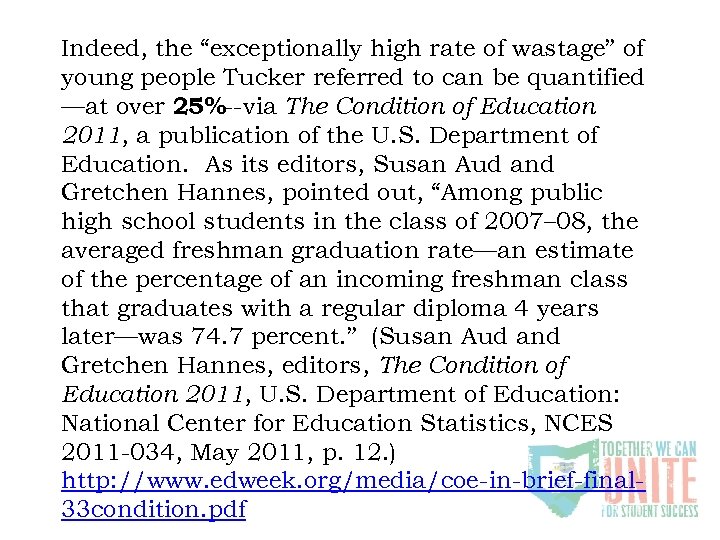 Indeed, the “exceptionally high rate of wastage” of young people Tucker referred to can be quantified —at over 25%--via The Condition of Education 2011, a publication of the U. S. Department of Education. As its editors, Susan Aud and Gretchen Hannes, pointed out, “Among public high school students in the class of 2007– 08, the averaged freshman graduation rate—an estimate of the percentage of an incoming freshman class that graduates with a regular diploma 4 years later—was 74. 7 percent. ” (Susan Aud and Gretchen Hannes, editors, The Condition of Education 2011, U. S. Department of Education: National Center for Education Statistics, NCES 2011 -034, May 2011, p. 12. ) http: //www. edweek. org/media/coe-in-brief-final 33 condition. pdf
 “Among students who enrolled in 4 -year institutions in fall 2002, Asian/Pacific Islander students had the highest 6 -year graduation rate (67 percent), followed by Whites (60 percent), Hispanics (49 percent), Blacks (40 percent), and American Indians/Alaska Natives (38 percent). At both public and private not-for-profit 4 -year institutions, the 6 -year graduation rates for females were higher than the rates for males. ” (Susan Aud and Gretchen Hannes, editors, The Condition of Education 2011, U. S. Department of Education: National Center for Education Statistics, NCES 2011 -034, May 2011, p. 18. ) http: //www. edweek. org/media/coe-in-brief-final 33 condition. pdf
 “For less-advantaged students, however, not getting to attend college means a lifetime of low-wage jobs instead of economic and social mobility. And that is a future we cannot accept. ” (Anthony P. Carnevale, “Yale Versus Jail, ” The New York Times, April 1, 2011. ) http: //www. nytimes. com/roomfordebate/2 011/03/31/the-college-acceptance-rateracket/the-yale-versus-jail-problem-incollege-acceptance
 Wendy Kopp, Princeton graduate and the founder of Teach for America—which she based on her senior thesis—noted in a recent online video interview: “. . . Where you’re born really determines your educational prospects and, in turn, your life prospects. And I just thought that is, I believe, our country’s most fundamental injustice. ” (Rick Stengel, “ 10 Questions for Teach for America’s Wendy Kopp, ” Time Video) http: //www. time. com/time/video/player/ 0, 32068, 764185307001_2044692, 00. html
 “Today, 30. 6 percent of all Americans aged 25 to 29 have earned a bachelor’s degree or higher. For students from low-income families, the college completion rate is even lower: only 8. 3 percent have earned a bachelor’s degree by their mid-20 s. These low college completion rates are diminishing the United States’ promise and economic competitiveness worldwide. While America is first in the world in the percentage of adults aged 55 to 65 with a two- or four-year degree, our ranking slips to eighth in the percentage of 25 - to 34 -year olds who have completed college. ” (The Promise Of College Completion: KIPP’s Early Successes and Challenges, Knowledge Is Power Program, April 28, 2011, p. 4. ) http: //www. kipp. org/files/dmfile/College. Completi on. Report. pdf 00. html
 “One risk is we've learned ‘to college’ is not ‘through college. ’ The whole country is focusing on high school graduation rates and getting kids to college. We're shedding light on the fact that the difference between ‘to college’ and ‘through college’ is massive. ” (Rick Hess, “Straight Up Conservation [sic]: KIPP CEO Richard Barth on the College Completion Challenge, ” Education Week— Rick Hess Straight Up, June 20, 2011. ) http: //blogs. edweek. org/edweek/rick_hess_straig ht_up/2011/06/straight_up_conservation_kipp_ce o_richard_barth_on_the_college_completion_challe nge. html
 “Terenzini, Cabrera, and Bernal’s (2001) comprehensive review of the literature informs us that low-income students are already handicapped by a variety of adverse factors while attending college. These factors include: low participation rates at the 4 -year sector; enrolling on a part-time basis; delayed enrollment after high school completion; working full -time; dropping, withdrawing from, or not completing college credits; and being a parent. ” (Alberto F. Cabrera, Kurt R. Burkum and Steven M. La Nasa, Pathways to a Four-Year Degree: Determinants of Degree Completion Among Socio. Economically Disadvantaged Students, Washington, DC: U. S. Department of Education, 2003, p. 18. ) http: //www. sheeo. org/access/On%20 the%20 Right%20 Path. pdf ard_barth_on_the_college_completion_challenge. html
 "We will never close the achievement gap, we will never solve our dropout crisis, we will never break the cycle of poverty that afflicts so many children if we don’t make sure that all of our students learn to read. ” (Ralph Smith, “Friday Churn: Importance of reading, ” Education News Colorado, April 8, 2011. ) http: //www. ednewscolorado. org/2011/04 /08/17279 -friday-churn-importance-ofreading
 “Right now, The State of America’s Children 2011 tells us children of color are behind on virtually every measure of child well-being. They face multiple risks that put them in grave danger of entering the pipeline to prison rather than the pipeline to college, productive employment and successful futures. Children of color are at increased risk of being born at low birth weight and with late or no prenatal care, living in poverty and extreme poverty, lacking family stability, facing greater health risks, lacking a quality education, being stuck in foster care without permanent families, ending up in the juvenile justice system, being caught in the college completion gap, being unemployed and being killed by guns. ” (Marian Wright Edelman, “A National Family Portrait, ” HUFF POST—IMPACT, July 29, 2011. ) http: //www. huffingtonpost. com/marian-wright-edelman/anational-family-portrai_b_913729. html
 As Peter Sacks put it in an interview about his book Tearing Down the Gates: Confronting the Class Divide in American Education, “Instead of a system of equal educational opportunity, we are creating a system of educational haves and have-nots that increasingly is based upon birthright. Yes, a system based upon class origins. ”— Scott Jaschik, “Tearing Down the Gates, ” Inside Higher Ed, May 9, 2007. http: //www. insidehighered. com/news/200 7/05/09/sacks
 “As of 2007, 27. 4 percent of young Americans aged 25 to 29 had obtained at least a bachelor’s degree, and an additional 8. 1 percent had earned an associate degree. . These average rates conceal large disparities among subgroups. Asian Americans aged 25 to 29 are at the top, with 58 percent holding a bachelor’s degree, followed by whites (33 percent), African Americans (17 percent), Hispanics (11 percent) and finally, American Indians (9 percent). These large gaps are unlikely to change without reducing disparities at each transition point in the educational pipeline. ” (Mikyung Ryu, Minorities in Higher Education: 2009 Supplement--Twenty-Third Status Report, American Council on Education, September 2009, p. 1. )
 As Kevin Carey, policy director of the nonprofit Education Sector, stated in a recent posting, "All in all, this confirms what we already knew: College works well for the kind of student who has been going to college for a long time: white middle- and upper-class children of college graduates who enroll full-time directly after leaving high school. " (“College Grad Rates Stay Exactly the Same, ” The Chronicle of Higher Education, December 2, 2010. ) (http: //chronicle. com/blogs/brainstorm/collegegrad-rates-stay-exactly-the-same/29394)
 Indeed, University of Wisconsin, Milwaukee professor Martin Haberman quoted Loeb (1999) as stating, “If you’re in the top economic quarter of the population, your children have a 76% chance of getting through college and graduating by age 24. . If you’re in the bottom quarter, however, the figure is 4%. ” (“Urban Education: The State of Urban Schooling at the Start of 21 st Century, ” 7/12/2010. ) (http: //www. educationnews. org/ed_reports/1041 05. html).
 “Meanwhile, fewer boys than girls take the SAT. Fewer boys than girls apply to college. Fewer boys than girls, in annual surveys of college freshmen, express a passion for learning. And fewer boys than girls are earning college degrees. ” --David Von Drehle, “The Boys Are All Right, ” Time (August 6, 2007), p. 42.
 “Statistics collected over two decades show an alarming decline in the performance of America’s boys—in some respects, a virtual free fall. Boys were doing poorly in school, abusing drugs, committing violent crimes and engaging in promiscuous sex. . The standardized NAEP test, known as the nation’s report card, indicates that by the senior year of high school, boys have fallen nearly 20 points behind their female peers [in reading]. ” --David Von Drehle, “The Boys Are All Right, ” Time (August 6, 2007), pp. 43 -44.
 “According to a study by the Center for Community Development and Civil Rights at Arizona State University, out of 100 Latino males who start elementary school, 49 leave before high school graduation. Of those who finish high school, only 10 complete college. Our high school dropout rate (29%) surpasses that of white males (7%) and African-American males (14%). ” --Raul Reyes, “Education progress eludes Latinos, ” USA Today (August 17, 2007), p. 11 A.
 He ends his column by pointing out the observation of ETS researchers Barton and Coley in their work America’s Smallest School: The Family. Will indicated their assessment “. . . that about 90 percent of the difference in schools’ proficiencies can be explained by five factors: the number of days students are absent from school, the number of hours students spend watching television, the number of pages read for homework, the quantity and quality of reading material in the students’ homes — and, much the most important, the presence of two parents in the home. ” (George Will, “For black children, daunting divides in achievement and family life, ” August 29, 2010. ) http: //www. washingtonpost. com/wpdyn/content/article/2010/08/27/AR 2010082703805. html? nav=rss_opinion/columns
 “Another researcher, an anthropologist named Annette Lareau, has investigated the same question from a cultural perspective. Over the course of several years, Lareau and her research assistants observed a variety of families from different class backgrounds, basically moving into in to each home for three weeks of intensive scrutiny. Lareau found that the middle-class families she studied followed a simlar strategy, which she labeled concerted cultivation. The parents in these families engaged their children in conversation as equals, treating them like apprentice adults and encouraging them to ask questions, challenge assumptions and negotiate rules. They planned and scheduled countless activities to enhance their children’s development—piano lessons, soccer games, trips to the museum. ” --Paul Tough, “What It Takes To Make a Student: Can teaching poor children to act more like middle-class children help close the education gap? ” The New York Times Magazine (November 26, 2006), pp. 49.
 James J. Heckman, Nobel Laureate in the department of economics at the University of Chicago, framed the issue of the achievement gap as a “skill gap. ” As he wrote in the abstract for his recent study: “In contemporary America, racial gaps in achievement are primarily due to gaps in skills. Skill gaps emerge early before children enter school. Families are major producers of those skills. ” (James J. Heckman, “The American Family in Black and White: A Post-Racial Strategy for Improving Skills to Promote Equality, ” IZA DP No. 5495, February 2011, p. 2. ) http: //ftp. iza. org/dp 5495. pdf
 Heckman then echoed the view of James Coleman regarding the impact of schools on children, stating “Inequality in performance in school is strongly linked to inequality in family environments. Schools do little to reduce or enlarge the gaps in skills that are present when children enter school. ” (James J. Heckman, “The American Family in Black and White: A Post. Racial Strategy for Improving Skills to Promote Equality, ” IZA DP No. 5495, February 2011, p. 2. ) http: //ftp. iza. org/dp 5495. pdf
 “Parenting matters, and the true measure of child advantage and disadvantage is the quality of parenting received. A growing fraction of American children across all race and ethnic groups is being raised in dysfunctional families. ” (James J. Heckman, “The American Family in Black and White: A Post-Racial Strategy for Improving Skills to Promote Equality, ” IZA DP No. 5495, February 2011, p. 2. ) http: //ftp. iza. org/dp 5495. pdf
 In October 2010, The Council of the Great City Schools issued its research report called A Call For Change: The Social And Educational Factors Contributing To The Outcomes Of Black Males In Urban Schools. In his preface, Executive Director of the Council Michael Casserly pulled no punches: “The nation’s young Black males are in a state of crisis. They do not have the same opportunities as their male or female counterparts across the country. . At almost every juncture, the odds are stacked against these young men in ways that result in too much unfulfilled potential and too many fractured lives. ” (A Call For Change: The Social And Educational Factors Contributing To The Outcomes Of Black Males In Urban Schools, The Council of the Great City Schools, October 2010, p. iii. ) http: //graphics 8. nytimes. com/packages/pdf/opinion/ACall-For-Change. pdf
 In his article “Proficiency of Black Males Is Found to Be Far Lower Than Expected, ” on the release of the report A Call for Change, reporter Trip Gabriel of The New York Times cited this striking fact: “Only 12 percent of black fourth-grade boys are proficient in reading, compared with 38 percent of white boys, and only 12 percent of black eighth-grade boys are proficient in math, compared with 44 percent of white boys. Poverty alone does not seem to explain the differences: poor white boys do just as well as African-American boys who do not live in poverty, measured by whether they qualify for subsidized school lunches. ” (Trip Gabriel, “Proficiency of Black Males Is Found to Be Far Lower Than Expected, ” The New York Times, November 9, 2010. ) http: //www. nytimes. com/2010/11/09/education/09 gap. ht ml? _r=2&hpw es. com/packages/pdf/opinion/A-Call-For. Change. pdf
 Bob Herbert, former op-ed columnist for The New York Times, also commented on the report A Call for Change in his posting “This Raging Fire, ” of November 15, 2010. As Herbert stated: “We know by now, of course, that the situation is grave. We know that more than a third of black children live in poverty; that more than 70 percent are born to unwed mothers; that by the time they reach their mid-30 s, a majority of black men without a high school diploma has spent time in prison. We know all this, but no one seems to know how to turn things around. No one has been able to stop this steady plunge of young black Americans into a socioeconomic abyss. ” (Bob Herbert, “This Raging Fire, ” The New York Times, November 15, 2010. ) http: //www. nytimes. com/2010/11/16/opinion/16 herbert. h tml? _r=1&hp
 “On measure after measure, black males are struggling. Nationwide, they are twice as likely to be left back or assigned to dead-end special education and three times as likely to be kicked out of school as white males. All too often they’re on what educators privately dub ‘the prison track. ’”--David L. Kirp, “There are ways to bridge the achievement gap in schools, ” The Vindicator, October 19, 2010, p. A 11. http: //www. vindy. com/news/2010/oct/19/thereare-ways-to-bridge-the-achievement/? newswatch
 “Although there are many barriers to college access and success for low-income and minority students, most can be grouped into three major categories. The first set of major barriers [emphases added] relates to cost. . A second major set of barriers to college enrollment and persistence is academic preparation. . . The third major impediment to. higher education for many students, particularly those from low-income families, is the complexity of the college admissions process and financial aid systems, as well as a lack of accurate information about higher education costs. College attendance is the culmination of a series of steps and benchmarks, and this current landscape is too complex and difficult for many families to decipher and navigate. ” (Bridget Terry Long and Erin Riley, “Financial Aid: A Broken Bridge to College Access? ” Harvard Educational Review, Vol. 77 No. 1, Spring 2007, pp. 40 -42) http: //www. hepg. org/document/19/)
 A similar view of the obstacles students face was expressed in the brief From Access to Success: A Funder’s Guide to Ensuring More Americans Earn Postsecondary Degrees, by Grantmakers for Education. The barriers cited “at the student level” included the following: “Inadequate academic preparation at the K-12 level Incomplete information about college [and] Difficulty understanding the costs and accessing adequate financial aid” (From Access to Success: A Funder’s Guide to Ensuring More Americans Earn Postsecondary Degrees, Grantmakers for Education, 2010, p. 2) http: //edfunders. org/downloads/GFEReports/GF E_From. Access. To. Success_Funders. Guide. pdf
 Necessarily, any plan of action would be based on sound guidance principles and seek to overcome the aforementioned obstacles and barriers. But first and foremost, any plan would start early long , before students are in high school—indeed, considerably before they even enter kindergarten. Or preschool. Ideally, this early start would mean advising expectant mothers—particularly, teenagers--during the critical prenatal period of their children. This is the approach taken by Geoffrey Canada at the Harlem Children’s Zone in its “. . . Baby College, a nine-week prenatal and early childhood parenting class with sections on brain development, discipline and parent-child bonding. . ”
 David L. Kirp, professor of public policy at University of California Berkeley, stressed the need to start early succinctly: “Because African American boys are academically behind even before they start kindergarten, their education needs to begin earlier, at age 3 or 4. ” (David L. Kirp, “There are ways to bridge the achievement gap in schools, ” The Vindicator, October 19, 2010, p. A 11. ) http: //www. vindy. com/news/2010/oct/19/thereare-ways-to-bridge-the-achievement/? newswatch
 Nonetheless, it may be that measures would commonly occur during children’s school-age years. Regardless, a first step would be to encourage early readingfor all children. As Professor Kirp put it, “focusing on reading is also smart practice. ” (David L. Kirp, “There are ways to bridge the achievement gap in schools, ” The Vindicator, October 19, 2010, p. A 11. ) http: //www. vindy. com/news/2010/oct/19/thereare-ways-to-bridge-the-achievement/? newswatch
 Another focus would be on encouraging regular attendance at school Again to quote the Grad Nation Update, . “In recent years, there has been a growing awareness that communities with low graduation rates often have very high rates of chronic absenteeism from the early grades onward. Research shows that three out of four students who are severely chronically absent in the sixth grade never graduate from high school. ” (Robert Balfanz, et al. , Building a Grad Nation: Progress and Challenge in Ending the High School Dropout Epidemic— 2010 -2011 Annual Update, America’s Promise Alliance, March 2011, p. 20. ) http: //www. americaspromise. org/Our-Work/Grad. Nation/~/media/Files/Our%20 Work/Grad%20 Nation/2011 %20 Summit/Reports/Grad. Nation-rd 6 -FINAL. ashx
 Also, per the Update, is an emphasis on “early warning and intervention systems” an emphasis on the middle grades and. Indeed, according to that report: “Research has shown that students who eventually leave high school before graduating exhibit strong predictive warning signs of dropping out, such as infrequent attendance, behavior infractions, and course failure. These warning signs — the ABCs of dropout prevention — more accurately predict whether a student will drop out of high school than any other socioeconomic factors and can be used to predict high school graduation as early as the start of middle school. Given this reality, states are enhancing the quality of the data they are collecting and are building longitudinal data systems. This is prompting the adoption of early warning systems throughout the country at the state, district, and school levels. ” (Robert Balfanz, et al. , Building a Grad Nation: Progress and Challenge in Ending the High School Dropout Epidemic— 2010 -2011 Annual Update, America’s Promise Alliance, March 2011, p. 21. ) http: //www. americaspromise. org/Our-Work/Grad. Nation/~/media/Files/Our%20 Work/Grad%20 Nation/2011%20 Su mmit/Reports/Grad. Nation-rd 6 -FINAL. ashx
 Two other factors cited in the original report Building a Grad Nation are also important to emphasize. The first was parental engagementof which that first report stated the , following: “Research has shown that students with involved parents, regardless of their family income or background, are more likely to earn higher grades and test scores, enroll in higher level classes, attend school and pass their classes, develop better social skills, graduate from high school, attend college, and find productive work. The opposite is true for students whose parents are less engaged. “ (Robert Balfanz, et al. , Building a Grad Nation: Progress and Challenge in Ending the High School Dropout Epidemic, America’s Promise Alliance, November 2010, p. 52) http: //www. americaspromise. org/Our-Work/Grad. Nation/~/media/Files/Our%20 Work/Grad%20 Nation/Build ing%20 a%20 Grad%20 Nation/Building%20 a%20 Grad%20 Na tion_Full. Report_FINAL%2011 -30 -10. ashx 0 Nation/2011%20 Summit/Reports/Grad. Nation-rd 6 FINAL. ashx
 “In looking at characteristics of the students who enroll and those who don't, the research found strong impact of parents and peers. Students who ‘talked frequently with their parents about college’ are 7 percentage points more likely to enroll than are those who talked only infrequently with their parents. The researchers also found ‘strong and positive association’ between the proportion of a student's friends with college plans and college enrollment. If most of a student's friends plan to enroll, the student is 14. 2 percentage points more likely to enroll. ” (Scott Jaschik, “The Other ‘Summer Melt’ in Admissions, ” Inside Higher Ed, April 4, 2011. ) http: //www. insidehighered. com/news/2011/04/04/new_re search_points_to_a_summer_melt_issue_for_low_income_stu dents mit/Reports/Grad. Nation-rd 6 -FINAL. ashx
 “. . . Educators do agree on the courses that students should take in high school: four years of English at the collegepreparation level; four years of science including two lab sciences; four years of social sciences such as history and economics; and, increasingly, four years of math. ‘If you take a year off from math, when you take your college math placement exam, you could find yourself in a remedial class that doesn't qualify for financial aid or count toward graduation, ’ warns Jacqueline King, who directs the American Council on Education's Center for Policy Analysis. To be ready for the college-level algebra required of most freshmen, for example, means taking algebra I and II courses and trigonometry in high school. ” (Carol Frey, “Crash Course in Preparedness, ” U. S. News & World Report, September 2010, p. 38. ) http: //www. usnews. com/education/articles/2010/08/16/a -crash-course-in-college-preparedness
 “Support a rigorous public high school curriculum that prepares all students, including those traditionally underserved, to succeed. [emphasis in original] Data show limited academic preparation for postsecondary education for too many high school graduates. . Providing academic rigor in middle and high school courses and effectively monitoring student progress in core courses for any necessary interventions are important strategies for increasing their higher education access, retention and completion. ” (Roadmap for Ensuring America’s Future By Increasing Latino College Completion, Excelencia in Education, March 2011, p. 16. ) http: //www. edexcelencia. org/initiatives/EAF/Roadmap
 “Many students and parents need more information about the requirements to get into, pay for and succeed in college, particularly during middle school. One-third of high school students (35%) rate their school as fair or poor on providing information on the requirements to succeed in college, compared to 52% of middle school students. Students who say they will go to college are less likely than others to rate their school low in this area (37% vs. 59% of those who do not plan on going beyond high school), and students who have considered dropping out of school are more likely than others to rate their school low (70% vs. 37%). ” (The Met. Life Survey of the American Teacher: Preparing Students for College and Careers, Part 1: Clearing the Path, p. 21. ) http: //www. metlife. com/assets/cao/contributions/foundati on/american-teacher/Met. Life_Teacher_Survey_2010. pdf
 A key factor in college academic success, at the micro level, appears to be how successful the student had been in high school. Our study of both the college graduates and the non -degreed former MVCAP advisees from the high school Class of 2004 who were still enrolled in college during 2008 indicated as much. Indeed, for those 78 (of 568) students who had already earned their two- or four-year degree in 2008, the average [high school] GPA was 3. 58; the average ACT composite score was 23. 47. (In fact, for these graduates, only 5 had GPAs lower than 3. 0 and but 9 had ACT composites lower than 20. ) For those students who had not yet earned their two- or four year degree in 2008, but who were still enrolled in college, the average [high school] GPA was 3. 08; the average ACT composite score was 20. 68.
 These findings suggested what might be viewed as a “common-sense” hypothesis: those high school graduates who matriculate and continue in pursuit of their degree will have been “good students” in high school; those who graduate from college in four years will have been even stronger students in high school. http: //mvcap. blogspot. com/2009/11/9 -resultsfrom-class-of-2004. html
 According to a 2004 federal report, “approximately 60 percent of those students are referred to at least one remedial or developmental education course—and less than a quarter of those ultimately receive a degree or certificate. ” (J. Wirt, et al. , The Condition of Education 2004, U. S. Department of Education, National Center for Education Statistics in College Completion Tool Kit, Washington, D. C. : U. S. Department of Education, March 2011, p. 8. ) http: //www. ed. gov/sites/default/files/cctoolkit. pdf
 “However, community colleges have often struggled to graduate their students, with just over three in ten community college students earning a degree or credential within six years of first enrolling. Over half of these students are academically underprepared for college-level work, and improving the success of these developmental, or remedial, students is one of the greatest challenges that community colleges face in the efforts to increase overall graduation rates –– very few of these students end up completing their required sequence of developmental coursework needed to enroll in college-level courses, let alone graduating from college with a diploma or certificate. ” (Elizabeth Zachry Rutschow and Emily Schneider, Unlocking the Gate: What We Know About Improving Developmental Education, MDRC, June 2011, p. ES-1. ) http: //www. mdrc. org/publications/601/full. pdf
 In short, low SES students without sufficient academic preparation have reduced chances of success in college. As the authors of the report Reclaiming the American Dream stated, “Students who lack sufficient academic preparation in high school, particularly low-income students, have exceptionally little chance of attending and completing college. ” [emphasis added] (William Bedsworth, Susan Colby, and Joe Doctor, Reclaiming the American Dream, The Bridgespan Group, October 2006, p. 19. ) http: //www. nhscholars. org/Documents/Reclaimi ng. American. Dream. pdf
 Clifford Adelman, senior researcher at the U. S. Department of Education, addressed the importance of academic preparation on underrepresented students. In his view, its impact was greater for such students; as he stated: ”The impact of a high school curriculum of high academic intensity and quality on degree completion is far more pronounced and positive for African-American and Latino students than any other pre-college indicator of academic resources. The impact for African-American and Latino students is also much greater than it is for white students. ” (Clifford Adelman, Answers in the Tool Box: Academic Intensity, Attendance Patterns, and Bachelor’s Degree Attainment, Washington, DC: U. S. Department of Education, 1999, p. 3. ) http: //www. nacada. ksu. edu/National. Conf/2007/Handouts /S 229 H 3. pdf
 “Academic preparation is the most effective means of increasing the odds that students will graduate from high school ready for college, matriculate, and eventually receive their degrees. [emphasis added] Cliff Adelman, a Department of Education researcher, has found that, ‘A rigorous high school curriculum has greater impact on bachelor’s degree completion than any other pre-college indicator of academic preparation, regardless of socioeconomic status or race. ’ These results have been confirmed specifically for low-income students by A. F. Cabrera, who reports that low-income students enroll and progress in college at much higher rates when they graduate high school academically-prepared. ” (William Bedsworth, Susan Colby, and Joe Doctor, Reclaiming the American Dream, The Bridgespan Group, October 2006, p. 4. ) http: //www. nhscholars. org/Documents/Reclaiming. America n. Dream. pdf
![Reading [emphasis added] has been emphasized as important to student success, since students who](https://present5.com/presentation/84a74f9131331171845dc4aadf375f9c/image-92.jpg "Reading [emphasis added] has been emphasized as important to student success, since students who") Reading [emphasis added] has been emphasized as important to student success, since students who don’t read well may never get to college. Indeed, a new report by of Anthony Hernandez of Hunter College links reading inability and poverty to dropping out from high school. According to Hernandez, students who have difficulty reading and are poor face “double jeopardy. ”
Reading [emphasis added] has been emphasized as important to student success, since students who don’t read well may never get to college. Indeed, a new report by of Anthony Hernandez of Hunter College links reading inability and poverty to dropping out from high school. According to Hernandez, students who have difficulty reading and are poor face “double jeopardy. ”
 To underscore the importance of reading, Adelman cited these data: “Thirty-nine percent of 4 -year college students who were assigned to remedial reading courses completed bachelor’s degrees, compared with 60 percent of students who took only one or two other types of remedial courses, and 69 percent of those who were not subject to remediation at all. ” (Clifford Adelman, Answers in the Tool Box: Academic Intensity, Attendance Patterns, and Bachelor’s Degree Attainment, Washington, DC: U. S. Department of Education, 1999, p. 5. ) http: //www. nacada. ksu. edu/National. Conf/2007/ Handouts/S 229 H 3. pdf
 Mathematicsand sciencehave also been identified as being important for students to succeed in college. Indeed, according to the report Reclaiming the American Dream, “The level of math taken in high school correlates strongly with a student’s likelihood of completing college, for example, with ‘the tipping point of momentum towards a bachelor’s degree now firmly above Algebra 2. ’ The number of units in lab science courses is a similarly good predictor. ” (William Bedsworth, Susan Colby, and Joe Doctor, Reclaiming the American Dream, The Bridgespan Group, October 2006, p. 4. ) http: //www. nhscholars. org/Documents/Reclaimi ng. American. Dream. pdf
 “Of all pre-college curricula, the highest level of mathematics one studies in secondary school has the strongest continuing influence on bachelor’s degree completion. [emphasis added] Finishing a course beyond the level of Algebra 2 (for example, trigonometry or pre-calculus) more than doubles the odds that a student who enters postsecondary education will complete a bachelor’s degree. ” (Clifford Adelman, Answers in the Tool Box: Academic Intensity, Attendance Patterns, and Bachelor’s Degree Attainment, Washington, DC: U. S. Department of Education, 1999, p. 3. ) http: //www. nacada. ksu. edu/National. Conf/2007/ Handouts/S 229 H 3. pdf
 “Aspiring for a college degree is a good predictor of eventual college degree completion. Across all SES quartiles, students with college degree aspirations while still in high school were 26% more likely to do so, as compared with students without such aspirations. SES moderates the effect of collegiate aspirations. While all students benefit from this factor, Middle Low-SES students benefit the most. Lowest-SES students holding degree aspirations while in high school increase their chances of completing a degree by 17%. Middle Low-SES, Middle High-SES, and Highest-SES students increase their degree completion chances by 38%, 20%, and 28%, respectively. ” (Alberto F. Cabrera, Kurt R. Burkum and Steven M. La Nasa, Pathways to a Four-Year Degree: Determinants of Degree Completion Among Socio. Economically Disadvantaged Students, Washington, DC: U. S. Department of Education, 2003, p. 30. ) http: //www. sheeo. org/access/On%20 the%20 Right%20 Path. pdf edu/National. Conf/2007/Handouts/S 229 H 3. pdf
 “Every variable we studied in the category of college expectations had a statistically significant effect on college completion. Nevertheless, one in particular stood out: the student’s expectation that he or she would need a bachelor’s degree to pursue the career he or she wished to have at age 30. [emphasis added] When this expectation was in place, a student had a 46 percentage point higher rate of obtaining a bachelor’s degree. This number is astonishing and, in effect, binary: students who make the connection between college and career graduate at a rate of 55%; those who don’t at a rate of 9%. In other words, even when academic preparation is held constant, high school graduates who subscribe to this belief are more than six times as likely to earn their bachelor’s degrees. ” (William Bedsworth, Susan Colby, and Joe Doctor, Reclaiming the American Dream, The Bridgespan Group, October 2006, p. 11. ) http: //www. nhscholars. org/Documents/Reclaiming. America n. Dream. pdf
 “Development of degree aspirations as early as the 8 th grade, securing high school academic qualifications, applying for college, and successful adjustment to college are related to the extent to which the student receives encouragement from parents, high school personal [sic], and important high school friends (e. g. , Cabrera, Nora & Castaneda, 1992; Cabrera & La Nasa, 2001; Flint, 1992; Hossler, Schmitt & Vesper, 1999). This type of encouragement takes different forms, including from motivational support, saving for college, and being involved in school activities (Cabrera & La Nasa, 2001). Encouragementis key for subsequent college enrollment. Perna (2000), for instance, noted that parental involvement in school activities predicts whether the student would enroll at a 4 -year college or university following high school graduation. ” (Alberto F. Cabrera, Kurt R. Burkum and Steven M. La Nasa, Pathways to a Four-Year Degree: Determinants of Degree Completion Among Socio-Economically Disadvantaged Students, Washington, DC: U. S. Department of Education, 2003, p. 19. ) http: //www. sheeo. org/access/On%20 the%20 Right%20 Path. pdf
 “Encouragement matters in a student’s chances of getting a college degree. Irrespective of SES, students who received encouragement from parents and friends to pursue a college degree while in high school were more likely to complete this goal. Compared with students whose parents did not encourage them to pursue a college degree, those who did receive parental encouragement increased their chance of degree completion by 5%. The impact of high school peer encouragement is similar, increasing degree completion chances by 6%. ” (Alberto F. Cabrera, Kurt R. Burkum and Steven M. La Nasa, Pathways to a Four-Year Degree: Determinants of Degree Completion Among Socio-Economically Disadvantaged Students, Washington, DC: U. S. Department of Education, 2003, p. 20. ) http: //www. sheeo. org/access/On%20 the%20 Right%20 Path. pdf
 “In the general category of culture and social supports, the factor most likely to bump up a student’s odds of completing college was having a significant portion of friends who were also planning to attend college. [emphasis added] Having friends who ‘value learning’ also improves the odds, although the effects are less pronounced. These findings reinforce the views of the American Council on Education, which reports that students are four times more likely to enroll in college if a majority of their friends also plan to attend than if their friends do not. Put simply, cohorts of students matter. ” (William Bedsworth, Susan Colby, and Joe Doctor, Reclaiming the American Dream, The Bridgespan Group, October 2006, p. 11. ) http: //www. nhscholars. org/Documents/Reclaiming. America n. Dream. pdf. sheeo. org/access/On%20 the%20 Right%20 Path. pdf
 Interestingly, as for parental supports, the correlational evidence was less strong. Indeed, according to Reclaiming the American Dream, “By contrast, only one of four parental supports was statistically significant: the parent and student visiting at least one college together. [emphasis added] Unlike other forms of parental support, such as checking homework, encouraging students to take the SAT or ACT, and discussing college applications, campus visits appear to make college and its accessibility much more tangible. ” (William Bedsworth, Susan Colby, and Joe Doctor, Reclaiming the American Dream, The Bridgespan Group, October 2006, p. 11. ) http: //www. nhscholars. org/Documents/Reclaimi ng. American. Dream. pdf
 One demographic fact not supportive of a student’s matriculation and graduation involved their own parental responsibility. Simply put, if they were a parent, their chances of access and success were reduced.
 “Incurring parental responsibilities while pursuing a college degree hampers ones chances of degree completion by 23%. This negative effect is felt most by Highest-SES students for whom having children by age 23 decreases their degree completion chances by 48%. ” (Alberto F. Cabrera, Kurt R. Burkum and Steven M. La Nasa, Pathways to a Four-Year Degree: Determinants of Degree Completion Among Socio-Economically Disadvantaged Students, Washington, DC: U. S. Department of Education, 2003, p. 31. ) http: //www. sheeo. org/access/On%20 the%20 Righ t%20 Path. pdf
 “Researchers found that by age 29 or 30, more than half of high school students who had worked less than 15 hours a week had completed a bachelor's degree. But for every five additional hours worked over 15 hours a week, students experienced an 8% drop in college completion. Only about 20% of those who had worked 31 hours or more a week in high school finished college. ” (Sophie Terbush, “High-schoolers who work less likely to finish college, ” USA TODAY, April 27, 2011. ) http: //www. usatoday. com/yourlife/parentingfamily/teen-ya/2011 -04 -28 highschooljobs 28_st_N. htm? loc=interstitialskip
 “Both applying for financial aid and applying for college loans improve the likelihood a student will obtain a bachelor’s degree. So does a student’s or parent’s attendance at an information session on financial aid benefits. Likewise, students who believe affordability does not affect their choice of college have an improved chance of attaining bachelor’s degrees. ” (William Bedsworth, Susan Colby, and Joe Doctor, Reclaiming the American Dream, The Bridgespan Group, October 2006, p. 12. ) http: //www. nhscholars. org/Documents/Reclaimi ng. American. Dream. pdf
 Unfortunately, many at-risk students don’t access financial aid. Indeed, according to the 2006 report for The Bridgespan Group, “Half to threequarters of low-income students don’t apply for aid; they don’t apply for loans; and/or they don’t attend information sessions on postsecondary aid and its availability. ” (William Bedsworth, Susan Colby, and Joe Doctor, Reclaiming the American Dream, The Bridgespan Group, October 2006, p. 15. ) http: //www. nhscholars. org/Documents/Reclaimi ng. American. Dream. pdf
 Susan Choy followed this approach, stating in her 2002 study: “To make it to a four-year college, students must complete five steps, usually in this order: • Aspire to college. • Be academically prepared. • Take the necessary entrance exams (such as the SAT or ACT). • Apply to college. • Enroll. Students leave the path at each step along the way, but the greatest numbers are lost because they do not aspire to attend a four year college or because they fail to prepare academically. ” (Susan P. Choy, Access & Persistence: Findings from 10 Years of Longitudinal Research on Students, American Council on Education, 2002, pp. 11 -12. ) http: //inpathways. net/access. pdf
 “College preparation activities also remained important in predicting 4 -year college enrollment in the full model, especially if students participated in high school outreach programs. After all engagement variables were controlled for, students who reported participating in an outreach program had nearly twice the odds of enrolling in a 4 -year college as those who did not. ” (Laura J. Horn, Xianglei Chen, and Clifford Adelman, Toward Resiliency: At-Risk Students Who Make It to College, Office of Educational Research and Improvement, 1998, p. 19. ) http: //www. mprinc. com/products/pdf/toward_re silency. pdf
 However, there seems to be little consensus on what constitutes the essential elements of such programs. In a 2005 book of readings analyzing different components of access programs, the editors stated the following: “All activities are not equal and some activities will be more effective than others. Unfortunately, there is very little evaluative data on what works in college preparation programs. ” (William G. Tierney, Zoe B. Corwin, and Julia E. Colyar, editors, Preparing for College: Nine Elements of Effective Outreach, Albany, NY: State University of New York Press, 2005, p. 2. ) http: //books. google. com/books? hl=en&lr=&id=a 9 PFfx. OPXgc C&oi=fnd&pg=PR 7&dq=Corwin, +Colyar, +%26+Tierney, +200 5&ots=9 Eqbm 32 W 11&sig=f. Wc. IE 3 txtb 3 xu. E 1 kja. E 5 dbmcczs# v=onepage&q&f=false mprinc. com/products/pdf/toward_resilency. pdf
 It should come as little surprise that the first program feature scrutinized by Schultz and Mueller was that they “Prepare students academically. ” [emphasis in original] As the authors noted: “Multiple research studies have concluded that access to a college preparatory curriculum while in high school is the most critical variable for helping students gain access to postsecondary education (Corwin, Colyar, & Tierney, 2005; Cabrera & La Nasa, 2001; Perna, 2000). ” (Jennifer Lee Schultz and Dan Mueller, Effectiveness of programs to improve postsecondary education enrollment and success of underrepresented youth: A literature review, North. Star Education Finance, November 2006. p. 9. ) http: //www. mncollegeaccess. org/sites/b 862 decd-72 ee-44 b 5 -80 f 84 f 0 ac 42 e 8716/uploads/Northstar. Lit. Review. Without. RICFSum_1106. pdf
 In her review of college access programs, Laura W. Perna spoke unequivocally on the importance of academic preparation, emphasizing that such preparation must be the priority of these initiatives. As she stated, “. . . college preparation programs will most effectively reach their primary goal of raising college enrollment rates by ensuring that low-income, African American, and Hispanic high school students are academically prepared to enroll and succeed in college. ” (Laura W. Perna, “The Key to College Access: Rigorous Academic Preparation, ” in William G. Tierney, Zoe B. Corwin, and Julia E. Colyar, editors, Preparing for College: Nine Elements of Effective Outreach, Albany, NY: State University of New York Press, 2005, p. 114. )
 “Although such services as tutoring, admissions test preparation, academic assistance, academic counseling, and instruction in note taking and study skills may be beneficial components of student-centered academic development programs, these activities should be used only to support successful completion of high-quality, rigorous academic coursework. ” (Laura W. Perna, “The Key to College Access: Rigorous Academic Preparation, ” in William G. Tierney, Zoe B. Corwin, and Julia E. Colyar, editors, Preparing for College: Nine Elements of Effective Outreach, Albany, NY: State University of New York Press, 2005, p. 130. )
 “Only by focusing on ensuring high levels of academic preparation will college preparation programs effectively reduce the continued income and racial/ethnic group gaps in college enrollment and degree compliance. ” (Laura W. Perna, “The Key to College Access: Rigorous Academic Preparation, ” in William G. Tierney, Zoe B. Corwin, and Julia E. Colyar, editors, Preparing for College: Nine Elements of Effective Outreach, Albany, NY: State University of New York Press, 2005, p. 134. )
 The second trait Jennifer Lee Schultz and Dan Mueller examined in their literature review of access programs was to “Balance academic support with social support. ” [emphasis in original] As the two writers indicated, “Research has shown that social support is a predictor of college attendance and completion (Perna, 2000). Social support helps students see college as a realistic option. ” (Jennifer Lee Schultz and Dan Mueller, Effectiveness of programs to improve postsecondary education enrollment and success of underrepresented youth: A literature review, North. Star Education Finance, November 2006. p. 9. ) http: //www. mncollegeaccess. org/sites/b 862 decd-72 ee-44 b 5 -80 f 84 f 0 ac 42 e 8716/uploads/Northstar. Lit. Review. Without. RICFSu m_11 -06. pdf
 “Students are more likely to plan to attend college if their friends also plan to enroll (Hossler, Schmit, & Vesper, 1999). Strong social networks help support students’ academic and emotional development, which can influence their likelihood of enrolling in college (Cabrera & La Nasa, 2001). ” (Jennifer Lee Schultz and Dan Mueller, Effectiveness of programs to improve postsecondary education enrollment and success of underrepresented youth: A literature review, North. Star Education Finance, November 2006. p. 9. ) http: //www. mncollegeaccess. org/sites/b 862 decd-72 ee-44 b 5 -80 f 84 f 0 ac 42 e 8716/uploads/Northstar. Lit. Review. Without. RICFSu m_11 -06. pdf
 “In addition to peer support, research has shown that mentors play a key supportive role in helping low-income students overcome obstacles and enroll in college (Levine & Nidiffer, 1996). ” (Jennifer Lee Schultz and Dan Mueller, Effectiveness of programs to improve postsecondary education enrollment and success of underrepresented youth: A literature review, North. Star Education Finance, November 2006. p. 9. ) http: //www. mncollegeaccess. org/sites/b 862 decd 72 ee-44 b 5 -80 f 84 f 0 ac 42 e 8716/uploads/Northstar. Lit. Review. Withou t. RICFSum_11 -06. pdf
 A third characteristic of college preparation programs reviewed by Schultz and Miller was that such initiatives “Intervene early. ” [emphasis in original] As the authors indicated, “Research has shown that it is critical to intervene early in order to facilitate curricular planning. Researchers recommend that programs begin by eighth grade (Perna, 2002), no later than the ninth grade (Corwin et al. , 2005), or well before high school (Levine & Nidiffer, 1996) if possible. ” (Jennifer Lee Schultz and Dan Mueller, Effectiveness of programs to improve postsecondary education enrollment and success of underrepresented youth: A literature review, North. Star Education Finance, November 2006. p. 10. ) http: //www. mncollegeaccess. org/sites/b 862 decd-72 ee-44 b 5 -80 f 84 f 0 ac 42 e 8716/uploads/Northstar. Lit. Review. Without. RICFSu m_11 -06. pdf
 The fourth criterion of college access programs reviewed by Jennifer Lee Schultz and Dan Mueller is “Involve and encourage parents/family. ” [emphasis in original] As those authors indicated, “Students with parents who are knowledgeable about college are more likely to attend college. Effective outreach programs address this predictor by involving parents and other family members, providing college information to parents, and teaching parents how to support their children’s education (Perna, 2002; Corwin et al. , 2005; Swail & Perna, 2002). ” (Jennifer Lee Schultz and Dan Mueller, Effectiveness of programs to improve postsecondary education enrollment and success of underrepresented youth: A literature review, North. Star Education Finance, November 2006. p. 10. ) http: //www. mncollegeaccess. org/sites/b 862 decd-72 ee-44 b 5 -80 f 84 f 0 ac 42 e 8716/uploads/Northstar. Lit. Review. Without. RICFSu m_11 -06. pdf
 “Students whose parents frequently discussed school-related matters with them had more than double the odds of enrolling in a 4 -year college (odds ratio=2. 17) than students whose parents had little to no discussion with them. Parent discussions—even some discussion—also had a strong effect on increasing the odds of a student attending any postsecondary education (odds ratios 1. 57 and 2. 45, respectively, for some and much discussion). ” (Laura J. Horn, Xianglei Chen, and Clifford Adelman, Toward Resiliency: At-Risk Students Who Make It to College, Office of Educational Research and Improvement, 1998, p. 16. ) http: //www. mprinc. com/products/pdf/toward_re silency. pdf
 The fifth characteristic of college access programs that Jennifer Lee Schultz and Dan Mueller reviewed was to “Help students navigate the college admissions process. ” [emphasis in original] As the authors succinctly put it, “Research has shown that helping students complete college applications and helping students prepare for entrance exams are important predictors of enrollment (Horn & Chen, 1998). ” (Jennifer Lee Schultz and Dan Mueller, Effectiveness of programs to improve postsecondary education enrollment and success of underrepresented youth: A literature review, North. Star Education Finance, November 2006. p. 10. ) http: //www. mncollegeaccess. org/sites/b 862 decd-72 ee-44 b 5 -80 f 84 f 0 ac 42 e 8716/uploads/Northstar. Lit. Review. Without. RICFSu m_11 -06. pdf
 “Similarly, getting help with college applications and preparing for entrance exams also remained important predictors of enrollment. ” (Laura J. Horn, Xianglei Chen, and Clifford Adelman, Toward Resiliency: At-Risk Students Who Make It to College, Office of Educational Research and Improvement, 1998, p. 19. ) http: //www. mprinc. com/products/pdf/toward_re silency. pdf
 The sixth characteristic of college access programs reviewed by Jennifer Lee Schultz and Dan Mueller was to “Provide comprehensive, long-term support. ” [emphasis in original] According to their review of literature, they concluded the following regarding initiatives’ impact: “The programs that have the greatest impact tend to be those that are comprehensive in terms of the services provided and intense with regard to the level of involvement required (Cabrera & La Nasa, 2001; Perna & Swail, 2002). In addition, several evaluations have shown that students benefit more the longer they participate in the program (Gándara & Bial, 2001). ” Schultz and Mueller also noted that “Nearly all of the programs in this review offer a wide variety of services and support students for at least four years. ” (Jennifer Lee Schultz and Dan Mueller, Effectiveness of programs to improve postsecondary education enrollment and success of underrepresented youth: A literature review, North. Star Education Finance, November 2006. p. 10. ) http: //www. mncollegeaccess. org/sites/b 862 decd-72 ee-44 b 580 f 84 f 0 ac 42 e 8716/uploads/Northstar. Lit. Review. Without. RICFSum_1106. pdf
 The seventh trait of college preparation programs examined by Jennifer Lee Schultz and Dan Mueller was, perhaps, the most controversial: “Encourage systemic reform. ” [emphasis in original] In the estimation of the authors, “Most outreach programs are peripheral and supplemental to the classroom, which may explain why outreach programs tend to have little effect on students’ academic achievement (Gándara & Bial, 2001). ” They quote the view of Watson Scott Swail (2001) of the Educational Policy Institute that, at bottom, such programs require “‘a desire to help change the very system whose failure required their existence’ if they are to have any long-term or systemic impacts on our educational system (p. xiii). ” (Jennifer Lee Schultz and Dan Mueller, Effectiveness of programs to improve postsecondary education enrollment and success of underrepresented youth: A literature review, North. Star Education Finance, November 2006. p. 11. ) http: //www. mncollegeaccess. org/sites/b 862 decd-72 ee-44 b 580 f 84 f 0 ac 42 e 8716/uploads/Northstar. Lit. Review. Without. RICFSum_1106. pdf
 Reviewers Schultz and Mueller also opined on the place of access programs in schools, citing “. . . researchers at the State Higher Education Executive Officers (SHEEO, 2003) [who] found that the most effective programs offer long-term systemic services that are incorporated as part of the regular school offerings, rather than shortterm supplemental programmatic services. ” (Jennifer Lee Schultz and Dan Mueller, Effectiveness of programs to improve postsecondary education enrollment and success of underrepresented youth: A literature review, North. Star Education Finance, November 2006. p. 11. ) http: //www. mncollegeaccess. org/sites/b 862 decd-72 ee-44 b 5 -80 f 84 f 0 ac 42 e 8716/uploads/Northstar. Lit. Review. Without. RICFSu m_11 -06. pdf
 The final descriptor of college preparation programs reviewed by Jennifer Lee Schultz and Dan Mueller was that they “Provide financial assistance. ” [emphasis in original] As the authors stated, logically, “Students need adequate financial resources in order to attend and complete college. Research has shown that financial aid – especially state funded needbased grants – is positively associated with college enrollment (St. John, Chung, Musoba, Simmons, Wooden, & Mendez, 2004), and students who received financial aid persist in college better than or as well as students who do not receive aid (Hu & St. John, 2001). ” (Jennifer Lee Schultz and Dan Mueller, Effectiveness of programs to improve postsecondary education enrollment and success of underrepresented youth: A literature review, North. Star Education Finance, November 2006. p. 11. ) http: //www. mncollegeaccess. org/sites/b 862 decd-72 ee-44 b 5 -80 f 84 f 0 ac 42 e 8716/uploads/Northstar. Lit. Review. Without. RICFSu m_11 -06. pdf
 Schultz and Mueller specify some of the forms this “financial assistance” can take, stating “Programs can provide financial assistance by sending students on college visits, covering the fees for college entrance exams and applications, and awarding scholarships (Gándara & Bial, 2001). ” The authors further noted that, “Although only about half of the programs included in this review provide scholarships, most programs provide students with information and assist students in applying for financial aid. ” (Jennifer Lee Schultz and Dan Mueller, Effectiveness of programs to improve postsecondary education enrollment and success of underrepresented youth: A literature review, North. Star Education Finance, November 2006. p. 11. ) http: //www. mncollegeaccess. org/sites/b 862 decd-72 ee-44 b 5 -80 f 84 f 0 ac 42 e 8716/uploads/Northstar. Lit. Review. Without. RICFSu m_11 -06. pdf
 Follow the most important stories on college admissions and financial aid on Twitter at http: //twitter. com/rottenbornj For links to articles on college admissions and financial aid, you can "friend" Joe Rottenborn at http: //www. facebook. com/profile. php? id=233255 44 Read The Joe Rottenborn Daily for today's top stories on college admissions/financial aid in newsletter form - http: //paper. li/rottenbornj
 See free MVCAP e-books on college admissions and financial aid for sharing, printing, and downloading at our online resource library: http: //issuu. com/mvcap Find links and read excerpts from daily news articles about college access and success on the MVCAP blog at http: //mvcap. blogspot. com/
 E-Mail: jrottenb@kent. edu jfrottenborn@ysu. edu
 Yale Honors GW Provost and VPHA Dr. Williams with Service Award posted: January 18, 2008, 4: 11 PM John F. Williams Jr. , MD, Ed. D, MPH, provost and vice president of Health Affairs at The George Washington University Medical Center, was presented with the Distinguished Service Award by The Association of Yale Alumni in Public Health. Dr. Williams received recognition during a reception Nov. 5, kicking off the annual American Public Health Association conference in Washington, DC. The award recognizes an alumnus whose career exemplifies the highest levels of achievement in public health, especially in the areas of leadership to the field, academic public health, public health practice or sustained service to Yale. Dr. Williams received his MPH in Health Administration from Yale in 1975. Prior to attending Yale, he received degrees from Boston University and The London School of Economics and Political Science. He received his Doctor of Medicine in 1979 and his Ed. D in Human Resource Development in 1996, both from GW. Dr. Williams long has championed a commitment to service. He was a dominant force in the establishment of the School of Public Health and Health Services at GW and he initiated The George Washington University Africa Center for Health and Human Security. Dr. Williams has been an integral part of the Medical Center leadership for more than 10 years. He also maintains appointments as a professor of Anesthesiology and of Health Services Management and Leadership. http: //inside. gwumc. edu/medctr/news. cfm? view=news&d=6150